
This work is licensed under Creative Commons Attribution-NonCommercial-ShareAlike 4.0 International.
Received: 17 April 2018
Accepted: 05 January 2019
Abstract:
Objective: The marketization of the different social instances has pointed the market as the main intermediary of the social and cultural constructions in contemporary society, including football. Therefore, this study analyzes how the process of marketization takes place through the intertwining between football’s cultural dimensions and the market ideology.
Method: Through an interpretative approach, we perform an ethnographic study in the universe of one Brazilian football club, Sport Club Internacional.
Originality/Relevance: Contributing with previous studies on consequences of the marketization process, results indicate how marketing producers and consumers naturalize passion and consumption discourses around a market ideology, shaping the marketization process.
Results: We observed that both marketing producers and consumers mix the notions of ‘supporting’ and ‘consuming’ in a single discursive structure. This intertwining involves the approximation of supporters’ passion to the notion of consumer, reinforced by discourses of professionalization e the creation of new products. This process is conducted under the influence of euroamerican spectacularization of sport.
Theoretical Contributions: We use the lenses of cultural and market studies to analyze a football club, demonstrating that market ideology disseminates, among other possible forms, modifying specific cultural relations, as football passion. Football marketization involves, thus, the transformation of football as a consumption cultural phenomenon mediated by economic rationality.
Keywords: Marketization, Football, Market ideology, Passion, Consumption.
Resumo:
Objetivo: A mercantilização das mais diferentes instâncias sociais tem elevado o mercado como o principal intermediário das construções sociais e culturais da sociedade contemporânea, inclusive do futebol. Nesse sentido, o presente estudo tem como objetivo analisar como se dá o processo de mercantilização do futebol a partir do entrelaçamento das suas dimensões culturais com as ideologias de mercado.
Método: Na execução do seu plano empírico, foi feito uso de um estudo de inspiração etnográfica, no universo de um clube de futebol do Brasil, o Sport Clube Internacional.
Origialidade/Relevância: Complementarmente aos estudos que apontam as diferentes consequências do processo de mercantilização, os resultados demonstram como produtores de marketing e consumidores naturalizam os discursos de paixão e de consumo em torno de uma ideologia de mercado, dando forma ao processo de mercantilização.
Resultados: Observa-se que tanto os produtores de marketing quanto os consumidores mesclam as noções de ‘torcer’ e ‘consumir’ dentro de uma única construção discursiva. Esse entrelaçamento envolve a aproximação da noção de torcedor com a de consumidor, reforçada por discursos de profissionalização e a criação de novos produtos pelo clube. Esse processo é conduzido sob a influência euramericana de espetacularização do esporte.
Contribuições teóricas: Ao envolver as lentes dos estudos culturais e de mercado para analisar um clube de futebol, demonstra-se que a ideologia de mercado se dissemina modificando relações culturais específicas, como a paixão pelo futebol. A mercantilização do futebol envolve, assim, a transformação do futebol enquanto fenômeno cultural em um fenômeno de consumo mediado pela racionalidade econômica.
Palavras-chave: Mercantilização, Futebol, Ideologia de mercado, Paixão, Consumo.
1. Introduction
One of the main characteristics of the contemporary capitalist system is the capacity to spread, throughout the many instances of life, a market ideology (Polanyi, 2000; Slater & Tonkiss, 2001). The sociocultural consequences of this process can be seen in a wave called marketization, term used to define the practice of naturalizing market exchanges as the main form of socioeconomical coordination of life (Araújo & Pels, 2016). Thus, the market becomes one of the most important intermediaries of social and cultural constructions, reaching new areas and activities, such as religion (McAlexander, Dufault, Martin, & Schouten, 2014), social norms (Vikas, Varman, & Belk, 2015) and tradition (Dalmoro & Nique, 2017).
Being a part of this phenomenon, football, as an element of culture, is also facing an approximation process to the market logic and practices (Alvito, 2006; Gonçalves & Carvalho, 2006; Finn & Giulianotti, 2015). Evidences of this transformation within the universe of football are many: players becoming mediatic celebrities, association between brands and players, discourse of professionalization of the management of football clubs, development of global standards for arenas (FIFA standard), search for income maximization (Rodrigues & Silva, 2009; Damo & Oliven, 2001; Nascimento & Barreto, 2015; Suarez & Belk, 2017).
Previous studies on the processes of marketization identified different consequences of this phenomenon. Among these consequences, aspects such as the increase (Firat & Venkatesh, 1995) or conditioning of consumer agency in social arenas (Slater, 1997; Holt, 2002) and an influence on the process of identity construction (McAlexander et al., 2014; Vikas et al., 2015). Additionally, marketization processes have been appointed as capable of reconfiguring traditional objects within a given culture (Türe & Ger, 2016; Dalmoro & Nique, 2017). However, the aforementioned studies do not elucidate the intertwining between the cultural instances and the market ideologies found in the marketization processes.
Thereby, taking the context of football as a starting point, we seek to analyze how the process of marketization takes place through the intertwining between football’s cultural dimensions and the market ideology. As stated by Damo (2005), football is a privileged context to think society because it is a complex phenomenon in which all ethnicities, genders, social classes and age groups take part, gathered by their passion for football. Therefore, it becomes a rich context for understanding discourses of consuming and of passion for the clubs in an environment where the market and its ideology are naturalized. While this transformation has been discussed in the field of sport sociology in regards to the spectacularization and the globalization of football (Andrews & Ritzer, 2007; Giulianotti, 2015), there is space for the description of this transformation in terms of the marketization of football, considering marketing as an agent (Araújo & Pels, 2016). This process will be further detailed, starting by the presentation of the theoretical concepts that support this study.
2. Conceptual development
In order to understand the relation between the dynamics of the market and other sociocultural instances it is necessary to overcome the perspective of the economic bias. That implies recognizing that the market activities take place in a complex empiric environment, where various actors shape and are shaped by the participating entities (Araujo et al., 2010; Geisler & Fischer, 2017). Therefore, we take as a starting point Latour’s (2005) concept of ‘space’. According to the author, the empirical space of interest is comprised by the places (physical and virtual, but always observable) where the studied actors circulate.
Hence, the market emerges as a key concept for this study, since it represents the space where marketing producers and consumers build their practices and discourses. As Polanyi (2000) states, the market is immersed in society. It is not an entity separated from social and cultural life but, to the contrary, it is intertwined within sociocultural reality (Slater & Tonkiss, 2001) in specific ways according to each space (Latour, 2005; Law, 2004). As Sahlins (2003, p.211) states, “capitalist production is, as any other economic system, a cultural specificity, and not a mere natural and material activity, because, as means to a total way of life, it is inevitably a production of symbolic meaning. However, since it presents itself to the producer as a search for monetary gain and to the consumer as the acquisition of necessary goods, the basic symbolic character of the process is completely hidden from the participants.”
In western capitalist culture, market economy has become a fundamental agent of symbolic production (Araujo et al., 2010). The production of goods therefore becomes the privileged way of producing and transmitting social meanings, causing symbolism mediated by the market to be preponderant. While in the world called “primitive” the ranking of social differences (people, time, space and occasion) was given by familial relations, in the market societies it starts to be given by the symbolic system of goods (Sahlins, 2003).
This process of intertwining between the different dimensions of social life and market practices has, generically, been understood as marketization (Araújo & Pels, 2016). It consists of a growing agency (Latour, 2005) of market practices and activities within a given social space such as, for example, football. This intertwining is what, according to Sahlins (2003), defines the western civilization, which transforms itself by incorporating the sociocultural dimensions to the dominant rationale of its general significance code (economic dimension).
In order to explain this relation, a growing number of studies in the field of marketing has directed its efforts to describing the construction of the markets (Araujo et al., 2010; Araújo & Pels, 2016; Geisler & Fischer, 2017; Venkatesh & Peñaloza, 2006). The myriad of market related activities, encompassed by these studies, involves the recognition that the production of goods is charged with symbolic differentiations (Araujo, 2007; Araujo et al., 2010), calculating agencies (Callon, 1998) and financial intermediation (Zelizer, 1998).
Each one of these activities (and their connections) specifically contributes within time and space to the creation and transformation of a market economy. Specifically, it is worth noting that these works evidence the malleable aspect of the markets, to a god extent because they are formed by complex actors, which co-constitute themselves through the practical processes of social interaction (Araujo, 2007; Araujo et al., 2010; Kjellberg & Halgesson, 2007).
Furthermore, research in the field of Marketing has been theorizing about the dynamic and transformation of the markets (Giesler & Fischer, 2017). Some works show the transformations of the market as the result of the discursive negotiations of the consumers (Martin & Schouten, 2014; Parmentier & Fischer, 2015). Others, as the result of multiple negotiations of other interest groups, such as managers, the media, scientists, technology enthusiasts, government and political activists (Giesler, 2008, 2012; Humphreys, 2010; Karababa & Ger, 2011; Peñaloza 2000; Sandikci & Ger, 2010). This line of study has been emphasizing the role of social actors in market dynamics by explaining, for instance, how the actors and the meanings they produce emerge (Giesler, 2012; Humphreys 2010; Martin & Schouten, 2014), develop (Giesler, 2008; Vikas et al., 2015) and are finalized (Parmentier & Fischer, 2015) inside a given market.
The concept of markets as a socially built dimension brings the notion of markets as fluid spaces that permeate other dimensions of social life. Specifically dealing with football as a social dimension, the literature has been emphasizing a process that naturalizes the market rationale through two management mechanisms (which operate within organizations): the professionalization and the transformation of football into a product (commodification). The first mechanism consists of organizing the club into a business format. Following the parameters of a business structure (Proni, 1998; Rodrigues & Silva, 2009) and operating under the aegis of professional management (Gonçalves & Costa, 2007; Albino et al., 2009). The organization of the club into a business rationale is one of the steps for attributing economic value to what the club produces (Rodrigues & Silva, 2009). Under this influence, the teams begin to operate according to the same mechanism: the transformation of the sports activity into a product that can be offered according to market laws (Sewart, 1987).
Both mechanism help describe the transformation of football and clubs into objects with exchange value among the market agents (Stone, 2017; Jackson, 2015). However, they are not able to explain the processes that are external to the organization and contribute to the dissemination of the market ideology in this space such as, for example, the involvement of consumers. For that matter, the intertwining between passion and market could not be explained only by the organizational process. It involves different agents actively shaping the cultural content in relation with the market and its rationale (Araujo et al., 2010; McAlexander et al., 2014; Vikas et al., 2015; Dalmoro & Nique, 2017). Once pervaded by market mechanisms, football, as a cultural phenomenon, can be molded by the many different agents (fans, clubs, companies) to assume the sense of a merchandise, making it accessible through consumption, via market exchanges. This argument will be empirically prospected in the following chapters.
3. Method
To understand how the process of marketization of football is negotiated within the relations between the different actors, we choose as research context a football club that could be characterized as a “great football club”. According to Andrews and Ritzer (2007) and Guilianotti and Robertson (2004), such clubs involves great reserves of symbolic and football capital and, correlatedly, great marketing/commerce of products and services. In the first year of our field work (2010), Sport Club Internacional, from the city of Porto Alegre, in Rio Grande do Sul (RS), was prominent for being the club with the largest amount of associated members in Brazil (106 thousand members) and one of the five largest club in terms of its membership base in the world (Internacional, 2012). Along with that, executives elected to conduct the club in the following years systematically reinforced in their discourses the idea of professionalization of the managerial model, investment in marketing and strengthening the club’s brand.
Seeking to understand this context, the empirical investigation was conducted in two stages. In the first stage, conducted between March of 2010 and January of 2011, we performed an ethnographic approach to the practices and the fans/consumers relations and to marketing producers connected to Sport Club Internacional. The data collection took place through several interactions which involved interviews and participant observation. A total of 15 formal interviews were performed with marketing producers (8 interviewees) and fans (7 interviewees), selected from the development of the field. The number of interviews was sufficient to build a qualitative understanding by saturation (McCracken, 1988) that answered the research question, especially by complementing the other collected data. The interviews were conducted according to the teachings of MacCracken (1988). The participant observation took place in several games of the season, fan’s churrascos (barbecue parties), bars, marketing events – such as the release of new uniforms and books –, visits to the club’s museum, stadium and stores and other stores selling licensed products. A field diary was used to take note of the description of the practices of agents and fans, informal conversations and the main impressions in each moment of the experience in the field, totaling 52 pages.
The second stage took place five years after this ethnographic approach, when we decided to revisit the data collect during the first stage of this study in order to reflect on the transformations that space had suffered. In the year 2016, the club had been lowered form the A to the B series of the Brazilian football league. In terms of the performance in the football field, the year of 2016 was considered by the club, press and fans as the worst year in the club’s history. All of this took place under the management of the same group that was responsible for the professionalization of the club (Globoesporte, 2017). Artefacts (news pieces published in newspapers and websites and the club’s financial data) were collected. Crossing the data collected in both stages reinforced the initial interpretations regarding the marketization process. As evidenced in Table 1, while in the first stage of data collection the club’s revenue was R$ 188 million (or R$ 281 million taking into consideration the inflation), in 2016, despite the bad performance in the football field, the revenue was R$ 327 million. The number of associated members also grew from 106 thousand in 2011 to 108 thousand in 2016.
– Comparative numbers in millions of R
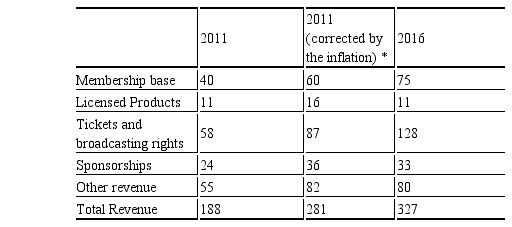
Source: Internacional (2012) and Internacional (2017)* Values corrected by the inflation according to the IPCA Brazilian index brought to values corresponding to the year of 2016 Inflation data during the period 201165% 2012583% 2013591% 2014641% 20151067% 2016629% Source httpsbradvfncomindicadoresipca Site visited in November 20th 2017
The data obtained in the first and the second stages were analyzed in an iterative approach, according to the principles of the hermeneutic circle (Moisander & Valtonen, 2006). This approach involves an interpretation of an entirety towards its parts and, after that, of the parts towards the entirety. Thereby, the data were gathered into groups, after identifying the emerging categories. These categories were confronted against each other and the literature, allowing to identify the most consistent and relevant themes, as well as their relation to the whole (Moisander & Valtonen, 2006).
In dealing with the data, it became clear that the cultural texts merge ‘cheering’ and ‘consuming’ within one single discursive construct. Taking this intertwining in the discourse as a starting point, a first category was created, capable of describing the central element of this intertwining: the passion of the football fan for the supported club. Noticing that the marketing professionals connected to the club also manifested this passion, a second category was created to deal with describing the transformation of passion into marketing knowledge. The third category emerged from the incorporation of passion as a market resource (called marketing derivatives). The last category describes the source of inspiration for theses discursive constructs. At last, these four categories were interpreted as parts of the marketization of football, as described in the following sections.
4. The intertwining of discourses
4.1 “Inter, we’ll always be with you! You are my passion! No matter what they say...”: A passion that gathers and justifies
“Inter, we’ll be with you/You are my passion/No matter what they say / I’ll always bring with me/My red shirt/And cachaça in my hand/The giant awaits me/To begin the party/Shalaialaia /You drive me crazy / Shalaialaia / Inter of my heart!” (Chant from the Guarda Popular do Inter, an organized group of football fans).
This chant, from the Guarda Popular, one of the most passionate and most sang during the games, represents to a god extent what ‘passion’ means to the fans. Passion proved to be, in the work field, a sentiment that allows fans to perform actions they normally would not. It causes fans to remain close to the club and follow it even through hardships, as manifested in the aforementioned chant “no matter what they say”. According to Damo (2012), passion is the emotional dimension of football, it bestows meaning and interest, the necessary conditions to ensure and involvement with the club, in the form of emotional belonging. Passion is used by both marketing producers and fans and it plays a central role in the meaning that both attribute to the relationship with the club.
Fans attribute meanings to passion such as euphoria, enthusiasm and connection with other people, which legitimize their actions. Many of these actions, motivated by passion, rupture with the expectancies of people who are not involved with the club or with football in general. Automatically, the passion for the club becomes a bond in the development of a social group, unified by a sentiment:
“It was a Sunday and she went for the first time. It was a Sunday and a calm game, with daylight, it was earlier than usual. It was awesome! Because Marina was born, she was three months old, and I signed her as member of Inter. So, if she wants, she will be an associate member of Inter later. She gets the Inter magazines at home, I save all of them. They are all stacked up and still sealed: someday I’ll give her a suitcase with all of them, for her to have fun. When she is around 18 years old. So that was a lot for me as a colorado father, because I’ll make a violent effort for her to also be a colorada. I’m sure she will be, after pre-school, but… now she looks at everything that is red and has the Inter emblem and says “Inter, Inter”. And that’s how it begins. It is like brainwashing, I dress up in red, sit her in my lap, get the Inter jersey and show it to her: “Inter, Inter, Inter” just to get it into her head! “Inter, inter, inter…”, I sing her this song… When she was little, I put her to sleep with the Inter anthem, which I played myself. Now I have stopped a little, but it’s violent work. The day was wonderful, I have pictures, so great my daughter on my lap, the Beira-Rio stadium full on top and that sunset… Bah! That for a colorado is…” (Roberto, fan)
The excerpt above illustrates the power and the intensity that the sentiment of passion can have. It substantiates the connection to the football club. For Roberto, making his daughter an Internacional fan is the correct thing to do, even if through “brainwashing” (Roberto, fan). Given the importance he attributes to his daughter being a colorada like him, the club belonging of his daughter becomes almost like a moral imperative, a choice between good and evil, a good person or a lawbreaker. From there onwards, many actions symbolize and display this passion. Consistently, this socialization of children in the universe of football (Reale & Castilhos, 2015), takes place through the use of merchandise with the brand and the colors of the club, purchased in the market.
“Inter is a passion for me. It’s a passion and something that brings me joy, you know, being able to cheer for my club. (…) This feeling is like what brings together (…), the feeling of celebrating, of winning. I remember very well everybody hugging and a bunch of people I didn’t know. Passion takes over and you don’t worry… that’s what I find very nice” (Babila, fan).
While the fan’s passion is signified as a very intense emotion, that bonds the fan to the club in a peculiar way, the appropriation of goods becomes a way of displaying this passion. In the work field, we several times were confronted with situations in which the fans bought Internacional merchandise even when they did not find what they were initially looking for, or even if the quality was not up to their usual standards, acquiring the products only because they had the club’s brand. In one of these situations, a fan came to the club store to buy a jersey, but did not find the red version, referred to as the “first uniform”, only the white, the “second uniform”, and resigned to saying: “Ah, but it’s from Inter”. In another situation, a fan, using a low-quality battery radio said: “It’s old and ugly, but it’s from Inter!”. Or, as stated by the fan called Babila: “it’s a pleasure for me to pay, you know? Which is hardly ever the case, but there is something about Inter”.
Passion is, therefore, a form of connection between the fan and the club, which brings them together with great strength and to an extension that decreases occasional differences that could occur in other social and commercial situations. Damo (2005) characterizes this relation as ‘club belonging’, a form of emotional and symbolic relationship that connects fans and club through connected feelings, imagery, language and artefacts, attached to the football disputes and belongings. This connection is very intense, especially for those fans who are engaged with the club. It is a force that causes fans to consume products and services in order to belong to the group and justifies, in the discourse of the fans, intense and often unusual behaviors.
4.2 “Regardless of how professional you are, an emotional connection helps a lot”: the incarnated knowledge of passion
It is interesting to note that the marketing producers of the studied club also identify with this passion and feel they belong to the group of fans. It impacts, for example, the way marketing actions are conceived. According to the producers themselves, they bring a strong influence from “day-to-day interaction” (João, producer), “from what you hear interacting with the fans” (Antonio, producer), and so on. The following excerpt illustrates this idea:
“Well, Inter, for me, besides being the club from my heart, I was born colorado, I watched this club grow, by my age I’ve seen the inauguration of the Beira-Rio (stadium), its construction, I think it is one of the greatest clubs of Brazil, because of the size it has reached. Not only by the titles, but for the greatness, for the number of associates (106 thousand members) (…) and because of a very strong emotional connection. I think that the main factor in working for a football club, regardless of how professional you are, is if you are able to establish an emotional connection, it helps a lot. It helps a lot because it enables you to get to know the profile of the fan, because you are also a fan. So, in a way, it helps you understand what the fan wants” (João, producer).
In the condition of managers of the clubs or of their brands, they are imbued of a practical rationality and seek to utilize this passion as form of knowledge. This incarnated understanding (Bourdieu & Wacquant, 1992) allows to decide how to manage economic revenues for the clubs or for associated companies.
Concurrently, marketing producers believe that the club is on an intense competition for meager resources against the clubs from Rio de Janeiro and São Paulo and, thereby, this passion needs to be translated into financial resources. By exploring passion in a rational and economically oriented way, from a practical and incarnated knowledge of what the passion for the club is, producers practice an intertwining between the market ideology and passion.
For this purpose, they use the deep and incarnated knowledge of passion in the creation of products and services capable of re-converting this passional capital into economic capital. An exemplary case is the “fan membership program”, which will be approached subsequently.
Through the program, “real passion” or “real fan” is equated with “member with up-to-date fees”.
If passion is the main connection between the fan and the club, marketing producers also live this club passion in the condition of fans, ensuring them a privileged knowledge of their “target-public”. This knowledge is, then, converted into products and services that appeal to the fan, often as an imposition, with the potential threat of being excluded from the legitimate universe of club in case of non-consumption.
4.3 “The fan has to stand by the club in joy and in sadness, for richer or for poorer”: the marketing derivatives
The marketing department of Internacional works with the intent of generating the largest amount possible of revenue for the club, that’s the main goal of the marketing professionals, as reported by the producer João, on an interview. However, this intent, within the rationale of club passion, suffers the influence of the performance inside the sports field. Given the intensity of the passion form the fans and its connection to victories and rivalries (Damo, 2005), the consumption of products and services depend on the club performance. Thus, when the club is winning, the passion, the pride and the consumption rise, when it is losing, they decrease. The marketing professionals seek to revert this logic, dissociating team performance from the consumption of merchandise/generation of revenue:
“So, what I say is that it is like a husband and wife relationship. Like a marriage, in joy and in sadness, in sickness and in health, for richer or for poorer, they have to be together. Otherwise, what kind of a fan am I? A momentary fan, an opportunistic fan. The fan has to stop with the habit of only wanting to come to the final games. To the fillet mignon of games. They have to be here for those games that are not worth a lot. And what do we have to do about that? Bring alternatives for the fan to feel comfortable, for they to feel good about coming to one of those games at 10pm in the winter. If I have no security, no parking, no good lighting, a good bathroom, good food, these are things we are working on to improve” (João, producer).
The fans become consumers in the eyes of the marketing professionals. In all the marketing actions we followed, a pivotal aspect that caused strangeness was the fact that all communication was directed towards the Internacional ‘up-to-date members’ (fans with their membership program monthly regularly paid). The marketing treats as legitimate colorados (another way of referring to the fans of the Sport Club Internacional) only those who pay the membership program monthly fees (with no delays). There is, therefore, a gradual attempt to establish a connection between being a ‘real colorado’ and paying a membership fee on time.
In addition, access to the ‘sacred temple’ of the club, the stadium, in game days, has become almost restricted to up-to-date members. It became almost impossible for fans who are not part of the membership program to find tickets for the larger games, since tickets sell out quickly with the purchases from members, who have priority in buying them.
These practices disseminate the belief that being a ‘real’ colorado means being up-to-date with the membership monthly fees, it means watching (and consuming) all the games, and buying the products with the club’s brand always, not only when the team is winning, having good performances in the field. As reported by one of the marketing producers, “the fan has to be a member of the club rather than a fan of the team” (João, producer). In other words, marketing producers attempt to make believe that one can only be a legitimate fan, can only feel legitimately impassionate after consuming products and services from the club, especially through paying the fees of the membership program. Therefore, through a constant reference from the marketing discourse to the importance of consuming products and services, the concept of fan becomes closer to the concept of consumer. It is necessary to contribute with financial resources towards the survival of the club, since it is not enough to be passionate, according to marketing rationale.
The producers’ attempt to change the ways of engaging – in the sense of dissociating the consumption of football from the results in the field – shows us one of the paths through which the discourses of passion and market rationale most explicitly intertwine. The displays of passion from the fans approach the consumption discourse, enacted by the marketing producers, as when they manifest that “it’s a pleasure for me to pay, you know?” (Babila, fan). That’s the converging point between football and the market, where the market producer attempts to transform the fan’s “irrational’ passion for football into a stable relationship, making it possible to sell and to predict the sales regardless of the sports performance and its decurrent passional variations. They are used as derivatives, an instrument used in the financial market in which value emerges from a basic variable (active-object), but incorporating a standardized value to avoid the fluctuations of the basic variable (Hull, 1997).
In this case, the marketing derivatives arise from the club passion as a basic variable, but are commercialized and consumed within a specific rationale that comes from the notion of consumer and is rather distant from the original relationship between the passional fan and the club. The evidence of the effect of this distancing can be observed when, even in the ‘worst year’ of Internacional, its financial performance had an insignificant drop in some accounts of the financial statements. The marketing derivatives allowed for the detachment of the unstable moment of the team inside the sports field creating more stable and manageable forms via the market.
4.4 “The NBA status”: Euro-American references
The marketing producers at Sport Club Internacional serve as mediators between the globalizing forces of football, represented by the FIFA standard, and the ream fans. The professionalization process, in the view of the marketing producers, involves mimicking the European model of football. This can be especially noticed in the reiterated references to the models from F. C. Barcelona, Manchester United F.C. and F.C. Bayern München, as well as in the formal partnership established with the Tottenham Hotspur Football Club, from England. During the guided tours of the Beira-Rio stadium, the tour guide proudly announced that the redesign project for the 2014 FIFA World Cup was based on Germany’s Bayern München’s Allianz Arena. Relationship actions with fans in the stadium are also similar to those used by the North-American NBA. There are several examples manifested in the data, such as this excerpt from an interview with a producer about the North-American references:
“In a near future we’ll get the NBA status, where people go to a program with their families and they spend, I don’t know, like 500 dollars to go to a game”. (Maurício, producer)
All the Strong references to the European model and its practices are used by the producers - and also by some fans - to justify the modernizing actions and changes. Actions performed to enhance the club’s income are seen as something necessary for survival in football and for achieving what fans want the most: victories inside the football field, trophies gathered winning championships tournaments.
The interviewees demonstrated an admiration for the success of the European clubs managing football from an economic-financial rationality, as stated by producer João:
“You see, in the European clubs there is an over valuing, an overuse of hiring idols in order to attract resources. You have Kaká, presented by Real Madrid, even Cristiano Ronaldo, selling jerseys, the business possibilities that arise from hiring him pretty much pay the bill for hiring this big hero”. (João, producer)
Referencing the Euro-American reality as natural and obvious, the marketing producers mimic the offer of products, services and ways of managing the club. The dissemination of the marketing rationale inside the reality of the club passes through this gradual mimicking that managers attempt to apply to the Brazilian reality. As stated by Andrews e Ritzer (2007), the transformation of football into a market is oriented and defined by the inter-relational processes of corporate management (the management and the marketing of sports entities according to profit) and spectacularization (the primacy of producing experiences oriented by the media). In the case of corporate management, this aspect can be noticed in the discourses that emphasize the professionalization of the management, involving concepts of evolution and rationalization such as, for example, obtaining the ISO 9000 certification and implementing corporate governance practices. Regarding the spectacularization, the process takes place based on the images and the imagery of what happens in Europe and the United States.
5. Discussion
The analysis of the discourse and the practices of fans and producers of a large Brazilian football club around team passion shows us that this passion not only gathers and promotes identification between the fan and the club, but it is also incorporated to the discourse of consumption. Within the context of contemporary football, club passion is recognized by the literature as a key element (Damo, 2005; Hollanda, 2012; Lever, 1983). It is characterized by a relation of belonging to a club one is passionate about, which causes people, moved by the formative emotions of that passion, to be capable of ‘madness’ (Lever, 1983), which is often measured by the consumption of goods and services.
On the other hand, the marketing producers need to know this passion to be able to re- convert it into financial capital. After all, as stated by several authors (Damo, 2005; Hollanda, 2012; Lever, 1983), passion is extremely complex and hard to comprehend. Passion is a type of outstandingly visceral feeling, of fervor, which demands a deep involvement for its understanding. It’s the type of mocked knowledge that Bourdieu and Wacquant (1992) describe, and it becomes a prerequisite to understanding and later seducing the fans through products and services. In other words, to re-convert (emotional capital into economic capital) it is necessary to be passionate.
The knowledge that marketing producers have over fan’s passion, together with fan’s propension to want to ‘help the team’ (passion), causes the producers to create products and services that combine the idea of ‘true passion’ with the idea of ‘financially aiding the club’. The great purpose of the producers is to detach the team’s performance inside the football field – the usual motor for highs and lows in passion – from consumption, in order to achieve control, causing revenues to grow and to be predictable.
As previously seen, with the notion that ‘up-to-date members are the real colorados’, or that it is necessary to go to the stadium ‘during the coldest winter’, and by the legitimization of these concepts through several diffusion campaigns, the notions of passion and consumption are deeply intertwined. Therefore, the fans are exposed to a discourse that naturalizes the marketing rationale inside the universe of football. Close to what Slater and Tonkiss (2001) called, in a broad sense, market society, we observed that, in the specific context of the Sport Club Internacional, the market principles started to mediate the social, economic and cultural universe of football. Thus, the act of ‘rooting’, legitimate within this cultural space, is re-signified, at least partially, as ‘consuming’.
The literature suggests that the clubs are incorporating a globally diffused pattern to their discourses and practices (Andrews & Ritzer, 2007; Suarez & Belk, 2017) oriented towards the market and professional management to seek for the maximization of profits (Rodrigues & Silva, 2009; Damo & Oliven, 2001; Nascimento & Barreto, 2015).
Within the studied context, this professionalization of football proved to be a relevant stage in the marketization and spectacularization of football. The transformation of passion into consumption requires a proper structure, built from European and North-American references of sports management (Proni, 1998). The notions of spectacle, comfort, services (such as parking), good restaurants, constitute this view of a club that implies an entire new myriad of consumption options inside the scope of the football stadium and of rooting for a team.
As stated by Damo (2005), fans can boo, complain and fight with the squad, the managers and the players, but they can never stop loving the club. A godsend relation that justifies its own existence, being an end onto itself. The marketization of football involves transforming this godsend, expressed in the form of a passion, into practice mediated by the market, capable of bringing economic meaning to passion. The integrated analysis demonstrates that, for these purposes, it is necessary to construct goals and experiences that are susceptible of being consumed and legitimized via commercial exchanges. These products are used by consumers to bring shape to their discourse of passion, namely, by consuming them, through the market, it becomes possible to support the team on the field. This process allows to adjust to a new reality in Brazilian football, needed for the passion for the club to be lived, preserved or even enhanced. Two different flows emerge, capable of generating intertwining between the consumption discourses and the passion (enacted by the fans) and discourses of professionalization and transformation of football into a product as a condition for the survival of the club (enacted by the marketing producers). The consequence of this intertwining between the visceral force of passion and the economic rationality of the market results in what we call ‘marketing derivatives.’ This term describes the detachment, or better, the attempt to detach the club’s generation of income from the results in the football field which, as described by Damo (2005), is the traditional motor for the joys and sorrows of the fans.
The marketing creates products or symbols that are detached form the performance of the club, such as ‘the best stadium’, ‘the best management’, the ‘FIFA standard club’, ‘comfort’, ‘discounts for members who pay on time’ as substance for the fans to be proud of their club. Consequently, an agency that stimulates fans to act in economic rationalized ways circulates in this space (Polanyi, 2000; Callon, 1998), detached from emotional variations inherent to club passion. The generation of marketing derivatives is a condition that ensures that football, as a cultural dimension, approaches the market ideologies, remaining stable through time, despite the highs and lows in the football field. This intertwining constitutes, through time, the marketization of football. Figure 1 describes this process through the interpretation of the Sport Club International context.
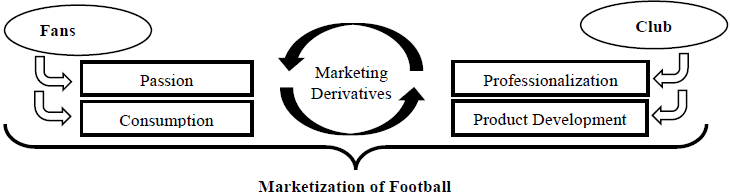
Figure 1
– Football Marketization Process
Source: Developed by the authors
From these considerations, the first theoretical contribution to the study resides on the extent of the previous studies that deal with the consequences of marketization in contemporary society (Slater, 1997; McAlexander et al., 2014; Vikas et al., 2015; Türe & Ger, 2016). Describing how the passion for football – as a cultural instance – intertwines with the market ideologies, we describe the marketization process. While Peñaloza (2000), for example, shows how different cultural instances are incorporates into goods by marketing producers in order to be later marketized, the present study demonstrates that fans act together with marketing producers in this process. The transformation of discourses originally and foremostly guided by passion allows for the configuration of new possibilities of economic exchanges through its approximation to the market ideologies.
According to the lines of Sahlins (2003), the markets are complex spheres of material and symbolic exchanges, where the meanings and the flows of material goods are disputed and negotiated according to the positions of the agents in the social space, always in reference to a dominant axis of significance (market economy). The goods, their appearance and circulation are a concrete part of the marketization process. Therefore, the second theoretical contribution of the study lies in demonstrating that the market ideology is spread, among other possible ways, by modifying specific relations, such as the passion for football (a form of godsend) from an appeal for inevitability, as a necessity for this passion to take place. Fans and producers mold their discourses to the appeals of the market as a way of ‘saving’ their passion in a reality where there, allegedly, are no other alternatives, except for fighting inside the inevitable rules of the market.
Finally, the study reinforces the notion that the marketization of football – like other cultural instances – cannot be defined in its entirety as an organizational and market process of creating goods. Despite this being an important stage, the marketization involves a transformation of football as a cultural phenomenon (Andrews & Ritzer, 2007; Giulianotti & Robertson, 2004) associated with passion (Damo, 2005) into a consumption phenomenon mediated by economic rationality. From a practical standpoint, the marketization process should not be understood only as construction of products by marketing professional to be accessed through the market. It becomes solidified by the producers and consumers capacity of stabilizing and naturalizing the economic exchanges in a long-term relationship (marketing derivatives) through the intertwining between passion and consumption that exists within contemporary football.
6. Final remarks
By looking through the lenses of culture (Sahlins, 2003) and of the market studies (Araujo et al., 2010; Callon, 2007) in order to analyze the relations between producers and consumers inside the scope of a football club, it has been possible to enlighten the marketing relationships ever- increasingly present in various spaces of society. We observed that the marketing, in this case, is not merely a mean for the satisfaction of needs and desires (and passions), as presented by the managerial marketing view, for example in Kotler or Keller (2012, but it is also an end onto itself. The passion of the fans is channeled in the form of consumption. However, for that purpose, there is an effort from the marketing producers in order to make football (in the sense of the performance of the team inside the football field) no longer be the main symbolic content to mediate the interaction between the club and the fans, dividing space with products and services, within the scope of the market. This perspective allows for visualizing new mechanisms in the process of society marketization (Araujo et al., 2010; Polanyi, 1944; Slater & Tonkis, 2001), bringing together cultural discourses and consumption discourses through the intertwining and the stabilization of these discourses, through its naturalization inside a market ideology.
In this intertwining, passion justifies the need to transform football into a product, altering the victory-incentive relationship which was prevalent in football for a relationship based on an economic or practical rationality. Through marketing articulations, the relationship of the fans with the club goes beyond the victories of the club inside the football field of the trophies it conquers. It then also goes through more easily manageable aspects such as, for example, the beauty and the comfort of the stadium, the legitimizing of the ‘up-to-date member’, among other aspects built from Euro-American references. Acting to replace the victories in football, the dissemination of ‘gains’ that reinforce the passion of fans for the club works ‘artificial marketing victories’ in the marketization process of Brazilian football. These conclusions are not exempt from limitations. It is worth noting that the findings here reported, especially regarding the fans, were constructed based on a relatively homogeneous characterization of the set of interviewees, in face of the heterogeneity of the universe of Sport Club Internacional fans. Furthermore, new points of view are stimulated, in order to complement the perspective on marketization presented here. The effects of the professionalization mechanisms and of the creation of products could be observed in fans from other clubs that did not undergo a management professionalization process. Also, the concept of marketing derivatives could be analyzed in other contexts, such as, for example, cases of brands affected by corruption scandals. Finally, it is our understanding that the comprehension of the marketization processes allows to enlighten specific phenomena that may seem naturalized within the capitalist rationale, but that deeply alter cultural phenomena when intertwined by market ideologies.
References
Albino, J.C.A., Carrieri, A.P., Figueiredo, D., Saraiva, F.H., & Barros, F.L.R.S. (2009). Sport Club Internacional e a constituição da identidade corporativa de ‘clube-empresa’. Organizações & Sociedade, 16(48), 81-100.
Alvito, M. (2006). A parte que te cabe neste latifúndio: o futebol brasileiro e a globalização. Análise Social, 41(179), 451-474,
Andrews, D.L., & Ritzer, G. (2007). The Grobal in the Sporting Glocal. Global Networks, 7(2), 135- 153.
Araujo, L.M., Finch, J., & Kjellber, G.H. (2010). Reconnecting marketing to markets: an introduction. In: L. Araujo, J. Finch, & H. Kjellberg (Eds.) Reconnecting Marketing to Markets. Oxford: Oxford University Press.
Araujo, L. (2007). Markets, market-making and marketing. Marketing Theory, 7(3), 211–226.
Araujo, L., & Pels, J. (2015). Marketization and its limits. Decision, 42(4), 451-456.
Bourdieu, P., & Wacquant, L.J.D. (1992). An invitation to reflexive sociology. University of Chicago press.
Brittos, V.C., & Santos, A.D.G. (2013). Processos midiáticos do esporte: do futebol na mídia para um futebol midiatizado. Comunicação, Mídia e Consumo, 9(26), 173-190.
Callon, M. (2007). What does it mean to say that economics is performative?. In: D. Mackenzie, F. Muniesa, & L. Siu (Org.). Do economists make markets? On the Performativity of Economics. Princeton: Princeton University Press.
Callon, M. (1998). The laws of the markets. Oxford: Blackwell Publishers/The Sociological Review.
Dalmoro, M., & Nique, W.M. (2017). Tradição Mercantilizada: Construção de Mercados Baseados na Tradição. Revista de Administração Contemporânea, 21(3), 327-346.
Damo, A., & Oliven, R. (2001). Fútbol y Cultura. Bogotá: Norma.
Damo, A. (1998). Para o que Der e Vier: O pertencimento clubístico no futebol brasileiro a partir do Grêmio Foot-Ball Porto Alegrense e seus torcedores. Dissertação de Mestrado, Universidade Federal do Rio Grande do Sul, RS, Brasil.
Damo, A. (2005). Do dom à profissão: Uma etnografia do futebol de espetáculo a partir da formação de jogadores no Brasil e na França. Tese de Doutorado, Instituto de Filosofia e Ciências Humanas, Universidade Federal do Rio Grande do Sul, Porto Alegre, 2005.
Damo, A. (2012). Paixão Partilhada e Participativa: o caso do futebol. História: Questões e Debates, 57(s.n.), 45-72, 2012.
Finn, G.P.T., & Giulianotti, F. (2015). Football Culture: local contests, global visions. Londres: Taylor e Francis Ltd.
Firat, A.F., & Venkatesh, A. (1995). Liberatory Postmodernism and the Reenchantment of Consumption. Journal of Consumer Research, 22(3), p. 239-267.
Giesler, M. (2008). Conflict and Compromise: Drama in Marketplace Evolution. Journal of Consumer Research, 34(6): 739–53.
Giesler, M. (2012). How Doppelgänger Brand Images Influence the Market Creation Process: Longitudinal Insights from the Rise of Botox Cosmetic. Journal of Marketing 76(6): 55–68.
Giesler, M., & Fischer, E. (2017). Market system dynamics. Marketing Theory, 17(1), 3-8.
Giulianotti, R., & Robertson, R. (2004). “The Globalization of Football: A Study in the Glocalization of the ‘Serious Life’”. The British Journal of Sociology, 55(4), 545–568.
Globoesporte. O pior ano da história do Inter. 2017. Disponível em: http://globoesporte.globo.com/rs/futebol/times/internacional/noticia/2017/01/quatro-tecnicos- swat-e-rebaixamento-2016-o-pior-ano-da-historia-do-inter.html. Acesso em 15 out. 2017.
Gonçalves, J.C.S., & Carvalho, C.A. (2006). A mercantilização do futebol brasileiro: instrumentos, avanços e resistências. Cadernos EBAPE, 4(2), 1-27.
Gonçalves, J.C.S., & Silva, C.E. (2007). “Empresarização” e controle: o caso do Figueirense Futebol Clube. Cadernos EbapeBr, 5(3), 1-16.
Hollanda, B.B.B. (2012). A torcida brasileira. Rio de Janeiro: 7letras.
Holt, D.B. (2002). Why do Brands cause Trouble? A dialectical Theory of consumer Culture and Branding. Journal of Consumer Research, 29(1), 70-90.
Hull, J.C. (1997) Introdução aos Mercados Futuros e de Opções. Arizona: Bookman.
Humphreys, A. (2010). Megamarketing: The Creation of Markets as a Social Process. Journal of Marketing, 74(2), 1–19.
Internacional. Clube divulga Balanço Financeiro de 2011. Disponível em: http://www.internacional.com.br/pagina.php?modulo=2esetor=18ecodigo=17463. Acesso em 20 set. 2012.
Internacional.Informativos financeiros. 2017. Disponível em: http://transparencia.internacional.com.br/category/2#. Acesso em 20 out. 2017.
Jackson, S.J. (2015). Assessing the sociology of sport: On media, advertising and the commodification of culture. International Review for the Sociology of Sport, 50(4-5), 490-495.
Karababa, E., & Ger, G. (2011). Early Modern Ottoman Coffeehouse Culture and the Formation of the Consumer Subject. Journal of Consumer Research, 37(5), 737–760.
Kjellberg, H., & Halgesson, C. (2007). On the nature of markets and their practices. Marketing Theory, 7(2), 137-62.
Kotler, P., & Keller, K.L. (2012). Administração de Marketing.São Paulo: Prentice Hall.
Latour, B. (2005). Reassembling the Social: An Introduction to Actor Nework-Theory. New York: Oxford.
Law, J. (2004). After Method: Mess in social science research. New York: Routledge.
Lever, J. (1983). A loucura do Futebol. Rio de Janeiro: Record.
Martin, D., & Schouten, J.W. (2014). Consumption-Driven Market Emergence. Journal of Consumer Research, 40(5), 855–870.
Mcalexander, J.H., Dufault, B.L., Martin, D M., & Schouten, J.W. (2014). The marketization of Religion: Field, Capital and consumer identity. Journal of Consumer Research, 41(3), 858-875.
Mccracken, G. (1988). The Long Interview. Sage Publications. California: Newbury Park.
Moisander, J., & Valtonen, A. (2006). Qualitative Marketing Research. London: Sage.
Nascimento, C., & Barreto, T.V. (2015). “Habitus” dos torcedores brasileiros e adoção do “padrão Fifa” nos estádios da Copa do Mundo de futebol 2014. Estudos de Sociologia, 2(19), 1-19.
Parmentier, M.-A., & Fischer, E. (2015). Things Fall Apart: The Dynamics of Brand Audience Dissipatio. Journal of Consumer Research, 41(5), 1228–51.
Peñaloza, L. (2000). The commodification of the American West: Marketer’s production of Cultural Meanings at the Trade Show. Journal of Marketing, 64(4), 82-109.
Polanyi, K. (2000). The Great Transformation. Boston: Beacon Press.
Proni, M.W. (1998). Esporte-espetáculo e futebol-empresa. Tese de Doutorado, Faculdade de Educação Física, Universidade Estadual de Campinas, Campinas.
Reale, G., & Castilhos, R. (2015). Consumer Socialization and Intergenerational Brand Loyalty in the Context of Soccer. In. Kristin Diehl & Carolyn Yoon (org.). NA - Advances in Consumer Research Volume 43. Duluth, MN: Association for Consumer Research. pp. 399-403.
Rodrigues, M.S., & Silva, R.C.A. (2009). A estrutura empresarial nos clubes de futebol. Organizações e Sociedade, 16(48), 17-37.
Sahlins, M. (2013). Cultura e razão Prática. Rio de janeiro: Jorge Zahar.
Sandikci, Ö., & Ger, G. (2010). Veiling in Style: How Does a Stigmatized Practice Become Fashionable? Journal of Consumer Research, 37(1): 15–36.
