Gooool: motivation drivers of attitudinal and behavioral fan loyalty in Brazil
GOOOOOL: MOTIVADORES ATITUDINAIS E COMPORTAMENTAIS DA LEALDADE DE FÃS NO BRASIL
Gooool: motivation drivers of attitudinal and behavioral fan loyalty in Brazil
Revista Brasileira de Marketing, vol. 18, núm. 4, pp. 116-136, 2019
Universidade Nove de Julho

Esta obra está bajo una Licencia Creative Commons Atribución-NoComercial-CompartirIgual 4.0 Internacional.
Recepción: 06 Mayo 2018
Aprobación: 05 Febrero 2019
Abstract:
Objective: Football is the predominant sport in Brazil, but a better understanding of what motivates non-football and football fans is needed.
Method: A conceptual model is empirically tested of the effects of six motivational drivers—Interest in Team, Socialisation, Aesthetics, Sport Knowledge, Interest in Sport, Vicarious Achievement—on both attitudinal and behavioural fan loyalty using survey data from 483 Brazilian sports fans.
Originality/Relevance: A theoretical gap exists as to understanding the motivations for Brazilian fan loyalty (Wang, Zhang, & Tsuji, 2011) and what drives Brazilian fans to attitudinally commit to a team and exhibit fan-related behaviours, such as attending matches and buying team merchandise.
Results: Fans of both football and other sports in Brazil share some underlying motivational drivers of attitudinal loyalty and behavioural loyalty. They also indicate that some differences exist across the motivational drivers of attitudinal and behavioural fan loyalty.
Theoretical/methodological contributions: Results from this study support previous research into the influence of motivations on attitudinal loyalty and behavioural loyalty and offer insights into the direct influence of different motivations on attitudinal loyalty and behavioural loyalty.
Social/management contributions: These findings will assist sports-marketing practitioners of sports competing with football in Brazil to formulate more effective, fan-centric marketing-communication strategies leading to a more extensive loyal fan base.
Keywords: Motivation, Motivational drivers, Fan loyalty, Attitudinal loyalty, Football fan.
Resumo:
Objetivo: o futebol é o esporte predominante no Brasil, mas é necessária uma melhor compreensão do que motiva os fãs e não fãs de futebol.
Método: um modelo conceitual foi testado empiricamente sobre os efeitos de seis impulsionadores motivacionais: interesse em equipe, socialização, estética, conhecimento esportivo, interesse no esporte, realização vicária - tanto na fidelidade atitudinal como comportamental, utilizando dados de pesquisa de 483 fãs de esportes brasileiros.
Originalidade/Relevância: existe uma lacuna teórica quanto à compreensão das motivações para a fidelidade dos fãs brasileiros (Wang, Zhang & Tsuji, 2011) e o que leva os torcedores a se comprometerem com uma equipe e exibirem comportamentos relacionados aos torcedores, como participar de partidas e comprar produtos da equipe.
Resultados: os torcedores do futebol e de outros esportes no Brasil compartilham alguns motivadores motivacionais subjacentes à lealdade atitudinal e à lealdade comportamental. Também indicam que existem algumas diferenças entre os impulsionadores motivacionais da lealdade de fãs atitudinais e comportamentais.
Contribuições teóricas/metodológicas: os resultados deste estudo apoiam pesquisas anteriores sobre a influência das motivações na lealdade atitudinal e na lealdade comportamental e oferecem insights sobre a influência direta de diferentes motivações na lealdade atitudinal e lealdade comportamental.
Contribuições sociais / para a gestão: essas descobertas ajudarão os profissionais de marketing esportivo de esportes que competem com o futebol no Brasil a formular estratégias de comunicação de marketing mais eficazes e centradas no torcedor, levando a uma maior base de fãs leais.
Palavras-chave: Motivação, Motivadores, Fidelidade, Lealdade atitudinal, Fãs de futebol.
Introduction
Sports are a fundamental role in the life of Brazilians and are present in the routine of more than 90% of the population, either through their practice, monitoring of TV broadcasts and radio games or going to the stadium (Miranda, 2013). There is no question that football, or "futebol", is the most popular sport in Brazil (Gaffney, 2014). The media define Brazil as ‘the soccer country’ (Gastaldo, 2013), where it is the preferred sport (Kasznar & Graça Filho, 2012). Football is a social phenomenon in Brazil, forms a vital part of the national identity and can also give meaning to the power of wishes of many Brazilians. This relationship is so strong that it is seen as part of the very nature of the country. Football, if read correctly, can explain Brazil (Guterman, 2013).
The impressive numbers can explain this relationship with football in Brazil. Brazil has 29,208 football clubs, 2.1 million registered players, 11.2 million unregistered players, 27 state championships and four divisions (series A, B, C, D). Each year, 5000 professional games are played in more than 100 competitions (Portal 2014, 2015). The Brazilian Championship was established in 1971 and has featured 46 editions, 17,152 games and 42,514 goals (http://futpedia.globo.com). Brazil has 790 football stadiums spread all over the country (CBF, 2016).
The cultural importance of football in Brazil is undisputed, where any Brazilian becomes a ‘subject matter expert’ on football (Drummond, Araújo, & Shikida, 2010). Specifically, in Brazil, economic growth resulting from sport and the activities, trade and services related to sports, in general, reached about $US 15.6 billion dollars in 2005, equivalent to 1.95% of the Brazilian GDP for that year. From 1995 to 2005, Brazil’s GDP grew on average, 3.2% per year, while the national sport GDP grew 10.9% annually (Azevêdo, 2009). The typical patron of football matches in Brazil cuts across all social groups, unlike other sports, such as tennis or polo, which feature the economic elite (Bruhns, 2000) predominantly.
However, while the predominant sport in Brazil, other sports also live in football’s shadow and seek to thrive and grow. For example, volleyball has made excellent performance because of a particular culture, geography, climate and unique management system (Zhang, Zhang, & Guo, 2011). The decision to attend sporting events is strongly influenced by spectator motivation (Karakaya, Yannopoulos, & Kefalaki, 2016), and fan motivations can vary across different sports (Bernthal et al., 2015; Ballouli et al., 2016). To this end, by understanding how motivations differ in driving attitudinal and behavioural loyalty for fans of football and other sports in Brazil may yield insights that can assist in the positioning of non-football sports against, and competing with, the juggernaut that football is in Brazil.
Despite the growing literature of fan-loyalty studies (e.g. Bauer, Stokburger-Sauer, & Exler, 2008; Dwyer, 2011; Wu, Tsai, & Hung, 2012), and with research identifying those sports-fan motivations can vary in different countries (Han, Mahony & Greenwell, 2016), little or no research has attempted to investigate the motivational antecedents of Brazilian fan loyalty, especially capturing both attitudinal and behavioural aspects, and comparing fans of football with fans of other sports. Thus, a theoretical gap exists as to understanding the unique motivations for Brazilian fan loyalty (Wang, Zhang, & Tsuji, 2011) and what drives Brazilian fans to attitudinally commit to a team and exhibit fan-related behaviours, such as attending matches and buying team merchandise. To address this deficiency, in the remainder of this paper, the literature is reviewed regarding the nature of fan loyalty and the motivation dimensions posited as factors influencing Brazilian fan loyalty (both attitudinal and behavioural).
Next, we present the methodology followed by the analysis of data. Finally, we discuss the results and offer conclusions and future research directions.
Literature review
This section presents the theoretical framework used in this study. First, how fan loyalty is conceptualised in this study is discussed, followed by motivation and the dimensions of Brazilian sports fans’ motivation focused on in this study. Figure 1 presents the conceptual model of the study.
Fan Loyalty
Loyal consumers exhibit strong, positive attitudes and more intense, frequent behaviours towards a specific product (Jacoby, 1971). There is broad agreement in the extant literature on conceptualising loyalty into attitudinal and behavioural aspects (Andreassen & Lindestad, 1998; Gladden & Funk, 2001; Doyle et al., 2013). Many sports-fan studies focus on behavioural loyalty only (e.g. Theodorakis et al., 2013; Yoshida et al., 2014). However, fan loyalty requires an examination beyond behavioural traits (i.e. behavioural loyalty) by involving the attitudinal component of loyalty (Stevens & Rosenberger, 2012), which reflects the psychological commitment of a fan to a team (Funk & James, 2001, 2006; Mahony et al., 2000). On this basis, fan loyalty is conceptualised for this study as comprising two distinct aspects: attitudinal loyalty and behavioural loyalty.
Motivation
Research has begun to focus more on the psychological factors motivating fan behaviour (Han, Mahony & Greenwell, 2016). Motivation refers to an activated state within a person, which represents internal factors that arouse, lead and provoke goal-direct behaviour (Funk, Filo, Beaton & Pritchard 2009; Pritchard, Funk, & Alexandris, 2009; Santos et al, 2016), such as sports fans watching on TV/online or and attending matches (Karakaya, Yannopoulos, & Kefalaki, 2016; Madrigal, 2006; Mahony, Nakazawa, Funk, James, & Gladden, 2002; Trail & James, 2001; Wann, 1995; Zhang & Byon, 2017). An individual’s personal characteristics, which include motivations, also shape and exhibit affective states, such as the enjoyment and satisfaction derived from watching a sporting event (Hung, Lee, & Hou, 2011; Madrigal, 1995; Thien & Van Mu, 2012).
As well as driving behavioural loyalty, motivations can also drive the attitudinal loyalty that fans have towards their team (Funk et al., 2009; Neale & Funk, 2006). For example, Wang et al. (2011) found that a series of sports-fan motivations to be related to attitudinal fan loyalty, including interest in the team, interest in football, socialisation, aesthetics, sport knowledge and vicarious achievement.
Despite the importance of motivating factors that stimulate fan-related behaviour (Beccarini & Ferrand, 2006), knowledge about how fans around the world may differ is still limited (Han, Mahony, & Greenwell, 2016), with little research having been done that investigates the influence of motivation has been linked to both attitudinal and behavioural fan loyalty in the Brazilian context. Furthermore, as fan motivations can vary across different sports (Bernthal et al., 2015; Ballouli et al., 2016; Wann, Grieve, Zapalac, & Pease, 2008), there is a need for better understanding these differences in the Brazilian context.
A range of sports-fan motivations has been linked to fan loyalty, including aesthetics, celebrity attraction, flow and vicarious achievement (Mahony et al., 2002; Pritchard et al., 2009; Stander, de Beer, & Stander, 2016; Tokuyama & Greenwell, 2011; Wann & Branscombe, 1993; Wang et al., 2011), which are this paper’s focus. Aesthetics represents consumers’ gratitude towards the mastery displayed by the athletes (Boxill, 1985). Consumers appreciate celebrity attraction for displaying the performers' personalities, including their notoriety, reputation and fame (Madrigal, 2006). Flow is an optimal psychological state exhibiting a loss of time track and self-consciousness derived by intense events (Csikszentmihalyi, 1990). Vicarious achievement is a sense of personal achievement when the team performs well and is as an essential predictor of fan loyalty (Mahony et al., 2002; Pritchard et al., 2009; Wu et al., 2012). Concerning football (soccer), Mahony et al. (2002) identified seven motives that positively influenced the length of time as a fan and frequency of attendance of J-League (Japanese) spectators: drama; vicarious achievement; aesthetics; team attachment; player attachment; sport attachment and community pride. Similarly, Stander, de Beer, and Stander (2016) found that seven motivations had a direct influence on the sports-consumption behaviours of South African Premier League football fans, including match attendance (vicarious achievement, aesthetics, drama/eustress, physical skill, social interaction) and purchasing merchandise (vicarious achievement, acquisition of knowledge, drama/eustress, physical attractiveness, physical skill, social interaction). Having established that motivations are vital to understanding fan loyalty, it is argued that these motivations will influence a fan’s attitudinal loyalty and behavioural loyalty. Based on the preceding discussion, this leads to the following hypotheses:
H1a-f Each motivation dimension—(a) interest in team, (b) socialisation, (c) aesthetics, (d) sport knowledge, (e) interest in sport, and (f) vicarious achievement—
will influence attitudinal fan loyalty.
H2a-f Each motivation dimension—(a) interest in team, (b) socialisation, (c) aesthetics, (d) sport knowledge, (e) interest in sport and (f) vicarious achievement— will influence behavioural fan loyalty.
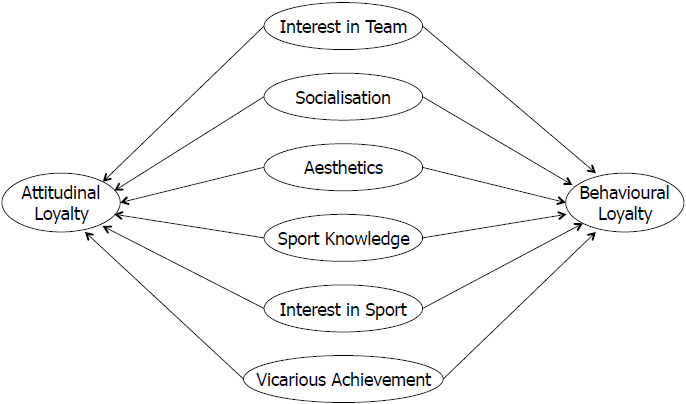
Figure 1
Conceptual Model
Methodology
The data in this paper comes from a part of a more extensive study of fan loyalty. A self- administered, web-based survey was used to collect the data to evaluate the hypothesized relationships. The questionnaire was initially developed in English with the items then translated into Portuguese using a professional translation agency. The resulting translation was reviewed by a panel of researchers to ensure the original meaning of the questions had been maintained in the Portuguese version, with minor changes made as required. The resulting version of the survey was pretested and modified as needed before distributing to participants.
Due to the difficulty in identifying a standard favourite team amongst all participants, each participant was allowed to select his/her favourite sport team in order to respond the questionnaire (Han, Mahony, & Greenwell, 2016). The survey took around six minutes to complete.
Measures
The measures used in the study were drawn from the sports-marketing literature. Regarding the measured constructs, 18 items (Funk, Ridinger, & Moorman, 2003; Wang et al., 2011) tapped six motivation dimensions (three items each): Interest in Team, Socialisation, Aesthetics, Sport Knowledge, Interest in Football and Vicarious Achievement. These were rated on a 7-point, Likert- type scale (1 = strongly disagree, 7 = strongly agree). These motivations reflect a mixture of social and psychological motivations (Han, Mahony, & Greenwell, 2016). Attitudinal Loyalty was measured using four items drawn from Wang et al. (2011) and measured on a 7-point, Likert-type scale (1 = strongly disagree, 7 = strongly agree). Behavioural Loyalty used four items to measure the frequency of current and future attendance of both home and away games on a 6-point scale (Gladden & Funk, 2001; Stevens & Rosenberger, 2012).
Several variables were included in the research model to ensure that the empirical results are not due to covariance with other variables. As such, gender and age were included to control for fan heterogeneity. The items used are listed in Figure 2.
| Code | Item |
| TEA_1 | I consider myself a fan of the whole team more than a fan of a single player |
| TEA_2 | I come to games to support the whole team |
| TEA_3 | I am a fan of the entire team |
| SOC_1 | I enjoy interacting with other spectators and fans when attending games |
| SOC_2 | Games give me a chance to meet other people with similar interests as myself |
| SOC_3 | I like to talk with other people sitting near me at games |
| AES_1 | The style of play of my favourite team provides me with an enjoyable form of entertainment |
| AES_2 | I like my favourite team because their style of play emphasises strategy and the traditional aspects of the game |
| AES_3 | My favourite team’s style is a pure form of my favourite sport compared to other sport teams |
| KNW_1 | Knowing the rules of my favourite sport helps me to enjoy the games |
| KNW_2 | I enjoy my favourite sport’s games because I know a lot about the sport |
| KNW_3 | I feel my understanding of my favourite sport games adds to my enjoyment of watching the team |
| INT_1 | My interest in my favourite sport sparked my interest in the team |
| INT_2 | I attend my favourite team’s games because it is one of my favourite sports |
| INT_3 | First and foremost, I consider myself a fan of my favourite sport |
| VIC_1 | I feel like I have won when my favourite team wins |
| VIC_2 | I feel a sense of accomplishment when my favourite team wins |
| VIC_3 | When my favourite team wins, I feel a personal sense of achievement |
| AL_1 | I would be willing to defend my favourite team publicly, even if it caused controversy |
| AL_2 | I could never change my affiliation from my favourite team to another professional team |
| AL_3 | I consider myself a committed fan of my favourite team |
| AL_4 | I would watch my favourite team regardless of which team they were playing against at the time |
| BH_P_1 | How many home games of YOUR favourite team did you attend in the last season? |
| BH_P_2 | How many away games of YOUR favourite team did you attended in the last season? |
| BH_F_1 | How many home games of YOUR favourite team do you anticipate yourself attending in the next season? |
| BH_F_2 | How many away games of YOUR favourite team do you anticipate yourself attending in the next season? |
| Age | Age |
| Gender | Gender |
Note: AES = Aesthetics, KNW = Sport Knowledge, AL = Attitudinal Loyalty, BL = Behavioural Loyalty, SOC = Socialisation, INT = Interest in Sport, TEA = Team Interest, VIC = Vicarious Achievement
Sample recruitment
This study used a convenience sample of university undergraduate students, from different states of Brazil, interested in traineeships. The purpose of this study is to build a theory that helps explain relationships that occur in a real-world situation, rather than generalizing effects to a specific population. Therefore, the use of a homogenous, convenience-based sample (such as university students) is appropriate. The use of a homogeneous sample facilitates identifying relationships among constructs and improves the theory-building/testing process (Calder et al., 1981). Accordingly, students 18 years of age and over in Brazil who followed football or other sports were invited by means Web postings to participate in the study.
Results
Sample profile
In total, 483 valid responses were received: 337 football fans and 146 fans of other sports. The sample comprised 56% male respondents and 44% female respondents. The average age of the respondent was 22.1 years of age. A wide range of thirty sports was identified by non-football fans, including volleyball, basketball, handball, motorsports and American football.
Measurement Model Analysis
The analysis was conducted using Partial Least Squares structural equation modelling (PLS- SEM) employing SmartPLS v3 (Ringle, Wende, & Becker, 2015). PLS-SEM is appropriate for prediction-based research (Fornell & Bookstein, 1982), such as predicting what drives Brazilian fans to attitudinally commit to a team and exhibit fan-related behaviours. PLS-SEM aims to estimate an endogenous target construct (e.g. attitudinal loyalty) in the model and maximise its explained value (Hair, Ringle, & Sarstedt, 2011, 2012).
Adopting a two-step analytical procedure, the measurement (inner) model was first assessed, and then the structural (outer) model was assessed. The .-values were calculated with the bootstrapping procedure of 5000 samples following the recommended SmartPLS defaults (Hair et al., 2017). The recommended settings for conducting the MGA (multiple-group analysis) were followed.
To establish construct reliability, the internal consistency was examined using both Cronbach’s α and composite reliability (see Table 1). The analysis showed that Cronbach’s α values were greater than 0.80, thus exceeding the recommended 0.70 thresholds. The composite-reliability analysis indicated that all values exceeded 0.86, indicating good reliability of all scales with an average variance extracted (AVE) of all constructs greater than 0.60 (see Table 1). Regarding convergent validity, as reported in Table 3, the measurement-model analysis also indicated that the reflective items of all constructs had significant component loadings > 0.70 benchmark except one behavioural-loyalty item (= 0.698, rounds to 0.70 in the table). The analyses of significance of all outer loadings yielded very good results with all .-values, which were calculated with the bootstrapping procedure of 5000 cases, greater than the 1.96 benchmark (α level < 0.05).
Next, discriminant validity was established according to the Fornell-Larcker criterion, examining cross-loadings and by using the more conservative heterotrait-monotrait ratio (HTMT).
For the Fornell-Larcker criterion, the square root of the AVE was greater than the correlations with other reflective constructs (see Table 2 for the construct-correlations matrix). Regarding cross- loadings, all items loaded more strongly on the relevant construct (see Table 3). For the HTMT ratio (see Table 4), all but one value was below the more conservative 0.85 threshold (Henseler, Ringle, & Sarstedt, 2015), with the value for Sport Knowledge – Interest in Sport (0.875) below the 0.90 threshold for conceptually similar constructs (Hensler et al., 2015). Additionally, none of the confidence intervals for the HTMT statistics contained the value of 1.0. This suggests that discriminant validity has been established. Finally, all variance inflation factor (VIF) values for the inner model were less than 3.5, falling below the recommended 5.0 threshold, suggesting that collinearity was not an issue (Hair et al., 2017).
| Constructs | Cronbach's α | Compositereliability | Average variance extracted (AVE) |
| Attitudinal Loyalty | 0.911 | 0.937 | 0.789 |
| Behavioural Loyalty | 0.819 | 0.878 | 0.644 |
| Aesthetics | 0.898 | 0.937 | 0.831 |
| Interest in Sport | 0.829 | 0.896 | 0.742 |
| Socialisation | 0.886 | 0.929 | 0.813 |
| Sport Knowledge | 0.922 | 0.950 | 0.865 |
| Team Interest | 0.844 | 0.906 | 0.762 |
| Vicarious Achievement | 0.965 | 0.977 | 0.935 |
| Latent variable | AES | AL | BL | INT | SOC | KNW | TEA | VIC |
| AES | 0.91 | |||||||
| AL | 0.59 | 0.89 | ||||||
| BL | 0.35 | 0.56 | 0.80 | |||||
| INT | 0.60 | 0.68 | 0.48 | 0.86 | ||||
| SOC | 0.69 | 0.59 | 0.42 | 0.56 | 0.90 | |||
| KNW | 0.60 | 0.71 | 0.40 | 0.77 | 0.53 | 0.93 | ||
| TEA | 0.68 | 0.71 | 0.40 | 0.62 | 0.66 | 0.68 | 0.87 | |
| VIC | 0.64 | 0.77 | 0.49 | 0.74 | 0.56 | 0.70 | 0.70 | 0.97 |
| Item | AES | KNW | AL | BL | SOC | INT | TEA | VIC |
| AES_1 | 0.91 | 0.60 | 0.57 | 0.33 | 0.69 | 0.56 | 0.67 | 0.62 |
| AES_2 | 0.92 | 0.51 | 0.51 | 0.29 | 0.62 | 0.54 | 0.60 | 0.55 |
| AES_3 | 0.90 | 0.54 | 0.54 | 0.33 | 0.57 | 0.55 | 0.58 | 0.58 |
| KNW_1 | 0.59 | 0.92 | 0.64 | 0.33 | 0.49 | 0.67 | 0.64 | 0.64 |
| KNW_2 | 0.52 | 0.92 | 0.66 | 0.37 | 0.50 | 0.74 | 0.62 | 0.63 |
| KNW_3 | 0.58 | 0.95 | 0.69 | 0.40 | 0.50 | 0.74 | 0.65 | 0.68 |
| AL_1 | 0.46 | 0.54 | 0.85 | 0.52 | 0.50 | 0.54 | 0.55 | 0.64 |
| AL_2 | 0.54 | 0.66 | 0.89 | 0.43 | 0.48 | 0.56 | 0.66 | 0.64 |
| AL_3 | 0.54 | 0.64 | 0.90 | 0.58 | 0.57 | 0.65 | 0.64 | 0.75 |
| AL_4 | 0.56 | 0.69 | 0.90 | 0.48 | 0.55 | 0.65 | 0.68 | 0.70 |
| BH_F_1 | 0.37 | 0.47 | 0.62 | 0.89 | 0.42 | 0.50 | 0.46 | 0.54 |
| BH_F_2 | 0.27 | 0.24 | 0.36 | 0.79 | 0.33 | 0.32 | 0.26 | 0.31 |
| BH_P_1 | 0.23 | 0.32 | 0.46 | 0.82 | 0.32 | 0.40 | 0.32 | 0.37 |
| BH_P_2 | 0.22 | 0.15 | 0.29 | 0.70 | 0.23 | 0.26 | 0.16 | 0.26 |
| SOC_1 | 0.64 | 0.55 | 0.62 | 0.41 | 0.91 | 0.57 | 0.69 | 0.59 |
| SOC_2 | 0.60 | 0.41 | 0.47 | 0.35 | 0.89 | 0.45 | 0.52 | 0.43 |
| SOC_3 | 0.62 | 0.46 | 0.48 | 0.36 | 0.91 | 0.48 | 0.55 | 0.48 |
| INT_1 | 0.49 | 0.58 | 0.42 | 0.25 | 0.40 | 0.78 | 0.45 | 0.50 |
| INT_2 | 0.52 | 0.68 | 0.63 | 0.53 | 0.54 | 0.90 | 0.57 | 0.68 |
| INT_3 | 0.56 | 0.73 | 0.66 | 0.41 | 0.50 | 0.90 | 0.57 | 0.70 |
| TEA_1 | 0.54 | 0.63 | 0.66 | 0.35 | 0.56 | 0.57 | 0.89 | 0.63 |
| TEA_2 | 0.58 | 0.61 | 0.63 | 0.39 | 0.58 | 0.52 | 0.89 | 0.59 |
| TEA_3 | 0.66 | 0.55 | 0.57 | 0.32 | 0.60 | 0.53 | 0.84 | 0.60 |
| VIC_1 | 0.63 | 0.70 | 0.75 | 0.46 | 0.55 | 0.72 | 0.69 | 0.96 |
| VIC_2 | 0.63 | 0.69 | 0.75 | 0.47 | 0.54 | 0.72 | 0.69 | 0.98 |
| VIC_3 | 0.60 | 0.64 | 0.74 | 0.48 | 0.55 | 0.71 | 0.64 | 0.96 |
| AES | Age | AL | BL | Gender | INT | SOC | KNW | TEA | VIC | |
| AES | ||||||||||
| Age | 0.05 | |||||||||
| AL | 0.65 | 0.17 | ||||||||
| BL | 0.39 | 0.08 | 0.62 | |||||||
| Gender | 0.05 | 0.21 | 0.20 | 0.12 | ||||||
| INT | 0.70 | 0.10 | 0.76 | 0.53 | 0.30 | |||||
| SOC | 0.77 | 0.04 | 0.64 | 0.47 | 0.10 | 0.64 | ||||
| KNW | 0.66 | 0.22 | 0.77 | 0.42 | 0.32 | 0.88 | 0.58 | |||
| TEA | 0.78 | 0.18 | 0.81 | 0.45 | 0.16 | 0.73 | 0.76 | 0.77 | ||
| VIC | 0.69 | 0.05 | 0.82 | 0.52 | 0.14 | 0.81 | 0.60 | 0.74 | 0.77 |
Note: AES = Aesthetics, KNW = Sport Knowledge, AL = Attitudinal Loyalty, BL = Behavioural Loyalty, SOC = Socialisation, INT = Interest in Sport, TEA = Team Interest, VIC = Vicarious Achievement
Structural model analysis
To test the structural model, we analyzed the size and significance of the path-coefficients. The variance explained by the model (R²) is a key criterion for evaluating the structural model’s quality in PLS-SEM (Hair et al., 2012). Some scholars suggest that the recommended R. benchmark and AVA (average variance accounted for) should exceed 0.10 (cf. Falk & Miller, 1992; Chin, 1998), while a value of 0.20 is considered high for consumer-behaviour studies (Vock et al., 2013). As presented in Table 5, the model explains 64% of Attitudinal Loyalty for both football and non-football fans and 24% (football) and 20% (non-football) of Behavioural Loyalty, with the AVA being > 0.40. Therefore, the explanatory ability of the model exceeds the 0.10 criterion, as well as achieving a higher threshold. In sum, all the results substantiate the conceptualized model. To control for fan (respondent) heterogeneity, gender and age were included in the model, with no meaningful effects of the independent variables on the dependent variables changing with their inclusion in the model compared to their exclusion.
The combined sample was used for testing the hypotheses. As presented in Table 5, Interest in Team ( = .199, . < .001), Socialisation ( = .112, . < .001), Sport Knowledge ( = .196, . < .001) and Vicarious Achievement ( = .415, . < .001) were found to significantly influence Attitudinal Loyalty for the combined sample, whilst Aesthetics ( = -.026, . = .587) and Interest in Sport ( = .039, . = .451) did not have a significant influence on Attitudinal Loyalty. Therefore, H1a, H1b, H1d and H1f were supported, whilst H1c and H1e were not supported.
Next, Socialisation ( = .203, . < .01), Interest in Sport ( = .243, . < .01) and Vicarious Achievement ( = .257, . < .001) were found to significantly influence Behavioural Loyalty for all sports fans, with Aesthetics ( = -.124, . < .10) having a marginally significant effect. Interest in Team ( = .054, . = .415) and Sport Knowledge ( = -.033, . = .636) did not have a significant influence on Behavioural Loyalty. Therefore, H2b, H2e and H2f were supported, H2c was partially supported, and H2a and H2d were not supported.
| Structural Paths | Total Sample (n = 483) | Football (n = 337) | Other Sports (n = 146) | Significant Pairwise Differences# | |||
| Controlvariablesto Attitudinal Loyalty | |||||||
| Age | .054+ | .075+ | .011 | N/A | |||
| Gender | -.017 | -.02 | .012 | N/A | |||
| Control variables to Behavioural Loyalty | |||||||
| Age | -.054 | -.041 | -.074 | N/A | |||
| Gender | -.012 | -.011 | .185* | N/A | |||
| H1a: Interest in Team → Attitudinal Loyalty | .199*** | .197*** | .156 | ns | |||
| H2a: Interest in Team → Behavioural Loyalty | .054 | .023 | -.06 | ns | |||
| H1b: Socialisation → Attitudinal Loyalty | .112** | .148** | -.018 | p = .069 | |||
| H2b: Socialisation → Behavioural Loyalty | .203*** | .202** | .171 | ns | |||
| H1c: Aesthetics → Attitudinal Loyalty | -.026 | -.082+ | .239+ | p < .05 | |||
| H1d: Aesthetics → Behavioural Loyalty | -.124+ | -.112 | .174 | p < .05 | |||
| H1d: Sport Knowledge → Attitudinal Loyalty | .196*** | .203*** | .128 | ns | |||
| H2d: Sport Knowledge → Behavioural Loyalty | -.033 | -.017 | -.241+ | p = .077 | |||
| H1e: Interest in Sport → Attitudinal Loyalty | .039 | .038 | .055 | ns | |||
| H2e: Interest in Sport → Behavioural Loyalty | .243** | .212** | .255 | ns | |||
| H1f: Vicarious Achievement → Attitudinal Loyalty | .415*** | .424*** | .350* | ns | |||
| H2f: Vicarious Achievement → Behavioural Loyalty | .257*** | .246** | .132 | ns | |||
| R2 of Attitudinal Loyalty | .690^ | .641^ | .644^ | ||||
| R2 of Behavioural Loyalty | .293^ | .244^ | .204^ | ||||
| AVA | .49 | .44 | .42 | ||||
In further analysis, in order to understand what differences existed between fans of football and other sports, MGA (multiple-group analysis) was conducted in PLS-SEM of the conceptual model for each group. Turning to the subgroups, as presented in Table 5, Interest in Team, Socialisation, Vicarious Achievement and Sport Knowledge were found to significantly influence Attitudinal Loyalty for football fans (. < 0.01), with Aesthetics having a marginally significant effect (. < 0.10). Next, Socialisation, Interest in Sport and Vicarious Achievement were found to significantly influence Behavioural Loyalty for football fans (. < 0.01).
As presented in Table 5, Vicarious Achievement was found to significantly influence Attitudinal Loyalty for fans of other sports (. < 0.05), with Aesthetics having a marginally significant influence (. < 0.10). Next, Sport Knowledge was found to have a marginally significant influence on Behavioural Loyalty for fans of other sports (. < 0.10).
Finally, in the multiple-group analysis, the influence of Aesthetics was found differ significantly between the two groups of fans for both Attitudinal Loyalty and Behavioural Loyalty (. < 0.05). Marginally significant differences (. < 0.10) were found for the influence of Socialisation and Sport Knowledge on Behavioural Loyalty.
Discussion, implications and future research
Results from this study support previous research into the influence of motivations on attitudinal loyalty and behavioural loyalty (e.g. Mahony et al., 2002; Pritchard et al., 2009; Stander, de Beer, & Stander, 2016; Tokuyama & Greenwell, 2011; Wann & Branscombe, 1993; Wang et al., 2011), and offer insights into the direct influence of different motivations on attitudinal loyalty and behavioural loyalty. The results also contribute to theory development in the specific context of fan-loyalty research in a Brazilian context.
Firstly, the six motivations had a strong explanatory effect on Attitudinal Loyalty, explaining 64% of the variation in Attitudinal Loyalty for football fans and 64% for fans of other sports. Of the six motivation dimensions examined in this study, Interest in Team, Socialisation, Vicarious Achievement and Sport Knowledge were found to significantly influence Attitudinal Loyalty for football fans, with Aesthetics having a marginally significant effect. However, the number of influential motivation dimensions was smaller for fans of other sports, with only Vicarious Achievement having a significant influence on Attitudinal Loyalty and Aesthetics having a marginally significant influence. This finding confirms the findings of previous studies that fan motivations can drive the attitudinal loyalty that fans have towards their team (Funk et al., 2009; Neale & Funk, 2006; Wang et al., 2011).
Secondly, in comparison to the large effect on Attitudinal Loyalty for fans of both football and non-football sports, the six sports-fan motivations had a noticeably weaker explanatory effect on Behavioural Loyalty, explaining 24% of the variation in Behavioural Loyalty for football fans and 20% for fans of other sports in contrast. Of the six motivation dimensions examined in this study, Socialisation, Interest in Sport and Vicarious Achievement were found to significantly influence Behavioural Loyalty for football fans. However, the number of influential motivation dimensions was smaller for fans of other sports, with only Sport Knowledge having a marginally significant influence. This finding suggests other factors may have a role to play in explaining the behavioural loyalty of sports fans, such as fan identification with the team, media use and involvement.
Fan identification is an individual’s attachment to or concern for a specific sports team (Wann & Branscombe, 1993), with studies showing that highly identified fans exhibit various behavioural- loyalty outcomes, such as match attendance and purchasing team merchandise (Carlson, Donavan, & Cumiskey, 2009; Gray & Wert-Gray, 2012; Madrigal, 2000; Stevens & Rosenberger, 2012; Wu et al., 2012). Alternatively, it could be that sports-fan motivations have a greater indirect effect on Behavioural Loyalty. For example, in their study of motivational drivers of Premier Soccer League fans’ consumption behaviours, Stander, de Beer, and Stander (2016) found that fan identification with the team had a mediating effect for most of the sport-consumption motives for both match attendance and merchandise expenditure.
Next, whilst motivation facilitates behavioural-loyalty outcomes, both internal and external constraints have the potential to prevent or dampen them, with research having identified that constraints can moderate the effect of sports-fan motivations on consumption behaviours (Pritchard, Funk, & Alexandris, 2009). Equally, research has found that following sport and media usage can not only have a direct effect on fan loyalty (e.g. Stevens & Rosenberger, 2012) but that it may also mediate motivation’s influence on match attendance, reflecting a dual role, where media can both compete with and fuel fan attendance (Pritchard, Funk, & Alexandris, 2009).
Thirdly, the results suggest that similarities and differences exist in the pattern of influence of the motivation drivers for attitudinal loyalty and behavioural loyalty across the two fan groups. Specifically, the multiple-group analysis identified that similarities exist in the influence of Interest in Team, Interest in Sport and Vicarious Achievement for both Attitudinal Loyalty and Behavioural Loyalty, as well as for Socialisation (Behavioural Loyalty) and Sport Knowledge (Attitudinal Loyalty). Next, differences were found for the influence of Aesthetics for both Attitudinal Loyalty and Behavioural Loyalty and Socialisation (Attitudinal Loyalty) and Sport Knowledge (Behavioural Loyalty). This finding is consistent with previous studies that found that fan motivations can vary across different sports (Bernthal et al., 2015; Ballouli et al., 2016; Wann, Grieve, Zapalac, & Pease, 2008).
Collectively, these findings indicate that fans of both football and other sports in Brazil share some underlying motivational drivers of attitudinal loyalty and behavioural loyalty. They also suggest that some differences exist across the motivational drivers of attitudinal and behavioural fan loyalty.
On a practical level, these findings will assist sports-marketing practitioners of sports competing with football in Brazil to formulate more effective, fan-centric marketing- communication strategies leading to a larger loyal fan base. For example, they could consider focusing on the aesthetics and sport knowledge of their respective games in their marketing communications. Equally, marketers of sports other than football still need to consider the motivational drivers shared with football fans and tap into these in developing and executing their promotional campaigns. Similar insights can also be garnered by marketers for football in Brazil.
There are research limitations that should be kept in mind when seeking to compare and generalise these findings and open avenues for further research. A cross-sectional, Brazilian student sample was used. Next, the results for the non-football fans may have been attenuated by the diversity of sports, which may have also affected the cross-group comparisons with football fans. Finally, other factors may also play a role in explaining fan loyalty, such as involvement, fan identification, brand image and constraints.
Although the motivations of sports fans explain, a large proportion of the variation in Attitudinal Loyalty for both football and non-football sports fans, the much smaller effect on Behavioural Loyalty suggests other factors may have a role to play, which could be investigated in future research. For example, future analysis of Brazilian sports fans could investigate the potential for fan identification with the team to mediate the influence of sports-fan motivations on behavioural loyalty (Stander, de Beer, & Stander, 2016). Future studies in Brazil could also investigate the potential moderating influence of constraints on consumption behaviours, as well as the potential mediating effect of media use (Pritchard, Funk, & Alexandris, 2009).
In conclusion, this study has increased our understanding of the motivational drivers of attitudinal loyalty and behavioural loyalty for fans of football and other sports in Brazil. Practitioners can also use these findings to formulate more effective marketing strategies. Through the improved understanding of sports fans in Brazil that these results contribute to, sports marketers can gain insights that could help in developing and maintaining a stable fan base. Having a stable fans base implies that practitioners can increase their revenue by extending core products into such income generators and charging a price premium (Mahony, Madrigal, & Howard, 2000).
References
Andreassen, T. & Lindestad, B. (1998). The Effect of Corporate Image in the Formation of Customer Loyalty. Journal of Service Research, 1(1), 82-92.
Azevêdo, P. H. (2009). O esporte como negócio: uma visão sobre a gestão do esporte nos dias atuais. Revista Estudos, 36(9/10), 929-939.
Ballouli, K., Trail, G. T., Koesters, T. C., & Bernthal, M. J. (2016). Differential effects of motives and points of attachment on conative loyalty of Formula 1 U.S. Grand Prix attendees. Sport Marketing Quarterly, 25(3), 166-181.
Bauer, H. H., Sauer, N. E., & Exler, S. (2008). Brand Image and Fan Loyalty in Professional Team Sport: A Refined Model and Empirical Assessment Journal of Sport Management, 22(2), 205-226.
Beccarini, C., & Ferrand, A. (2006). Factors Affecting Soccer Club Season Ticket Holders' Satisfaction: The Influence of Club Image and Fans' Motives. European Sport Management Quarterly, 6(1), 1-22.
Bernthal, M. J., Koesters, T., Ballouli, K., & Brown, M. T. (2015). Motivations and fan engagement related to professional bass fishing spectatorship. Sport Marketing Quarterly, 24(1), 6-18.
Boxill, J. M. (1985). Beauty, Sport, and Gender. Journal of the Philosophy of Sport, 11(1), 36-47.
Bruhns, H. T. (2000). Futebol, carnaval e capoeira: entre as gingas do corpo brasileiro. Campinas: Papirus.
CBF – Confederação Brasileira de Futebol. (2016). CBF cadastra 790 estádios brasileiros. Retrieved August 13, 2017, from http://www.cbf.com.br/noticias/campeonato/cbf-cadastra-790-estadios-brasileiros#.WZB5RHGQyUk
Calder, B., Phillips, L., & Tybout, A. (1981). Designing research for application. Journal of Consumer Research, 8(2), 197-207.
Carlson, B. D., Donavan, T., & Cumiskey, K. J. (2009). Consumer-Brand Relationships in Sport: Brand Personality and Identification. European Journal of Marketing, 37(4), 370-384.
Chin, W. (1998). The partial least squares approach for structural equation modeling. In G. Marcoulides (Ed.), Modern methods for business research (pp. 295–336). Mahwah, NJ: Laurence Erlbaum Associates.
Csikszentmihalyi. M. (1990). Flow: The Psychology of Optimal Experience. New York: Harper and Row.
Dwyer, B. (2011). Divided Loyalty? An Analysis of Fantasy Football Involvement and Fan Loyalty to Individual National Football League (NFL) Teams. Journal of Sport Management, 25(5), 445-457.
Doyle, J. P., Filo, K., McDonald, H., & Funk, D. C. (2013). Exploring Sport Brand Double Jeopardy: The Link Between Team Market Share And Attitudinal Loyalty. Sport Management Review, 16(3), 285-297.
Drummond, L., Araújo, J. A., & Shikida, C. (2010). Brazilian Soccer Championship and Competitive Balance: an analysis for 1971-2009. The Brazilian Journal of Soccer Science, 3(2), 73-87.
Falk, R., & Miller, N. (1992). A primer for soft modeling. Akron, OH: University of Akron Press.
Fink, J. S., Trail, G. T., & Anderson, D. (2002). An Examination of Team Identification: Which Motives are Most Salient to its Existence? International Sports Journal, 6(2), 195-207.
Fornell, C., & Bookstein, F. (1982). Two structural equation models: LISREL and PLS applied to consumer exit-voice theory. Journal of Marketing Research, 19(4), 440–452.
Funk, D. C., Filo, K., Beaton, A. A., & Pritchard, M. (2009). Measuring the Motives of Sport Event Attendance: Bridging the Academic-Practitioner Divide to Understanding Behavior. Sport Marketing Quarterly, 18(3), 126-138.
Funk, D. C., & James, J. (2001). The Psychological Continuum Model (PCM): A Conceptual Framework For Understanding An Individual’s Psychological Connection To Sport. Sport Management Review, 4(2), 119-150.
Funk, D. C., Ridinger, L. L., & Moorman, A. M. (2003). Understanding Consumer Support: Extending the Sport Interest Inventory (SII) to Examine Individual Differences among Women 's Professional Sport t Consumers. Sport Management Review (Sport Management Association of Australia & New Zealand), 6(1), 1-32.
Gaffney, C. (2014). A World Cup for Whom? The impact of the 2014 World Cup on Brazilian Football Stadium and Cultures. In: P. Fontes, & B. B. Holanda, The country of Football: Politcs, Popular Culture, and the Beautiful Game in Brazil (pp. 187-206). London: C. Hurts & Co.
Gastaldo, É. (2013). Soccer and media in Brazil. Soccer & Society, 15(1), 123-131.
Guterman, M. (2013). O futebol explica o Brasil. São Paulo: Contexto.
Gladden, J. M., & Funk, D. C. (2001). Understanding Brand Loyalty in Professional Sport: Examining the Link between Brand Associations and Brand Loyalty. International Journal of Sports Marketing & Sponsorship, 3(2), 67-91.
Gray, G. T., & Wert-Gray, S. (2012). Customer Retention in Sports Organization Marketing: Examining the Impact of Team Identification and Satisfaction with Team Performance. International Journal of Consumer Studies, 36(3), 275-281
Hair, J. F., Hult, G. T. M., Ringle, C. M., & Sarstedt, M. (2017). A primer on partial least squares structural equation modelling (PLS-SEM) (2nd ed.). Thousand Oaks, CA: Sage Publications.
Hair, J. F., Ringle, C. M., & Sarstedt, M. (2011). PLS-SEM: Indeed a silver bullet. Journal of Marketing Theory and Practice, 19(2), 139-152.
Hair, J. F., Ringle, C. M., & Sarstedt, M. (2012). Editorial-partial least squares: The better approach to structural equation modelling?. Long Range Planning, 45(5-6), 312-319.
Hair, J. F., Sarstedt, M., Ringle, C. M., & Mena, J. A. (2012). An assessment of the use of partial least squares structural equation modeling in marketing research. Journal of the Academy of Marketing Science, 40(3), 414-433.
Han, D., Mahony, D. F., & Greenwell, T. C. (2016). A comparative analysis of cultural value orientations for understanding sport fan motivations. International Journal of Sports Marketing & Sponsorship, 17(3), 260-276.
Henseler, J., Ringle, C. M., & Sarstedt, M. (2015). A new criterion for assessing discriminant validity in variance-based structural equation modeling. Journal of the Academy of Marketing Science, 43(1), 115-135.
Hung, C-H., Lee, C-H., & Hou, C-S. (2011). Segmenting Motivations for the Satisfaction of Spectators in 2009 World Games. In Dong Lijuan, ed. Innovation, Management and Service: 2011 2nd International Conference on Innovation, Management and Service. Singapore: IACSIT Press, 79-84.
Jacoby, J. (1971). A Model of Multi-Brand Loyalty. Journal of Advertising Research, 11(3), 25-30.
Kasznar, I., & Graça Filho, A. S. (2012). A indústria do esporte no Brasil: economia, PIB–produto interno bruto, empregos e evolução dinâmica. São Paulo: M. Books.
Karakaya, F., Yannopoulos, P., & Kefalaki, M. (2016). Factors impacting the decision to attend soccer games: An exploratory study. Sport, Business and Management, 6(3), 320-340.
Laverie, D. A., & Arnett, D. B. (2000). Factors Affecting Fan Attendance: The Influence of Identity Salience and Satisfaction. Journal of Leisure Research, 32(2), 225-246.
Madrigal, R. (1995). Cognitive and Affective Determinants of Fan Satisfaction with Sporting Event Attendance. Journal of Leisure Research, 27(3), 205-227.
Madrigal, R. (2000). The Influence of Social Alliances with Sports Teams on Intentions to Purchase Corporate Sponsors' Products. Journal of Advertising Research, 29(4), 13-24.
Madrigal, R. (2006). Measuring the Multidimensional Nature of Sporting Event Performance Consumption. Journal of Leisure Research, 38(3), 267-292.
Mahony, D. F., Madrigal, R., & Howard, D. R. (2000). Using the Psychological Commitment to a Team (PCT) Scale to Segment Sport Consumer based on Loyalty. Sport Marketing Quarterly, 9(1), 15-25.
Mahony, D. F., Nakazawa, M., Funk, D. C., James, J. D., & Gladden, J. M. (2002). Motivational Factors Influencing the Behaviour of J. League Spectators. Sport Management Review, 5(1), 1-24.
McDonald, H., & Shaw, R. (2005). Satisfaction as a Predictor of Football Club Members’ Intentions. The International Journal of Sports Marketing and Sponsorship, 7(1), 81-87.
Miranda, F. d. (2013). Marketing Digital e o Futebol Brasileiro: um estudo sobre a interação entre clubes e torcida nas mídias sociais. Esporte e Sociedade, 8(22), 1-19.
Neale, L., & Funk, D. (2006). Investigating Motivation, Attitudinal Loyalty And Attendance Behaviour With Fans of Australian Football. International Journal of Sports Marketing & Sponsorship, 7(4), 307- 317.
Portal 2014. (2015). O futebol Brasileiro. Retrieved June 18, 2015, from: http://www.portal2014.org.br/o- futebol-brasileiro/
Pritchard, M. P., Funk, D. C., & Alexandris, K. (2009). Barriers to Repeat Patronage: the Impact of Spectator Constraints. European Journal of Marketing, 43(1/2), 169-187.
Ringle, Christian M., Wende, Sven, & Becker, Jan-Michael. (2015). SmartPLS 3. Hamburg: SmartPLS. Retrieved from http://www.smartpls.com
Santos, A. S., Nóbrega, M. A. G., Lima, M. P., Pereira, M. (2016). Fatores motivacionais para a prática esportiva em adolescentes do 3º ano do Ensino Médio. Revista Brasileira de Futsal e Futebol, 8(31), 313-318.
Shank, M., & Beasley, F. (1998). Fan or Fanatic: Refining a Measure of Sports Involvement, Journal of Sports Behaviour, 21(4), 435-444.
Stander, F. W., de Beer, L. T. & Stander, A. S. (2016). Consumption motives, sport identification and buying behaviours of South African Premier League football fans. African Journal for Physical Activity and Health Sciences (AJPHES), 22(3:1), 777-794.
Stevens, S., & Rosenberger, P. J. (2012). The Influence of Involvement, Following Sport and Fan Identification on Fan Loyalty: an Australian Perspective. International Journal of Sports Marketing & Sponsorship, 13(3), 221-235.
Theodorakis, N. D., Alexandris, K., Tsigilis, N., & Karvounis, S. (2013). Predicting Spectators’ Behavioural Intentions In Professional Football: The Role Of Satisfaction And Service Quality. Sport Management Review, 16(1), 85-96.
Tokuyama, S., & Greenwell, T. C. (2011). Examining Similarities and Differences in Consumer Motivation for Playing and Watching Soccer. Sport Marketing Quarterly, 20(3), 148-156.
Trail, G. T., Anderson, D. F., & Fink, J. S. (2000). A Theoretical Model of Sport Spectator Consumption Behaviour. International Journal of Sport Management, 1(3), 154-180.
Trail, G. T., Fink, J. S., & Anderson, D. F. (2003). Sport Spectator Consumption Behavior. Sport Marketing Quarterly, 12(1), 8-17.
Trail, G. T., & James, J. D. (2001). The Motivation Scale for Sport Consumption: Assessment of the Scale's Psychometric Properties. Journal of Sport Behavior, 24(1), 108-127.
Thien, H. T., & Van Mu, T. (2012). Relationship Between Spectator’s Motivations and Satisfaction in Sporting Events at Hochiminh City. In Søren Bang and Morten Kätow, eds., The 20th EASM Conference: Sport Between Business and Civil Society, Aalborg, Denmark: University College of Northern Denmark (UCN) (in co-operation with the Danish Institute for Sports Studies), 64, Retrieved 17 January 2014 from: http://easm.net/download/2012/01bcc28522c275325ce77cfbd3931a41.pdf.
Van Leeuwen, L., Quick, S., & Daniel, K. (2002). The sport spectator satisfaction model: A conceptual framework for understanding the satisfaction of spectators. Sport Management Review, 5(2), 99-128.
Vock, M., Van Dolen, W., & De Ruyter, K. (2013). Understanding willingness to pay for social network sites. Journal of Service Research, 16(3), 311-325.
Wang, R. T., Zhang, J. J., & Tsuji, Y. (2011). Examining fan motives and loyalty for the Chinese Professional Baseball League of Taiwan. Sport Management Review, 14(4), 347-360. doi: http://dx.doi.org/10.1016/j.smr.2010.12.001
Wann, D. L. (1995). Preliminary Validation of the Sport Fan Motivation Scale. Journal of Sport and Social Issues, 19(4), 377-396.
Wann, D. L., & Branscombe, N. R. (1990). Die-Hard and Fair-Weather Fans: Effects of Identification on BIRGing and CORFing Tendencies. Journal of Sport and Social Issues, 14(2), 103-117.
Wann, D. L., & Branscombe, N. R. (1993). Sports Fans: Measuring Degree of Identification with their Team. International Journal of Sports Psychology, 24(1), 1-17.
Wann, D. L., Grieve, F. G., Zapalac, R. K., & Pease, D. G. (2008). Motivational profiles of sport fans of different sports. Sport Marketing Quarterly, 17(1), 6-19.
Wu, S.-H., Tsai, C.-Y. D., & Hung, C.-C. (2012). Toward Team or Player? How Trust, Vicarious Achievement Motive, and Identification Affect Fan Loyalty. Journal of Sport Management, 26(2), 177- 191.
Yoshida, M., Gordon, B., Nakazawa, M., & Biscaia, R. (2014). Conceptualization and Measurement of Fan Engagement: Empirical Evidence From a Professional Sport Context Journal of Sport Management, 28(4), 399-417.
Zhang, H., Zhang H., & Guo, X. On the Development of Brazil Football and Volleyball. Journal of Sports and Science, 1(20).
Zhang, Y. & Byon, K. K. (2017). Push and pull factors associated with the CTTSL game events between on-site and online consumers. International Journal of Sports Marketing and Sponsorship, 18(1), 48-69