Seeded word-of-mouth marketing strategy: mapping and analysis of a network of political supporters
A ESTRATÉGIA DE SEMEADURA NO MARKETING POLÍTICO BOCA A BOCA: MAPEAMENTO E ANÁLISE DE UMA REDE DE APOIADORES POLÍTICOS
Seeded word-of-mouth marketing strategy: mapping and analysis of a network of political supporters
Revista Brasileira de Marketing, vol. 18, núm. 4, pp. 177-195, 2019
Universidade Nove de Julho

Esta obra está bajo una Licencia Creative Commons Atribución-NoComercial-CompartirIgual 4.0 Internacional.
Recepción: 28 Junio 2018
Aprobación: 08 Octubre 2019
Abstract:
Objective: To analyze how a structure-based seeding strategy can improve word-of-mouth marketing efficiency in proportional elections.
Methodology: This study is quantitative and qualitative. In the quantitative phase, an egocentric social network analysis (SNA) of a candidate was conducted. Using Bonacich's degree, intermediation and power centralities, the study identified, then interviewed nine seed actors, which through the snowball technique, led to the identification of 31 other interviewees and the formation of a total network of 232 actors. In the qualitative phase, the reasons for supporting ego and alters as well as their preceding characteristics were analyzed using report content analysis.
Originality / Relevance: This is a study of the characteristics of the actors along with their centrality in the strategy of seeding, spreading and maintaining the reputation of the political actor, especially candidates for proportional elections.
Results: The characteristics of the most central supporters within the network reflect the bonds of trust built and deposited in the candidate, with ideology and friendship being the most prone to a more effective word-of-mouth marketing. The precedents for commitment and perceived value of word-of-mouth propensity were also verified.
Theoretical / Methodological Contributions: This study includes the discussion of proportional elections in electoral marketing, highlighting the power of supporters through analysis of social network marketing. It also contributes to the analysis of the characteristics of actors in the effectiveness of seeding strategy in word-of-mouth marketing.
Contributions to Management: The candidate may adopt a seeding strategy in his campaign, thereby promoting effectiveness in resource allocation, while allowing the supporter to understand the difference of his role as a supporter.
Keywords: Political marketing, Seeding strategy, Political supporters, Word-of-mouth, Reputation, Social networks.
Resumo:
Objetivo: Analisar como a estratégia de semeadura baseada na estrutura pode melhorar a eficiência do marketing boca a boca em eleições proporcionais.
Método: Este estudo é quanti-qualitativo. Na fase quanti- foi realizada a análise da rede social (ARS) da rede egocêntrica de um candidato. Foram identificados nove atores sementes entrevistados, que, por meio da técnica de bola de neve levaram a identificação de 31 entrevistados e a formação de uma rede com 232 atores. Foram analisadas as centralidades de grau, intermediação e poder de Bonacich para identificação dos atores da rede. Na fase qualiforam analisados os motivos do apoio ao ego e aos alteres, investigando suas características precedentes em uma análise de conteúdo dos relatos.
Originalidade/Relevância: Trata-se de estudo das características dos atores aliada à sua centralidade na estratégia de semeadura, disseminação e manutenção da reputação do ator político, em especial dos candidatos a vagas eletivas proporcionais.
Resultados: As características dos apoiadores mais centrais na rede refletem os laços de confiança construídos e que depositam no candidato por motivação ideológica e de amizade, sendo os mais propensos a um marketing boca a boca com maior efetividade. Foram verificados os precedentes de comprometimento e valor percebido de propensão do marketing boca a boca.
Contribuições teóricas/metodológicas: Este estudo inclui a discussão de eleições proporcionais no marketing eleitoral, diferenciando o poder dos apoiadores com a inclusão da análise de redes sociais no marketing e contribui para a análise das características dos atores na efetividade da estratégia de semeadura no marketing boca a boca.
Contribuições para a gestão: O candidato pode adotar uma estratégia de semeadura em sua campanha, promovendo assim uma efetividade de alocação de recursos, mas, permite ao apoiador compreender a diferenciação de seu papel enquanto apoiante.
Palavras-chave: Marketing político, Estratégia de semeadura, Apoiadores políticos, Boca a boca, Reputação, Redes sociais.
1. Introduction
Although highly studied in the academe, marketing and political propaganda still call for additional research towards the elaboration of a general theory of political marketing (Van Steenburg, 2015). In discussing political marketing, research has defended the possibility of studying the voter as a consumer, and the politician as a product (Scotto, 2003).
In election campaigns, various strategies are outlined, and the performance metric is expressed in the number of votes received at the end of the election. To understand the marketing strategies used, literature focuses on the analysis of the major elections (elections for the heads of the executive power), applying them on proportional elections (elections for the district legislative representatives).
In proportional district elections, there are several winners and in many cases the sum of the votes of the winners does not represent the majority of the population. As an example, the sum of the votes of the 24 candidates for district representatives in Brasilia (the capital of Brazil) in the 2018 election, corresponded to 22.3% of the valid votes (TRE-DF, 2018), thus 77.7% of the valid votes was actually not for any of the elected candidates.
Because they require fewer votes and due to competition in proportional candidatures, proximity marketing and segmentation strategies may be more effective. Therefore, political marketing becomes closely related to the actors participating in the political landscape, as this play a key role in the development of the political process and the electoral behavior (Silva, 2012).
One of the problems a politician faces in developing his strategic plan is the choice of political stakeholders (Ormrod, 2017). Stakeholders are supporters who form part of the political actor's internal environment, supporting the front line of the campaign, personally or virtually promoting the candidate to their respective communities. Therefore, they can extend the candidate's reputation building and consequently, improve his chance in garnering votes towards electoral victory.
One of the roles of this team is to put into practice the strategy of direct political or face- to-face (F2F) marketing (Iyer, Yazdanparast, & Strutton, 2017) and, more generally, the word- of-mouth marketing communication (Matos & Rossi, 2008). Word-of-mouth marketing can be done in real time setting, in a virtual environment, as well as in digital social networks. It is important to emphasize that this type of marketing, where there is a direct indication of someone familiar, is more effective than other strategies (Iyer et al., 2017).
In the 2010 district elections, it was observed that voters mostly chose their candidates by closeness, with 80% of respondents meeting their candidates through friends, family, co- workers, church and neighbors or through self-introduction of the candidate himself (Barreto, 2013). Thus, the proximity of the chosen candidate arises mostly through referral or word-of- mouth marketing, responsible for establishing the bonds of trust based on the reputation built.
Van Steenburg (2015) states that analyzing voters as consumers is a promising agenda for bringing political marketing closer to consumer behavior. In addition, the description of consumer characteristics in explaining the relationship characteristics as information dissemination predictors (Chen, van der Lans, & Phan, 2017) and the need to analyze real candidates in order to assess supporter engagement (Iyer et al ., 2017) are also issues that direct this field of knowledge. From these considerations, the following research question arises: How can structure-based seeding strategy improve word-of-mouth marketing efficiency?
After this brief introduction, this study is organized as follows: theoretical basis, methodological aspects, data analysis, discussion and final considerations.
2. Theoretical reference
2.1 Political word-of-mouth seeding strategy
The term word-of-mouth [WOM] communication in marketing or also buzz marketing, in communication strategy, is widely used in marketing analysis, wherein antecedents are verified to describe the stimuli of word-of-mouth activity (Matos & Rossi, 2008). In their study about word-of-mouth communication (WOM) in marketing, the authors cite the motives that influence a person to do word-of-mouth marketing, namely: satisfaction, loyalty, quality, commitment, trust and perceived value. Of these, the antecedent constructs most correlated with the propensity to perform WOM are commitment and perceived value, while trust proves to be the main construct for relationships.
Commitment can be understood as the desire to maintain a lasting relationship, and, in a multidimensional approach, can be considered as composed of affective, continuous and normative commitment. On the other hand, perceived value refers to the general assessment of the voter as to what is received from the candidate when giving their vote, i.e., an exchange of benefits (Matos & Rossi, 2008). Thus, assessing the relationship between candidate and supporter can demonstrate the existence of precedents that stimulate WOM.
Political marketing based on proximity and direct contact, stimulated by at least some of the aforementioned antecedents, can be called word-of-mouth marketing (Matos & Rossi, 2008). In this context, word-of-mouth influences trust which, in turn, is present in the marketing channels. However, an individual tends to only indicate a product, service or, in the case of this study, a politician to a friend based on belief in the candidate, thereby denoting a sense of trust in the indication (Basso, Reck, & Rech, 2013).
Word-of-mouth information, conveyed either in a physical or virtual environment, has a strong influence on consumer decisions, be it in relation to products or politicians (Iyer et al., 2017). These consumers claim that they rely more on information from well-known sources rather than on those gathered from other media such as advertising. Hence, word-of-mouth is more responsible for the buying decision (Basso et al., 2013), which in this particular case, is the vote. But for such word-of-mouth communication to exist, the message-transmitter must also trust or inspire trust, as there is a predisposition of people to trust others according to the image created and perceived (Bernstein, 2007).
Businesses should use social networking information to determine their marketing strategy and should choose highly connected people as seed if they want to raise awareness or encourage action through their marketing campaigns (Hinz, Skiera, Barrot, & Becker, 2011). Hence, the seeding strategy consists of spreading content among influential members within the social network, which is crucial to the success of a viral marketing campaign and the dissemination of the political actor's image (Chen et al., 2017). Then, the choice of target supporters for content seeding becomes extremely important because it optimizes resources in the segmentation activity (Ormrod, 2017). Empirical results show that the best seeding strategies can be up to eight times more successful than other strategies if the best-connected people are chosen (Hinz et al., 2011).
Political groups or teams are immersed in a social environment in which relationships and constant flow of information occur. These relationships, however, are unevenly distributed across a group, as the relationships in each pair of actors, called the dyadic relationship, have distinct relational attributes, forming a diverse interactive social network that directly impact political marketing performance by referrals (Chen et al., 2017). To understand the information flows in social networks, it is essential to investigate actors social network links and interactions (Vergueiro & Sugahara, 2010), especially their trust constructs.
2.2 Trust-Based relationships
In several studies, relationships based on trust have been evidenced by organizational and socioeconomic theories scholars, consolidating this element as an important inter-
organizational interaction mechanism and important in actor relationships (Cunha & Melo, 2006). Trust can be represented through the sharing of moral, personal values and collective norms as a coordinating element of cooperation and collaboration in uncertain environments (Reed, 2001).
There is a predisposition of the actors to trust the other in certain aspects, through the image constructed (Bernstein, 2007). In some cases, trust is established, not through direct interaction, but mediated by third party perceptions, be they individual or collective. The person trusts because the friend trusts and they share common values. The trust that can be placed on individual aspects of the actor, based on actions and behaviors, or on collective perception mediated by a person or institution, called the interpersonal reputation mechanism, is a valuable asset and is gradually built on the information of trusted third parties ( Ryan, 2004).
In terms of magnitude, trust exceeds 60% effect in the area of organizational behavior compared to other reported outcomes (De Jong, Dirks, & Gillespie, 2016). There is a consensus on the numerous benefits that trust can provide to relationships between social actors. The presence of trust positively influences cognitive, and attitudinal processes along with collective outcomes in the organizational environment (Naskrent & Siebelt, 2011). Mayfield, Tombaugh and Lee (2016) claim that confidence, besides influencing the performance of a group, positively influences psychological collectivism. Conversely, in political marketing, “broken trust” limits marketing to mere instrumental content, making it difficult to apply methods and concepts as messages become less believable and convincing (Andrei, 2018).
Thus, in the decision to cooperate, one should also consider the rational processes in relationships, as well as social and situational factors that influence the behavior of each actor (Cohen, 2014). Different interactions and incentives generate different forms of trust, with the possibility of varying the type of trust according to the stage of relationship development (Rousseau, et al., 1998). Social network theory has been widely used to analyze phenomena linked to interpersonal relationships in order to identify these relational structures (Wasserman & Faust, 1994).
Network connections continuously vary in strength and this has important implications on information dissemination (Granovetter, 1973). The strengths of these connections depend not only on the characteristics of relationships (collegiality, friendship, etc.), but also on the information exchanged among the actors (Chen et al., 2017). Within the internal environment, these relational forces can be reflected in group motivation, so that change in internal marketing influences organizational commitment and positively influences the workforce (Warraich, Nigah-e-hussain, & Khurram, 2016).
Several authors have analyzed the importance of actor types in network marketing, which is basically composed of hubs (well-connected actors), fringes (actors with few connections) and bridges (actors who bridge participants on opposite sides, not connected to the network) (Hinz et al., 2011). In the analytical sphere of social networks, Wasserman & Faust (1994) differentiates hubs from fringes with an analysis of degree centrality, or number of relationships that the actor has, while bridges are identified through the intermediation centrality as actors who link groups or other actors further from the network.
In conscientization and support generation, social network analysis is of great importance in determining the marketing strategy in choosing well-connected actors (Hinz et al., 2011) and understanding their interactions and connections (Vergueiro & Sugahara, 2010). In this context, the present study aimed to analyze the social relations between candidate and political supporters, and the characteristics of the relationship in the context of Brasília - Federal District (FD), in the dispute for the elective office of district representative using word-of-mouth marketing in the transmission of reputation.
3. Methodology
This study is qualitative and exploratory, since the candidate's networks of political supporters, especially in proportional elections, are still unknown in the field of political marketing. It is then necessary to explore these networks to better understand and define the problem. It is also descriptive, because in addition to describing the candidate's network of supporters, it describes the characteristics of its actors.
The egocentric network of the candidate will be analyzed, which is formed from one main actor (ego) and the other actors (alters). The population in an egocentric analysis of social networks is formed by the ego-appointed actors, called the first wave, and the actors appointed by each alter of the first wave, forming the second wave and so on (Wasserman & Faust, 1994). The sampling process of this study was nonprobabilistic, using snowball sampling. This method is used for low visibility or hidden populations - (Goodman, 1961), considered as such on either social or legal reasons, such as the lack of formalization of their activity. Hidden populations do not have any reason to show themselves or deem that they are not differentiable from people in general. The method is only applicable in populations where members can identify each other, as it is the sample members who nominate acquaintances to integrate the sampling plan (Goodman, 1961). The existence of this social world connected to the supporters of a given candidate justifies the choice of snowball as a sampling method.
In order to begin the construction of the sample, it was necessary to identify the district representative candidate, ego, that justifies the creation of the egocentric social network. The ego indicated the seed actors in the construction of the network, and these first nominees form the first wave (Goodman 1961). The alters of the first wave indicate new alters in the interviews, forming the second wave. Finally, the second wave alters indicated other actors who entered the political support network and formed the third wave. With these three waves, 31 interviews were conducted.
The research technique adopted was extensive direct observation performed through an interview script (Marconi & Lakatos, 2003) composed of two blocks. The first block consisted of ten structured questions for sociodemographic descriptions and general aspects of the supporters. The second block contained six unstructured questions in which the interviewee describes his or her relationship with the candidate and the other supporters by quoting the names of the supporters with whom they maintain friendship or collegial ties and who they referred to the group. This instrument is based on the questionnaires of Burt (1992), used by (Dias, 2019), which represent bonds of trust for the construction of the network as well as indicating the candidate's characteristics and ideal traits of a district representative.
After collecting the primary data, a sociodemographic analysis of the network actors and an analysis of the researched social network followed. The Federal District was divided into Central Zone and Satellites, according to average per capita income of each administrative region of the city. The 2016 Planning Yearbook of the FD Planning Company was used, classifying the regions with per capita income above or equal to R$ 4,500.00 as Central Zone and, below this value, as Satellite (Codeplan, 2016).
The UCINET software was used for the analysis of the social network to measure and map the interpersonal relationships, and NETDRAW for the graphic representation of the network. Through this procedure, the positioning of the actors in the network, verifying their centrality, was analyzed. There are different types of centrality, and each refers to a type of agent behavior in the network (Rossoni & Guarido Filho, 2006). In this study we used the degree of centrality, intermediation centrality (Freeman, 1979) and Bonacich power (Bonacich, 1987; Wasserman & Faust, 1994).
The degree of centrality represents the number of connections, or links, that an actor has in the network, so that the more connections there are, the greater their degree of centrality (Freeman, 1979; Kadushin, 2012; Wasserman & Faust, 1994). Degree of centrality can be seen as a way of identifying the most powerful or most prestigious actors in the network, since they are the ones who have the most connection and access to other actors and, consequently, the greater power of information dissemination.
Betweenness centrality refers to the measure of potential control over interactions between two actors, denoting the ability to link less privileged actors in the network and the possibility of disruption of connections (Freeman, 1979). The absence of an actor with a high degree of intermediation can cause large structural holes, or lack of links between actors (Kadushin, 2012). Due to the importance of these actors and seeking to avoid the occurrence of structural holes, such identification is important in marketing channels, especially in word-of- mouth marketing.
In addition to the degree of centralities and intermediation (Freeman, 1979), the Bonacich measure of power (Bonacich, 1987) was also used. Walsserman and Faust (1994) link the centrality of degree to the power of the actor in the network. The actors with the highest degree of centrality are those with the most relationships in the network. Thus, another way to measure power in the network is to analyze actors who have many relationships with other actors that possess low degree of centrality. These would have greater power, since they are linked to many who have few connections with other actors (Bonacich, 1987).
Lastly, the supporters' responses regarding the perceived characteristics of the candidate and characteristics considered as key for a good district representative were analyzed. These questions sought to show evidence of the predictors of commitment and perceived value, as they were those that had the highest correlation in the propensity to word-of-mouth referrals in the study by Matos and Rossi (2008). For these questions, a Content Analysis was performed, conceptualized by Bardin (1977, p.36) as “a research technique that through an objective, systematic and quantitative description of the manifest content of communications aims to interpret these same communications”.
The Content Analysis was performed in three steps, according to the method proposed by Bardin (1977). In the first stage, all the supporters' responses were subjected to initial reading, through which the central aspects of the responses were selected. In the second step, the qualitative data were manually coded from common record units. Finally, the answers were categorized and classified according to their similarities, which allowed the interpretation of the research results.
4. Results and discussion
The sample of this study comprised four-wave actors from a network of political supporters, totaling nine seed actors (first order alters) and a total of 31 respondents, totaling a network of 232 actors, among interviewed and cited. Contact was attempted with several actors, but there was great resistance to participate in the research, and the attempt was made to the extent considered satisfactory, over two waves, resulting in four waves of indications (Wasserman & Faust, 1994).
4.1 Characteristics of the supporters
In order to have a supporter analysis parameter, a prior analysis of the ego profile is important. This subject is 34 years old, works in the regional government and defends the banner of efficient management, innovation and economic liberalism. He has been a supporter of regulation of transportation applications and the regulation of mobile snack bars known as Food trucks. He is a lecturer on innovation and entrepreneurship in colleges and belongs to a family of businessmen.
Among the 31 actors analyzed, 83.9% are men and only 16.1% are women. There were no respondents under 21 or over 50, and approximately 42% are close to the candidate's age, between 31 and 35 years. Supporters are highly educated, and 93.5% have completed or are in college.
45.2% live in the Central Zone and 54.8% in the satellite cities. 51.6%, living in the central zone, has a family income of over R$ 15,000.00 (CODEPLAN, 2016) while the rest, with family income below this amount corresponds to 48.4%.
Although the candidate is an entrepreneur and defends entrepreneurship, his supporters are mostly civil servants. A total of 77.5% of the supporters are civil servants, including teachers, bankers, military police and commissioners. In addition, 42% work directly with the candidate in the Secretariat where he holds the position of Secretary of State.
As for religion, a vast majority of the supporters is Christian (87.1%), with 67.7% being Catholics, 12.9% Evangelicals (protestants) and 6.5% spiritualists.
4.2 Trust based network analysis
The network is made up of 232 actors, represented in Figure 1, in which men are represented by triangle and women by circles. Interviewed actors start with letter A and those just mentioned begin with letter B. Colors represent the wave in which each actor was identified: red represents the first wave, dark blue are the actors of the second wave, light blue, the third wave and gray those of the fourth wave. In a first observation, some third wave actors are in the central part of the network, which gives them an important position, even though they are mentioned only in the third wave, as is the case of actor B92, B163, B181, B182 and B183.
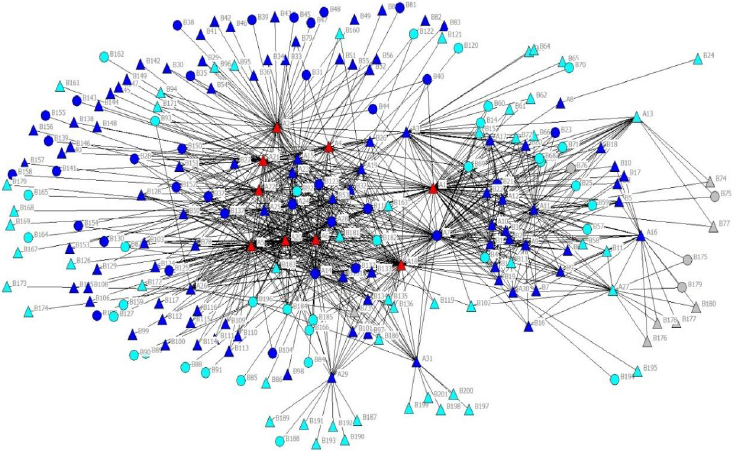
Figure 1
Complete supporter network
It can be observed in the complete network that the group on right composed of A1, A7 and A3 have practically no other link with the network except these actors, just above Figure 1 it is also observed that A2 is the only link with several supporters. , denoting that there are supporters with a key role in the composition of the network and that they should be treated differently compared to the other actors because they represent the marketing channel with subgroups internal to the network.
In Figure 2, the network is composed only of the actors who were interviewed. Actors A1 and A7 are a couple and A3 qualifies as A1's best friend by saying “I joined the group on the recommendation of my best friend, A1”. Any breakup of one of these actors with the network would bring all three together, due to the strength of the relational bond, bride and best friend, care of these supporters is extremely important.
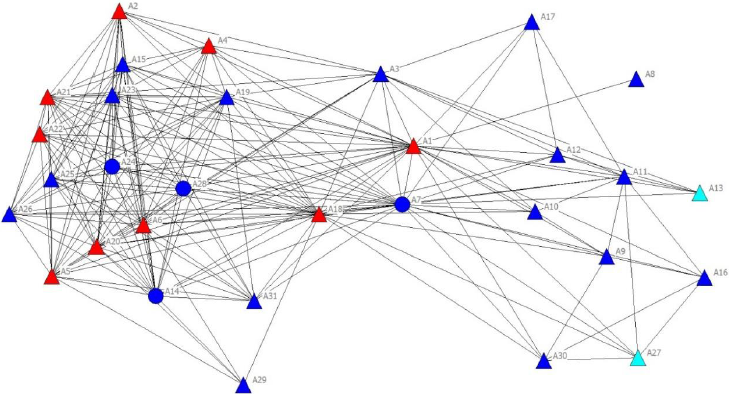
Figure 2
Network of interviewed supporters
Still in the network of those who were interviewed, in Figure 2, we can also observe that despite having a privileged position in the network, close to the main actors, actors such as A24 and A28 do not represent strong group intermediation power, but have easy dissemination because of their position in the network. So while actors like A1, A7 and A3 are key to reaching a larger number of people with the least effort, actors A24 and A28 can be strong actors for internal message reinforcement but not marketing propagation like the other three, reinforcing the importance of understanding the characteristics of these supporters to anticipate the process of information dissemination (Chen et al., 2017).
4.2.1 Centralities
As a result of the centralities, the following sequences were obtained in descending order: a) Degree Centrality obtained the actors A1, A7, A20, A5, A18, A6, A2 and A21. The importance of couple A1 and A7 in the network is verified; b) Centrality of Intermediation, resulted in actors A1, A2, A20, A7, A5, A18, A14 and A6; c) Bonacich power generated actors A18, A20, A7, A6, A1, A5, A14 and A21. Thus, according to Table 1, actors A1, A7, A20, A5, A18, A6 and A21 are confirmed among the eight most powerful of the networks, alternating only between A2 and A14, for the powers of Degree and Bonacich.
| DEGREE | INTERMEDIATION | BONACICH | |||
| Actor | NormalizedIndex | Actor | Normalized Index | Actor | Normalized Index |
| A1 | 0,329 | A1 | 19,92 | A18 | 3,89 |
| A7 | 0,312 | A2 | 15,92 | A20 | 3,76 |
| A20 | 0,312 | A20 | 11,99 | A7 | 3,60 |
| A5 | 0,286 | A7 | 11,70 | A6 | 3,57 |
| A18 | 0,286 | A5 | 10,78 | A1 | 3,51 |
| A6 | 0,260 | A18 | 10,32 | A5 | 3,45 |
| A2 | 0,255 | A14 | 7,96 | A14 | 3,18 |
| A21 | 0,221 | A6 | 7,38 | A21 | 3,09 |
To confirm the correlation found between the centralities, Pearson's degree of correlation was verified, obtaining confirmation of the high degree of correlation between centralities as shown in Table 2. It is concluded that these are, in fact, the most influential actors of the network and should receive special attention from the ego. Of these, only A7 is a woman and only A1 is a career civil servant. A20, A5, A6 and A21 are businessmen performing appointed public functions in a position of trust.
| Table 2. Pearson Correlations | |||
| Centrality | Degree | Bonacich | Intermediation |
| Degree | 1 | ||
| Bonacich | 0,94** | 1 | |
| Intermediation | 0,90** | 0,78** | 1 |
It was observed that in a network, there are supporters who have greater power and influence than others. Actors with the highest degree of centrality or power are excellent information disseminators and can reduce efforts in the rapid transmission of information or in
order to circulate knowledge within the network. Performing Bonacich's power analysis confirmed the most powerful actors, as found in the degree of centrality analysis. Actors with the highest intermediation have the power to connect the most distant actors to each other, reducing communication noise. They can also break the link among various actors in the network, weakening the group and thus must be treated with caution by the candidate.
4.2.2 Characteristics of the main actors
Actor A1 is a military police officer and leads a very specific Ego supporter group. In several questionnaires the actors expressed that they are in the group exclusively due to the suggestion of the A1. There are also some who are in the group for believing in A1, as can be seen in the affirmation of A8 “it was the A1 who referred me to the project”, and of A17 “I am supporting my godson A1” or of A3 “ I am supporting A1 because he saw potential in the candidate. ” As for A7, she is engaged to A1 and works with the Ego. A20 is Undersecretary of State and head of A7, also works for the egoand is the main articulator of executive actions and contacts with business leaders as described by the ego himself. A5 was referred to by Ego as a childhood friend and is currently a representative of the craft brewers of DF. A18 is the chief of staff and appointed by Ego as main political articulator. A6 is an administrator of the City Park, the main park of the FD, and considered by Ego as his representative to programs of occupation and use of public areas. A2 and A21 were labeled by the Ego as childhood friends; A2 is currently chief of staff of a Senator of the Republic, and A21 has great representation in the FD cyclist groups.
Some statements are important in understanding the predominance of A1 as the main actor of degree and intermediation, such as the number of respondents who cited him as being the single most trusted name among the supporters. Nine actors indicated only A1 as the actor they trust in the network, and among them A10 becomes emphatic when he says, "I trust A1 only". This makes A1 a key actor in the Ego network.
Third wave actors located in the central area of the network are spouses of also centralized actors, B92 with A15 and B163 with A24, or work as advisors to a central actor, such as B181, B182 and B183 who are advisors to A19, thus justifying your position in the network.
It was observed in the analysis that family and friendship ties are frequent among the main actors of the network, denoting the great importance of valuing these ties for a satisfactory network of supporters to remain concise, characterizing the precedent as affective commitment. It was also found that 42% of respondents have employment ties with the candidate, which can be a strong influence on the decision of support, characterizing the commitment as continuity,
i.e., related to perceived costs in case of leaving the group, or normative commitment, that which is generated moral obligation (Matos & Rossi, 2008).
Actors who have no family, friendship, or employment ties are in the network because of their trust in another actor, such as actors who said they are in the network because of their trust in A1. In accordance with past studies on word-of-mouth marketing (Matos & Rossi, 2008), the present study verified that the presence of antecedents of trust and affective, normative and continuity commitment in the perception of the actors that compose the network of supporters.
4.3 Perceived characteristics and expectations
Respondents described what key characteristics they see in the candidate, as well as what are the characteristics of an ideal district representative. Questions towards this end aim to map the perceived characteristics of the supporters with regards to the ego and the ideal characteristics for one in the ego-desired function. According to Matos and Rossi (2008), perceived value is the other construct of greater correlation with the word-of-mouth indication. Thus, the presence of this construct in the interviewees' narrative was qualitatively analyzed.
Among the characteristics of the ego, the most cited were: first, words that refer to a skilled and working person (good manager, energy, will, dynamic, skilled, entrepreneur and worker) with 71% of the mentions; followed by honesty, with 68% of the time and family value quoted in 32% of the interviews. Among the negative aspects, cited in 52% of the interviews, were: stubbornness, perfectionism, strictness and impatient.
In the characteristics of the ideal representative, the most cited, coinciding with an ego characteristic, was honesty (74% of the interviews), followed by being concerned and attentive to the public welfare and population (61% of the citations), and keeping campaign promises and commitment (48% of the interviews).
It is inferred from this result that the candidate is aligned with the question of honesty to the desired ideal; however, he must adjust his image and reputation strategy to emphasize his concern for the public good and the population in general, as well as make clear campaign promises with an emphasis on the importance of delivering on them.
Despite the differences, the precedent of perceived value was observed, i.e., the relative perception of what is received by donating the vote (Matos & Rossi, 2008), given that the political candidate largely corresponds to the ideal of a district representative. Thus, confirming the existence of the precedent of perceived value for the dissemination of information.
4.4 General Discussion
A good dissemination of the political actor's image is crucial for effective viral political marketing (Chen et al., 2017), and to this end emphasis is given on the importance of choosing political supporters in marketing strategy for optimizing resources in spreading information (Ormrod, 2017) and in generating awareness and encouragement of propagation actions (Hinz et al., 2011). Even though the choice of actors through their position in the network is so important, examining the characteristics of these actors in explaining the relationship created was seen by Chen et al. (2017) as a research opportunity which can help marketers predict the importance of these characteristics before information dissemination. In order to contribute to the field of research, the present study verified the characteristics of the political supporters of a self-generated network based on nominations of a candidate for the elective office of district representative in Brasília - DF, herein referred to as ego. In addition to these, the perceived characteristics of the ego and what is expected of a political actor occupying the said government post were also verified.
Among the characteristics of the actors with the highest degree of centrality are those in which the bond of trust is not related to the interest of exchange. Therefore, actors with characteristics of subordination, or being in the group encouraged by exchange of any kind, whether favor, money or employment, were not identified as central, except those who have a history of friendship with the Ego before the ensuing employment relationship. Thus, the bonds of trust established by ideological motivation and friendship proved to be more central, and consequently, highly prone to more effective viral marketing (Hinz et al., 2011).
Most supporters have been shown to be in the network due to trust factors, generated either directly or through reputation. Thus, the present study confirms the position of trust as a construct that carries great influence on organizational behavior (De Jong et al., 2016; Mayfield et al., 2016).
After collecting the data and understanding the supporters' profile, it is possible to outline a strategy of outcome-based actions that foster word-of-mouth marketing, specifically directed to the most powerful actors in the network. This strengthens reputational bonds and thus converting these supporters into replicators and recruiters of new actors for the political network.
5. Conclusion
The present study aimed to analyze the structure of trust relationships in a group of political supporters, supporting the front line of the campaign and endorsing the candidate to their community in real or virtual space, and to analyze how the structural seeding strategy can improve the efficiency of word-of-mouth marketing. It has been found that the power of supporters is driven by family and trust as an expectation of behavior from both the ego itself and the supporter. The ego conveys a set of values that makes it appreciable as a candidate, and the supporters reinforce this kind of perception.
Theoretically, this work initially contributes to the inclusion of proportional elections in the discussion of political marking, allowing the identification of any differences in the analysis of these campaigns. Methodologically, this paper introduces the analysis of social networks in this discussion, which can be a tool with important explanatory power in supporter differentiation.
These aspects can contribute to strategic marketing formation and, especially, political marketing in proportional elections, as the large number of candidates tends to diminish voter involvement by making candidate choice largely based on trust or by word-of-mouth reputation. For the practical management of political marketing, this study contributes to the understanding of proportional electoral candidates who would put more effort into seeding strategies with the aid of key, reputable actors, and conduct word-of-mouth marketing using trust for a more effective campaign in the face of diversity of options. Thus, strategies wherein the legislative candidate approaches his key actors, fostering trust and affection, tend to be more efficient than traditional advertisements such as pamphlets, roving announcements, and so on.
This understanding could lead to a restructuring of campaign spending and more efficient application of campaign resources.
It is suggested that to better understand the networks of political supporters, the present study be expanded to other national and international locations, thereby enabling the identification of possible patterns of relationships and characteristics, as well as the carrying out of further longitudinal analyses of the same candidates in order to longitudinally observe the development of the network. For a broad understanding of the characteristics of a network's actors in the seeding strategy, it is also important to apply the study to other types of social networks, not only in politics, but also in arts and sports, where the person becomes the product.
References
Andrei, C. (2018). The Political Marketing of Broken Trust. Journal of Political Marketing, 17(2), 176–192. https://doi.org/10.1080/15377857.2018.1447764
Bardin, L. (1977). Análise De Conteúdo. Lisboa, Portugal: Edições 70.
Barreto, L. (2013). O voto para deputado distrital Como o candidato escolhe o seu eleitor. Universidade de Brasília (UnB).
Basso, K., Reck, D., & Rech, E. (2013). Personalidade e boca a boca: propensão ao envio e recebimento de informações. Revista de Administração de Empresas, 53(6), 580–591.
Bernstein, M. (2007). Friends without favoritism. Journal of Value Inquiry, 41(1), 59–76.
Bonacich, P. (1987). Power and Centrality: A Family of Measures. American Journal of Sociology, 92(5), 1170–1182.
Burt, R. S. (1992). The Social Structure of Competition. 65–103. Retrieved from http://search.epnet.com/login.aspx?direct=true&db=ecn&an=0405891
Chen, X., van der Lans, R., & Phan, T. Q. (2017). Uncovering the Importance of Relationship Characteristics in Social Networks: Implications for Seeding Strategies. Journal of Marketing Research, 54(2), 187–201. https://doi.org/10.1509/jmr.12.0511
Codeplan. (2016). Anuário estatístico do DF. In Companhia de Planejamento do DF. Retrieved from http://www.codeplan.df.gov.br/areas-tematicas/indicadores-economicos/anuario-estatistico-do-df.html
Cohen, M. a. (2014). Genuine, non-calculative trust with calculative antecedents: Reconsidering Williamson on trust. Journal of Trust Research, 4(1), 44–56.
Cunh, C. R., & Melo, M. C. de O. L. (2006). A confiança nos relacionamentos interorganizacionais: o campo da biotecnologia em análise. RAE Eletrônica, 5(2).
De Jong, B. A., Dirks, K. T., & Gillespie, N. (2016). Trust and team performance: A meta-analysis of main effects, moderators, and covariates. Journal of Applied Psychology, 101(8), 1134–1150.
Dias, F. O. (2019). A influência dos valores pessoais e relacionamentos no desempenho individual dos grupos táticos da polícia militar. Dissertação de Mestrado. Universidade de Brasília-UnB.
Freeman, L. C. (1979). Centrality in Social Networks. Social Networks, 1(1968), 215–239.
Goodman, L. A. (1961). Snowball Sampling. The Annals of Mathematical Statistics, 32(1), 148–170.
Granovetter, M. S. (1973). The Strength of Weak Ties. American Journal of Education, 78(6), 1360– 1380.
Hinz, O., Skiera, B., Barrot, C., & Becker, J. U. (2011). Seeding Strategies for Viral Marketing: An Empirical Comparison. Journal of Marketing, 75(6), 55–71. https://doi.org/10.1509/jm.10.0088
Iyer, P., Yazdanparast, A., & Strutton, D. (2017). Examining the effectiveness of WOM/eWOM communications across age-based cohorts: implications for political marketers. Journal of Consumer Marketing, 34(7), 646–663.
Kadushin, C. (2012). Understanding Social Networks: Theories, Concepts, and Findings.
Marconi, M., & Lakatos, E. (2003). Fundamentos de metodologia científica. In Editora Atlas S. A.Matos, C. A., & Rossi, C. A. V. (2008). Word-of-mouth communications in marketing: A meta- analytic review of the antecedents and moderators. Journal of the Academy of Marketing Science, 36(4), 578–596.
Mayfield, C. O., Tombaugh, J. R., & Lee, M. (2016). Psychological collectivism and team effectiveness: Moderating effects of trust and psychological safety. Journal of Organizational Culture, Communications and Conflict, 20(1), 78–95.
Naskrent, J., & Siebelt, P. (2011). The Influence of Commitment, Trust, Satisfaction, and Involvement on Donor Retention. Voluntas, 22(4), 757–778.
Ormrod, R. P. (2017). Stakeholders in the political marketing context. Journal of Public Affairs, 17(4), 1–9. https://doi.org/10.1002/pa.1671
Provdanov, C. C., & Freitas, E. C. De. (2013). Metodologia do trabalho científico: métodos e técnicas da pesquisa e do trabalho acadêmico. In Novo Hamburgo: Feevale. https://doi.org/10.1017/CBO9781107415324.004
Reed, M. I. (2001). Organization, trust and control: A realist analysis. Organization Studies, 22(2), 201–228.
Rossoni, L., & Guarido Filho, E. R. (2006). Cooperação interinstitucional no campo da pesquisa em estratégia. Revista de Administração de Empresas, 47(4), 74–88.
Rousseau, D. M., Sitkin, S. B., Burt, R. S., & Camerer, C. (1998). Not so different after all: A cross- discipline view of trust. Academy of Management Review, Vol. 23, pp. 393–404.
Ryan, S. (2004). Initial Trust Formation in an Online Social Action Network. Sixth International Conference of the International Society for Third-Sector, 1–25.
Scotto, G. (2003). Encontros e desencontros entre a política e o mercado: uma antropologia das “trocas” no espaço do marketing político. Horizontes Antropológicos, 9(19), 49–78.
Silva, S. C. e. (2012). Marketing Político E Comportamento Eleitoral: Reflexões Sobre As Estratégias De Marketing Político Em Campanhas Eleitorais. Revista Brasileira de Marketing, 11(1), 113–136. https://doi.org/10.5585/remark.v11i1.2268
TRE-DF. (2018). Eleições 2018. Retrieved July 25, 2019, from http://www.tre- df.jus.br/eleicoes/estatistica/estatisticas
Van Steenburg, E. (2015). Areas of research in political advertising : a review and research agenda. International Journal of Advertising: The Review of Marketing Communications, (February), 37– 41.
Vergueiro, W., & Sugahara, C. R. (2010). Aspectos conceituais e metodológicos de redes sociais e sua influência no estudo de fluxos de informação. Revista Digital de Biblioteconomia e Ciência Da Informação, 7(2), 102–117.
Warraich, U., Nigah-e-hussain, & Khurram, S. R. (2016). impact of internal Marketing on Organizational commitment : a case of Lucky cement Employees. 10(2), 107–126.
Wasserman, S., & Faust, K. (1994). Social network analysis: Methods and applications. In Cambridge University Press (3rd printi, Vol. 1). New York.
ANNEX I - Questionnaire
I. Personal Data
| 1. Name | |
| 2. Sex | |
| 3. Age | |
| 4. Educational Degree | |
| 5. Home Address | |
| 6. Birthplace | |
| 7. Religion | |
| 8. Occupation | |
| 9. Are you affiliated with any political party? Which one? | |
| 10. Are any of your family members politicians? |
II Relations aspects
- 1. How did you meet the candidate and why did you decide to support him?
- 2. Are you a friend or colleague of any of the candidate's political supporter? Name him or her.
- 3. Have you ever nominated the candidate to someone who has become a supporter? Name him or her.
- 4. What are the main characteristics of the candidate?
- 5. In your view, what are you looking for, and what are the characteristics of an ideal district representative?
- 6. Which people do you trust most of the candidate's political supporters?