Artigos
A influência da orientação para o mercado nas estratégias de inovação de Exploration e Exploitation e no desempenho orgazanizacional
A influência da orientação para o mercado nas estratégias de inovação de Exploration e Exploitation e no desempenho orgazanizacional
Revista Brasileira de Marketing, vol. 18, núm. 1, pp. 1-16, 2019
Universidade Nove de Julho
Recepção: 17 Dezembro 2018
Aprovação: 22 Março 2019
Resumo:
Objetivo: O presente estudo buscou verificar a influência da orientação para o mercado (OM) nas estratégias de inovação de exploitation e exploration e também no desempenho organizacional.
Método: A pesquisa foi realizada com proprietários e gestores de empresas da indústria de alimentos no Brasil, por meio de um questionário online e coleta de dados pessoalmente. A amostra final consistiu de 112 empresas do sul e sudeste brasileiro. Os dados foram inicialmente analisados com as estatísticas descritivas com auxílio do software SPSS. Posteriormente, foi aplicada a modelagem de equações estruturais no teste de hipóteses.
Relevância: Apesar dos recentes desenvolvimentos na literatura sobre os temas de orientação para o mercado, estratégias de inovação de exploitation e exploration, duas lacunas teóricas foram identificadas no estudo proposto: (1) quanto a OM contribui para estratégias de inovação de exploitation e exploration, e (2) quanto a OM contribui para o desempenho organizacional quando as empresas utilizam as estratégias de inovação exploitativas e explorativas.
Resultados: Os resultados deste estudo indicam que empresas orientadas ao mercado podem atingir ambas as estratégias de inovação (exploitation e exploration). Outro achado indica que empresas orientadas ao mercado podem potencializar o desempenho organizacional ao desenvolver estratégias de inovação de exploration e estratégias de inovação de exploitation.
Contribuições teóricas: A compreensão de quanto o conhecimento de mercado, advindo da OM, pode contribuir para as estratégias de inovação de produtos, tecnologia e capacidades além das existentes e as inovações incrementais. Além de quanto estas relações podem promover o desempenho organizacional, que pode auxiliar no entendimento de quanto as empresas orientadas ao mercado precisam investir recursos em estratégias de inovação.
Palavras-chave: Orientação para o mercado, Estratégias de Inovação de Exploration, Estratégias de Inovação de Exploitation, Desempenho Organizacional.
Abstract:
Objective: The present study aimed to verify the influence of market orientation (MO) on exploration and exploitation of innovation strategies and also organizational performance.
Method: The survey was conducted with owners and managers of companies in the food industry in Brazil through an online questionnaire and personal data gathering. The final sample consisted of 112 companies in southern and southeastern of Brazil. The data were first analyzed through descriptive statistics using SPSS software. Structural equation modeling by SMART PLS software was applied to test hypotheses.
Relevance: Whereas recent developments in the literature on the themes of market orientation, exploration and exploitation innovation strategies, two theoretical gaps were identified for the proposed study: (1) how much MO contributes to exploration and exploitation innovation strategies, and (2) how much MO contributes to organizational performance when companies use exploration and exploitation innovation strategies.
Results: The results of the study indicate that market-oriented companies can achieve both innovation strategies of exploration and innovation strategies of exploitation. Another finding indicates that market-oriented companies can improve their organizational performance by developing innovation strategies of exploration and innovation strategies of exploitation.
Theoretical contributions: The understanding of how much market knowledge, proceeding from MO, can contribute to product innovation strategies, technologies, and capabilities beyond existing and more incremental innovations. And, how such relationships promote organizational performance can contribute to the understanding of how much market-oriented firms need the resources investments in innovation strategies.
Keywords: Market Orientation, Explorative Innovation Strategy, Exploitative Innovation Strategy, Business Performance.
INTRODUCTION
Market orientation has been widely explored by literature since it was first proposed by Kohli and Jaworski (1990), Narver and Slater (1990), and Deshpandè, Farley and Webster (1993). Narver and Slater (1990) defined market orientation as an organizational culture with creates the necessary behaviors to develop value to the consumers and to achieve a sustainable competitive advantage. For them, the market orientation consists of three dimensions: customer orientation, competitor orientation and interfuncional coordination (Narver & Slater, 1990).
Recent studies of market orientation (MO) focus on examining the influence of this concept on the innovation strategies adopted by companies (Newman, Prajogo & Atherton, 2016; Tan & Liu, 2014; Morgan & Berthon, 2008; He & Wong, 2004). When an innovation strategy is defined, the company might develop innovation that is new to the market or improve the existents (Bercovitz & Feldman, 2007). He and Wong (2004) defined that an explorative innovation strategy refers to the technology strategies that intend to enter new markets and the exploitative innovation strategy as the technology strategies that proposes to improve the existents. As well as Morgan and Berthon (2008, p.1332) assigned that an explorative innovation strategy establishes an "a clear advance in activity from previous norms and is characterized by an aggressive technology policy," in other words, this strategy is new for the company market. At the same time, an exploitative innovation strategy involves a "reaction to basic knowledge and learning moreover, results in adjustments to technological practice" (Morgan & Berthon, 2008 p.1332).
Previous studies that analyzed the relation of market orientation and the explorative and exploitative innovation strategies found divergent results depends on the adopted approach of the concepts (Tan & Liu, 2014; Alpkan, Sanal & Ayden, 2012; Morgan & Berthon, 2008). Therefore, there are controversial results from initial studies. Furthermore, relatively little is known on the effects of this relation on organizational performance. To Wang, Chiu and Chen (2015), organizational performance is the result of organization operations, it includes the achievement of the organization internal and external objectives, and serves as an analysis of the companies competitiveness. In proposing the relationships between MO, strategies of innovation in exploration and exploitation and organizational performance. Whereas recent developments in the literature on the themes of market orientation, exploration and exploitation innovation strategies, two theoretical gaps were identified for the proposed study.
The second gap refers to the search for understanding: how much MO contributes to organizational performance when companies use exploration and exploitation innovation strategies. Even though, previous studies have shown that organizational performance can be influenced more intensively by exploitative rather than exploitative innovation strategies, this is because over time the accumulated profits of the investments in improvement can be more effective than investments in exploratory innovation strategies (Vorhies, Orr & Bush,2011; Gatignon et al., 2002). Consequently, understanding how such relationships promote organizational performance can contribute to the understanding of how much market-oriented firms need the resources investments in innovation strategies. When making decisions to invest its resources properly, the companies improve organization performance as well as innovation success (Subramanian & Nilakanta, 1996; Valle & Avella, 2003).
The present study aims to analyze how the MO enhances exploitative innovation strategies, explorative innovation strategies, and how each of these aspects influences organizational performance in the food sector in Brazil. The food industry is continuously increasing and is considered one of the most dynamic sectors of the Brazilian economy (Banco Nacional de Desenvolvimento Econômico e Social - BNDES, 2014). Among the sectors of the transformation industry that is the one that better applies the external sources of knowledge, seeking to anticipate the needs of the consumers (Research of Technological Innovation - PINTEC, 2014). In this aspect, market orientation can be one of the sources of this knowledge.
THEORETICAL BASIS AND RESEARCH HYPOTHESES
Market orientation and explorative innovation strategies
Market orientation is a philosophy strategy that drives the organization to answer the needs of consumers and ensure a competitive advantage (Narver & Slater, 1990). MO consists of three behavioral dimensions that make up the organization culture: customer orientation, competitor orientation, and interfuncional coordination (Narver & Slater, 1990). The customer orientation dimension refers to the company that intends to direct its activities to understand the information collected by clients. These activities involve the development of an after-sale system, track the changes in the price of products, and seek to understand consumer satisfaction (Narver & Slater, 1990). The competitor orientation is when the company observes, monitors, directs its activities based on what its competitor behaves, also involves the collection of the market information to develop market plans and use the sales force to monitor and report the competitor activities (Narver & Slater, 1990). The interfuncional coordination occurs when the company shares market information between departments and areas (Narver & Slater, 1990).
Recent discussions on the matter of market orientation related this concept to innovation aspects that can help an organization to implement strategies that seek the development of innovative products, process, and technologies new to the market or enhance the existent ones (Tan & Liu, 2014; Bercovitz & Feldman, 2007). Based on organizational theory, when are two aspects that can generate a dilemma in which one to invest, one aspect is related to exploration and another to exploitation (March, 1991). Exploration indicates aspects of new or not known yet by the company and exploitation refers to the specialization of activities, which develops incremental results through the use of existing knowledge (March, 1991; Popadiuk, 2007).
He and Wong (2004), were the first authors to suggest that exploration and exploitation are two different aspects of the innovation strategies. In this perspective, exploration innovation strategies are intended to promote clear advances to the pre- established norms, and the exploitation innovation strategies are the strategies of adjustments to the current practices (He & Wong, 2004; Morgan & Berthon, 2008). Consequently, focusing on exploration innovation creates new opportunities and the focus on exploration enhances current skills and practices (Wang, Chiu & Chen, 2015).
Morgan and Berthon (2008) complement the study by He and Wong (2004), proposing that innovation derives from different possibilities and different knowledge of the organization. Thus, an innovation strategy could be directed as consumers and markets seek to achieve innovation in product and process, the technology which has to develop and the improvement of the organizational learning. Morgan and Berthon (2008) also argue that the market orientation is characterized by the market strength in which the company works, and it leads to a strategy of exploitative innovation. At the same time, the impulse of technology is distinguished by generative learning to an explorative innovation strategy.
Tan and Liu (2014) analyzed the influence of the relationship between market orientation on organizational performance when mediated by exploration and exploitation innovation strategies. In the authors' proposal, market orientation was explored in the proactive and responsive dimensions. The results of the study did not prove the relations between responsive market orientation and organization performance when mediated by exploitation and exploration innovation strategies, only the relationship with proactive market orientation was confirmed (Tan & Liu, 2014). As suggested by Tan and Liu (2014), when analyzing the market orientation divided into two aspects (proactive and responsive), relationships may not have been analyzed in more intensity, because it may not have been considered the essence of market orientation. Therefore, the authors suggest that market orientation as a single construct is related to the two innovation strategies (Tan & Liu, 2014).
Complementing previous studies, the Alpkan, Sanaa, and Ayden (2012) study proposes to analyze the perceptions of proactive and responsive market orientation in these two strategies (exploration and exploitation) and organizational performance. Notwithstanding, Alpkan, Sanaa, and Ayden (2012) elaborated only a theoretical proposition on these relations, not carrying out an empirical analysis of these impacts.
Tan and Liu (2014) suggest that a market- oriented company directs its activities to expressed needs of consumers, and develops more radical innovations, that is, they did not previously exist. While for Alpkan et al. (2012), exploration innovation strategies are designed to explore new markets and consumer need through the development of new knowledge. As well as, exploration innovation strategies have been driven by innovation products and services guided by a consumer-driven culture (Alpkan et al, 2012). For He and Wong (2008), an exploratory innovation strategy refers to exploratory learning and radical innovation activities.
For Enkel, Heil, Hengstler, and Wirth (2016), market orientation is perceived as a dynamic capacity that directly and positively affects exploitative and explorative innovation strategies. In this way, market orientation is interpreted as an effort by members of a company to achieve innovation results. It is noteworthy that in the study of Enkel, Heil, Hengstler, and Wirth (2016), the behavioral dimensions of market orientation were analyzed individually.
Ngo, Bucic, Sinha and, Lu (2017), affirm that an organization with the capacity to feel the market creates innovation activities of exploration and exploitation, which determine the market performance of the organizations. According to these authors, companies that seek exploitative and explorative innovations emphasize the modi operandi that generates an effect in the sense of technology in the capacity to feel the market and that improves the organizational performance (Ngo, Bucic, Sinha & Lu, 2017).
According to the concepts presented, some similarities between MO and exploitative and explorative innovation strategies were evidenced. Market orientation acts as a way of generating knowledge about the external environment, distributing and interpreting internally, in order to respond to the needs of consumers (Day, 1994). Companies that use this external knowledge can develop original innovations or modifications in existing product and processes (Atuahene-Gima, 2005). Hence, OM can influence exploration and exploitation innovation strategies (He & Wong, 2004).
For this reason, market orientation is considered to be a contributory factor in exploitative innovations, since knowledge of new markets, competitors and consumers can enable the development of products, technologies, and capabilities beyond the existing ones (Vorhies, Orr & Bush,2011; He & Wong, 2004).
One of the indications of this contribution is that innovation originates from the market knowledge, which, if consider market orientation, may assist to combine different strategic possibilities (Narver & Slater, 1994; Tidd, Bessant & Pavitt, 2008). That said, we propose the following hypothesis:
H1: Market orientation has a directly and positively impact on exploration innovation strategies.
Exploitative innovation strategies are designed to fulfill the needs of consumers by developing and adjusting the existing knowledge (He & Wong, 2004). Atuahene-Gima (1995) suggests that market-oriented firms may have difficulties in developing new products entirely new for the existent market because of the knowledge of competitors' activities may make innovations more incremental. That happens because by developing innovations more efficiently and effectively than competitors, the company will have to invest heavily in innovation (Narver; Slater; Maclachlan, 2004).
The company could answer the needs of consumers tends to promote the development of strategies aimed to improve the current market (exploitation), that because entering new markets (explorations) may require knowledge not only of the needs but also of the habits of the consumers (He & Wong, 2004; Christensen, 1997).
Consequently, market orientation can favor exploitative strategies since the external information can provide the necessary knowledge to improve the current market position (He & Wong, 2004). This knowledge can provide an adjustment in the organization technological practices and increase knowledge about market, products, and capabilities, which are related to an exploitative innovation strategy (Vorhies, Orr & Bush, 2011).
In previous studies, there were findings of a positive relationship between market orientation and exploitation innovation strategies (Morgan & Berthon, 2008; Alpkan et al., 2012; Tan & Liu, 2014; Ngo et al., 2017). Morgan and Berthon (2008) justify that a strategy of innovation in market-oriented companies is more likely to be exploitative, this is because the competitive process encourages reactive forms of innovation, that is, more incremental innovations. Alpkan et al. (2012), suggests that market-oriented firms present significant changes in the implementation of products and concepts of entirely new business (exploration). Tan and Liu (2014) complement these justifications by highlighting that the search of latent knowledge of consumer needs, in market-oriented companies, enhances the incremental innovations and thus the exploitative innovation strategies. Therefore, the following hypothesis is proposed:
H2: Market orientation has a directly and positively impact on exploration innovation strategies.
Market orientation, exploitative and explorative innovation strategies and organizational performance
This study proposes to verify how much the organizational performance is favored by the relation of market orientation and exploitative and explorative innovation strategies. Organizational performance is formed by the set of results achieved as the activities of an organization are executed (Sobral & Peci, 2008). It is a complex set, with multiple causes and dependent on internal factors and strategy (Deshpande, Farley & Webster, 1993). The firms that perform better are those which are strongly market-oriented, innovative and have a marketing culture, simultaneously (Deshpande, Farley & Webster, 1993).
In some studies, exploitative innovation strategies have proven to have a more significant effect on performance than explorative innovation strategies (He & Wong, 2004; McGrath, 2001). Song, Di Benedetto and Zhao (1990) present that innovation strategies are implemented to improve the company performance or minimize performance negative effects that emerge from environmental chance.
In general, previous studies indicate that market orientation positively affects organizational performance (Atuahene-Gima; Slater & Olson, 2005). In the same way, previous studies confirm that market orientation favors exploitative innovation strategies (Alpkan et al., 2012; Morgan & Berthon, 2008). Thus, it can be argued that market orientation can favor exploration and exploitation innovation strategies (Morgan & Berthon, 2008; Alpkan et al., 2012).
The relationship between market orientation and organizational performance when mediated by exploration and exploitation innovation strategies was previously analyzed by Tan and Liu (2014). For the authors, the market orientation is interpreted as proactive and responsive. In this way, the relationship between responsive market orientation and organizational performance when mediated by the exploitative innovation strategies has not been proved. Similarly, the relationship between proactive market orientation and organizational performance, as mediated by exploration innovation strategies, has not been confirmed (Tan & Liu, 2014).
With this in mind, it can be assumed that market-oriented firms are more likely to develop exploration and exploitation innovation strategies and, in turn, are more likely to improve organizational performance (Han et al., 1998).
Based on this, the following hypotheses are proposed:
H3a: Market orientation positively impacts organizational performance when mediated by exploration innovation strategies.
H3b: Market orientation positively impacts organizational performance when mediated by exploitation innovation strategies.
Figure 1 summarizes the conceptual framework for this article.
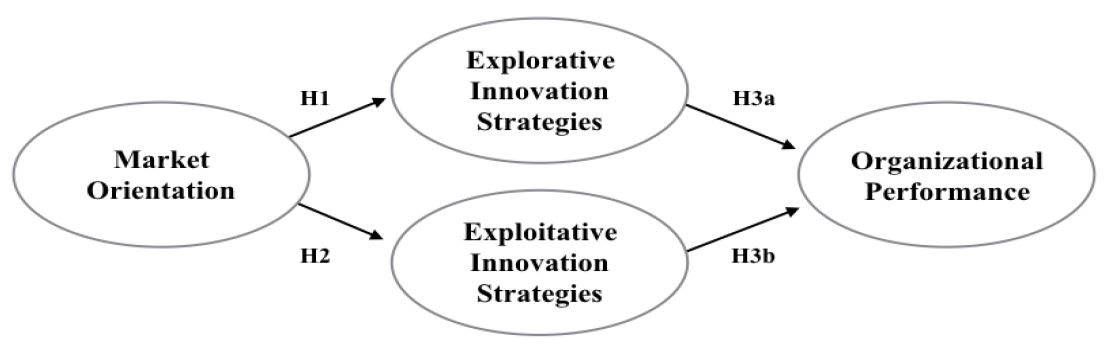
Figure 1
Conceptual Framework.
As can be seen in Figure 1, the present study proposes that market orientation enhances exploration (H1) and exploitation (H2) innovation strategies. Just as market orientation positively influences organizational performance by being mediated by exploration (H3a) and exploitation (H3b) innovation strategies. In the following section will be presented the development and the application of the method that was used to test the model highlighted in Figure 1.
METHOD
This research has the format to examine characteristics or functions of the market, and it has a pre-planned and structured design, so it is considered a descriptive research and requires a quantitative analysis of the data (Malhotra, 2012). The survey was cross- sectional type and corresponded to the collections of information from a given sample of population elements in only one moment (Malhotra, 2012).
The target population corresponded to the manufacturing companies of the food industry of Brazil. The food industry encompasses the processing and the transformation of agricultural, livestock and fishery products for human and animal food (Instituto Brasileiro de Geografia e Estatística - IBGE, 2016). According to IBGE (2016) data, in 2015 the Brazilian food industry was constituted by a universe of 43.9 thousand companies. The sector also represents a significant part of the Brazilian Gross Domestic Product (GDP). Given the impossibility of reaching all these companies for the research, it became necessary to use the sampling technique, more specifically the non-probabilistic sampling for convenience (Field, 2009). In order to constitute the sample, contacts are made with the Federação das Indústrias do Estado do Paraná (FIEP), the Federação das Indústrias do Estado do Rio Grande do Sul (FIERGS), with the exhibitors of national fair FIPAN 2016 (Feira da Indústria da Panificação e Confeitaria) in São Paulo and two trade unions in the sector in Paraná. These regions were selected based on ABIA (2016) data, which suggests that these are the Brazilian regions that most contributed to food exports are positioned in the south and south-east regions.
Through these contacts, FIEP and FIERGS provided the register of 619 companies in this sector. In the register held at the FIPAN fair were 39 companies from the food industry sector. The unions provided the register of 43 associated companies, which were not included in the previous registrations. With the records provided, an initial database of 701 companies was obtained.
Regarding the constructs, these were measured using a 10-point Likert scale, considering the extremes 1= totally disagree and 10= totally agree. For the 'market orientation' construct, 15 items of the Narver and Slater (1990) scale were considered. The constructs of 'exploration innovation strategies' and 'exploitation innovation strategies' were measured using ten items obtained from Morgan and Berthon (2008) scale. The 'organizational performance' construct considered aspects of innovation and financiers. The innovation indicators were adapted from three items proposed by Kuhne, Gellynck, and Weaver (2015) and three items proposed by Langerak, Hultink, and Robben (2004). Financial performance indicators were measured using six items from Wang, Chiu, and Chen (2015) scale. The list of indicators is shown in Table 1, in the results section of the study.
Before the data collections, the content validity of the constructs proposed here was performed. This validation has the function of verifying if the content of the scale represents what it is intended to measure and need to be done through the method of judges; practical (specialists) and academic (Malhotra, 2012). For this study, the two types of validities were performed. First, two rounds of validation were conducted with academics, contemplating a detailed analysis of the previously translated questionnaire indicators. At this moment, chances were made in order to adapt the vocabulary to the reality of the companies studied and to help to understand the text of the question. The second stage of validation was conducted out with two specialists who are active in medium-sized companies in the food industry, that stage aims to verify the comprehension of the questions by specialized professionals that work in this area in Brazil. Therefore, it was possible to adapt the language to the sector and facilitate the understanding of the questions.
Following the first stage of validation of the constructs, contact was made with the companies from the databases provided by FIEP, FIERGS, FIPAN and the unions, as highlighted. Initially, all 701 companies were contacted and, after confirmation by telephone, the research approach the use of the database sending an e-mail explaining the objectives of the research and the link of the self-fulfilling questionnaire. Considering the validation sequence of the research instrument, the questionnaire was pre-tested at this moment. The pre-test had the objective of analyzing the response time, complexity of response and improvement of the questionnaire (Malhotra, 2012). Twenty questionnaires were applied personally to companies in the sample initially defined, without any influence or explanation of the items by the researcher. The interviewees did not comment on the content of the questions, and there was no demonstration of difficulty in understanding the items, so no modifications were made to the questionnaire. As no modification was made, the pre-test questionnaires were included in the final sample. Thus, the pre-test met the requirements to ensure that the data collected from this questionnaire meet the research objectives.
Once the pre-test was done, the questionnaire was sent to the companies. The sending process was performed once or twice a week, and the e-mail display rate in this contact list reached 25%. The data collection occurred between July and September 2016, and 142 questionnaires were answered. After data purging, 114 questionnaires were considered valid for the study. In this step was performed the outliers analysis of the variables presented by Boxplot, in SPSS software, to avoid that atypical cases showed bias in the model (Field, 2009). This analysis indicated 2 cases of outliers with extreme values, frequent in several indicators. As suggested by Field (2009), these cases were eliminated. Finally, the sample resulted in 112 valid cases to test the hypotheses.
RESULTS
The preliminary analysis of the hypothesis test corresponded the steps of reliability, Common Method Bias test, verification of heteroscedasticity and multicollinearity, and data normality test.
The reliability test of the scales was performed using SPSS software. The three constructs presented high values of Cronbach's Alpha, as mentioned in Table 1.
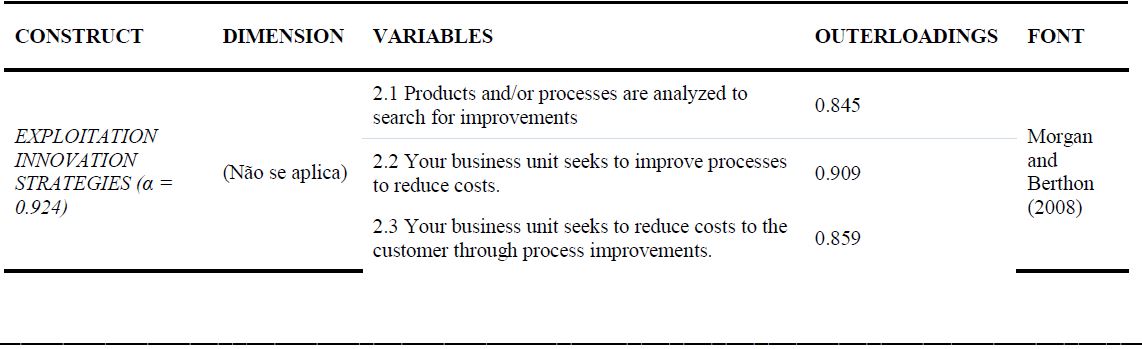
Table 1
Constructs, indicators and preliminary results of the study.
The questionnaire was pre-tested and applied in Portuguese.
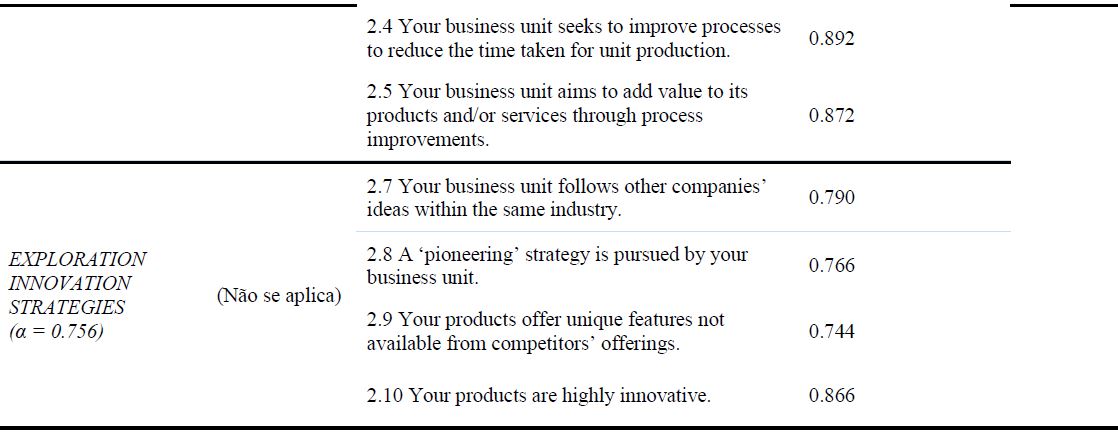
Table 1 Cont.
Constructs, indicators and preliminary results of the study.
The questionnaire was pre-tested and applied in Portuguese.
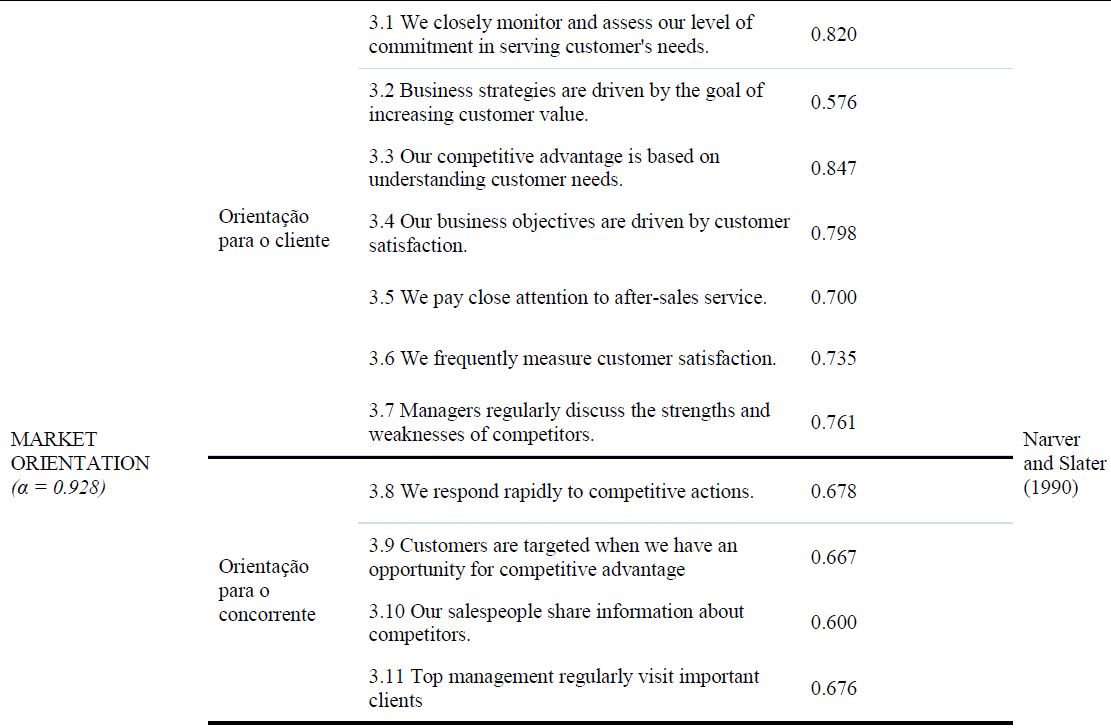
Table 1 Cont.
Constructs, indicators and preliminary results of the study.
The questionnaire was pre-tested and applied in Portuguese.
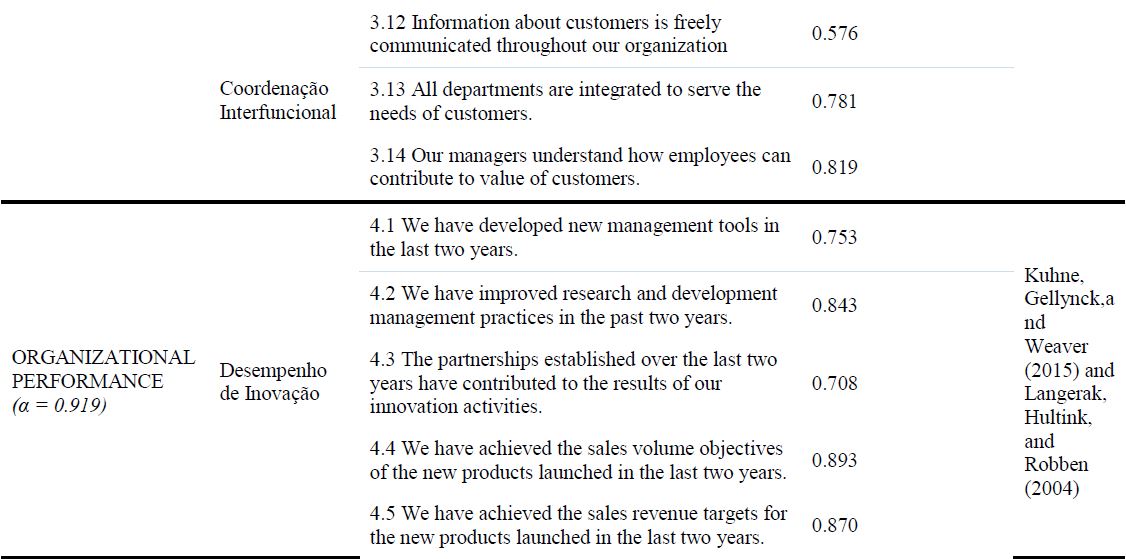
Table 1 Cont.
Constructs, indicators and preliminary results of the study.
The questionnaire was pre-tested and applied in Portuguese.
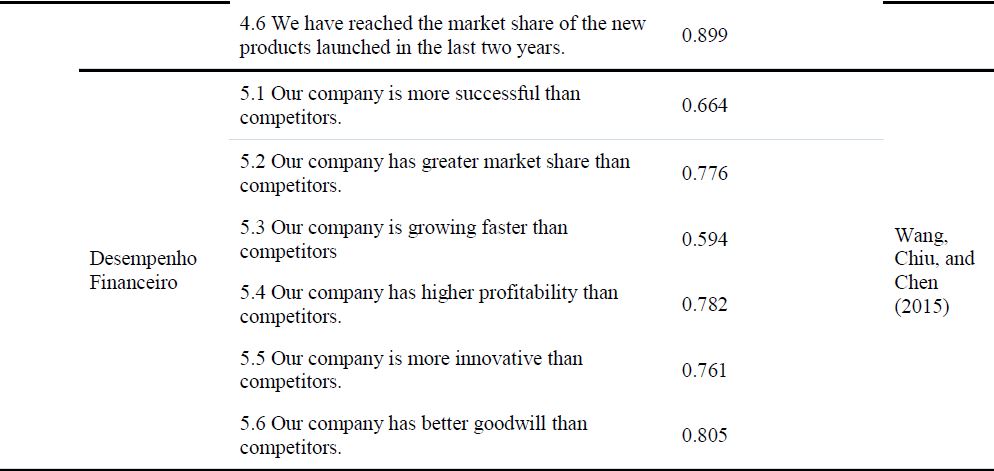
Table 1 Cont.
Constructs, indicators and preliminary results of the study.
The questionnaire was pre-tested and applied in Portuguese.
The Common Method Bias test was performed to verify if no bias could distort the data (Lowry & Gaskin, 2014). To do so, the Harman single-factor test was conducted to verify if a single factor would explain most of the variance in the model which would indicate the response bias (Lowry & Gaskin, 2014). The result of the test revealed that a single factor explained 31.74% of the variance, demonstrating that the data do not suffer from common method bias.
The Breusch-Pagan and the Koenker test were conducted to identify possible problems with heteroscedasticity. In both tests the values did not present values lower than 0.05 (Breusch-Pagan: 0.416 and Koenker: 0.766), rejecting the null hypothesis that the data present heteroscedasticity.
In order to verify the absence of multicollinearity, the Variance Inflation Factor (VIF) test was performed to ensure that the independent variables are not correlated (Hair et al., 2009). The results presented values of VIF less than 2, which shows that there is no multicollinearity (exploitation innovation strategies, VIF = 1,433, exploration innovation strategies, VIF = 1,715, market orientation, VIF = 1,567).
The valid cases were submitted to the normality test of Kolmogorov-Smirnov and Shapiro- Wilk, in the statistical software SPSS. According to Hair et al. (2012), these are the most common tests for normality analysis. Field (2009) recommends that the p-value should be higher than 0.05. As the p-value of most of the questions in this study presented values lower than 0.05, it can be inferred that the data of this research do not present normality. In this case, the use of structural equation modeling techniques based on variance is indicated in cases of non-normality (Hair et al., 2014). Therefore, it was decided to use the method of Partial Least Squares (PLS), using SMART PLS software to test the hypotheses of this study. One of the advantages of this method is the use of statistical techniques when data follow different standards (Hair et al., 2014)
Performing the hypothesis test of a model in SMART PLS, it is necessary to observe the values of loads in each construct (outer loadings). These shipments indicate the full contribution of a given item to the latent variable to which it is linked (Hair, Gabriel & Patel, 2014). Items with loading less than 0.05 have been deleted. The other loads are shown in Table 1.
The convergent validity was ensured by the observations of the outer-loadings (values presented in Table 1) and by Average Variance Extracted (AVE), which should reach values higher than 0.5. The reliability of the construct was verified employing the CR (Construct Reliability), which values should be higher than 0.7 (Hair et al., 2009). Table 2 presents the convergent validity and reliability index of the constructs of the proposed model. It was verified that all the variables reached the adequate rates of stroke and CR. Also shown in Table 2 are the r² values of the dependent variables.
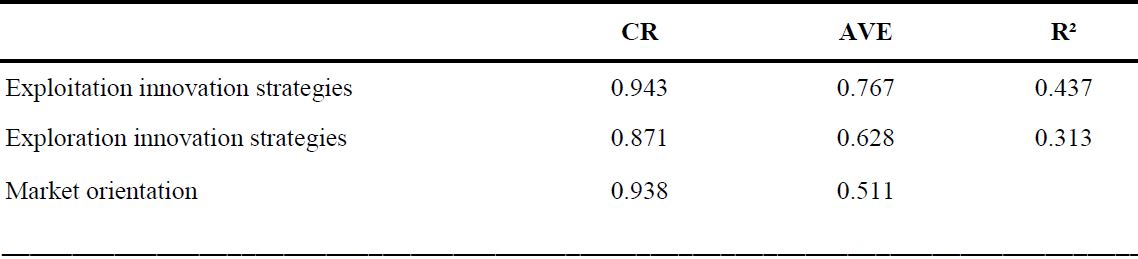
Table 2
Reliability and convergent validity of the constructs.
Establishing the discriminant validity, a comparison was made of the square root of the AVE of each construct with the estimated correlations between this construct. The value of the square root of the AVE (the table diagonal in bold) must be higher than the value of the correlations with the other constructs. As can be seen in Table 3, the data have discriminant validity.
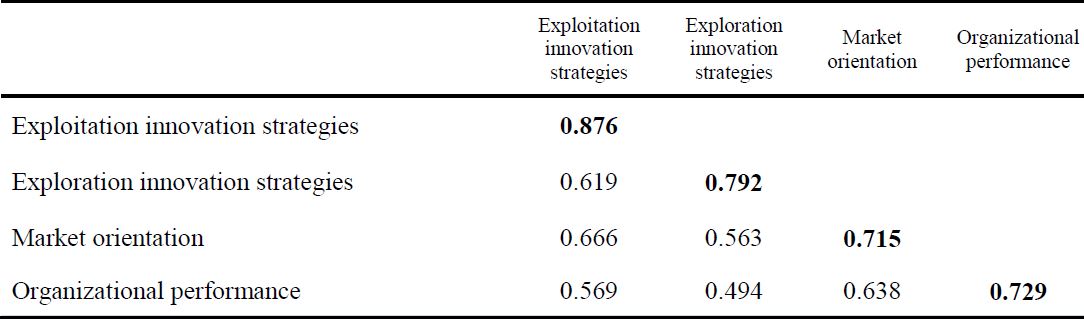
Table 3
Discriminant validity
Once the validity and reliability criteria of the constructs were confirmed, the hypothesis test proposed in the theoretical model was confirmed. Figure 2 shows the results of the model tested.
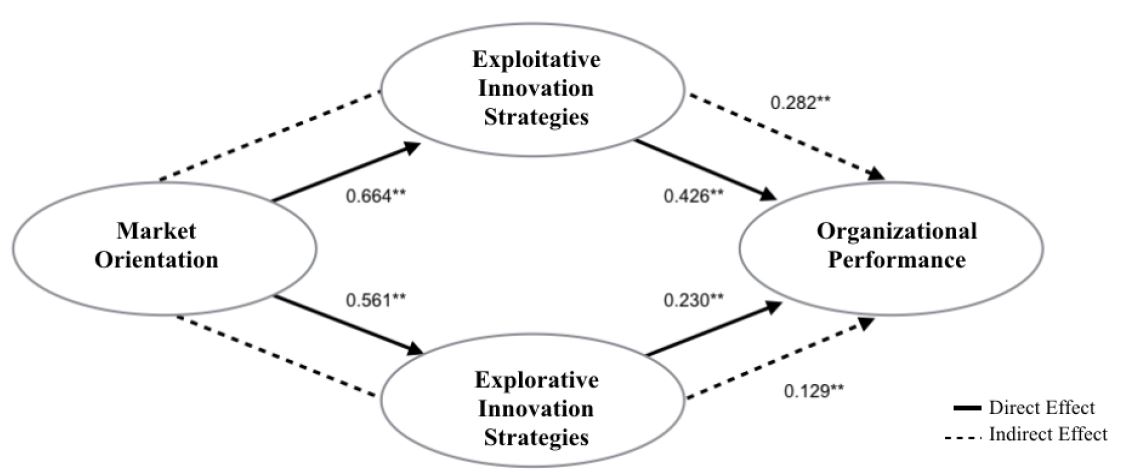
Figure 2
Test of the study model
**Significant values at the level of p>0.05 = 1.96
In Figure 2 it is possible to verify the path coefficient of the result regarding the hypothesis tests that investigated the influences of the market orientation on the explorative and exploitative innovation strategies and the organizational performance.
Hypothesis 1 (H1) refers to the relationship between market orientation on exploration innovation strategies. The tests results revealed a coefficient of 0.561. The t-test showed a coefficient of 8.344 (t- value> 1.96), confirming that market orientation influences directly and positively as a 95% confidence level. This result allows H1 to be accepted.
Hypothesis 2 (H2) was proposed to verify the influence of market orientation on exploitation innovation strategies. The coefficient of 0.664 and t- value of 12.909 (t-value> 1.96) confirming that market orientation directly and positively influences the exploitation innovation strategies, allowing H2 to be accepted.
The propose of Hypothesis 3a (H3a) was to test the mediation effect of exploitation innovation strategies on the relationship between market orientation and organizational performance. First, the indirect effect path (AxB) was calculated, in other words, the value of the first coefficient (A) is multiplied by the second (B) coefficient (Hair, et al., 2009). In the case of the variables in this study, the calculation was performed by multiplying the coefficient of the relationship between market orientation and exploitation innovation strategy (0.664) and the exploitation innovation strategy and organizational performance (0.426), which resulted in an indirect effect coefficient of 0.282. Calculating the significance of the mediation path, a bootstrapping of 5000 sub-samples of each path coefficient was generated in the Smart PLS program (Hair, Gabriel & Patel, 2014). Subsequently, with the help of Excel Software, the significance of the indirect effect and the standard deviation was seen. Finally, the t-value was 4.46, confirming that the path is significant (t-value>1.96).
The last hypothesis (H3b) of this study analyzed the mediating effect of exploration innovation strategies on the relationship between market orientation and organizational performance. The path coefficient of the indirect effect (AxB) of the market orientation on organizational performance when mediated by the exploration innovation strategies was calculated by multiplying the coefficients of the relations between market orientation and exploration innovation strategies (0.561) and exploration innovation strategies with organizational performance (0.230), which resulted in an indirect effect coefficient of 0.129. For the calculation of significance, the calculations made previously for H3a were repeated. The result indicated the value of significance (t-value) of 2.01, revealing that the mediation is significant (t- value> 1,96).
Table 4 shows the value of the path and the hypothesis tests confirmations.
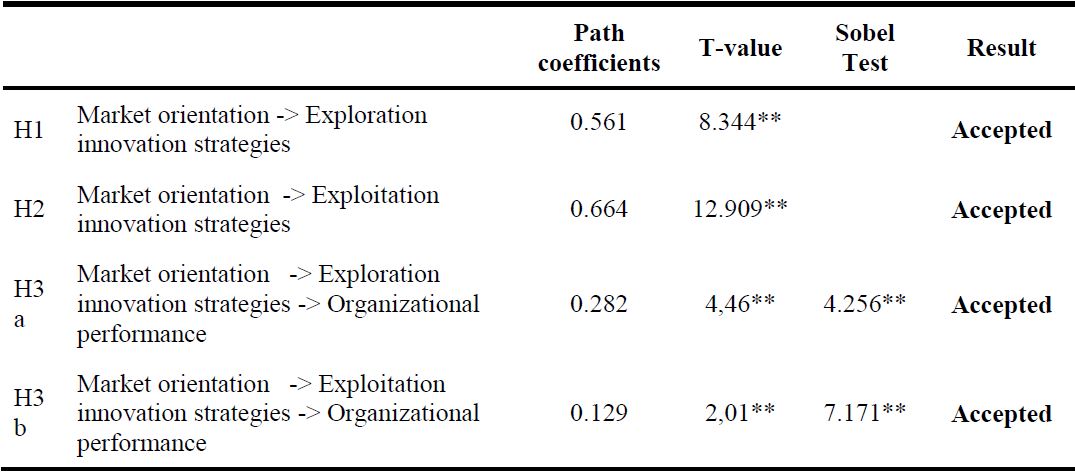
Table 4
Hypothesis test confirmations
**Significant values at the level of p ≥ 0.05 = 1.96.
As a way of proving the confirmation of hypotheses H3a and H3b, which presuppose mediation, the data were submitted to the Sobel test, which aims to verify this effect. The Sobel test compares the strength of the indirect effect of the independent variable versus the dependent (Sobel, 1982). The results of this test confirm the hypotheses H3a and H3b (see Table 4). Despite the result of the Sobel test confirming the mediation, for Preacher and Hayes (2004), this test presupposes a low statistical explaining power for cases of multiple mediations. Thus, the bootstrapping mediation test was performed using the macro process for SPSS elaborated by Hayes (2013), through model 5. In the chosen model it is possible to analyze the mediation of two mediators present in the same model. As the model of this study does not test the integration between them, this aspect was not considered. This test allowed the calculation of mediation compatible with Smart PLS (Hair et al., 2014). The results of this test for the hypotheses H3a and H3b are presented in Table 5.
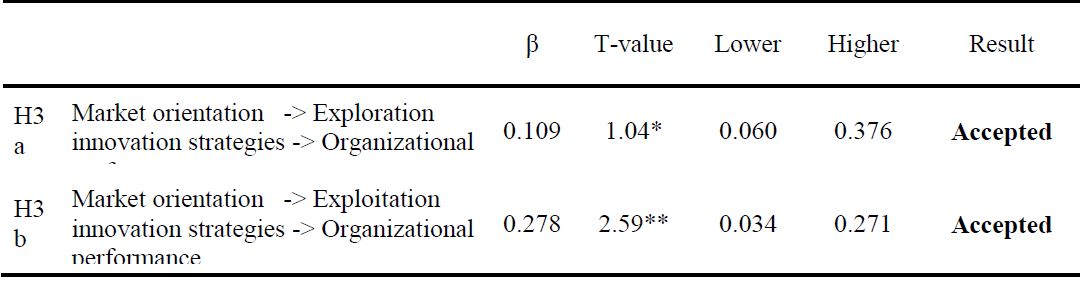
Table 5
Hayes test results
**Significant values at the level of p ≥ 0.001 = 1.96. *Significant values at the level of p ≥ 0.05 = 1.96. Bootstrap of 5.000 samples
Confirming the hypotheses of mediation, the confidence intervals were analyzed in this test (see Table 5). If there is no difference of signals in the lower and the higher results of the confidence intervals, this effect is considered significant (Hair et al., 2014). Thus, the hypotheses H3a and H3b can be confirmed by Hayes's test.
It is shown that the market orientation potentiates the innovation strategies of exploitation and exploration. Just as the influence of each of these relationships on organizational performance were confirmed in the sector of the food industry in Brazil.
CONCLUSIONS
This study has analyzed how market orientation influences organizational performance when exploration and exploitation innovation strategies act as mediators of this relationship. The confirmation that market orientation influences directly and positively exploration innovation strategies (H1) indicates that firms can opt for innovative strategies that seek to develop new products, processes, and markets (He & Wong, 2004) when they are market- oriented. With the confirmation of this hypothesis, this study corroborates with the results of previous studies. For authors, Tan and Liu (2014), in a context of market orientation companies are predisposed to carry out more innovative strategies of exploration, and the result found in this hypothesis support to this premise. The result of this hypothesis complements the proposal of Morgan and Berthon (2008) when confirmed that explorative innovation strategies positively and directly impact the market orientation. Also, this result is in accord with the study by Alpkan et al. (2012), which states that companies seeking to develop new knowledge, based on market orientation, develop innovation strategies designed to explore new markets, in other words, more exploitative. However, it is worth mentioning that Alpkan et al. (2012) did not test the hypotheses. Thus, the results of the study confirm that market orientation positively and directly influences exploration innovation strategies, indicating that, according to previous theoretical developments, a market-driven culture contributes to the innovations that can be considered a clear breakthrough to pre- established standards (Tan & Liu, 2014, Baker & Sinkula, 2007, Bennet & Cooper, 1981, Christensen, 1997). Consequently, the understanding of the market fostered by the customer orientation, competitor orientation, and the cross-functional coordination can favor the internal articulation for the response to the market, presents greater possibilities for the company to seek the new, supported by the knowledge of the customers' needs and competitors' strategies.
The confirmation of the hypothesis that market orientation directly and positively influences exploitation innovation strategies (H2) presents an indication that market-oriented firms can opt for innovation strategies aimed to enhance existing products and processes and the market which the company operates (He & Wong, 2004). The results of this hypothesis test corroborate the studies developed by Morgan and Berthon (2008) who argue that market orientation enhances exploitation innovation strategies, not the explorative strategies. For these authors, companies that recognize the competitive environment are more likely to undertake more reactive and incremental innovations, and so have tested only the impacts on the exploitation innovation strategies (Morgan & Berthon, 2008). This result complements the findings of Tan and Liu (2014), which showed that the market orientation from a proactive and responsive perspective had been shown to influence exploitation innovation strategies. However, Tan and Liu (2014) divided the market orientation construct, and thus analyzed only the impact of responsive market orientation on innovation strategies. Therefore, market orientation elements were not taken into consideration as in the present study. Alpkan et al. (2012), theoretically indicated that market orientation has a positive influence on exploitation innovation strategies because when a company knows its consumers and competitors, it can improve its exploitative innovation strategies. This finding also complements the study by Ngo et al. (2017), who showed that the ability to feel the market influences exploitative innovations and organizational performance. However, this study did not analyze the same perspective of market orientation proposed in this study. Therefore, this result supports the theoretical assumption that the knowledge of the competitor's activities can indicate that in the market- oriented companies the innovations are more incremental and therefore exploitative (Atuahene- Gima, 1995; Narver, Slater & Maclachlan, 2004).
In addition to this finding, it is worth emphasizing that organizational performance can be improved when a market-oriented company allocates correctly its resources to exploration and exploitation innovation strategies (Morgan & Berthon, 2008). It occurs because market orientation through market knowledge can enable the company to take an innovative approach (Hurley & Hult, 1998). Consequently, the company can invest in exploration and exploitation innovation strategies that generate results for the organization (Tan & Liu, 2014).
The hypothesis that market orientation influences positively organizational performance when mediated by innovation exploration strategies (H3a) was confirmed. Showing that market-oriented companies develop innovative strategies that seek to develop new products and processes for the market, as well as a better organizational performance (He & Wong, 2004; Han et al., 1998). Thus, this result did not correspond to the findings of Tan and Liu's (2014) study, which did not confirm the relationship between proactive market orientation and organizational performance when mediated by exploration innovation strategies. It could have occurred considering that the market orientation in the present study is analyzed as a single construct, whereas for Tan and Liu (2014) it was analyzed from a proactive perspective and may not have captured all the elements of the market orientation. This assumption can be proved because the results of this hypothesis are similar to those of the study by Morgan and Berthon (2008), who found a positive relationship between market orientation and exploitative innovation strategies. The hypothesis test results confirm that market orientation positively influences organizational performance when mediated by exploration innovation strategies.
The confirmation that market orientation positively influences organizational performance when mediated by exploitative innovation strategies (H3b) reveals that market-oriented firms also to improve organizational performance when implementing innovative strategies that seek to improve products, processes and the market in which the company operates (He & Wong, 2004). The findings of this hypothesis are also divergent from the result found by Tan and Liu (2014). For these authors, when analyzing the relationship of market orientation as responsive to exploitation innovation strategies and organizational performance, did not find a positive result (Tan & Liu, 2014). The result of the present study revealed a positive influence of market orientation on organizational performance when mediated by exploitation innovation strategies. Thus, there is an indication that market-oriented firms can pursue organizational performance by developing innovative strategies that address consumer needs through the development of existing products, processes, and markets (He & Wong 2004, Morgan & Berthon, 2008).
Concluding through previous studies, that market orientation positively influences also exploration innovation strategies as exploitation innovation strategies, and consequently organizational performance.
Theoretical contributions
In the introductory section two gaps to be mitigated were evidenced, when analyzing them empirically, this article made two contributions.
By empirically testing how much a market- oriented company can opt for exploration and exploitation innovation strategies, the results of this research respond to the first proposed shortcoming. Hence, it is possible to affirm that market-oriented companies can develop innovative strategies that aim to develop products, technologies, and existing capacities and to improve the current ones. In addition to contributing to the study of Alpkan, Sanaa, and Ayden (2012), when carrying out an empirical verification on the theoretical development of the authors. Likewise, in confirming these relationships, this study complements earlier studies, such as Tan and Liu (2014), which compared the effect of exploitative and exploitative innovation strategies on the relationship of market orientation to organizational performance. The findings of this study also complement the proposal of He and Wong (2004), who did not analyze the elements that precede the innovation strategies. Also, the findings of this study complement the research of Morgan and Berthon (2008) to prove that exploration and exploitation innovation strategies are positively impacted by market orientation.
The second contribution to the existing theory was the inclusion of exploration and exploitation innovation strategies in the already known relationship between market orientation and organizational performance. With this, the second gap evidenced in the introduction of this study was proved. Hence, the results found here can complement the findings of He and Wong (2004), when analyzing not only the relationship between innovation strategies and organizational performance but also the market orientation as an antecedent element of the relationship between innovation strategies and organizational performance. With this, it can be said that in market- oriented companies the organizational performance can be favored when there is an investment in innovation strategies, whether they are focused on improving products, technologies, and capabilities whether creating innovations beyond existing ones.
Management Contributions
Regarding managerial contributions, two main aspects stand out. First, by demonstrating that companies seeking market knowledge, through knowledge of competitors' strategies, customer understanding and the distribution of information between areas, innovative strategies can be developed and aimed to enter in new markets and new products. Also, the results indicate that market orientation allows companies to invest in innovation strategies aimed to improve the products, processes, and market in which the company operates.
Second, companies that use market knowledge and with these apply innovation strategies that encompass both aspects (developing new markets and products and improving products and position in the current market) can present a better organizational performance, involving aspects like financial and innovation policies. That is, when company managers gained the market knowledge and based on this information they invest in innovation strategies, the company can have a better financial result and innovation.
Limitations and Future Studies
During the theoretical survey and based on the results found, some aspects are seen to be considered limitations and therefore object of future research.
One of the limitations of this study is because of the analysis of the interaction between exploration and exploitation innovation strategies was not performed, which would allow the analysis of ambidexterity. Although it is a different assumption from this study, analyzing the ambidexterity in the innovation strategies would contribute to the understanding of how much the market oriented companies can boost their organizational performance, investing in one of the strategies and also in both. In this way, future studies can be directed to analyze the interaction between exploration and exploitation innovation strategies.
The replication of this study including other performance indicators, such as market, product, and marketing programs, is another limitation of the study. These indicators would allow the understanding of which performance aspects are most influenced by market orientation, exploration and exploitation innovation strategies, as suggested by Katsikeas et al. (2016). With this, future research can analyze other performance measures and analyze them individually.
Another limitation of the study concerns the research design, which in this case was quantitative. One suggestion would be to conduct qualitative research on the form of a case study, where it would be possible to verify the reasons why companies make choices when investing in an exploration or exploitation innovation strategy. In this way, an investigation is carried out that preserves the characteristics of the sector and helps the understanding of complex phenomena (Yin, 2005).
REFERENCES
ABIA - Relatório Anual 2015. Disponível em: http://www.abia.org.br/vsn/anexos/relatorioanualABI A2015.pdf. Acesso em 03/06/2016.
Atuahene-Gima, K. (1995). The influence of new product factors on export propensity and performance: An empirical analysis. Journal of International Marketing, 11-28.
Alpkan, L., Sanal, M., & Ayden, Y. (2012). Market orientation, ambidexterity and performance outcomes. Procedia-Social and Behavioral Sciences, 41, 461-468.
Atuahene‐Gima, K., Slater, S. F., & Olson, E. M. (2005). The contingent value of responsive and proactive market orientations for new product program performance. Journal of product innovation management, 22(6), 464-482.
Baker, W. E., & Sinkula, J. M. (2007). Does market orientation facilitate balanced innovation programs? An organizational learning perspective. Journal of product innovation management, 24(4), 316- 334.
Bennett, R. C., & Cooper, R. G. (1981). The misuse of marketing: an American tragedy. Business Horizons, 24(6), 51-61.
Bercovitz, J. E., & Feldman, M. P. (2007). Fishing upstream: Firm innovation strategy and university research alliances. Research Policy, 36(7), 930-948.
Bercovitz, J. E., & Feldman, M. P. (2007). Fishing upstream: Firm innovation strategy and university research alliances. Research Policy, 36(7), 930-948.
Christensen, C. M. (2002). The rules of innovation. Technology review, 105(5), 32-38.
Day, G. S. (1994). Continuous learning about markets. California Management Review, 36(4), 9-31.
Deshpandé, R., Farley, J. U., & Webster Jr, F. E. (1993). Corporate culture, customer orientation, and innovativeness in Japanese firms: a quadrad analysis. The journal of Marketing, 23-37.
ENKEL, Ellen et al. Exploratory and exploitative innovation: To what extent do the dimensions of individual level absorptive capacity contribute?. technovation, v. 60, p. 29-38, 2017.
Field, A. (2009). Descobrindo a estatística usando o SPSS-2. Bookman Editora.
Gatignon, H., Tushman, M. L., Smith, W., & Anderson, P. (2002). A structural approach to assessing innovation: Construct development of innovation locus, type, and characteristics. Management Science, 48(9), 1103-1122.
Hair, J. F., Anderson, R. E., Tatham, R. L., & Black, W. C. (2009). Multivariate data analysis 9th edition prentice hall. New Jersey.
Hair, J. F., Sarstedt, M., Pieper, T. M., & Ringle, C. M. (2012). The use of partial least squares structural equation modeling in strategic management research: a review of past practices and recommendations for future applications. Long range planning, 45(5), 320- 340.
Hair Jr, J. F., Gabriel, M. L. D. D. S., & Patel, V. K. (2014). Modelagem de Equações Estruturais Baseada em Covariância (CB-SEM) com o AMOS: Orientações sobre a sua aplicação como uma Ferramenta de Pesquisa de Marketing. REMark, 13(2), 43.
He, Z. L., & Wong, P. K. (2004). Exploration vs. exploitation: An empirical test of the ambidexterity hypothesis. Organization science, 15(4), 481-494.
Homburg, C., & Pflesser, C. (2000). A multiple- layer model of market-oriented organizational culture: Measurement issues and performance outcomes. Journal of marketing research, 37(4), 449-462.
Hurley, R. F., & Hult, G. T. M. (1998). Innovation, market orientation, and organizational learning: an integration and empirical examination. The Journal of Marketing, 42-54.
Katsikeas, C. S., Morgan, N. A., Leonidou, L. C., & Hult, G. T. M. (2016). Assessing performance outcomes in marketing. Journal of Marketing, 80(2), 1- 20.
Kohli, A. K., & Jaworski, B. J. (1990). Market orientation: the construct, research propositions, and managerial implications. The Journal of Marketing, 1- 18.
Kühne, B., Gellynck, X., & Weaver, R. D. (2015). Enhancing Innovation Capacity Through Vertical, Horizontal, and Third‐Party Networks for Traditional Foods. Agribusiness, 31(3), 294-313.
Langerak, F., Hultink, E. J., & Robben, H. S. (2004). The impact of market orientation, product advantage, and launch proficiency on new product performance and organizational performance. Journal of product innovation management, 21(2), 79-94.
Lowry, P. B., & Gaskin, J. (2014). Partial least squares (PLS) structural equation modeling (SEM) for building and testing behavioral causal theory: When to choose it and how to use it. IEEE Transactions on Professional Communication, 57(2), 123-146.
Malhotra, N. K. (2012). Pesquisa de marketing: uma orientação aplicada. Bookman Editora.
March, J. G. (1991). Exploration and exploitation in organizational learning. Organization science, 2(1), 71-87.
Morgan, R. E., & Berthon, P. (2008). Market orientation, generative learning, innovation strategy and business performance inter‐relationships in bioscience firms. Journal of Management Studies, 45(8), 1329-1353.
Narver, J. C., & Slater, S. F. (1990). The effect of a market orientation on business profitability. The Journal of marketing, 20-35.
Narver, J. C., Slater, S. F., & MacLachlan, D. L. (2004). Responsive and proactive market orientation and new‐product success. Journal of product innovation management, 21(5), 334-347.
Newman, A., Prajogo, D., & Atherton, A. (2016). The influence of market orientation on innovation strategies. Journal of Service Theory and Practice, 26(1), 72-90.
Ngo, Liem Viet et al. Effective sense-and-respond strategies: Mediating roles of exploratory and exploitative innovation. Journal of Business Research, 2017.
OCDE, E. (2005). La mesure des activités scientifiques et technologiques, Manuel d'Oslo, Principes directeurs pour le recueil et l'interprétation des données sur l'innovation.
Pallant, J. (2005). SPSS survival guide. Crow's Nest, NSW: Allen & Unwin.
Preacher, K. J., & Hayes, A. F. (2004). SPSS and SAS procedures for estimating indirect effects in simple mediation models. Behavior research methods, 36(4), 717-731.
Sobral, F., & Peci, A. (2008). Administração: teoria e prática no contexto brasileiro. Pearson Prentice Hall.
Song, X. M., Di Benedetto, C. A., & Zhao, Y. L. (1999). Pioneering advantages in manufacturing and service industries: Empirical evidence from nine countries. Strategic Management Journal, 811-836.
Subramanian, A., & Nilakanta, S. (1996). Organizational innovativeness: exploring the relationship between organizational determinants of innovation, types of innovations, and measures of organizational performance. Omega, 24(6), 631-647.
Tan, M., & Liu, Z. (2014). Paths to success: An ambidexterity perspective on how responsive and proactive market orientations affect SMEs' business performance. Journal of Strategic Marketing, 22(5), 420-441.
Tidd, J., Bessant, J., & Pavitt, K. (2008). Managing Innovation: Integrating.
Valle, S., Fernandez, E., & Avella, L. (2003). New product development process: strategic and organisational success factors. International journal of manufacturing technology and management, 5(3), 197- 209.
Vorhies, D. W., Orr, L. M., & Bush, V. D. (2011). Improving customer-focused marketing capabilities and firm financial performance via marketing exploration and exploitation. Journal of the Academy of Marketing Science, 39(5), 736-756.
Wang, E. T., Chiu, C. H., & Chen, E. (2015, January). Impact of IT Intellectual Capital on IT Explorative-Exploitative Innovation Strategy and Performance. In System Sciences (HICSS), 2015 48th Hawaii International Conference on (pp. 4266-4275). IEEE.
Yin, R. K. (2005). Estudo de caso: planejamento e métodos. Tradução Daniel Grassi.