Abstract: Natural reserve Huilo Huilo in the south of Chile is home to more than 80,000 hectares of temperate rainforest. After a long history of unregulated logging, since 1996, the area has been subject to a private conservation initiative. This includes tourist facilities with a unique architecture and variety of services, which have been recognized for promoting sustainable tourism, but are also facing various environmental and social challenges. This paper first reviews the context of national tourism, environmental development and sustainable construction, and then characterizes this reserve and the trajectory of interventions made therein. Subsequently, the building conditions and architectural configuration of the tourist resort and the visitor experience are examined. Various academic and public questions raised by the installation are explored, in particular regarding the conservation of the forest, the participation of local people, energy supply and consumption, and social segmentation, as well as the symbolism of Huilo Huilo´s architecture, spatial planning and building technology. Finally, the relationship between natural conservation and tourism management are discussed and the barriers and opportunities that these entail are examined.
Keywords:EcotourismEcotourism,Nature ConservationNature Conservation,Local developmentLocal development,Natural Reserve Huilo Huilo, ChileNatural Reserve Huilo Huilo, Chile.
Resumo: A reserva natural Huilo Huilo, no sul do Chile, abriga mais de 80 mil hectares de floresta temperada. Após uma longa história de exploração não regulamentada, desde 1996 a área está sujeita a uma iniciativa privada de conservação. Isso inclui instalações turísticas com arquitetura única e uma variedade de serviços, reconhecidos por promoverem um turismo sustentável, mas enfrentam vários desafios ambientais e sociais. Este artigo analisa, primeiro, o contexto do turismo nacional no Chile, o desenvolvimento ambiental e construção sustentável, caracteriza a reserva e a trajetória das intervenções nela realizadas. Posteriormente, são examinadas as condições de construção e configuração arquitetônica da estância turística e a experiência do visitante. Várias questões acadêmicas e públicas levantadas pela instalação são apresentadas, em particular no que se refere à conservação da floresta, à participação da população local, ao fornecimento e ao consumo de energia e à segmentação social, bem como o simbolismo da arquitetura de Huilo Huilo, o ordenamento do território e tecnologia de construção. Finalmente, é discutida a relação entre a conservação natural e a gestão do turismo e examinam-se as barreiras e as oportunidades que isso implica.
Palavras-chave: Ecoturismo, Conservação da Natureza, Desenvolvimento Local, Reserva Natural Huilo Huilo, Chile.
Artigos
Visiting Southern Forests: Architectural Imagery and Local Challenges in Huilo Huilo, Chile
Visitando Florestas do Sul: Imagens Arquitetônicas e Desafios Locais em Huilo Huilo, Chile
Universidade de Caxias do Sul
Received: 07 May 2017
Accepted: 26 June 2017
Eco-tourism and sustainable development - The nature reserve Huilo Huilo in the south of Chile encompasses more than 80,000 hectares of temperate rainforest, thus acting as one of the few areas in the world that preserves this kind of biome and its accompanying biodiversity. After a long history of deregulated logging, since 1996, the area has been subject to a private conservation initiative that includes tourism facilities with a unique architecture and variety of services (Fig.1). In addition to receiving other international acknowledgements, the reserve was recently recognized by the National Geographic 2015 World Legacy Awards for promoting sustainable tourism. However, it is also facing various environmental and social challenges.
Sustainable development implies the proper preservation of natural resources in a manner compatible with the population´s activities and growth (Brundtland, 1987). Tourism, which has progressively increased and diversified in supply globally, is particularly oriented toward natural places in which the population´s interests in knowledge and recreation must go together with environmental implications. It is from this relationship that the concept of eco-tourism has emerged (WTO, 2002), as well as many public and private initiatives that adopt this approach. They are primarily aimed at planning and carrying out environmentally responsible tourism activities that encourage greater social awareness of natural resources. Several works (WTO, 2002; Elbers, 2011; Drumm, Moore, Soles, Patterson & Terborgh, 2004) has studied relationships of eco-tourism to local development, building construction and preservation procedures, but this paper provides a novel review about mythical architecture and private management in southern Chile.
Chile´s unusual geography, emerging economy and social stability, in addition to very little tradition of conventional tourist destinations, have fostered the emergence of several unique kinds of visit and recreational enjoyment. From the southern tip of Patagonia, through the southern forests, along the central coast, to the arid northern desert and Easter Island, a wide range of landscapes and cultural contexts are on offer, with tourist establishments that differ in conditions and services.
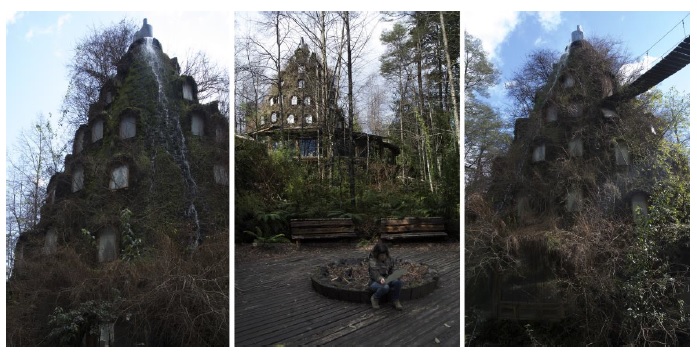
Figure 1
Views of Magic Mountain Hotel [waterfall in its façade, outdoor terraces and pedestrian bridge].
Foto Hernan Ascui Fernandez
Aim and Methodology - Through a case study of the Huilo Huilo nature reserve, this article aims to review a singular experience resulting from the express combination of the preservation of a vast and prodigious natural territory with a single tourist operation consisting of a variety of services with legendary architecture. This will be done in order to extract examples and conditions that can encourage the development of actions pertinent to the appropriate integration of both aspects for the generation of similar initiatives, especially in emerging countries.
This paper first reviews the context of national tourism, environmental development and sustainable construction, and then characterizes the Huilo Huilo reserve and the trajectory of interventions made therein. Subsequently, it examines the building conditions and architectural configuration of the tourist resort, which is composed of small, themed hotels; food services; a spa; cabins; and camping grounds. The reserve also boasts hiking trails, facilities for other outdoor activities, museums, and a sector dedicated to real estate development, and hosts cultural events. In particular, the visitor experience is explored in relation to the cultural and spatial conditions, and subsequent implications. Then, background information on this topic provided by the foundation and various academic and public questions raised by the installation are reviewed. These issues relate to forest conservation, the participation of local people, energy supply and consumption, social segmentation, the symbolism of the reserve´s architecture, and its spatial planning and building technology.
The research procedure involved the collection and analysis of documents on national and regional policies related to the topics of study, as well as documents about the case published in different sources, in order to review the local understanding of tourism and sustainable building, and reports of the facility according general concepts. Specifically, some written records were investigated about the history of the reserve, its goals and development, in addition to relations with the local community, which appear in publications edited by the Huilo Huilo foundation itself, independent authors and transcripts of meetings between authorities and representatives of the property. Moreover, a review of the architectural features was carried out using the establishments’ public relations documents, as well as visitor experience by direct visits by researchers with occasional interviews of tourists and residents of the area, and an open on-line survey. The information collected was synthesized and debated by the researchers to compare with other establishments and similar initiatives in Chile and abroad, as well as to verify the consistency of the reserve´s declared policies, regulations and principles.
The survey carried out for this research was based on a non-random convenience sample (Levine, Berenson & Krehbiel, 2006). Data was collected through an online questionnaire carried out during the month of August 2015. The survey consisted of a total of 18 structured questions with categorized valuations. The questionnaire was divided into three main sections. The first section refers to demographic information of the respondents [age, gender, country or area] and their level of familiarity with this kind of stay in protected natural areas [frequency of visit and last visit], in order to compare this information with previous studies (Roman & Nahuelhual, 2009). The second section collects information related to the particular stay in Huilo Huilo [date, duration, group, information media, accommodation], in order to relate this information to the evaluation of the visit. The third section seeks to collect data on the qualitative perception resulting from the visitors’ experience within the buildings [self-assessment of the expectations and the actual visit, appraisal of the services, relationship of the buildings with nature, originality, appraisal of the shape and quality of constructions, will to return and recommendation to others]. This section seeks to contrast the expectations generated before the visit, probably influenced by the extensive imagery that exists on the internet and print documentation, with the live experience. It also seeks to obtain their views regarding the main motivations that guided the architectural design process declared by the architect and owners, who aimed at connecting harmoniously with the woods, blending with the landscape and building a new and magical world through and organic and surrealistic architectural language (Petermann, 2011). The questionnaire ends by requesting comments about the experience and about the buildings. The study considered a target group of people who have stayed in the facility.
Tourism, environmental development and sustainable construction - In recent years, travel and tourism’s total contribution to the global economy has reached 9.5% of the global GDP; while in Chile it only represents 3.5% of the national economy (WTTC, 2014; SERNATUR, 2015). Nevertheless, there is high potential for increasing this figure by promoting sustainable tourism, as the country possesses large areas of natural landscape with high ecological value. The country has been promoted worldwide by the National Service for Tourism, SERNATUR, under the motto ‘Chile, naturaleza que conmueve’ meaning ‘Chile, nature that thrills’, thus demonstrating that there is a will to place nature at the centre of the country´s touristic assets. Both public and private protected areas for conservation are the focus of sustainable tourism, but also for the conservation of biodiversity in the country.
Most of the public effort has focused on the sustainable touristic development of wild areas protected by the state through SERNATUR. However, it is important to note that there are more than 308 Private Initiatives for Conservation in the country, which cover more than 1,600,000 hectares of land. One quarter of these overlap with territories of high ecosystemic value (Nuñez-Avila, Corcuera, Farías, Pliscoff, Palma, Barrientos & Sepulveda, 2013) and only 37% of these initiatives have a conservation management program. Huilo Huilo is one of the five largest private initiatives that together with Parque Tantauco, CA Diaguita los Huascoaltinos, Parque Pumalin and Parque Karukink cover more than 1,000,000 hectares.
Additionally, the state has shown explicit support for the development of sustainable buildings, mainly through the National Strategy for Sustainable Construction, which brings together the Ministries of Housing and Urban Planning, Public Infrastructure, Environment, and Energy in the design of actions for integrating sustainability in architecture and construction. In Chile, the building sector accounts for 33% of carbon emissions, 26% of energy consumption, 6% of water consumption and 34% of waste generated. Therefore, the actions that could be taken to bring about a more sustainable use of resources and waste could potentially have a high impact on these figures.
Most of the actions that have been taken to date have focused on energy efficiency in buildings through the improvement of the thermal envelope and on the integration of solar thermal technologies for the provision of hot water. It is possible to find some good examples of sustainable buildings both in urban and rural areas and with different emphases. While urban buildings are more high tech and promote energy efficiency and energy generation on site through more advanced technologies, in rural areas it is possible to find low tech buildings that make use of local materials such as earth and wood, in this way promoting self-building.
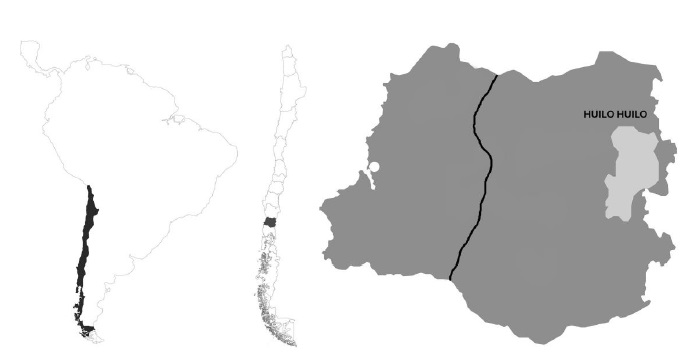
Figure 2
Location of Huilo Huilo reserve in Region de Los Rios, Chile
Os Autores
Huilo Huilo Reserve - Huilo Huilo nature reserve is a protected, private area located in southern Chile (Fig.2), with approximately 100,000 hectares of mostly temperate rainforest. As such, it acts as one of the few areas in the world that preserves this kind of biome and corresponding biodiversity (Teillier et al, 2013). The reserve is located at latitude 40° [39°51'S-71°57'W], approximately 800km southeast of capital city of Santiago, in the foothills of the Andes Mountains. The international road connecting the Region de los Rios [Rivers Region] with Argentinean Patagonia crosses Huilo Huilo and passes through the towns of Neltume and Puerto Fuy [Fig.3], where a barge carries passengers over Pirihueico Lake to the Hua Hum border crossing. The reserve extends north to the town of Liquiñe and south including the Pampa of Pilmaiquén and the east side of Mocho Choshuenco Volcano. Ranging in altitude from 400 to 1,800 m, area is home to a variety of flora and fauna, and has a humid, temperate, maritime climate, with an annual precipitation of 2,000 mm of rain and snow in winter.
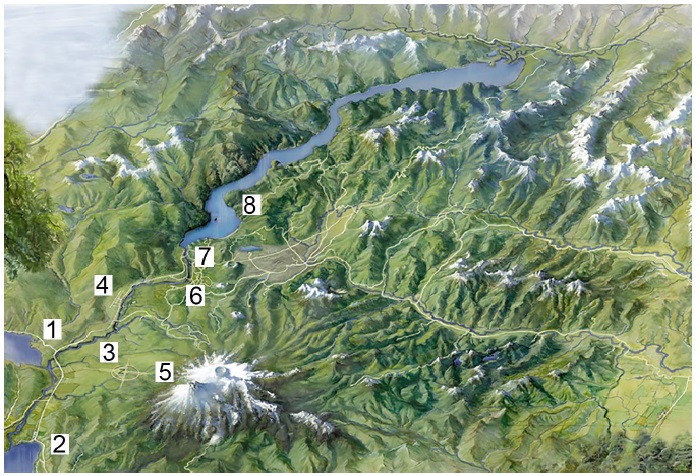
Figure 3
(1) Neltume Lake, (2) Panguipulli Lake, (3) Fuy River, (4) Neltume town (5) Mocho Choshuenco Vulcano , (6) Main public entrance to Reserve, (7) Puerto Fuy town, (8) Pirihueico Lake
Os Autores
In the late nineteenth century, the forest industry began to exploit this area and in the late twentieth century the property was acquired by the Panguipulli Forestry and Timber Company [COFOMAP], whose majority shareholders, a family of German descent, first formed a group of volunteer experts, and then a foundation to guide Huilo Huilo´s development as a biological reserve. In 2001, a café was built and in the following years joint activities were carried out with the educational establishments of the area, including training of tourism personnel and development studies. In 2004, the Montaña Mágica or Magic Mountain Lodge was constructed and the Botanical Garden built. The next year, the petrol-station, camping facilities and cottages were built. Also at this time, animal species began to be reintroduced. In 2006, the Huilo Huilo Foundation was established by law, specialized courses and cultural events began, and the ranger service was implemented. In 2008, Unesco declared a bi-national area of 5,000,000 hectares in the Patagonian Andean forest to be a biosphere reserve, the Baobab Hotel opened and the breeding of southern Andean deer began. In 2009, the Canopy Village and ski sports centre were installed.
The sector was recognized in 1998 as a Biosphere Reserve of Temperate Rainforests of the Southern Andes by the World Wide Fund for Nature [also known as the World Wildlife Foundation] and was included by the state in the National System of Protected Wilderness Areas [SNASPE], which was launched in 1984 and has been managed since 2005 by the Ministry of Environment´s National Environmental Commission [CONAMA]. Additionally, in December of 2003 the reserve was also included in the national biodiversity strategy, which was adopted in accordance with the United Nations Convention. At this time, it was selected in conjunction with Lake Neltume as a priority site for conservation in Chile. Additionally, in 2010 through Law 20,423, the reserve was included in the Seven Lakes Area of tourist interest that is managed by the Municipality of Panguipulli.
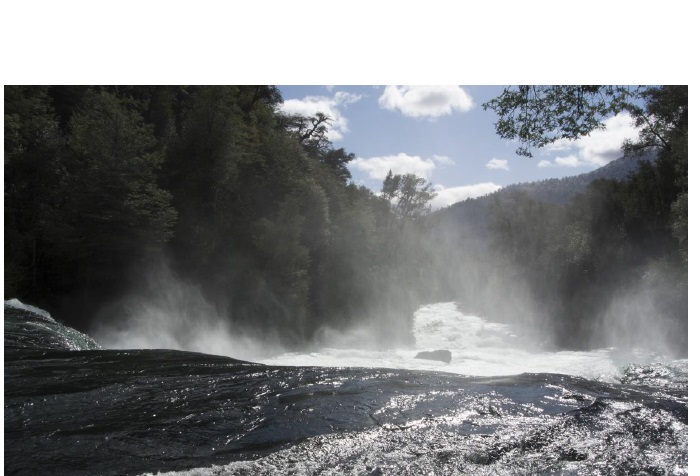
Figure 4
La Leona waterfall in the Huilo Huilo reserve
Foto Hernan Ascui Fernandez
Entrances to the touristic buildings and public places are located to the north and south of the international road, which runs parallel to the Fuy River. The main access for temporary visitors, that is, those that do not stay overnight, is located approximately 2 km west of the town of Neltume, with cafés, parks, shops and trails that reach the waterfalls La Leona in the Fuy River (Fig.4) and Huilo Huilo in Truful River. The major hotels and the first cabins are located about 5 km east of Neltume and 3 km before Puerto Fuy to the south. The sports fields, animal reserves and other cabins are located to the north in the same location. Further south, are the real-estate complexes that include 263 privately owned plots, about which there is little public disclosure.
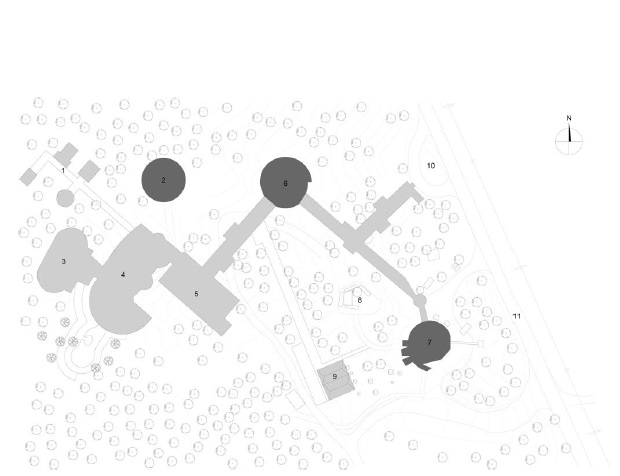
Figure 5
(1) Holistic Spa, (2)Reino Fungi Lodge, (3) Pool, (4) Lawenko Spa, (5) Conferences room, (6) Baobab Hotel, (7) Magic Mountain Hotel, (8) Hot Loogs, (9) Machine Room, (10) Main Entrance, (11) International Road.
Os Autores
Huilo Huilo Foundation is headed by a private owner with a council compose of voluntary members, and its management organization consists of four areas: conservation, management, social, and art and media, and has a labour force of 270 different officials and professionals. It focuses on three strategic areas: sustainable tourism, community and territory conservation. Its management and facilities have received numerous awards for their environmental and social contributions. In 2010, it received the Chilean National Tourism Service´s Green Seal and in 2011 was awarded the same recognition by the locations Center Huemul Conservation Project South and Conservation Project in situ, Toad of Darwin. Furthermore, in 2012, the Chilean tourism Federation bestowed Huilo Huilo with the prize for Most Sustainable Destination Chile, the reserve won the Virgin Holidays Responsible Tourism Award and the Deutsche Ecotrophea- Reiseverband [DRV], and became a member of the Long Run Initiative - Zeitz Foundation. In 2015, Huilo Huilo received a National Geographic World Legacy Award.
The nature of the architecture in Huilo Huilo´s buildings - The constructions for tourist services in Huilo Huilo reserve are distributed in different areas of the park according to a general plan of action that includes reforestation, research, preservation and controlled use areas. There are five sectors that house different buildings for tourism uses, which together seek to provide diversity to the experience of visiting and staying at the reserve and take advantage of the unique landscape features of each of these places. On the south side of the reserve are located the Montaña Mágica [Magic Mountain], Nothofagus and Baobab Lodges; mini-golf facilities; Lawenko Spa; and Nawelpi Lodge and the Forest Cabins in the main public access area. Across the road are the Petermann Brewery and mineral water company, the Canopy Village cabins, Deer Lookout, Boar Lookout, the Darwin´s Frog Information Centre, the camping area and the Volcano Museum. Café del Lago [Lake Café] and Marina Fuy hotel are located in Puerto Fuy. Finally, in the southern part of the reserve, on the other side of the Fuy River, there are three subdivision projects: the Renovales, Quebrada Honda and the Pudu [Fig. 5]. All buildings have a natural and mythological character with different aspects expressing their creator’s intention to keep visitors´ attention by causing feelings of surprise and expectation during one´s stay, in addition to a relationship with nature and the evocation of a mythical experience. The project´s emblematic works of architecture became a reality at different times [Montaña Mágica Hotel in 2004, Baobab Hotel in 2008] and are founded on sense of form that incorporates geometries inspired by the natural world, vernacular building techniques, and references to the world of dreams and children's fictional literature.
The Magic Mountain hotel owes its name to the title of the novel published by the writer Thomas Mann in 1924, but according to the architect Rodrigo Verdugo, officially the name has direct connections to the book Hijos del Bosque [Children of the Forest] by the Chilean writer, architect and illustrator Rodolfo Hoffmann. The requirement of the owner, Victor Petermann, consisted in the design of a grand water sculpture to provide accommodation for fishermen and tourists and serve as a marker in the landscape at one of the entrances to the reserve. For its construction, a metal structure was built to create a strong and stable volume, which after being waterproofed was covered with volcanic stones from Mocho Choshuenco Volcano. Subsequently, its entire surface was transformed into a large waterfall that has gradually incorporated the growth of shrubs and other local plant species. The hotel has fourteen en-suite bedrooms, three living rooms, a dining room for forty people, bar, kitchen, sauna, game room, bathrooms, laundry, three wine cellars, a service area and terraces. Rooms are organized according to the geometry of a large snail shape that coils out from a central steel column 1.6 m in diameter, which also surrounds water pipes and fireplace and ventilation ducts.
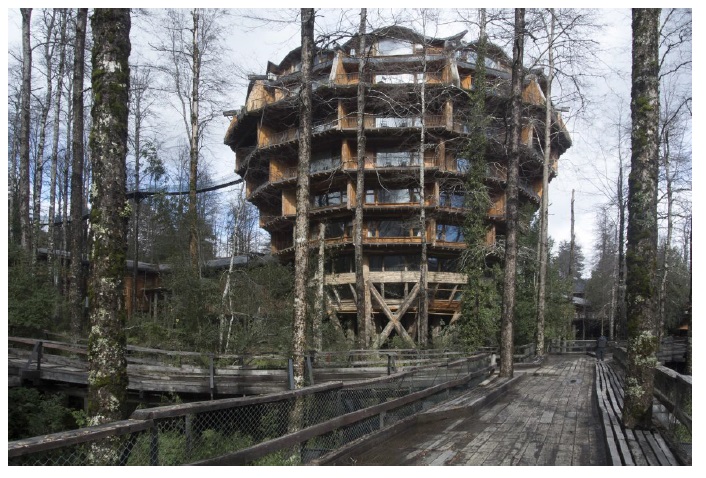
Figure 6
View of Baobab Hotel from the bridges
Foto Hernan Ascui Fernandez
The Baobab Hotel project [Fig.6] was born from the idea of inverting Montaña Mágica´s pyramid shape and alludes to a great tree and the exploration of new possibilities in the resulting interior space [Fig.7]. Thus, the upper rooms are more spacious and water runs inside a large, naturally lit, empty space, around which the guests circulate. The two hotels are connected via a bridge that forms a sizeable, air-conditioned room with large windows overlooking the forest, and also makes visible the flow of water from Montaña Mágica to the Baobab´s inner pool. Finally, on its roof there is a 360º terrace that makes it possible for guests to contemplate the reserve in its entirety. The hotel has 7 floors with 53 en-suite bedrooms and 2 premium, exclusive, duplex bedrooms; living rooms; an upper terrace with a café; a reading room; restaurant; kitchen; international bar; internet room; library; meeting room for 250 people; sauna; children's game room; laundry; mini-golf; and baths in ancient tree trunks with naturally heated water.
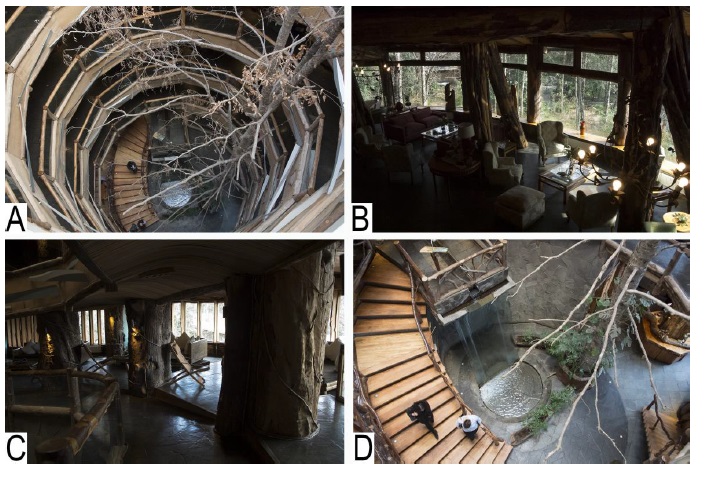
Figure 7
Indoors of Baobab Hotel (a) Central hall with daylighting for circulations to hotel rooms, (b and c) Dining rooms close to the hall, (d) Indoor waterfall coming from the Magic Mountain Hotel
Foto Hernan Ascui Fernandez
This complex and eccentric design's main objective is to blend with the landscape and build a new and magical world through a ‘surreal, organic’ language. This is reinforced by a series of wooden walkways that forms an impressive network of aerial walks with the firm purpose of upholding the state of wonder of the guests, who move from one building to another as if floating through the forest. The result is tremendously effective and builds a unique experience that seeks to involve the visitor and in an interwoven relationship with the place, based on emotionality and the fixing of significant memories in one´s memory. Alternately, it generates curiosity in many people who only go to the area to see the architecture that defies habitual logic, which has significant potential for economic stimulus in the region, and for the development of environmental education through the appreciation of this natural area and its protected species. However, this original formal proposal has some conditions that weaken the coherence of its conceptual discourse. Excess formal development and the magnitude of the interventions made have a major visual impact that ultimately influences the experience of staying in a natural forest. This occurs both in outdoor spaces surrounding the hotels as well as in the interior spaces intended to keep one´s attention on the spectacular spatial solutions and lush native wood interiors that divert attention from what is happening every minute in this fragile ecosystem.
Regarding the environmental strategies included in the interventions and the explicit desire to promote a respectful relationship with the forest, certain contradictions come to light. Questions fundamentally concentrate on the great constructive complexity that building´s final shape requires, which for example, obligate the use of large-sized steel parts in the primary structure, external manpower, and high impact heavy equipment. The sustainable spirit is regained in the secondary structures and woodwork that are built with local labour and hence take advantage of the experience and knowledge of resident carpenters who are accustomed to skilfully working woods native to the area with local techniques.
Likewise, efforts to incorporate energy efficiency strategies such as the cooling of the volcanic rock that extends over the entire Montaña Mágica Hotel with the natural waterfall that covers the building; taking advantage of the natural light in the great, open, central column that traverses all floors of the Baobab Hotel; or the construction of a small run-of-the-river hydroelectric power station inside the park to supply energy in the buildings. However, it is clear the hotels demand an enormous amount of energy due to their scale, complexity of form, and comfort requirements. By insufficiently committing to the incorporation of bioclimatic strategies from the moment of the project´s conception, and with little possibility of achieving acceptable levels of airtightness given the rustic wood solutions, the sustainability discourse is substantially weakened in the energy area.
Currently, there are several certification tools that help to deliver buildings that fulfil sustainable requirements in terms of energy, emissions, wellbeing of the occupants, water, biodiversity, etc. The most internationally well-known is Leadership in Green Building [LEED], which has become very popular in Chile, particularly with office buildings. A large number of lodging projects have been certified by LEED across the world, and it has recently incorporated an Hospitality module, specially devoted to this type of building. In Chile, the Certificate for Sustainable Buildings [CES] has been developed to certify buildings in terms of comfort, energy consumption, etc. There are some contestable aspects of these certification tools, but they certainly require building projects to achieve several performance tasks, which help to deal with sustainable criteria by quantifying performance. By contrast, in this case study there is no evidence that the buildings achieve certain environmental sustainability tasks and simple observation of the buildings rise questions regarding their energy performance.
Visitor experience - Previous studies on the characterization of visitors to Huilo Huilo Park (Roman & Nahuelhual, 2009) highlighted their national origin, lower age and higher income in comparison with visitors to other national parks, which receive more regional and older guests with more diverse incomes. This also contrasts with the general impression and statistical records demonstrating older foreign visitors to establishments connected to nature reserves, although the study mentioned focused on day visitors.
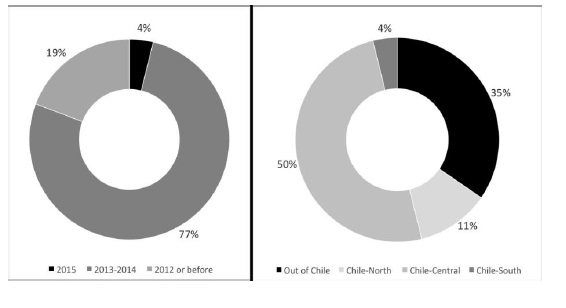
Figure 8
Results of the survey (a) year of visit, (b) nationality of visitors
Os Autores
The survey was sent to a universe of 50 visitors, getting 26 responses. The responses according to geographic origin [Fig. 8] reveal the predominant presence of Chilean nationals [65%, mostly from the central region] and secondly, foreigners [35%], and a higher age segment [80.77% from 26 to 50 years, and 15.38% over 50 years] was observed. Nonetheless, upon enquiring about the period of stay, it was discovered that most guests visit more than two days and stay at a hotel or cabins, that is, they are overnight visitors to the establishment contrary to the previously mentioned study. This reveals that tourists with longer stays are even more geographically diverse in origin (although, the majority is also from Chile), but differ in their greater age, probably because of the financial ability to remain. It should be noted that the Roman and Nahuelhal (2009) study highlighted the increased educational level of day visitors to Huilo Huilo, which in turn is consistent (unfortunately) with the greater income level and age of tourists that stay, and in both cases shows motivation based on knowledge and commitment to the environment.
The survey specifically gathered information on visitor perception of the quality of services, buildings and experience in relation to the natural environment, and took into consideration that it was completed sometime after the visit [one to three years in most cases], unlike the previous enquiry, which was carried out in the same place. The survey indicates how previous expectations about the experience change from positive to very positive [although they may be influenced by hindsight]: perception of building form and originality, as well as their relationship with nature were consistently high, and services and construction quality were only slightly weaker [Fig. 9]. This is also consistent with interviews and spontaneous conversations with visitors, although professional opinions tend to be more critical about the mythical configuration of the architecture, which is sister to the fantasy of theme parks.
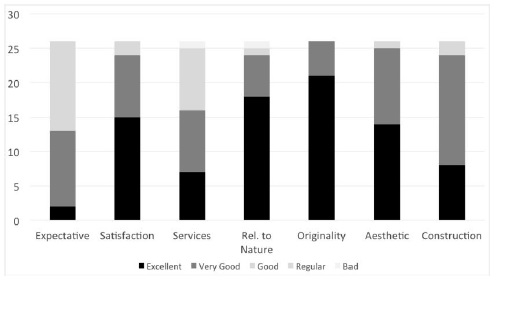
Figure 9
Results of the survey about appraisal of installations
Os Autores
The last two questions related to the will to return and if they would recommend Huilo Huilo to others achieved a high amount of positive answers [Fig.9]. These results suggest a great accomplishment of the activity planned and the role that the facilities play in the relationship with nature. Therefore, the surveys essentially reveal visitor satisfaction in relation to the tourism experience offered and in particular with the architectural design of buildings, which in both cases are oriented to an experience of the natural environment. This contributes to the environmental awareness of the population through recreational activities, although it must be recognized that the experience´s scope is limited to a range of educated visitors with financial resources, and by the availability of the infrastructure.
Local questions raised - Huilo Huilo raises some important questions regarding sustainable tourism. It publically reflects an integrated approach to sustainability that covers ecological, social and economic dimensions, all of which have downsides (Petermann, 2001; Navarro & Corcuera, 2002; FHH, 2009). The main concerns relate to the relationship between Huilo Huilo and the local community, as this very large area of land is privately owned and most of the local people of Neltume work for the reserve, with little opportunity for entrepreneurship due to no public access to some tourist attractions and lack of seed capital. Local people can only undertake new business in the Lake Pirihueico sector, such as kayaking or beach-related activities, or in the town of Neltume, such as restaurants and hostels. There are also issues regarding the availability of water for residents during the tourist season [summer] due to the high influx of tourists in the reserve. It is evident that Huilo Huilo has significantly boosted tourism in the area, but the locals have seen little impact on their quality of life.
The Foundation has also invited various scientists to participate as technical consults for nature conservation and support for specific studies on existing species. Furthermore, the Foundation has collaborated with independent organizations and indigenous communities in environmental planning analysis (Red de Organizaciones Ambientales de Panguipulli, 2013). Alternately, the municipal authorities in the area have held meetings with Foundation representatives in order to understand park´s development and tourist services (Municipalidad de Panguipulli, 2014). They present concerns about: the magnitude of logging and the installation of hydroelectric stations [although both matters are managed through regional services], wages, recruitment and training of local labour, lower entrance fees for locals, and the foundation´s contribution to and coordination with social development and new tourism initiatives. In response, the Foundation representatives have presented individual plans and partnerships.
Concerning the architecture, the buildings show a new imagery world that was developed specifically for this project in an attempt to reflect a new relationship between architecture and nature, particularly though organic building shapes that blend into the landscape. The buildings make use of local materials, mainly wood and volcanic stone obtained from the site, although the main structure is generally steel. The drawback of the buildings is the thermal envelope possesses many infiltration gaps due to the lack of skilled carpenters to deal with these complex building forms. Local climate is relatively harsh in winter, so thermal comfort can only be achieved by high energy consumption.
Management and conservation - The Huilo Huilo reserve is a combination of nature conservation and tourism, run by a private enterprise with limited government regulation (Elbers, 2011). It has a single manager that controls a vast territory and balances environmental protection and economic sustainability goals, while seeking both public outreach and local participation. However, limitations are apparent in the management of its natural resources without sufficient technical support and subject to private administration, along with its social scope, which restricts the number and kind of visitors, apparently according to profitability. Although income segmentation is common with tourists in protected natural areas [including a number of privileges for visitors of high economic class], in this case the limited development of the local community and poor supply of complementary services is apparent. Together with the confrontation of different participants, this generates a sense of restriction for the extent of the managed area. Nevertheless, the private management´s focus has also guaranteed the architectural setting and quality of the visitor experience, which are reflected in both the perceptions recorded and the awards received.
These initiatives have the power to serve as models for private involvement in conservation and ecotourism, as well as for global awareness of the ecosystem and places of high natural value (Tiffin, Torres & Neira, 2008). However, it is not possible to completely verify the effective benefits of preservation, local participation, public outreach or profitability, because the private manager concentrates the administration on this combination of factors. Neither is it possible to predict whether more government regulation can stimulate or discourage similar initiatives. At the least, a wide-ranging expression of nature conservation occurs.
The limits of a private-owned model for ecotourism has been previously expressed by the OEA (Roldban, 1993), like difficult access to funding, few commitment to long-term conservation; eventual sacrifice of preservation for profit, and weak participation in regulations. This case shows few evidence about these issues, instead more questions related to local development. The experience of Huilo-Huilo looks also motivation for natural conservation chained with profit to get economic viability in order to provide an innovative eco-tourism offer. This model is increasing in developing countries and Chile in particular [5], although it demonstrate weak state planning and/or few participation of NGO, that could be act like as facilitators between players in the ecotourism context (Drumm et al, 2004).
This paper has reviewed the development of tourism in Huilo Huilo reserve in order to characterize the compatibility of nature conservation with economic management and environmental outreach based on the concept of ecotourism. It focused on the private management model and configuration of the buildings with a mythological architecture. Normative and conceptual considerations were reviewed, as well as the implementation strategy, visitor experience and implications for the local community. The existence of a unique project in a vast territory with high biodiversity and limited tourist facilities controlled by the private manager was demonstrated, although there are tensions regarding local development, environmental consistency and public outreach.
The development of Huilo Huilo reserve also expresses a clear and permanent private dedication to the proper maintenance of the natural environment. It enables visitors to have a significant, relational experience with original biodiversity, through legendary architectural features that evoke the mythical legends of childhood. However, form and construction excesses may threaten the environmental experience. Finally, it is concluded that territorial planning and social consciousness can contribute to an interconnected and emerging vision of sustainable tourism together with private entrepreneurship. This relationship is visible in certain conditions of this facility, in the diversification of services and architectural expression. However, the social diversity of visitors should increase, as well as the commitment to nature, and effective and extensive environmental preservation actions and outreach efforts should be made. Local regulations, as well as NGO’s participation could contribute to balance these private-owned initiatives.
Figure 1
Views of Magic Mountain Hotel [waterfall in its façade, outdoor terraces and pedestrian bridge].
Foto Hernan Ascui Fernandez
Figure 2
Location of Huilo Huilo reserve in Region de Los Rios, Chile
Os Autores
Figure 3
(1) Neltume Lake, (2) Panguipulli Lake, (3) Fuy River, (4) Neltume town (5) Mocho Choshuenco Vulcano , (6) Main public entrance to Reserve, (7) Puerto Fuy town, (8) Pirihueico Lake
Os Autores
Figure 4
La Leona waterfall in the Huilo Huilo reserve
Foto Hernan Ascui Fernandez
Figure 5
(1) Holistic Spa, (2)Reino Fungi Lodge, (3) Pool, (4) Lawenko Spa, (5) Conferences room, (6) Baobab Hotel, (7) Magic Mountain Hotel, (8) Hot Loogs, (9) Machine Room, (10) Main Entrance, (11) International Road.
Os Autores
Figure 6
View of Baobab Hotel from the bridges
Foto Hernan Ascui Fernandez
Figure 7
Indoors of Baobab Hotel (a) Central hall with daylighting for circulations to hotel rooms, (b and c) Dining rooms close to the hall, (d) Indoor waterfall coming from the Magic Mountain Hotel
Foto Hernan Ascui Fernandez
Figure 8
Results of the survey (a) year of visit, (b) nationality of visitors
Os Autores
Figure 9
Results of the survey about appraisal of installations
Os Autores
