Artigos
Recepción: 30 Mayo 2021
Aprobación: 16 Agosto 2021
DOI: https://doi.org/10.18226/21789061.v13i4p29
Abstract: This article will explore the use of technology in smart cities for the development of Halal Tourism[i] during the Covid-19 pandemic in Indonesia. The function of technology for Halal Tourism services can be utilized for the prevention and transmission of Covid-19 and for realizing changes in the tourism system that are integrally developed with aspects of public health. The method in this article uses content analysis techniques that are based on written or visual material with the main content sourced from journal articles indexed by Scopus and WoS, then operationalized by determining the aims and objectives of the research, compiling the latest content, analyzing content, comparing results analysis, refine results, and conclude findings. This article concludes that smart cities can improve services rapidly to the public in accessing information about Halal Tourism and help control and manage the Covid-19 pandemic in tourism places by increasing detection, mitigating outbreaks, and making effective decisions when situations are critical. Social protection and economic stimulus by the government for tourism actors affected by Covid-19 and technological innovations such as virtual tourism as new services in developing local tourism potential are solutions to new normal conditions while preserving the values of Indonesia's cultural heritage.
Keywords: Tourism, Covid-19, Halal Tourism, Smart City, Indonesia.
Resumo: Este artigo analisa o uso de tecnologia por cidades inteligentes, para o desenvolvimento do Turismo Halal durante a pandemia Covid-19, na Indonésia. A presença da tecnologia nos serviços associados ao Turismo Halal pode auxiliar na prevenção à transmissão do Covid-19 e na realização de mudanças no sistema turístico, que são desenvolvidas integralmente em termos de saúde pública. Neste artigo, o método inclui a Análise de Conteúdo de materiais visuais ou escritos, provenientes de artigos em periódicos indexados nas bases Scopus e WoS, operacionalizados a partir os objetivos e metas da pesquisa. A seguir os dados coletados mais recentes foram compilados, comparados e analisados; a análise refinou os resultados, concluindo-se com os principais achados da pesquisa. Neste artigo conclui-se que as cidades inteligentes podem qualificar os serviços oferecidos ao público, através do acesso rápido a informações sobre o Turismo Halal, e assim contribuindo com o controle e gerenciamento da pandemia Covid-19 em locais turísticos, aumentando a detecção, mitigando surtos e tomando decisões eficazes quando as situações são críticas. A proteção social e o estímulo econômico do governo para com os atores do turismo afetados pela Covid-19 e as inovações tecnológicas, como o turismo virtual e os novos serviços no desenvolvimento do potencial turístico local, são soluções para quando das novas condições normais, e para preservação dos valores do patrimônio cultural indonésio.
Palavras-chave: Turismo, Covid-19, Turismo Halal, Cidade Inteligente, Indonésia.
INTRODUCTION
Studies on smart cities and tourism during the Covid-19 pandemic are quite important as part of technological advances implemented in the development of the tourism industry. Some researchers note that smart cities emphasize digital-based forward-looking technology solutions (Wiig, 2016); develop human and social capital through dedicated business and industry (Angelidou, 2017); develop social inclusion with the participation of everyone from various backgrounds (Shelton & Lodato, 2019); build new cities with new infrastructure with rich and distinct urban arrangements (Allam & Newman, 2018); and have physical infrastructure and legislation that supports economic development, ensures social inclusion, and enables environmental protection (Eremia, Toma, & Sanduleac, 2017). This sustainable, inclusive, and prosperous city promotes a human-centered approach (Olokesusi, Aiyegbajeje, Mboup, & Mwaniki, 2017).
At the time of the Covid-19 pandemic that is currently sweeping the world globally, studies on smart cities have almost no meaning when faced with the problem of disease transmission and the massive spread of the virus to humans due to the coronavirus. This encourages the latest research that can take advantage of smart cities for the benefit of prevention, distribution, and fulfillment of the daily needs of everyone in cities that are experiencing a deadly pandemic. If a smart city is the main part of a city that provides sophisticated technology with a variety of products (Allam, 2019; Allam & Jones, 2020) and has a social development dimension that includes education, health, social inclusion, social capital, population dynamics, and other variables (Mboup, 2017).
Covid-19 has rapidly affected everyday life, business, disrupting trade, and world movement [Figure 1] (Haleem, Javaid, & Vaishya, 2020). The impact of the massive and alarming spread of COVID-19 in cities is causing the tourism industry to experience a global crisis (Uğur & Akbıyık, 2020), destroying and damaging the local tourism economy (Rogerson & Rogerson, 2020), hotel marketing and hospitality management practices (Jiang & Wen, 2020), threatening the safety and welfare as well as the costs incurred due to the cessation of tourism activities (Qiu, Park, Li, & Song, 2020), creating public panic which causes a decline in demand for the tourism industry from the international travel sector, lowering gross domestic product (GDP), total employment, and the economic trade balance (Bakar & Rosbi, 2020; Mariolis, Rodousakis, & Soklis, 2020), especially the three main tourism stakeholders, namely tourism demand, supply and destination management organizations, and policy makers (Sigala, 2020), so that the facts of public health, urban tourism, and the three stages of COVID-19 are m encompassing response, recovery, and rearrangement by stakeholders is a major concern of the world community.
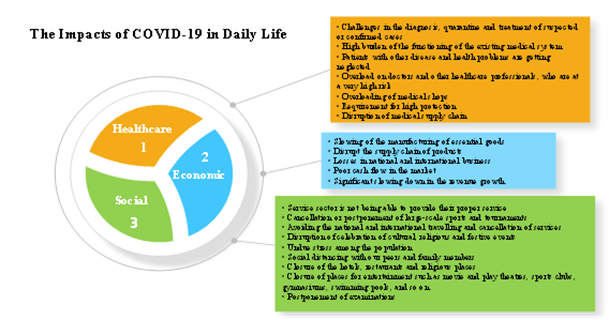
Figure 1
The impact of Covid19 in daily life
Modified from Haleem et al. (2020).
The development of smart cities in Indonesia aims to maximize the use of technology that can develop smart city destinations in the form of the ability to bring in tourists, attract investors to invest in the city, and attract new residents from various circles (Winarno, 2017). The development of this smart city is also expected to contribute to preventing and reducing the spread of Covid-19. In this case, tourism in Indonesia until 2019 has become the second-largest contributor to foreign exchange, namely 15 billion US dollars, under crude palm oil (CPO) which reached 17 billion US dollars. This is supported by infrastructure development such as airports and toll roads to facilitate access for foreign tourists visiting tourist destinations in Indonesia (Jaelani, 2017) which have events, festivals, and local wisdom in the regions (Jaelani, 2016; Jaelani, Setyawan, Aziz, Wahyuningsih, & Djuwita, 2020). This momentum is important to develop a smart city that supports the halal tourism industry in the midst of the COVID-19 pandemic.
In the halal industry, travel and tourism activities were initially to fulfill Hajj or Umrah trips (Kamali, 2012), then this type of industry began to develop in the financial and banking sectors, food, clothing, recreation, media, cosmetics, and pharmaceuticals (Muhamed, Ramli, Abd. Aziz, & Yaakub, 2014). This halal industry refers to Islamic values to meet the needs of products and services (Rahman, Tareq, Yunanda, & Mahdzir, 2017) and the existence of “halal” certified products to provide assurance to consumers about product ingredients and production processes in accordance with Islamic law (Yunos, Mahmood, & Abd Mansor, 2014).
All sectors of the halal industry are starting to develop with the support of digital technology in increasing economic growth, including the development of smart cities that support the sustainability of the halal industry. The halal industry offers opportunities for product and brand expansion with a special marketing approach and presents opportunities to create new ones (Wilson, 2014) for every country inclusively not only for Muslims or the majority of Muslim countries. This is evidenced by Thailand's success in exploring the development of the halal industry as the largest exporter of halal-certified food and products in the Southeast Asia region (Nawawi, Abu-Hussin, & Faid, 2019).
Halal tourism as part of the halal industry is one type of tourism that supports a new growth sector in the global economy which is starting to be of interest to many countries, such as in Asia, the Middle East, Europe, and America (Manan, Abd Rahman, & Sahri, 2016; Elasrag, 2016), despite the expansion and standardization of the market for halal products and services, there are political, social and economic contestations and differences (Bergeaud-Blackler, Fischer, & Lever, 2015). However, the Covid-19 pandemic is expected to result in an 8% decline in Muslim spending between 2019 and 2020 in the Islamic economic sector. Meanwhile, Muslim spending on travel is expected to fall from $ 194 billion in 2019 to $ 58 billion in 2020. Muslim spending on other sectors, such as food, clothing, media, and recreation is expected to decline as well. Some of the top exporting countries in the world have been badly affected by Covid-19. Manufacturing, production, and logistics have been disrupted affecting global supply chains (Thomson Reuters, 2020).
This article will explain the development of smart cities and the halal tourism industry during the Covid-19 pandemic in Indonesia. Smart cities that optimize technology functions for halal tourism services, while also providing solutions in the prevention and transmission of Covid-19 for surrounding communities who have tourism destinations and guarantee their health and well-being (Kunzmann, 2020; Allam & Jones, 2020; Allam & Jones, 2021; Sonn & Lee, 2020) amidst the current decline in global tourism. In the end, the development of smart cities and halal tourism can bring about changes in the tourism system for the sustainability of the city and tourist destinations themselves which are integrally developed with aspects of public health (Butler, 2020; Koh, 2020).
LITERATURE REVIEW/SMART CITY, HALAL TOURISM, AND COVID-19
Smart City System, Tourism, and Prevention of the Spread of Covid-19 - Cities as centers of economic activity and growth drivers that generate wealth and prosperity (Gracia & García, 2018) are transformed into smart cities with urban-based technological innovation and positive change through ICT (Hollands, 2008) with efficient urban service production (Comstock, 2012; Campbell, 2012). Smart cities as cities of learning or connecting their knowledge with creative cities (Florida, 2010), have smart communities (Paquet, 2001), share data in cities (Bates & Friday, 2017), and are expected to become green cities or smart green cities (Beatley & Newman, 2013; Joss, Cowley, & Tomozeiu, 2013) that growth and sustainability meet its own needs (Gracia & García, 2018).
The smart city system associated with safety or security aspects, as detailed by Lacinak and Ristvej (2017), includes smart transportation, smart energy, smart technology, smart life, smart environment, smart citizens and education, smart economy, smart government, and cities. safety. More details can be seen in Figure 2 below:
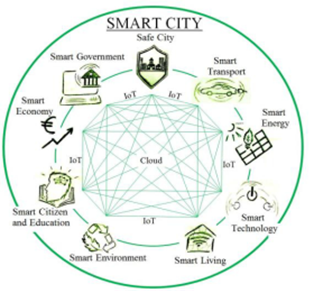
Figure 2
System of smart city
Lacinak and Ristvej (2017)
A smart city has 14 characteristics, namely competitiveness, knowledge-based economy, reactivity and innovation, formation of innovation clusters, innovation through networks, Internet of Things [IoT], sharing economy, mutual cooperation between companies, research institutions, and citizens, entrepreneurship, job creation, social responsibility, green economy, triple helix model in which government, business, and academics have changed roles, and the use of ICT (Kumar & Dahiya, 2017).
The use of technology through smart cities can be applied to develop the tourism sector as well as to detect and reduce the spread of Covid-19 in maintaining global public health. Smart cities are created to solve contemporary urban problems and technology with the ability of spontaneity to solve related problems (Glasmeier & Nebiolo, 2016), to enhance and add value to the tourist experience and improve the quality of life of residents with the support of technology that provides information about destinations, makes reservations, and sharing travel experiences on social networks (Ramos, Andraz, & Cardoso, 2020), and to take advantage of internet-based technology and business models that can generate evolution in digital tourism through innovation and interconnection of products and services (Saura, Reyes-Menendez, & Palos-Sanchez, 2020).
Smart cities that rely on the use of information technology [IT] can develop innovative tools that provide opportunities for marketers and tourist destinations to expand tourism products and tourism experiences into the realm of virtual tourism [VT] (Ankomah & Larson, 2019), even IT and social media applications are utilized on airlines, travel brokers, accommodation, food services, destinations, events, and entertainment. The results of this research have proven that the tourism experience during the Covid-19 pandemic is obtained through virtual reality [VR]. This IT application serves information needs in travel and tourists can make decisions before, during, and after their trip (Benckendorff, Xiang, & Sheldon, 2019).
The development of smart cities on a global scale is in line with real relational changes in urban and economic geography (Tranos & Gillespie, 2011). The global city is not a place but a process in the production and consumption centers that are connected in a global network (Castells, 1996), because the world city is a value-based value-producing complex, it is connected in a production and management network, and a flexible production model facilitated by the concentration of production and management networks in the core cities and their hinterlands. However, smart cities must be sustainable, conserve resources, and resilience, and develop an economy that is suitable for their respective places (Kumar & Dahiya, 2017).
During the current Covid-19 pandemic, researchers have a big challenge when people experience a global health emergency in building a smart city network (Kunzmann, 2020). Smart cities can be used to improve the standardization of health protocols, especially by sharing data about outbreaks or disasters (Allam & Jones, 2020; Allam & Jones, 2021), maximizing technology for disease surveillance and control (Sonn & Lee, 2020), increasing effectiveness and efficiency. tracing patient contact with technology on urban infrastructure, human mobility, and local government administration (Sonn, Kang, & Choi, 2020), and mitigating the risk of Covid-19, reducing the impact, or minimizing the impact of a pandemic (Jaiswal, Agarwal, & Negi, 2020; Costa & Peixoto, 2020).
In its implementation, digital technology in smart cities can inform the use of masks to everyone in public places through the city network's Closed-Circuit Television [CCTV] cameras to reduce the spread of Covid-19 through the health care system (Rahman, Manik, Islam, Mahmud, & Kim, 2020), in addition to social protection measures, such as social distancing, lockdowns, border closings, and tracking of people who have confirmed this disease (Kang, Choi, Kim, Lee, Lee, Park, Park, & Seo, 2020). During the Covid-19 pandemic, restrictions were imposed on travel and the fear of tourists and local residents with the transmission of this disease (Butler, 2020), so the application of digital technology in smart cities is very useful in presenting Covid-19 literacy and its dangers, as well as its application in online learning (Olmos-Gómez, Luque-Suárez, Mohamed-Mohamed, & Cuevas-Rincón, 2020).
The industry needs to plan tourism recovery and rebuilding with greater consideration for customer biosecurity with the increased incorporation of automation technologies (Ivanov, Webster, Stoilova, & Slobodskoy, 2020). New social norms must also be applied by maintaining personal hygiene and maintaining safe distances when tourists begin to revisit tourism destinations and attractions (Koh, 2020). The use of technology also needs to be done together with medical care or health care to make the response more effective and reduce the risk of spreading the disease (Shaw, Kim, & Hua, 2020).
Smart City for Development of Halal Tourism during the Covid-19 Pandemic - The development of a smart city for tourism lies in creating a single cloud-based architecture for the management of various multi-media content, to be exploited on multiple platforms, the design of a unique content management system used by several small cities in the same area, preferences, and monitoring needs of users by collecting data. user-generated, and meaningful statistical analyzes of travelers, were tested and verified in real scenarios with real users (Pierdicca, Paolanti, & Frontoni, 2019). In smart cities, the application of blockchain can be utilized in the tourism sector as a network-based technology that will have a significant impact on the tourism industry (Nam, Dutt, Chathoth, & Khan, 2019). Likewise, smart cities can be used for the development of halal tourism, because this type of tourism can be an industrial alternative on a global scale (Samori, Salleh, & Khalid, 2016). Halal tourism is closely related to religion [Islam] which can be conceptualized as a continuum based on the intensity level of inherent religious motivation (Smith, 1989), or another extreme form known as sacred pilgrimage (travel driven by faith, religion, and spiritual fulfillment). and to satisfy personal interests or spiritual needs through tourism (Smith, 1992).
In halal tourism, the term ‘halal’ refers to everything that is ordered in the teachings of religion and the basis of behavior and activities of Muslims (Baskanligi, 2011), anything that can be consumed according to the holy book Al-Quran or the Hadith of the Prophet (Gulen, 2011), a motive which is very specific to maintaining religious sanctity, maintaining an Islamic mentality, preserving life, protecting property, protecting future generations, supporting dignity (Jaelani, 2017), or belief systems, ethical-moral codes, and integral to everyday life, such as speech, behavior, clothing, food consumed, and how to eat (Ijaj, 2011). So, halal tourism is the same as other types of tourism, while the differentiating aspect lies in the dimensions and characteristics that come from the values of Islamic teachings regarding the halal concept (Table 1).
Dimensions and characteristics of halal tourism
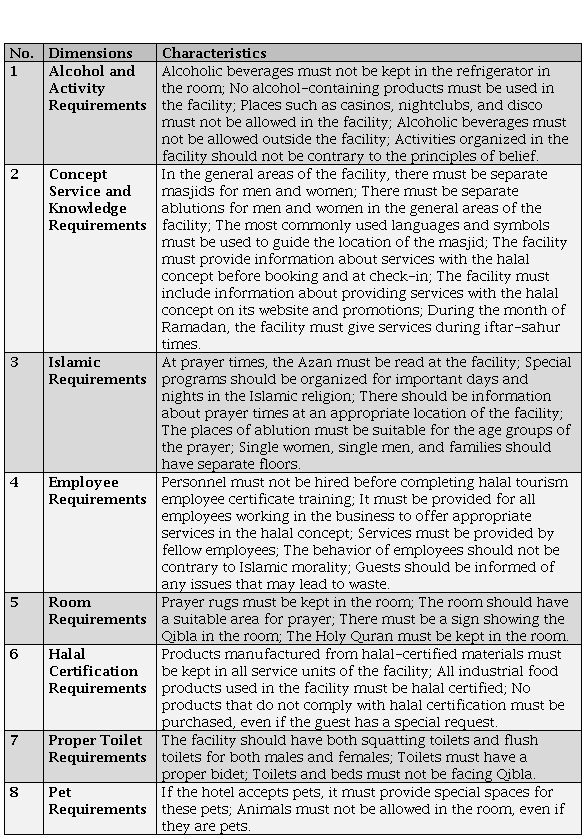
Modified from Pamukcu and Sariisik (2020).
Halal tourism includes activities to study people's lives in the past or visit safe and prosperous cities (Tajzadeh, 2013), travel based on the values of the Islamic religion, but as recommended by the World Tourism Organization (Wto), halal tourism consumers not only Muslims but also non-Muslims who want to enjoy the local wisdom. The general criteria for halal tourism are oriented to the common good, orientation enlightenment, refreshment, and serenity avoid idolatry and superstition, free from sin, maintain security and comfort, protect the environment, and respect for social and cultural values and local wisdom (Sofyan, 2012). Clearly, the characteristics of halal tourism in Figure 3, as follows:
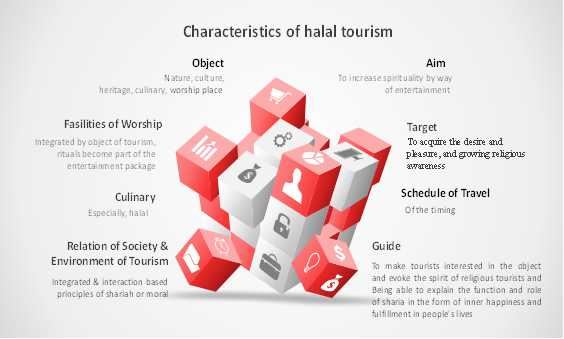
Figure 3
Characteristics of halal tourism
by Authors (2021).
Halal tourism as part of world tourism is a great opportunity for global economic development (Yagmur, Ehtiyar, & Aksu, 2019). The economic crisis due to the Covid-19 pandemic has affected the tourism industry, especially small and medium enterprises in tourist destinations (Maulana, Oktaviaman, & Farah, 2020). However, the global economic recession can be resolved with opportunities for economic growth through the development of potential halal tourism (Arfah, Olilingo, Syaifuddin, Dahliah, Nurmiati, & Putra, 2020; Karim, Haque, Anis, & Ulfy, 2020). On the other hand, such as halal food produced by companies, it is required to meet halal standards before being served to consumers (Talib, Rahman, Iskandar, & Kassim, 2020), so this can reduce the risk of COVID-19 transmission.
Tourism places are one of the domains that can expand the spread of Covid-19. In this regard, four urban and regional problem domains are related to the secondary impact of Covid-19, including: (1) social distancing, urban structure, community, and density; (2) housing affordability; (3) lockdown, closure of borders, reshoring, and regional economic recovery; and (4) smart city technology, contact tracing, and privacy (Kang et al., 2020). For this reason, smart cities through the use of digital technology can minimize the risk of Covid-19 including in tourism activities, so that it can be applied: 1) to maintain social distancing that avoids face-to-face interaction and physical contact; 2) position technology is used to track infected people; 3) drone and robot technology are used to work as medical staff and help other essential services; 4) smart health care to treat infected people without any contact; and 5) smart delivery system as contact-free technology for delivering goods important, including foodstuffs, food, and medicine, without physical contact (Agarwal & Negi, 2020).
METHODS
This study focuses on (1) the dimensions and characteristics of smart cities and the implementation of technology for friendly and fast public services sourced from reviews of reports, policies, and journal articles about smart cities; (2) analyzing the development of the halal tourism industry in Indonesia sourced from reports from related ministries, halal tourism providers, and tourism indicators released by official institutions, such as the Thomson Reuters (Salaam Gateway) report in 2019 and 2020, GMTI (Global Muslim Travel Index) report in 2019, and IMTI (Indonesia Muslim Travel Index) report in 2019; and (3) exploring the application of technology in smart cities for the development of halal tourism during the Covid-19 pandemic in Indonesia, most of which were sourced from journal articles.
The content analysis method used in this article is based on written or visual material, including web pages, journal articles, magazines, newspapers, reports, and official documents (Jenkins, 1999). The content analyzed were taken from several Scopus and WoS indexed journal articles published by reputable publishers such as Elsevier, Sage, Springer, Wiley, Taylor, Emerald, MDPI, and others. Some of the keywords used in article searches are smart city and tourism, smart city and Covid-19, halal tourism and Covid-19, and the halal tourism industry. The stages in the content analysis model include 6 steps: determining the aims and objectives of the research, compiling the latest content, analyzing content, comparing analysis results, refining the results, and concluding findings (Neumann & Kreuger, 2003; Finn, Walton, & Elliott-White, 2000; Davis & Cosenza, 1993), as can be seen in Figure 4 below:
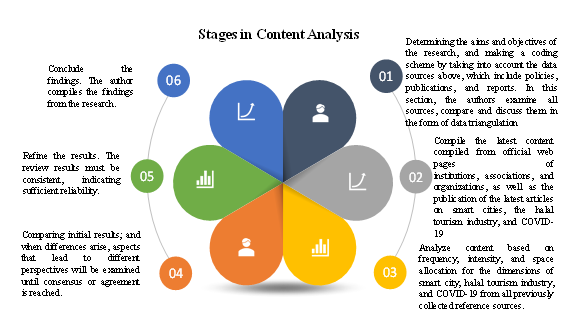
Figure 4
Stages in content analysis
Modified from Neumann and Kreuger (2003); Finn et al. (2000); Davis and Cosenza (1993)
RESULTS AND DISCUSSION
Smart City Performance and Its Use for Tourism in Indonesia - In a digital network society, the economic division has emerged as a new economic or business model, which is in line with smart cities in terms of economic sharing which can be formulated from insights into the nature of the sharing economy (Sundararajan, 2016), with peer-to-peer networks that provide perspective useful examples to promote and develop a smart economy (Gori, Parcu, & Stasi, 2015) or the purpose of this smart city to attract new businesses with characteristics not limited to an innovative spirit, entrepreneurship, economic image, and trademarks (Tranos & Gertner, 2012).
According to Jessop and Sum (2000), the urban development literature describes an entrepreneurial city associated with the concept of a smart city which emphasizes entrepreneurial and innovative strategies to maintain or improve the economic competitiveness of the city. Lazaroiu and Roscia (2012) explain that a smart city is a city that performs well with 6 characteristics that are built on a combination of volunteerism and independent, self-aware and self-aware citizen activities as detailed in Table 2.
Characteristics and key performance of smart city
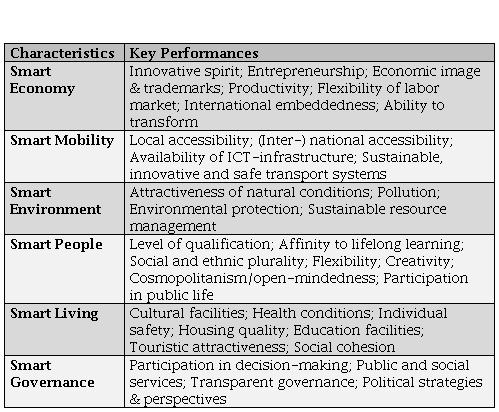
Modified from Lazaroiu and Roscia (2012)
This smart city development can also be applied to tourism which produces the concept of smart tourism. Unwto (2009) released a report that smart tourism is a clean, green, ethical, and quality industry at all levels of the service chain. Smart tourism technology consists of three main components, namely cloud services, the internet of things, and ICT, including mobile communication technology and artificial intelligence used in positioning, guides, tours, and bookings. Smart tourism consists of three levels, namely capabilities, attributes, and applications.
This framework emphatically outlines the four core technologies of smart tourism and offers its value to four application objects, including tourists, residents, government, and companies. Then, four more intelligent tourism core information technologies include the internet of things, cellular communication, cloud computing, and artificial intelligence technology (Zhang, Li, & Liu, 2012). In this case, the eTourism concept that reflects the digitization of all processes and value chains in the tourism and hospitality business can be applied. At the tactical level, eCommerce and ICT applications are also to maximize the efficiency and effectiveness of tourism organizations. At the strategic level, eTourism is revolutionizing all business processes, the entire value chain, and the organization's strategic relationships with stakeholders (Buhalis, 2003).
The use of technology in smart cities for tourism development during the Covid-19 pandemic can be done by adopting automation technology that is in accordance with the tourism industry business model and is used for consumer safety and health (Ivanov et al., 2020). The use of blockchain and cryptocurrency as basic technology can also have an impact on the tourism and hospitality industry, especially for the benefit of consumers and suppliers, in addition to creating new tourism products or systems (Önder & Gunter, 2020). In line with the use of technology for tourism, the increasing demand for health care equipment, medicines, medical accessories, as well as the need for advanced information technology applications, and industry 4.0 has the potential to meet special needs and reduce the impact of the Covid-19 disaster during the crisis. This revolution has started with advanced manufacturing applications and digital information technology (Javaid, Haleem, Vaishya, Bahl, Suman, & Vaish, 2020; Kumar, Raut, Narwane, & Narkhede, 2020).
The use of this technology is carried out in conjunction with medical care or health care to make the response more effective and reduce the risk of disease spread that is tailored to the tourist destinations of each region (Shaw et al., 2020). Industry 4.0 technology can provide many innovative ideas and solutions to combat local and global medical emergencies. This technology can assist in the proper control and management of the Covid-19 pandemic, especially assisting in detecting and diagnosing Covid-19 and other related problems and symptoms (Javaid at al., 2020). Furthermore, industry 4.0 can act as a significant driver to reduce the impact of the identified challenges on retailers to fight the pandemic. Supply chain partners and government agencies must act wisely to improve services during Covid-19 and similar situations. The proposed roadmap provides future research direction for researchers working in the fields of epidemic control, supply chain, and disaster management (Kumar et al., 2020).
Smart city and halal tourism for mitigation the spread of Covid-19 in Indonesia - Covid-19 is crippling the travel and tourism industry in completely unexpected ways - global events including the Tokyo Olympics were postponed, airlines went bankrupt and the hospitality sector crashed. Most importantly, Muslim's main travel businesses, Haj, and Umrah were canceled or restricted, adding to the losses. Despite the gloomy environment, investors are still seeing long-term growth, especially in the travel technology area. Indonesian company Traveloka raised $ 250 million in July 2020 while Indonesian travel company Pigijo raised $ 861,000 in its IPO. Muslim travel spending increased 2.7% in 2019 to $ 194 billion and is expected to fall to $ 58 billion by 2020, before recovering to pre-pandemic levels in 2023 growing at a 5-year CAGR of 1.4% between 2019 and 2024 (Thomson Rheuter, 2020). Covid-19 also has an impact on the Islamic economic sector, one of which is the tourism travel industry. However, social distancing measures have developed e-commerce platforms in various sectors (Figure 5). Innovative ideas are used by businesses in most sectors to adapt and survive, including virtual gear (fashion), tableware (food), and virtual tours (travel).
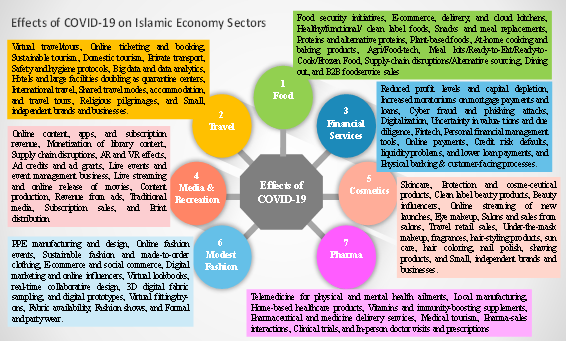
Figure 5
Effects of Covid19 on Islamic economy sectors
by Authors (Modified from Thomson Rheuter, 2020)
Digital technology implanted in a smart city is important in developing halal tourism. A smart city represents an environment with technology embedded in the city by facilitating unlimited access to value-added services for both residents and tourists as city visitors, such as access to real-time information on public transportation networks and the city can dynamically engage with its stakeholders (Vicini, Bellini, & Sanna, 2012), and to involve tourists and other stakeholders in the innovation process of tourism companies (Hoarau, 2016). The use of information technology in the tourism sector is increasing in providing smart services for tourists.
In halal tourism, a cultural, historical, religious, and beach tourism offering has been developed, an expansion of services and facilities for tourists traveling abroad, Muslim-friendly main travel services from timeshare holiday apartments to various applications and websites that cater to Muslim tourists. The development of digitalization of halal tourism in Indonesia is to encourage the halal tourism sector because travel expenditure reached US $ 177 billion in 2017 and is expected to reach US $ 274 billion by 2023 (Thomson Rheuter, 2019). By 2020, more than 158 million Muslim visitors are expected to come globally 2020 to Indonesia. The high growth of the tourism industry and the largest Muslim population in the world can be a boon for Indonesia to become the best halal and family-friendly tourist destination (GMTI, 2019).
There are three developments associated with the development of megatrend technology in the global Islamic economy related to the lifestyle in halal tourism which includes: (1) supply chain visibility for products in the halal tourism sector is enhanced by the broad application of blockchain, enabling verification and accountability; (2) finances become more agile and crumble when consumers and businesses try to trade immediately, prompting the emergence of alternative currencies. Financial institutions have also become more efficient, automating important functions, including in the tourism sector; and (3) digital immersion substantially enhances human recreation, including the way humans experience and determine travel plans, and media, from games to content, and paves the way for new types of advertising, including in the development of halal tourism. Megatrend technology in this lifestyle can be seen from the achievements of the development of the Islamic economy in six sectors in Indonesia (Thomson Rheuter, 2019).
In developing halal tourism in Indonesia, government policies can be carried out through the following: (1) the existence of a road map and guidelines for halal tourism that refer to the best standards of world tourism which include destinations, marketing, industry, and institutions; (2) develop national tourism service standards for halal tourism certification for tourism products and actors. Certification can be used as a halal guarantee for tourism products produced by entrepreneurs covering four business fields, namely culinary, hotels, travel agencies, and spas; (3) develop 10 priority halal tourist destinations consisting of ten halal tourist destinations, namely Aceh, Riau, and Riau Islands, West Sumatra, Jakarta, West Java, Central Java, Yogyakarta, East Java, South Sulawesi, and Lombok [West Nusa Tenggara], and other potential destinations; (4) compiling the results of a report on the development of halal tourism from the information provided by the Indonesia Muslim Travel Index (IMTI, 2019), GIE, and other institutions as performance indicators in halal tourism and determining the ranking of family-friendly halal tourist destinations in Indonesia; (5) The main strategic areas in halal tourism are access, communication, environment, and services. This can be used to map the development of halal tourism in various destinations in Indonesia and also give awards to destinations that are committed to developing halal tourism destinations, and (6) develop Sustainable Tourism Development (STD) as an integrated platform that has several touchpoints that can be accessed through various user devices that support the creation and facilitate real-time tourism experiences and improve the effectiveness of tourism resource management in all destinations.
The development of smart city initiatives that are more efficient and widespread can improve data collection, data processing, data storage, and dissemination of data that can be used for tourism. To improve detection and mitigation of the Covid-19 outbreak, as well as to reduce execution times when taking critical actions. Technology solutions can be adopted in more integrated city-scale systems. The development of a new smart city that is centered on health (Costa & Peixoto, 2020), including the use of digital technology to mitigate the spread of Covid-19 in tourism places.
In this case, the development of a smart city for halal tourism that guarantees public health, among others, needs to pay attention to; first, institutional and cultural factors are more important than urban features, such as population density. To deal with infectious diseases such as Covid-19, it is important to build systems, technology, infrastructure, and urban structures that can strengthen resilience instead of implementing a policy of directionless dispersal; second, it is necessary to increase access to essential services at the community level, including medical facilities and food supplies; third, continuous efforts should be made to improve housing affordability, as this is directly linked to the basic life of the community; fourth, measures are needed to protect socially and economically disadvantaged persons.
There is also a need to restore global trade and economic relations; fifth, because data technology-based Covid-19 controls pose human tracking and privacy concerns, we must ensure privacy management principles, such as transparency and voluntary consent, are met; and sixth, because Covid-19 is spread through humans, individuals can become anxious and afraid of others without reason; this can increase prejudice and resentment, including xenophobia. Significant social efforts are needed to overcome these uncertain anxieties and fears and maintain a healthy civil society (Kang et al., 2020).
The Covid-19 pandemic has an impact on individuals and groups in the travel and tourism sector around the world (Brouder, Teoh, Salazar, Mostafanezhad, Pung, Lapointe, ... & Clausen, 2020). The short-term and long-term future of tourism in relation to the effects of the response to Covid-19 and the implications of potential changes tourism may face (Butler, 2020). However, transformative travel and tourism as a growing trend are important media to find new ways to reset the global tourism system (Ateljevic, 2020). Changes to the normal are only just beginning to emerge and as tourists begin to flock to destinations and attractions it can generate higher awareness among tourists and locals about maintaining personal hygiene and the need to maintain safe distances when in crowded crowds (Koh, 2020).
Government policies for tourism and creative economy actors during the Covid-19 pandemic in Indonesia - The Covid-19 pandemic has had a tremendous impact on halal tourism so that the tourism industry is focused on the rescue side first so that tourism players have a way to survive in conditions of minimal demand while maintaining tourism human resources. The Ministry of Tourism and Creative Economy recorded 189,586 workers in the tourism and creative economy sectors from 34 provinces in Indonesia that were affected by the Covid-19 pandemic (Noor, 2020). The Government of Indonesia, through the Minister of Tourism and Creative Economy, refocused and reallocated the budget to provide social protection and economic stimulus for tourism and creative economy actors. The stimulus is given to economic actors who are being crushed by the Covid-19 pandemic so that they can maintain and open up jobs.
The Covid-19 pandemic can be an excuse for the government to play a bigger role in improving the quality of life for its citizens (Koh, 2020). Several programs to improve the creative economy sector, such as: (1) package design or differentiation grant programs aimed at increasing and developing the business of culinary creative actors through understanding the important functions of product packaging; (2) craft, fashion, and culinary MSME development program through incubation by providing assistance so that they produce sustainable products with quality that have the potential to be developed, making these products have a selling value and have national competitiveness; and (3) an energy-aligned action program aimed at accelerating the growth of the creative economy in tourist destination areas, so that not only has an impact on profits but also on the community and not only in the five super-priority destinations but also in other potential areas (Hermawan, 2021).
In reviving the tourism sector during the Covid-19 pandemic, in collaboration with tourism companies such as Travel.co and Caventer Indonesia to hold a virtual tour entitled "Virtual Indonesia-a Hidden Heaven" in order to introduce 10 villages and tourist areas throughout Indonesia that have culture and culture extraordinary natural beauty, but still not widely known by the public. The ten villages are Pulau Banyak (Aceh Singkil), Belibak Village (Anambas Islands), Karangduwur Village (Kebumen Kawasan), Honey Pineapple Tourism Village (Pemalang), Bayan Village (North Lombok), Kabola Area (Alor Island), Aisandami Village (Teluk Wodam), Bajo Mola Village (Wakatoba Islands), Ngilngof Village (Kei Islands), and Sebujit Village (Bengkayang) (Amanda, 2021).
Tourists can enjoy Kali Banteng Waterfall in Rahtawu Village, Kudus, Central Java [illustration] every Saturday and Sunday, 10 am WIB, from January 30 to February 28, 2021, on Youtube ‘Persona Indonesia’ which can be followed online and for free. The community can also participate in giving donations to help develop villages and tourist areas. Development of tourism villages as a response to local innovative ideas at the ‘grassroots’ level as well as preserving cultural heritage values that become Indonesia's identity.
This virtual tour is one of the solutions to raise all the tourism potential of an area in the midst of the Covid-19 pandemic. ‘Virtual Indonesia - A Hidden Heaven’ is packaged in a form of a storyline supported by interesting audio and visuals, so it is hoped that it will attract the world's people to visit these 10 tourist villages after the pandemic ends (Figure 6).

Figure 6
Tourists enjoy Kali Banteng Waterfall in Rahtawu Village Kudus Central Java
Amanda (2021)
Virtual tourism is a medium that 'provokes' tourists digitally, as well as having fun experiences so tourists can get information and support the decision whether they will go to that destination after the pandemic is over (Figure 7). ‘Atourin’, a technology company that provides online and offline services in the tourism sector, including the development of virtual tour content in Indonesia in collaboration with Traveloka in creating virtual tours to 15 tourist destinations from seven provinces in Indonesia, namely Bali, West Nusa Tenggara, East Nusa Tenggara, Kalimantan, Sulawesi, Maluku, Papua. From July to September 2020, there are more than 900 virtual tourists exploring domestic destinations. Another company, BliBli E-commerce also provides virtual tourism services both domestic and foreign, one of which is a way to peek at the city of Seoul, South Korea (Azizah, 2020).

Figure 7
Virtual tours illustration
Azizah (2020)
CONCLUSION
Smart cities provide new opportunities through the use of technology in the development of the halal tourism industry during the Covid-19 pandemic, not only providing rapid service improvements to the public in accessing information about halal tourism but also simultaneously being applied to reduce the risk of spreading disease in tourist destinations (Shaw et al., 2020). This technology can assist in the proper control and management of the Covid-19 pandemic, especially assisting in detecting and diagnosing Covid-19 and other related problems and symptoms in tourism places ranging from data collection, data processing, data storage, and data dissemination that can be used in halal tourism and stakeholders.The application of technology in smart cities can be developed to improve detection, mitigation of the Covid-19 outbreak, and make effective decisions in critical situations so that its integration with the development of halal tourism is important by focusing on health (Costa & Peixoto, 2020). On the other hand, the current pandemic which has an impact on the tourism sector has become a new potential in making re-changes to the tourism system (Ateljevic, 2020) which emphasizes human health and the environment (Koh, 2020) which is more humanist and civilized.
In the development of the halal tourism industry in Indonesia, smart cities can offer new perspectives on the management of halal tourism which is growing and potential in the global market. The potential for halal tourism in the global scope of the Islamic economy requires an open, transparent, and diverse economic engagement for the global community that opens job opportunities with job market flexibility, diversification that encourages entrepreneurship and innovation, as well as higher productivity through local, regional and global interconnections. which is implemented in its development. The management of halal tourism can be developed by focusing integrally between technology support in smart cities and the maintenance of public health, especially during the Covid-19 pandemic.
The active role of the Indonesian government in providing social protection and economic stimulus for tourism and creative economy actors and various programs in reviving the halal tourism sector affected by the Covid-19 pandemic provides solutions for tourism actors, and technological innovations such as virtual tourism are new services in introducing local tourism potential to national and global tourists who are expected to develop after this pandemic is over. The development of tourism villages is also a form of response to local innovative ideas at the "grassroots" level in preserving cultural heritage values that become Indonesia's identity.
REFERENCES
Allam, Z. (2019). Cities and the digital revolution: Aligning technology and humanity. Springer Nature. Link
Allam, Z., & Jones, D. S. (2020). On the coronavirus (Covid-19) outbreak and the smart city network: universal data sharing standards coupled with artificial intelligence (AI) to benefit urban health monitoring and management. Healthcare, 8(1), 46. Link
Allam, Z., & Jones, D. S. (2021). Future (post-Covid) digital, smart and sustainable cities in the wake of 6G: Digital twins, immersive realities and new urban economies. Land Use Policy, 101, 105201. Link
Allam, Z., & Newman, P. (2018). Redefining the smart city: Culture, metabolism and governance. Smart Cities, 1(1), 4-25. Link
Allam, Z., Dey, G., & Jones, D. S. (2020). Artificial intelligence (AI) provided early detection of the coronavirus (Covid-19) in China and will influence future Urban health policy internationally. AI, 1(2), 156-165. Link
Amanda, G. (2021, 27 JAN). Kementerian Pariwisata dan Ekonomi Kreatif gelar wisata virtual ke-10 desa wisata [The Ministry of Tourism and Creative Economy held virtual tourism in the 10 tourist villages]. Jakarta: Republika. Link
Angelidou, M. (2017). The role of smart city characteristics in the plans of fifteen cities. Journal of Urban Technology, 24(4), 3-28. Link
Ankomah, P., & Larson, T. (2019). Virtual tourism and its potential for tourism development in sub-saharan africa. In: M. Khosrow-Pour, D.B.A. (Ed.), Advanced Methodologies and Technologies in Digital Marketing and Entrepreneurship. (pp. 584-595). IGI Global. Link
Arfah, A., Olilingo, F. Z., Syaifuddin, S., Dahliah, D., Nurmiati, N., & Putra, A. H. P. K. (2020). Economics during global recession: Sharia-economics as a post Covid-19 agenda. The Journal of Asian Finance, Economics, and Business, 7(11), 1077-1085. Link
Ateljevic, I. (2020). Transforming the (tourism) world for good and (re) generating the potential ‘new normal’. Tourism Geographies, 22(3), 467-475. Link
Azizah, N. (2020, 08 october). Tur virtual kian diminati selama pandemi [Virtual tours have grown in demand during the pandemic]. Jakarta: Republika. Link
Bakar, N. A., & Rosbi, S. (2020). Effect of Coronavirus disease (Covid-19) to tourism industry. International Journal of Advanced Engineering Research and Science, 7(4), 189-193. Link
Baskanligi, D.I. (2011). Helal [The halal]. Link
Bates, O., & Friday, A. (2017). Beyond data in the smart city: Repurposing existing campus IoT. IEEE Pervasive Computing, 16(2), 54-60. Link
Beatley, T., & Newman, P. (2013). Biophilic cities are sustainable, resilient cities. Sustainability, 5(8), 3328-3345. Link
Benckendorff, P. J., Xiang, Z., & Sheldon, P. J. (2019). Sustainable tourism and information technology. Tourism Information Technology, 3, 312-340. Link
Bergeaud-Blackler, F., Fischer, J., & Lever, J. (Eds.). (2015). Halal Matters: Islam, politics and markets in global perspective. Routledge. Link
Brouder, P., Teoh, S., Salazar, N. B., Mostafanezhad, M., Pung, J. M., Lapointe, D., ...& Clausen, H. B. (2020). Reflections and discussions: Tourism matters in the new normal post Covid-19. Tourism Geographies, 22(3), 735-746. Link
Buhalis, D. (2003). eTourism: Information technology for strategic tourism management. Harlow: Pearson. Link
Butler, R. (2020). Tourism–resilient but vulnerable as ‘the times they are a changing’ in the ‘new normality’. Worldwide Hospitality and Tourism Themes, 12(6), 663-670. Link
Campbell, T. (2012). Beyond Smart Cities: how cities network, learn and innovate. Routledge. Link
Castells, M. (1996). The Information age: economy, society and culture (3. vol.). Oxford: Blackwell.
Comstock, M. (2012, 02 april). What is a smart city and how can a city boost its IQ ?. World Bank. Link
Costa, D. G., & Peixoto, J. P. J. (2020). Covid-19 pandemic: A review of smart cities initiatives to face new outbreaks. IET Smart Cities, 2(2), 64-73. Link
Davis, D., & Cosenza, R. M. (1993). Business Research for Decision Making. California: Wadswort.
Elasrag, H. (2016). Halal industry: Key challenges and opportunities. SSRN, 1-33. Link
Eremia, M., Toma, L., & Sanduleac, M. (2017). The smart city concept in the 21st century. Procedia Engineering, 181, 12-19. Link
Finn, M., Walton, M., & Elliott-White, M. (2000). Tourism and Leisure Research Methods: Data collection, analysis, and interpretation. Pearson Education.
Florida, R. (2010). Who's your city?: How the creative economy is making where to live the most important decision of your life. Canada: Vintage. Link
Glasmeier, A., & Nebiolo, M. (2016). Thinking about smart cities: the travels of a policy idea that promises a great deal, but so far has delivered modest results. Sustainability, 8(11), 1122. Link
Global Muslim Travel Index – GMTI. (2019). Welcome to the global Muslim travel index 2019 - Halal travel development goals. Link
Gori, P., Parcu, P. L., & Stasi, M. (2015). Smart cities and sharing economy. RSCS (Robert Schuman Centre for Advanced Studies), Research Paper, 96. Link
Gracia, T. J. H., & García, A. C. (2018). Sustainable smart cities: creating spaces for technological, social and business development. Boletín Científico de las Ciencias Económico Administrativas del ICEA, 6(12). Link
Gulen, F. (2011). Helal lokma ve iffetli nesiller [Halal bite and virtuous generations]. Link
Haleem, A., Javaid, M., & Vaishya, R. (2020). Effects of Covid 19 pandemic in daily life. Current Medicine Research and Practice, 10(2), 78-79. Link
Hermawan, B. (2021, 28 JAN). Kementerian Pariwisata dan Ekonomi Kreatif siapkan stimulus bagi pelaku parekraf [The Ministry of Tourism and Creative Economy prepares a stimulus for tourism and creative economy actors]. Jakarta: Republika. Link
Hoarau, H. (2016). Open innovation in the tourism experience sector: The role of practice based knowledge explored. In: R. Egger, I. Gula, & D. Walcher. (eds), Open Tourism: open innovation, crowdsourcing and co-creation challenging the tourism industry (pp. 137-152). Berlin: Springer. Link
Hollands, R.G. (2008). Will the real smart city please stand up? City, 12(3), 303-320. Link
Ijaj, A. (2011). Halal concept & brands. Halal Brands. Link
Indonesia Muslim Travel Index - MTI. (2019). Mastercard-crescent rating Indonesia Muslim travel index 2018. Link
Ivanov, S. H., Webster, C., Stoilova, E., & Slobodskoy, D. (2020). Biosecurity, crisis management, automation technologies and economic performance of travel, tourism and hospitality companies: a conceptual framework. Tourism Economics, 1-24. Link
Jaelani, A. (2016). Islamic tourism development in Cirebon: The study heritage tourism in Islamic economic perspective. Journal of Economics Bibliography, 3(2), 215-235. Link
Jaelani, A. (2017). Halal tourism industry in Indonesia: Potential and prospects. International Review of Management and Marketing, 7(3), 25-34. Link
Jaelani, A., Setyawan, E., Aziz, A., Wahyuningsih, N., & Djuwita, D. (2020). Sustainable event and festival in Cirebon, Indonesia: In Islamic marketing perspective/evento y festival sostenible en Cirebon, Indonesia: En perspectiva del marketing Islámico. Revista Rosa dos Ventos - Turismo e Hospitalidade, 12(4), 811-838. Link
Jaiswal, R., Agarwal, A., & Negi, R. (2020). Smart solution for reducing the Covid‐19 risk using smart city technology. IET Smart Cities, 2(2), 82-88. Link
Javaid, M., Haleem, A., Vaishya, R., Bahl, S., Suman, R., & Vaish, A. (2020). Industry 4.0 technologies and their applications in fighting Covid-19 pandemic. Diabetes & Metabolic Syndrome: Clinical Research & Reviews, 14(4), 419-422. Link
Jenkins, O. (1999). Understanding and measuring tourist destination images. International Journal of Travel Research, 1(1), 1–15. Link
Jessop, B., & Sum, N. L. (2000). An entrepreneurial city in action: Hong Kong's emerging strategies in and for (inter) urban competition. Urban Studies, 37(12), 2287-2313. Link
Jiang, Y., & Wen, J. (2020). Effects of Covid-19 on hotel marketing and management: A perspective article. International Journal of Contemporary Hospitality Management, 32(8), 2563-2573. Link
Joss, S., Cowley, R. and Tomozeiu, D. (2013). Towards the ‘ubiquitous eco-city’: An analysis of the internationalisation of eco-city policy and practice. Urban Research & Practice, 6(1), 54-74. Link
Kamali, M. H. (2012). Tourism and the halal industry: A global Shariah perspective. ICR Journal, 3(3), 456-473. Link
Kang, M., Choi, Y., Kim, J., Lee, K. O., Lee, S., Park, I. K., ... & Seo, I. (2020). Covid-19 impact on city and region: What’s next after lockdown?. International Journal of Urban Sciences, 24(3), 297-315. Link
Karim, W., Haque, A., Anis, Z., & Ulfy, M. A. (2020). The movement control order (mco) for Covid-19 crisis and its impact on tourism and hospitality sector in Malaysia. International Tourism and Hospitality Journal, 3(2), 1-7. Link
Koh, E. (2020). The end of over-tourism? Opportunities in a post-Covid-19 world. International Journal of Tourism Cities, 6(4), 1015-1023. Link
Kumar, M. S., Raut, R. D., Narwane, V. S., & Narkhede, B. E. (2020). Applications of industry 4.0 to overcome the Covid-19 operational challenges. Diabetes & Metabolic Syndrome: Clinical Research & Reviews, 14(5), 1283-1289. Link
Kumar, T. V., & Dahiya, B. (2017). Smart economy in smart cities. In: T. M. V. Kumar (ed.), Smart Economy in Smart Cities (pp. 3-76). Singapore: Springer. Link
Kunzmann, K. R. (2020). Smart cities after Covid-19: ten narratives. disP-The Planning Review, 56(2), 20-31. Link
Lacinák, M., & Ristvej, J. (2017). Smart city, safety and security. Procedia Engineering, 192, 522-527. Link
Lazaroiu, G. C., & Roscia, M. (2012). Definition methodology for the smart cities model. Energy, 47(1), 326-332. Link
Manan, S. K. A., Abd Rahman, F., & Sahri, M. (2016). Contemporary issues and development in the global halal industry. Singapore: Springer Science+ Business Media. Link
Mariolis, T., Rodousakis, N., & Soklis, G. (2020). The Covid-19 multiplier effects of tourism on the Greek economy. Tourism Economics, 27(8), 1848-1855. Link
Maulana, N., Oktaviaman, R., & Farah, Y. (2020). Hygiene from the heart: The rise of Sharia compliant hotel in Indonesia after Covid-19 pandemic. JEBIS (Jurnal Ekonomi dan Bisnis Islam), 6(2), 241-258. Link
Mboup, G. (2017). Smart social development key for smart economy. In: T. M. V. Kumar (ed), Smart Economy in Smart Cities (pp. 905-930). Singapore: Springer. Link
Mohd Nawawi, M. S. A., Abu-Hussin, M. F., Faid, M. S., Pauzi, N., Man, S., & Mohd Sabri, N. (2019). The emergence of halal food industry in non-Muslim countries: a case study of Thailand. Journal of Islamic Marketing, 11(4), 917-931. Link
Muawanah, M., Fauziah, N. D., Toha, M., & Manaku, A. C. (2021). The survival strategy of halal tourism in Covid-19 pandemic era. Indonesian Interdisciplinary Journal of Sharia Economics (IIJSE), 3(2), 165-177. Link
Muhamed, N. A., Ramli, N. M., Abd Aziz, S., & Yaakub, N. A. (2014). Integrating Islamic financing and halal industry: a survey on current practices of the selected Malaysian authority bodies. Asian Social Science, 10(17). Link
Nam, K., Dutt, C. S., Chathoth, P., & Khan, M. S. (2019). Blockchain technology for smart city and smart tourism: latest trends and challenges. Asia Pacific Journal of Tourism Research, 26(4), 1-15. Link
Neuman, W. L., & Kreuger, L. (2003). Social Work Research Methods: Qualitative and quantitative approache.. Boston: Allyn and Bacon. Link
Noor, A.F. (2020, 16 april). Pandemi Corona, industri wisata halal harus kolaborasi [Pandemic Corona, the halal tourism industry must collaborate]. Jakarta: Republika. Link
Olmos-Gómez, M. D. C., Luque-Suárez, M., Mohamed-Mohamed, S., & Cuevas-Rincón, J. M. (2020). Validation of the smart city as a sustainable development knowledge tool: The challenge of using technologies in education during COVID-19. Sustainability, 12(20), 8384. Link
Olokesusi, F., Aiyegbajeje, F. O., Mboup, G., & Mwaniki, D. (2017). Smart city foundation for smart economy. In: T. M. V. Kumar (ed), Smart Economy in Smart Cities (pp. 793-817). Singapore: Springer. Link
Önder, I., & Gunter, U. (2020). Blockchain: Is it the future for the tourism and hospitality industry? Tourism Economics, 1-22. Link
Pamukcu, H., & Sariisik, M. (2020). Suggestions for standardization of halal tourism in hospitality industry. Journal of Islamic Marketing, 12(2), 389-407. Link
Paquet, G. (2001). The new governance, subsidiarity and the strategic state. In: Governance in the 21st century (pp. 183-208).
Pierdicca, R., Paolanti, M., & Frontoni, E. (2019). eTourism: ICT and its role for tourism management. Journal of Hospitality and Tourism Technology, 10(1), 90-106. Link
Qiu, R. T., Park, J., Li, S., & Song, H. (2020). Social costs of tourism during the Covid-19 pandemic. Annals of Tourism Research, 84, 102994. Link
Rahman, F. K., Tareq, M. A., Yunanda, R. A., & Mahdzir, A. (2017). Maqashid al-Shari’ah-based performance measurement for the halal industry. Humanomics: The International Journal of Systems and Ethics, 33(3), 357-370. Link
Rahman, M. M., Manik, M. M. H., Islam, M. M., Mahmud, S., & Kim, J. H. (2020, SEP). An automated system to limit COVID-19 using facial mask detection in smart city network. In: 2020 IEEE International IOT, Electronics and Mechatronics Conference (IEMTRONICS) (pp. 1-5). IEEE. Link
Ramos, C. M., Andraz, G., & Cardoso, I. (2020). The role of ICT in involving the tourist and in sustainability of tourism destinations. In. Technological progress, inequality and entrepreneurship (pp. 29-45). Cham: Springer. Link
Rogerson, C. M., & Rogerson, J. M. (2020). Covid-19 and tourism spaces of vulnerability in South Africa. African Journal of Hospitality, Tourism and Leisure, 9(4). Link
Samori, Z., Md Salleh, N.Z., & Khalid, M.M. (2016). Current trends in halal tourism: Cases on selected Asian countries. Tourism Management Perspectives, 19, 131–136. Link
Saura, J. R., Reyes-Menendez, A., & Palos-Sanchez, P. R. (2020). The Digital tourism business: A systematic review of essential digital marketing strategies and trends. In. Digital Marketing Strategies for Tourism, Hospitality, and Airline Industries (pp. 1-22). IGI Global. Link
Shaw, R., Kim, Y. K., & Hua, J. (2020). Governance, technology and citizen behavior in pandemic: Lessons from Covid-19 in East Asia. Progress in Disaster Science, 6, 100090. Link
Shelton, T., & Lodato, T. (2019). Actually, existing smart citizens: Expertise and (non) participation in the making of the smart city. City, 23(1), 35-52. Link
Sigala, M. (2020). Tourism and Covid-19: Impacts and implications for advancing and resetting industry and research. Journal of Business Research, 117, 312-321. Link
Smith, V.L. (1989). Hosts and Guests: the anthropology of tourism. Philadelphia: University of Pennsylvania Press.
Smith, V.L. (1992). The quest in guest. Annals of Tourism Research, 19, 1-17. Link
Sofyan, R. (2012). Prospek bisnis pariwisata syariah [Islamic tourism business prospects]. Jakarta: Republika. Link
Sonn, J. W., & Lee, J. K. (2020). The smart city as time-space cartographer in Covid-19 control: the South Korean strategy and democratic control of surveillance technology. Eurasian Geography and Economics, 61(4-5), 482-492. Link
Sonn, J. W., Kang, M., & Choi, Y. (2020). Smart city technologies for pandemic control without lockdown. International Journal of Urban Sciences, 24(2), 149-151. Link
Sundararajan, A. (2016). The sharing economy: The end of employment and the rise of crowd-based capitalism. Mit Press. Link
Tajzadeh, N.A. (2013). Value creation in tourism: An Islamic approach. International Research Journal of Applied and Basic Sciences, 4(5). 1252-1264. Link
Talib, Z., Rahman, N. A., Iskandar, M. L., & Kassim, N. (2020). Factors influence sustainability in quality and halal integrity among halal food manufacturers in Malaysia during Covid-19 pandemic. Solid State Technology, 63(4), 2933-2949. Link
Thomson Reuters. (2019). Global Islamic economy indicator. Dubai: Salaam Gateway. Link
Thomson Reuters. (2020). State of the global Islamic economy 2020/21 report. Dubai: Salaam Gateway. Link
Tranos, E., & Gertner, D. (2012). Smart networked cities? Innovation: The European Journal of Social Science Research, 25(2), 175-190. Link
Tranos, E., & Gillespie, A. (2011). The urban geography of Internet backbone networks in Europe: roles and relations. Journal of Urban Technology, 18(1), 35-50. Link
Uğur, N. G., & Akbıyık, A. (2020). Impacts of Covid-19 on global tourism industry: A cross-regional comparison. Tourism Management Perspectives, 36, 100744. Link
Unwto. (2009). UNWTO tourism resilience committee stresses need for smart tourism. Link
Vicini, S., Bellini, S., & Sanna, A. (2012, May). How to co-create Internet of things-enabled services for smarter cities. The First International Conference on Smart Systems, Devices and Technologies, 27, 55-61. Link
Wiig, A. (2016). The empty rhetoric of the smart city: from digital inclusion to economic promotion in Philadelphia. Urban Geography, 37(4), 535-553. Link
Wilson, J. A. (2014). The halal phenomenon: an extension or a new paradigm? Social Business, 4(3), 255-271. Link
Winarno. (2017). Langkah menuju “100 smart city” [Steps to "100 smart city"]. Jakarta: Kominfo. Link
Yagmur, Y., Ehtiyar, R., & Aksu, A. (2020). Evaluation of halal tourism in terms of bibliometric characteristics. Journal of Islamic Marketing, 11(6), 1601-1617. Link
Yunos, R. M., Mahmood, C. F. C., & Abd Mansor, N. H. (2014). Understanding mechanisms to promote halal industry-the stakeholders’ views. Procedia-Social and Behavioral Sciences, 130, 160-166. Link
Zhang, L. Y., Li, N., & Liu, M. (2012). On the basic concept of smarter tourism and its theoretical system. Tourism Tribune, 5, 15. Link
