Artículos
A semi-analytical method applied to turbocharger engine model
A semi-analytical method applied to turbocharger engine model
Journal of applied research and technology, vol. 18, no. 4, pp. 178-186, 2020
Universidad Nacional Autónoma de México, Instituto de Ciencias Aplicadas y Tecnología
Received: 24 February 2020
Accepted: 30 June 2020
Published: 31 August 2020
Abstract: In this study, we apply a new version of the Homotopy Analysis Method called decomposition of the homotopy analysis method (DHAM). The DHAM method is based on the decomposition of the right-hand side of a given system of differential equations into a sum of functions. After the decomposition one can apply the HAM method. The physical model that we investigate in this paper is a complex system of equations that contains nonlinear ordinary differential equations of the first order. The system of equations takes into account the important variables such as the pressure, the temperature, the mass flow, the torque due to the turbine turbocharger, the torque from the compressor, the speed of turbocharger, etc. This system is very complex and cannot be solved analytically. The HAM method includes an artificial small parameter that inserts into the physical model and hence it enables one to apply different asymptotic methods. We compared the results of DHAM and HAM to numerical simulations analyses. We concluded that the DHAM results are closer to the numerical simulation results.
Keywords: Turbocharger engine model, Homotopy analysis method, Asymptotic analysis.
1. Introduction
Turbocharged engines are very popular today. Since the turbocharger generates extra power, it allows smaller turbocharged engines to equal larger non-turbocharged ones in acceleration (Chen, 2012; Bell, 1997; Holmbom, Liang, & Eriksson, 2017; Miller, 2008). But because the turbocharged engines are smaller, they are also generally capable of better fuel economy (Abdelmadjid, Mohamed, & Boussad, 2013; Bontempo, Cardone, Manna, & Vorraro, 2015; Burke, Copeland, & Duda, 2014; Burke, Vagg, Chalet, & Chesse, 2015). How does turbocharging work in practice? A turbocharger is effectively two little air fans (also called impellers or gas pumps) sitting on the same metal shaft so that both spins around together. One of these fans, called the turbine, sits in the exhaust stream from the cylinders. As the cylinders blow hot gas past the fan blades, they rotate and the shaft they are connected to (technically called the center hub rotating assembly or CHRA) rotates as well. The second fan is called the compressor and, since it is sitting on the same shaft as the turbine, it spins too. It is mounted inside the car air intake so, as it spins, it draws air into the car and forces it into the cylinders.
This presents a slight problem: Compressing a gas makes it hotter (that is why a bicycle pump warms up when you start inflating your tires). Hotter air is less dense (that is why warm air rises over radiators) and less effective at helping fuel to burn, so it would be much better if the air coming from the compressor was cooled before it entered the cylinders. To cool it down, the output from the compressor passes over a heat exchanger that removes the extra heat and channels it elsewhere (Ekberg & Eriksson, 2017; Gancedo, Guillou, & Gutmark, 2018; Gronman, Sallinen, Honkatukia, Backman, & Uusitalo, 2016; Smolík, Hajžman, & Byrtus, 2017; Yang, Gu, Deng, Yang, & Zhang 2018; Zhao, Sun, Wang, & Song, 2017).
All the operations we described above can be represented by a mathematical model that usually contains a nonlinear ordinary differential equation system as has been done by Andersson (2005). There are many numerical simulations and semi-analytical methods to investigate such models. In this paper we applied the well-known semi-analytical method called the Homotopy Analysis Method (Liao, 2010; 2009a) and applied it to various subjects in the sciences (Abbasbandy et al. 2006; Liao, 2009b; Molabahrami & Khani, 2009; Turkyilmazoglu, 2009; Yang & Liao, 2006). HAM is a mathematical tool that is based on homotopy, a fundamental concept in topology and differential geometry. This is an analytical approach to formulate the series solution of linear and nonlinear partial differential equations. Most perturbation methods assume a small parameter exists in the mathematical model. The HAM does not depend on a small parameter which is difficult to find (Cheng, Liao, Mohapatra, & Vajravelu, 2008; Li & Liao, 2005; Liao, 2003; 2012).
The HAM method also provides a simple way to ensure the convergence of the series solution. Moreover, the HAM provides a large degree of freedom to choose an appropriate base function to approximate the linear and non-linear problems (Abbasbandy, 2006; Fallahzadeh & Shakibi, 2015). Another important advantage of this method is that one can construct a continuous mapping of an initial guess approximation to the exact solution of the given problem through an auxiliary linear operator. To ensure the convergence of the series solution an auxiliary parameter is used. In addition, Liao has substantiated that the HAM differs from the other analytical methods in that it ensures the convergence of the series solution by choosing a proper value for the convergence-control parameter (Jafari, Saeidy, & Firoozjaee, 2009).
2. The turbocharger model
For the present study, the engine model is based on a system of first-order ordinary nonlinear differential equations that include pressure, temperature, and mass flow observer along the air-path of a turbocharged engine (Andersson, 2005).
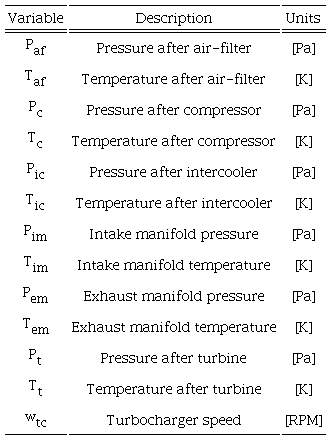
The model has states for pressures and temperature in each control volume and one state for the turbocharger speed. The dynamical variables of the physical model of turbocharger engine model are shown in the following table:
In addition, the main physical/ mathematical assumptions of the model are listed below: - Flows run only in a forward direction. Example: the air always flows from the air-filter to the compressor, never from the compressor to the air-filter,
No heat transfer to/from the gas inside of the control volumes,
- No compressor bypass valve as the modeled engine was not initially equipped with such a valve,
- All gases are ideal and there are two sets of thermodynamic properties:
(a) Air on the intake side has gas constant and the ratio of specific heats is ,
(b) Burned (exhaust) gas has gas constant and the ratio of specific heats is .
The turbocharged engine model consists of components such an as air-filter, compressor, intercooler, etc. Between these components, there are pipes or manifolds. These parts can be considered as control volumes where the pressure and temperature of the gas depends on the mass-flow into and out of the volumes. Mass-flows are determined by restrictions that are components that, given the pressure and temperature before and after the restriction, determine the mass-flow and temperature of the flow.
The list below contains the partitions to the restrictions control parts:
Restriction: Air-filter, Compressor, Intercooler, Throttle, Engine determines port air-mass flow, Turbine/wastegate, Exhaust system
Control volume: Pipe between air-filter and compressor, Pipe between and intercooler, Pipe between and intercooler and throttle, an intake manifold connects the throttle and cylinders, an exhaust manifold connects the cylinders and the turbine/ wastegate, Pipe between and turbine/wastegate and the exhaust system.
The model has the form of (Andersson, 2005)
The initial conditions of the model are as follows:
3. Preliminaries to the standard HAM method
In this section we present the concept of HAM as introduced in (Liao, 2003). Due to the model that we are investigating is only time-dependent, the method of homotopy must be written assuming its reduced form, which fits in the model under consideration.
Consider the following system of differential equations:
where k = 13 for the following dynamical variables of the model: are nonlinear operators, t denotes time and are unknown functions, and are known analytic functions. For = 0, system of differential equations (28) is the homogeneous part.
Zero order deformation of HAM
The zero-order deformation equation is defined as
Where is a non-zero auxiliary parameter called the convergence-control parameter, ℓ is an auxiliary linear operator, (·) is an initial guess of (·), and are unknown functions. The degree of freedom is established when the initial guess, the auxiliary linear operator, and the auxiliary parameter are chosen. If we set p = 0 and p = 1 at equation (29) we obtain: and respectively. Thus, as p increases from 0 to 1, the solution ) varies from the initial guesses to the solutions .
Expanding in Taylor series with respect to the embedding parameter p, we obtain
where
If the auxiliary linear operator, the initial guess, and the auxiliary parameter, are chosen and the above series converges at p = 1, then we obtain
which is one of the solutions of the original nonlinear equation, as proved in (Liao, 2003).
mth -order deformation
The zero-order deformation is a private case of mth -order deformation as follows:
Differentiating Equation (29) m-times with respect to the embedding parameter p and then setting p = 0 and finally dividing the terms by m!, we obtain the mth -order deformation equation in the form of:
where,
and is the unit step function. Applying the inverse operator (·) on both sides of Equation (34), we get
In this way, it is easy to obtain for m ≥ 1, at mth -order and finally determine the solution as:
For the present work, we choose the initial guess to be the initial conditions of the considered model. Therefore, the linear operator will be:
3.1 Description of the DHAM method
In this section, we present the new concept of the DHAM method. Given a system of differential equations
The base assumption of the DHAM method is that the function can be divided into n terms such as
Expanding in powers of the embedding parameter p as follows:
the zero-order deformation has the form of:
Where
The mth order deformation has the form of:
where
As an example of using the designated analytical method, at Equation (1) we define the function as
thus, we can define the decomposition of as follows
4. Results and discussion
In this section, we compute the optimal convergence control parameter and compared the numerical results with the application of the HAM and DHAM. To check the validity of the HAM as well as the DHAM method, Liao defined the optimal homotopy analysis methods Liao defined the optimal homotopy analysis methods (Liao, 2012) as:
Where Г is the whole region of interest, N is the non-linear operator and is defined differently for each equation of the variables in the vector . As Re decreases to zero, the faster the corresponding homotopy series solution converges. To determine the optimal values of ћ, we minimize the square residual error i.e., we compute the following derivative:
In our analysis, we compute for -order approximation directly using symbolic computational software. The optimal values of ћ for all cases are obtained by minimizing (47) using the symbolic computational software, such as Mathematica 8.0 by applying the function Minimize. We apply the square residual error and found that ћ = 0.02 is the optimal parameter, given that the homotopy series converges faster to the numerical solutions. Next, we find the optimal convergence parameter, and we define the absolute error for each method compared to numerical results is defined as:
where
In addition, the relative error to the numerical results in percent is:
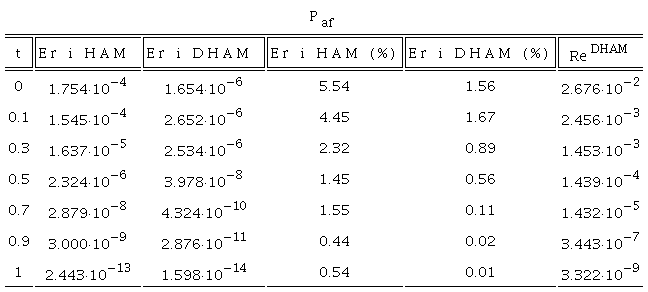
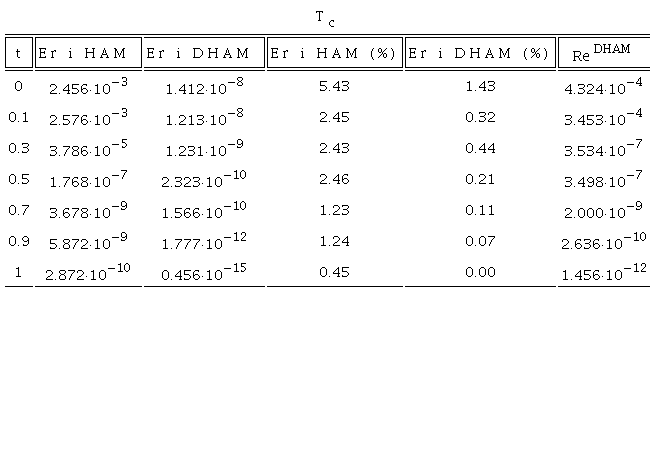
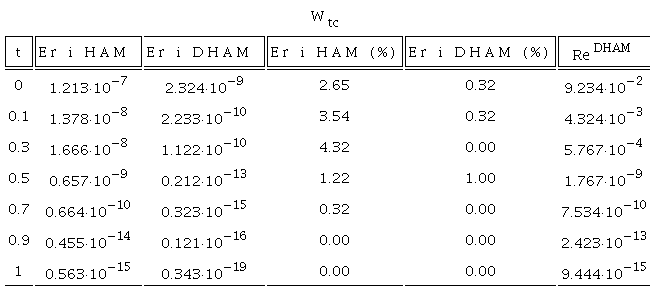
We present a summary of the main results obtained using the numerical and analytical methods at Tables 1-3. The values of the errors of the dynamic variables included in the model: , , and are compared for the interval time [0,1].
5. Conclusions
In the present research, we modified a semi-analytical method known as HAM, the homotopy analysis method, such that the right-hand side of the ODE system decomposes into a sum of analytical functions. We called the procedure as the DHAM decomposition of the homotopy analysis method (DHAM). After the decomposition, we applied the homotopy analysis method (HAM) to the turbo-engine mathematical model. The system of nonlinear ordinary differential equations is shown with hidden hierarchy, i.e., not as a multi scale system. In this sense, the HAM is based on an artificial parameter that presents the model as SPS system i.e., a singularly perturbed system with explicit hierarchy. To find the optimal value of the artificial parameter of the HAM we applied the Minimize procedure to the residual error, where we have found that the optimal value of ћ is 0.02. Also, we determined that for 32th order approximation the residual errors are very small for all study cases. To validate the DHAM method we defined two types of error: absolute error and relative error in percent. We compared the results of HAM and the DHAM with the numerical results obtained by standard numerical methods Runge-Kutta (RK4). In general, we have found that the DHAM solutions are closer to the numerical results compared with the standard HAM solution. Also, the square residual error was computed and compared for all results, obtaining a convergence similar to the previous one.
References
Abdelmadjid, C., Mohamed, S., & Boussad, B. (2013). CFD Analysis of the Volute Geometry Effect on the Turbulent Air Flow through the Turbocharger Compressor. Energy Procedia, 36, 746-755. https://doi.org/10.1016/j.egypro.2013.07.087
Abbasbandy, S. (2006). The application of homotopy analysis method to nonlinear equations arising in heat transfer. Physics Letters A, 360(1), 109-113. https://doi.org/10.1016/j.physleta.2006.07.065
Andersson, P. (2005). Air charge estimation in turbocharged spark ignition engines. Department of Electrical Engineering, Linköping University.
Bell, C. (n.d.). Maximum boost: Designing, testing, and installing turbocharger systems. Cambridge, MA: Bentley Publ.
Bontempo, R., Cardone, M., Manna, M., & Vorraro, G. (2015). Steady and unsteady experimental analysis of a turbocharger for automotive applications. Energy Conversion and Management, 99, 72-80. https://doi.org/10.1016/j.enconman.2015.04.025
Burke, R., Copeland, C., & Duda, T. (2014). Investigation into the assumptions for lumped capacitance modelling of turbocharger heat transfer. Retrieved from https://researchportal.bath.ac.uk/en/publications/investigation-into-the-assumptions-for-lumped-capacitance-modelli
Burke, R., Vagg, C., Chalet, D., & Chesse, P. (2015). Heat transfer in turbocharger turbines under steady, pulsating and transient conditions. International Journal of Heat and Fluid Flow, 52, 185-197. https://doi.org/10.1016/j.ijheatfluidflow.2015.01.004
Cheng, J., Liao, S., Mohapatra, R., & Vajravelu, K. (2008). Series solutions of nano boundary layer flows by means of the homotopy analysis method. Journal of Mathematical Analysis and Applications, 343(1), 233-245. https://doi.org/10.1016/j.jmaa.2008.01.050
Chen, W. J. (2012). Rotordynamics and bearing design of turbochargers. Mechanical Systems and Signal Processing, 29, 77-89. https://doi.org/10.1016/j.ymssp.2011.07.025
Ekberg, K., & Eriksson, L. (2017). Improving Fuel Economy and Acceleration by Electric Turbocharger Control for Heavy Duty Long Haulage. IFAC-PapersOnLine, 50(1), 11052-11057. https://doi.org/10.1016/j.ifacol.2017.08.2486
Fallahzadeh, A., & Shakibi, K. (2015). A method to solve Convection-Diffusion equation based on homotopy analysis method. Journal of Interpolation and Approximation in Scientific Computing, 2015(1), 1-8. https://doi.org/10.5899/2015/jiasc-00074
Gancedo, M., Guillou, E., & Gutmark, E. (2018). Effect of bleed slots on turbocharger centrifugal compressor stability. International Journal of Heat and Fluid Flow , 70, 206-215. https://doi.org/10.1016/j.ijheatfluidflow.2017.12.007
Grönman, A., Sallinen, P., Honkatukia, J., Backman, J., & Uusitalo, A. (2016). Design and experiments of two-stage intercooled electrically assisted turbocharger. Energy Conversion and Management , 111, 115-124. https://doi.org/10.1016/j.enconman.2015.12.055
Holmbom, R., Liang, B., & Eriksson, L. (2017). Implications of Using Turbocharger Speed Sensor for Boost Pressure Control. IFAC-PapersOnLine , 50(1), 11040-11045. https://doi.org/10.1016/j.ifacol.2017.08.2484
Jafari, H., Saeidy, M., & Firoozjaee, M. A. (2009). The homotopy analysis method for solving higher dimensional initial boundary value problems of variable coefficients. Numerical Methods for Partial Differential Equations, 26(5), 1021-1032. https://doi.org/10.1002/num.20471
Liao, S. (2003). Beyond perturbation: Introduction to the homotopy analysis method. CRC Press.
Li, S., & Liao, S. (2005). An analytic approach to solve multiple solutions of a strongly nonlinear problem. Applied Mathematics and Computation, 169(2), 854-865. https://doi.org/10.1016/j.amc.2004.09.066
Liao, S. (2009a). Notes on the homotopy analysis method: Some definitions and theorems. Communications in Nonlinear Science and Numerical Simulation, 14(4), 983-997. https://doi.org/10.1016/j.cnsns.2008.04.013
Liao, S. (2009b). Series solution of nonlinear eigenvalue problems by means of the homotopy analysis method. Nonlinear Analysis: Real World Applications, 10(4), 2455-2470. https://doi.org/10.1016/j.nonrwa.2008.05.003
Liao, S. (2010). An optimal homotopy-analysis approach for strongly nonlinear differential equations. Communications in Nonlinear Science and Numerical Simulation , 15(8), 2003-2016. https://doi.org/10.1016/j.cnsns.2009.09.002
Liao, S. (2012). Homotopy analysis method in nonlinear differential equations (pp. 153-165). Beijing: Higher education press.
Miller, J. K. (2008). Turbo real world high-performance turbocharger systems. North Branch, MN: CarTech
Molabahrami, A., & Khani, F. (2009). The homotopy analysis method to solve the Burgers-Huxley equation. Nonlinear Analysis: Real World Applications , 10(2), 589-600. https://doi.org/10.1016/j.nonrwa.2007.10.014
Smolík, L., Hajžman, M., & Byrtus, M. (2017). Investigation of bearing clearance effects in dynamics of turbochargers. International Journal of Mechanical Sciences, 127, 62-72. https://doi.org/10.1016/j.ijmecsci.2016.07.013
Turkyilmazoglu, M. (2009). A homotopy treatment of analytic solution for some boundary layer flows. International Journal of Nonlinear Sciences and Numerical Simulation, 10(7). https://doi.org/10.1515/IJNSNS.2009.10.7.885
Yang, C., & Liao, S. (2006). On the explicit, purely analytic solution of Von Kármán swirling viscous flow. Communications in Nonlinear Science and Numerical Simulation , 11(1), 83-93. https://doi.org/10.1016/j.cnsns.2004.05.006
Yang, M., Gu, Y., Deng, K., Yang, Z., & Zhang, Y. (2018). Analysis on altitude adaptability of turbocharging systems for a heavy-duty diesel engine. Applied Thermal Engineering, 128, 1196-1207. https://doi.org/10.1016/j.applthermaleng.2017.09.065
Zhao, B., Sun, H., Wang, L., & Song, M. (2017). Impact of inlet distortion on turbocharger compressor stage performance. Applied Thermal Engineering, 124, 393-402. https://doi.org/10.1016/j.applthermaleng.2017.05.181
Notes
Author notes
∗Corresponding author. E-mail address:naveof@gmail.com (OPhir Nave).