Articles
Registration and follow-up of people with suspected COVID-19 by means of mobile applications: A mapping study
Registration and follow-up of people with suspected COVID-19 by means of mobile applications: A mapping study
Journal of applied research and technology, vol. 21, no. 3, pp. 471-483, 2023
Universidad Nacional Autónoma de México, Instituto de Ciencias Aplicadas y Tecnología
Received: 27 November 2021
Accepted: 24 August 2022
Published: 30 June 2023
Abstract: In December 2020 will be two years since the first case of COVID-19 was reported by the OMS. Many strategies and policies of isolation and social distancing have been put in place around the world since this event to avoid contagion. At the same time, many mobile applications started to develop to register and trace people with suspected coronavirus in order to avoid the chain of COVID-19 infections. This work proposes a systematic mapping review of mobile applications to registration and tracing of people with suspected coronavirus. To develop this research, three citation databases were used: Scopus, Web of Science and PudMed. Sixteen articles have been identified proposing the implementation of this type of application, which were validated in different communities and/or regions. The main results obtained were first-hand knowledge of the reality of how the COVID-19 disease expands, evolves and is registered. On the one hand, these applications offer a solution that allows social contact with adults and young people, on the other hand, they could guarantee quick and timely action for decision making. Those types of applications can be considered as a real-time population health surveillance system, with this approach would have the ability to convert data into usable information to initiate appropriate and localized public health actions in a community and/or institution that are trying to avoid the chain of COVID-19 contagions.
Keywords: COVID-19, SARS-CoV, Pandemic, Register, Follow-up, Mobile Applications.
1. Introduction
The pandemic caused by the new coronavirus COVID-19 (or SARS-CoV-2) appeared in December 2019. By March 2020, the head of World Health Organization (WHO), Tedros Adhanom Ghebreyesus, stated this outbreak as a pandemic due to the high cases of COVID-19 infection worldwide (Lancet, 2020). In April 2020, vaccine development began and by July of that year, some vaccines arrived. Next, on Tuesday, December 8, 2020, Margaret Keenan became the first person in the world to receive a vaccine against COVID-19. More than eight months have passed since then and the various vaccination campaigns around the world have already managed to administer the first billion doses, which means that approximately 7.3% of the world's population has received at least one dose (World Health Organization, 2020). The WHO recommends that we should continue to take care of ourselves, even with the application of vaccines, since we can be contagious.
Pharmaceutical companies have not been able to supply the large number of vaccines needed worldwide and their distribution is too slow, even more so for underdeveloped countries. By May 2021, around 3.5 million people will have died worldwide as a result of COVID-19 infections. The United States leads the statistics by exceeding 607,700 deaths, followed by Brazil with 456,700. As of May 28, 2021, there were more than 169.5 million confirmed cases of COVID-19 worldwide. Some countries are in the third wave of the pandemic, where numbers are increasing. The percentage of mutations and variations of the disease is large, some of them are easy to transmit and are more lethal del Rio-Chanona et al. (2020) . Health systems continue to collapse and face a serious burden with resource allocation, service delivery and containment of the spread of the COVID-19 virus (Rutledge et al., 2020; Jnr, 2020), there is fear and confusion at all levels. This has made this disease the most complex of all the situations we have faced globally, and one in which the world must work and seek the support and help of all countries to collaborate and cope with this high impact pandemic.
The international community has taken much attention to the effectiveness of quarantine (Fuller et al., 2020; Yu et al., 2021), social distancing and strengthening prevention measures, including the proper and rational use of personal protective equipment in different settings (hospital, pre-hospital, outpatient, laboratory, points of entry, home care, public spaces), which are a key factor in containing transmission at the local and community level. The WHO director stated that "We all want this to end. We all want to get on with our lives. But the harsh reality is that this is not even close to being over". He further indicated that some progress is being made and there is a need to strengthen activities and infrastructure, which is still lacking in many countries (van Veen et al., 2019).
To minimize the impact of the COVID-19 pandemic, many countries have developed various strategies to combat it, the most important being the identification, monitoring and isolation of suspected cases. Many strategies are used to self-report signs and symptoms of COVID-19, others are used to identify people with suspected coronavirus, another for cases where people have been exposed to an infected person, others are used to trace contacts, and others that provide information on health services such as diagnosis, consultation, treatment, rules, regulations, etc. All of these are tactics to support and prevent disease and to store information on health-related issues and contact tracing (Jnr et al., 2021; Mobile Network Subscriptions Worldwide 2020-2021 Statista, 2020).
For years now, with the use of technologies, health interventions have been developed that have made possible the creation of software applications (web or mobile) that integrate features and functionalities that significantly improve the provision of remote health services and the implementation of preventive measures such as social distancing and home quarantine (Drew et al., 2020; Menni et al., 2020; Noronha et al., 2020; Ramirez et al., 2016)
Overall, there is limited research on evaluating mobile applications to manage COVID-19 (Davalbhakta et al., 2020; Islam et al., 2020) that are used as health interventions. Therefore, it is necessary to propose a research work whose objective will be to review the characteristics, functionalities and effectiveness of health mobile applications, to allow the registration and follow-up of persons suspected of having the disease. The results and observations from a comprehensive review of these types of health interventions can have many positive implications, for example, suggesting more efficient applications for patients to manage health operations with online diagnosis and consultation (saving time and money and reducing travel to prevent COVID-19 transmission), understand drawbacks of current applications to integrate COVID-19 specific functionalities and propose applications with innovative technologies to know and understand how the pandemic evolves in order to generate and adopt measures and strategies to mitigate COVID-19, as well as, data can be used at a more aggregated level to assess the local or regional health status and the (expected) pressure on the health care system (Bassi et al., 2020; Jalabneh et al., 2021; Ming et al., 2020; Nguyen et al., 2020; Singh et al., 2020). So, these applications could be used as a tool to avoid the chain of contagion (Mbunge, 2020), by being more effective in providing and exchanging current information in a fast, dynamic and timely manner related to overall health (Biolchini et al., 2005).
2. Materials and methods
This systematic mapping review (SR) is based on the guidelines proposed in (Biolchini et al., 2005; Brereton et al., 2007; Kitchenham et al., 2010; Kitchenham & Charters, 2007; Kitchenham et al., 2009; Petersen et al., 2015; Sampaio & Marcini, 2007), where the main objective is to conduct an analysis of the current landscape of research related to software applications for registration and follow-up of people with suspected Coronavirus. This review includes two stages: planning and implementation. The first one addresses the definition of the research questions specifying the intervention of interest, the search process, and the definition of article selection criteria: The second stage implements the selection process of the research relevant to the object of study, through the application of the selection criteria and data extraction to obtain the results of this systematic review.
2.1. Planning
The intent of this research will be governed to the primary research question (PRQ): What approaches are being used/proposed for the development of software applications for the registration and tracking of individuals with suspected COVID-19?
The PRQ seeks to locate relevant documents on the proposed topic, to achieve this objective it is divided into three research sub-questions (RSQ).
-
RSQ_1: What are the techniques and methods of these applications for the management of COVID-19?
-
RSQ_2: What types of data are recorded by these kinds of applications and what is their use?
-
RSQ_3: What limitations and innovations are identified in the applications explored?
To carry out the search process for scientific publications that contribute to the analysis of the object of study, three citation databases are considered: Scopus, Web of Science (WoS) and PubMed. The first two are bibliographic databases of abstracts and citations of scientific journal articles. The third is a bibliographic reference search engine that allows queries of the National Library of Medicine (MEDLINE). All these databases complement each other because they include documents from various sources, including journal articles and conference papers.
The review process consists of keywords election, which arise from the research question: i) COVID-19, ii) signal, iii) register, iv) tracking and v) application.
The keywords that allow identifying synonyms and terms related to the object of study, which when combined form the search string, whose purpose is to identify articles relevant to the research. The search period for relevant publications was conducted between the years 2015 - 2020, due to the speed at which technological changes are currently occurring.
Once the documents were found, inclusion and exclusion criteria were used to preselection and selection of relevant articles. The main systematic review criteria are the following:
Inclusion criteria
-
English language studies
-
Studies related to the object of research
-
Full text studies
Exclusion criteria
-
Duplicate studies
-
Studies where no application is being developed
-
Review studies, books or book chapters.
2.2. Execute
The execution process begins with the application of the initial search string in indexed databases in order to refine the string and find the articles relevant to the object of study.
In the first iteration of search in bibliographic databases the following numbers of publications were obtained: 260 in Scopus, 157 in WoS and 213 in PubMed, all of them from 2015 to 2020.
After a series of test and review iterations, related terms and their synonyms were identified, in such a way that: i) COVID-19, coronavirus, SARS-CoV2, ii) signal, sign, symptom, iii) register, identify, identification, iv) track, monitor, follow, control, v) application, app.
So that, the standard search string model is expressed as follows: (COVID-19 OR coronavirus OR SARS-CoV-2) AND (sign OR signal OR symptom) AND (regist* OR identify OR identification) AND (track* OR monitor* OR follow* OR control*) v) application or app.
Once the refined search string was applied, primary studies were found and, in order to maximize the completeness of the search, the references of these studies were reviewed with the aim of identifying other relevant studies (a search technique known as "snowballing" (Wohlin, 2014). According to Figure 1, which shows the details of the process of preselection and selection of relevant articles, 61 in Scopus, 106 in WoS, and 222 in PubMed were identified, giving a total of 389 documents. After that, we eliminated 27 duplicate articles, obtaining 27 repeated studies in the different databases.
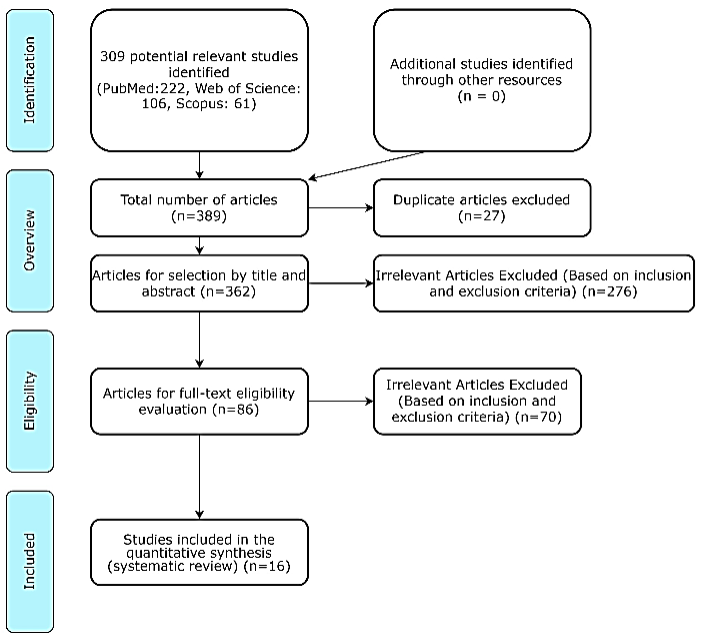
Figure 1
Diagram flowchart showing the overview of the research process for relevant studies.
Finally, 362 articles were obtained to be analyzed in detail. A first approximation of relevant studies is their pre-selection, first, articles whose language was different from English were discarded, and then the title, abstract and keywords of each article were analyzed to verify if they are related to the object of study, 276 articles were eliminated after this evaluation and 86 articles were obtained for their complete review
For the selection of articles, the full text was thoroughly analyzed to determine whether the article was closely related to the object of study, or whether an application was developed that could verify the construction of a tool as a minimum requirement for selection. To avoid subjectivity, article review and data extraction activities were performed independently by two reviewers. If an article was not included, the reason for its exclusion was mentioned. With this analysis, 70 articles were eliminated, resulting in 16 studies used for data extraction.
3. Results
The results found in Table I show the relevant information from the selected studies about the functionalities, methods and techniques used in the applications for the registration and follow-up of persons with suspected COVID-19, information that is used to generate a distribution map of the selected studies over the research context (Figure 2) and to calculate the frequencies of the studies for each functionality of the classification scheme (Figure 3). This allows us to analyze how the functionalities, techniques and registries used in the different applications for the follow-up of people with suspected COVID-19 are addressed and thus answer the proposed research questions.
RSQ_1: What are the techniques and methods of these applications for COVID-19 management?

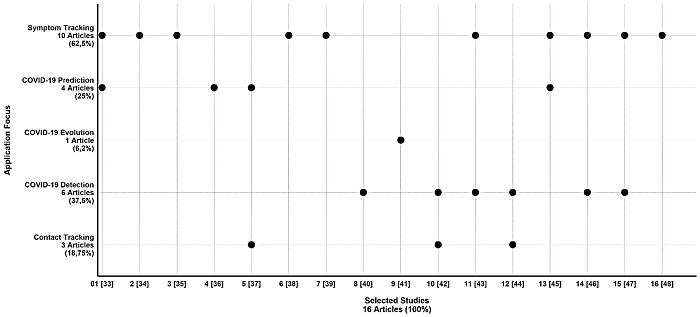
Figure 2
Distribution of selected studies on research approach.
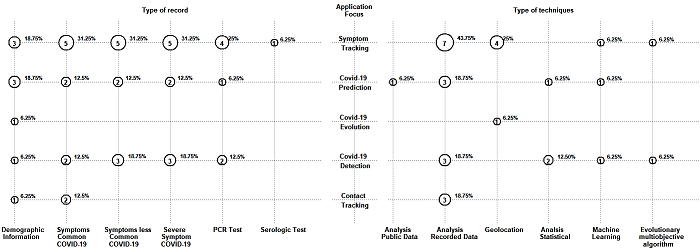
Figure 3
Map of the context of research on mobile applications that register and track people with suspected COVID-19. The researchfocuses on the Y-axis, the types of features and functionalities on the left side of the X-axis, and the type of techniques and methods on the right side of the X-axis.
To answer this question, a bubble diagram was created to represent the interconnected frequencies, where the relationship between the functionalities vs. the techniques and methods used can be clearly and precisely visualized (Figure 3: right side of the X-axis). The number of publications on each side of the X-axis may differ, as some publications use multiple functionalities, registries and techniques, e.g., an article focusing on symptom tracking could also be used for detection of new COVID-19 positive cases, as well as for case prediction, disease progression or contact tracing. The map (Figure 3: right side of the X axis) shows that the most frequent technique is the analysis of recorded data with 43.75% (7 articles) based on the report of information entered by users, obtaining averages, standard deviations, etc., 25% (4 articles) use geolocation for symptom tracking and 6.25% (1 article) apply machine learning techniques and multi-objective evolutionary algorithms. On the other hand, for contact tracing and infection prediction, 18.75% (3 articles) use the analysis of recorded data, 12.5% use statistical analysis and 6.25% use machine learning and multi-objective evolutionary algorithms. For the evolution of Covid-19, only 6.25% (1 article) use geolocation.
RSQ_2: What types of data are recorded by these kinds of applications and what is their use?
The different applications have specific functionalities related to the recorded data, in Figure 3 on the left side of the X-axis we can observe that 31.25% (5 items) record COVID-19 symptoms, the common ones (fever, dry cough. The less common ones (aches and pains, sore throat, diarrhea, conjunctivitis, headache, loss of sense of smell or taste) and those considered severe (difficulty breathing or feeling short of breath, chest pain or pressure, inability to speak or move) for symptom tracking. In the case of the PCR tests, 25% (4 articles) recorded information on PCR tests, 18.75% (3 articles) recorded patient demographic information and only 6.35% (1 article) recorded serological tests. On the other hand, for contact tracing, 12.5% recorded common symptoms and only 6.25% recorded demographic information.
For the prediction of infection, 18.75% recorded demographic information, 12.5% recorded information on common, less common and severe symptoms, only 6.25% recorded information on PCR tests. For covid-19 detection, 18.75% recorded severe and less common symptoms, 12.5% recorded information on common symptoms and PCR tests, and only 6.25% recorded demographic information.
RSQ_3: What limitations and innovations are identified in the applications explored?
After analyzing the articles, it was found that, even though each one proposes different innovative approaches for the detection, monitoring, tracking, prediction and evolution of COVID - 19, each one has limitations related to the number of participants, since in most cases the relatively small samples tend to homogenize the population. Among the most outstanding innovations was the use of respiratory sound patterns and heart rate variation as support for COVID-19 remote sensing.
PRQ: What approaches are being used/proposed for the development of software applications for the follow-up of people suspected of Covid-19?
Figure 2 shows the distribution of the functionalities, where it was found that the 16 articles cover at least one of the identified functionalities such as: symptom follow-up, COVID-19 detection, contact tracing, disease prediction and evolution. It was found that 62.5% of the studies focus on symptom tracking 10 articles); 37.5% focus on disease detection (6 articles); 25% focus on disease contagion prediction (4 articles); 18.75% focus on contact tracing (3 articles) and the rest address/study covid-19 evolution, i.e., 6.2% (1 article).
3. Analysis and discussions
The analysis of results shows the number of articles in line with each category covered in this research. This allows us to determine which categories have been emphasized in previous investigations, thus identifying future lines of research. The systematic map shows how the research conducted has been handled in multiple areas, all of which are related to symptom tracking or tracing possible infected persons.
Also, it can be observed that the number of articles on software applications in the follow-up of people with COVID-19, 81.3% (13 articles) and 18.8% (3 articles) have been published in 2020 and 2021, respectively. Another interesting result is 62.5% (10 articles) of the proposed applications track participants, while 37.5% (6 articles) allowed the detection of COVID-19. Of these, 25% (4 articles) made a prediction of possible infections, hospital burden, transmission rate, etc., and only 6.3% (1 article) monitored the evolution of the pandemic at a national level.
The bubble chart, see Figure 3, can indicate that the largest set of contributions in the area of monitoring people with suspected COVID- 19 is related to the recording of common symptoms of the disease and their subsequent analysis. Most of the studies refer to mobile applications that have served as a tool to alleviate the burden on healthcare systems. On the other hand, an interesting fact is the appearance of a single study that focuses on the analysis and evolution of COVID-19 through public information to generate an informative application. This indicates that there are very few studies that deal with applications that seek to inform the population based on the collection of public information to make it more accessible. It is necessary to consider that all of the identified studies make novel proposals that could be integrated to generate a very useful and widely used application by the population for the management of COVID-19 through the follow-up of infected persons, the information of possible contagions and the follow-up of contacts, as well as informing the population about the progress of the pandemic in their locality and/or region in a rapid and timely manner.
In addition, several studies applied various techniques and methods for the analysis of information and generation of results, among the most interesting techniques are those that, by using artificial intelligence, make a prediction of possible contagion through specific characteristics of the disease.
Finally, we can highlight the presence of some articles that used contact tracing, a feature that in the current context is interesting to avoid the rapid spread of the disease and therefore the emergence of new cases
4. Conclusions
This document presented a study of existing mobile applications used for registration and follow-up individuals as possible cases of COVID-19. (Zhang & Smith, 2020). As shown in the systematic map, many approaches have been proposed for either tracking, tracing, detection of possible coronavirus cases.
According to the map, there seems to be a relative lack of studies on applications that use techniques for collecting and disseminating public information that would be useful for monitoring the evolution of COVID-19 in the general population.
Also, geolocation and data analysis have been the techniques used for follow-up people with suspected COVID-19. (Plantes et al., 2021). Considering the above, it can be determined that past research is focused on the development of proposals for COVID-19 monitoring and detection.
Mobile applications, which have emerged in COVID-19 emergencies, are essential to improve the management of pandemics by using new technologies based on data analysis.
Finally, all mobile applications have used conventional and modern techniques such as statistics and artificial intelligence, to improve their performance.
Acknowledgements
The authors would like to express their gratitude to the anonymous reviewers and the chief editor for their valuable suggestions, which have significantly improved the presentation of this paper.
References
Antonelli, M., Capdevila, J., Chaudhari, A., Granerod, J., Canas, L. S., Graham, M. S., ... & Loeliger, A. E. (2021). Optimal symptom combinations to aid COVID-19 case identification: Analysis from a community-based, prospective, observational cohort.Journal of infection,82(3), 384-390. https://doi.org/10.1016/j.jinf.2021.02.015
Bassi, A., Arfin, S., John, O., & Jha, V. (2020). An overview of mobile applications (apps) to support the coronavirus disease 2019 response in India. Indian Journal of Medical Research, 151(5), 468. https://doi.org/10.4103/ijmr.ijmr_1200_20
Biolchini, J., Mian, P. G., Natali, A. C. C., & Travassos, G. H. (2005). Systematic review in software engineering.System engineering and computer science department COPPE/UFRJ, Technical Report ES,679(05), 45.
Brereton, P., Kitchenham, B., Budgen, D., Seed, P. T., & Khalil, M. M. (2007). Lessons from applying the systematic literature review process within the software engineering domain. Journal of Systems and Software, 80(4), 571-583. https://doi.org/10.1016/j.jss.2006.07.009
Bokolo, A. J. (2021). Exploring the adoption of telemedicine and virtual software for care of outpatients during and after COVID-19 pandemic.Ir Journal of Medical Science 190(1), 1-10. https://doi.org/10.1007/s11845-020-02299-z
Chatzinotas, S., & Ottersten, B. (2020). A Comprehensive Survey of Enabling and Emerging Technologies for Social Distancing-Part I: Fundamentals and Enabling Technologies. IEEE Access, 8, 153479-153507. https://doi.org/10.1109/access.2020.3018140
Cruz, S. B., Soares, E., Machado, D., Meireles, P., Ribeiro, J. N., Barros, H., ... & Aguiar, A. (2020). Crowdsensing spatial data to follow epidemic evolution. InProceedings of the 18th Conference on Embedded Networked Sensor Systems(pp. 671-672). https://doi.org/10.1145/3384419.3430427
Dantas, L. F., Peres, I. T., Bastos, L. S., Marchesi, J. F., De Souza, G. F., Gelli, J. G. M., ... & Bozza, F. A. (2021). App-based symptom tracking to optimize SARS-CoV-2 testing strategy using machine learning.PLoS One,16(3), e0248920. https://doi.org/10.1371/journal.pone.0248920
Davalbhakta, S., Advani, S., Kumar, S., Agarwal, V., Bhoyar, S., Fedirko, E., ... & Agarwal, V. (2020). A systematic review of smartphone applications available for corona virus disease 2019 (COVID19) and the assessment of their quality using the mobile application rating scale (MARS).Journal of medical systems,44, 1-15. https://doi.org/10.1007/s10916-020-01633-3
Denis, F., Galmiche, S., Dinh, A., Fontanet, A., Scherpereel, A., Benezit, F., & Lescure, F. (2020). Epidemiological Observations on the Association Between Anosmia and COVID-19 Infection: Analysis of Data From a Self-Assessment Web Application. Journal of Medical Internet Research, 22(6), e19855. https://doi.org/10.2196/19855
del Rio-Chanona, R. M., Mealy, P., Pichler, A., Lafond, F., & Farmer, J. D. (2020). Supply and demand shocks in the COVID-19 pandemic: An industry and occupation perspective .Oxford Review of Economic Policy,36(Supplement_1), S94-S137. https://doi.org/10.1093/oxrep/graa033
Drew, D. A., Nguyen, L. H., Steves, C. J., Menni, C., Campbell, A., Varsavsky, T., Sudre, C. H., Cardoso, M. J., Ourselin, S., Wolf, J., Spector, T. D., & Chan, A. T. (2020). Rapid implementation of mobile technology for real-time epidemiology of COVID-19. Science, 368(6497), 1362-1367. https://doi.org/10.1126/science.abc0473
Echeverría, P., Bergas, M. A. M., Puig, J., Isnard, M., Massot, M., Vedia, C., ... & Negredo, E. (2020). COVIDApp as an innovative strategy for the management and follow-up of COVID-19 cases in long-term care facilities in Catalonia: implementation study.JMIR public health and surveillance, 6(3), e21163.https://doi.org/10.2196/21163
Ediriweera, D. S., De Silva, N., Malavige, G. N., & De Silva, H. J. (2020). An epidemiological model to aid decision-making for COVID-19 control in Sri Lanka. PLOS ONE, 15(8), e0238340. https://doi.org/10.1371/journal.pone.0238340
Fuller, S., Vaporciyan, A. A., Dearani, J. A., Stulak, J. M., & Romano, J. C. (2020). COVID-19 Disruption in Cardiothoracic Surgical Training: An Opportunity to Enhance Education. The Annals of Thoracic Surgery, 110(5), 1443-1446. https://doi.org/10.1016/j.athoracsur.2020.05.015
Faezipour, M., & Abuzneid, A. (2020). Smartphone-Based Self-Testing of COVID-19 Using Breathing Sounds. Telemedicine Journal and E-health, 26(10), 1202-1205.https://doi.org/10.1089/tmj.2020.0114
Galmiche, S., Rahbe, E., Fontanet, A., Dinh, A., Bénézit, F., Lescure, F., & Denis, F. (2020). Implementation of a Self-Triage Web Application for Suspected COVID-19 and Its Impact on Emergency Call Centers: Observational Study. Journal of Medical Internet Research, 22(11), e22924. https://doi.org/10.2196/22924
Hirten, R. P., Danieletto, M., Tomalin, L., Choi, K. H., Zweig, M., Golden, E., ... & Fayad, Z. A. (2021). Use of physiological data from a wearable device to identify SARS-CoV-2 infection and symptoms and predict COVID-19 diagnosis: observational study.Journal of medical Internet research,23(2), e26107.https://doi.org/10.2196/26107
Intawong, K., Olson, D. K., & Chariyalertsak, S. (2021). Application technology to fight the COVID-19 pandemic: Lessons learned in Thailand. Biochemical and Biophysical Research Communications, 534, 830-836. https://doi.org/10.1016/j.bbrc.2020.10.097
Islam, M. N., Islam, I., Munim, K. M., & Islam, A. N. (2020). A review on the mobile applications developed for COVID-19: an exploratory analysis.Ieee Access, 8, 145601-145610.https://doi.org/10.1109/access.2020.3015102
Jalabneh, R., Syed, H. Z., Pillai, S., Apu, E. H., Hussein, M. R., Kabir, R., ... & Saxena, S. K. (2021). Use of mobile phone apps for contact tracing to control the COVID-19 pandemic: A literature review.Applications of Artificial Intelligence in COVID-19, 389-404.https://doi.org/10.2139/ssrn.3641961
Jnr, B. A. (2020). Use of Telemedicine and Virtual Care for Remote Treatment in Response to COVID-19 Pandemic. Journal of Medical Systems, 44(7). https://doi.org/10.1007/s10916-020-01596-5
Jnr, B. A., Nweke, L. O., & Al-Sharafi, M. A. (2021). Applying software-defined networking to support telemedicine health consultation during and post Covid-19 era.Health and technology,11, 395-403.https://doi.org/10.1007/s12553-020-00502-w
Kassaye, S., Spence, A. B., Lau, E. M., Bridgeland, D. M., Cederholm, J., Dimolitsas, S., & Smart, J. (2020). Rapid Deployment of a Free, Privacy-Assured COVID-19 Symptom Tracker for Public Safety During Reopening: System Development and Feasibility Study. JMIR Public Health and Surveillance, 6(3), e19399. https://doi.org/10.2196/19399
Kitchenham, B., & Charters, S. M. (2007). Guidelines for performing Systematic Literature Reviews in Software Engineering. ResearchGate.
Kitchenham, B., Brereton, P., Turner, M., Niazi, M., Linkman, S., Pretorius, R., & Budgen, D. (2009). The impact of limited search procedures for systematic literature reviews-A participant-observer case study. In2009 3rd international symposium on empirical software engineering and measurement(pp. 336-345). IEEE.https://doi.org/10.1109/esem.2009.5314238
Kitchenham, B., Pretorius, R., Budgen, D., Brereton, O. P., Seed, P. T., Niazi, M., & Linkman, S. (2010). Systematic literature reviews in software engineering - A tertiary study. Information & Software Technology, 52(8), 792-805. https://doi.org/10.1016/j.infsof.2010.03.006
Mbunge, E. (2020). Integrating emerging technologies into COVID-19 contact tracing: Opportunities, challenges and pitfalls. Diabetes and Metabolic Syndrome: Clinical Research and Reviews, 14(6), 1631-1636.https://doi.org/10.1016/j.dsx.2020.08.029
Menni, C., Valdes, A. M., Freidin, M. B., Sudre, C. H., Nguyen, L. H., Drew, D. A., ... & Spector, T. D. (2020). Real-time tracking of self-reported symptoms to predict potential COVID-19.Nature medicine,26(7), 1037-1040.https://doi.org/10.1038/s41591-020-0916-2
Ming, L. C., Untong, N., Aliudin, N. A., Osili, N., Kifli, N., Tan, C. S., ... & Goh, H. P. (2020). Mobile health apps on COVID-19 launched in the early days of the pandemic: content analysis and review.JMIR Mhealth and Uhealth, 8(9), e19796.https://doi.org/10.2196/19796
Mobile network subscriptions worldwide 2016-2021 Statista. (2020). 2020, December, 3. Statista. https://www.statista.com/statistics/330695/number-of-smartphone-users-worldwide/
Noronha, N., D'Elia, A., Coletta, G., Wagner, N., Archer, N., Navarro, T., & Lokker, C. (2020). Mobile applications for COVID-19: a scoping review of the initial response in Canada.https://doi.org/10.21203/rs.3.rs-23805/v2
Nguyen, C. T., Saputra, Y. M., Van Huynh, N., Nguyen, N. T., Khoa, T. V., Tuan, B. M., ... & Ottersten, B. (2020). A comprehensive survey of enabling and emerging technologies for social distancing-Part I: Fundamentals and enabling technologies.Ieee Access, 8, 153479-153507.https://doi.org/10.1109/access.2020.3018140
Plantes, P. J., Fragala, M. S., Clarke, C. L. A., Goldberg, Z. J., Radcliff, J., & Goldberg, S. R. (2021). Model for Mitigation of Workplace Transmission of COVID-19 Through Population-Based Testing and Surveillance. Population Health Management, 24(S1), S-25.https://doi.org/10.1089/pop.2020.0322
Petersen, K., Vakkalanka, S., & Kuzniarz, L. (2015). Guidelines for conducting systematic mapping studies in software engineering: An update. Information & Software Technology, 64, 1-18. https://doi.org/10.1016/j.infsof.2015.03.007
Quer, G., Radin, J. M., Gadaleta, M., Baca-Motes, K., Ariniello, L., Ramos, E., ... & Steinhubl, S. R. (2021). Wearable sensor data and self-reported symptoms for COVID-19 detection.Nature Medicine,27(1), 73-77. https://doi.org/10.1038/s41591-020-1123-x
Ramirez, V., Johnson, E., Gonzalez, C., Ramirez, V., Rubino, B., & Rossetti, G. (2016). Assessing the use of mobile health technology by patients: an observational study in primary care clinics.JMIR mHealth and uHealth, 4(2), e4928. https://doi.org/10.2196/mhealth.4928
Rutledge, G., & Wood J. (2020). Virtual health and artificial intelligence: Using technology to improve healthcare delivery. 169-175. https://doi.org/10.1016/B978-0-12-820543-3.00008-0
Sampaio, R. F., & Mancini, M. C. (2007). Estudos de revisão sistemática: um guia para síntese criteriosa da evidência científica. Revista Brasileira De Fisioterapia, 11(1), 83-89. https://doi.org/10.1590/s1413-35552007000100013
Singh, H. J. L., Couch, D., & Yap, K. Y. (2020). Mobile Health Apps That Help With COVID-19 Management: Scoping Review. JMIR Nursing, 3(1), e20596. https://doi.org/10.2196/20596
Soriano, J. B., Fernández, E., de Astorza, Á., de Llano, L. A. P., Fernández-Villar, A., Carnicer-Pont, D., ... & Ancochea, J. (2020). Hospital epidemics tracker (HEpiTracker): description and pilot study of a mobile app to track COVID-19 in hospital workers.JMIR Public Health and Surveillance, 6(3), e21653. https://doi.org/10.2196/21653
Timmers, T., Janssen, L., Stohr, J. J., Murk, J., & Berrevoets, M. a. H. (2020). Using eHealth to Support COVID-19 Education, Self-Assessment, and Symptom Monitoring in the Netherlands: Observational Study. Jmir Mhealth and Uhealth, 8(6), e19822. https://doi.org/10.2196/19822
Dong E, Du H, & Gardner L. (2020) An interactive web-based dashboard to track COVID-19 in real time. The Lancet infectious diseases, 2020 May, 20(5), 533-534. https://doi.org/10.1016/S1473-3099(20)30120-1
van Veen, T., Binz, S., Muminovic, M., Chaudhry, K., Rose, K., Calo, S., ... & Miller, J. B. (2019). Potential of mobile health technology to reduce health disparities in underserved communities.Western Journal of Emergency Medicine,20(5), 799-802.
Wohlin, C. (2014). Guidelines for snowballing in systematic literature studies and a replication in software engineering. InProceedings of the 18th international conference on evaluation and assessment in software engineering(pp. 1-10). https://doi.org/10.1145/2601248.2601268.
World Health Organization: WHO. (2020). Estimating mortality from COVID-19. https://apps.who.int/iris/handle/10665/333857
Yu, M., Li, Z., Yu, Z., Jiaxin, H., & Zhou, J. (2021). Communication related health crisis on social media: a case of COVID-19 outbreak. Current Issues in Tourism, 24(19), 2699-2705. https://doi.org/10.1080/13683500.2020.1752632
Yap, K. Y. L., & Xie, Q. (2020). Personalizing symptom monitoring and contact tracing efforts through a COVID-19 web-app.Infectious Diseases of Poverty, 9(1), 1-4. https://doi.org/10.1186/s40249-020-00711-5
Zhang, M. W. B., & Smith, H. (2020). Digital Tools to Ameliorate Psychological Symptoms Associated With COVID-19: Scoping Review. Journal of Medical Internet Research, 22(8), e19706. https://doi.org/10.2196/19706
Zens, M., Brammertz, A., Herpich, J., Südkamp, N. P., & Hinterseer, M. (2020). App-Based Tracking of Self-Reported COVID-19 Symptoms: Analysis of Questionnaire Data. Journal of Medical Internet Research, 22(9), e21956. https://doi.org/10.2196/21956
Author notes
∗Corresponding author. E-mail address:mjflores@espe.edu.ec (M. Flores-Calero).
Conflict of interest declaration