Dossier
Five factors for U.S. - Cuba Rapprochement
Cinco factores para el acercamiento entre E.E.U.U y Cuba
 Yulia Vlasova vlasova-yue@rudn.ru
Tatiana Vavichkina vavichkina-ta@rudn.ru
Yulia Vlasova vlasova-yue@rudn.ru
Tatiana Vavichkina vavichkina-ta@rudn.ru
Five factors for U.S. - Cuba Rapprochement
Revista Científica General José María Córdova, vol. 22, no. 45, pp. 32-56, 2024
Escuela Militar de Cadetes "General José María Córdova"
Received: 16 April 2023
Accepted: 22 January 2024
Published: 02 February 2024
Abstract: The article is devoted to the analysis of the five factors that may ensure the U.S. - Cuba rapprochement such as geographical proximity, the historical experience of cooperation, existing strong economic ties between the two states, the Castro Era end implications as well as special foreign conditions. The authors show that the USA and Cuba remain interconnected even amid the economic blockade, point out that the Cuban regime has already faced a lot of challenges in terms of economic development and public unrest and demonstrate how new international reality fosters normalization of bilateral relations.
Keywords: Cuba, USA, U.S. - Cuban Rapprochement.
Resumen: El artículo está dedicado al análisis de los cinco factores que pueden asegurar el acercamiento entre EE. UU. y Cuba, tales como la proximidad geográfica, la experiencia histórica de cooperación, los fuertes vínculos económicos existentes entre ambos estados, las implicaciones del fin de la Era Castro, así como las condiciones exteriores especiales. Los autores muestran que EE. UU. y Cuba siguen interconectados incluso en medio del bloqueo económico, señalan que el régimen cubano ya se ha enfrentado a muchos desafíos en términos de desarrollo económico y malestar público y demuestran cómo la nueva realidad internacional favorece la normalización de las relaciones bilaterales.
Palabras clave: Cuba, EE. UU., Acercamiento EE. UU. - Cuba.
Introduction
Today, Cuba is in a transition period, the era of the Castro brothers' rule has come to an end. The country continues to follow the path of not only economic, but also political transformations, such as the introduction of the posts of President and Prime Minister, limiting the term of Presidential office, as well as attracting the public to discuss issues which are important for the future of the country, such as certain provisions of the Constitution of 2019, etc. This indicates that in the foreseeable future Havana may say goodbye to its authoritarian past, which will open new opportunities for the development of U.S.-Cuba relations. In addition, we cannot ignore the factor of the emergence of new figures in the Cuban political arena, that indicates that later Cuba's foreign policy could be more pragmatic, and the Cuban leaders could be able to make several concessions to normalize bilateral relations with Washington.
Besides, even under the economic blockade, economic ties between Washington and Havana remain quite strong, primarily due to money transfers from Cuban Americans to their relatives in Cuba, the large number of American tourists visiting this island, as well as the activity of American companies that supply medicines, agricultural products, etc. That is why, if the USA takes the initiative, Washington can make a mutually acceptable deal with Havana. Taking into account both the current situation in the international arena and in Latin America, as well as the challenges to U.S. global leadership, the political rapprochement with Cuba, whose foreign policy raises U.S. concern, and, in the opinion of the White House, poses a threat to all democratic states of the Western hemisphere (US National Security Strategy, 2017), can be compared with the normalization of U.S.-Chinese relations in the early 1970s, which completely changed the international balance of power, as well as brought the USA significantly closer to victory in the Cold War with the Evil Empire yet entailed serious reputational costs concerning the recognition of the Republic of China.
Considering the relevance of restoring full-fledged partnership with Cuba, the authors of this article analyse the key factors which may ensure the U.S.-Cuba rapprochement and serve as a basis for future intense political and economic cooperation between Havana and Cuba placing a special emphasis on the effects of the Castro Era end as well as on the changed international conditions Washington provides with an exceptional opportunity to restore U.S. influence over the island. There is a lot of research devoted to the analysis of the U.S.-Cuba relations. For instance, Lamrani and Oberg (2015) stress that the U.S.-Cuba rapprochement is possible only if bilateral relations are based on the principles of sovereign equality, reciprocity, and non-interference. Campos and Prevost (2015) underline that the changes of the U.S. policy towards Cuba during the tenure of Obama were caused by the rise of independent thinking in Latin America.
Erisman (2019), points out that the development of Cuban oil deposits may be beneficial for the U.S.-Cuba relations, while Rosetti and Holland (2015) examine the key spheres for cooperation between the two states. In addition, López-Levy and Abrahams (2010) show the inefficiency of the human rights defence component in the U.S. policy towards the island. However, the scientific novelty of this research consists in the fact that the scholars conduct a comprehensive analysis of the five key factors for the U.S.-Cuba rapprochement, stressing the relevance of the Castro Era end as well as assessing the current international arena events influence on the prospects of the partnership between Washington and Havana.
The purpose of this research is to analyse the factors for the U.S.-Cuba rapprochement and assess to what extent are both parties ready for the restoration of the full-fledged economic and political partnership. To achieve the aforementioned purpose, the authors state the following objectives: to examine the historical pattern of U.S.-Cuba relations evaluating the effect of embargo on bilateral economic and political interaction, to assess the current level of Cuban dependency on trade and other forms of economic cooperation with the USA, to examine how the Castro Era and the current international situation may foster the normalization of bilateral relations.
This paper is qualitative research that includes the content and narrative analysis as well as the comparative historical analysis of the economic cooperation and political interaction between the USA and Cuba. The scholars use statistical data provided by Havana Consulting Group, the World Bank, the OEC, the National Office of Statistics and Information (ONEI), various academic articles by American, European, Russian and Latin American specialists, several monographs, a number of documents such as the Helms-Burton act of 1996, the Constitution of the Republic of Cuba 2019, the US National Security Strategy 2017, the UN General Assembly resolution 68/262, the United Nations General Assembly Resolution ES- 11/1, the Concept of Russian Foreign Policy 2013 as well as information from various news reports and analytical articles.
The authors develop the ideas of prominent realist scholars such as Morgenthau (1949), Modelski (1987), Brzezinski (2000), Mearsheimer (2018), etc. regarding material resources as a driver of world politics and economic cooperation as a pillar of political interaction and dialogue. In particular, the researchers focus on the trade dimension of the U.S.-Cuba economic cooperation pattern analysing the prospects of the rapprochement considering the key provisions of the gravity equation concept that prioritize economy size, as well as geographical proximity over any other factors in terms of bilateral trade growth (Yotov et al, 2016).
Factor 1. Geographical Proximity
The first factor that determines why the United States has always shown a special interest in building relations with Cuba is its geographical location. Cuba, which is surrounded by smaller Caribbean islands and archipelagos, is located in the very heart of the Caribbean. It is remarkable that the proximity to such large Latin American countries as Mexico, Venezuela, and Colombia as well as the fact that the distance between the island and Florida is less than 200 km have turned Cuba into a great trade centre since the very beginning of Americas' colonization. For instance, Havana's harbour used to be one of the key hubs and one of the most important Spanish military shipyards of the Western hemisphere in the 15th - 17th centuries with all the main trade routes connecting European and American colonies going through the port of Havana. Moreover, the extreme strategic significance of Havana lay in the fact that Cuba was one of the most important stops on the way of the Spanish treasure fleet both departing for and coming from Europe (Hugh, 2018). Afterwards, with the opening of the Panama Canal which acquired the status of one of the world trade arteries and the economic rise of Latin American countries (Argentina, Brazil, Venezuela, Mexico, etc.) as well as the USA, Cuba remained to be on the crossroad of many international trade routes. Thus, it is fair to agree with Whittlesey (1992) who stated back in 1922 that it was the geographic factor that had dictated the relationship between the USA and Cuba before the Spanish-American war of 1898. However, its relevance was demonstrated once again during the Cuban crisis of 1962 when the deployment of Soviet missiles right at the U.S. border was a direct threat to U.S. security and brought mankind to the brink of a nuclear war.
Anyway, this factor has another side that should be considered. That is the trade gravity equation (figure 1) concept and its implications. Since the trade turnover directly depends on both countries' production level and inversely depends on transaction costs (Yotov et al, 2016), Cuba could seem to be doomed to have the USA as its key trading partner if it had not been for the economic blockade and artificial limitations on economic cooperation between the two states. The USA is the largest world economy in terms of nominal GDP, while the distance between the two states is less than 200 km. Other leading world economies (e.g. mainland China, Germany, the United Kingdom, Japan, France, India, Russia, etc.) are located thousands of kilometres away from Cuba. So, it seems to be doubtful that any other state, but the USA has such exceptional geographic conditions that could serve as pillars for intense economic cooperation with the island. However, there is no doubt that the Cuban trade remains extremely distorted due to the Cold War legacy: the Cuban focus on cooperation with socialist states and reliance on COMECON economies assistance amid the U.S. embargo (Montenegro & Soto,1996).
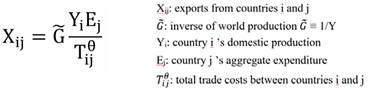
Figure 1.
Trade Gravity Equation
Source: An Advanced Guide to Trade Policy Analysis: The Structural Gravity Model byYotov et al, (2016).
Still, as it will be demonstrated later in this paper even amid a hard economic blockade and political discords the trade gravity equation remains in force: the economic ties between the two states are still strong as will be further demonstrated in the third section devoted to the economic interaction between the USA and Cuba amid the embargo. Even without the restoration of official trade relations the USA is one of the key Cuban trading partners that together with other factors can ensure the political rapprochement. Also, there is no doubt that it is the island geography that did not let the Cubans and Americans fully break all the ties even during the period of direct confrontation after the Castro regime assumption to power in 1959 and the nationalization of US. citizens property. And it was primary due to geography that hundreds of thousands of Cubans have found refuge in the United States fleeing from the Castro regime. Therefore, today the U.S. Cuban diaspora includes more than 2 million people who shape the US agenda towards Cuba via the Cuban lobby (Pew Research Center, 2017).
Factor 2. Historical Experience
The second factor that may encourage the normalization of bilateral relations is the fact that the USA and Cuba have already a historical experience of cooperation that used to be rather disproportional with the USA acting as a senior partner openly interfering in the internal affairs of Cuba, and the Cubans taking advantage of exporting the key Cuban export goods to the U.S. market as well as getting access to U.S. investment and technology (Dye & Sicotte,1999). Thus, such a pattern of interaction can be invoked in the future, especially, because during the Cold War the model of cooperation between the USSR and Cuba was rather similar to the U.S.-Cuba one (Wiesel, 1968). Besides, it is remarkable that economic success of the Castro regime was partly based on direct assistance from the USSR apart from exceptional trade conditions (Blasier, 2002). The question is to what extent are the U.S. leaders willing to sacrifice their economic benefits for the sake of political goals attainment in terms of restoring political interaction with Cuba.
Washington began to show a special political interest in Cuba almost from the very moment of the formation of an independent American State. Back in the 1820s, there appeared the idea of annexing Cuba. It was formulated in the Ripe Fruit doctrine of the U.S. Secretary of State under the administration of President Monroe Quincy Adams. In his letter of instructions to the U.S. ambassador in Madrid, Hugh Nelson, on 28 April 1823 Adams claimed that "Cuba, almost in sight of our shores, from a multitude of considerations has become an object of transcendent importance to the political and commercial interests of our union" (Rodriguez, 2015). Subsequently, the idea of turning Cuba into a new American state was clearly stated in the Ostend Manifesto of 1856. At the same time, the U.S.-Cuba economic ties continued to strengthen, and by 1869 it was the United States that had become the main trading partner of the Spanish colony (Rodriguez, 2015). Finally, it is impossible to argue with the fact that it was the American victory in the war against Spain in 1898 that led to the independence of Cuba. Despite several decades of confrontation with the Spanish crown, for example, the Ten Years" War (1868-1878), the Cubans did not manage to free themselves from the Spanish rule. For the Americans, the victory over Spain was a great opportunity to create a satellite state on the island, whose would allow Washington to finally become the leading power of the western hemisphere.
The best evidence of the new status that Cuba received after the U.S. victory in the war against Spain is the famous Platt amendment, which provided for Washington's direct intervention in the internal affairs of Havana, as well as the possibility of deploying U.S. units on the island (Platt Amendment, 1903). From the very beginning of the 20th century until the Cuban Revolution of 1959, the United States was the main economic partner of Cuba, and Washington's political control was exercised through pro-American Cuban leaders, such as Machado (1925-1933) or Batista (1952-1959). The most vivid illustration of how Washington directed Cuban foreign policy is Cuba's entry into World War II on the side of the Allies on December 8,1941, a day after the Japanese attack on Pearl Harbor.
Only the Castro regime rise as well as the nationalization of U.S. property campaign forced the U.S. leaders to reconsider their perception of Cuba. But even after more than five decades of a hard economic blockade and the conversion of Castro brothers into zealous Communists, there are still rather strong economic ties between the Cubans and Americans as it will be demonstrated further. Thus, the fact that the two states had the rich historical experience of intense political and economic cooperation may encourage normalization of bilateral relations and the old pattern of interaction may be applied once again.
Economic Blockade
The main obstacle to the normalization of U.S-Cuba relations remains the ongoing for more than half a century economic blockade of the island by Washington. After coming to power in 1959, Fidel Castro and his supporters set a course for economic transformation in Cuba. Having failed to find support from Washington during his visit to the United States in 1959, the dictator began to actively nationalize the property of foreigners and Cubans. This led to an immediate reaction from the Americans, namely the introduction of economic sanctions against the regime. Subsequently, the unsuccessful landing operation of pro-American mercenaries in the Bay of Pigs (1961) only worsened the crisis.
It was at this moment that Cuba found a new patron in the international arena, namely the USSR, which provided the island with protection from potential pressure from the United States, and also created all the conditions for the Cuban regime to parasitize on the supply of equipment, fuel, technologies and preferential purchases on Cuban sugar and nickel from the USSR and the COMECON countries (Pérez-López, 1988).. Nevertheless, the cooperation with the Soviet Union had its drawbacks, for example, because of the Soviet bluff with the deployment of missiles on the island, the world almost stood on the verge of a new world nuclear war, and the missile crisis became one more scar in the U.S.- Cuba relations. It is also worth emphasizing that Soviet economic support corrupted Cuban leaders and allowed them to ensure relatively stable economic growth at the expense of Moscow's assistance and preferential trade conditions. In the end, by the time the evil empire collapsed, the Cuban economy was in a terrible state (Binns,1996), and the Cuban leaders immediately rushed to look for new partners, but the Americans did not hurry to save their enemy and did not lift the blockade regime.
The Cuban leaders did not pursue real democratic reforms. Eventually, after the end of the Cold War the famous Helms-Burton law was passed in 1996, according to which any foreign companies that cooperate with Cuban enterprises are subject to American sanctions. Also, it is important to mention the third article of this act, which provides for the possibility of applying to the American court of persons affected by the expropriation and nationalization of private property during the rule of the Castro brothers (Helms-Burton Act U.S. Department of State Archive, 2020).
Havana and Washington have diametrically opposed views on the blockade issue. The Cuban representatives use every opportunity to accuse the U.S. authorities that the existence of such an economic regime is a flagrant violation of international law, and the very fact of the blockade is interpreted as "an act of genocide and the main component of the policy of state terrorism" (Larin, 2019). U.S. officials, in turn, characterize the blockade as an effective tool to force the authoritarian Cuban regime to follow the path of democratic reforms, and to help the Cuban people free themselves from the Communist tyranny and force Havana to abandon support for Latin American regimes with a clear anti-American orientation, for example, Venezuela (Washington Post, 2019).
Anyway, the two countries managed to achieve some success in restoring full-fledged bilateral relations and lifting several restrictions. During the tenure of the U.S. President, Democrat Barack Obama (2008-2016), an American Embassy was opened on the island (July 2015), restrictions on visits to Cuba by American citizens were partially lifted and several restrictions on the money transfers volume from the USA to Cuba were eliminated (an extremely important factor, given the huge Cuban Diaspora in the USA). In addition, eight American airlines have started regular flights to Cuba, and certain barriers to the supply of American agricultural equipment and the import of Cuban cigars, rum, and several medicines wee removed. So, in 2016, the total amount of money transfers reached 3.44 billion dollars (Kalashnikov, 2017), while the number of American tourists visiting Cuba began to increase rapidly, and not only among Cuban Americans visiting their relatives on the island but also among ordinary U.S. citizens. For instance, before 2015, the number of American tourists did not exceed 100 thousand people per year but since 2015, there has been a rapid growth in this indicator: in 2015, more than 162 thousand people visited the island, in 2016 more than 284 thousand U.S. citizens spent their holiday in Cuba, and by 2018, this figure has exceeded 600 thousand people per year, while in 2018 more than 637 thousand Americans travelled to Cuba (Centro de Gestión de la Información Económica, 2019). All that indicates that during Barack Obama's Presidency, even in the conditions of the ongoing economic blockade, the United States managed to strengthen bilateral economic ties with Cuba, which could become the basis for political rapprochement between the two countries in the future.
However, Republican Donald Trump's victory at the Presidential election of 2016 jeopardized the prospects for further rapprochement between Havana and Washington. In his speech in Florida in June 2017, the 45th President of the United States of America strongly criticized the foreign policy of his Democratic predecessor towards Cuba. The new President stressed that, in his opinion, the main beneficiary of Obama's Cuban policy was the criminal Cuban regime, which supports the Latin American authoritarian States and destabilizes the situation in the Western hemisphere. Donald Trump noted that the parties will need to reach a new "smart deal". Unlike Obama, Trump said that further normalization of bilateral relations is possible only if the Cuban authorities begin to implement democratic reforms, ensure respect for human rights, and release political prisoners. He also stated that it was important that the new agreement addressed the issue of compensation to U.S. citizens who suffered from the expropriation and nationalization of private property carried out by the Castro regime in the late 1950s and early 1960s immediately after the victory of the Cuban revolution 1959 (ABC News, 2017).
Subsequently, the position of the Trump administration on the Cuban issue became even more rigid. In November 2018, former U.S. National Security Adviser John Bolton called Venezuela, Nicaragua, and Cuba "the Troika of Tyranny" or "Triangle of Terror" and added that the above-mentioned three countries are "the source of instability and the dirty cradle of communism in the Western hemisphere" (Rogin, 2018). This was one of the signs of the beginning of a new approach by Washington to engage in a bilateral dialogue with Havana. Trump moved rather quickly to implement his new Cuban policy. In 2019, the President imposed a series of limitations on the activity of U.S. companies on the island. Also, in the tourism sector, some restrictions were introduced on the U.S. citizens' travelling to the island for tourism and on money transfer amount from the USA to Cuba. Thus, at that moment a U.S. citizen could not send more than 1 thousand dollars per quarter to the island. In addition, money transfers from the United States to the accounts of members of the Communist party of Cuba were prohibited, as well as on making transfers as donations to Cuban foundations and other legal persons. Washington justified the need to tighten the sanctions against Havana saying that the financial isolation of the Cuban regime can lead to an end to the oppression of Cubans by their authoritarian regime and the Cuban support for Latin American dictatorships. In addition, Trump stressed that most of the funds received through money transfers from the United States of America, from American tourists and the activities of American companies on the island went directly to the pocket of representatives of the Cuban regime. In his opinion, it was also responsible for malicious violations of human rights, political repression, torture, forcible deprivation of private property, etc. and for assisting such criminal regimes as the Maduro regime in Venezuela and the Ortega Regime in Nicaragua. That is why Washington strengthened the embargo of the island and decisively limited the economic interaction between individuals and legal persons of both countries (Washington Post, 2019).
It is important to note that even amid the coronavirus pandemics, the White House did not make any concessions to the Cuban government when Havana once again insisted that maintaining this economic regime under the conditions of the epidemic was a gross violation of international law, endangering the lives of Cuban citizens. Even before the pandemics, in November 2019, the Cuban delegation sponsored a resolution calling the economic blockade of the island an illegal act (A/RES/74/7). However, this draft was blocked by Washington. (RBC. 2019). Then, during the coronavirus pandemics, representatives of Cuba, along with their col leagues from Russia, Venezuela, Iran, China, North Korea, Syria, and Nicaragua, sent an appeal to the UN Secretary-General, Antonio Guterres, calling for the lifting of all unilateral economic sanctions that, according to the authors of this appeal, hinder the effective fight against coronavirus. For obvious reasons (the US seat in the security Council and the veto right), this initiative did not bring any tangible results (The Ministry of foreign Affairs of the Russian Federation, 2020).
Thus, American leaders generally shared the U.S. President's position on the Cuban issue. The attempts of Democrats to force Trump, if not to return to Obama's political course to normalize bilateral relations, at least to safeguard the progress Washington had managed to achieve in this area during the Obama presidency, were unsuccessful. For instance, due to the strong opposition of Republicans, the bill of Congressman Bobby Lee Rush on the normalization of bilateral relations between Washington and Havana in July 2017 was not adopted (U.S. Congress H.R. 2966 United States. Cuba Normalization Act, 2017). As for President Biden, his administration has already announced their determination to reverse several restrictions on the island imposed by Trump. For instance, they proposed reinstating Cuban Family Reunification Parole (CFRP) Program, promising to increase consular services, to assist Cubans with the Internet access as well as to rise the quarter remittances limit (U.S. Department of State, 2022). Still, time will show how successful the implementation of these measures will be.
In any case, it cannot be denied that the economic blockade remains the main obstacle to the normalization of bilateral political relations and is the key reason for bilateral trade distortion. Still, one may agree with Donald Trump and stress that any U.S. concession to the Cuban authoritarian regime would be considered as a sign of weakness and widening of bilateral economic cooperation will let the Cuban leader assist so-called rogue states and continue violating human rights and suppress the liberty of the Cubans as well as support other Latin American dictators. But considering that even amid such a hard economic blockade the USA managed to be among key trading partners of the island as it will be shown in the next section, the lifting of certain restrictions as a means of bargaining and soft power application can be used to realize U.S. political goals in terms of either normalizing relations with Cuba or exerting American political influence over the island.
Factor 3. Strong Economic Ties Amid Embargo
The third factor that could be the basis for the future U.S.-Cuba rapprochement is the fact that even amid more than half a century economic blockade the USA and Cuba remained extremely interconnected, especially after the collapse of the USSR and COMECON dissolution. Even in terms of goods turnover, since the beginning of the 2000s the USA became one of the key exporters to the Cuban market with the volume of goods imported from the USA to Cuba exceeding the one from such large Western Hemisphere economies as Canada, Brazil and Mexico being inferior only to the ones from Spain and Mainland China. For instance, in 2003 the U.S. exports to Cuba amounted to 318 million USD, the Chinese ones equaled 423 million USD, the Spanish ones were 561 million USD, while the Canadian and the Mexican indicators did not exceed 230 million USD. Afterwards, the Cuban dependence on the U.S. goods only increased. In 2008 it reached the maximum figure of 712 million dollars. In the next years the Cuban imports from the USA dramatically decreased: in 2014 the figure was only 292 million USD, while in 2017 the USA was surpassed by all the examined in the graph states except Mexico with the US exports to the island amounting to 282 million USD. In 2019 U.S. exports to Cuba seems rather modest (279 million USD) compared to the Chinese (790 million USD) or Spanish ones (1.1 billion USD), still it exceeds the Brazilian one and only slightly behind the Russian and Canadian ones.
The most important thing is that the USA managed to surpass the aforementioned states in terms of exports to Cuba even amid the embargo conditions, so it becomes obvious that in case of restrictions lifting the gravity equation implications will prove their relevance (Figure 2). What is more, it is noteworthy that during 2016-2020 the USA was solely responsible for more than 50% of all meat exports to Cuba, while during the period of 2002-2015 this figure never fell below 30%. Also, during 2002-2019 more than 40% of all oil seeds and oleaginous fruit were exported to Cuba from the USA. Finally, during 2002-2009 the USA exported more than 50% of residues and waste from the food industries as well as prepared animal fodder delivered to the island (OEC, 2022).
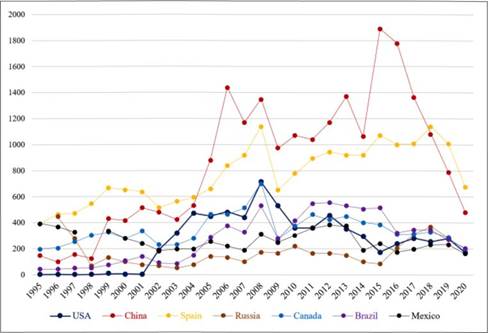
Figure 2.
Cuban Imports of Goods from Selected Countries 1995-2020, million USD
Source: OEC. Cuba: Exports, Imports and Trade Partners
Still, the situation with Cuban exports to the USA is completely different. Under the embargo Cuban producers are almost denied any access to the American market, while representatives of Spain and Mainland China are the key buyers of Cuban products. For instance, according to the OEC data, Cuban exports to the USA during 2018-2020 did not exceed 5 million USD, while Cuban exports to Spain were more than 100 million USD and the ones to Mainland China surpassed 440 million USD. Another remarkable fact is that Cuban exports to Russia dramatically decreased throughout the examined period. Thus, in the 1990s the indicator exceeded 300 million USD but since 2006 the figure never surpassed 100 million USD. So, despite Moscow's rhetoric about fostering cooperation with Cuba, the actual economic ties between two countries weakened (e.g. in 2019 Cuban exports to Russia amounted to 18.4 million USD). Anyway, the PRC is an unquestionable leading trade partner of Cuba with the island's dependence on commerce with this state only growing during the examined period (Figure 3).
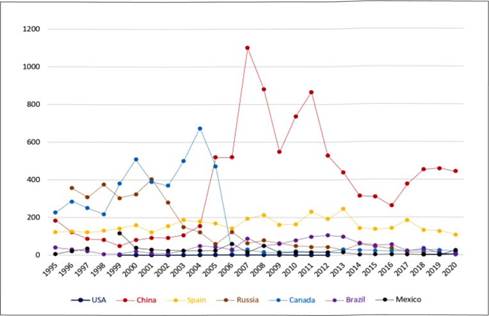
Figure 3.
Cuban Exports of Goods to Selected Countries 1995-2020, million USD
Source: OEC. Cuba: Exports, Imports and Trade Partners
The second illustration of strong economic ties between the USA and Cuba is annual remittance statistics. Cuban economy heavily depends on remittances from other countries. For instance, according to Havana Consulting Group estimations, the number of remittances received by Cubans rose from 1.4 billion USD in 2008 up to more than 3.7 billion USD in 2019 with more than 90% of it being sent from the United States (Havana Consulting Group, 2020). It is remarkable that the amount of U.S. remittances to Cuba exceeds or almost equals the island's turnover with its such key trading partners as Mainland China and Spain. Also, it is noteworthy that according to Pew Research Center the number of Cuban- origin Americans in the USA significantly grew from about 1.2 million people in 2000 to more than 2.2 million people in 2017, so there is nothing surprising in the fact that the USA is the main donor of remittances to Cuban economy. Moreover, it demonstrates why the adjustment of quarter remittances limits for Cuban Americans turns out to be such an effective tool to assert pressure on the Cuban regime (Figure 4); (Figure 5).
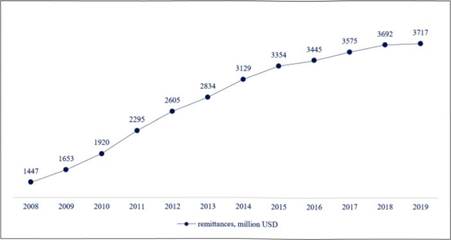
Figure 4.
Annual Remittances to Cuba, million USD
Source: Havana Consulting Group
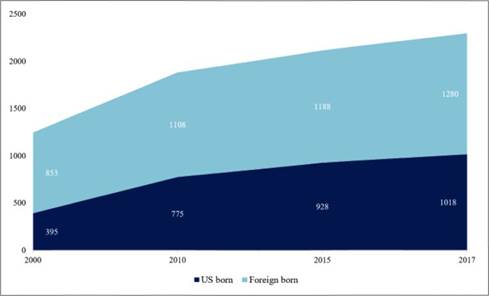
Figure 5.
Cuban-origin population in the USA, 2000-2017 thousand people
Source: Pew Research Center
The final illustration is the number of U.S. citizens travelling annually to Cuba as tourists. According to the data provided by the National Office of Statistics and Information (ONEI), during 2016-2019 the share of U.S. tourists among all the international tourists visiting the island ranged from 7 to 11.6 %. The total number of American tourists annually visiting Cuba before the pandemics never dropped below 280 thousand people with the U.S. tourists being the third largest group of tourists visiting Cuba after Canadian tourists and Cubans living abroad. It is remarkable than even amid embargo and rather tense diplomatic relations the number of U.S. tourists is greater than the one of various European states as well as Russia. However, with the beginning of the COVID19 crisis the situation altered and the total flow of tourists travelling to Cuba dramatically decreased. For instance, throughout 2016-2019 the island was visited by more than 4 million people, while in 2020 the indicator dropped to almost 1 million and in 2021 it stopped at 356 thousand people. The crisis primary affected the tourist flows from developed states such as the USA, Canada, and European states, so in 2021 the number of Russian tourists surpassed the ones of all the examined states. Still, it is only a matter of time, and it does not affect the general picture. Cuban economy heavily depends on tourist flows with tourism accounting for more than 2.5% of Cuban GNP until the beginning of the pandemics (World Data, 2022). So, the large share of U.S. tourists in the total number of tourists visiting the island is a great demonstration of the strong economic ties between the countries (Figure 6).
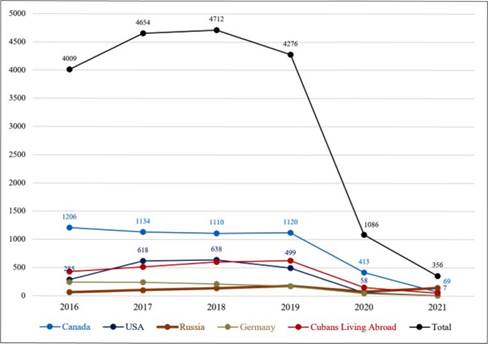
Figure 6.
Tourists Visiting Cuba by Country 2016-2021, thousand people
Source: National Office of Statistics and Information (ONEI)
So, even in the conditions of the economic embargo the USA and Cuba are still economically interconnected. Cuban economy strongly depends on imports from the USA, remittances from U.S. citizens and U.S. tourists flows. Also, today in the USA there is a large Cuban diaspora whose members have relatives on the island. There is no doubt that in case of restrictions lifting the cooperation between the peoples of the two nations will only increase but even the existing level of economic interaction and interdependency is sufficient for seeking political rapprochement.
Factor 4. End of Castro Era
The fourth factor that provides favorable conditions for the U.S.-Cuba rapprochement is the fact that Cuba has entered a transition period. The reign of the two Castro brothers has finally ended. Fidel Castro's younger brother Raul has resigned as Head of the Communist Party of Cuba with more, and more real power being concentrated in the hands of the incumbent President (Miguel Mario Díaz-Canel Bermúdez). It is important to mention that even the first transition of power from Fidel to Raul Castro (2008) launched a series of new economic and political reforms which were continued after the end of the Castro era (López-Levy, 2016). Over the past few years, Cuba has experienced significant changes in the economic sphere. For instance, under the new Constitution of 2019, the areas in which corporate and even private ownership is possible have been expanded, private enterprise and foreign investors" activity has been legalized, with certain guarantees provided to them on behalf of the Cuban government.
However, it should be stressed that several restrictions on their activities still remain. However, the main alterations were made in the Cuban public administration system. Even though the role of the Communist party in the new Constitution remains unquestionable, several provisions such as the introduction of the posts of President and Prime Minister, and restrictions on the term of the head of state's office (Constitución de la República de Cuba, 2019), suggest that in the future Cuba will be able to say farewell to its authoritarian past. Also, for a country that has been under an authoritarian regime for more than six decades, where all power belonged to the two Castro brothers, the very fact of the adoption of the new Constitution, which came into force after 73.3% of Cubans voted for it in a referendum ( BBC News Mundo, 2020), and the vast majority of the island's inhabitants: 8945.5 thousand people took part in the discussion of its draft may indicate the beginning of a new era. Definitely such participation of the Cuban people in the drafting of the Constitution is very formal, since none of the 133,000 meetings to discuss the draft Constitution had sufficient authority to make any changes and radically affect the future text of the main legislative act. However, for authoritarian Cuba, the fact that about 1.7 million people used an opportunity to share their opinion at these meetings: 783 thousand proposals: 667 thousand amendments, 32 thousand supplements, 45.5 thousand exceptions and 38.5 thousand doubts were made, already shows that we witness the possible birth of the Cuban civil society (Kalashnikov, 2019,p.26).
Also, we should not underestimate the factor of the emergence of new figures in the Cuban political arena. Clearly, it is fair to note that Miguel Mario Diaz-Canel Bermúdez, who has been the Cuban President since October 10, 2019, has had an impeccable party reputation all his life, from participation in the activities of the Union of Young Communists to membership in the Communist party of Cuba. He was distinguished by his faith in the ideals of communism and loyalty to the precepts of Karl Marx and Lenin (BBC Mundo, 2018). However, there are many historical examples of how even the most zealous Communists, having obtained full power, radically changed the foreign political course of their country and opened a new page in the history of its external policy. For instance, before the famous XX Congress, the General Secretary of the CPSU Central Committee, N. S. Khrushchev, was considered one of the most loyal associates of I. V. Stalin, B. N. Yeltsin used to fulfill all the party's instructions and did not cloud his party reputation until he assumed power. Moreover, Chinese leader Deng Xiaoping supported almost all the initiatives of the "Great Helmsman" Mao Zedong before becoming the true leader of China. The last example is especially relevant because under the rule of Deng Xiaoping (late 1970s - early 1990s) Beijing finally converted into a U.S. economic and political partner that in the long run not only contributed to the rapid economic development of China but also helped Washington defeat the USSR in the Cold war. Thus, the countries which were on the verge of war in the early 1950s (during the Korean war (1950-1953)) with completely opposite ideologies and models of economic development became almost brothers-in-arms in the fight against the "Evil Empire".
Even if the Diaz-Canel regime does not embark on a course of full-fledged democratic transformations, it cannot be denied that today we are witnessing the formation of a new Cuban political reality. The coronavirus pandemic has shown the extreme vulnerability of the Cuban economy and the weakness of the famous Cuban medical system. But what is much more important, the lack of medicines provoked the awakening of the Cuban public consciousness. In July 2021, thousands of Cubans took part in demonstrations with anti-government slogans, and Cuban leaders could only once again accuse American provocateurs of destabilizing the internal political situation in the country (Reuters, 2021). It would have been impossible to imagine such a scenario in Cuba a decade ago. Also, the island's economy has not demonstrated high rates of economic growth for the last two decades. After the economic crisis of 2008 Cuban GDP growth dropped even fell below the world average GDP growth indicators with the pandemic's crisis affecting the Cuban economy in a far more serious way than the world economy in general (Figure 7). Thus, the statements about the current Cuban leaders' economic management success and the effectiveness of the existing Cuban economic model seem rather questionable.
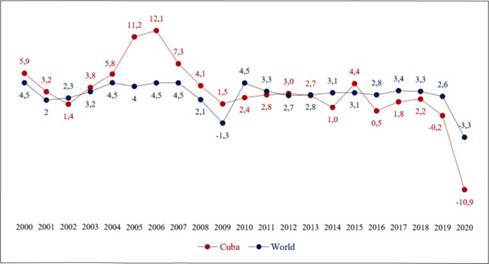
Figure 7.
Cuba and World. GDP Growth (annual %) 2000-2020
Source: The World Bank
So, the future foreign policy of Havana, including the vector of development of U.S.- Cuban relations, is being determined right now. Undoubtedly, the recent actions and statements of the Cuban leader rather indicate that he continues to apply populist rhetoric (The Guardian, 2018); (Xinhuanet,2018); (CubaSí, 2020) and seems to be willing to focus on cooperation with such states as China or Russia instead of making any serious concessions to the USA. However, there is a second option for further evolution of the island's foreign political course: building a more pragmatic external policy. It implies not only strengthening bilateral economic ties with the EU Member States and Latin American countries but also preserving a free hand in foreign policy, that is, an attempt to extract maximum benefits from cooperation with both Mainland China and Russia, as well as with the United States of America. In such a scenario, Washington may play a significant role not only because of its geographical proximity but also primarily due to the strong ties which already exist between the citizens of the two republics.
However, one may claim Cuban leaders will not betray the principles set forth in the new Constitution of 2019 which states that the Republic of Cuba is a socialist state, where the ruling Communist party is the only political force, the main Cuban objective is to build a Communist society, while in international relations the Cuban main principles are anti-imperialism and internationalism, and that Cuba will not accept any negotiations under aggression and threats (Constitución de la República de Cuba, 2019). Still, the fact is that such postulates, especially if we are talking about the fundamental ideas of totalitarian and authoritarian states' doctrines, have very little to do with reality. It is appropriate to compare the Russian Foreign Policy Concept of 2013 provision according to which Russia conducts a foreign policy aimed at creating a stable system of international relations based on international law (Foreign Policy Concept of the Russian Federation, 2013) with the annexation of Crimea. In the case of Cuba, we can recall Fidel Castro's repeated statements after the fall of the Soviet Union that the country will continue to follow the path of building socialism only in its new form that meets the challenges of the modern reality (Castro Speech Data Base LANIC 1993); (Castro Speech Data Base LANIC, 1994). However, in fact, to survive, the Cuban leaders were forced to make significant alterations in the socio-economic model of the country and to reorient the Cuban foreign policy. It is fair to say that the principle of anti-imperialism and internationalism has very little in common with economic cooperation with capitalist Spain, Canada, Germany, France as well as other western countries. So, even despite the populist rhetoric of the Cuban leaders the end of Castro brothers reign provides new opportunities for the U.S.-Cuban rapprochement.
Factor 5. Favorable Exterior Conditions
The final factor that ought to be taking into consideration when analyzing the possibility of the U.S.-Cuba rapprochement are the current international conditions. Though, over the last decade Washington and Havana had a lot of controversies and used to adopt opposite positions in addressing key regional and international conflicts, the current situation in the international arena provides new opportunities and reasons for rapprochement primary due to Washington's need to consolidate the field of its partners amid the Russian threat and Chinese competition and Moscow's discredit as the center of power due to the economic deterioration caused by sanctions and a disgraceful military campaign in Ukraine.
Washington and Havana confronted each other on many international issues. For instance, the representatives of the Cuban Republic openly supported the Maduro regime (14ymedio, 2017), while Washington stood for Juan Guaidó (France24, 2019). In addition, back in April 2018, at the Summit of the Americas in Lima, U.S. Vice President Michael Pence, representing the American delegation, harshly criticized the actions of the Maduro regime in Venezuela and lambasted the Cuban leaders, saying that "the outdated Cuban Communist regime continues to rob its own people, infringe on the rights of its citizens, and extends its failed ideology to other countries and supports the dictatorial Maduro regime in Venezuela" (The White House, 2018). The United States of America also reacted in a rather negative way to the fact that in January 2019, about 2,000 Cuban doctors, who previously worked in Brazil under the "More doctors for Brazil" program, were sent to Venezuela (RIA, Novosti, 2019). The White House stated that Havana merely used such medical aid programs and the Cuban doctors' activity as a political tool to achieve its own goals in the international arena. Also, the U.S. representatives claimed that such medical programs had nothing to do with humanitarian assistance (The Guardian, 2020). Washington reacted in a similar way to the sending of Cuban specialists to other countries of the world to fight against the coronavirus Covid-19, which, according to the White House, is just a political instrument (Arab news, 2020).
In addition, Havana and Washington took diametrically opposite positions on the Bolivarian issue. During the political crisis of 2019, the Trump administration supported the opponents of President Evo Morales (Common Dreams, 2019), while the Cuban leaders even expressed their readiness to grant the former President political asylum on the island (El Pais, 2019). Also, Cuba and the USA clashed over the Syrian (ABC News, 2015), Crimean (UN General Assembly resolution 68/262, 2014): Cuba voted against; and Ukrainian crises (Moskovskij, 2014. What is more, Havana did not share Trump's recent rhetoric against China: the U.S. President accused the Chinese authorities of concealing information about the spread of coronavirus, and openly called COVID-19 the "Chinese virus" (CNBC, 2020). So, it was not surprising that today Cuba turned out to be in the blacklist of countries whose policies destabilize the situation in the international arena and posed a threat to all democratic States of the Western Hemisphere in the U.S. national security strategy of 2017 (National Security Strategy, 2017).
Still, unlike the situation before 2022, today there are those who openly challenge the U. S. global leadership apart from several minor rogue states. First, the world saw the out- break of a full-scale military conflict between Russia and Ukraine supported by the USA as well as other developed states. Analyzing the rhetoric of the senior Russian governmental officials it is evident that the motivation behind the aggression against the neighbor state is the Russian leader's desire to reconsider the existing balance of power and enhance the Russian international status by means of brute force and aggressive foreign policy (RGRU, 2022); (Izvestia, 2022). On the one hand, it may seem alarming to Washington and be considered as a signal to ensure support of its key partners and find new international allies (e.g. Cuba) to strengthen Russian economic and political isolation. On the other hand, considering that Russian economic resources are extremely limited, and the Russian military potential turns out to be overestimated since so-called second world army has not managed to beat the Ukrainian forces for almost half a year, Cuban leaders may understand that the chances that Russia will manage to escape with dignity from the current confrontation with all the developed world are rather low. Thus, the orientation on Moscow and expectations about Moscow's readiness to assist Cuban authoritarian regime is to prove its pointlessness. The fact that Havana did not recognize the Donetsk People's Republic and the Luhansk People's Republic as well as the fact that Cuban delegation abstained from voting on the United Nations General Assembly Resolution ES-11/1 demanding the withdrawal of Russian forces from Ukraine, is the illustration that in the eyes of the Cuban regime the outcome of the Russian military campaign seems doubtful (United Nations General Assembly resolution ES-11/1, 2022).
Also, the world has not seen the true political rise of Mainland China and the coinage of the Chinese alternative to Pax Americana with Chinese leaders remaining in the shadow observing the current confrontation between Russia and the developed world. The future of the Chinese economic success and the prospects of China's conversion to a developed economy are still questionable since Beijing is to overcome the middle-income trap (Fang & Zheng, 2014). So, even though Mainland China is the key trading partner of Cuba, there is still time left for Washington to enhance bilateral economic links and achieve a new smart deal with Havana to deny the rise of Chinese political influence on the island. Following the trade gravity equation provisions Washington is to have significant advantages over Beijing in terms of trade with Cuba primary due to the geographical proximity.
So, Washington may take advantage of the above-mentioned factors and seek to normalize bilateral relations with Cuba to secure momentum amid the fall of Russia and before possible full-fledged rise of Mainland China. The only question is whether Cuban leaders' economic rationale will prevail over political illusions and personal ambitions. Still, considering that Cuba strongly depends on trade with the USA as well as on U.S. remittances and tourists, the key problem for the rapprochement is reaching mutually appropriate conditions that would allow Biden administration to preserve dignity and not to dissatisfy the Cuban diaspora. Still, the exterior international conditions are in favor of bilateral dialogue normalization.
Conclusion
It is fair to conclude that no rapprochement between Cuba and the United States of America is possible without a strong political will and determination of both parties to find a mutually acceptable solution which will let them to escape with dignity from the historical trap. What is more, the five factors themselves do not guarantee that very soon the world will see the normalization of the bilateral relations or even the conversion of Cuba into the U.S. partner. Still, it cannot be denied that apart from geographical proximity and rather strong economic ties which used to be between the two countries since the very beginning of their independent history, the current internal political situation on the island together with the changing international conditions (the erosion of the Russian reputation and the Chinese unreadiness to openly challenge the U.S. global leadership) may become the basis for the enhancement of the cooperation between Washington and Havana as well as allow the White House to take advantage of the situation and with small concessions restore its former influence over the island.
Taking into account the fact that even under the embargo the USA still remains one of the most important trading partners of Cuba, that Cubans strongly depend on the remittances from more than 2 million Cuban Americans as well as on tourist flows form the USA, there is no doubt that lifting of basic blockade elements, for instance, concerning machinery or transport exports, will ensure that the USA will quickly become the main trading partner of the island. Especially if we consider the implications of the trade gravity equation. The only problem is that Cuban leaders mired in populism may find it complicated to justify making any concessions to the USA such as paying contributions to the victims of the Castro regime nationalization or building and enhancing democratic institutions on the island. Still, since Russia will no longer be able to assist the Cuban authoritarian leaders after its defeat on the battlefield in Ukraine and until the probable political rise of Mainland China, which may try to convert its economic presence in Latin America into political influence, Washington still has some time to negotiate a smart deal with Havana.
Considering that the Cuban economy cannot even catch up with the world in general in GDP growth, that Cuban leaders have already faced unprecedented riots and protests, understanding that trade and other forms of economic cooperation with the USA will definitely ensure rather sustainable economic development of the island can be the factor to force the Cuban regime to refrain from populism and switch to a more pragmatic and realistic policy since the rapprochement with the USA is one of the ways to save the existing Cuban regime (with some alterations negotiated with Washington) by avoiding economic collapse and popular unrest.
Thus, that is why the factor of the historical experience is to prove its relevance since both states were used to the model of unequal cooperation that ensure economic development of Cuba and let the U.S. leaders satisfy their political ambitions. Since the Cuban partnership with the USSR mostly resembles such a pattern and ensure rather stable but slow economic growth of the island, the only question is whether economic rationale will take over personal interests and desires of the Cuban leaders and to what extent the American ruling elites are ready to forget the past.
Acknowledgements
The authors wish to thank RUDN University named after Patrice Lumumba for the support given to this article.
References
14ymedio. (2017, August 25). Manifestación en La Habana en apoyo a Nicolás Maduro. https://www.arabnews.com/node/1666976/world
ABC News. (2015, October 15). Cuba, ¿aliado de Rusia y Al Asad en Siria?https://www.abc.es/internacional/20151015/abci-general-cubano-siria-201510152223.html?ref=https%3A%2F%2Fwww.google.
ABC News. (2017, June 17). Trump "canceling" Obama's Cuba policy but leaves much in place, https://abcnews.go.com/Politics/trumps-cuba-policy/story?id=48058622
Arab News. (2020, April 29). Pompeo criticizes Qatar; S. Africa for taking Cuban doctors, https://www.arab-news.com/node/1666976/world
BBC Mundo. (2018). Cuba: quién es Miguel Díaz-Canel, el «discípulo predilecto» de Raúl Castro llamado a continuar con el castrismo. https://www.bbc.com/mundo/noticias-america-latina-43663157
BBC News Mundo. (2020). Reference en Cuba: la nueva Constitución se aprueba pese a cifra record de fotos en contra, https://www.bbc.com/mundo/noticias-america-latina-4736508
Binns, L. A. (1996). The Demise of the Soviet Empire and its Effects on Cuba. Caribbean Quarterly, 42 (1), 41-54. https://www.jstor.org/stable/40653962
Blasier, C. (2002). Soviet Imoacts on Latin America. Russian History; 29(2/4), 481-497. http://www.jstor.org/stable/24660798
Brzezinski, Z. (2000). The Grand Chessboard: American Primacy and Its Geostrategic Imperatives. Moscow: International Relations.
Campos, C., & Prevost, G. (2015). Cuba in the Western Hemisphere: What Has Changed? International Journal of Cuban Studies, 7(2), 142-63. https://doi.org/10.13169/intejcubastud.7.2.0142
Castro Speech Data Base LANIC. (1993, December 28). Castro Speech Data Base LANIC. Castro Views U.S. Administration, Socialism. http://lanic.utexas.edU/project/castro/db/1993/19931228.html
Castro Speech Data Base LANIC. (1994, January 5). Exclusive' Interview With Castro. http://lanic.utexas.edu/project/castro/db/1994/19940105.html
Centro de Gestión de la Información Económica, M. y. (2019, March 30). Turismo Internacional Indicadores Seleccionados, Enero - Diciembre de 2018. http://www.onei.gob.cu/sites/default/files/publicaciondid8.pdf
CNBC. (2020, March 18). Trump defends calling coronavirus 'Chinese virus' - "it's not racist at all", https://www.cnbc.com/2020/03/18/coronavirus-criticism-trump-defends-saying-chinese-virus.html
Common Dreams. (2019, November 12). Trump Applauds Bolivia's Military Coup As US Establishment Media Blame Morales For Turmoil, https://www.commondreams.org/views/2019/11/12/trump-ap- plauds-bolivias-military-coup-us-establishment-media-blame-morales-turmoil
Constitución de la República de Cuba (2019). http://www.granma.cu/file/pdf/gaceta/Nueva%20
CubaSí. (2020). President Diaz-Chanel says socialism helps fight COVID-19. http://cubasi.cu/en/news/president-diaz-chanel-says-socialism-helps-fight-covid-19
Dye, A., & Sicotte, R. (1999). U.S.-Cuban Trade Cooperation and Its Unraveling. Business and Economic History, 28(2), 19-31. http://www.jstor.org/stable/23703316.
El Pais. (2019, November 12). México otorga asilo político a Evo Morales, https://elpais.com/internacion-a1/2019/11/11/actualidad/1573504978.938761.html
Erisman, H. (2019). Cuba as a Hemispheric Petropower: Prospects and Consequences. International Journal of Cuban Studies, 43-60. doi: 10.13169/intejcubastud.11.1.0043
Fang, Y., & Zheng, J. (2014). Between Poverty and Prosperity: China's Dependent Development and the Middle-Income Trap. Third World Quarterly, 35(6), 1014-31. http://www.jstor.org/stable/24522061
Foreign Policy Concept of the Russian Federation. (2013). https://www.garant.ru/products/ipo/prime/doc/70218094/
France24. (2019, February 24). US' will take action' in support of Guaido in Venezuela. https://www.france24.com/en/20190224-us-eu-will-take-action-support-guaido-venezuela-maduro-pompeo-colombia
Havana Consulting Group. (2020). COVID-19 puede hacer declinar las remesas a Cuba entre un 30 y 40% en el 2020. http://www.thehavanaconsultinggroup.com/en-us/Articles/Article/74
Helms-Burton Act US. Department of State Archive, (n.d.). Retrieved July 29, 2020, from https://1997-2001.state.gov/regions/wha/cuba/helms.html
Hugh, T. (2018). World Without End: The Global Empire of Philip II. Moscow: AST.
Izvestia. (2022, July 7). Putin accused the West of starting a war in Ukraine. https://iz.ru/1361501/2022-07-07/putin-obvinil-zapad-v-razviazyvanii-voiny-na-ukraine
Kalashnikov, N. (2019). Nueva Constitución es un nuevo paso para renovar el socialismo. En N. Kalashnikov, Cuba Sí! 60 Años de Revolución. Moscow.
Kalashnikov, N. (2017). Cuba on the Eve of Generational Change. Moscow.
Lamrani, S., & Oberg , L. (2015). Rapprochement Cuba/USA: Opportunities and Obstacles. International Journal of Cuban Studies, 7(1), 8-15. https://doi.org/10.13169/intejcubastud.7.1.0008
Larin, E. (2019). Modern History of Latin America. Moscow.
Lopez-Levy, A. (2016). Cuba-US: The December 17 Agreement in the Rationale of Asymmetric Relations. A New Chapter in US-Cuba Relations Social Political, and Economic Implications, 27-41.
López-Levy, A., & Abrahams, H. (2010). Anything But Human Rights: US Pol icy Towards Cuba Under Helms- Burton. International Journal of Cuban Studies 2,3(4), 315-34. http://www.jstor.org/stable/41945910.
Mearsheimer, J. (2018). The Great Delusion Liberal Dreams and International Realities. Yale University Press.
Modelski, G. (1987). Long Cycles in World Politics. Seattle: University of Washington Press.
Montenegro, C., & Soto, R. (1996). How Distorted is Cuba's Trade? Evidence and Predictions from a Gravity Model. Journal of International Trade and Economic Development, 5(1), 45-68. doi: 10.1080/09638199600000004
Morgenthau, H. J. (1949). Politics Among Nations. The Struggle For Power And Peace.
Moskovskij, K. (2014, July 12). Cuba supports Russia on the Ukrainian issue, https://www.mk.ru/politics/2014/07/12/kuba-podderzhala-rossiyu-po-ukrainskomu-voprosu.html
National Office of Statistics and Information ONEI. (2020). Anuario Estadístico de Cuba. Año 2020 Enero-Diciembre 2020. Retrieved from http://www.onei.gob.cu/sites/default/files/15_turismo.pdf
National Office of Statistics and Information ONEI. (2021).Arribo de Viajeros y Visitantes Internacionales 2021 (Diciembre), http://www.onei.gob.cu/sites/default/files/arribo_de_viajeros_y_visitantes_internacionales_diciembre_2021 .pdf
National Security Strategy. (2017). https://www.whitehouse.gov/wp-content/uploads/2017/12/NSSFinal-12-18-2017-0905.pdf
OEC. (2022). Cuba: Exports, Imports and Trade Partners. https://oec.world/en/profile/country/cub?compareExports0=comparisonOption5&depthSelector1=HS2Depth&yearSelector1=exportGrowthYear16&yearlyTradeFlowSelector=flow1
Perez-Lopez, J. F. (1988). Cuban-Soviet Sugar Trade: Price and Subsidy Issues. Bulletin of Latin American Research, 7(1), 123-147. www.jstor.org/stable/3338444
Pew Research Center. (2017). Facts on Hispanics of Cuban origin in the United States, 2017. https://www.pewresearch.org/hispanic/fact-sheet/u-s-hispanics-facts-on-cuban-origin-latinos/
Platt Amendment. (1903). Retrieved from https://www.ourdocuments.gov/doc.php?flash=true&doc=55
RBC. The UN General Assembly adopted a resolution demanding to end the blockade of Cuba. (2019, November 7). Retrieved August 2, 2020, from https://www.rbc.ru/rbcfreenews/5dc47c199a794768f7c75268
Reuters. (2021, July 12). Cuba sees biggest protests for decades as pandemic adds to woes. https://www.reuters.com/world/americas/street-protests-break-out-cuba-2021-07-11/
RGRU. (2022 July 7). Putin: The West has already lost, the scrapping of the American world order has begun. https://rg.ru/2022/07/07/putin-zapad-uzhe-proigral-nachalsia-slom-miroporiadka-po-amerikanski.html
RIA Novosti. (2019, January 12). Expelled from Brazil Cuban doctors are going to Venezuela, Maduro said. https://ria.ru/20190112/1549257857.html
Rodríguez, T. (2015). US Foreign Policy towards Cuba: Historical Roots, Traditional Explanations and Alternative. International Journal of Cuban Studies, 7(1), 16-37.
Rogin, J. (2018, November 1). The Washington Post. Bolton promises to confront Latin America's "Troika of Tyranny, https://www.washingtonpost.com/opinions/global-opinions/bolton-promises-to-confrontlatin-americas-troika-of-tyranny/2018/11/01/df57d3d2-ddf5-11e8-85df-7a6b4d25cfbb_story.html
Rosetti, P., & Holland, A. (2015). Potential Areas of Cooperation Between the United States and Cuba. American Security Project, http://www.jstor.org/stable/resrep06032.
The Guardian. (2018). Cuba's new leader vows to modernise economy but no return to capitalism, https://www.theguardian.com/world/2018/apr/19/cuba-president-miguel-diaz-chanel-modernise-economy
The Guardian. (2020, February 11). Trump puts Cuban doctors in firing line as heat turned up on island economy. https://www.theguardian.com/global-development/2020/feb/11/trump-puts-cubandoctors-in-firing-line-as-heat-turned-up-on-island-economy
The Ministry of Foreign Affairs of the Russian Federation. Comment by the Information and Press Department on the joint address to the UN Secretary-General urging the withdrawal of unilateral sanctions in view of the spread of the coronavirus. (2020, March 27). https://www.mid.ru/en/maps/cu/-/asset_publisher/ZCoR8WfDPJng/content/id/4093009
The Ostend Manifesto. (1854, October 15). https://loveman.sdsu.edu/docs/1854OstendManifesto.pdf
The White House. (2018, April 15). Remarks by Vice President Pence at First Plenary Session of the Summit of the Americas, https://www.whitehouse.gov/briefings-statements/remarks-by-vice-president-penceat-first-plenary-session-of-the-summit-of-the-americas/
The World Bank. (2022). GDP growth (annual %) - Cuba, World, https://data.worldbank.org/indicator/NY.GDP.MKTP.KD.ZG?end=2020&locations=CU-1W&start=2000
UN General Assembly resolution 68/262. (2014, March 27). https://undocs.org/ru/A/RES/68/262
United Nations General Assembly resolution ES-11/1. (2022). https://documents-dds-ny.un.org/doc/UNDOC/LTD/N22/272/29/PDF/N2227229.pdf?OpenElement
US Congress. H.R.2966 United States-Cuba Normalization Act. (2017). Retrieved August 3, 2020, from US Congress: Retrieved August 3, 2020, from US Congress: https://www.congress.gov/bill/115th-congress/house-bill/2966?s=1&r=64
US Department of State. (2022). Biden Administration Expands Support to the Cuban People. https://www.state.gov/biden-administration-expands-support-to-the-cuban-people/
Washington Post. (2019, April 17). Trump administration announces new measures against Cuba. Retrieved July 28, 2020, from Retrieved July 28, 2020, from https://www.washingtonpost.com/world/national-security/trump-administra- tion-announces-new-measures-against-cuba/2019/04/17/cfc2bc96-6132-11e9-9ff2-abc984dc9eec_story.html
Washington Post. (2019, September 7). U.S. sets limits on money Cuban Americans can send to family in Cuba. Retrieved August 4, 2020, from Retrieved August 4, 2020, from https://www.washingtonpost.com/national-security/us-sets-limits-on-money-cuban-
Whittlesey, D. (1922). Geographic Factors in the Relations of the United States and Cuba. Geographical Review, 12(2), 241-56. https://doi.org/10.2307/208739
Wiesel, I. (1968). Cuban Economy and the Revolution. Acta Oeconomica, 3(2), 203-220. http://www.jstor.org/stable/40727812
World Data. (2022). Development of the tourism sector in Cuba from 1995 to 2020. https://www.worlddata.info/america/cuba/tourism.php#:~:text=Cuba%20generated%20around%201.15%20billion,international%20tourism%20receipts%20in%20Caribbean.&text=On%20average%2C%20each%20of%20the,spent%20about%20897%20US%20Dollars.
Xinhuanet. (2018). Miguel Diaz-Chanel elected as Cuba's new president, vows continuity of socialism. http://www.xinhuanet.com/english/2018-04/20/c_137123597.htm
Yotov, Y. V., Larch, M., Monteiro, J.-A., & Piermartini, R. (2016). An Advanced Guide to Trade Policy Analysis: The Structural Gravity Model. World Trade Organization, https://doi.org/10.30875/abc0167e-en
Notes
Author notes
*Contact: Ravel Terentev 2021-29896@snu.ac.kr
Conflict of interest declaration