
This work is licensed under Creative Commons Attribution-NonCommercial 4.0 International.
Received: 21 March 2018
Accepted: 11 June 2018
Abstract: Access to safe and sustainable energy is essential for human preservation and improvement of quality of life. Development is not possible without appropriate energy supplies. Arguably the biggest energy challenge of the 21st century is the health and wellbeing of 2.9 billion people globally who rely on burning biomass fuels in traditional stoves. This paper discusses the social and community level impact of using biofuels as an energy source in San Jose Villa de Allende, rural Mexico. Semi structured interviews were undertaken from indigenous women within the village. Picture evidence was also collected in order to identify the major energy problems of the community. The cooking stoves and fuels are identified as being the major contributors to time barriers and health issues for women. An implementation strategy for alternatives chimneys is suggested in order to develop policies for change and mitigate fuel poverty for an increased quality of life for rural Mexican women. The main discussion argues that cultural barriers and traditions are of foremost importance for policy making within the community.
Keywords: Energy development, indigenous Mexican women.
Resumen: El acceso a una energía segura y sostenible es esencial para la preservación humana y para mejorar su calidad de vida. El desarrollo no es posible sin los suministros adecuados de energía. El mayor desafío energético del siglo XXI es la salud y el bienestar de 2.9 mil millones de personas en todo el mundo que dependen de la quema de combustibles de biomasa en las estufas tradicionales. Este documento analiza el impacto social y comunitario del uso de biocombustibles como fuente de energía en San José Villa de Allende en el Estado de México. Se realizaron entrevistas semiestructuradas con mujeres indígenas dentro de la comunidad. También se recopiló evidencia de imágenes para identificar los principales problemas energéticos de la comunidad. Las cocinas y los combustibles que emplean en ellas se identifican como los principales causantes de problemas de salud para las mujeres de la localidad. Se sugiere una estrategia de implementación de chimeneas alternativas para desarrollar políticas para el cambio y mitigar la pobreza de combustible para una mayor calidad de vida de las mujeres rurales mexicanas. La discusión principal sostiene que las barreras culturales y las tradiciones son importantes para la formulación de políticas dentro de la comunidad.
Palabras clave: desarrollo energético, mujeres indígenas mexicanas.
INTRODUCTION
Using biomass as a main energy source, entails a significant time and effort commitment for collection, preparation and use. Such work is primarily carried out by women, particularly in low-middle income countries and in rural areas (UNDP, 2011). Rural women and girls tend to therefore be the primary energy producers within lower income countries. This reliance on biofuels and culture of ‘women’s work’ leaves little time for women to pursue carriers and educational opportunities outside the home. Alternatively the UN Gender and energy report suggests rural women therefore depend on locally available resources and agricultural opportunities for their livelihood. Thus grounding the issues surrounding rural women, energy poverty and the constriction of opportunities.
With the collection of fuel and water constituting of a considerable proportion of women in rural communities time, the activities available to women consist around biomass-dependant sectors as a focus (UNDP, 2011). This global rural energy poverty crisis affecting women’s time commitments leads to ‘time poverty’. Essentially the theory that while women are spending most of their time per day collecting water and biomass as well as doing subsidence tasks they are in an essential ‘time debt’ when it comes to taking up a structured occupation or educational programme.
Published within the un report for gender equality ‘Access to Sustainable Energy’ The Gendered Dimensions’ the world is facing an increasingly evident divide between urban and rural areas and between emerging economies and established economies. This divide stretches to include the differences concerning men and women especially in terms of poverty and empowerment. This gendered energy divide occurs as women in lower income countries tend to experience higher rates of poverty than men (MRF, 2011), a global issue which needs to be addressed in order to alleviate poverty in developing nations and improve quality of life at community level.
According to the UN (2015), energy poverty is one of the most critical challenges facing the international community today, concerning global objectives and obligations, energy poverty is employing serious focus due to the nature of potential to affect future sustainability. Economic and social development, at both community and national scale across gender and geographic boundaries, is critically facilitated by access to energy and sustainable energy sources. By reducing time and labour intensive burdens, energy sustainability can both empower and improve the quality of life of women globally, both in terms of enterprise and health. Access to environmentally friendly, affordable, and secure energy is therefore a supporting factor for economic development and poverty alleviation.
Whilst access to modern energy and alternative sources of heating and cooking fuels may not directly be associated with increased gender equality, however the opportunities it can create lessen the burden on rural lower income women (UNDP- ENERGIA, 2011). This is true in terms of health implications, occupational prospects and development options available to women and communities. Essentially improving the basic attributes of quality of life and leading to gender empowerment. In terms of the Millennium developmental goals, poverty alleviation, gender equality and resource efficiency are all key focus themes for the future of energy policy (Gender and Energy UNDP, 2011).
For the success of future energy policies it is key that decisions are made based on evidence at community and individual level. Women cannot be excluded from discussion about energy policies because of their vital role in energy services and processing at ground level. In order to reduce the likelihood of ‘gender-blind’ planning its vital studies are done involving the women primarily at the epicentre of such issues.
This report aims to reduce gender-blind energy policies by suggesting strategies and planning for energy based quality of life beneficiaries based on first hand opinions of women in San Jose Villa de Allende, Mexico.
CONTEXT OF THE STUDY
Cooking Stoves and Health
The most important implication of solid fuel use is the impact it has upon human health, especially concerning women and children (Smith et al., 2000; Foell et al., 2011). Domestic solid fuel use is the most widespread source of indoor air pollution globally. Published findings by the who (2006) stated pneumonia as being the biggest child killer annually. Indoor air pollution has been directly linked to causing this illness amongst others including soot in lungs; chronic obstructive pulmonary disease; acute respiratory disease; child anaemia and high blood pressure. Naeher et al. (2000) and Bielecki & Wingenbach (2014) define open cook fires are harmful practises which produce high levels of particulate matter and noxious gasses within a home. With a lack of ventilation of appropriate chimneys these gasses swell and are trapped within the home causing severe indoor air pollution. This continuous exposure to high levels of particulate matter within the air are mainly responsible for the negative health implications associated with this phenomena (Boy et al., 2002). Indoor air pollution from solid fuel cook stoves has been linked to over 2 million deaths every year (Foell et al., 2011).
Due to the nature of indoor air pollution and the traditional role of women within developing and rural communities, they can be established as the most vulnerable group involved. A change in energy supply could therefore drastically improve the health of women and children using solid fuels without proper ventilation. Studies have shown such energy interventions to produce significant health benefits as well as economic and societal level improvements (Foell et al., 2011); (Malla et al., 2011); (Hutton et al., 2006).
Energy poverty and Women in Mexico
In order to consider the effects of energy poverty on the women of San Jose Villa de Allende it is vital to appreciate the fuel needs, uses and energy poverty problem in rural Mexico as a whole. According to the World Bank, in 2010, over half those living in rural Mexican communities are below the national government stated poverty line. IFAD describes this in three main determinates: ethnicity (indigenous communities more impoverished than non-indigenous), gender (women face less opportunities than men) and geographic area (rural poverty is highest the further away from big cities). This study incorporates these three dimensions within the research by focusing on the indigenous women of San Jose Villa de Allende.
Poverty in rural Mexico is described within IFAD’s ‘Investing in Rural Mexico (2014) as stemming from both structural and transitional issues. Structural in terms of a lack of basic services including occupational opportunities, health, education, housing and sanitation and technology. As well as transitional created by the recent global economic crisis (Francescutti, 2014).
In terms of Mexico’s energy supply, in 2011, 92% of Mexico’s total energy came from fossil fuels with only 7% coming from renewables (Mundo-Hernandez et al., 2014). This is compared to almost 100% coming from biofuels in rural Mexican communities (Mundo-Hernandez et al., 2014). SENER (2013) published reports states the current energy demand and consumption in Mexico will soon outweigh the energy provisions. This countries reliance on unsustainable fossil fuels will mean there will not be enough energy to meet Mexico’s future energy demands. Total energy consumption in Mexico increased 2.08% from 2010-2011 and is predicted to continue to increase as Mexico continues to be a global emerging economic market, the government predicts an energy deficit by 2020 (Mundo-Hernandez et al., 2014). The Mexican government has established a number of national objectives in order to take action against this rising energy dilemma. Three main strategies have been rolled out, these focus around energy security, economic and production efficiency and environmental sustainability (SENER, 2013).
These governmental objectives along with the worldwide goals to reduce rural poverty and increase the quality of life across all nations become the focus of this research. From these governmental objectives it can be suggested that any implementation strategy proposed must be broadly outlined in terms of its contribution towards meeting Mexico’s future energy demands; using Mexico’s energy resources as efficiently and sustainably as possible; and to be aware of externalities involving human health and environmental impacts.
Mazahua Community
This study focuses on the energy problems and changes within the rural Mexican village of San Jose Villa de Allende. The women of the village are the main study group with their opinions on change being priority. The village is home to mainly indigenous people belonging to the Mazahua community. The Mazahuas are the largest indigenous ethnic group within Mexico. This community is represented as being impoverished within Mexico, they tend to be marginalized within society and contribute little to the wider economy other than for seasonal construction work. More than half of the Mazahua village households in rural Mexico have no fridge (65.8%) or piped water (55.5%) and lack electricity (CONAPO, 2013: 17 from direct info).
The main occupation for income within the group is agriculture of maize and corn as well as the manufacture of traditional crafts. Most of the crops grown by the community are for subsistence use, a portion of the corn grown is usually for selling in order to generate some income. The crafts produced by the women of the community include waist looms, pottery and woodwork. The Mazahua people take part in traditional ceremonies and festivities including the Day of the Dead, in November after the crop season is over. Socially the Mazahua communities are guardians over the land they inhabit, however still need the land owner’s permission to exploit water and other resources the land may hold. Caring for the land and sustainability is incredibly important to these people.
In terms of domestic energy trends in Mexico, cooking fuel accounts for the largest energy end use, particularly for rural households without electrifications. In 2006, 60% of households use fuel-wood as their primary source of domestic energy supply (Rosas-Flores & Morillón-Galvéz, 2010). Over the past decade in Mexico the trend in domestic fuel-wood use for energy has increased proportionally with increases in alternative energy sources.
San Jose Villa de Allende
San Jose Villa de Allende is a small village within the municipality of Villa de Allende. Over 42000 Mazahua people (7.7% of the ethnic group) live within this region. Toluca is the state capital, 70km away from the village. Villa de Allende is a heavily agricultural municipality with 60% of the land used for crops, 30% for forests and 10% urban areas (Plan Municipal de Desarrollo Municipal, 2003 from direct info).
Textile crafts are the main way women in this village gain an income. Textile creation has a strong pre-Hispanic heritage, most are main in traditional ways including spinning and weaving with ancient instruments.
Due to do cultural practises in San Jose Villa de Allende most energy is used domestically for traditional cooking practises. Mazahua cooking stoves named ‘braceros’, are traditionally used not only for cooking but also heating homes using locally collected dead wood. These stoves are placed on dust floors, and burn throughout the day and night, heat being maintained by the bare floor and open rooms. Occasionally these stoves are located out of the homes in smoke kitchens covered by traditional ‘tejaban’, women spend many hours in these throughout the day using slow cooking methods. In considering the opinions and quality of life of the women within this community and to draw conclusions on their energy policy needs it is key to understand ‘what is quality of life for them’.
Data collection and analysis
Semi structured interviews were undertaken in San Jose Villa de Allende, the data collected was obtained from in depth interactions with 18 women from the Mazahua community within the village. Picture evidence was also collected for analysis and comparison with interview data.
The primary method of data analysis involved the codification of answers by highlighting phrases and words which were mentioned multiple times. A colour coding system was adopted in order to show the relative importance of each significant phrase. Words and phrases were deemed of higher significance based on the number of repetitions of similar phrases amongst respondents.
Photographs have been used in order to get a visual representation of the lives of the women involved. Figure 2 is a representation of the type of stoves used by the women of San Jose Villa de Allende, there is no chimney present and therefore creates significant health issues (REF).
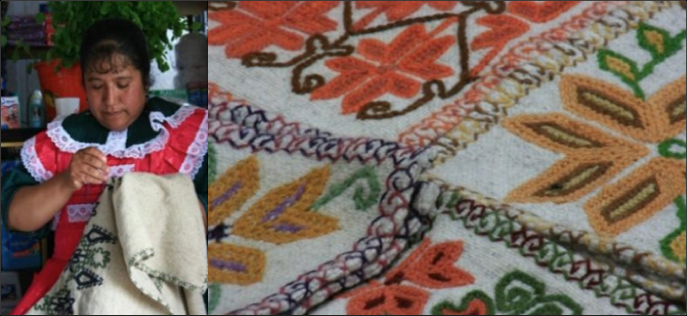
Figure 1.
A photograph taken within the community showing a women taking part in traditional hand textile crafts and the material produced.
Fuente: Rosas-Flores, J.A, y Morillón-Galvéz, David (2010).
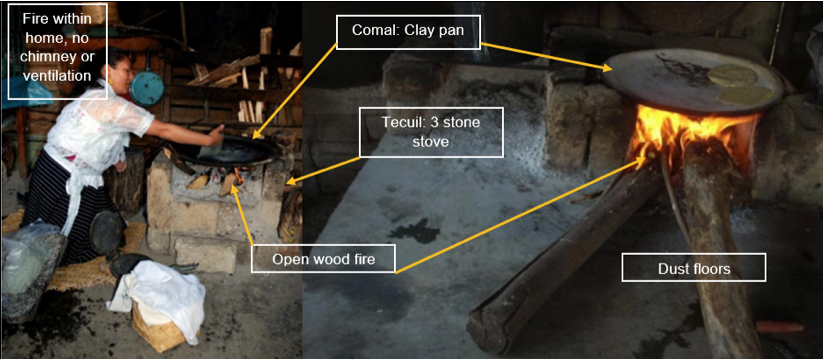
Figure 2.
A photograph diagram showing a women within San Jose Villa de Allende cooking using the traditional Comal cooking pan and Tecuil stone stove.
Fuente: Rosas-Flores, J.A, y Morillón-Galvéz, David (2010).
RESULTS
The results shows a consolidation of resulting categories, raw sections taken from interview content analysis and the implications of these.
Review of previous literature and case study analysis has identified a number of issues faces by the indigenous community, particularly women, in rural San Jose Villa de Allende. Interview analysis of questions about these issues then exposed a number of specific problems, and challenges facing the community and halting economic development and improvements in quality of life. These differing problems have resulted in many potential solutions for strategy formation, and therefore created a platform for discussion. The key issues can be categorised under four main sections: solid fuel based; stove based; chimney and health based; and policy/government intervention based.
Development action plans and social benefits
Alternative technologies and solutions constitute complex systems and strategies involving a number of different stakeholder groups. Multifaceted socio-economic, environmental and cultural interactions also need to be integrated holistically in order to define an appropriate solution approach. Results have shown women spend much of their day partaking in medial tasks revolving around wood collection, sorting and cooking with as fuel. The study found adverse health effects where likely caused by open wood stoves without appropriate ventilation yet the community used these methods as they were traditional and culturally significant.
One of the possible solutions to the issues created is the use of alternative fuels and technologies as a means of creating energy for both household heating, lighting and cooking. Interviews revealed a significant amount of repetition involving time related problems causes by wood collection and use. Wood proved to be used by every family interviewed, as resources are scare within the area it is one of the only commodities available. Previous studies have provided an inside into the potential solution of using alternative fuels REF and thereby limiting the need for continuous wood collection. As well as mitigating the health impacts of using solid fuels within the home for heating and cooking. Results also found the health implications of using open stoves and burning wood to be a key contributor in holding the community back from a higher quality of life. One potential mitigation strategy of this is the introduction of alternative stoves and cooking practises or the use of chimneys and fumes for ventilation. Within each of these potential changes to the lifestyles of women within the community there are a number of influential factors which need to be accounted for. These factors will have direct effects on the feasibility of each mitigation strategy.
SOCIAL BENEFITS
Time Saving and empowerment of women
Reducing the reliance of women on fuelwood as their main energy source for heating and cooking, whether that be through alternative energies, stoves or increased electrification, can have a significant social impact.
Imperative to this impact is the concept of time as a commodity for rural women. Time is a main factor in opportunity availability for these women, collecting fuel wood and spending long hours tending to a fire is time ‘lost’ for taking part in textile crafts and other money making opportunities. If by introducing an alternative fuel source time is redirected from collection to crafts women may have a higher quality of life. Resulting from spending more time doing emotionally rewarding activates as well as having a higher potential for earning to increase as a result of more sales.
Having a greater access to domestic energy has been proven to empower women as well as have access to better education and livelihoods in rural areas (Sapkota et al., 2014; IEA, 2002). This, as well as time saving, means a reduction in workload primarily for women, which could contribute to increased social involvement. Involvement within policy making and matters of the community allows women to become empowered and feel valued within the community, overall increasing quality of life.
Education, income generation and employment benefits
Findings from interview analysis imply there is a limitation of the amount of textile crafts women can do each day due to other time consuming responsibilities in the home and involving energy resources. Textile crafts was mentioned by every people interviewed as being the main source of income for women. As well as the income generating potential, textile crafts is also a traditional and highly skilled activity which is synonymous with the Mazahua people and their way of life.
Electrification also has a large part in educational and occupational opportunities. Using alternative fuels (solar, bio-digester and micro hydropower) would all generate electricity. The lack of effective lighting means studying is impossible after dark and therefore some aspects of education are made unfeasible. It has been reported that there is also a lack of lighting within the streets, thus causing a safety issue for women and children travelling to and from school after dark. Using renewable energy technologies (RETs) would create local access to electricity and lighting providing the potential for studying or taking part in some form of work after dark. Despite this, alternative fuels may prove detrimental to income potential as wood is occasionally sold by women of San Jose Villa de Allende for additional earnings. With appropriate policies in place it would however be possible to create jobs within the community involving maintenance of the RET.
Improved health
The use of solid fuels within under ventilated homes in San Jose Villa de Allende has causes severe indoor air pollution. This community is poor and rural, lacking a hospital and other larger scale medical facilities. Poor health also reduces quality of life, in order to mitigate these issues alternative fuels or stoves can be used. With the introduction of RETs and electrification within homes people will also have easier access to news, radio and television allowing them to stay connected and increase public knowledge of potential health issues. Therefore allowing for the community to self-mitigate these issues based on increased knowledge and communication. With the introduction of RETs and increased electrification in the village, this also brings the potential for refrigeration of vaccinations and higher quality medical technologies locally.
Changing the stoves or chimney introduction may also have an impact on the dangerous of fires and burns. If stoves and chimneys are altered to ensure they have better ventilation and require less energy to fire, its possible indoor air pollution issues will be reduced and health of women and children in San Jose Villa de Allende will significantly improve LINK. As health increases this also has knock on effects for further development. Better health can be linked to better school and work attendance and therefore high potential for higher wage employment. Renewable technologies could therefore make contributions to overall economic development within the wider area of Mazahua community, both directly and indirectly.
Cultural barriers
Despite the potential for economic growth and improved quality of life created by the introduction of RETs, alternative energy sources and different cooking methods, there are many cultural implications behind any change of lifestyle within a community. Fuelwood is used not only for its ease of availability but also for its taste for cooking. Food cooked with wood has a smoked flavour which is key in traditional Mexican cooking. The traditional tecuil stoves used are an ancient method of cooking corn tortillas used for many generations by indigenous people and therefore this will be very difficult to change.
Despite the health, social and economic benefits possible from alternative energy sources they are unlikely to be accepted within the community due to the cultural barriers behind the use of wood. The matter of financial implications also becomes an issue, without substantial government aid or financial support, people will be unwilling to make the change from a ‘free’ energy source to one which they will now have to pay for such as liquid fuels.
Taking into account the cultural context and traditional lifestyles of the indigenous community it would not be feasible to devise a strategy for alternative fuel use or stove creation. With the potential for knock on benefits created from improvements in health, a change in ventilation and introduction of chimneys within homes in the community is therefore the best option for increasing quality of life with respect to the cultural and traditional needs of the people. An implementation strategy for change has been developed, in line with existing and proposed policy introductions, for the use of ventilation systems within homes of indigenous people in order to increase quality of life and mitigate the health impacts of energy use in rural Mexico.
Implementation strategy formulation
An implementation plan has been devised for the introduction of alternative chimneys within homes in rural Mexico. Thus forming a new approach for the future for improving health and quality of life. This management tool is used in order to illustrate critical steps in the project strategy guide, forming a proactive approach and identifying challenges early. A 5-year plan is used in order to outline change. The following key factors are needed to facilitate the implementation, combining both factors already under implementation and primary ideas for building upon:
· Enabling policy framework, detailing regulatory factors. Allowing for an incentivized economic and fiscal approach to be developed, levelling the playing field in terms of financial implications and recognition of the benefits.
· Providing education and public information campaigns.
· Effective and appropriate technological developments and support.
· Coordination of energy, health, economic, governmental and cultural issues in order to establish a working solution which is unlikely to be rejected by the community.
· Engagement of both the public and private sectors in development and implementation of chimneys on stoves.
The factors defined above are derived from the themes established within the discussion of results. A baseline for the strategy has been established inclusive of resulting opinions of the community, feasibility of the project and cultural barriers. As a result a phased transition of implementation is proposed over a 5 year period, thus adapting current norms with new practises one element at a time. Primarily it is key to establish the goals of the project, the strategy should be formed with the overall goal of establishing safer and cleaner ventilation systems within homes in rural Mexico. Within this umbrella goal a number of target elements will be introduced, using a bottom up approach. This approach will allow for the goals to be met whilst ensuring the beneficiaries are at the forefront of implementation of the project. This self-help technique will allow for the community to benefit from short term education and training in the long term by having the means of building up the community. This concept of self-reliance among beneficiaries is key. The implementation of alternative chimneys is based around a number of key sections.
CONCLUSIONS
Currently 27 million people in rural Mexico use biomass, 80% of this coming from fuelwood, as their main energy source. Open fires being the most frequently used technology for both cooking and heating homes. People using this technology are therefore exposed to emissions resulting in serious ill health. This mainly affects women and children. The study analyses the implications of using biofuels in rural Mexican communities, using interviews, and potentially energy changes with the goal of economic development. With the implementation of alternative chimneys within homes there is potential to reduce smoke related health issues and create knock on socio-economic benefits within the community.
Methodologically this study shows that the cultural norms and behaviours of the community are of primary importance in the planning and implementation of any change within the energy sector of the community. Analysis took the form of qualitative research, using interviewing as the method of data collection and content analysis for interpretations. Data was collected within the village of study, and in the native language. Interview answers are coded and analysed for opinions regarding the energy uses and struggles of the community as well as their daily activities and cultural importance.
This paper suggests, based on qualitative analysis, taking into account cultural practises and the opinion of the community the only viable change to energy resources in the village is the introduction of chimneys within homes. Alternative fuels were suggested to be inappropriate due to the changes to the taste and cooking of traditional foods which would result. Despite the benefits this would bring in terms of time and opportunities for women including education and textile crafts. Taking into account the socio-cultural and community level impact of energy resource changes it was been concluded that a focus on health would allow for improvements to be made in terms of development and quality of life, without the alterations in daily activates and norms within the community. Results also showed the use of biofuels within San Jose Villa de Allende had a vast impact on the lives of the in habitants and aspects including wage employment; empowerment; enjoyment and education are all effected by the use of fuelwood for energy. Although the major energy problem facing the community was proven to result from the time demands of the resource this element also entailed cultural barriers, which are unfeasible to change, potentially causing policy failings and rejection of alternative measures. Conclusions can be drawn concerning the apparent trade-offs identified between quality of life, cultural traditions and energy poverty. Within potential strategies for change the elements of this trilemma are mutually exclusive and therefore compromises and priorities must be established.
Based on the findings of the study, a number of policy recommendations were discussed. These outline the need for a shift in policy making, absorbing the women and people of community into the policy making. Meaning the beneficiaries of the change will be at the forefront of the policies creation which affects their own livelihoods. Education and training proved key in the success of the implementation strategy and policy recommendations, in order to establish a self-sufficient system within the community, for the future.
References
Bielecki C., Wingenbach, G. (2014), “Rethinking improved cookstove diffusion programs: a case study of social perceptions and cooking choices in rural Guatemala”, Energy Policy, vol. 66, pp. 350-358.
Bikram Malla, M., Bruce, N., Bates, E. & Rehfuess, E. (2011), “Applying global cost-benefit analysis methods to indoor air pollution mitigation interventions in Nepal, Kenya and Sudan: Insights and challenges”, Energy Policy, vol. 39, issue 12, pp. 7518-7529.
Boy, E., Bruce, N., Delgado, H. (2002), “Weight and exposure to kitchen wood smoke during pregnancy”, Environ Health Perpect, vol. 110, núm. 1, pp. 109-114.
CONAPO (Consejo Nacional de Población) (2013), Índice absoluto de marginación 2000-2010, Consejo Nacional de Población, México.
Foell, W., Pichauri, S., Spreng, D. & Zerriffi, H. (2011). “Household cooking fuels and technologies in developing economies”, Energy Policy, vol. 39, núm. 12. December pp. 7487 – 7496.
Francescutti, C. (2014), Energy Poverty. [On line] http://www.ifad.org/operations/projects/regions/pl/factsheet/mexico_e.pdf, Last accessed june 2015.
Gobierno del Estado de México (2003), Plan Municipal de Desarrollo de Villa de Allende, GEM, Toluca.
Hutton, G., Rehfuess, E., Tediosi, F. & Weiss, S. (2006), Evaluation of the costs and benefits of household energy and health interventions at global and regional levels, WHO, Switzerland.
IEA (2003), Worlds Energy Outlook, OECD/IEA, Paris.
MRF-Climate Justice (2011), Access to sustainable Energy-The gender dimentions. [On line] http://www.mrfcj.org/pdf/Policy-Brief-Malawi-Access-to-Sustainable-Energy-the-Gender-Dimensions.pdf. Last, accessed june 2015.
Mundo-Hernandez, J., de Celis Alonso, B., Hernandez-Alvarez, J., de Celis-Carrillo, B. (2014), “An overview of solar photovoltaic energy in Mexico and Germany”, Renewable and sustainable energy reviews, vol. 31, núm.1, pp. 639-649.
Naeher, P., Leaderer, B. & Smith, K. (2000), "Particulate Matter and Carbon Monoxide in Highland Guatemala: Indoor and Outdoor Levels from Traditional and Improved Wood Stoves and Gas Stoves", INDOOR AIR (10), pp. 200-205.
Rosas-Flores, J., Glavez, D. (2010), “What goes up: Recent trends in Mexican residential energy use”, Energy, vol. 35, núm. 1, pp. 2596-2602.
Sapkota, M. y Manandhar, P. (2014), “Ethnic Movement and Contested Rural Development: A critical reflection from Nepal”, International Journal of Agriculture and Applied Science, vol. 6, núm. 1, pp. 1-11.
SENER (2013), Estrategia Nacional de Energía 2013-2017. [on line] http://www.energia.gob.mx/res/PE_y_DT/pub/2013/ENE_2013-2027.pdf. Last accessed june 2015.
Smith, K.R., Samet, J.M., Romieu, I, Bruce, N. (2000), “Indoor air pollution in developing countries and acute lower respiratory infections in children”, Thorax, vol. 55, núm. 6, pp.518-532.
UNDP, Gaye, A. (2010), Human Development Report. [On line] http://www.bvcooperacion.pe/biblioteca/bitstream/123456789/5942/1/BVCI0005758.pdf. Last accessed june 2015.
undp (2011), Gender and Energy. ENERGIA: Fact Sheet on Energy, gender and sustainable development. GGCA-Global gender and climate alliance, USA.
who (World Health Organization) (2006), Geneva: World Health Organization; Global Physical Activity Questionnaire (gpaq), Suiza.
World Energy Council (2015), World Energy Trilemma: Time to get real- the agenda for change. [On line] http://www.worldenergy.org/publications/2013/world-energy-trilemma-time-to-get-real-the-agenda-for-change/. Last accessed june 2015.
