ARTÍCULO
Influence of growth parameters on wood density of Acacia auriculiformis
 Jesugnon Fifamè Murielle Féty Tonouéwa murielle.tonouewa@leb-up.org
Samadori Sorotori Honoré Biaou
Eméline Sêssi Pélagie Assèdé
Patrick Langbour
Ogoulonou Rodrigue Balagueman
Jesugnon Fifamè Murielle Féty Tonouéwa murielle.tonouewa@leb-up.org
Samadori Sorotori Honoré Biaou
Eméline Sêssi Pélagie Assèdé
Patrick Langbour
Ogoulonou Rodrigue Balagueman
Influence of growth parameters on wood density of Acacia auriculiformis
Maderas. Ciencia y tecnología, vol. 24, 19, 2022
Universidad del Bío-Bío
Received: 01 March 2021
Accepted: 09 January 2022
Abstract: Understanding the drivers of wood density variation both within a tree and between trees is important in predicting the quality of wood logs and improving this quality through adequate forestry management. This study examined the effect of the diameter growth of Acacia auriculiformis on its wood density variation. The study was conducted in the South of Benin in four plantations of Acacia auriculiformis. Near infrared spectroscopy (NIRS) method was used to predict the basic density of 225 tree wood cores of Acacia auriculiformis. A predicting model of the average tree density using the diameter as predictor was established. The relationship between wood density and tree diameter was best described by a linear mixed-effect model. The average wood density of trees increased with the diameter. The study concluded that the quality of the species logs can be improved through regular thinning and genetic selection.
Keywords: Acacia auriculiformis, log, NIRS, tree diameter, wood characteristics.
Introduction
Density is a major functional trait of wood (Hietz et al. 2013, Ducey 2012). It is related to the physico-mechanical characteristics and natural durability of the wood (Hietz et al. 2013, Pérez-Peña et al. 2020) and is correlated with the longevity of trees. Trees with low wood density usually have higher mortality risks (Hietz et al. 2013). Also, wood density represents a good indicator of forest biomass and the rate of carbon sequestered in wood (Morel et al. 2018, Nabais et al. 2018). Wood density is among the most important parameters used in tree breeding programs (Alves et al. 2010). It varies inside species with the height and the radial position (Guller et al. 2012, Hietz et al. 2013). Hence, wood density is a combined effect of several intrinsic and extrinsic factors, including the environment, genetic factors, age and growth parameters (Nabais et al. 2018, Morel et al. 2018, Mevanarivo et al. 2020).
Tree growth is usually expressed in several ways, including height increment, and diameter growth (DeBell et al. 1994, Silva et al. 2019). Tree growth influence several characteristics of wood such as wood density. The effect of tree growth on wood density is not consistent across species. In general, fast-growing species have low density (DeBell et al. 1994). The increase in tree growth would lead to an increase in the ring’s width, a low wood density (Wang et al. 2000, Gapare et al. 2010) and an inter-annual variability in the wood density. On the contrary, DeBell et al. (2001) found that the wood density of Eucalyptus saligna increased with the diameter, particularly on nutrient rich soil whereas Jakubowski et al. (2020) found no significant effect of tree growth on wood density for Betula pendula. The relation between tree growth and wood density is apparently site-specific (e.g. climatic factors and soil water reserve) and species-specific (Bouriaud et al. 2005).
Several methods are used to estimate wood density. Direct measurements from felled trees, with wood density corresponding to the mass over the volume of a sample, provide quite accurate results (Alves et al. 2010). Still, indirect measurements through near infrared spectroscopy (NIRS) could be used for predicting wood properties with high precision based on calibrated and validated Partial Least Squares (PLS) regression models (Alves et al. 2010, Cooper et al. 2011, Diesel et al. 2014). This method allows to evaluate a large amount of data very quickly and efficiently (Cooper et al. 2011). It also has the advantage of using samples from un-felled trees to determine wood characteristics.
Knowledge on the distribution of wood density in individual trees and its formation process is required to improve both the silvicultural processes and the wood production so as to obtain a wood of the desired quality (Guller et al. 2012, Mäkinen and Hynynen 2012). But the complexity of the wood density formation usually limits the interpretation of the models because a similar average density of two woods can result from different anatomical parameters and environmental factors. Thus, understanding the intraspecific variability of wood density can enable the identification of appropriate silvicultural practices to produce wood at a higher yield and of a better quality (Hai et al. 2010).
Acacia auriculiformis is native to Asia (Wickneswari and Norwati 1993) where its wood shows distinct rings. The number of rings may be inconsistent with the age of the tree (Chowdhury et al. 2009) and the determination of the radial variation of its wood is of definite interest. In West Africa, the species was introduced in 1980 (Tandjiekpon and Dah-Dovonon 1997) mainly for firewood production but also currently include timber prospects (Tonouéwa et al. 2019). The species produces a wood with quite good characteristics (Hounlonon et al. 2018, Tonouéwa et al. 2020). Determining the variability of its wood density within and between trees and understanding the influence of tree diameter on the wood density will allow for the improvement of the species growth parameters and wood physico-mechanical characteristics through appropriate silvicultural treatments. The main objective of this study is to identify patterns and drivers of wood density variation in A. auriculiformis grown in plantations in South Benin. More specifically it aims to (i) determine the relationship between the diameter and wood density of A. auriculiformis; and (ii) determine the radial variation of the wood density of A. auriculiformis.
Materials and methods
Study area
The study was conducted in Southern Benin around 6º22 'to 6º54'N latitude and 2º05 'to 2º8'E longitude (Figure 1) and precisely in twelve state-owned plantations of A. auriculiformis. These plantations were located at Lama (on vertisol), Pahou (on ferruginous soil), Ouedo (on ferralitic soil) and Sèmè-kpodji (on sandy soil). The climate is similar across the study sites (Amoussou et al. 2016). The average annual rainfall is 1100 mm and the average annual temperature 27 °C.
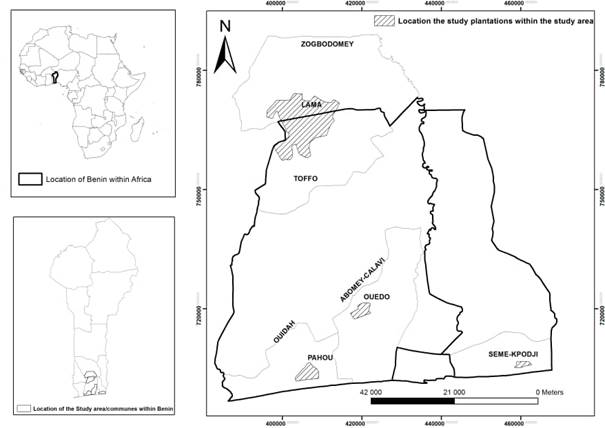
Figure 1:
Map of study area and location of the study plantations.
Data collection
The data comes from twelve state-owned plantations of A. auriculiformis (Table 1, Figure 2). A total of 255 cores of 5 mm diameter were sampled, at 1,30 m height from 255 tree individuals (1 core per tree), using a Pressler auger. The transverse surface of the cores was sanded with sandpaper (fine grits) to obtain a flat and smooth surface for the measurements. The cores moisture was stabilized at 12%. The near infrared spectrometry (NIRS) method was used to determine the wood density on each core sample at 1 cm interval (Figure 3) and the radial variation of the wood density of A. auriculiformis was described. Near infrared spectra were obtained with a Bruker Vector 22/N spectrometer run by OPUS 200 software version 5.5.
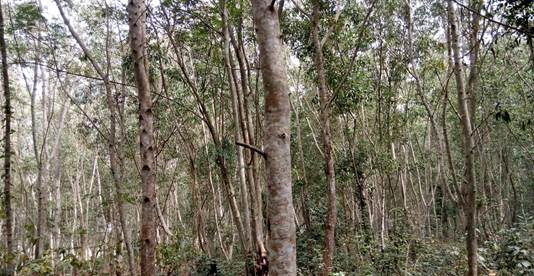
Figure 2:
A. auriculiformis plantations of 4 years old, South-Benin.
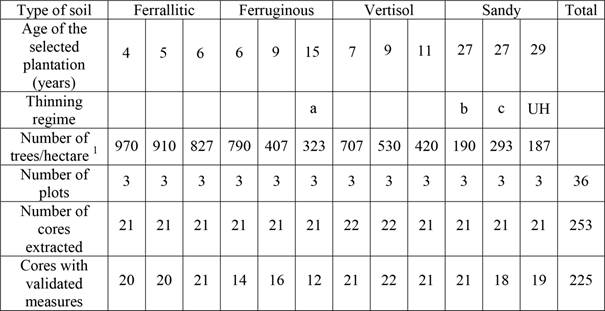
UH=Uncontrolled Harvesting; a= thinning at 9 years; b= thinning at 7 years+ Uncontrolled Harvesting; c= Thinning at 14 years + Uncontrolled Harvesting 1(Tonouéwa et al. 2019).
On each core, the number of measures in the heartwood was ≤ 20 (20th radial position, Figure 3 and Figure 6).
After removing broken and poorly preserved cores from the samples and after removing outliers, 225 cores translating into 2869 measurements (430 on sapwood and 2439 on heartwood) were validated (Table 1). However, the wood density of A. auriculiformis was predicted using only the 2439 measurements on heartwood because wood density is always higher in heartwood than in sapwood (Githiomi and Kariuki 2010). This is due to the high proportions of carbon, lignin and extractives in the heartwood (de Aza et al. 2011, Bertaud and Holmbom 2004). In addition, heartwood is the most interesting part of the tree for use as timber.
For the prediction of wood density, we used a pre-established NIRS model of the basic density of A. auriculiformis in South Benin (Tonouéwa et al. 2020). The model had a root-mean-square error (RMSE) of 50,33 kg/m3 (R2 = 0,75) for the prediction model and 45,88 kg/m3 (R2 = 0,79) for the calibrated model. The Unscrambler software, version 9.7 CAMO (The Unscrambler 2007) was used to estimate the basic density and the standard deviation for each measured point. The value of the basic density at a given point on a wood core is an average of 16 measurements with the spectrometer at this point. The standard deviation of the 16 measurements at each point was ≥ 60 kg/m3.
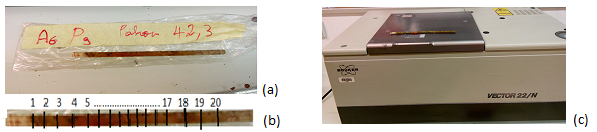
Figure 3:
A. auriculiformis wood core packed within the field with codes indicating the location, the tree and tree diameter (a); a wood core marked for measurements (b) and the spectrometer used to make the measurements (c).
The basic density of A. auriculiformis trees was evaluated as a function of the radial position in the tree and as the ratio between the dry mass of a sample and its saturated volume (Rybníček et al. 2012, Diesel et al. 2014).
Statistical analysis
A first exploratory analysis of the predicted wood density of A. auriculiformis on cores was done. Samples with standard deviations greater than or equal to 200 kg/m3 (i.e. 1,5 times the interquartile range above the third quartile or below the first quartile; Crawley 2007) were considered as outliers and excluded from the batch for the subsequent analyses.
To assess the relationship between the wood density and tree diameter, several Linear and Non-Linear Mixed Effects Models (NLME) were tested in R.3.5.2 (R Core Team 2018) with the nlme package (Pinheiro et al. 2018). The random effects were: plots nested within zone of data collection and the fixed effect was tree diameter. Based on the inspection of the scatterplots and models previously used for explaining the relation between tree diameter or tree age and wood density, a linear (Silva et al. 2019) and four nonlinear functions (Table 3) were assumed to potentially fit well the data. The nonlinear functions include the second-degree polynomial function (Githiomi and Kariuki 2010), the first exponential function (Oddi et al. 2019), the Michaelis-Menten asymptotic function (Oddi et al. 2019) and the second exponential function (Oddi et al. 2019).
The appropriate model was selected based on the Akaike Information Criterion (AIC) (Akaike 1973) and the random effect. The best model is the one that minimizes the AIC value (Chave et al. 2005) and shows a high random effect (i.e. variance in the wood density explained by the random effect). The general equation of the NLME model developed in R.3.5.2 is showed below:
Model = nlme(ER,
Data = WDdata,
Fixed = a+b+c~1,
Random = a~1|zone/plot,
Start = c(a=u, b=v, c=w))
ER: the linear or nonlinear regression equation used (Table 2); WD data: the database containing the dependant (wood density) and the explanatory variables; a + b + c ~ 1: the parameters of the function (Table 2) used for the fixed effect of the model; a ~ 1 | zone / plot: the random effect; u, v, w: the list of initial estimates for the values of a, b, and c respectively.
When the function has two parameters (a, b), the fixed effect takes the form a + b ~ 1.
Regarding the type of linear or nonlinear relationship, parameters a, b and c were calculated with an adjustment in R (R.3.5.2).
Concerning the linear function, parameters a and b were determined by solving in R the following matrix Equation 1:
 (1)
(1)Considering the second-degree polynomial function, parameters a, b, and c were calculated by solving in R the following matrix Equation 2:
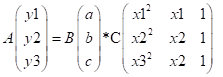 (2)
(2)Regarding the first exponential Equation 3, a and b were calculated as follow:
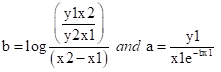 (3)
(3)For the Michaelis-Menten asymptotic function, a and b were calculated using the SSmicmen function of the package stats.
For the second exponential Equation 4, a and b were calculated as follow:
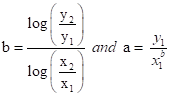 (4)
(4)After the selection of the best model, normality quantile, modelling variance, correlation structure, residuals wood density as function of tree diameter, and a plot of the predicted vs observed wood density were analysed to evaluate the model assumptions.
In addition, the relations between the wood density and the age of the plantation, and the radial position in the tree were determined using a mixed effect model in R.3.5.2 (R Core Team 2018) with the lmerTest package. The average values of the wood density were eventually regressed against the radial position for each age of plantation.
Results
Variation in wood density of A. auriculiformis in relation to tree diameter
Among the models tested (Table 2) for expressing the wood density as a function of tree diameter, the linear mixed effect model was the most suitable for A. auriculiformis (low AIC, high random effect). This model validity is restricted to A. auriculiformis trees with at least 10 cm diameter at breast height and growing in conditions similar to those of south Benin. The model is in the form of: WD=a*D+b, with D = tree diameter, WD = wood density,
a =1,2335; b= 537,6931 from solving Equation 1. With a Root-Mean-Square Error (RMSE) of 51,79 kg/m3 and a Bias of 0,2%, the quality of the model is suitable.
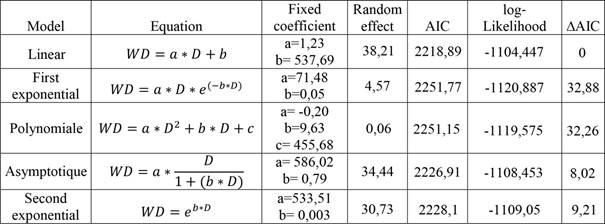
WD = wood density; a, b and c are the parameters of the function used for the fixed effect of each model (see Table 2); AIC = Akaike Information Criterion; ∆AIC = difference between the AIC of the best model (smallest AIC) and each of the alternate models, for ease of comparison.
The characteristics of the linear model obtained indicate a distribution of the data close to normal (Figure 4a), a homogeneity of the variance (Figure 4b), a weak autocorrelation structure (Figure 4c), and a coherent and uniform distribution of wood density residues as a function of the diameter of the trees (Figure 4d). The scatter plot between the real data and those predicted is not perfect (Figure 4e), however we observe that the predicted values are averages of the real values.
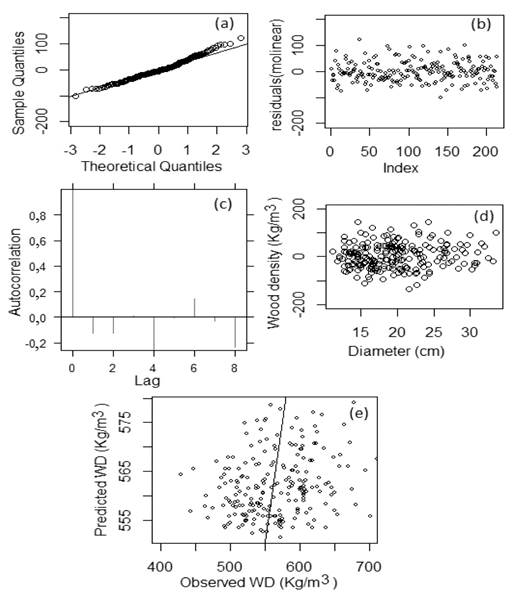
Figure 4:
Characteristics of the linear mixed effect model of wood density as a function of tree diameter for A. auriculiformis in Benin: (a) Normality quantile, (b) modelling variance, (c) correlation structure, (d) Residual wood density as a function of tree diameter, (e) Predicted Wood density vs observed wood density, 45° line.
In general, wood density of A. auriculiformis increased with the diameter (Figure 5). There is also a significant and positive correlation between tree diameter and wood density of A. auriculiformis (r = 0,23; p-value = 0,0006**).
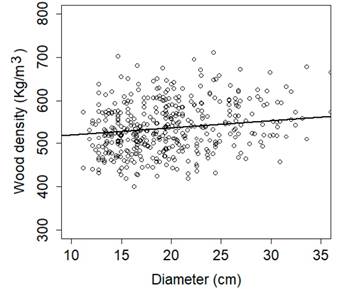
Figure 5:
Wood density of A. auriculiformis as a function of the tree diameter.
Intra-species and intra-tree variations in the wood density of A. auriculiformis
Wood density varies from one tree to another (Table 3), and the random effect of this parameter explains 25,7% of the variation of A. auriculiformis wood density in the study plantations.
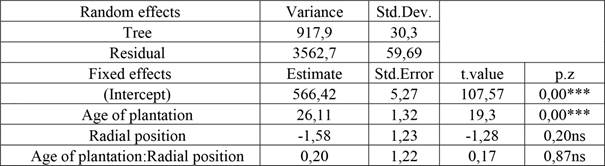
***Significant difference at 0,1% level; ns = no significant.
In general, the relation between the wood density of A. auriculiformis and the radial position of the wood in a tree was not significant (Table 3, Figure 6). The radial pattern of the wood density of the species did not show the demarcation between juvenile and mature wood. Still, we noted a sawtooth radial variability of wood density, an increase in the density of the wood outwards until a wood density peak is obtained, and a decrease in the wood density towards the ends of the tree. On the contrary, the age of the plantation has a significant and positive effect on wood density (Table 3).
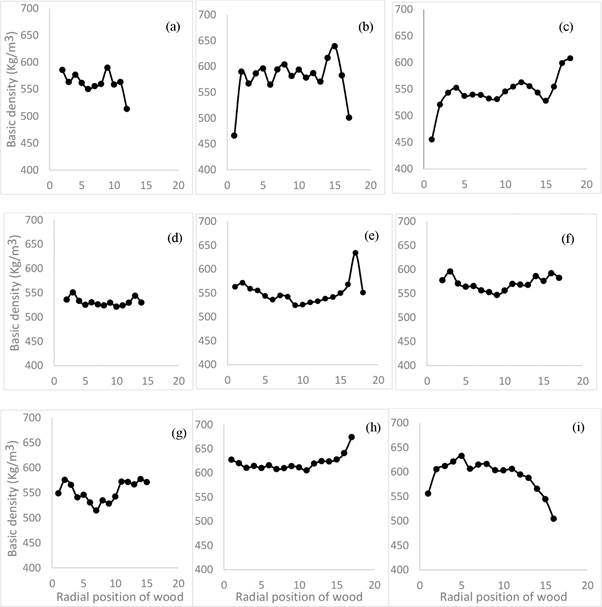
Figure 6:
Variations in the wood density of A. auriculiformis as a function of the radial position of the wood and the age of the plantation: (a) = 4 years old plantation; (b) = 5 years old plantation; (c) = 6 years old plantation; (d)= 7 years old plantation; (e) = 9 years old plantation; (f) = 11 years old plantation; (g) = 15 years old plantation; (h) = 27 years old plantation; (i) = 29 years old plantation.
Discussion
The best model for predicting the wood density of A. auriculiformis as a function of diameter is a linear function, and wood density increased with tree diameter within the range of diameters considered for the sample trees in this study (10-35 cm diameter at 1,30 cm). Linear models have been widely applied for the estimation of wood density in various settings and for various species. For example, an estimation of the wood density of Cerrado species (e.g. Luehea paniculata, Terminalia fagifolia) was obtained in Brazil with a lineal mixed model (Silva et al. 2019) and for several species in Madagascar (Ramananantoandro et al. 2016). Similarly, a linear mixed-effect model was used to estimate the wood density of Quercus petraea as a function of growth parameters and site quality (Guilley et al. 2004). Wood density increased with diameter. Forestry focused on accelerating the growth of A. auriculiformis trees is generally recommended for the rapid obtaining of good wood quality and large diameters. As such, regular thinning could be effective in increasing the value of A. auriculiformis plantations as shown elsewhere (Huong et al. 2020, Wiersum and Ramlan 1982). However, climate and soil conditions can alter trees response to thinning and post‐thinning diameter growth. Thus, further experiments are needed to evaluate the response of the species to frequent thinning practices in the specific conditions of South Benin.
The correlation between the diameter of the trees and wood density, although significant, was moderate in this study and suggests that the diameter of the tree alone does not explain entirely the variation in wood density of A. auriculiformis. Indeed, the relationship between wood density and growth rate in a species is generally influenced by environmental, silvicultural and genetic factors (Zobel and van Buijtenen 1989, Zhang and Morgenstern 1995). Consequently, contrasting relations between tree growth and wood density are found in the literature. For example, in Madagascar, Ramananantoandro et al. (2016) found that tree diameter did not significantly affect wood density for native hardwood species. Similarly, a lack of correlation between tree growth and wood density was observed for Eucalyptus globulus in Portugal (Quilhó and Pereira 2001) and for black spruce (Picea mariana) in Canada (Hall 1984), while DeBell et al. (2001) found a negligible influence of growth rate on wood density for Eucalyptus saligna in Hawai. In contrast, Roque and Fo (2007) and Boyle et al. (1988) reported negative correlations between wood density and growth traits, respectively for Gmelina arborea in Costa Rica and for black spruce (Picea mariana) in Canada. In the present study, the moderate positive correlation between A. auriculiformis wood density and tree diameter suggests that diameter growth can be improved with a small gain in the species wood density. This is interesting as most wood mechanical properties are closely related to wood density.
In addition, wood density varies from one tree to another within same plot. This variability of the wood density can find an explanation in the silvicultural practices in Benin. A. auriculiformis plantations in Benin are set up from seeds from mother plants chosen mostly randomly, or based on the availability and accessibility of the trees (survey in South Benin). The probability of a large genetic variability between trees on the same plot is thus high. This stress the importance of genetic selection, as the structural characteristics of A. auriculiformis wood, such as the wood density, are heritable. The selection of good quality parent material are particularly critical for improving the properties of new plantations (Hai et al. 2010, Chowdhury et al. 2012, Nabais et al. 2018).
Regarding the intra-tree variation of wood density, we found no significant relation between the radial positions of the wood and the wood density for A. auriculiformis. Wood density being the main technological parameter of wood, its variation within trees and the magnitude of the variation provide information on the quality of the logs produced (Guilley et al. 2004). As such, our results indicate that the characteristics of A. auriculiformis logs are heterogeneous. Bouriaud et al. (2005) linked the variability of the radial density of wood to the differences in radial growth of trees. The latter is influenced by climatic variations, thinning and soil fertility (Mäkinen and Hynynen 2012, Hietz et al. 2013, Miranda and Pereira 2015, Nabais et al. 2018). For A. auriculiformis these site-specific constraints could relate to climatic conditions and tree spacing.
Although the intra-tree variation of wood density was not significant in this study, the following patterns could be drawn from the data: (i) a sawtooth radial variability of wood density that possibly reflect the succession of rainy and dry seasons at the study sites; (ii) an increase in the density of the wood outwards until a wood density peak is obtained, suggesting that the wood formed during the last years of the tree's life is of higher density; (iii) a decrease in the wood density from pith to bark, which is potentially linked to the presence of sapwood. Similar variations of radial characteristics were also recorded on A. auriculiformis produced in Asia (Chowdhury et al. 2012) as well as for other timber species (Hietz et al. 2013).
The low radial variability in the wood density indicates that for estimation of wood biomass of A. auriculiformis and carbon content in the wood, the samples wood can be taken at any radial position in the tree (Chave et al. 2006, Hietz et al. 2013). This low radial variability in the wood density also makes it possible to predict low constraints growing of the tree (Curran et al. 2008, Nock et al. 2009, Nabais et al. 2018) predicting good ecological and biological conditions of growing and better quality of the log.
Conclusions
In this study, the best model for predicting the wood density of A. auriculiformis as a function of diameter is a linear function, and wood density increased with tree diameter. The moderate positive correlation between A. auriculiformis wood density and tree diameter suggests that diameter growth can be improved with a small gain in the species wood density. The suggested opportunities for improvement include the selection of good quality parent and the practice of frequent and regular thinning to reach desirable diameters and produce high-density timber. However, further experiments should evaluate the response of the species to frequent thinning in the specific climate and soil conditions of A. auriculiformis grown in South Benin. The study also highlights the need for reducing the intra-tree variability in wood quality, which could also be achieved through improved tree breeding.
Acknowledgments
The first author received support from the International Foundation for Science (FIS; Grant I-1-D-6154-1), L'Oréal UNESCO (Sub-saharan Africa young Talents program 2019; grant For Women in Science), and IDEA Wild (field equipment). The authors extend their thanks to the French Agricultural Research Centre for International Development (CIRAD-Montpellier, France) for making it possible for the first author to carry out wood samples analyses within its UR BioWooEB laboratory.
References:
Akaike, H. 1973. Information theory and an extension of the maximum likelihood principle. In Petrox B.; F. Casaki, B., eds. Second international symposium on information theory, Budapest: Akadémiai Kiadò: 267-281. https://hero.epa.gov/hero/index.cfm/reference/details/reference_id/591
Alves, A.; Santos, A.; Rozenberg, P.; Pâques, L.E.; Charpentier, J-P.; Schwanninger, M.; Rodrigues, J. 2010. A common near infrared-based partial least squares regression model for the prediction of wood density of Pinus pinaster and Larix 3 eurolepis. Wood Sci Technol 46: 157-175. https://doi.org/10.1007/s00226-010-0383-x
Amoussou, E.; Vodounon, S.H.T.; Cledjo, F.P.; Allagbe, Y.B.S.; Akognongbe, J.S.A.; Houndenou, C.; Mahe, G.; Camberlin, P.; Boko, M.; Perard, J. 2016. Evolution climatique du Bénin de 1950 à 2010 et son influence sur les eaux de surface. In Fallot, J-M.; Joly, D.; Bernard, N., eds. Actes du XXIXe Colloque de l’Association Internationale de Climatologie, Lausanne - Besançon, July 6-9, 2016: 231- 236. http://www.climato.be/aic/colloques/LausanneBesancon16/Pres/Amoussou.pdf
Bertaud, F.; Holmbom, B. 2004. Chemical composition of earlywood and latewood in Norway spruce heartwood, sapwood and transition zone wood. Wood Sci Technol 38: 245-256. https://link.springer.com/article/10.1007/s00226-004-0241-9
Bouriaud, O.; Leban, J.M.; Bert, D.; Deleuze, C. 2005. Intra-annual variations in climate influence growth and wood density of Norway spruce. Tree Physiol 25: 651-660. https://academic.oup.com/treephys/article-pdf/25/6/651/4642306/25-6-651.pdf
Boyle, T.J.B.; Balatinecz, J.J.; McCaw, P.M. 1988. Genetic control of some wood properties in black spruce. In Proceedings of the Twenty-first Meeting of the Canadian Tree Improvement Association 2: August 17-21, 1987, Truro, Nova Scotia.
Chave, J.; Andalo, C.; Brown, S.; Cairns, M.A.; Chambers, J.Q.; Eamus, D.; Fölster, H.; Fromard, F.; Higuchi, N.; Kira, T.; Lescure, J.P.; Nelson, B.W.; Ogawa, H.; Puig, H.; Riéra, B.; Yamakura, T. 2005. Tree allometry and improved estimation of carbon stocks and balance in tropical forests. Oecologia 145: 87-99. https://link.springer.com/content/pdf/10.1007/s00442-005-0100-x.pdf
Chave, J.; Muller-Landau, H.C.; Baker, T.R.; Easdale, T.A.; Steege, H.T.; Webb, C.O. 2006. Regional and phylogenetic variation of wood density across 2456 neotropical tree species. Ecol Appl 16(6): 2356-2367. https://esajournals.onlinelibrary.wiley.com/doi/abs/10.1890/1051-0761(2006)016(2356:RAPVOW)2.0.CO;2
Chowdhury, M.Q.; Ishiguri, F.; Iizuka, K.; Hiraiwa, T.; Matsumoto, K.; Takashima, Y.; Yokota, S.; Yoshizawa, N. 2009. Wood property variation in Acacia auriculiformis growing in Bangladesh. Wood Fibre Sci 41: 359-365. https://wfs.swst.org/index.php/wfs/article/view/1230
Chowdhury, Md.Q.; Ishiguri, F.; Hiraiwa, T.; Takashima, Y.; Iizuka, K.; Yokota, S.; Yoshizawa, N. 2012. Radial variation of bending property in plantation grown Acacia auriculiformis in Bangladesh. Forest Science and Technology 8(3): 135-138. https://www.tandfonline.com/action/journalInformation?journalCode=tfst20
Cooper, P.A.; Jeremic, D.; Radivojevic, S.; Ung, Y.T.; Leblon, B. 2011. Potential of near-infrared spectroscopy to characterize wood products. Can J For Res 41(11): 2150-2157. https://doi.org/10.1139/x11-088
Crawley, M.J. 2007. The R Book. Wiley: Chichester, UK, 951p. https://onlinelibrary.wiley.com/doi/10.1111/j.1751-5823.2007.00030_16.x
Curran, T.J.; Gersbach, L.N.; Edwards, W.; Krockenberger, A.K. 2008. Wood density predicts plant damage and vegetative recovery rates caused by cyclone disturbance in tropical rainforest tree species of North Queensland, Australia. Austral Ecol 33(4): 442-450. http://doi.wiley.com/10.1111/j.1442-9993.2008.01899.x
de Aza, C.H.; Turrión, M.B.; Pando, V.; Bravo, F. 2011. Carbon in heartwood, sapwood and bark along the stem profile in three Mediterranean Pinus species. Ann For Sci 68: 1067-1076. http://link.springer.com/article/10.1007/s13595-011-0122-y
DeBell, J.D.; Tappeiner, J.C.; Krahmer, R.L. 1994. Wood density of western hemlock: effect of ring width. Can J For Res 24: 638-641. https://www.researchgate.net/publication/249532779
DeBell, D.S.; Keyes, C.R.; Gartner, B.L. 2001. Wood density of Eucalyptus saligna grown in Hawaiian plantations: effects of silvicultural practices and relation to growth rate. Aust For 64(2): 106-110. https://www.tandfonline.com/doi/abs/10.1080/00049158.2001.10676173
Diesel, K.M.F.; da Costa, F.S.L.; Pimenta, A.S.; de Lima, K.M.G. 2014. Near-infrared spectroscopy and wavelength selection for estimating basic density in Mimosa tenuiflora (Willd.) Poiret wood. Wood Sci Technol 48: 949-959. https://link.springer.com/content/pdf/10.1007/s00226-014-0652-1.pdf
Ducey, M.J. 2012. Evergreenness and wood density predict height-diameter scaling in trees of the northeastern United States. For Ecol Manag 279: 21-26. http://dx.doi.org/10.1016/j.foreco.2012.04.034
Gapare, W.J.; Ivkovié, M.; Baltunis, B.S.; Matheson, C.A.; Wu, H.X. 2010. Genetic stability of wood density and diameter in Pinus radiata D. Don plantation estate across Australia. Tree Genet. Genomes 6: 113-125. https://link.springer.com/article/10.1007/s11295-009-0233-x
Githiomi, J.K.; Kariuki, J.G. 2010. Wood basic density of Eucalyptus grandis from plantations in central rift valley, Kenya: variation with age, height level and between sapwood and heartwood. J Trop For Sci 22(3): 281-286. https://www.frim.gov.my/v1/JTFSOnline/jtfs/v22n3/281-286.pdf
Guilley, E.; Hervé, J.C.; Nepveu, G. 2004. The influence of site quality, silviculture and region on wood density mixed model in Quercus petraea Liebl. For Ecol Manag 189: 111-121. http://www.academia.edu/download/45351632/The_influence_of_site_quality_silvicultu20160504-19351-1cy0b2s.pdf
Guller, B.; Isik, K.; Cetinay, S. 2012. Variations in the radial growth and wood density components in relation to cambial age in 30-year-old Pinus brutia Ten. at two test sites. Trees 26: 975-986. https://doi.org/10.1007/s00468-011-0675-2
Hall, J.P. 1984. Relationship between wood density and growth rate and the implications for the selection of black spruce (Picea mariana (Mill.) BSP) plus trees. Newfoundland Forrest Research Centre, Canadian Forest Service. https://agris.fao.org/agris-search/search.do?recordID=US201302053530
Hai, P.H.; Hannrup, B.; Harwood, C.; Jansson, G.; Ban, D.V. 2010. Wood stiffness and strength as selection traits for sawn timber in Acacia auriculiformis. Can J For Res 40(2): 322 - 329. https://doi.org/10.1139/X09-191
Hietz, P.; Valencia, R.; Wright, S.J. 2013. Strong radial variation in wood density follows a uniform pattern in two neotropical rain forests. Funct Ecol 27: 684-692. https://onlinelibrary.wiley.com/doi/abs/10.1111/1365-2435.12085
Hounlonon, M.C.; Kouchade, C.A.; Kounhouewa, B.; Tonouéwa, M. 2018. Caractéristiques technologique d’une essence de bois du Bénin à vocation bois énergie, actuellement utilisées comme bois d’œuvre : Acacia auriculiformis. CIFEM 4: 193-199.
Huong, V.D.; Mendham, D.S.; Beadle, C.; Hai, N.X.; Close, D.C. 2020. Growth, physiological responses and wood production of an Acacia auriculiformis plantation in southern Vietnam following mid-rotation thinning, application of phosphorus fertiliser and organic matter retention. For Ecol Manag 472: 118211. https://doi.org/10.1016/j.foreco.2020.118211
Jakubowski, M.; Tomczak, A.; Jelonek, T.; Grzywiński, W. 2020. Variations of wood properties of birch (Betula pendula Roth) from a 23-year old seed orchard. Wood Res 65(1): 75 - 86. http://www.woodresearch.sk/wr/202001/07.pdf
Mäkinen, H.; Hynynen, J. 2012. Predicting wood and tracheid properties of Scots pine. For Ecol Manag 279: 11-20. https://doi.org/10.1016/j.foreco.2012.05.024
Mevanarivo, Z.E.; Ramananantoandro, T.; Tomazello Filho, M.; Napoli, A.; Razafimahatratra, A.R.; Razakamanarivo, H.R.; Chaix, G. 2020. Variability in the physico-chemical properties of wood from Eucalyptus robusta depending on ecological growing conditions and forestry practices: the case of smallholdings in the Highlands of Madagascar. Maderas-Cienc Tecnol 22(4). http://dx.doi.org/10.4067/S0718-221X2020005000401
Miranda, I.; Pereira, H. 2015. Variation of wood and bark density and production in coppiced Eucalyptus globulus trees in a second rotation. iForest 9(2): 270-275. https://iforest.sisef.org/contents/?id=ifor1442-008
Morel, H.; Lehnebach, R.; Cigna, J.; Ruelle, J.; Nicolini, E.; Beauchêne, J. 2018. Basic wood density variations of Parkia velutina Benoist, a long-lived heliophilic Neotropical rainforest tree. Bois et Forets du Trop 335(1): 59-69. http://dx.doi.org/10.19182/bft2018.335.a31518
Nabais, C.; Hansen, J.K.; David-Schwartz, R.; Klisz, M.; López, R.; Rozenberg, P. 2018. The effect of climate on wood density: What provenance trials tell us? For Ecol Manag 408: 148-156. https://doi.org/10.1016/j.foreco.2017.10.040
Nock, C.A.; Geihofer, D.; Grabner, M.; Baker, P.J.; Bunyavejchewin, S.; Hietz, P. 2009. Wood density and its radial variation in six canopy tree species differing in shade-tolerance in western Thailand. Ann Bot 104(2): 297-306. https://academic.oup.com/aob/article/104/2/297/105004
Oddi, F.J.; Miguez, F.E.; Ghermandi, L.; Bianchi, L.O.; Garibaldi, L.A. 2019. A nonlinear mixed‐effects modeling approach for ecological data: Using temporal dynamics of vegetation moisture as an example. Ecol Evol 9(18): 10225-10240. https://onlinelibrary.wiley.com/doi/full/10.1002/ece3.5543
Pérez-Peña, N.; Elustondo, D.M.; Valenzuela, L.; Ananías, R.A. 2020. Variation of perpendicular compressive strength properties related to anatomical structure and density in Eucalyptus nitens green specimens. Bioresources 15(1): 987-1000. https://ojs.cnr.ncsu.edu/index.php/BioRes/article/view/BioRes_15_1_987_Perez_Pena_Perpendicular_Compressive_Strength
Pinheiro, J.; Bates, D.; DebRoy, S.; Sarkar, D. 2018. nlme: Linear and Nonlinear Mixed Effects Models. R package version 3.1-155. R Core Team. https://CRAN.R-project.org/package=nlme
Quilhó, T.; Pereira, H. 2001. Within and between-tree variation of bark content and wood density of Eucalyptus globulus in commercial plantations. IAWA J 22(3): 255-265. https://brill.com/view/journals/iawa/22/3/article-p255_5.xml
R Core Team. 2018. R: A language and environment for statistical computing. R Foundation for Statistical Computing: Vienna, Austria. https://www.R-project.org/
Ramananantoandro, T.; Ramanakoto, M.F.; Rajoelison, G.L.; Randriamboavonjy, J.C.; Rafidimanantsoa, H.P. 2016. Influence of tree species, tree diameter and soil types on wood density and its radial variation in a mid-altitude rainforest in Madagascar. Ann For Sci 73: 1113-1124. https://link.springer.com/content/pdf/10.1007/s13595-016-0576-z.pdf
Roque, R.M.; Fo, M.T. 2007. Wood density and fiber dimensions of Gmelina arborea in fast growth trees in Costa Rica: relation to the growth rate. For Syst 16(3): 267-276. http://citeseerx.ist.psu.edu/viewdoc/download?doi=10.1.1.551.6320&rep=rep1&type=pdf
Rybníček, M.; Koňasoá, E.; Koňas, P.; Kolář, T. 2012. The decrease in basic density of spruce (Picea abies (l.) karst.) in the past thirty years. Wood Res 57(4): 531-544. http://www.woodresearch.sk/wr/201204/04.pdf
Silva, J.P.M.; Fernandes, M.R. de M.; Gonçalves, A.F.A.; Lopes, I.L.; Silva, G.F.; Cabacinha, C.D. 2019. Estimation of the basic wood density of native species using mixed linear models. Floresta e Ambient 26(1): e20180387. https://doi.org/10.1590/2179-8087.038718
Tandjiekpon, A.M.; Dah-Dovonon, J.Z. 1997. Régénération naturelle par rejet de souche de Acacia auriculiformis A. Cunn. ex Benth. Bulletin de la Recherche Agronomique 20 : 18-31. http://www.slire.net/download/1112/tandjiekpon_bra_020_1997-2.pdf
Tonouéwa, J.F.M.F.; Assédé, E.P.S.; Biaou, S.S.H.; Natta, A.K. 2019. Facteurs déterminant la productivité et la séquestration de carbone de Acacia auriculiformis A. Cunningham ex Benth au Bénin. Bois et Forets des Trop 342(4): 17-28. https://revues.cirad.fr/index.php/BFT/article/view/31787
Tonouéwa, J.F.M.F.; Langbour, P.; Biaou, S.S.H.; Assédé, E.P.S.; Guibal, D.; Kouchadé, C.A.; Kounouhewa, B.B. 2020. Anatomical and physico-mechanical properties of Acacia auriculiformis wood in relation to age and soil in Benin, West Africa. Holz als Roh- und Werkstoff 78(4): 745-756. https://doi.org/10.1007/s00107-020-01540-x
The Unscrambler. 2007. The Unscrambler User’s Guide: ver. 9.7. Woodbridge: CAMO Software AS.
Wang, T.; Aitken, S.N.; Rozenber, G.P.; Millie, F. 2000. Selection for improved growth and wood density in lodgepole pine: effects on radial patterns of wood variation. Wood Fiber Sci 32(4): 391-403. https://wfs.swst.org/index.php/wfs/article/view/387
Wickneswari, R.; Norwati, M. 1993. Genetic diversity of natural-populations of Acacia auriculiformis. Aust J Bot 41(1):65-77. https://www.publish.csiro.au/BT/BT9930065
Wiersum, K.F.; Ramlan, A. 1982. Cultivation of Acacia auriculiformis on Jaya, Indonesia. Commonw For Rev 62(2): 135-144. https://www.jstor.org/stable/42608631
Zhang, S.Y.; Morgenstern, E.K. 1995. Genetic variation and inheritance of wood density in black spruce (Picea mariana) and its relationship with growth: implications for tree breeding. Wood Sci Technol 30(1): 63-75. https://link.springer.com/content/pdf/10.1007/BF00195269.pdf
Zobel, B.J.; Van Buijtenen, J.P. 1989. Wood variation: its causes and control. Springer-Verlag: Berlin, Heidelberg, New York.
Author notes
♠Corresponding author: murielle.tonouewa@leb-up.org