ARTÍCULO
Shear strength and hardness of two tropical wood species as function of heat treatment
 Alia Syahirah Yusoh
Fatimah Athiyah Sabaruddin
Paridah Md Tahir parida@upm.edu.my
Seng Hua Lee lee_seng@upm.edu.my
Mohd Khairun Anwar Uyup
Hamdan Husain
Aizat Ghani
Salim Hiziroglu
Alia Syahirah Yusoh
Fatimah Athiyah Sabaruddin
Paridah Md Tahir parida@upm.edu.my
Seng Hua Lee lee_seng@upm.edu.my
Mohd Khairun Anwar Uyup
Hamdan Husain
Aizat Ghani
Salim Hiziroglu
Shear strength and hardness of two tropical wood species as function of heat treatment
Maderas. Ciencia y tecnología, vol. 24, 29, 2022
Universidad del Bío-Bío
Received: 20 October 2020
Accepted: 14 March 2022
Abstract: The aim of this study was to evaluate the effect of heat treatment on surface roughness, shear strength and hardness of two tropical wood species, namely batai (Paraserainthes falcataria) and sesendok (Endospermum malaccensis). Samples were exposed to temperature levels of 120 ºC and 180 ºC for 3 h and 6 h. The surface quality of the control and heat-treated samples were determined using a stylus technique. Hardness and shear strength of the samples were evaluated using Janka hardness and block-shear test, respectively. The results reveal that the surface roughness of batai improved 3 % for 80-grit and 5 % for 180-grit samples while surface roughness of sesendok improved 7 % and 10 % for 80-grit and 180-grit, respectively by the increase of the heat temperature and prolonged durations. Analysis of variance (ANOVA) also revealed that most of the tested properties on the treated wood were significantly affected by the species, girt number and also temperature. In contrast to the untreated wood species, the heat-treated wood species exhibited lower values of shear strength and hardness. Overall, the hardness and shear of both species were adversely influenced by heat exposure.
Keywords: Batai, hardness, heat treatment, surface roughness, sesendok, shear.
Introduction
Wood instability has become a common problem in many applications thus extensive effort to overcome the problem has been done. Heat treatment is one of the methods used to improve the wood quality has been increased significantly in the last few years and is still and getting more attention as an environmentally friendly approach (Priadi et al. 2019). Thermal treatment of wood is the most commercialized modification method to improve the properties of wood. It is reported that heat treatment had some predominance in enhancing both the chemical and the physical properties of wood including hygroscopicity, dimensional stability and durability (Gao et al. 2018). The foremost research regarding heat treatment generally focused on the equilibrium moisture content, dimensional stability, durability and mechanical properties. Even earlier studies carried out in the 1920s showed that the equilibrium moisture content and swelling of wood decreased with exposure to high temperature (Esteves and Pereira 2009). It is a known fact that the changes in these properties are closely related to the magnitude of heat and exposure time.
Heat treatment is typically carried out by exposing wood to high-temperature levels ranging from 150 ºC to 230 ºC to change its chemical composition. The higher temperature and extended treatment time would generally result in changes in the properties of the member (Metsä-Kortelainen et al. 2006; Lee et al. 2015). The modification of heat treatment involved the structural degradation within three main components which are hemicellulose, cellulose and lignin in the cell wall (Lee et al. 2018). Having the lowest thermal stability, hemicellulose formed a carbonic acid through cleavage of acetyl group and this acid promotes the decomposition of carbohydrates and lignin at a high temperature of heat treatment. These processes lead to reduce the number of the hydroxyl group, decreasing the hygroscopicity of wood resulting in an improvement in overall dimensional stability (Hoseinzadeh et al. 2019). However, it is a known fact that heat-treated wood becomes more brittle and certain mechanical properties reduced by 10 % to 30 % after being exposed to a high temperature for a long duration (Ozcan et al. 2012).
The reduction of mechanical properties is one of the main disadvantages of heat-treated wood. Meanwhile, exposure to lower temperature levels does not have significant changes in the wood constituents. Therefore, an extensive compromise has been reached among the researchers that the minimum temperature required to conduct heat treatment of wood should be at a temperature of 100 ºC (Tiryaki 2015). Numerous studies have been carried out on the modification of wood properties due to the heat-treatment process. Kesik et al. (2014) reported that the dimensional stability and surface roughness of all four species, namely black locust (Robinia pseudoacacia), common alder (Alnus glutinosa), Western prickly juniper (Juniperus oxycedrus) and plum (Prunus domestica) improved after they have been heat-treated at temperature levels of 130 ºC and 160 ºC for 3 h and 7 h. Meanwhile, Priadi and Hiziroglu (2013) have also found a similar increasing trend for dimensional stability and surface quality of mindi (Melia azedarch), mahogany (Swietenia macrophyla), red oak (Quercus falcate) and Southern pine (Pinus taeda) samples.
In the same study, it was determined that the hardness for all samples decreased at a higher temperature and longer exposure time. Fu et al. (2020) also reported that the mechanical properties specifically modulus of elasticity and modulus of rupture of heat-treated radiata pine deteriorated as a result of exposure to temperature levels higher than 180 ºC. Meanwhile, in another previous study, Balkis et al. (2013) found an enhancement in the surface roughness and wettability characteristics on heat-treated rubberwood (Hevea brasiliensis), eastern red cedar (Juniper virginiana) and red oak (Quercus rubra) after exposing them to temperature levels of 120 ºC and 190 ºC for the periods of 2 h and 8 h. However, the shear strength and hardness of the samples were found to be reduced following the treatment.
Batai (Paraserainthes falcataria) and sesendok (Endospermum malaccensis) are fast-growing indigenous species and can be widely found in Malaysia which is having conducive climate and soil conditions that are ideal for many fast grown plantation species including these two species. The density of batai and sesendok ranges from 220 kg/m3 - 450 kg/m3 and 305 kg/m3 - 655 kg/m3, respectively, both having strength group 7 (SG 7) (Nordahlia et al. 2018). Batai and sesendok are generally not only used to produce indoor and outdoor furniture but also used in the manufacture of mouldings, doors and flooring. Although most of the physical and mechanical properties of batai and sesendok have been studied, there is little or no information reporting on their characteristics particularly on shear strength and hardness properties as a function of heat treatment (Alia Syahirah et al. 2019, Hamdan et al. 2016, Nordahlia et al. 2014). Therefore, the main objective of this study was to evaluate the shear strength and hardness of two selected light tropical hardwoods, namely batai (Paraserainthes falcataria) and sesendok (Endospermum malaccensis) as a result of heat treatment. The results were supported by the statistical analysis to find the significant effect of heat treatment on each testing. The surface properties of the heat-treated samples were also determined. It is expected that data from this work would beneficial to use both species with better efficiency and effectiveness.
Materials and methods
Materials
Two hardwood species, namely batai (Paraserainthes falcataria) and sesendok (Endospermum malaccensis) were selected in this study and obtained from commercially flat sawn lumber. The air-dried density of both hardwood species, batai and sesendok were determined as 358 kg/m3 and 384 kg/m3, respectively.
Preparation of test samples
The samples for shear test and surface roughness test were cut into dimensions of 20 mm x 20 mm x 20 mm and finished with sandpaper having 80-grit and 180-grit before being exposed to the heat. Dimensions and weight of the samples were measured at an accuracy of 0,01 mm and 0,01 g, respectively at each level to calculate density and moisture content changes. A total of sixteen samples from each species were put in an oven having temperature levels of 120 ºC and 180 ºC for 3 h and 6 h for heat treatment schedules. Then, all measured samples were kept in the oven having 103 ºC ± 2 ºC overnight to determine the density and moisture content.
Surface roughness test
The surface roughness test was carried out using a stylus-type profilometer as shown in Figure 1. It is measured either along a single line profile or along a set of parallel line profile, where Ra referring to center-line average (CLA) attribute to the area between the profiles. Whilst Rz is referring to average peak-to-valley height (Bhushan 2000). Using a 15 mm tracing span, eight measurements were taken from each side of heat-treated and untreated wood samples. The measurements were made on the surfaces across the grain. The stylus unit consists of the main unit and the pick-up model TkE, which has a skid-type diamond stylus with a 5 µm tip radius and a 90° tip angle. The stylus traverses the surface at a constant speed of 1 mm/s over a 15 mm tracing length, converting the vertical displacement of the stylus into an electrical signal. After every 100 measurements, the instrument was calibrated using a standard reference plate with Ra values of 3,02 m and 0,48 m. A cut-off length of 2,5 mm was used for the test, a parameter that differentiates roughness and waviness profiles (Hiziroglu and Suzuki 2009).
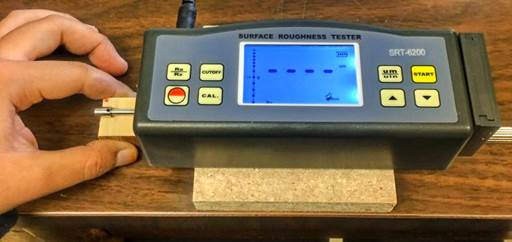
Figure 1:
Surface roughness test set-up.
Shear strength test
The wood samples were carried out for 80-grit and 180-grit sanded samples for block-type glueline shear test. Two pieces of wood were glued with Polyvinyl acetate (PVAc) glue at the 5 mm bondline. The samples then let dried for 24 h prior testing. The determinations of ultimate shearing stress parallel to grain by using Comten-95 Series Universal Testing machine (Figure 2).
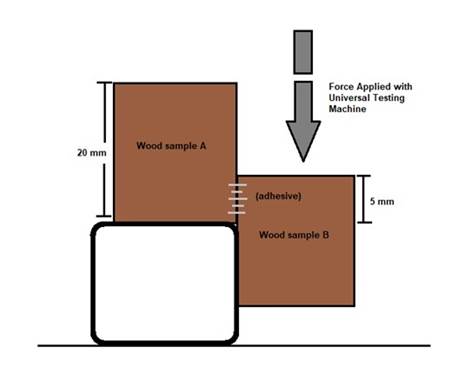
Figure 2:
Shear measurement using Comten-95 Universal Testing Machine
Hardness test
The hardness of untreated and treated samples with dimension of 4 mm (thickness) x 60 mm (length) x 20 mm (width) was conducted according to the procedures stipulated in Standard Test Methods for Evaluating Properties of Wood-Based Fiber and Particle Panel Materials ASTM D1037-12 (2020). The samples were tested by embedding a steel hemisphere with a diameter of 11,2 mm onto the surface tangential to the grain direction. Since the thickness of samples are 6 mm or less than 6 mm, an extra specimen was added as backing material during the test. Two measurements were taken from each sample and recorded in pounds to evaluate Janka hardness (Figure 3).
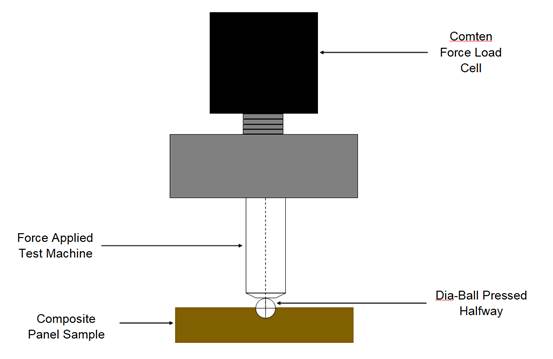
Figure 3:
Hardness measurement using Comten-95 Universal Testing Machine.
ANOVA Analysis
Analyses of Variance (ANOVA) were conducted using SPSS Statistical Software. The differences between mean values of control and heat-treated samples were determined using Duncan’s multiple range test and a p-value of ≤ 0,05 was considered statistically significant. To estimate the individual and interaction factors of the analysis, F-test statistic was also included to analyze the factorial design experiment.
Results and discussion
Surface roughness
The surface roughness of two different wood species; batai and sesendok are listed in Table 1. Control samples of batai and sesendok samples sanded with 80-grit had average Ra values of 16,3 µm and 13,5 µm, respectively. Corresponding values for those samples sanded with 180-grit sandpaper were found as 8,1 µm and 7,2 µm. It appears that the overall surface roughness of the samples from both species did not show any significant change when they were exposed to a temperature of 120 ºC for both 3 h and 6 h time exposure as can be seen in Table 1. In a previous study surface roughness of yellow poplar, southern pine and eastern red cedar samples exposed to a temperature of 130 ºC also did not have a noticeable difference in Ra values as compared to those of the control specimens (Ulker et al. 2018). According to Shukla (2019), the surface roughness value can be affected by the increasing treatment temperature and duration. Therefore, it is suggested that higher temperature and longer duration of heat treatment are needed for the surface roughness to change its behavior. This statement proved by the results shown when both types of samples were exposed to a temperature of 180 ºC their surface becomes smoother based on average roughness parameters. Batai samples sanded with 80-grit had average Ra values of 12,3 µm and 8,1 µm as a result of exposure to a temperature of 180 ºC for 3 h and 6 h, respectively. Those values are nearly 50 % and 4 % lower than those of control samples.
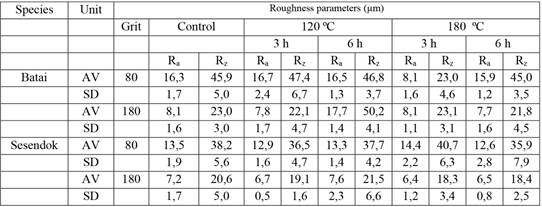
AV = actual value, SD = standard deviation
Sesendok samples also followed a similar trend. Heat treatment above 150 ºC -160 ºC could cause conversion of lignin resulting in thermoplastic condition developing densification of the surface layers (Ozcan et al. 2012). Such densification of the samples can also be translated in the form of a smoother surface as it was determined for both batai and sesendok samples in this work. Similar to the findings in past studies thermal treatment has limited benefit to improve the surface roughness of the samples so that further finishing processes can be carried out more efficiently (Korkut et al. 2010). Therefore, even such limited enhancement of the overall surface quality of batai and sesendok samples can still be considered as a potential approach.
Analysis variance (ANOVA) on the surface roughness for both species; batai and sesendok are displayed in Table 2. In this study, the alpha level (α) = 0,05 for each F test to analyze the factorial design experiment. The higher the F-ratio value, the higher influence of that factor on the experiment response (Muthuraj et al. 2016). According to the F-value, grit depicted the highest value F = 670,256 followed by species with value F = 59,823 which both sources possess P-value less than 0,05. From the ANOVA results, it was found that only grit number, species and also the interaction between grit number and species were significantly affected the surface roughness of treated wood. Other than that, temperature, hour and other interaction treatment processes did not give significant effects on the surface roughness of treated wood. The value of R-sq value should typically lie between 0 ≤ R-sq ≤ 1. Hence, the value of R-sq (0,841) and adjusted R-sq (0,819) indicate that the developed model aligns with the experimental results very well.
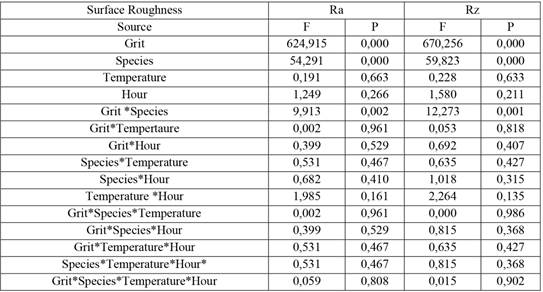
R-sq = 0,841 (Adjusted R-sq = 0,819)
Shear strength
The experimental results of shear strength for both species are reported in Table 3. Overall shear strength of the samples was adversely influenced by heat treatment. The lowest average shear strength value of 1,2 N/mm2 was found in batai samples exposed a temperature of 180 ºC for 6 h after they were sanded with 180-grit sandpaper. This value is 55 % lower than that of control samples. Naturally control samples of batai and sesendok specimens sanded with 80-grit resulted in the highest shear strength values of 2,6 N/mm2 and 3,1 N/mm2, respectively. It is an accepted fact that heat treatment adversely influences overall mechanical properties including shear strength (Yang et al. 2016). This finding aligns with the ANOVA results listed in Table 4. However, from the analysis, the only temperature used was significantly affected by the shear strength of the treated wood in this experiment. The value of the F-value for temperature is the highest indicate its highest influence upon experimental response. The P-value also lower than 0,05 indicate the significance of temperature on shear strength value for both species.
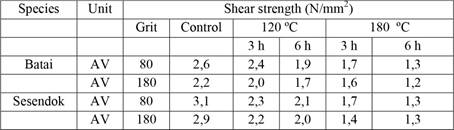
AV = actual value
Several past studies also confirmed that the shear strength of the samples from different species reduced when they were exposed to high-temperature levels (Boonstra et al. 2007, Ulker and Hiziroglu 2017). Also, according to Shukla (2019), researchers found that the degradation of strength in wood can be associated with changes in wood acidity depending to temperature and duration of heat treatment.
In comparison shear strength of two species in this work, it seems that sesendok had somehow higher values than those of batai samples. This could be related to a higher density of sesendok creating better interlocking between sanded two pieces. The images of the fracture surface of both batai and sesendok after the shear test were displayed in Figure 4.
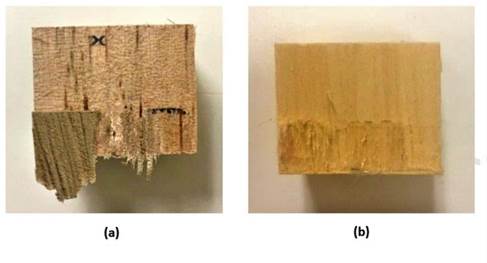
Figure 4:
Heat treated samples of (a) batai and (b) sesendok after shear strength test.
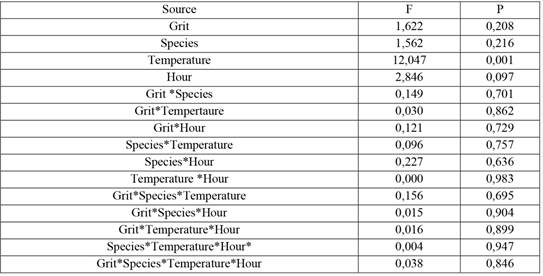
R-sq = 0,411 (Adjusted R-sq = 0,225)
Hardness
The hardness properties of both species, batai and sesendok were depicted in Table 5. The fracture surface images of both species after the hardness test were shown in Figure 5. The control sample of sesendok had the highest hardness value of 2246,3 N which is 2,1 times higher than that of batai. Three hours of heat treatment of the samples at a temperature of 120 ºC had an average value of 10,8 % reduction. Such reduction was found 37,7 % when the samples were exposed to a temperature of 180 ºC for 6 h. Some of the samples also crumbled and collapsed with the exposure of a temperature of 180 ºC during the hardness test.
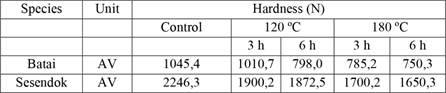
AV = actual value
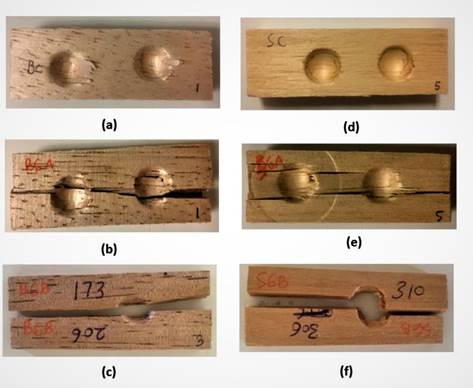
Figure 5:
Illustration of hardness for batai: (a) control; (b) heat treated at 120 ºC for 6 h and; (c) heat treated at 180 ºC for 6 h; and sesenduk: (d) control; (e) heat treated at 120 ºC for 6 h and; (f) heat treated at 180 ºC for 6 h.
Typically, hemicellulose in the cell wall is degraded due to heat resulting in reduction of mechanical properties of the member. In a previous study southern pine samples exposed to a temperature of 190 ºC had reduction of more than 100 % (Ulker et al. 2018). It appears that species, batai and sesendok did not have substantial adverse influence of heat treatment. This could be related to chemical structure and extractive content of such tropical species. Following heat treatment lignin also shows evidence of thermal degradation resulting in breakage of aliphatic bonds and releasing of hydrocarbon fragments (Ulker et al. 2018). Possibly such reaction in these tropical species retarded due to their possible chemical structure. Although no color measurements were taken from the surface of heat-treated samples, based on visual inspection no significant discolouration of the samples was observed.
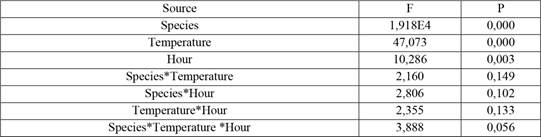
R-sq = 0,982 (Adjusted R-sq = 0,978)
The ANOVA analysis value for the hardness of both species; batai and sesendok were listed in Table 6. From the analysis, it is showed that the hardness properties of the treated wood were highly significantly affected by the species, temperature and also hour. Besides, the F-value of showed that species did give the highest influence on the hardness value followed by the temperature and hour. However, all these sources give significance to the hardness value as all value lies below 0,005. The R-sq and adjusted R-sq also showed value low than 1 indicate the developed models align the reported experimental results.
Conclusions
Based on the findings in this work, the surface quality of both types of samples had some improvement as results of heat treatment. It appears that the samples had lower hardness as well as shear strength values as they were exposed to heat treatment and such effect was more prominent in the case of the 180 ºC temperature process. Those samples sanded with 80-grit sandpaper resulted in better shear strength characteristics in all cases due to better interlocking of the pairs. In further studies, colour changes in addition to other mechanical properties of batai and sesendok samples could be desirable to investigate to have a better understanding of overall behaviour of two species as a function of heat treatment.
Acknowledgements
The authors wish to thank the Fundamental Research Grant Scheme (FRGS 2017-1) and the Ministry of High Education (MOHE) under Grant 6300892 for providing the financial support to carry this study (Recipient: Hamdan Hussain; Code: FRGS/1/2017/STG07/NRE/02/01, Title: Adhesion and Bonding Properties of Adjacent Layers from Mixed Timber Species for Cross-laminated Timber (CLT). The authors also would like to express gratitude towards Institute of Tropical Forestry and Forest Products, Universiti Putra Malaysia for the financial support to visit Oklahoma State University. The authors would like to thanks Forest Research Institute Malaysia (FRIM) for providing the materials used in this study.
References:
Alia Syahirah, Y.; Paridah, M.T.; Hamdan, H.; Anwar, U.M.K.; Nordahlia, A.S.; Lee, S.H. 2019. Effects of anatomical characteristics and wood density on surface roughness and their relation to surface wettability of hardwood. J Trop For Sci 31(3): 269-277. https://doi.org/10.26525/jtfs2019.31.3.269
ASTM. 2020. Standard test methods for evaluating properties of wood-base fiber and particle panel materials. ASTM. D1037-12. 2020. ASTM: West Conshohocken, PA. https://www.astm.org/d1037-12r20.html
Balkis, B.F.; Hiziroglu, S.; Paridah, M.T. 2013. Properties of some thermally modified wood species. Mater Des 43(2013): 348-355. https://doi.org/10.1016/j.matdes.2012.06.054
Boonstra, M.J.; Van Acker, J.; Tjeerdsma, B.F.; Kegel, E.V. 2007. Strength properties of thermally modified softwoods and its relation to polymeric structural wood constituents. Ann For Sci 64(7): 679-690. https://doi.org/10.1051/forest:2007048
Bhushan, B. 2000. Surface roughness analysis and measurement techniques. In Modern Tribology Handbook. CRC Press: London, UK. ISBN 9780849384035. https://doi.org/10.1201/9780849377877
Esteves, B.M.; Pereira, H.M. 2009. Wood modification by heat treatment: A review. BioResources4(1): 370-404. https://dx.doi.org/10.15376/biores.4.1.370-404
Fu, Z.; Zhou, F.; Gao, X.; Weng, X.; Zhou, Y. 2020. Assessment of mechanical properties based on the changes of chromatic values in heat treatment wood. Measurement 152(2020): 107215. https://doi.org/10.1016/j.measurement.2019.107215
Gao, J.; Kim, J.S.; Terziev, N.; Cuccui, I.; Daniel, G. 2018. Effect of thermal modification on the durability and decay patterns of hardwoods and softwoods exposed to soft rot fungi. Int Biodeter Biodegr 127(2018): 35-45. https://doi.org/10.1016/j.ibiod.2017.11.009
Hiziroglu, S.; Suzuki S. 2009. Surface characteristics of overlaid wood composites. J Trop For Sci 21(3): 272-276. https://www.jstor.org/stable/23616807
Hoseinzadeh, F.; Zabihzadeh, S.M.; Dastoorian, F. 2019. Creep behavior of heat treated beech wood and the relation to its chemical structure. Constr Build Mater 226(2019): 220-226. https://doi.org/10.1016/j.conbuildmat.2019.07.181
Hamdan, H.; Iskandar, M.; Anwar, U.M.K. 2016. Cross laminated timber: production of panel using sesenduk timber species. Timber Technol Bull 59: 1-6. http://myagric.upm.edu.my/id/eprint/11461
Kesik, H.I.; Korkut, S.; Hiziroglu, S.; Sevik, H. 2014. An evaluation of properties of four heat treated wood species. Ind Crops Prod 60: 60-65. https://doi.org/10.1016/j.indcrop.2014.06.001
Korkut, S.; Karayilmazlar, S.; Hiziroglu, S.; Sanli, T. 2010. Some of the properties of heat-treated sessile oak (Quercus petraea). Forest Prod J 60(5): 473-480. https://doi.org/10.13073/0015-7473-60.5.473
Lee, S.H.; Ashaari, Z.; Lum, W.C.; Halip, J.A.; Ang, A.F.; Tan, L.P.; Chin, K.L.; Paridah, M.T. 2018. Thermal treatment of wood using vegetable oils: A review. Constr Build Mater 181(2018): 408-419. https://doi.org/10.1016/j.conbuildmat.2018.06.058
Lee, S.H.; Lum, W.C.; Zaidon, A.; Maminski, M. 2015. Microstructural, mechanical and physical properties of post heat-treated melamine-fortified urea formaldehyde-bonded particleboard. European Journal of Wood and Wood Products 73(5): 607-616. https://doi.org/10.1007/s00107-015-0924-y
Metsä-Kortelainen, S.; Antikainen, T.; Viitaniemi, P. 2006. The water absorption of sapwood and heartwood of Scots pine and Norway spruce heat-treated at 170 °C, 190 °C, 210 °C and 230 °C. Holz Roh Werkst 64(3): 192-197. https://doi.org/10.1007/s00107-005-0063-y
Muthuraj, R.; Misra, M.; Defersha, F.; Mohanty, A.K. 2016. Influence of processing parameters on the impact strength of biocomposites: A statistical approach. Composites Part A: Applied Science and Manufacturing 83(2016): 120-129. https://doi.org/10.1016/j.compositesa.2015.09.003
Nordahlia, A.S.; Lim, S.C.; Hamdan, H.; Anwar, U.M.K. 2014. Wood properties of selected plantation species : Tectona grandis (Teak), Neolamarckia cadamba (Kelempayan/Laran), Octomeles sumatrana (Binuang) and Paraserianthes falcataria (Batai). Timber Technol Bull 54:1-8. http://myagric.upm.edu.my/id/eprint/11457
Nordahlia, A.; Anwar, U.M.K.; Hamdan, H.; Lim, S.C.; Iskandar, M.; How, S.S. 2018. Wood properties of two selected pioneer species: Ludai (Sapium Sp.) and Mahang (Macaranga Sp.). Timber Technol Bull 80: 1-5. https://info.frim.gov.my/infocenter/booksonline/ttb/TTB80.pdf
Ozcan, S.; Ozcifci, A.; Hiziroglu, S.; Toker, H. 2012. Effects of heat treatment and surface roughness on bonding strength. Constr Build Mater 33(2012): 7-13. https://doi.org/10.1016/j.conbuildmat.2012.01.008
Priadi, T.; Hiziroglu, S. 2013. Characterization of heat treated wood species. Mater Des 49(2013): 575-582. https://doi.org/10.1016/j.matdes.2012.12.067
Priadi, T.; Suharjo, A.A.C.; Karlinasari, L. 2019. Dimensional stability and colour change of heat-treated young teak wood. Int Wood Prod J 10(3): 119-125. https://doi.org/10.1080/20426445.2019.1679430
Shukla, S.R. 2019. Evaluation of dimensional stability, surface rougness, colour, flexural properties and decay resistance of thermally modified Acacia auriculiformis. Madera-Cien Tecnol 21(4): 433-446. http://dx.doi.org/10.4067/S0718-221X2019005000401
Tiryaki, S. 2015. Investigating the relationship between some mechanical properties and weight loss in heat treated woods. J Polytechnic 18(3): 149-154. https://app.trdizin.gov.tr/makale/TWpBNU56ZzFOUT09/investigating-the-relationship-between-some-mechanical-properties-and-weight-loss-in-heat-treated-woods
Ulker, O.; Aslanova, F.; Hiziroglu, S. 2018. Properties of thermally treated yellow poplar, Southern pine, and Eastern redcedar. BioResources 13(4): 7726-7737. https://doi.org/10.15376/biores.13.4.7726-7737
Ulker, O.; Hiziroglu, S. 2017. Some properties of densified eastern redcedar as function of heat and pressure. Materials 10(11): 1275. https://doi.org/10.3390/ma10111275
Yang, T.H.; Chang, F.R.; Lin, C.J.; Chang, F.C. 2016. Effects of temperature and duration of heat treatment on the physical, surface, and mechanical properties of Japanese cedar wood. BioResources 11(2): 3947-3963. https://doi.org/10.15376/biores.11.2.3947-3963
Author notes
♠Corresponding author: parida@upm.edu.mylee_seng@upm.edu.my