ARTÍCULO
Predictive expressions for withdrawal force capacity of various size of dowels from particleboard and medium density fiberboard
 Mehmet Yüksel myuksel@mu.edu.tr
Halil Kılıç
Tolga Kuşkun
Ali Kasal
Mehmet Yüksel myuksel@mu.edu.tr
Halil Kılıç
Tolga Kuşkun
Ali Kasal
Predictive expressions for withdrawal force capacity of various size of dowels from particleboard and medium density fiberboard
Maderas. Ciencia y tecnología, vol. 24, 36, 2022
Universidad del Bío-Bío
Received: 14 May 2021
Accepted: 14 May 2022
Abstract: The objective of this study was to develop predictive expressions for estimating the withdrawal force capacity of various size of beech (Fagus orientalis) dowels from medium density fiberboard (MDF) and particleboard (PB). Furthermore, effects of the base material type, dowel diameter, dowel penetration and adhesive type on withdrawal force capacity were investigated. Polyurethane (PU), polyvinyl acetate based D2, and polyvinyl acetate (PVA) adhesives were utilized for gluing of dowels. A total of 540 specimens were prepared for edge and face withdrawal force capacity tests including two material types (MDF, PB), three dowel diameters (6 mm, 8 mm, 10 mm), three dowel penetration depths (15 mm, 20 mm, 25 mm for edge, 6 mm, 9 mm, 12 mm for face), three adhesive types and five replications for each group. Specimens were tested under static withdrawal forces. Based on results of tests, predictive expressions that allow furniture engineers to estimate edge and face dowel withdrawal force capacity as a function of dowel diameter and dowel penetration were developed. Calculations showed that the expressions developed provided reasonable estimates for withdrawal force capacity of dowels. As a result of statistical analyses, material type, dowel diameter, dowel penetration, adhesive type and their four-way interaction have significantly affected the withdrawal force capacity of dowels. Test results also indicated that PU adhesive and MDF ranked the highest withdrawal force capacity among the adhesive and material types. Increasing either dowel diameter or penetration tended to have a positive effect on withdrawal force capacity. Dowel diameter was found to have a higher effect on withdrawal force capacity than dowel penetration.
Keywords: Dowel, dowel joints, medium density fiberboard, particleboard, predictive expression, withdrawal force capacity.
Introduction
Furniture is a product that human beings use widely after settling down, starting with the need for storage, and later to meet their needs for sitting, sleeping, eating etc. With the development of technology over time, the increase in these needs has caused the use of furniture to become widespread. Various problems have arisen over time during the use of furniture, which is one of the most used products in the world. For example, about 80 % of structural failures have their origin on connections (Itani and Faherty 1984).
Factors affecting furniture design were determined as a result of systematic scientific researches. One of the most important factors affecting furniture design is strength. The strength of a furniture plays an important role as well as its aesthetics and ergonomics. Furniture is structurally divided into three different construction types (frame, case and combined). Many different joint connection techniques are used in these three different construction types. The dowel joints, which dates back to ancient times in history, is also widely used in each of the frame, case and combined construction types. Moreover, it is main joint technique used worldwide in the wooden structures. But the mechanical behavior of wooden joints is a complex problem governed by a number of geometric, material and loading parameters (e.g. wood species, fastener diameter, end distances, edge distances, spacing, number of fasteners, fastener/hole clearances, friction and loading configuration) (Santos et al. 2010). Traditionally, wooden dowel connections have been modelled based on Johansen’s model (Johansen 1949), proposed in 1945, which has been incorporated in design codes (Soltis and Wilkinson 1987, BS EN 1995-1-1 2014). The literature shows that the dowel dimensions, wood species and adhesive type that affects withdrawal, bending, shear, and tension strength on different joint surfaces are investigated by using certain test standards such as TS 4539 (2005), and ASTM D5764-97a (2018).
Many studies have been performed for strength of dowels from solid wood and wood based materials. A study (Eckelman 1971) of the bending moment resistance of T-type, two-pin dowel joints indicated that the ultimate bending moment resistance (M) of the joint could be estimated by means of the expression M = F × d, where F = withdrawal force of a single dowel and d = distance between resultant compression and tension forces vectors. Englesson and Osterman (1972) found that applying glue on both the walls of the holes and the surface of the dowels (double gluing) resulted in a 35 % increase in holding strength compared to coating the walls of the holes or surface of the dowels alone. They also found that joint strength could be increased by filling the holes with adhesive, so that the glue was forced into the porous surrounding substrate. Eckelman and Cassens (1985) studied the face withdrawal strength of plain and spiral-grooved dowels from medium density fiberboard (MDF), oriented strand board (OSB), and particleboard (PB). Results showed that the plain and spiral-groove dowels give better face withdrawal strength than multi-groove dowels, and both face and edge withdrawal strength of dowels linearly increased as the dowel penetration increased. Furthermore, they recommended predictive expressions for edge and face withdrawal strengths. Another study was conducted to investigate the withdrawal strength of dowels from plywood and OSB. Results were incorporated into predictive expressions in order to predict the withdrawal strength as a function of the diameter of the dowels, their depth of embedment and the material density (Erdil and Eckelman 2001). In a similar study, Eckelman et al. (2002) searched bending strength of dowel joints constructed of plywood and OSB. Kasal (2007) studied the edge and face withdrawal strength of dowels from some wood and wood based composite materials in the other study. In the results, it was found that highest values obtained from beech with 10 mm diameter dowels with 20 mm penetration from edge withdrawal, and with 13 mm penetration from face withdrawal strength. He also developed the predictive expressions for estimating the withdrawal force capacity of dowel from wood and wood based materials.
Uysal and Özçiftçi (2003), performed a study to determine the withdrawal strength of 10 mm diameter dowels produced from medium-density fiberboard (MDF), plywood, scotch pine (Pinus sylvestris), and beech (Fagus orientalis), bonded parallel and vertical to the surface of MDF and PB with polyvinylacetate (PVAc) and Polyurethane (PU) adhesives. They obtained the highest withdrawal strength in beech dowels bonded vertically with PVAc adhesive to the surface of MDF at 7,91 MPa. Uysal and Kurt (2007) investigated the effects of edge banding thickness, dowel dimension, type of material and type of adhesive used for edge banding on the withdrawal strength of dowel. Results showed that the highest withdrawal strength (7,019 MPa) was obtained in beech dowels with 6 mm diameter for MDF with solid wood edge banding of white oak with 10 mm thickness bonded with the hot-melt adhesive. In a similar study carried out by Yapıcı et al. (2011), it was determined that the edge banding thickness, dimension of dowels, material type. and adhesive type used for edge banding have significant effect on withdrawal strength of dowels. They obtained the highest withdrawal strength in beech dowels (6,68 MPa) with 8 mm diameter for MDF with 5 mm thickness of solid wood edge banding of bonded beech with PU adhesive. Kurt et al. (2009), determined the withdrawal strengths of 6 mm, 8 mm, 10 mm diameter beech dowels with respect to edge of MDF or PB edged with 5 mm, 10 mm and 15 mm thickness of solid wood edge banding of Uludağ fir bonded with different adhesives. They obtained the highest withdrawal strength in beech dowels (6,37 MPa) with 8 mm diameter for MDF with 5 mm thickness of solid wood edge banding of Uludağ fir with PU adhesive. In the one of the latest studies performed by Karaman (2021), he determined the effect of wooden dowel species, thickness of edge banding, and the type of adhesives on the withdrawal strength using laminated medium density fiberboard (MDF-Lam). In this study it was found that withdrawal strength values of polyurethane were 65 % higher than the withdrawal strength values of polyvinyl acetate, oak dowels bonded with polyurethane (PU-D4) adhesive vertical to the surface of MDF-Lam performed the highest (8,35 MPa) withdrawal strength but lowest withdrawal strength value was obtained from the dowel produced from oak with polyvinyl acetate (PVAc-D4) adhesive in the samples without PVC edge banding.
When the latest literature was reviewed, it was seen that some auxetic (materials with negative Poisson’s ratio) dowel designs were developed to be used in furniture joints, and their mounting forces and withdrawal strengths were investigated. Aa a result of the study, it was reported that the auxetic dowels could be utilized as an alternative fastener for the traditional wooden dowels in furniture joints (Kasal et al. 2020, Kuşkun et al. 2021).
Although dowel joints are commonly utilized in the construction of case furniture, limited information is available on estimating the strength and effects such as, dowel sizes (diameter and penetration), adhesive type and base material type on withdrawal force capacity. Accordingly, the aim of this study was to obtain practical information concerning the withdrawal force capacity of dowels from PB and MDF that the furniture engineers could use in the strength design of case furniture. The objectives were to:
- Estimate the average withdrawal force capacity of dowels evaluated in this study with the developed predictive expressions,
- Compare the withdrawal force capacity of dowels from different panel materials, namely, MDF and PB,
- Determine the effects of dowel sizes (diameter and penetration) utilized on withdrawal force capacity of dowels,
- Determine the effects of adhesive type (PU, D2, PVA) on withdrawal force capacity.
Materials and methods
Test materials
In the tests, 18 mm thick medium density fiberboard (MDF) and particleboard (PB) were used as base materials. The MDF and PB panels were obtained from commercial suppliers. To prepare the specimens, 1880 mm x 3660 mm full-size sheets were first cut into member strips. These strips were subsequently cut into the desired member lengths. Some physical and mechanical properties of the MDF and PB were tested in accordance with the procedures described in ASTM D4442-92 (2001) and ASTM D1037-99 (2001). Average MC values were 7,24 % and 6,72 %, and panel density values were 740 kg/m3 and 610 kg/m3 for MDF and PB, respectively.
In the tests, beech dowels of different diameters with straight grooved were utilized with the features specified in TS 4539 (1985). Dowels were in six different lengths (45 mm, 50 mm and 55 mm for edge withdrawal specimens and 36 mm, 39 mm and 42 mm for face withdrawal specimens) and three different diameters (6 mm, 8 mm and 10 mm).
In gluing of dowels, three adhesive types were used, namely, polyurethane (PU), 41 % solid content polyvinyl acetate based D2 (BS EN 204 2016), and 45 % solid content polyvinyl acetate (PVA). These adhesives were selected because of their useful properties such as cold application, easily spreading, rapidly drying, to be scentless and fireproof, and being preferred in the case furniture constructions. Some properties of the adhesives used were given by the producer firm as density of 1110 kg/m3, viscosity of 3300-4000 cps at 25 °C, PH = 3 for PU adhesive; density of 960 kg/m3, viscosity of 1400 ± 1000 cps at 22 °C, PH = 5-6 for D2 adhesive; and density of 1100 kg/m3, viscosity of 160-200 cps, PH = 5, ash rate of 3 % for PVA adhesive (Polisan, Turkey).
Test specimens
Four factorial experiments with five replications per cell were conducted to evaluate the effect of four variables on withdrawal force capacity of dowels from edge and face. The variables were material type (MDF and PB), dowel diameter, dowel penetration, and adhesive type (PU, D2, and PVA). Accordingly, a total of 540 specimens were prepared for edge and face withdrawal force capacity tests including two base material types, three different dowel diameters, three dowel penetrations, three adhesive types and five replications for each group.
For both edge and face withdrawal tests, dowels with diameters of 6 mm, 8 mm, and 10 mm were used. However; depths of penetration were 15 mm, 20 mm and 25 mm for edge withdrawal and 6 mm, 9 mm and 12 mm for face withdrawal.
In general, test specimens consisted of a test piece from which the dowels with drawn, and a load piece whose purpose was to provide a structure to which the other end of the dowel could be attached, and a dowel. Test piece of both edge and face withdrawal specimen measured 80 by 80 mm square, whereas the load piece measured 80 mm in length by 50 mm wide. The general view and dimensions of the withdrawal test specimens are illustrated in Figure 1.
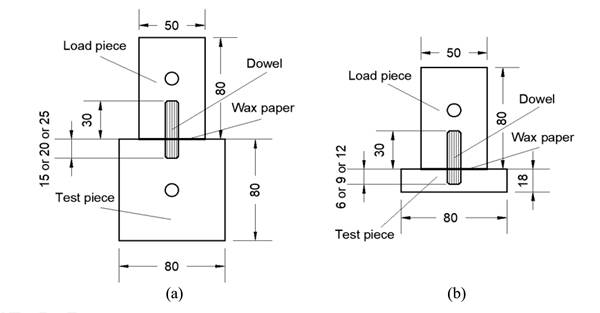
Figure 1:
(a) Configuration and sizes (in mm) of edge and (b) face withdrawal test specimens.
Dowel holes for the edge withdrawal tests were drilled in the center of the edge in required depth of each test piece perpendicular to the face of the edge; similarly, holes for the face withdrawal tests were drilled to the required depth in the center of each test piece perpendicular to the face. All the holes were drilled with standard twist drills.
In preparation of the specimens, the ends of the dowels were very slightly chamfered to facilitate entry into the holes. Measurements were not made of the dowel-hole clearances, but all dowels fit snugly into the holes. The depths of the holes in the test piece of specimens were carefully controlled so that the dowels penetrated into the holes exactly in required penetration size for edge and face specimens. A liberal amount of adhesive (approximately 150 gr/m² ± 10 gr/m²) was spread over the sides of the holes and all surface of the dowels. Pieces of wax paper with holes in them to accommodate the dowels were used to prevent the end of the load piece from adhering to the test piece. The dowels were penetrated to a depth of 30 mm in the end of the load pieces in order to ensure that the dowels would withdraw from the test piece rather than the load piece. The dowels were first inserted into the holes in the end of the load pieces and then forced into the hole until the required penetration were provided in the corresponding test pieces. All specimens were kept at 20 ºC ± 2 °C and 65 % ± 3 % relative humidity until their weight became stable (1 month) in an environmentally controlled climate chamber before the testing in order to reach an equilibrium moisture content (MC).
Withdrawal force capacity testing
The edge and face dowel withdrawal force capacity of MDF and PB were determined according to acceptable test methods that were given in previous studies (Eckelman et al. 2002, Erdil et al. 2003). All of the tests were carried out on a 50 kN capacity numerically controlled universal testing machine under the static uniaxial loading. In the tests, rate of loading was taken as 2 mm/min. For the tests, the specimen-holding fixture was bolted up and down to the testing machine table and leveled to ensure withdrawal force direction parallel to dowel penetration direction. The fixture allowed self-alignment of a specimen with the loading direction. Withdrawal force was applied until the dowels exactly pull out from the holes. The withdrawal force (N) needed to pull out the dowels from the holes were recorded. So, ultimate failure loads were taken as the withdrawal force capacity of the dowels. The loading form of withdrawal tests from edge and face are given in Figure 2.
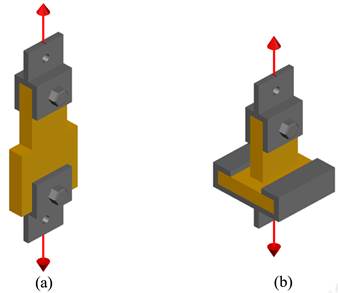
Figure 2:
(a) Withdrawal force capacity testing from edge and (b) face.
Statistical analyses
After the tests, obtained results were statistically analyzed. Four factor analysis of variances (MANOVA) general linear model procedure was performed for individual data both edge withdrawal and face withdrawal force capacity to analyze main effects and their interactions on the edge and face withdrawal capacity values. Then, the least significant difference (LSD) multiple comparisons procedure at 5 % significance level was performed to determine the mean differences of withdrawal force capacity from edge and face values of specimens tested considering the significant main effects and four-factor interactions in the MANOVA results. Minitab (Version 17, 2013) statistical software was utilized for the statistical analyses in this study (Minitab, LLC, State College, PA, USA).
Regression models with one dependent variable and more than one independent variable are called multivariate regression analysis. In multivariate regression analysis, the independent variables try to explain the changes in the dependent variable simultaneously. Accordingly, in this study, multiple regression analyzes were performed and predictive expressions were developed in order to determine the changes caused by the independent variables (dowel diameter and dowel penetration) simultaneously in the dependent variable (edge and face withdrawal force capacity).
Results and discussion
Test results for withdrawal force capacity of dowels
In general, all the test specimens failed in an ordinary manner; in other words, no unexpected failure occurred. Failures took place in the glue line of the joints (Figure 3a, Figure 3b). Withdrawal force capacity of the dowels (from edge and face) from the PB and MDF with their coefficients of variation are given in Table 1.
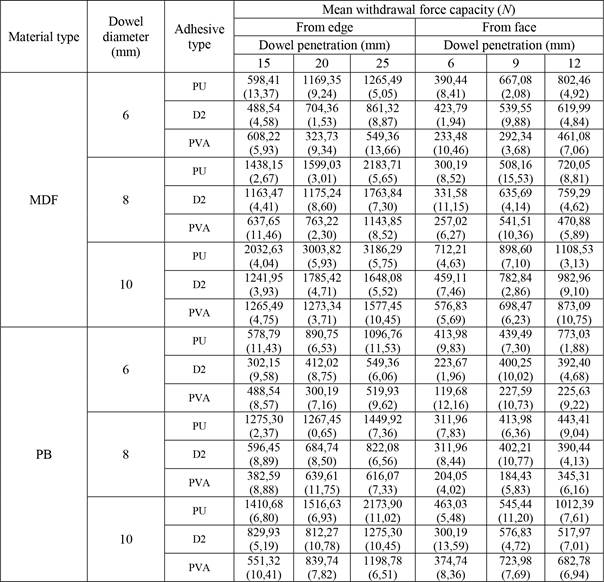
Values in parentheses are coefficients of variation.
Summary of the MANOVA results for both edge and face withdrawal force capacity values are provided in Table 2.
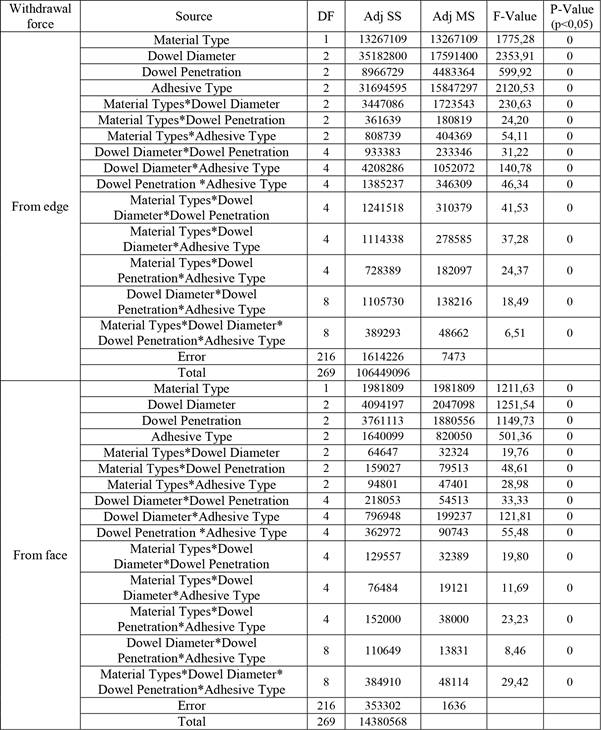
DF: Degrees of freedom, SS: Sums of Squares, MS: Mean Squares, P: Probability
Four factor MANOVA results indicated that for both edge and face withdrawal force capacity, the main effects (material type, dowel diameter, dowel penetration, adhesive type), two-factor interactions, three-factor interactions and four-factor interactions were statistically significant at 5 % significance level. Although the two-factor and three-factor interactions were found to be significant, they were not analyzed because the four-way interaction was found to be significant. Thus, for the edge and face withdrawal force capacity values, the main effects and four-factor interactions were analyzed. Comparing the F-values to one another, it can be concluded that withdrawal fore capacity from edge were mainly affected by dowel diameter and adhesive type, respectively. For the withdrawal tests from face of specimens, withdrawal force capacity depended mainly on dowel diameter and material type. The adhesive factor did not show its effect in the withdrawal force capacity from face due to the low penetration.
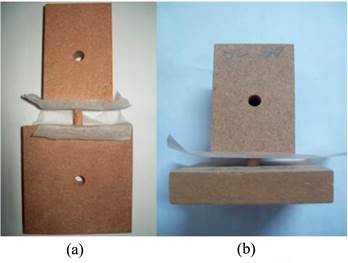
Figure 3:
(a) Typical failure modes of the edge and (b) face specimens after withdrawal test.
Table 3 gives mean comparisons of withdrawal force capacities of the dowels from edge and face for material type.

As seen in Table 3, mean comparisons results based on the material type indicated that the withdrawal force capacities from edge and face were significantly affected by the material type. Means comparisons results showed that the withdrawal force capacities of the MDF specimens had considerably higher withdrawal force capacity values than ones of PB for both from edge and face. In case of the withdrawal force capacity from edge and face; MDF specimens was higher withdrawal force capacities than PB specimens by 51 % and 41 %, respectively. These differences in withdrawal force capacities could be explained by differences in densities of the materials used. It is a fact that the density of the materials directly affects the adhesive bonding strength. In other words, materials with higher density would likely yield higher bonding strength and withdrawal force capacities.
When the failure modes of specimens observed; it is understood that the withdrawal force capacity of the dowels depend on the bonding strength of the adhesive used. According to this; it can be said that the other important factor for providing a strong adhesive bonding concerning the material is the surface roughness. The specific adhesion between the smooth surface and the glue line can be stronger. It is expected that the walls of the dowel hole of MDF give smoother surface than the dowel hole of PB after drilling. Therefore, the adhesion between the MDF and glue line is stronger than the adhesion between the PB and the glue line. It is accepted that the adhesion is lower on the rough surfaces. Furthermore, one of the important advantages for adhesion is the homogeneity of the material. MDF is more homogeneous material than the PB. Mean comparisons results for the dowel diameter are given in Table 4. In the Table, values followed by the same capital letter are not significantly different.

HG: Homogenous group
As seen in Table 4, it was observed that the withdrawal force capacity values increased with the increase in the diameter of the dowel, especially from edge increased significantly. The highest withdrawal force capacity values were obtained from the10 mm diameter dowels for both from edge and face of the specimens. Dowels with 6 mm penetration had the lowest withdrawal force capacities from edge of the specimens. In case of the withdrawal force capacity from face, the differences between the 6 mm and 8 mm dowels were not significantly different.
Table 5 gives mean comparisons of withdrawal force capacity values from edge and face of the specimens for dowel penetration.

HG: Homogenous group
According to Table 5, the withdrawal force capacities of the dowels increased as the penetration is increased from both edge and face of the specimens. The results also indicated that dowel penetration has a more significant effect on withdrawal force capacity from edge than from face. Withdrawal force capacity from edge increased 21 % and 25 % respectively, as the dowel penetration increased from 15 mm to 20 mm or 20 mm to 25 mm. For the withdrawal force capacity from face; when the dowel penetration increased from 6 to 9 mm, the average withdrawal force capacity increased by 48 %, whereas the withdrawal force capacity of the dowels with 12 mm penetration averaged 22 % greater than those for the dowels with 9 mm penetration.
Table 6 gives mean comparisons of withdrawal force capacities from edge and face of the specimens as a function of adhesive type.

HG: Homogenous group
As seen in Table 6, the dowels glued with PU had the highest value both from edge and face withdrawal force capacity. The lowest values were obtained from PVA for both edge and face withdrawal force capacity. Average value of withdrawal force capacity of the dowels glued with PU (1563,17 N) was higher than the dowels glued with D2 (950,92 N) by 64 %, and average value of the dowels glued with D2 was higher than the dowels glued with PVA (759,95 N) by 25 % for edge withdrawal tests. In case of face withdrawal tests; the dowels glued with PU (606,912 N) had higher withdrawal force capacity values than the dowels glued with D2 by 20 %, and the dowels glued with D2 was higher than the dowels glued with PVA by 21 %.
Table 7 and Table 8 give mean comparisons of withdrawal force capacities from edge and face of tested dowels with their homogeneity groups considering the four-way interactions (material type*dowel diameter*dowel penetration*adhesive type interactions), respectively. The withdrawal force capacity values in these tables are given in order form the highest to the lowest. As shown in Table 7, the 10 mm diameter dowels with 25 mm penetration and glued with PU had the highest withdrawal force capacity (3186,29 N) from the edge of MDF; while the lowest withdrawal force values (300,19 N) were obtained from the 6 mm diameter dowels with 20 mm penetration and glued with PVA from the edge of PB. For the edge withdrawal force capacity of 6 mm diameter dowels; the differences between the 15 mm and 20 mm penetration, and D2 and PVA adhesive was not statistically significant.

HG: Homogenous group
Results of the tests indicated that the edge withdrawal force capacity of dowels became stronger as either dowel diameter or dowel penetration increased. In case of face withdrawal tests (Table 8), the highest values (1108,53 N) were obtained from the 10 mm diameter dowels with the 12 mm penetration and glued with PU from the face of MDF; while the 6 mm diameter dowels with 6 mm penetration and glued with PVA gave the lowest withdrawal force values (119,68 N) from the face of PB. As in edge withdrawal force capacity, it can be said that increasing either dowel diameter or dowel penetration tended to have a positive effect on the face withdrawal force capacity.
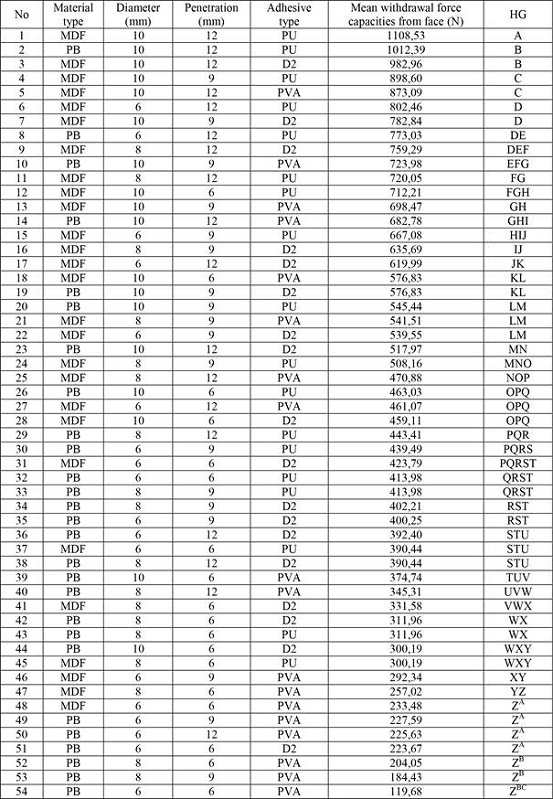
HG: Homogenous group
Predictive expressions for withdrawal force capacity of dowels
Multiple regression analyses were performed to provide a means of comparing the results of the edge and face withdrawal tests as well as to obtain functional relationships between withdrawal force capacity and the various dowel sizes for MDF and PB. Curves were fitted to the individual test data points by means of regression techniques. The curves had following forms for edge withdrawal force capacities (Equation 1, Equation 2, Equation 3, Equation 4, Equation 5 and Equation 6):
 (1)
(1)
 (2)
(2)
 (3)
(3)
 (4)
(4)
 (5)
(5)
 (6)
(6)In case of the face withdrawal force capacities, the following forms were fitted to the individual test data points (Equation 7, Equation 8, Equation 9 , Equation 10, Equation 11 and Equation 12):
 (7)
(7)
 (8)
(8)
 (9)
(9)
 (10)
(10)
 (11)
(11)
 (12)
(12)Where FEMPU , FEMD2, FEMPV = withdrawal force capacities of the dowels glued with PU, D2, PVA, respectively, from the edge of MDF (N); FEPPU , FEPD2, FEPPV = withdrawal force capacities of the dowels glued with PU, D2, PVA, respectively, from the edge of PB (N); FFMPU , FFMD2, FFMPV = withdrawal force capacities of the dowels glued with PU, D2, PVA, respectively, from the face of MDF (N); FFPPU , FFPD2, FFPPV = withdrawal force capacities of the dowels glued with PU, D2, PVA, respectively, from the face of PB (N); D = dowel diameter (mm); P = dowel penetration (mm). According to each adhesive type and each material type, a total of 12 predictive expressions were developed; 6 for edge withdrawal force capacity and 6 for face withdrawal force capacity. The coefficients of determination (R2) values were 0,9384; 0,8240; 0,8562; 0,8544; 0,8747 and 0,6919 for the edge withdrawal force capacity Equations (1), (2), (3), (4), (5) and (6); and 0,7169; 0,8332; 0,8416; 0,5163; 0,5983 and 0,7568 for the face withdrawal force capacity Equations (7), (8), (9), (10), (11) and (12), respectively.
To provide a practical evaluation of how well the withdrawal force capacity values predicted by these developed expressions agreed with the observed withdrawal force capacity results from the actual tests, comparisons of the observed withdrawal force capacity test results with the withdrawal force capacity values obtained with predictive expressions developed in this study are given in Table 9 and Table 10 for edge and face, respectively.
Table 9 and Table 10 indicated that with the exception of few specimens, predicted and observed values agree well for both edge and face withdrawal force capacity tests.
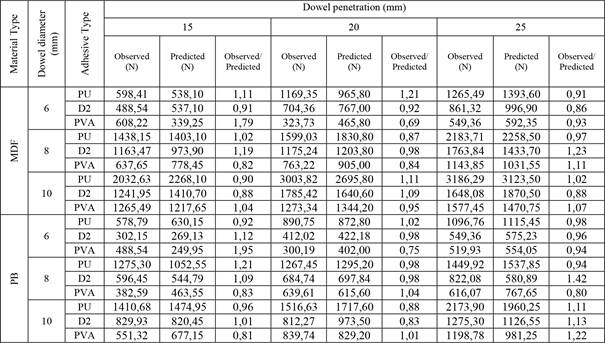
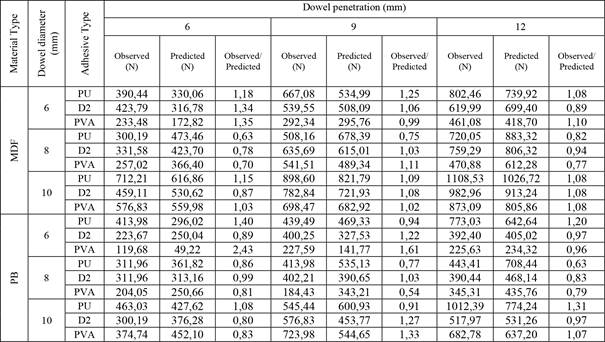
In general, it is seen that edge withdrawal force capacity values can be better predicted than face withdrawal force capacity values. Except for the specimen group of 6 mm diameter dowel with 15 mm penetration and glued with PVA and withdraw from MDF and PB, the other groups could be estimated with the expressions developed reasonably for the edge withdrawal force values. In case of the face withdrawal force capacity values; with the exception of a few specimens, especially the specimens 6 mm diameter dowel with 6 mm and 9 mm penetration and glued with PVA and withdraw from PB, predicted and observed values agree well.
Conclusions
This study was carried out to obtain information relating to the withdrawal force capacity of various size of dowels glued with different adhesives from MDF and PB; and also to develop predictive expressions for estimating the withdrawal force capacity of the dowels.
Material type, adhesive type, dowel diameter and dowel penetration effects on the edge and face withdrawal force capacity of dowels were investigated. Results showed that significant differences were found in edge and face withdrawal force capacities with respect to above mentioned variables.
Results also indicated that the dowels from MDF specimens yield higher edge and face withdrawal force capacity than those of PB. Moreover, increasing either dowel diameter or dowel penetration tended to have a positive effect on edge and face withdrawal force capacity values. Dowel diameter was found to have a bigger effect on withdrawal force capacity than dowel penetration. According to the results, the withdrawal force capacity of the dowels glued with PU ranked the highest among the adhesive types, followed by the strength of the dowels glued with D2 and PVA. The 10 mm diameter dowels with 25 mm penetration (12 mm penetration for face) and glued with PU had the highest withdrawal force capacity from the edge and face of MDF.
The most important conclusion is that the comparisons of the predicted and actual test results indicated that the average withdrawal force capacity of the dowels evaluated in this study could be estimated by developed predictive expressions.
The results of this study provide experimental and theoretical information on the withdrawal force capacity of various size of dowels, which will in turn help optimize furniture engineering design and construction of case furniture joints with the dowels.
References:
ASTM. 2001. Standard test methods for evaluating properties of wood-base fiber and particle panel materials. ASTM. D1037-99. 2001. ASTM: West Conshohocken, PA, USA. https://www.astm.org/Standards/D1037.htm
ASTM. 2001. Standard test methods for direct moisture content measurement of wood and wood-base materials. ASTM. D4442-92. 2001. ASTM: West Conshohocken, PA, USA . https://www.astm.org/Standards/D4442.htm
ASTM. 2018. Standard Test Method for Evaluating Dowel-Bearing Strength of Wood and Wood-Based Products. ASTM. D5764-97a. 2018. ASTM International: West Conshohocken, PA, USA.
BS EN. 2014. Design of Timber Structures. Part 1-1: General rules and rules for buildings. BS EN 1995-1-1. 2014. https://www.en-standard.eu/bs-en-1995-1-1-2004-a2-2014-eurocode-5-design-of-timber-structures-general-common-rules-and-rules-for-buildings/?gclid=CjwKCAjwnPOEBhA0EiwA609ReW9R77FaShe6YwyctPRl1MJ4XZViOHREgF0h65K_ahL0WlDiV_jTFRoCWX0QAvD_BwE
BS EN. 2016. Classification of thermoplastic wood adhesives for non-structural applications. BS EN 204. 2016. https://www.en-standard.eu/bs-en-204-2016-classification-of-thermoplastic-wood-adhesives-for-non-structural-applications/?gclid=CjwKCAjwnPOEBhA0EiwA609ReSbRSuLiFRnr8DM6jSqra5N1WdbJgDuQFXvphUQ2ldkHoonLNaheYxoCRssQAvD_BwE
Eckelman, C.A. 1971. Bending strength and moment-rotation characteristics of two-pin moment resisting dowel joints. Forest Products Journal 21: 35-39. https://agris.fao.org/agris-search/search.do?recordID=US201301155620
Eckelman, C.A.; Cassens, D.L. 1985. Withdrawal strength of dowels from wood composites. Forest Products Journal 35(5): 55-60. https://pascalfrancis.inist.fr/vibad/index.php?action=getRecordDetail&idt=9173060
Eckelman, C.A.; Erdil, Y.Z.; Zhang, J. 2002. Withdrawal and Bending Strength of Dowel Joints Constructed of Plywood and Oriented Strandboard. Forest Products Journal 52(9): 66-75. https://www.agriculture.purdue.edu/fnr/faculty/eckelman/documents/d200209a_000.pdf
Englesson, T.; Osterman, A. 1972. Assembly of chipboard with round dowels. Swedish Forest Products Research Laboratory: Stockholm. Report 208.
Erdil, Z.Y.; Eckelman, C.A. 2001. Withdrawal strength of dowels in plywood and oriented strand board. Turkish Journal of Agriculture anf Forestry 25: 319-327. https://journals.tubitak.gov.tr/agriculture/issues/tar- 01-25-5/tar-25-5-5-0007-20.pdf
Erdil, Y.Z.; Zhang, J.; Eckelman, C.A. 2003. Withdrawal and bending strength of dowel-nuts in plywood and oriented strandboard. Forest Products Journal 53(6): e54. https://www.elibrary.ru/item.asp?id=6218546
Itani, R.Y.; Faherty, K.F. 1984. Structural wood research: state-of-the-art and research needs. American Society of Civil Engineers: New York, NY. USA. 210p. https://cedb.asce.org/CEDBsearch/record.jsp?dockey=0042890
Johansen, K.W. 1949. Theory of timber connections. International Association for Bridge and Structural Engineering 9: 249-262. http://doi.org/10.5169/seals-9703
Karaman, A. 2021. Effects of wooden-dowel species, edge banding thickness, and adhesive types on withdrawal strength in MDF-Lam. Wood Material Science and Engineering 1-10. https://doi.org/10.1080/17480272.2021.1881999
Kasal, A. 2007. Determination of the dowel holding performance of some solid wood and wood composite materials. Journal of the Faculty of Engineering and Architecture of Gazi University 22(3): 387-397. https://dergipark.org.tr/tr/download/article-file/75625
Kasal A.; Kuşkun, T.; Smardzewski, J. 2020. Experimental and numerical study on withdrawal strength of different types of auxetic dowels for furniture joints. Materials 13(19): e4252. https://doi.org/10.3390/ma13194252
Kurt, S.; Uysal, B.; Özcan, C.; Yildirim, M.N. 2009. The effects of edge banding thickness of Uludag Fir bonded with some adhesives on withdrawal strengths of Beech dowel pins in composite materials. BioResources4(4): 1682-1693. https://bioresources.cnr.ncsu.edu/resources/the-effects-of-edge-banding-thickness-of-uludag-fir-bonded-with-some-adhesives-on-withdrawal-strengths-of-beech-dowel-pins-in-composite-materials/
Kuşkun, T.; Smardzewski, J.; Kasal, A. 2021. Experimental and numerical analysis of mounting force of auxetic dowels for furniture joints. Engineering Structures 226: e111351. https://doi.org/10.1016/j.engstruct.2020.111351
Santos, C.L.; De Jesus, A. M. P.; Morais, J.J.L.; Lousada, J.L.P.C. 2010. A comparison between the EN 383 and ASTM D5764 test methods for dowel‐bearing strength assessment of wood: experimental and numerical investigations. Strain 46(2): 159-174. https://doi.org/10.1111/j.1475-1305.2008.00570.x
Soltis, L.A.; Wilkinson, T.L. 1987. Bolted-Connection Design. General Technical Report FPL-GTR-54. Forest Product Laboratory USDA: Madison, WI., USA. https://www.fpl.fs.fed.us/documnts/fplgtr/fplgtr54.pdf
TS. 1985. Wood joints-rules of dowel joint. TS 4539. 1985. Institute of Turkish Standards: Ankara, Turkey. https://intweb.tse.org.tr/Standard/Standard/Standard.aspx?08111805111510805110411911010405504710510 2120088111043113104073088090108051112090076099048047070
Uysal, B.; Kurt, Ş. 2007. The effect of edge banding thickness of white oak bonded with different ad hesives on withdrawal strengths of beech dowels in composite materials. Journal of Adhesion Science and Technology 21(8): 735-744. https://doi.org/10.1163/156856107781362626
Uysal, B.; Özçifçi, A. 2003. Effects of dowels produced from various materials on withdrawal strength in MDF and PB. Journal of Applied Polymer Science 88(2): 531-535. https://doi.org/10.1002/app.11700
Yapici, F.; Likos, E.; Esen, R. 2011. The effect of edge banding thickness of some trees on withdrawal strength of beech dowel pins in composite material. Wood Research 56(4):601-612. http://www.woodresearch.sk/wr/201104/15.pdf
Author notes
♠Corresponding author: myuksel@mu.edu.tr