ARTÍCULO
Performance of cement-bonded wood particleboards produced using fly ash and spruce planer shavings
 Husnu Yel yel33@artvin.edu.tr
Elvan Urun
Husnu Yel yel33@artvin.edu.tr
Elvan Urun
Performance of cement-bonded wood particleboards produced using fly ash and spruce planer shavings
Maderas. Ciencia y tecnología, vol. 24, 44, 2022
Universidad del Bío-Bío
Received: 21 September 2021
Accepted: 06 June 2022
Abstract: The aim of this research was to investigate the physico-mechanical, thermal, and morphological properties of cement-bonded wood particleboards produced by using fly as has a partial cement replacement and spruce planer shavings. Experimental single-layer cement-bonded wood particleboards produced using a target density of 1200 kg/m3, 1/3 wood-cement ratio, a dimension of 460x460x10 mm3 and 5%, 10%, 15%, 20% fly ash as cement replacement were tested for physical and mechanical properties in accordance with EN and ASTM standards. Moreover, morphological and thermal properties of the cement-bonded wood particleboards were analysed by using the scanning electron microscope and thermogravimetric analysis-derivative thermogravimetry. Test results indicated that the fly ash enhanced both the bending strength and water-resistance of the cement-bonded wood particleboards. Internal bond and screw withdrawal strengths tended to decrease as the fly ash content increased in the cement-bonded wood particleboards, but this decrease was not statistically significant. As the fly ash increased, the weight loss of the cement-bonded wood particleboards decreased in the thermogravimetric analysis because of the pozzolonic reaction of the fly ash with calcium hydroxide. In the scanning electron microscope, it was observed that calcium silicate hydrate gel increased, whereas calcium hydroxide decreased as the usageratio of the fly ash increased in the cement-bonded wood particleboards.
Keywords: Cement-bonded wood particleboards, fly ash, planer shavings, physic-mechanical properties, thermal-morphological properties.
Introduction
Cement-bonded wood particleboard (CBWP) has been widely used as various construction components for more than 100 years, because of their excellent properties such as high toughness, high durability, high impact resistance, dimensional stability, low water absorption, thermal insulation, freeze-thaw resistance, fire resistance (in both B1 and A2 class), good acoustic, biological degradation resistance (fungi, insects, termites, and vermin attacks), easy manufacturing and low manufacturing costs (Quirogaa et al. 2016, Cavdar et al. 2022). Cement-bonded wood particleboards perform very well in both interior and exterior uses such as wall cladding, roof sheathing, floor, fences, paving and sound barriers without any treatment (Okino et al. 2004, Aras et al. 2022).
In recent years, building sector has faced the challenge of incorporating sustainability into their manufacturing processes, either by exploring for new materials more eco-friendly or by reducing the amount of carbon dioxide emitted into the environment. The opportunity of incorporating waste from other industries in the manufacturing processes can contribute to the aim (Pereira et al. 2013). Many researches have been carried out on the utilization of waste materials to avoid the harmful effects to the atmosphere and to develop the present waste disposal techniques by doing more economical and feasible due to the increasing environmental concerns and economic pressure (Rajamma et al. 2015, Vu et al. 2019).
Cement production needs enormous energy consumption and is responsible for approx. 7% of total greenhouse gas emissions in the world (Malhotra 2002). Fly ash (FA) isa by-product of pulverized coal-burning electric power plants. More than 500 million tons of coal-fired fly ash are produced annually in thermal power plants all over the world. Only 25% - 30% of this fly ash can be reused in different sectors (Xu and Shi 2018, Mathapati et al. 2022). Fly ash has a surface area ranging from 300 m2/kg to 500 m2/kg and a bulk density ranging from 540 kg/m3 to 860 kg/m3. It contains large amounts of spherical shaped particles ranging from 10 μm to 50 μm and a small amount of irregularly shaped particles (Sanalkumar et al. 2019, Mathapati et al. 2022). Itis a pozzolanic material reacting with calcium hydroxide to form calcium silicate hydrate gel. Saha (2018) investigated the effect of fly ash on the durability of concrete, and the results showed that the use of fly ash as a partial replacement for cement reduced the drying shrinkage of concrete, and increased the long-term compressive strength. Saboo et al. (2019) concluded that the use of fly ash over 20% based on cement weight caused a decrease in the mechanical properties of concrete. Zhang et al. (2021) researched the effect of fly ash replacement ratio on fiber- reinforced cementitious composites. It was found out that the use of fly ash up to 25% led to an improvement in the workability of the composites and the better fiber dispersion in cement matrix, and a marked increase in the strength properties of the composites due to the fly ash's reactivity and packing effect. It was also stated that the excess use of fly ash over 25% caused a dilution effect, resulting in a decrease in mechanical properties of cementitious composites. Behl et al. (2022) stated that the water amount required to produce cement-bonded composites decreased with increasing fly ash content. Golewski (2021) evaluated effect of fly ash content in the reduction of microcracks in Cementous composites and the results showed that the use of 20% fly ash as partial cement replacement reduced the width of microcracks by more than 40% compared to fly ash-free concrete. Lin et al. (2017) reported that the addition of fly ash at high dosage caused the fly ash to act as an inert filler instead of binder, which led to a decrease in the durability of cement-based composites. Besides enhancing the durability of cement-bonded wood particleboards, the utilization of FA as a partial replacement for cement can provide energy saving. Another benefit of FA is that it can help to minimize the environmental problems by reducing the carbon dioxide emission of cement manufacturing (Yu and Ye 2013, Bui et al. 2018). In addition, the effective utilization of fly ash in the wood cement board industry can contribute to reducing cement consumption and eliminating waste disposal costs.
The decrease of wood raw materials together with the increasing demand for them, the need to protect nature and economic reasons have made it necessary to use trees more efficiently. The use of wood wastes such as sawdust, mill residues, planer shavings in the manufacturing of wood-based composites has been considered environmentally sustainable, economically viable and socially acceptable (Hays et al. 2005).
This work was performed to evaluate the effects of fly ash on the cement-bonded wood particleboards (CBWPs) and to produce more environmentally friendly and economical cement-bonded wood particleboards using fly ash as a partial replacement of cement and spruce (Picea orientalis) planer shavings.
Materials and methods
Materials
The woody material used in this work was spruce (Picea orientalis (L.) Link.) planer shavings obtained from Artvin Coruh University Furniture and Decoration Atelier in Artvin, Turkey. The planer shavings were chipped into smaller pieces using a knife-ring chipping machine and then screened to remove the dust and the oversized particles. To obtain the high particle surface area and to produce the boards with smooth surface, the fine particles remaining on the 1,5 mm sieve and passing through the 3 mm sieve were utilized for producing of CBWPs. As a cement setting accelerator, calcium chloride (CaCl2) solution was used in order to enhance the compatibility of wood with cement and accelerate the cement hydration reaction. The ordinary Portland cement, manufactured by Askale Cement Co. and the fly ash supplied by ARES Cement Co. (Seyitomer Thermal Power Plant) in Kutahya, Turkey were used in this work as a binding materials. Chemical properties of the ordinary Portland cement and Seyitomer FA were compared in Table 1.
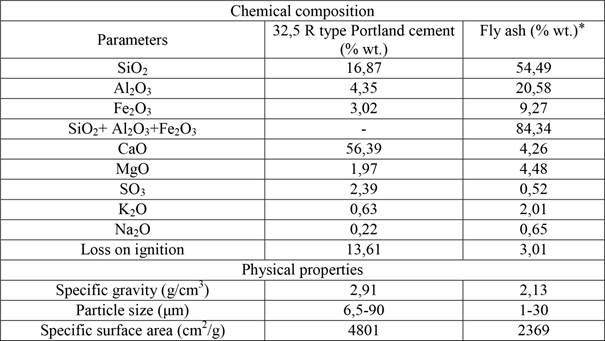
*(Türker et al. 2009).
Manufacture of CBWPs
All the CBWPs were produce data constant wood/cement ratio of 1:3.CaCl2 solution at a dosage of 5 % by the cement weight was added to the cement-wood-water mixture. The amount of water required for producing the boards was calculated by means of the Equation 1 below, which was formulated by Simatupang (1979) as:
 (1)
(1)Where, Wt was water weight (kg), C was weight of cement (kg), MC wass pruce planer shavings moisture content (oven-dry basis, %), and W was oven-dry spruce planer shavings weight (kg). The fly ash was applied at 5%, 10%, 15%, and 20%, based on cement weight, as cement replacement. The manufacturing planning of the experimental cement-bonded wood particleboards was summarized in Table 2.
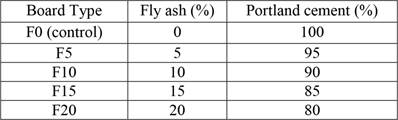
The mixture of planer shavings, cement, fly ash, distilled water and CaCl2 solution were uniformly blended and then hand-formed on an aluminium plate inside a wooden mould. After wards, the mats were kept under a pressure of 20 kg/cm2 using a single-layer hot press for 24 h. A temperature of 60 ℃ was applied on the matsduring the first 8 h of the pressing time becauseit was found that the best mechanical and physical properties were achieved at a pressing temperature of 60 ℃ in manufacturing cement-bonded wood particleboards from spruce wood (Yel et al. 2020).
Four replications were made for each variable studied, totalling 15 single-layer CBWPs with a dimension of 500 x 500 x 10 mm3 and a target density of 1200 kg/m3. After 24 h, the CBWPs were kept in a controlled room at 65 % relative humidity and 20 ℃ temperature for 30 days in order to let the cement to cure. The conditioned boards were processed into test samples for determining physical, mechanical, thermal, and morphological properties.
Determination of physical and mechanical properties
The mechanical performances of CBWPs including modulus of rupture (MOR), modulus of elasticity (MOE), screw withdrawal strength (SW), internal bond (IB) strength were tested in according to TS EN 310 (1999), TS EN 319 (1999), TS EN 320 (2011) standards, respectively. Moreover, physical tests such as density (D), moisture content (MC), water absorption (WA) and thickness swelling (TS) were carried out in accordance with TS EN 323 (1999), TS EN 322 (1999), ASTM D1037 (2006), TS EN 317 (1999) standards, respectively.
Thermogravimetric analysis (TGA/DTG)
The samples were ground and screened prior to the thermal test. Thermogravimetric analysis-derivative thermogravimetry (TGA/DTG) of the samples were performed by heating of specimens in nitrogen atmosphere up to 900 ℃ at a heating rate of 10 ℃/min in a Perkin Elmer STA 6000 Thermal Analyser.
Scanning electron microscope (SEM)
The small fractured samples were dried at 60 ℃ ±2 ℃ until they reached a constant weight before SEM observations. After the fractured samples were coated with gold for 120 seconds, the morphology of the fractured surfaces of the samples was characterized using a scanning electron microscope ZEISS EVO LS 10.
Statistical analysis
The results of mechanical and physical tests were submitted to analysis of variance (One-Way ANOVA) using SPSS 19.0 package software. A comparison of the mean values was done by Duncan’s multiply range test when the differences between the means of board groups were found to be significant (p < 0,05).
Results and discussion
Physical properties
The means, standard deviations, and statistical comparisons of D, MC, TS and WA values of CBWPs containing various amounts of the fly ash (FA) were illustrated in Table 3. Density (D) values of the CBWPs were found to be the highest in the control (F0) and decreased as the usage of the FA increased. This can be interpreted by the fact that the specific gravity of Seyitomer FA (2130 kg/m3) used as cement replacement is far less than the Portland cement (2910 kg/m3). Zhang et al. (2021) reported that an increase in fly ash content led to a significant reduction in the density of fiber-reinforced cement composites due to the lower density of fly ash compared to cement. On the other hand, the study conducted by Saha (2018) indicated that the early age strength of cementitious composites decreased with an increase in fly ash content as the hydration reaction of fly ash takes longer time compared to cement. Therefore, another reason for the decrease in the CBWPs may have been a spring back occurred in the fly ash-added CBWPs after the pressing process because the FA decreased the early age strength of CBWPs. This low density can provide some advantages for the CBWPs in terms of transportation and insulation.
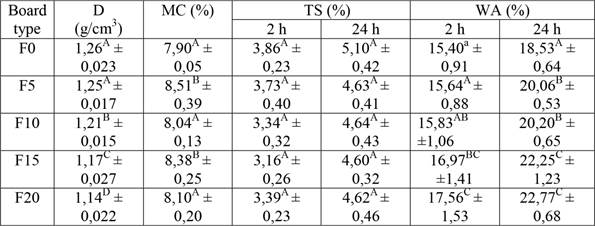
Means within a column followed by the different capital letters are significantly difference at 5 % level of significance for P values <0,05. ± represents the standard deviations.
Although the FA had not a statistically significant effect on TS of the CBWPs for both 2 h and 24 h water soaking, it slightly decreased the TS values. This indicated that the C-S-H gel, formed as a result of the FA reaction with Ca(OH)2, contributed to the durability of the CBWPs, despite the reducing content of cement in the binder due to the FA replacement.
On the contrary to the thickness swelling values, as the rate of the FA in the CBWPs increased, a significant increase in water absorption values was observed. This might be caused by the high water holding capacity of FA due to its porous structure (Fischer et al. 1978). Ma et al. (1995) reported the surface area of FA, after reacting with Ca(OH)2, dramatically increased due to C-S-H gel with a huge surface area, and as a result of this, the volumes of pores increased. A study conducted by Karahan (2006) on the utilization of FA as cement replacement up to 45 % in producing the polypropylene and steel fibre reinforced concretes indicated that the porosity and water uptake rates of concrete increased as the utilization of FA increased. Tkaczewska and Małolepszy (2009) also stated that the porosity of the cement-based composite increased as FA replaced cement. In addition, the increment in the water absorption values of the CBWPs with fly ash added is thought to be associated with the decrease in the density of the CBWPs. Ashori et al. (2012) concluded that the wood cement panels with low density have more void spaces than the dense ones. Therefore, they can uptake more water.
MC values of all the CBWPs were found incompatible with the MC requirement (6 % - 12 %) mentioned in TS EN 634-1 (1999) standard. However, none of the CBWPs met the maximum thickness swelling requirements (<1,5 %) in the same standard.
Mechanical properties
The means, standard deviations, and statistical comparisons of MOR, MOE, IB, SW values of CBWPs containing various amounts of fly ash were given in Table 4. The values of modules of rupture and modules of elasticity ranged from 9,18 MPa to 11,71 MPa and from 5096 MPa to 6175 MPa, respectively and all of them were well above the minimum MOR (9 MPa) and MOE (4000 MPa) requirements set forth by TS EN 634-2 (2007) standards for ordinary Portland cement (OPC) bonded particleboards. The main products of hydration reaction of cement are calcium silicate hydrate (C-S-H) gel, which is primarily responsible for the mechanical performance of CBWPs and calcium hydroxide (Ca(OH)2), which has no contribution to the mechanical properties. The FA reacted with Ca(OH)2 to form more C-S-H gel. Therefore, the FA improved the MOR and MOE values of the CBWPs because the CBWPs containing the FA had more C-S-H than that in the control. In addition to the pozzolanic reactivity of fly ash, its smaller particle size and lower specific gravity compared to cement may have contributed to the improvement in MOR and MOE of CBWPs.
It was seen that the highest MOR and MOE values were achieved in the CBWPs containing 5 % the FA and the MOR and MOE values decreased as the use of the FA increased over 5 %. The reason for this may be that the amount of cement decreases as the FA usage rate increases, and as a result, not all the FA particles could react with calcium hydroxide since the amount of calcium hydroxide reduced due to the decrease in the amount of cement used. Consequently, the excess FA acted as an inert filler instead of binder, resulting in a reduction in the mechanical properties of the CBWPs (Lin et al. 2017).

* Means within a column followed by the different capital letters are significantly difference at 5 % level of significance for P values <0,05. ± represents the standard deviations.
Saboo et al. (2019) concluded that the use of fly ash at high dosage caused a decrease in the mechanical properties of concrete. Zhang et al. (2021) also stated that utilization of fly ash at low dosage led to a significant increase in the strength properties of the fiber-added cement composites due to the fly ash's reactivity and packing effect, whereas fly ash at high dosage caused a dilution effect. In addition, the reduction in the boards density with the increase of the fly ash content may have contributed to the decrease in the MOR and MOE of the boards.
It was observed that all the CBWPs containing the FA had a higher MOR value than the control. On the other hand, the difference between the MOR values of the CBWPs (F10, F15, F20) containing 10%, 15% and 20% FA was statistically not significant in according to the results of the ANOVA test. Some researchers (Saha 2018, Saboo et al. 2019, Al-sallami et al. 2020, Venkateswara and Srinivasa 2020) stated that the addition of FA at the low dosages significantly improved the mechanical properties of cementitious composites due to its pozzolanic activity. Furthermore, Horsakulthai and Paopongpaiboon (2013) mentioned that fly ash (FA) concrete with bagasse-rice husk-wood ash (BRWA) additive improved in strength, compared to Portland cement concrete, due to the factth at both BRWA and FA reacted with Ca(OH)2 to produce more C-S-H gel.
The IB and SW values ranged from 0,77MPa to 1,13 MPa and 86,70 MPa to 97,46 MPa, respectively. The highest IB and SW values were achieved in the control. It was observed that the IB and SW values slightly decreased with an increase in fly ash content. This may have been due to the fact that fly ash caused the spring back and low density in the CBWPs. However, the IB values of all the CBWPs exceeded the minimum IB requirement (0,5MPa) stipulated in TS EN 634-2 (2007) standard. In addition, the difference between the IB values of all the CBWPs containing the FA was statistically not significant.
Thermal properties
TGA-DTG curves of the CBWPs made at different cement replacement levels with the fly ash (FA) were shown in Figure 1. The first peak represented the dehydration of pore water (approx. 100 ºC) in the CBWPs. The second peak indicated the decomposition of wood components (hemicellulose (180 °C to 350 °C), cellulose (275 °C to 350 °C) and lignin (250 °C to 500 °C)) (Kim et al.2006).
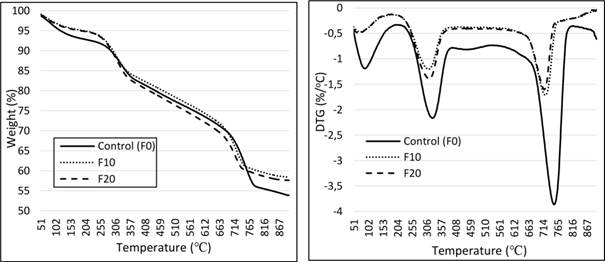
Figure 1:
TGA/DTG curves of CBWPs containing FA.
The third peak slightly occurred at about 450 ℃ due to the decomposition of calcium hydroxide (Ca(OH)2). The reason why calcium hydroxide decomposition occurred very slightly may have been due to the fact that the pozzolanic reaction of the FA consumed calcium hydroxide (Ca(OH)2), which formed as a result of cement hydration reaction, in the CBWPs. In addition, another reason could be said to be the carbonation reaction, a reaction of calcium hydroxide(Ca(OH)2) with carbon dioxide (CO2), because the peaks between 700 ℃ -800 ℃ were quite high. The last peak, occurred at approx. 750 ℃, showed the decarbonisation of calcium carbonate (CaCO3) which is not a product of cement hydration process such as ettringite, C-S-H, monosulphate and Ca(OH)2. The FA significantly reduced the calcium carbonate (CaCO3) in the CBWPs, compared to the control. This demonstrated that there was not enough calcium hydroxide for the carbonation reaction in the CBWPs because of the pozzolanic reaction of the FA with calcium hydroxide (Ca(OH)2).
Morphological properties
Micrographs of fractured surfaces of the CBWPs with the FA were shown in Figure 2. The formations of C-S-H, ettringite, and Ca(OH)2, which resulted from the cement hydration reaction, were observed in the SEM views of the CBWPs. It is believed that there is a mechanical interlocking process between C-S-H gel and the rough wood surface and this makes a very important contribution to the strength of the wood-cement composites (Hermawan et al. 2001).
As the usage of the FA increased in the CBWPs, it was seen that the amount of C-S-H gel significantly increased, whereas the content of Ca(OH)2 decreased. This explains why the FA improved the flexural and thickness swelling properties of the CBWPs. Moreover, it was seen that the FA increased the size and number of voids in the CBWPs. This may have been one of the reasons for the increase in the water absorption of the CBWPs.
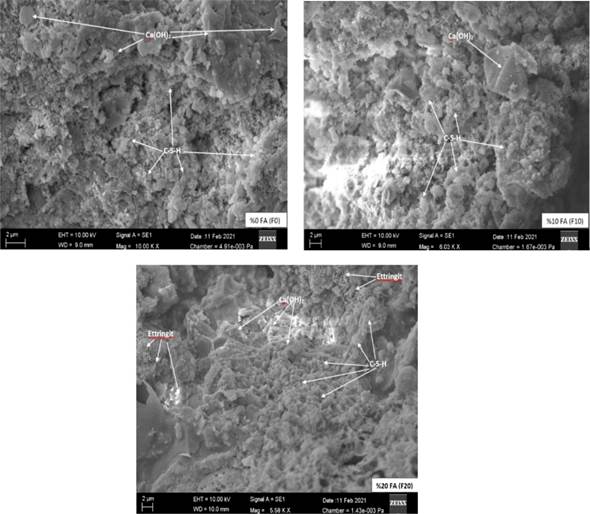
Figure 2:
SEM images of fractured surfaces of the CBWPs with the FA.
Conclusions
The usage potential of the fly ash (FA) as a partial cement replacement in manufacturing cement-bonded wood particleboards was investigated in this paper. According to the findings of this work, the following conclusions can be drawn:
The results demonstrated that it is possible to manufacture more environmentally friendly and durable cement-bonded wood particleboards using the FA as partial cement replacement and spruce planner shavings as virgin wood particles replacement. In addition, the cement-bonded wood particleboards in this study are considered to be more economical than traditional cement-bonded wood particleboards because they were produced using waste materials in this study.
The highest MOR and MOE values were achieved in the CBWPs containing 5% FA, and as the use of FA increased over 5 %, the MOR and MOE values of the CBWPs decreased. Moreover, the FA negatively affected the IB and SW values of CBWPs. MOR, MOE, IB values of all the CBWPs met the requirements mentioned in the standards. By using the FA up to 20% as cement replacement and 100% spruce planer shavings, cement-bonded wood particleboards with mechanical properties above the required level of the standards could be produced.
The FA decreased the density values of the CBWPs due to the lower density of the FA compared to cement and the spring back occurred in the fly ash-added boards. The FA improved the thickness swelling values thanks to the increasing C-S-H gel as a result of the reaction of the FA with Ca(OH)2. However, the FA increased the water absorption values due to its high water holding capacity and porosity. In addition, the decrease in the density of the fly ash-added boards resulted in an increase in the water absorption values of the boards.
In TGA/DTG of CBWPs, less weight losses occurred in 400 oC -500 oC and 700 oC -800 oC because the FA decreased the amount of CaCO3 and Ca(OH)2 by reacting with Ca(OH)2.
It was observed that the FA increased C-S-H gel and decreased Ca(OH)2 in cement-bonded wood particleboards.
Additional works are required to determine the effects of FA on cement-bonded wood particleboards produced using different tree species, cement setting accelerator and cement types.
References:
Al-sallami, Z.H.A.; Marshdi, Q.S.R.; Mukheef, R.A.A.H. 2020. Efect of cement replacement by fy ash and epoxy on the properties of pervious concrete. Asian Journal of Civil Engineering 21: 49-58.https://doi.org/10.1007/s42107-019-00183-5
ASTM. 2006. Standard Test Method for Evaluating Properties of Wood-Based Fibres and Particle Panel Materials. ASTM. D1037. 2006. ASTM: West Conshohocken, USA.
Aras, U.; Kalaycıoğlu, H.; Yel, H.; Kuştaş, S. 2022. Utilization of olive mill solid waste in the manufacturing of cement-bonded particleboard. Journal of Building Engineering 49: e104055. https://doi.org/10.1016/j.jobe.2022.104055
Ashori, A.; Tabarsa, T.; Sepahvand, S. 2012. Cement-bonded composite panels made from poplar strands. Construction and Building Materials 26: 131-134. https://doi.org/10.1016/j.conbuildmat.2011.06.001.
Behl, V.; Singh, V.; Dahiya, V.; Kumar, A. 2022. Characterization of physico-chemical and functional properties of fly ash concrete mix. Materials Today: Proceedings 50: 941-945. https://doi.org/10.1016/j.matpr.2021.06.353
Bui, P.T.; Ogawa, Y.; Kawai, K. 2018. Long-term pozzolanic reaction of fly ash in hardened cement-based paste internally activated by natural injection of saturated Ca(OH)2 solution. Mater Struct 51: e144. https://doi.org/10.1617/s11527-018-1274-0
Cavdar, A.D.; Yel, H.; Torun, S.B. 2022. Microcrystalline cellulose addition effects on the properties of wood cement boards. Journal of Building Engineering 48: e103975. https://doi.org/10.1016/j.jobe.2021.103975.
Fischer, G.L.; Prentice, B.A.; Silberman, D.; Ondov, J.M.; Bierman, A.H.; Ragiani, R.C.; McFarland, A.R. 1978. Physical and morphological studies of size classified coal fly ash. Environmental Science & Technology 12(4): 447-451. https://doi.org/10.1021/es60140a008
Golewski, G.L. 2021. The beneficial effect of the addition of fly ash on reduction of the size of microcracks in the ITZ of concrete composites under dynamic loading. Energies 14: e668. https://doi.org/10.3390/en14030668.
Hays, M.D.; Fine, P.M.; Geron, C.D.; Kleeman, M.J.; Gullett, B.K. 2005. Open burning of agricultural biomass:physical and chemical properties of particle-phase emissions. Atmospheric Environment 39(36):6747-6764. https://doi.org/10.1016/j.atmosenv.2005.07.072
Hermawan, D.; Hata, T.; Umemura, K.; Kawai, S.; Nagadomi, W.; Kuroki, Y. 2001. Rapid production of high-strength cement-bonded particleboard using gaseous or supercritical carbon dioxide. Journal of Wood Science 47: 294-300. http://dx.doi.org/10.1007/BF00766716
Horsakulthai, V.; Paopongpaiboon, K. 2013. Strength, chloride permeability and corrosion of coarse fly ash concrete with bagasse-rice husk-wood ash additive. Am J Appl Sci 10(3): 239-246. https://doi.org/10.3844/ajassp.2013.239.246
Karahan, O. 2006. Liflerle güçlendirilmiş uçucu küllü betonların özellikleri. PhD Thesis. Cukurova University. 272p. https://tez.yok.gov.tr/UlusalTezMerkezi/tezSorguSonucYeni.jsp
Kim, H.S.; Kim, S.; Kim, H.J.; Yang, H.S. 2006. Thermal properties of bio-flour-filledpolyolefin composites with different compatibilizing agent type and content. Thermochimica Acta 451:181-188. https://doi.org/10.1016/j.tca.2006.09.013
Lin, C.; Kayali, O.; Morozov, E.V.; Sharp, D.J. 2017. Development of self-compacting strain-hardening cementitious composites by varying fly ash content. Construction and Building Materials 149: 103-110. https://doi.org/10.1016/j.conbuildmat.2017.05.051
Ma, W.; Liu, C.; Brown, P.W.; Komarnen, S. 1995. Pore structure of fly ash activated by Ca(OH)2 and CaSO4.2H2O. Cement and Concrete Research 25(2): 417-425. https://doi.org/10.1016/0008-8846(95)00027-5
Malhotra, V.M. 2002. Introduction: sustainable development and concrete technology. ACI Concrete International 24(7): e22 https://www.concrete.org/publications/internationalconcreteabstractsportal.aspx?m=details&ID=12127.
Mathapati, M.; Amate, K.; Durga Prasad, C.; Jayavardhana, M.L.; Hemanth Raju, T. 2022. A review on fly ash utilization. Materials Today: Proceedings 50: 1535-1540. https://doi.org/10.1016/j.matpr.2021.09.106.
Okino, E.Y.A.; de Souza, M.R.; Santana, M.A.E.; Alves, M.V.S.; de Sousa, M.E.; Teixeira, D.E. 2004. Cement-bonded wood particleboard with a mixture of eucalypt and rubberwood. Cement and Concrete Composites 26: 729-734. https://doi.org/10.1016/S0958-9465(03)00061-1
Pereira, C.L.; Savastano, H.; Payá, J.; Santos, S.F.; Borrachero, M.V.; Monzó, J.; Soriano, L. 2013. Use of highly reactive rice husk ash in the production of cement matrix reinforced with green coconut fiber. Industrial Crops and Products 49: 88-96. https://doi.org/10.1016/j.indcrop.2013.04.038
Quirogaa, A.; Marzocchib, V.; Rintoulc, I. 2016. Influence of wood treatments on mechanical properties of wood-cement composites and of Populus euroamericana wood fibers. Composites Part B: Engineering 84: 25-32. https://doi.org/10.1016/j.compositesb.2015.08.069
Rajamma, R.; Senff, L.; Ribeiro, M.J.; Labrincha, J.A.; Ball, R.J.; Allen, G.C.; Ferreira, V.M. 2015. Biomass fly ash effect on fresh and hardened state propeties of cement bases material. Composites Part B: Engineering 77:1-9. https://doi.org/10.1016/j.compositesb.2015.03.019
Saboo, N.; Shivhare, S.; Kori, K.K.; Chandrappa, A.K. 2019. Effect of fly ash and meta kaolin on pervious concrete properties. Construction and Building Materials 223: 322-328. https://doi.org/10.1016/j.conbuildmat.2019.06.185
Saha, A.K. 2018. Effect of class F fly ash on the durability properties of concrete. Sustainable Environment Research 28(1): 25-31. https://doi.org/10.1016/j.serj.2017.09.001
Sanalkumar, K.U.A.; Lahoti, M.; Yang, E.H. 2019. Investigating the potential reactivity of fly ash for geopolymerization. Construction and Building Materials 225: 283-291. https://doi.org/10.1016/j.conbuildmat.2019.07.140
Simatupang, M.H. 1979. Water requirement for the production of cement-bonded particleboard. European Journal of Wood and Wood Products 37(10):379-382. https://doi.org/10.1007/BF02610947.
Tkaczewska, E.; Małolepszy, J. 2009. Hydration of coal-biomass fly ash cement. Construction and Building Materials 23: 2694-2700. https://10.1016/j.conbuildmat.2008.12.018
Türker, P.; Erdoğan, B.; Katnaş, F.; Yeğinobalı, A. 2009. Türkiye’deki Uçucu Küllerin Sınıflandırılması Ve Özellikleri. Türkiye Çimento Müstahsilleri Birliği (TCMB): Ankara. http://www.arescimento.com.tr/wp-content/uploads/2017/05/ucucu_kul.pdf.
TS. 1999. Wood-based panels- determination of moisture content. TS EN 322. 1999. Ankara: Turkey
TS. 1999. Wood-based panels- determination of density. TS EN 323. 1999. Ankara: Turkey
TS. 2011. Particleboards and fibreboards - Determination of resistance to axial withdrawal of screws. TS EN 320. 2011. Ankara: Turkey
TS. 1999. Wood based panels, determination of modulus of elasticity in bending and bending strength. TS EN 310. 1999. Ankara: Turkey
TS. 1999. Particleboard and fiberboards, determination of tensile strength perpendicular to the plane of the board. TS EN 319. 1999. Ankara: Turkey
TS. 1999. Particleboards and fibreboards- Determination of swelling in thickness after immersion in water. TS EN 317. 1999. Ankara: Turkey
TS. 1999. Cement-bonded particleboards. Specifications - part 1: general requirements. TS EN 634-1. 1999. Ankara: Turkey
TS. 2007. Cement-bonded particleboards. Specifications. Requirements for OPC bonded particleboards for use in dry, humid and external condition. TS EN 634-2. 2007. Ankara: Turkey
Venkateswara Rao, A.; Srinivasa Rao, K. 2020. Effect of fly ash on strength of concrete. In: Ghosh, S., Kumar, V. (eds) Circular Economy and Fly Ash Management. ISBN : 978-981-15-0013-8. Springer: Singapore, pp. 125-135. https://doi.org/10.1007/978-981-15-0014-5_9
Vu, V.A.; Cloutier, A.; Bissonnette, B.; Blanchet, P.; Duchesne, J. 2019. The effect of wood ash as a partial cement replacement material for making wood-cement panels. Materials 12(17): e2766. https://doi.org/10.3390/ma12172766
Xu, G.; Shi, X. 2018. Characteristics and applications of fly ash as a sustainable construction material: A state-of-the-art review. Resources, Conservation & Recycling 136: 95-109. https://doi.org/10.1016/j.resconrec.2018.04.010
Yel, H.; Donmez Cavdar, A.; Boran Torun, S. 2020. Effect of press temperature on some properties of cement-bonded particleboard. Maderas. Ciencia y Tecnología 22(1): 83-92. http://dx.doi.org/10.4067/S0718-221X2020005000108
Yu, Z.; Ye, G. 2013.The pore structure of cement paste blended with fly ash. Construction and Building Materials 45: 30-35.https://doi.org/10.1016/j.conbuildmat.2013.04.012
Zhang, D.; Ge, Y.; Pang, S.D.; Liu, P. 2021. The effect of fly ash content on flexural performance and fiber failure mechanism of lightweight deflection-hardening cementitious composites. Construction and Building Materials 302: e124349. https://doi.org/10.1016/j.conbuildmat.2021.124349
Author notes
♠Corresponding author:yel33@artvin.edu.tr