ARTÍCULO
Chemical constituents of palm wastes slow pyrolysis derived vinegar
 Ghanbar Ebrahimi ba_ebrahimi@yahoo.com
Alireza Shakeri
Peyman Ahmadi
Mosayeb Dalvand
Masuod Shafie
Hamid Zare Hosseinabadi
Ghanbar Ebrahimi ba_ebrahimi@yahoo.com
Alireza Shakeri
Peyman Ahmadi
Mosayeb Dalvand
Masuod Shafie
Hamid Zare Hosseinabadi
Chemical constituents of palm wastes slow pyrolysis derived vinegar
Maderas. Ciencia y tecnología, vol. 24, 47, 2022
Universidad del Bío-Bío
Received: 02 October 2021
Accepted: 14 July 2022
Abstract: Out of rachis and stem of palm tree from grooves in humid and dry zones, test materials were randomly collected and chipped for slow pyrolysis process. Chemical constituents of a set of pyrolysis derived vinegar were identified in their aqueous phase by gas chromatograph and quantitatively compared in sampled parts of sampled tree and grooves. Another set of vinegar was dewatered by dichloromethane, then their constituents were identified by gas chromatograph coupled with mass spectrometer, chemical constituents in aqueous state in both sampled grooves were the same but with different percentage values. In the organic phase, common chemical constituents of sampled parts and grooves were quantitatively compared. In humid zone rachis was 2,22 times richer in acetic acid and 2,37 times in phenol, but in dry zone stem is richer in acetic acid by 15,35 %. In their organic phases dominant and comparable chemicals of stem and rachis from sampled zone were furfural, phenol, benzic acid, 5-methyl-2- furancarboraldehyde, butanic acid and 2-methyl-phenol. Stem from dry zone was richer in these chemicals by 36,55 %; 96,93 %; 6,37 times, 62,05; 49; 32,57 % respectively. Rachis of humid zone contained more furfural, 63,95 %, 22,08 %, 2-methyl-phenol, but that of dry zone was richer in phenol by 46,20 %, 2,5 times in benzoic acid. Results from both phases of vinegar indicate that ecological impacts on the chemical constituents of palm from the same species are evident.
Keywords: GC analysis, GC/MS, palm wastes, slow pyrolysis, vinegar.
Introduction
Iran in its southeast down to its southwest owns vast date palm grooves (Phoenix dactylifera), measuring up to 250000 ha. From 40 % of these date palm grooves high quality date is harvested. So, Iran is a major date producing country. Fruit harvesting is the only kind of utilization of such vast palm stands, which takes place once a year, while in these grooves huge amount of lignocellulosic wastes from rachis (fronds) and dried palm tree trunks are available that contain useful materials with rather wide areas of applications.
Dried rachis is trimmed twice a year, total a of about 15 of them from each palm tree. This type of waste comprises 2,2 million metric tons, annually, according to Iran's agricultural yearbook (Ahmadi et al. 2015). There are no statistical records on dried palm tree slashes, but they are found frequently across the palm grooves, although they are long lasting type of trees. These wastes are partially burnt by date farmers, for removing obstacles on their commuting routes.
During recent decade some researchers have focused their works to characterize properties and elemental constituents (Jonoobi et al. 2019) of these wastes with objectives of making use of them in replacing raw materials in wood-based products, such as panels, since date palm wastes are fibrous materials. Regarding this proposed objective, results of field scale comprehensive studies related to environmental issues, feasible equipment is not available yet and due to existing records of relevant fiber - based products producing installations are some sort of contributors to environmental problems (Martin and Northeim 1996). It is also conceivable that such installations are rather capital intensive comparing with similar panel producing factories. This trend will not be wise recommendation because in long run continually annual removing wastes from date palm grooves certainly will damage fertility of soils and environment of palm grooves. This impact on soil has been substantiated (Prasad and Power 1991).
During past decade a number of researchers have extended thermochemical process on date palm wastes and characterized resulted substances which are known vinegar and biochar. Their studies on properties of biochar have shown usefulness of such material (Kloss et al. 2012, Ronsse et al. 2013, Jouiad et al. 2015, Bensidhom et al. 2018, Prasad and Power 1991) as green sorbent, improving soil fertility (Usman et al. 2015, Usman et al. 2016, Al-Wabel et al. 2019), remediation degraded soils (Hussain et al. 2014, Al-Wabel et al. 2019) and climate change mitigation as well (Woolf et al. 2010, Skjemstad et al. 2002). Therefore, if pyrolyzing date palm wastes is expanded to commercial scale that will require removal of mentioned wastes from palm grooves, resulted biochar is returnable to palm grooves soils for maintaining their nutrient balance and improving physical properties of them.
The other product of pyrolysis process is vinegar which is called biofuel also. This product contains several chemical compounds, similar to those found in wood vinegars which were found functional in replacing synthetic pesticides and biocides (Tiilikkala et al. 2010). Antifungal and antitermitic activities of oil palm vinegar have been studied as well (Oramahi et al. 2018). Antioxidant and antibacterial activities of wood vinegars have been reported too (Yang et al. 2016, Li et al. 2019). Date palm vinegar like wood vinegar may have impact on soil's enzyme activities that has been experienced in soils for grain cultivation (Koc et al. 2018).
Regarding consequences of scientific investigations conducted on application of thermochemical conversion of lignocellulosic wastes, one can conclude that such process looks more feasible product for utilizing date palm wastes. Abundance of these wastes, particularly rachis, their distribution in rather close date palm grooves territories that can provide supply for medium scale pyrolysis installations are all positive factors justifying establishment of thermochemical conversion for making safe uses of them. This technique is rather less capital intensive and regarding environmental issues it will be safe implementation.
The objectives of this study were to identify the chemical content of slow pyrolysis-derived vinegar from the dried stem (trunk) and annually harvested dried rachis in its aqueous phase through gas-chromatography finding chemical constituents in the same vinegar in its organic phase by making use of GC/MS technique.
Test materials were collected from palm grooves in two different regions having humid and dry climatic conditions for finding ecological impacts on kind and values of identified chemicals in them.
Materials and methods
For conducting this study, date palm wastes (dead stem and dried rachis Figure 1), samples were collected from palm grooves in Lamerd (Southern territory of Fars province of Iran, a hot and humid zone) and Kerman (Southeast province of Iran, a hot and dry zone). The purpose of collecting test materials from date palms in two different climate zones was to find discrepancies in waste’s chemical constituents due to ecological impacts, if there is any, however, species of the palm is the same (Phoenix dactylifera) in both grooves.
Test materials were re-air dried to 12 % moisture content, then chipped into particles, 10 mm - 15 mm in length, less than 10 mm in thickness. Prepared waste particles of stem and rachis were separately pyrolyzed in a laboratory-scale pilot electrical furnace (designed by author and fabricated in shop, Figure 2) with temperatures ranging from 350 ºC - 400 ºC.
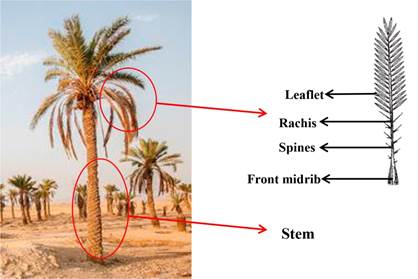
Figure 1:
Stem and Rachis in a palm tree.
The furnace was equipped with a programmable control panel for time-based temperature rise. Temperature increment was set as 5 ºC min-1. The weight of test load for pyrolysis varied 500 g - 1000 g. Total residential time was 5 h. Emitted volatiles from furnace was transferred through a steel pipe to condensing system, comprising a small diameter slopped spiral stainless-steel pipe, embedded in a mixture of ice cubes and water, being at a temperature slightly below zero 0 ºC. Non condensable gases were allowed to be exhausted through a valve on transferring pipe after condensing system. Condensed vinegar was collected in a transparent bottle with a liquid and gas-tight lid. At the end of predetermined residential time (determined experimentally by stopping vinegar droplet falling into bottle), power was switched off and as a precautionary measure, the apparatus was allowed overnight to cool off. Then furnace was dis-loaded, weights of bio char and vinegar were determined.
Date palm trees are long-lasting ones, usually over a century, while rachises are old about 2 years to 4 years. Each palm tree trunk consists of remainder of pruned rachis in its circumference. Thus, some differences might exist in their chemical and elements constituents. So, pyrolyzing of rachis and trunk and analyzing corresponding vinegar independently, is justified. This was followed in this study.
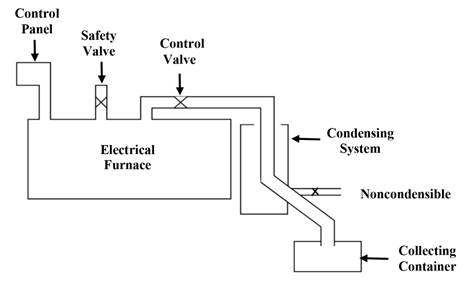
Figure 2:
Pyrolysis apparatus.
Results and discussion
Chemical constituents of vinegars in aqueous phase
Chemical constituents of vinegars from both sampled parts of palm tree and also sampled grooves, were the same, but their values (in %) were different in stem, rachis and sampled grooves. These constituents in descending order in terms of percentages of values were acetic acid, methanol, phenol and propionic acid.
Quantitative comparisons
Quantitative comparison chemical constituents of slow pyrolysis derived vinegar (aqueous phase) from date palm wastes from humid and dry zones were made in Table 1.
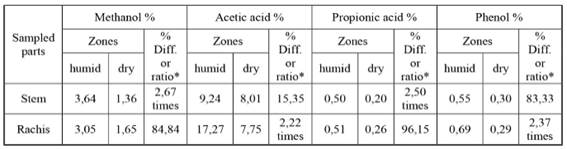
* % diff. was calculated with respect to lower values and ratios were determined by higher values to lower ones.
Stem
According to experimental data, vinegar of stem from humid zone in its aqueous phase contained 2,67 times methanol more than that of dry zone, and in acetic acid it is richer by 15,35 %. Also, this vinegar had higher amount of propionic acid, and phenol, by 2,5 times and 83,33 % respectively.
Rachis
As collected data indicate, vinegar of rachis from humid zone contains more methanol, acetic acid, propionic acid and phenol by 84,84 %; 2,22 times, 96,15 and 2,37 times, in the same order.
Differences in values of chemical constituents of slow pyrolysis derived vinegar of dried stem and rachis of date palm trees from humid and dry zones, are considerable, although species of palm is the same (Phoenix dactylifera). These should be related to ecological and soil’s parameters. Detailing impacts of such parameters was not part of this work.
Identification of chemical constituents in date palm wastes vinegar in its organic phase
A set of slow pyrolysis derived vinegars specimen of date palm wastes from sampled grooves in humid and dry zones were dewatered by dichloromethane, then in their organic phase their chemical constituents were identified by making use of gas-chromatograph coupled with mass-spectrometer.
Number of chemical items in vinegars was not the same in stem and rachis of each sampled grooves. But there were common items between identified compounds of stem and rachis of each palm groove and both sampled grooves as well.
Humid zone
Common constituents in vinegar of sampled parts from humid zone have been quantitatively compared in Table 2 and that of dry zone in Table 3.
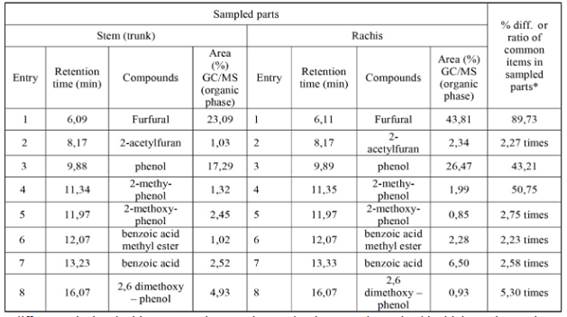
* % diff. was calculated with respect to lower values and ratios were determined by higher values to lower ones.
Organic phase of vinegars from stem and rachis of humid zone contained 8 common items with different values (in %). The major constituents in terms of higher values that are common in vinegars organic of stem and rachis are furfural, phenol and benzoic acid. In these items vinegar of rachis in its organic phase has dominant values, by 89,73 %; 43,21 % and 2,57 times, respectively, comparing with same vinegar of stem.
Dry zone
In organic phase of pyrolysis derived vinegars of stem and rachis of date palm from this zone contain totally 12 common chemical compounds were identified, each with different values in two sampled parts (Table 3). Among these compounds furfural, 5-methyl-2-furancarboraldehyde, and 2- acetyl furan have dominant values. Vinegar of stem contains higher furfural by 18 % with respect to that of rachis, but in two other compound, vinegar of rachis is richer by 19,83 % and 9,85 %, respectively in mentioned order.
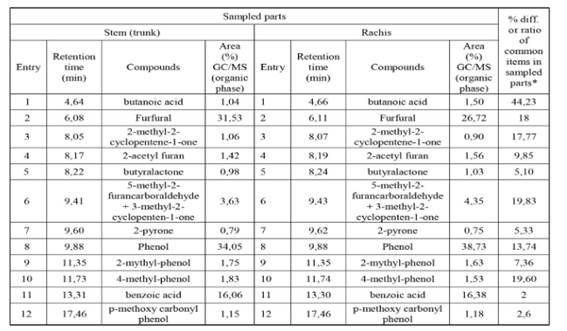
* % diff. was calculated with respect to lower values and ratios were determined by higher values to lower one
The rather drastic discrepancies between values of common chemical compounds in organic phase of vinegars from stem and rachis in humid zone should be due to governing ecological conditions. In dry zone such pronounced differences are not evident in values of common chemical constituents between stem and rachis of palm tree.
Comparison of chemical constituents in vinegars of date palm wastes from humid and dry zone
Chemical compounds in organic phase of slow pyrolysis derived vinegars of date palm wastes from humid and dry zone, identified by GC/MS are presented in Table 4. It is observed from experimental data in this table that organic vinegars of the same date palm species’ dried stems, contain seven common chemical compounds, however organic vinegar of stem from dry zone is rich in phenol, 96,93 %, 5-methyl-2-furancarboraldehyde 62,05 %, furfural 36,55 %, 2-methy-phenol 32,57 %, 2-methy-2-cyclopentene 30,86 % and 6,37 times in benzoic acid and its butanoic acid is less by 49 %.
Organic vinegars of rachis from palm grooves in humid and dry zones contain 9 common chemical compounds. Vinegar of rachis from dry zone is rich in p-methoxycarbonyphenol 90,32 %, phenol 46,20 %, 2-methy-2-cyclopentene-1-one 15,38 % and 2,51 times in benzoic acid and its furfural content is less by 63,95 %.
Discrepancies in values of common chemical compounds in organic vinegars of sampled date palm wastes and grooves as mentioned, should be related to climatological conditions and soil’s parameters.
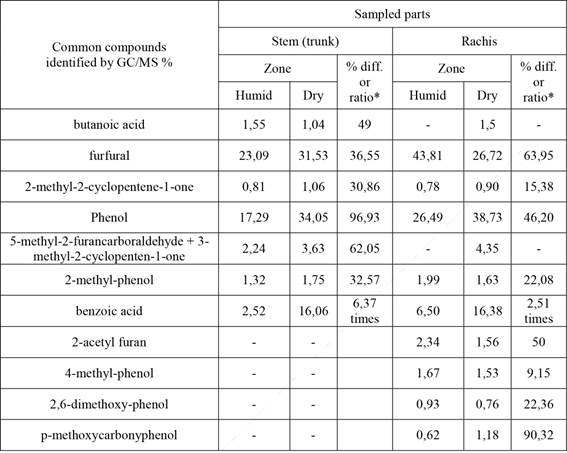
* % diff. was calculated with respect to lower values and ratios were determined by higher values to lower ones.
Conclusions
Analysis of slow pyrolysis derived vinegars of dead stem and dried rachis of the same species of date palm from two grooves in terms of ecological conditions and type of soil have shown that:
From stem of humid zone, this vinegar in aqueous phase contains dominant values of common chemical constituents, compared with that of dry zone.
From rachis of humid zone, such vinegar is richer in common chemical compounds.
In humid zone organic phase of slow pyrolysis derived vinegar of rachis is richer in major common chemical constituents, comparing with that of stem.
In dry zone, organic phase of pyrolysis derived vinegar of rachis contains common chemical compounds with higher values, compared with that of stem, except in Furfural.
Among proposed concepts on utilization of date palm wastes that have been briefly reviewed in introductory section of this article, establishing commercially feasible scale of slow pyrolysis process for making use of date palm wastes, has the right justification ones, since from this process two Environmental-Friendly products are produced and both of them have preferred applications for agricultural purposes, including protection of natural sustainable condition of date palm grooves as well.
Acknowledgements
This work was supported by Iran National Science Foundation (grant numbers 96010137).
References:
Ahmadi, K.; Gholizadeh, H.; Ebadzadeh, H.R.; Hatami, F.; Fazli Starbagh, M.; Hossein Pur, R.; Kazemian, A.; Rafiei, M. 2015. Agricultural Statistics. Ministry of Agriculture of Iran: Tehran, 147p.
Al-Wabel, M.I.; Usman, A.R.A.; Al-Farraj, A.S.; Ok, Y.S.; Abduljabbar, A.; Al-Faraj, A.I.; Sallam, A.S. 2019. Date palm waste biochars alter a soil respiration, microbial biomass carbon, and heavy metal mobility in contaminated mined soil. Environmental Geochemistry and Health 41(4): 1705-1722. https://doi.org/10.1007/s10653-017-9955-0
Bensidhom, G.; Hassen-Trabelsi, A.B.; Alper, K.; Sghairoun, M.; Zaafouri, K.; Trabelsi, I. 2018. Pyrolysis of Date palm waste in a fixed-bed reactor: Characterization of pyrolytic products. Bioresource Technology 247: 363-369. https://doi.org/10.1016/j.biortech.2017.09.066
Hussain, A.; Farooq, A.; Bassyouni, M.I.; Sait, H.H.; El-Wafa, M.A.; Hasan, S.W.; Ani, F.N. 2014. Pyrolysis of Saudi Arabian date palm waste: A viable option for converting waste into wealth. Life Science Journal 11(12): 667-671. https://doi.org/10.7537/marslsj111214.126
Jonoobi, M.; Shafie, M.; Shirmohammadli, Y.; Ashori, A.; Zarea-Hosseinabadi, H.; Mekonnen, T. 2019. A review on date palm tree: properties, characterization and its potential applications. Journal of Renewable Materials 7(11): 1055-1075. https://doi.org/10.32604/jrm.2019.08188
Jouiad, M.; Al-Nofeli, N.; Khalifa, N.; Benyettou, F.; Yousef, L.F. 2015. Characteristics of slow pyrolysis biochars produced from rhodes grass and fronds of edible date palm. Journal of Analytical and Applied Pyrolysis 111: 183-190. https://doi.org/10.1016/j.jaap.2014.10.024
Kloss, S.; Zehetner, F.; Dellantonio, A.; Hamid, R.; Ottner, F.; Liedtke, V.; Schwanninger, M.; Gerzabek, M.H.; Soja, G. 2012. Characterization of slow pyrolysis biochars: effects of feedstocks and pyrolysis temperature on biochar properties. Journal of Environmental Quality 41(4): 990-1000. https://doi.org/10.2134/jeq2011.0070
Koc, I.; Yardim, E.N.; Akca, M.O.; Namli, A. 2018. Impact of pesticides and wood vinegar, used in wheat agro-ecosystems, on the soil enzyme activities. Fresenius Environmental Bulletin 27(4): 2442-2448. https://www.researchgate.net/profile/Muhittin-Akca/publication/324441641_Impact_of_Pesticides_and_Wood_Vinegar_Used_In_Wheat_Agro-Ecosystems_on_the_Soil_Enzyme_Activities/links/5ad58ac4aca272fdaf7c1a67/Impact-of-Pesticides-and-Wood-Vinegar-Used-In-Wheat-Agro-Ecosystems-on-the-Soil-Enzyme-Activities.pdf
Li, Z.; Zhang, Z.; Wu, L.; Zhang, H.; Wang, Z. 2019. Characterization of five kinds of wood vinegar obtained from agricultural and forestry wastes and identification of major antioxidants in wood vinegar. Chemical Research in Chinese Universities 35(1): 12-20. https://doi.org/10.1007/s40242-019-8207-5
Martin, C.; Northeim, C. 1996. Characterization of Manufacturing Processes and Emissions and Pollution Prevention Options for the Composite Wood Industry. US Environmental Protection Agency, Air Pollution Prevention and Control Division. https://cfpub.epa.gov/si/si_public_record_Report.cfm?Lab=NRMRL&dirEntryId=115182
Oramahi, H.A.; Yoshimura, T.; Diba, F.; Setyawati, D. 2018. Antifungal and antitermitic activities of wood vinegar from oil palm trunk. Journal of Wood Science 64(3): 311-317. https://doi.org/10.1007/s10086-018-1703-2
Prasad, R.; Power, J.F. 1991. Crop residue management. In Advances in soil science, Volume 15. Springer: New York, NY, USA. 205-251. https://doi.org/10.1007/978-1-4612-3030-4_5
Ronsse, F.; Van Hecke, S.; Dickinson, D.; Prins, W. 2013. Production and characterization of slow pyrolysis biochar: influence of feedstock type and pyrolysis conditions. GCB Bioenergy 5(2):104-115. https://doi.org/10.1111/gcbb.12018
Skjemstad, J.O.; Reicosky, D.C.; Wilts, A.R.; McGowan, J.A. 2002. Charcoal carbon in US agricultural soils. Soil Science Society of America Journal J 66(4): 1249-1255. http://dx.doi.org/10.2136/sssaj2002.1249
Tiilikkala, K.; Fagernäs, L.; Tiilikkala, J. 2010. History and Use of Wood Pyrolysis Liquids as Biocide and Plant Protection Product. Open Agriculture Journal 4(1): 111-118. https://doi.org/10.2174/1874331501004010111
Usman, A.; Sallam, A.; Zhang, M.; Vithanage, M.; Ahmad, M.; Al-Farraj, A.; Ok, Y.S.; Abduljabbar, A.; Al-Wabel, M. 2016. Sorption process of date palm biochar for aqueous Cd (II) removal: Efficiency and mechanisms. Water, Air, & Soil Pollution 227(12):1-16. https://doi.org/10.1007/s11270-016-3161-z
Usman, A.R.; Abduljabbar, A.; Vithanage, M.; Ok, Y.S.; Ahmad, M.; Ahmad, M.; Elfaki, J.; Abdulazeem, S.S.; Al-Wabel, M.I. 2015. Biochar production from date palm waste: charring temperature induced changes in composition and surface chemistry. Journal of Analytical and Applied Pyrolysis 115: 392-400. https://doi.org/10.1016/j.jaap.2015.08.016
Woolf, D.; Amonette, J.E.; Street-Perrott, F.A.; Lehmann, J.; Joseph, S. 2010. Sustainable biochar to mitigate global climate change. Nature Communications 1(1):1-9. https://doi.org/10.1038/ncomms1053
Yang, J.F.; Yang, C.H.; Liang, M.T.; Gao, Z.J.; Wu, Y.W., Chuang, L.Y. 2016. Chemical composition, antioxidant, and antibacterial activity of wood vinegar from Litchi chinensis. Molecules 21(9): e1150. https://doi.org/10.3390/molecules21091150
Author notes
♠Corresponding author: ba_ebrahimi@yahoo.com