Artigos
OPEN INNOVATION: A NEW MECHANISM FOR ADOPTION OF ORGANIZATIONAL INNOVATION FROM ALGERIAN COMPANIES
INOVAÇÃO ABERTA: UM NOVO MECANISMO PARA ADOÇÃO DE INOVAÇÃO ORGANIZACIONAL EM EMPRESAS ARGELINAS
OPEN INNOVATION: A NEW MECHANISM FOR ADOPTION OF ORGANIZATIONAL INNOVATION FROM ALGERIAN COMPANIES
International Journal of Innovation, vol. 4, núm. 2, pp. 11-22, 2016
Universidade Nove de Julho
Abstract: The aim of this paper is to analyze the relationship between the openness degree of companies and organizational innovation. The openness degree is defined as the use of purposive inflows and outflows of knowledge to accelerate internal Innovation, and to expend markets for external use of innovation (Chesbrough, 2006). The research utilizes causality models and suggests a conceptual schema subsequent to a comprehensive analysis of the literature linked to open innovation field. A sample of 120 managers and employees of Algerian pharmaceutical company is used. The SEM is used to analyze and approve the proposal of the conceptual schema. Results of the empirical research show that open innovation is positively and significantly related to organizational innovation, on the other hand, these results indicate that there is a positive and significant impact of organizational innovation on organizational performance.
Keywords: Resources Based View, Open Innovation, Organizational Innovation, Organizational Performance, Pharmaceutical Industry.
Resumo: O objetivo deste estudo é analisar a relação entre o grau de aceitação de inovação organizacional em empresas. O grau de abertura é definida como o uso de entradas intencionais e saídas de conhecimento para acelerar a inovação interna , e recursos dos mercados para uso externo da inovação (Chesbrough, 2006). A pesquisa utiliza modelos de causalidade e sugere um esquema conceitual subsequente para uma análise abrangente da literatura relacionada ao campo de inovação aberta. Foi utilizado uma amostra de 120 gerentes e empregados da empresa farmacêutica argelina. Por meio da modelagem estruturada (SEM) foi usada para analisar e testar a proposta do modelo conceitual. Os resultados da pesquisa empírica mostraram que a inovação aberta é positiva e, significativamente relacionada com a inovação organizacional , por outro lado, esses resultados indicam que há um impacto positivo e significativo da inovação organizacional no desempenho organizacional .
Palavras-chave: Visão Baseada em Recursos, Inovação Aberta, Inovação Organizacional, Desempenho Organizacional, Indústria Farmacêutica.
INTRODUCTION
In today's Competitive markets, the organizations cannot be innovative on their own and according to Chesbrough (2003) there is no sustainability in the use of merely closed in house innovation. To keep industries growing, innovation is needed and open innovation is argued to help the innovation process. Chesbrough(2003) suggested that industrial development work is undergoing a paradigm shift, from a closed internal development to a more open and collaborative way for adopting innovation. The main idea of open innovation is to open up the innovation process to other firms, individuals’ research labs, universities, customers, suppliers, ect (Chesbrough, 2006). With the aim to facilitate a smooth flow of ideas inside and outside of organization and in this way, derive advantage from the exploration of external and exploitation of internal resources (Chesbrough, 2003). From the theoretical logic which says that the open innovation is the way to generate increased levels of innovation; the open innovation is claimed to have a more significant influence on organizational innovation. However, there are only few studies examining the relationship between open innovation and organizational innovation. Our study is aims to bridge the gap by examining the relationship between the open degree of companies and organizational innovation in Algerian Pharmaceutical Company.
LITERATURE REVIEW AND HYPOTHESES
A. Resources based-view According to Penrose, the pioneer author of resource based-view, the firm is defined as “a set of internal resources that can be exploited in different ways, have the ability to develop the organization through interaction and the combination of all the financial and human resources available”. These resources can support the implementation of enterprise strategy, mainly including enterprise assets, comprehensive ability, enterprise owned information and knowledge (Barabel et al, 2008). Wernerflet and Barney was contributed in the development of this theory by clarifying sources of sustainable competitive advantage, were explained the
resource as "anything that can be considered as strength or a weakness for the organization".
The theory has seen several additions, particularly the development of knowledge based- view “kBV (Kathleen, 1996) and those based on competencies "CBV" (Prahalad, Hamel, 1990), without neglecting the origins of the theory.
The two approaches are based on certain resources; the intangible resources are more easily interchangeable. Teece found out that a resource is the foundation of enterprise innovation, especially complementary resources the enterprises need. Other scholars believe that the implementation of cooperative innovation between enterprises is based on the introduction of technology and market knowledge (Marichal, 1999)
The organization's resources are the main component of the theory of resources "RBV"; it can be one of the determinants of organizational innovation. According to Barney, "Resources are defined as a set of assets and capabilities and organizational processes and characteristics of the organization and its information’s and knowledge controlled by the organization and allow it to design and implement strategies that will improve its operations and competences”.
Bates and Flynn consider that the theory of resources is a special for technological process innovation and organizational process innovation, because they require an organizational and managerial policies or a combination of the human and organizational capital.
In addition; several authors consider that one of the main purposes for organizations implementing open innovation is to obtain the key resources needed to enhance the competitiveness of the organizations (Zhai, 2010).
B. The theoretical foundation of the research variables
1) Organizational innovation: The existing literature on organizational innovation is diverse and scattered. There is no consensus on a definition of the term ‘‘organizational innovation’’, which remains ambiguous.
Different areas of research are developing their own approaches to try understanding the Complex phenomenon of organizational innovation (Sidow, Ali, 2014).
Innovation researchers have a main distinguished among many typologies of innovation, but the best known is the distinguished innovation in the product and innovation in the process. Product innovation is the development of new products and services within the organization, whereas innovation in the process includes the introduction of improvements in the production process (Evan, 1966).
According to Edquist et al (2001) the process an innovation is divided into two categories: technological process innovations (TPI), and organizational process innovations (OPI) which is defined as new tools and devices in throughput technology that mediate between inputs and outputs. This process innovation type operates in the technical system of the organization and is related to the organization’s primary work activity.
Organizational process innovation is defined as a new way to organize work or by which a new organizational form is introduced (Edquist et al, 2001). It encompasses new management practices, process, policies, structures of tasks and units (Armbruster et al, 2008), (Birkinshaw et al, 2008), (Damanpour, 1987). It operates in the social system of the organization and contains no technological elements as such Edquist & al (2001); Meeus & Hage. It has to do with the coordination of human resources and other organizational systems (Damanpour, Aravind, 2011)
Based on the above, the organizational innovation is part of a non-technological processes innovation.
Consequently, Organizational innovation is a nontechnological processes innovation, including applications, mechanisms, organizational structures, and new principles and techniques in business management, which aims to improve the efficiency and effectiveness of internal organizational processes.
Reichstein & Salter (2006), Guanday & al(2011) consider that it is difficult to distinguish between organizational processes innovation and technological process innovation. As for Schmid & Rammer (2014).suggested the combination of the two types within process innovation.
In addition, Bocquet et al (2013) consider that technological and organizational process innovations share several common characteristics.
Both TPI and OPI have internal focus and aim to increase the efficiency and effectiveness of the organizational process, for that reason, several authors have considered that technological and organizational process innovations are two dimensions of the same phenomenon .
This research intends to examine the organizational innovation from the perspective of complementarily relationship between it and the technological process innovation.
Table below illustrates the main characteristics of technological and organizational process innovations.
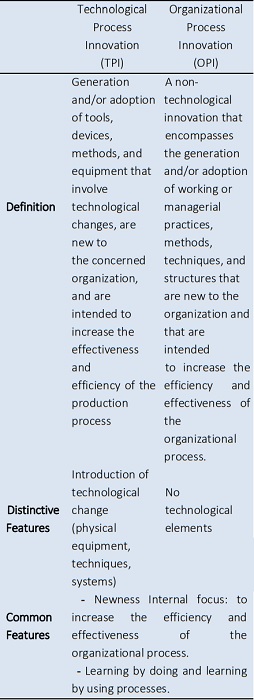
Bocquet Rachel, Damanpour Fariborz, Dubouloz Sandra, 2013 ,"Innovations De Procédés Technologiques et Organisationnels: Autécédents Et Complémentarité", Euram Conférance, Intanbul, PP 2629, June.
2) Open innovation: Birkinshaw et al (2008) suggested that organizational innovation emerge through a process of interaction between internal and external actors of the company. Their analysis suggest that the open innovation model (Chesbrough, 2003), and a reasonable use of external sources of knowledge could provide a representation of the adoption method of an organizational processes innovation in companies (Birkinshaw et al, 2008).
The term Open Innovation was introduced and popularized by Henry Chesbrough in 2003, a Berkeley professor at University of California.
Chesbrough(2003) describes a paradigm shift from a closed to an open innovation model. He defines Open innovation as “the use of purposive inflows and outflows of knowledge to accelerate internal innovation, and expand the markets for external use of innovation, respectively. Open innovation is a paradigm that assumes firms can and should use external ideas as well as internal ideas, and internal and external paths to market, as they look to advance their technology.” (Chesbrough, 2006).
Chesbrough (2003) explains that in closed innovation models, research projects are launched from the science and technology base of the firm. They are further developed internally and eventually, some projects are selected for further work where after the successful projects are chosen to go through to the market. This approach to innovation is called ‘closed’, because research projects can only enter the process via one way, namely at the beginning from the firm’s internal base. Finally, when a project is developed, it can only exit the process in one way, by going into the market.
According to Chesbrough (2003), Organizational Innovation differs from closed innovation systems in several ways. First of all, a research project in OI models can enter the innovation process, not only at the beginning from the firm’s science and technology base, but also from external science and technology bases. This could be the technology base of other firms, but also the base of scientific institutions like universities.
Second, during the development phase in OI, knowledge can enter the process by getting it from external sources. Acquiring knowledge from other firms through technology insourcing is an example of this.
Third, during the development phase of OI, knowledge is developed, but not every piece of knowledge will be useful for the firm. Some pieces of knowledge simply do not coincide with its current strategies. In an OI system, these pieces of ‘useless’ knowledge or ‘spin-offs’ can now be exploited by outlicensing the knowledge to others. Moreover, a firm can also decide to use the accumulated knowledge to enter new markets. Hence, spin-offs were always seen as incurred costs resulted from the innovation process. In OI however, these spin-offs are seen as opportunities (Chesbrough, 2003).
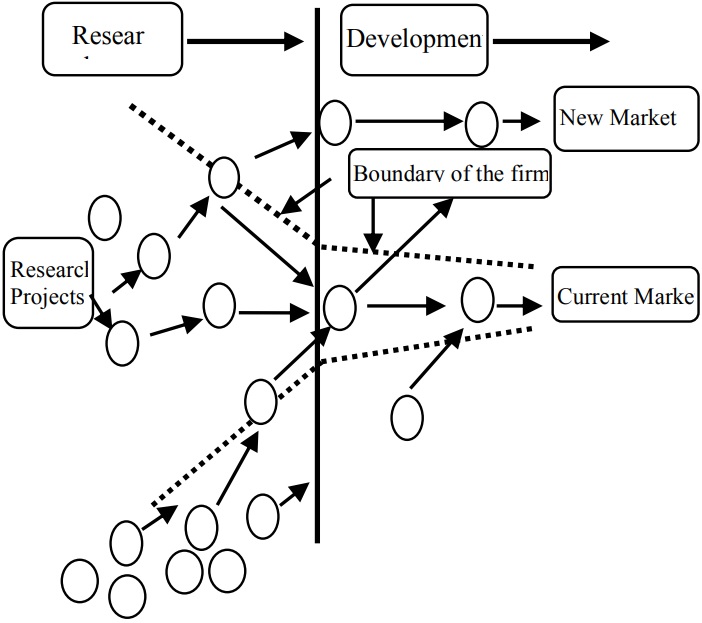
Fig 1
Open Innovation
Cornell Brent. T, Open Innovation Stategies For Overcoming Competittive Challenges Facing Small And Mid-Sized Entreprises, Doctorat Thesis Of Management, Maryland University College, 2012.
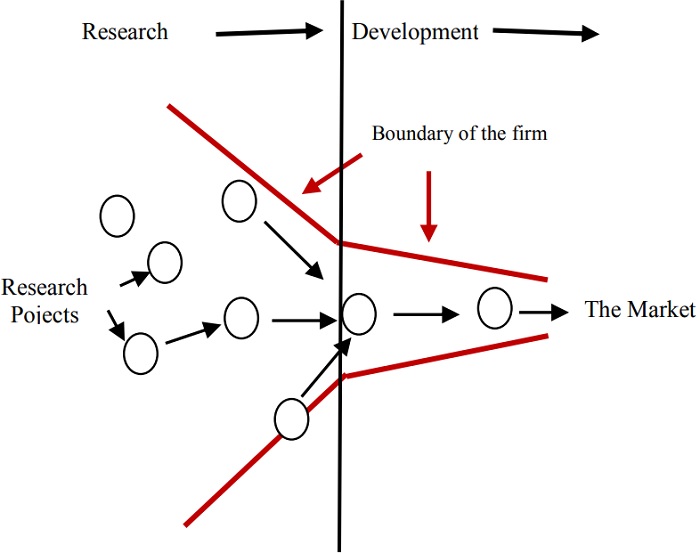
Fig 2
Closed Innovation
Cornell Brent. T, Open Innovation Strategies for Overcoming Competittive Challenges Facing Small And Mid-Sized Enterprises, Doctorat Thesis Of Management, Maryland University College, 2012.
Authors identify three dimensions of the open innovation model (Gassmann, 2010), (Isckia, Lescop, 2011):
ü The Outside-in processes, enriching a company’s own knowledge base through the integration of suppliers, customers, and external knowledge sourcing can increase a company’s innovativeness.
ü The Inside-out processes, The external exploitation of ideas in different markets, selling IP and multiplying technology by channeling ideas to the external environment
ü The Coupled process, Linking outside-in and inside-out by working in alliances with complementary companies during which give and take are crucial for success.
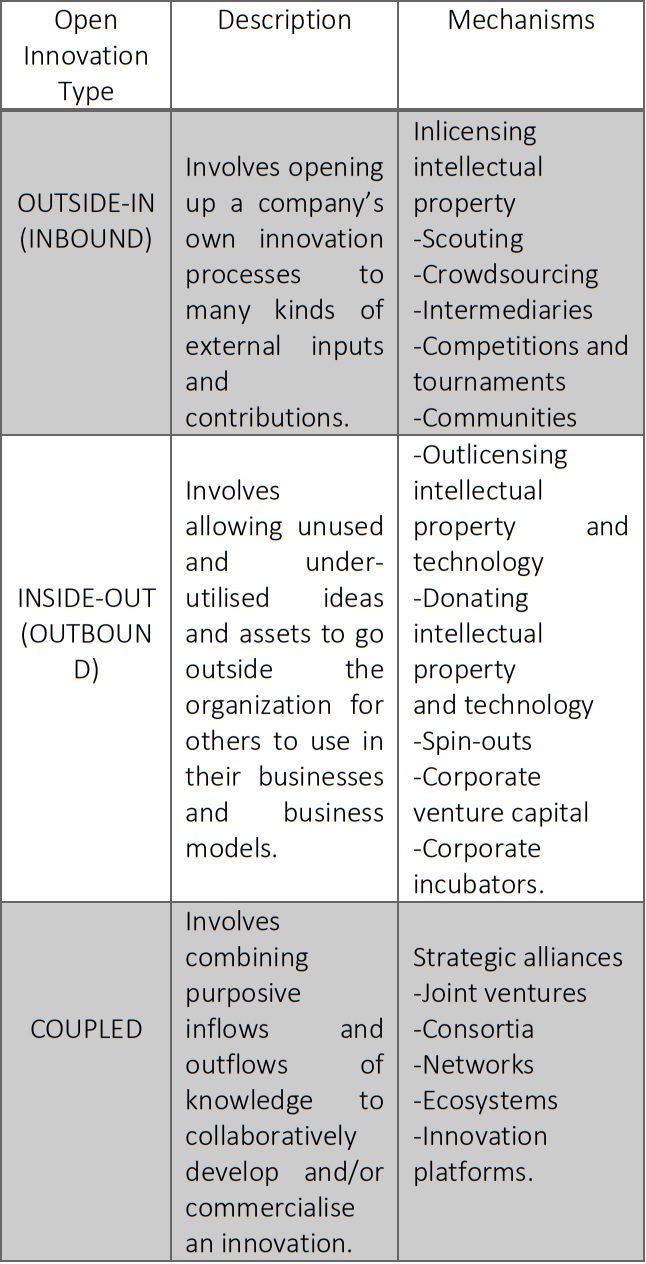
Bogers, M, "A beginner's guide to open innovation", Global Innovation Magazine, Vol 1(2), pp. 4-8, 2014.
3) Conceptual Framework and Hypotheses:
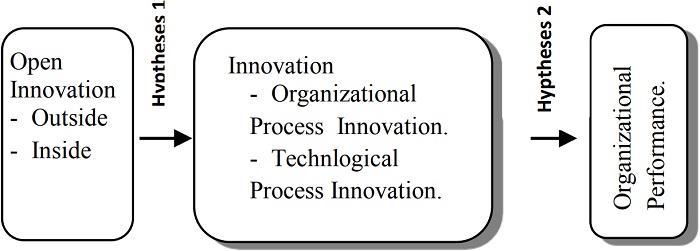
Fig 3
Research Framework
AMOS22.
Figure (03) demonstrates the conceptual framework of open innovation relationship with organizational innovation and organizational performance and indicates that open innovation positively relate to organizational innovation, Organizational innovation has also a positive relation to organizational performance.
The diffusion of innovation literature confirms the view that open innovation is the most important determinant of innovation (product and process)(Huang, Rice, 2012), (Mol, Birkinshaw, 2009), (Ganter, Hecker 2013) indicates that external sources of knowledge have a positive impact on organizational innovation, as indeed on technological processes innovation . Based on these researches illustrated above, the following hypothesis is adopted:
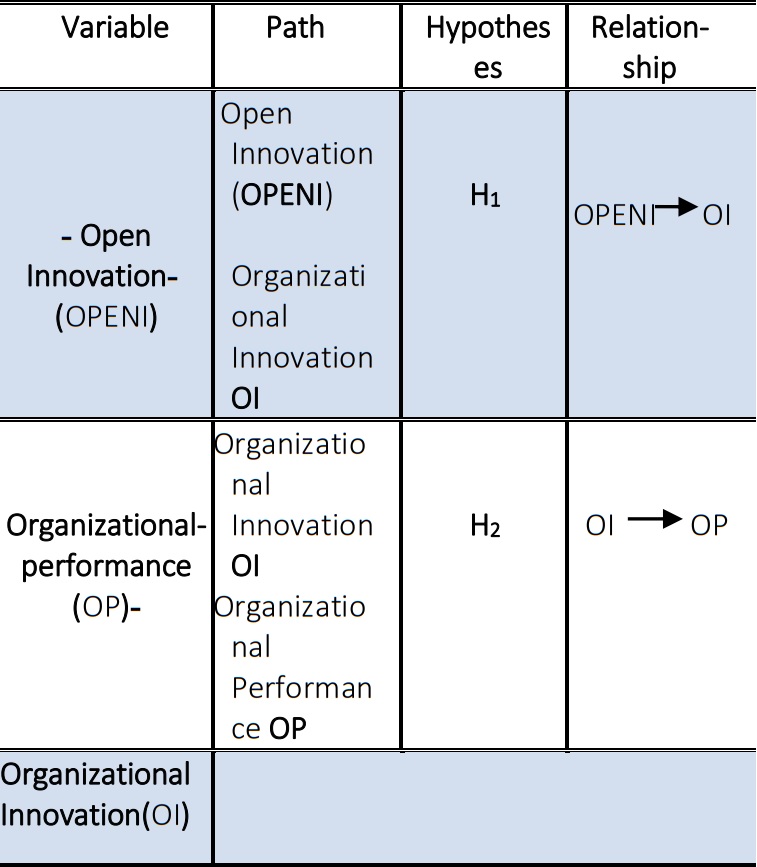
H1: open innovation positively affects Organizational innovation.
According to Neely and al, and Naoum, organizational performance is defined as “the extent to which its stakeholders requirements are met, and how economically the firm’s resources are utilized when providing a given level of customers’ satisfaction’ (zhai, 2010).
Several studies emphasize that organizational performance is the most important outputs of organizational innovation. And an organizational innovation positively affects performance, and suggests that innovation can cause grater organizational performance in any fields it deals with. This result has been approved in several types of manufactures (Damanpour et Evan, 1984),
(Subramanian, Nilakanta, 1996), (Damanpour, 1991), (Al-Bahussin, El Garaihy, 2013).Based on these researches illustrated above, the following hypothesis is adopted:
H2: Organizational innovation positively affects organizational performance.
The following table illustrates a summary of variables and hypotheses of the study.
AMOS 22.
RESEARH METHODS
A. Data collection tool
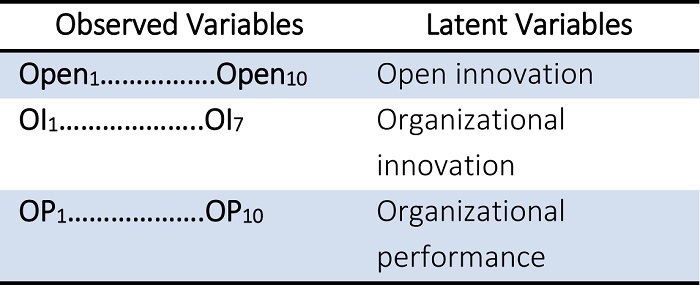
The purpose of the field study is to explore the relationships between open innovation, organizational innovation and organizational performance in the Algerian pharmaceutical company. For the purpose of testing the above stated hypotheses a questionnaire was designed, including an innovation scale adapted from previous studies which have been used and validated for studies in innovation management comprising 21 .This questionnaire was tested in a pilot study on 20 managers in SAIDAL GROUP, and it was revised according to the feedback obtained from these 20 managers and the experts of the group.
B.Data analysis tool
Data obtained through questionnaires was analyzed through the SPSS version 22.0 and AMOS version 22.0 SPSS was used to analyze the preliminary data, and AMOS for Structural Equation Modeling (SEM) for the measurement model analysis and structural model to test the proposed hypothesized model. Selected statistical methods were employed to analyze data and achieve the research objectives.
C. Sample of the study
The revised version of the questionnaire was used in the field study which was conducted through 150 questionnaires Distributed to the employees SAIDAL GROUP. This sample was derived from a population of 4000 employee. A total of 120 questionnaires were obtained and found to be valid for the analysis. This sample in total represents 03% of the Algerian pharmaceutical company.
AMOS 22.
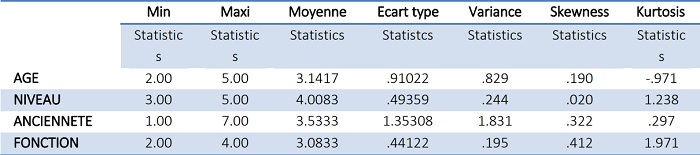
Characteristics of the sample (TABLE V)
The answers to the questions mentioned in the survey questionnaire indicated that respondents represent:
AMOS 22.
- A variety of age categories.
- The majority of respondents have a university level (Bachelor, Master).
- Most of them are top and middle management because of the nature of the organization.
- Most of them have a long experience.
QUANTITATIVE ANALYSIS
This research conducted a quantitative analysis by using the two-step approach in SEM recommended by (Hair et al, 2010). In the first step, CFA was used by conducting a measurement model evaluation in order to examine the unidimensionality, validity and reliability of latent constructs, using AMOS. In the next step, the structural model procedure was conducted in order to examine and test the hypothesized relationships between the latent constructs in the proposed research model.
A. Confirmatory factor analysis
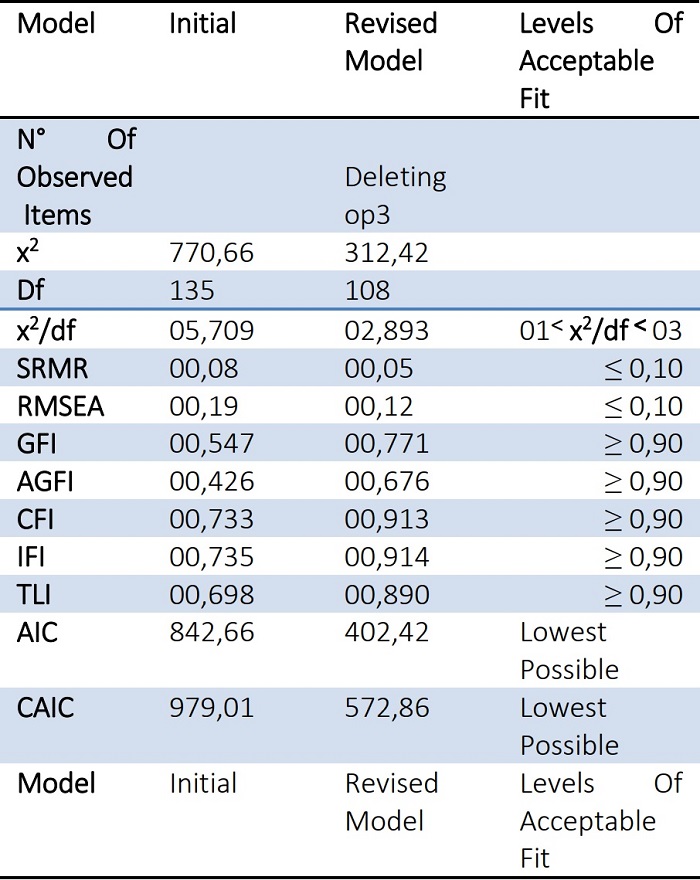
1) Measurement model: The measurement model in this study was evaluated using the Maximum Likelihood (ML) estimation techniques. Table 1 shows fit indices that assess the specification of the model. Results revealed that the values of some indices are not consistent with the recommended values of the fit indices, indicating the need for further refinement of the model. Then, in order to improve the overall fit, the modification index (MI) is checked, which indicates high error covariance between Item (op3) and (op4) (MI = 75.427).
So item (op3) is deleted in revised model. Also the model was reestimated with the covariance between errors (e11 and e17) and (e10 and e11) and (e8 and e9),(e14 and e17), (e14and e16) specified as a free parameter. The revised model is assessed again, goodness-of-fit indices of which are shown in the second row of Table VI. It can be seen that the revised model yields a more satisfactory model-data-fit statistics than the initial model.
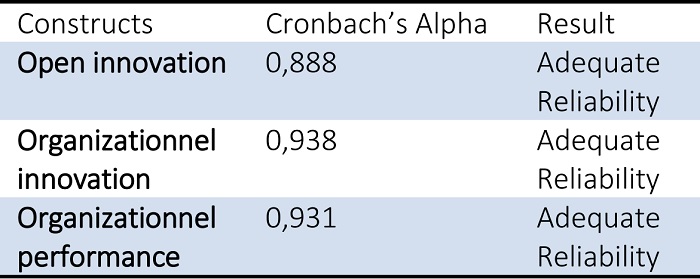
2) Reliability of constructs: In this study, Cronbach’s alpha reliability coefficients were used to assess the internal consistency of each measure.
The rule of thumb for good construct reliability is ≥0.7, which indicates that internal consistency exists (Hair et al, 2010).
Table VII shows that all constructs in the model have high internal consistency and adequate reliability.
AMOS 22.
3) Validity of Constructs: In this study, construct validity can be assessed by convergent, discriminant and nomological validity.
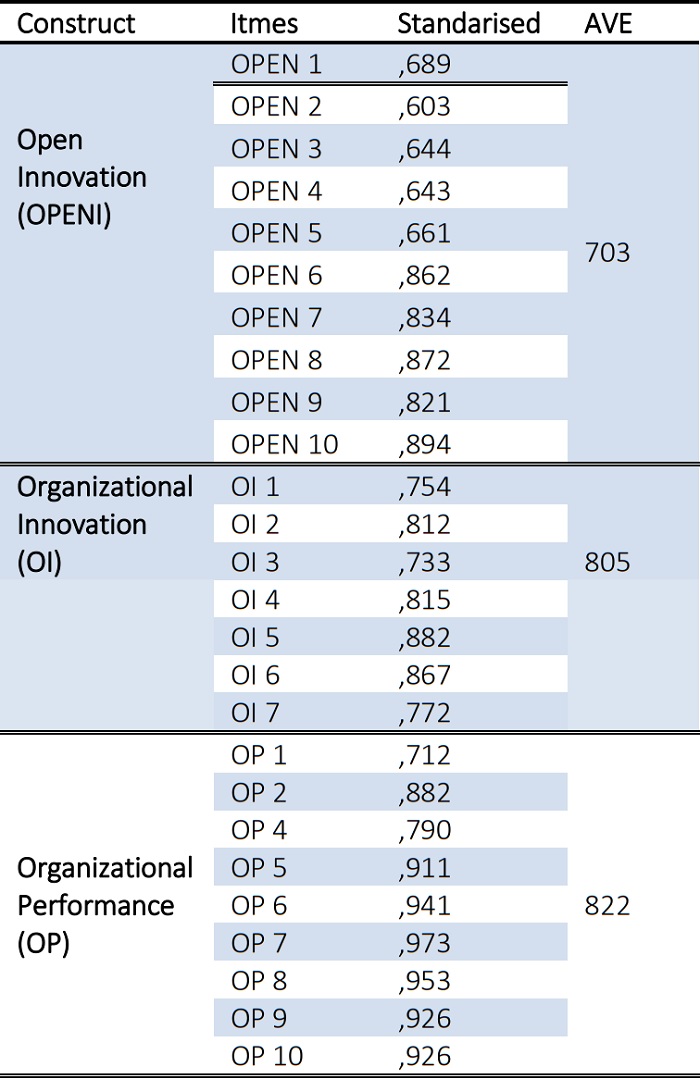
To assess the convergent validity, minimum cut-off criterion for factor loading, the standardized regression loading is >0.5, and AVE reliability > 0.5. Table 3 shows that
All the standardized regression weights (factor loadings) were greater than the minimum cut-off point (>0.5) and all AVE were greater than >0.5. The results in Table 3
Show a high level of convergent validity of the constructs.
AMOS 22.
To assess the discriminant validity, the AVE for each construct was compared with the corresponding Squared Inter-construct Correlation (SIC). The discriminant validity of each construct exists when AVE is greater than SIC.
Table 4 reveals that AVE estimates of all constructs are greater than their SIC, which demonstrates a high level of discriminant validity of the constructs.
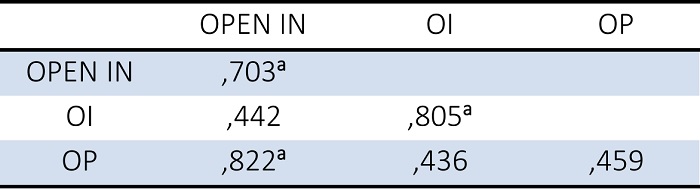
AMOS 22.Note: a Indicate average variance extraction, numbers belew the diagonal represent the square of construct correlations
The Nomological validity was tested by examining whether the correlations between the constructs in the measurement model make sense(Hair et al, 2010).In this research the construct correlations (estimates) were used
to assess the nomological validity of the model. Tables X shows that all of the estimates are positive and significant.
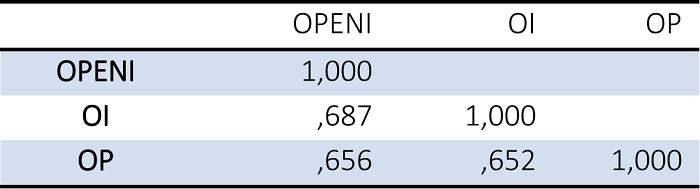
AMOS 22.
B. Structural Model
CFA results revealed reliability, validity and the goodness-of-fit of the constructs used in the measurement model. Path estimates, standardized residuals and modification indices were assessed and showed the fitness of the model. To assess the goodness-of-fit of the structure model, the same steps will be followed as with the CFA model to evaluate the significance, direction and size of the structural parameter estimates.
1) Goodness-of-fit indices of structural model: Goodness-offit indices and other parameter estimates were examined to assess the Hypothesized structural model. The fit indices show that the hypothesized structural Model provided acceptable fit with the data. The absolute fit measures and the incremental fit measures indicate goodness-of-fit of the model. Table XI shows the goodness-of-fit statistics of the structural model.
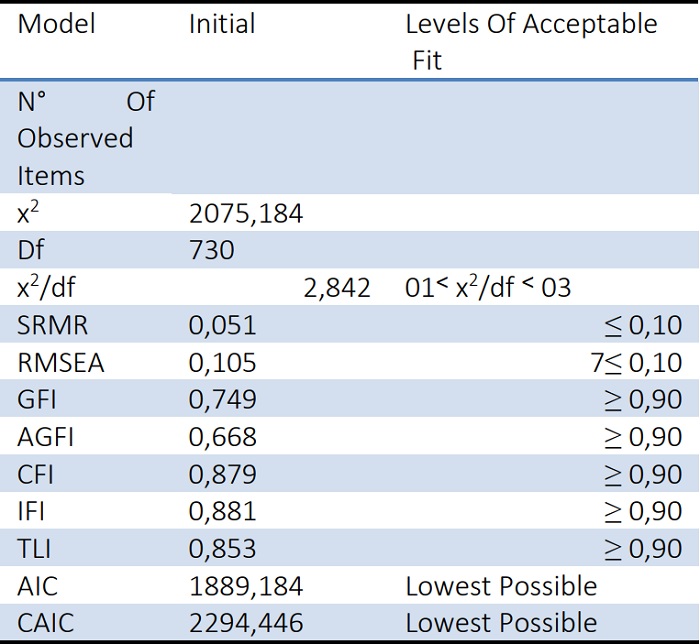
AMOS22.
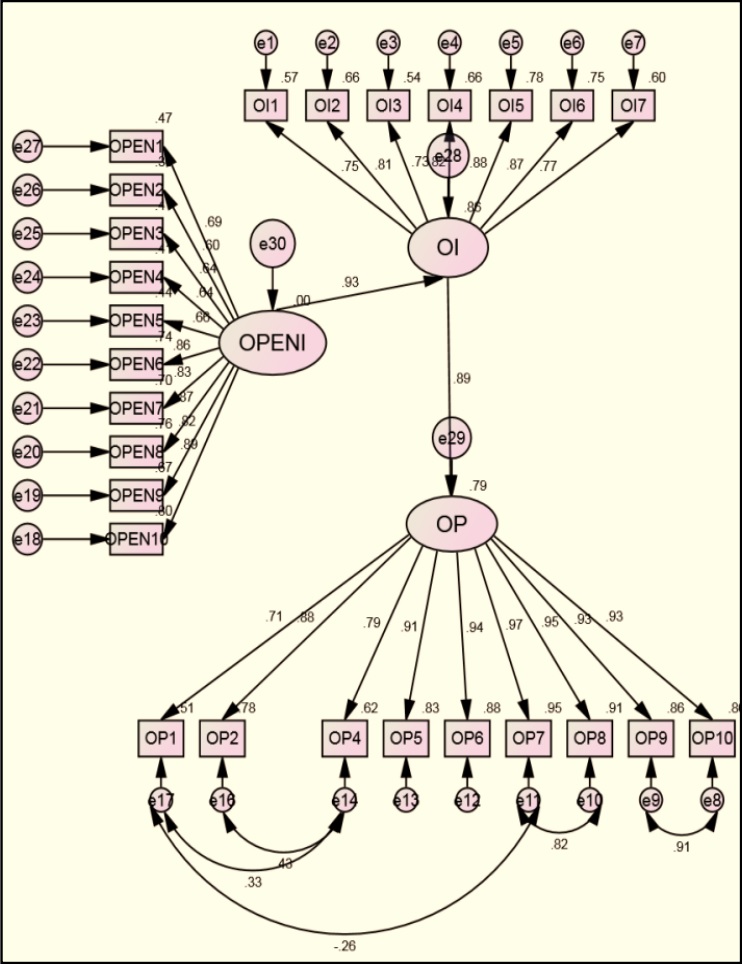
Fig 4
Structural Model.
AMOS22.
2) Hypothesis testing: the results of testing the structural model indicated that the two hypothesized paths are positive and significant. The standardized estimates for all hypotheses are statistically significant and show support for the hypotheses.
Accordingly, all hypotheses were accepted. These results are presented in Table XII.
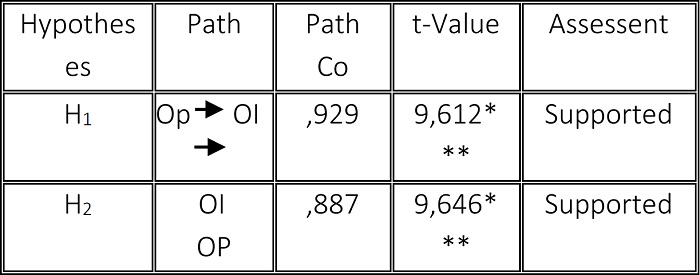
authors.Note: *** significant at P<0.001

Fig 5
SEM Specification And Relevant Hypotheses
authors.
RESULTS ANALYSIS
The assessment of the validity, reliability and goodnessof-fit of the hypothesized model of this study showed the following results:
- Confirmatory Factor Analysis (CFA) was conducted and the results showed that constructs used in the revised measurement model possessed adequate reliability, convergent, discriminant and nomological validity.
- The structural model (Figure) was assessed; the results revealed that the standardized estimates for all hypotheses are statistically significant and show support for all hypotheses.
- The results demonstrated that OPENI has a strong and positive significant effect on OI (β =0.929). The study results also showed that OI adoption has positive and significant effects on OP (β =0.887).
The following table shows the results of the structural model analysis and test hypotheses of this study:
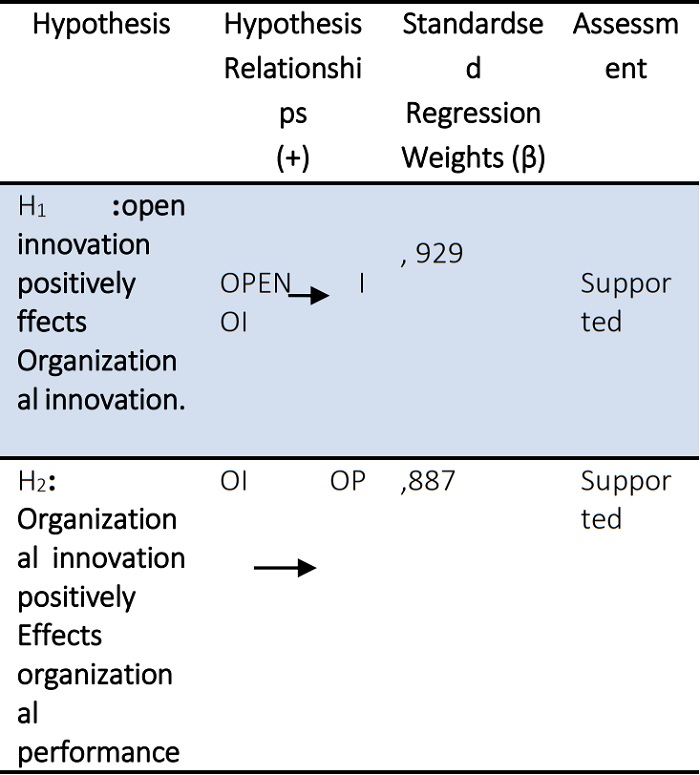
AMOS 22. H2: OI OP ,887 Suppor
Organization ted al innovation positively Effects organization
al
performance
CONCLUTIONS AND IMPLICATIONS
This paper discussed the relationship between open innovation and organizational innovation, and how the latter affects organizational performance within the context of Algerian Pharmaceutical Company. After literature review together with questionnaire DATA design and analysis, we reach conclusion as below:
Open innovation significantly affects the organizational innovation. Referring to huang and Rice (2012), Ganter and Hecker (2013), there is a relationship between open innovation and organizational innovation and according to Mol and Brikinsaw(2009), the open innovation is able to encourage creativity and nurture the organizational innovation.
Meanwhile, it is found that the open innovation is one of the variables which are considered to have an important impact on innovation through the external knowledge adoption sourcing and technology acquisition.
Moreover it is found that organizational innovation significantly affects the organizational performance this has been agreed by Al Bahussin and Elgaraily (2013) that the organizational innovation is one of the variables which are considered to have an important impact on organizational performance.
Eventually, it could be argued that the main contributions to the current study are in:
- This study provided a new conceptual framework with a set of strong Overarching themes concerning the relationship between open innovation, organizational innovation and organizational performance.
This study is distinguished from the existing empirical work by providing a model that examines the relationships between OPENI, OI and OP in pharmaceutical industry.
- This study used sophisticated statistical tools (structural equation modeling with AMOS) in testing measurement and structural models, which have been limited in previous literature.
- The findings give fruitful insights to managers, decision-makers inside SAIDAL GROUP.
- The study proposed a new conceptual framework and model that would help
IT specialists and managers in identifying new ways of leveraging and sharing knowledge by using open innovation model to support innovation process in SAIDAL GROUP.
REFERENCES
Al-bahussin Sami Abdullah, El-garaihy Wael Hassan, (2013), "The Impact of Human Resource Management Practices, Organisational Culture, Organisational Innovation and Knowledge Management on Organisational Performance in Large Saudi Organisations: Structural Equation Modeling With Conceptual
Armbruster. H, Bikfalvi. A, Kimkel. S, Lay. G, (2008), " Organizational Innovation: The Challenge of Measuring Non-Technical Innovation In Large Scale Surveys", Technovation, Vol 28, N° 10, 644-657, Mar.
Barabel Michel, Meier Olivier Et Teboul Thierry, (2008), Les fondamentaux du management, Dunod, Paris.
Birkinshaw. J, Hamel. G, Mol. M. J, (2008), "Management Innovation", Academy Of Management Review, Vol 33, N° 04, 825-845.
Bocquet Rachel, Damanpour Fariborz, Dubouloz Sandra, (2013),"Innovations De Procédés Technologiques et Organisationnels: Autécédents Et Complémentarité", Euram Conférence, Istanbul, 26-29, jun.
Bogers, M, (2014), "A beginner's guide to open innovation", Global Innovation Magazine, Vol 1(2), 4-8.
Chesbrough, H.W, (2006), Open Business Models: How to Thrive in the New Innovation Landscape, Cambridge, MA: Harvard Business School Publishing.
Chesbrough. H. W, (2003), Open Innovation: The New Imperative For Creating And Profiting From Technology, Harvard Business School Press Book.
Cornell Brent. T, (2012), “Open Innovation Stategies For Overcoming Competittive Challenges Facing Small And Mid-Sized Entreprises”, Doctorat Thesis Of Management, Maryland University College.
Damanpour Fariborz, Aravind Deepa, (2011), "Managerial Innovation: Conceptions, Processes and Antecedents", Management And Organization Review, Vol 08, N° 02, 423-454.
Damanpour, F, (1987), "The adoption of technological, administrative, and ancillary innovations impact of organizational factor", Journal of Management , Vol 13, N 4, 675-688.
Damanpour, F, (1991), "Organizational Innovation: A meta-analysis of effects of determinants and moderators", Academy of Management Journal, Vol 34, N 3, 555-590.
Damanpour. F, Evan. W. M, (1984), "Organizational Innovation And Perfomance: The Problem Organizational Lag", Administrative Science Quarterly, Vol 29, N° 03, 392409.
Edquist. Charl, Hommen Leif, Mc Kelvey Maureen, (2001), "Innovation And Employment: Process Versus Product Innovation", Cheltenham: Edward Elgar.
Evan William. M, (1966), "Organizational Lag", Human Organizations, Vol 25, N° 01, 51-53.
Ganter. A, Hecker. H, (2013), "Deciphering Antecedents Of Organizational Innovation", Journal Of Business Research, Vol 66, N° 05, 575-584.
Gassmann Oliver, (2010), Enkel Ellen, Chesbrough Henny, "The Future Of Innovation", R And D Management, 01-09.
Gunday. G, Ulusoy. G, Kiliç. K, Alpkan. L, (2011), "Effects To Innovation types On Firm Performance", International Journal of Production Economics, Vol 133, 662-676.
Hair Jr Joseph F, Black William C, Barry J. Babin, Anderson Rolph E, (2010), Multi Variate Data Analyse, Pearson Prentice Hall, Seventh Edition.
Huang. F, Rice. J, (2012), "Openness Inproduct and Process Innovation", International Journal Of Innovation Management, Vol 16, N° 04, 01-24.
Isckia, T. & Lescop, D, (2011), " Une analyse critique des fondements de l'innovation ouverte". Revue Française de Gestion, Vol 1(210), 87-98.
Kathleen R.Conner and C.K. Prahalad, (1996), "A Resource-Based Theory of Firm: Knowledge versus Opportunism" Organization Science, vol 7, Issue 5, SepOct, 477-501.
Marichal Jean-Paul, (1999), "Eléments d’analyse économique de la firme", Didact Economie, Presses Universitaires De Rennes.
Mol. M.J, Birkinshaw. J, (2009), "The Sources Of Management Innovation: When Firms Introduce New Management Practices", Journal Of Business Research, Vol 62, N° 12, 1269-1280.
Prahalad C.K., Hamel G, (1990), “The Core Competence of the Corporation”, Harvard Business Review, 79-91, MayJune.
Ramilo Runddy, Bin Embi Mohaed Rached, (2014),"Key Determinants and Barriers In Digital Innovation, Among Small Architectural Organizations", Journal Of Information Technology In Construction, Vol 19, 188-209.
Reichstein. T, Slter. A, (2006), "Investigating the Source Of Process. Innovation among UK Manufactering Firms", Industrial and Corporate Change, Vol 15, 653-682.
Sidow Mohamed Abdiaziz et Ali Yassin Shikh Ali, (2014), "Corporate Innovation And Organizational Performance: The Case Of Somalia Telecommunication Industry", International Journal of Business, Economics and Law, Vol.
Subramanian.A, Nilakanta.S, (1996), «Organizational Innovativeness: Exploring the Relationship between Organizational Determinants of Innovation, Types Of Innovation And Measures Of Organizational Performance", International Journal Of Management Science, Vol 24, N° 06, 631-647.
Zhai Xiaofeng, (2010), "The Role of Human Resource Practices in Enhancing Employees' Behaviours and Organisational Learning in Chinese Construction Organisations", Doctoral Thesis Submitted in partial fulfillment of the requirements for the award of Doctor of Philosophy, Loughborough University, Nov.