Abstract: Excellent dolomite exposures are observed in the eastern Salt Range (Pakistan), where the Cambrian Jutana Formation consists of two distinct units (i.e. oolitic – pisolitic unit and massive dolomite unit). Field observations revealed that the lower, oolitic-pisolitic unit mostly comprises medium to thick bedded, interlayered brown yellowish dolostone containing ooids/pisoids and faunal assemblages, and grey whitish sandstone with distinct depositional sedimentary features (i.e. trough-, herringbone- and hummocky-cross bedding). The upper massive dolostone unit consists of thick bedded to massive dolostone. These two units are separated by shale. Petrographic studies identified three dolomite types, which include: fine crystalline dolomite (Dol. I), medium-coarse crystalline dolomite (Dol. II) and fracture associated, coarse crystalline dolomite (Dol. III). Stable isotope studies indicate less depleted δ18O values for Dol. I (-6.44 to -3.76‰V-PDB), slightly depleted δ18O values for Dol. II (-7.73 to -5.24‰V-PDB) and more depleted δ18O values for Dol. III (-7.29 to -7.20‰V-PDB). The δ13C values of the three dolomite phases are well within the range of Cambrian sea-water signatures. Furthermore, δ26Mg-δ25Mg signatures (Dol. I; δ26Mg=-1.19 to -1.67, δ25Mg=-0.61 to -0.86 and Dol. II; δ26Mg=-1.34 to -1.59, δ25Mg=-0.70 to -0.83) indicate three phases of dolomitization in different diagenetic settings. First, an initial stage of dolomitization during the early Cambrian resulted from altered marine, Mg-rich fluids associated with mixing zone mechanism. Second, a late stage of dolomitization was associated with burial during late Permian. A third dolomitization phase was related to post-Eocene times.
Keywords:Cambrian dolomiteCambrian dolomite,Salt RangeSalt Range,Diagenetic phasesDiagenetic phases,O/C isotiopesO/C isotiopes,Mg-isotopesMg-isotopes.
Multiphase dolomitization in the Jutana Formation (Cambrian), Salt Range (Pakistan): Evidences from field observations, microscopic studies and isotopic analysis
Universitat de Barcelona
Recepción: 01 Noviembre 2017
Aprobación: 03 Septiembre 2018
Publicación: 07 Enero 2019
Khan, S., Shah, M.M., 2019. Multiphase dolomitization in the Jutana Formation (Cambrian), Salt Range (Pakistan): Evidences from field observations, microscopic studies and isotopic analysis. Geologica Acta, Vol.17.2, 1-18. DOI: 10.1344/GeologicaActa2019.17.2
Dolomite is a carbonate mineral and constitute a major part of dolostone, which is a potential reservoir rock in known giant hydrocarbon fields. Understanding its precipitation and alteration kinetics in present-day conditions remains a complex issue (Warren, 2000). Previous workers presented dolomitization schemes with various diagenetic realms that result from the interaction with fluids of different chemical composition (Dewit et al., 2014, 2012; Martin-Martin et al., 2013; Shah et al., 2012, 2010; Swennen et al., 2012; Nader et al., 2007; Gasparrini et al., 2006; Machel et al., 2004; Nader and Swennen, 2004). In various published case studies, detailed investigations using field characteristics, microscopic observations and isotope analysis (i.e. O/C and Mg-) helped in deciphering dolomite formation and associated diagenetic environment (Zhang et al., 2012; Bontognali et al., 2010; Vasconcelos et al., 2005; Machel, 2004; Machel and Lonnee, 2002; Warren, 2000; Budd, 1997; Last, 1990). According to Zenger et al. (1980), 50% of the identified hydrocarbon reservoirs in carbonate rocks are associated with dolomites, where Ghawar oil field of Saudi Arabia contains one-eighth of the world’s demonstrated reserves (Cantrell et al., 2004). Reservoirs of the Appalachian and Michigan basins of North America are also associated with dolomites (Keith, 1989).
The study area forms part of the eastern Salt Range, where Jutana Formation (Cambrian) exhibits excellent exposures in various N-S oriented gorges (Fig. 1). Maximum thickness (i.e. 84.5m) of the studied Jutana Formation is attained at the type locality near Jutana village (expressed as “G” in Fig. 1) (Shah, 2009). The underlying Kussak Formation (lower Cambrian) and the overlying Baghanwala Formation (upper Cambrian) exhibit normal contact with the Jutana Formation respectively (Shah, 2009). In the adjoining Potwar Basin, the Jutana Formation is a proven hydrocarbon reservoir which consists dominantly of dolostone (80%) and sandstone (20%) (Wandrey et al., 2004; Fig. 1). In order to better constrain the reservoir properties, the present study focuses on the study of the diagenetic evolution of the dolostone sequence of the Jutana Formation. Two selected outcrop sections were identified and sampled (i.e. Khewra gorge and exposures along M-2 motorway, eastern Salt Range, Pakistan; Fig. 1). The studied succession consists of three units (i.e. interbedded dolostone-sandstone unit and massive dolostone unit), separated by a shale interval (Shah, 2009). The existence of facies variations and more porous dolomitic intervals within the formation demonstrates its excellent hydrocarbon reservoir properties in the area (Ahmad et al., 2013; Quadri and Quadri, 1996; Kadri, 1995).
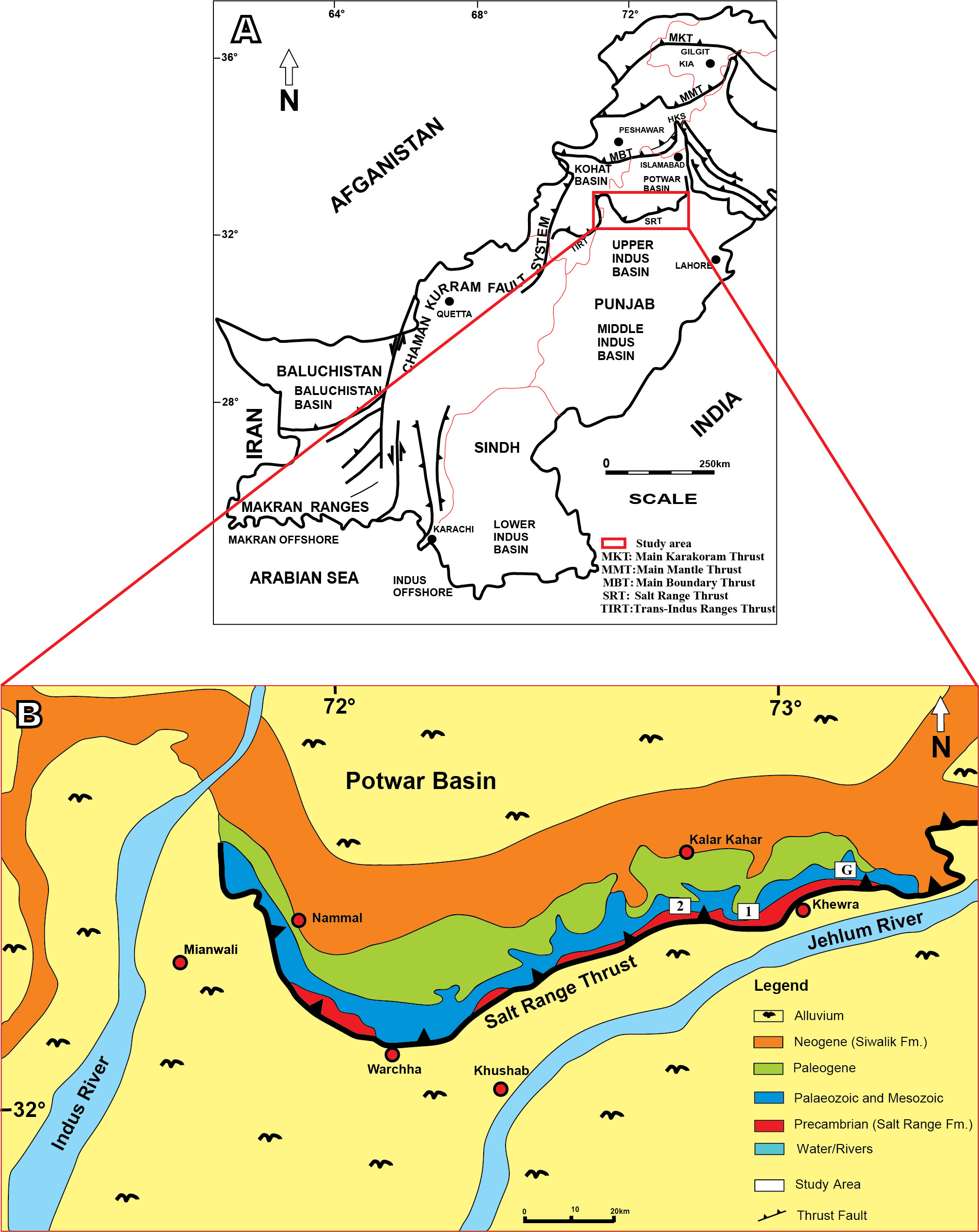
Figure 1
A) Tectonic map of Pakistan showing the location of Salt Range (red box)
B) Enlargement shows the geological map of Salt Range, where Paleozoic rocks are thrusted over Quaternary alluvial deposits along Salt Range Thrust. White squares indicate location of studied areas; 1: Khewra gorge section; 2: Motorway section, G: Jutana village.
During Cambrian times, the study area (part of the Gondwanaland) experienced warm, shallow marine conditions (Kazmi and Jan, 1997; Kadri, 1995). Deposition of clastics, evaporites and limestones took place in lagoonal and shallow marine environments (Kadri, 1995). The study area being part of the Indian plate experienced diverse climatic changes due to plate latitudinal drift from Jurassic to Miocene times. According to Chatterjee et al., 2013, the Indian plate was part of the super continent Gondwanaland, where Australia and Antarctica were situated adjacently. During early Jurassic, complete detachment of Pangea resulted in the formation of eastern and western Gondwanaland respectively, followed by northward drift of the Indian plate after detachment from Australia and Antarctica during the early Cretaceous (Chatterjee et al., 2013). In the early Cretaceous, the Indian plate collided with Kohistan-Ladakh Island Arc (KIA), followed by continental collision of the Indian and Eurasian plates during the early Eocene (Allègre et al., 1984; Molnar and Tapponnier, 1977). Continued collision of the Indo-Eurasian plates resulted in the Himalayan orogeny. Regional thrust systems developed which included the Main Karakoram Thrust (MKT, Eurasia- KIA), the Main Mantle Thrust (MMT, India-KIA), the Main Boundary Thrust (MBT) and the Salt Range Thrust (SRT), bringing older sedimentary successions on top of younger rocks (Malinconico, 1989; Gansser, 1981, 1964; Seeber and Armbruster, 1979; Fig. 1).
The study area is part of the Salt Range, where the SRT acted as a regional decollement for Paleozoic successions thrusted over Neogene sediments of the Jhelum Plain in Pleistocene times (Kazmi and Jan, 1997; Lillie et al., 1987; Yeats et al., 1984; Gee, 1945). The stratigraphic record of the Salt Range exhibits sedimentary successions from Pre-Cambrian to recent times, with the occurrence of few regional and local unconformities (Fig. 2). The studied succession (Jutana Formation) is part of the Jhelum Group, which comprises sandstone, shale and dolomite forming distinctive sedimentary cycles (Shah, 2009; Yeats and Hussain, 1987; Noetling, 1901; Fleming, 1853). The lower part of the Jutana Fm. comprises interbedded sandstone and dolostone lithologies that resulted from cyclic deposition of clastic and non-clastic sediments. Clastic sediments contain well-preserved depositional sedimentary structures (i.e. ripple marks, trough and herring-bone cross-bedding) and demonstrates a transition from sub-tidal to intertidal depositional settings (Ahmad et al., 2013; Ghauri, 1979; Khan, 1977). The upper part of the Jutana Fm. consists of massively bedded, yellow dolomite and cross-bedded (herringbone) sandstones, suggesting intertidal to supratidal depositional conditions before diagenetic modifications. The formation has its lower and upper conformable contact with the Kussak Formation (shale, greenish grey glauconitic micaceous sandstone, interbedded light grey dolomite) and Baghanwala Formation (red shale and clay with alternate beds of flaggy sandstone and cast of salt pseudomorphs) respectively, both of Cambrian age (Shah, 2009).
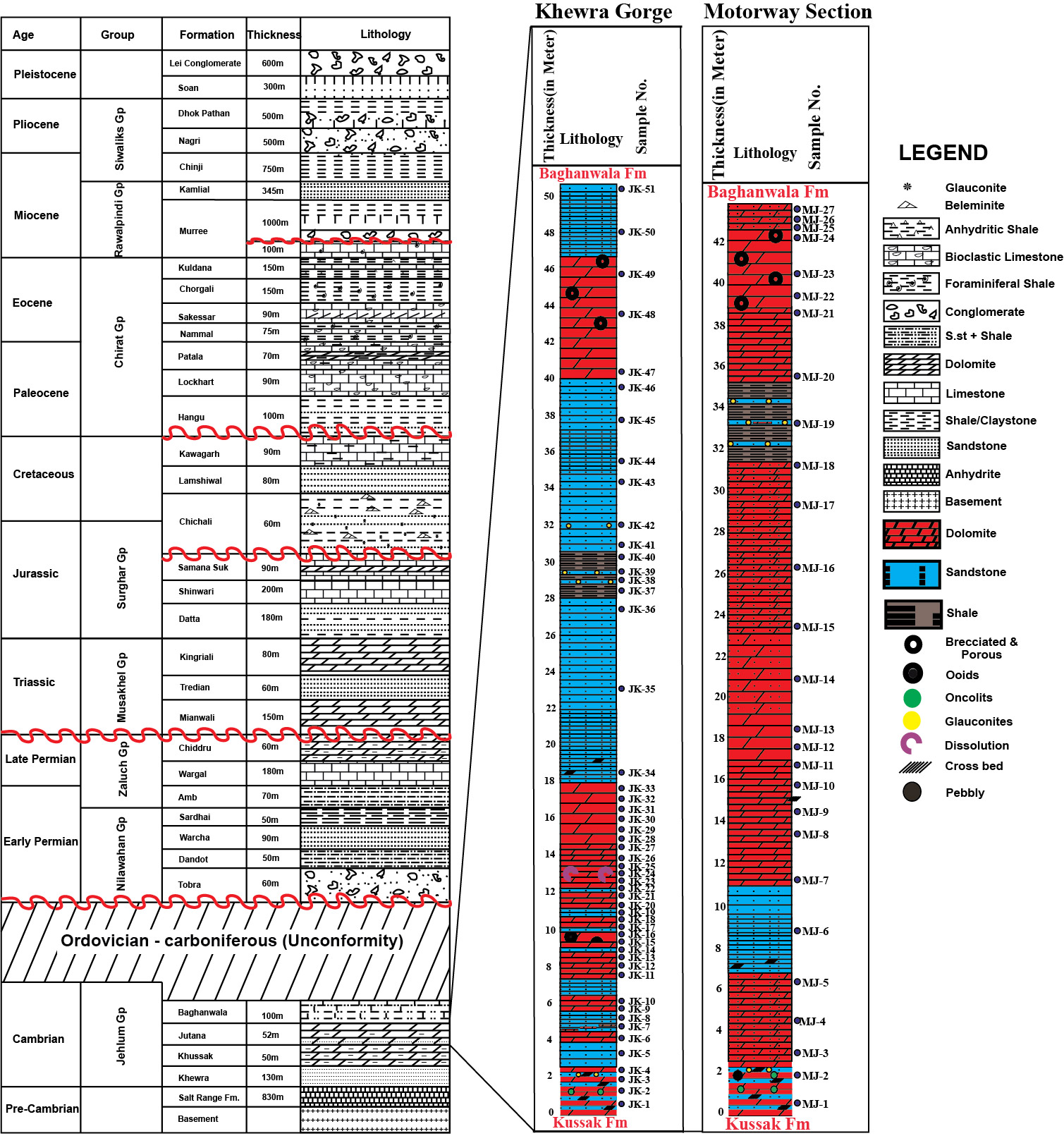
Figure 2
Lithostratigraphic chart of the Salt Range
Red undulating lines indicate unconformities (Modified after Shah, 2009). Inset columns show stratigraphic logs of two sampled sections (i.e. Khewra gorge and Motorway) of the Jutana Formation.
Field observations at the two studied sections (i.e. Khewra gorge section and Motorway section; Fig. 1) helped to identify various depositional as well as diagenetic features. Selected representative samples from both sections were examined macroscopically. In total, 183 thin sections were prepared in the thin section laboratory of Geoscience Advance Research Laboratories, Geological Survey of Pakistan, Islamabad. The thin sections were studied using polarizing microscope (Olympus CX41) with digital camera fitted (Olympus DP21) for dolomite phase identification and subsequent diagenetic environment determination. 62 stable isotopes (δ13C and δ18O) analyses were performed at Pakistan Institute of Nuclear Science and Technology (PINSTECH), Islamabad. Oxygen and carbon stable isotopic composition of dolomite phases was analyzed. Sampling was performed with a micro drill equipped with 0.4 to 1mm diameter bits. Powdered dolomite preparations were reacted with phosphoric acid for 3 and 15min respectively in vacuum at standard temperature and pressure conditions. The evolved CO2 was analyzed on a Thermo Finnigan MAT-252 mass spectrometer. Results were corrected and expressed in relation to the standard Vienna Pee Dee Belemnite (VPDB), reporting a precision of ±0.02 for δ13C V-PDB and of ±0.04 for δ18O V-PDB. In addition, 4 samples were analyzed for Mg isotopes (δ25Mg and δ26Mg) at the Institute of Geology, Mineralogy and Geophysics, Ruhr-University Bochum, Germany. The solution was dried and re-dissolved with 250μl of a 1:1 mixture of HNO3 (65 %) H2O2 (31 %). Subsequently, the solution was evaporated and again re-dissolved in 1.25M HCl. According to Immenhauser et al. (2010), Mg-bearing fraction was extracted by using ion-exchange columns (Bio-Rad ion exchange resin AG50 W-X12, 200 to 400 mesh), evaporated to dryness and a 500ppb Mg- solution (in 3.5% HNO3) was prepared. The samples were analyzed with Thermo Fisher Scientific Neptune MC-ICP- MS using DSM3 standard solution. The external precision was determined by measuring the mono-elemental solution Cambridge 1 against DSM3 standard solution repeatedly (n=4, δ25Mg:-0.75±0.02‰ 2σ and δ26Mg:-1.44±0.05‰ 2σ).
Total thickness of the Jutana Fm. in the Khewra gorge and the Motorway sections is 52m and 43.7m, respectively, where Jutana Fm. consists of three distinct units (Fig. 3A, B). These include: i) Alternating sandstone and dolomite unit; ii) Middle shale unit and iii) Massive dolostone unit.
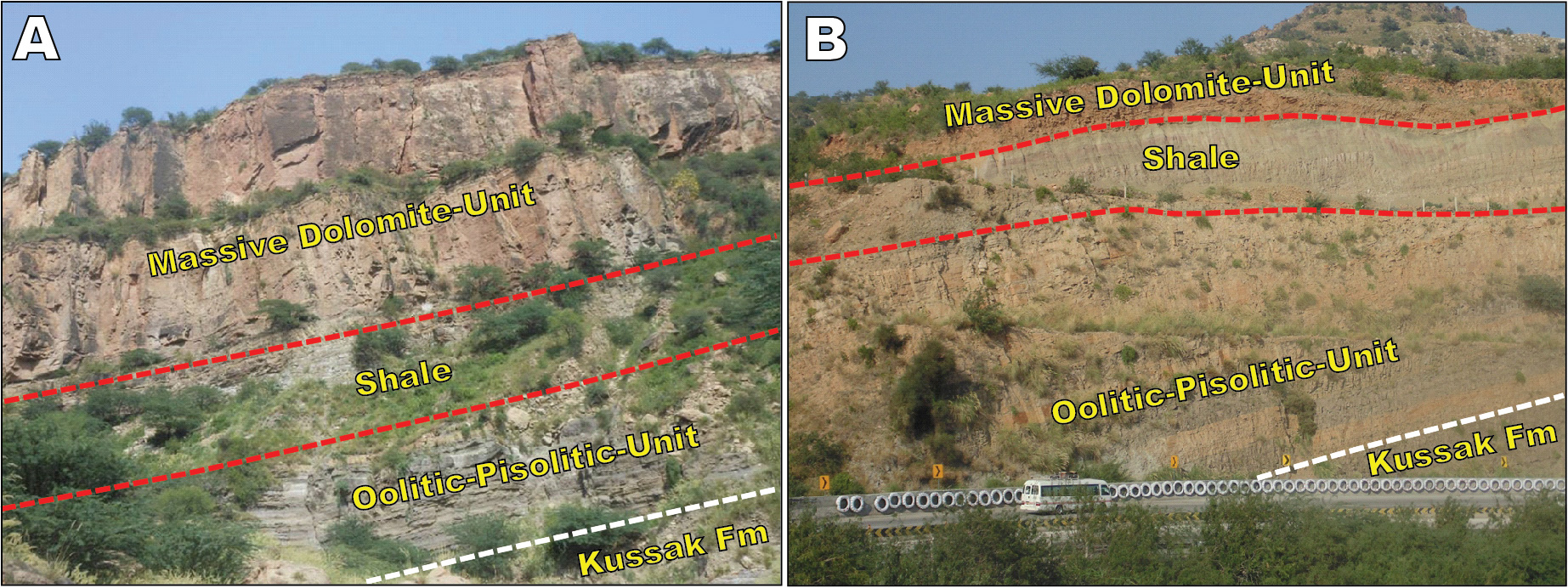
Figure 3
Field photographs of Jutana Formation (Fm.) in the eastern Salt Range:
A) stratigraphic units of Jutana Fm. in the Khewra gorge section and B) main units of Jutana Fm. in the Motorway section. The contact of Jutana Fm. with the underlying Kussak Fm. is shown in both locations.
The lower unit (the sandstone/dolostone unit) has a thickness of 31m and 28m in the Khewra gorge and motorway sections, respectively. In the Khewra gorge section, this unit represents medium to thick bedded light cream to grey color dolomites with alternating layers of medium to thinly laminated impure micaceous sandstone (Fig. 4A-C). Well preserved primary sedimentary structures (i.e. cross-bedding and ripple marks) are typically associated with sandstone successions (Fig. 4B-C). In addition, dolomite beds contain foraminiferal assemblages and centimeter scale ooids and pisolites (Fig. 4D, E). Oolitic and pisolitic beds alternating with cross- bedded sandstones, exhibit boudinage that resulted from early deformation due to overburden pressure (Fig. 4E). Bedding parallel stylolites and intensive fracturing are also found in this unit (Fig. 4F-G). In the Motorway section, excellent exposures consist of interbedded dolostone and sandstone (Fig. 4H). Oolitic-pisolitic units are frequent in the dolomitic beds. Tectonic features include faulting that resulted in step-like geometry (Fig. 4H).
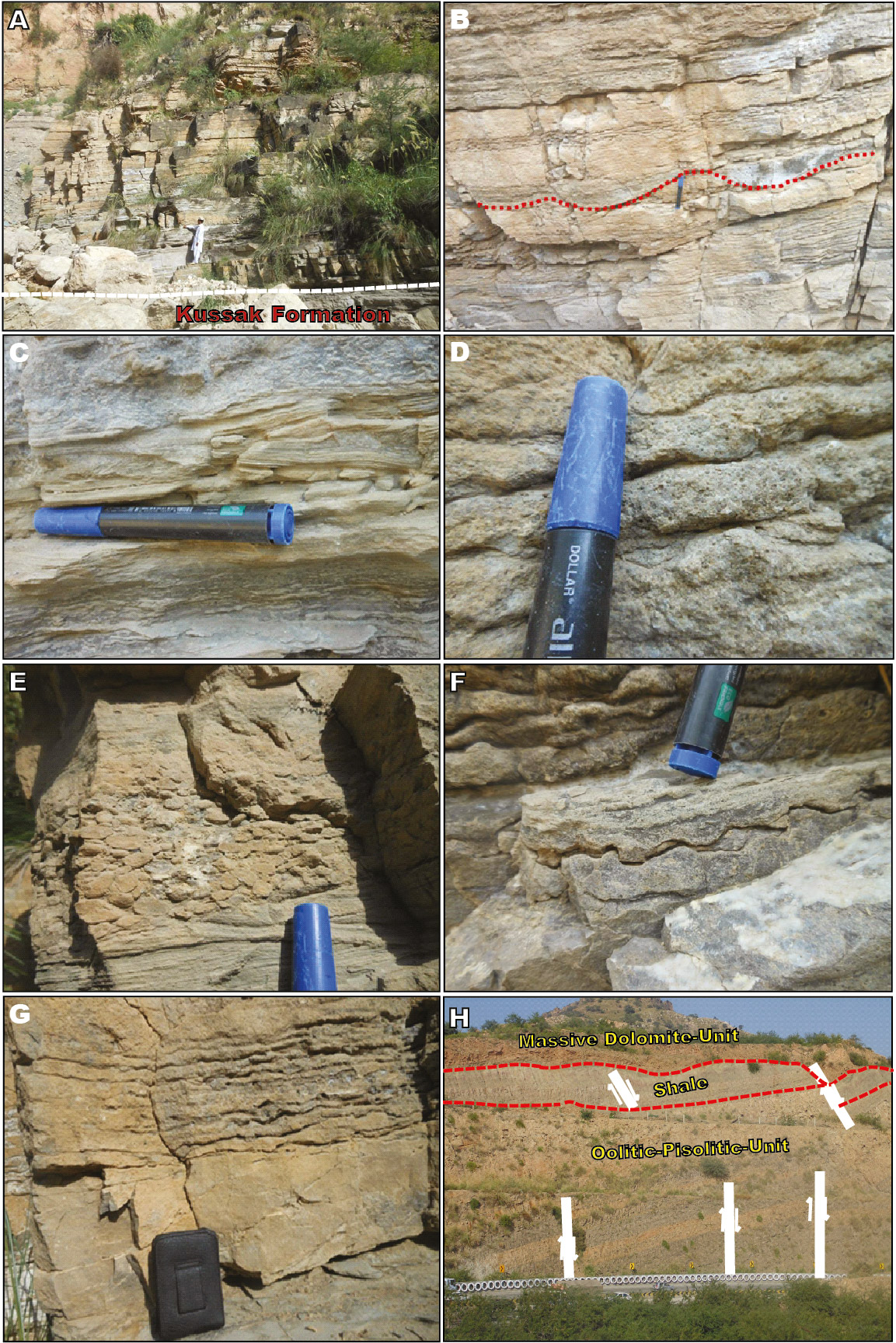
Figure 4
Detailed field characteristics of the Jutana Formation:
A) Contact between the shales of the Kussak Formation and thin to medium, interbedded sandstones and dolostone; B) Centimeter-scale ripple marks in the sandstone beds; C) Low-angle, cross bedded sandstones; D) Dolomitized limestone with preserved foraminiferal assemblages,; E) Oolitic pisolitic unit in the dolomitized part; F) Bedding parallel stylolites; G) Fractures development in the studied dolostone and H) Panoramic view of the Motorway section, showing normal faulting.
The middle shale unit is dark-grey greenish to maroon shale, interbedded with glauconitic sandstone (Fig. 5A, B). Its thickness varies from 3 to 4 meters in the studied sections (Fig. 5A). Various fossils (i.e. Linguelella fuchsi, Botsfordia, Reedlichia noetlingi and a gastropod identified as Pseudotheca ef. Subrugosa) have been reported (Teichert, 1964). This unit exhibits similarities to the underlying Kussak Formation.
The upper massive dolostone unit in the Khewra gorge section is composed of massive to thick-bedded yellow dolomite (~31m thickness), exhibiting intense fracture density (Fig. 5C). It is highly deformed, shows chop-board weathering (Fig. 5C-E), and contains isolated clast of host limestone embedded in dark grey colored dolomite (Fig. 5D). In the Motorway section, similar features as in the Khewra gorge section are observed.
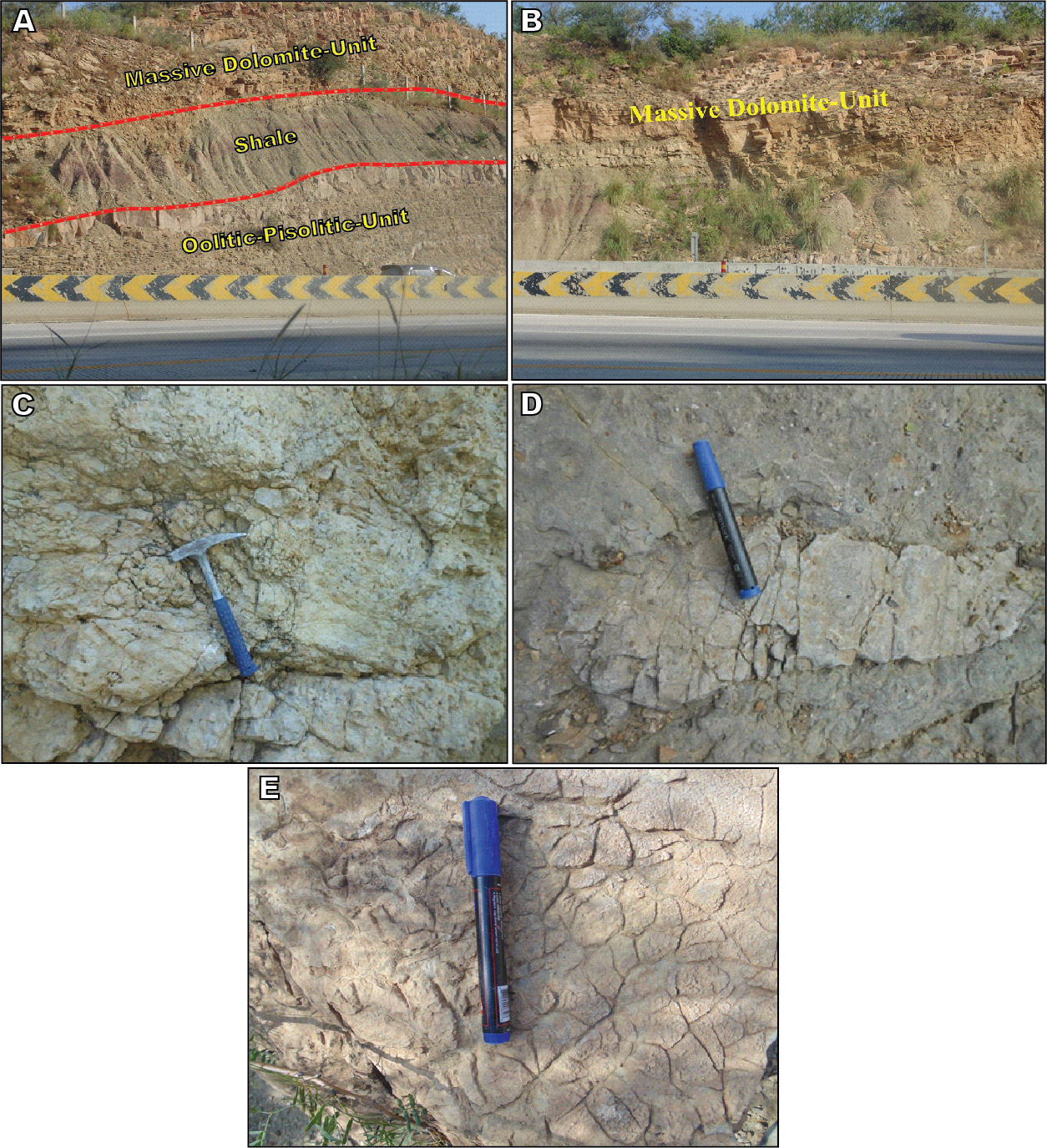
Figure 5
Field observations of Jutana Formation:
A) Along the road cut side of M-2 Motorway, the three main subdivisions of Jutana Formation are well exposed with the lower part representing the oolitic-pisolitic unit, followed by the shale unit that is overlain by the massive dolomitic unit; B) M-2 Motorway section, upper massive unit is exposed consisting of dolomite; C) Highly fractured massive dolomitic unit in the M-2 Motorway section; D) Isolated clast of host limestone embedded in dark grey colored dolomite and E) Distinct chop-board weathering observed in the massive dolomite unit of Khewra section.
Thin sections of precursor limestone (partially dolomitized) showed distinct depositional features that include ooids, pisolites, intraclasts, foraminiferal assemblages, and relics of various unidentified fossils. Partially altered limestone contain ooids with concentric rims, whereas similar ooids are completely dolomitized in other parts of the studied sections (Fig. 6A-B). It is noteworthy that the upper part of the Jutana Formation shows relics of precursor limestone, whereas the lower part is completely dolomitized. In the next section, the various dolomite phases are discussed in order to understand the diagenetic processes that affected the studied rocks, which include: i) fine crystalline, euhedral dolomite matrix (Dol I) that form the major part of the dolomitized Jutana Formation, followed by ii) medium to coarse crystalline, anhedral dolomite (Dol. II) mostly observed in replaced ooids and pisolites (Fig. 6C-F) and iii) coarse crystalline, anhedral dolomite cement (Dol. III) exhibiting fracture- filling and saddle type dolomite cement (Figs. 6D; 7A-B).
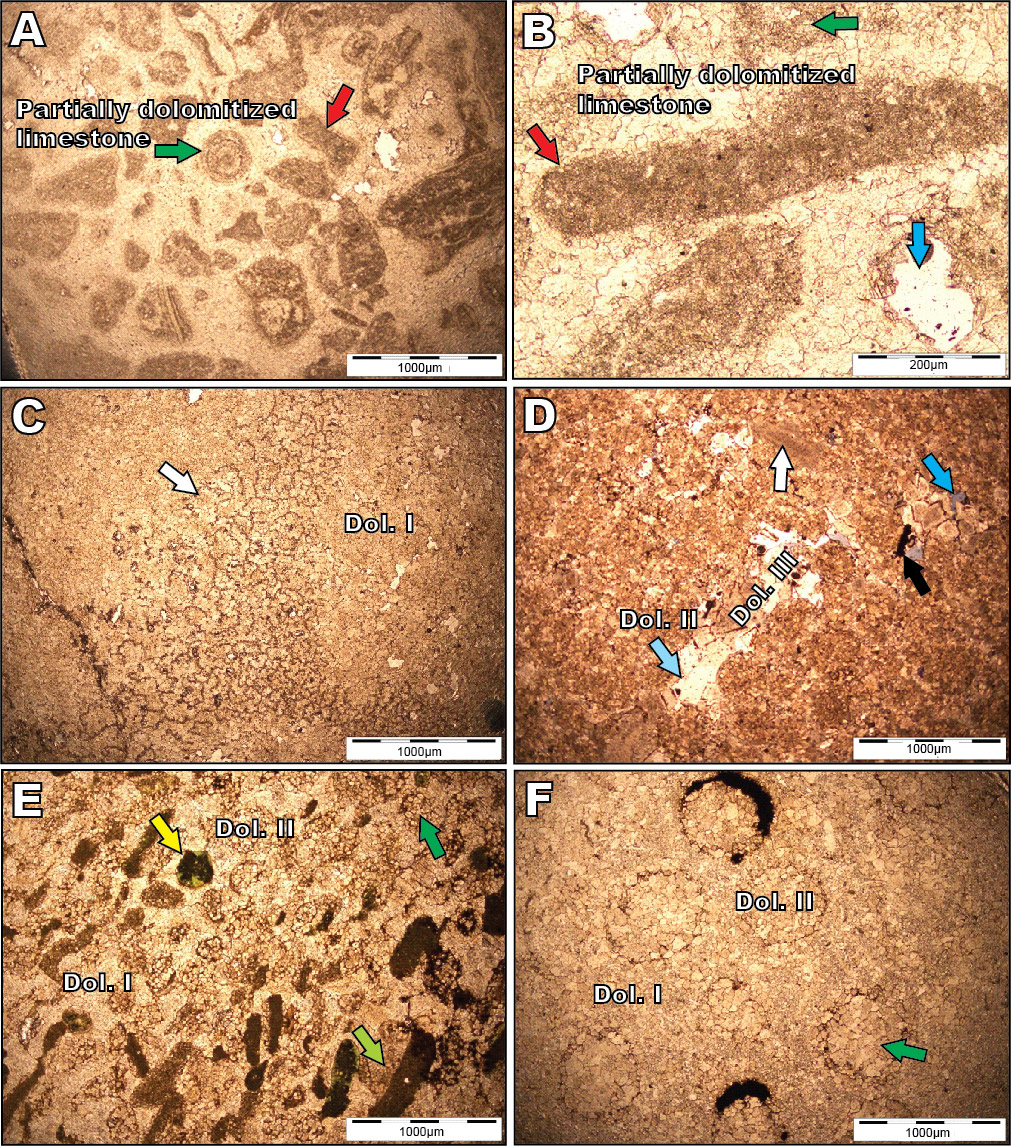
Figure 6
Petrographic characteristics of the studied Jutana Formation (Photomicrographs, Plane-Polarized Light, PPL):
A) Partially dolomitized limestone with intraclasts (red arrow) and ooids (green arrow); B) Close up of a partially dolomitized intraclast (red arrow) surrounded by off-white colored, coarse crystalline dolomite cement. Note ooid (green arrow) and vuggy porosity (blue arrow); C) Fine to medium crystalline dolomite (Dol. I) containing well preserved algae (white arrow); D) Medium to coarse crystalline dolomite (Dol. II) containing fracture-filled, coarse crystalline dolomite cement (Dol. III), pyrite observed in the fracture-fillings (black arrow), skeletal fragments (white arrow). D) Points fracture porosity (dark blue arrow) and cement (light blue arrow); E) Fine crystalline dolomite (Dol. I) containing oolite (green arrow) filled with medium-coarse crystalline dolomite (Dol. II), glauconite (yellow arrow) and intraclast (light green arrow) and F) Fine crystalline dolomite (Dol. I) and medium-coarse crystalline dolomite (Dol. II) with ooid (green arrow) modified to coarse crystalline dolomite. Both E and F contain ooids of different sizes.
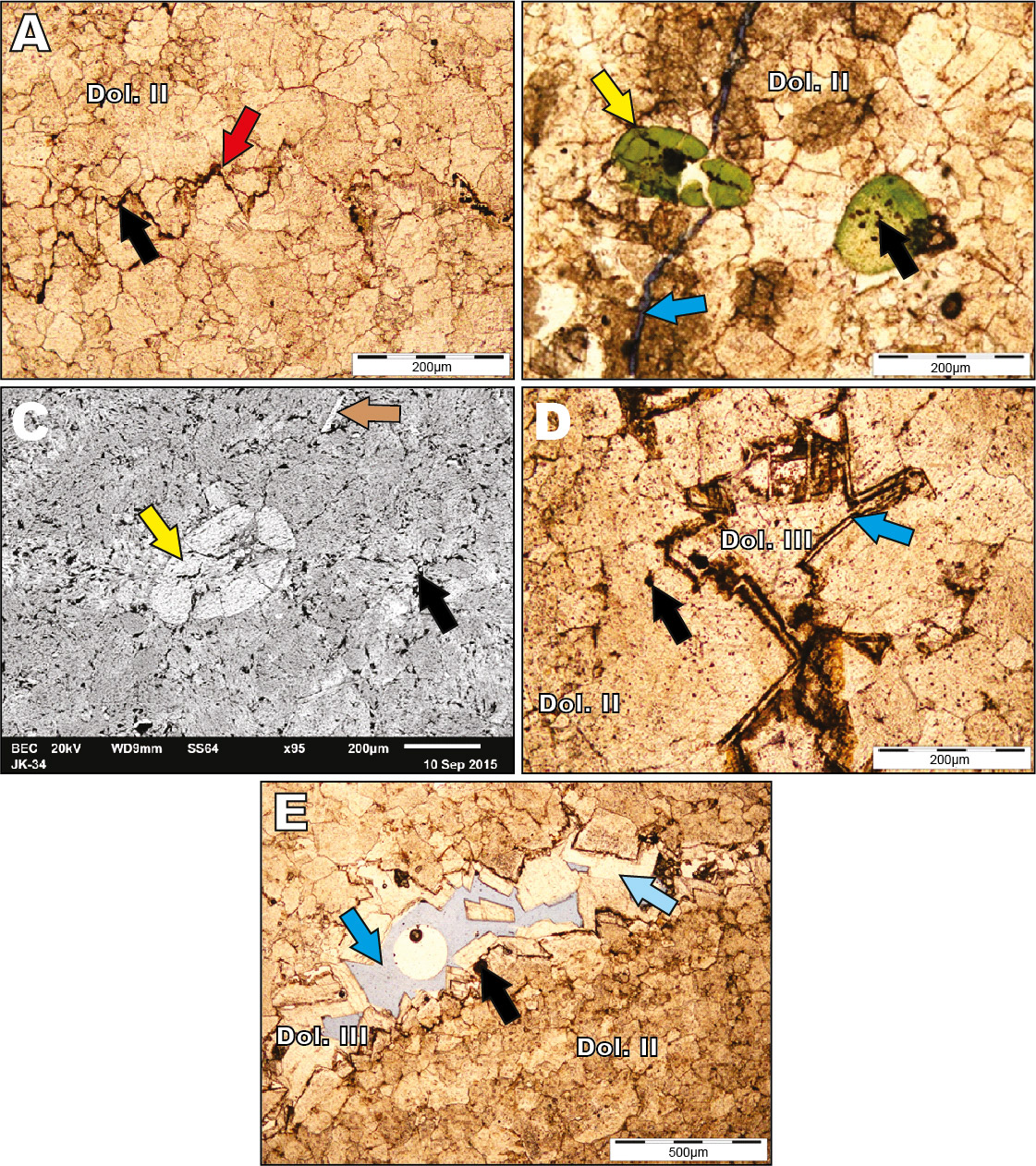
Figure 7
Photomicrographs showing the petrographic characteristics of the Jutana Formation
A) Pressure dissolution stylolite (red arrow) in medium-coarse crystalline dolomite (Dol. II) and pyrite (black arrow) along stylolites; B) Green glauconite (yellow arrow) in dolomite and pyrite clasts within fractured glauconite (black arrow), fracture porosity is evident as open fractures (blue arrow); C) Back scattered SEM image, glowing white glauconite (yellow arrow) embedded in light grey colored medium to coarse dolomite (Dol. II), black arrow indicate Fe-residue, lathe shaped mica (brown arrow). D) Medium to coarse crystalline dolomite contains fracture filling, coarse crystalline dolomite (Dol. III) with dark colored crystal boundary (blue arrow), sparse distribution of pyrite is indicated by black arrow; E) Crystal growth cementation in coarse crystalline fracture filling dolomite (Dol. III), whereas porosity reduction (dark blue arrow) is evident due to calcite cementation (light blue arrow), pyrite is distribute dalong the fractures (black arrow).
In the Khewra gorge section, microcrystalline to fine crystalline dolomite (Dol. I) is of light grey color (Fig. 6C). Such replacive dolomite exhibits crystal size <10μm, displays nonplanar-a to planar-s texture with irregular intercrystalline boundaries, and is characterised by the fabric preservation of the precursor lithology (Fig. 6C-D), containing partially altered ooids and peloids respectively (Fig. 6D). In addition, vuggy and moldic porosity form part of such dolomite in the Khewra gorge section (Fig. 6B, D).
In the Motorway section, Dol. I is characterised by matrix associated finely crystalline dolomite (Fig. 6E, F). The dolomite crystals are relatively closely packed, equigranular, euhedral to subhedral. Dol. I mostly occurs around oolitic and peloidal grains, which are completely replaced by medium to coarse crystalline dolomite (Dol. II; Fig. 6E, F). In addition, Fe- rich residue (i.e. pyrite) mostly occurs along the crystal boundaries in all observed dolomite types (Fig. 6D).
In the Khewra gorge section, brown, medium to coarse crystalline planar-s to planar-e type dolomite (Dol. II) mostly occurs as replacive dolomite (Sibley and Gregg, 1987). The crystal size of such dolomite ranges from 90 to 200μm, and is characterized by its fabric destructive character and local preservation of the precursor’s texture (Fig. 6D). It is noticeable the presence of pores and relics of various fossil fragments (Fig. 6D). Other associated features include; fabric destructive fractures and seams of stylolites, where dark pyrite occur along stylolite seams (Fig. 7A). Petrographic studies and scanning electron microscopy also shows pyrite crystals engulfed in glauconite grains (Fig. 7B, C). In general, porosity is negligible, but fracture-associated porosity is observable in Dol. II (Fig. 7E).
According to Sibley and Gregg (1987), Dol. II are planar/idiotopic-e to planar/idiotopic-s in the Motorway section. In this section, replacive dolomite (Dol. II) mostly occurs in replaced ooids (Fig. 6E), where the abundance of the replaced ooids is high compared to Khewra gorge section (Fig. 6E, F). Some unidentified skeletal fragments and burrows are also present (Fig. 6E). Dol. II displays scattered rounded pale-green glauconitic grains (Figs. 6E; 7B). Dol. II is locally highly fractured, and the fractures are filled with calcite cement (Figs. 7B). In addition, the presence of iron leaching along fractures has been observed (Fig. 6D).
This phase shows the presence of coarse crystalline, fracture filling dolomite cement (Dol. III; Fig.7D, E). Crystal size varies from 200μm up to 3mm with planar-nonplanar and euhedral to subhedral textural characteristics. Dol. III mostly occurs along fracture openings, in the form of coated cement around Dol. I and Dol. II crystals (Fig. 7D). The growth of dolomite is clear along fractures showing multiple growth rims (Fig. 7D). In the studied samples, the residual space after Dol. III cement precipitation is filled by calcite cement (Fig. 7D). Likewise, samples from the Motorway section exhibits dolomite cements of equant, planar to nonplanar and euhedral to subhedral crystals (Fig. 7E). In contrast, samples from the Khewra gorge section have dolomite cement rims of Dol. III relatively thicker than dolomite rims exhibited in the Motorway section (Fig. 7E).
Similarly, Dol. III is mostly associated with fractures and openings in the earlier formed dolomite matrix (i.e. Dol. I and Dol. II) (Fig. 7E). Besides dolomitization, other features include the presence of rounded, sparsely distributed pale- green colored glauconite (Figs. 6E; 7B, D-E). In addition, accessory heavy minerals are also observed (Fig. 7E). Lastly, fracture porosity is partly filled by calcite cement, which mark the end of diagenetic history of the studied rocks (Fig. 7E).
Based on stable isotopes (i.e. δ18O and δ13C), deviation from marine signatures indicate diagenetic imprints on the studied rocks. According to Prokoph et al. (2008) and Veizer et al. (1999), Cambrian marine signatures ranged from -1.00 to 0.00‰V-PDB (δ18O), whereas δ13C signatures tend to range from -2.00 to 0.00‰V-PDB. In the studied sites, the different dolomite phases exhibited a wide range of isotopic signatures (Fig. 8; Table 1). These include Dol. I (δ18O=-6.44 to -3.76‰V-PDB; δ13C=-0.54 to +0.35), Dol. II (δ18O=-7.73 to -5.24‰V-PDB; δ13C= 0.09 to -1.83), and Dol. III (δ18O=-7.29 and -7.20‰V-PDB; δ13C=-1.83 and -1.83). Stable isotope signatures indicate slightly depleted δ18O and δ13C values compared to Cambrian marine environments.
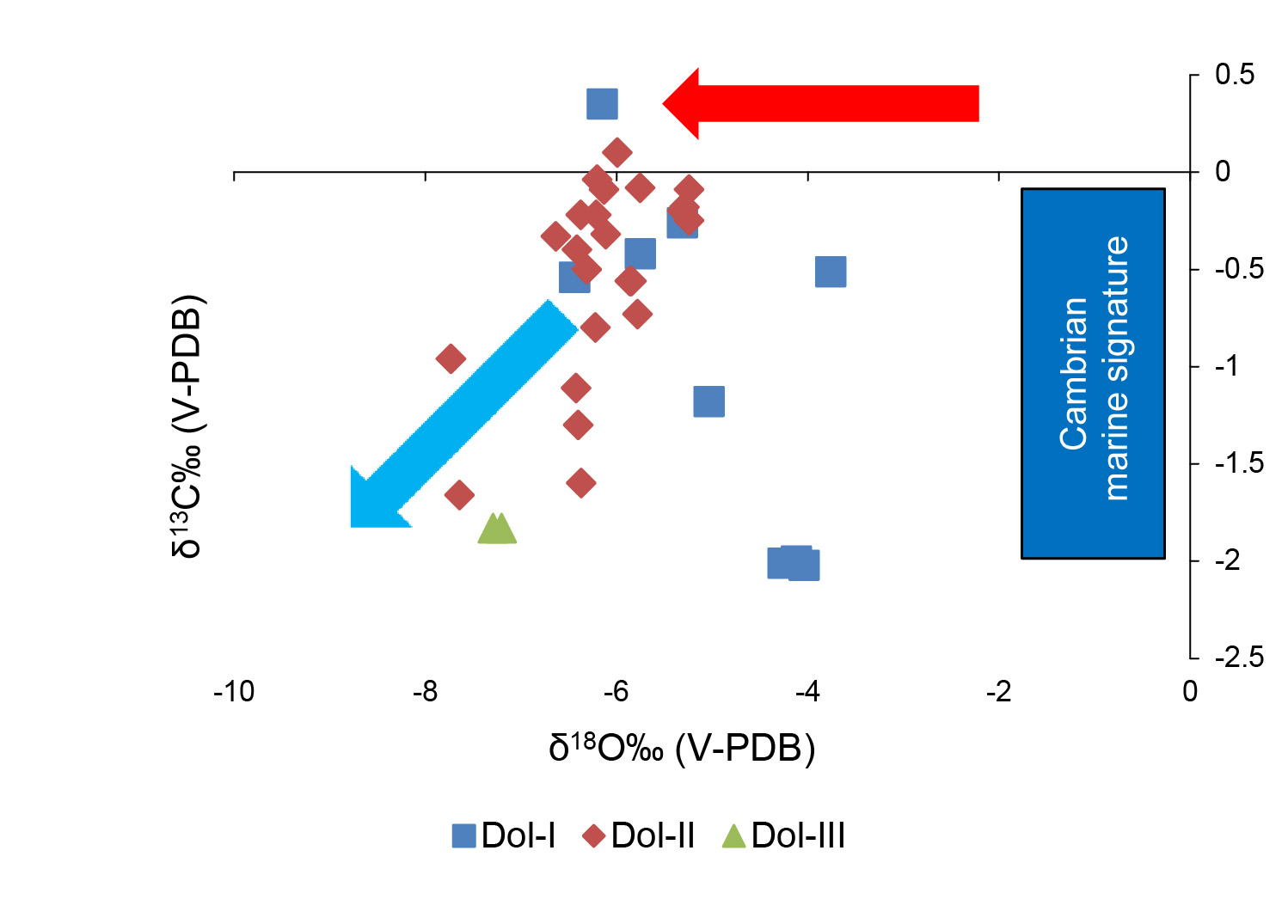
Figure 8
Stable isotopes (C and O) signatures of samples from the Khewra gorge and Motorway sections (see the sections in Fig. 2).
Theseisotopic signatures indicate depletion of δ18O compared to Cambrianmarine limestones (red arrow), whereas δ13C signatures of the studieddolomite phases are within the range of precursor limestone (blue arrow).
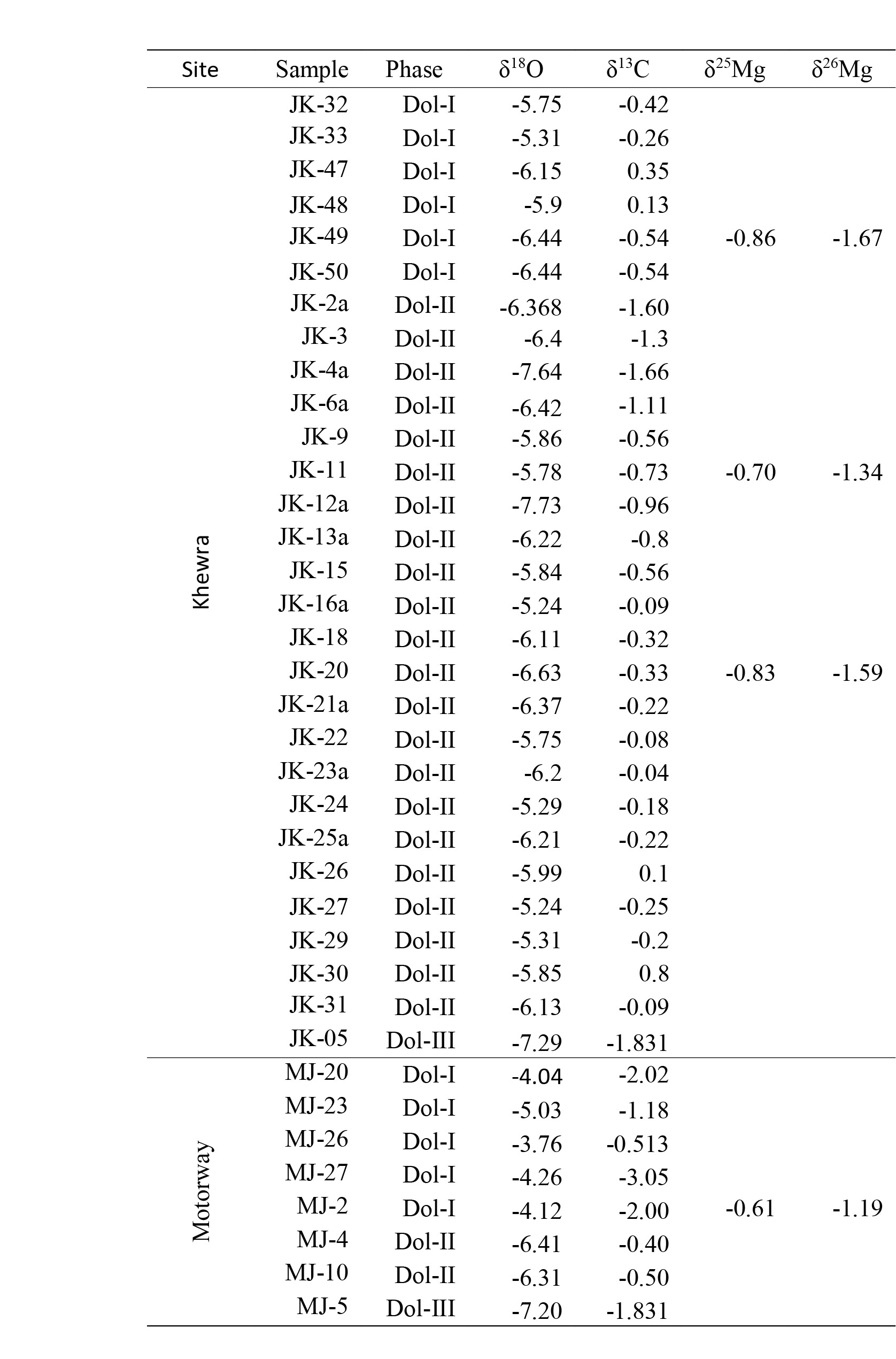
Table 1
O/C and Mg isotopes results of selected samples from the studied sections
Mg-isotope signatures are important for systematic investigations of various types of diagenetic dolomites formed from different settings and time intervals worldwide (Geske et al., 2014). In four representative samples from the studied sections, δ26Mg ranges from -1.19 to -1.67‰ in Dol. I, and from -1.34 to -1.59‰ in Dol. II, while δ25Mg ranges from -0.61 to -0.86 in Dol. I, and from -0.70 to -0.83‰ in Dol. II (Fig. 9; Table 1).
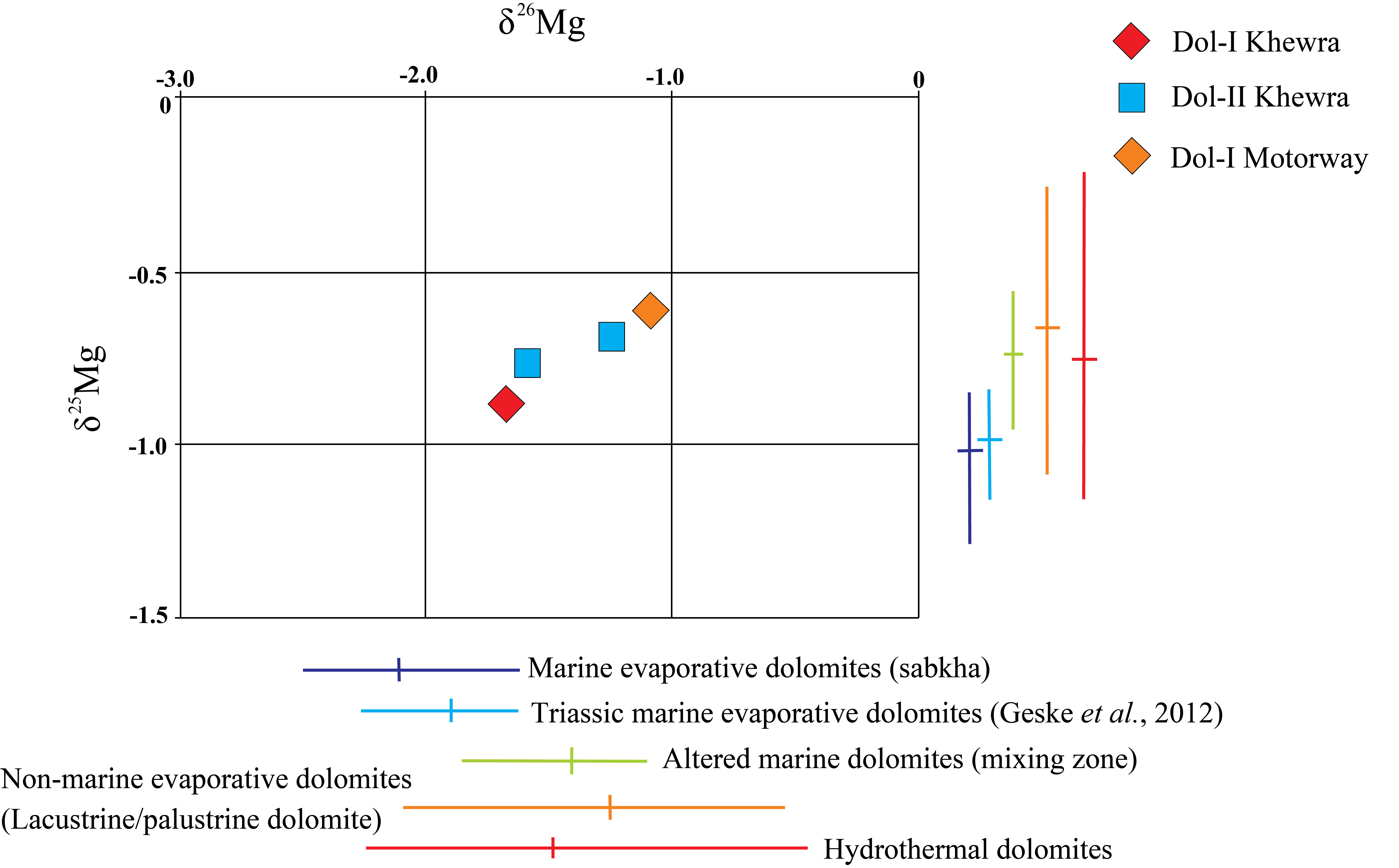
Figure 9
Cross plot of Mg-isotopes results (δ25Mg vs.δ26Mg) of the studied sections according to Geske et al.(2015)
The two studied locations of the Jutana Formation (i.e. Khewra gorge and Motorway sections) show alternating sandstone and dolostone beds, which contain preserved primary features (i.e. ooids and foraminifera, ripple marks and cross-bedding). Petrographic studies distinguished three dolomite phases in the studied rocks (i.e. Dol. I, Dol. II and Dol. III (Figs. 6; 7). The presence of glauconite indicates restricted marine condition under low sediment supply conditions (Amorosi, 1997; Odin and matter, 1981; McRae, 1972). Constraints on the relative timing of dolomitization were fundamented on a number of observations. It is observed that an initial phase of partial dolomitization affected the host limestone in the earliest stage of diagenesis. The matrix of the limestone underwent complete dolomitization into Dol. I (Fig. 10A), while ooids and other intraclasts remained unaltered. This argument is supported by three main evidences, which are described as follows. Petrographic observations indicate the presence of quartz grains (average: 8-10%) in the matrix dolomite, which is also confirmed by XRD analysis in another studies (Shah and Khan, accepted). Furthermore, less depleted oxygen isotope signatures (-6.44 to -3.76‰V-PDB) further support Dol. I formation in the earliest stage of diagenesis during the early Cambrian (Fig. 2). As documented in various studies, meteoric diagenesis could have played an active role in the dissolution of ooids during a period of subaerial exposure (Honarmand and Amini, 2012; Mazullo, 1977; Sellwood and Beckett, 1991). Dissolution of unaltered ooids and intraclasts in the partially dolomitized limestone during Ordovician- Carboniferous exposure (Fig. 2) could result from percolating of meteoric fluids, which might have passed through the overlying Baghanwala Formation. During Permian deposition, precipitation of Dol. II in the dissolved ooids is more likely as evidenced by the presence of stylolites post- dating Dol. II (Figs. 7A; 10B). Dol. III represents last stage of dolomitization, where coarse crystalline, saddle type dolomite filled open fractures in Dol. I and II respectively (Figs. 6D; 7D- E). Nonplanar, saddle dolomite exhibits undulose extinction, which is typical of burial conditions (Radke and Mathis, 1980). Such dolomites (i.e. Dol. III) formed under tectonic influence (fracture-filling) and burial under ~5000m-thick sedimentary cover, which might be linked to post orogeny (i.e. post Eocene), and before the emplacement of Salt Range Thrust during Pliocene-Pleistocene time (Yeats et al., 1984). Other diagenetic features include the presence of calcite and pyrite, which mark the end of diagenetic history of the studied successions (Figs. 7B-C; 11).
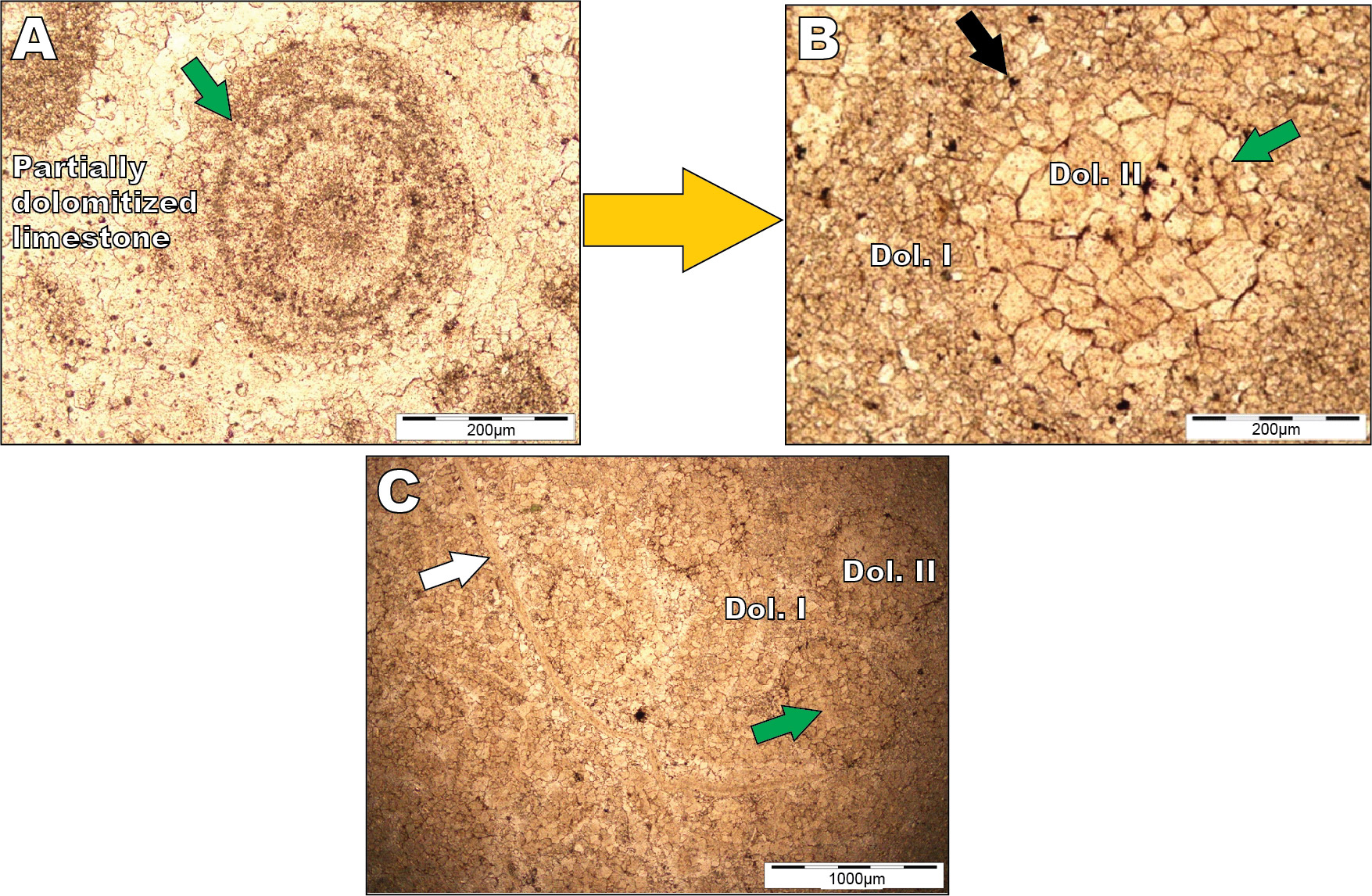
Figure 10
Sedimentary facies precursors and diagenetic modifications observed in the studied rocks (Photomicrographs, PPL):
A) Partially dolomitized limestone; green arrow: ooid; B) Medium-coarse crystalline dolomite (Dol. II) and fine crystalline dolomite (Dol. I); green arrow: ooid modified to coarse crystalline dolomite, black arrow: iron/heavy mineral residue and C) Fine crystalline dolomite (Dol. I) and medium-coarse crystalline dolomite (Dol. II) with fossil fragments; white arrow: fossil fragment, green arrow: ooid modified to coarse crystalline dolomite.
Isotope studies (C, O, Mg) helped constraining dolomitizing fluid chemistry, which lead us to propose possible mechanism of dolomitization (Bowen et al., 2008; Jaffres et al., 2007). O/C isotope signatures indicate less depleted δ18O values for Dol. I, whereas Dol. II and Dol. III represent more depleted δ18O values (Fig. 8). In contrast, reported δ13C values of various dolomite phases are within the range of original marine signatures of the host limestone (i.e. Cambrian), thus the carbon isotopic composition of the dolomitizing fluids may have been buffered by the host rock. Mg- isotope signatures further helped in constraining diagenetic conditions. Based on Geske et al. (2015), δ25Mg vs. δ26Mg crossplot indicates three possible sources of dolomitizing fluids for Dol. I, Dol. II and Dol. III events that include burial activity, non-marine lacustrine or palustrine process and/or altered marine, mixing zone process for dolomitization in the Jutana Formation (Fig. 9).
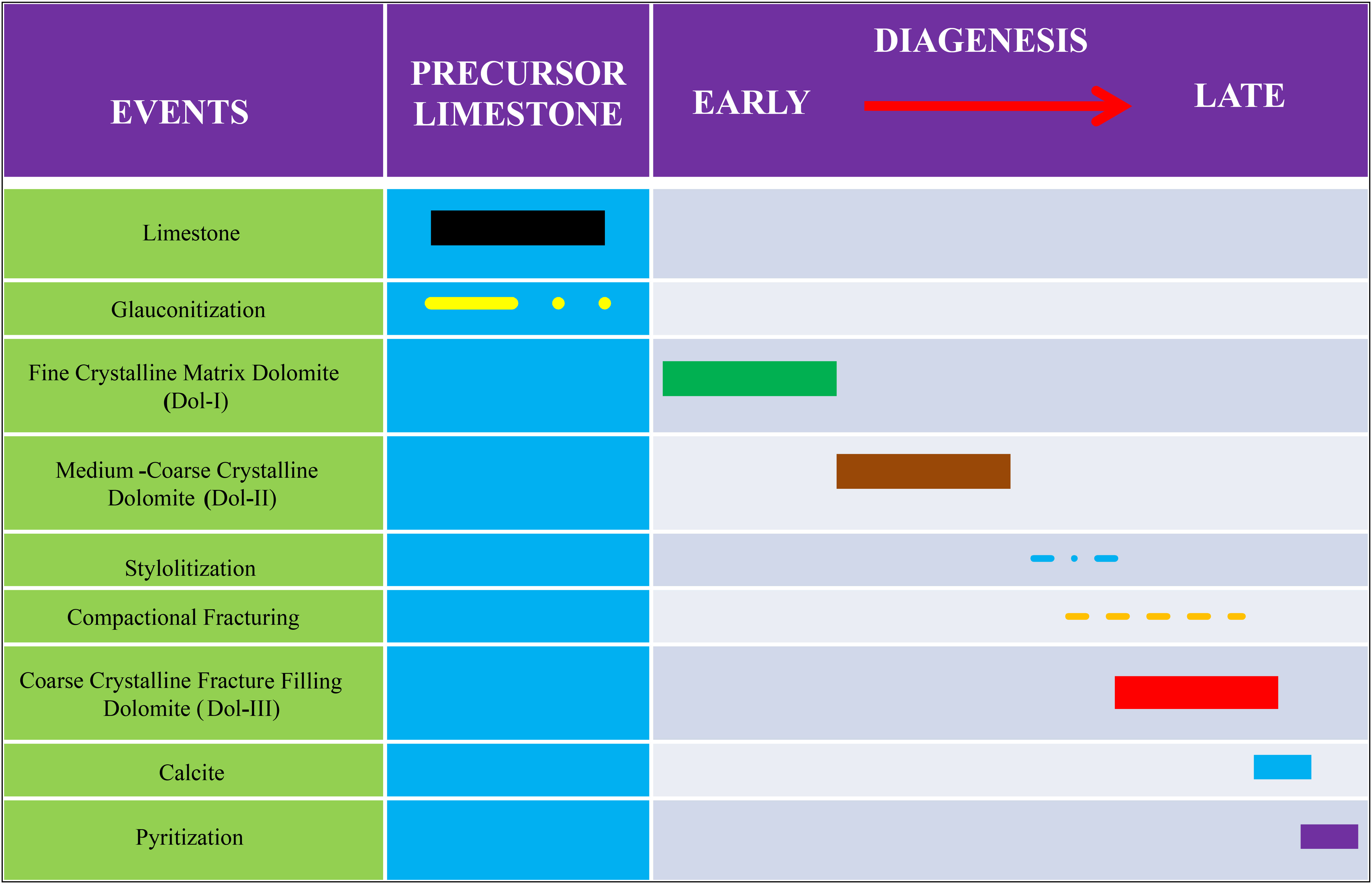
Figure 11
Detailed paragenetic history of the dolomite of Jutana Formation, representing early diagenetic modifications in the host limestone, followed by middle to late stage diagenetic alterations.
The studied interbedded carbonate-siliciclastic succession represents tidal flat depositional settings (Ahmed et al., 2013). The precursor limestone underwent partial dolomitization and resulted in the formation of matrix dolomite Dol. I. As discussed earlier, initial stage of dolomitization occurred during early Cambrian, where restricted, shallow marine conditions prevailed as evidenced by overlying Baghanwala Formation in the study area (Shah, 2009). Furthermore, less depleted δ18O signatures indicates dolomitization from slightly altered marine waters (Fig. 8). This implies that dolomitization may have resulted from altered marine fluids in the seepage-reflux and/or mixing zone environments during capillary flow through sediments as discussed in various studies (Fu et al., 2006; Jones et al., 2002; Melim and Scholle, 2002; Qing et al., 2001; Al-Aasm, 2000; Müller et al., 1990; Peter and Kinsman, 1981). Furthermore, δ13C signatures exclude the possibility of seepage reflux conditions of dolomitization, as such conditions are representative of more depleted δ13C values due to meteoric influx (Machel et al., 1995; Irwin et al., 1977). This is also supported by the absence of evaporites in the studied sites. In brief, mixing zone dolomitization occurred, where Mg-rich fluids of altered marine origin percolated through interbedded sandstone and limestone successions leading to dolomitization in the platform margin. Pore-filling dolomite Dol. II exhibits more depleted δ18O values (Fig. 8), hence indicative of dolomitization in the burial regime or changes in δ18O SMOW of fluids. In addition, fracture-filled, saddle type dolomite Dol. III also indicated highly depleted δ18O values (Fig. 8) and confirmed burial conditions of its formation.
In conclusion, above-mentioned discussion revealed that initial stage dolomites (Dol. I) are compatible with altered marine, mixing-zone related dolomitization fluids, followed by burial associated dolomitization in the form of Dol. II and Dol. III in the study area.
Based on the above discussion, it is observed that the interbedded limestone and sandstone of the Jutana Formation underwent dolomitization in the eogenetic, near depositional phase (Fig. 12A). Marine, Mg- rich fluids percolated through interbedded sandstone and limestone, whereas in situ fluids may have altered marine, Mg-rich fluids, leading to the partial dolomitization of the limestone succession with the formation of matrix dolomite (Dol. I; Fig. 12B). During the Cambro-Ordovician exposure, dissolution of ooids due to meteoric influx occurred in the partially dolomitized limestone (Fig. 12C). This was followed by a second phase of dolomitizing fluids originated from deep-seated sediments due to initial burial activity (based on moderate depleted stable isotope signatures), which resulted in pore-filling of dissolved ooids (Dol. II; Fig. 12D). Post orogenic events caused fracture development in Dol. I and Dol. II (Fig. 12E). In a last stage, fracture-filling type dolomitization (i.e. Dol. III) resulted from burial associated fluids of relatively more depleted stable isotope signatures as compared to Dol. II during Eocene-Pleistocene time (Fig. 12F).
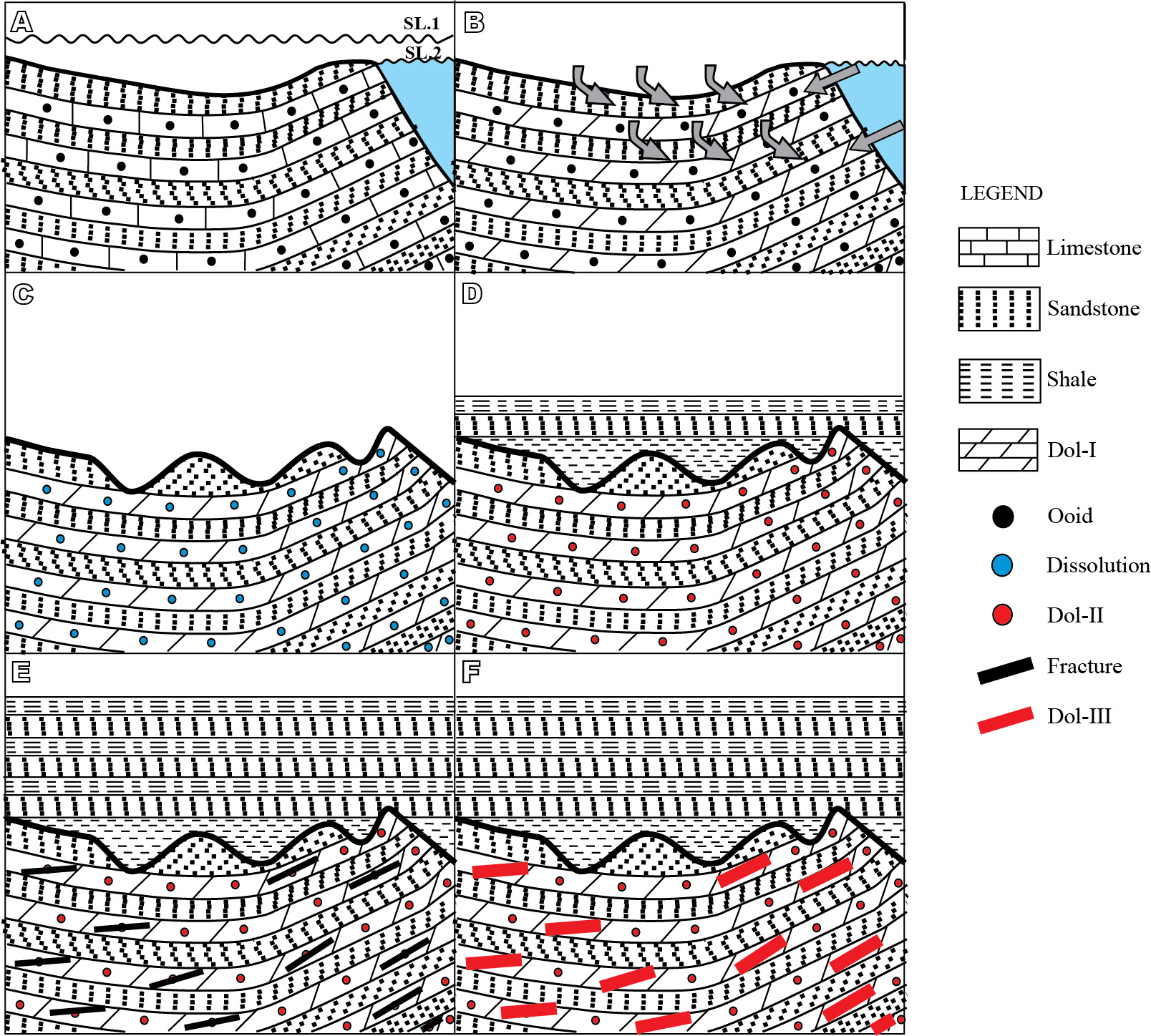
Figure 12
Conceptual model of dolomitization in the Cambrian Jutana Formation:
A) Shale limestone-sandstone deposition in a tidal flat environment; B) Early Cambrian initial phase of dolomitization in the mixing-zone resulting in fine-crystalline dolomite (Dol. I); C) Selective dissolution of ooids in the partially dolomitized limestone during the Ordovician-Carboniferous exposure; D) Late Permian dolomite cementation (Dol. II) in the dissolved ooids; E) Fracture development related to post-orogenic event (post Eocene) and F) Fracture-filled coarse crystalline dolomite cementation (Dol. III) during post-orogenic uplift (i.e. post-Eocene) and activation of Salt Range thrust (i.e. Plio-Pleistocene).
Field observations in the three main units of Jutana Formation (i.e. lower oolitic/pisolitic, middle shale and upper massive dolomitic unit) indicate interbedded dolostone-sandstone successions, containing depositional features in the sandstone (i.e. ripple marks, cross-bedding) and precursors of original limestone in dolostone (i.e. mica laths, ooids, pisolites, intraclasts, glauconite and foraminiferal assemblages). The presence of glauconite grains represent restricted marine conditions for the formation of the precursor limestone.
Petrographic studies helped in delineating three dolomite phases of distinct characteristic features. These include; Fine to medium crystalline, matrix dolomite (Dol. I), Medium to coarse crystalline, replacive dolomite (Dol. and coarse crystalline, fracture-filling dolomite cement (Dol. III) respectively.
O/C isotope analysis; Dol. I (δ18O=-6.44 to -3.76‰V-PDB; δ13C=-0.54 to +0.35), Dol. II (δ18O=-7.73 to -5.24‰V-PDB; δ13C=-0.09 to -1.83) and Dol. III (δ18O=-7.29 and -7.20‰V-PDB; δ13C=-1.83 and -1.83) and Mg-isotope values (i.e. Dol. I; δ26Mg=-1.19 to -1.67, δ25Mg=-0.61 to -0.86 and Dol. II; δ26Mg=-1.34 to -1.59, δ25Mg=-0.70 to -0.83) indicate diverse signatures of above mentioned different dolomite types.
Petrographic observations and isotopic signatures (O/C and Mg) indicate multiple phases of dolomitization. An initial phase of dolomite (Dol. I) resulted from interaction with altered marine, Mg-rich fluids originated during earliest diagenetic phase, representing mixing-zone conditions during early Cambrian. This was followed by dissolution of the unaltered ooids by meteoric water during Ordovician-Carboniferous exposure (Dol. II and Dol. III). Dol. II and Dol. III are associated with burial conditions, where Dol. II formed in the earlier stage of burial (i.e. late Permian), whereas Dol. III formation was associated with burial and post-orogenic events before the activation of Salt Range Thrust (i.e. between Eocene and Plio-Pleistocene). Calcite precipitation and pyrite mineralization in the late stage mark the end of diagenetic history.
http://dx.doi.org/10.1344/GeologicaActa2019.17.2.pdf (pdf)
http://revistes.ub.edu/index.php/GEOACTA/article/view/GeologicaActa2019.17.2/28458 (html)
Pakistan Institute of Nuclear Science and Technology (PINSTECH), Islamabad, is acknowledged for stable isotopes (C and O) analysis and is thanked Prof. Adrian Immenhauser (University of Bochum, Germany) for Mg- isotope analysis. Last but not the least, the authors are highly indebted to two reviewers (Fadi Nader and Mercè Corbella) for their fruitful reviews, which helped us to improve the manuscript.
Shahzad Town, 1461 Islamabad, Pakistan
Figure 1
A) Tectonic map of Pakistan showing the location of Salt Range (red box)
B) Enlargement shows the geological map of Salt Range, where Paleozoic rocks are thrusted over Quaternary alluvial deposits along Salt Range Thrust. White squares indicate location of studied areas; 1: Khewra gorge section; 2: Motorway section, G: Jutana village.
Figure 2
Lithostratigraphic chart of the Salt Range
Red undulating lines indicate unconformities (Modified after Shah, 2009). Inset columns show stratigraphic logs of two sampled sections (i.e. Khewra gorge and Motorway) of the Jutana Formation.
Figure 3
Field photographs of Jutana Formation (Fm.) in the eastern Salt Range:
A) stratigraphic units of Jutana Fm. in the Khewra gorge section and B) main units of Jutana Fm. in the Motorway section. The contact of Jutana Fm. with the underlying Kussak Fm. is shown in both locations.
Figure 4
Detailed field characteristics of the Jutana Formation:
A) Contact between the shales of the Kussak Formation and thin to medium, interbedded sandstones and dolostone; B) Centimeter-scale ripple marks in the sandstone beds; C) Low-angle, cross bedded sandstones; D) Dolomitized limestone with preserved foraminiferal assemblages,; E) Oolitic pisolitic unit in the dolomitized part; F) Bedding parallel stylolites; G) Fractures development in the studied dolostone and H) Panoramic view of the Motorway section, showing normal faulting.
Figure 5
Field observations of Jutana Formation:
A) Along the road cut side of M-2 Motorway, the three main subdivisions of Jutana Formation are well exposed with the lower part representing the oolitic-pisolitic unit, followed by the shale unit that is overlain by the massive dolomitic unit; B) M-2 Motorway section, upper massive unit is exposed consisting of dolomite; C) Highly fractured massive dolomitic unit in the M-2 Motorway section; D) Isolated clast of host limestone embedded in dark grey colored dolomite and E) Distinct chop-board weathering observed in the massive dolomite unit of Khewra section.
Figure 6
Petrographic characteristics of the studied Jutana Formation (Photomicrographs, Plane-Polarized Light, PPL):
A) Partially dolomitized limestone with intraclasts (red arrow) and ooids (green arrow); B) Close up of a partially dolomitized intraclast (red arrow) surrounded by off-white colored, coarse crystalline dolomite cement. Note ooid (green arrow) and vuggy porosity (blue arrow); C) Fine to medium crystalline dolomite (Dol. I) containing well preserved algae (white arrow); D) Medium to coarse crystalline dolomite (Dol. II) containing fracture-filled, coarse crystalline dolomite cement (Dol. III), pyrite observed in the fracture-fillings (black arrow), skeletal fragments (white arrow). D) Points fracture porosity (dark blue arrow) and cement (light blue arrow); E) Fine crystalline dolomite (Dol. I) containing oolite (green arrow) filled with medium-coarse crystalline dolomite (Dol. II), glauconite (yellow arrow) and intraclast (light green arrow) and F) Fine crystalline dolomite (Dol. I) and medium-coarse crystalline dolomite (Dol. II) with ooid (green arrow) modified to coarse crystalline dolomite. Both E and F contain ooids of different sizes.
Figure 7
Photomicrographs showing the petrographic characteristics of the Jutana Formation
A) Pressure dissolution stylolite (red arrow) in medium-coarse crystalline dolomite (Dol. II) and pyrite (black arrow) along stylolites; B) Green glauconite (yellow arrow) in dolomite and pyrite clasts within fractured glauconite (black arrow), fracture porosity is evident as open fractures (blue arrow); C) Back scattered SEM image, glowing white glauconite (yellow arrow) embedded in light grey colored medium to coarse dolomite (Dol. II), black arrow indicate Fe-residue, lathe shaped mica (brown arrow). D) Medium to coarse crystalline dolomite contains fracture filling, coarse crystalline dolomite (Dol. III) with dark colored crystal boundary (blue arrow), sparse distribution of pyrite is indicated by black arrow; E) Crystal growth cementation in coarse crystalline fracture filling dolomite (Dol. III), whereas porosity reduction (dark blue arrow) is evident due to calcite cementation (light blue arrow), pyrite is distribute dalong the fractures (black arrow).
Figure 8
Stable isotopes (C and O) signatures of samples from the Khewra gorge and Motorway sections (see the sections in Fig. 2).
Theseisotopic signatures indicate depletion of δ18O compared to Cambrianmarine limestones (red arrow), whereas δ13C signatures of the studieddolomite phases are within the range of precursor limestone (blue arrow).
Table 1
O/C and Mg isotopes results of selected samples from the studied sections
Figure 9
Cross plot of Mg-isotopes results (δ25Mg vs.δ26Mg) of the studied sections according to Geske et al.(2015)
Figure 10
Sedimentary facies precursors and diagenetic modifications observed in the studied rocks (Photomicrographs, PPL):
A) Partially dolomitized limestone; green arrow: ooid; B) Medium-coarse crystalline dolomite (Dol. II) and fine crystalline dolomite (Dol. I); green arrow: ooid modified to coarse crystalline dolomite, black arrow: iron/heavy mineral residue and C) Fine crystalline dolomite (Dol. I) and medium-coarse crystalline dolomite (Dol. II) with fossil fragments; white arrow: fossil fragment, green arrow: ooid modified to coarse crystalline dolomite.
Figure 11
Detailed paragenetic history of the dolomite of Jutana Formation, representing early diagenetic modifications in the host limestone, followed by middle to late stage diagenetic alterations.
Figure 12
Conceptual model of dolomitization in the Cambrian Jutana Formation:
A) Shale limestone-sandstone deposition in a tidal flat environment; B) Early Cambrian initial phase of dolomitization in the mixing-zone resulting in fine-crystalline dolomite (Dol. I); C) Selective dissolution of ooids in the partially dolomitized limestone during the Ordovician-Carboniferous exposure; D) Late Permian dolomite cementation (Dol. II) in the dissolved ooids; E) Fracture development related to post-orogenic event (post Eocene) and F) Fracture-filled coarse crystalline dolomite cementation (Dol. III) during post-orogenic uplift (i.e. post-Eocene) and activation of Salt Range thrust (i.e. Plio-Pleistocene).
