Middle-Late Eocene marine record of the Biga Peninsula, NW Anatolia, Turkey
Middle-Late Eocene marine record of the Biga Peninsula, NW Anatolia, Turkey
Geologica Acta: an international earth science journal, vol. 16, no. 2, pp. 163-187, 2018
Universitat de Barcelona
Received: 15 October 2017
Accepted: 15 February 2018
Published: 15 May 2018
Abstract: The Eocene shallow marine deposits marking the first marine incursion in the Biga Peninsula (NW Turkey) after the collision of the Sakarya and Anatolide-Tauride plates were investigated based on paleontological, litho- and chrono-stratigraphic data. Larger Benthic Foraminifera (LBF) from patchily distributed outcrops were studied in order to i) revise the stratigraphy of Eocene shallow marine units, and ii) establish a modern biostratigraphic setting and a correlation scheme. The Şevketiye Formation (Fm.) is herein defined as a predominantly shallow marine clastic deposit with subordinate carbonates overlying the Çamlıca metamorphic rocks, and passing laterally to the Soğucak Fm., a carbonate unit that is widely represented in the Thrace Basin. The record of alveolinids, primitive developmental stages of heterosteginids, and orthophragminids in the Şevketiye Fm. suggests that this formation is part of the Shallow Benthic Zones (SBZ) 16?/17 (Late Lutetian?/Early Bartonian), SBZ17?/18 and SBZ19A (Early Bartonian/earliest Priabonian). The Soğucak Fm., which overlies the Eocene volcanics, on the other hand, yielded advanced developmental stages of heterosteginids, Spiroclypeus sp. and Nummulites fabianii lineages, implying a younger marine incursion during the Late Eocene (earliest Priabonian; SBZ19A). A drastic shift in the depositional regime is marked amid Priabonian by the deposition of deep-marine clastics and volcanoclastics of the Ceylan Fm. In conclusion, the Eocene Sea transgressed first Gökçeada (in the Aegean Sea) during the Late Lutetian, then reached the Biga and Gelibolu peninsulas in the Bartonian, and finally led to the widespread deposition of carbonate and siliciclastic rocks in the Biga Peninsula and the Thrace Basin during the Late Bartonian and Priabonian.
Keywords: Larger Benthic Foraminifera (LBF), Biostratigraphy, Stratigraphy, Biga Peninsula, Eocene.
Cite as:
Özcan, E., Okay, A.I., Bürkan, K.A., Yücel, A.O., Özcan, Z., 2018. Middle-Late Eocene marine record of the Biga Peninsula, NW Anatolia, Turkey. Geologica Acta, 16(2), 163-187, I. DOI: 10.1344/GeologicaActa2018.16.2.4
INTRODUCTION
The Late Cretaceous-Cenozoic sedimentary succession of Central and West Anatolia provides an archive of the collision of the Sakarya Continent with the Anatolide-Tauride Platform and the Kırşehir Continent with the Anatolide-Tauride Platform (Fig. 1A). The drastic change in the geological record is evidenced by i) the widespread development of the Late to Middle Eocene (Ypresian-Lutetian) post-collisional volcanic rocks, locally intercalated with marine (Middle) Eocene beds in Armutlu Peninsula (Genç and Yılmaz, 1997; Özcan et al., 2012; Gülmez et al., 2013), ii) the transition from marine to continental deposition in Early- to Middle-Eocene in Central Anatolia (Sirel, 1998; Okay et al., 2001; Özcan et al., 2007) and iii) the development of widespread Middle to Late Eocene post-collisional volcanic complexes as well as the lack of marine post-Eocene deposits in the Biga Peninsula (Siyako et al., 1989; Altunkaynak and Genç, 2008; Ilgar et al., 2012; Ersoy and Palmer, 2013).
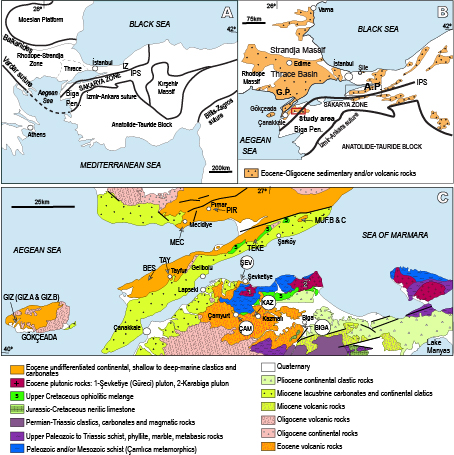
Figure 1.
A) Tectonic map of the northeastern Mediterranean region showing the major sutures and continental blocks (simplified from Okay and Tüysüz, 1999). IZ in this map refers to Istanbul Zone. B) Simplified map of the Black Sea-North Aegean region showing the distribution of Eocene-Oligocene sedimentary and/or volcanic rocks and the main tectonic sutures (modified from Okay et al., 2017). Study area framed. The positions of the Gelibolu Peninsula (G.P.) and Armutlu Peninsula (A.P.), and Intra-Pontide Suture (IPS) are marked. C) Geological map of the northern segment of the Biga Peninsula and locations of the studied sections: Şevketiye (ŞEV), Çamyurt (ÇAM), Kazmalı (KAZ) and Biga (BIGA) (slightly modified from Akbaş et al., 2011 and Duru et al., 2012). Localities of the sections of the Soğucak Fm., previously studied from the southern Thrace Basin (Özcan et al., 2010) and adopted here for the regional correlation (Fig. 18): GIZ.A and B (Gizliliman, Gökçeada), BEŞ (Beşyol), TAY (Tayfur), MEC (Mecidiye), PIR (Pırnar), TEKE (Teke), MÜF.B and C (Mürefte).
In the Biga Peninsula, extensive Eocene magmatic rocks (North Anatolian Eocene Magmatic (NAEM) rocks of Ersoy and Palmer, 2013) post-date the collision of the Anatolide-Tauride Platform and the Sakarya Continent (Figs. 1 and 2) (Siyako et al., 1989; Ilgar et al., 2012). Magmatic activity occurred almost continuously from Middle Eocene to Late Miocene (Altunkaynak and Genç, 2008). The NAEM volcanic rocks were deposited in continental and, partly, marine settings (Genç et al., 2012), and are stratigraphically associated with continental and shallow to deep marine sedimentary units, namely Fıçıtepe, Soğucak and Ceylan formations (fms.), respectively. The Şevketiye Fm., a lithostratigraphic unit established in this study, and the Soğucak Fm., previously reported as the only Eocene marine unit in the Biga Peninsula, crop out between Lapseki and Biga (Fig. 1B; C). The Cenozoic evolution of the Thrace Basin in the North of the Biga Peninsula, on the other hand, strongly contrasts with that of adjacent basins in the East and South. In the Thrace Basin, the Middle Eocene volcanics are missing and Early Eocene deposits (Hamitabat Fm.) belong to the deep marine settings (Siyako and Huvaz, 2007). The Middle to Late Eocene (Bartonian-Priabonian) shallow marine carbonates of the Soğucak Fm. are widely exposed in northern and southern segments of the basin (Saner, 1985; Önal, 1986; Sümengen and Terlemez, 1991; Siyako and Huvaz, 2007; Okay et al., 2010; Özcan et al., 2010; Less et al., 2011) (Fig. 1A; B). Moreover, thick deep marine Early Oligocene marls and shales are also recorded at the East of the basin (Okay et al., 2017). The Soğucak Fm., typified by foraminiferal carbonates and patchy red algal/coral reefs at its type-locality and other outcrops in Thrace, exhibits a wide range of facies characterizing inner, middle- to outer-shelf settings (Özcan et al., 2010; Less et al., 2011 and references therein). The geographic extension of the Soğucak Fm., westwards to Gökçeada and southwards to the Biga Peninsula, was previously reported by Temel and Çiftci (2002), Özcan et al. (2010) and Ilgar et al. (2012). The chronostratigraphic development of the Soğucak Fm. in the Biga Peninsula is, however, poorly known due to absence of detailed biostratigraphic studies. Therefore, it is not well understood whether the various ages (ranging from Lutetian to Priabonian) previously assigned to the ‘Soğucak’ Fm. correspond or not to different marine incursion events. Furthermore, the unit was reported either as a ‘reefal limestone’ or as a ‘nummulitic limestone’ in the Biga Peninsula (Siyako et al., 1989; Ilgar et al., 2012), which is rather a lithological feature of the Soğucak carbonates in the neighbouring Thrace Basin. On the other hand, the predominantly clastic shallow marine deposits (Şevketiye Fm.) overlying the Çamlıca metamorphics were previously not described.
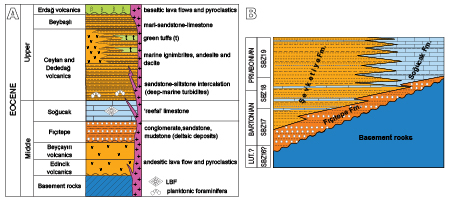
Figure 2.
A) Eocene chronostratigraphy of the Biga Peninsula (modified from Ilgar et al., 2012), B) stratigraphic lateral-vertical relationships of the Eocene shallow marine units proposed in this study.
In order to resolve these pending points, the outcrops of Şevketiye and Soğucak fms. were studied in four localities: Şevketiye, Çamyurt, Kazmalı and Biga. The latter was excluded from biostratigraphic analyses due to the poor stratigraphic development and limited fauna of the Soğucak Fm. there. The data from this locality are used in evaluating the geographic extension of the Eocene Sea in the Biga Peninsula. To sum up, the aim of this study is to i) revise the stratigraphy of post-collisional shallow marine units in the Biga Peninsula, ii) document the Larger Benthic Foraminifera (LBF) assemblages from these deposits by studying both isolated specimens and specimens from rock thin-sections, iii) establish a high-resolution biostratigraphy, and iv) provide a correlation scheme between the Thrace Basin and the Biga Peninsula during the Eocene in order to delineate the southward extension of post-collisional marine incursion(s) in the Sakarya Zone.
GEOLOGICAL SETTING, EOCENE STRATIGRAPHY AND BIOSTRATIGRAPHY
The Biga Peninsula lies at the North of the İzmir-Ankara Suture Zone, which separates the Sakarya Zone (in the North) from the Anatolide-Tauride Block (in the South) (Fig. 1B). The basement rocks between Lapseki and Biga Area are constituted by Çamlıca micaschist, built up of quartz micaschist and minor calc-schist, metaquartzite, marble and eclogite (Okay et al., 1991). The metamorphism dates from Late Cretaceous–Early Paleocene (70–64Ma) (Okay and Satır, 2000; Aygül et al., 2012). The cover rocks consist of widespread Eocene to Oligocene-Miocene volcano-plutonic complexes, continental and, shallow to deep marine Eocene deposits (Fig. 1C) (Siyako et al., 1989; Dönmez et al., 2005; Altunkaynak and Genç, 2008; Genç et al., 2012; Ilgar et al., 2012; Ersoy et al., 2017). The volcanic activity started in the Lutetian and lasted until the Miocene producing volcanic suites ranging from basalt to dacite (Altunkaynak and Genç, 2008; Ersoy et al., 2017). With regard to the sedimentary record, previous studies have differentiated continental clastics of the Fıçıtepe Fm., and a main ‘reefal’ or ‘nummulitic’ limestone unit, the Soğucak Fm., occurring between the andesitic and basaltic volcanics and deep marine turbidites, ignimbrites, tuffs and andesites (Siyako et al., 1989; Ilgar et al., 2012) (Fig. 2). The Fıçıtepe Fm. is a thick continental unit built up of conglomerate, sandstone, siltstone and mudstone, and is interpreted as a deltaic depositional system (Ilgar et al., 2012). In the Lapseki-Biga Area, this formation was considered Middle Eocene in age by Ilgar et al. (2012), and Early Eocene by Siyako et al. (1989) based on its position below the Middle Eocene (Lutetian) Soğucak Fm. The latter age designation was adopted by Şengün et al. (2011) to explain the exhumation history of the Çamlıca metamorphics. The Fıçıtepe Fm. is overlain either by predominantly clastic deposits of the Şevketiye Fm., comprising fossiliferous sandstone, siltstone, shale, limestone and some conglomerate beds, or by the Soğucak Fm., built up of fossiliferous limestone, sandy/clayey limestone with rare thin sandstone and mudstone beds. LBF occur abundantly in limestone beds, whereas the clastic levels are mostly barren in foraminifera, but rich in mollusks and other invertebrates.
The Middle Eocene-Priabonian shallow marine deposits in Tethys chiefly contain LBF, such as nummulitids, orthophragminids, alveolinids and rotaliids, widely used in biostratigraphy (Serra-Kiel et al., 1998; Less and Özcan, 2012; Hottinger, 2014 and references therein). Common Middle Eocene foraminiferal taxa belong to large Nummulites (Giant Nummulites), various species of Assilina, Operculina, alveolinids and orthophragminids (Fig. 3) (Serra-Kiel et al., 1998; Less and Özcan, 2012). The first appearance of Heterostegina, Spiroclypeus, Nummulites fabianii group, Pellatispira, Chapmanina, Silvestriella, together with the disappearance of alveolinids and large Nummulites in the Bartonian and across the Bartonian/Priabonian boundary, corresponds to significant bioevents in western Tethys, and their superposition allows the definition of some sub-zones in the Bartonian-Priabonian interval (Less and Özcan, 2012). The Operculina gomezi group appears to be the most important LBF group in the delineation of the Lutetian/Bartonian boundary, as key foraminiferal events for this boundary are not yet well defined (Less and Özcan, 2012). The Assilina schwageri-Assilina alpina group is also abundant in Bartonian-Priabonian Tethyan deposits, although the distinction of the two species is difficult in the lack of morphometric data. In the present study, the species of this group were determined as A. schwageri-alpina. The first appearance of Heterostegina is perhaps the most significant event across the Bartonian/Priabonian boundary. Heterostegina armenica and H. reticulata’s lineages display a very rapid evolution and, hence, are used as a valuable proxy to date LBF events and biostratigraphic evaluations (Less et al., 2008). The most important evolutionary trend recorded in these lineages is the reduction in the number of operculinid chambers over time, which is used in the morphometric discrimination of their subspecies. Similarly, reticulate Nummulites (N. fabianii’s lineage) display a progressive increase of the size of the proloculus, which helps in the discrimination of the successive species (Özcan et al., 2009, 2010). Genus Spiroclypeus, a key Priabonian taxon, also displays reduction in the number of operculinid chambers and is, therefore, subdivided into different species with the help of morphometry (Less and Özcan, 2008, 2012). The first presence of Silvestriella, Pellatispira and Chapmanina close to the Bartonian/Priabonian boundary represents another foraminiferal event and is very useful in the delimitation of Middle/Late Eocene boundary in Tethys (Özcan et al., 2010). Orthophragminids include various species of Discocyclina, Nemkovella, Orbitoclypeus and Asterocyclina (Less, 1987; Özcan et al., 2006; Less et al., 2011). The extinctions of taxa such as Discocyclina pulcra and Orbitoclypeus douvillei during the Bartonian, and Discocyclina pratti, Asterocyclina kecskemetii and A. alticostata in the Priabonian, before the Priabonian/Rupelian boundary, are key events. An integrated biostratigraphy of nummulitids, orthophragminids and alveolinids was established first by Serra-Kiel et al. (1998) in the frame of the Shallow Benthic Zonation (SBZ) of the Tethys. This zonation was subsequently updated by Less and Özcan (2012) for the Bartonian-Priabonian, subdividing biozones SBZ18 and SBZ19 in a number of subzones (SBZ18A, 18B, 18C, 19A and 19B). The Bartonian/Priabonian boundary, coincident with the SBZ18/19 boundary in Serra-Kiel et al. (1998), was lowered by Costa et al. (2013) and Papazzoni et al. (2017) (Fig. 3). In this study, the definition of the SBZ18 and 19 subzones proposed by Less and Özcan (2012) is followed. The taxonomy and morphometry of the studied LBF taxa from the Biga Peninsula are not provided here, since they were introduced in former studies focused on the Thrace Basin (Özcan et al., 2010; Less et al., 2011).
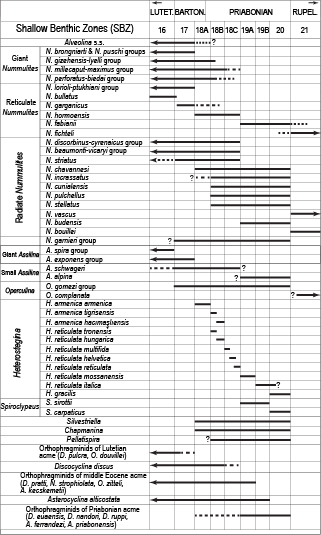
Figure 3.
Stratigraphic ranges of Late Lutetian-Rupelian Larger Benthic Foraminifera (LBF) of the Western Tethys and proposed biostratigraphic scheme by Less and Özcan (2012). The relationship of the Bartonian/Priabonian boundary with respect to the Shallow Benthic Zonation (SBZ) is after Costa et al. (2013) and Papazzoni et al. (2017).
MATERIALS AND METHODS
The studied material was sampled in four localities in the northwestern part of the Biga Peninsula, from West to East: Şevketiye, Çamyurt, Kazmalı and Biga (Fig. 1C). The axial and equatorial sections of isolated LBF specimens were prepared for the taxonomic identifications. The taxonomy is based on the morphometry at species and subspecies ranks following the studies of Özcan et al. (2006), Less and Özcan (2008, 2012), and Less et al. (2008), for genera Heterostegina, Spiroclypeus, Discocyclina, Orbitoclypeus, Asterocyclina and reticulate Nummulites (N. fabianii group). The associated fauna and flora were identified in rock thin-sections. The list of the foraminiferal taxa identified from the Şevketiye and Soğucak fms. is given in the Appendix.
RESULTS
A new lithostratigraphic unit: Şevketiye Formation
Shallow marine deposits in Şevketiye and Çamyurt sections are characterized predominantly by shale-siltstone-sandstone and conglomerate beds, with minor limestone rich in Bartonian-Priabonian LBF, in contrast to the Soğucak Fm., which is a carbonate unit. Şevketiye Fm. is established here to differentiate the Bartonian-Priabonian (predominantly) clastic marine sequence from the coeval Soğucak carbonates, common in the Thrace Basin. A formal description of the Şevketiye Fm., cropping out near Şevketiye and Çamyurt (Figs. 4 and 5) is given below:
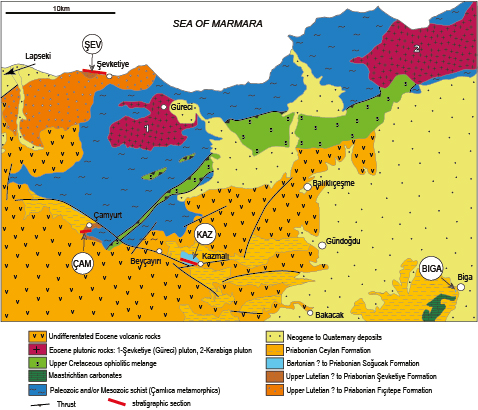
Figure 4.
Geological map of the region between Lapseki and Biga and location of the studied sections: Şevketiye (ŞEV), Çamyurt (ÇAM), Kazmalı (KAZ) and Biga (BIGA) (map slightly modified after Duru et al., 2012).
Lithology, lateral and vertical variation: The unit comprises dominantly gray to dark green, thick-bedded to massive shale/marl, siltstone-sandstone, conglomerate and cream to gray limestone and argillaceous nodular limestone interbeds (Figs. 4 and 5). A breccia level is also recognized in the Çamyurt Section. Facies and fossil assemblages indicate a restricted (inner to middle) shelf environment at its base, and middle/outer shelf at its upper part.
Thickness: The measured thickness ranges from ~50m (in the Çamyurt Section) to >132m (in the Şevketiye Section).
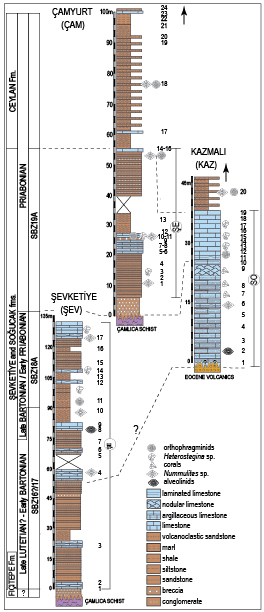
Figure 5.
Lithostratigraphic columns of the Soğucak and Şevketiye fms. in the studied sections and their correlation. SBZ: Shallow Benthic Zones by Serra-Kiel et al. (1998), updated by Less and Özcan (2012). ŞE: Şevketiye Fm., SO: Soğucak Fm.
Relationship to adjacent stratigraphic units and nature of boundaries: The unit conformably overlies the Fıçıtepe Fm. and is overlain in gradational contact by the Ceylan Fm. Its upper contact, not observed at the Şevketiye Section (ŞEV), crops out in the Çamyurt Area.
Type-section: Type section is situated 2.6km West of Şevketiye (40°23’59.21”N, 26°50’34.35”E; 40°24’1.86”N, 26°50’24.01”E), about 15km northeast of Lapseki (Fig. 4).
Geographic distribution: The unit crops out between Şevketiye and Çamyurt (East of Lapseki).
Fossil composition: Foraminifera consist of Discocyclina discus discus (Rütimeyer, 1850), D. pratti pratti (Michelin, 1846), D. radians (d’Archiac, 1850), Nemkovella daguini (Neumann, 1958), Orbitoclypeus varians varians (Kaufmann, 1867), O. varians scalaris (Schlumberger, 1903), Asterocyclina stellata stellaris (Brünner, in Rütimeyer, 1850), A. stella cf. stella (Gümbel, 1861), A. alticostata cf. alticostata (Nuttall, 1926), A. kecskemetiiLess, 1987, Nummulites fabianii (Prever, in Fabiani, 1905), Heterostegina armenica armenica (Grigoryan, 1986), H. reticulata mossanensisLess, Özcan, Papazzoni and Stockar, 2008, Spiroclypeus sp., Operculina gomeziColom and Bauzá, 1950, Assilina schwageri Silvestri, 1928–A. alpina (Douvillé, 1916), Silvestriella tetraedra (Gümbel, 1868), Gyroidinella magna Le Calvez, 1949, Pellatispira madarasziHantken, 1876. In addition, bivalves, echinoids, gastropods, bryozoans and red algae are common.
Age: Late Lutetian? to Priabonian.
Description of sections
Şevketiye Section
The studied section (ŞEV: 40°23’59.32”N, 26°50’49.93”E; 40°24’1.86”N, 26°50’24.01”E) is located 2.6km West of Şevketiye and is well exposed along the shores of the Marmara Sea (Fig. 1C). It shows the Fıçıtepe Fm., up to several hundred metres-thick, overlain by the 135m-thick Şevketiye Fm. This formation has a limited geographic extent in the region, cropping out only along the hillside of Çam Tepe (ÇAM) (Fig. 4). The basal conglomerates of the Fıçıtepe Fm., resting nonconformably on the Çamlıca high-grade metamorphics, are made of mudstone, sandstone, siltstone and clast-supported conglomerates, dominated by subangular to subrounded andesite pebbles (Figs. 5 and 6A; B). These continental clastics, barren in fossils, pass upwards into marine sandy limestone, siltstone-sandstone intercalations of the Şevketiye Fm. with locally abundant shells of bryozoans, bivalves, gastropods, echinoids, red and dasycladacean algae, miliolids and Nummulites sp. (Figs. 6C; D and 7A; B). The portion of the unit with thin-to-medium bedded limestone intercalations contains coarse pebbles at their base, which grade into sand and silt at their upper parts (samples 1–4). The lower part of the Şevketiye Fm. (55m-thick) lacks age-diagnostic fossils and is assumed to be Late Lutetian? and/or Early Bartonian (SBZ16? and/or 17) based on the occurrence of alveolinids and its location below the Heterostegina armenica-bearing beds up in the section. Upwards, the succession comprises thick-bedded siltstone/sandstone with thin-to-medium bedded limestone intercalations (from 55 to 90m; Fig. 8) yielding LBF such as nummulitids (Nummulites sp. and Operculina gomezi), alveolinids and other fossil groups shown in Figure 8. The alveolinid bed (sample 8) at ca. 80 metres from the base consists of abundant globular and axially elongated forms (Fig. 6E). Bryozoans are abundant in the upper part of the siltstone-limestone intercalations. This part is attributed to the Early Bartonian based on the occurrence of Operculina gomezi and its position immediately below the beds bearing the first primitive Heterostegina (H. armenica). The upper part of the Şevketiye Fm. (90–135m-thick) consists of sandstone, calcareous sandstone and siltstone, conglomerate and highly fossiliferous limestone intercalations (Fig. 6F). This is the most fossiliferous part of the section. The occurrence of Heterostegina armenica armenica, Assilina schwageri-alpina, Operculina gomezi, Discocyclina discus discus, Asterocyclina stellata, A. stella, Orbitoclypeus varians, Silvestriella tetraedra, and Linderina sp. points out to the SBZ18A, suggesting an age close to the Bartonian/Priabonian boundary. The section cannot be followed further up because the last observable beds dip under the Marmara Sea.
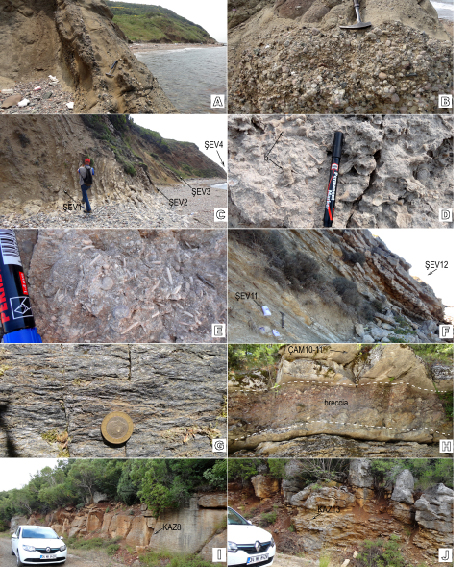
Figure 6.
Field photographs of Şevketiye (A–H) and Soğucak (I–J) fms. A–F: Şevketiye Section, A, B) conglomerates of the Fıçıtepe Fm. consisting of mainly basaltic pebbles (B); C) limestone beds in the lower part of the Şevketiye Fm. (sampling points are shown); D) very fossiliferous limestone bed in the lower part of the Şevketiye Fm., rich in bryozoans (B) and mollusks (sample ŞEV4); E) alveolinid marker limestone bed in the middle part of the Şevketiye Fm. (sample ŞEV8); F) transition from marine siltstone-sandstone to highly fossiliferous limestone in the middle part of the Şevketiye Fm. (samples ŞEV11-12), where Heterostegina armenica, Discocyclina discus and Operculina gomezi occur abundantly. G–H: Çamyurt Section, G) basement Çamlıca schist; H) breccia interlayer (thickness of ca. 1.5m) in the lower part of the Şevketiye Fm., indicating the transition from marine to continental setting. I–J: Kazmalı Section, I) laminated argillaceous limestone in the lower portion of Soğucak Fm.; J) nodular limestone with corals in the middle part of the Soğucak Fm.
Çamyurt Section
Çamyurt Section (ÇAM: 40°16’22.22”N, 26°51’3.35”E; 40°16’16.22”N, 26°50’47.14”E) is situated along a small creek at the vicinity of Çamyurt village, 14.3km to the South of the Şevketiye Section (Fig. 4). The basement consists of the Çamlıca metamorphics, which are overlain by ca. 6m-thick basal conglomerates of the Fıçıtepe Fm., comprising metamorphic pebbles from underlying rocks (Figs. 5 and 6G). These coarse clastic materials are devoid of any fossils and their age remains questionable. Overlying thick-bedded intercalations of pebbly siltstone and sandstone (ca. 14m-thick) mark well the increasing marine influence and yield reticulate Nummulites (N. fabianii), Heterostegina reticulata mossanensis, Pellatispira madaraszi, Gyroidinella magna, bivalves, and echinoids (Fig. 7C–E). This part of the sequence becomes calcareous upward and grades into sandy limestone/calcareous sandstone beds. The assemblage of Heterostegina reticulata mossanensis, Nummulites fabianii and associated foraminifera listed in Figure 9 indicate the SBZ19A, corresponding to the Priabonian. Upwards, a chaotic breccia (ca. 1.5m-thick) is built up of large angular metamorphic clasts (up to 50cm across), and is attributed to intermittent inputs of terrestrial materials (Fig. 6H). The breccia bed is overlain by the first prominent limestone bed in the section (samples 10 and 11), rich in Heterostegina reticulata mossanensis and Assilina schwageri-alpina. This bed is, in turn, overlain by a ca. 7m-thick shale-siltstone succession consisting of rare planktonic foraminifera and orthophragminids (sample 13, Fig. 7F), suggesting a deepening in the depositional environment. The higher part of the succession contains shales, siltstone with rare Nummulites sp., and conglomerates devoid of fossils, then it passes into a limestone bed with abundant LBF (samples 14–16). The conglomerates consist of pebbles from the Çamlıca metamorphics and may represent a continental influence in the upper part of the section. The limestone bed (samples 14–16) above the siltstone-sandstone part contains biostratigraphically diagnostic LBF, such as Heterostegina reticulata mossanensis, Assilina schwageri-alpina, Nummulites fabianii, Discocyclina pratti pratti, Orbitoclypeus varians varians, and Nemkovella daguini. The assemblage corresponds to the SBZ19A, suggesting a Priabonian age for the upper part of the unit. The Soğucak Fm. is overlain by volcaniclastic rocks of the Ceylan Fm., containing sporadic planktonic foraminifera and re-sedimented LBF, such as Discocyclina sp., and Nummulites sp. in sample 23.
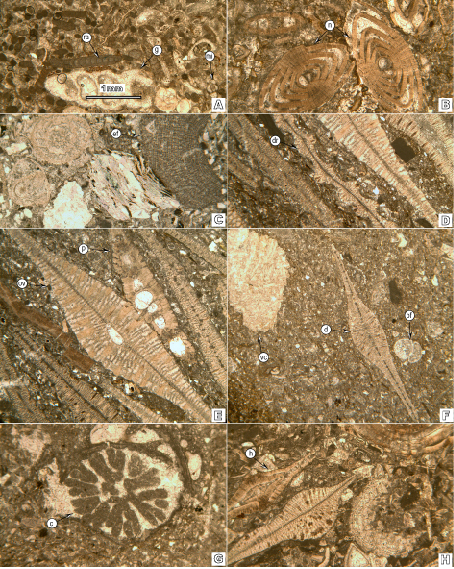
Figure 7.
Thin-section microphotographs of the fossil associations from the Şevketiye (A–F) and Soğucak (G–H) fms. A) Red algae-gastropod packstone (ŞEV2) and B) nummulitid packstone (ŞEV4) in the lower part of the Şevketiye Section. C) Siltstone/sandstone level with encrusting foraminifera (ÇAM1), and D–E) orthophragminids and Pellatispira (ÇAM4) in the lower part of the Soğucak Fm. In the Çamyurt Section. F) Shale/siltstone facies with planktonic foraminifera, orthophragminids and volcanic fragments in the Çamyurt Section (ÇAM13). G) Corals encrusted by red algae in the lower part (KAZ8), and H) foraminiferal packstone (KAZ16) in upper part of the Soğucak Fm. in the Kazmalı Section. Abbreviations: c, corals; d, Discocyclina sp.; dr, Discocyclina radians; ef, encrusting foraminifera; g, gastropods; h, Heterostegina; mi, miliolids; n, Nummulites; ov, Orbitoclypeus varians; p, Pellatispira madaraszi; pf, planktonic foraminifera; ra, red algae; vc, volcanic fragments.
Kazmalı Section
Kazmalı Section (KAZ: 40°14’56.89”N, 26°57’14.19”E; 40°14’48.29”N, 26°58’8.12”E) is located at the vicinity of Kazmalı village, 10km southeast of the Çamyurt Section (ÇAM). The Soğucak Fm. is best exposed along the road from Kazmalı to Beyçayır, where the unit unconformably rests on the Early (?) Eocene volcanic rocks (Fig. 4). The lower part of the Soğucak Fm. (ca. 0–25m-thick) is built up of thick-bedded, laminated, argillaceous limestone with thin marl/shale intercalations and nodular limestone (Fig. 6I; J). Corals constitute a significant part of the fossil assemblage found in nodular limestones. The LBF include sporadic axially elongated alveolinids, Nummulites sp. and Orbitolites sp. Nodular limestones grade upward into medium to thick-bedded limestones with Heterostegina reticulata mossanensis, Spiroclypeus carpaticus, Assilina schwageri-alpina, Operculina gomezi, Nummulites fabianii, Pellatispira madaraszi, Orbitoclypeus varians scalaris, and associated fauna and flora (Fig. 10). This assemblage would belong to SBZ19A (Priabonian) based on the presence of Heterostegina reticulata mossanensis, although the occurrence of Spiroclypeus carpaticus, which is a key species of SBZ20, suggests a younger age. The Soğucak Fm. is overlain by the volcaniclastic rocks of the Ceylan Fm., which contain sporadic planktonic foraminifera and re-sedimented LBF. Orbitoclypeus varians, Discocyclina sp., Assilina schwageri-alpina and Nummulites sp. occur in volcanogenic clasts (sample 20) and show an affinity to the Bartonian-Priabonian fauna of Şevketiye and Soğucak fms.
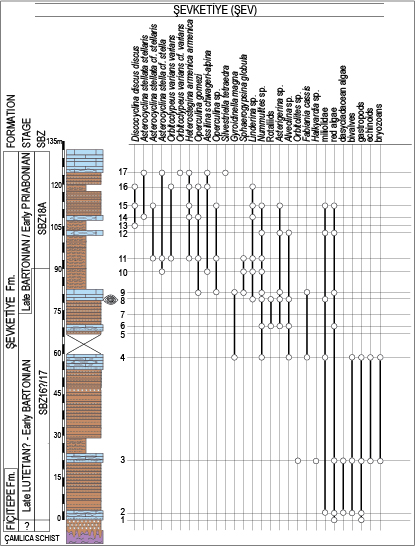
Figure 8.
Distribution of Larger Benthic Foraminifera (LBF) and associated fossil groups with inferred Shallow Benthic Zones (SBZ) from the Şevketiye Fm. in the Şevketiye Section.
Biga Section
Biga Section (40°13’18.59”N, 27°14’3.67”E) is located near Biga town, along the hillside of Balıklıtepe, just next to the Biga nursing home (Figs. 1C and 4). The outcrop is poorly developed, with conglomerate or coarse sand and upper argillaceous limestone, ca. 1.5–2m-thick. LBF are represented by scarce Nummulites sp. and Assilina schwageri-alpina. The unit could not be assigned to any SBZ, but the common occurrence of latter species suggests that it might have been deposited during the Bartonian-Priabonian time interval.
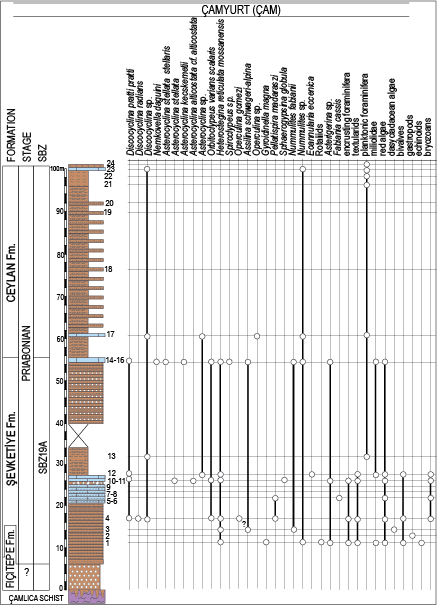
Figure 9.
Distribution of Larger Benthic Foraminifera (LBF) and associated fossil groups with inferred Shallow Benthic Zones (SBZ) from the Şevketiye Fm. in the Çamyurt Section.
LBF and associated fossils from the Şevketiye and Soğucak formations
The Şevketiye and Soğucak fms. preserve a diverse assemblage of LBF dominated by nummulitids, and orthophragminids, whereas rotaliids occur sporadically. Alveolinids are represented by Alveolina in the lower-middle part of the Şevketiye Fm. near Şevketiye (sample 8) and in the lowermost part of the Soğucak Fm. in the Kazmalı Section, and by Praebullalveolina in the upper part of Soğucak Fm. in Kazmalı Section. In general, the LBF from the Biga Peninsula are similar to those from Gökçeada and the Thrace Basin. However, orthophragminids appear to be less diverse in the Biga Peninsula in comparison with those from the Soğucak Fm. in the Thrace Basin (see Özcan et al., 2010; Less et al., 2011). The benthic foraminifera listed in the Appendix are identified and illustrated here for the first time in the studied area (Figs. 11; 12; 13; 14; 15; 16; 17). In addition, encrusting foraminifera, Fabiania cassis, red and dasycladacean algae, bivalves, gastropods, bryozoans, echinoids and corals are recorded in some levels.
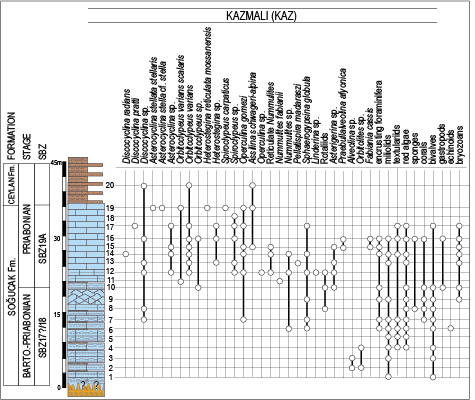
Figure 10.
Distribution of Larger Benthic Foraminifera (LBF) and associated fossil groups with inferred Shallow Benthic Zones (SBZ) from the Soğucak Fm., in the Kazmalı Section.
Heterostegina specimens belong to the most primitive subspecies of Heterostegina armenica’s lineage, H. armenica armenica, in the Şevketiye Fm. (Figs. 8 and 11A–G), and an advanced developmental stage of Heterostegina reticulata’s lineage, H. reticulata mossanensis, in Çamyurt and Kazmalı sections (Figs. 9, 10 and 12A–H). Operculina is characterised by Operculina gomezi, while Assilina is represented by the Assilina schwageri-alpina group in the Şevketiye and Çamyurt sections (Figs. 8 and 11H; I) and in the Kazmalı Section (Figs. 9, 10 and 12N–P). Spiroclypeus, identified only in Çamyurt and Kazmalı sections, belongs to S. carpaticus, which is an advanced developmental stage of this genus (Figs. 9, 10 and 12I–M). This genus could not be identified at the species level in the upper part of the Kazmalı Section, below sample 19. The co-occurrence of H. reticulata mossanensis and S. carpaticus is somewhat in contradiction, as both taxa are the key species of SBZ19 and 20, respectively. Due to the prevalent occurrence of Heterostegina in the studied samples, the assignment of SBZ was based on this taxon. The reticulate Nummulites (N. fabianii group) have only been recognized in Çamyurt and Kazmalı sections, and are assigned to N. fabianii (Fig. 13A–F). Orthophragminids are dominant in the upper parts of the Şevketiye Section and belong to Discocyclina discus (Fig. 15H; I), Asterocyclina stellata (Fig. 15A–D), A. stella (Fig. 15E; F) and Orbitoclypeus varians (Fig. 14D). A more diverse orthophragminid assemblage occurs in the upper part of Kazmalı and Çamyurt sections, mostly dominated by O. varians (Fig. 14E–G) and A. stellata (Fig. 14I). The associated orthophragminids are Discocyclina pratti (Fig. 14A–C), D. radians (Fig. 7D), rare Nemkovella daguini (Fig. 14H), A. stellata, A. stella, A. kecskemetii and A. alticostata (Fig. 15G). The other biostratigraphically significant taxa associated with nummulitids and orthophragminids in the Şevketiye and Soğucak fms. are Linderina sp. (Fig. 16A–G), Sphaerogypsina globula (Fig. 16H; I), Pellatispira madaraszi (Fig. 16J; K), Silvestriella tetraedra (Fig. 16L), Orbitolites sp. (Fig. 16O), Praebullalveolina afyonica (Fig. 16P), Gyroidinella magna (Fig. 16N), Eoannularia eocenica (Fig. 16S; T) and rotaliids (Fig. 16U; V). Encrusting foraminifera, Fabiania cassis (Fig. 16M) and others (Fig. 16Q; R), are common in both units. Corals, a major component of the patchy reefs in the Thrace Basin, are recognized only in the lower part of the Şevketiye Fm., near Kazmalı.
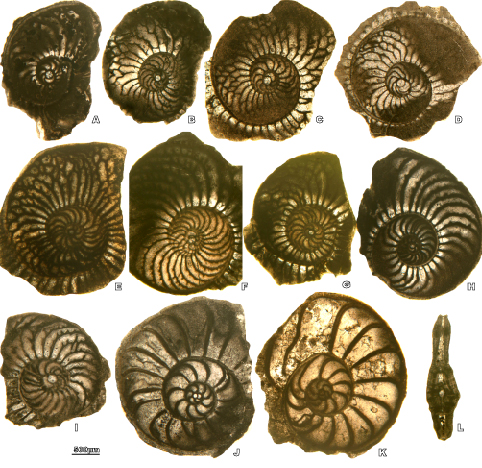
Figure 11.
Heterostegina, Operculina and Assilina from the Şevketiye Fm. in the Şevketiye Section (SBZ17 and 18A). A–G: Heterostegina armenica armenica. A) Sample ŞEV11-3, B) sample ŞEV17-13, C) sample ŞEV17-35, D) sample ŞEV17-34, E) sample ŞEV17-4, F) sample ŞEV17-5, G) sample ŞEV17-2. H-I: Operculina gomezi. H) Sample ŞEV14-3, I) sample ŞEV16-4. J–L: Assilina schwageri-alpina. J) Sample ŞEV10-5, K) sample ŞEV16-21, L) sample ŞEV17-25.
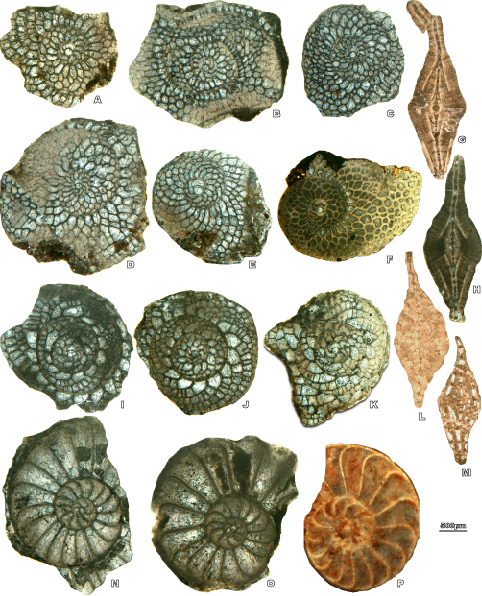
Figure 12.
12. Heterostegina, Spiroclypeus and Assilina from the Şevketiye (A–D, G–H, M–O, respectively) and Soğucak (E-F, I-L, P, respectively) fms. in the Çamyurt and Kazmalı sections (SBZ19A, 19A/20, respectively). A–H: Heterostegina reticulata mossanensis. A) Sample ÇAM10-15, B) sample ÇAM14-14, C) sample ÇAM14-32, D) sample ÇAM14-17, E) sample KAZ19-5, F) sample KAZ19-4, G) sample ÇAM12-4, H) sample ÇAM10-19. I–M: Spiroclypeus carpaticus. I) Sample KAZ19-15, J) sample KAZ19-20, K) sample KAZ19-9, L) sample KAZ17-4, M) sample ÇAM17-2. N–P: Assilina schwageri-alpina. N) Sample ÇAM14-22, O) sample ÇAM10-6, P) sample KAZ15-1.
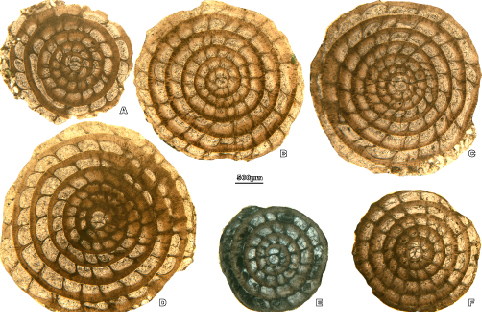
Figure 13.
Reticulate Nummulites from the Şevketiye (A–E) and Soğucak (F) fms. in Çamyurt and Kazmalı sections (SBZ19A, 19A/20, respectively). A–F: Nummulites fabianii. A) Sample ÇAM3-2, B) sample ÇAM3-3, C) sample ÇAM3-4, D) sample ÇAM3-8, E) sample ÇAM14-21, F) sample KAZ11-9.
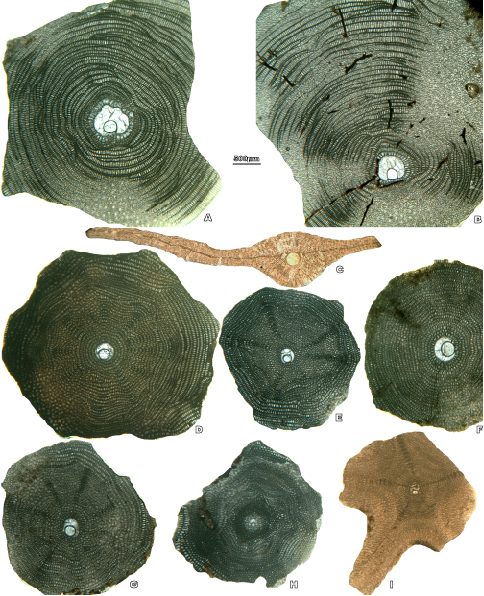
Figure 14.
Orthophragminids from the Şevketiye (A–C, E–I), and Soğucak (D) fms. in Çamyurt and Kazmalı sections (SBZ19). A–C) Discocyclina pratti pratti. A) sample ÇAM14-37, B) sample ÇAM14-12, C) sample ÇAM17-1; D) Orbitoclypeus varians scalaris, sample KAZ11-29; E–G) O. varians varians. E) sample ÇAM14-28, F) sample ÇAM14-2, G) sample ÇAM14-26; H) Nemkovella daguini, sample ÇAM14-25; I) Asterocyclina stellata, sample ÇAM10-3.
Biostratigraphy
The record of Heterostegina, Spiroclypeus, reticulate Nummulites, Assilina, Operculina, orthophragminids and other taxa that first appear across the Bartonian/Priabonian boundary (e.g. Pellatispira, Silvestriella), provide a sound basis in the establishment of SBZ (Less and Özcan, 2008, 2012; Less et al., 2008; Özcan et al., 2010; Papazzoni et al., 2017). Shallow marine clastics and carbonates in the lower to middle part (0–90m) of the Şevketiye Fm. are referred to the SBZ16?-17 based on the first record of Operculina gomezi in sample 9 (at 82m) and the stratigraphic position of these beds below the first record of Heterostegina armenica at 94m in the section, a marker species of the SBZ18A and 18B in western Tethys. The lowermost part of the unit might extend down into late Lutetian considering the relatively thick sequence below the H. armenica beds and the absence of any typical Bartonian species. Based on the occurrence of Opeculina gomezi, the part of the Şevketiye section between 82–90 meters is confidently referred to SBZ17, hence, Early Bartonian in age. The LBF assemblage, represented by Heterostegina armenica armenica, a subspecies characteristic of the SBZ18A, Operculina gomezi, Assilina schwageri-alpina, Discocyclina discus discus, Silvestriella tetraedra and other associated LBF in the upper part of the section (Fig. 8), points to a younger stratigraphic position, referable to SBZ18A across the Bartonian-Priabonian boundary according to Papazzoni et al. (2017). The occurrence of axially elongated Alveolina specimens in the lowermost part of the Kazmalı section, below the Priabonian strata suggests that these beds are Bartonian in age. Contrary to the LBF assemblages in the Şevketiye Section, the foraminiferal fauna of both Şevketiye and Soğucak fms. in Çamyurt and Kazmalı sections are characterized exclusively by phylogenetically advanced stages of Heterostegina reticulata’s lineage, which are associated with the typically Priabonian genus Spiroclypeus and the advanced developmental stages of the Nummulites fabianii group. In the Çamyurt Section, the lowest marine beds of the Şevketiye Fm. (just about the conglomerates of the Fıçıtepe Fm.) contain Nummulites fabianii, Heterostegina reticulata mossanensis, Pellatispira madaraszi and Orbitoclypeus varians scalaris, and are assigned to the SBZ19A. The highest limestone bed of the unit contains a similar assemblage as well as Spiroclypeus, suggesting the same zone. The lower beds of the Soğucak Fm. in Kazmalı Section (0–12m) cannot be confidently assigned to any biozone in the absence of key taxa. These beds may be referred to the SBZ17?/18 on the basis of the first occurrence of Operculina gomezi in sample 7 and their position below the Spiroclypeus-N. fabianii beds (samples 11–19). The diverse assemblages represented by Spiroclypeus sp., N. fabianii, Discocyclina pratti, Orbitoclypeus varians scalaris, Heterostegina reticulata mossanensis and Pellatispira in the upper part of the section (12–37m) are confidently assigned to the SBZ19A (Priabonian).
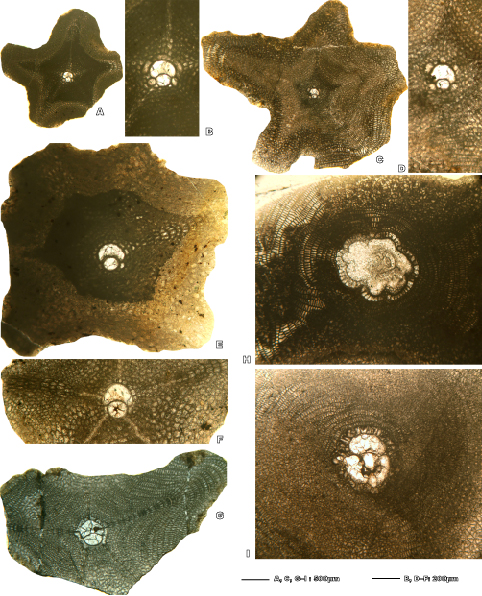
Figure 15.
Orthophragminids from the Şevketiye Fm. in the Şevketiye (SBZ17) and Çamyurt sections (SBZ19). A–D) Asterocyclina stellata stellaris. A–B) Sample ŞEV11-24, C-D) sample ŞEV11-14. E–F) A. stella cf. stella. E) Sample ŞEV7-5, F) sample ŞEV7-13. G) A. alticostata cf. alticostata. Sample ÇAM14-24. H–I) Discocyclina discus discus. H) Sample ŞEV10-14, I) sample ŞEV10-17.
DISCUSSION
Extension and correlation of Şevketiye and Soğucak formations in NW Turkey
Soğucak Fm., a common carbonate unit in the Thrace Basin, and its clastic equivalent, the Şevketiye Fm., were deposited in the northwestern part of the Biga Peninsula, between Lapseki and Biga towns. The southern extension of the Eocene Sea is tentatively delimited by the Kazmalı and Çamyurt localities, where both units dip beneath a thick sequence of the Late Eocene Ceylan Fm. and post-Eocene volcanic units, making it impossible to trace both formations further to the South. The limited vertical extent of the Soğucak Fm. in the Biga locality and the absence of any coeval units further to the East of the study area suggest that the sea transgressed eastward to reach this region. The shallow-marine deposits display a diachronic development in the area, as it has been shown in the Thrace Basin and Gökçeada (Figs. 18 and 19). The oldest record to date the transgression was found in Gökçeada and belongs to the SBZ15/16 (Middle to Late Lutetian), whereas all the other sections studied in the Gelibolu Peninsula (southern Thrace) and northern Thrace yielded a range of zones, varying from SBZ17 to 20 (Bartonian to Priabonian). At a regional scale, the results point out at a polarity from West (Gökçeada) to northeast (northern Thrace; see Less et al., 2011). The SBZ17 was only recorded from Gökçeada and Gelibolu Peninsula (e.g. TEKE and BEŞ sections in southern Thrace) and from Şevketiye Section in the Biga Peninsula, whereas this zone was never recorded in northern Thrace. Diachronic marine onlap of the Eocene Sea at a single locality is best recorded in Çatalca high where topographic lows were flooded in the SBZ18A and highs in the SBZ19 and 20 (Okay et al., 2010, 2017; Less et al., 2011). The latter age of the marine incursion is recorded widely in the Thrace Basin. The metamorphic basement near Mecidiye (MEC Section) and the ophiolites near Teke (TEKE Section) in southern Thrace are directly overlain by the Soğucak Fm. The metamorphic rocks of the Strandja Massif(?) near Karaburun (KARA Section) in northern Thrace are covered by the Soğucak Fm. that yielded LBF from the SBZ19 and/or 20. Thick carbonates of the same unit cover the Strandja Massif in sections TEKE and Hacımaşlı, which belong to the SBZ18 (A, B, C) at its lower parts (Less et al., 2011).
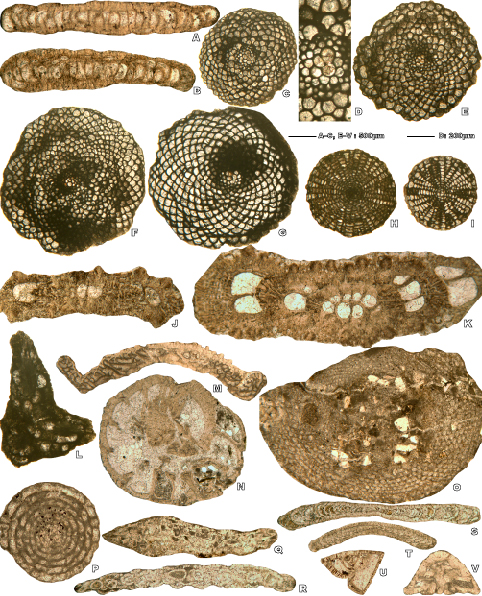
Figure 16.
Foraminifera and other fossils groups in the Şevketiye (A–L, N–P, S–T), and Soğucak (M, Q–R, U–V) fms. A–G) Linderina sp. A–B) Sample ŞEV10, C–G) sample ŞEV11. H–I) Sphaerogypsina globula. H) Sample ŞEV11, I) sample ŞEV10. J–K) Pellatispira madarazsi. J) Sample ÇAM4, K) sample ÇAM6. L) Silvestriella tetraedra. Sample ŞEV17. M) Fabiania cassis. Sample KAZ15. N) Gyroidinella magna. Sample ÇAM1. O) Orbitolites sp. Sample ŞEV3. P) Praebullalveolina afyonica. Sample KAZ16. Q–R) encrusting foraminifera. Q) Sample KAZ14, R) sample ÇAM16. S–T) Eoannularia eocenica. S) Sample ÇAM8, T) sample ÇAM16. U–V) Rotalids. Sample KAZ12.
To sum up, the Biga Peninsula and the Thrace Basin display a similar Bartonian-Priabonian evolution. The oldest marine record in Şevketiye (SBZ16?/17) suggests a minor age difference with that of the Section GIZ.B in Gökçeada and shows a great similarity to sections BEŞ and TEKE from the Gelibolu Peninsula. A shallow marine realm developed in Gökçeada, Gelibolu and Biga peninsulas during the Bartonian (SBZ17), which did not reach the northern part of Thrace. During the Priabonian, the shallow-marine realm increased and is recorded from both southern and northern Thrace and the Biga Peninsula. A marine connection was established with the Black Sea in the Priabonian, as evidenced by the deposition of the Soğucak Fm. upon the Strandja Massif, which formed an emerged landmass until the Bartonian/Priabonian transition (SBZ18: Less et al., 2011; Okay et al., 2017) (Fig. 19). A continuous shallow marine section, including both SBZ18 and 19, has never been documented, although the superpositon of other zones was recorded. This suggests that the SBZ19 may correspond to a separate, major marine incursion at a basinal scale.
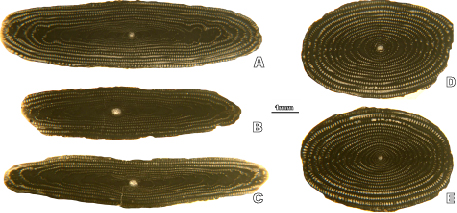
Figure 17.
Alveolinids from the Şevketiye Fm. in the Şevketiye Section (sample ŞEV8).
Inferences for regional geology
In the Biga Peninsula, the Şevketiye and Soğucak fms. correspond to the first marine incursions of the post-collisional Eocene sequence. The oldest volcanics beneath the Soğucak/Şevketiye transgression, Edincik volcanics, were previously dated as 42.3Ma (Lutetian), and the overlying Beyçayır volcanics as 37.3Ma (Altunkaynak and Genç, 2008; Genç et al., 2012). This age is close to the Bartonian/Priabonian boundary according to Gradstein et al. (2012). The results presented here are in strong agreement with these geochronological data, suggesting that the Lutetian was a period of extensive volcanism, followed by a marine realm during the Bartonian and Priabonian. Nevertheless, the marine transgression appears to have developed diachronically as shown from the Şevketiye and Çamyurt sections. The age of the Soğucak Fm. was previously commonly reported to be ‘Middle Eocene-Lutetian’ (e.g. Siyako et al., 1989). The ‘Lutetian’ was widely adopted to constrain the age of oceanic suturing (İzmir-Ankara suture) and the onset of the exhumation history of the metamorphic basement rocks (Şengör and Yılmaz, 1981; Okay et al., 1991, 2001; Şengün et al., 2011). Siyako et al. (1989) considered the Soğucak Fm. of ‘Lutetian’ age and the underlying continental clasts of the Fıçıtepe Fm. of Early Eocene age based only on stratigraphic superposition. This flawed age was, then, widely used to interpret the tectonic evolution of the region and exhumation of the Çamlıca metamorphics (e.g. Bonev and Beccaletto, 2007; Şengün et al., 2011). However, the continental clasts of the Fıçıtepe Fm. cannot be older than ‘Middle Eocene’ based on the marine record in the studied sections and the geochronological data obtained from the volcanics covering the basement rocks. The Early Eocene (Late Ypresian) shallow marine deposits in Bozcaada, attributed to the Soğucak Fm. by Varol et al. (2007), are the product of a much earlier transgression, which is also recorded in the Thrace Basin (Fig. 18). The results presented here suggest that suturing occurred before the Lutetian/Bartonian boundary, as the lower part of the Şevketiye Fm. is younger than the SBZ16. This is in accordance with the records from sections along the same suture zone in Central Anatolia, where the youngest pre-collisonal marine deposits range up to the Middle Lutetian (Okay et al., 2001).
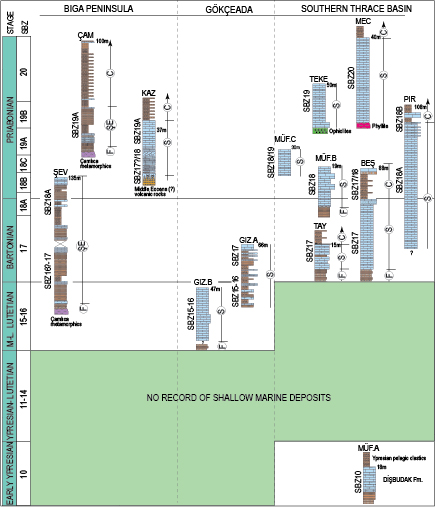
Figure 18.
Biostratigraphic correlation scheme of the Şevketiye and Soğucak fms. in NW Anatolia. The sections of the unit from northern Thrace Basin are not included. The sections from Gökçeada and Thrace Basin are from Özcan et al. (2010). Abbreviations: ŞE: Şevketiye Fm., S: Soğucak Fm.
CONCLUSIONS
The Eocene shallow marine deposits in the Biga Peninsula are characterized by two partly coeval lithostratigraphic units, Şevketiye and Soğucak fms. The Şevketiye Fm., formally described in the present study, consists of dominantly a clastic sequence with subordinate carbonates deposited during the Late Lutetian (?)/Bartonian–Priabonian. The Soğucak Fm., on the other hand, is characterized by dominantly limestone and subordinate shale/marl laminae, deposited during the Bartonian (?)–Priabonian. Unstable depositional conditions are inferred by the non-marine breccia or conglomerate intercalations, and by temporary deepening of the shelf, evidenced by beds rich in planktonic foraminifera in the lower part of the Şevketiye Fm. (Çamyurt Section). The oldest marine incursion is dated as Late Lutetian?-Bartonian in Şevketiye, while the youngest one is Priabonian in the Çamyurt and Kazmalı sections. This is consistent with the geochronological ages obtained in previous studies from the volcanic units underlying the Soğucak Fm. The oldest volcanic materials, allegedly recording a post-collisional event, constrain further the collision as pre- Middle Lutetian. The correlation of the sections with those from southern Thrace and previous data from northern Thrace, clearly point out to a transgression polarity from Gökçeada towards the Biga Peninsula and the southern Thrace Basin that ended with a regional marine transgression in the Priabonian. The marine connection with the Black Sea was established in the Priabonian, as evidenced by the deposition of the Soğucak Fm. on the Strandja Massif and İstanbul Zone via the Çatalca gap and further northwest in the Vize-Kıyıköy Region.
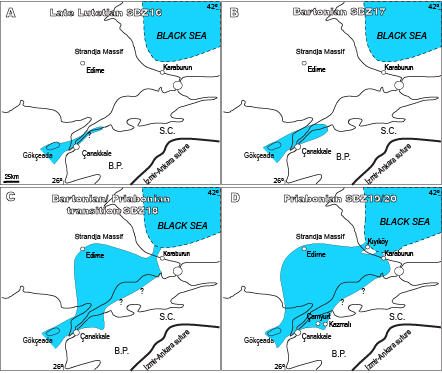
Figure 19.
Cartoons depicting the marine transgression in NW Anatolia during the Late Lutetian-Priabonian interval. Middle to Late Eocene reefal and nummulitic deposits in the Strandja Massif in Bulgaria, as well as in Greece, are not considered due to the lack of precise biostratigraphic data (e.g. Caracciolo et al., 2012). Data from the northern part of the Thrace Basin are from Less et al. (2011). Abbreviations: B.P.: Biga Peninsula, S.C.: Sakarya Continent.
Acknowledgements
We are grateful to D. Bassi (Ferrara), an anonymous reviewer and associate editor C. Martín-Closas for helpful suggestions in the review of the manuscript. We thank C. Ferràndez-Cañadell (Barcelona) for his comments on genus Linderina. This study was supported by İstanbul Technical University BAP project No. 34768.
References
Akbaş, B., Akdeniz, N., Aksay, A., Altun, İ., Balcı, V., Bilginer, E., Bilgiç, T., Duru, M., Ercan, T., Gedik, İ., Günay, Y., Güven, İ.H., Hakyemez, H.Y., Konak, N., Papak, İ., Pehlivan, Ş., Sevin, M., Şenel, M., Tarhan, N., Turhan, N., Türkecan, A., Ulu, Ü., Uğuz, M.F., Yurtsever, A., 2011. Geological Map of Turkey. 1:1,250,000. Ankara, Turkey, General Directorate of Mineral Research and Exploration.
Altunkaynak, Ş., Genç, Ş.C., 2008. Petrogenesis and time-progressive evolution of the Cenozoic continental volcanism in the Biga Peninsula, NW Anatolia (Turkey). Lithos, 102, 316-340.
Aygül, M., Topuz, G., Okay, A.I., Satır, M., Meyer, H.P., 2012. The Kemer metamorphic complex (NW Turkey): A subducted continental margin of the Sakarya Zone. Turkish Journal of Earth Sciences, 21, 19-35.
Bonev, N., Beccaletto, L., 2007. From syn- to post orogenic Tertiary extension in the north Aegean region: constraints on the kinematics in the eastern Rhodope-Thrace, Bulgaria-Greece and the Biga Peninsula, NW Turkey. In: Taymaz, T., Yılmaz, Y., Dilek, Y. (eds.). The geodynamics of the Aegean and Anatolia. London, Geological Society of London, Special Publications, 291, 113-142.
Caracciolo, L., Eynattten, H.V., Tolosana-Delgado, R., Critelli, S., Manetti, P., Marchev, P., 2012. Petrological, geochemical, and statistical analysis of Eocene-Oligocene sandstones of the western Thrace Basin, Greece and Bulgaria. Journal of Sedimentary Research, 82, 482-498.
Cole, W.S., Bermudez, P.J., 1944. New foraminiferal genera from the Cuban middle Eocene. Bulletins of American Paleontology, 28, 333-344.
Colom, G., Bauza, J., 1950. Operculina canalifera gomezi n. subesp. de Bartoniense de Cataluña. Boletín de la Real Sociedad Española de Historia Natural, 47, 219-221.
Costa, E., Garcés, M., López-Blanco, M., Serra-Kiel, J., Bernaola, G., Cabrera, L., Beamud, E., 2013. The Bartonian-Priabonian marine record of the eastern South Pyrenean foreland basin (NE Spain): a new calibration of the larger foraminifers and calcareous nannofossil biozonation. Geologica Acta, 11(2), 177-193.
d’Archiac, E.J.A., 1850. Description des fossiles du groupe nummulitique recueillis par M.S.-P. Pratt et M.J. Delbos aux environs de Bayonne et de Dax. Mémoires de la Société Géologique de France, 2, 397-456.
Dönmez, M., Akçay, A.E., Genç, Ş.C., Acar, Ş., 2005. Biga yarımadasında Orta-Üst Eosen volkanizması ve denizel ignimbiritler (Marine ignimbrites and middle-late Eocene volcanism in Biga Peninsula). Maden Tetkik ve Arama Dergisi, 131, 49-61.
Douvillé, H., 1916. Le Crétacé et le Tertiaire aux environs de Thones (Haute-Savoie). Comptes Rendus des Séances de l’Académie des Sciences, 163, 324-331.
Duru, M., Dönmez, M., Ilgar, A., Pehlivan, Ş., Akçay, A.E., 2012. Geology and mineral deposit map of the Biga Peninsula. In: Yüzer, E., Tunay, G. (eds). Biga Yarımadası’nın Genel ve Ekonomik Jeolojisi. Bulletin of the Mineral Research and Exploration, Special Publication, 28, 326pp. and three maps.
Ersoy, E.Y., Palmer, M.R., 2013. Eocene-Quaternary magmatic activity in the Aegean: implications for mantle metasomatism and magma genesis in an evolving orogeny. Lithos, 180-181, 5-24.
Ersoy, E.Y., Akal, C., Genç, Ş.C., Candan, O., Palmer, M.R., Prelevic, D., Uysal, İ., Mertz-Kraus, R., 2017. U-Pb zircon geochronology of the Paleogene-Neogene volcanism in the NW Anatolia: its implications for the late Mesozoic-Cenozoic geodynamic evolution of the Aegean. Tectonophysics, 717, 284-301.
Fabiani, R., 1905. Studio geo-paleontologico dei Colli Berici. Atti del Regio Istituto Veneto di Scienze, Lettere ed Arti, 64, 1797-1839.
Genç, Ş.C., Yılmaz, Y., 1997. An example of post-collisional magmatism in Northwestern Anatolia: the Kızderbent volcanics (Armutlu peninsula, Turkey). Turkish Journal of Earth Sciences, 6, 33-42.
Genç, Ş.C., Dönmez, M., Akçay, A.E., Altunkaynak, Ş., Eyüpoğlu, M., Ilgar, Y., 2012. Biga Yarımadası Tersiyer volkanizmasının stratigrafik, petrografik ve kimyasal özellikleri (Stratigraphic, petrographic and chemical features of Tertiary volcanism in Biga Peninsula). In: Yüzer, E., Tunay, G. (eds.). Biga Yarımadası’nın Genel ve Ekonomik Jeolojisi. Bulletin of the Mineral Research and Exploration, Special Publication, 28, 122-162.
Gradstein, F.M., Ogg, J.G., Schmitz, M., Ogg, G., 2012. The Geologic Time Scale 2012. The Netherlands, Elsevier.
Grigoryan, S.M., 1986. Nummulitidy i orbitoidy Armanskoj SSR. Akademia Nauk Armanskoj SSR, Erevan, 216pp.
Gülmez, F., Genç, Ş.C., Keskin, M., Tüysüz, O., 2013. A post-collision slab-breakoff model for the origin of the Middle Eocene magmatic rocks of the Armutlu-Almacık belt, NW Turkey and its regional implications. In: Robertson, A.H.F., Parlak, O., Ünlügenç, U.C. (eds.). Geological Development of Anatolia and the Easternmost Mediterranean Region. London, Geological Society, Special Publications, 372, 107-139.
Gümbel, C.W., 1861. Geognostische Beschreibung des bayerischen Alpengebirges und seines Vorlandes: I, Gotha, 950pp.
Gümbel, C.W., 1868. Beiträge zur Foraminiferenfauna der nordalpinen, älteren Eocängebilde oder der Kressenberger Nummulitenschichten. Abhandlungen der Mathematisch-Physikalischen Klasse der Königlich Bayerischen Akademie der Wissenschaften, 10, 581-730.
Hantken, M., 1876. A Clavulina szaboi retegek Faunaja 1. Foraminiferak, Maygar Allami Földtani Intezet Evkönyve, 4, 1-82.
Hottinger, L., 2014. Paleogene larger rotaliid foraminifera from the western and central Neotethys. Switzerland, Springer, 196pp.
Ilgar, A., Demirci-Sezen, E., Demirci, Ö., 2012. Biga Yarımadası Tersiyer istifinin stratigrafisi ve sedimantolojisi (Stratigraphy and sedimentology of the Tertiary sequence in Biga Peninsula). In: Yüzer, E., Tunay G. (eds.). Biga Yarımadası’nın Genel ve Ekonomik Jeolojisi. Bulletin of the Mineral Research and Exploration, Special Publication, 28, 75-120.
Kaufmann, F.J., 1867. Geologische Beschreiburg des Pilatus. Beiträge Zur Geologischen Karte Der Schweiz, 5, 1-169.
Le Calvez, Y., 1949. Révision des foraminifères Lutétiens du Bassin de Paris II, Rotaliidae et familles affines. Mémoires du Service de la Carte Géologique Détaillée de la France, 1-54pp.
Less, Gy., 1987. Paleontology and stratigraphy of the European Orthophragminae. Geologica Hungarica series Palaeontologica, 51, 1-373.
Less, Gy., Özcan, E., 2008. The Late Eocene evolution of Spiroclypeus, nummulitid Foraminifera, in the Western Tethys. Acta Paleontologica Polonica, 53, 303-316.
Less, Gy., Özcan, E., 2012. Bartonian-Priabonian larger benthic foraminiferal events in the Western Tethys. Austrian Journal of Earth Sciences, 105, 129-140.
Less, Gy., Özcan, E., Papazzoni, C.A., Stockar, R., 2008. The middle to late Eocene evolution of nummulitid foraminifer Heterostegina in the Western Tethys. Acta Palaeontologica Polonica, 53, 317-350.
Less, Gy., Özcan, E., Okay, A.I., 2011. Stratigraphy and larger foraminifera of the Middle Eocene to Lower Oligocene shallow-marine units in the northern and eastern parts of the Thrace Basin, NW Turkey. Turkish Journal of Earth Sciences, 20, 793-845.
Michelin, H., 1846. Iconographie zoöphytologique. Bertrand, P. (ed.), Paris, 348pp.
Neumann, M., 1958. Revision des Orbitoidides du Cretace et de l’Eocene en Aquitaine occidentale. Mémoires de la Societé Géologique de France, 37, 1-174.
Nuttall, W.L.F., 1926. The zonal distribution and description of the larger foraminifera of the Middle and Lower Kirthar series (Middle Eocene) of parts of Western India. Records of the Geological Survey of India, 59, 115-164.
Okay, A.I., Tüysüz, O., 1999. Tethyan sutures of northern Turkey. In: Durand, B., Jolivet, L., Horwáth, F., Séranne, M. (eds.). The Mediterranean Basins: Tertiary extension within the Alpine Orogeny. Geological Society of London, Special Publication, 156, 475-515.
Okay, A.I., Satır, M., 2000. Upper Cretaceous eclogite-facies metamorphic rocks from the Biga Peninsula, Northwest Turkey. Turkish Journal of Earth Sciences, 9, 47-56.
Okay, A.I., Siyako, M., Bürkan, K.A., 1991. Geology and tectonic evolution of the Biga Peninsula. Bulletin of the Technical University of Istanbul, 44, 191-255.
Okay, A.I., Tansel, İ., Tüysüz, O., 2001. Obduction, subduction and collision as reflected in the Upper Cretaceous-Lower Eocene sedimentary record of western Turkey. Geological Magazine, 138, 117-142.
Okay, A.I., Özcan, E., Cavazza, W., Okay, N., Less, Gy., 2010. Basement types, Lower Eocene series, Upper Eocene Olistostromes and the initiation of the southern Thrace Basin. Turkish Journal of Earth Sciences, 19, 1-25.
Okay, A.I., Özcan, E., Hakyemez, A., Siyako, M., Sunal, G., Kylander-Clarck, A.R.C., 2017. The Thrace Basin and the Black Sea: the Eocene-Oligocene marine connection. Geological Magazine, 1-23. DOI: 10.1017/S0016756817000772
Oppenheim, P., 1896. Das Alttertiar der Colli Berici in Venetien, die Stellung der Schichten von Priabona, und die Oligocane transgression in alpinen Europa. Zeitschrift der Deutschen Geologischen Gesellschaft, 48, 27-152.
Önal, M., 1986. Gelibolu yarımadası orta bölümünün sedimanter fasiyesleri ve tektonik evrimi, KB Anadolu, Türkiye (Sedimentary facies and tectonic evolution of the middle part of the Gelibolu Peninsula, NW Anatolia, Turkey). Jeoloji Mühendisliği, 29, 37-46. [In Turkish with English abstract]
Özcan, E., Less, Gy., Báldi-Beke, M., Kollányi, K., Kertesz, B., 2006. Biometric analysis of middle and upper Eocene Discocyclinidae and Orbitoclypeidae (Foraminifera) from Turkey and updated orthophragmine zonation in the Western Tethys. Micropaleontology, 52, 485-520.
Özcan, E., Less, Gy., Kertesz, B., 2007. Late Ypresian to middle Lutetian orthophragminid record from central and northern Turkey: taxonomy and remarks on zonal scheme. Turkish Journal of Earth Sciences, 16, 281-321.
Özcan, E., Less, Gy., Báldi-Beke, M., Kollányi, K., Acar, F., 2009. Oligo-Miocene foraminiferal record (Miogypsinidae, Lepidocyclinidae and Nummulitidae) from the Western Taurides (SW, Turkey): biometry and implications for the regional geology. Journal of Asian Earth Sciences, 34, 740-760.
Özcan, E., Less, Gy., Okay, A.I., Báldi-Beke, M., Kollányi, K., Yılmaz, İ.Ö., 2010. Stratigraphy and larger Foraminifera of the Eocene shallow-marine and olistostromal units of the southern part of the Thrace Basin, NW Turkey. Turkish Journal of Earth Sciences, 19, 27-77.
Özcan, Z., Okay, A.I., Özcan, E., Hakyemez, A., Özkan-Altiner, S., 2012. Late Cretaceous – Eocene geological evolution of the Pontides based on new stratigraphic and palaeontologic data between the Black Sea coast and Bursa (NW Turkey). Turkish Journal of Earth Sciences, 21, 933-960.
Papazzoni, C.A., Cosovic, V., Briguglio, A., Drobne, K., 2017. Towards a calibrated larger foraminifera biostratigraphic zonation: celebrating 18 years of the application of shallow benthic zones. Palaios, 32, 1-5.
Reuss, A., 1848. Die fossilen Polyparien des Wiener Tertiarbeckens. Naturwissenschaftliche Abhandlungen Wien, 2, 1-109.
Rütimeyer, L., 1850. Ueber das schweizerische Nummulitenterrain mit besonderer Berücksichtigung des Gebirges zwischen den Thunersee und der Emme. Denkschriften der Schweizerischen Naturforschende Gesellschaft, 11, 1-120.
Saner, S., 1985. Saros Körfezi dolayının çökelme istifleri ve tektonik yerleşimi, Kuzeydoğu Ege Denizi, Türkiye [Sedimentary sequences and tectonic setting of the region around the Saros Bay, northeastern Aegean, Turkey]. Türkiye Jeoloji Kurumu Bülteni, 28, 1-10. [In Turkish with English abstract]
Schlumberger, C., 1903. Troisième note sur les Orbitoïdes. Bulletin de la Societé Géologique de France, 4, 273-289.
Serra-Kiel, J., Hottinger, L., Caus, E., Drobne, K., Ferràndez, C., Jauhri, A.K., Less, Gy., Pavlovec, R., Pignatti, J., Samso, J.M., Schaub, H., Sirel, E., Strougo, A., Tambareau, Y., Tosquella, J., Zakrevskaya, E., 1998. Larger foraminiferal biostratigraphy of the Tethyan Paleocene and Eocene. Bulletin de la Societé Géologique de France, 169, 281-299.
Silvestri, A., 1928. Di alcune facies litho-paleontologiche del Terziario di Derna, nella Cirenaica. Bolletino Società Geologica Italiana, 37, 109-113.
Sirel, E., 1998. Foraminiferal descriptions and biostratigraphy of the Paleocene-lower Eocene shallow-water limestone and discussion on the Cretaceous-Tertiary boundary in Turkey. Maden Tetkik ve Arama Genel Müdürlüğü, Ankara (Turkey), Monograph Series, 2, 117pp.
Sirel, E., Acar, Ş., 1982. Praebullalveolina, a new foraminiferal genus from the Upper Eocene of the Afyon and Çanakkale region (west of Turkey). Eclogae Geologicae Helvetiae, 75, 821-839.
Siyako, M., Huvaz, O., 2007. Eocene stratigraphic evolution of the Thrace Basin, Turkey. Sedimentary Geology, 198, 75-91.
Siyako, M., Bürkan, K.A., Okay, A.I., 1989. Biga ve Gelibolu yarımadalarının Tersiyer jeolojisi ve hidrokarbon olanakları (Tertiary geology and hydrocarbon potential of the Biga and Gelibolu peninsulas). Türkiye Petrol Jeologlari Derneği Bülteni, 1, 183-199. [In Turkish with English abstract]
Sümengen, M., Terlemez, İ., 1991. Stratigraphy of Eocene sediments in the southwest Thrace. Bulletin of the Mineral Research and Exploration of Turkey, 113, 15-29.
Şengör, A.M.C., Yılmaz, Y., 1981. Tethyan evolution of Turkey: a plate tectonic approach. Tectonophysics, 75, 181-241.
Şengün, F., Yiğitbaş, E., Tunç, İ.O., 2011. Geology and tectonic emplacament of Eclogite and Blueschists, Biga Peninsula, Nortwest Turkey. Turkish Journal of Earth Sciences, 20, 273-285.
Temel, R.Ö., Çiftçi, N.B., 2002. Gelibolu Yarımadası, Gökçeada ve Bozcaada Tersiyer çökellerinin stratigrafisi ve ortamsal özellikleri. Türkiye Petrol Jeologlari Derneği Bülteni, 14, 17-40. [In Turkish with English abstract]
Uhlig, V., 1886. Über eine Mikrofauna aus dem Alttertiar der westgalizischen Karpathen. Jahrbuch der Kaiserliche und Königliche Geologische Reich−sanstalt, 36, 141-214.
Varol, B., Sirel, E., Ayyıldız, T., Baykal, M., 2007. New sedimentological and paleontological data from the Soğucak Fm. in the Bozcaada (Çanakkale). Bulletin of Mineral Research and Exploration Institute of Turkey, 135, 83-86. [In Turkish]
APPENDIX
LIST OF THE FOSSIL TAXA
Discocyclina discus discus (Rütimeyer, 1850)
D. pratti pratti (Michelin, 1846)
D. radians (d’Archiac, 1850)
Nemkovella daguini (Neumann, 1958)
Orbitoclypeus varians varians (Kaufmann, 1867)
O. varians (Kaufmann, 1867) scalaris (Schlumberger, 1903)
Asterocyclina stellata (d’Archiac, 1846) stellaris (Brünner, in Rütimeyer, 1850 )
A. stella cf. stella (Gümbel, 1861)
A. alticostata cf. alticostata (Nuttall, 1926)
A. kecskemetii Less, 1987
Nummulites fabianii (Prever, in Fabiani, 1905)
Heterostegina armenica armenica (Grigoryan, 1986)
H. reticulata (Rütimeyer) mossanensis Less, Özcan, Papazzoni and Stockar, 2008
Spiroclypeus carpaticus Uhlig, 1886
Operculina gomeziColom and Bauzá, 1950
Assilina schwageri Silvestri 1928-alpina (Douvillé, 1916)
Silvestriella tetraedra (Gümbel, 1868)
Sphaerogypsina globula (Reuss, 1848)
Gyroidinella magnaLe Calvez, 1949
Pellatispira madaraszi Hantken, 1876
Praebullalveolina afyonicaSirel and Acar, 1982
Fabiania cassis (Oppenheim, 1896)
Eoannularia eocenicaCole and Bermudez, 1944
Linderina sp.
Orbitolites sp.
Alveolina sp.
Nummulites sp.
Operculina sp.
Author notes
ozcanerc@itu.edu.tr
ozcanerc@itu.edu.tr
Alternative link
https://doi.org/10.1344/GeologicaActa2018.16.2.4 (html)
http://revistes.ub.edu/index.php/GEOACTA/article/view/20265/23638.pdf (pdf)