Abstract: In this short note, we present the first data on stable isotope composition of the oilfield waters from Carabobo area of the Faja Petrolífera del Orinoco “Hugo Chávez” (Orinoco Oil Belt). From a chemical point of view, the formation waters show a main Na-Cl level (TDS up to 30g/l) with a dilution trend toward Na-HCO3 composition (down to 1g/l). Until now, such a clear net chemical compositional trend was ascribed to a meteoric dilution (fresh/brackish bicarbonate) of the seawater endmember (the saltiest chloride). The isotope results of this study reveal that the seawater mother water was modified during a high-temperature thrusting event (120–125°C), forming 18O-enriched diagenetic water (up to +4‰), which was diluted in recent times by glacial meltwater and present-day meteoric water. The hypothetical presence of flood by a meteoric paleo-water also offers new hints to explain the low API gravity (<10°API biodegraded, extra heavy oil) and composition of the local crude.
Keywords: Orinoco Oil Belt, Carabobo area, Formation water, Chemical and isotope composition.
Chemical and stable isotope composition (18O/16O, 2H/1H) of formation waters from the Carabobo Oilfield, Venezuela
Universitat de Barcelona
Recepción: 15 Septiembre 2017
Aprobación: 15 Abril 2018
Publicación: 15 Junio 2018
The Faja Petrolífera del Orinoco “Hugo Chávez” (FPOHCh; also known in the literature as “Orinoco Oil Belt” or “Orinoco Heavy-Oil Belt”) encompasses a territory of approximately 55,000km2 of the East Venezuela Basin, located in the southern strip of the eastern Orinoco River Basin in Venezuela. With 1.36 trillion barrels of oil-in-place, it is the world’s largest onshore oil reserve (Fiorillo, 1987; Schenk et al., 2009; Petróleos de Venezuela S.A.-Corporación Venezolana del Petróleo, 2013). The deposition of the oil source rocks occurred on the northern passive continental margin (Cretaceous to Paleogene). Since the Oligocene-Miocene, a southward migration of the oil occurred in the foreland basin during the fold-thrust belting, which involved a North-South crustal shortening of 40% or more, forming a flexural forebulge against the Guyana shield (Talukdar et al., 1988). The main southward migration of meteoric and connate/formation waters has been modeled and theorized in several studies (Gallango and Parnaud, 1995; Parnaud et al., 1995; Schneider, 2003; Schneider, 2005). However, an isotopic analysis of the local oilfield waters was still lacking. In this study, the origin of the Carabobo’s formation waters is inferred from the chemical and isotope water composition.
The extraction area of the FPOHCh is subdivided from West to East in four administrative areas (Fig. I in the Electronic Appendix): Boyacá and Junín, mainly located in the western Guárico sub-basin; and Ayacucho and Carabobo, mainly located in the eastern Maturín sub-basin. The water samples of this study were collected from boreholes within the Monagas state, in the central sector of the Carabobo area, previously known as Cerro Negro (Fiorillo, 1987). In this area, the Las Piedras (Upper Miocene/Pliocene) and Mesa (Pleistocene) sandstone formations are at the upper part of the stratigraphic column (Fig. II in Electronic Appendix). Often undistinguishable, these formations do not contain hydrocarbons but fresh-to-brackish groundwater of the Mesa/Las Piedras regional aquifer (Montero et al., 1998; Petroleos de Venezuela S.A., 1999; De Freitas and Coronel, 2012). Beneath, the Freites Formation (Fm.) (Middle Miocene) consists of shale and sandstones. It conformably overlies the Oficina Fm. (Middle-Upper Miocene), which represents the most productive reservoir. It is subdivided in four members (from base to top): Moríchal, Yabo, Jobo, and Pilón. In particular, the sandstones of the Moríchal Member have the best reservoir quality, with 32% porosity and 10Darcy permeability on average (Lugo et al., 2001). One interpretation is that these sands deposited in valley fairways, with valley incision controlled by climate and sea-level changes, thus forming a transgressive sequence with fluvial sands at the base and marginal marine sands near the top (Gary et al., 2001). In the study area, the Moríchal reservoir sands are 100m-thick on average and unconformable overlie the Precambrian igneous and metamorphic basement. The top of the basement is located at a depth of approximatively 850–900m (Santos and Frontado, 1987; Pérez, 2010; Gil, 2017). Water recharges came from Serranía del Interior (North) and the Guyana Shield (South), but in the Oligocene-Miocene reservoir, a deep groundwater drainage from West to East also occured (Parnaud et al., 1995; Bartok, 2003; Martinius et al., 2013). The main geologic structure of the Oficina Fm. is represented by a regional monocline, striking East-West and dipping 3ºN (the ramp of the peripheral bulge). Normal faults and fault blocks were caused by lithostatic charges over the crystalline basement. Minor structures consist of sequences of uplifted and depressed blocks in alternating sequences (Santos and Frontado, 1987; González and Meaza, 2014).
Water samples from thirteen wells, which draw crude oil from the Oficina (C4–C13) and Freites formations (C1–C3), were collected during 2014–2016 for physicochemical and isotope measurements. These wells were chosen because they were not affected by waterflooding (i.e. use of water injection to enhance production) and had a water production higher than 40% (Boschetti et al., 2016). All water samples were not in emulsion with the crude and showed spontaneous separation from organic fraction after 24h, except for sample C4. In the latter case, water was extracted after emulsion destabilization and demulsification using the procedure described in Boschetti et al. (2016). Then, all water samples were passed through a funnel filled with glass wool to guarantee the elimination of crude residuals. Physicochemical parameters were determined according to Boschetti et al. (2016). The oxygen and hydrogen stable isotope ratios of water molecules, δ18O(H2O) and δ2H(H2O), were analyzed at the Stable Isotope Laboratory of the Instituto Andaluz de Ciencias de la Tierra (Consejo Superior de Investigaciones Científicas-Universidad de Granada, Granada, Spain) by, a high-Temperature Conversion/Elemental Analyzer (TC/EA) coupled online with an Isotope Ratio Mass Spectrometer (IRMS, Delta XP, Thermo-Finnigan, Bremen). Samples for isotopic analysis were passed through activated carbon for organic compounds remotion. After that, an aliquot of 0.7µl was injected into the reactor of the elemental analyzer, a ceramic column containing a glassy carbon tube kept at 1450ºC, to produce H2 and CO gases (Sharp et al., 2001; Rodrigo-Naharro et al., 2013). Five different internal laboratory standards (δ18O; δ2H) IACT-2 (+7.28‰; +57.42‰), EEZ3B (+1.05‰; +7.90‰), CAN (-3.70‰; -17.50‰), GR-08 (-8.35‰; -55.00‰) and SN-06 (-10.61‰; -72.77‰), were employed for instrumental calibration. These were previously calibrated against certified international standards from the International Atomic Energy Agency: V-SMOW, GISP and SLAP (NIST codes RM8535, RM8536 and RM8537, respectively). To avoid memory effects, each sample was analyzed ten times, discarding the first five results and doing average on the last five. The calculated precision, after correction of the mass spectrometer daily drift from previously calibrated internal standards systematically interspersed in the analytical batches (Rodrigo-Naharro et al., 2013), was better than ±0.2‰ for oxygen and ±1‰ for hydrogen. Local groundwater (Mesa/Las Piedras) and surface water from a river (Río Moríchal) were also analyzed for isotope composition and chloride concentration.
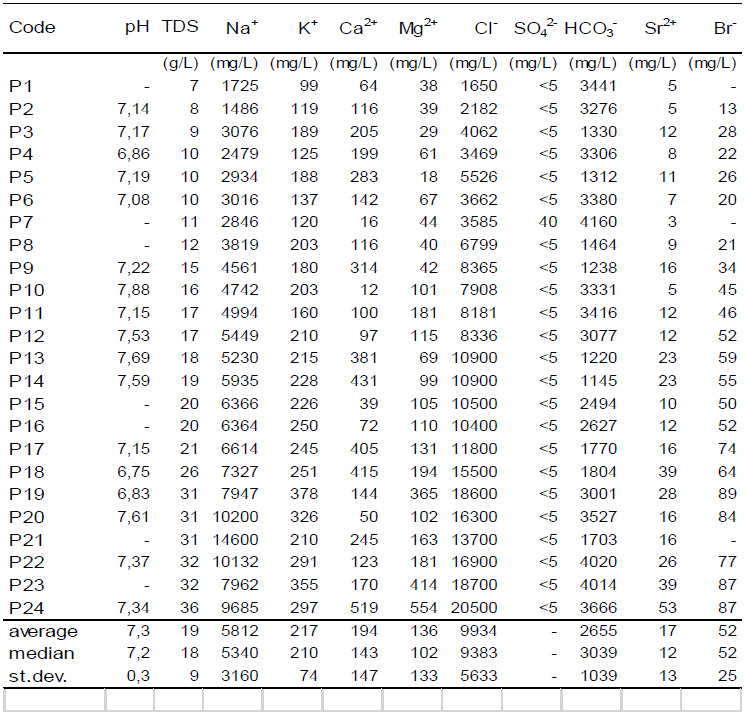
The obtained results are shown in the Electronic Appendix (Table I). An additional chemical dataset of 24 oilfield waters from the Carabobo area, collected and analyzed during 2017 (Table II, Electronic Appendix) was also used to interpret the chemical processes.
When plotted in the Langelier-Ludwig plot (Boschetti, 2011), formation waters from the FPOHCh had a Na-Cl main composition with brackish to saline Total Dissolved Solids (TDS) up to approximatively 30g/l, and the saltiest waters plot close to the “marine-side” of the diagram (Fig. 1). The Cl/Br ratio <286mg/l (211±38) also testifies a seawater origin, probably modified by the reaction with minerals of the basement and/or by ternary mixing between meteoric water, seawater and a seawater-evaporated brine (Rosenthal, 1997; McCartney and Rein, 2005; Sonney and Vuataz, 2010). Only the sample C1 from the Freites Formation showed a Na-HCO3 composition (Fig. 1) and was characterized by a lower TDS 1g/l. The chemical trend depicted in the diagram was consistent with the preliminary investigations in the Carabobo area (Pirela et al., 2008), in the Oficina Member formation waters from the Anaco Field (central Anzoátegui state; Funkhouser et al., 1948) and in the Junín area of the FPOHCh (Marcos et al., 2007). In all studies concerning the FPOHCh, three different members were distinguished in the area: Na-Cl brines, Na-Cl intermediate and Na-HCO3 meteoric. Figure 1 shows that the formation waters that are more affected by the “meteoric Na-HCO3 member” compositionally correspond to the deepest groundwater of the Mesas-Las Piedra aquifer (De Freitas and Coronel, 2012). As revealed in the Anaco Fields, groundwater flow could also occur deeply in the Oficina Formation, as evidenced by pressure switch (Funkhouser et al., 1948; Tackett, 2008). However, in comparison with the Oficina Formation, our Carabobo’s Na-HCO3 sample C1 is more closely shifted toward the Ca-HCO3 field, which is the most common composition of the local shallow groundwater (De Freitas and Coronel, 2012). The Orinoco River (Lewis and Weibezhan, 1981; Lewis et al., 1995) and most of the thermal waters of the Monagas state (Hernández and Sánchez, 2004) also showed a Ca-HCO3 composition, with the exception of the H2S-bearing spring of Los Baños. In the diagram (Fig. 1), this spring falls within the formation water trend because it has probably been affected by oil seep (Urbani, 1989).
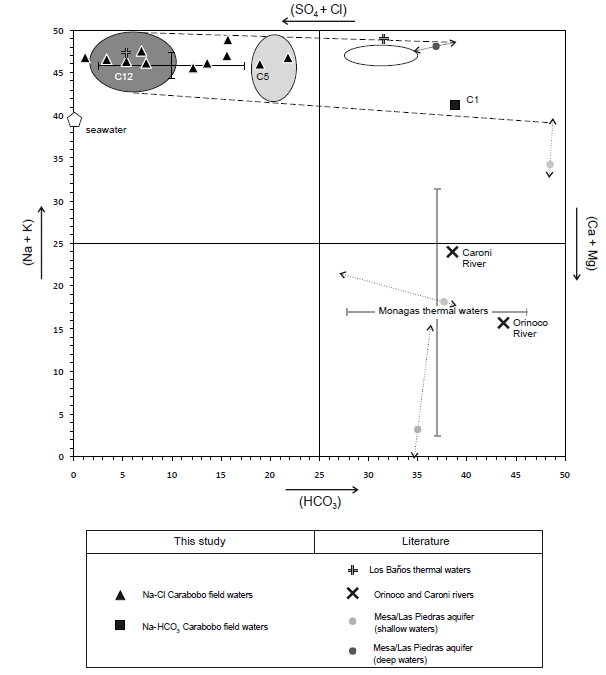
Figure 1.
Langelier-Ludwig diagram (Boschetti, 2011) of the oilfield waters from Carabobo area (meq/L basis): Na-Cl (triangles: data from Table I, ElectronicAppendix; dark error bars: average and standard deviations from Table II , Electronic Appendix.
Appendices available at www.geologica-acta.com) and Na-HCO3 (squares: C1 sample in the Table I, Electronic Appendix). Dashed lines show the compositional variation trend. Following this trend, the three different oilfield waters detected in the Junín area (Marcos et al., 2007) are shown by ellipses for comparison purposes: Na-Cl brine (dark gray); Na-HCO3 meteoric (white); mixed (light gray). Dots with arrows show the average and variation trend, respectively, of the shallow (light gray dots) and deep (dark gray dots) components of the Mesa/LasPiedras aquifer (De Freitas and Coronel, 2012). The Ca-HCO3 composition of the Orinoco and Caroni Rivers (X) (Lewis and Weibezhan, 1981; Lewis et al., 1995) and thermal waters in Monagas state (Hernández and Sánchez, 2004) are also shown. An exception from the shallow Ca-HCO3 composition is represented by Na-HCO3 to Na-Cl composition of the Los Baños thermal spring (+), which is mixed with oil seeps (Urbani, 1989).
Most of the sampled waters plot below the Global Meteoric Water Line (Gourcy et al., 2007) (Fig. 2A), clustering between the mean values of the Orinoco River at Ciudad Bolivar (International Atomic Energy Agency/World Meteorological Organization, 2017a) and the seawater and/or porewaters from the Venezuela Basin (Friedman and Hardcastle, 1973; Lawrence, 1973). The waters of the first cluster, -35‰<δ2H(H2O)<-20‰, fall close to the area containing the samples of the Maracaibo Oilfield (Boschetti et al., 2016). However, differently from this latter, the contribution of meteoric water in the Carabobo formation waters is probably more important than an 18O-enriched diagenetic water (Fig. 2A). Indeed, the Na-HCO3 sample C1 showed the most depleted δ2H(H2O), falling between the Moríchal and Orinoco Rivers (Fig. 2A). In the second seawater-derived samples cluster, -10‰<δ2H(H2O)<0‰, the sample C5 showed a prominent O-shift on the right side of the water line up to δ18O(H2O)=+4‰. This 18O-enrichment, commonly associated with water-rock interaction processes, could be attributed to a diagenetic effect. Accordingly, an estimated δ18O composition between +2‰ and +6‰ was related to the formation fluids, which precipitate quartz at a temperature of 100–125°C during the southward thrusting event (Schneider, 2005). Indeed, when the Na-Li geothermometer for sedimentary brines (Sanjuan et al., 2014) was applied to the concentrations of the two elements obtained in this study, a mean temperature of 125±5°C was recorded. This temperature is significantly higher than the present-day temperature at the bottom hole (not higher than 60°C, also according to the present-day local geothermal gradients (Fiorillo, 1987; Quigiada, 2006) but is consistent with temperatures achieved during the quartz cementation process during the Miocene thrusting (Roure et al., 2010). Finally, a deuterium-chloride diagram (Fig. 2B) confirmed that local Na-Cl formation waters derive from marine porewaters, which were diluted by two main end-members: diagenetic waters with δ2H(H2O) similar to porewater (sample C5), and inflows from present-day meteoric water (samples C1, C8), e.g. Orinoco River with δ2H(H2O)=-41‰ (International Atomic Energy Agency/World Meteorological Organization, 2017b). We hypothesize that a third end-member could be meltwater from the last glaciation, with a δ2H(H2O) of approximatively -145‰ (Ramirez et al., 2003), which probably diluted sample C12 as similarly expected in different studied sites (Birkle et al., 2009; Boschetti et al., 2016). As opposed to other oilfield waters from the study area, this latter sample falls very close to the Meteoric Water Line (Fig. 2A) and on the seawater-meltwater binary mixing curve (Fig. 2B), showing a substantially unchanged chloride content similar to the porewaters. Considering the lack of chloride-bearing evaporite minerals in the formations at depth, and according to Warne et al.(2002), this glacial melts-seawater mixing probably occurred in the Orinoco area at approximatively 18,000-15,000yrs BP. However, at this stage of the investigation we cannot exclude the possible contribution of meteoric paleo-water of different age. For example, isotope composition of the rainfall during the last 14,000 years was not so different from that of the present-day, -45‰<δ2H(H2O)<-28‰ and -8 ‰<δ18O(H2O)<-4‰ (Van Breukelen et al., 2008), thus representing another potential source of the local formation waters (Fig. 2).
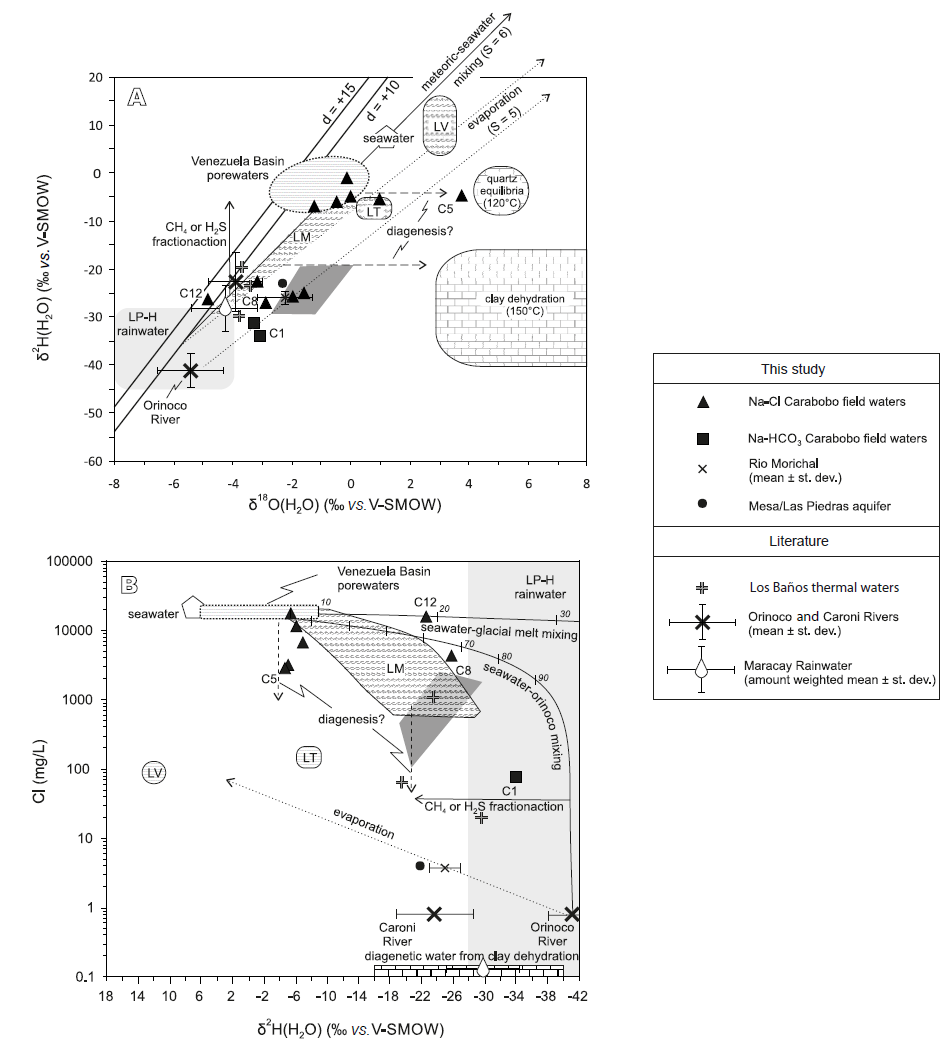
Figure 2.
A) δ2H(H2O) vs. δ18O(H2O) and B) chloride (mg/L) vs. δδ2H(H2O) diagrams, modified from Boschetti et al. (2016). Na-Cl (triangles) and Na-HCO3(squares) oilfield waters from Carabobo area (this study) and Lake Maracaibo (dark gray field) (Boschetti et al., 2016) are shown.
Global (d=+10) and local (d=+15) meteoric water lines are shown in A). The mean composition of Orinoco and Caroni rivers (International Atomic Energy Agency/Water Resources Programme, 2009; International Atomic Energy Agency/World Meteorological Organization, 2017b), Maracay rainwater (International Atomic Energy Agency/World Meteorological Organization, 2017a), Los Baños thermal waters (Urbani, 1989) and Late Pleistocene–Holocene rainfall (LP-H light gray field; Van Breukelen et al., 2008) are plotted in both diagrams. Lake Maracaibo (LM), Lake Valencia (LV) and Lagoon Taguaiguay (LT) are also plotted in both diagrams to represent the fractionation effect due to evaporation (Boschetti et al., 2016). As opposed to Maracaibo oilfield waters, which showed 18O-enrichment due to clay dehydration, the Carabobo waters show an 18O-shift, probably due to quartz equilibrium during the thrusting event in Maturín Sub-basin, starting from Venezuela Basin porewater. In the plot B), the inflows of present-day meteoric water (δ2H=-43‰, Cl=1mg/l) on C8, C1 samples and a hypothetical last glaciation floodwater (δ2H=-145‰, Cl=1mg/l) on C12 are also distinguishable. Curves represent binary mixings: numbers in italic are the percentage of the aforementioned diluting waters. See text for details. The fractionation effect due diagenesis (dashed arrow; Boschetti et al., 2016) and to hydrogen-bearing gases (solid arrow; Clark, 2015) are also shown in both diagrams.
In this study, a Na-Cl main composition of the Carabobo oilfield waters from the Moríchal Member, with a dilution trend toward Na-HCO3 due to the influx of diluted and shallow waters, was revealed. These findings agree in part with the results previously obtained by other authors (Pirela et al., 2008). The novelty of our work lies in the discrimination of the isotope signature of these waters. Our results highlight i) the seawater origin of the deep Na-Cl endmember, which resembles the porewaters of the Venezuela Basin; and ii) the presence of three additional, isotopically different waters, which can shift the composition of the mother salty porewater toward a high δ18O(H2O) (diagenetic water from quartz cementation) or low δ2H(H2O) (meteoric components from the last glaciation to the present). Such chemical-isotope differentiation of the waters is the result of a complex history combined with the particular structural settings of the studied area (peripheral bulge, stratigraphic pinch-outs, normal faults). Additional chemical and isotopic analyses (along with 14C data) of waters from the neighbouring boreholes are necessary to better decipher the paleo-recharge and provenance of the meteoric waters (i.e. Serranía del Interior, Guyana Shield, Orinoco). However, until now, only generic meteoric water was considered in a hydrodynamic model and biodegradation process during heavy oil formation (Parnaud et al., 1995; Talwani, 2002). The flood of the oil reservoir by a meteoric paleo-water could also help to explain the extreme degradation of the oil in this area (Larter and Head, 2014).
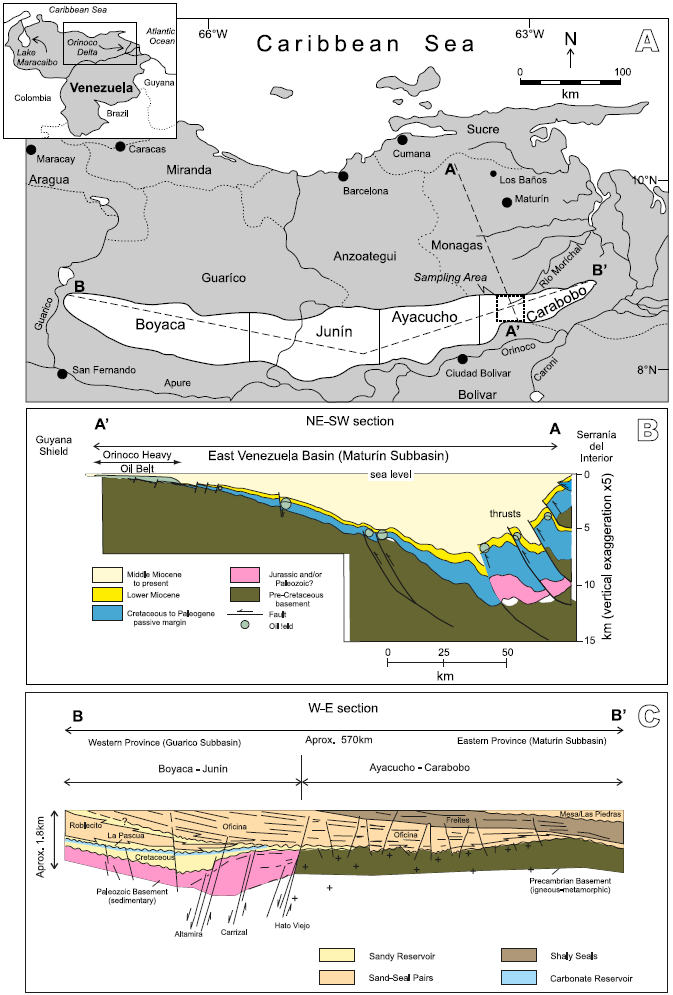
Figure I.
A) Location map of the Faja Petrolífera del Orinoco “Hugo Chávez” (FPOHCh, in white) and sampling area in the Carabobo area, modifiedfrom Martinius et al. (2012) and Petroleos de Venezuela S.A.-Corporación Venezolana del Petróleo (2013). Continuous lines are rivers and creeks;thin dashed lines are the Venezuela states boundaries. B) NW-SE schematic cross section, modified from Schenk et al. (2009), see A) for location:A–A’ dashed path. C) W-E cross section, modified from Audemard et al. (1985), see A) for location: B–B’ dashed path.
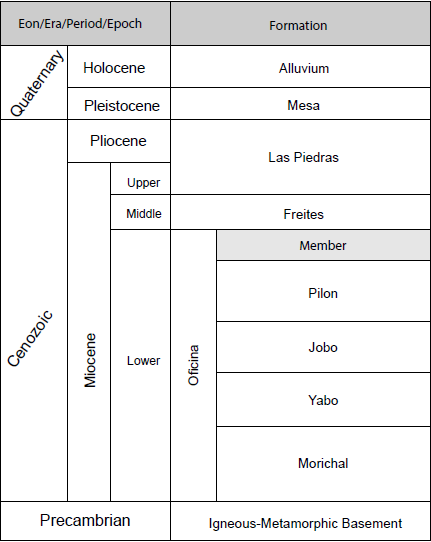
Figure II.
Stratigraphic framework and age for the Carabobo area, modified from (Petróleos de Venezuela S.A., 1999).
Stratigraphic framework and age for the Carabobo area, modified from (Petróleos de Venezuela S.A., 1999)
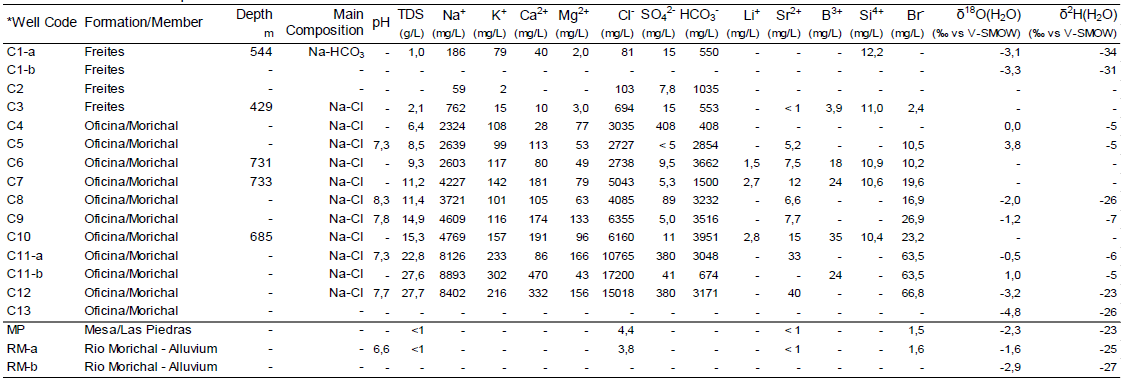
*a: 2014-2015 sampling; b: 2016 sampling
-: not analyzed
TDS: calculated Total Dissolved Solids
< #: below detection limit
Preliminary chemical composition dataset of the Carabobo oilfield waters (2017 sampling campaign)
Cite as:: Boschetti, T., Angulo, B., Quintero, F., Volcán, J., Casalins, A., 2018. Chemical and stable isotope composition (18O/16O, 2H/1H) of formation waters from the Carabobo Oilfield, Venezuela. Geologica Acta, 16(3), 257-264, I-III. DOI: 10.1344/GeologicaActa2018.16.3.2
http://doi.org/10.1344/GeologicaActa2018.16.3.2 (html)
http://revistes.ub.edu/index.php/GEOACTA/article/view/20023/23759.pdf (pdf)
We would like to thank Dr. A. Delgado, Consejo Superior de Investigaciones Científicas (CSIC)-Instituto Andaluz de Ciencias de la Tierra, Granada, Spain, for the isotope analyses. Petróleos de Venezuela S.A. and the oil companies participating in the local joint ventures (Petromonagas, Petrolera Sinovensa, Petroindependencia) are also thanked for allowing us to conduct this research, their support during sampling and permission to publish the data. The comments made by anonymous reviewers were highly appreciated.
tiziano.boschetti@unipr.it
Figure 1.
Langelier-Ludwig diagram (Boschetti, 2011) of the oilfield waters from Carabobo area (meq/L basis): Na-Cl (triangles: data from Table I, ElectronicAppendix; dark error bars: average and standard deviations from Table II , Electronic Appendix.
Appendices available at www.geologica-acta.com) and Na-HCO3 (squares: C1 sample in the Table I, Electronic Appendix). Dashed lines show the compositional variation trend. Following this trend, the three different oilfield waters detected in the Junín area (Marcos et al., 2007) are shown by ellipses for comparison purposes: Na-Cl brine (dark gray); Na-HCO3 meteoric (white); mixed (light gray). Dots with arrows show the average and variation trend, respectively, of the shallow (light gray dots) and deep (dark gray dots) components of the Mesa/LasPiedras aquifer (De Freitas and Coronel, 2012). The Ca-HCO3 composition of the Orinoco and Caroni Rivers (X) (Lewis and Weibezhan, 1981; Lewis et al., 1995) and thermal waters in Monagas state (Hernández and Sánchez, 2004) are also shown. An exception from the shallow Ca-HCO3 composition is represented by Na-HCO3 to Na-Cl composition of the Los Baños thermal spring (+), which is mixed with oil seeps (Urbani, 1989).
Figure 2.
A) δ2H(H2O) vs. δ18O(H2O) and B) chloride (mg/L) vs. δδ2H(H2O) diagrams, modified from Boschetti et al. (2016). Na-Cl (triangles) and Na-HCO3(squares) oilfield waters from Carabobo area (this study) and Lake Maracaibo (dark gray field) (Boschetti et al., 2016) are shown.
Global (d=+10) and local (d=+15) meteoric water lines are shown in A). The mean composition of Orinoco and Caroni rivers (International Atomic Energy Agency/Water Resources Programme, 2009; International Atomic Energy Agency/World Meteorological Organization, 2017b), Maracay rainwater (International Atomic Energy Agency/World Meteorological Organization, 2017a), Los Baños thermal waters (Urbani, 1989) and Late Pleistocene–Holocene rainfall (LP-H light gray field; Van Breukelen et al., 2008) are plotted in both diagrams. Lake Maracaibo (LM), Lake Valencia (LV) and Lagoon Taguaiguay (LT) are also plotted in both diagrams to represent the fractionation effect due to evaporation (Boschetti et al., 2016). As opposed to Maracaibo oilfield waters, which showed 18O-enrichment due to clay dehydration, the Carabobo waters show an 18O-shift, probably due to quartz equilibrium during the thrusting event in Maturín Sub-basin, starting from Venezuela Basin porewater. In the plot B), the inflows of present-day meteoric water (δ2H=-43‰, Cl=1mg/l) on C8, C1 samples and a hypothetical last glaciation floodwater (δ2H=-145‰, Cl=1mg/l) on C12 are also distinguishable. Curves represent binary mixings: numbers in italic are the percentage of the aforementioned diluting waters. See text for details. The fractionation effect due diagenesis (dashed arrow; Boschetti et al., 2016) and to hydrogen-bearing gases (solid arrow; Clark, 2015) are also shown in both diagrams.
Figure I.
A) Location map of the Faja Petrolífera del Orinoco “Hugo Chávez” (FPOHCh, in white) and sampling area in the Carabobo area, modifiedfrom Martinius et al. (2012) and Petroleos de Venezuela S.A.-Corporación Venezolana del Petróleo (2013). Continuous lines are rivers and creeks;thin dashed lines are the Venezuela states boundaries. B) NW-SE schematic cross section, modified from Schenk et al. (2009), see A) for location:A–A’ dashed path. C) W-E cross section, modified from Audemard et al. (1985), see A) for location: B–B’ dashed path.
Figure II.
Stratigraphic framework and age for the Carabobo area, modified from (Petróleos de Venezuela S.A., 1999).
Stratigraphic framework and age for the Carabobo area, modified from (Petróleos de Venezuela S.A., 1999)
*a: 2014-2015 sampling; b: 2016 sampling
-: not analyzed
TDS: calculated Total Dissolved Solids
< #: below detection limit
Preliminary chemical composition dataset of the Carabobo oilfield waters (2017 sampling campaign)
