Documentary texts
Cosmopolitanism and oceanic thinking: Anaximander’s world map
Cosmopolitanism and oceanic thinking: Anaximander’s world map
Mètode Science Studies Journal, vol. 15, núm. 5, e28911, 2025
Universitat de València

Esta obra está bajo una Licencia Creative Commons Atribución-NoComercial-SinDerivar 4.0 Internacional.
Recepción: 04 Junio 2024
Aprobación: 29 Enero 2025
Abstract: One of the most interesting maps in the history of cartography is the one attributed to the Greek philosopher and geographer Anaximander of Miletus, who lived around the 6th century BCE. We know of it, in part, thanks to the version made by another citizen from Miletus: the geographer Hecataeus. Anaximander’s world map is part of a set of transformations related to knowledge, society, politics, and geography. In order to interpret the map correctly, therefore, we need to understand these transformations. Moreover, we also need to know about the myths and cosmogonic traditions of the time. Finally, we note that the general cosmology described by Anaximander can partially illuminate current politics and planetary ecology.
Keywords: Anaximander, history of science, world map, cosmopolitics, oceanic thinking.
Almost nine centuries later, the geographer Agathemerus, from Alexandria, still knew that Anaximander, a disciple of Thales, had been the first to dare draw the inhabited Earth, and that thanks to his colleague Hecataeus, who had «corrected» or «perfected» the drawing, we knew what the original map by Anaximander was like (Colli, 2008, p. 181). More recently, the Italian philosopher Maria Michela Sassi observed that Anaximander was also one of the first to write in prose, rather than verse, in order to convey his ideas more clearly and directly. At the same time, she claims, he had inaugurated a new discursive genre: reflection on the nature of the Cosmos (Sassi, 2022, pp. 134–150). She thus agreed with the 4th-century rhetorician Themistius, who said in one of his speeches that Anaximander of Miletus was «the first of the Greeks who dared to write a treatise on nature» (Themistius, Discourses, cited in Colli, 2008, p. 205). This is why the philosophers who lived in Miletus around the 5th century BCE are also known as the physikoi or «naturalists»; or even as the first geographers (Farinelli, 2003, pp. 8–9).
But what was the relationship between Anaximander’s first world map and this «naturalistic» thinking which, according to recent authors, led to a «first humanism» or even a «first enlightenment» within the history of Mediterranean culture? What role did the new image of the world play in the construction of the new cosmology, seemingly liberated from previous poetic, mythical, and religious thinking? Finally, to what extent was that graphic representation of the inhabited world a pure expression of rational thought, independent of the political context and metaphors used by archaic cosmogonies?
Many historians of science and philosophy agree that in the 4th century BCE there was a revolution in the way we approached knowledge about the world. The focal point of this revolution was the Ionian city of Miletus, and some of its protagonists were the aforementioned Thales and Anaximander, as well as Anaximenes. All three began to explain some natural phenomena, as well as the origin and order of the universe, according to their immediate experience; that is, without resorting to supernatural elements and based on rational and logical arguments. Admittedly, not everyone agrees that this revolution represented a radical break with the previous tradition, especially that handed down by Homer and Hesiod. Indeed, some authors including Francis M. Cornford believe that the Miletians built their thinking «on certain tacit assumptions which it never occurs to them even to state, because they are taken over from poetical cosmogony» (Cornford, 1987, p. 225). Nevertheless, be that as it may, the system of ideas they had developed at that time already shared some of the traits with what we now consider science.
To begin with, the physikoi did not resort to any divinity, supernatural forces, or higher powers when it came to understanding natural phenomena, especially in relation to the atmosphere. For Anaximander, rain or wind were the result of evaporation and solar radiation, not the will of a Zeus or Poseidon. Secondly, for them, imagining an ordered Cosmos was no longer linked to the image of a sovereign god imposing control and instead began to be related to an impersonal law that regulated and ordered the Cosmos. Aristotle justified this with a comment in On the heavens:
(...) there are some, Anaximander, for instance, among the ancients, who say that the earth keeps its place because of its indifference. Motion upward and downward and sideways were all, they thought, equally inappropriate to that which is set at the centre and indifferently related to every extreme point [of the universe]; and to move in contrary directions at the same time was impossible: so it must needs remain still. (Aristotle, On the heavens, cited in Colli, pp. 171–173)
Finally, and unlike, for example, Babylonian astronomy, which was more «arithmetic» in nature, according to Vernant, Anaximander’s cosmology fit into a geometric spatial scheme. In Vernant’s words, whether in the field of geography, astronomy, or cosmology, Anaximander conceived and projected the physical world into a spatial framework that was no longer defined by its religious qualities but rather, was made up of reciprocal, symmetrical, and reversible relationships (Vernant, 1992, p. 11).
More generally, if «scientific thought» was born with Anaximander, as argued by Carlo Rovelli, it was mainly due to the philosopher’s attitude: because of his criticism of inherited knowledge, the questioning of previous certainties, or doubt in the face of the immediate experience of things. In this sense, Rovelli himself states that Anaximander’s great cognitive leap was to understand that the «the Earth is a finite body that floats free in space» (Rovelli, 2018, p. 72). If, throughout human history, the Earth had always been conceived as that which we tread on, that which lies beneath our feet, and the sky and the universe as that which is above our heads, from the time of Anaximander onwards, the above and the below ceased to be absolute values. In other words: heaven was no longer just up above, but also below; it actually surrounds the entire Earth. What is more relevant, then, is that Anaximander questioned the previous images of the Cosmos and proposed an alternative and coherent explanation for them. However, he could not have done so if the intellectual environment of Miletus had not favoured a new relationship between masters and disciples, a relationship based on debate, discussion, and criticism.
It is easy to relate this atmosphere to the appearance, during the same period, of a new social space in the Greek polis: the agora, where free citizens discussed the affairs of the city. It was here that the habit of simultaneously debating, arguing, and questioning one’s own and others’ arguments was transferred to the sphere of knowledge. However, it is more difficult to directly link, as Rovelli himself does, Greek political geography to this change in mentality. «While peoples around the planet struggled to attain stability by means of great kingdoms and empires», writes Rovelli, «Greece remained divided into cities fiercely jealous of their independence. This fragmentary structure turned out to be anything but a source of weakness – it was at the heart of the extraordinary dynamism (...) of the Greek world» (Rovelli, 2018, p. 43). It seems that with the end of the Mycenaean civilisation, which historians place around the 13th century BCE, the region had experienced some stagnation; then, during the 8th and 7th centuries BCE, Greece once again became an active agent, with significant demographic and economic growth driven, in part, by the opening of trade routes to the East. In 620 BCE, for example, Miletus founded a colony in Egypt, which could have favoured cultural exchange and the transfer of astronomical knowledge (Freely, 2021). Even more important was their relationship with the Phoenicians, from whom they would adopt the alphabetic writing system.
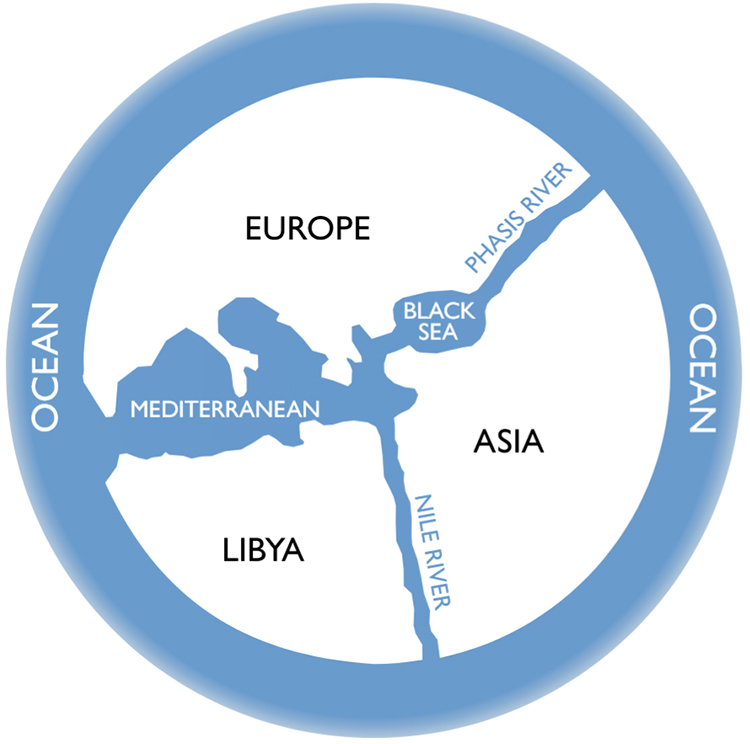
Reconstruction of the world map designed by Anaximander.
Bibi Saint-PolNevertheless, the Greeks immediately started evolving this writing towards a system more closely resembling phonetic expression. This favoured its dissemination and learning, meaning that it ceased to be exclusively the instrument of scribes closely linked to the interests of power. Therefore, this transition facilitated the transmission of knowledge and the writing of new types of documents. This has been highlighted, once again, by Maria Michela Sassi, when she stated that Anaximander’s prose could have been inspired, on the one hand, by legal texts and written laws; and on the other, by certain architectural treatises. The description of a Cosmos governed by proportion, symmetry, or balance, and the image of the Earth depicted as a section of a column located at the centre of the universe, support this hypothesis (Sassi, 2022, p. 139). «Geometric shapes (in particular the circle and the sphere)», Christian Jacob writes, «allow us to understand the architecture of the universe», and «are a visual support for reasoning and calculation» (Jacob, 2008, p. 50).
Let us stop at this last sentence: geometric shapes, most notably the circle and the sphere, «are a visual support for reasoning and calculation». This idea allows us to return to Anaximander’s world map, which worked, above all, as a visual support framed within the consolidation of what Sassi calls mixed orality; that is, the presence of two simultaneous channels of communication in educational culture: written and oral. In fact, anthropologists of writing have long insisted on the role that writing played in fostering critical thinking, because it allowed for the revision, rectification, and updating of acquired knowledge and expertise (Goody, 1985). In the case of maps, there is even a word to refer to this process: «correction» (diorthôsis); Hecataeus corrected Anaximander’s map. Indeed, written or engraved documents – Anaximander’s pinax – encourage the habit of correcting and expanding previous information. At the same time, such information acts as a «visual support» in the sense that the map became a «heuristic device», as Christian Jacob calls it: a device that encourages new questions, that allows us to establish new geographical relationships or organise territorial thinking differently. In short, maps facilitate some «intellectual operations» that are difficult to conceive without a graphic and synthetic representation of a given territory (Jacob, 2008, p. 81, 158).
Thus, at this point we must understand Anaximander’s map not only as an auxiliary element of this new way of thinking about nature and the Cosmos, but also as an instrument that drove the cognitive revolution. Thus, it fits with a naturalistic philosophy, if by «naturalistic» we understand an explanation and description that aims to approach the shared experience of a world that is external and independent of our conceptual schemes. In light of this, Livio Rossetti considers that Anaximander’s map did not have any glaring errors and that it was «capable of offering a moderately ordered and plausible representation of the Mediterranean area». The coastline, for example, which according to Rossetti was an «absolute novelty», defines the shape of the Mediterranean in a fairly recognisable way. The novelty lies on the one hand, in representing it «as the places would be seen if we could observe them from a great height», and not according to what «the navigators had seen and narrated». On the other hand, it also lies in the decision to trace only the coastline and «exclude the ornaments, such as drawing large fish or terrible lions, or Poseidon with the trident, or the sirens, or perhaps Hephaestus where Etna is located» (Rossetti, 2020, p. 525, 528).
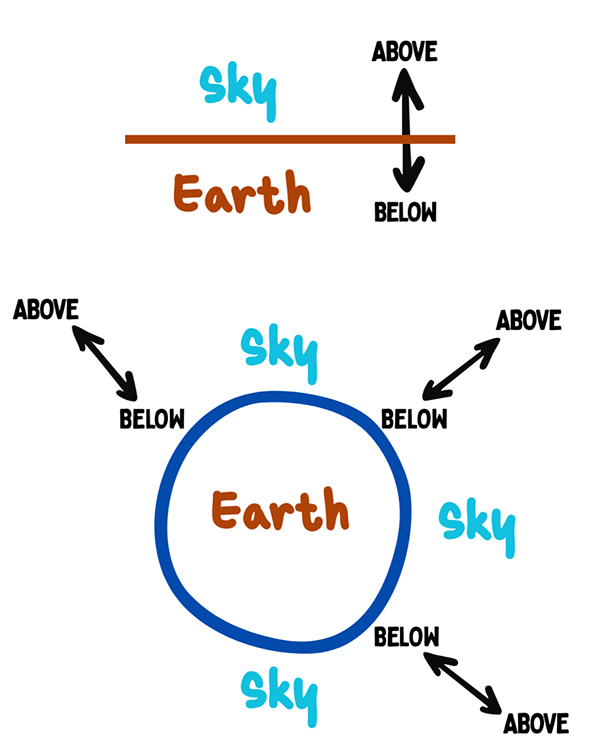
Outline of the worldview before and after Anaximander; his contribution was to stop thinking of the sky as what is above (top diagram) and to instead see the Earth as being suspended in the middle of space, with the sky surrounding us (bottom diagram), thus eliminating the idea of above and below.
Source: Adapted from C. Rovelli (2018)The world map, visual support of cosmopolitanism
Nonetheless, all of the above does not exclude the fact that his world map showed some continuities with the mythical and religious thought of the past, or that it was very much determined by the political situation experienced in Miletus in the 6th century BCE. Let us first focus on the latter idea. According to Jean-Pierre Vernant, the fact that Anaximander’s map of the world is circular is because of the simultaneous emergence of the Greek polis and, in particular, a form of social and political organisation known as isonomia. According to Vernant, isonomy, a remote precedent of democracy, would have been a system of political participation in which all free citizens were considered equal in terms of power (Vernant, 1992, p. 72).
Vernant described the operation of isonomy as follows: «each citizen, because he was like all the others, would have to cover the entire circuit as time went round, successively occupying and surrendering each of the symmetrical positions that made up civic space» (Vernant, 1992, pp. 12–13). In other words, the centre remains the symbolic place where power resides but is not identified with one person (the pharaoh, king, or sovereign) but rather, is occupied by different citizens. The other citizens must wait for their moment – their chance to take centre stage and have their say – and meanwhile, form a circle around the person in power at the time. The distance from the centre of each position in the circle is symmetrical or equidistant. The power of each citizen is, therefore, reversible and reciprocal. For Vernant, Anaximander projects the model of isonomy onto the known world first and subsequently, onto the entire Cosmos. This would imply a «structural homology» between cites, the Earth, and the Cosmos. The new map of the world, Vernant concludes, was «solidary in its geometric framework with the institutional forms and mental structures of the polis» (Vernant, 1992, pp. 12–13).
Sassi provides another way of linking Anaximander’s world map and cosmology to the political context of the time. She suggests that Anaximander’s vision of the Cosmos – that is, of a circular Earth floating unmoved at the centre of the universe because, being equidistant from the equally circular end of the Cosmos, «it is impossible for it to move in opposite directions at the same time», as Aristotle himself repeated – was intended to inspire balance in the decisions that the assembled citizens had to make. According to the author, cities were experiencing strong tensions and revolts, and the image of a centred Cosmos, where none of the extremes could have enough weight to «tip the scales» (move the Earth, the centre, the place of power, in one direction or another), served as a guide to resolve conflicts of interest (Sassi, 2022, p. 147).
The second aspect qualifies the idea according to which Anaximander’s naturalistic, geometric, and rational thinking involved a radical and secular break with previous mythical and poetic descriptions. But before moving on to that, I will first insist on a point that deepens the analogy between political and cosmological space. We have already seen that, according to some authors, Anaximander’s true conceptual «leap» was to have imagined the Earth as a finite object that floats unsupported in the middle of space. Thus, the sky observed above is actually also below. For Carlo Rovelli, his great contribution was, indeed, putting the categories of up and down into context; understanding that they are not absolute categories but rather, relative to the surface of the Earth. The question, then, is whether this new «grammar» of the universe, to use Rovelli’s term, also corresponds to a political philosophy; and whether Anaximander really translated an experience or a social ideology into the field of cosmology. This is difficult to state with any certainty.
Nevertheless, the truth is that a common language, a discourse that moves easily from cosmological treatise to political theory, suggests a very strong affinity. In another book, Jean-Pierre Vernant describes the political space of Greek cities thus: «In the Eastern kingdoms, political space took the form of a pyramid, dominated by a king, with a hierarchy of powers, prerogatives, and functions stretching from top to bottom. In the city-state, in contrast, political space is symmetrically organized around a central point, as a geometrical schema of reversible relationships governed by equilibrium and reciprocity among equals» (Vernant, 1985, p. 198). In this way, and to conclude this point, whereas in monarchies the sovereign occupies the top of the hierarchy in a fixed and absolute way, in the case of the polis, sovereignty passes from one group to another, from one individual to the next, and so governing or being governed, being «above» or «below», became relative positions in time and space.
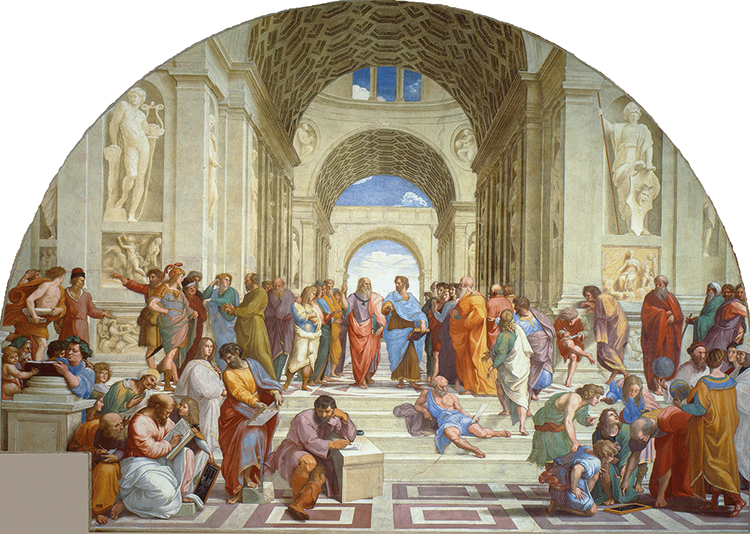
Raphael’s painting The School of Athens (1509–1511), stored in the Raphael Rooms of the Vatican.
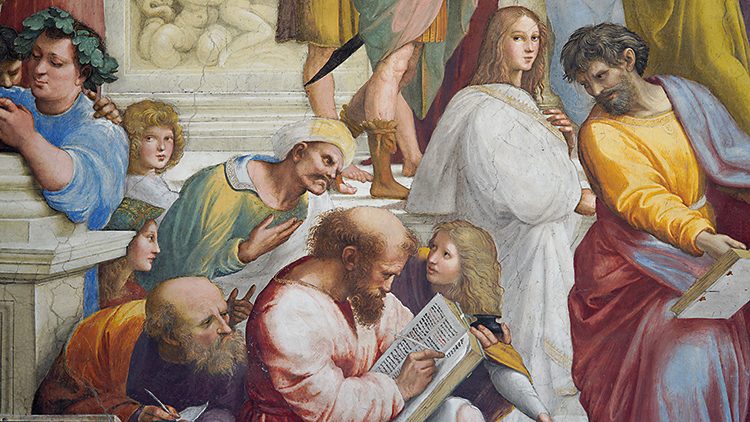
The artist depicts Anaximander sitting and taking notes among other Greek philosophers.
The origins of oceanic thinking
Anaximander’s world map was bold, on the one hand, because it adopted a point of view reserved for the gods and, therefore, once again turned the idea of what was above and what was below on its head; on the other, because his representation tried to be «naturalistic». In other words, it limited itself to only recognising natural objects as real (even though, for example, the toponyms Europe, Asia, and Libya already had mythological origins). There is, however, one element of his map that is clearly linked to earlier cosmogonic traditions: the ocean that surrounds the Earth’s disc.
«The model set by Anaximander», says Rossetti, «is based on the Homeric idea of Ocean» (Rossetti, 2020, p. 525). For Homer, the ocean was the «father of all the gods»; «Okeanos, whence is risen the seed of all immortals» (quoted in Freely, 2021, p. 24). This idea would have passed from Homer to Hesiod and moreover, they both would have inherited the idea of a primordial sea from Babylonian and Egyptian cultures (Regazzoni, 2022). The Greeks, Vernant summarises, conceived the Earth as a «more or less flat disc surrounded by a circular river, ocean, which has no beginning and no end as it flows into itself»; an image that was already appearing in regions «where the cultivated land had been painfully reclaimed from the waters by means of a system of dikes and drainage ditches» (Vernant, 1985, p. 186). Hence, it is likely that the idea reached Anaximander either directly or through his teacher Thales, who also believed that the Earth was a disk floating on the ocean. How far this ocean represented by Anaximander relates to his own philosophy of nature is beyond me and I have been unable to find any studies clearly examining this question. But I would like to venture the following hypothesis.
Past physicists wondered about the origin of nature, of everything that exists. They reduced it to a single principle, which they called arkhe. The word is interesting, because it means both power – which is why we find it in words like monarchy («the power of one») – and principle, that is, what comes first. For Thales, it was water that had the power to generate things; and was the origin of everything that exists. Anaximander, on the other hand, went one step further, and used a word or a concept that is possibly one of the most discussed but least clarified in the entire history of philosophy: apeiron, usually translated as «the unlimited» or «the indefinite». At the beginning of everything, before anything was what it is, there was the unlimited. On this point, I personally share Carlo Rovelli’s opinion that Anaximander was less interested in the exact meaning of the term than its use, which was nothing more than «introducing the idea that it is reasonable to postulate the existence of a new natural entity, even if we cannot see it, in order to explain phenomena» (Rovelli, 2018, p. 93).
However, what is this «natural entity» that we cannot see? Well, what we cannot see, and what Anaximander intuited, perhaps for the first time, was the continuity of nature, its flow, interconnection, and circulation, or what we now call a set of ecological relationships. What represents this continuity, this movement, is precisely the ocean. Thus, if I am not mistaken, Anaximander’s reasoning is doubly abstracted: he calls water, the sea, rivers, oceans, steam, and the sky, which are all one and the same thing, apeiron; but he does not use this word to describe a natural, physical, specific entity but rather, to refer to the power capable of generating, creating, transforming, and connecting – cyclically and constantly – what exists today and what will exist tomorrow. Of all the words we use today, perhaps hydrosphere is the closest equivalent: «The hydrosphere includes the waters of the seas, lakes and rivers; atmospheric humidity, clouds, raindrops, snow and ice crystals; and the water present in the bodies of living beings, including ours, to the extent that our body is 70 % water» (Regazzoni, 2022, p. 142).
Two authors, one ancient and one modern, make me suspect that this interpretation is not misguided. Aristotle, in his Physics, wrote: «[...] none of the physicists made fire or earth the one infinite body, but either water or air or what is intermediate between them» (Aristotle, Physics, cited in Colli, 2008, p. 169). For his part, Francis M. Cornford adds in Principium sapientiae: «Homer speaks of an island “round which the sea forms an (unbroken) ring”; and the term unlimited applied to the Stream of Ocean encircling the earth has the same meaning» (Cornford, 1987, p. 213).
One of the keywords in this current article is reversible, so I cannot conclude the text without wondering whether Anaximander is behind me or rather, in front of me; whether he is an author from the past or the future. Simone Regazzoni can help me answer this. His book Oceano. Filosofia del pianeta (‘Ocean. Philosophy of the planet’) begins with a very suggestive idea: the current global emergency, the present eco-social crisis, is, at the same time, also a cosmological crisis. Our worldview, he says, is still grounded in the Earth; ours is a «terrestrial mindset». «We are terrestrial, living beings who inhabit a terrestrial land divided into well-defined territorial units, who establish ourselves as its sovereigns (superanus, “the one who is above”), who deceive ourselves into thinking that we are rooted in the soil where we were born and that we live, feel and think based on terrestrial concepts and language» (Regazzoni, 2020, p. 18). The earth below, the sky above; and of course, we have a desire and need for stability, for foundation, for restraint, for drawing limits and borders. But that is not how nature works, which is actually what the physikoi from Ionia first began to suspect. The earth that Anaximander drew, surrounded by a great ocean, is therefore the image of a cosmology that can help us rethink our relationship with the world, with our planet. We do not live on Earth. We live in an ocean that makes no distinction between sea and land, land and climate, climate and life.
A current look at Anaximander
Diogenes Laërtius announced that Anaximander had died in «the time of Polycrates, tyrant of Samos» (cited in Colli, 2008, p. 183). His cosmopolitan ideal therefore did not survive him (and, as far as we know, has rarely been fulfilled). In The book of dead philosophers, the contemporary philosopher Simon Critchley noted (not without dark humour): «Anaximander somewhat obscurely claimed that the Unlimited or that which is without boundaries (apeiron) is the original material of all existing things. He discovered his own limit at the age of sixty-four» (Critchley, 2008, p. 52). We too are beginning to realise our limits as a species; the consequences of transgressing them are echoed in the words of Anaximander, as collected by Aristotle:
At first, they say, the earth was surrounded by moisture. Then the sun began to dry it up, part of it evaporated and is the cause of winds and the turnings back of the sun and the moon, while the remainder forms the sea. So the sea is being dried up and is growing less, and will end by being some day entirely dried up.
(Aristotle, Meteorology, cited in Colli, 2008, p. 173)
References
Colli, G. (2008). La sabiduría griega, II. Trotta. (Original published in 1978)
Cornford, F. M. (1987). Principium sapientiae. Los orígenes del pensamiento filosófico griego. Visor. (Original published in 1952)
Critchley, S. (2008). El libro de los filósofos muertos. Taurus.
Farinelli, F. (2003). Geografia. Un’introduzione ai modelli del mondo. Einaudi.
Freely, J. (2021). La llama de Mileto. El nacimiento de la ciencia en la Grecia clásica (y cómo cambió el mundo). Alianza Editorial. (Original published in 2012)
Goody, J. (1985). La domesticación del pensamiento salvaje. Akal. (Original published in 1977)
Jacob, C. (2008). Geografía y etnografía en la Grecia antigua. Bellaterra. (Original published in 1991)
Regazzoni, S. (2022). Oceano. Filosofia del pianeta. Ponte alle Grazie.
Rossetti, L. (2020). Il ‘mappamondo’ di Anassimandro. In G. Maddoli, M. Nafissi, & F. Prontera (Eds.), Anna Maria Biraschi. Scritti in memòria (pp. 521–533). Morlacchi Editore.
Rovelli, C. (2018). El nacimiento del pensamiento científico. Anaximandro de Mileto. Herder. (Original published in 2009)
Sassi, M. M. (2022). Los inicios de la filosofía griega. Siruela. (Original published in 2020)
Vernant, J. P. (1985). Mito y pensamiento en la Grecia antigua. Ariel. (Original published in 1965)
Vernant, J. P. (1992). Los orígenes del pensamiento griego. Paidós. (Original published in 1962)
Notas de autor
Información adicional
redalyc-journal-id: 5117