Animal welfare. The neverending debate
Are humans natural speciesists? What we can we learn from trolly cars, self-driving cars, and hypothetical sinking ships
Are humans natural speciesists? What we can we learn from trolly cars, self-driving cars, and hypothetical sinking ships
Mètode Science Studies Journal, vol. 15, núm. 5, e29021, 2025
Universitat de València

Esta obra está bajo una Licencia Creative Commons Atribución-NoComercial-SinDerivar 4.0 Internacional.
Recepción: 12 Junio 2024
Aprobación: 28 Julio 2024
Abstract: An ethical cornerstone of the animal protection movement is that elevating the interests of humans over other animals – is, like sexism, racism, or homophobia – a form of discrimination that is ethically unjustified. Yet, most people intuitively value human lives over the lives of other species. Studies using hypothetical moral dilemmas suggest that the moral rule «spare people over animals» is culturally universal in adults. But in these situations, children typically make the opposite decision – they elect to save dogs, cats, and even pigs at the expense of human lives. These studies raise important questions about the universality of moral principles, the relative importance of socialization and cognitive development in our beliefs about the use of other species, and the roles of emotion and rationality in human moral judgment.
Keywords: speciesism, animal protection, animal rights, moral dilemmas, animal welfare.
In 1975, the Australian ethicist Peter Singer jump-started the modern animal rights movement with the publication of his book Animal liberation. In it, he made the logical case against «speciesism» – the elevation of human interests above those of non-human animals. Singer, who is arguably the most influential living philosopher, contended that discriminating against creatures based on the size of their brains or the number of their legs is as morally repugnant as racism or sexism.
Singer’s book hit an intellectual sweet spot. Philosophers took his arguments on the moral status of animals seriously and the book had an enormous impact on public attitudes toward the treatment of animals. More recently, social scientists have examined the psychological underpinnings of speciesism. For example, people who have higher scores on speciesism scales are more likely to be politically conservative, consume meat, and score high on measures of racism, sexism, and homophobia.
The fact is, however, that most people are speciesists. For example, according to surveys by Statistica, 95 % of people in Spain consume animal flesh – about the same percentage of meat-eaters as in the United States. And few people would agree with the animal rights activist Joan Dunayer who wrote in her 2004 book Speciesism that one should flip a coin when deciding to snatch a puppy or a child from a burning building and that «wasps need a legal right to life».
This raises the question, are humans natural speciesists? Is the general principle «save people over animals» a cultural universal?
The Moral Machine: Should self-driving cars always spare people over pets?
The first death caused by a self-driving car occurred on Sunday, March 18, 2018. Elaine Herzberg, a 50-year-old woman, was walking down a street in Tempe, Arizona when an Uber Volvo operating in «fully autonomous mode» slammed into her. Uber temporarily suspended their self-driving car trials, but autonomous vehicles are now on the streets on the streets in American cities including Phoenix, San Francisco, and Austin. Autonomous vehicles are essentially robots with wheels. They are guided by artificial intelligence systems that sometimes will need to make life-and-death decisions on the fly. But how should they be programmed? Should, for example, autonomous vehicles like the one that killed Herzberg automatically swerve to avoid hitting an old man if it means running over a dog?
If you are thinking, «Aha! This is a variation on the famous trolley problem», you are right. The classic version of this thought experiment was developed by the moral philosopher Phillipa Foot. In the most common scenario, a runaway trolley car is careening down the tracks toward a group of five people. What if you could pull a lever that would send the trolley onto another set of tracks where only one person would be killed? Most people in this situation say, yes, pull the lever. However, a slightly different version of the trolley problem typically generates a different decision. In this case, to save the five people, you must personally push a fat man walking across a footbridge onto the tracks to stop the trolley. In this case, most people say no – even though the moral calculus is identical in both situations.
Cognitive scientists have used many variations of the trolley problem to explore aspects of human moral decision-making. With the development of autonomous vehicles, the trolley problem has suddenly become relevant to real-world situations. Using self-driving car variants of the trolley problem, a team of investigators from the MIT Media Lab used global crowdsourcing to study cultural differences and similarities in human moral values (Awad et al., 2018). The researchers were looking for universally accepted moral rules that could, in principle, help fine-tune the ethical decision-making of autonomous vehicles. Their research helps answer the question of whether the ethical rule «save people over animals» is a universal moral principle.
The MIT researchers describe their Moral Machine studies as «a serious computer game for collecting large-scale data on how citizens would want autonomous vehicles to solve moral problems in the context of unavoidable accidents». Here’s how it works. The brakes on a hypothetical self-driving car are broken. The car is programmed to choose between two options. The job of the Moral Machine gameplayer is to select the ethically preferable course of action.
For example, in the situation shown below, the player has to decide whether it would be better for the self-driving car to swerve into the left lane and kill a cat or continue in the right lane and smash into the woman. The game was translated into ten languages, and, to the researcher’s surprise, the Moral Machine game went viral. Over ten months, they collected 40 million of these who-to-spare decisions from individuals in 233 countries.
The researchers were interested in comparisons. These included saving more people over fewer people, males over females, younger people over older people, law-abiding pedestrians in crosswalks versus illegal jaywalkers, physically fit people over the less fit, high-status over low-status individuals, and saving people over cats or dogs. The researchers also added several additional variables – for example, what if the person in the middle of the road was a criminal or a pregnant woman?
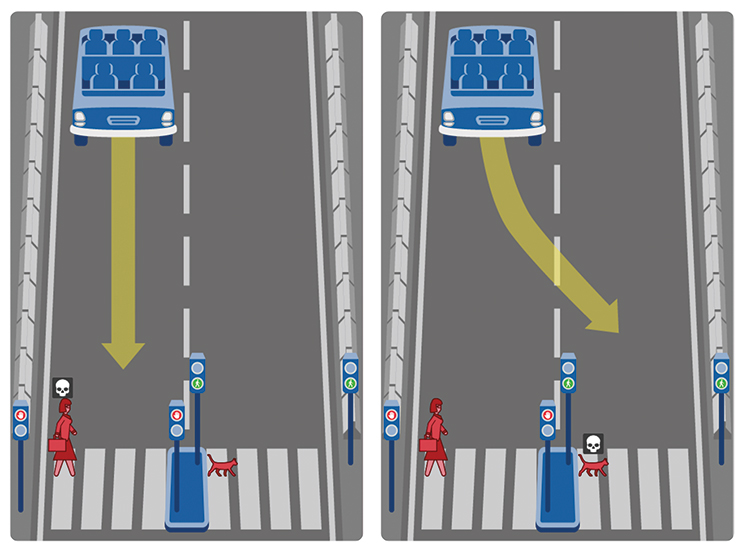
Figure 1
What should the self-driving car do?
Moral Machine presents a hypothetical situation in which the brakes of a self-driving car fail. The car is programmed to choose between two options. Each participant must choose the ethically preferable course of action.
Courtesy of Azim ShariffCultural similarities and differences in moral values
The researchers found there were substantial national differences in some of the moral decisions. People in individualist societies such as France were more likely to spare the young over the old while individuals from collectivist cultures like Japan and China were prone to save the elderly even if it meant the death of a child. But there were moral principles in which there was general agreement across all cultures. The research called these «essential building blocks of machine ethics»: (I) Spare people over animals. (II) Spare more lives over fewer lives. (III) Spare the young over the old.
Among the most important of the «essential building blocks of machine ethics» was speciesism – saving humans over animals. There were, however, cultural differences in degrees of speciesism. People in the «Southern Cluster» of nations (primarily South and Central American countries) were less inclined to spare people at the expense of pets than respondents in other parts of the world. I was mystified by this finding. After all, dogs and cats are more likely to be pampered in North America and Europe than in Latin America. I emailed Dr. Azim Shariff, a member of the research team, and asked if he had any explanation for this geographic difference in attitudes toward pets.
He immediately wrote back: «We don’t have a good explanation for the Southern pet effect. It’s not that they prefer pets to humans; everyone prefers humans to a large degree. It’s just less so in the Southern cluster of nations.»
Dr. Shariff’s statement that «everyone prefers humans to a large degree» is consistent with the finding of a study in which the trolley problem was used to search for universal moral principles (Petrinovich et al., 1993). Some of the scenarios involved animals – for example, the decision to sacrifice the last five mountain gorillas on Earth to save one man. After testing hundreds of people in several countries, the investigators concluded that the single most powerful universal moral principle was to «value human life over the lives of non-human animals». The «people over pets» principle was also supported by the findings of a 2024 study in which four AI systems played the tens of thousands of variations of self-driving car scenarios—the AI programs also opted to prioritize saving people over pets (Takemoto, 2024).
There are, however, exceptions to the «people over pets» rule. In their variant of the trolly scenario, researchers at Georgia Regents University asked subjects if they would save a dog or a person in the path of a runaway bus (Topolski et al., 2013) The vast majority of people in the study said they would save a foreign tourist, rather than a dog. But their decisions changed dramatically if the subjects were told the dog was their personal pet. In this situation, 30 % of men and 45 % of women said they would let the bus run over the foreign stranger if it would save their dog.
Are children less speciesist than adults? The shipwreck study
The takeaway of the Moral Machine and Run-Away-Trolley experiments is that, except for personal pets, valuing humans over animals appears to be a culturally widespread – if not universal – ethical principle. It does not, however, apply to children.
Take my grandson, Ryland. One afternoon when he was eight years old, we logged onto my computer and played The Moral Machine Game together. Ryland quickly learned the rules, and his moral decisions were generally predictable. Like most adults he opted for the self-driving car to spare children over adults, more people over fewer people, and law abiders versus criminals. But I was surprised when he wanted the car to swerve and hit a child to save a dog. Indeed, in nearly every scenario involving an animal (always a dog or cat), he chose to save spare the animal over the human. (The only exception was when he chose to sacrifice a dog to spare a female doctor – an understandable decision as his mother is a doctor.)
Huh? Is something wrong with my grandson? Or do most kids value the lives of animals over the lives of people? A recent study of moral decision-making in children suggests that Ryland’s decision to save animals over people is the rule for kids, not the exception.
The lead co-authors of the study were Matti Wilks and Lucius Caviola (Wilks et al., 2021). The researchers wanted to know whether children and adults differed in how much they prioritized people over animals. The children in the study were 243 American kids between the ages of 5 and 9 years old and the grownups were 224 American adults. The participants were asked to imagine a situation in which two boats are sinking but they can only save the passengers in one of them. One boat contained either one dog, one pig, or one person and the other boat contained one, two, 10, or 100 dogs, pigs, or humans. Each comparison had three options – save the humans, save the animals, or indicate they could not decide.
This graph shows the percentage of children (green bars) and adults (red bars) who elected to save people rather than dogs. The difference between the decisions of the children and the adults was stark. In every scenario, most of the adults opted to save people over dogs or pigs – even if saving one person would cause 100 dogs to die. Not so with the kids. In every situation, the children were more likely than adults to save dogs rather than humans. Indeed, a third of the kids would sacrifice a single person to save a single dog. Adults, on the other hand, were four times more likely than kids to save the life of a person over 100 dogs. The same pattern occurred with pigs – in every comparison, children were less likely than adults to save people over pigs. Surprisingly, the age of the kids made no difference in the degree of their preferences to save animals over people. Indeed, the researchers wrote, «Children from 5 to 9 years all tended to value animals far more than adults did».
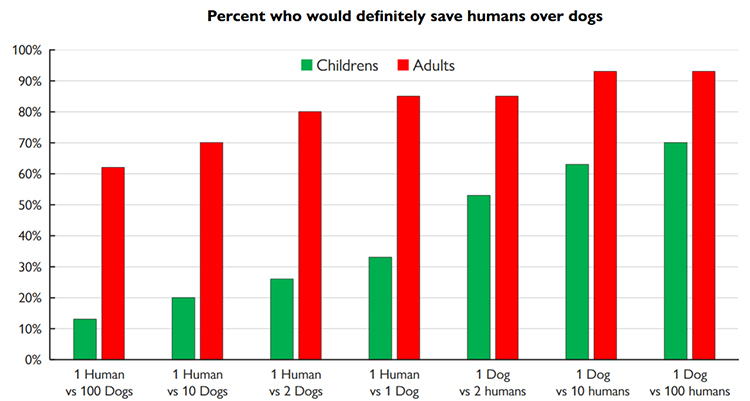
Figure 2
Percent who would definitely save humans over dogs
The study by Wilks et al. (2021) involved 243 children and 224 adults. They were asked to imagine a situation in which two ships are sinking, but they can only save the passengers of one of them. On one of the ships there was a dog, a pig or a person, and on the other, one, two, ten or a hundred dogs, pigs or humans. Each comparison had three options: save the humans, save the animals, or state that they were unable to decide. In all scenarios, most adults chose to save the people over the dogs, even if saving one person meant the death of a hundred dogs. The children, on the other hand, did not.
Source: Created by the authorWhy do children value dogs and pigs over people?
All the children in the shipwreck study were less speciesist than adults. But when and why does the developmental shift toward speciesism occur between childhood and adulthood? A study by Luke McGuire and his colleagues suggests this change happens by late adolescence (McGuire, 2023). They found that individuals between 18 and 21 years old were adult-like in their moral thinking about animals when compared with kids aged 9 to 11 years old.
The reasons for the increasing moral elevation of humans over animals between childhood and late adolescence are unclear. Matti Wilks, Lucius Caviola, and their colleagues believe the shipwreck study shows that humans are not natural speciesists. They believe that prejudice against animals is, like racism, a widespread but learned form of discrimination that shows up during adolescence.
I agree that the tendency for children to elevate the interests of animals over humans is partly due to socialization. But there are other reasons five-year-olds might think differently than grown-ups about the moral status of non-human animals – brain maturation and increasing cognitive sophistication. The fact is that young children’s brains are not fully developed. Indeed, their ability to think abstractly begins to jump when they are around 11 or 12 years old (Dumontheil, 2014).
This is where Harvard’s Josuha Greene’s (2014) camera model of ethical judgments comes into play. Greene compares our moral operating systems to an SLR camera that comes with multiple modes. One of these is the cognitive equivalent of the point-and-shoot «auto-mode» built into SLR cameras. This moral system is intuitive, instantaneous, and largely emotional. I use the no-brainer default auto mode on my iPhone for most of my photography, and it usually produces good pictures. Greene argues that human moral systems also operate on auto-mode most of the time. Our ethical judgments are often the products of unconscious moral emotions, and they usually steer us in the right direction – don’t steal, obey traffic lights, do not have sex with close relatives.
However, I have installed a fully manual photo app called ProCamera on my iPhone. I use it in tough lighting situations. This manual app requires much more thought and knowledge than the iPhone default app. But in the right circumstances, the manual photo app takes better photos.
Greene’s camera model helps explain the results of the shipwreck study. One reason adults are three times more likely than children to save humans over dogs is that adults have the option of flipping into the deliberative mode of moral thinking. As a result, grownups can sometimes override their irrational moral emotions by logically weighing the relative value of the lives of people and dogs in ways that young children cannot.
Even animal rights philosophers sometimes value humans over animals
Is there evidence that the decision to elevate the status of humans over animals is, at least partly, the result of rational thinking and not socially acquired prejudices? Yes. Even the two most influential animal liberation philosophers, Peter Singer and the late Tom Regan, concede that pure reason sometimes leads to the elevation of the interests of humans over the interests of other species. In his book, The case for animal rights, Regan (1983) laid out the rights-based (deontological) logical argument for animal protection. Regan, however, concluded that if four normal humans and a dog are in a lifeboat that only has room for four, the dog goes overboard. He wrote, «Death for the dog is not comparable to the harm for any of the humans». Indeed, he goes further and says, «It would not be wrong to cast a million dogs overboard to save the four human survivors, assuming the lifeboat case were otherwise the same».
In Animal liberation, Peter Singer (1975) made the rational utilitarian (harm/suffering) case against speciesism. Yet, he has argued the deaths of 3,000 people who died in the World Trade Towers attack on September 11, 2001, was a greater tragedy than the slaughter of the millions of chickens killed on the same day in poultry slaughterhouses in the United States. Singer says that, unlike the chickens, the humans who died had many loved ones who suffered from the loss of friends and family members in the World Trade Towers. And he added that death is more tragic to beings who have a high degree of self-awareness, and a vivid sense of their own existence over time.
People become more speciesist when they listen to their heads rather than their hearts
A recent experiment supports the idea that people are more likely to elevate human welfare over animal welfare when told to think deliberatively rather than rely on intuition. Lucius Caviola and Valerio Capraro (2020) asked adults to imagine a situation in which they had to save either a human or a very bright chimpanzee. Subjects in the experiment’s «deliberative condition» were told to rely on logic and reason in making their decision (Greene’s manual moral mode). The subjects in the «emotion condition» were told that relying on emotions often leads to good decisions and that they should let their feelings guide their choices (Greene’s moral auto mode).
To their surprise, the researchers found that when their subjects were told to base their decision on logic, they were MORE likely to value human lives over the lives of chimpanzees than when they were told to heed their moral emotions. In a second study reported in the same research paper, their subjects were asked how they would divvy up $100 between a charity for humans and a charity for animals. Again, subjects who were primed to rely on logic donated more money to the human charity than subjects primed to trust their intuition.
My experience playing the Moral Machine Game with Ryland and the innovative studies by Lucius Caviola and Matti Wilks and their colleagues clearly show that kids give more moral weight to non-human animals than adults do. I agree with them that this difference is, in part, the result of socialization and cultural norms. But I would add another factor into the mix – when it comes to difficult moral judgments involving other species – (most) adults are more sophisticated thinkers than (most) five to nine-year-olds.
References
Awad, E., Dsouza, S., Kim, R., Schulz, J., Henrich, J., Shariff, A., Bonnefon, F., & Rahwan, I. (2018). The moral machine experiment. Nature, 563(7729), 59–64. https://www.nature.com/articles/s41586-018-0637-6
Caviola, L., & Capraro, V. (2020). Liking but devaluing animals: Emotional and deliberative paths to speciesism. Social Psychological and Personality Science, 11(8), 1080–1088. https://doi.org/10.1177/1948550619893959
Dumontheil, I. (2014). Development of abstract thinking during childhood and adolescence: The role of rostrolateral prefrontal cortex. Developmental Cognitive Neuroscience, 10, 57–76. https://doi.org/10.1016/j.dcn.2014.07.009
Dunayer, J. (2004). Speciesism. Ryce Publishing.
Greene, J. D. (2014). Beyond point-and-shoot morality: Why cognitive (neuro) science matters for ethics. Ethics, 124(4), 695–726. https://doi.org/10.1086/675875
McGuire, L., Palmer, S. B., & Faber, N. S. (2023). The development of speciesism: Age-related differences in the moral view of animals. Social Psychological and Personality Science, 14(2), 228–237. https://doi.org/10.1177/19485506221086182
Petrinovich, L., O’Neill, P., & Jorgensen, M. (1993). An empirical study of moral intuitions: Toward an evolutionary ethics. Journal of Personality and Social Psychology, 64(3), 467–478. https://doi.org/10.1037/0022-3514.64.3.467
Regan, T. (1983). The case for animal rights. University of California Press.
Singer, P. (1975). Animal liberation: A new ethics for our treatment of animals. Avon Books.
Takemoto, K. (2024). The moral machine experiment on large language models. Royal Society Open Science, 11(2), 231393. https://doi.org/10.48550/arXiv.2309.05958
Topolski, R., Weaver, J. N., Martin, Z., & McCoy, J. (2013). Choosing between the emotional dog and the rational pal: A moral dilemma with a tail. Anthrozoös, 26(2), 253–263. https://doi.org/10.2752/175303713X13636846944321
Wilks, M., Caviola, L., Kahane, G., & Bloom, P. (2021). Children prioritize humans over animals less than adults do. Psychological Science, 32(1), 27–38. https://doi.org/10.1177/0956797620960398
Notas de autor
Información adicional
redalyc-journal-id: 5117