Melting point. The voice of the mountains
Aerosols and global change in the Pyrenees: A dustier atmosphere in the warmest scenario?
Aerosols and global change in the Pyrenees: A dustier atmosphere in the warmest scenario?
Mètode Science Studies Journal, vol. 15, núm. 6, e30380, 2025
Universitat de València

Esta obra está bajo una Licencia Creative Commons Atribución-NoComercial-SinDerivar 4.0 Internacional.
Recepción: 11 Febrero 2025
Aprobación: 10 Abril 2025
Abstract: We have been witnessing rapid climate change in recent decades, with heatwaves now more frequent and winters less distinct. One notable consequence is the increasing frequency of dust storms in many areas of Spain. This raises concerns about the extent of atmospheric pollution compared to the past and its impact on regions like the Pyrenees. Current research aims to understand if dust episodes are more intense and frequent than before, how they affect high-altitude lakes, and how desert dust aerosols influence snow-cover duration in the area. These investigations are crucial for assessing the broader environmental impacts of climate change in mountainous regions.
Keywords: climate change, Pyrenees, high mountain, aerosols, global warming.
Developments in air quality and climate change mitigation
In recent decades, we have become aware of the importance of balancing the use and exploitation of natural resources with the protection of the Earth system and everything it entails. One key area of action in this regard is the implementation of policies aimed at reducing atmospheric emissions.
On the one hand, it is essential to reduce the emission of greenhouse gases such as carbon dioxide (CO2), dinitrogen monoxide (N2O), and methane (CH4) to prevent our society from heading towards a global warming scenario with unpredictable – yet certainly very negative – consequences. On the other hand, achieving the Paris Agreement’s goal limiting global warming to +1.5 ºC (already exceeded in 2024) would lead to lower concentrations of air pollutants – especially suspended particulate matter and certain gaseous compounds such as nitrogen oxides and sulphur compounds – and would reduce the number of annual fatalities globally by one million.
One of the key questions we seek to address is the extent to which efforts in these two areas are coordinated, or how focusing on improving air quality without considering the climate impacts of such policies, or vice versa, could work against us, is. To date, emission reduction policies have significantly improved air quality, cutting pollutant concentrations by nearly 80 % over the past two decades, especially nitrogen (NOx) and sulphur oxides (SOx), and leading to a sharp decline in bulk aerosols (Aas et al., 2019). However, soot levels – which are closely linked to diesel emissions – have remained almost unchanged (Klimont et al., 2017). On the other hand, aerosols have historically helped cool the planet (see different IPCC reports) by reflecting sunlight and supporting cloud formation, partially offsetting greenhouse gas-induced warming. While pollution control measures have removed many reflective aerosols, little effort has been made to reduce soot emissions. As a result, we have gradually eliminated a key factor that once mitigated global warming, potentially accelerating climate change.
Atmospheric aerosols. Saharan dust
Aerosols are particles up to 100 microns in size, in solid or liquid state, that remain suspended in the atmosphere and originate from both natural and anthropogenic sources. The presence of aerosols in the atmosphere is associated with various effects on human health, the Earth’s climate, and ecosystem dynamics. Among all types of aerosols, those associated with emissions from desert areas are particularly abundant and form one of the many components of the Earth’s complex system.
Desert dust is the second most abundant primary aerosol globally, following marine aerosol. It is estimated that approximately 2,000 megatonnes of dust are emitted into the atmosphere annually, of which 75 % is deposited on land surfaces and the remaining 25 % is deposited in the oceans. Among all the arid and semi-arid regions of the Earth, the deserts of North Africa are the largest dust emitters (Kok et al., 2023; Shao et al., 2011), with a significant fraction being transported northwards via various atmospheric pathways (Pey et al., 2013).
Dust particles are primarily of inorganic origin and exhibit a highly diverse chemical and mineralogical composition. Quartz and clay particles are largely insoluble in water, allowing them to persist during atmospheric transport and in sedimentary records. Other particles, such as iron oxides, carbonates, or phosphate minerals, can dissolve significantly during their atmospheric cycle and therefore their preservation in their original form is not guaranteed.
Health effects
Among the aerosols found in the atmosphere of Southern Europe, dust transported from North Africa (known as calima in Spanish) is responsible for a significant proportion of air pollution and often contributes to exceeding the daily limits set by air quality regulations (Querol et al., 2009). Epidemiological studies have shown that desert dust has negative effects on human health (Stafoggia et al., 2016).
On many occasions, the arrival of Saharan dust waves over urban or industrial areas increases the concentration of anthropogenic pollutants (Pandolfi et al., 2014). This is due to the thinning of the mixing layer, the lower tropospheric zone where atmospheric pollutants are dispersed, caused by the intrusion of an air mass with very different thermodynamic characteristics. Such scenarios significantly increase the impact on human health: on the one hand, anthropogenic pollutant concentrations rise, while on the other, pollutants of natural origin add to the existing burden.
Epidemiological studies attempt to differentiate the effects of these various pollutants (Stafoggia et al., 2016) to design the most effective measures to improve air quality and protect public health. In this complex situation, it is important to recognise that Saharan dust transport towards south-western Europe (Salvador et al., 2022) is becoming increasingly frequent, making it even more essential to step up efforts to improve air quality in our cities.
Climate impacts
Atmospheric aerosols play a crucial role in the planet’s climate. Their chemical composition and microphysical properties, particularly their hygroscopicity, are key factors to consider. For instance, sulphates, nitrates, and marine aerosols reflect a significant fraction of incoming radiation and are highly hygroscopic, contributing to cloud formation (IPCC, 2023). In contrast, other aerosols, such as soot particles absorb solar radiation and have low hygroscopicity, making them less conducive to cloud formation.
Mineral dust, the second most abundant aerosol on a global scale, presents a particularly complex case. Depending on its chemical composition, it can either absorb or reflect solar radiation (a direct effect that either warms or cools the atmosphere, respectively) and can enhance or inhibit cloud formation (an indirect effect) (IPCC, 2023). Additionally, when dust particles settle on ice- or snow-covered surfaces, they alter the energy balance in these regions, impacting the local climate and accelerating ice and snowmelt processes (Painter et al., 2017). Both processes are linked to episodic or permanent changes in surface albedo (Pey, Revuelto et al., 2020).
For these reasons, mineral (desert) dust emerges as a major climate forcing agent besides of black carbon within the broader category of atmospheric aerosols.
Impacts on ecosystems
The abundance of certain chemical components in dust particles, primarily iron, phosphorus, and potassium, is essential for some terrestrial and aquatic ecosystems, even those located thousands of kilometres from dust sources (Prospero et al., 1996; Yu et al., 2015). In some cases, the nutrient inputs associated with dust deposition can disrupt the natural balance of certain ecosystems, for example by promoting the exponential growth of undesirable bacterial and algal communities (Westrich et al., 2016). Additionally, the transport of specific microorganisms along with dust particles has been observed (Cáliz et al., 2018), and potentially harmful effects have been suggested (Hervás et al., 2009).
Saharan dust variability over the last millennia
According to Hooper and Marx (2018), dust emissions to the atmosphere have doubled since 1750 due to changes in land use. Saharan dust has been recorded in marine sediments (Martínez-Ruiz et al., 2015; Rodrigo-Gámiz et al., 2011), peat bogs (Martínez-Cortizas et al., 2019), and lake deposits (Sánchez-López et al., 2016) in the Iberian Peninsula over the past 50,000 years. Its arrival has been linked to climate shifts (Moreno et al., 2005), particularly during glacial periods and cold events. Over the past 20,000 years, African dust transport patterns have evolved due to changes in the Sahara Desert (Martínez-Cortizas et al., 2019; Rodrigo-Gámiz et al., 2011) and climate oscillations at both millennial (late glacial abrupt changes, Holocene variability) and centennial to decadal scales (such as the North Atlantic Oscillation). During the late Holocene, dust events became more frequent, influenced by both natural climate variability and human activities. Recent studies show a strong connection between Saharan dust flux and North Atlantic climate changes (Cruz et al., 2021; Sánchez-López et al., 2016), demonstrating that dust deposition patterns have responded to both oceanic and atmospheric shifts.
Aerosols in the southern Pyrenees: the surrounding lines of research
In order to advance our knowledge of aerosol deposition phenomena and the effects of dust aerosols and other types of aerosols once deposited, several lines of research are being pursued in the Pyrenees through a series of research projects.
Understanding long-term interannual variability
One of the lines of research focuses on the long-term monitoring of atmospheric deposition at different sites in Spain, including sites in the Pyrenees. This article examines the case of Ordesa and Monte Perdido National Park, where monitoring started in 2016 (Pey, Larrasoaña, et al., 2020) and has been carried out on a monthly basis since then.
Over these nine years of continuous monitoring (Figure 1), a noticeable decrease in nitrogen and sulphur species has been observed, particularly from 2021 onwards. This trend is probably linked to the progressive reduction of nitrogen and sulphur oxide emissions, partly due to the transition towards hybrid and electric vehicles, but primarily driven by the closure of coal-fired power plants in favour of solar and wind energy.
Regarding dust aerosols, which predominantly originate from the desert regions of North Africa (see Pey, Larrasoaña, et al., 2020), peak values have been recorded in years with intense dust episodes. In the Pyrenees, these peaks were observed in 2016, 2017, 2018, and 2021, with a less pronounced event in 2022 – a year when record-breaking dust intrusions affected most of the Iberian Peninsula (Liger et al., 2024).
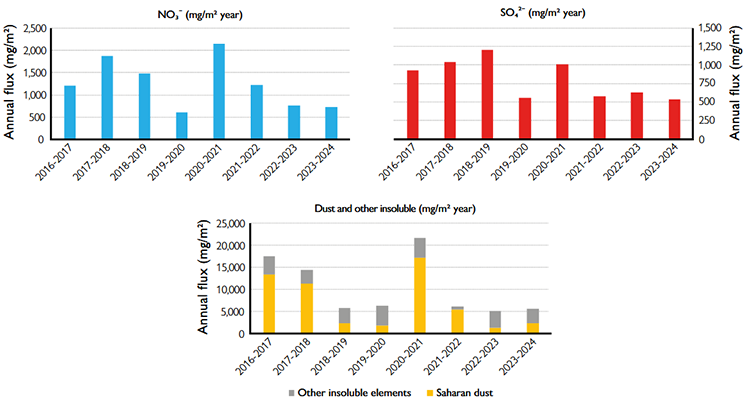
Figure 1
Annual fluxes of nitrate (NO3-), sulphate (SO42-) and dust in the Ordesa and Monte Perdido National Park.
Values in mg/m2 per year.
Source: Parador Nacional de Torla-Ordesa.Investigating the impacts on the cryosphere
Dust events are becoming more frequent, disrupting the typical seasonal pattern in which these episodes have traditionally occurred – from spring to autumn. Nowadays, intense and frequent dust intrusions are also observed in winter and early spring. Understanding the extent to which dust and other aerosols affect the cryosphere remains an active area of research.
To investigate this, we have developed a methodology (Figure 2) that allows us to control key factors such as aerosol type and concentration, snow characteristics, and exposure conditions. Each of the experiments consists of two trays stacked on top of each other. The first tray contains the snow, with one side missing and a perforated bottom to allow meltwater to seep through. The second tray will collect the meltwater when it occurs. The trays are properly labelled and tared. A controlled amount of dust and black carbon is added to each set of trays to simulate a gradient of the usual concentrations observed in the region. Our experiments begin as early as possible in the cold season and continue until late spring. We conduct controlled experiments in which particles of different types are added in carefully regulated concentrations, simulating low-, medium-, and high-deposition scenarios under realistic conditions.
The parameters we measure include albedo, snow liquid water content, snow grain transformation, and total snow melt in each plot. A summary of our 2024 records (Figure 2) highlights the significant impact of dust and black carbon aerosols on accelerating snowmelt. This effect becomes increasingly pronounced as incoming solar radiation intensifies, but it is also highly relevant during the core winter months. Notably, our experiments recorded melt rates between 10 % and 15 %, even under mid-winter conditions. These estimates were obtained from the difference between the snow weight (first tray) before aerosol addition and the meltwater weight recorded in the second tray three or four hours after aerosol addition.
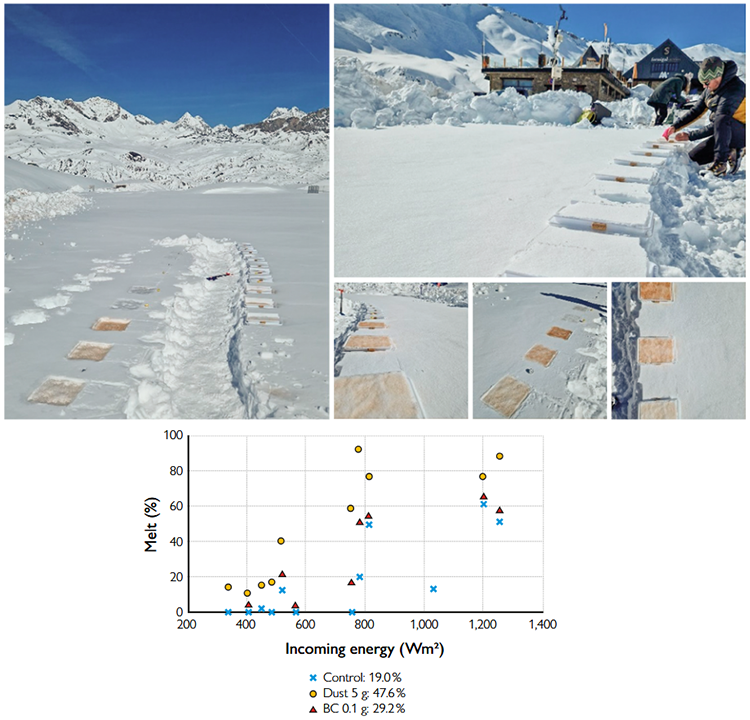
Figure 2
Example of the experiments designed to estimate snow impacts after different aerosol deposition types and baselines.
The graph shows a summary of the 2024 records. Our research shows an acceleration of the deglaciation due to aerosols and black carbon.
Pictures taken at Formigal (Huesca).Disentangling the role of aerosols in current alpine lake sedimentation
One of our key research objectives is to better understand lake sedimentation throughout the year and the variable sources of sediment inputs. Once the sediment analysis is complete, we expect to be able to distinguish the fraction of sediment derived from atmospheric deposition from other sources.
In the summer of 2023, we installed an automated sediment trap in Marboré Lake (central Pyrenees, 2600 m a.s.l.), allowing us to collect sequential monthly samples over a full year of operation. The installation and retrieval of the trap were challenging, but the initial results are highly promising (Figure 3).
So far, our first analytical results provide insights into water composition throughout the year, along with a detailed record of sediment colour changes. As shown in Figure 3, sediment colour transitions from light grey to brown or dark grey, reflecting seasonal variations in sediment composition. The 2023–2024 season was not particularly notable for dust deposition in this part of the Iberian Peninsula.
So far, noticeable differences in water composition have been observed. In particular, dissolved sulphate and calcium show opposite trends throughout the year, probably related to different lake processes and mixing versus stratification processes during ice-covered and ice-free periods.
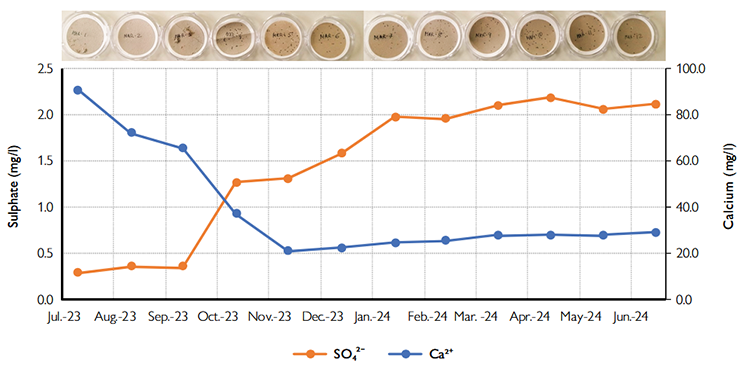
Figure 3
Variability of monthly water composition (dissolved sulphate and calcium, in mg/l) and sediment colour (from clear grey to clear brown and dark grey) from August 2023 to July 2024 in the Marboré lake, Ordesa and Monte Perdido National Park.
Contextualising our present in the Holocene
Another line of research focuses on assessing past variability in Saharan dust transport to the Pyrenees. Alpine lakes are excellent archives for reconstructing past environmental conditions, not only within the lake itself, but also in the surrounding landscape and at regional to global scales. Dust aerosols are preserved in lake sediments, although they are often mixed with other terrigenous materials transported by runoff processes.
A key challenge in this research is that aerosol deposition is typically much lower than runoff sedimentation, making it difficult to distinguish atmospheric dust inputs. To address this, we are analysing the present-day geochemical composition of dust aerosols, with a particular focus on identifying unique tracers or elemental relationships that can help isolate dust from other sedimentary inputs.
One of our study sites is Marboré Lake (Figure 4), which contains one of the longest and best documented sedimentary sequences covering the entire Holocene period at high elevations in the Pyrenees. Our findings suggest that the iron/titanium (Fe/Ti) ratio is one of the most reliable indicators of Saharan dust deposition (Pey et al., 2025, in preparation). Given that Fe/Ti values in the surrounding sediments range from 140 to 300, sharp decreases in this ratio along the sedimentary sequence likely correspond to periods of increased Saharan dust deposition. As shown in Figure 4, distinct Fe/Ti cycles suggest multiple phases of intensified dust transport over time on a millennial scale during the Holocene, as well as a recent increase.
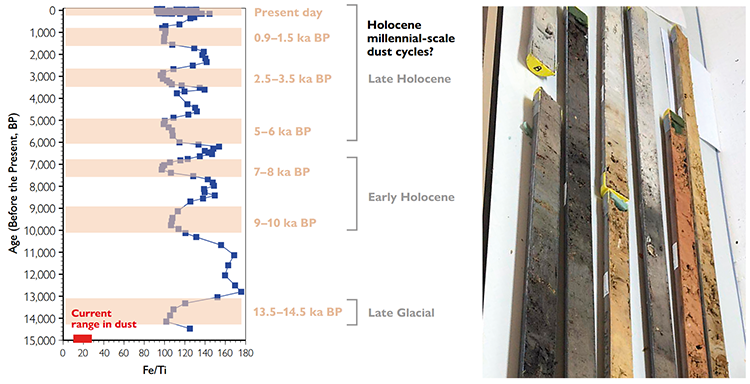
Figure 4
The Marboré iron (Fe) and titanium (Ti) records and the indication of the current Fe/Ti range were retrieved from Saharan dust samples at Ordesa and Monte Perdido.
The sharp drops in the Fe/Tu ratio likely correspond to periods of increased Saharan dust deposition, which are highlighted in colour. On the right, different sedimentary records from the Alcúdia lagoon (Mallorca) collected in 2021, opened in the laboratory, illustrating the type of samples that are necessary to carry out these studies.
Understanding the present, anticipating the future
Dust aerosols play a complex and not yet fully understood role in the Earth’s climate; they interact with numerous biogeochemical cycles and have adverse effects on human health. The recently adopted European Air Quality Directive 2024/2881 will halve the current limit values for aerosols, and most European countries will need to make significant efforts to comply with the new regulations. As a result, anthropogenic air pollutants will need to be reduced.
However, desert dust events are expected to become more frequent, particularly in southern and central Europe. How this evolving scenario will impact regional and global climate, the already fragile cryosphere, or the balance of sensitive ecosystems remains uncertain. Our research aims to deepen our understanding of the present (at times drawing on past evidence from different climatic contexts), in order to better anticipate future challenges and environmental shifts.
Acknowledgments
This work was possible thanks to the support of three research actions, namely ASAH-AS (OAPN 2021, 2799/2021), SNOWDUST (TED2021-130114B-I00) and POSAHPI-2 (PID2022-143146OB-I00). We are grateful to all the colleagues who made the field campaign and all the laboratory work behind each of the lines of research presented in the article possible.
References
Aas, W., Mortier, A., Bowersox, V., Cherian, R., Faluvegi, G., Fagerli, H., Hand, J., Klimont, Z., Galy-Lacaux, C., Lehmann, C. M. B., Myhre, C. L., Myhre, G., Olivié, D., Sato, K., Quaas, J., Rao, P. S. P., Schulz, M., Shindell, D., Skeie, R. B., ... Xu, X. (2019). Global and regional trends of atmospheric sulfur. Scientific Reports, 9(1), 953. https://doi.org/10.1038/s41598-018-37304-0
Cáliz, J., Triadó-Margarit, X., Camarero, L., & Casamayor, E. O. (2018). A long-term survey unveils strong seasonal patterns in the airborne microbiome coupled to general and regional atmospheric circulations. Proceedings of the National Academy of Sciences, 115(48), 12229–12234. https://doi.org/10.1073/pnas.1812826115
Cruz, J. A., McDermott, F., Turrero, M. J., Edwards, R. L., & Martín-Chivelet, J. (2021). Strong links between Saharan dust fluxes, monsoon strength, and North Atlantic climate during the last 5000 years. Science Advances, 7(26), eabe6102. https://doi.org/10.1126/sciadv.abe6102
Hervás, A., Camarero, L., Reche, I., & Casamayor, E. O. (2009). Viability and potential for immigration of airborne bacteria from Africa that reach high mountain lakes in Europe. Environmental Microbiology, 11(6), 1612–1623. https://doi.org/10.1111/j.1462-2920.2009.01926.x
Hooper, J., & Marx, S. (2018). A global doubling of dust emissions during the Anthropocene? Global and Planetary Change, 169, 70–91. https://doi.org/10.1016/j.gloplacha.2018.07.003
IPCC. (2023). Climate change 2023: Synthesis report. Contribution of Working Groups I, II and III to the Sixth assessment report of the Intergovernmental Panel on Climate Change (H. Lee & J. Romero, Eds.). IPCC. https://doi.org/10.59327/IPCC/AR6-9789291691647
Klimont, Z., Kupiainen, K., Heyes, C., Purohit, P., Cofala, J., Rafaj, P., Borken-Kleefeld, J., & Schöpp, W. (2017). Global anthropogenic emissions of particulate matter including black carbon. Atmospheric Chemistry and Physics, 17, 8681–8723. https://doi.org/10.5194/acp-17-8681-2017
Kok, J. F., Storelvmo, T., Karydis, V. A., Adebiyi, A. A., Mahowald, N. M., Evan, A. T., He, C., & Leung, D. M. (2023). Mineral dust aerosol impacts on global climate and climate change. Nature Reviews Earth & Environment, 4(2), 71–86. https://doi.org/10.1038/s43017-022-00379-5
Liger, E., Hernández, F., Expósito, F. J., Díaz, J. P., Salazar-Carballo, P. A., Gordo, E., González, C., & López-Pérez, M. (2024). Transport and deposition of radionuclides from northern Africa to the southern Iberian Peninsula and the Canary Islands during the intense dust intrusions of March 2022. Chemosphere, 352, 141303. https://doi.org/10.1016/j.chemosphere.2024.141303
Martínez Cortizas, A., López-Costas, O., Orme, L., Mighall, T., Kylander, M. E., Bindler, R., & Gallego Sala, Á. (2019). Holocene atmospheric dust deposition in NW Spain. The Holocene, 30(4), 507–518. https://doi.org/10.1177/0959683619875193
Martínez-Ruiz, F., Kastner, M., Gallego-Torres, D., Rodrigo-Gámiz, M., Nieto-Moreno, V., & Ortega-Huertas, M. (2015). Paleoclimate and paleoceanography over the past 20,000 yr in the Mediterranean Sea Basins as indicated by sediment elemental proxies. Quaternary Science Reviews, 107, 25–46. https://doi.org/10.1016/j.quascirev.2014.09.018
Moreno, A., Cacho, I., Canals, M., Grimalt, J. O., Sánchez-Goñi, M. F., Shackleton, N., & Sierro, F. J. (2005). Links between marine and atmospheric processes oscillating on a millennial time-scale: A multi-proxy study of the last 50,000 yr from the Alboran Sea. Quaternary Science Reviews, 24(14-15), 1623–1636. https://doi.org/10.1016/j.quascirev.2004.06.018
Painter, T. H., Skiles, S. M., Deems, J. S., Brandt, W. T., & Dozier, J. (2017). Variation in rising limb of Colorado River snowmelt runoff hydrograph controlled by dust radiative forcing in snow. Geophysical Research Letters, 45(2), 797–808. https://doi.org/10.1002/2017gl075826
Pandolfi, M., Tobias, A., Alastuey, A., Sunyer, J., Schwartz, J., Lorente, J., Pey, J., & Querol, X. (2014). Effect of atmospheric mixing layer depth variations on urban air quality and daily mortality during Saharan dust outbreaks. The Science of the Total Environment, 494–495, 283–289. https://doi.org/10.1016/j.scitotenv.2014.07.004
Pey, J., Querol, X., Alastuey, A., Forastiere, F., & Stafoggia, M. (2013). African dust outbreaks over the Mediterranean Basin during 2001–2011: PM10 concentrations, phenomenology and trends, and its relation with synoptic and mesoscale meteorology. Atmospheric Chemistry and Physics, 13, 1395–1410. https://doi.org/10.5194/acp-13-1395-2013
Pey, J., Larrasoaña, J. C., Pérez, N., Cerro, J. C., Castillo, S., Tobar, M. L., De Vergara, A., Vázquez, I., Reyes, J., Mata, M. P., Mochales, T., Orellana, J. M., & Causapé, J. (2020). Phenomenology and geographical gradients of atmospheric deposition in southwestern Europe: Results from a multi-site monitoring network. The Science of the Total Environment, 744, 140745. https://doi.org/10.1016/j.scitotenv.2020.140745
Pey, J., Revuelto, J., Moreno, N., Alonso-González, E., Bartolomé, M., Reyes, J., Gascoin, S., & López-Moreno, J. I. (2020). Snow impurities in the Central Pyrenees: From their geochemical and mineralogical composition towards their impacts on snow albedo. Atmosphere, 11(9), 937. https://doi.org/10.3390/atmos11090937
Prospero, J. M., Barrett, K., Church, T., Dentener, F., Duce, R. A., Galloway, J. N., Levy, H., Moody, J., & Quinn, P. (1996). Atmospheric deposition of nutrients to the North Atlantic Basin. Biogeochemistry, 35(1), 27–73. https://doi.org/10.1007/bf02179824
Querol, X., Pey, J., Pandolfi, M., Alastuey, A., Cusack, M., Pérez, N., Moreno, T., Viana, M., Mihalopoulos, N., Kallos, G., & Kleanthous, S. (2009). African dust contributions to mean ambient PM10 levels across the Mediterranean Basin. Atmospheric Environment, 43, 4266–4277. https://doi.org/10.1016/j.atmosenv.2009.06.013
Rodrigo-Gámiz, M., Martínez-Ruiz, F., Jiménez-Espejo, F. J., Gallego-Torres, D., Nieto-Moreno, V., Romero, O., & Ariztegui, D. (2011). Impact of climate variability in the Western Mediterranean during the last 20,000 years: Oceanic and atmospheric responses. Quaternary Science Reviews, 30(15–16), 2018–2034. https://doi.org/10.1016/j.quascirev.2011.05.011
Salvador, P., Pey, J., Pérez, N., Querol, X., & Artíñano, B. (2022). Increasing atmospheric dust transport towards the Western Mediterranean over 1948–2020. Npj Climate and Atmospheric Science, 5(1), 34. https://doi.org/10.1038/s41612-022-00256-4
Sánchez-López, G., Hernández, A., Pla-Rabes, S., Trigo, R., Toro, M., Granados, I., Sáez, A., Masqué, P., Pueyo, J., Rubio-Inglés, M., & Giralt, S. (2016). Climate reconstruction for the last two millennia in central Iberia: The role of East Atlantic (EA), North Atlantic Oscillation (NAO) and their interplay over the Iberian Peninsula. Quaternary Science Reviews, 149, 135–150. https://doi.org/10.1016/j.quascirev.2016.07.021
Shao, Y., Wyrwoll, K., Chappell, A., Huang, J., Lin, Z., McTainsh, G. H., Mikami, M., Tanaka, T. Y., Wang, X., & Yoon, S. (2011). Dust cycle: An emerging core theme in Earth system science. Aeolian Research, 2(4), 181–204. https://doi.org/10.1016/j.aeolia.2011.02.001
Stafoggia, M., Zauli-Sajani, S., Pey, J., Samoli, E., Alessandrini, E., Basagaña, X., Cernigliaro, A., Chiusolo, M., Demaria, M., Díaz, J., Faustini, A., Katsouyanni, K., Kelessis, A. G., Linares, C., Marchesi, S., Medina, S., Pandolfi, P., Pérez, N., Querol, X., ... Forastiere, F. (2016). Desert dust outbreaks in Southern Europe: Contribution to daily PM10 concentrations and short-term associations with mortality and hospital admissions. Environmental Health Perspectives, 124(4), 413–419. https://doi.org/10.1289/ehp.1409164
Westrich, J. R., Ebling, A. M., Landing, W. M., Joyner, J. L., Kemp, K. M., Griffin, D. W., & Lipp, E. K. (2016). Saharan dust nutrients promote Vibrio bloom formation in marine surface waters. Proceedings of the National Academy of Sciences, 113(21), 5964–5969. https://doi.org/10.1073/pnas.1518080113
Yu, H., Chin, M., Yuan, T., Bian, H., Remer, L. A., Prospero, J. M., Omar, A., Winker, D., Yang, Y., Zhang, Y., Zhang, Z., & Zhao, C. (2015). The fertilizing role of African dust in the Amazon rainforest: A first multiyear assessment based on data from Cloud‐Aerosol Lidar and Infrared Pathfinder Satellite Observations. Geophysical Research Letters, 42(6), 1984–1991. https://doi.org/10.1002/2015gl063040
Notas de autor
Información adicional
redalyc-journal-id: 5117