Melting point. The voice of the mountains
Acting local, targeting global: The NeverRest Project initiatives towards a sustainable Everest base camp
Acting local, targeting global: The NeverRest Project initiatives towards a sustainable Everest base camp
Mètode Science Studies Journal, vol. 15, núm. 6, e30247, 2025
Universitat de València

Esta obra está bajo una Licencia Creative Commons Atribución-NoComercial-SinDerivar 4.0 Internacional.
Recepción: 20 Enero 2024
Aprobación: 11 Junio 2025
Abstract: High mountain environments, characterized by extreme climates, complex terrain, and socio-environmental challenges, are increasingly vulnerable to global change. Anthropogenic climate change accelerates glacier retreat, snowline shifts, and cryospheric hazards, impacting ecosystems and downstream communities. The Sagarmatha National Park, home to Mount Everest, exemplifies the intersection of climate change, unsustainable tourism, and local environmental degradation. The NeverRest Project addresses these issues by proposing sustainable practices for Everest base camp, encompassing spatial planning, waste management, water and energy use, conservation awareness, and education. By integrating localized action with broader conservation goals, the project offers a replicable model for mitigating climate change and promoting sustainability in high mountain regions globally.
Keywords: high mountain, climate change, regenerative tourism, waste management, renewable energy.
Defining high mountain environments is not an easy task in the field of environmental sciences. Some prefer simply straight thresholds, like the height above sea level, while others take several interacting and complex factors into account, thus considering high mountain as a socio-environmental totality.
Bilbao Barrenetxea and Faria (2022), for example, define high mountains as geological structures where cryospheric elements, e.g., snow, permafrost, and glaciers, play a leading role. They also consider a series of additional, but not less important, environmental and social characteristics, such as the extreme climate and terrain complexity, as well as spatial and institutional remoteness. As the authors well emphasize, these characteristics often led to a common perception that high mountains are distant and unrelated to most people’s lives, and the functioning of societies. Nevertheless, high mountain environments are themselves material and immaterial goods for different people and undeniably of huge importance from a socio-ecological perspective.
Despite their extreme conditions, high mountain environments are fragile and, thus, more vulnerable to global change than other regions in the world. It is expected that the rate of temperature increase in high mountains will be, on average, faster than in low altitudes, implying several direct consequences for the environment and society (IPCC, 2022).
The most direct consequences of higher air temperature in high mountains are the changes in the snow/precipitation patterns and ice cover melting. Hotter temperatures lead to snow formation in gradually higher altitudes, thus, reducing the overall snow cover, and increasing the erosivity of the raindrop impacts on the lower altitude rocks and soils, previously covered by ice, triggering positive feedback loops, leading to further melting and the consequent temperature rise. The evolution of mean and extreme temperatures in high mountain regions is projected to impact slope stability, potentially increasing slope failures under climate changes (Fischer et al., 2013).
Moreover, the ongoing melting of snow and ice in high mountain is expected to modify the magnitude and frequency of cryospheric hazards, such as glacial lake outburst floods, thaw-induced slope failures like rockfalls and landslides, and debris flows (Thornton et al., 2021), causing permanent landscape changes and associated socioeconomic systems (Ballesteros‐Cánovas et al., 2018).
The strong reduction in glacier volume and snow cover causes decreased snowmelt runoff, with adverse effects on water resources. Less water flowing from the mountains potentially leads to water shortages in the near future, especially where communities heavily depend on these high mountain water sources for agriculture, hydropower, and domestic use. This is particularly the case of the Hindu-Kush, Karakoram, and Himalaya (HKH) region, which holds the third-largest ice reserve globally, serving as a water source for 1.3 billion people, around 16 % of the world’s population (Moazzam et al., 2022).
Unsustainable land use in high mountain environments also contributes to ecosystem degradation, synergically intensifying the impacts of climate change. There are several sources of land degradation in high mountains, mainly associated with natural resources exploitation and, though to a lesser extent in most cases, tourism. Its associated impacts extend beyond the mountains, affecting downstream environments and society as a whole. Thus, addressing the socio-environmental challenges in high mountain requires targeted policy responses and land-use planning to mitigate and adapt to the joint negative effects of climate change and unsustainable exploitation, while promoting sustainable practices with direct and indirect benefits, from the local to the global scale (Bilbao Barrenetxea & Faria, 2022).
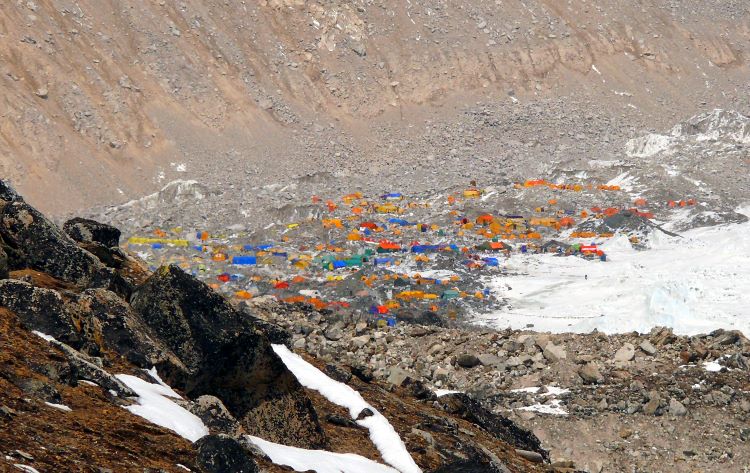
Everest receives an increasing number of visitors every year. Together with climate change, this has direct repercussions for the environment and society. In the picture, Kala Patthar base camp (Nepal).
Goutamm Doutta – Wikimedia CommonsThe Everest-Sagarmatha in the Anthropocene
Everest and the Sagarmatha National Park are easily defined as high mountain environments using a simple threshold method, because they host the highest peak in the Earth, along with several other peaks above 6,000 m above sea level. But this thresholding method hides the complex local socio-environmental dynamics, thus, only a systemic approach, grounded in the high mountain definition from Bilbao Barrenetxea and Faria (2022), as presented above, is able to capture the nuances of the Sagarmatha landscape.
Historically, its remoteness and rugged terrain posed challenges to data collection and research in the Sagarmatha region. But with the development of remote sensing techniques, Thakuri et al. (2014) observed that, from 1992 to 2011, the glaciers in Everest shrank three times faster than in the 1962–1992 period. Additionally, King et al. (2017) found that all 32 glaciers monitored from 2000 to 2015 in the Everest region shrank, with an average rate of –0.52 (±0.22) m water equivalent per year, as a consequence of warmer temperatures. Glacier water is responsible for 65 % of the drinking water in the Khumbu Valley, where the communities are extremely vulnerable to the effects of climate change as glaciers retreat and snowpack declines (Wood et al., 2020). Thus, despite their high elevation, the glaciers in the Everest are not excluded from a relentlessly continuous and slow recession process as a result of anthropogenic climate change.
In the period of 1959 to 2007, the mean annual air temperature increased by about 0.62 °C per decade in the Northern face of Everest, with the greatest warming trend observed in winter seasons (0.86 °C per decade). This rate of temperature rise is alarming once it exceeds by far the estimated anthropogenic global warming, currently increasing at 0.2 °C per decade due to past and ongoing greenhouse gas emissions (IPCC, 2022).
Snow cover is significantly decreasing in the Sagarmatha National Park, with a rate of decrease more pronounced in lower altitudes, confirming previous findings that the snow line altitude keeps shifting upwards (Thakuri et al., 2014), given the observed patterns of temperature increase in the region.
At the global scale, the net loss of snow and glacier cover affects the albedo of the Earth system, which feedbacks the temperature increase, resulting in further ice melting. However, the albedo also decreases with the atmospheric deposition of combustion derived aerosols, known as black carbon. Menon et al. (2010) estimated that from 1990 to 2000, snow/ice cover in the Himalayas decreased by ~0.9 % due to black carbon, an important contributing factor to glacier retreat, being as important as greenhouse gas in the observed retreat of over two thirds of the Himalayan glaciers.
Despite its remoteness, the Everest glaciers are influenced by the deposition of black carbon from Nepal, China and India, derived from both fossil fuel and biomass burning sources (Li et al., 2016) that usually are transported over long ranges. At a smaller scale, though not negligible, local tourism also contributes to the deposition of black carbon (Nair et al., 2013) from cooking and the combustion of fossil fuels for transport.
The social context of the Sagarmatha region is influenced by a variety of factors that shape the cultural landscape and interactions within the community. Increasing massive tourism has changed the local cultural dynamics (Mu et al., 2020) and negatively impacted the environment in several ways. Some impacts include the overharvesting of shrubs and plants for expedition and tourist lodge fuel, overgrazing, accelerated erosion, and uncontrolled lodge building, as well as the ever increasing deposition of solid, sometimes toxic, waste along the trekking route to the Everest’s base camp (Byers et al., 2020) and microplastics in the snow and stream water up to 8,440 m above sea level, more concentrated near high human presence (Napper et al., 2020).
Nearly 1,000 tons of solid waste are likely to be generated in the Sagarmatha National Park and its buffer zone each tourist season, with nearly all of it ending up in one of the 75 landfills existing inside the park (Byers et al., 2020). These landfills pose serious public health issues and environmental hazards, as landfill seepage has been linked to an increase in the incidence of gastrointestinal diseases among tourists and local people (Manfredi et al., 2010). Moreover, pollutants and microbiological contamination are found in water bodies, deteriorating the water quality (Manfredi et al., 2010) because of improper disposal of solid waste and human excreta, like solid waste dump sites, open defecation, and the poor condition of septic tanks. Recently, in early 2024, the Nepali government addressed the problem related to the disposal of human faeces in the Everest, potentially providing more protection to water bodies from contamination.
Nevertheless, more actions towards sustainable tourism in the Everest are needed to tackle the challenges posed by climate change and the ever-increasing number of visitors. All of the mentioned above have direct local and downstream impacts for the environment and society. In order to mitigate the impacts of tourism and to seek climate change adaptation in the region, avoiding further social environmental damages, sustainable management practices must be implemented as fast as possible, engaging the local communities and based on ethical approaches informed by sound and inclusive research for a just and sustainable future.
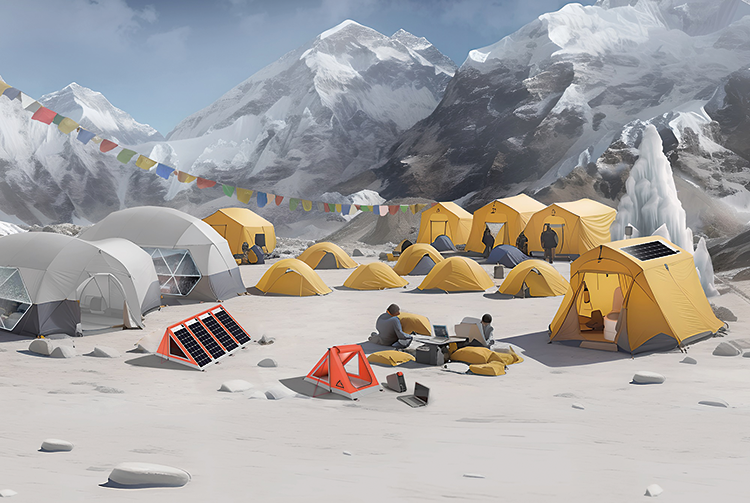
Representation of the first sustainable base camp on Everest, by the NeverRest Project. This is one of its most important actions, in the context of the combined impact of climate change and unsustainable tourism in this area.
The NeverRest ProjectTowards a sustainable Everest base camp
It is in the context of the combined impact of climate change and unsustainable tourism in the Sagarmatha National Park that the NeverRest Project is born. This pioneering initiative aims to promote ecosystem conservation on the highest mountain of the world. The utmost objective of the initiative is the cleaning up of Mount Everest in Nepalese territory, involving a cross-disciplinary team of local and international specialists. To reach that extremely ambitious aspiration, several previous steps are needed, including reducing the pace of waste deposition in the mountain and preserving the current environment to halt further impacts on the ecosystem.
Thus, establishing a sustainable base camp on the Nepali side of Everest is one of the most important actions proposed by the NeverRest Project. Crafted through the collaboration of several institutions, mainly the Elisava, School of Design & Engineering in Barcelona (Spain), the first step of the initiative was to analyse the major issues caused by the tourist exploitation of Everest. After a holistic diagnosis, the initiative launched EverData1, a platform to share data on environmental impact of tourism on Mount Everest, along with nine scientifically sound sustainable practices proposed to mitigate the impacts of the ever-growing number of visitors to the base camp. The proposals also look at adapting to new climatic and social conditions in high mountain environments. These practices, discussed more in depth below, tackle key issues in the following five thematic aspects of the current Everest base camp organization: 1) planning and design, 2) human waste management, 3) water and energy, 4) conservation awareness, and 5) education.
Planning and design
Currently, the Everest base camp follows no space organization, as it consists of hundreds of tents arranged according to the preferences of the first tourism agencies to arrive. The lack of land use planning implies the unsustainable exploitation of the local resources, such as glacier water, and waste disposal issues, as well as taking groups to risky places in the landscape, susceptible to landfills or avalanches.
Three initiatives are proposed to overcome the chaotic spatial organization of the Everest base camp. The first one, called «Kapas», establishes protocols and strategies for tent placement. The objective of this first initiative is to offer step-by-step guidelines to travel agencies to create well-organized, environmentally responsible and efficiently spaced base camps, promoting sustainable practices and minimizing disruptions to the natural surroundings. The direct results expected from this coordination amongst agencies are the end of disorganized camping practices, the increase in services shared by agencies, the creation of communal spaces with the purpose of promoting interactions, and the creation of a sense of community. The structured layout and organization based on the analysis of the terrain, creating a dense but ordered occupation of the space, will reduce possible areas of environmental impact.
Following the space organization, the next initiative called «Sustainable Operators» is aimed at rewarding the tourism operator’s responsible and ethical use of the space. This approach combines the efficiency and sustainability of the Kapas manual to encourage the travel operators to adhere to best practices in tent placement and actively participate in community and sustainable actions. In this approach, the Kapas is used as a scoring tool for the operators, rewarding them based on how well they follow the guidelines, resulting in higher scores and, consequently, bonuses that may include economic benefits and a sustainable operator certificate, ensuring a good reputation among tourists, institutional perks and corporate advantages. This reputation score will be open to everyone in an interactive digital platform that will also allow operators to efficiently and transparently select and reserve spaces in the well-planned Everest base camp following Kapas.
Finally, the «Makura» initiative aims to interconnect accommodations of the Everest base camp through a comprehensive system of modular tents that can be linked to shared spaces, such as rest areas, kitchens, and dining rooms. Including these connector modules enhances the quality of life and safety, particularly during harsh weather conditions. Based on urban planning and organization principles, this modular connectivity enhances thermal conservation of the base camp, while promoting social interactions among users, fostering the sense of community needed to minimize the environmental impacts of tourism operation in the Everest.

One of the main challenges of the NeverRest project is to tackle human waste at the base camp. It is estimated that Everest's lakes and pools of water receive between 4,000 and 6,000 litres of urine per day. In this regard, the «Nourea» initiative encourages the use of a portable, lightweight urinal (in the picture) with a built-in filter, which can reduce urine contamination by 42 %.
The NeverRest ProjectHuman waste management
Perhaps one of the biggest challenges to safeguard Everest from further human impacts is managing waste disposal from tourism activities in the base camp. Most waste is burnable garbage, e.g., paper, cardboard, packaging, clothing, and food, followed by human waste, known to have impacted downstream populations. Establishing efficient waste management systems at the Everest base camp encompasses waste reduction mainly of single-use items, reuse of materials, recycling what is possible, and proper waste disposal.
In this sense, The NeverRest Project proposes two major initiatives for dealing with human waste at the Everest base camp. The first initiative, «Nourea», aims to incentivize the use of a portable lightweight (180 g) urinal with a built-up filter, able to reduce the urinal pollution by 42 %. This simple initiative would safeguard waterbodies and glaciers that currently receive from 4,000 to 6,000 litres of urine each day.
The second initiative is how to deal with the huge amount of human faeces in the Everest Camp Base, estimated around 8,000 kg per year. Part of this is carried into 40 l barrels and emptied on the ground. The major problem of how human waste is currently addressed is downstream water pollution. This may also affect climbers and local guides, as accumulation of human waste in crowded areas can increase health risks by creating an environment conducive to the spread of diseases and pathogens. Thus, the «FlameFlush» initiative aims to address sanitation and waste management challenges by implementing incinerating toilets that transform human waste into ashes, destroying pathogens and significantly reducing the volume of waste. This would require the implementation of nearly a hundred flaming toilets, fuelled with solar energy, which is very challenging in the Everest base camp, but it is likely the most efficient way to minimize the impacts of the huge accumulation of waste disposal at high altitudes.
Water and energy
Nearly 12,000 litres of water are used daily at the Everest base camp, pressuring the small streams and glaciers in the surroundings. The «IceSpring» initiative aims to supply drinking water for daily needs without relying on the glacier by constructing a 15 m tall ice stupa (artificial glacier) alongside a central 20 m pipe. Water gathered during the low season would provide 175,000 litres of water during the expedition season, which is sufficient to the current needs, from a reliable, potable and sustainable source.
Regarding energy, the «SUNMIT Solar Tent» aims to promote the use of a portable tent with a flexible solar panel, lightweight (2.4 kg) and optimized for efficiency, that allows climbers to be self-sufficient in high mountains. Reducing as much as possible the dependency of fossil fuels for energy in high mountain is paramount for reducing pollution, transport necessity and deposition of black carbon over glaciers and snow surfaces.
Conservation awareness
Mountaineers often lack a complete understanding regarding the individual environmental impact of their high mountain activities, affecting not only the fragile ecosystem but also the local communities. One potential way to raise awareness is to provide tourists with indicators of their impacts. Currently, the equivalent carbon emission of travel is very common worldwide and, with standard guidelines to calculate the emissions, can become a useful tool for depicting travel impacts to the environment. For example, it is estimated that a luxury travel from Europe to the Everest base camp emits 14,505 kg CO2 equivalent, while a standard travel would emit around 2,360 kg CO2 equivalent. With travel information provided by the travellers, the «Track Conversion» initiative aims to calculate the carbon footprint of visitors in an interactive application of The NeverRest Project, and suggest a set of good practices they can adopt during their trip to minimize their environmental impacts. By the end of the trip, the traveller can opt to compensate for the emissions generated during the expedition, contributing to neutralizing the global warming impacts.
Education
Finally, a «Manual of Best Practices» is proposed to foster individual awareness and establish regulatory guidelines for activities at the Everest base camp. The manual will cover the variety of critical aspects presented here, and the regulations will result from the collaboration with experts in mountaineering, ecology and socio-culture, addressing the major issues identified by the local community. It will suggest actions not only from an environmental perspective but also from a socio-cultural standpoint, aiming to facilitate more balanced, beneficial and meaningful exchanges between visitors and local communities in accordance with the principles of regenerative tourism.
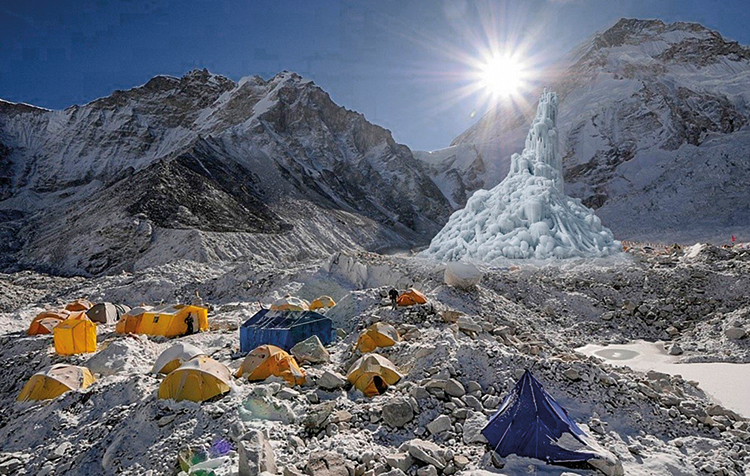
Simulation of the «IceSpring» at Everest base camp. This initiative consists of the construction of an artificial ice stupa next to a canyon. Water gathered during the low season would provide 175,000 litres of water during the expedition season.
The NeverRest ProjectFrom local to global
While the implementation of such proposals is costly and challenging, requiring the involvement of several stakeholders, local governments, tourism agencies and tourists themselves, these initiatives have a high potential to minimize tourism impacts at the Everest base camp. Moreover, this initiative can certainly be replicated in other high mountain areas that are receiving an ever-increasing flux of tourists, scaling up the contribution to global climate.
By optimizing energy use through planning the spatial organization of base camps and using technology like renewable energy, thus reducing the reliance on fossil fuels, the pace of positive feedback loops acting towards warmer climates is reduced, as less carbon is emitted and less black carbon is deposited over snowy surfaces. Moreover, preserving glaciers and water sources flowing downstream is paramount to ensure quality water for human and agricultural use in the watershed, allowing opportunities for best agricultural practices in accordance with the environment. This way, fostering local actions in key environments like high mountain regions can contribute significantly to climate change mitigation and environmental conservation at large watersheds around the globe.
References
Ballesteros-Cánovas, J. A., Trappmann, D., Madrigal-González, J., Eckert, N., & Stoffel, M. (2018). Climate warming enhances snow avalanche risk in the Western Himalayas. Proceedings of the National Academy of Sciences, 115(13), 3410–3415. https://doi.org/10.1073/pnas.1716913115
Bilbao Barrenetxea, N., & Faria, S. H. (2022). Climate change in high-mountain regions: An international perspective and a look at the Pyrenees. Metode Science Studies Journal, 12, 115–121. https://doi.org/10.7203/metode.12.20509
Byers, A. C., Gustafsson, T., Shrestha, M., & Chhetri, N. (2020). A sustainable solid waste management plan for Sagarmatha (Mt Everest) National Park and Buffer Zone, Nepal. Mountain Research and Development, 40(3), A1–A9. https://doi.org/10.1659/mrd-journal-d-20-00018.1
Fischer, L., Huggel, C., Kääb, A., & Haeberli, W. (2013). Slope failures and erosion rates on a glacierized high‐mountain face under climatic changes. Earth Surface Processes and Landforms, 38(8), 836–846. https://doi.org/10.1002/esp.3355
IPCC. (2022). Summary for Policymakers. En Global warming of 1.5°C: IPCC special report on impacts of global warming of 1.5°C above pre-industrial levels in context of strengthening response to climate change, sustainable development, and efforts to eradicate poverty (p. 1–24). Cambridge University Press. https://doi.org/10.1017/9781009157940.001
King, O., Quincey, D. J., Carrivick, J. L., & Rowan, A. V. (2017). Spatial variability in mass loss of glaciers in the Everest region, central Himalayas, between 2000 and 2015. The Cryosphere, 11(1), 407–426. https://doi.org/10.5194/tc-11-407-2017
Li, C., Bosch, C., Kang, S., Andersson, A., Chen, P., Zhang, Q., Cong, Z., Chen, B., Qin, D., & Gustafsson, Ö. (2016). Sources of black carbon to the Himalayan–Tibetan Plateau glaciers. Nature Communications, 7(1), 12574. https://doi.org/10.1038/ncomms12574
Manfredi, E., Flury, B., Viviano, G., Thakuri, S., Khanal, S. N., Jha, P. C., Maskey, P. K., Kayastha, R. B., Kafle, K. R., Bhochhibhoya, K. R., Ghimire, N. P., Shrestha, B. B., Chaudhary, G., Giannino, F., Cartenì, F., Mazzoleni, S., & Salerno, F. (2010). Solid waste and water quality management models for Sagarmatha National Park and buffer zone, Nepal. Mountain Research and Development, 30, 127–142. https://doi.org/10.1659/MRD-JOURNAL-D-10-00028.1
Menon, S., Koch, D., Beig, G., Sahu, S., Fasullo, J., & Orlikowski, D. (2010). Black carbon aerosols and the third polar ice cap. Atmospheric Chemistry and Physics, 10(10), 4559–4571. https://doi.org/10.5194/acp-10-4559-2010
Moazzam, M. F. U., Bae, J., & Lee, B. G. (2022). Impact of climate change on spatio-temporal distribution of glaciers in Western Karakoram region since 1990: A case study of Central Karakoram National Park. Water, 14(19), 2968. https://doi.org/10.3390/w14192968
Mu, Y., Nepal, S. K., & Lai, P. (2020). Tourism and sacred landscape in Sagarmatha (Mt. Everest) National Park, Nepal. In M. A. Di Giovine & J. Choe (Eds.), Pilgrimage beyond the officially sacred (p. 82–99). Routledge. https://doi.org/10.4324/9781003007821-5
Nair, V. S., Babu, S. S., Moorthy, K. K., Sharma, A. K., Marinoni, A., & Ajai. (2013). Black carbon aerosols over the Himalayas: direct and surface albedo forcing. Tellus B: Chemical and Physical Meteorology, 65(1), 19738. https://doi.org/10.3402/tellusb.v65i0.19738
Napper, I. E., Davies, B. F., Clifford, H., Elvin, S., Koldewey, H. J., Mayewski, P. A., Miner, K. R., Potocki, M., Elmore, A. C., Gajurel, A. P., & Thompson, R. C. (2020). Reaching new heights in plastic pollution—Preliminary findings of microplastics on Mount Everest. One Earth, 3(5), 621–630. https://doi.org/10.1016/j.oneear.2020.10.020
Thakuri, S., Salerno, F., Smiraglia, C., Bolch, T., D’Agata, C., Viviano, G., & Tartari, G. (2014). Tracing glacier changes since the 1960s on the south slope of Mt. Everest (central Southern Himalaya) using optical satellite imagery. The Cryosphere, 8(4), 1297–1315. https://doi.org/10.5194/tc-8-1297-2014
Thornton, J. M., Palazzi, E., Pepin, N. C., Cristofanelli, P., Essery, R., Kotlarski, S., Giuliani, G., Guigoz, Y., Kulonen, A., Pritchard, D., Li, X., Fowler, H. J., Randin, C. F., Shahgedanova, M., Steinbacher, M., Zebisch, M., & Adler, C. (2021). Toward a definition of essential mountain climate variables. One Earth, 4(6), 805–827. https://doi.org/10.1016/j.oneear.2021.05.005
Wood, L. R., Neumann, K., Nicholson, K. N., Bird, B. W., Dowling, C. B., & Sharma, S. (2020). Melting Himalayan glaciers threaten domestic water resources in the Mount Everest region, Nepal. Frontiers in Earth Science, 8, 128. https://doi.org/10.3389/feart.2020.00128
Notes
Notas de autor
Información adicional
redalyc-journal-id: 5117