Melting point. The voice of the mountains

Esta obra está bajo una Licencia Creative Commons Atribución-NoComercial-SinDerivar 4.0 Internacional.
Recepción: 16 Enero 2025
Aprobación: 10 Junio 2025
DOI: https://doi.org/10.7203/metode.15.30220
Abstract: The changes brought about by the rising temperatures of ongoing global climate change are affecting the ecosystems of high mountains. The most affected are marginal environments, whose climate parameters are especially sensitive. This is the case of the highest mountains in the Iberian Peninsula, where the cryosphere still resists under its specific topoclimatic conditions, and where the general trend towards ice regression is exposing a hidden but equally affected environment: ice caves. This article presents the main impacts affecting the ice caves in the Picos de Europa mountain range over the past 15 years. We will examine their importance, the potential consequences of ice retreat, and their current patterns of change.
Keywords: ice caves, climate change, high mountains, Picos de Europa.
Global climate change affects our planet’s cryosphere, as well as many other related phenomena and dynamics, in many different ways. Among the numerous environmental impacts reported in the media, the melting of ice is often highlighted, particularly in the most visually accessible locations: glaciers and snow in the mountains and at the poles – the largest frozen masses on the surface of the Earth. However, within the context of the current widespread reduction of the cryosphere (IPCC, 2022), beneath these vast surface ice formations lies another equally striking and significant environment: ice caves. Within these natural cavities, ice masses have formed and persisted under specific environmental conditions, sustained by inputs in of rainfall or direct snow. Ice caves are currently distributed throughout most of the planet’s high mountains (Perşoiu & Lauritzen, 2018), and are also well represented in the highest peaks of several ranges within the Iberian Peninsula.
The importance of ice caves has been emphasised over the last three decades, primarily due to the valuable insights they provide. Their chronology and isotopic analysis have allowed studies to connect with climate sequences, including the North Atlantic Oscillation (see Stoffel et al., 2009) and isotopic surveys of Greenland (see Sancho et al., 2012). Moreover, some caves are on a par with mesotrophic lakes in terms of microbiological importance (Standhartinger et al., 2010). Of note, some Martian ice caves have also been studied (see Schörghofer, 2021).
They are widely distributed across the globe and can be found in a wide variety of environments, ranging from low altitudes at high latitudes (e.g., Svarthammarhola in Mefjell-Fauske, Norway, at 275 m, or the Yukon ice caves in Bear Cave Mountains and Tsi-it-toh-Choh, at 66° N at elevations of 600–900 m) to, less often, high altitudes at low latitudes, such as Mauna Loa ice cave (Hawaii) at 3,500 m and 20° N. However, they are particularly prevalent in mid-latitudes and, therefore, have been the subject of extensive study due to their proximity and accessibility (Perşoiu & Lauritzen, 2018). They occur at a wide range of altitudes, but for obvious reasons, are most commonly found in high mountain areas.
In the Spanish territory, we can find frozen caves in the high-altitude lands of the Pyrenees. Some interesting examples are found in the Monte Perdido–Marboré massifs and in Aísa, Tendeñera, Las Tucas, and Cotiella (Serrano, Gómez-Lende et al., 2018; Serrano, Oliva et al., 2018). The Cantabrian Mountains, particularly the Picos de Europa region, are home to numerous caves; according to topographic compilations, more than 120 have been documented in this area (Gómez Lende, 2016). They are also present in sensitive contexts elsewhere on the Iberian Peninsula, including some highly resilient examples at relatively low altitudes in the Cantabrian Mountains. Among them are those of the Valnera massif: V.2, also known as La Grajera cave, located at an altitude of 1,490 m, and CM24, also known as La Len cave, which is located in Cubada Grande and currently containing only a small amount of ice (see Martín Merino et al., 2024). Other examples are found in the Montaña Palentina region (see UEVa, 2011) and in Vegacervera (León), at Sima del Infierno (at 1,650 m). A particularly fascinating case, due to its low latitude, was the so-called Cueva del Hielo in Altavista, Teide, in the Canary Islands (Figure 1). Until very recently, it had permanent ice, but this has now completely disappeared. Located at 3,350 m and at only 28° N (Martínez de Pisón & Quirantes, 1981), this cave also attracted the attention of renowned scientists such as Alexander von Humboldt at the end of the 18th century.
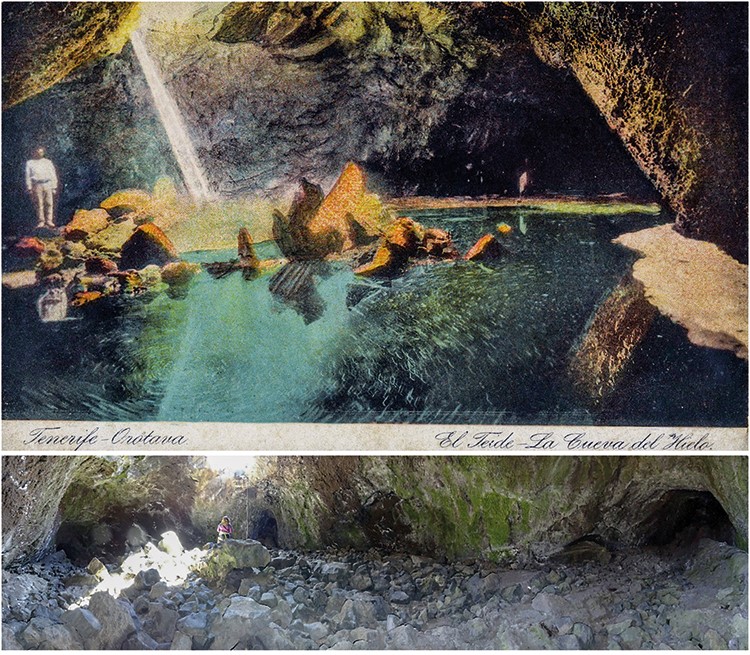
Figure 1
The Teide ice cave in Altavista, an emblematic ice cave due to its location near the summit of Teide in Tenerife, its latitudinal position, and the fact that it captured the attention of renowned scientists such as Humboldt. Today it is devoid of any perennial ice mass. Above, a coloured postcard from 1900–1905. Below, current state of the cave.
Fundación para la Etnografía y Desarrollo de la Artesanía Canaria-FEDAC / Manuel Gómez Lende
Ice caves: unique environments
Cave environments differ markedly from their surrounding environments, yet remain dependent on them; the formation and maintenance of their ice blocks require specific internal environmental conditions. Firstly, they need either water that can freeze and refreeze inside them, or a direct input of snow from outside. Secondly, they require either access points that facilitate internal air circulation and low temperatures for freezing snow and water (i.e., thermodynamically dynamic caves) or air and ice cul-de-sacs (i.e., thermodynamically static caves). In both cases, their inputs and temperatures must be balanced. If this balance is disrupted—usually by external factors—their mass either increases or begins to decline. In the context of our mountains today, the latter is more common.
The balance with the surrounding environment defines their endoclimates, making ice caves an excellent laboratory (Figure 2), and an ideal capsule for sharpening our regional understanding of global climate change, especially past causes and future consequences. These same endoclimatic balance conditions make them valuable environments whose significance varies according to their location. Therefore, their value as a palaeoenvironmental record increases when local records are scarce or unavailable. The presence of ice caves in regions where it is impossible to create palaeoenvironmental records using directly datable or analysable elements makes them even more important. This is the case for the highest peaks in the Iberian Peninsula, including Picos de Europa.
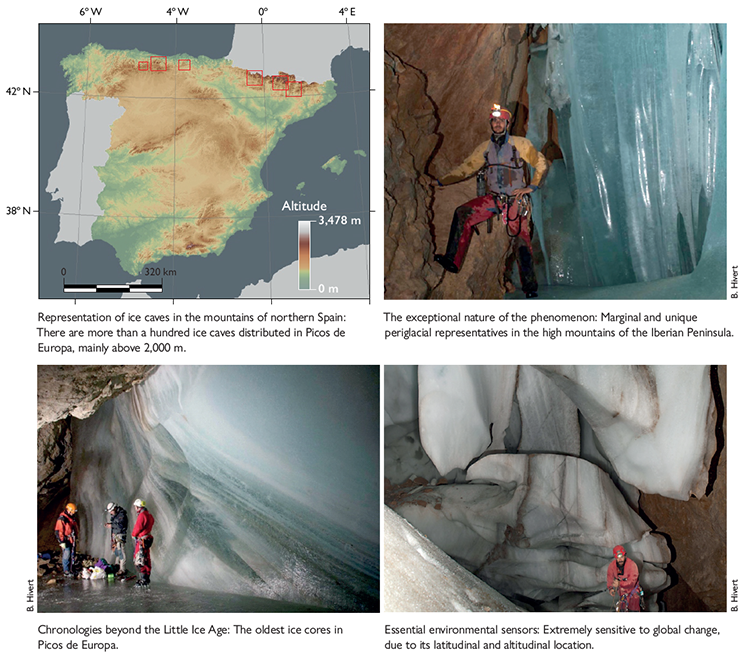
Figure 2
The ice caves in Picos de Europa, are unique periglacial environments and perfect laboratories to help us understand global change.
B. Hivert
State of the art in a context of global change
Permafrost environments and periglacial processes: The first pattern of change
The scientific community considers ice caves to be indicators of sporadic permafrost (based on the thermal records contained in their walls), although there are many epistemological issues to be clarified regarding glacial and periglacial boundaries. However, the environments within these caves– specifically at sites the sites of ice blocks – are considered underground mountain permafrost environments. This is based on the thermal conceptualisation of the word permafrost (since average annual temperatures have fallen below 0 °C for several consecutive years; Gómez-Lende, 2016). This affects their consideration as a periglacial phenomenon as well as their global distribution, which contributes to completing the geographical permafrost scenario. However, the thermal records available in some monitored caves in Picos de Europa over the last 15 years show a degradation of these conditions as a consequence of climate change in high mountain environments. This has already happened, as mentioned above, in the Teide ice cave, where permanent ice has disappeared. More recent endoclimatic records show similar thermal trends in some ice caves of the Picos de Europa. This reduces the geographical distribution of permafrost, which might not have a great impact globally, but does affect conditions at the regional level, especially in regions where the presence of permafrost is at its environmental limit.
Rising temperatures: Second pattern of change
Studies carried out in some ice caves in Picos de Europa over the last decade and a half show average annual temperatures below 0 °C in the rooms and galleries where permanent ice blocks accumulate. The coldest month is usually February, with temperatures ranging between –1 and –3 °C. During the winter months, external conditions influence temperatures within the caves. Temperatures are lower outside than inside, causing air to flow inwards due to density differences. During this period, known as the open thermodynamic period, a heterothermal regime occurs inside the caves, with daily average variations between 0 °C and –2 °C. This regime is partly conditioned by whether the inlets are blocked by snow accumulation. However, during the summer months (the closed thermodynamic period) outside temperatures are higher than those inside, creating a homothermal internal thermal regime, with stable temperatures around 0 °C and no significant thermal influence from the outside. This shows that outdoor temperatures exert a stronger influence during the winter months, as observed in the caves of Picos de Europa and the Austrian Alps (Wind et al., 2022). A key area for further investigation is the influence of extreme weather events on internal thermal behaviour and the resulting mass balances. In caves in the Canin massif (Italian Alps), the importance of extreme weather events has been demonstrated, particularly during the warmer and more intense rainfall linked to a rise in the 0 °C isotherm (Colucci et al., 2016). It is therefore necessary to continue research along similar lines to determine, for example, the effect of events such as heat waves – such as those of 2022 and 2023, which brought record high temperatures in Spain – on the frozen caves in our mountains, or to assess whether unusually mild winters exert a stronger influence. Using decadal thermal series, Wind et al. (2022) showed that the warming trend in Hundsalm ice cave in Austria exceeded the warming trend outside the cave. This should alert us to the need for further research into such trends in our mountain caves and their correlation with external climatic conditions.
Changes in snow cover: Third pattern of change
Another pattern of change in the evolution of ice caves in the current context relates to snow cover. Snowfall is a decisive factor for the Picos de Europa ice caves, as a fundamental component of their metamorphic ice blocks and essential for their development and preservation. In other caves, generally those at medium or low altitudes, the main input is the freezing of precipitation or melt water. In addition, in some caves it prevents external thermal influences from reaching the interior during snow-covered months. In caves studied in Picos de Europa, some closed thermodynamic periods have been observed, induced by snow clogging the entrances. This process causes a homothermal regime during what would normally be a heterothermal winter period, similar to the pattern summer months. Thus, thermodynamic patterns are altered, minimising external thermal influence during this period. In addition to these disruptions, in some caves with small inlets, snow accumulation also prevents direct snow inputs and, therefore, replenishment of the ice block. All of this contributes to the reduction of ice volume within the caves, as shown over the last decade in the Altaiz ice cave (Figure 3).
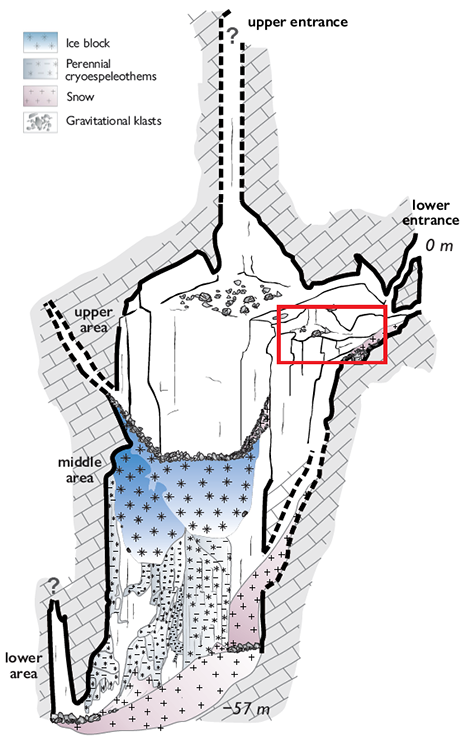
Figure 3
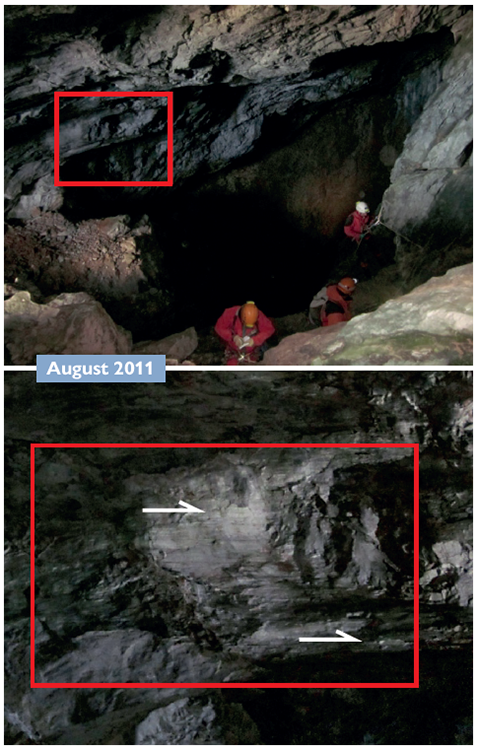
The mass balances of the ice blocks in the caves of Picos de Europa, which are markedly negative, show traces of abrasion on the walls of the cavities that allow us to estimate the retreat of the ice.
The volumes of metamorphic ice were markedly larger in the past The photo below shows abrasion grooves (white arrows) left by the ice in the Altaiz ice cave, near its lower entrance (as seen in the diagram).
B. Hivert
Variations in snowfall patterns resulting from the current global context show a reduction in the permanence of snow cover by about 10 days per decade and a decrease in large snowfalls (Hock et al., 2022). These therefore represent patterns of change affecting ice caves, especially in cases where the main input is snow, as is the case in Picos de Europa. A decline in snow accumulation reduces the volume of ice, allowing external thermal trends to have a greater influence since inlets are less likely to become blocked during winter. This results in a reduction, or even the disappearance, of the aforementioned induced closed periods.
At the entrance to the Altaiz cave, for example, the snowdrift has not survived the summer in recent years, despite its favourable topoclimatic conditions (northern orientation, altitude, small topographic depression, and topoclimatic shelter provided by the base of the wall). The same situation applies to the main entrances of the Hs4 (Figure 4) and Verónica ice caves, whose permanent snowdrifts, which supply snow and meltwater to their interior ice blocks, have considerably reduced over the last 15 years.
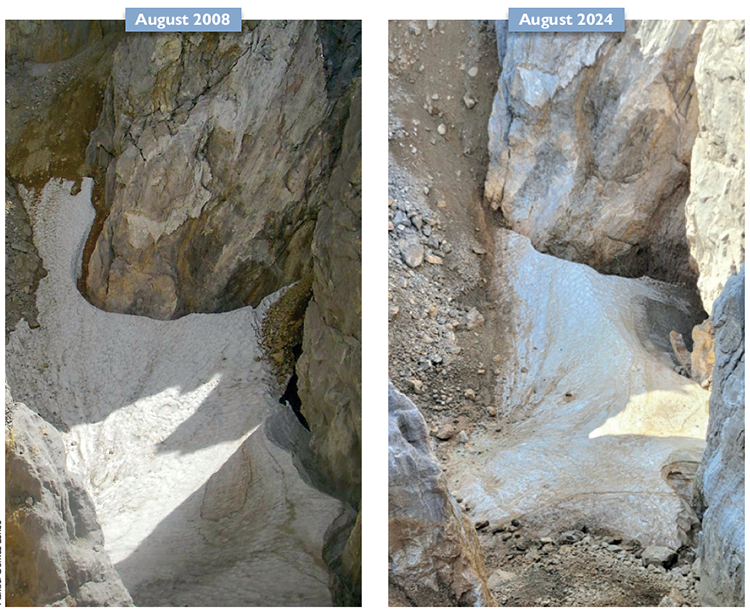
Figure 4
Snow, the main input in the Picos de Europa ice caves, has dwindled considerably in recent years.
Permanent snowdrifts that supply the ice blocks with melt water and direct snow inputs from the surface have also reduced considerably.
Manuel Gómez LendeRegression in mass balances: Fourth pattern of change
In the years studied, ice caves in Picos de Europa such as Altaiz, Verónica, Castil, Hs4, K5, 2N, and P13 have shown clearly negative mass balances. While it is difficult, if not impossible, to record the exact volume of the losses because of the impossibility of fully monitoring their respective ice blocks, they nonetheless show clear signs of regression. This is the case for the Peña Castil ice cave, where the top of the ice block has dropped considerably, as can be seen by observing the marks made by the first speleologists who explored it. In the ice cave of Altaiz, the melting is appreciable throughout the ice block, which has even fractured in two and shifted downward vertically in its pit.
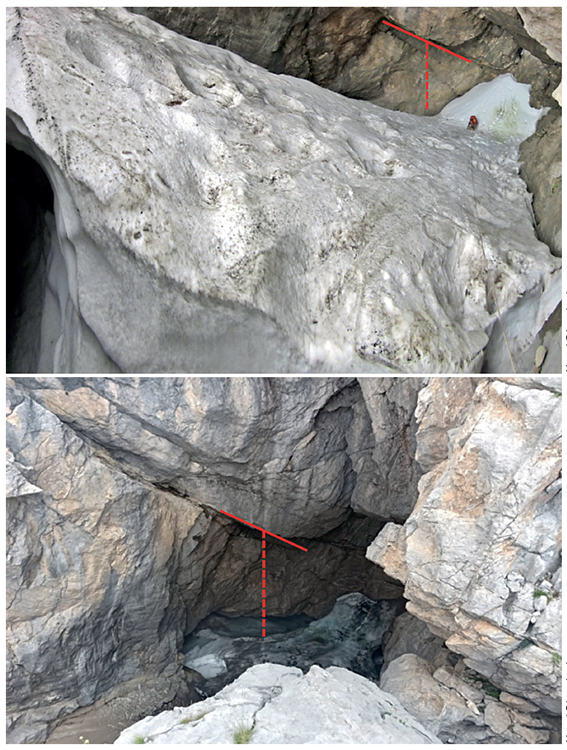
Figure 5
In some of the ice caves in Picos de Europa, such as the Verónica ice cave, the blocks of ice penetrate from the surface to the interior and reach depths of over 100 m. Snow inputs are crucial for their mass balance and, consequently, their survival.
Manuel Gómez Lende
Reductions in ice volumes can be seen in all the caves studied so far. In some cases, this is reflected at their openings, where grooves mark past ice levels. This is evident on the ceiling over the entrance to the Altaiz cave, or in the lower opening of the Verónica cave (Figure 5). On other occasions, permanent cryospeleothems that two decades ago maintained considerable volumes now barely protrude a few tens of centimetres above the ground, as is the case with the ice stalagmites of Sala de los Fantasmas (‘ghost room’, –109 m) in the Verónica ice cave, or the ice mound in the Castil cave (Figure 6). The terrestrial laser scanner (TLS) monitoring carried out annually since 2010 in the Castil cave shows a progressive reduction in its ice block, accompanied by a significant eat of all its bergschrunds.
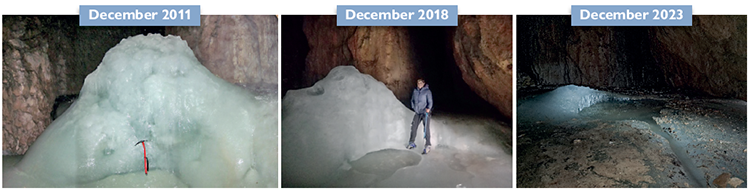
Figure 6
Regressive trend in the mass balance of perennial cryospeleothems.
Perennial ice speleothems, like metamorphic ice blocks, show strikingly negative mass balances that point to their complete disappearance in about 10 years. The pictures show the ice form of the Peña Castil ice cave.
Manuel Gómez LendeThe response to global change in these subterranean and marginal cryospheric ecosystems may be, as with Pyrenean glaciers, faster and more pronounced than observed in alpine areas in terms of volume losses, with a marked negative acceleration in the last two decades. Such a pattern may also be occurring in ice caves. Continued volumetric controls will provide clarification, but in any case, this is certainly an urgent problem (Figure 7).
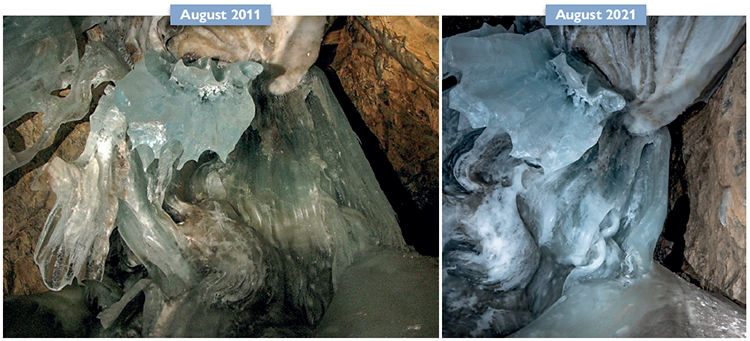
Figure 7
The melting and deformation of ice blocks and their associated cryospeleothems can be seen in the ice caves of Picos de Europa.
In some cases, they represent an irreparable loss of heritage, not only natural and scientific, but also purely aesthetic. The pictures show the perennial cryospeleothems hanging from the ice block in Altaiz cave in August 2011 and 10 years later.
Manuel Gómez LendeAn irretrievable underground ice heritage
Ice caves are the least studied cryospheric phenomena globally. At the same time, they are the last remnants of massive ice still present in some of the highest mountains in the Iberian Peninsula, such as those in the Cantabrian Mountains. This makes them exceptional representatives of cold environments in our current context of global change, and for this reason alone they deserve the highest regard. As a unique natural laboratory in danger of disappearing soon, they must be considered one of the most important geo-indicators of current and past environmental change in our mountains.
Our generation has witnessed the decline and extinction of many glaciers and ice caves across the planet. The presence of glaciers, permafrost, and snow is one of the defining factors characterising what we consider high mountains, defining both the scientific and cultural imaginaries. These are the basic pillars underpinning the concept but climate change is now shaking this traditional perception. Future generations may have to redefine and adapt this term to enc very different characteristics. The intrinsic fragility of high mountain environments might become a verdict in itself, as they shift toward a different concept. In this context there is an urgent need to collate and adapt the IPCC projections (Hock et al., 2022) for the ice masses preserved beneath the surface, to include those hidden treasures that are still with us.
Ice cave research, analysis, and inventories are still at an early stage, both because of the low number of ice caves relative to the global cryosphere and the difficulties in studying them due to their challenging access, configuration, and monitoring. Direct exploration is the only way to observe and collect data in these extreme cryospheric environments. However, the rapid evolution and millimetre-accurate precision of non-invasive geomatic instrumentation and techniques, together with state-of-the-art analysis of physical, chemical, and biological indicators, now offer promising new research possibilities.
Things like checking the most recent melting trends and whether, as in the case of some caves in the Pyrenees, the current changing conditions are still favourable for the preservation of ice inside them (Bartolomé et al., 2023); testing whether ice caves continue to lose volume in years with heavy snowfall (as is the case for Pyrenean glaciers); examining whether (and how much) exceptionally hot summers have taken their toll on the mass balance of the caves in Picos de Europa; and verifying the influence of milder winters, the intensification of extreme rainfall events, and the increasing frequency of warmer, more intense precipitation events. All of these are key questions to be tackled in the study of ice caves in our mountains.
References
Bartolomé, M., Cazenave, G., Luetscher, M., Spötl, C., Gázquez, F., Belmonte, Á., Turchyn, A. V., López-Moreno, J. I., & Moreno, A. (2023). Mountain permafrost in the Central Pyrenees: Insights from the Devaux ice cave. The Cryosphere, 17, 477–497. https://doi.org/10.5194/tc-17-477-2023
Colucci, R. R., Fontana, D., Forte, E., Potleca, M., & Guglielmin, M. (2016). Response of ice caves to weather extremes in the southeastern Alps, Europe. Geomorphology, 261, 1–11. https://doi.org/10.1016/j.geomorph.2016.02.017
Gómez-Lende, M. (2016). Cuevas heladas en el Parque Nacional de Picos de Europa, fronteras subterráneas del hielo en el Macizo Central. Organismo Autónomo de Parques Nacionales (OAPN). Ministerio de Agricultura y Pesca, Alimentación y Medio Ambiente.
Hock, R., Rasul, G., Adler, C., Cáceres, B., Gruber, S., Hirabayashi, Y., Jackson, M., Kääb, A., Kang, S., Kutuzov, S., Milner, A., Molau, U., Morin, S., Orlove, B., & Steltzer, H. (2022). High mountain areas. En H.-O. Pörtner, D. C. Roberts, V. Masson-Delmotte, P. Zhai, M. Tignor, E. Poloczanska, K. Mintenbeck, A. Alegría, M. Nicolai, A. Okem, J. Petzold, B. Rama, & N. M. Weyer (Eds.), IPCC Special report on the ocean and cryosphere in a changing climate (pp. 131–202). Cambridge University Press. https://doi.org/10.1017/9781009157964.004
IPCC. (2022). IPCC Special report on the ocean and cryosphere in a changing climate. [H.-O. Pörtner, D. C. Roberts, V. Masson-Delmotte, P. Zhai, M. Tignor, E. Poloczanska, K. Mintenbeck, A. Alegría, M. Nicolai, A. Okem, J. Petzold, B. Rama, & N. M. Weyer (Eds.)]. Cambridge University Press. https://doi.org/10.1017/9781009157964
Martín Merino, M. A., Ruiz García, F., Ortega Martínez, A. I., & Benito Calvo, A. (2024). Marco geográfico y geológico de los Montes de Valnera (Espinosa de los Monteros, Burgos). Boletín SEDECK, 19, 11–43. https://cir.cenieh.es/handle/20.500.12136/3243
Martínez de Pisón, E., & Quirantes, F. (1981). El Teide. Estudio geográfico. Universidad de la Laguna.
Perşoiu, A., & Lauritzen, S. E. (Eds.). (2018). Ice caves. Elsevier. https://doi.org/10.1016/B978-0-12-811739-2.00003-6
Sancho, C., Belmonte, A., Moreno, A., Bartolomé, M., Calle, M., & Santolaria, P. (2012). Potencial paleoclimático de la cueva helada A294 (Macizo de Cotiella, Pirineos, Huesca). Geogaceta, 52, 101–104.
Schörghofer, N. (2021). Ice caves on Mars: Hoarfrost and microclimates. Icarus, 357, 114271. https://doi.org/10.1016/j.icarus.2020.114271
Serrano, E., Gómez-Lende, M., Belmonte, A., Sancho, C., Sánchez-Benítez, J., Bartolomé, M., Leunda, M., Moreno, A., & Hivert, B. (2018). Ice caves in Spain. En A. Perşoiu, & S. E. Lauritzen (Eds.), Ice caves (pp. 622–655). Elsevier. https://doi.org/10.1016/B978-0-12-811739-2.00028-0
Serrano, E., Oliva, M., González-García, M., López-Moreno, J. I., González-Trueba, J. J., Martín-Moreno, R., Gómez-Lende, M. Martín-Díaz, J., Nofre, J., & Palma, P. (2018). Post-little ice age paraglacial processes and landforms in the high Iberian mountains: A review. Land Degradation & Development, 29, 4186–4208. https://doi.org/10.1002/ldr.3171
Standhartinger, B., Sattler, B., Wendlinger, C., & Psenner, R. (2010). Bacterial life in ice and glacier caves. En C. Spötl, M. Luetscher, & P. Rittig (Coords.), Abstracts Volume 4th International Workshop on Ice Caves. Obertraun, Austria.
Stoffel, M., Luetscher, M., Bollschweiler, M., & Schlatter, F. (2009). Evidence of NAO control on subsurface ice accumulation in a 1200 yr old cave-ice sequence, St. Livres ice cave, Switzerland. Quaternary Research, 72, 16–26. https://doi.org/10.1016/j.yqres.2009.03.002
UEVa. (2011). Memoria de trabajos de campo 2011. Unión Espeleológica Vallisoletana.
Wind, M., Obleitner, F., Racine, T., & Spötl, Ch. (2022). Multi-annual temperature evolution and implications for cave ice development in a sag-type ice cave in the Austrian Alps. The Cryosphere, 16, 3163–3179. https://doi.org/10.5194/tc-16-3163-2022
Notas de autor
Información adicional
Funding: This work was partly funded by the Natural Heritage and Applied Geography Research Group of the University of Valladolid, the CES Alfa caving group, and the Spanish Ministry of Science and Innovation (PID2020-113247RB-C21).
Información adicional
redalyc-journal-id: 5117
