Science without a conscience. Technology at war’s service
The British sciences and the Great War: Myths and histories1
The British sciences and the Great War: Myths and histories1
Mètode Science Studies Journal, vol. 15, núm. 8, e32382, 2025
Universitat de València

Esta obra está bajo una Licencia Creative Commons Atribución-NoComercial-SinDerivar 4.0 Internacional.
Abstract: The history of the relations of science and war in the United Kingdom during the Great War has been the subject of much mythologising, by scientists and by historians. Those myths need to be understood, not ignored. Contrary to those myths, the UK had a powerful military-scientific complex prior to the Great War, which was greatly expanded during it, not least by the recruitment of physicists to it.
Keywords: Great War, history of science, science and technology, physics.
My Oxford teacher, Margaret Gowing, used to rail against those who believed that science and war only conjoined themselves in the Second World War. Alas her war against ignorance and cliché still needs to be fought many decades on.
The poverty of our understanding of the relations of science and war is part of a larger deficit in our knowledge of the relations of science and society. Intellectuals have a dismal record in telling empirically coherent stories about science and society. The problem derives in significant part from taking the public statements of academic scientists rather too literally and taking the word of crude propagandists for science like Charles P. Snow and Jacob Bronowski far too seriously (Desmarais, 2012; Edgerton, 1996). Any serious history of science must start not with their stories but rather with an understanding not only that they mislead, but how they mislead. Such understanding, and not merely as fresh start, is in fact a precondition for the serious study of modern science.
What scientists said to each other in their own worlds was rather different. Here it was known and acknowledged where scientists actually worked and what on, including with the military. And none of this was secret. Reality was hidden not by secrecy but by rhetorical tricks. One of the most successful has been the invocation of something called science, which is different from something called technology, two very fluid and often misleading concepts which ought to be used with great care, or not at all. In the years of the cold war it was held in all seriousness that historically science had little to do with war or the military, while technology did. In the cold war, we were told that in the past, «the sciences were never at war», that when science and war came together in the second world war, the «tongues of conscience» spoke out, that «science had known sin» (Edgerton, 1996). Lying at the core of these ideas was an especially naïve version of nineteenth century liberal internationalism. The idea that «science» was the future, and the future was peaceful, was a key 19th century idea. It established a basic antithesis between science and war which became very important in science and society writings.
For the British case, the established academic story about «science» in the Great War as it stood in the 1970s and 1980s was something like this.
Before the Great War there were minimal connections between British science and the military (or the state more generally). The British military were, it was supposed, wedded to gentlemanly warfare and had no understanding of the power of machine guns, submarines or aeroplanes. Aldous Huxley joked that the Encyclopaedia Britannica had entries for three different kinds of intelligence – human, animal, and military; lesser wits have repeatedly claimed that «military intelligence is a contradiction in terms». Now this is sometimes tinged with a certain affection for the Ruperts who supposedly disdained ungentlemanly weapons, the admirals who thought iron ships would not float, and the cavalry men who thought aeroplanes went too fast for useful reconnaissance. How lovely it would have been if the knights of old had kept to the chivalrous traditions.
Similarly, the British elite had no understanding of the importance of science for industry, and of industry for military strength. The result was the UK was unprepared for modern war. The blimps left the Army without machine guns, the Navy without submarines, and both without aeroplanes. In the interwar years the cavalry left Britain without tanks. Only war, and the intercession of modern civilians, among them scientists, could modernise war along decisive, modern, civilian, industrial lines. The military were so stupid they had to be pushed aside in wartime.
The Great War, in this story, was a profound shock, which led to important changes during the War, which indeed became a «chemists’ war». However, the lessons were not fully learnt, and it was not until the mid-1930s that physicists in particular began to mobilise for what would become in due course a «physicists’ war». The physicists, in this picture, had lived in innocence until the second world war, having been in the interwar years the standard bearers for the internationalism and pacificism of science.
In order to think coherently about the relations of science and war, we are much better off discussing chemistry and chemists, physics and physicists, rather than «science». Similarly, we can have much more grown up conversations about aeroplanes or washing machines than about «technology». Secondly, we need to disabuse ourselves of the notion that historically chemistry, or physics, has been separate from the state, and especially separate from the military. Now such a separation was by no means obvious on the Continent. In France the greatest mathematical/scientific school, the École Polytechnique, belonged to the Ministry of War. The École Normale Supérieure was also a state institution, of course, under the Ministry of Education.
Now in the United Kingdom military academies and indeed teacher training schools had a very different place in the educational hierarchy. However, we should not forget there were professors at the Royal Military Academy at Woolwich, which trained artillery and engineer officers, and that there was a Normal School of Science, later called the Royal College of Science, and later still part of the Imperial College of Science and Technology. Shocking and absurd as it came to be seen, in the 1870s over 10 % of Fellows of the Royal Society were or had been career serving officers a proportion which had fallen to around 5 % by 1914 (David, 2009). By this time there were a number of important military research laboratories which would grow in the following decades, notable among them the Research Department at Woolwich, and the Royal Aircraft Factory (later Establishment) at Farnborough. There was a British military scientific complex before 1914. Nor were physicists left out of this world. One only needs to look at the work of Lord Rayleigh who in the years before the War was concerned with British aviation, and British explosives.
Indeed, as we tell the story of physics in the Great War we need to reject the notion of this war as chemists’ war. To judge from the pages of Nature, the term chemists’ war was not coined until 1920, and then only in reference to a future war, while physicists’ war signified only radio and aeroplanes in the early phases of the Second World War. In any case, both clichés are absurd: it certainly ought not to be read as the chemists got involved in 1914 and the physicists in 1939!
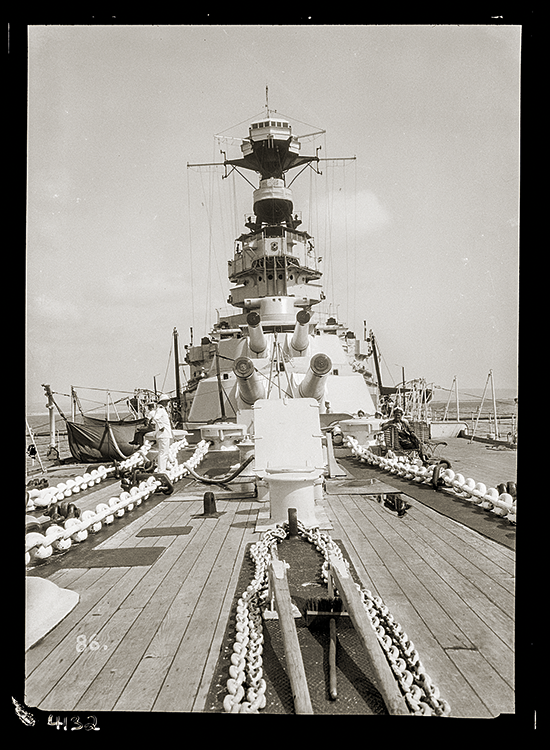
HMS Barham, shown here in 1929, was laid down at John Brown’s shipyard in Clydebank in 1913, launched in 1914. It joined the fleet in 1915 and was in the Battle of Jutland in 1916. She was torpedoed and lost on active service in 1941.
Library of Congress Prints and Photographs Division Washington, DCBattleships
To study the British war effort in the Great War we should start with the Royal Navy, the greatest navy in the world, which cost much more to keep up than the Army. Electricity, optics, thermodynamics, mechanics, and acoustics – these were amongst the most important branches of contemporary physics, and all found use.
Take HMS Barham, a pre-war superdreadnought battleship, a product of a British-led technical revolution in large warships. She had oil-fired, not coal-fired boilers, and steam turbines rather than reciprocating engines, as well as radio and torpedoes. Her huge guns could fire an explosive shell many miles, and with computer controlled-aiming could hit moving targets at enormous ranges, ranges measured with very large and very precise optical range finders.
Such battleships did not, as it is well known, fight very much, but they did enforce a brutal blockade of Germany. But there were occasional confrontations, notably the Battle of Jutland. On board Barham at Jutland was a young midshipman named Patrick Blackett. He was a product of the new educational system of the navy, put into practice by the Director of Naval Education, Sir Alfred Ewing, former Professor of Engineering at Cambridge, who would become a key codebreaker during the war. Young Blackett went on to Cambridge as part of the postwar naval education programme, resigned from the Navy and became a leading particle physicist, and during the Second World War Director of Naval Operational Research.
Blackett’s future supervisor, at the University of Manchester during the war, was also working for the Royal Navy, pioneering echo-sounding techniques for detecting submarines, what would later be known as ASDIC and sonar.
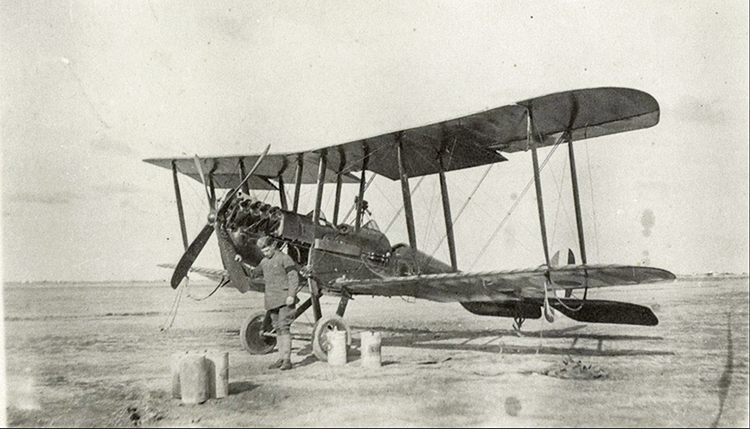
The BE2 was designed and developed by the Royal Aircraft Factory as a reconnaissance and light bomber aircraft and first flew in 1912. The BE2c was a redesign which served in France in 1915. In the photograph, a BE2c during air operations in Mesopotamia, circa 1917, during World War One.
National Army MuseumAeroplanes
Far from being indifferent to aviation, British generals and admirals each created their own air forces before the War started. Not only that they looked to government science to push the development of aviation, using two institutions, the Royal Aircraft Factory and the National Physical Laboratory. BE2c was a product of this government system. It was an aeroplane which was designed by a young Cambridge engineer on principles developed by mathematicians and mathematically-inclined engineers. It was inherently stable, meaning that it did not have to be actively controlled all the time, ideal for the reconnaissance roles it was intended for.
During the War aircraft developed very much faster than battleships. The Handley Page V/1500 delivered at the very end of the War, did not see wartime service. It was a four engined bomber designed to bomb Berlin from East Anglia. In 1919 one flew to India, and the very same one bombed Kabul the same year.
The technical development of aviation was due to many people in industry and in government. Among them were physicists recruited to the Royal Aircraft Factory, which emerged from the War as purely a research establishment. Among them was Frederick Lindemann, later Lord Cherwell, George Thomson and F. W. Aston, just to name the physicists from among the seven future Fellows of the Royal Society who worked at Farnborough.
To serve in or for the forces in the Great War was what the sort of upper-class Britons expected to do (as did French mathematicians or German chemists). In the British case they had, at the beginning of the War, to volunteer, and many did, including Henry Moseley, who was killed in Gallipoli in 1915 as a signals officer in the Engineers. To suggest that his death showed the indifference of the British state to science, which used to be a common story, betrays a deep misunderstanding both of the nature of the British state, and of the British upper class.
These cases are just a small example of the extraordinary mobilisation of talent, not just in government, but in the Armed Forces and industry, which built on pre-existing institutions. After the War, the now three service ministries, one each for the Army, Navy, and the new independent Air Force, would maintain very large research establishments which gave the United Kingdom one of the two or three strongest military scientific complexes of the interwar years, and perhaps the strongest of all, strongly integrated with the academic world. Thus, it was that figures like Blackett, Lindemann, Thomson, and very many others were in important advisory military positions long before the War started, just as Lord Rayleigh had been.
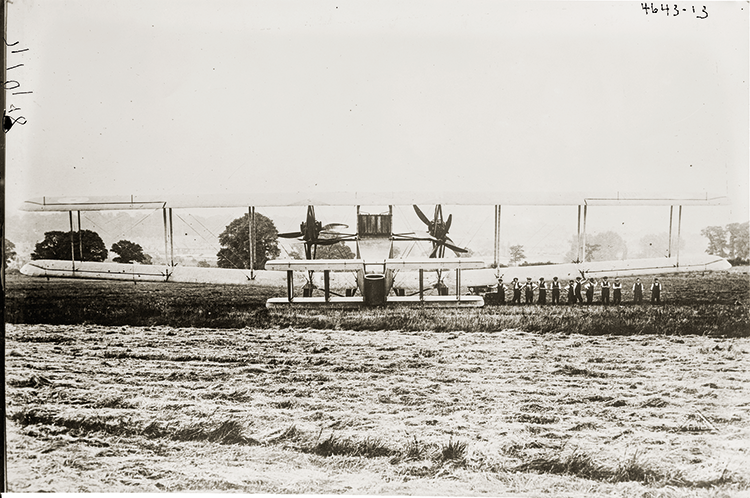
The Handley Page V/1500 first flew in 1918, but the war ended before it could be used to bomb Berlin. It was a four-engined heavy bomber designed to be used at night. It made a failed attempt to cross the Atlantic in 1919, a feat achieved by a smaller, also new, bomber, the Vickers Vimy, in that year. No aircraft with remotely similar capabilities existed in 1914.
Library of Congress Prints and Photographs Division Washington, DCThe DSIR story
It might be thought that the horrors of the war were quickly linked to science and that therefore there were attempts to distance the two. But in the 1920s even chemical warfare was looked to as rather a boon by scientists writing for the public. It would keep wars short. But with the rise of anti-war sentiment and in the midst of an economic crisis in the early 1930s things changed. Rather than tell this story matter-of-factly, many scientists wanted to downplay the relations of war and scientific research. The connections of scientific research and the military were deprecated, and were used as an argument for a new dispensation for the relations of science and society. War and unemployment were seen as products of a decaying capitalism allied with science; science needed to be relaunched as a central element of a new socialist programme.
Scientists began to tell the story of science in the Great War as one concerning the creation of the civilian Department of Scientific and Industrial Research (DSIR), which was about the future, not the war, and even in the interwar years was significantly less important than the research efforts of the Armed Forces. Proper science was to be associated only with the civil. For the Second World War, science was associated with what were taken to be defensive techniques and those which showed scientists had the keys to rational decision-making and to saving lives: radar, operational research, and penicillin were highlighted. The contribution of physicists to the making of offensive weapons was radically downplayed, a notable example being Patrick Blackett not mentioning his key role in the design of Bomber Command’s main bombsight (Marsh, 2019). They also played down the role of the long-established military research establishments and of the arms industry.
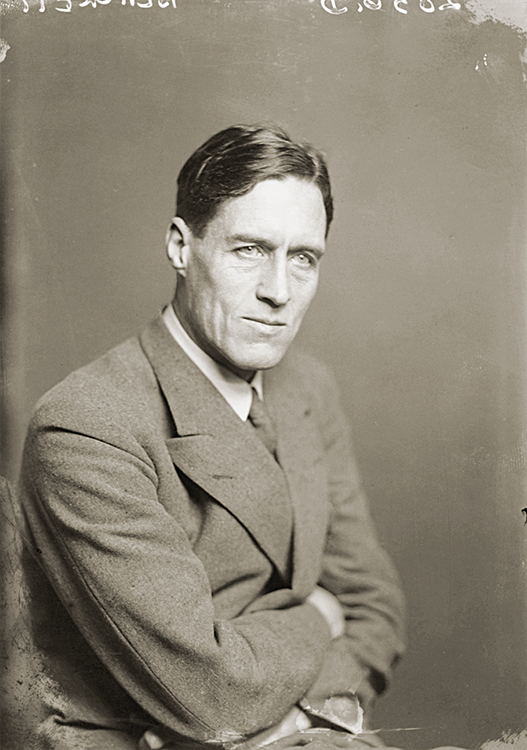
The contribution of physicists to the making of offensive weapons was radically downplayed, a notable example being Patrick Blackett not mentioning his key role in the design of Bomber Command’s main bombsight. In the photograph, Blackett in 1947.
National Portrait Gallery, 1947After the war, the discussion of the relations of science and war in the British case took a number of very strange forms. First, scientists of the left played up their own role as advisers on military matters, which they took as evidence of the generality and superiority of the scientific method. Secondly, they wanted to claim they were on the side of the angels in terms of warfighting. Thus, in the early 1960s, C. P. Snow and others lined up to claim that good scientists were against strategic bombing, which they claimed was the preferred policy of deluded militarists and Churchill’s scientific adviser, a figure of the right. Perhaps the most grotesque case of all was that of Jacob Bronowski, who hid his own role in maximising the effect of strategic bombing, but told a deeply mendacious account of the role of scientists in the making of the atomic bomb. He claimed, ludicrously, that Leo Szilard gave a patent for a chain reaction to the British Navy to keep it secret and unused. He also falsely claimed that the scientists were against the use of the bomb and that, disgusted, they went to work on other things. On the contrary, most scientists wanted the bomb used, and in the United States case, and the British case, there were more bomb-making physicists after the War than during it.
The late 1950s and early 1960s were also a period of making very general claims about the lack of connection between real science and the military. The argument was made that real science had historically had nothing to do with war or the military, but of course something called technology did. This was the period in which the term technology came into general use, replacing earlier concepts like «wonders of science». Aviation went from being the product of science to technology; the atomic bomb a piece of machinery, not the greatest product of science.
There was some reaction against these fairy stories, but largely by looking at the United States case, rather than the British case. In the post-war USA, there was very obviously a military-scientific complex in the major universities, which became notorious in the Vietnam War. In the United Kingdom, by contrast, military research was done in government laboratories and industry, and only incidentally in universities.
The grip of the older stories by scientists profoundly affected the writing of the historians of British science, who essentially retold the stories of scientists – of academic scientists coming in and doing good in both world wars – ignoring the deep, permanent connections between state and scientific researchers. It was to take till the very end of the century for an alternative, more realistic account to emerge, though its influence is not guaranteed.
The reality is scientists and the military in Britain and elsewhere had a long and intimate relation – the problem is that scientific intellectuals have worked hard to convince us otherwise and largely succeeded.
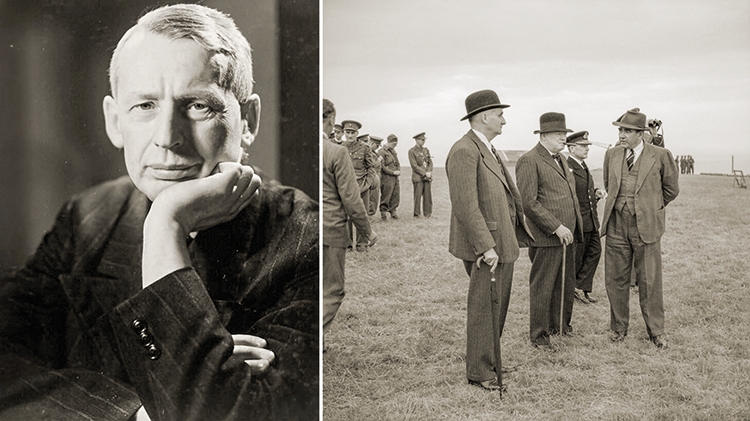
George Thomson, on the left, was one of the British physicists, along with Frederick Lindemann and F. W. Aston, recruited by the Royal Aircraft Factory, which emerged after the war as a research centre. Many of these physicists also played an important role during World War II. In the picture on the right (left to right at the front), professor Friederick Lindemann, with Winston Churchill and Dr. Alwyn Douglas Crow (Chief Superintendent of Projectile Development, Ministry of Supply), watching a demonstration of a secret anti-aircraft device between 1939 and 1945.
Imperial War MuseumsReferences
David, Thomas. (2009). British scientists and soldiers in the First World War, with special reference to ballistics and chemical warfare [Doctoral dissertation, Imperial College]. http://hdl.handle.net/10044/1/71582
Desmarais, Ralph. (2012). Jacob Bronowski: A humanist intellectual for an atomic age, 1946–1956. British Journal for the History of Science, 45(4), 573–589. https://doi.org/10.1017/S0007087412001069
Edgerton, David E. H. (1996). British scientific intellectuals and the relations of science, technology and war. Boston Studies in the Philosophy of Science, 180, 1–35. https://doi.org/10.1007/978-94-011-0671-9_1
Marsh, Stephen. (2019). The Air Ministry and the bomb dropping problem: Bombsights, scientists, and techno-military invention, 1918-45 [Doctoral dissertation, King’s College London]. https://kclpure.kcl.ac.uk/portal/en/studentTheses/the-air-ministry-and-the-bomb-dropping-problem
Notes
Notas de autor
Información adicional
Original publication: The original paper was published in Journal of Physics: Edgerton, David. (2024). The British sciences and the Great War: Myths and histories. Journal of Physics: Conferences Series, 2877, 012025.https://doi.org/10.1088/1742-6596/2877/1/012025
Información adicional
redalyc-journal-id: 5117