Science without a conscience. Technology at war’s service
Physicists at war: Nuclear bombs in World War II and the Cold War
Physicists at war: Nuclear bombs in World War II and the Cold War
Mètode Science Studies Journal, vol. 15, núm. 8, e30498, 2025
Universitat de València

Esta obra está bajo una Licencia Creative Commons Atribución-NoComercial-SinDerivar 4.0 Internacional.
Recepción: 26 Mayo 2025
Aprobación: 28 Julio 2025
Abstract: Science and technology are fundamental pillars of modern societies and have an impact on aspects such as industrial and economic growth, among others. While they are not the cause of wars themselves, thanks to scientists and technologists, the destructive power of weapons has increased continuously. It is worth remembering that Athena was the goddess of both knowledge and war. In this article we will briefly look at the role and attitudes of physicists in developing nuclear weaponry (atomic and hydrogen bombs) and some implications of the Cold War for physics – as recounted by some of the most prominent individuals involved.
Keywords: atomic bomb, Los Alamos, hydrogen bomb, physics and Cold War.
Most scientists seem to hold an idealised vision of science, which they believe should only serve to expand the frontiers of knowledge for the benefit of humanity. They consider any science that deviates from this ideal to be corrupt, especially when it is related to military applications. In the case of Great Britain, David Edgerton (1996) revealed significant discrepancies between the narratives presented by scientists and historical accounts of the relationship between science, technology, and war. These conclusions can be applied to other countries.
The ideals of pure science are often disregarded during military conflicts, which tend to exacerbate or bring out nationalist sentiments. Fritz Haber’s synthesis of ammonia from atmospheric nitrogen enabled the production of artificial fertilisers, which have brought many benefits to humanity – as well as problems related to excess nitrates. However, during World War I, Haber devoted all his expertise to producing asphyxiating and poisonous gases. Years after the war, he justified this duality as follows: «The scientist belongs in wartime, like everyone, to their fatherland. In peacetime he belongs to humanity» (Haber, 1927, p. 147).
World War II can be considered the first scientific war due to the extraordinary impact of previous research projects, which collectively gave rise to innovations such as radar, proximity detonators, acoustic torpedoes, electronic calculators, and the atomic bomb (Hartcup, 2000). The joint efforts of physicists, chemists, mathematicians and engineers, who appeared to adhere to Haber’s justification, was crucial in this respect. In the USA, the war transformed the relationship between scientists and the government, as well as between the military and industry. A radical change occurred in science that continued throughout the long Cold War.
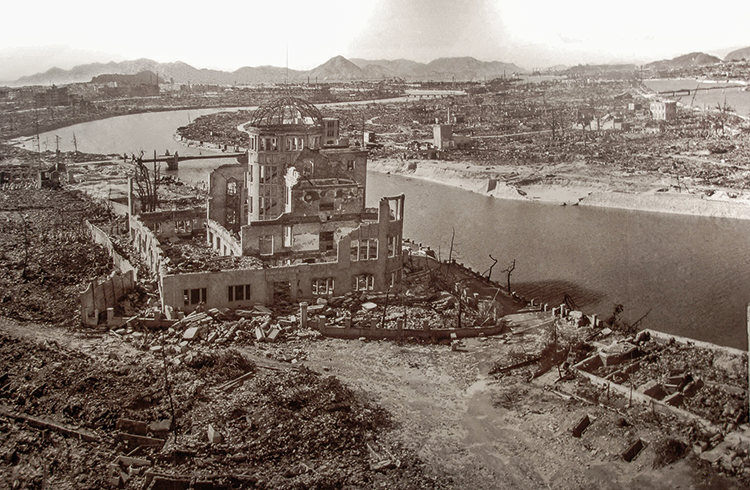
The Genbaku Dome, also known as the Atomic Bomb Dome, is one of the few structures that remained standing after a single plane dropped an atomic bomb on Hiroshima on 6 August 1945. The bomb had a power equivalent to 15,000 tons of conventional explosives (15 kT), which is more than eight times greater than the amount dropped by around 800 aircraft on Dresden in February 1945.
Maarten HeerlienThe atomic bomb
The discovery of the neutron in 1932 prompted research programmes in several European countries, culminating in the discovery of neutron-induced fission of uranium nuclei by the end of 1938. This opened up a fascinating new field of basic research, aiming to answer difficult questions that posed a genuine scientific challenge. However, in the pre-war environment of the time, the military potential of nuclear fission was not overlooked. This became particularly apparent when it was discovered that an average of 2.6 neutrons are released by a uranium nucleus, demonstrating that a chain reaction was possible in principle. It also meant that a bomb with a power one million times greater than that of a conventional explosive could be created if the reaction were to be divergent. Indeed, it was the physicists themselves who alerted their respective governments to the possibility of a nuclear bomb – a term that has endured for historical reasons.
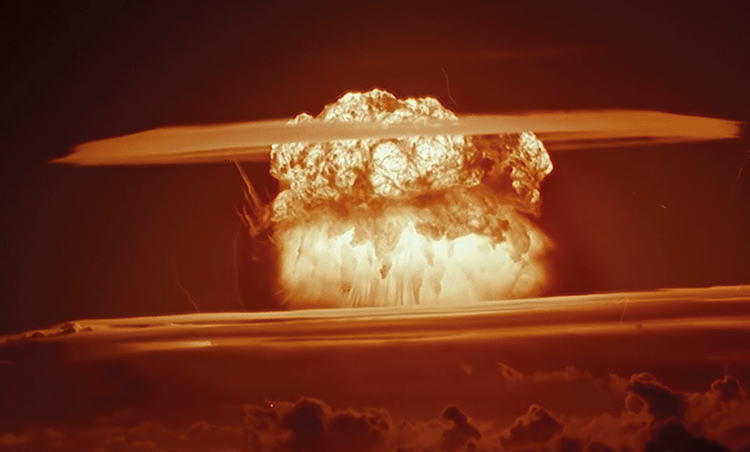
The Castle Bravo nuclear test was the detonation of the most powerful thermonuclear device (15 MT) ever tested by the United States. The explosion took place in March 1954 at Bikini Atoll. The fireball was visible more than 400 km away.
Federal Government of the United StatesBetween 1939 and 1942, nuclear programmes were established in Germany, the United Kingdom, the United States of America, and Japan. The USSR started theirs towards the end of the war. The German and Japanese programmes were not prioritised because both countries’ military strategies called for a swift conflict and it was believed that a bomb could not be obtained before the war ended. As is well known, the only programme to reach its goal was the Manhattan Project in the USA. This collaboration between the USA, the UK, and Canada was led by General Groves, with physicist Oppenheimer overseeing the scientific and technical aspects.
As Haber said, the war clearly awoke the patriotism of scientists and their desire to contribute their knowledge. In Germany’s case, we must consider that the country was controlled by the Nazi Party, which was supported by much of the population and did not hide its intentions. Heisenberg’s attitude when he was appointed director of the nuclear programme at the end of 1939 is still a hotly debated topic. In June, he was in the United States, where he discussed the subject of fission and its implications with his colleagues. Many of them believed that he would accept one of the offers made to him by American universities, so they were very surprised when he declined, arguing that his place was in Germany at that moment. Heisenberg’s subsequent justifications for his actions and participation in the German programme have been the subject of much debate and should be critically considered (Walker, 2024).
Perhaps Heisenberg’s colleagues expected him to have an attitude similar to Einstein’s. In January 1933, Einstein was in the United States and decided not to return to Germany, regarding the Nazis as a threat to European peace. He then abandoned his active pacifism and argued for the necessity of preparing for an unavoidable war. When asked to intervene on behalf of Belgian conscientious objectors, he replied:
In the heart of Europe lies a power, Germany, that is obviously pushing toward war with all available means. [...] Were I a Belgian, I should not, in the present circumstances, refuse military service; rather, I should enter such service cheerfully in the belief that I would thereby be helping to save European civilization. (Nathan & Norden, 1960, p. 229)
Einstein agreed to sign the famous letter to President Roosevelt in August 1939, acting on this conviction. The letter warned Roosevelt of the danger that Germany would pose if it were to obtain uranium from the Belgian Congo, the world’s leading producer at the time. However, Einstein did not want to participate in the preliminary study commission created by Roosevelt, nor in the nuclear project. After the war, he resumed his pacifist activities, collaborating with Bertrand Russell to advocate for initiatives that aimed to prevent the escalation of armaments and the development of the hydrogen bomb. Like Russell and Bohr, Einstein believed that the unprecedented power of nuclear weapons required international governance.
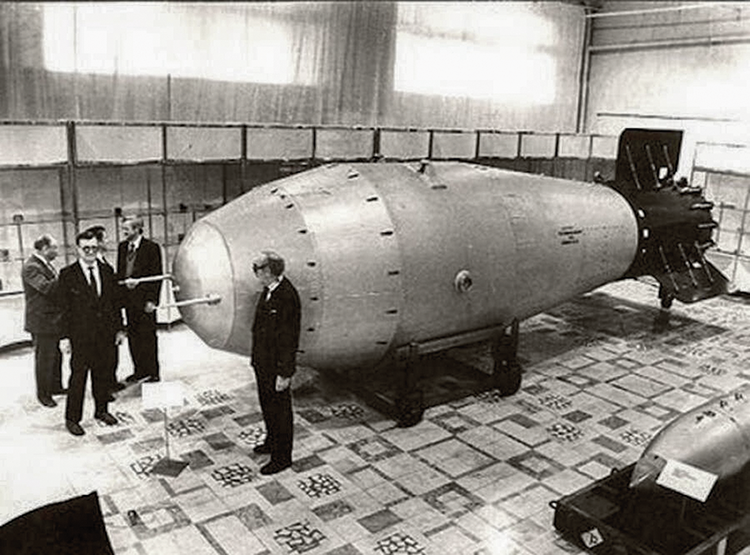
A bomb similar to the so-called Tsar Bomba is exhibited at the All-Russian Scientific Research Institute of Experimental Physics in Sarov, where Soviet bombs were developed. This is the most powerful bomb (50 MT) ever detonated. The explosion occurred in October 1961 on Novaya Zemlya Island in the Arctic Circle.
VNIITFAt Los Alamos
Testimonies and studies concerning the Manhattan Project emphasise that its participants were determined to develop the bomb before the Germans did. At Los Alamos, they worked in a climate of extreme urgency, believing that the Germans were two or three years ahead of them. The fact that the renowned physicist Heisenberg was leading the nuclear programme did little to calm people’s spirits. It was widely believed that if the bomb were to be used, it would be used against Germany, thereby ending the war. By the end of 1944, the United States was certain that the Germans had abandoned their efforts to build a bomb. However, General Groves classified this information as secret and shared it only with group directors. When physicist Joseph Rotblat learned of the true situation in Germany, he decided to abandon the project (Rotblat, 1985). Groves agreed to let him leave Los Alamos, but only on the condition that he claimed to be experiencing a personal crisis due to not having heard from his wife, who was still in Poland following its occupation by Germany. Rotblat was made to promise to keep the information secret (Brown, 2012).
Germany’s capitulation in May 1945 marked the first time that scientists began to talk about the moral implications of their work. Although they were aware that politicians and the military had already decided to drop the bomb on Japan, they continued to work with the same intensity as before, discussing what should be done with it. In fact, a presidential advisory commission had been set up to determine the objectives of the bombing. This commission established a scientific panel comprising the physicists Oppenheimer, Compton, Lawrence, and Fermi. At the panel’s first meeting on 16 June, the variety of scientific opinions on the project was apparent. According to the minutes of the meeting (Sherwin, 1987, pp. 304–305), the proposals ranged «from a purely technical demonstration to the military application best designed to induce surrender». Some advocated prohibiting nuclear weapons, while others argued that the bombing would end the war and save lives (of US soldiers, of course). However, the four physicists on the commission saw «no acceptable alternative to direct military use» and agreed with dropping the bombs on Japan. It seems that the project’s scientists did not consider the enormous cost of the project – approximately two billion dollars, approved without going through Congress – when making the political decision. They also failed to consider that the atomic bomb was a warning to the USSR, foreshadowing the Cold War.
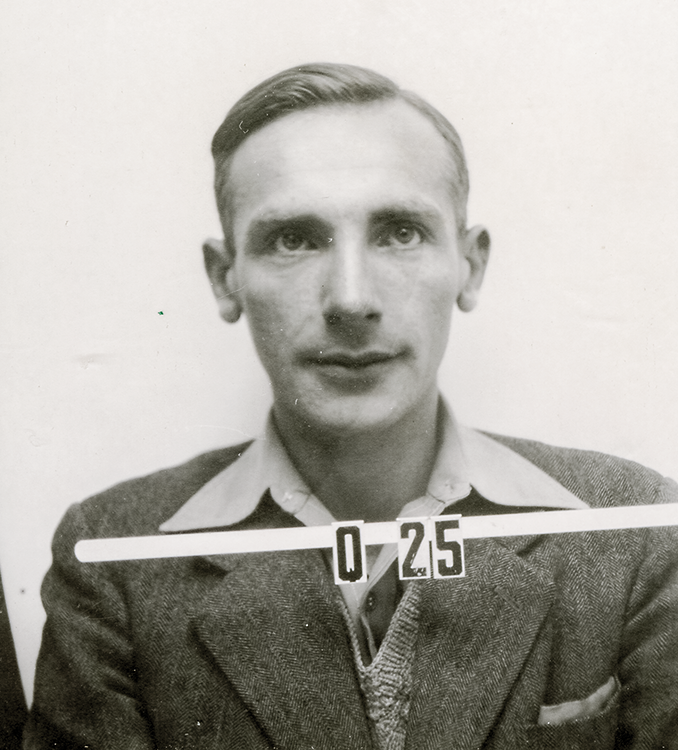
This is a photograph of Joseph Rotblat’s identification card from his time at Los Alamos. Joseph Rotblat and the Pugwash Conferences on Science and World Affairs were jointly awarded the 1995 Nobel Peace Prize «for their efforts to diminish the part played by nuclear arms in international politics and, in the longer run, to eliminate such arms».
Los Alamos LaboratoryThe hydrogen bomb
After the war ended, most of the scientists involved in the Manhattan Project returned to their respective universities. Many of them were reluctant to participate in another secret research project. The leading physicists involved in the Manhattan Project were integrated into several government defence commissions. One issue considered at the time was whether or not it would be advisable to build a bomb based on the fusion of hydrogen nuclei to form helium nuclei, as occurs inside the Sun. This hydrogen bomb, also known as a thermonuclear bomb, is more than a thousand times more destructive than an atomic bomb.
Discussions about the hydrogen bomb were not made public; they were restricted to committee meetings. Some members, including scientists and politicians, saw it as unnecessary, citing moral and practical arguments in view of the already known effects of the atomic bomb. With the sole exception of Teller, who was always in favour, the physicists had many doubts and changed their minds several times (Galison & Bernstein, 1989). A series of events altered the conditions of the debate. In August 1949, the USSR exploded its first atomic bomb; in October of that year, the People’s Republic of China was proclaimed; then, in January 1950, Klaus Fuchs, the physicist who had passed details about the atomic bomb on to the USSR from Los Alamos, was arrested. On 31 January, the United States began work on the hydrogen bomb project. The first prototype was tested in November 1952. Two years later, the USSR followed suit, setting off a long arms race that other countries would later join.
Although information on the Soviet project remains limited, the motivations of those involved in developing this new weapon were similar on both sides. Many physicists were attracted to the scientific challenges of a problem they found fascinating. The patriotic motivations of previous years persisted in the context of the new Cold War, even though moral arguments could no longer be avoided following the events of Hiroshima and Nagasaki.
In the USA, the hydrogen bomb had two fathers: the mathematician Stanislaw Ulam and the physicist Edward Teller. In his memoirs, Ulam distinguished between the calculations required to build the bomb and the strategic justification for doing so. He never felt «it was immoral to try to calculate physical phenomena. [...] Even the simplest calculation in the purest mathematics can have terrible consequences» (Ulam, 1976, p. 222). The argument seems rather cynical. After all, Ulam knew exactly why he was making the calculations and what the consequences would be. Teller, on the other hand, was truly obsessed with the bomb and employed a more subtle argument: «There is no case where ignorance should be preferred to knowledge – especially if the knowledge is terrible» (Schweber, 2000, p. 15). According to Teller, the advancement of scientific knowledge and technology is inevitable, and every scientist has an obligation to improve our understanding of the physical world, including knowledge relevant to weapons production. Furthermore, he argued that the USA should always be technically and militarily superior to the USSR, and therefore should be the first to build the hydrogen bomb.
Andrei Sàkharov is widely regarded as the father of the Soviet hydrogen bomb. Despite having refused to conduct research on issues of military use twice, he was integrated into the thermonuclear programme in 1948, with no regard for his opinion. This demonstrates how the Soviet system conditioned the decisions of its scientists. However, as he recounts in his memoirs, he willingly accepted this role because he was going to engage in «wonderful physics». He describes the physics of atomic and thermonuclear explosions as «the theorist’s paradise». Nevertheless, he says that for him and the other collaborators in the group, the essential thing was «the intimate conviction that such work was indispensable», despite being aware of its inhuman and terrible nature (Sakharov, 1990, pp. 114–115). Sàkharov fell out of favour in the 1960s when he campaigned for nuclear disarmament and against the development of nuclear-armed missiles.

Starting in 1947, the U.S. Atomic Energy Agency promoted the construction of large accelerators, as part of a policy driven by Ernest Lawrence, the inventor of the cyclotron. In the image, Oppenheimer (on the left) and Lawrence (on the right), at the 184-inch cyclotron of the University of California, Berkeley, around 1946.
U. S. Department of EnergyThe Cold War and physics
The idea that science, particularly physics, had won the war gave rise to a new form of scientism. Science came to be seen as the origin of all progress (Pestre, 2004). The relationship between scientists, the government, the military, and industry in the USA was radically altered. In fact, the collaboration model promoted by Vannevar Bush at the beginning of the war was expanded upon. There was a shift from private funding to substantial federal funding through projects or contracts for researchers – both full- and part-time – working in universities or industries, within existing or newly created organisations. Many of these organisations were dependent on the Department of Defense (Oreskes, 2014). The substantial funding of physics in the USA led to it becoming the de facto centre of global research, influencing the rest of the world, including the USSR. Converging trends were observed in both countries, «not only intellectual and technological developments, but also institutional and structural similarities» (Da Silva & Kojevnikov, 2019). During the Cold War, the two superpowers created what Eisenhower, at the end of his term as president, described as a «military-industrial complex», in which universities played an important role (Pestre, 2004; Roland, 1985). The consequences of the symbiotic relationship between research and the United States military have attracted much analysis and debate over the last forty years. I will now discuss the views of Paul Forman and Dan Kevles.
Forman demonstrated that, in the 1950s, the Department of Defense and the Atomic Energy Commission (AEC), «whose mission was de facto predominantly military» (Forman, 1987), were essentially the only significant sources of academic physics research in the USA. Changes in military funding altered the nature of research, and «physicists had lost control of their discipline». Fields such as solid-state physics and quantum electronics were developed, «areas that had not previously been viewed as priorities by physicists, but were priorities for their military patrons». According to Forman, government funding led physicists to believe that they were conducting basic research when, in reality, they were merely fulfilling the military’s desires.
On the other hand, Kevles pointed out that funding from United States agencies also covered basic research not intended for civilian or military use. Furthermore, government commissions included scientists from the Manhattan Project, whose influence extended to decisions about the future direction of physics in the USA. «The government also sponsored major programs of research in practical areas such as nuclear weapons and impractical ones such as high-energy particle physics» (Kevles, 1990). Indeed, Lawrence, the inventor of the cyclotron, was the driving force behind the AEC’s decision to construct large-scale accelerators from 1947 onwards. Topics that were considered priorities included some that «were clearly relevant to military technology, yet [...] it is difficult to agree that they represented perverse departures from some true basic physics», «it would seem arbitrary to say that one type of investigation is truly basic physics, while the other is not». Kevles concludes his arguments with the phrase «physics is what physicists do – or have done». Out of context, this might seem like a useless tautology.
In practice, however, it is difficult to avoid contributing to knowledge that could be applied to the military in physics or any other discipline. Even if scientists do not wish to conduct defence-oriented research themselves, they will still train students who will, or who will be capable of conducting such research. It is therefore interesting to observe how the number of physics doctorates awarded in the USA has evolved, as shown in Figure 1. This clearly illustrates the correlation with certain Cold War-related events.
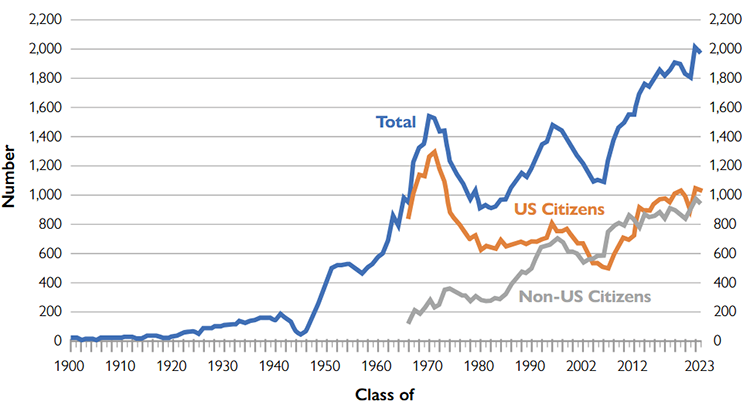
Figure 1
Evolution of the number of doctorates earned in physics in the USA.
The key years for interpreting the observed peaks are as follows: the United States entered the war at the end of 1941. Between 1950 and 1953, the Korean War took place. In 1957, the Soviet satellite Sputnik was launched, which produced an increase in physics dissertations and a profound reform of physics teaching in the United States, which spread to many European countries. Protests against the Vietnam War and military research on college campuses occurred in 1968. Between 1984 and 1992, the «Strategic Defense Initiative» (popularly known as «Star Wars») was developed. The increase in physics doctorates since 2005 is probably due to the spectacular development of artificial intelligence, which has both civilian and military uses. Notably, there has been a high presence of foreign doctoral students since the 1980s.
Graph source: AIP (aip.org/statistics). Source of data: ACE (1900-1919), NAS (1920-1961), AIP (1962-2023)Conclusion
The ideals of disinterested and altruistic science are nothing more than wishful thinking; they are merely shadows in Plato’s cave. They implicitly assume that all scientists love peace. The examples mentioned here demonstrate that facts often tell a different story, because moral issues lie with those who construct, apply, or use science, rather than with science itself. Contrary to what many involved in the Manhattan Project believed, it is unrealistic to think that scientists can control how the results of their research are used, particularly when the research is funded by state agencies. However, it is possible to predict potential applications and act accordingly, lest we forget that scientists ultimately reflect the ideas, beliefs, and opinions of the society in which they live.
References
Brown, A. (2012). Keeper of the nuclear conscience. The life and work of Joseph Rotblat. Oxford University Press.
Da Silva, C. P., & Kojevnikov, A. (2019). Convergence in Cold War physics: Coinventing the maser in the postwar Soviet Union. Berichte zur Wissenschaftsgeschichte, 42, 375. https://doi.org/10.1002/bewi.201900009
Edgerton, D. E. H. (1996). British scientific intellectuals and the relations of science, technology and war. In P. Forman & J. M. Sánchez-Ron (Eds.), National military establishments and the advancement of science and technology. Kluwer.
Forman, P. (1987). Behind quantum electronics: National security as basis for physical research in the United States, 1940–1960. Historical Studies in the Physical and Biological Sciences, 18(1), 149. https://doi.org/10.2307/27757599
Galison, P., & Bernstein, B. (1989). In any light: Scientists and the decision to build the superbomb, 1952–1954. Historical Studies in the Physical and Biological Sciences, 19(2), 267. https://doi.org/10.2307/27757627
Haber, F. (1927). Aus Leben und Beruf. Aufsätze, Reden, Vorträge. Springer.
Hartcup, G. (2000). The effect of science on the Second World War. MacMillan Press.
Kevles, D. J. (1990). Cold war and hot physics: Science, security, and the American state, 1945–56. Historical Studies in the Physical and Biological Sciences, 20(2), 239. https://doi.org/10.2307/27757644
Nathan, O., & Norden, H. (1960). Einstein on peace. Schoken.
Oreskes, N. (2014). Science in the origins of the Cold War. In N. Oreskes & J. Krige (Eds.), Science and technology in the global Cold War. MIT Press.
Pestre, D. (2004). Repenser les variantes du complexe militaire-industriel-universitaire. In A. Dahan & D. Pestre (Eds.), Les Sciences pour la guerre. École des Hautes Études en Sciences Sociales.
Roland, A. (1985). Science and war. Osiris, 1, 247.
Rotblat, L. (1985). Leaving the bomb project. The Bulletin of Atomic Scientists, 41(7), 16. https://doi.org/10.1080/00963402.1985.11455991
Sakharov, A. (1990). Mémoires. Seuil.
Schweber, S. S. (2000). In the shadow of the bomb. Princeton University Press.
Sherwin, M. J. (1987). A world destroyed: Hiroshima and the origin of the Cold War. Vintage Books.
Ulam, S. M. (1976). Adventures of a mathematician. Scribner.
Walker, M. (2024). The historiography of Hitler’s atomic bomb. Physics in Perspective, 26, 18. https://doi.org/10.1007/s00016-024-00309-6
Notas de autor
Información adicional
redalyc-journal-id: 5117