Artículos

Esta obra está bajo una Licencia Creative Commons Atribución-NoComercial-CompartirIgual 3.0 Internacional.
Recepción: 18 Junio 2018
Aprobación: 05 Noviembre 2018
Abstract:
Eastern Andalusian Spanish deletes all coda consonants; yet, coda deletion analyses have focused on /-s/. The acoustic and statistical analyses of 317 tokens of /u/ in 24 Eastern Andalusian speakers confirm that the differences in quality between word-final /u/ and /u/ preceding deleted /-s/, /-r/, and /-θ/ are statistically significant. Furthermore, /-s/, /-r/, and
/-θ/ deletion changes the quality of a preceding /u/ in different degrees but the difference of quality between these three realisations of /u/ is not statistically significant. Likewise, a perception experiment confirms that Eastern Andalusian speakers can identify whether or not /u/ is followed by an underlying /-s/, /-r/, or /-θ/; however, they cannot identify the deleted consonant.
Keywords: Eastern Andalusian vowel system, Eastern Andalusian Spanish, Andalusian vowels, coda consonant deletion, Andalusian Spanish phonetics and phonology.
Resumen: Las consonantes finales de sílaba se apocopan en andaluz oriental, aunque los estudios se han centrado solamente en la consonante /-s/. El análisis acústico y estadístico de 317 muestras de /u/ tomadas de 24 hablantes de andaluz oriental confirman que las diferencias de calidad entre /u/ final de palabra y /u/ ante /-s/, /-r/ o /-θ/ apocopadas son estadísticamente significativas. Igualmente, la elisión de /-s/, /-r/ y /-θ/ cambia la calidad de una /u/ precedente en distintos grados pero la diferencia de calidad entre estas tres realizaciones de /u/ no es estadísticamente significativa. Asimismo, un experimento de percepción confirma que los hablantes de andaluz oriental pueden identificar si /u/ está seguida o no de una /-s/, /-r/ o /-θ/ subyacente; sin embargo, no pueden identificar qué consonante se ha elidido en cada caso.
Palabras clave: Andaluz oriental, sistema vocálico del andaluz oriental, vocales andaluzas, elisión de consonantes en coda, fonética y fonología del andaluz.
1. INTRODUCTION
Syllable-final consonant deletion has been reported in Eastern Andalusian Spanish (henceforth EAS) by several researchers (e.g. Schuchardt 1881; Wulff 1889; Navarro Tomás 1938, 1939; Alvar 1955; Gómez Asensio 1977; Tejada Giráldez 2012; Ruch and Harrington 2014; Henriksen 2017); however, the implications of such deletions in terms of production and perception remain unknown (Herrero de Haro 2016).
All consonants are deleted in coda in EAS under different circumstances (Alvar et al. 1973; Rodríguez-Castellano and Palacio 1948a, 1948b; Peñalver Castillo 2006; O’Neill 2010), but research has focused on the effects of /s/ deletion. This bias for the study of /s/ can be explained due to the high functional load of this consonant in Spanish (Gerfen and Hall 2001).
In Spanish, /s/ can mark plurality (e.g. casa ‘house’ vs casas ‘houses’), it can differentiate between subjects in verbs (e.g. tiene ‘he/she has’ vs tienes ‘you sing. have’) and it can also differentiate words (o ‘or’ vs os ‘to you pl.’).
A widely studied consequence of /-s/ deletion in EAS is vowel opening (Alvar et al. 1973: map 1696; Salvador 1957); vowels undergo opening when they precede a deleted /-s/ (Navarro Tomás 1938, 1939; Corbin 2006; Lloret and Jiménez 2009). Vowel opening refers to the phonetic output of EAS vowels, while vowel doubling refers to the debated phonological role of open vowels by virtue of which they carry the functional load of underlying /-s/.
Vowel opening has been quantified acoustically by some researchers (e.g. Sanders 1998; Herrero de Haro 2017a), although some authors argue against it (e.g. Martínez Melgar 1986; Carlson 2012). Interestingly, the high vowels /i/ and /u/ have been subject to a special scrutiny, as some authors maintain that these two vowels are the only ones which do not open in EAS when they precede a deleted /-s/ (Navarro Tomás 1938, 1939; Sanders 1998; Martínez Melgar 1986; Henriksen 2017).
Vowel doubling, on the other hand, represents a more complex debate. For authors such as Salvador (1977) and Peñalver Castillo (2006), vowel doubling is due to vowel opening; for Carlson (2012), however, the distinctive feature in vowel doubling is vowel quantity. Vowel doubling is rejected on different grounds. Some authors reject it due to the fact that context, aspiration or gemination carries the functional load of a deleted /-s/ (e.g. López Morales 1984; Mondéjar Cumpián 1979), while others believe that vowel doubling cannot be a phonemic feature as they claim that it only operates word-finally (e.g. Contreras Jurado 1975; Cerdà Massó 1992). Herrero de Haro (2018), however, concludes that context is not essential to identify underlying /s/ in EAS. Finally, some scholars have proposed vowel system doubling as opposed to vowel doubling (Alarcos Llorach 1958, 1983; Contreras Jurado 1975; Cerdà Massó 1992). Further details regarding the phonetic-phonological debate of EAS vowels and consonants can be found in Herrero de Haro (2017b).
The findings reported in the above-mentioned studies show that the phonetic-phonological debate in EAS has focused on the contrast /Vowel/ vs /Vowel + deleted /s// (/V/ vs /Vs/).
The present paper aims to expand the traditional view of vowel doubling to ascertain what consequences /-s/, /-r/, and /-θ/ deletion has on a preceding /u/ and whether EAS speakers can distinguish between word-final /u/ and /u/ preceding underlying /-s/, /-r/, and /-θ/. The Spanish phonemes /r/ and /ɾ/ merge syllable-finally and their realisation vary depending on dialectical and stylistic variation (e.g. Blecua Falgueras 2005; Bradley 2014); I have decided to use the symbol /r/, following Monroy and Hernández-Campoy (2015).
The effect of the deletion of different consonants on preceding vowels has already been considered by some researchers, but in a very limited way. For example, Wulff (1889) reported different degrees of vowel lengthening depending on which underlying consonant followed each vowel and Alvar et al. (1973: maps 1626 and 1629) noticed how vowel quality varied depending on whether a vowel was followed by an underlying /-s/ or /-θ/. However, these studies did not analyse the data acoustically, but perceptually. Thus, it has not been investigated if /u/ presents different quality depending on whether it is followed by an underlying /-s/, /-r/, or /-θ/. This, however, has been done for the other Spanish vowels (Herrero de Haro 2016, 2017a, 2017c, 2019). The effect of /-s/, /-r/, /-θ/ deletion on the complete vowel system of EAS and on the vowel system of EAS speakers with articulation disorders are analysed in Herrero de Haro (in press, under review), respectively.
Changes in the phonetic-phonological system of languages rarely affect just one sound (Alarcos Llorach 1976:12) and languages resort to new developments to solve any loss of distinction which may have been created as a readjustment to the phonemic system (Alarcos Llorach 1976: 122). These claims motivated the present study in order to clarify whether they are in operation when it comes to /-s/, /-r/, and /-θ/ deletion after /u/.
Several researchers have posited theories on the phonetic and phonemic systems of EAS (e.g. Alarcos Llorach 1983; Jiménez and Lloret 2007; Tejada Giráldez 2012); however, these theories have not taken into account perception of EAS features by native speakers of this geolect.
García Marcos (1987), O’Neill (2010), Torreira (2007b) and Henriksen (2017) are some of the very few studies which analyse speech perception in EAS. The perception of underlying /-s/, however, has been researched in other Spanish geolects (e. g. Torreira 2007a, 2007b, 2012 for Western Andalusian Spanish; Figueroa 2000 for Puerto Rican Spanish). Unlike EAS, those varieties of Spanish do not present consistent vowel opening before a deleted /-s/, so it is not likely for the findings posited for those geolects to apply to EAS.
The present study has four objectives: 1) to investigate whether /u/ opens before underlying /-s/, /-r/, and /-θ/; 2) to analyse whether the deletion of /-s/, /-r/, and /-θ/ changes the quality of a preceding vowel to a different extent; 3) to establish whether native speakers of EAS can identify whether or not /u/ is followed by an underlying consonant; and if so 4) to determine if these speakers can detect in each case whether /u/ is followed by underlyinɡ /-s/, /-r/, or /-θ/.
The speech of 24 speakers from El Ejido (Eastern Andalusia), was analysed to measure the quality of /u/ word-finally and before deleted /-s/, /-r/, and /-θ/. After this, a perception experiment was carried out to determine whether EAS speakers can identify [u], [us], [ur], or [uθ] in isolation (consonants written in superscript represent underlying consonants deleted from the phonetic output). Perception has been ignored in EAS research (Bishop 2007) and this papers aims to clarify the relationship between the vowel contrasts that EAS speakers can produce and perceive.
The present paper has 7 sections. Sections 1 and 2 contain the introduction and the methodology, respectively. A review of /u/ in previous studies is included in Section 3. The acoustic analysis of word-final [u], [us], [ur], and [uθ] is presented in Section 4. The results of the perception test of [u], [us], [ur], and [uθ] are discussed in Section 5. Section 6 contains the conclusions and the bibliography is in Section 7.
2. METHODOLOGY
2.1. Acoustic analysis
2.1.1. Data collection
The present paper is based on analyses of speech samples from El Ejido, in Western Almería, although it is reasonable to assume that these findings do apply to EAS as a whole. Further details about the extent of this geolect and its features can be found in Jiménez Fernández (1999), Villena Ponsoda (2000), Moya Corral (2010), and Herrero de Haro and Hajek (under review).
Speakers from El Ejido were interviewed by the researcher, with the interviews being divided in three parts: 1) an informal conversation about trivial topics (e.g. hobbies); 2) naming objects from photos; 3) reading words and phrases.
The participants recorded were friends and family of the researcher, students from local schools, and people who were approached in parks and in the street. The informal nature of the conversation, together with the local EAS accent of the researcher, helped the interviewees feel relaxed to use their vernacular accent instead of feeling forced to use features from Castilian Spanish (henceforth CS) not present in natural EAS speech (Martínez Melgar 1986). The 24 speakers recorded displayed features of a stereotypical EAS accent. None of them presented seseo (pronouncing /θ/ as [s]) or ceceo (pronouncing /s/ as [θ]); this lack of ceceo conflicts with what Alvar et al. (1973: map 1705) registered in El Ejido. The interviews were recorded on a Zoom H2n digital recorder and analysed on Praat (Boersma and Weenink 2016).
Age and gender of the interviewees

2.1.2. Data analysis
After careful consideration, the sections of recordings where participants read different words and phrases were not included in our analysis; thus, only the sections of free speech samples and object naming were analysed. This was done in order to focus on natural forms of speech, as suggested by some authors (e.g. Sanders 1998; Torreira 2012). The following table shows the number of tokens of /u/ analysed.
Tokens of word-final [u], [us], [ur], and [uθ] analysed

The F1 and F2 of /us/, /ur/, and /uθ/ were only measured when the final consonant had been deleted, pronouncing them as [us], [ur], and [uθ], respectively. To avoid analysing vowels affected by coarticulation, no realisation of /u/ was analysed if this preceded or followed another vowel (e.g. andaluz y [anda lųθ i] ‘Andalusian and’; autobús en [auto βųs en] ‘bus in’).
The spectrogram of word-final [u], [us], [ur], and [uθ] were analysed on Praat (Boersma and Weenink 2016) and the F1 and F2 of each realisation of /u/ were only measured during their stable sections.
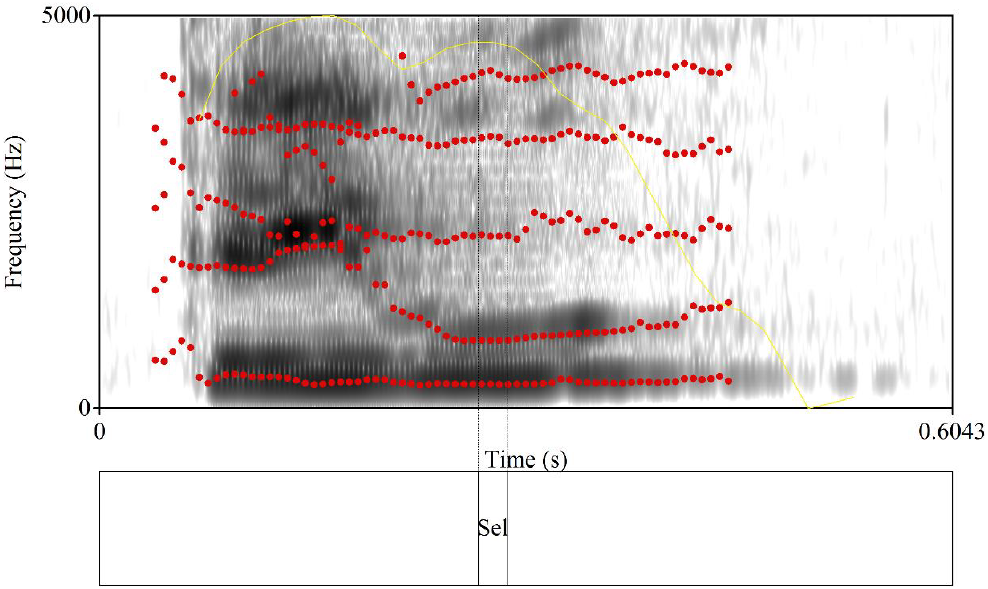
Figure 1
Sample of analysed portion of [us] in tribus [ tɾiβu ] ‘tribes’
Formant values were rounded up or down (e.g. 376.9 became 377 and 826.2 became 826). This was also done when reporting measurements from other studies. Each value was entered on an Excel spreadsheet under the category [u], [us], [ur], or [uθ] and the mean and standard deviation were calculated for the F1 and F2 of each of these vowels. The results from the acoustic analysis are discussed in Section 4.
2.2. Perception experiment
The investigator read u, us, ur, and uz several times in his EAS accent; thus pronouncing them [u], [us], [ur], and [uθ]. Two examples of each of those four realisations of /u/ were chosen based on their clarity. The researcher also recorded himself reading numbers in a normative CS accent. Audacity (Audacity Team 2014) was then used to create an audio track with the recording of one number introducing a randomised item of [u], [us], [ur], and [uθ] (e.g. cuatro [ur] ‘four [ur]’; seis [u] ‘six [u]’). The handout which the participants used to record their answers is included in Appendix 1.
Ethics approval was requested and obtained from the researcher’s institution, from the Office of Education in Almería, and from each participating school. The perception test was carried out in five secondary schools (two in Adra, two in El Ejido, and one in Balerma). Answers from respondents who had not lived in Western Almería since the age of four were not analysed.
The participants completed the experiment listening to the stimulus on individual MP3 players with earphones. They were instructed to enter an answer only when they were sure that they had identified a sound correctly; otherwise, they had to leave it blank. The possible number of answers was 952 (238 for each realisations of /u/: [u], [us], [ur], and [uθ]). Out of 952 answers, 18 were left blank by the participants (1.89%): 2 answers were left blank for [u] (0.21%); 4 for [us] (0.42%); 7 for [ur] (0.74%); and 5 for [uθ] (0.53%). It should be noted (c.f. Herrero de Haro 2016) that even phonemes in complete words are not always identified correctly by native speakers.
3. EAS /u/ IN PREVIOUS STUDIES
3.1. Previous acoustic studies of /u/ in EAS and in CS
The vowel /u/ has been analysed in CS by several researchers and it is worth reviewing reported values for this vowel to compare /u/ in CS and in EAS. All values in the tables below have been rounded up or down to avoid using decimals.
Formant values for CS [u]
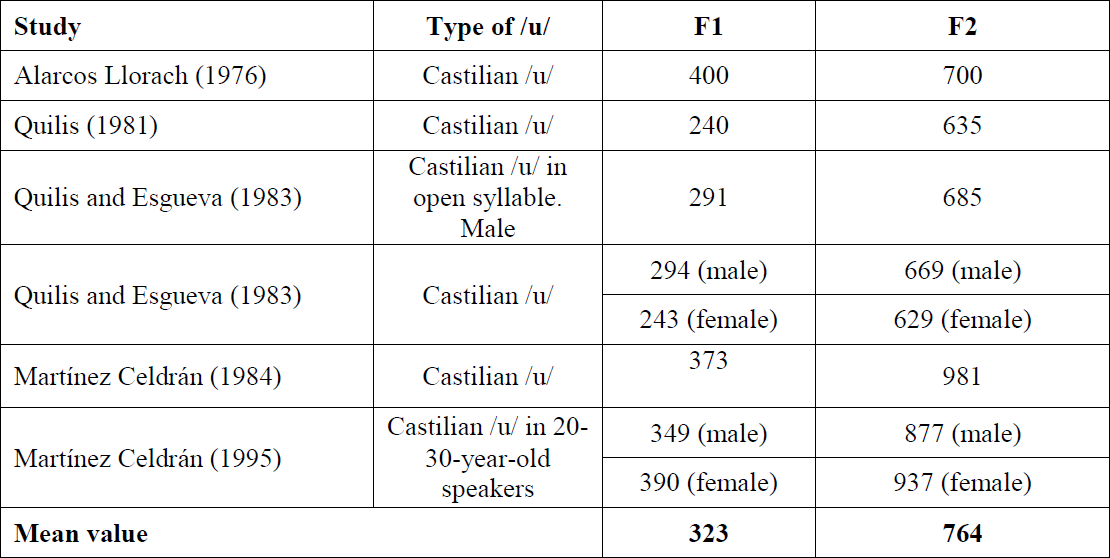
The values from Table 3 for CS /u/ can be compared to the values reported for EAS /u/ by other researchers.
Formant values for EAS [u]
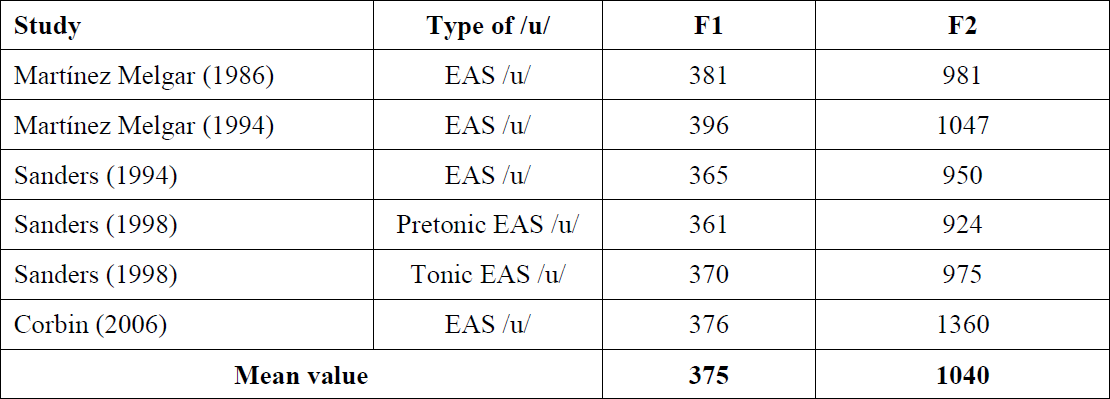
The values presented in Tables 3 and 4 suggest that /u/ is more open and fronted (F1 and F2 are greater) in EAS than in CS; thus, presenting a tendency of EAS /u/ towards centralisation when compared to its CS counterpart. We can see a similar tendency of centralisation of EAS /e/, /o/, /a/, and /i/ when compared to their CS counterparts in Herrero de Haro (2016, 2017a, 2017c, 2019). These results agree with the findings reported in Corbin (2006). This tendency towards centralisation in EAS vowels might be the reason why Contreras Jurado (1975) described the distinction between EAS vowels word-finally vs EAS vowels preceding underlying /-s/ as word not affected by prosodeme of openness vs. affected word. Likewise, this might explain Martínez Melgar’s (1986) distinction for the same contrast as open vs non-open vowels.
3.2. EAS /u/ in other contexts
The high back vowel has also been analysed in EAS preceding underlying /-s/.
Formant values for EAS [us]
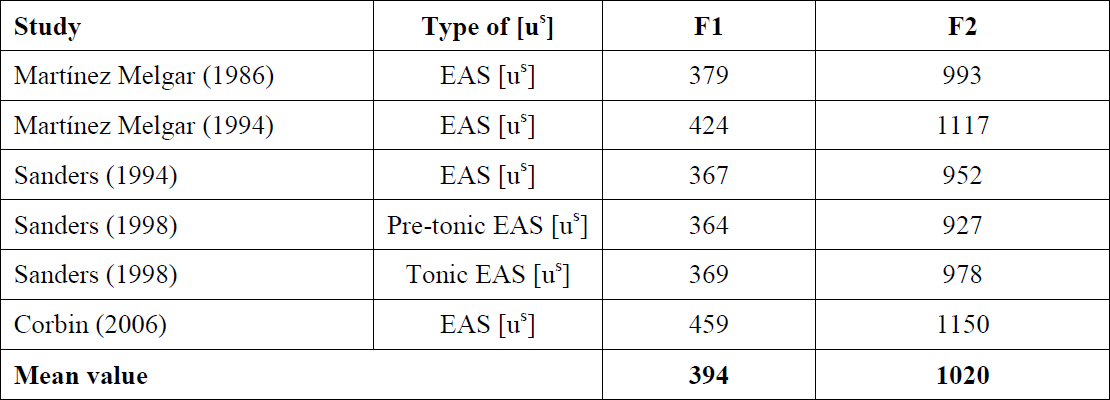
According to the data from Tables 4 and 5, /u/ is more open before underlying /-s/ than word-finally, although the degree of opening reported varies in different studies. Martínez Melgar (1986) is the only study to report closing of /u/ before underlying /-s/; this closing is almost insignificant. Sanders (1994) reports a very slight opening of /u/ preceding deleted /-s/, as it does Sanders (1998) for pre-tonic and tonic [us]. Martínez Melgar (1994) reports opening of /u/ before underlying /-s/ as well, with Corbin (2006) positing the biggest opening of /u/ before deleted /-s/. The mean value from the measurements reported by these authors suggests that EAS [us] is more open than [u].
Regarding F2, Martínez Melgar (1986, 1994) and Sanders (1994, 1998) suggest fronting of /u/ before underlying /-s/, although Corbin (2006) reported backing. Corbin’s (2006) reported difference is much higher than the difference reported in the other four studies, which results in the mean value for [us] in Table 5 being more back than for [u] in EAS.
Corbin (2006) also measured F1 and F2 for three types of realisations of /u/: [us] (F1 438, F2 1324); [uh] (F1 445, F2 1210); and [us] (F1 427, F2 1170). As we can deduce from these values, /u/ is more closed in [us] than in [uh], with /u/ in [us] being between [uh] and [us] in terms of lowering. Likewise, /u/ is more back in [uh] than in [us], and /u/ is pronounced even further back when pronounced [us].
4. ACOUSTIC ANALYSIS OF EAS /u/
4.1. Word-final /u/ in EAS
The following table contains the values obtained in the present study for word-final [u].
F1 and F2 values for word-final EAS [u]
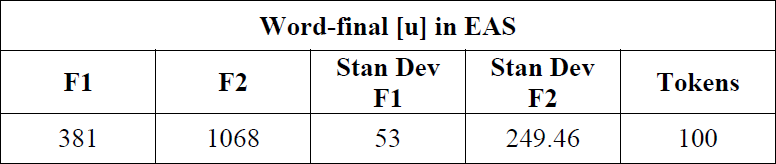
The measurements obtained for [u] in the present study are more similar to the values reported in Table 4 for EAS than to the ones reported in Table 3 for CS. Furthermore, the value obtained for the F1 and F2 of [u] in this paper matches closely those reported by Martínez Melgar (1986, 1994), Sanders (1994, 1998) and Corbin (2006).
4.2. EAS /u/ preceding deleted /-s/
An analysis of word-final [us] has yielded the following results.
F1 and F2 values for word-final EAS [us]
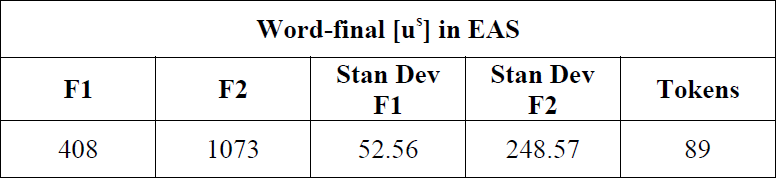
A comparison of the data from Tables 6 and 7 shows that [us] is more open and fronted than [u] in EAS, suggesting that /u/ opens as a results of /-s/ deletion. This contradicts the findings reported in Navarro Tomás (1938, 1939), Salvador (1977), Zubizarreta (1979), and Henriksen (2017), but the opening of /u/ found in the present study is in line with the findings reported by Alvar (1955), Salvador (1957), Mondéjar Cumpián (1979), Martínez Melgar (1994), Sanders (1994), and Corbin (2006). Sanders (1998) found opening of pre-tonic /u/ before /-s/ deletion but not opening of tonic /u/.
The values presented in Table 7 for word-final [us] are higher than the mean reported in Table 5 for the F1 and the F2. Martínez Melgar (1994) and Corbin (2006), however, posited a more open and fronted pronunciation for [us] in their results compared to the values reported in the present study. The results from Tables 4 and 5, however, show backing of /u/ when it precedes underlying /-s/. Corbin (2006) is the only author who posits backing of this vowel, however, the big difference in backing posited in that study causes the mean for the F2 of [us] in Table 5 to be lower than the mean for [u].
López Morales (1984) considered vowel opening a phonetic feature with no phonemic value. Likewise, for Zubizarreta (1979), /i/ and /u/ are subject to phonetic laxing, not to phonemic laxing. The perception test presented in Section 5 will analyse these claims, as these have not been tested perceptually yet.
4.3. EAS /u/ preceding deleted /-r/
The results obtained for word-final EAS [ur] are included in the table below.
F1 and F2 values for word-final EAS [ur]
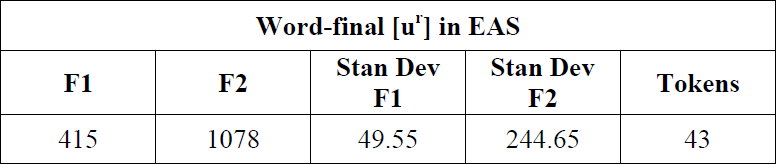
No previous studies have analysed word-final [ur] acoustically; thus, the data from Table 8 cannot be compared with previous data. Navarro Tomás (1938, 1939), however, completed an impressionistic analysis and concluded that vowels open less when they precede underlying /-r/ than when they precede underlying /-s/, which Jiménez and Lloret (2007) also support.
The values reported in Table 8 show that [ur] is slightly more open and fronted than [us]. This suggests that the deletion of /-s/ and /-r/ causes a different degree of modification to the quality of a preceding /u/, which has not been proposed before.
4.4. EAS /u/ preceding deleted /-θ/
An analysis of [uθ] yielded these results.
F1 and F2 values for word-final EAS [uθ]
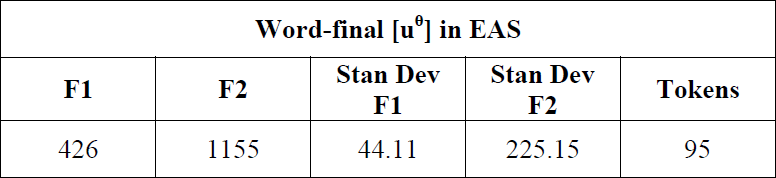
The values reported in Table 9 show that [uθ] is more open and more fronted than [ur]. There are no previous acoustic analyses of [uθ], which means that the values reported in the present study cannot be compared to previous findings.
4.5. Formant values for word-final [u], [us], [ur], and [uθ] in EAS
Studies analysing EAS coda consonant deletion have focused on the consonant /s/ (Gerfen and Hall 2001). The present paper aims to analyse a more complex reality of EAS coda consonant deletion and how this affects preceding vowels. The measurements obtained for the F1 and F2 of word-final EAS [u], [us], [ur], and [uθ] are included in the table below.
F1 and F2 values for word-final EAS [u], [us], [ur], and [uθ]
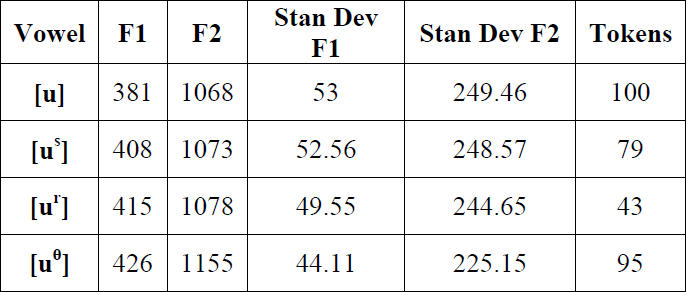
The mean values for the realisations of /u/ analysed in the present paper are easier to appreciate in the following figure.
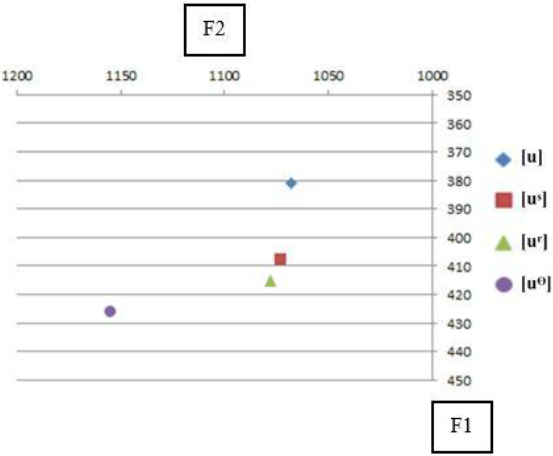
Figure 2
Average F1 and F2 values for word-final EAS [u], [us], [ur], and [uθ]
Figure 2 and Table 10 show that F1 values for /u/ before underlying /-s/, /-r/, and /-θ/ are higher than for word-final /u/. This was also the case for /e/, /o/, /a/, and /i/ in (Herrero de Haro 2016, 2017a, 2017c, 2019). Regarding F2, /u/ is slightly more fronted when it precedes underlying /-s/ and /-r/ than in word-final position; [uθ], however, presents an obvious fronting when compared with the other three realisations of /u/.
The measurements for the 317 tokens of [u], [us], [ur], and [uθ] were analysed statistically on SPSS to investigate whether the values obtained for the F1 and F2 of these four different realisations of /u/ were statistically significant. The baseline p-value for determining statistical significance was 0.5 and the data met the assumptions of the ANOVA test.
A one-way ANOVA found the differences between the F1 of [u], [us], [ur], and [uθ] to be statistically significant (F (3, 316) =14.086, p-value = .000). F2 differences between [u], [us], [ur], and [uθ] were also statistically significant (F (3,316) =2.632, p-value = .05).
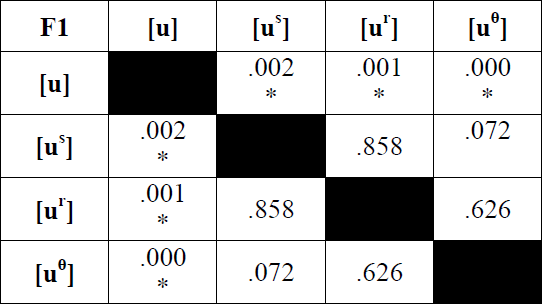
However, a one-way ANOVA cannot determine which differences in the F1 or F2 of [u], [us], [ur], and [uθ] are statistically significant, so a Tukey post hoc test was performed for this. The tables below include p-value results from the cross comparison between the F1 and F2 of [u], [us], [ur], and [uθ].
p-value for differences between the F1 of word-final [u], [us], [ur], and [uθ] in EAS*
* indicates differences which are statistically significant
As shown in Table 11, the difference in F1 for the realisations of /u/ are statistically significant for the pairs [u]-[us], [u]-[ur], and [u]-[uθ] but not for the pairs [us]-[ur], [us]-[uθ], or [ur]-[uθ]. The p-value of .072 for [ur] and [uθ] shows that, although not statistically significant, there is a tendency for the F1 of these two vowels to be different.
The values for the cross comparison between the F2 of the four realisations of /u/ are included in the table below.
p-value for differences between the F2 of word-final [u], [us], [ur], and [uθ] in EAS
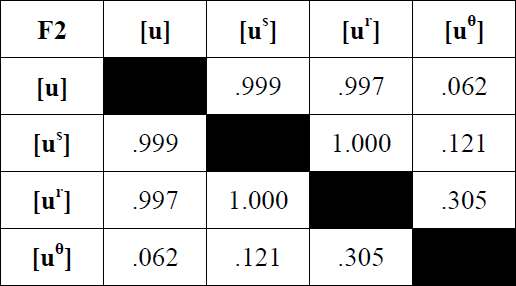
The values reported in Table 12 show that the differences between the F2 of [u], [us], [ur], and [uθ] are not statistically significant. The difference between the F2 values of [u] (1068) and [uθ] (1155) is the closest to being statistically significant, with a p-value of .062.
Considering the results presented in Tables 11 and 12, out of the six possible contrasts in the four realisations of /u/ analysed in this study ([u] - [us], [u]-[ur], [u]-[uθ], [us]-[ur], [us]- [uθ], and [ur]-[uθ]), only the contrasts between the pairs [u]-[us], [u]-[ur], and [u]-[uθ] are statistically significant. These results are similar to the ones obtained in Herrero de Haro (2019) for /i/ and suggest that, although the deletion of word-final /s/, /r/, and /θ/ changes the quality of a preceding /u/ to a different extent, these changes are not statistically significant in all cases. This is the first time that this has been posited for /u/.
Although the difference between [us], [ur], and [uθ] is not statistically significant, the perception test discussed in Section 5 will ascertain whether EAS speakers can identify the vowels [u], [us], [ur], and [uθ] in isolation.
5. PERCEPTION OF /u/
5.1. Perception experiment: [u] vs [us] vs [ur] vs [uθ]
The participants listened to the stimulus on an individual MP3 player and they had to identify whether the vowel being played was [u], [us], [ur], or [uθ]. The answer sheet used for the experiment is included in Appendix 1.
Each realisation of /u/ ([u], [us], [ur], and [uθ]) appeared twice in the audio track, which is why the number of answers is exactly double the number of participants. The description all possible answers – blank answers refers to the number of answers submitted (e.g. if the total number of answers was 100 and 10 answers had been left blank, then the all possible answers – blank answers would be 90). The results from the perception experiment are in Table 13.
Results from the perception test
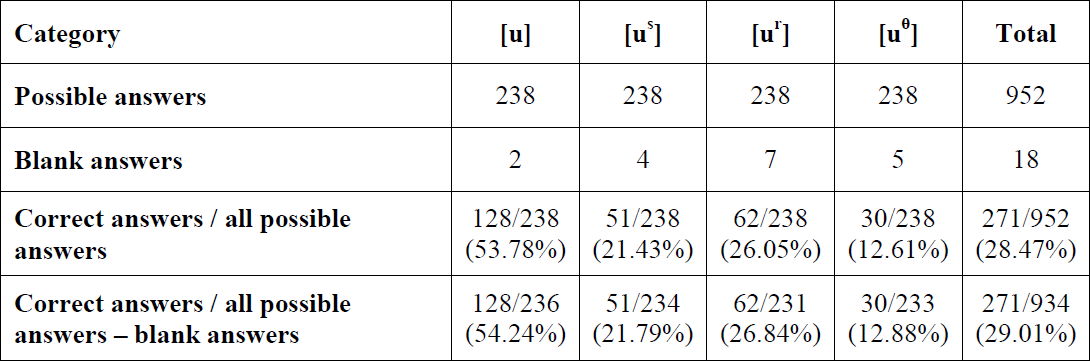
A series of one sample t-tests were run on SPSS to analyse whether the correct identification of [u], [us], [ur], and [uθ] were statistically significant. As each realisation of /u/ could be grouped into four different categories, chance level was 25%.
The vowel [u] was identified correctly in 54.24% of cases (53.78% if we count blank answers as errors). A one sample t-test yielded the same result for both percentages, with a p-value < .000. This suggests that the correct identification of [u] is not due to chance, which means that EAS speakers can differentiate [u] from [us], [ur], and [uθ] perceptually.
The realisation [us] was identified correctly at a rate of 21.79% (21.43% if blank answers are counted as errors). Both of these percentages are below chance level (25%), meaning that the participants could not distinguish [us] from [u], [ur], or [uθ].
Regarding [ur], the percentage of correct identification for this vowel was 26.84% (26.05% if we count blank answers as errors). These rates of correct identification are just slightly over chance level and a one sample t-test confirmed that these percentages of identification are not statistically significant (p-value = .282 for the identification rate of 26.84% and p-value .197 for the identification rate of 26.05%). Thus, EAS speakers cannot distinguish [ur] from [u], [us], or [uθ].
Finally, the rate of correct identification of [uθ] was 12.88% (12.61% if we count blank answers as errors). These percentages are below chance level; thus, EAS speakers cannot distinguish [uθ] from [u], [us], or [ur].
5.2. Perception experiment: Results discussion
The results from the experiment suggest that EAS speakers can identify whether /u/ precedes an underlying /-s/, /-r/, or /-θ/, which means that they can distinguish word-final [u] from [us], [ur], and [uθ]. However, they cannot distinguish between [us], [ur], and [uθ] word-finally; that is, they cannot identify whether the deleted consonant after /u/ is /-s/, /-r/, or /-θ/. The statistical analyses of the perception test confirm this. These results contrast with the findings presented in Herrero de Haro (2016), where EAS speakers were able to identify [e], [es] and [er]. Likewise, Herrero de Haro (2017a) posits that EAS speakers can identify [o] and [oθ] correctly and Herrero de Haro (2019) concludes that EAS speakers can identify [i] and [ir] successfully.
It is worth pointing out that /s/, /r/, and /θ/ were totally deleted in all the samples analysed in the present paper and none of the 317 tokens of /u/ was followed by aspiration. Thus, the distinction [u] vs [us], [u] vs [ur], and [u] vs [uθ] is not due to presence vs absence of aspiration. Vowel quantity was not measured in the present study and it could be argued that this could be the cue to distinguish between the contrasts [u] vs [us], [u] vs [ur], and [u] vs [uθ]. Vowel quantity has been identified as the distinctive feature in other varieties of Spanish (e.g. in Miami-Cuban Spanish [Hammond 1978] and in Puerto Rican Spanish [Figueroa 2000]). However, the distinctive feature which allows EAS speakers to distinguish [u] from [us], [ur], and [uθ] will most likely be vowel quality; the F1 is lower for [u] than for [us], [ur], and [uθ]. As proposed by Navarro Tomás (1939), the contrast [u] vs [us] might be resolved in the mind of an EAS speaker not by identifying the quality of [us], but by identifying that a consonant has been deleted. Something similar could happen with the contrasts [u] vs [ur] and [u] vs [uθ].
6. CONCLUSION
This article has investigated EAS /u/ acoustically and perceptually.
Regarding the acoustic analysis, 317 samples of /u/ were analysed to study whether word-final /s/, /r/, and /θ/ deletion changes the quality of a preceding /u/. As outlined in Section 4.5, the deletion of /-s/, /-r/, and /-θ/ opens a preceding /u/. Furthermore, the deletion of /-s/, /-r/, and /-θ/ changes the quality of a preceding /u/ to a different extent; however, the differences in quality between [us], [ur], and [uθ] are not statistically significant. These results are similar to the ones reported for /i/ in Herrero de Haro (2019).
Regarding the perception analysis, an experiment carried out with native speakers from Western Almería suggests that these speakers can identify whether /u/ is followed by an underlying /-s/, /-r/, or /-θ/; this has also been reported for /e/, /o/, /a/, and /i/ (Herrero de Haro 2016, 2017a, 2017c, 2019). However, EAS speakers cannot identify whether the underlying consonant after /u/ is /-s/, /-r/, or /-θ/.
Out of the four realisations of /u/ analysed in the present paper ([u], [us], [ur], and [uθ]), the only difference in F1 and F2 which was statistically significant was that of [u] with [us], [ur], and [uθ]. Interestingly, those were the only contrasts which EAS speakers could perceive. Thus, it could be posited that the identification of [u] vs [us], [u] vs [ur], and [u] vs [uθ] could be based on a difference of height. However, this needs to be investigated further, as it is also plausible for vowel length or for an unidentified suprasegmental element to be at play in the identification of this contrast.
Considering all this, it can be posited that:
- 1. /u/ opens before underlying /-s/, /-r/, and /-θ/,
- 2. the deletion of word-final /s/, /r/, and /θ/ changes the quality of a preceding /u/; however, the slight differences in the F1 and F2 of [us], [ur], and [uθ] are not statistically significant,
- 3. speakers of EAS can differentiate perceptually [u] from [us], [ur], and [uθ] word-finally,
- 4. even though EAS speakers can identify whether /-s/, /-r/, or /-θ/ has been deleted after /u/, they cannot identify the underlying consonant.
Acknowledgments
This work was supported by a Hispanex grant from the Ministry of Education, Culture, and Sport (Spain), and by funds from the Faculty of Law, Humanities, and the Arts (University of Wollongong).I would like to thank Elisabeth Duursma for comments on earlier drafts of this work. I would also like to thank staff and students at the following schools for helping me gather the necessary materials for this research project: I.E.S. Fuente Nueva (El Ejido); I.E.S. Santo Domingo (El Ejido); C.E.I.P. Laimún (El Ejido); I.E.S. Mar Azul (Balerma); I.E.S. Virgen del Mar (Adra); and I.E.S. Abdera (Adra).
References
Alarcos Llorach, Emilio. 1958. Fonología y fonética (a propósito de las vocales andaluzas). Archivum: Revista de la Facultad de Filología 8. 193-205.
Alarcos Llorach, Emilio. 1976. Fonología española (4th ed.). Madrid: Gredos.
Alarcos Llorach, Emilio. 1983. Más sobre vocales andaluzas. In Julio Fernández Sevilla, Humberto López Morales, José Andrés de Molina, Antonio Quilis & Gregorio Salvador (eds.), Philologica hispaniensia: in honorem Manuel Alvar (Vol. 1). 49-56. Madrid: Gredos.
Alvar, Manuel. 1955. Las encuestas del "Atlas lingüístico de Andalucía". Revista de dialectología y tradiciones populares 11. 231-274.
Alvar, Manuel, Antonio Llorente & Gregorio Salvador. 1973. Atlas lingüístico y etnográfico de Andalucía (Vol. 6). Granada: Universidad de Granada. Consejo superior de investigaciones científicas.
Audacity Team. 2014. Audacity. (Version 2.0.2). (downloaded on 26 October 2014).
Bishop, Jason. 2007. Incomplete neutralization in Eastern Andalusian Spanish: Perceptual consequences of durational differences involved in s-aspiration. In Jürgen Trouvain & William J. Barry (eds.), Proceedings of the International Congress of Phonetic Sciences 16. 1765-1768. Dudweiler: Pirrot GmbH.
Blecua Falgueras, Beatriz. 2005. Variación acústica de la vibrante en posición implosiva. In María José Albalá, Margarita Cantatero, Celia Casado Fresnillo, M. Victoria Escandell, Manuel Esgueva, José Manuel Fradejas, Pilar García Mouton, Lourdes García-Macho, César Hernández Alonso & Victoria Marrero Aguiar (eds.), Filología y lingüística: estudios ofrecidos a Antonio Quilis (Vol. 1), 97-111. Madrid: CSIC/UNED/Universidad de Valladolid.
Boersma, Paul & David Weenink. 2016. Praat: doing phonetics by computer. (version 6.0.19). (downloaded on 26 August 2016).
Bradley, Travis G. 2014. Optimality Theory and Spanish Phonology. Language and Linguistics Compass 8 (2). 65-88.
Carlson, Kristin M. 2012. An acoustic and perceptual analysis of compensatory processes in vowels preceding deleted post-nuclear /s/ in Andalusian Spanish. Concentric:Literacy & Cultural Studies 38 (1). 39-67.
Cerdà Massó, Ramón. 1992. Nuevas precisiones sobre el vocalismo del andaluz oriental. Lingüística española actual 14 (1). 165-182.
Contreras Jurado, Antonio. 1975. Vocales abiertas del plural en andaluz oriental, fonemas o prosodemas. Yelmo. 23-25.
Corbin, Lindsey. 2006. The phonetics and phonology of s-lenition and vowel laxing in Eastern Andalusian Spanish. Williams College, Williamstown, Massachusetts, Dissertation.
Figueroa, Neysa. 2000. An acoustic and perceptual study of vowels preceding deleted post-nuclear /s/ in Puerto Rican Spanish. In Alonso Morales-Font, Héctor Campos, Elena Herburger & Thomas J. Walsh (eds.), Hispanic linguistics at the turn of the millennium: Papers from the 3rd Hispanic Linguistics Symposium, 66-79. Somerville, MA: Cascadilla Press.
García Marcos, Francisco Joaquín. 1987. El segmento fónico vocal+S en ocho poblaciones de la costa granadina. Epos: Revista de filología 3. 155-180.
Gerfen, Chip & Kathleen Hall. 2001. Coda aspiration and incomplete neutralization in Eastern Andalusian Spanish. Manuscript, University of North Carolina at Chapel Hill.http:///www.unc.edu/~ gerfen/papers/GerfenandHall.pdf/ (accessed 10 July 2013).
Gómez Asensio, José. J. 1977. Vocales andaluzas y fonología generativa. Studia philologica salamanticensia 1. 116-130.
Hammond, Robert. 1978. An experimental verification of the phonemic status of open and closed vowels in Caribbean Spanish. In Humberto López Morales (ed.), Corrientes actuales en la dialectología del Caribe hispánico, 33-125. Rio Piedras: Universidad de Puerto Rico.
Henriksen, Nicholas. 2017. Patterns of vowel laxing and harmony in Iberian Spanish: Data from production and perception. Journal of Phonetics 63. 106-126.
Herrero de Haro, Alfredo. 2016. Four mid front vowels in Western Almería: The effect of /s/, /r/, and /θ/ deletion in Eastern Andalusian Spanish. Zeitschrift für Romanische Philologie 132 (1). 118 - 148.
Herrero de Haro, Alfredo. 2017a. Four mid back vowels in Eastern Andalusian Spanish: The effect of /s/, /r/, and /θ/ deletion on preceding /o/ in the town of El Ejido. Zeitschrift für Romanische Philologie 133 (1). 82 – 114.
Herrero de Haro, Alfredo. 2017b. The phonetics and phonology of Eastern Andalusian Spanish: A review of literature from 1881 to 2016. Ikala 22 (2). 313-357.
Herrero de Haro, Alfredo. 2017c. The vowel /a/ before underlying /-s/, /-r/, and /-θ/ in El Ejido: Four low central vowels in Eastern Andalusian Spanish. Dialectologia et Geolinguistica 25. 23-50.
Herrero de Haro, Alfredo. 2018. Context and vowel harmony: are they essential to identify underlying word-final /s/ in Eastern Andalusian Spanish? Dialectología20. 107 – 145.
Herrero de Haro, Alfredo. 2019. Consonant deletion and Eastern Andalusian Spanish vowels: The effect of word-final /s/, /r/, and /θ/ deletion on /i/. Australian Journal of Linguistics.
Herrero de Haro, Alfredo. In press. Catorce vocales del andaluz oriental: Producción y percepción de /i/, /e/, /a/, /o/ y /u/ en posición final y ante /-s/, /-r/ y /-θ/ subyacentes en Almería. Nueva Revista de Filología Hispánica.
Herrero de Haro, Alfredo. Under review. The vowel system of Eastern Andalusian Spanish speakers with articulation disorders: The effect of consonant deletion on preceding vowels in Western Almería.
Herrero de Haro, Alfredo & John Hajek. Under review. Illustrations of the IPA: Eastern Andalusian Spanish.
Jiménez Fernández, Rafael. 1999. El andaluz. Madrid: Arco/Libros.
Jiménez, Jesús & María Rosa Lloret. 2007. Andalusian vowel harmony: Weak triggers and perceptibility. Paper presented at Harmony in the Languages of the Mediterranean. University of Aegean, Rhodes, Greece.
Lloret, María Rosa & Jesús Jiménez. 2009. Un análisis "óptimo" de la armonía vocálica del andaluz. Verba: Anuario galego de filoloxia 36. 293-325.
López Morales, Humberto. 1984. Desdoblamiento fonológico de las vocales en el andaluz oriental: reexamen de la cuestión. Revista española de lingüística 14 (1). 85-97.
Martínez Celdrán, Eugenio. 1984. Fonética. Barcelona: Teide.
Martínez Celdrán, Eugenio. 1995. En torno a las vocales del español: análisis y reconocimiento. Estudios de fonética experimental 7. 195-218.
Martínez Melgar, Antonia. 1986. Estudio experimental sobre un muestreo de vocalismo andaluz. Estudios de fonética experimental 2. 198-248.
Martínez Melgar, Antonia. 1994. El vocalismo del andaluz oriental. Estudios de fonética experimental 6. 11-64.
Mondéjar Cumpián, José. 1979. Diacronía y sincronía en las hablas andaluzas. Lingüística española actual 1 (2). 375-402.
Monroy, Rafael & Juan Hernández-Campoy. 2015. Murcian Spanish. Journal of the International Phonetic Association 45 (2). 229-240.
Moya Corral, Juan A. 2010. El oriente andaluz y el español común. Paper presented at the XVI Jornadas sobre la lengua española y su enseñanza, Granada, Spain.
Navarro Tomás, Tomás. 1938. Dédoublement de phonemes dans le dialecte andalou. Travaux du Cercle Linguistique de Prague 8, 184-186.
Navarro Tomás, Tomás. 1939. Desdoblamiento de fonemas vocálicos. Revista de filología hispánica 1. 165-167.
O'Neill, Paul. 2010. Variación y cambio en las consonantes oclusivas del español de Andalucía. Estudios de fonética experimental 19, 11-41.
Peñalver Castillo, Manuel. 2006. El habla de Cabra: situación actual. Anuario de estudios filológicos 29, 247-253.
Quilis, Antonio. 1981. Fonética acústica de la lengua española. Madrid: Editorial Gredos.
Quilis, Antonio, & Manuel Esgueva. 1983. Realización de los fonemas vocálicos españoles en posición fonética normal. In Manuel Esgueva & Margarita Cantarero (eds.), Estudios de fonética (Vol. 1), 159-252. Madrid: CSIC.
Rodríguez-Castellano, Lorenzo & Adela Palacio. 1948a. Contribución al estudio del dialecto andaluz: El Habla de Cabra. Revista de dialectología y tradiciones populares4 (3). 387-418.
Rodríguez-Castellano, Lorenzo & Adela Palacio. 1948b. Contribución al estudio del dialecto andaluz: El Habla de Cabra. Revista de dialectología y tradiciones populares 4 (4). 570-599.
Ruch, Hanna & Jonathan Harrington. 2014. Synchronic and diachronic factors in the change from pre-aspiration to post-aspiration in Andalusian Spanish. Journal of Phonetics 45, 12-25.
Salvador, Gregorio. 1957. El habla de Cúllar-Baza. Contribución al estudio de la frontera del andaluz. Revista de Filología Española 41. 161-252.
Salvador, Gregorio. 1977. Unidades fonológicas vocálicas en andaluz oriental. Revista española de lingüística 7 (1). 1-24.
Sanders, Benjamin. P. 1994. Andalusian vocalism and related processes. Ph.D. dissertation,University of Illinois at Urbana-Champaign.
Sanders, Benjamin. P. 1998. The eastern Andalusian vowel system: Form and structure. Rivista di lingüística 10 (1). 109-136.
Schuchardt, Hugo. 1881. Die Cantes Flamencos. Zeitschrift für romanische Philologie 5 ( 2-3). 249-322.
Tejada Giráldez, María de la Sierra. 2012. Los factores lingüísticos de la /-s/ implosiva en el nivel de estudios altos de Granada. Normas 2. 185-217.
Torreira, Francisco. 2007a. Coarticulation between aspirated-s and voiceless stops in Spanish: An interdialectal comparison. In Nuria Sagarra & Almeida J. Toribio (eds.), Selected proceedings of the 9th Hispanic linguistics symposium, 113–120. Somerville, MA: Cascadilla Proceedings Project.
Torreira, Francisco. 2007b. Pre-and postaspirated stops in Andalusian Spanish. In Pilar Prieto, oan Mascar María osep Sol (eds.), Segmental and Prosodic Issues in Romance Phonology, 67-82. Amsterdam: John Benjamins.
Torreira, Francisco. 2012. Investigating the nature of aspirated stops in Western Andalusian Spanish. Journal of the International Phonetic Association 42 (01). 49-63.
Villena Ponsoda, Juan A. 2000. Identidad y variación lingüística: Prestigio nacional y lealtad vernacular en el español hablado en Andalucía. In Georg Bossong & Francisco Báez de Aguilar González (eds.), Identidades lingüísticas en la España autonómica, 107-150. Madrid: Iberoamericana Vervuert.
Wulff, Fredrik. 1889. Un chapitre de phonétique andalouse. In Thomas Antoine (ed.), Recueil de mémoires philologiques présenté à Monsieur Gaston Paris, 211-260. Stockholm: L'imprimerie centrale.
Zubizarreta, María L. 1979. Vowel Harmony in Andalusian Spanish. Papers on Syllable Structure, Metrical Structure and Harmony Processes. MIT Working Papers in Linguistics 1. 1-11.
APPENDIX 1

APPENDIX
1
