Recepção: 24 Setembro 2018
Aprovação: 15 Dezembro 2018
Resumo: É fato que a tecnologia tem grande impacto e efeito nos processos de aprendizagem. Este artigo visa verificar se os alunos são capazes de aprender e reter vocabulário somente assistindo vídeos. Cada vez mais os alunos sugerem o uso de vídeos em sala de aula. Contudo, vídeos são realmente eficazes ou são usados somente para o entretenimento dos alunos? Baseado em autores como Muslem (2017) e Mc Nulty (2012), percebemos que vídeos melhoram a fluência e estimulam a pronúncia adequada dos aprendizes da língua inglesa. Além disso, vídeos combinam estímulo visual e sonoro, são acessíveis àqueles que ainda não aprenderam a escrever e ler adequadamente, e proporcionam contexto para a aprendizagem (Fazey, 1999; Johnston, 1999). No primeiro momento desta pesquisa, os alunos são expostos a um questionário no qual eles têm que escolher o significado correto de determinada palavra ou expressão. Na segunda fase, os mesmos estudantes assistem a 5 vídeos diferentes, escolhidos por eles, antes do primeiro questionário, de um canal do YouTube. Por último, os alunos respondem novamente ao questionário a fim de verificar o quanto eles aprenderam e retiveram o novo vocabulário. Percebemos que, possivelmente, os alunos não aprendem novas palavras de vocabulário somente através de sua exposição a vídeos, sem que realizem atividades relacionadas a eles antes, durante e depois de assisti-los.
Palavras-chave: Ensino de língua adicional, Aquisição de vocabulário em língua inglesa, Vídeos em sala de aula.
Abstract: It is fact that technology has a great impact and effect on learning processes. This article aims at verifying if students are able to learn and retain vocabulary just by watching videos. Over and over, students suggest the use of videos in the classroom, but are they really effective or are they only used for students’ entertainment? Based on authors such as Muslem (2017), Mc Nulty (2012) and Wang (2015), we realize that videos increase fluency and stimulate the appropriate pronunciation of English language learners. In addition, videos combine visual and audio stimuli, are accessible to those who have not learned to read and write well, and provide context for learning (Fazey, 1999; Johnston, 1999; Burt, 1999). In the first moment of this research, students are exposed to a quiz in which they have to choose the correct meaning for a certain word or phrase. In the second phase, the same pupils watch 5 different videos, chosen by them before the first quiz from a YouTube channel. Last but not least, students answer a questionnaire again to check how much they have learned and retained new vocabulary. We notice that, possibly, students do not learn new vocabulary just by being exposed to videos, without meaningful pre, while and post activities.
Keywords: Additional Language Teaching, English vocabulary acquisition, Videos in classroom.
INTRODUCTION
Technology intrigues all of us and we all feel fascinated by it. Students’ books are no longer the only and main source of material used in classes. Interactive whiteboards, laptop computers, tablets and even eBooks have taken place. For this reason, this paper focuses on how much learners can acquire new vocabulary by watching videos. Çakir (2006) affirms that technology cannot be separated from society and so teachers can’t be away from it either. He also says that videos can’t replace a teacher but they can make the learning process more attractive. Herron & Hanley (1992) asserted that the use of video facilitates English as a Second Language (ESL) comprehension and retention by rendering information more meaningful to students. Burt (1999) explains that through videos, students have access to an effective tool not only in the classroom but also in self-study situations. Furthermore, Silverman & Hines (2009) have affirmed that the use of videos can enhance the teaching of vocabulary or a second language. Videos have been used for different purposes all around the world. They are one of the most effective and efficient tools to achieve mass media. Wang (2015) adds that by watching authentic videos, students acquire cultural background information and emotional attitudes of the foreign language. Moreover, people worldwide are fascinated by them and are deeply touched when they come to being a “window for the world”. The purpose of conducting this study is to verify if videos are really an effective tool to help additional language students learn, understand and use an additional language.
LITERATURE REVIEW
Compared to other technological sources, the use of videos is more common due to the fact that they are easy to find, accessible to everyone and fit into all types of language learning courses. Mc Nulty (2012, p. 59) published the results of her ground-breaking research on videos in the classroom and affirmed that technology is an essential part of the educational world and, if used properly, can effectively promote successful language acquisition. Moreover, native and non-native speakers are brought into the learning environment and enhance the learning process. “It is difficult for an EFL (English as a foreign language) student to master the language as their exposure to the language is limited by their environment (MUSLEM et al., 2017, p. 25). According to Muslem & Abas (2017), there are two possible effective ways of developing ESL speaking skills, namely staying abroad in an English speaking country and learning through media (Youtube, Video, live programs, TED, Toastmasters). Videos in the classroom are important tools for language acquisition, as learners need comprehensive input. In addition, if chosen according to students’ levels, classrooms’ purposes and learner’s interests, activities evolving videos can be extremely beneficial. For English language learners, videos have the added benefit of providing real language and cultural information (BELLO, 1999; STEMPLESKI, 1992). Burt explains why teachers should use videos made in first place to native speakers:
Because many excellent videos are produced as entertainment for native English speakers, they generally present real language that is not simplified and is spoken at a normal speed with genuine accents. These videos include movies, television programs, and new broadcasts; they can provide a realistic view of American culture, and their compelling story lines can motivate learners to stretch their comprehension (BURT, 1999, p. 9)
Wang also demonstrates the importance of using authentic videos in the classroom and clarifies the idea:
Students can see how language is used in real life which is very different from the traditional English teaching materials. [...] Listening to different varieties of accents help students strengthen their listening skills and improve their pronunciation and intonation effectively (WANG, 2015, p. 25)
Furthermore, Johnson and Milne (1995) stated that the use of video in language classrooms enhances the learning by tuning the students’ eyes and ears to the diversity of the language, as well as non-verbal cues, generally associated with the authentic speech in the audio-visual form.
The possibility of controlling videos, such as pausing, rewinding, and repeating bring the possibility of analysing language in terms of phonology, semantics, syntax and pragmatics. Above all, body language is what also makes a difference when watching videos. “The quality of being able to hear and see synchronous communication, communicators’ gestures, gazes, paralinguistic cues, facial expressions, and lip movement are very important” (Mc Nulty, 2012, p. 52). Blonskyté (2014) also explains that “images clarify the auditory input, as in real life situations, where people very often communicate using any words at all”. Listening exercises with regular audios and podcasts seem to be fine. However, videos are rather sophisticated for they raise the possibility of interpreting conversations and speeches based on what can be seen.
There many multiple instructional advantages of video in comparison to printed materials, such as rich visual support, audio component, enhanced contextualization and better control over medium (slow motion play or possibility to record student voice) (WHITE et al. 2000)
Krashen (1982, 1985) states that in order for the acquisition of a language to take place, learners need “comprehensible input”. Besides selecting videos according to students’ interests, teachers must be aware of students’ competence in listening and students’ level according to the Common European Framework (CEF). Furthermore, the videos should have a clear audio to facilitate communication without undesirable noises disturbance. Some lexis may be new for students, but they are the focus of this research. If students do understand what is being said, it does not mean they acquire that specific vocabulary. Researchers like Winke at al (2010) also take in consideration the form in which the vocabulary is presented within the videos showing there is a difference between exposing students to written or aural mode, captioned or not videos. “Captioned videos also aid overall comprehension of the videos. In other words, the use of different modalities appears to facilitate vocabulary recognition and overall comprehension (WINKE et al., 2010, p. 79).
Blonskytè (2014) demonstrates that videos can also be motivating in the classroom: “the most straightforward benefit of using video material in teaching any language [...] is that it is often perceived as entertainment by students and, naturally, such attitude generates motivation”. But videos do not only promote fun, indeed. Videos are able to introduce various aspects of real life into the second or foreign language learning environment, and help to contextualisation on the learning process (SHERMAN, 2003). Other factors such as cultural awareness are deeply dealt with into videos, they approximate learners to real-life situations in which students who travel or not abroad find differences and similarities to their own cultures. Rowland (2007, p. 37) points out that some close-captioned videos meet historic and cultural criteria. According to Svensson and Borgarskola (1985), videos are excellent tools to provide cultural insights for learners who have never visited countries where the target language is spoken or learnt. Furthermore, additional language speakers are enabled to interact with native and non-native speakers in an efficient and appropriate way. Koç at al (2017, p. 106) points out that “when exposing learners to Formulaic Sequences (FSs) in media, instructors should make sure that the way FSs are used in media correspond to how they are used in real life.” Although acquiring language might seem easy to some who believe learning a language is learning grammar and vocabulary, language acquisition is much wider, considered from worldwide famous researchers’ point of views. Students must be aware of how native speakers behave in different circumstances, like celebrating Thanksgiving, Saint Patrick’s Day or Anzac Day.
The acquisition of formulaic repertoire is a socially-loaded process that goes beyond mastering elements of the language code as it also requires “tapping into” the sociocultural reality of the L2 community and incorporating elements of it into the learners’ own language behavioural repertoire (DÖRNYEI et al. 2004, p. 87)
Wang (2015), as well, emphasises the importance of cultural elements in a foreign language learning process:
Learning English does not only mean the acquisition of such linguistic knowledge as pronunciation, grammar, vocabulary and idiomatic expressions but also means learning [...] the values, social customs and habits of westerners in order to reach near-native English proficiency [...]. Teaching English with videos materials combines English learning with the acquisition of social and cultural knowledge and in the end it will enhance students’ cognitive competence in English and cultivate English way of thinking (WANG, 2015, p. 25).
Participants of Koç et al (2017, p. 103) research affirm that “it is easier to remember words and expressions when you hear them on TV. When you hear an idiom, you remember the context in which it is used and when you see a context, you remember the idiom that has been used in that particular context. When you think about the context and the idiom together, you can easily remember the meaning of the idiom”. Students who are visual or auditory benefit from video activities, as well as students who have different learning styles.
According to Rowland (2007, p. 39), “multiple intelligence and learning styles research suggest that students are both visual and auditory. This multi-sensory approach to language instruction allows the student to see, hear, and contextualize what is on the screen.” Learners need to be exposed to real-life situations to retain FSs as single items, Wood (2002). It is unarguable that students acquire language from watching videos, even though videos are chosen randomly and unpretentiously. For this, videos are likely to be seen as powerful motivators as well as extremely stimulators. Muslem et al (2017) suggests that English teachers use a combination of videos clips as a supportive learning media with small groups’ teaching-learning activities. In the following section, we are describing how this research was conducted and done.
METHODOLOGY
This research answers the question if additional language students can grasp language, more specifically vocabulary, by watching videos unlinked with lessons with pre, while and post activities. In other words, the students, subjects of this research, are exposed to the videos the same way they would be exposed outside the classroom. The theme of the videos is not going to be elicited, and students’ previous knowledge about the topics will not be checked at any time. Whilst the videos are shown on the screen, students will not have to answer any type of exercise. After watching the videos, students will not be asked to talk about them or discuss any questions related to them.
Firstly, a group of students from an English language course was chosen for its characteristics. We had been teaching them for over 8 months and found them atypical related to most teenagers due to their interest, involvement, competence and maturity. The group is formed by 9 upper-intermediate students who are between 16 and 17 years old. All of them have always demonstrated wide interest in watching videos, being this kind of activity part of the class or not. We are privileged to count on an Interactive Whiteboard with broadband connection to enhance and cheer our classes. Four learners inspired the object of our study by having frequently asked questions of vocabulary, slangs and idioms that they had encountered by chance on videos and channels they watch on YouTube.
Secondly, we concentrated on finding an absorbing, engaging and involving YouTube channel which learners could benefit from its language exposure. Narrowing down, a YouTube channel from Cultura Inglesa São Paulo, which is a Brazilian School that teaches English, was chosen. It is called “Talk British to Me”, and as far as we are concerned, this channel’s objective is to disseminate British Culture and language. There are twelve episodes, so far, in which the watchers are exposed to idioms, collocations, phrasal verbs, slangs and vocabulary that are often unknown by Brazilians students. Titles are usually self-explanatory and catchy in terms of content. Students voted on the video they would most feel attracted to watch based on their titles. The top five videos were selected: “The Gatropub”, which will be called here video 1 (V1), “On the football pitch”, video 2 (V2), “How to talk like a London Teenager”, video 3 (V3), “Dancing in the pub”, video 4 (V4), and “In the supermarket”, video 5 (V5). In V1, images and written words were on the screen to illustrate meanings, like the meaning of “cold calling”, for instance. The pub was quite noisy, what disturbed a bit the listening comprehension. Words like Sheperd’s pie were selected not only to be learnt in terms of new lexis, but also to be noticed as cultural. Above all, the subjects of this research reckon videos are interesting and appealing. However, the editing was not successful for not having controlled and balanced the volume throughout the video, especially in between the topics and interviews. V2 brought real situations images, showing real games and having the interview recorded at a neighbourhood in London. V3 was source of trendy teenagers’ slangs, which were visualized through interviewees’ smartphones. Besides being suitable for the students’ ages, the slangs were meaningful and authentic. V4 did not really fulfill the expectations of the title because there were expectations of the video being filmed in a regular pub, crowded with people. V5 was the only video that, apparently, did not have the option of hiding the subtitles. It was filmed in one of Britain’s main supermarket and raised the awareness of how different eating habits in Britain are compared to the rest of the world.
Thirdly, a multiple-choice quiz was formulated based on the videos. There were 25 questions with 4 options for answer each. The last option consisted of an “I don’t know” answer. When formulating the quiz, we verified if the vocabulary in the options was clear and familiar to students. Questions were about vocabulary meaning. Some were phrasal verbs, expressions, acronyms, slangs, idioms, etc. When the videos were selected, it was considered the students’ listening level, videos’ meaningfulness, content and cultural awareness. The 25 questions were chosen according to the clearness of explanation given by the videos. When elaborating the questionnaire, it was also meant to choose expressions and words, assuming that students would not be familiar with. Some of the options were an attempt to bring similar words from the expressions in order to call students’ attention to the fact that meaning of words alone and in expressions are different. Some questions from the quiz, which are not illustrated in the correct order here, can be found below:
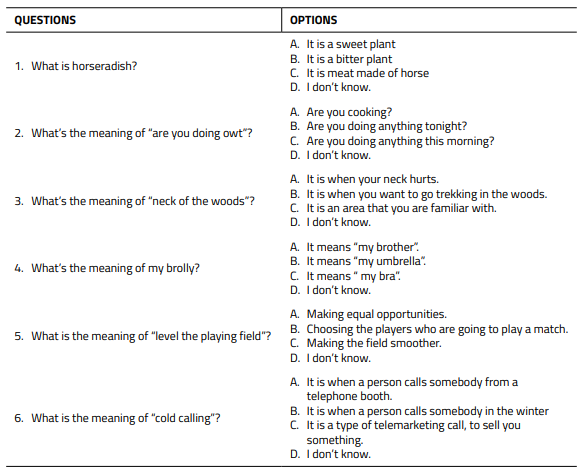
Table 1
The Questionnaire
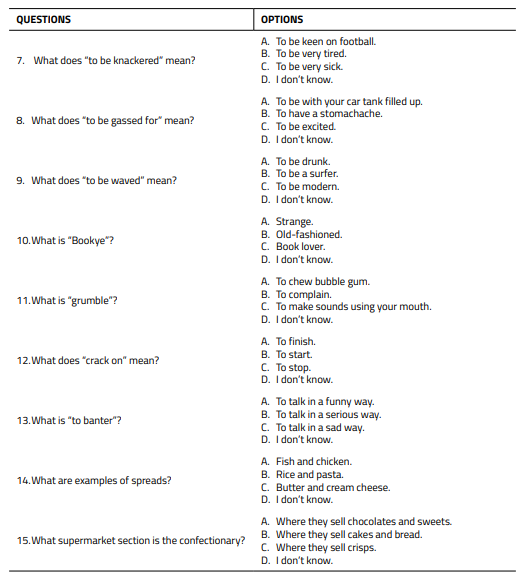
Source: elaborated by the authors
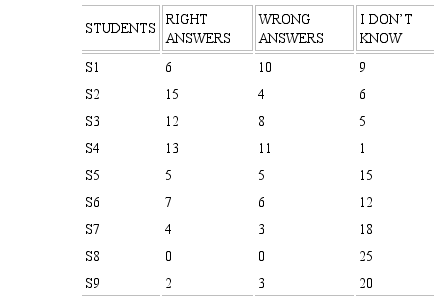
Before watching the videos, learners were submitted to the questionnaire without any type of pre- taught vocabulary or explanation, only being aware that the questionnaire was for academic purposes. They were also informed that there should not be any kind of cheating or discussions about the topics and that the vocabulary presented in the questions would not be clarify by the teacher. Moreover, students were conscious that they would be not graded for the questionnaire. In this paper we will refer to students as S1, S2, S3 and so on. The results for the first quiz can be found below.
The results of the first quiz
Source: elaborated by the author
Taking in consideration the table above, it is noticeable that most students were not familiar with some of the vocabulary presented in the quiz. Only S2 and S4 managed to get more than 50% of the quiz correct. That has probably happened because they were exposed to these expressions and vocabulary previously. It is important to highlight that even though the teacher instructed them to answer “I don’t know” in case of not knowing the answers, we notice that some students attempted to answer the questions wrongly. According to them, these attempts happened because some of the options in the answers were tendentious in terms of trying to translate or refer to the expression based on the words’ original meanings. For instance, the word “bookye”, which means strange, had an option meaning “book lover”. Students might have answered that as the correct option for trying to find the meaning of the word. On the other hand, S8, who usually has the highest grades in class, answered 15 “I don’t know” out of 25 questions.
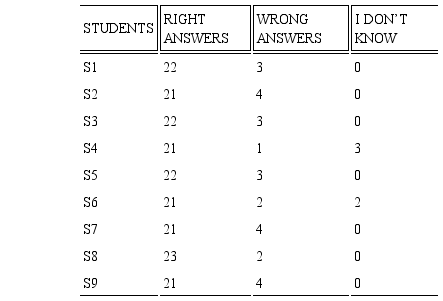
A week after taking the quiz for the first time, students were exposed to the videos without any type of pre or while activities. During the videos, students would make comments as: “I can’t believe I got that one wrong”, “Oh, now it makes sense”, “I knew it”, etc. Immediately after the videos, students answered the questionnaire again. The results can be found below.
The answers after the videos
Source: elaborated by the authors
It can be affirmed that all students performed better in the questionnaire after being exposed to the videos. It can be highlighted that the proximity of time between the first quiz and the second might have been a decisive factor of inference in the results. It should be noticed that if students had faced longer periods between the quiz 1 and quiz 2, they could have forgotten about the questions and might have not been so successful on the results.
Another interesting fact that should be taken into account is that pupils took the second quiz right after having watched the videos. Perhaps, if students were given more time between watching the videos and answering the second quiz, they would not have the content so fresh in their minds and would not have remembered some of the answers. Thus, this shows that they can retain the content effectively when exposed to video learning materials. From this research, it can be assumed that learning can also take place in a decontextualized input, since the videos where presented apart from any type of lesson engagement. For this reason, the results indicate that videos can be effective and efficient instructional tools. Furthermore, videos in the EAL (English as an Additional Language) classes stimulate cognitively the learning process.
In the following section, the students’ perceptions are going to be shown and analysed.
STUDENTS’ PERCEPTIONS
After the end of the tasks, students were invited to comment on some questions regarding the use of videos in the classroom as well as the videos shown by the teacher. The questions and answers can be found below.
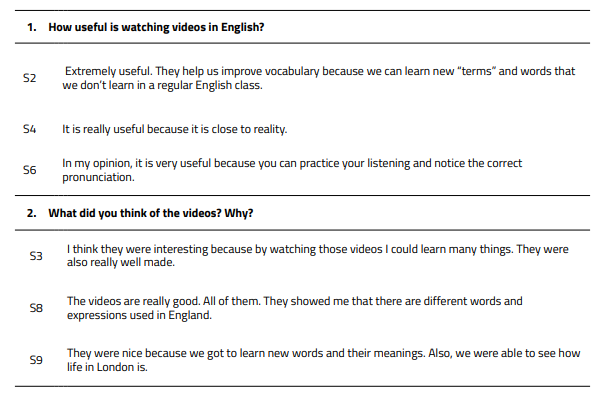
Table 4
Students’ perceptions
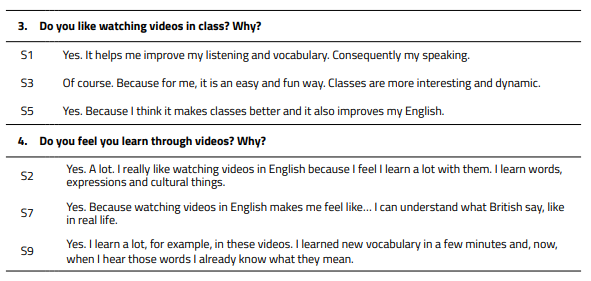
Source: Elaborated by the authors
After having the evidences gathered, it can be concluded that learners are partially aware that watching videos in English can be a tool to help them develop in the whole learning process. Some of them mentioned the importance of culture awareness, others how much their listening skills are improved. However, all of them consider videos to be fun, motivating and interesting.
FINAL REMARKS
This article’s purpose is to shed some light at how much technology, more precisely videos, can assist and support English language acquisition. The research took place in the classroom, but the results show that the exposure of videos benefit students wherever they are. Not only learners acquire new language if the videos are linked to other activities, but just for being exposed to them. Taken the research into consideration, we observed that pupils were engaged, pleased and motivated by the videos. Furthermore, it was noticeable that students acquired new vocabulary, expressions and idioms. The results show that learners can acquire language from simple exposure.
In addition, videos are attractive and seem to carry students away to the distant land of paradise. Learners feel like they are learning through an amusing and entertaining way that escape from traditional and old-fashioned methods and methodologies.
When teaching learners a foreign language or second language, the teachers or the instructors should focus on how to facilitate learners’ interest and motivation in learning the language. Learners hold their attention on language learning only if the learning is interesting (KAUR et al. 2014, p. 34).
Overall, this research offers a tentative explanation of the effectiveness and efficiency of the use of videos in the classroom. Despite having found evidence to support this claim, further studies should be carried in order to point out how much of the acquired language could be retained.
REFERENCES
Bello, T. New avenues to choosing and using videos. TESOL Matters, v. 20, n. 9, a. 4, aug./sep. 1999.
Blondskytè, Marija. Case study of the use of video material in an English Classroom. Kauno Technologijos Universitetas, n. 25, p. 97-105, 2014.
Burt, Marim. Using videos with adult English language learners. Washington, DC: National Clearinghouse for ESL Literacy Education, 1999.
Çakir, Ísmael. The use of video as an audio-visual material in foreign language teaching classroom. Turkish Online Journal of Educational Technology, n. 5, a. 4, p. 67-72, jan. 2006.
Dörnyei, Z.; Durow, V.; Zahran, K. Individual differences and their effects on formulaic sequence acquisition. In: N. Schmitt (Ed.). Formulaic sequences: Acquisition, processing, and use. p. 87-106. Amsterdam, Netherlands: John Benjamins, 2004.
Fazey, M. “Guidelines to help instructors help their learners get the most out of video lessons.” Unpublished manuscript (Available from Kentucky Educational Television, Lexingon, KY), 1999.
Herron, C.; Hanley, J. Using video to introduce children to a foreign culture. Foreign Language Annals, n. 25, p. 419-426, 1992.
Johnston, J. “Enhancing adult literacy instruction with video.” Unpublished manuscript, University of Michigan-Ann Arbor, 1999.
Johnston, J.; Milne, L. Scaffolding second language communicative discourse with teachercontrolled multimedia. Foreign Language Annals, a. 28, p. 315-329, 1995.
Kaur, D.; Young, E.; Zin, N.; DeWitt, D. The Use of Videos as a Cognitive Stimulator and Instructional Tool in Tertiary ESL Classroom. The Malaysian Online Journal of Educational Technology, v. 2, I. 3, 2014.
Krashen, S. D. Principles and practice in second language acquisition. Oxford, UK: Pergamon, 1982. Krashen, S. The input hypothesis: Issues and implications. New York, NY: Longman, 1985.
Koç, D.; Koç, S. On the Role of Media Input in the Learning of Formulaic Sequences by EFL Learners. TESL CANADA JOURNAL/REVUE TESL DU CANADA, v. 34, I. 3, 2017 p. 93-110.
Muslem, A.; Abbas, M. The effectiveness of immersive multimedia learning with peer support on English speaking and reading aloud. International Journal of Instruction, a. 10, n. 1, 2017.
Muslem, A.; Mustafa, F.; Usman, B.; Rahman, A. The application of video clips with small group and individual activities to improve young learners’ speaking performance. Teaching English with Technology, a. 17, n. 4, p. 25-37, 2017.
Mc Nulty, A. Best practices in using video technology to promote second language acquisition. Teaching English with Technology, a. 12, n. 3, p. 49-61, 2012.
Rowland, James. Close-captioned Videos and the ESL Classroom: A Multi-Sensory Approach. MPAEA Journal of Adult Education, v. XXXVI, n. 2, 2007.
Sherman, Janes. Using Authentic Video in the Language Classroom. Cambridge University Press, 2003.
Silverman, R.; Hines, S. The effects of multimedia enhanced instruction on the vocabulary of English language learners and non-English language learners in pre-kindergarten through second grade. Journal of Educational Psychology, a. 101, n. 2, p. 305-314, 2009.
Stempleski, S. Teaching communication skills with authentic video. In: Stempleski, S.; Arcario, P (Eds.). Video in second language teaching: Using, selecting, and producing video for the classroom. p. 7-24. Alexandria, VA: Teachers of English to Speakers of Other Languages, Inc. 1992.
Svensson, S.; Borgarskola, M. Video, authenticity, and language for special purposes teaching. Foreign Language Annals, a. 18, p. 499-517, 1985.
Wang, Zhaogang. An analysis on the use of video materials in college English teaching in China. Journal of Educational Psychology, a. 101, n. 2, p. 305-314, 2009.
White, C.; Easton, P. ; Anderson, C. Students’ perceived value of video in a multimedia language course. Educational Media International, v. 37, a. 3, p. 167-175, 2000.
Winke, P. ; Gass, S.; Sydorenko, T. The effects of captioning videos used for foreign language listening activities. Language Learning and Tecghnology, Michiagan State University, v. 14, n. 1, p. 65-86, 2010..
Wood, D. Formulaic language in acquisition and production: Implications for teaching. TESL Canada Journal, a. 20, n. 1, p. 1-15. 2002. Disponível em: https://doi.org/10.18806/tesl.v20i1.935;. Acesso em: 01 set. 2017.
