BEYOND ALLIANCE FOR KNOWLEDGE FROM HAMK’S POINT OF VIEW
ALÉM DA ALLIANCE FOR KNOWLEDGE, DO PONTO DE VISTA DA HAMK
BEYOND ALLIANCE FOR KNOWLEDGE FROM HAMK’S POINT OF VIEW
Revista Prâksis, vol. 3, pp. 43-52, 2019
Universidade Feevale
Received: 26 March 2019
Accepted: 11 July 2019
Abstract: Long term cooperation that is based on common trust, friendship and especially willingness to go forward together is a good basis for development of an international university. Challenging the modern world together makes it possible to reach goals beyond the average. This is the heart of the Beyond Alliance for Knowledge—an alliance between Feevale University, VIA University College and Häme University of Applied Sciences (HAMK). This article is written to highlight the basic needs for the Beyond Alliance for Knowledge from HAMK’s perspective. The perspectives are (1) the need for internationalisation of the university itself, (2) better education products for students and (3) effective research results for businesses and society. The ultimate goal in this alliance should be to develop competences which we need to challenge global wicked problems.
Keywords: Alliance, Education, Competence, Co-operation, Research.
Resumo: A cooperação de longo prazo, baseada na confiança comum, na amizade e especialmente na disposição de avançar juntos, é uma boa base para o desenvolvimento de uma universidade internacional. Desafiando o mundo moderno juntos, é possível alcançar objetivos além da média. Este é o coração da Beyond Alliance for Knowledge - uma aliança entre a Universidade Feevale, a VIA University College e a Häme University of Applied Sciences (HAMK). Este artigo foi escrito para destacar as necessidades básicas da Beyond Alliance for Knowledge na perspectiva da HAMK. As perspectivas são (1) a necessidade de internacionalização da própria universidade, (2) melhores produtos de educação para os estudantes e (3) resultados efetivos de pesquisa para empresas e sociedade. O objetivo final desta aliança deve ser o desenvolvimento de competências que precisamos para desafiar os complexos problemas globais.
Palavras-chave: Aliança, Educação, Competência, Cooperação, Pesquisa.
INTRODUCTION
HAMK IN A COMPLEX WORLD
We are living in a very complex and rapidly changing world (e.g. HOLLING, 2001), which means that teacher’s daily work is under reform all the time. When we talk about learning outcomes, we understand at once that pedagogical competence is most important. It is also necessary to notice that we need different kinds of pedagogical approaches to succeed. Students at the Häme University of Applied Sciences (HAMK) are owners of their own learning, and teachers act as instructors and enablers of learning. We also encourage our students to cultivate creativity and critical thinking in a complex operating environment. Thus, the students’ role is increasing, and they need more self-direction skills. Teachers’ work is also changing rapidly, and they need support to succeed.
EDUCATION AND COMPETENCE CREATION
HAMK promotes lifelong learning and utilises a diverse range of appropriate pedagogical solutions, which are implemented with a strong international approach. HAMK has renewed its educational model, and nowadays we have three different study models: 8–16, 18–100 and 24/7. A student can choose the appropriate study model in relation to their individual needs; full-time studies during weekdays (8- 16), part-time studies while working (18-100) and tailored, fast-track studies (24/7). This renewal also means a change from a course-based curriculum to a competence-based curriculum and phenomenon- based learning in modules.
We are also very interested in our intellectual capital because we know that without competencies and strong professionalism, we are not able to achieve our strategic goals. It is also clear that leaders must understand what is happening, accept uncertainty and still take appropriate action while leading others who are likewise experiencing uncertain events (HAZY, 2018). To help our staff members to succeed according to our strategy and reach their goals, we have built a competence management system (Figure1) in which teachers’ personal goals and HAMK’s strategic goals are combined. We are also using a different kind of networks to expand our own competencies and co-create new knowledge.
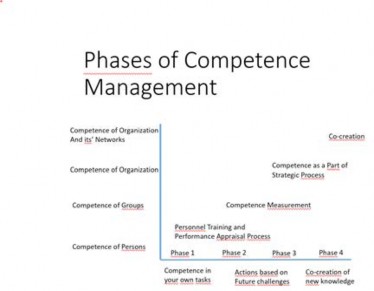
Figure 1
Phases of Competence management (SALOJÄRVI, 2009). HAMK’s goal is to be in phase 4, where co- creation is a way of working, and we are also using our networks’ competences to reach our strategic goals. In this phase, the organisation is also capable of creating new knowledge.
To succeed, it is very important to do things systematically. That is why every year managers at HAMK go through performance appraisal processes; and in those meetings, one of the focus points of discussion is competence development. After this performance appraisal process, every teacher has their own development plan. This development plan also includes projects, research and internationalisation actions in which the teacher is planning to take part in. When the development plans are written, it is much easier to choose the right parts from different kinds of competence development tools, which HAMK as an organisation also offers. Change is the key word when we talk about competence management. One of the main reasons why higher education teachers are successful in changes is that teachers are able to learn new practices while developing them (KUNNARI, 2018).
HAMK has various competence development tools. The HAMK100 program offers different kinds of development programs, team work and workshops that are in line with the HAMK2030 strategy. For supporting the development of teachers’ digital competences, HAMK has introduced a project, the LeaD team. It is one of the newest openings at HAMK and it will help teachers´ to develop online modules and online teaching. Open badges are also important tools to develop and show competencies in different areas.
When we discuss competence management, we have to also talk about leadership and management. One of the main processes to bring up is our yearly action and financial plan at HAMK. During this process of drafting the action and financial plans, every unit determines their own strategic goals based on HAMK’s strategy. Thus, the pedagogical development is tightly linked to competence management in the context of strategic leadership in higher education at HAMK.
APPLIED RESEARCH
The applied research process has also been under systematic development in recent years at HAMK. Four research units have been built: HAMK Edu, HAMK Bio, HAMK Smart and HAMK Tech. A principal research scientist system (i.e. leaders of a research area) has been established in research units. Profiling of research units (e.g. for branding) and selecting focus areas of the research activities has been done in a joint and co-managed process. In this process, global megatrends and identified weaker local, national and international signals were taken into account. In addition, this process reflected HAMK’s own research strategy in relation to national and regional strategies. PhD education at HAMK takes its first steps with our international partner universities, including Feevale University.
Research work at HAMK is categorized into two categories: (1) professional applied research work in four research units and (2) student-orientated development work in module projects. In the first category, professional researchers (i.e. HAMK staff members) run applied research with partners in externally funded (public and company funding) research projects. Students also participate in these projects. Today it means more than 100 projects with over 10 million euros in funding per year. In addition, international networks and funding is utilised. The goal is to solve national and/or international challenges in working life and society. Hence, research skills of the staff need be at an advanced level.
In the second category, to produce up-to-date knowledge in constantly developing working life, applied research skills are also needed among the teaching staff. A rough estimation is that every lecturer should have at least a couple of research-orientated projects with the working life per semester. Research orientation in the project means that a group of students is solving practical problems in a company (or in the public sector) through theoretical approach, and they are not just producing a hands-on solution to a certain problem. Though this process, a deeper understanding of problem-solving methods is gained. Evidently, this challenges lecturers to keep their theoretical and applied research competences up-to- date.
These kinds of developments are the reason why international cooperation is very important to Häme University of Applied Sciences. You are not able to do things alone, and you need professional networks around the world in order to be competitive. In alliance, you go beyond your level by creating together new solutions to wicked problems (Sensu RITTEL & WEBBER, 1973).
RESULTS AND ANALYSIS
FROM FRIENDSHIP TO STRATEGIC ALLIANCE
We would like to say that Beyond Alliance for Knowledge has been a long journey beyond our comfort zone. It has its origins in long-lasting friendship between individuals at three universities—Feevale University, Häme University of Applied Sciences and VIA University College. It mixes people, cultures and languages together from Brazil, Denmark and Finland. It is obvious that you have to learn new things every day in that kind of cooperation to make it fruitful. This why we are so enthusiastic about it—it challenges all of us.
There has been a lot of cooperation between HAMK, Feevale and VIA. In the beginning, it was based on a regular partnership, mainly consisting of a student and staff exchange. In the second phase, it became a more strategic partnership between these universities. The basic idea was to make the partnership more ambitious.
In the beginning, when everything, such as the basic idea of an alliance, was only in our heads, we started to figure out the basic principles of the alliance. We understood well that an alliance of multiple universities would be a lot harder to structure than a traditional strategic partnership between two universities. The key elements identified were mutual trust, a willingness to go forward to be a better university, and commitment to cooperation and co-creation.
The partnership was basically based on the friendships between individual people. It was a good start, but at the same time it was also one of the weak points. How to make things more working at a university-level and still maintain the enthusiasm needed for good results. At our university, HAMK, it has largely been a question of values. From a more general point of view, we are speaking about valuing co-creation and challenging our common goals at a higher level than in heroic stories rising from the level of an individual person. We at HAMK really believe that we are better when working together as a group.
HAMK AS A FORERUNNER
In Finland, we believe that HAMK has taken the forerunner’s role as a builder of an international university alliance. Afterwards, several alliances and strategic partnership networks have come into existence in our country. A key element is a commitment to working together. As a university, the major role is in education and of course in research and development activities. How can we do things to make the world a better place to live, how can our students get a better education service, and how can our R&D activities have more beneficial results?
Key elements in education have been the formulation of new e-modules: education modules (15 credits) that are available through digital environments without limits of time and space; making international education available to those not taking part in a student exchange (CASARI CUNDARI ET AL., 2018); and, of course, simultaneously learning to work together as colleagues around the world in pursuit of the ideal of truly international university.
Cooperation in applied research work was one of the key elements in the alliance. The main idea was to build a joint research unit between three partner universities (Figure 2).
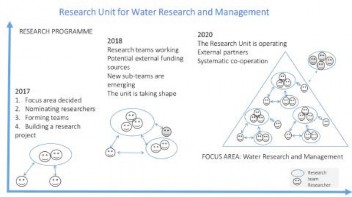
Figure 2
Formation of network-based research unit for Water Research and Management.
This unit will be a network of researchers, laboratories and other infrastructure operating together as partners. The focus areas of the research have been discussed and selected (see below). The rationale to build a joint research unit between Nordic European Union and Latin American universities rises from differences and diversity in working life, society and natural ecosystems (CASARI CUNDARI ET AL., 2018). The business world, public services and environmental issues created rough niches in which common research interests are supposed to be found. It was obvious that, despite evident complications due to the variability between operational environments, this variability also gives an opportunity to deepen understanding of different phenomena. It may also give rise to new innovations to solve pointed challenges of global wicked problems.
Joint focus areas were selected and have evolved during the last years. In the first phase, there have been research themes on successful aging, digitalization and the bioeconomy. Now the joint research unit will be developed for research connected to water issues as a global challenge. The conceptual analysis of deviation in researchers’ competences clearly indicates that the basis of the research unit (from year 2017) is suitable for transdisciplinary problem-solving of a wicked problem (i.e. water issues) (Figure 3; see also SAKAO & BRAMBILA-MACIAS, 2018). From HAMK’s point of view, another important investment in Feevale University is a field test facility for weather resistance of thin sheet metal materials (a reference for Finnish weather conditions). In addition, sustainable development education and innovation activities have been under active research (FRIMAN ET AL., 2018).
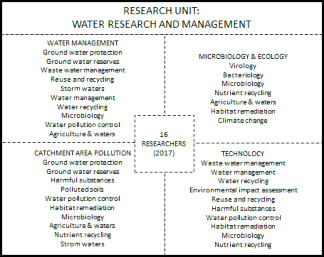
Figure 3
A conceptual framework of research cooperation and researchers’ competence sets in the Water Research and Management Unit in 2017. Disciplinary orientated competences of researchers are divided into general phenomenon blocks (4) that affect/control water-related processes in ecosystems. Disciplinary characterization and division into blocks were done by the authors. The need for transdisciplinary working is evident because most of the competences can be located in several phenomenon blocks.
CONCLUSIONS
Together we are better. The process of building an international alliance of three different types of universities and universities of applied sciences has been challenging but fruitful. It seems that most of the difficulties faced were based on a weak common understanding about goals, which led to limited commitment. However, it is also obvious that the willingness to do things together among the three alliance partners opens new possibilities over time. From our point of view, it is good to see operations going forward with increasing speed. It is good to see people (friends) tackling different problems and going forward. It is good to see that trust increases over time.
At the moment, we are thinking about what the future will be. In the centre of these discussions there are issues such as (1) adaptation to climate change, (2) reduction of environmental pollution and (3) processing of human population overgrowth and urbanization. We believe that there are plenty of wicked problems for universities to solve. On the other hand, it is plausible that many of the solutions are far beyond our imagination, but together in the Beyond Alliance of Knowledge, we can exceed our limitations.
REFERENCES
CASARI CUNDARI, P.; FRIMAN, M.: RÄIKKÖNEN, M.; PEDERSEN, J. Building a Nordic-Latin American cooperation among higher education institutes in Finland, Denmark, and Brazil. Revista Conhecimento Online, Novo Hamburgo, 10:3, 2018.
FRIMAN, M.; SCHREIBER, D.; SYRJÄNEN, R.; KOKKONEN, E.; MUTANEN A.; SALMINEN, J. Steering sustainable development in higher education - Outcomes from Brazil and Finland. Journal of Cleaner Production, Amsterdam, 186, 364–372, 2018.
HAZY, J.K. Complexity and its implications in advanced leadership development. Complexity, Governance & Networks, Special Issue: Teaching Complexity, Bamberg, 4(1), 59–79, 2018.
HOLLING, C. S. Understanding the complexity of economic, ecological, and social systems. Ecosystems, New York, 4(5), 390–405, 2001.
KUNNARI, I. Teachers changing higher education: From coping with change to embracing change. Doctoral dissertation. University of Helsinki, Helsinki, 2018. Available at: http://urn.fi/URN:ISBN:978-951-51-4551-2. Accessed on: 14. Jun. 2019.
RITTEL, H.W.J.; WEBBER, M.M. Dilemmas in general theory of planning. Policy Sciences, Amsterdam, 4, 155–169, 1973.
SAKAO T.; BRAMBILA-MACIAS, S.A. Do we share an understanding of transdisciplinary in environmental sustainability research? Journal of Cleaner Production, Amsterdam, 170, 1399–1403, 2018.
SALOJÄRVI, S. Osaamisen merkitykset työelämässä. In: Helsilä, M.; Salojärvi, S. (Eds.). Strategisen henkilöstöjohtamisen käytännöt (in Finnish). Kariston Kirjapaino Oy, Hämeenlinna, 148–15, 2009.