Artículo
FROM OKLAHOMA TOWARDS NARARACHI: INTANGIBLE LANDSCAPES OF IDENTITIES IN TRANSIT*
DE OKLAHOMA HACIA NANARACHI: PAISAJES INTANGIBLES DE IDENTIDADES EN TRÁNSITO
FROM OKLAHOMA TOWARDS NARARACHI: INTANGIBLE LANDSCAPES OF IDENTITIES IN TRANSIT*
El Ornitorrinco Tachado. Revista de Artes Visuales, no. 8, 2018
Universidad Autónoma del Estado de México

This work is licensed under Creative Commons Attribution-NonCommercial-NoDerivs 4.0 International.
Received: 31 July 2018
Accepted: 06 September 2018
Abstract: This article resumes the motivations, methodological and theoretical aspects of an arts-based research around territory-significance density maps, built through key-words analysis, body behaviour, identities in transit, syncretism and métissage, cultural landscapes and transcendental art. This interdisciplinary arts work shows a set of “on the road” - visual and poetic landscapes, part of research assistance for documentary production and a doctoral thesis. It demonstrates how art increases ‘territory significance density’, and how in transit-syncretic native and mestizo resistance strategies are juxtaposed to material space cultural hegemonic dominance.
Keywords: transcendental arts, poetry, identities in transit, Cheyenne, Tarahumara, peyote road, cultural landscapes.
Resumen: Éste artículo resume las motivaciones y aspectos teóricos de una investigación basada en las artes en torno a la densidad significativa del territorio, análisis de palabras clave, el viaje como estrategia de investigación-creación, comportamiento y prácticas corporales, sincretismo y mestizaje, identidades en tránsito, paisajes culturales y el arte trascendental. Este trabajo de investigación interdisciplinar en las artes muestra un conjunto de paisajes visuales y líricos como parte de una asistencia a la investigación cinematográfica y parte de una tesis doctoral. Muestra cómo el arte aumenta la densidad de significatividad del territorio y también muestra cómo estrategias sincréticas inmateriales de resistencia nativa y mestiza se yuxtaponen al dominio cultural hegemónico sobre el espacio material.
Palabras clave: arte transcendental, poesía, identidades en tránsito, Cheyenne, Taraumara, camino del peyote, paisajes culturales.
introduction
Trips have become a valuable strategy for art creation and arts-based research (Leavy, 2015). Trips as procedures in scientific research exploration in the form of field journeys, expeditions, become epistemological strategies for finding explanations and discoveries. They have been used by architects and geographers (Noble, 1992), painters and sculptors (Cortazar & Dunlop, Artaud, Borroughs, Kerouac), scientists (Humboldt, Schultes & Hofmann), adventurers and traders, cinematographers and video makers (Rhine & Moreno; Rhine & Cousineau; Depardon; Schrader). Trips have left invaluable testimonies of voyager’s foreigner’s eye observations, impressions, memories and insights, registered on drawings, pictures, notes, writings and poems, registered on note-books, sketch-books, cameras, albums and travel-diaries (Mancilla, 2002). In transcendental means, trips are also ‘pilgrimage’, journeys for pagamento.1Trips can also be understood as a biographic art´s tracendental percorse through life (Khalo, 1995; Dubuffet, 1975; Artaud, 1972), to understand people´s emotional relationship with places (Tuan, 1977).
development
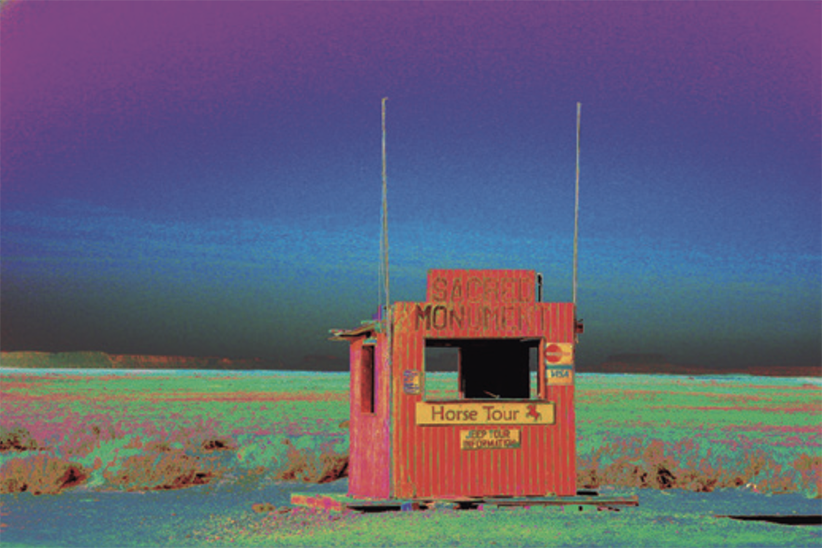
Image 1
Sacred monument, Monument Valley
F. Cabanzo (2007)
In the syncretic context, extreme differences are upheld but aligned such that likeness is found amongst unlike things, the power of each element enriching the power of all others within the array of their differences. […] Of the myriad universes of discourse that constitute whole cultures and countries, only those open to change and adaptation are likely to survive the step change in evolution exerted by scientific development and technological innovation (Ascott, 2005: 1).
Territory significance density maps
Oklahoma towards Nararachi are related to each other by peyote, a liturgy brought from Mexico to help American native people survive after conquest and colonization struggle (Lee & Rachlin, 1971; Le Barre, 1980; Basso, 1996). Both maintain the spirit of shamanic based cultures identity and mythological cosmologies alive (Schultes & Hofmann, 1982; Gillette, 1997). Space and time through poetry and visual arts manifest major or minor ‘territory significate density’. Tables shown below resulted from a pre-trip key-word analysis applied to book poems written by Henson. Analysis applied to each poem identified: book, publication year and place (place in parenthesis - where poem was written, or place named in the content), subject (key words). The tables were built as part of the documentary preliminary research and direction research assistance to determine protagonist (Henson) possible routes and arguments during trip.2
Henson´s landscapes may put in relation places, events and people who do not belong to common synchronic frames of space and time. They may happen to result from juxtaposed layers belonging to diverse transcendental and identity significant frames, mythological, historical, and biographical dimensions.
Henson’s poetry is not abstract, it is tightly linked to places emerging from concrete and particular situations, events, people, sensations and emotions related to real places. His poems are landscapes, even when images emerge from insights, ecstasy or dreams, they are all expressing vivid moments. In a second stage, maps were built from information extracted from tables, indicating protagonist´s Places with mayor ‘territory significance density’ of places possibly crossed during ‘documentary’ trip, as no determined definite pre-established routes were designed.
Movements through territory had sort of a drift driven, almost erratic trajectory. Pre-trip and “Oklahoma-Nararachi on the road landscapes” maps were juxtaposed on a GIS, contrasting previous state and after trip ‘territory significance density’ making visible-quantitative and qualitative density variation.
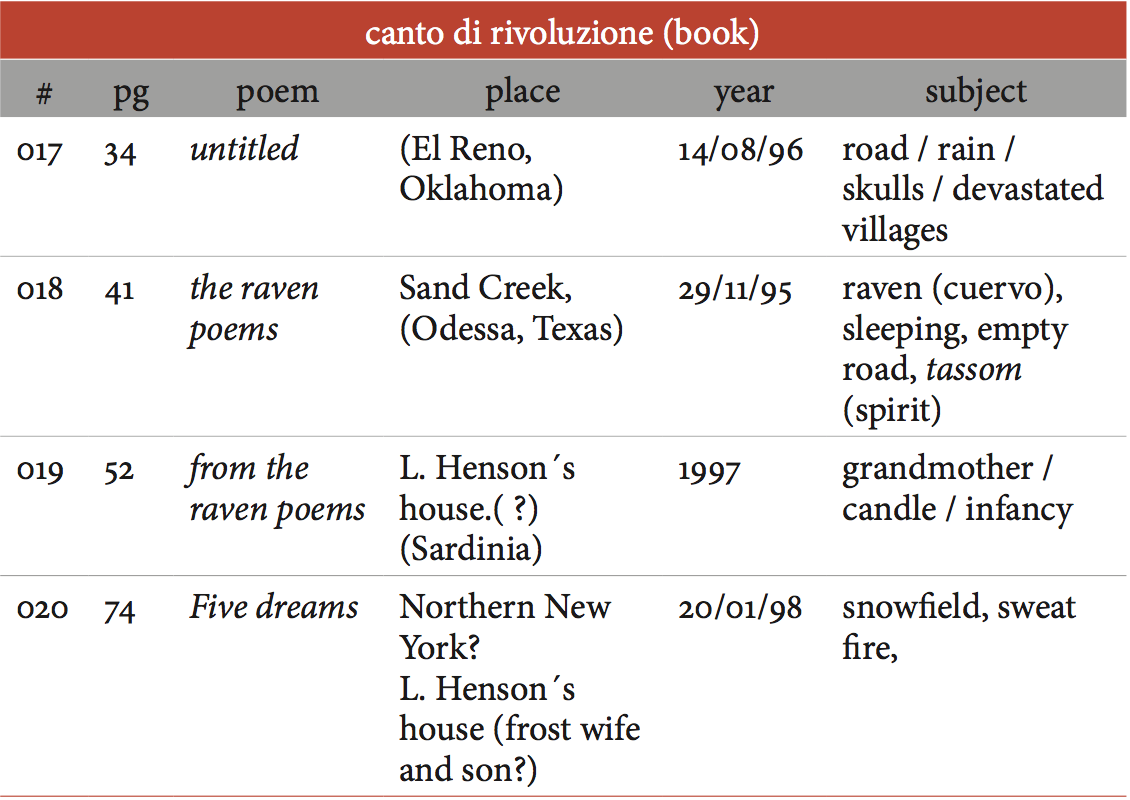
F. Cabanzo, 16/07/2006. Book – canto di rivoluzione (revolution chaint). Note. place in parenthesis = in which poem was written, place not in parenthesis = named in the poem, title or content.
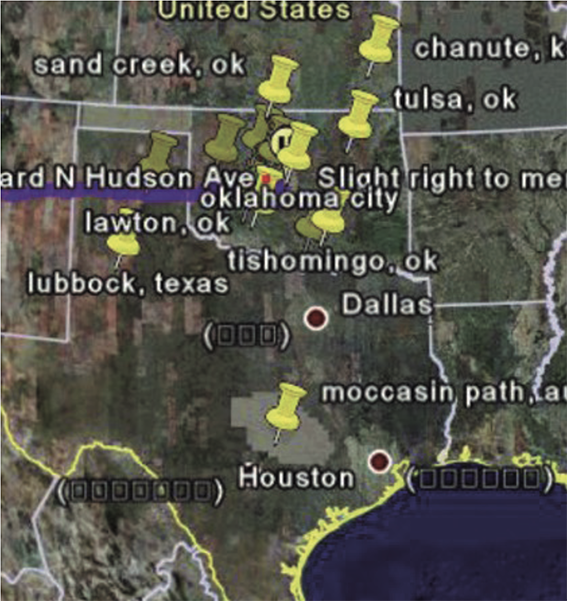
Image 2
Signi cance density map
Pre-trip Google map (2005)
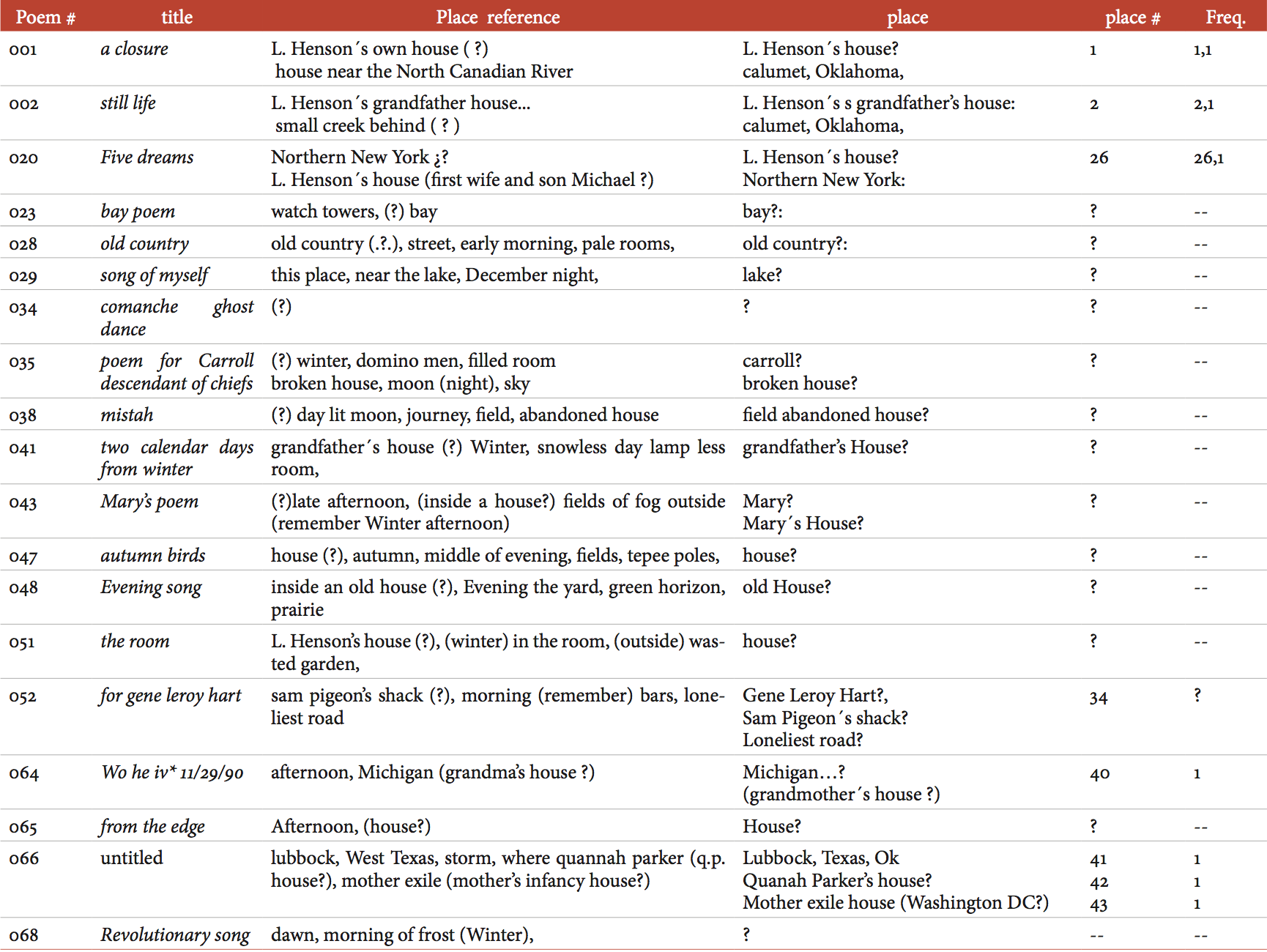
F. Cabanzo (2006).3
L. Henson’s poems analysis. Geo-located places (Google earth, map of poems – landscapes).
Methodologically, Henson’s poetry ‘territory significance density’ was assumed as subjective, particular to his personal condition appearing relative and subjective. Henson´s key-words value attributed was compared with different values (using the same key-words on internet search), being ‘relativized’ as alien values emerged: those words meant different things depending on which cultural-ethnic group`s background or interests. Diverse, and sometimes opposite meanings were given to those same words and places, landscape significance revealed subjective place´s significance as a cultural construction, in presence of cultural diversity can become diverse also, being common, un-congruent, and even conflictive.4 Images meaning is accepted to be diverse and complex (Barthes, 1981), even though often explained through universal values. When explained through post-modern (Foucault; Deleusse & Guattari) or post-colonial thought paradigms (De Sousa Santos; Mignolo; Escobar), image meanings appear non homogeneous and resulting in non-horizontal power relations: domination-submission (Clifford, 1995). Through our trip, we explored and experienced how immaterial landscape construction, appropriation, identity, perceptual sensitiveness and representation varied. In the case of America’s contemporary territory, it depended on the ‘sense’ and attributes given by different cultural groups to places making this trip with a mix-blooded documentary-protagonist, a native American, grown and educated in the hegemonic-occidental-modern-logic-rational-colonial-academic-euro-centered values system, and also in the magic-mythological-traditional-informal-adaptive-sibversive-peripheral-post-colonial-native values system. The trip made it possible to identify ‘hybrid’ elements of both systems, in which poetry images and landscapes were at the same time present in ‘real’ and ‘virtual’ space-time dimensions.
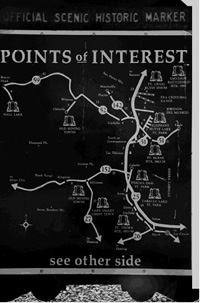
Image 3
Touristic map on a rest point near True or Consequences
F. Cabanzo (2006).
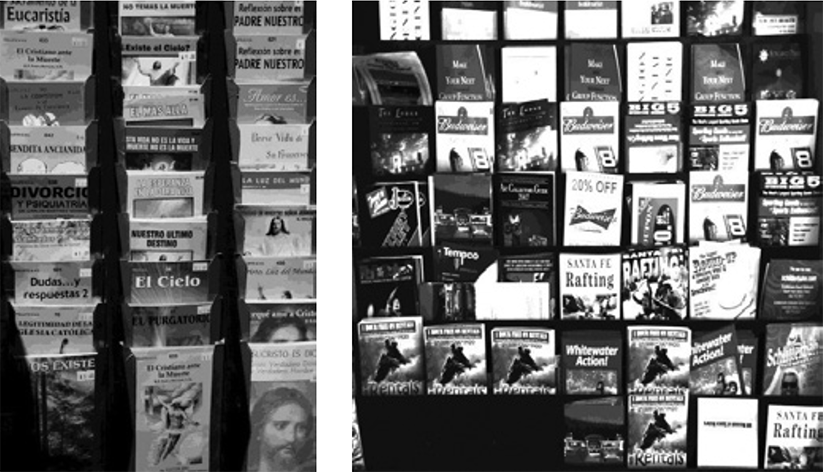
Images 4 & 5
Two images of trail touristic lea ets found during trip
F. Cabanzo (2006)
‘Territory significance diversity’ evidence emerged through visual and poetic narratives form different cultural groups. Touristic leaflets offered ‘on the road’ (bus stations, motels and gas stations displays): Group 1- dominant (WASP) are delivered to tourists seeking for ‘adventure’ (Western-frontier, cowboy/Indian, ‘Gold’, casino, xxx as values of a ‘Fortune’ frontier land). Group 2- peripheral catholic-latino-spanish-chicano is delivered to Christian travelers route towards ‘heaven’. We drove our way on a Group 3- peripheral native inexistent-leaflet-display recognizable route driven only by a mix-blooded protagonist through “peyote-road”.
Identities in transit
Globalized main-stream cultural systems mainly invest resources and efforts in cultural identity stabilization (Rosaldo, 1993; Garduno, 2004), seeking permanence and prominence through power and domination (Foucault, 2004; Schroeder, w. d.), over (ex)-colonial peripheral geographic and cultural places, restless places (Fracasso, 2013), places where identities in transit adapt and resist (Cabanzo, 2010; Lacapra, 2004). This article is written by two “mestizo”5 (mix-blooded) non-homogeneous cultural identity subjects, Cabanzo and Henson, coming both from resistance cultural areas in relation to the dominant cultural main-stream. This cultural ‘submission-edge’ cultural condition in which identity seems to be determined by cultural dominant stereotypes, make authors aware of their ‘mestizo’ condition of resistance that determines the need of an ‘extra effort’ to be able to earn a native existence through euro-centric dominant values. The ‘mestizo’ co-existence in people’s values of at least two un-concealed cultural systems determine the need to assume contradictory identities; ambiguous identity belonging in terms of non-clearly space-located, nor well contoured-image defined, assumed as a contradictory ‘in transit’, work in progress identity. Identities struggle for `mestizo’ are the result of subjective self-tailored gender approach construction, due to the selfness/consciousness and behavior/practices conflict.6 This identities ‘in transit’ conflict is resolved by isolation or adaption through “syncretic” adopted7 strategies. “Syncretism” (Ascott, 2005) manifests a conflict lived by subjects inhabited both with oppressor-oppressed identities, but also generates incongruity with nationalism, ethnicity, and racialized community based identities (Gedalof, 2000). ‘In transit identities’ imply moving through ambiguity, ambiguous, in motion, fragile and in the limits of ephemeral survival, non-strength based resistance (Pratt, 1992; Cabanzo, 2010), not passive. ‘In transit identities’ also stand for trascendental trip dislocation, lived through arts (Kuspit, 2003), moving from rational aesthetic values towards ecstasy trascendental aesthetic values (Eliade, 1995). Within American territory juxtaposed often conflictive and violent cultural and aesthetic values struggle between European and native identities (Schultes, & Hofmann, 1982; Thevenin, 1956), determine a conflict against traditional knowledge frequently associated with out of law drugs and states of madness or intoxication (Jaspers, 2001).
Bodies and mestizage
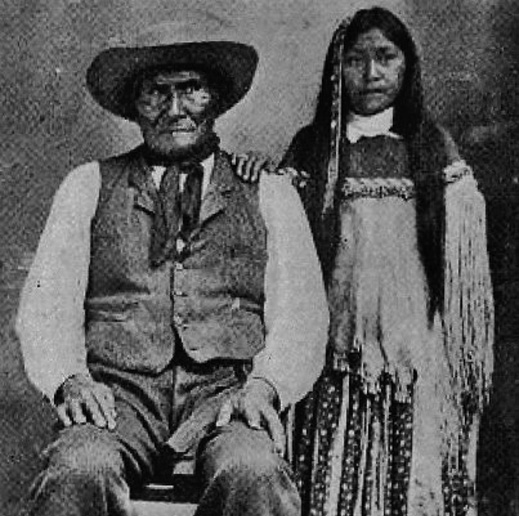
Image 6
Chief Geronimo and wife
Halaas & Masich (2004)
Images appearing in visual, oral, text, space or performative formats are iconosophies as forms of human knowledge (Jori I Gomilla 2000-2001). They also make part of contemporary arts expressions as ways of nowadays people´s embodying identities. This relations between knowledge and art within people’s identities happened to manifest during ‘peyote road’ trip in many ways: events, meetings, day by day relations, interviews and occasional encounters. Avoiding inhabitants stereotypes, while characterizing people or places appearing within the filmic space was solved by adopting a syncretic tactic: assuming that characterization was complex, ambiguous and not easily recognizable. Before the trip several interviews with Henson, and internet key-word values were useful, when juxtaposed, they both helped to develop tables and maps that made certain ambiguous patterns emerge, avoiding misleading stereotypes.
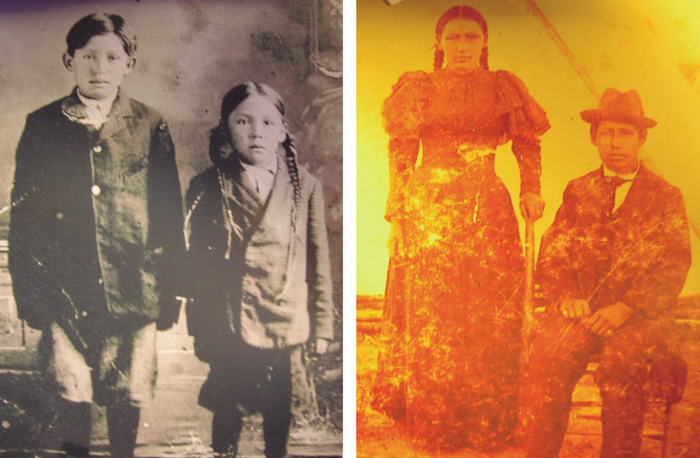
Images 7 & 8
Henson’s relatives
Personal archive
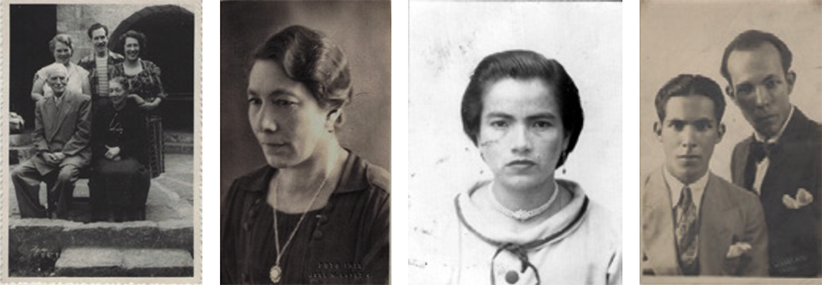
Henson helped also to understand syncretic and resistance patterns manifesting through body language. In his apartment in Bologne he showed a pair of photographs hanging on his studio walls, they showed his relatives wearing occidental clothing, abandoning traditional native clothes and objects while women still used to resist wearing certain suits, decorations or combing their long hair with braids. Again reality margins happened to dilute, things and bodies were much more than they appeared to be. Certain stereotypes were overcome through syncretism, creative adaptation and mestissage helped to move frontiers activating overlaps and contaminations that generate an incredible fan of ambiguous images and characters.
Images 9-12
Cabanzo’s relatives
Personal archive
This made Cabanzo remember some pictures of his own family album. Things in common appeared, although distances happened to exist in space and time (between Colombia and the USA), as in his mother’s grandma picture: Elvira Uribe, “Tutta”,8 Cabanzo´s mother´s grandma appeared alone at first (Image 10), and seated with his husband “Tutto” (son of Spanish immigrants) with his brothers and sisters (Image 11). Tutta´s face traits and hair braids help to identify her native origin. The same situation of “whitening” (blanqueo) happens with aunt Toledo Piraquive (top-right), whose second surname easily helps to identify her native ancestors while her dress and hair are occidentally shaped. Ethnic facial traits seem to disappear on three of Tutta´s “mestizo” sons, who are more similar to their father´s (Spanish origins), their bodies are dressed in a completely Occidental-European modern way. But Efrain (Image 12, right) inherited Tutta´s native traits (bottom, on the right hand of picture with cousin). This analysis for Cabanzo and Henson relatives body behavior was made based on a picture of mix-blooded Cheyenne, George Brent´s biography (Halaas & Masich, 2004), in which he appears dressed in Occidental clothes except for his native beaded moccasins, while his wife Magpie wears a traditional wedding dress, braids and accessories.
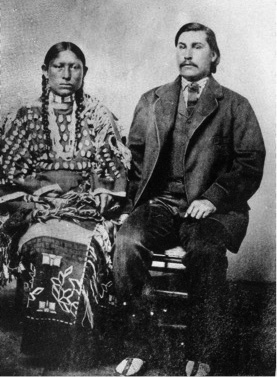
Image 13
Cheyenne George Brent and wife Magpie
Colorado Historical Society, in Halaas & Masich (2004)
During ‘on the road´ trip over Navajo territory, Malcolm Mc Abee, a young shepherd, NAC roadman and traditional Navajo medicine apprentice, gave us his peyote blessing at Kayenta. Malcolm took us to Monument Valley where he was asked by his grandfather, NAC roadman, John Holliday to bring his traditional dress, his turquoise and silver jewels (symbols of power and hierarchy) before we could take them a picture. The dress and adorns guaranteed the respect and dignity he deserved, even though his age and illness didn´t allow him to work as a priest and medicine-man anymore and forced him to move with crutches.
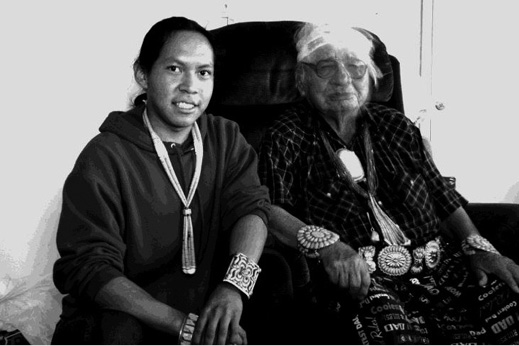
Image 14
Marcolm McAbee and Grandfather John Holliday
F. Cabanzo (2006)
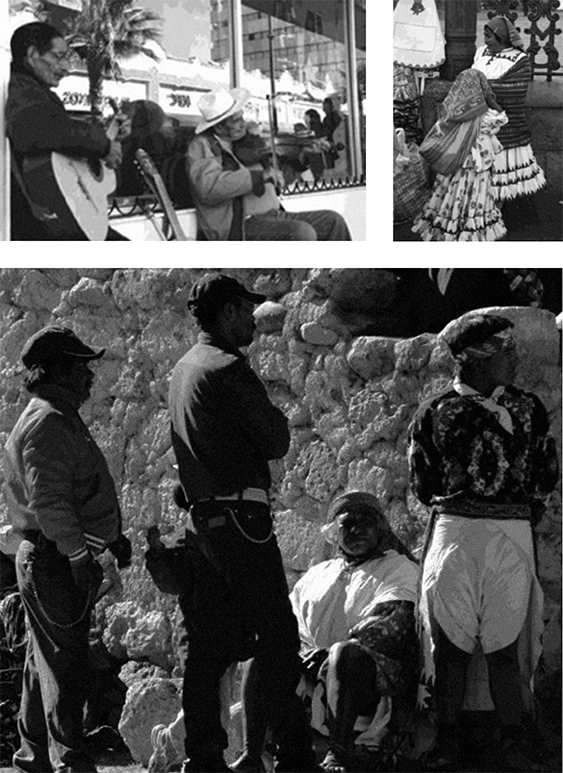
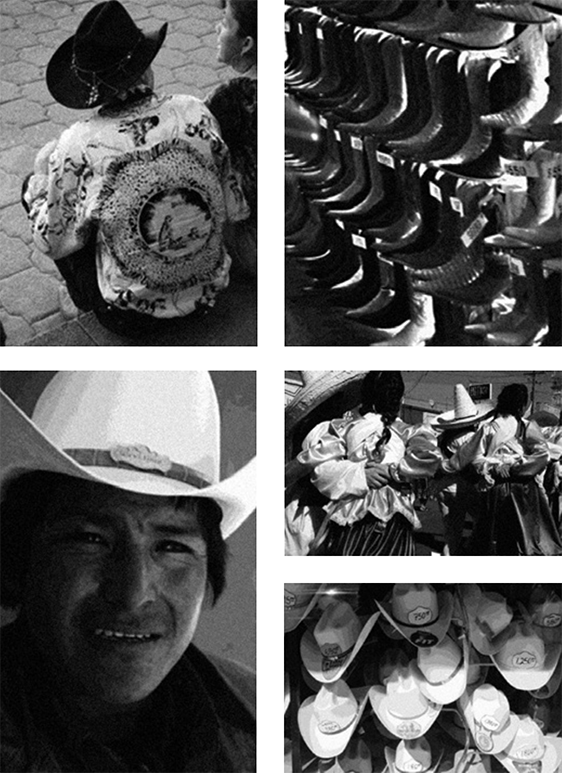
The same analysis is applied to three pictures shot in the streets of Chihuahua: first with a couple of Mexican mestizos playing guitars and violins (introduced by Colonial missionaries), while singing rancheras and corridos: images show Spanish-identities dressing and body behaviors over native traits faces. The second one was shot a few meters away by the Chihuahua Colonial cathedral building, here Tarahumara ladies gather still wearing traditional suits and accessories, and nothing seems to have changed from the Pre-Colonial years. The third image, shot in Nararachi, (Sierra Tarahumara) shows Tarahumara men, some of them look like ‘Contemporary’ acculturated people, wearing baseball caps (also petroleum and mining workers wear them too), jeans and boots, while traditionally dressed men are standing on the back.
Images 15-17
Cuauhtemoc, Chihuahua, Nararachi
F. Cabanzo (2006)
The same symbols are worn by people during the Independence Day parade in the city of Cuauhtemoc (Chihuahua State). Instead of military cars parade Tarahumara boys and girls still run kicking a wooden ball the same way they do in the Sierra, where Tarahumara people call themselves Raraimuri, which means ‘the people who run’.
Images 18-22
Cuauhtemoc
F. Cabanzo (2006)
These frontier lands were plentiful of American cowboy imaginaries, cowboy hats and ostrich-skin boots appeared in presence of Raraimuri body-behavior resistance. All made sense: as when Henson in his poetry spoke of him writing his “words from the edge”, those images captured came from this same place. Appearances under the syncretism gaze become powerful and eloquent to fight against acculturation and dismissive stereotypes, they keep on helping tradition hide away and persist through time and space, under a chameleonic skin. As an example, see the main character poet Henson written by Lanchares for the documentary project:9
Henson. It is a robust man of 61 years old, measures one seventy-five tall. It has long black hair slightly wavy, graying beard and brown eyes. The color of your skin is quite clear, Henson looks much younger than she is, her posture when walking is right, he practiced sport and has a black belt in taekwondo. At first glance, Henson looks like a "Hell Angel" a vagabond poet wears a black leather jacket and shoulder bags. Henson, was born in Washington, D. C. in 1944, Cheyenne and Oglala. He was raised on a farm near Calumet, Oklahoma by her great aunt and uncle grandfather, Bob Cook and Bertha. His great uncle was he shaman of Chapter One of the Native Church American from Oklahoma, a non-Christian influences, which uses as the hallucinogenic cactus peyote sacrament. Henson was the last of five children raised by this couple. He grew up immersed in the culture Southern Cheyenne (Lanchares, 2005).10
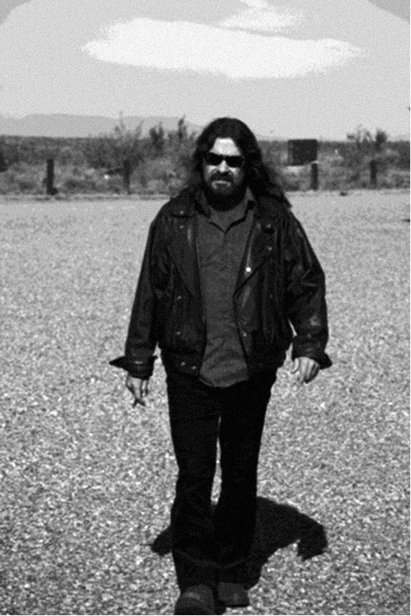
Image 23
Henson, New Mexico
F. Cabanzo (2006)
Visual arts “dialogos” series
“Dialogos” (dialogues)11 series speak about contemporary aesthetic experimentation and research focused on ‘in transit’ identity. Particularly, the series shows this dialectic absence, or its expression in form of confrontation or re-appropriation.
A set of a set of artworks perform,12 for syncretic resignification purposes: alien-peripheral iconography values and cosmologies (referred to native part of mix-blooded culture) juxtaposed over “totemic”, almost “sacred” contemporary visual main-stream Occidental artworks determine a platform to establish “Dialogos” (dialogues) in the mix-blooded-in transit subject sphere, as an effort to appropriate art-agency spaces (museums and collections) and academic-agency scientific institutionalized spaces (PhD).
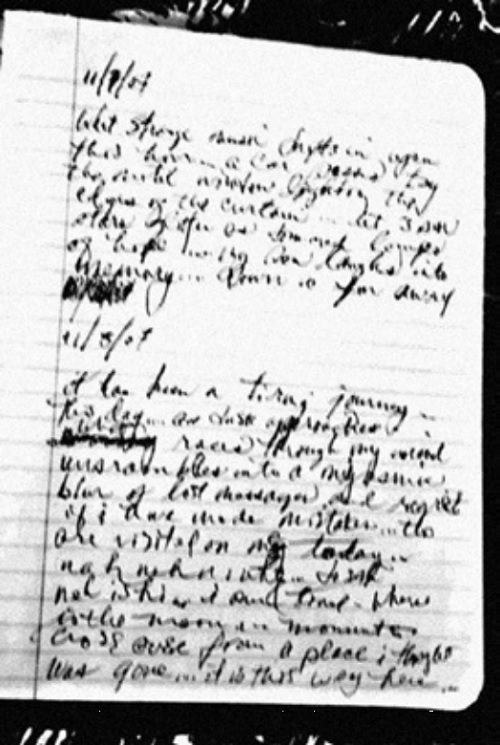
Image 24
Henson´s poetry composition manuscript during trip.
F. Cabanzo (2006).
Henson met his son at the airport, and his friend poet Barney Bush. At the airport’s nearby barbecue restaurant, conversation was relaxed, Independent documentary production (mainly with Cabanzo financial resources). Barney Bush became a silent vigilant presence during the trip, he was the only one with a driving license, becoming the troupe driver.13
el reno, Oklahoma
it has been a tiring journey this day
a dusk approaches what races through my mind
unscrambles into a myasmic blur of lost
messages and regret
if i have made mistakes
they are visited upon me today
nahchinehiutd dosah
neh ishi
i am tired
where is the moon
moments cross over a place i thought was gone
it is this way here...
Source: L. Henson, El Reno, Oklahoma, 08.11.2007 poem 02-tour
Images 25-30
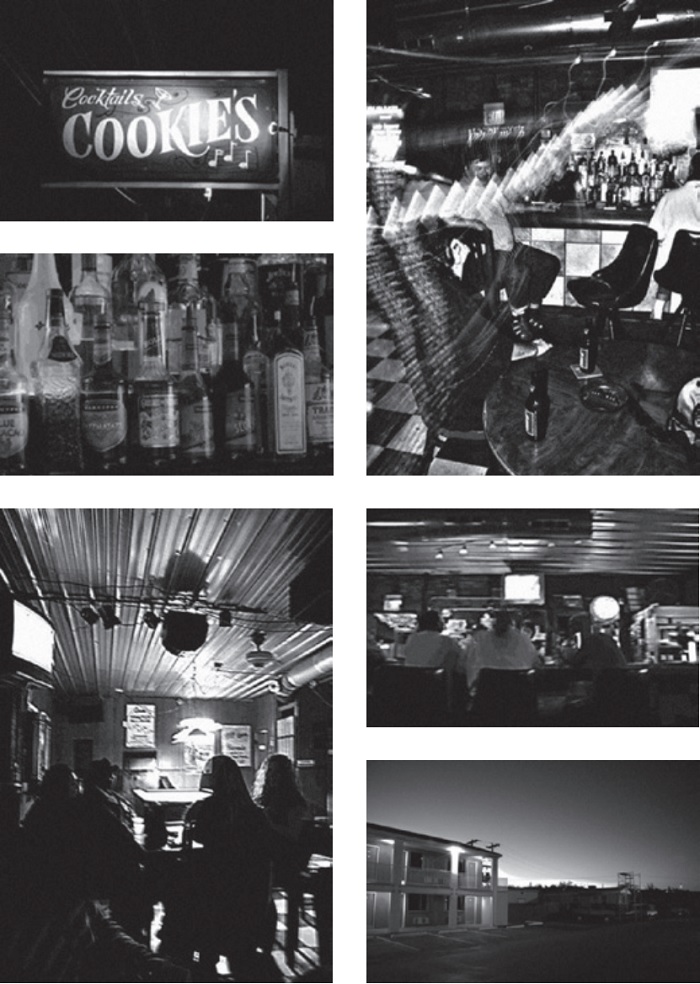
Cookie´s Bar, Oklahoma City.
F. Cabanzo (2006).
twelve mile point
at twelve mile point we stand in a cheyenne river wind...
she was allways showing us her beadwork...
Source: L. Henson, twelve mile point, Oklahoma, 09.11.2007, poem 03-trip
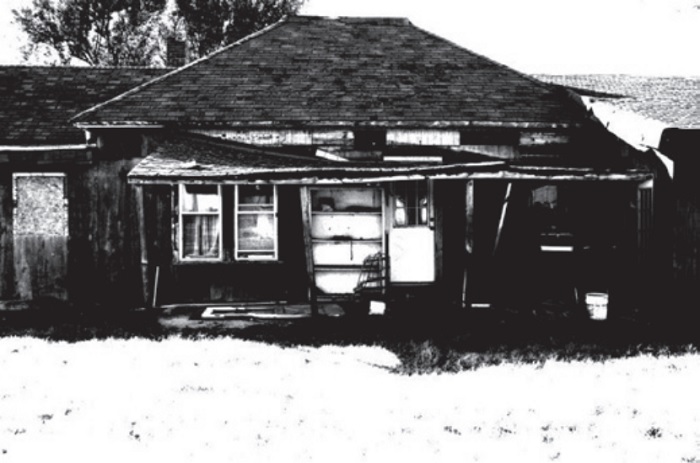
Image 31
Ben Cook’s ranch (Henson´s house). Twelve Mile Point, Calumet.
F. Cabanzo (2006).
twelve mile point
funnel of wind
coyotes calling
faint calling of owl
know the owls
familiar...
Source: L. Henson, Twelve mile point, Oklahoma, 09.11.2007, poem 04-tour
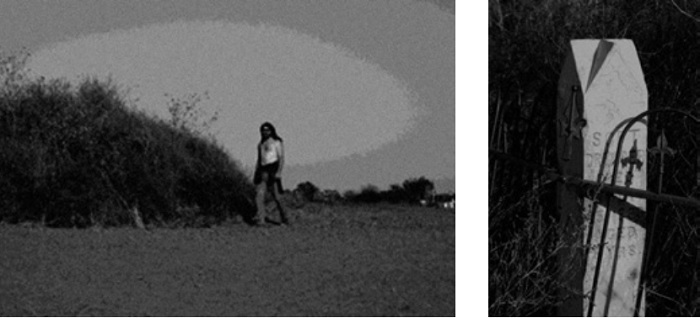
Images 32 & 33
Sacred places, Henson´s relative tomb-Soft Dresser place, Twelve Mile Point, Calumet.
F. Cabanzo (2006).
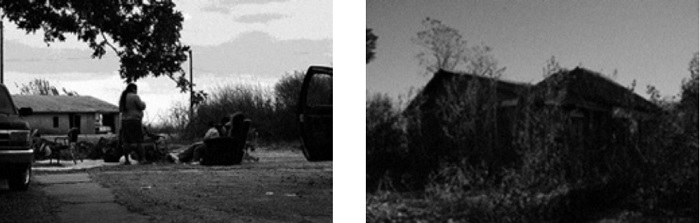
Image 34 & 35
Ben Cook’s ranch (Henson’s house), Twelve Mile Point, Calumet.
F. Cabanzo (2006).
Calumet, Oklahoma
home place. prairie sage... visitation
gathering of cedar... walking to soft dresser
darkened earth... ride the highway west
away from home...
Source: L. Henson, Calumet, Oklahoma, 10.11.2007, poem 05-trip

Image 36
Henson´s trip poetry notebook.
F. Cabanzo (2006).
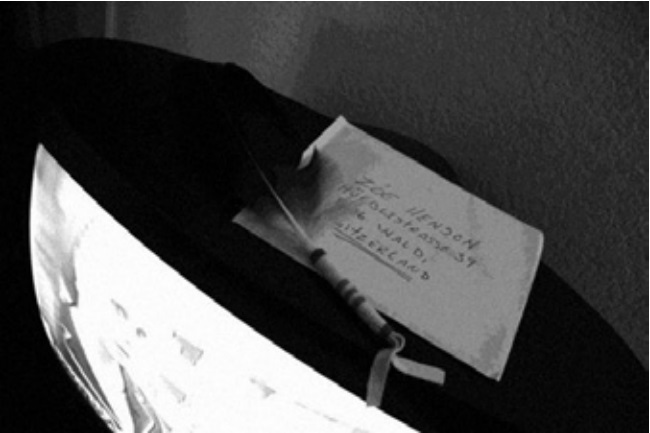
Image 37
(dedicated to Zoe), on the road’s motel room.
F. Cabanzo (2006).
Conclusions
´Territory Significance Density´- TSD is expressed in the form of: Henson’s poems compositions (pre- trip) place - places where written, - or named on poems (key-words). Research hypothesis was confirmed during preparation for the trip: space and time in territory for Henson are not homogeneous, nor empty of significance and density. The major the quantity of poems (visual and literary), the higher the ‘Territory Significance Density’ attributed to a place. The second hypothesis confirmed during fieldwork, was that places and of day-by-day facts were the raw material with which Henson composed his ‘landscapes’.14 As a result, during the trip and afterwards, we were witnesses to how territory significance density increased while moving ‘on the road’. Arts-based research suited both, knowledge production and aesthetic creation purposes.
References
Artaud, A. (1972). Viaje al país de los Tarahumaras. Barcelona: Barral.
Ascott, R. (2005). “Syncretic reality: art, process, and potentiality”. In Drain Magazine, November, pp. 1-12. Available in Internet: http://drainmag.com/index_nov.htm [Consulted 25/06/2018].
Basso, K. H. (1996). Wisdom Sits in Places: Landscape and Language Among the Western Apache. Albuquerque: University of New Mexico Press.
Cabanzo F., L. Henson, & F. Lancha res (2011). “Oklahoma-nararachi [visual art performance and poetry lecture]”. In XVII Convegno Internazionale di Studi Cinematografici: Cinema & Diversità Culturale. (Program) Universita Roma Tre, Teatro Palladium, Roma 28-29-30 Novembre. Available in Internet: http://gina.uniroma3.it/download/1321547201_152.programma%20convegno.pdf [Consulted 25/06/2018].
Cabanzo, F., L. Henson, & F. Lanchares, (2012). Haeretici, mostra d’arte contemporanea Barletta, Italy, dicembre 2011–gennaio 2012. Barletta: Magmart, pp.18-19. Available in Internet: http://franciscocabanzo.blogspot.it/2012/05/oklahoma-nararachi-cabanzo-2012-video.html
Clifford, J. (1995). Dilemas de la cultura. Antropologia, literatura y arte en la perspectiva posmoderna. Barcelona: Gedisa.
Foucault, M. (2004). Vigilar y castigar, nacimiento de la prisión. Madrid: Siglo XXI Editores.
Fracasso, L. (2013). I luoghi inquieti. Arte e città in rete. Claudio Grenzi Ed. Foggia.
Garduno, E. (2004). “Cuatro ciclos de resistencia indígena en la frontera Mexico-Estados Unidos”. In Revista Europea de Estudios Latinoamericanos y del Caribe, No. 77, pp. 41-60.
Halaas, D. F. & A. E. Masich (2004). Halfbreed: The remarkable true story of George Brent - Caught between the worlds of the Indian and the white man. Cambridge: The Capo Press.
Lacapra, D. (2004). History in Transit: Experience, Identity, Critical Theory. New York: Cornell University Press
Lanchares, F. (Dir.). (2009). Impressions from Peyote Road [Documentary]. (32 min. Color digital). Festival Archivos OVNI. Barcelona: Centre de Cultura Contemporania de Barcelona – CCCB. Available in Internet: http://www.desorg.org/autors/lanchares/ [Consulted 25/06/2018].
Le Barre, W. (1980). El culto del peyote. Madrid: Premia Editora.
Leavy, P. (2015). Method meets art: arts-based research practice. New York: Guilford Press.
Mancilla, M. L. (2002). Apuntes de viaje al interior del tiempo. Barcelona: Fundación Caja de Arquitectos.
Pratt, M. L. (1992). Imperial Eyes: Travel Writing and Transculturation. London-New York: Routledge.
Salazar-Zarco, A. L. (2014). “Identidades en tránsito. Migración y reapropiación del espacio en el sur latinoamericano”. In Economía, Sociedad y Territorio, Vol. XIV, No. 45, pp. 581-592.
Tuan, Y-F. (1977). Space and place the perspective of experience. Minessota: Minessota Press.
Notes
(2012). “Faccia” – IV, with Giuseppe Penone “Faccia” 1973.
(2011). “Art. 11 / Altare delle attese” - III, with Lucio Fontana, “Concetto Spaziale, Attese” 1959.
(2010). “DVD-Buddha” - II, with Nam June-Paik, “TV-Buddha” 1974.
(2010). “Rubinetto a colori,” - I, with Michelangelo Pistoletto, “Rubineto in bianco e nero” 1979.