Recepción: 24 Octubre 2024
Aprobación: 05 Febrero 2025
DOI: https://doi.org/10.33304/revinv.v20n1-2025007
Abstract: This research focuses on Ecuador’s participation as a non-permanent member of the United Nations Security Council in the periods of 1991-1992 and 2023. It examines the role of international organizations such as the Security Council and their influence on events in a small country like Ecuador. The study traces back the evolution of the political model from the Cold War to the present day, concentrating on the effects of polarity and alliances on the decision-making process. Previously, unanimity prevailed in Council votes. There is now a greater disagreement among the powers, posing an additional challenge for Ecuador, which seeks to maintain its agency in politics without yielding to external pressures. In its voting, the country has endorsed a policy of non-alignment based on respect for international law to navigate a constantly changing global system.
Keywords: international system, Non-Aligned Movement, institutions, polarity, small country.
Resumen: Esta investigación se enfoca en la participación de Ecuador como miembro no permanente del Consejo de Seguridad de las Naciones Unidas en los períodos de 1991-1992 y 2023. Examina la función de las organizaciones internacionales como el Consejo de Seguridad y su influencia en los acontecimientos de un país pequeño como Ecuador. Se destaca la evolución del sistema desde la Guerra fría hasta la actualidad, resaltando los efectos de la polaridad y las alianzas en la toma de decisiones. Previamente predominaba la unanimidad en las votaciones. Ahora existe una mayor discrepancia entre las potencias, lo que presenta un reto adicional para Ecuador, que busca mantener su agencia política sin ceder a presiones externas. A través de las votaciones se observa que Ecuador ha respaldado una política de no alineamiento, basada en el respeto al derecho internacional, para así poder navegar en un sistema internacional cambiante.
Palabras clave: sistema internacional, agencia, Movimiento de los Países No Alineados, polaridad, país pequeño.
Introduction
The Security Council is one of the six principal organs of the United Nations (UN), primarily responsible for upholding international peace and security (Carranco, 2022). It is composed of five permanent members: The United States (US), France, the United Kingdom, China, and Russia, plus ten non-permanent members that rotate every two years, and other member countries elect. The permanent members have veto power, which means that resolutions can only be approved if none of them votes against. Although the other countries do not hold the same power, they also occupy a privileged position, as their voting capacity demonstrates their national stance and integrates them into various aspects of the international system, including its internal dynamics.
This document covers Ecuador’s terms on the Security Council in 1991 and 1992, as well as its current period, which began in 2023. It is essential to analyze both times, as the configuration of the international system has evolved over the years to its current state. Thus, Ecuador’s agency in different contexts is observed to determine changes in its interventions according to the circumstances or consistency with its alignments, which helps to understand the functioning of the country’s foreign policy within an international organization.
Ecuador’s last term in the UN Security Council was characterized by a certain uniformity following the polarization between the US and the Union of Soviet Socialist Republics (USSR) that arose after World War II. These countries competed for global domination in all areas, causing constant tension until 1991, when the USSR officially dissolved, and the US emerged as the leader of a unipolar world (Rodríguez Hernández, 2014). With a weakened USSR in 1991, followed by its dissolution, and Russia already acting in the Security Council in 1992, the balance shifted in favor of the US. It was demonstrated within the Security Council that the influence of the USSR, and later Russia, had reduced. During Ecuador’s term in those years, the US and Russia had abandoned their direct enmity. Russia could not propose its political agenda to this international entity, which led to more unanimous decisions in the Council, with very few disagreements and even no vetoes. This can be seen in the Council’s votes in 1991 and 1992 (UN, n.d.), in which Russia and the US, the two most powerful nations to date, did not act against each other.
Ecuador rejoined the UN Security Council in 2023, and the international landscape looked different. Many believe that this is a time of change, where the US continues to dominate militarily. However, economically, they are no longer the unique power, as other forces that have altered the international system and its pattern emerge (Shifrinson et al., 2023). Currently, a total reorganization is occurring, in which power is more distributed globally and states are no longer its only agents; thus, “a group of emerging powers compete and act in alliances to achieve a new distribution of world power, trying to end the unipolar coalition led by the United States” (Rodríguez Hernández, 2014, p. 58). This change can also be observed in Security Council votes, where it is increasingly complicated to approve resolutions due to constant disagreements and vetoes by the powers as part of their struggle. Unlike in the past, when voting in the Council was straightforward and the majority acted alike, Ecuador must now proceed carefully within the international system. As a country highly dependent on powers, it needs the help of the most influential states to boost its economy.
The international system is “a set of actors, factors, processes, and patterns that interact frequently in a specific space and time under certain rules and based on a guiding principle” (Velázquez, 2011, p. 159). Ecuador’s limited position within the international model is the reason it has been part of the Non-Aligned Movement (NAM) since 1981. This was created for neutral countries during the Cold War under principles such as respect for human rights, sovereignty, integrity, non-intervention in internal affairs, and the promotion of international cooperation (Fabara Espín, 2021).
Belonging to the UN Security Council means that the country is somehow part of the structure that governs the rest. It is an exceptional moment for the county to increase its action capacity, an opportunity to realize that, although with limited potential, there must be a guideline or strategy for harnessing the circumstances. In this sense, understanding the non-alignment and the contexts from the 1991-1992 and 2023 terms can explain Ecuador’s decisions within the Security Council during both periods. As actions such as voting patterns are highlighted here to verify non-alignment or stance and to assimilate them in an increasingly conflictive world, the country's diplomatic line and eventual adherence to them are described.
In international relations, change is constant, and states must adapt to it; thus, this work provides a more profound explanation of Ecuador’s position in context. It also traces the decision-making process of a country with less relevance in the system and within an international organization such as the UN. This analysis contributes to foreign policy studies, specifically in small nations for which the bibliography is limited. The text describes the agency’s or state’s ability to proceed independently according to its needs.
Theoretical framework
Interacting parties such as states and international organizations constitute the global system. This research is guided by institutional liberalism, which defines international organizations as stabilizers of the system through cooperation, even in times of anarchy. Through these actions, institutions regulate the behavior of states to achieve common objectives that promote positive relationships among all involved (Pease, 2007). In these parameters, all states can exert a certain degree of agency within the framework of cooperation; therefore, this account focuses on a small country acting under institutional liberalism, where organizations influence state decisions, a noticeable dynamic in times of greater agency.
A small actor in the international system
Regardless of their characteristics, all states are part of the international system. They vary in size, economic power, political influence, and military strength. Understanding these characteristics, Keohane (1984) classifies states into four groups: (a) those that determine the system, (b) those that significantly influence it without dominating it, (c) those that can affect it through alliances, and (d) those that are ineffective in actions. Whereas this division helps to understand the functioning of the international system, it excludes the position of countries such as Ecuador.
Keohane (1984) defines small countries as “a state whose leaders consider that they cannot, by themselves or in small groups, have a significant impact on the system.” This concept implies that a small state is much more dependent than a fully developed one. This research discards factors such as population, gross domestic product, and military strength to focus on the concept of a small state based on its participation in foreign policy. In addition to Keohane's remarks, East (1973) and Hey (2003) argue that a small country has low participation in global affairs but a high level of intervention in international or regional organizations (multilateralism). These kinds of nations focus on the morality of their foreign policy, respecting legal norms or international law, and showing that they find opportunities in multilateralism to position themselves in the global arena, even though their action capacity remains limited.
To increase the participation of these states in the international system, the Non-Aligned Movement (NAM) was officially established in 1961 as an alternative during the Cold War for countries seeking better international positions. Not aligned with any of the superpowers of the time, it was based on the ten principles of Bandung, which include respect for human rights, territorial sovereignty, non-intervention in internal affairs, and the promotion of international cooperation (NAM, n.d.). It also promotes justice and compliance with international obligations, as these facilitate refined implementation of the other principles.
The role of institutions according to liberalism
In international relations, liberalism perceives the state as a decentralized entity, but not the only one, recognizing that non-state actors can be of similar or greater importance. Although the system is inherently anarchic, it considers humanity to be good and believes that the interest in cooperation and mutual aid through regulatory organizations can overcome selfishness (Lozano, 2016). It also underlines that cooperation is possible due to complex interdependencies, which prevent the notion of self-help and conflict in the pursuit of individual interests (Jiménez González, 2003). It is a theory that sees the world in a causal manner, where some actions generate predictable reactions in the international context.
International relations are conflictual, and the structure of living, anarchic. However, cooperation via multilateralism can monitor this power struggle. Institutional liberalism, or institutionalism, addresses the reasons that lead to processes of international cooperation. It considers institutions as resources for agents or members of the global model to achieve their objectives (Lallande, n.d.). International cooperation occurs when “actors adjust their respective behaviors to the preferences of others through a process of political coordination” (Keohane, 1984). Nevertheless, institutionalism also establishes that this process can only happen when states consider these international bodies to be facilitators of their objectives.
Institutions and state behavior
Institutions demonstrate that, through specific processes, they can achieve predictable results in the search of common goals and can standardize the behavior of states due to their ability to formulate and enforce rules. They found public order, the rule of law, and collective goods (Krasner, 2010). Given the anarchic nature of the system, institutions are the best tool to combat it, as nothing else can govern the behavior of all. Participation in these bodies is voluntary, but it entails the obligations imposed by the institution. It means that, to reach agreements on issues, countries must converge and compromise to arrive at joint solutions; however, the benefits of participation outweigh the costs (Keohane, 1984).
States influence the functioning of institutions, but institutions can modify the behavior of states. International entities are “persistent and connected sets of rules (formal and informal) that prescribe roles of behavior, constrain activities, and shape expectations” (Keohane, 1984). Established in areas of common interest, institutions ensure predictable behavior of their members and call for order within the international system since they influence the behavior of states using their normativity. Thus, states tend to act based on the principles of different organizations, not necessarily out of conviction, but because increased cooperation offers greater possibilities for addressing the everyday needs dictated by those institutions (Lallande, n.d.). The UN can therefore be understood as a persuasive phenomenon that modifies state preferences, leading to more cooperation and fewer conflicts.
Methodology
According to Keohane’s division of states, not all countries played the same role within organizations. This notion was reflected in the case of Ecuador, a country with needs for help and alliances on the international stage to achieve its objectives. Liberalism suggests that we live in a world full of anarchy, where chaos ensues due to power struggles without institutions to help regulate the behavior of states within a framework of common goals. Contextualized as the ultimate example of global governance, the UN is responsible for regulating the positions of states through equality, sovereignty, and international law.
Institutions are assumed to be modifiers of the behavior of member states, which, by accepting integration, also salute their principles and norms to increase cooperation. Therefore, this research explores the causal relationship between institutions and their effect on the actions of a small country. This means understanding Ecuador as a nation with limited agency, but one that increased its decision-making capacity when it was part of a larger structure such as the UN Security Council. However, the institution still influences decision-making based on what is right, depending on the context, to maximize gains.
This research aims to comprehend Ecuador’s actions as a non-permanent member of the UN Security Council and establish which determinants influence the country's voting behavior and its agency and limitations. For this purpose, the voting behavior in the periods 1991-1992 and 2023 was first descriptively analyzed, observing the approved resolutions and the behavior of the Security Council, specifically Ecuador's stance on these issues. Two questions arose from this analysis: What was the international system like during these periods, and how did it affect this organization? How were Ecuador's votes, and what were their implications for a small country?
Two variables were proposed to examine the effect of institutions on power and agency. As qualitative research, it focused on identifying observable patterns by collecting and analyzing data that confirmed a cause-and-effect relationship between these variables and Ecuador's behavior within this organization (Jatobá, 2013).
The contextualized materialization of the concept “institution” drew on information about the distribution of power and the influence of organizations during the periods 1991-1992 and the present. Addressing these two situations separately showed how this division affected conflicts and the system, specifically the role of international organizations such as the UN. This was demonstrated by the number of resolutions approved or vetoed in the years mentioned.
Secondary sources, including experts’ works in international relations, were consulted to obtain this information. The analysis of power and institutions fulfilled the first objective of the research, achieving an understanding of these two periods. How the world worked, how power was distributed, and, especially, the role of an institution, such as the UN, in shaping it.
Then, to account for Ecuador’s agency as a small country, non-alignment was used as a reference, observed through its actions in the Security Council. The information on the country's participation in this body and its voting behavior was gathered from the UN Council’s data library, voting section. It was then systematized in tables according to the resolution, proposing country, issue, votes in favor, against, vetoes, and abstentions. The votes of Ecuador and those of the powers were compared for each moment.
The data was obtained by triangulating primary and secondary source documentation to graph the information. After systematization, the second question was answered, revealing the impact of active non-alignment and how the institution affected the behavior of the state. In the case of Ecuador, if non-alignment remained, it implied the influence of institutions on the state; otherwise, the absence of continuity in foreign policy would indicate that the UN impacts the country's behavior. Through the analysis of the variables, it was possible to define Ecuador's agency in the respective periods.
Results
Changes in the configuration of the international system
Within the systemic institutional framework of international relations (IR), “polarity” refers to the distribution of capacities, indicating the behavior of states, since power counts as one of the factors that shape their actions (Buzan, 2018). Polarity explains how power is distributed among states and changes over time according to historical dynamics.
Several types of polarity have prevailed in recent history. From the start of World War I in 1914 to the end of World War II in 1945, the world was multipolar, and more than two states held similar powers. Represented by the US and the USSR, bipolarity emerged at the end of World War II and lasted until 1991, with the conclusion of the Cold War. The collapse of the USSR led to unipolarity, dominated by the US. This absolute hegemony has been debated, as the American influence has declined, giving rise to new powers like China, the European Union, Japan, and India (McGlinchey et al., 2022).
The relevance of polarity lies in its explanatory function regarding the division and balance of power, which permits the forecasting of the behavior of the states within the system, involving both economic and military superiority. It also includes the ideological factor that establishes alliances and, likewise, reinforces the power of dominant states by building trust and safeguarding the interests of a group in case of conflict (Buzan, 2018). Consequently, coalitions operate flexibly and opportunistically in a multipolar system, more rigidly in a bipolar system, and hardly exist in a unipolar system (Buzan, 2018).
The UN was established in 1945 and experienced a long period of relative calmness characterized by the non-existence of direct conflicts between the powers. Its creation coincided with the Cold War and inaugurated a polarized scenario between the USSR and the US, revealing the positions and the hegemonies in the United Nations Security Council during the ideological confrontation and after it.
From its inception, the UN set out to ensure world peace, and the Security Council was responsible for making decisions. Due to the existing polarization, the Council’s ability to resolve issues diminished, as evidenced by data from the UN Library: During the organization’s first 45 years, 193 resolutions were vetoed, hindering cooperation. In contrast, between 1990 and June 2003, there were only 12 vetoes, reflecting a greater willingness to collaborate among Council members. The ineffectiveness of the Cold War in the Security Council typified this moment, while from 1987 or 1991, when this conflict officially ended, unprecedented efficiency was noted (Malone, 2004).
He adds that the level of power influence over the years is measurable through participation in international organizations such as the UN. In this setting, the permanent members of the Security Council wield influence and power over other countries and the decision-making process. Consequently, in a multipolar world, there would be multiple axes of influence and resistance; in a bipolar world, only two distinct axes; while in a unipolar world, discrepancies would be minimal.
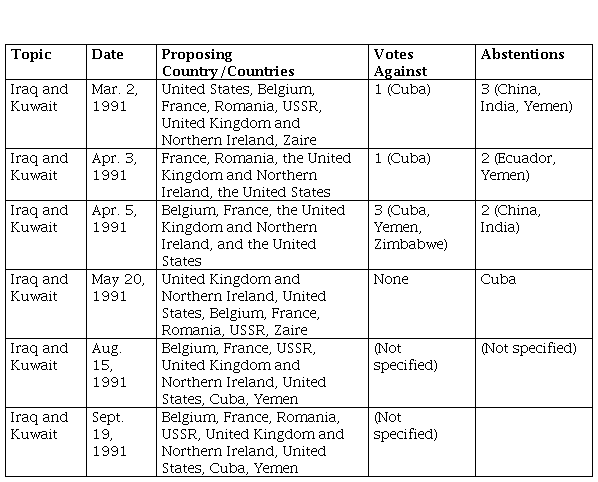
Data from the UN Library reveals the voting patterns of Security Council members. In 1991, all 42 proposed resolutions were adopted, and six were not put to a vote because of the addition of new members. There were only four abstentions: China, India, Yemen, and Ecuador. Five votes against were cast, mainly by Yemen and Cuba, and one by Zimbabwe. That year, there were no vetoes by permanent members, resulting in the approval of thirty resolutions with the maximum possible number of votes (15) from both permanent and non-permanent members (Table 1).
Votes against and abstentions in 1991
Note. Source: UN (n.d.).
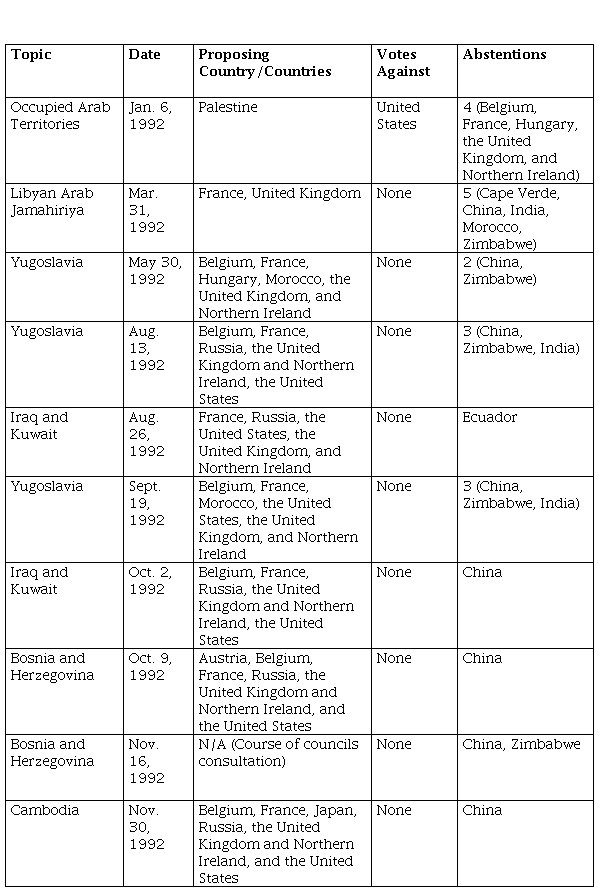
In 1992, the situation was similar, with 73 proposed resolutions, all of which were approved. Of these, 12 concerned the inclusion of new members in the UN. Table 2 shows ten instances of abstentions, mainly by China, India, Zimbabwe, and Ecuador. There was only one vote against, cast by the US, which decided not to use its veto power, and no country chose this option. Finally, all 15 members voted in favor of 50 resolutions, representing the majority of the total (Table 2).
Votes against and abstentions in 1992
Note. Source: UN (n.d.).
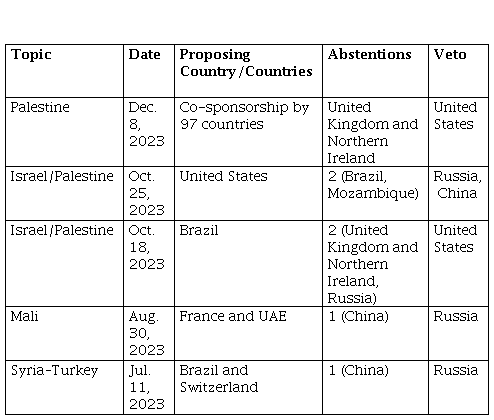
The current period, 2023, only includes the Security Council's voting data for that year. Sixty-two draft resolutions were submitted, of which 49 were approved. While this figure represents a majority, it shows a trend contrary to that of previous years. Of all the draft resolutions, 27 were subject to abstentions, mostly by permanent members. There were eight votes against, and the veto was used five times. Unlike previous periods, unanimity was only achieved on 35 occasions, representing just over half of the total for the year, as shown in Table 3.
Number of vetoes in 2023
Note. Source: UN (n.d.).
In summary, Ecuador's role as a non-permanent member of the Security Council during the 1991 and 1992 terms illustrates a time when the Security Council operated smoothly under unipolarity, with no vetoes and few abstentions or votes against. Conversely, in 2023, the weakening of U.S. hegemony and the emergence of new powers suggest a multipolar world, leading to increased discrepancies. Blockages in resolutions stem from competition between powers seeking to expand their influence. Understanding Ecuador's function in these two periods reveals the evolution of its agency.
Non-Alignment in Ecuador's Voting Behavior
For a small country, managing changes in the distribution of power poses challenges for its foreign policy, as taking sides is not always advantageous, particularly when depending on the support of others for development. During the Cold War, the world was polarized between the US and the USSR; however, less influential countries needed cooperation mechanisms and ways to secure their position within a conflict-ridden system without risking independence. The solution was to adopt a strategy of “alternatively positioning themselves in either anti-communist or anti-capitalist stances to gain support” (Fabara Espín, 2021, p. 121), leading to establishment of principles and motivations during the Bandung Conference in 1955, which ultimately gave rise to the Non-Aligned Movement (NAM) for countries considered part of the Third World.
Ecuador joined the NAM in 1981, first, because it had more in common with Third World countries; second, because it sought to reduce its commercial and economic dependence on the great powers; and third, due to a conflict with Perú, where Ecuador decided to shift its foreign policy from territorial claims to a more expansive approach, including efforts to enhance its international position (García Sayán, 1988). Thus, the NAM became a tool for building new relationships and obtaining benefits while respecting commitments to the organization.
Ecuador's participation in the UN Security Council provides a platform to demonstrate agency or positioning within the system, applying non-alignment as a decisive factor in its voting. During 1991-1992, when the US was the hegemonic power and consensus was almost universal among Council members, Ecuador largely aligned with the majority. However, there were two notable exceptions on which the country abstained from voting, reflecting its adherence to the precepts of non-alignment despite pressure from major powers. The cases occurred under Resolution 687 of 1991 and Resolution 773 of 1992, both related to the Gulf War. Ecuador abstained because the Security Council lacked the authority to define or delimit the borders between Iraq and Kuwait and because such matters should be addressed by the International Court of Justice (S/PV. 3108). Thus, Ecuador used its agency to defend international law and the principles of non-alignment.
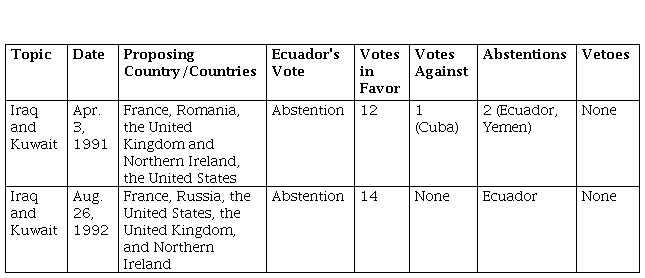
In 1991, Ecuador voted in favor of 35 of the 42 approved resolutions (excluding six with no votes), as did other members of the Council, particularly the permanent ones. In one case, Ecuador abstained along with Yemen, while Cuba voted against, and the rest, in favor. During 1992, Ecuador supported 60 of the 73 resolutions (excluding 12 on new members’ inclusion), aligning mostly with other countries, including the major powers, but abstained once, being the only country to do so against 14 affirmative votes (Table 4).
Impact of non-alignment in the period 1991-1992
Note. Source: UN. (n.d.).
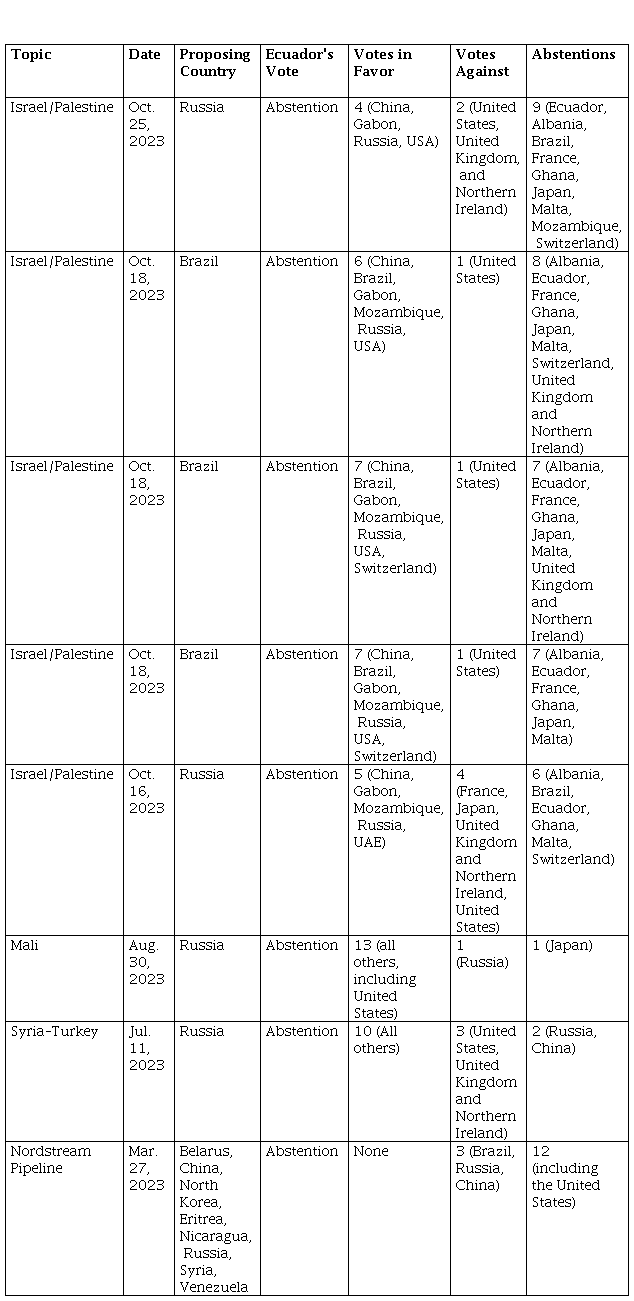
In 2023, Ecuador voted in favor of 55 of the 62 proposed resolutions, aligning with those that received majority or unanimous support. The country abstained then in eight cases, in resolutions where major powers, especially China and the US, had divergent opinions. The analysis focuses on these cases where the decisions were less clear. Table 5 shows that Ecuador's abstentions occurred in resolutions where the Security Council, particularly the major powers, were divided, reflecting Ecuador's commitment to international norms and the precepts of non-alignment.
Impact of Non Alignment in 2023
Note. Source: UN (n.d.).
Ecuador's decision to abstain stems from non-alignment, which avoids unconditional positions with hegemonies and relies on the country’s principles, respecting international law. The abstentions occurred in resolutions where the Security Council, especially the major powers, was divided, demonstrating Ecuador’s agency to adhere to international norms and non-alignment.
Conclusions
The configuration of the international system has proven to be changeable throughout history. This research reflects the dynamic using the theory of balance and power, its evidence, and the functioning of the structure, as observed in the UN, specifically in the Security Council. The results of the study demonstrate a change in the configuration of the international system during the last period and the current one.
In this context, the collected data and conclusions concur with the objectives of the research. As previously mentioned, during the Cold War, 193 resolutions were vetoed, demonstrating the constant friction within the Council due to the relationship between the USSR and the US; conversely, there were only 12 vetoes in 13 years since 1990, indicating a change in power management that led to the end of the conflict. Finally, in 2023, there were five official vetoes, excluding repeated cases in which this term was not applied because the resolutions did not reach the necessary minimum. This condition pinpoints that the system is changing again, as the conflicts that dominated the Council in past years increase.
Due to the actions of the Security Council members—particularly the powers China, the US, France, Russia, and the United Kingdom—small countries, such as Ecuador, find it more challenging to make decisions in the current period than in the previous, because the positions of the permanent members no longer always agree, and there are occasions for two "sides." This situation did not happen in 1991-1992, during the dissolution of the USSR and the emergence of the Russian Federation. Therefore, Ecuador must correctly assess the panorama so that it does not affect its bilateral or multilateral relations with other states when voting on a resolution. Since 1981, Ecuador has applied non-alignment as a strategy to maintain a similar distance from the dominant powers of the time. In this way, it strengthens its ties with others while continuing to pursue its national interests. This principle has prevailed since then and is evident in the voting patterns of the two periods addressed with the data collection.
In a time when the US controlled the world, the votes for the 1991-1992 period were relatively straightforward in the Council, resulting in unanimity on most resolutions and, above all, similar votes by the powers. For Ecuador, this meant clear decisions, a defined path, and no controversy or problems about the exercise of its agency. Nevertheless, as shown in Table 2 and resolutions 687 and 773, the country has upheld the values of the Non-Aligned Movement (NAM) and the Bandung Conference, based on international law, justice, human rights, and non-intervention, as set out in the UN Charter.
This position is valid today and consistent with the country’s actions within a less homogeneous Security Council than previously. Ecuador’s approach is direct: no power-based tactics in international conflicts. Instead, a steadfast commitment to respecting international non-alignment norms has been unmistakable in Ecuador since the previous period and remains so in 2023. The research reveals that Ecuador's voting record has consistently coincided with non-alignment, helping the country attain a favorable position in the international system.
Ecuador’s approach in 1991-1992 and again in 2023 was consistent: respecting non-alignment and maintaining a firm stance on the norms that guide its behavior in the international arena. Its capacity for action as a Security Council member is limited due to its size and the need for alliances to achieve national objectives; it must maintain amicable relations with all powers, as evidenced in its voting behavior. The influence of institutions on the state, as dictated by institutional liberalism, is evident: The country has systematically applied international law and its mandates to determine right and wrong. Ecuador has demonstrated its ability to maintain non-alignment by voting in the Security Council, highlighting the impact international organizations have on its actions.
The nation has used its agency for action within the Security Council to maintain a clear position in the international system, defending its principles and maintaining alliances with powers to maximize benefits.
It is vital to maintain a solid diplomatic line that remains uniform, not depending on the government, but on professionals with in-depth knowledge. Taking sides can be counterproductive given the ever-expanding world and the importance of alliances, especially in times of crisis. Ecuador must continue to respect international law and the principles of the NAM, which, without losing relevance, continues to seek ways to adapt to the new needs of smaller countries.
References
Buzan, B. (2018). Polarity. In Security Studies: An Introduction (pp. 147–160). Routledge.
Carranco, S. (2022, April 28). ¿Qué representa para el Ecuador ser parte del Consejo de Seguridad de la ONU? [What does it mean for Ecuador to be part of the UN Security Council?] El Telégrafo. https://www.eltelegrafo.com.ec/noticias/columnistas/15/que-representa-ecuador-ser-parte-consejo-seguridad-onu
East, M. (1973). Size and foreign policy behavior: A test of two models. World Politics, 25(4), 556–576. https://doi.org/10.2307/2009952
Fabara Espín, J. G. (2021). El Movimiento de los No Alineados (MNOAL) como foro y brújula de las relaciones internacionales [The Non-Aligned Movement (NAM) as a forum and guide for international relations]. Tsafiqui - Revista Científica en Ciencias Sociales, 12(16), 119–129. https://doi.org/10.29019/tsafiqui.v12i16.884
García Sayán, D. (1988). Relaciones del Perú con Ecuador [Peru's relations with Ecuador]. In E. Ferrero Costa (Ed.), Relaciones del Perú con los países vecinos (pp. 35–51). CEPEI.
Hey, J. (2003). Introducing small state foreign policy. In J. Hey (Ed.), Small states in world politics: Explaining foreign policy behavior (pp. 1-11). Lynne Rienner Publishers.
Jatobá, D. (2013). Repensar y rehacer la realidad contemporánea tras la expansión filosófica de las Relaciones Internacionales [Rethinking and reshaping contemporary reality following the philosophical expansion of international relations]. Grupo de Estudios de Relaciones Internacionales, 24, 109–127. https://doi.org/10.15366/relacionesinternacionales2013.24.005
Jiménez González, C. (2003). Las teorías de la cooperación internacional dentro de las relaciones internacionales [Theories of international cooperation in international relations]. Polis: Investigación y Análisis Sociopolítico y Psicosocial, 2(3), 115–147 https://www.redalyc.org/pdf/726/72620305.pdf
Keohane, R. (1984). After hegemony: Cooperation and discord in the world political economy. Princeton University Press.
Krasner, S. (2010). Desarrollo estatal, construcción del Estado y ayuda externa [State development, state building, and foreign aid]. Foro Internacional, 50(3), 689–723. http://dx.doi.org/10.2307/25822671
Lallande, J. P. (n.d.). El liberalismo institucional [Institutional liberalism].
Lozano, A. (2016). Aspectos ontológicos y epistemológicos en las relaciones internacionales: Breves propuestas de abordajes teóricos [Ontological and epistemological aspects in international relations: Short proposals for theoretical approaches]. Revista Mexicana de Análisis Político y Administración Pública, 5(1), 41–60. https://doi.org/10.15174/remap.v5i1.163
Malone, D. (Ed.) (2004). The UN Security Council: From the Cold War to the 21st century. Lynne Rienner Publishers.
McGlinchey, S., Mathur, S., & Acharya, A. (2022). Introducing bipolarity, tripolarity, unipolarity, multipolarity, and multiplexity. E-International Relations. https://www.e-ir.info/2022/03/27/introducing-bipolarity-tripolarity-unipolarity-multipolarity-and-multiplexity-in-international-relations/
Non-Aligned Movement. (n.d.). Bandung principles. https://nam.go.ug/bandung-principles
Pease, K. (2007). Mainstream approaches: Liberalism in international organizations. In Perspectives on governance in the twenty-first century (pp. 58-73). https://doi.org/10.4324/9781351213110
Rodríguez Hernández, L. E. (2014). De la unipolaridad a la multipolaridad del sistema internacional del siglo XXI [From unipolarity to multipolarity in the international system of the 21st century]. Revista de Estudios Estratégicos, 1. https://biblioteca.clacso.edu.ar/Cuba/cipi/20180227121442/Art4.pdf
Shifrinson, J., Slaughter, A.-M., Kausikan, B., Keohane, R., Brooks, S. G., & Wohlforth, W. C. (2023, November/December). The long unipolar movement? Debating American dominance. Foreign Affairs, 102.
United Nations. (n.d.). UN Security Council meetings & outcomes tables. https://research.un.org/en/docs/sc/quick
Velázquez, R. (2011). Cambios y continuidades del sistema internacional [Changes and continuities in the international system]. Relaciones Internacionales, 41. https://revistas.unlp.edu.ar/RRII-IRI/article/view/1193
Notes
Notas de autor
Información adicional
Conflict of interest: This article does not present any conflict of interest, as it has been prepared without funding or assistance from any entity.
Información adicional
redalyc-journal-id: 5337
