Article
Why Are They Here? The Intentions of Brazilian Exhibitor at Business Fairs
Por que eles estão aqui? As intenções do expositor brasileiro em feiras de negócios
 Débora Regina Schneider Locatelli debora.locatelli@uffs.edu.br
Paulo Jorge Reis Mourão paulom@eeg.uminho.pt
Débora Regina Schneider Locatelli debora.locatelli@uffs.edu.br
Paulo Jorge Reis Mourão paulom@eeg.uminho.pt
Why Are They Here? The Intentions of Brazilian Exhibitor at Business Fairs
Revista Administração em Diálogo, vol. 24, no. 1, pp. 76-95, 2022
Programa de Estudos Pós-Graduados em Administração
Received: 26 January 2021
Accepted: 01 October 2021
Abstract: The objective this to investigate the motivations that lead companies to participate in business fairs. Three hypotheses were formulated based on the literature. The methodological procedures had a qualitative approach, with the data collection performed through personal interviews. The population was companies from the metalworking sector that participated as exhibitors of international business fairs and renowned fairs in their segments. A content analysis was performed, after the data treatment, using the Software Interface for Multidimensional Analysis of Texts et Questionnaires (IRAMUTEQ). Three stages structured the texts: analysis of the frequency of relevant terms, analysis of the association of relevant terms, and differentiated structuring of discourses. Were tested H2 and H3 and refuted H1.
Keywords: Exhibitors, Intentions, Business Fairs.
Resumo: O objetivo é investigar as motivações que levam as empresas a participar de feiras de negócios. Com base na literatura, três hipóteses foram formuladas. Os procedimentos metodológicos tiveram abordagem qualitativa, foram realizadas entrevistas. A população eram empresas do setor metalúrgico que participam como expositores de feiras internacionais de negócios e de renome em seus segmentos. Após o tratamento dos dados, foi realizada uma análise de conteúdo utilizando a Interface de Software para Análise Multidimensional de Textos e Questionários (IRAMUTEQ). Esta foi estruturada em três etapas: análise da frequência de termos relevantes, análise da associação de termos relevantes e estruturação diferenciada de discursos. H2 e H3 foram aprovadas e H1 foi refutada.
Palavras-chave: Expositores, Intenção, Feira de Negócios.
Introduction
Business fairs represent events for an open public, with free access or with ticket collection, which can be visited by any interested party and have outstanding commercial efficiency ( Martin, 2014).
Preliminary research has shown that there is little academic material on trade shows. As several authors point out, topics related to the motivation of participants and exhibitors, as well as the need for this knowledge to make the fair organization more efficient still have a long way to go ( Ahola, 2012; Luoa & Zhonga, 2016).
The fairs are used by companies as a strategic tool to conquer commercial, technological and even collaborating partners ( Giacaglia, 2012). In addition, the fairs can develop a network of relationships, since they generate more than short-term results, are also means to strengthen relations among all of the production chain.
We are aware of few studies focused on the Business Fairs and Derivatives for the perception of participants’ motivations. Thus, we intend with this work to complement this gap, especially in the Business Fairs in Latin America. As several authors have presented, if we do not know well the motivations of the participants in the Business Fairs, there is an increased risk of a poor organization of these events, with increasing costs of reputation that will lead to decreasing participations. In addition, everyone involved - from organizers to municipal, regional or federal entities - has a damaged reputation link, which will lead to significant negative externalities. The objective of the study is to investigate the motivations that lead companies to participate in business fairs. The unquestionable relevance of the business and activities of the business fairs is not yet accompanied by a body of cohesive and multi-perspective knowledge ( Sarmento & Simões, 2018).
This research may help to understand the dynamics involved in the participation of metal mechanics companies in the business fairs, which is important both for the exhibitors and for the other actors involved. It is understood that this is a relevant theoretical contribution, since no work has been found that presents this systematization, and it is an important issue both for the academic and business environments.
With the knowledge of the joint efforts made and the integration of those involved, the organizers of the fairs can draw actions to improve their performance and of all those involved in this process and / or use this factor as an element of the fair’s marketing composition.
It also highlights the importance of events and trade shows for the economy, Exhibitors & Event Association of Australasia (EEAA, 2016) highlights that in Australia business events are important drivers of the national economy, with 412,000 business events per year in the country, which generate $ 13.5 billion of indirect value-added and $ 23.1 billion in contribution to the total economic. In the US, although it had a low growth of 1.1% in 2016, it was 2.4% in 2017 and projected a 3% increase in business fairs in 2019 ( McMillin, 2017). He continues, stating that the performance of the exhibit industry traditionally follows the same path of US GDP, which looked promising in early 2017 with the Dow Jones Industrial Average index above 20,000. In Germany business fairs are one of the main service sectors of the country, the sector also enjoys a high status internationally. Almost two thirds of the major global fairs in different branches of the industry are held in Germany. The country is the number one place in the world for international fairs. German companies plan to increase their trade show budgets by an average of 3% for next year ( Kötter, 2019).
This study was conducted in Brazil, because it occupies the leadership of the sector in South America, according to a study by the International Association of Congresses and Conventions (ICCA). Its overall position is the 17th, with the cities of São Paulo, Rio de Janeiro and Foz do Iguaçu being highlighted ( Maciel, 2019).
Theoretical Framework
Business fair
The business fair is an event in which, in a defined space, the company displays the results and negotiates its technologies, products and services (Zitta, 2013). For Reis, (2013, p. 17), “Fair is a public exhibition of artistic or industrial products on panels or stands. Usually happens in the same period of the year, in large exhibition centers”. They can also be conceptualized as a “public exhibition for the purpose of direct or indirect sale, consisting of several stands set up in special places where products and services are placed” (Matias, 2013, p. 66-67).
The sector fair is a multi-faceted event in which exhibitors can maintain and strengthen their relationships with current and potential customers, suppliers, intermediaries and other entrepreneurs in the same chain ( Nystrom & Sanberg, 2000). If the main objectives of the companies during the fairs are to sell and buy or create new partnerships, these events are also symbolic places where the reputation is built (Seringhaus & Rosson, 1998g). In fact, if a company attends a business fair regularly, it could be considered as a sign that it is thriving. The goal may also be simply to be there and be seen (Power & Jansson, 2008).
In recent years, the number of fairs held has grown. With this, the question arises about the importance or even the necessity of participation in the fairs of its sector. Participation in all can lead the exhibiting company not to obtain results. The choice of which fairs to participate in is also not an easy choice because of the difficulty in measuring the results of their participation. On the other hand, non-participation can be interpreted as a situation of financial crisis or any other negative situation of the company towards its customers, suppliers and competitors. In order to evaluate whether they will participate in all or some of the fairs of the year, companies should obtain as much information as possible about the profile of the fair and the public it attracts, evaluate their possibility of exposure with attractive, and novelties, in addition to other criteria linked to its strategy. In order to assess which fairs will participate in the year, companies must obtain as much information as possible about the profile of the fair and the public it attracts, evaluate its possibility of exposure with attractions and news, in addition to other criteria linked to its strategy. With the increasing number of fairs also the decrease of the visiting public can occur, especially if the fair and the exhibitors cannot present to the visitors launches, novelties and incentives. It is up to the fair organizers to seek innovations and companies to participate in the awareness that they should exhibit only when they are enabled to do so ( Giacaglia, 2012).
Fairs are in some respects the best example of marketing excellence and a unique social review experience, as all stakeholders (buyers, sellers, students, designers, decision-makers or product users) are represented under ( Blythe, 2010), in a short period of time, to generate attention and knowledge about an organization’s products and services, identify customers and generate sales ( Churchill & Peter, 2005).
Therefore, for some companies, those become the main reason for their participation in fairs, showing that the company is in the lead of the segment, or at least not among the “last ones” ( Blythe, 2002). Exhibitors tend to assume that the majority of visitors are buyers or at least have a substantial role in the purchase. However, this is not confirmed by Blythe’s (2010) survey, which shows that buyers are in the minority, typically only responding to ten percent or less of visitors.
Fairs can be considered small market arenas in which sellers and buyers come into face-to-face contact, are temporary organizations where market knowledge emerges and circulates among the participants, which is crucial in the construction of markets by the promotion of a social environment and in the production of specific norms and values. The fairs bring together the microcosm of an industry for a few days, allowing a global, fast and accurate view of the entire market, as well as comparing its strategies with those of its competitors ( Brailly; Favrea; Chatelleta & Lazega, 2016).
Business fairs are one of the most important types of business events ( Luoa & Zhonga, 2016). This term is used in this study for its wide practical use, refers to fairs designed to represent the entire production chain of a particular business, although it usually does not cover by entering or restricting the entry of people, its focus is people who work or have an interest in the business that is being presented.
Resources and needs in the organization and promotion of a business fair
The fairs usually take place in exhibition halls, specially prepared for this purpose, has an average duration of one week ( Giacaglia, 2012). The fairs are events that, due to their greatness and complexity, require the installation of special facilities and the use of a large area of occupation and movement, as well as the assembly of booths ( Zanella, 2011).
The biggest costs of a fair are assembly and maintenance ( Giacaglia, 2012, Zanella, 2011). There are many companies that are interested in supporting and sponsoring them, because although the costs are high, for businesses, the investment is minimal, if it is considered that the fair reaches in a short time a large public both of potential customers and from different locations. In addition to the companies, the official bodies linked to ministries, state and municipal secretariats reinforce the importance of the Business Fairs, since they consider the fairs an important business medium, even offering incentives for their realization ( SENAC, 2000). The resources for the fair also come from the sale of the spaces that are marketed to the exhibitors, usually taken into consideration for the establishment of the values, the square meter.
Zanella (2011) refers that fairs and exhibitions are commercial and large events, which in addition to promoting commercial contacts, aim at presenting or exposing products and services and presenting or launching new technologies. It continues to state that in the space of fairs and exhibitions meet suppliers, manufacturers, sellers, buyers or customers, consumers or users, development agencies, financiers, banks, among others.
The main objective of a business fair is to provide contacts with the marketing channels ( Zanella, 2011). Thus, it is used “when it is desired to attract large numbers of consumers to a single place to present products and services in a very attractive and motivating way, inducing them to buy immediately” ( Giacaglia, 2012, p. 42-43). This enables the company to contact a large part of its target audience without high disclosure investments.
Motivation for exhibitors
For the exhibitor, the objective of participating in fairs goes beyond the exhibition, presentation and marketing of their products and services. It should take advantage of the presence of its target audience to maintain direct and personal contact with customers and suppliers; conduct a rapid survey of the needs and wishes of consumers; develop a mailing for prospecting; collecting information about the competition; launch new products; and establish new business contacts ( Giacaglia, 2012).
The decision whether or not to attend exhibitions will depend on the company’s communication strategy. If it considers its participation important, the company can establish an annual plan, selecting the fairs that have the appropriate profile to its objectives and goals, or establishing a policy of sporadic participation, based on the emergence of opportunities ( Giacaglia, 2012).
Companies think of business fairs as a space for trade exchange activities in a broader and realistic context. Companies invest heavily in marketing and efforts to develop micro and macro positions in networks. A micro position is the relationship of one company to another, while a macro position is the relations of a company with others that make up the chain. These positions are the result of pre-show activities by the company and will shape their present and future activities. In industrial markets, relationships are generally stable, and positions rarely change ( Rosson & Seringhaus, 1995).
During the event, participants increase the size of their personal network with new perspectives, invigorate, develop or simply maintain existing contacts between customers and vendors ( Brailly et al, 2016). But relationships need to be built over time and fed with repeated contacts at different events, and it is necessary to meet the same people again and again at fairs (Power & Jansson, 2008).
This experience entails personalization of the relationships between buyers and sellers, especially since the actors already know a part of the mutual expectations and allow the establishment of bonds of trust between the organizations (Power & Jansson, 2008). Although the fairs demonstrate that there is a business-making process that requires long-distance coordination, it also requires occasional meetings, such as face-to-face meetings. As a result, a high frequency of co-participation of two actors in the same event increases their chances of creating social and economic relationships, because interorganizational partnerships need trust, information and mutual knowledge ( Brailly et al, 2016).
Many fairs are organized in the same industry for a single year, and often exhibitors and visitors participate in several of these events. This repetition influences the work of the actors involved. They have to prepare logistics, communication and prospecting, travel and invest several days to attend the fair, follow-up contacts after the event, and then prepare for the next fair (Power & Jansson, 2008).
Historically, business fairs have been viewed as vehicles to consummate sales or as promotional events, but they go beyond that. A fuller understanding of what trade shows are all about is when you can recognize that they are the microcosm of the industries they represent, with a large number of buyers and sellers, service providers, industry partners and regulators all gathered in one place to do business. During the few days of its accomplishment, the fair almost becomes the own market of that sector ( Rosson & Seringhaus, 1995).
Business fairs and conventions, along with vendor incentive programs, are the two main business promotion tools ( Kotler, Hayes, & Bloom, 2002). Lovelock and Wright (2006) emphasize that the concentration of the companies of a sector in the fairs of businesses is an advantage for the business promotion. According to them, about fifty percent of sales leads generated at trade shows can be closed with only one sales call, and a salesperson, who on average makes four or five calls to potential customers a day, can reach five qualified appointments for hour or thirty-five in just one day.
Bathelt, Maskell, and Malmberg (2004) describe business fairs as temporary clusters, since, especially international fairs, they bring together a wide range of companies from the same productive chain, which can be seen as compressing the global / regional market of a given string in a given space for a short period of time. In addition, horizontal and vertical knowledge exchanges within the value chain at trade shows resemble permanent clusters, although in a temporary, periodic and intensified fashion ( Bathelt, Maskell, & Malmberg, 2004; Maskell, Bathelt, & Malmberg, 2006).
Business fairs have the ability to create additional resources for companies giving them a guideline for networking, this should turn to the management area of the company. The relationships established in the network must be relevant in order to obtain competitive advantages based on access to the resources of other network partners ( Geigenmüller, 2010).
Exhibitors present their products and services, as well as their reputation and the strength of their ties within a business network, while visitors seek network access and strategically important partners. Thus, in addition to presenting the position in the network of a company, the activities of a fair are essential elements to strengthen existing relationships in order to ensure the stability of the network. However, this requires the awareness and understanding of the company’s position within a network ( Geigenmüller, 2010).
The main advantage of business fairs is that information circulates and is built through this practice of networks, which generate various sources of knowledge. It produces a global buzz that offers learning opportunities during and after the event and thus supports the maintenance of the long-distance trade relationship ( Maskell et al., 2006; Power & Jansson, 2008).
During the fair, information is constantly transmitted from one agent to another, it is interpreted, evaluated and enriched with relevant additional information and knowledge. The potential benefits of applying this knowledge become clearer as the evolution of business fairs and interpretations are drawn from the variety of encounters ( Bathelt, H.; Schuldt, 2010; Maskell; Bathelt & Malmberg, 2006).
There are two types of actors present at the fairs: buyers and sellers. To do so, they used a multilevel network and were able to distinguish three subnets: between sellers, between buyers and between buyers and sellers. This specification is critical because the relationships between buyers and sellers are different as well as the relationships between and within individuals and organizations ( Brailly et al, 2016).
B2B marketers allocate significant resources to trade shows, but often struggle to create a strong business case for such activities ( Brown, Mohan, & Boyd, 2017). Companies invest heavily to participate in trade shows, and they have a clear goal in achieving sales results, with fairs being an extension of the company’s sales force. Thus, the effectiveness of a fair for the company is measured by the effectiveness of the sales made and the incremental profits obtained ( Sarmento & Simões, 2018). They also cite non-sales results, such as obtaining competitive information.
Regarding the objectives of the companies in the participation of business fairs, it is verified that these are related to the effectiveness of the fairs, but they emphasize that the majority establishes few or no objective when attending a fair. When they establish are related to the product or the market, which makes it easier to carry out an evaluation of the fair’s effectiveness. The authors point to studies that suggest that business objectives are divided into sales and non-sales. Sales would be identifying prospects, gaining access to key decision makers in current or potential client companies, disclosing facts about products, services and suppliers, selling products, and servicing customers for problem solving. Non-sales objectives include: improving company image, collecting product information, pricing, and other marketing variables from competitors, and evaluating and testing their products ( Sarmento & Simões, 2018).
Summary of the literature and hypotheses
From the analysis of the literature, it is concluded that the studies indicate several motivation /reasons for the participation of the exhibitors in business fairs. However, literature also continues to stress the need for a greater definition of these motivations in order to make the purposes of business fairs more effective. On the other hand, if a business fair does not match the intentions of the exhibitors or the public, not only is the associated organization affected in terms of reputation, but the very continuity of the Business Fair is put at risk. This emergence is even more noticeable in countries such as Brazil, where studies on Business Fairs are emerging and the needs stemming from a systemic analysis of Business Fairs - with circulation values and associated revenues growing - reflection.
Brazil has important business fairs with the participation of exhibitors from different countries, such as the International Motor Show (São Paulo-SP), World Travel Market Latin America (São Paulo-SP), International Business Fair, Meat Processing and Industrialization - Mercoagro (Chapecó-SC), Agrishow (Ribeirão Preto-SP), International Plastic Fair - Feiplastic (São Paulo-SP), among others. In addition, Brazilian exhibitors participate in many fairs abroad. They therefore feel the need for a clear identification of the exhibitors’ purposes. In this sense, we will present the Hypotheses under test in this work.
As noted, the authors are divided among those who argue that Business Fairs primarily serve to create business networks or opportunities and those who advocate the purpose of generating sales. Thus, the first Hypothesis - in the line of Nystrom and Sanberg (2000) or Power and Jansson, 2009, will be H1:
H1 Exhibitors at business fairs prioritize product sales.
The literature also showed how participation in the Business fairs tends to be, for each exhibitor, a stage in a broader integrated strategy, in which structural elements and conjunctural elements combine ( Britto & Fontes, 2002; Geigenmuller, 2010). Thus, the second hypothesis (H2) of this study is:
H2: Exhibitors at business fairs participate in these as part of their structural strategy.
Finally, literature has shown how Business Fairs are market spaces par excellence, where diverse potentialities for exhibitors are explored ( Blythe, 2002; Maskell et al, 2006). We test as the third Hypothesis (H3):
H3: Exhibitors of business fairs act in several dimensions resulting from the common spaces generated at the fair.
The next section will detail the methodological procedures used to test these hypotheses.
Methodology
The study will use a qualitative approach. For Sampieri, Collado, and Lucio (2013), the qualitative approach of a research especially seeks the dispersion or expansion of data and information and is more complex and flexible than quantitative research. It is still different from this because it uses the text as empirical material, “[…] starting from the notion of the social construction of the realities under study, is interested in the perspectives of the participants, in their day-to-day practices and in their everyday knowledge regarding issue under study” ( Flick, 2009, p. 16).
Hair Jr., Celsi, Ortinau, and Bush (2014) emphasize that the goal of qualitative research is to discover new ideas, thoughts and feelings, as well as the initial understanding of relationships and predictions, and understanding of psychological and social processes. These authors argue that these researches usually use open-ended questions, small samples, and take a shorter execution time, but they have a limited generalization capability.
For the development of this qualitative research, we followed the PRISMA method based the following steps ( Liberati et al., 2009):
-
Eligibility criteria of the documents to be processed: inclusion and exclusion;
-
Information Criteria: the sources of information are defined, discussed and reviewed;
-
Data collection: we define the methods for collecting data, like the structure, moments and ancillary tools for the questionnaires’ distribution or for the interviews’ recording, or for searching terms in a bibliometric study;
-
Data screening: the collected data are filtered and prepared to be empirically analyzed.
The data collection was through personal interviews with semi-structured script. The main characteristic of personal interviews, which presupposes greater depth, is the use of probing questions to promote more detailed data on the subject addressed ( Hair Jr. et al., 2014). The semi structured interviews have a script of subjects or questions, however, the interviewer may, during the interview, ask other questions to supplement the information passed ( Sampieri et al., 2013).
All interviews were conducted personally by one of the researchers and recorded. The time and dynamics of the interview varied from interviewee to interviewee. In most cases, interviewees were initially asked to speak about the fairs they participated in and / or participated in, then questions or placements were introduced that would lead the interviewee to talk about the issues being researched.
The population of this study were companies from the metalworking sector that participate as exhibitors of business fairs. The metal-mechanical sector is responsible for making the metal transformation and encompasses a range of different types that companies produce products that are base for a large group of other companies. Thus, it ends up having a strategic position in the world economic development, supporting the generation and diffusion of new technologies for the other industrial sectors. In addition, it is a sector that, due to its diversity of economic activities, covers companies that can participate in various segments of business fairs, ranging from agribusiness to industry 4.0. What makes the respondents bring experiences not only from a trade fair or a single business segment, allowing a more comprehensive look.
We interviewed managers and entrepreneurs from companies in the west of Santa Catarina and north of Rio Grande do Sul, for the convenience of access to these companies. Preferably, companies that had experiences in business fairs were sought, not only in the region where they are located, but which were renowned fairs in their segments.
Thus, the criteria for choosing the participants were: to be a metal-mechanic company and to have participated in at least two business fairs in the last four years. These criteria (which follow) are justified because the study focuses on companies in this sector, given the desire to know the specificities of the sector; and having participated in at least two fairs gives you more experience both in planning and in the development of the activities involved, in participating in events like these and in the periodicity of four years to be able to participate in at least two fairs, since most fairs usually occurs biennially ( BRASIL. Ministério do Desenvolvimento, 2016). The ‘company size’ factors and the specificities of their activities were not considered, since they did not impact on the research objectives.
Twenty-two companies were interviewed, and the material obtained in two was discarded, one for not recording the interview and the other for the fact that the interviewee’s wife interrupted the interview and participated in the interview, defusing the interview’s intention. The number of respondents followed the saturation trend, which predicts that at some point in the study new interviews will add little to the research result, due to repetitions of content, this is because even though the experiences seem to belong to an individual, they are a consequence of a social process ( Gaskell, 2008; Sampieri et al., 2013). In addition, the data analysis technique and the software used require at least twenty texts to compose its corpus ( Camargo & Justo, 2013).
After the interviews were conducted, they were transcribed. Then a thorough reading of each interview was carried out again, and the respective content was formatted so that each respondent, duly identified and characterized, had his / her speech in order to be processed analytically.
Here we recall that we intend to test the three hypotheses presented at the end of section 2. In a generic analysis, we intend to analyze the substance and the content of the answers given by exhibitors of business fairs located in the States of Santa Catarina and Rio Grande do Sul. The saturation criterion suggests that we obtained a representative sample of the heterogeneity of responses, independently of extending the responding sample to other participants in the same events. Thus, as King, Horrocks, and Brooks (2019) refer, in content analysis we aim to analyze “what is said rather than how the story unfolds”. In addition to the personalized answers, it is intended to characterize ‘the social and cultural world’ that respondents inhabit. Even in other scientific fields such as economics, there has been a significant growth in the resources derived from the analysis of content as more suitable for certain methodological purposes. Royce (1995) clearly states “In recent years there has been a steady increase in interest and research in economics discourse by both economists and applied linguists who have spawned an expanding body of work.”
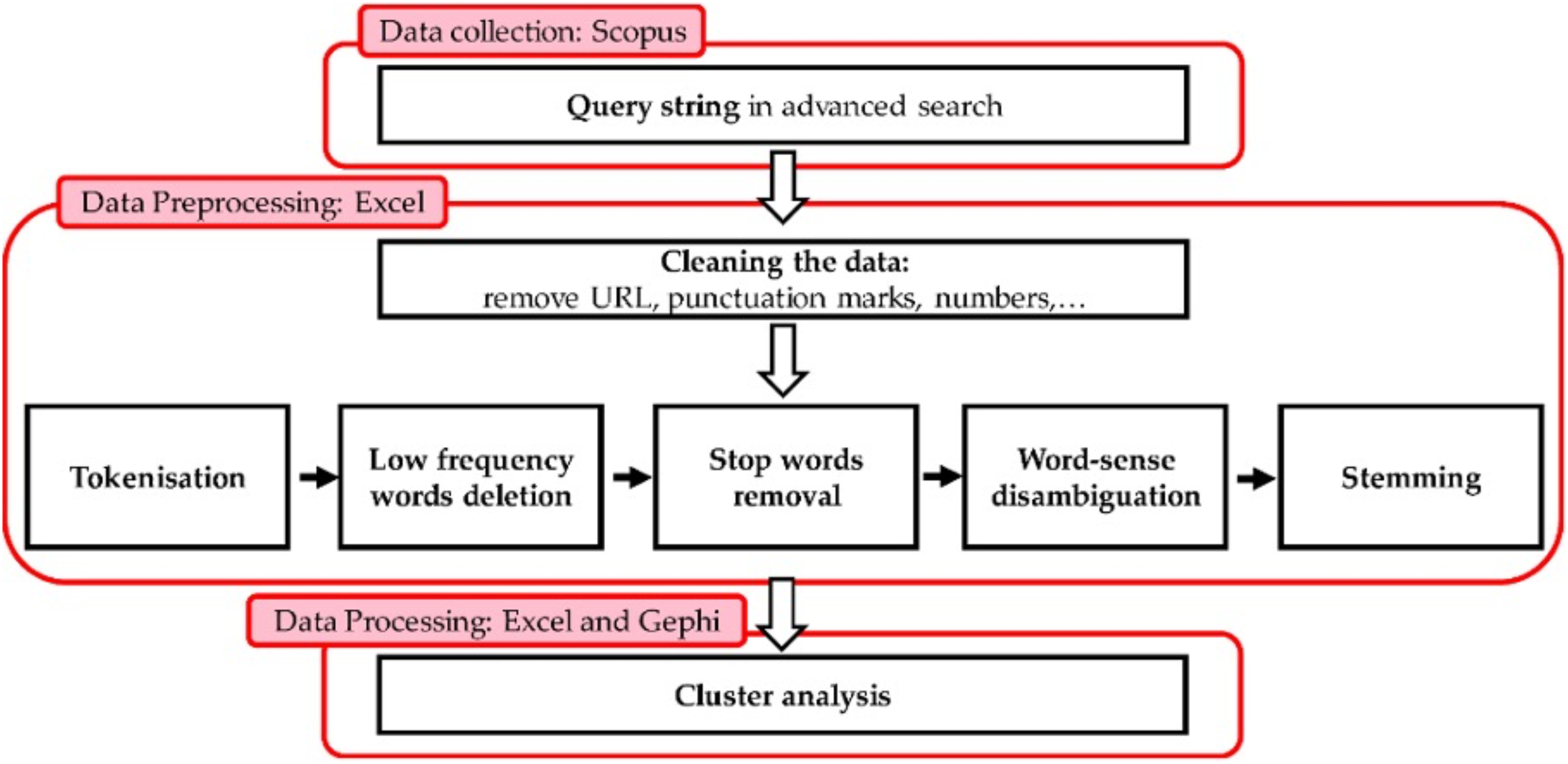
Now, we are going to follow Robert and Bouillaguet (1997) and conduct a detailed content analysis. This effort aims to test the hypotheses previously launched in order to extract a more precise reading of the collected interviews. Detailed content analysis is structured in three steps as follows: analysis of the frequency of relevant terms, analysis of the association of relevant terms, and differentiated structuring of discourses.
This set of steps has been suggested by Chaumier (1997) and has collected a relevant number of works. It aims to complement the simplified content analysis that is limited to choosing –sometimes with excessive arbitrariness ( Guessard, 2000) – expressions and data collected by methods of information collection (such as interviews or surveys) and positioning them in categories/constructs or as an approach to hypotheses.
These steps can be synthesized by the following Figure 1 ( Cogato, Meggio, De Antoni Migliorati, & Marinello, 2019).
Analysis and discussion of results
The first stage for testing Hypotheses 1 is the analysis of the frequency of relevant terms. A relevant term is a word or a reduced set of associated words that appears with significant frequency in the collected messages or in a key position in the message network ( Robert & Bouillaguet, 1997).
Several papers have emphasized the importance of this method, in a given content, if we observe the frequency of terms. Psychology works associate the frequency of certain words or expressions with various motivations of the issuer or intentions of the issuer ( Mertens, 1992). Generally, the subject who often expresses a certain term intends to expose his or her attention to this problem ( Jung, 1910), to emphasize the need for receptors to cooperate on the same issue ( Mezan, 2002), or to trigger associated action. Other works, from textual analysis in literature ( Defina, 1975) to political science ( Domenach, 1973), point out that the most frequent relevant terms of a given content are intended to exert a rhythmic space, to reinforce the focus on the subject, and to make the recipient of the message perceive it as more urgent.
In social sciences, particularly regarding management/administration, there is an increasing number of works that have gone through this stage. They do this essentially to investigate how certain agents rank the observation of certain hypotheses tested by qualitative methods or how they manifest needs considered more urgently in need of social action. Table 1 synthesizes the distribution of these terms.
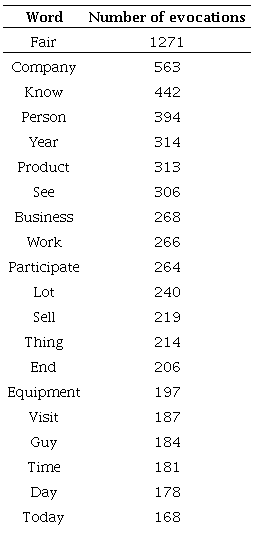
As shown, the most frequent terms are “fair,” “company,” and “[to] know” From the previous observation, we verified that the hypothesis of companies using fairs to enhance their knowledge of potentialities and threats is reinforced. The surveyed companies realize fairs as good opportunities for testing their market characteristics ( Nystrom & Sanberg, 2000).
Therefore, our Hypothesis 1 can be rejected. Our responding companies recognize they use business fairs as opportunities for an enlarged set of purposes besides selling products/services. As checked, the most frequently cited terms (ranked till 10th place) do not include the term ‘sell’ (12th rank) or any other derivative/lemmatized term. These most frequently cited terms regard to enhance the knowledge of the overall environment of the surrounding industry, to active participation in the fairs, and to a market test of each company’s products.
In order to avoid replication of the analysis of the most relevant terms according to variables or modalities to be considered (such as gender or age), other methodological procedures were developed, namely, the association of words or expressions by factor analysis and by analysis of “similitude.”
The factor analysis of the terms allows us to group the relevant terms into ‘families’. The terms are distributed according to the score loadings assigned by a factor analysis process. Authors who have focused on the details of factor analysis applied to the world of content analysis include Reinert (1990). Therefore, in order to opt for parsimony in approach as well as to speed the pace of this work, we will omit the technical details behind the factor analysis in this content analysis, based upon the ALCESTE method developed by Reinert (1990). In a simple way, factor analysis condenses the diversity observed in the texts into factors that represent latent dimensions. This process allows the distribution of the terms (but also by the authors or the other chosen variables, if necessary) by the main factors, eminently two factors, which allows us to verify which terms are neighbors to each other (applied to address common dimensions) or for which authors, respondents, or subgroups use a content structure that is closer by itself. For this step, we have considered the following variables of each respondent: gender, major production of his/her company, city of the company’s main office, State of the company’s main office, and date of the interview. The ALCESTE method then scores each word according to the frequency it has been observed depending upon each variable. Posteriorly, there is a standard factor (cluster) analysis upon this database (applying the principal factors’ method and with orthogonal rotation). As Bazeley and Jackson (2019) showed, cluster analysis based on word similarity test whether the responses/respondents fall neatly into a limited number of clusters, based on the language used in relation to the topics covered. The graphic visualization allows the identification and grouping of similar items in data sources. It additionally tests similarity based on “either (a) the similarity in the frequency with which the top number of words [e.g., 100 or 150] are used in the selected Files or are found in data coded with the selected Nodes, or (b) the similarity in the frequency with which the same codes have been applied to the text or images in those Files or Nodes” ( Bazeley & Jackson, 2019). The similarity measures can be various, but the Pearson correlation is the default method, being mapped recurring to Multidimensional scaling (MDS) processes in two- or more- dimensional space.
It was found that there are three predominant groups (‘clusters’) in the responses. The first is a central group in regard to factors positioned in the vertical axis composed of terms such as “equipment,” “machine,” and “product,” which are identified in blue. This group is in line with authors such as Britto and Fontes (2002) who demonstrated how all the fairs – given their own specificities – tend to attract a specific public interested on specified purposes. Another prominent group (which shows that these terms are common to all the respondents) relates to the set of contents around strategic decisions (green words). The most central words are ‘exhibitor’, ‘partnership’, and ‘business’. Bathelt et al (2004) are authors who related the focus in strategic concerns with the participation in business fairs.
The result of the factor analysis on the set of respondents’ texts allowed the construction of Figure 2.
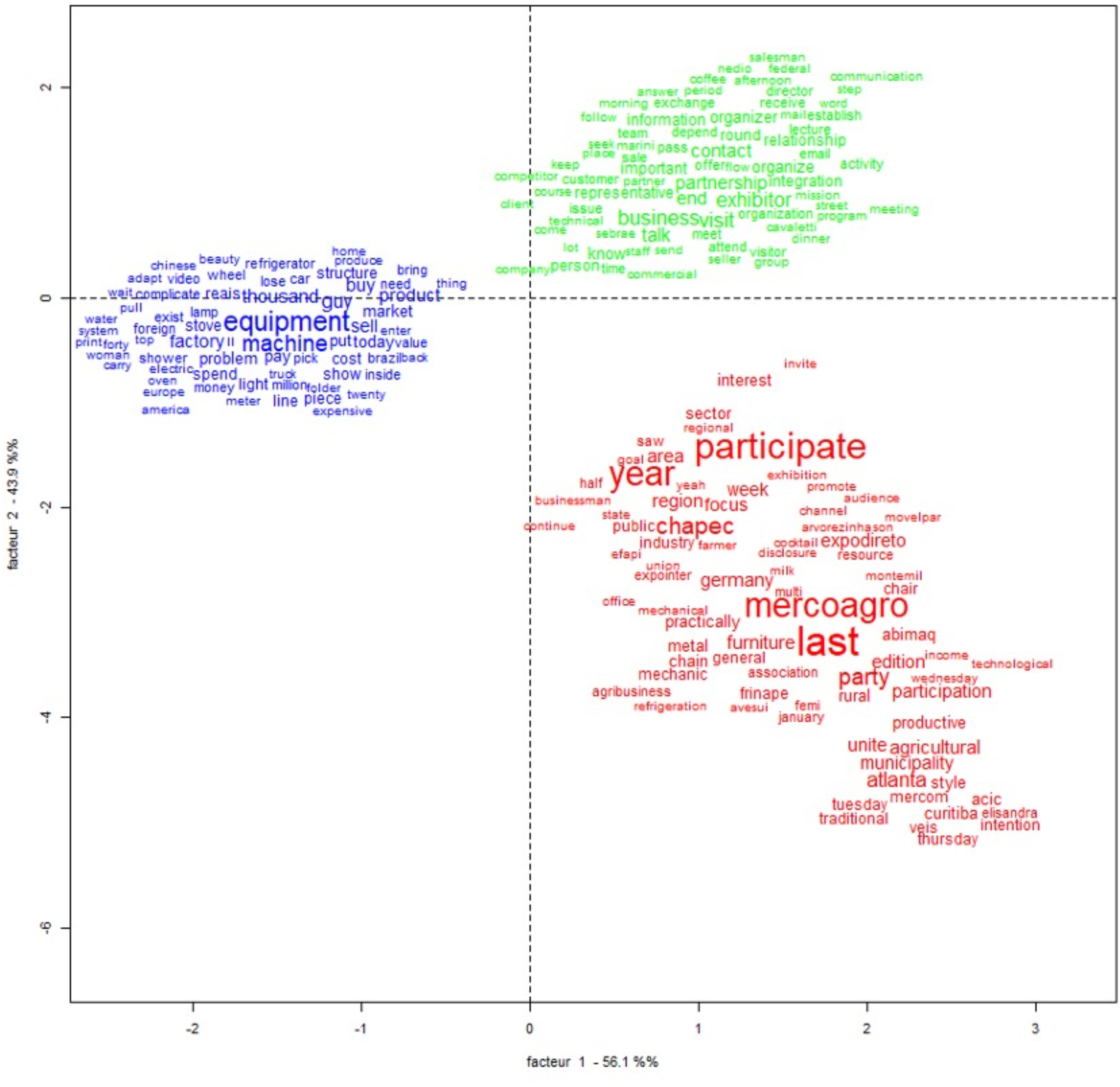
Figure 2
Results factor analysis
Source: Survey data
It was found that there are three predominant groups (‘clusters’) in the responses. The first is a central group in regard to factors positioned in the vertical axis composed of terms such as “equipment,” “machine,” and “product,” which are identified in blue. This group is in line with authors such as Britto and Fontes (2002) who demonstrated how all the fairs – given their own specificities – tend to attract a specific public interested on specified purposes. Another prominent group (which shows that these terms are common to all the respondents) relates to the set of contents around strategic decisions (green words). The most central words are ‘exhibitor’, ‘partnership’, and ‘busines’. Bathelt et al (2004) are authors who related the focus in strategic concerns with the participation in business fairs.
We recall that our Hypothesis 2 was: “H2: Exhibitors at business fairs participate in these as part of their structural strategy”. Therefore, following the evidence found in Figure 2, we can accept our Hypothesis 2.
For testing our Hypothesis 3, we have to follow King et al (2019). These authors suggest a structural analysis for focusing on the way responses are told. Being inspired by the Labov and Waletzky’s structural model of narrative analysis, we will also highlight the different degrees of centrality of words/expressions and the associate interlinkages. We are going to do so recurring to the analysis by similarity.
The analysis by similarity allows us, therefore, to improve the depth of the association of terms of relief in the analyzed answers ( Moliner & Vidal, 2003). It differs from the factor analysis because the analysis by similitude, using a methodology from Network Theory (or Graphs Theory) associates “central” words with remaining terms by “centrality” value. Unlike the factor analysis associated with Figure 2, similitude analysis is more focused on the direct link between terms, showing those that are central (i.e., frequent in the flow of messages) and the associated ones (i.e., the peripheral words which are used in association with the central words, i.e., which are co-occurrent).
As the example below shows ( Figure 3), respondent managers associate “fair” (one of the –predictably obvious- central terms) with other terms such as “company,” “work,” and “know.” “Machine” is closer to “work,” as “person” to “market”. Thus, we directly find that there is a more detailed conception that fairs are essentially used to explore personal potentialities towards the various markets in which each firm/company moves. However, the term ‘product’ is close to terms like ‘see/check’ and ‘know’ which confirms the potentiality of these fairs as proper tests of each product’s characteristics of marketing.
In consequence, we can validate the direction of our Hypothesis 3:
H3: Exhibitors of business fairs act in several dimensions resulting from the common spaces generated at the fair.
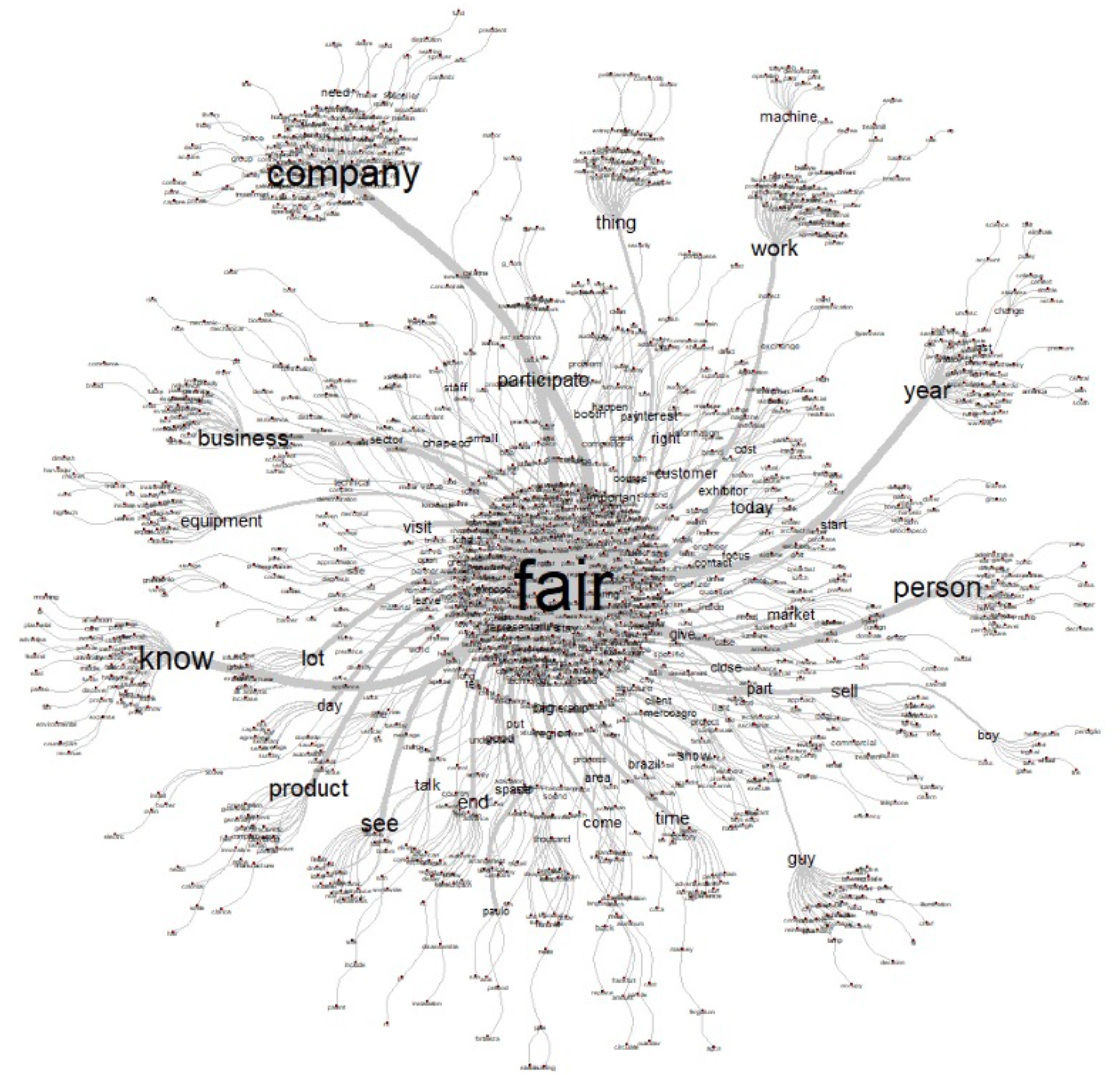
Figure 3
Association of terms dictated by managers
Conclusions
This article discusses the motivations that lead companies to participate in business fairs both in Brazil and abroad. The results are based on a detailed content analysis upon the collection of interviews’ records responded by managers participating in some of the most business fairs. We observe that these managers do not prioritize the sales’ purposes when participating at these events (Hypotheses 1). For the surveyed companies, the business fairs are essentially opportunities for an expanded set of purposes, such as: improving knowledge about the sector in which it operates, active participation in fairs and a market test of the products of each company.
Through the factor analysis it was tested the second hypothesis related to the intention of Exhibitors of business fairs as part of their companies’ strategy; we found evidence validating this second hypothesis. The respondents attributed to certain words connected with the core strategy for most of these companies (like ‘equipment’, ‘machine’ or ‘product’) a centrality role.
With the similitude analysis it was verified that respondents associate fair with terms such as: “company”, “work” and “knowledge”. In this way, there is a more detailed conception that the fairs are essentially used to explore potential in relation to the various markets in which each company moves. The term “product” is close to terms like “[to] see” and “[to] know”, which confirms the potential of these fairs as appropriate tests of the marketing characteristics of each product. This test validates the third Hypothesis - Exhibitors of business fairs act in several dimensions resulting from the common spaces generated at the fair.
Therefore, this study proved that participants of the important business fairs use the economic and social spaces generated by these events as powerful networks for enhancing the integrated aims of their companies. Because of this evidence, this work signals the importance of organizing well business fairs towards higher levels of achievement of the goals of all participants – like organizers, exhibitors, customers, or visitors.
A pioneering study like this one enhances at least three avenues for research. The first opportunity of research regards the possibility for qualitative research studies to validate the direction of these findings by different sets of respondents from different business sectors. The second shall motivate an integrated analysis of all the participants in business fairs for checking the simultaneity or the divergence of purposes. Therefore, not only managers or exhibitors must be surveyed but we are suggesting to extend this effort also for customers, visitors and organizers. Finally, in methodological dimensions, we suggest developing a longitudinal work by surveying again the present set of respondents in new participations at other editions of these business fairs. This effort would allow us to control the variability of the responses and to check the stability of the found evidence.
References
Ahola, E.-K. (2012). Towards an understanding of the role of trade fairs as facilitators of consumer creativity. Journal of Marketing Communications, 18(5), 321–333. Retrieved from http://www.tandfonline.com/doi/abs/10.1080/13527266.2010.528587
Bathelt, H.; Schuldt, N. (2010). International trade fairs and global buzz, part I: ecologyof global buzz. European Planning Studies, 1957–1974. Retrieved from https://tspace.library.utoronto.ca/bitstream/1807/71368/1/54_Bathelt%26Shuldt2010_EPS.pdf
Bathelt, H., Maskell, P., & Malmberg, A. (2004). Temporary clusters and knowledge creation: the effects of international trade fairs, conventions and other professional gatherings. Progress in Human Geography, 28, 31–56. Retrieved from http://journals.sagepub.com.ez372.periodicos.capes.gov.br/doi/pdf/10.1191/0309132504ph469oa
Bazeley, P., & Jackson, K. (2019). Qualitative Data Analysis with NVivo (3rd ed.). London: Sage.
Blythe, J. (2002). Using trade fairs in key account management. Industrial Marketing Management, 31, 627–635. Retrieved from http://klas.khu.ac.kr/common/downloadFile.do?fileId=FIL1305291631195da11151
Blythe, J. (2010). Trade fairs as communication: a new model. Journal of Business & Industrial Marketing, 25/1, 57–62.
Brailly, Julien; Favrea, Guillaume; Chatelleta, Josiane; Lazega, E. (2016). Embeddedness as a multilevel problem: a case study in economic sociology. Social Networks, 44, 319–333. Retrieved from http://dx.doi.org/10.1016/j.socnet.2015.03.005
BRASIL. Ministério do Desenvolvimento, I. e C. E. e M. das R. E. (2016). Calendário Brasileiro de Exposições e Feiras. Brasília. Retrieved from http://www.expofeiras.gov.br/public/files/82580ccaac2bfa4a9c0d74821525924f.pdf
Britto, J., & Fontes, N. (2002). Estratégias para eventos: uma ótica do marketing e do turismo. São Paulo: Aleph.
Brown, B. P., Mohan, M., & Eric Boyd, D. (2017). Top management attention to trade shows and firm performance: A relationship marketing perspective. Journal of Business Research, 81(August), 40–50. https://doi.org/10.1016/j.jbusres.2017.07.020
Camargo, B. V., & Justo, A. M. (2013). IRAMUTEQ: Um software gratuito para análise de dados textuais. Temas Em Psicologia, 21(2), 513–518. https://doi.org/10.9788/tp2013.2-16
Chaumier, J. (1997). L’Analyse documentaire ou la valorisation des documents. Recherche En Soins Infirmiers, (50), 99–102.
Churchill, G. A. J., & Peter, J. P. (2005). Marketing: criando valor para os clientes (2nd ed.). São Paulo: Saraiva.
Cogato, A., Meggio, F., De Antoni Migliorati, M., & Marinello, F. (2019). Extreme Weather Events in Agriculture: A Systematic Review. Sustainability, 11(9), 2547. https://doi.org/10.3390/su11092547
Defina, G. (1975). Teoria e prática de análise literária. São Paulo: Pionera.
Domenach, J.-M. (1973). A propaganda política. Lisboa: Círculo Leitores.
Flick, U. (2009). Desenho da pesquisa qualitativa. Porto Alegre-RS: Artmed.
Gaskell, G. (2008). Entrevistas individuais e grupais. In M. BAUER & G. GASKELL (Eds.), Pesquisa qualitativa com texto, imagem e som: um manual prático. Petrópolis-RJ: Vozes.
Geigenmüller, A. (2010). The role of virtual trade fairs in relationship value creation. Journal of Business & Industrial Marketing, 25(4), 284–292. https://doi.org/10.1108/08858621011038243
Giacaglia, M. C. (2012). Organização de eventos: teoria e prática. São Paulo: Cengage Learning.
Guessard, B. (2000). Ethique du documentaliste, éthique de l’usage de la documentation. Soins Cadres, (33), 51–52.
Hair Jr., J. F., Celsi, M. W., Ortinau, D. J., & Bush, R. P. (2014). Fundamentos de pesquisa de marketing (3. ed.). Porto Alegre-RS: Bookman.
Jung, C. G. (1910). The association method. American Journal of Psychology, 31, 219–269. Retrieved from http://the-eye.eu/public/Books/Occult_Library/Misc/CarlG.Jung/WorksofC.G.Jung/C.G.Jung-TheAssociationMethod%281%29.pdf
King, N., Horrocks, C., & Brooks, J. (2019). Interviews in qualitative research (2nd ed.). Sage.
Kotler, P., Hayes, T., & Bloom, P. N. (2002). Marketing de serviços profissionais: estratégias inovadoras para impulsionar sua atividade, sua imagem e seus lucros (2nd ed.). São Paulo: Manole.
Kötter, H. (2019). Exhibition Industry. Key Figures. Retrieved from https://www.auma.de/en/facts-and-figures/trade-fair-sector-key-figures
Liberati, A., Altman, D. G., Tetzlaff, J., Mulrow, C., Gøtzsche, P. C., Ioannidis, J. P. A., … Moher, D. (2009). The PRISMA statement for reporting systematic reviews and meta-analyses of studies that evaluate healthcare interventions: explanation and elaboration. BJM. Retrieved from https://www.bmj.com/content/bmj/339/bmj.b2700.full.pdf
Lovelock, C., & Wright, L. (2006). Serviços: marketing e gestão (6th ed.). São Paulo: Saraiva.
Luoa, Q., & Zhonga, D. (2016). Knowledge diffusion at business events: a case study. International Journal of Hospitality Management, 55, 132–141. Retrieved from http://dx.doi.org/10.1016/j.ijhm.2016.03.007
Maciel, V. (2019, May). Brasil é o país mais procurado, na América Latina, para a realização de reuniões de negócios. Ministério Do Tuismo. Retrieved from http://www.turismo.gov.br/últimas-notícias/12648-brasil-é-o-país-mais-procurado,-na-américa-latina,-para-a-realização-de-reuniões-de-negócios.html
Martin, V. (2014). Manual prático de eventos: gestão estratégica, patrocínio e sustentabilidade. São Paulo: Campus.
Maskell, P., Bathelt, H., & Malmberg, A. (2006). Building global knowledge pipelines: The role of temporary clusters Building Global Knowledge Pipelines: The Role of Temporary Clusters. European Planning Studies, 14(8), 997–1013. https://doi.org/10.1080/09654310600852332
McMillin, D. (2017). How The Economy Is Affecting B2B Exhibitions in 2017. Information + Insperation. Information + Insperation. Retrieved from https://www.pcma.org/center-for-exhibition-industry-research-index-2017-tradeshow-growth/
Mertens, T. (1992). O teste de associação de palavras na psicologia e psiquiatria: história, método e resultados. Análise Psicológica, 4(X), 531–541.
Mezan, R. (2002). Interfaces de psicanálise. (C. das Letras, Ed.). São Paulo.
Moliner, P., & Vidal, J. (2003). Stéréotype de la catégorie et noyau de la représentation sociale. Revue Internationale de Psychologie Sociale, 16(1), 157–176. Retrieved from https://www.researchgate.net/publication/289066493_Stereotype_de_la_categorie_et_noyau_de_la_representation_sociale
Nystrom, P., & Sanberg, E. (2000). SME's promotion activities in international trade shows: seven case studies of Swedish shows. International Business and Economics Programme. Retrieved from http://epubl.luth.se/1404-5508/2000/097/LTU-SHU-EX-00097-SE.pdf
Reinert, M. (1990). Alceste une méthodologie d’analyse des données textuelles et une application: Aurelia De Gerard De Nerval. Bulletin de Méthodologie Sociologique, 26(1). Retrieved from https://doi.org/10.1177/075910639002600103
Robert, A. D., & Bouillaguet, A. (1997). L’analyse de contenu. Paris: PUF.
Rosson, P. J., & Seringhaus, F. H. R. (1995). Visitor and exhibitor interaction at industrial trade fairs. Journal of Business Research, 32(1), 81–90. Retrieved from http://ac-els-cdn-com.ez372.periodicos.capes.gov.br/0148296394000124/1-s2.0-0148296394000124-main.pdf?_tid=0d2b9214-4d18-11e7-a25e-00000aacb35f&acdnat=1497015315_1d8042f3c53d8ce1abeceda39282e92b
Sampieri, R. H., Collado, C. F., & Lucio, M. del P. B. (2013). Metodologia de pesquisa (5. ed.). Porto ALegre: Penso.
Sarmento, M., & Simões, C. (2018). The evolving role of trade fairs in business: A systematic literature review and a research agenda. Industrial Marketing Management, 73(June 2015), 154–170. https://doi.org/10.1016/j.indmarman.2018.02.006
SENAC, S. N. D. A. C. (2000). Eventos: oportunidade de novos negócios. Rio de Janeiro: Editora Nacional.
Zanella, L. C. (2011). Manual de organização de eventos: planejamento e operacionalização. (4. Ed., Ed.). São Paulo: Atlas.