Dossiê
MEMÓRIA NÃO SE REMOVE’ - HERITAGE AS A POLITICAL STRATEGY AGAINST FORCED EVICTION
‘MEMÓRIA NÃO SE REMOVE’ - PATRIMÔNIO COMO ESTRATÉGIA POLÍTICA CONTRA DESPEJOS FORÇADOS
‘MEMÓRIA NÃO SE REMOVE’ - EL PATRIMONIO COMO ESTRATEGIA POLÍTICA CONTRA EL DESALOJO FORZOSO
MEMÓRIA NÃO SE REMOVE’ - HERITAGE AS A POLITICAL STRATEGY AGAINST FORCED EVICTION
Periferia, vol. 12, núm. 2, 2020
Universidade do Estado do Rio de Janeiro
Abstract: Based in ethnographic methods, this paper aims to discuss how residents of informal settlements called favelas reimagined the idea of the favela to avoid forced eviction in Rio de Janeiro. In the past, favela evictions were justified by their environmental impact as sites of pollution, high crime rates, and their urban landscape aesthetic. Proponents of favela removal also justified evictions through the belief that favelas were places without culture or history. According to this logic, favelas do not need to be protected or spared from eviction. In response to this public policy, residents of favelas under threat of eviction have attempted to subvert this narrative by rebranding themselves as historical sites and tourist destinations. This paper explains how some specific favela communities created museums and initiated tourism projects in the past ten years in order to prove that their communities have cultures and histories worth preserving. This paper also presents the argument that rebranding favela communities as historical sites and tourisms destinations signifies a politics of respectability.
Keywords: Favelas, Forced Eviction, Heritage, Museums, Stigma, Respectability Politics, Tourism.
Resumo: Usando métodos etnográficos, este artigo discute como os moradores de assentamentos informais chamados favelas usam meios criativos para evitar remoção no Rio de Janeiro. As expulsões das favelas são justificadas por uma multitude de motivos: que elas prejudicam o meio ambiente, geram crimes e poluição e que são esteticamente desagradáveis. Os proponentes da remoção de favelas também justificam despejos pela crença de que favelas são lugares sem cultura ou história. Portanto, de acordo com essa lógica, as favelas não precisariam ser protegidas ou guardadas de remoção. Em resposta, os moradores de favelas sob ameaça de remoção tentaram subverter essa narrativa renomeando-as como centros de patrimônio e turismo. Especificamente, este artigo explica como é que uma política conhecida como rebranding, na qual com o interesse patrimonial e turístico foi possível criar uma política de respeitabilidade em relação às favelas e às suas histórias. O artigo também apresenta o argumento de que essas atividades de rebranding baseadas no patrimônio e no turismo representam uma política de respeitabilidade perante o poder público.
Palavras-chave: Estigma, Favelas, Museus, Patrimônio, Política de Respeitabilidade, Remoção, Turismo.
Resumen: Usando métodos etnográficos, este artículo analiza cómo los residentes de los asentamientos informales llamados favelas utilizan medios creativos para evitar el desalojo forzoso en Río de Janeiro. Los desalojos de las favelas se justifican por una multitud de razones: que dañan el medio ambiente, generan crímenes y contaminación y son estéticamente desagradables. Los defensores de la eliminación de barrios marginales también justifican los desalojos en la creencia de que los barrios marginales son lugares sin cultura ni historia. Por lo tanto, de acuerdo con esta lógica, las favelas no necesitan estar protegidas contra su eliminación. En respuesta, los residentes de las favelas bajo amenaza de desalojo trataron de subvertir esta narrativa renombrándose como centros de patrimonio y turismo. Específicamente, este artículo explica cómo ciertas comunidades de favelas han creado museos e iniciado proyectos turísticos para demostrar que sus comunidades tienen culturas e historias que deben preservarse. El artículo también presenta el argumento de que estas actividades de cambio de marca basadas en el patrimonio y el turismo representan una política de respetabilidad.
Palabras clave: Desalojo Forzoso, Estigma, Favelas, Museos, Patrimonio, Política de Respetabilidad, Turismo.
Introduction
One of the prevailing challenges that residents of informal settlements face is stigma. In many cases, this stigma is at the root of mass evictions of informal settlements known as favelas in cities throughout Brazil. One of the ways in which favela stigma manifests is through the widespread belief that in addition to supposedly being places rife with crime, violence, and pollution, favelas are places without heritage or memory. Thus, being without heritage or memory, it becomes easier to justify evicting these communities. As research on indigenous land rights movements demonstrates, land rights are often restricted to so-called traditional groups who need land to preserve their cultures (SCHIPPERS, 2010; SULLIVAN, 2013; WARREN and JACKSON, 2002).
Memory and heritage are intertwined concepts, with heritage being an ‘inheritance’ of valued collective memories, cultures, and lifeways that are passed down throughout the generations (NURYANTI, 1996, p. 249). On social memory, a permanent exhibit in Rio’s Museu do Amanhã defines it as:
the fundamental dimension in all cultures. It is by using social memory in language that we teach and learn. Groups and societies pass, from one generation to another their knowledge and ways of life, their ways of being and acting in the world. At all times we register, remember, and renew our actions. The preservation of memory in monuments, libraries, and museums, for example, has an indispensable role in the conservation and diffusion of cultural experiences. They are memories of places that make us remember events of the past and guide the futures of each one of us. (Fieldnotes on the exhibit ‘Para interagir, sentir e pensar’, taken on 6 September 2018)
The mission of museums like the Museum of Tomorrow is to collect and preserve tangible aspects of a group’s collective memory, their heritage, for the benefit of people alive now and for future generations. Favela activists and their supporters are aware of how the assumed lack of culture, heritage, and memory have contributed to the perception of the favela as irrelevant to a city’s heritage and have led to increased evictions. In response, some communities have taken to documenting their heritage—a ‘heritage from below’ (ROBERTSON, 2008)—and preserving community memory by creating museums and promoting their narratives through community-based tourism.
This paper aims to discuss anti-forced eviction activism among favelas in Rio de Janeiro. Outcomes are based on fourteen months of ethnographic fieldwork conducted between 2016 and 2018, during which fifty-six semi-structured and open-ended interviews were conducted. The interviewees are members of the favela housing rights movement. This movement is organised by leaders of small informal settlements who are menaced by the spectre of eviction and who have been compelled to use creative measures to avoid forced eviction. Presented in this article is a detailed analysis of two informal settlements, Horto and Vale Encantado, who have endeavoured to subvert dominant ideas about heritage (i.e. what or who has heritage) and use heritage, through museums and tourism projects, as an alternative strategy in the fight against forced eviction. The main theoretical framework used for this analysis derives from work on social memory, heritage, and respectability politics.
Horto is a community of 620 families that neighbours the Botanical Garden of Rio de Janeiro. Its residents’ association, AMAHOR, is headed by president Emerson de Souza and his aunt, vice-president Emília de Souza. Both act as unofficial tour guides for visitors to the community. Many current residents are descendants of employees of the Botanical Garden who were permitted to build housing on-site in the 1960s. However, residents trace the origins of their community to 1596 when enslaved labourers were brought to the area to work in the Engenho D’El Rey sugarcane mill (Pires, 2018, 43). The Research Institute of the Botanical Garden rejects Horto’s claims to this heritage and has been attempting to evict Horto residents since the 2000s.
Horto has both community-based tourism and a community museum, called the Museu do Horto. Despite Emerson informing me that the tours of Horto were purely historical, not ecological, while exhibiting some distain for ecotourism (fieldnotes, 12 May 2017), he often offered information on local flora and fauna during tours. Horto tours are a part of the community’s heritage kinaesthetics (SAVOVA, 2009) to give tangible form to Horto’s open-air museum. Horto is in an excellent position to mobilise heritage as a resistance strategy because of its museum and the historical research that has already been done for the community.
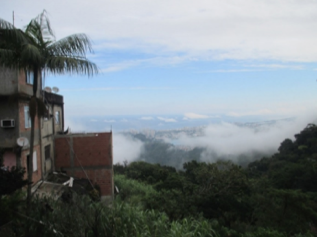
Figure 1
Vale Encantado overlooking Atlantic Ocean
Vale Encantado, on the other hand, lacks the museum and archive that Horto possesses but also engages in community tourism. Vale Encantado borders Tijuca National Park and is home to twenty-six families and approximately 116 people. The first families moved to the area in the late 1800s to work in a nearby coffee plantation. Eviction troubles began in the early 2000s when the Public Ministry of the State of Rio de Janeiro called for the removal of Vale Encantado, citing environmental harm and fears that the community would grow into a massive slum. Like Horto, residents of Vale Encantado have eviction notices but public defenders have managed to stall proceedings in the courts for the past decade. In the meantime, Otávio, the president of the community’s residents’ association, promotes community development with his tourism cooperative (interview, 22 August 2017).
While tours in Vale Encantado focus on the natural aspects of the community, given its location on the boundaries of Tijuca National Park, Otávio also regularly incorporates community history in these tours to provide visitors context, thereby making these tours part-heritage tour/part-ecotour. Community museums and tourism have a dual effect of instilling pride within communities, helping residents to see themselves as inheritors of rich local heritage, while at the same time troubling the idea that favelas are places without heritage or social memory that can be easily removed. Therefore, by engaging in these museum and tourism projects, residents seek to prove that favela communities have a culture that is worth preserving in a way that evokes respectability politics (HIGGINBOTHAM, 1993).
The politics of respectability
Respectability politics is a concept often utilised within African American studies to describe black politics and especially black women’s sexual politics.[4] Higginbotham first articulated the politics of respectability in her historical account of the Women’s Council, a black Baptist women’s organisation operating during the late 19th century and early 20th century. Their activities were broadly centred on combating anti-black prejudice. While members engaged in the mainstays of protest, including ‘petitions, boycotts, and verbal appeals to justice’, black women also encouraged each other to comport themselves in Christian, upstanding ways that Higginbotham deems ‘both conservative and radical’ (1993, p. 187). Indeed, respectability politics for the Women’s Council was about promoting positive images of African Americans (and African American women in particular) in order to counter the barrage of negative stereotypes of African Americans in the early 20th century (HIGGINBOTHAM, 1993, p. 191). Besides advocating for the subversion of negative stereotypes of black women, the Women’s Council also challenged the symbolic violence that had caused them to doubt their own virtue by reminding each other that ‘self-esteem and self-determination were independent of contexts of race and income’ (HIGGINBOTHAM, 1993, p. 191). Higginbotham calls this uplift work ‘racial self-help’ whereby African American women in the Council sought to empower themselves by behaving in morally superior ways to the whites who were oppressing them (HIGGINBOTHAM, 1993, p. 195).
Respectability politics has influenced all aspects of African American studies and has appeared in work detailing urban housing activism among African Americans (WILLIAMS, 2004). Here, I extend the concept beyond African American studies to claim that those active in the Favela Housing Rights Movement share similarities with the Women’s Council. Like the Women’s Council, activists within the movement use traditional forms of protest. However, they are also engaged in a battle to restore dignity to themselves and others who live in informal settlements by using heritage to assert themselves as morally superior to those who seek to evict them. Moreover, the appeals to heritage are also partly-conservative and partly-radical political tactics as they do not attempt to challenge the authority of those in power who desire their removal but nevertheless subvert their narratives and discourses used to justify favela evictions.
Favela tourism: a rebranding strategy
Although in this essay I discuss community-based favela tourism, it is not the the only form of favela tourism. The stereotypical image of favela tourism is that of intrepid Western travellers eschewing the comforts of sun, sand, and surf to view a grittier, more authentic portrait of Rio. Favelas like Rocinha, Providência, and Babilônia are common favela tourist sites though each caters to different audiences. For example, those interested in visiting an archetypical favela might opt for Rocinha, the largest and most visited favela in Rio (FRENZEL, 2016, p. 65) while tours in Providência, widely considered Brazil’s first favela, attracts tourists who are interested in favela history.
Favela tourism, or more broadly ‘slum tourism’, gained popularity in the early 1990s, namely in the favelas of Rio de Janeiro and in the townships of South Africa (FRENZEL, 2016, p. 1). In fact, Frenzel and Koens identify the 1992 Earth Summit and the subsequent surge of requests to visit favelas by attendees and ‘politically-minded tourists’ as the catalyst for specially designed favela tours (2012, p. 197-9). Initial research on slum tourism centred on Brazil and South Africa though India has emerged as a popular field site (FRENZEL and KOENS, 2012, p. 196-7). In Rio, favela tourism is largely embraced by policymakers who believe that tourism is a passive (and likely economical) option to ‘pacify’ favelas, or curb the violence within them, as well as a way to create more employment within favelas or, alternatively, gentrify them. (FRENZEL, 2016, p. 2; MENEZES, 2015, p. 141). In reality, favela residents do not generally receive much economic benefit from tourism (FREIRE-MEDEIROS, 2013, p. 155) but some see it as an opportunity to lessen favela stigma. For example, in Freire-Medeiros’ study of 178 survey respondents from Rocinha, 80% of residents said they were wholly in favour of tourism in the favela because tourism meant that Rocinha has a valuable commodity to offer outsiders. Additionally, residents saw tourism as an opportunity to counter negative images of Rocinha as a violent place and (mistakenly) believed that tourism significantly boosts Rocinha’s economy (FREIRE-MEDEIROS, 2013, p. 153-5).
Although few studies on slum tourism capture residents’ perspectives (FRENZEL and KOENS, 2012, p. 210) the research that does exist matches Freire-Medeiros’ findings. For instance, residents of Kibera in Kenya reported a general disregard for slum tourism but most thought tourism could improve economic conditions in the community (KIETI, 2013, p. 49). In Mexico and Jamaica, residents of informal settlements viewed tourism as a means to challenge unfavourable perceptions of their neighbourhoods: ‘In both cases, the tours engage with globally and nationally circulating spatial imaginaries of the neighbourhood, drawing on positive images of local cultural achievements in music, art, and religious practise to combat the stigma of poverty’ (DÜRR and JAFFE, 2012, p. 120). In order for residents to project a positive image of their communities through tourism, they must not only fully participate in the management of tourism but must also attract tourists who are committed to the political project of valorising informal settlements as valid tourist sites (KIETI, 2013, p. 55).
Frenzel, writing about Rio de Janeiro, identifies this subversive form of tourism as ‘disruptive valorization’ in which tourists, by ascribing value to favelas by spending money to visit them, ignore the rhetoric of the ‘local value regime’ that says these communities are shameful and should be ostracised (2016, 98-123). In this way, tourists signal the worth of favelas by making them more visible and by ‘actively contributing to their development and transformation’ (FRENZEL, 2016, p. 63). —though Freire-Medeiros might take issue with the overemphasis on the transformative impact of tourists in the lives of favela residents in Rio’s favelas. Nevertheless, Frenzel cautions that increased visibility is not always advisable since it could attract attention from detractors who would rather see favelas disappear. Therefore, activists campaigning for favela rights should not only strive towards increased visibility but should also make demands for improved infrastructure and creating ‘shared spaces’ (FRENZEL, 2016, p. 173, 192).
Frenzel attempts to disprove various myths about what he terms slum tourism: that tourists who visit these communities are necessarily voyeuristic so-called leeches who enjoy consuming images of poverty and despair, and that those who visit favelas without the sole purpose of sightseeing are not tourists. Frenzel and Koens found that most slum tourism research indicates that tourists primarily consume poverty. However, the authors argue that what is actually consumed is a ‘transformative experience of poverty’—one in which ‘the tourist’s knowledge and understanding of urban poverty’ expand, and/or when ‘the actual conditions of poverty’ improve if tourism manages to foster economic opportunities in communities (FRENZEL and KOENS, 2012, p. 199, 209). This view, of course, requires a perfect application of slum tourism that is both economically beneficial to residents and conducted in such a way that tourists gain insight on poverty.
One of the ways that Frenzel attempts to rehabilitate the image of the slum tourist is by emphasizing the power slum tourists have to disruptively valorise certain favelas. To prove his point, Frenzel references a 2003 city government-run project to turn Providência into a ‘cultural corridor’, living museum (museu vivo), and tourist attraction that failed because of resistance from residents (SAVOVA, 2005; FRENZEL, 2016, p. 125-6). The initiative also flopped because, as Frenzel insists, tourists had not yet identified Providência as a must-see attraction and so no disruptive valorisation had taken place (2016, p. 125-6). While tourists, especially Western ones, indeed have the power to challenge favela stigma by visiting favelas, Frenzel has overlooked how favelas with community-based tourism participate in disruptive valorisation on their own behalf.
In this research, the first introduction to Rio began with type of community-based tour of Providência. This tour series, called the Rolé dos Favelados is run by Cosme Felippsen, a professional tour guide of eight years who is originally from Providência. In an interview with the grassroots newspaper, A Voz da Favela, Cosme explains the purpose of these tours:
O Rolé não é só mostrar visualmente a favela, mas também discutir e debater sobre a cidade, o que é favela, segurança, turismo e ativismo.
O Rolé não é só mostrar visualmente a favela, mas também discutir e debater sobre a cidade, o que é favela, segurança, turismo e ativismo.
The Rolé isn’t only about visually showing the favela, but is also about discussing and debating the city, what makes a favela, as well as issues of security, tourism, and activism. (qtd. in BRUNO, 2018)
Cosme began the Role dos Favelados to not only tackle favela stigma but to also involve tourists (many of whom are Brazilian) in the dismantling of this stigma by asking them to question their own presuppositions about favelas and urban citizenship (fieldnotes, 18 February 2017).
Apart from the Rolé, most of my introductions to favela communities occurred through tours organised by residents. Typically, the other tourists besides myself were either students or researchers linked to local universities who had been invited to a community as part of an outreach scheme. We received first-hand experience of the favela that we could then use in the write-up of our papers and theses. In return, residents-cum-tour guides were able to disseminate their own narratives about their communities that often countered what had been said about them in the mainstream media.
Some might take issue with characterising research visits in the same vein as tourism; yet Frenzel makes a compelling argument against viewing researchers in a different light than other tourists. He calls this desire for differentiation ‘anti-tourism’: ‘often an attempt at distinction, at expressing one’s class position in specific forms of cultural consumption that are valued more highly than others’ (2016, 9). Frenzel criticises this tendency, alleging that it needlessly muddles the definition of tourism and maintains that interpreting ‘research, activism, and volunteering’ as tourism activities creates new opportunities for these actors to engage with residents in radical ways (2016, p. 15). He goes on to single out Rio as the ‘Mecca of research tourism’, citing the thousands of social scientists who arrive in the city to research favelas (2016, p. 15). Relatedly, Freire-Medeiros, an expert on favela tourism, admits that it would be hypocritical of her to judge other tourists:
When I go up Rocinha on board a green jeep with my young team of researchers, what place do I intend to occupy? How can I not pre-judge tourists and guides, how can I establish a sympathetic relationship, without yielding to the voyeuristic urge that seems to animate them? Why accuse them of exploiting the favela when we, social scientists, have long used it as a field of experimentation for our intellect? (2009, p. 587)
Being mindful of this false dichotomy between tourist and researcher allowed me to see these tours through the eyes of a tourist while at the same time being able to scrutinise what I was being shown and being told from the tour guides.
Tourism in Horto and Vale Encantado operates as community-based tourism, which Hiwaski understands to mean ‘empowerment and ownership, conservation of resources, social/economic development, and quality visitor experience’ (2007, p. 677). This definition perhaps applies more directly to Vale Encantado’s tourism cooperative, which typically charges a fee for its tours. Horto, on the other hand, engages in tourism primarily for educational purposes and to increase its visibility. In total, four tours of the Horto community occurred during fieldwork. Three of them were under the auspices of the Museu do Horto and were variably given to researchers and students of local universities. The fourth was a more informal tour led by two residents after a group interview was conducted. These two residents provided a tour of the outer limits of Horto as well as a tour of the Botanical Garden. Generally, tours organised by the Museu do Horto were led by either Emerson, Emília, or the two of them, as leaders of AMAHOR, although the museum is primarily Emerson’s project. Occasionally, members of the Residents’ Commission would also join tours. During the first tour of Horto in May 2017 the importance of heritage preservation for the community and the political undertones of their rhetoric surrounding heritage became apparent.
This tour began in Caxinguelê, the núcleo (neighbourhood) closest to the Botanical Garden. Near the entry gate, the visitors were shown the elementary school inaugurated by former president Juscelino Kubitschek and named after his mother, Júlia Kubitschek. According to Emerson, the school serves as the boundary between the Botanical Garden and the community, though the Botanical Garden considers the schools to be within the bounds of the Garden. Visitors were then shown the former site of the Clube Caxinguelê, a social club built by residents that formerly housed meetings of the Residents’ Association of Horto. The club was destroyed after the Garden annexed the property and in its place the Garden built a small plant nursery. Next, the tourists were taken through a narrow paved road flanked by monumental trees to the neighbourhood Morro das Margaridas (informally called ‘Morro do Quilombo’), whose name suggests the quilombo heritage of Horto.[5] Emerson informed the visiting group about former residents of Horto with known quilombo heritage and insisted that Horto’s proximity to Pedra do Sal and Quilombo Sacopã (two federally-recognised quilombos in Rio) is evidence that Horto was also likely home to escaped slaves. On other tours, Emerson regularly showed visitors a water well that slaves are believed to have used to fetch water as well as a house whose roof is made of parts from the colonial-era sugarcane mill. During one tour, a curious resident left her house to meet the group, telling them that the third house from hers has evidence of habitation by enslaved people.
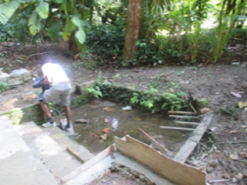
Figure 2
Emerson drinking from water source believed to be of slave origin
During the third tour in June 2017 with eight other women teaching or studying for a professional master’s degree in cultural heritage management at the Oswaldo Cruz Foundation, Emerson revealed a transmission tower that the city had built directly in front of a resident’s house, exposing this family to the risk of electrocution, and that now marks another boundary of Horto. Emerson also explained that Horto’s ancestors were dedicated to conserving the environment as we passed ancient trees and medicinal plants presumed to have been planted by the first residents. Treks to evicted houses always accompanied these tours along with a retelling of the story of the last forced eviction in Horto, which took place in November 2016.
Although ostensibly historical tours, it was clear that these excursions were also intended to promote a specific image of Horto that our guides hoped would disassociate Horto from the typical negative image of a favela and that, in doing so, would attract more supporters. Washington, a resident of Horto, confirmed my suspicions when asked if he supports tourists visiting Horto: ‘About the tours in Horto, I think they’re great since it’s a way for people to see that we residents preserve nature and the local environment]’ (interview, 10 September 2018).[6]
On a tour organised by the the Museu do Horto for a group of forty-five law students from the Pontifical Catholic University of Rio de Janeiro, the State University of Rio de Janeiro, and Federal University of Rio de Janeiro, the underlying motive of Horto’s tours became clear:
I’m wondering if the tour is designed to show a specific side of Horto. It always starts with showing the school, saying that it is the real boundary of Horto, then the destroyed Caxinguelê social club, then probably the quilombo part and the Solar da Imperatriz.[7] This is a tour of Horto’s resistance, which I get, but we’re also being treated to a nice view of Horto. We get shown the nice parts and I don’t know for sure if there are bad parts, but we don’t get a chance to see them on these tours. (Fieldnotes, 2 September 2017)
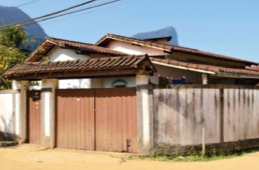
Figure 3
A typical house featured on Horto tours. Larger homes like this are older housing. Courtesy of TV Horto.
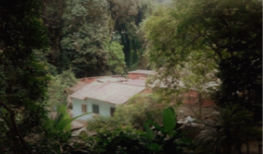
Figure 4.
Newer housing in Horto
Emerson and Emília are aware that tourists (especially Brazilian tourists) have an unfavourable image of informal settlements. Therefore, one goal of the tours is to counter this perception by avoiding evidence of newly built housing that more aesthetically approximates housing in well-known favelas. Another motive for guiding tourists away from newer houses is that newer housing contradicts Horto’s narrative of being a longstanding community with a rich history. For Horto, tourism is not an economic enterprise but public outreach—a project to rehabilitate the image of Horto and establish its residents as respectable citizens by countering allegations that Horto residents are invaders living in a place without history.
Likewise, tourism in Vale Encantado is about assuaging fears about favelas but has an additional objective: using tourism as a method for sustainable development. In this way, Vale Encantado provides a useful, gainful service that demonstrates the benefits of allowing the community to remain in the favela. In Vale Encantado, community organisers organised a tour given to a group of undergraduates from Augustana College in Illinois, who travelled to the community to receive hands-on experience for their economics and development course. Other tours were less formal and occurred as part of other events, such as after a mutirão in which local university students volunteered to help plant shade-giving foliage in the children’s playground, and after brainstorming workshops about how to increase tourism to Vale Encantado.
Tours are led by Otávio, president of Vale Encantado’s residents’ association, under the auspices of the favela’s ecotourism cooperative. As such, tours are geared towards demonstrating the natural resources and ecological history of the community. Otávio, as resident local history expert and tour guide, took the group of American undergraduates to a grove of jackfruit trees and lamented how invasive a species jackfruit has become in Rio.[8] But, Otávio maintained, the prolific trees are never cut down, as that would amount to deforestation and would likely lead to rock slides and water pollution. Other trees like the embaúba are harbingers of good fortune—that is, of soil that has become fertile again after a fire.
Later, Otávio indicated to us a plant whose leaves have antiseptic properties and a mamona tree whose fruit produces biofuel.[9] In Otávio’s estimation, these plants were most likely planted by the first settlers of Vale Encantado who may have used them to fuel gas lamps since this species of plant is not native to the Rio de Janeiro area. Sustainable technology prominently featured on tours as well, especially the sewage treatment and food compost systems. Nevertheless, tours were never only about highlighting local plants or exhibiting the technology that was enabling residents to live sustainably. In fact, Otávio often situated these within the context of Vale Encantado’s history, as evidenced in the story about the origins of the mamona tree but also within his own family’s 104-year history in the community.
Tourism in Vale Encantado is more than the rebranding strategy it is in Horto. In fact, it resembles more traditional forms of favela tourism coupled with the goals of community-based tourism. In this sense, tourism in Vale Encantado is largely about using tourism as a means towards sustainable development. To help achieve this goal, the Global Summit (the fifth of its kind) was held in the headquarters of Vale Encantado’s ecotourism cooperative on April 22, 2017. The meeting was attended by Otávio and non-favela resident supporters who all presented their ideas on how to expand tourism. The overarching theme was using tourism to empower the young adults of the favela—most of whom Otávio identified as being unemployed and without easy access to education given the community’s isolation.[10]
For Thais Pinheiro Rosa, director of Conectando Territórios (a community tourism agency), community tourism is the perfect antidote to social inequalities and segregation in Rio. During her presentation on the benefits of community tourism in favelas, she was highly critical of traditional favela tourism and displayed an image of tourists from the Global North huddled in a jeep disinterestedly taking in their surroundings. Thais juxtaposed this with community-based tourism which she believes has the power to dismantle prejudices about favelas, promote empathy among tourists, aid in ecological preservation, engage favela residents in tourism, encourage sales of artisanal goods, and preserve local history and memory (fieldnotes, 22 April 2017).
Otávio also believes in the transformative power of community-based tourism and hopes that it will reinvigorate his community by attracting a needed source of income. However, not everyone in the community is supportive of Otávio’s efforts or believes in tourism as a panacea. As he recounted while walking along a nature trail, most of the community is not very involved in the ecotourism business. Otávio assumes a role as educator to the other residents about the importance of sustainable development and therefore seemingly implies that most residents are either ignorant or disinterested in environmental sustainability.
The absence of other residents was likely due to Vale Encantado, in a similar fashion to Horto, having a designated tourist stage (DESMOND, 2002), in that there are spaces allocated to the enterprise of tourism which residents can choose to enter or avoid. For the most part, it appears that residents opt for the latter, perhaps due to a disinterest in tourism or because of a disinclination to be gazed upon by tourists. Since tours generally have an ecological focus, the absence of residents is perhaps not an issue, but it does undermine the ideal of community-based tourism.
Favela museums: favela as cultural artefact
Tourism is just one method informal settlements use to advertise themselves in a way that problematises the stigmatisation of favelas as without value, culture or history. Another related method is to establish community museums that promote the history and legacy of informal settlements. In addition to Horto’s community museum, the Pavão-Pavãozinho and Cantagalo communities share the Museu de Favela, Rocinha is home to the Museu da Rocinha Sankofa, the Museu da Maré (FESSLER VAZ, 2014) is based in the Complexo da Maré favela complex, and the favela Vila Autódromo runs the Museu das Remoções, or the Evictions Museum (SIMON and BRAATHEN, 2019). The Museu das Remoções, whose motto is ‘memória não se remove [memory can’t be evicted]’, began as the brainchild of museologist and activist Thania de Madeiro during the height of evictions in Vila Autódromo. His idea was to galvanise residents to resist by turning the community into a site of memory (NORA, 1989) and an open-air museum. Today, the ruins of demolished houses constitute part of the archives of not only the Museu das Remoções, but also those of the National Archives of Brazil (fieldnotes, 23 September 2018).
Favela museums are a result of the project of museologia social (social museology), a Brazilian movement among museums that first began developing after the Roundtable of Santiago de Chile in 1972 whose precepts were further outlined in the 1984 Declaration of Quebec (SOUZA, 2018, p. 25-6).[11] Within the context of favela museums, social museology strives to encourage the idea of insurgent memory (borrowing from HOLSTON, 2008) , or what Gouveia calls:
Memórias resistentes que afirmam um direito de lembrar, de (re)elaborar suas identidades, de existir e de permanecer em seus territórios...São memórias que combatem preconceitos, discriminações, ciclos da dominação social e que favorecem a diversidade cultural, estimulando e exercitando o direito à diferença.
Memories of resistance that affirm the right to remember, to (re)articulate their identities, to exist and stay on their lands…these are memories that combat prejudice, discrimination, cycles of social domination, and that favour cultural differences, encouraging and exercising the right to difference. (2018, p. 9)
Community-based museums in informal settlements like the Museu do Horto are a direct product of the social museology movement. In Horto, those involved in the museum have embraced the ideals of insurgent memory and memories of resistance and enthusiastically use their museum to counter stigma and to assert their right to land.
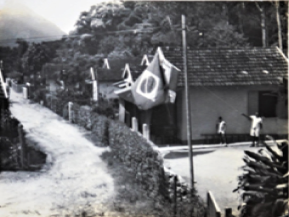
Figure 5
Caxinguelê Club in 1966. Courtesy of TV Horto.
The Museu do Horto, like many community museums in informal settlements, does not have a dedicated building. Instead, Horto itself is considered a living museum, or open-air museum. The project was envisioned by members of AMAHOR who, with support from the Instituto Brasileiro de Museus (Brazilian Institute of Museums), officially launched the museum in November 2010, though archival material had been collected by residents since 2000. The mission of the museum is intrinsically linked to Horto’s fighting against eviction:
O Horto Florestal é um lugar de memória da cidade do Rio de Janeiro e mesmo da história do Brasil, uma vez que a memória social local comporta fragmentos e rastros de um tempo histórico e de uma geografia urbana já inexistentes, ou quase. Laços de solidariedade comunitária e uma identidade de resistência (Manuel Castells) corajosa e eficiente dos moradores impedem a remoção da população do Horto e a destruição de sua cultura, frente às ameaças diversas que a comunidade tem sofrido historicamente.
Horto Florestal is a place of memory in the city of Rio de Janeiro and in the history of Brazil since local social memory contains fragments and traces of an historical time and an urban geography that almost does not exist anymore. Ties of community solidarity and a courageous and effective identity of resistance (Manuel Castells) among residents impedes the eviction of the population of Horto and the destruction of its culture, in the face of the various threats that the community has suffered historically.
The reference to the ‘historical time and an urban geography that almost does not exist anymore’ refers to the idea that Horto is a traditional community whose material culture evokes a time long past and whose residents have preserved both the cultural and ecological history of Rio. Some of these artefacts include coins, necklaces, personal documents, buildings (i.e. centenarian houses, ruins of slave quarters, the Kubitschek school, and the former social club) and immaterial examples of heritage including festivals, folk medicinal knowledge, Afro-descendant belief systems, and ancestry (SOUZA, 2018, p. 25). Expanding on the immaterial heritage of Horto, Pires explains that there is evidence of Afro-descendant religious practises taking place in Horto in former times: a pebble-laden path that leads to a towering jequitibá tree sacred to Candomblé (2018, p. 45).
Emerson, writing about the museum on behalf of AMAHOR, confirms that the mission of the museum is ‘to establish the legitimacy of the community of Horto Florestal, through the stories of the traditional families of the area, who live in areas under litigation in the region’ (SOUZA, 2018, p. 25).[13] Here, he is clear that the function of the museum is to help with their anti-eviction cause by refashioning Horto as a ‘non-favela’ and a traditional community above all. Appeals to tradition serve to emphasise Horto’s distinction as a community with a unique culture and heritage. Perhaps unbeknownst to residents, this emphasis on tradition and heritage tend to form the basis of land rights claims of indigenous and certain Afro-Latin peoples throughout the Americas (HOOKER, 2005). Emerson and Emília, however, are aware of the political currency of heritage and reached out to the United Nations in an attempt to become listed as a site of cultural heritage (interview, 29 January 2018). In September 2018, Horto received a letter of support from the United Nations Human Rights Council (UNHRC) in which the Council denounces potential future evictions in the community.
Through the museum, Horto presents itself as a community steeped in history with a unique culture developed over a long period of time. Lengthiness of time is seen as an important aspect of proving a community’s heritage and, by extension, their right to remain on their lands. In the case of Horto, residents promulgate the narrative of the community having several origin points (i.e. the era of habitation during colonial times and that of the most recent settlement by workers of the Botanical Garden). Horto residents trace their lineage directly back to the colonial occupation, while those who disagree with Horto’s land claims believe the community has more recent origins. Implicit in these positions is an awareness that the longer an informal settlement has existed, the more legitimacy it has as a place of heritage and memory.
The importance of time, or establishing the longevity of an informal settlement, is recognised in other communities. For example, the community of Morro das Andorinhas in Niterói had been threatened with eviction but was ultimately granted land usage rights. Residents achieved this through a successful effort to transform themselves from so-called favelados, (who Mota recognises as being stigmatised and having no inherent rights to property), to more respectable ‘tradicionais’, or traditional people due to their role as ‘protetores da natureza [protectors of the environment]’ (2014, p. 49-54). In this way, the community re-branded themselves using ‘uma ideia de ancestralidade [an idea of ancestry]’ as a tactic to ensure their land rights (MOTA, 2014, p. 42).
According to Mota, much of their case was justified by Lei Ordinária 2393, a 1995 state law that allows native populations that have been living in protected areas within Rio de Janeiro state for at least fifty years to remain (2014, p. 45). Given that ‘native’ and ‘traditional’ are not well-defined legally in Brazil (VIANNA, 2008, p. 229), the community saw an opportunity to argue that as a traditional community that has occupied the area for more than fifty years, they counted as indigenous to Rio de Janeiro state. To support this claim, the community had to amass a large amount of empirical evidence that established a ‘vinculação temporal dos moradores com seu território [a temporal link between residents and their territory] (MOTA, 2014, p. 45). A sympathetic judge then ruled in their favour, finding that the settlement was not a favela because the community had existed since the late 19th century (MOTA, 2014, p. 50). Mota himself agrees that time is an essential factor in whether an informal community deserves land rights and maintains that there is a distinct difference between ‘ocupações irregulares [informal settlements]’ and ‘ocupações antigas de moradores [long-standing communities]’—with only the latter having valid land rights claims (2014, p. 48).
In another informal settlement called Araçatiba, the conflict over land rights has also been articulated through the concept of time. The Federal Public Ministry released a blog post with the headline, ‘#RetrocessoAmbientalNão: ocupação irregular ameaça remanescente de manguezal em Guaratiba, no Rio de Janeiro [#NoEnvironmentalRetrocession: irregular occupation threatens the remainder of a mangrove in Guaratiba, in Rio de Janeiro]’. In the post, the social media advisor for the Rio office of the Attorney General of Brazil states that the ‘intensa e descontrolada [intense and uncontrolled]’ development of new houses within the area have frustrated plans to relocate to the buffer zone of Araçatiba seventeen families who are within the boundaries of the mangrove ecological reserve. These families, the advisor claims, have more rights than recent arrivals already in Araçatiba because they are ‘moradores antigos da região que já possuem uma identidade com o local [long-term residents of the region that already possess an identity with the locale]’ (Ministério Público Federal 2017). Lawyers assisting with Araçatiba’s case are aware that the State makes concessions for long-term communities who have the status of ‘native’ or ‘traditional’. For instance, a representative of the Ordem dos Advogados do Brasil (OAB, Brazilian Bar Association) suggested to residents during a visit that the residents who had lived in the community for an extended period ought to mention this in dealings with lawyers and politicians, indicating that lengthy occupation helps the cases of those who have eviction notices (fieldnotes, 20 October 2017).
Conclusion
Horto and Vale Encantado have mobilised heritage as a creative strategy to avoid forced eviction. Heritage as a resistance strategy is poorly documented in academic literature outside of indigenous studies, although research on favela museums and favela tourism is more robust. However, there is a strong case for reconceptualizing all favela community-based museums and tourism initiatives as examples of heritage as resistance. Future research on community-based museums and tourism enterprises in favelas should consider the ways in which heritage has become political, as well as the political currency of heritage in land and housing rights movements, especially in social movements of non-indigenous groups.
Additionally, the article demonstrates that amending the image of favelas in danger of removal to that of environmentally-minded communities laden with history and culture is a somewhat conservative yet subversive way of fighting for land rights. This tactic has been proven to work for at least one informal settlement in the Rio’s metropolitan area (Morro das Andorinhas) but this does not necessarily indicate that the strategy will work for others. However, it does show other leaders of informal settlements that they must engage in the politics of respectability by adopting the language and the cultural values of of and ingratiating themselves to the middle and upper-classes which have long harboured prejudices against those living informally in urban spaces.
Becoming respectable is at the heart of the alternative strategies used by residents within the Favela Housing Rights Movement. Gaining respect involves constantly mounting rebranding campaigns to redress a long, difficult history of favela stigmatisation that relates to racial and class stigmatisation. Although this is difficult work with no certainty of success, it is a fundamental part of how communities gain land rights. The fact is, as the Morro das Andorinhas example evinces, that informal communities need a certain amount of respect before they can be guaranteed land and housing rights. The transformation of favelas into heritage sites through tourism and museum projects is one avenue through which respect is gained. Communities labelled as traditional have a better chance of effectively lobbying for land and housing rights. This perhaps disincentives rallying around favela rights, or self-identifying as residents of favelas despite existing favela-specific resources that also help communities resist eviction.
References
BRUNO, Dionatan. Role dos Favelados. A Voz da Favela (Rio de Janeiro), September 2018.
DESMOND, Jane C. Staging Tourism: Bodies on Display from Waikiki to Sea World. Chicago: University of Chicago Press, 2002.
DÜRR, Eveline; JAFFE, Rivke. Theorizing Slum Tourism: Performing, Negotiating and Transforming Inequality. European Review of Latin American and Caribbean Studies 93 (October): 113-23, 2012. http://www.jstor.org/stable/23294474.
FESSLER VAZ, Lilian. Cultural facilities in the Opaque Spaces of Brazilian Cities as Instruments of Resistance. In: ELLEH, Nnamdi (Ed.). Reading the Architecture of the Underprivileged Classes, edited by, 101-118. Surrey: Ashgate, 2014.
FOSTER, Alison. Ricinus Communis L. (Euphorbiaceae). Oxford University Plants 400. Accessed 4 September 2019, 2014. https://herbaria.plants.ox.ac.uk/bol/plants400/profiles/QR/Ricinuscommunis.
FREIRE-MEDEIROS, Bianca. Touring Poverty. New York: Routledge, 2013.
FRENZEL, Fabian. Slumming It: The Tourist Valorisation of Urban Poverty. London: Zed Books, 2016.
FRENZEL, Fabian; KOENS, Ko. Slum Tourism: Developments in a Young Field of Interdisciplinary Tourism Research. Tourism Geographies 14, no. 2: 195-212, 2012. https://doi.org/10.1080/14616688.2012.633222.
GOUVEIA, Inês. Rede de Museologia Social do Rio de Janeiro. In: Rede do Museologia Social do Rio de Janeiro, Museu Sankofa Memória e História da Rocinha, and the Museu do Horto (Eds.). A Participação das mulheres na construção do território: Rocinha e Horto, 9-12. Rio de Janeiro: Secretaria de Estado de Cultura, 2018.
HARRIS, Fredrick C. The Rise of Respectability Politics. Dissent 61, no. 1 (Winter): 33-37. Project MUSE, 2014. https://doi.org/100.1353/dss.2014.0010.
HARRIS, Paisley Jane. Gatekeeping and Remaking: The Politics of Respectability in African American Women’s History and Black Feminism. Journal of Women's History 15, no. 1 (Spring): 212-220. Project MUSE, 2003. https://doi.org/10.1353/jowh.2003.0025.
HIGGINBOTHAM, Evelyn Brooks. Righteous Discontent: The Women’s Movement in the Black Baptist Church, 1880-1920. Cambridge, MA: Harvard University Press, 1993.
HIWASKI, Lisa. Community-Based Tourism: A Pathway to Sustainability for Japan’s Protected Areas. Society & Natural Resources 19, no. 8: 675-692. https://doi.org/10.1080/08941920600801090, 2007.
HOLSTON, James. Insurgent Citizenship: Disjunctions of Democracy and Modernity in Brazil. Princeton, NJ: Princeton University Press, 2008.
INSTITUTO DE PEQUISAS JARDIM BOTÂNICO. Solar Da Imperatriz. Accessed 4 September 2019. n.d., https://aplicacoes.jbrj.gov.br/cultura/solar.htm.
KIETI, Damiannah M. The Ethical and Local Resident Perspectives of Slum Tourism in Kenya. Advances in Hospitality and Tourism Research 1, no. 1: 1-21, 2013. http://www.ahtrjournal.org/issues/volume1_issue1/37_57.pdf.
LOVE, Ken and Robert E. Paull. Jackfruit. Fruit and Nuts 19 (June): 1-7, 2011. https://www.ctahr.hawaii.edu/oc/freepubs/pdf/F_N-19.pdf.
MINISTÉRIO PÚBLICO FEDERAL. #RetrocessoAmbientalNão: ocupação irregular ameaça remanescente de manguezal em Guaratiba, no Rio de Janeiro. 24 May 2017. http://www.mpf.mp.br/rj/sala-de-imprensa/noticias-rj/retrocessoambientalnao-ocupacao-irregular-ameaca-remanescente-de-manguezal-em-guaratiba-no-rio-de-janeiro.
MORGAN, Joan. Why We Get Off: Moving Towards a Black Feminist Politics of Pleasure. The Black Scholar 45, no. 4: 36-46, 2015. https://doi.org/10.1080/00064246.2015.1080915.
MOTA, Fabrio Reis. O meio-ambiente contra a sociedade? Controvérsias públicas, reconhecimento e cidadania o Brasil. Dilemas 7, no. 1 (January-March): 39-57, 2014. http://lemetro.ifcs.ufrj.br/meio_ambiente_contra_a_sociedade.pdf.
NORA, Pierre. Between Memory and History: Les Lieux de Memoire. Representations, 26 (Spring): 7-24, 1989. https://www.jstor.org/stable/2928520.
NURYANTI, Wiendu. Heritage and Postmodern Tourism’. In: WALL, Geoffrey; NURYANTIi, Wiendu (Eds.). Heritage and Tourism, Special issue, Annals of Tourism Research 23, no. 2: 249-260, 1996. https://doi.org/10.1016/0160-7383(95)00062-3.
PIRES, Carolina Câmara. Comunidade do Horto: lugar de resistência ancestral. In: Rede do Museologia Social do Rio de Janeiro, Museu Sankofa Memória e História da Rocinha, and the Museu do Horto (Eds.). A Participação das mulheres na construção do território: Rocinha e Horto, 41-49. Rio de Janeiro: Secretaria de Estado de Cultura, 2018.
ROBERTSON, Iain J. M. Heritage from Below: Class, Social Protest and Resistance. In: GRAHAM, Brian; HOWARD, Peter (Eds.). The Ashgate Research Companion to Heritage and Identity, 143–58. Aldershot, UK: Ashgate, 2008.
SAVOVA, Nadezhda Dimitrova. Heritage Kinaesthetics: Local Constructivism and UNESCO’s Intangible-Tangible Politics at a Favela Museum. Anthropological Quarterly 82, no. 2: 547–586, 2009. https://www.jstor.org/stable/25488282.
SCHIPPERS, Titia. Securing Land Rights Through Indigenousness: A Case from the Philippine Cordillera Highlands. Asian Journal of Social Science 38, no. 2: 220-238, 2010. https://doi.org/10.1163/156853110X490917.
SIMON, Véronique Karine; BRAATHEN, Einar. Collective Heritage and Urban Politics: An Uncertain Future for the Living Culture of Rio de Janeiro? International Journal of Heritage Studies 25, no. 4: 380-394, 2019. https://doi.org/10.1080/13527258.2018.1493700.
SOUZA, Emerson de. O museu do Horto. In: Rede do Museologia Social do Rio de Janeiro, Museu Sankofa Memória e História da Rocinha, and the Museu do Horto (Eds.). A Participação das mulheres na construção do território: Rocinha e Horto, 22-26, Rio de Janeiro: Secretaria de Estado de Cultura, 2018.
SULLIVAN, LaShandra. Identity, Territory and Land Conflict in Brazil. Development and Change 44, no. 2 (March): 452-471, 2013. http://dx.doi.org/10.1111/dech.12010.
VIANNA, Lucila Pinsard. De invisíveis a protagonistas: populações tradicionais e unidades de conservação. São Paulo: Annablume, 2008.
WARREN, Kay B.; JACKSON, Jean E. Introduction: Studying Indigenous Activism in Latin America. In: WARREN, Kay B.; JACKSON (Eds). Indigenous Movements, Self-Representation, and the State in Latin America, 1-46. Austin, TX: University of Texas Press, 2002.
WILLIAMS, Rhonda Y. The Politics of Public Housing: Black Women’s Struggles Against Urban Inequality. New York: Oxford University Press, 2004.