Artículos

Esta obra está bajo una Licencia Creative Commons Atribución-NoComercial 4.0 Internacional.
Recepción: 03 Abril 2023
Aprobación: 01 Junio 2023
DOI: https://doi.org/10.34096/oidopensante.v11n2.13329
Abstract: The emergence of new musical ideas, and new forms of musicality, is described here as the transformation of conceptual spaces in a cognitive niche, a distributed and self-organised set of intergenerational concepts, materials, and actions. According to this approach, there is a direct co-dependence relation, a co-evolutionary causal looping, between new, acceptable (valid) and surprising musical ideas (which define what is creative in a certain context), agents, tools and artifacts (instruments, musical notations, types of equipment, performance space), and conceivable epistemic and pragmatic actions (instrument techniques, dynamics of collaboration, scenic procedures). This co-evolutionary relation defines a conceptual space of musicality. To demonstrate our thesis, we detail the development of extended techniques for transverse flute, a phenomenon strongly dependent on performer-composer collaboration. We focus on Salvatore Sciarrino’s L’opera per flauto (1990), which was developed in an intensive work with the flautist Roberto Fabbriciani, through investigation of sounding possibilities of the instrument. The collaboration resulted in new and surprising sounds for the transverse flute, including the combination of extended techniques, and their notation, largely applied by later repertoire.
Keywords: Musical creativity, cognitive niche construction, extended techniques, transverse flute.
Resumen: El surgimiento de nuevas ideas musicales y nuevas formas de musicalidad se describe en este trabajo como la transformación de espacios conceptuales en un nicho cognitivo, un conjunto distribuido y autoorganizado de conceptos, materiales y acciones intergeneracionales. De acuerdo con este enfoque, existe una relación codependiente directa, un looping causal coevolutivo, entre ideas musicales nuevas, aceptables (válidas) y sorprendentes (que definen lo que es creativo en un contexto determinado), agentes, herramientas y artefactos (instrumentos, notaciones musicales, tipos de equipamiento, espacio de actuación) y acciones epistémicas y pragmáticas concebibles (técnicas instrumentales, dinámicas colaborativas, procedimientos escénicos). Esta relación coevolutiva define un espacio conceptual de musicalidad. Para demostrar nuestra tesis, detallamos el desarrollo de técnicas extendidas para la flauta travesera, un fenómeno que depende en gran medida de la colaboración entre compositor e intérprete. Nos centramos en L’opera per flauto (1990), de Salvatore Sciarrino, que se desarrolló en un intenso trabajo con el flautista Roberto Fabbriciani, a través de la investigación de las posibilidades sonoras del instrumento. La colaboración dio como resultado sorprendentes nuevos sonidos para la flauta travesera, incluida la combinación de técnicas extendidas y su notación, ampliamente aplicada por el repertorio posterior.
Palabras clave: creatividad musical, construcción de nichos cognitivos, técnicas extendidas, flauta travesera.
Resumo: O surgimento de novas ideias musicais e de novas formas de musicalidade é descrito neste trabalho como a transformação de espaços conceituais em um nicho cognitivo, um conjunto distribuído e auto-organizado de conceitos, materiais e ações intergeracionais. De acordo com essa abordagem, há uma relação direta de codependência, um looping causal coevolutivo, entre ideias musicais novas, aceitáveis (válidas) e surpreendentes (que definem o que é criativo em um determinado contexto), agentes, ferramentas e artefatos (instrumentos, notações musicais, tipos de equipamentos, espaço de performance) e ações epistêmicas e pragmáticas concebíveis (técnicas de instrumentos, dinâmicas de colaboração, procedimentos cênicos). Essa relação coevolutiva define um espaço conceitual de musicalidade. Para demonstrar nossa tese, detalhamos o desenvolvimento de técnicas estendidas para flauta transversal, um fenômeno fortemente dependente da colaboração compositor-intérprete. Focamos em L’opera per flauto (1990), de Salvatore Sciarrino, que foi desenvolvida em um intenso trabalho com o flautista Roberto Fabbriciani, por meio da investigação das possibilidades sonoras do instrumento. A colaboração resultou em novas e surpreendentes sonoridades para a flauta transversal, incluindo a combinação de técnicas estendidas e sua notação, amplamente aplicadas pelo repertório posterior.
Palavras-chave: criatividade musical, construção de nichos cognitivos, técnicas estendidas, flauta transversal.
Introduction
The emergence of new (musical) ideas, and new forms of musicality, is currently described as the breaking geniuses acts of “Aha!” Eureka-moments, and associated with special agents (internalist agent-centric approach). In contrast, our approach is based on a cognitive externalist frame, and on the notion of cognitive niche construction. How to explain the phenomenon of musical creativity from a non-internalist agent-centric perspective? We define musical creativity as the construction of a cognitive niche –a distributed, self-fueling and self-organised shareable set of intergenerational materials, structures, concepts, signs and actions. According to this approach, there is a direct co-dependence relation, a co-evolutionary causal looping, between “new, acceptable (valid) and surprising” musical ideas (which define what is creative in a certain context), agents, artifacts and tools (instruments, notations, equipments, performance space), and conceivable epistemic and pragmatic actions (instrument techniques, dynamics of collaboration, scenic procedures). This co-evolutionary relation defines a “conceptual space” of musicality. For Boden (1999, p. 352), a conceptual space “is defined by a set of enabling constraints, which make possible the generation of structures lying within that space [...]. If one or more of these constraints is altered (or dropped), the space is transformed.” A conceptual space defines a set of permissible actions, and defines what can be conceived in that space. It is a set of constraints that simplify the costs of cognitive activity for creators (composers and interpreters). We are especially interested in understanding how certain transformations in this space, or in certain constraints acting in this space, can lead to dramatic changes in musical cognitive niches –“Ideas that previously were impossible (relative to the original conceptual space) become conceivable” (Boden, 1999, p. 352).
We explore how the development of extended techniques (ETs) for transverse flute, a phenomenon strongly dependent on performer-composer dense collaboration, works to change the structure of conceivable musical ideas in a conceptual space, something that can be characterized as “change of habits” in cognitive niches.1 Instrument technique can be described as a “habit”, a regular pattern of cognitive activity, or a stable disposition to act in a certain way under certain conditions. According to the philosopher C. S. Peirce, habit has the formal structure of a set of conditionals (Atã; Queiroz, 2016). A habit is a “pattern of constraints”, stating that certain things would happen under specific circumstances; a “rule of action” (CP 5.397, CP 2.643), especially when the carrier of the habit is stimulated, animated, or guided by certain motives (CP 5.480). ETs can be defined as “changes of habits”, interruption of regular and persistent patterns of activities (breaking of habits). They generate new and surprising effects, disturbing stable patterns of action and producing new causal looping and cascades of events.2 They are among the most remarkable ways of investigating new forms of musicality in 20th century music –“I think each era has changed the sound of music. In our time, it changed when it was affected by atonality and the development of instrumental techniques and effects” (Sciarrino by Habbestad, 2019, p. 3). ETs directly determined the construction of cognitive niches in 20th century music and can be defined as a kind of collective (interpersonal) epistemic action (Kirsh; Maglio, 1996, p. 71), enacted for changing regular and stable patterns of musical procedures. As an epistemic action, they are created to extract new information from cognitive systems.
According to Olivier Messiaen, these techniques contribute “to the evolution of the notation and technique of one of the oldest and at the same time most modern instruments of our planet: the flute” (Messiaen, 1980, p. IV). Extended techniques are related to the expansion of a notion of musicality,3 as argued by Artaud and Geay: “The music of the XXth century has permitted a considerable widening of the notion of musicality, which can be seen not only in the greater utilization of percussion or the appearance of electronics, but also in the remarkable development of instrumental techniques” (1980, p. 3). Bartolozzi emphasises its relevance to the various transformations in the context of contemporary music: “It would be hard to find another musical epoch in which every aspect of musical technique and aesthetics has been subjected to such radical discussion and dispute as in ours” (1967, p. 1).
The object of this study is the relation between musical creativity, cognitive niche construction and extended techniques to transverse flute, one of the instruments on which the employment of new techniques has been systematically developed in the last decades, and the non-habitual manipulation of their possibilities produce a new and surprising collection of sound materiality and organization. Our study focusses on Salvatore Sciarrino’s4 L’opera per flauto (Sciarrino, 1990), which was developed in a collaborative work between the composer and the flautist Roberto Fabbriciani. Taking the contemporary repertoire for transverse flute into consideration, our research includes the study of methods on extended techniques for transverse flute, in its historical development. We investigate the context of their experimentation through descriptions by the composer and flautist, as well as the secondary literature about their cooperation. Our hypothesis is that extended techniques can be described as the building of structures and processes that transform conceptual spaces in music cognitive niches. Experimentation, systematization and the use of extended techniques correspond to the construction of a cognitive niche, in which new and surprising ways of playing an acoustic instrument are investigated.
Niche construction: from Biology to Biosemiotics and Cognitive Semiotics
Niche construction is the process by which organisms actively modify their own evolutionary niches (Odling Smee et al., 2003). The most mentioned examples include building nests, burrows, and other artifacts; changing the physical and chemical conditions related to the appearance of shadow, change in wind speed; changing the cycle of nutrients between plants. In ecology, the notion of niche describes the combinations of environmental factors that allow species to exist in a certain physical region or in a certain biotic community, as well as the effects that species have on these environmental factors (Peterson et al., 2011, p. 14). Hutchinson’s classic definition describes an ecological niche as an n-dimensional hypervolume, where each dimension represents an ecological factor that plays a significant role in a species’ success (Hutchinson, 1957).
The theory of niche construction originated in the field of evolutionary biology in the 1980s, when Richard Lewontin (1983), a biologist and mathematician, introduced new ideas. John Odling-Smee is credited with coining the term “niche construction” and being the first to argue that it should be considered an evolutionary process. Therefore, the theory of niche construction owes its origin to Lewontin’s ideas and its recognition as an evolutionary process to Odling-Smee’s contributions. The “niche construction theory” suggests that organisms actively modify their environment, that the modifications are transmitted in time and space (ecological inheritance), altering selective pressures on the niches of these organisms and with those with which they share the environment (Odling-Smee et al., 2003). According to this perspective, there is a close interdependence between organisms and environments (as well as ecosystems and niches) –“There is no organism without an environment, but there is no environment without an organism” (Lewontin; Levins 1997, p. 96).
According to Laland et al. (2016), the environment of organisms can be altered by both trophic interactions and direct interventions, as well as by the metabolic, physiological, and behavioral activities of the organisms themselves. These changes can then modify the evolutionary pressures acting on the organisms. This theory highlights an important distinction between the niche, the physical world, and the environment, which has significant implications for understanding the dynamics of evolution. There is a physical world outside of organisms and that world undergoes certain transformations that are autonomous. Rivers, and lakes, disappear, volcanoes erupt. Accordingly, for Lewontin and Levins (1997, p. 97), organisms “do not experience or fit into the environment, they construct it”. In the same sense, organisms not only fit into previously available niches in an ecosystem, but also construct their niches. This perspective challenges the notion that niches are simply a set of environmental circumstances that exist independently of organisms. In fact, according to this view, the very definition of a niche implies that an organism must be actively present and engaged in constructing its own niche. This process of niche construction is a crucial part of the evolutionary dynamic, and highlights the active role that organisms play in shaping their own environments and evolutionary trajectories.
The concept of niche is not only relevant to evolutionary theory, but has also been explored in other fields such as distributed cognitive science. Investigations into the evolution of cognition (Tooby and DeVore, 1987), culture (Laland, Odling-Smee, and Feldman, 2000), language (Bickerton, 2009), biosemiotics (Hoffmeyer, 2008), and cognitive semiotics (Atã and Queiroz, 2019) have all drawn on the concept of niche to understand the complex interplay between organisms and their environments. These diverse fields suggest that the concept of niche is a rich and multifaceted one, with wide-ranging implications for understanding the nature of cognition, culture, and communication. Tooby and DeVore (1987) first proposed the term “cognitive niche”, a specific ecological niche that human ancestors would have constructed at some point of our evolutionary history, and that would explain several of our species features (complex social behaviour, symbolic language and communication, learning and cultural transmission, among others) without having to resort to ad hoc explanations. Andy Clark’s work has expanded the concept of niche to encompass the cognitive niche, which is closely tied to the materiality of artifacts and structures –“… the process by which animals build physical structures that transform problem spaces in ways that aid (or sometimes impede) thinking and reasoning about some target domain or domains” (Clark, 2008, p. 62). Clark emphasizes that these structures are situated within complex socio-cultural contexts, environments, and cultural ecosystems. A different description of “cognitive niche construction” is given by Lorenzo Magnani. For Magnani, humans are “chance seekers” (Magnani, 2007; Bardone, 2011), “continuously engaged in a process of building up and then extracting latent possibilities to uncover new valuable information and knowledge” (Magnani, 2007, p. 918). Magnani emphasizes cognitive niche construction as a process through which we create “chances”. Cognitive niches are viewed as sets of affordances, “how humans exploit external resources and incorporate them into their cognitive systems” (Magnani, 2009, p. 332).
Musical creativity can be described as the building of cognitive niches. Disturbance of regular and expected behavior of instrument technique creates a potent (radically new, surprising and sometimes valid) form of musicality. This process is co-dependent of other cognitive ecologies –for example, development of notations, new mechanisms of diffusion and communication, new forms of composer-performer interaction.
L’opera per flauto
Describing L’opera per flauto (1990), a work by the Italian composer Salvatore Sciarrino (1947-), Cescon states that “when it was published, a sort of confusion was created among the various flautists since it became evident that it was possible to find other ways to play the flute” (Cescon, 2002, p. 20).5 These “other ways” are directly related to the systematization and diffusion of extended techniques, understood as non-habitual usages of acoustic instruments, which are lacking in a canonical repertoire, the latter established historically. The transverse flute’s potential in the investigation of new and surprising sound possibilities is related to “flute’s versatility in creating a wide array of sounds, allowing for a sophisticated extension of traditional methods of performance” (Levine and Mitropoulos-Bott, 2002, p. 7).
An association between the flute’s versatility and the constant search for new and surprising ways to play it, can be seen in L’opera per flauto, which consists of solos for the instrument, each dedicated to a specific technique. According to Farwick (2009, p. 242), “These seven pieces exhibit an extensive sound spectrum and virtuous elements. In addition, they show a variety of different ways of generating and modifying sound”.6 Sciarrino’s enthusiasm regarding the flute is reflected in a wide repertoire for the instrument, which includes in addition to solos, works for flute and orchestra (e.g. Adagio no. 2 Fl., Orch. 2009, Concerto for Flute Fl., Orch., 2009) and chamber music (e.g. Rondo Fl., Chmbr. Orch., 1972). The experimentation with non-habitual ensembles is also part of his repertoire, as can be seen in Studi per l’intonazione del mare (2000), composed for voice, four solo flutes, four solo saxophones, percussion and an orchestra of one hundred flutes and one hundred saxophones. According to Megan Lanz (2010, p. 32), Sciarrino’s dedication to the development of new and surprising sounds for the flute spans over twenty years, and the composer’s own conception in this regard indicates the intention to reveal the instrument’s possibilities –“Yes, the old flute, just so as it was, had not yet been explored completely” (Sciarrino, 2001, p. 139). At this point, a relationship between the work of Sciarrino and that of Helmut Lachenmann should be noted, since both composers are dedicated to expanding the instrumental sound repertoire through ET. Albertson asserts that Lachenmann has always tried “to encourage listeners to move beyond the ordinary, to not accept the notion that sound is a dead phenomenon already supersaturated by the works of previous composers, but instead an organism of intense modernity and individuality, as well as a nearly endless plethora of possibilities” (2004, p. 3).
Gottschalk (2016) highlights the necessity to acknowledge an open space between music and sound. Auner (2013) discusses this expansion of boundaries between music and noise in the general context of Twentieth Century music, in which the investigation of ET is presented as a possible interface between the musical use of noise and the expansion of instrumental sound possibilities.
The seven solos that constitute L’opera per flauto are relatively brief, and were written in the Seventies and Eighties, being first published by Ricordi Editions, in 1990.7 Just as Halfyard presents the set of Sequenzas by Luciano Berio, it could be said about Sciarrino’s work that “they are brief in terms of their duration [...] but in terms of their musical depth, they are giants of our time” (2016, p. XIX). Composed in 1958, Berio’s first Sequenza for solo flute predates Sciarrino’s work considerably and constitutes a precursor not only to the sound investigation presented in L’opera per flauto, but also to the general repertoire of ET. Sciarrino’s collection of solos in a same series is directly related to the compositional usage of extended techniques, since each solo is dedicated to a specific technique, which could be also noted regarding Berio’s work: “this is a series in which the pieces are linked [...] by particular compositional aims and preoccupations –virtuosity, polyphony, the exploration of a specific instrumental idiom [...]” (Halfyard, 2016, p. XIX).
In each musical piece that constitute L’opera per flauto, a first timbre related to a specific extended technique is presented and repeated in small variations for considerable periods of time, making it possible to hear both the presented technique and the economy in musical material. Only then a second technique, that presents a distinct timbre, is introduced. Sciarrino affirms that the economy of musical means was a necessity to the musical work, based on it, very few elements contribute to the musical discourse (Sciarrino, 1995, p. 4). In the general context of Twentieth Century music, a simplicity regarding Sciarrino’s work was pointed out by Griffiths (2010). However, the dynamics8 is also related to the presentation of new and surprising musical materials and plays a fundamental role in the work as a whole. The formation of arcs between a sound dal niente to another al niente reveals the timbre of employed techniques. According to Cescon (2002, p. 21), “[sounds] from nowhere lead to nowhere, arriving though at very precise and determined sounds in these passages”,9 which is confirmed by Geraci, who states that a large part of Sciarrino’s sounds originates and ends in nothingness (Geraci, 1995, p. 29). The flautist Roberto Fabbriciani relates this form of sound presentation to the presence of musicians themselves, which is renewed by each of the soffocati10 in Come vengono prodotti gli incantesimi? The sound is repeatedly born, grows and then disappears until its next appearance (Fabbriciani, 2007, p. 59). Not the musical gesture is modified by ET, but the way it sounds through soffocati, which is immediately perceived by the audience as a new, surprising, non-habitual sound that affords new forms of playing the flute from the musician’s perspective, even though a disappearing gesture can be found in standard repertoire.
The use of pianissimo dynamics level in its relationship with silence, as well as the non-preference for precise and determined sounds, unify the solos that compose L’opera per flauto and allow the exploration of constraints through extended techniques. In the work’s context each of the techniques employed takes on the character of a fundamental musical material, from which variability is developed. Nyffeler explains in accordance with Sciarrino that “an unmistakable variety of sounding phenomena emerges from a basic idea that is always newly and differently modified” (Nyffeler, 2008, p. 2).11 Thus, a relationship between musical repertoire and the spread of extended techniques is to be noticed, in the sense that musical works prove ET as valid musical materials, revealing a conception that is made of instruments: “It has become clear in recent years that the valid but limited traditional conception of the flute encompasses only a restrict number of the sonorities the instrument can produce” (Dick, 1989, p. V). The scope of Sciarrino’s experiment led to the creation of a second collection, L’opera per flauto 2,12 where extended techniques continue to be employed.
Extended techniques: compilation of new sounds and compositional application
The first book on extended techniques for flute to be published was New Sounds for Woodwind (1967), written by Bruno Bartolozzi. It covers woodwind instruments in general (flute, oboe, clarinet, and basson), including the investigation of monophonic possibilities, in which a classification of single sounds according to timbre is made, and multiphonic possibilities for all four instruments. After Bartolozzi’s book was brought out, other works on extended techniques were developed, such as Stokes and Condon (1970), followed by Lozzi and Mencarelli (1975) and Nancy Toff (1979), which are specifically dedicated to the transverse flute. Other instruments certainly continued having their technical possibilities investigated, such as the clarinet. Rehfeldt (1994) attests the relevance of the current repertoire and theoretical textbooks for the systematization of extended techniques for this instrument. Not only woodwinds continued such exploration, but acoustic instruments in general.
In 1980 Flûte au présent by Pierre-Yves Artaud was published. It presents a large compilation of techniques for transverse flute, including its description for flautists and composers, as well as a comprehensive list of multiphonic possibilities.13 The extension of this work and the practical research of the instrument that enabled the systematisation of such techniques, particularly multiphonic,14 made this book influential in contemporary classical music circles for a few decades after its publication. In the next years, the investigation of extended techniques continued to be of great interest, and thus appeared works by Dick (1986, 1989), Koizumi (1996) and Levine and Mittropoulos-Bott (2002), who review some aspects of Artaud’s book adding descriptions of new techniques.
A central aspect to the development of literature that spreads extended techniques is their notation. The investigation and communication of new and surprising sounds depends on their writing so that a technique becomes a conceptual implement (an implant or a cognitive artifact) that allow experimentation through time by many musicians –“Another matter which presents some difficulty is the classification and notation of sound material –a work which needs great care and attention if the pitch and timbre of sounds is to be correctly ascertained” (Bartolozzi, 1967, p. 60). The exploration of new and surprising sounds is often accompanied by the attempt to write new musical parameters, such as subtle variation in timbres, which makes the work of writing such sounds extensive and involves the need for testing the instrument itself. In that way, a causal loop between notation and experimentation is established, creating new, intergenerational stable patterns of activities or new habits.
The compilation of instrumental possibilities, often associated with their description for performance and compositional use, is frequent in these works. Thus, they often work as didactic manuals, which provide flautists with information on how to play certain techniques, in addition to exemplifying their sounding results, their potential and limitations for a compositional usage. It is done through verbal description and, in some cases such as in Levine and Mittropoulos-Bott (2002), through the citation of musical works that present the techniques described.
However, as can be seen in L’opera per flauto, the use of extended techniques is not restricted to an encyclopedic compilation or its didactic presentation. It includes its compositional application in works, such as the seven solos dedicated to specific techniques. According to Farwick, “A glance at the notes reveals both the great density of events in Sciarrino’s music, but also the precision in the musical notation, which is kept without metrical references to bars, but comes through guidelines for breathing” (2009, p. 242).15 Musical works that introduce new and surprising ways of playing an instrument change its niche structure, which involves the entire cycle of musical fruition: from creation and performance to the reception by an audience. This cycle then allows the techniques to be: 1) compositionally conceivable, which means (a) that they are comprehensively written, (b) collectively recognizable, and (c) audible; 2) that they are feasible and reproducible on the instrument.
Musical works such as L’opera per flauto prove the centrality of musical repertoire in the diffusion of extended techniques and, consequently, in the breaking of conceptual spaces related to instruments’ potential. This paradigm break with a historical sense of instruments’ use is related to the musical novelty proposed by extended techniques, which is presented by Bartolozzi as follows: “It first became clear that further developments in woodwind techniques16 can be achieved when it was found that certain new playing techniques led to the effects of unexpected novelty. Since then a substantial vocabulary of new sounds has been formed which can enrich and amplify that which already exists” (Bartolozzi, 1967, p. 2). In turn, this set of constraints intensely determines both the use of instruments and the conception that is made of them –“The traditional conceptual limitations of the flute exclude it from many of the innovations taking place in the musical fields of the avant-garde, jazz, and rock” (Dick, 1989, p. V). We observe in Sciarrino’s work that innovation related to transverse flute co-evolves on the interrelationship between instrumental experimentation and reproducibility of musical notation. Extended techniques (as cognitive artifacts) are spread through guides and methods, but they are only applied as performance practices through the repertoire, which in turn presents its own constraints, as we observe in All’aure in una lontananza, the first solo in L’opera per flauto, composed in 1977. In this work, Sciarrino uses special forms of whistle tones17 with specific pitches, rather than writing notes followed by either curves or dots that represent any resulting pitch from a given fingering position. In figure 1a and 1b we present these two notation forms of whistle tones.
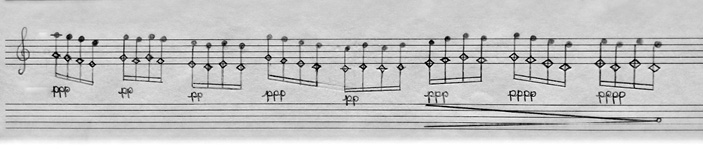
Figure 1a.
Whistle tones with specific pitches.
Source: authors, 2023.

Figure 1b.
Whistle tones with curves.
Source: authors, 2023.While Sciarrino’s music score presents the first form of notation, Artaud’s method, Flûte au présent (1980), mentions both. The central difference in musical notation is that the first example defines pitches resulting from each whistle tone, while the second guides the flautist on instrument’s fingering, but leaves pitches that will sound from that fingering free. Consider here that the year of Sciarrino’s composition corresponds to the period of experimentation that led to Artaud’s method. Later methods (Levine and Mittropoulos-Bott, 2002) adopt the notation used by Sciarrino for whistle tones, in addition to mentioning his score as a reference for the technique in question (2002, pp. 17-18). Another technique used by Sciarrino that is quoted by the same authors is that of jet whistle with arrows18 that indicate the strength of the explosive blast (Levine and Mittropoulos-Bott, 2002, pp. 17-18).
Both the difference between musical works and methods, and the constant revision of notation and technical possibilities, mean that musical works that make use of extended techniques often need performance notes in order to present musical notation and describe the sound effect of the techniques used. They usually precede music scores. For Farwick (2009, p. 23), “the many new signs that can make reference to all musical characteristics, such as pitch, tone duration and playing styles, are, in contrast to the conventional musical writing, often not generally binding and can differ depending on the composer, sometimes also depending on the piece. By some composers the multitude of new signs leads to long explanations”.19 In L’opera per flauto, Sciarrino presents performance notes for each solo, strengthening the relationship between the score and its didactic effect of diffusing extended techniques and elucidating its musical novelty. In this case, the centrality of musical works in the diffusion of extended techniques is reaffirmed, which in L’opera per flauto includes the relationship between solos and the main technique used in each of them, increasing the educational character of an introduction to extended techniques. However, we emphasise here how much this “introduction” has a different character from that which takes place in technical methods, insofar as it presents a compositional use, not an instrumental procedure. The very presence of performance instructions as introduction to music scores in the context of contemporary music, which already counts on the publication of various technical methods such as those mentioned, reinforces the distinction between musical works and technical methods.
Musical works associate technical possibilities to their compositional applications and performance practices, such as the notation of pitches in whistle tones, mentioned in our previous example. In this sense, we present the hypothesis that the musical novelty that is spread through the use of extended techniques depends on the establishment of a cognitive niche favorable to the systematization and diffusion of such techniques, which is directly related to compositional processes, as we will present next.
Composition of extended techniques in L’opera per flauto
In L’opera per flauto’s first solo, All’aure in una lontananza (1977), mostly three extended techniques are employed: tremolo of harmonics, violent glissando and breath-tone with closed mouthpiece, varied by different tongue positions. The first one, tremolo of harmonics, consists of a quick change between two partial notes, without their fundamentals sounding, but rather a common partial between fingered fundamentals, like an E at the very beginning of the piece.20 The result of this tremolo is a constant change in timbre and a smooth variation in the pitch of each partial. The sound production of harmonics depends on focusing on different partials from a same note fingering on the instrument. Gradually, the next two techniques are interspersed with this tremolo, starting from violent glissando. To play this technique the whole mouthpiece has to be covered by the lips.
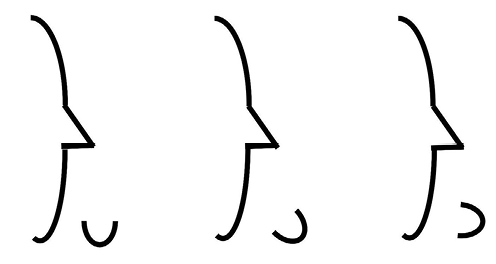
Figure 2.
Mouthpiece’s positions: usual position, mouthpiece turned inwards, whole mouthpiece covered by the lips.
Source: authors, 2023.A fast and strong blow will sound like a violent wind gesture, and the resulting pitch will be a seventh below the tone indicated in the music score. This technique is represented by an arrow over a diamond, as shown in Figure 3. Although the strong sound intensity of a violent glissando is interspersed with smooth tremolo of harmonics, the dynamic level around pianissimo (very quiet) is predominant in the piece and is also characteristic of breath-tone, the third technique used in this solo. It is produced with the mouthpiece positioned between the teeth, practically inside the mouth. The result has a definite pitch, and sounds like a brise. It is represented by a white diamond, represented in Figure 1a. A variation of this technique employs the tongue covering the hole of the mouth-piece by about two-thirds. It sounds two octaves above the fundamental, almost like a whisper. A gradual transition between these techniques is also used by Sciarrino, and is represented by a half white, and half black diamond, as shown in Figure 3. This technique tends to make it difficult to issue specific pitches, for this reason notes are indicated in parentheses. These variations of extended techniques, such as the use of both open and closed mouthpiece, or varying tongue positions, are characteristic of Sciarrino’s work for flute, as we will continue to present in the next solos of L’opera per flauto.

Figure 3.
violent glissando (1), breath-tone (2), breath-tone covering the mouthpiece (3), gradual transition between breath-tones (4).
Source: authors, 2023.In the second solo, Hermes (1984), multiphonic and harmonics are predominantly used (Figure 3). At the beginning of this music piece, the harmonic series of C stands out, later interspersed with other fundamentals. While in the first solo the partials of a harmonic series were quickly intercalated in tremolos, here the partials form a melodic sequence written in the score. The second technique used, called multiphonic, means the emission of two or more sounds at the same time. In this piece, they form small chords from a fundamental, therefore they are called multiple natural tones, as they sound from this fundamental note like partials in a harmonic series. In order for partials to sound pressure is needed. For this reason, in this solo multiphonics are associated with a range of dynamics around fortissimo (very loud). To play this solo, the flautist can make use of circular breathing, one more extended technique for flute that allows inspiration concurrently with expiration, without interrupting the air column, but there are indications for breathing, if the flautist does not master this technique. The violent glissando, presented in the first solo, whose dynamics is directly associated with multiphonics, is used here. Another technique employed is called tongue-ram, which is a tongue attack without blowing, that has a percussive character and sounds a seventh below the written pitch (Figure 4). Glissandos indicated in the music score are done turning the instrument from the mouthpiece, they sound like a small and continuous intonation slide.
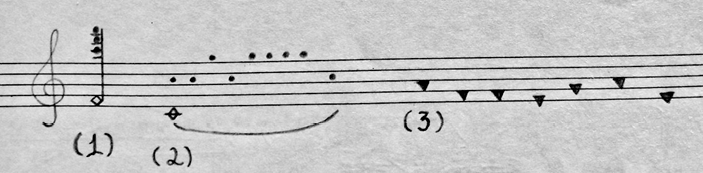
Figure 4.
Multiphonic (1), harmonics (2), and tongue-ram (3).
Source: authors, 2023.In Come vengono prodotti gli incantesimi? (1985) the tongue-ram technique is extensively used, creating a percussive character, which in its repetitions forms a constant rhythmic pattern, varied by accentuations, dynamics and the sporadic entry of new sounds. As tongue-rams require activity and tongue strength, in addition to air pressure, their repetition requires some physical preparation. The violent glissando is progressively inserted in the solo, as well as multiphonics, which grow in use, having started as a sporadic element. The rhythmic aspect of this solo metaphorically resembles the functioning of a gear. “Music imitates the machine”, attests Angius (2007, p. 116), and at the same time this character differentiates the solo from previous ones.
In Canzona di ringraziamento (1985), a polyphony is created from a continuous base and high notes that stand out from it. For that, Sciarrino uses three staffs in the music score. The lower staff features the rapid change between tremolos, which has the glissando effect between short intervals, often major seconds, represented in the middle staff. This continuous and fluid base is interspersed with isolated high sounds, mostly played in harmonics, which are progressively presented between the tremoli and represented in the upper staff. Both maintain a predominantly piano dynamic level. Not only the techniques used here relate to previous solos, but also the construction of a polyphony done by a melodic instrument, which is not usually employed in its polyphonic potential by a traditional repertoire, is repeatedly presented in L’opera per flauto.
Venere che le grazie la fioriscono (1989) achieves extreme piano dynamics, that calls for an expanded sense of hearing. “His music brings about a different way of listening, a changed perception and a new awareness of reality and of oneself” (Tadday, 2019, p. 3).21 Also Haselböck assotiates Sciarrino’s work with an audible silence (2019). In this solo, the subtle difference between two types of breath-tone varied by tongue position is represented in different staffs. In a continuous gesture the melodic combination of different instrumental techniques is presented. Violent glissando, key beating and tongue-ram are used to a lesser extent, if compared to breath-tones. The dynamics ranges from pianissimo to forte, but f and mf are sporadic, therefore the piece maintains the p dynamics in a predominant way. The representation in three staffs reveals the character of distinct layers of sound, their relationship, and their polyphonic character. In the upper staff, whistle tones and their appoggiaturas are represented, in the middle staff, breath-tones are to be read. They sound one seventh below the notated pitches, and are produced with the mouthpiece kept as close as possible to the teeth. In the lower staff, two percussive techniques are written: tongue-ram and key beating, the latter represented by the letter x. Both sound as notated.
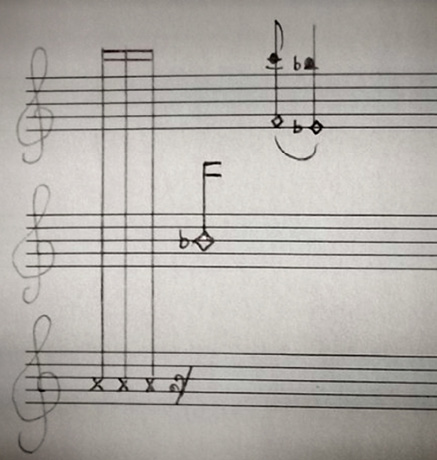
Figure 5.
Notation in three staffs representing three different layers of sound.
Source: authors, 2023.In L’orizzonte luminoso di Aton (1989) the physiological mechanism of breathing is represented through musical notation. The symbol of a right-turned bracket means expiration, while a cross means inspiration (Figure 6), both are associated with defined pitches. The duration of each breathing cycle varies and is interspersed with other sounds, first of all multiphonics, tongue-ram and small scales, all as part of the respiratory flow. Then, colpi di glottide increases the musical tension, and the techniques used in this solo are also added to the multiphonic harmonics, glissando and tremolo.
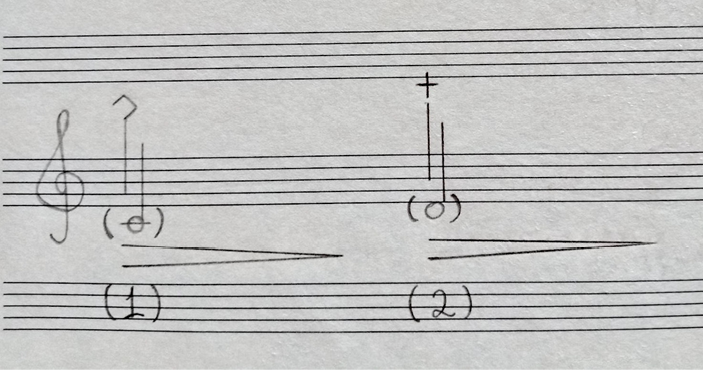
Figure 6.
Expiration (1) and inspiration (2) in L’orizzonte luminoso di Aton.
Source: authors, 2023.Fra i testi dedicati alle nubi (1989) presents a collage of diverse musical elements, with the frequent change between them and the rapidity of their variation. Multiphonics that are not formed from partials of the harmonic series, but from alternative instrumental fingering are widely used in this solo and constitute the main musical material explored. These multiphonics are called multiple artificial tones, both the resulting sounds and their fingering are explained at the beginning of the score in the performance notes. Each of the notes that make up the multiphonic has to be well balanced in a dynamics sense, but whenever a note should sound as a background to others, it is written in a smaller size.
Homogeneous two-tone multiphonic and two-tone multiphonic with breath-tone emission are combined with the former. A differentiation between them was created by the composer indicating the first with numbers and the last with letters. The following techniques are also used in this solo: frullato, whistle tones, breath-tone with closed mouthpiece and frullato, tongue-ram and key beating.
Throughout L’opera per flauto, variations and combinations of extended techniques are extensively used, as is the transition between techniques. The association of two or more techniques based on parameters common to them, such as piano dynamics or the character of general breath-sounds performed by different techniques are also quite common in the musical work. This association of distinct techniques creates correlations that determine their compositional use, at the same time they depend on viability tests when playing the instrument, which often happens through composers-performers collaboration: “the evolution of instrumental music has always been brought about by reciprocal collaboration between composers and performers” (Bartolozzi, 1967, p. 60), as we will present in the following section.
To summarise Sciarrino’s usage of extended techniques in L’opera per flauto, we have created a table in which the employed techniques are classified according to their main effect or sounding result (Table 1). Other effects could be described, and one single technique could also fit in different categories, for that reason we analysed their mostly used form. The possibility to create an effect combining different techniques is used in all solos, as well as the contrast between effects, and their gradual transformation. Therefore, we consider the interchange between techniques and sounding results a relevant way to investigate this musical work.
Collaboration between composer and performer
The performer’s role as co-creator is important in this music. In your experience, to what extent is this acknowledged by composers, publishers and the musical world in general?
Fabbriciani: Well, unfortunately the role of the performer-interpreter, often a co-author, is not recognized.
The development of extended techniques is often related to composers-performers collaboration –“As a result of the constructive and experimental cooperation between performers and composers– new performance techniques and notational forms have been developed” (Levine, 2002, p. 7). In the case of L’opera per flauto, the collaboration with the flautist Roberto Fabbriciani, who premiered all of the solos in the collection, determined the usage of extended techniques.22 Sciarrino relates new and surprising sounds in his work to Fabbriciani’s musical capacity: “New dimensions were created in L’opera per flauto, the music piece opens up a previously unknown tonal wealth, which primarily arises from its own ingenuity, but also from the skills of such an extraordinary musician as Roberto Fabbriciani” (Sciarrino, 1995, p. 4).23
Also from the flautist’s perspective, new and surprising sounds are directly related to the collaborative work. According to Fabbriciani, “new music needs performers to play an active role. They may not only be performers, but also co-creators, as they now have many more opportunities to create sounds than in the past. Here, the relationship between composer and performer becomes absolutely and necessarily complementary and interactive” (Sciarrino by Habbestad, 2019, p. 3-4). The flautist explains the collaborative context as responsible for the structure of the work, in which each solo is dedicated to a specific technique. He attests that “the flautist worked a lot with Sciarrino in discovering new and surprising ways to sound. New limits have always been tried [...]. Because of the collaboration, each of the seven pieces is dedicated to a particular playing technique” (Castello Branco, 2014, p. 240).24 From these descriptions, it is observed that cooperation was not limited to the educational and instructive aspect about flute techniques, but it shows its direct effect on the compositional process, as it allowed mutual experimentation in a context where both flautist and composer were able to investigate the limits and potentialities of the niche.
At this point, we emphasize a first characteristic of the cognitive niche that allows the investigation and subsequent systematization of extended techniques –experimentation, which in Sciarrino’s work seems to be mutual, that is, not only compositional possibilities are tested, and not only new and surprising flute techniques, but both investigations merge in a same experimental process, which also means a case of shared creativity. Interestingly, not only the flautist and composer show themselves as agents of this creative construction, but the flute presents itself as the centre of experimentation, insofar as its materiality is the very creative material that is being investigated. In other words, the creativity of a progressive and historical construction of the transverse flute is expressed in the possibilities and constraints of its construction.
This mutual experimentation also depends on a collective interest in the musical novelty represented by extended techniques. While the study of instrument’s technique is part of the daily activity of flautists, the interest of composers in investigating its potential seems fundamental in Sciarrino’s case. According to Geraci, the composer shows “an inevitable will to change the language of the instruments until they sound like their opposite, in order to discover further possibilities” (Geraci, 1995, p. 29).25
Thus, the effects of his musical work continue to present themselves after its debut. The various solos of L’opera per flauto are dedicated to Fabbriciani and also to the flautist Geoffredo Petrassi. According to Megan Lanz, “both flautists have made contributions to the research of Sciarrino’s new flute sounds” (2010, p. 32).26 But it was the work of a third flautist, Mario Caroli, that led to the compilation of a second volume of the work: L’opera per flauto 2, released in 2001. Sciarrino attests that Caroli’s “stupendous technique and the sensitivity of his sounds, once unimaginable, made my utopias possible and have changed the flute –not only for me” (Sciarrino; Furrer, 2010, p. 4).27 Mario Caroli recorded the solos of the first and second volumes of L’opera per flauto, Sciarrino dedicated him Libro noturno delle voci (2009) for flute and orchestra.28
Thus, we present a second characteristic of the cognitive niche related to extended techniques –it needs some stability to extend musical processes over time, in order to involve different individuals, whose experiences prove the viability of the techniques, in a sense of their instrumental feasibility and also in the straightforwardness of their notation. This temporal extension seems indispensable to the systematization of extended techniques, in addition to establishing a direct dialogue with the context in which the investigation occurs. In the case of Sciarrino, the question about the role of music in an environment as noisy as the contemporary arises. According to the composer, “the silence counteracts the noise of everyday life, the slowness is also an alternative to the accelerated present and the reduction to a minimum of material is the answer to the data masses of the digital age” (Sciarrino, 2008, p. 5).29 Also in the sense of an opposition to noise, the pianissimo dynamics in L’opera per flauto, as well as innumerable sound arcs dal niente al niente, described above, are analyzed. The stance of opposition to the status quo is shown in the study of extended techniques through the attempt to expand the sound universe of acoustic instruments. Thus, we notice a close relationship with the conceptual change on the use and possibilities of acoustic instruments, and we find a third characteristic of the cognitive niche that allows the study of such techniques: the openness to discussing, and transforming habits, and patterns of acoustic instruments’ usage.
Concluding remarks
Musical technique is a habit, a regular and stable pattern of action. The stability and persistence of techniques are directly associated with creation and development of musical notations, in a causal co-dependent relation between the emergence of new and surprising forms of sound materiality and organization and stable systems of representation and communication of these forms. Extended techniques (non-habitual, new and surprising patterns of epistemic action) tend to irritate the habit, their notation, and standard dynamic of collaborative relationship composer-performer. However, both extremes –maintenance or breaking the habit, do not result in sound phenomena that can be identified as creative. Neither of them achieves the stability we observe in the development of ET, largely dependent on generational systems produced in feedback loops.
From the musical analysis of techniques in Sciarrino’s work to their comparison in a historical development of methods for flute on extended techniques, we emphasize characteristics of a cognitive niche that allows their investigation and systematization. A first feature is mutual experimentation, meaning that compositional possibilities, new and surprising uses of transverse flute are tested. The relationship between composer and performer establishes the niche for the systematization of techniques, including their experimentation, subsequent systematization, and dissemination. A second characteristic of the cognitive niche is the need for a temporal distribution, which allows the relationship between different individuals, who test and reproduce the feasibility of instrumental techniques, in addition to the possibilities of their notation. A third characteristic of a cognitive niche that allows the investigation of extended techniques is an openness to question patterns and change of habits regarding acoustic instruments. We observe that the performance of musical works spreads new ways of playing in a more effective way if compared to compendiums, which systematize, but do not yet mean the compositional use of each technique. Thus, we understand performance as an epistemic action to the dissemination of extended techniques, as it involves the compositional application of techniques in musical works.
We also conclude that the direct relationship between niche and materiality of the acoustic instrument highlights the limitations of the term “extended techniques” when referring to new ways of playing flute, since these new ways break with the current conceptual, and aesthetic framework to the detriment of an “extension” of previous, well-known techniques. It seems to us that the idea of an extension is not only related to techniques, but also to the instrument itself, which remains the same materiality, being played in one way or another, which reinforces the relationship between cognitive niche and extended techniques that we present here, since the niche constitutes musical transformation of this same materiality. Furthermore, it should be noted that this relationship could be basically applied to other oeuvres, as it has more to do with a general explanation on extended techniques in contemporary music than with a particular one restricted to Sciarrino’s compositions for solo flute. Hence, we consider of great value future investigations on ET in the context of cognitive niche construction.
Extended techniques arise from epistemic actions. They extract new and surprising sounds from processes, which we observe in the interaction between composer and performer. Not textbooks (notation system), but composer-performer interaction constitutes high-standard communication, with immediate as well as intergenerational consequences. In this case, we are dealing with cognitive niche construction –interpreting minds (analogous to the organisms in ecological niche construction) act locally according to sets of opportunities and boundaries for the generation of meaning, their action frequently alters these sets, which in turn feedbacks into the interpretation activity and the mind.
Bibliography
Artaud, P.-Y. and Geay, G. (1980). Flûte au présent. Paris: Editions Jobert et Editions Musicales Transatlantiques.
Albertson, D. (2004). Foreword. Contemporary Music Review, 23(3/4), 3-5.
Angius, M. (2007). Come Avvicinare il Silenzo. La Musica di Salvatore Sciarrino. Roma: Rai Trade.
Atã, P. and Queiroz, J. (2016). Habit in Semiosis: Two Different Perspectives Based on Hierarchical Multi-level System Modelling and Niche Construction Theory. In D. West y M. Anderson (Eds.). Consensus on Peirce’s Concept of Habit: Before and Beyond Consciousness (pp. 109-119). Berlin: Springer.
Atã, P., and Queiroz, J. (2019). Semiosis is Cognitive Niche Construction. Semiotica, 228, 3-16.
Auner, J. (2013). Music in the Twentieth and Twenty-First Centuries. Western Music in Context: A Norton History. New York: W. W. Norton & Company.
Bardone, E. (2011). Seeking Chances: From Biased Rationality to Distributed Cognition. New York: Springer.
Bartolozzi, B. (1967). New Sounds for Woodwind. London: Oxford University Press.
Bickerton, D. (2009). Adam’s Tongue. New York: Hill and Wang.
Boden, M. A. (1999). Computer Models of Creativity. In R. Sternberg (Ed.). Handbook of Creativity (pp. 351-372) New York: Cambridge University Press.
Castello Branco, M. (2014). Das Instrument als Apparat. Analyse zeitgenössischer Musik für Querflöte auf der Grundlage der Medientheorie Vilém Flussers. (Ph.D. thesis). Universität der Künste Berlin, Berlin, Germany.
Cescon, Fa. (2002). Das atmende Klarsein di Luigi Nono: indagine analitica e filologica sulla prima esperienza di Luigi Nono con il live electronics. (Ph.D. thesis). Università Ca’ Foscari Venezia, Venezia, Italia.
Clark, A. (2008). Supersizing the Mind: Embodiment, Action, and Cognitive Extension. Oxford: Oxford University Press.
Dick, R. (1989). The Other Flute. New York: Multiple Breath Company.
Dick, R. (1986). Neuer Klang durch neue Technik. Frankfurt: Zimmermann.
Fabbriciani, R. (2007). Flauto in scena. (‘900 e oltre). In C. de Incontrera (Ed.). Quaderni di Cultura Contemporanea. Monfalcone: Teatro Comunale di Monfalcone.
Farwick, S. (2009). Studien zur zeitgenössischen Musik für Flöte Solo in der Zweiten Hälfte des 20. Jahrhunderts. New York: Peter Lang.
Geraci, T. (1995). Ein organischer Begriff des Klangs. Bemerkungen zu Salvatore Sciarrino. Wien Modern, 95(8), Wien: Pfau.
Griffiths, P. (2010). Modern Music and After. New York: Oxford University Press.
Gottschalk, J. (2016). Experimental Music Since 1970. New York: Bloomsbury Academic.
Habbestad, B. (2019). Working Together – An Interview with Roberto Fabbriciani. Music & Practice, 4. Retrieved from https://www.musicandpractice.org/volume-4/working-together-an-interview-with-roberto-fabbriciani/
Halfyard, J. (2016). Berio’s Sequenzas: Essays on Performance, Composition and Analysis. New York: Routledge.
Haselböck, L. (2019). Hörbare Stille? Sichtbarer Klang? Zur »Ökologie der Wahrnehmung« in Salvatore Sciarrinos Streichtrio Codex Purpureus (1983). In U. Tadday (Ed.). Musik-Konzepte. Sonderband Salvatore Sciarrino. München: Edition text+kritik.
Hoffmeyer, J. (2008). The Semiotic Niche. Journal of Mediterranean Ecology, 9, 5-30.
Honing, H. (2018). The Origins of Musicality. Cambridge: The MIT Press.
Hutchinson, G. E. (1957). Concluding Remarks. Cold Spring Harbor Symposion on Quantitative Biology, 22, 415-427.
Kirsh, D and Maglio, P. P. (1996). Epistemic Action Increases with Skill. In G. W. Cottrell (Ed.). Proceedings of the 18th Annual Conference of the Cognitive Science Society (pp. 391-396). New York: Routledge.
Koizumi, H. (1996). Technique for Contemporary Flute Music: for Players and Composers. Japan: Schott.
Laland, K., Odling-Smee, J. F. and Feldman, M. W. (2000). Niche Construction, Biological Evolution, and Cultural Change. Behavioral and Brain Sciences, 23(1), 131-175.
Laland, K., Blake, M. and Feldman, M. W. (2016). An Introduction to Niche Construction Theory. Evol Ecol, 30, 191-202.
Lanz, M. R. (2010). Silence: Exploring Salvatore Sciarrino’s style through L’opera per flauto. (Ph.D. thesis). University of Nevada, Las Vegas, USA.
Levine, C. and Mitropoulos-Bott, C. (2002). Die Spieltechnik der Flöte. Kassel: Bärenreiter.
Lewontin, R. (1983). The Organism as the Subject and Object of Evolution. Scientia, 77(188), 65-82.
Lewontin, R. and Levins, R. (1997). Organism and Environment. Capitalism Nature Socialism, 8(2), 95-98.
Lozzi, B. and Mencarelli, P. (1975). Metodo per flauto. Milano: Edizioni Suvini Zerboni.
Magnani, L. (2007). Creating Chances through Cognitive Niche Construction. In B. Apolloni (Ed.). Knowledge-based Intelligent Information and Engineering Systems (pp. 917-925). Berlin: Springer-Verlag.
Magnani, L. (2009). Abductive Cognition: The Epistemological and Eco-cognitive Dimensions of Hypothetical Reasoning. Berlin: Springer.
Messiaen, O. (1980). Introduction. In P. Artaud and G. Geay (Eds.). Flûte au présent. Paris: Editions Jobert et Editions Musicales Transatlantiques.
Nyffeler, M. (2008). Der Klang aus der Stille der Nacht. Salvatore Sciarrino, die Sprachkraft der Musik und die Kunst des Hörens. Retrieved from http://www.salzburgerfestspiele.at/downloads/nyffeler_de.pdf
Odling-Smee, F. J., Laland, K. and Feldman, M. (2003). Niche Construction: The Neglected Process in Evolution. Princeton: Princeton University Press.
Peirce, C. S. (1931–1935). The Collected Papers of C.S. Peirce, vols. I-VI, edited by Charles Hartshorne and Paul Weiss, Cambridge: Harvard University Press; 1958, vols. VII-VIII, edited by Arthur. W. Burks, Charlottesville: Intelex Corporation. (Quoted as CP, followed by volume and paragraph).
Peterson, A. T., Soberón, J., Pearson, R. G., Anderson, R. P., Martínez-Meyer, E., Nakamura, M., Araújo, M. B. (2011). Ecological Niches and Geographic Distributions. Princeton: Princeton University Press.
Rehfeldt, P. (1994). New Directions for Clarinet. Oxford: University of California Press.
Sciarrino, S. (1990). L’opera per flauto. Milan: BMG Ricordi Music Publishing.
Sciarrino, S. (1995). Fabbrica degli Incantesimi - L’opera per flauto. Col Legno. Compact disc.
Sciarrino, S.. (2008). Frammento e Adagio. Kairós. Compact disc.
Sciarrino, S.and Furrer, B. (2010). Donaueschinger Musiktage 2009. Neos. Compact disc.
Sciarrino, S. (2001). Note di programma, L’opera per flauto. In D. Oliveri (Ed.). Carte da suono (138-143). Palermo: Edizioni Novecento.
Stokes, S. and Condon, R. (1970). Special Effects for Flute. California: Trio Associates.
Tadday, U. (2019). Musik-Konzepte. Sonderband Salvatore Sciarrino. München: Edition text+kritik.
Toff, N. (1979). The Development of the Modern Flute. Chicago: Taplinger Publishing Company.
Tooby, J. and De Vore, I. (1987). The Reconstruction of Hominid Evolution through Strategic Modeling. In W. Kinzey (Ed.). The Evolution of Human Behavior: Primate Models (pp. 183-237). Albany: Suny Press.
Notes
Notas de autor
Marta Castello-Branco
Professor in the Music Department of the Institute of Arts and Design at Federal University of Juiz de Fora (UFJF), Brazil, and in the Postgraduate Program in Arts, Culture, and Languages at the same institution. She did a doctorate at the University of the Arts in Berlin (Universität der Künste Berlin - UdK) on the relationship between Vilém Flusser’s philosophy of new media and contemporary music (2014). Current research themes include the relationship between technique, materiality, and musical expression, universalism, and essentialism in music. http://orcid.org/0000-0002-2926-0215
João Queiroz
Professor at the Institute of Arts, Federal University of Juiz de Fora, Minas Gerais, Brazil, where he coordinates the Iconicity Research Group (IRG). He has been teaching courses on Cognitive Semiotics, Intermediality Studies, and supervised Ph.D. and Master students in the fields of Semiotics, Latin-American Art and Literature and Cognitive Aesthetics. He has several publications in international journals, books, and conferences, including the Commens Digital Companion to Charles S. Peirce, with M. Bergman and S. Paavola. Queiroz is a member of the International Association for Cognitive Semiotics (IACS), member of Group for Research in Artificial Cognition (UEFS, Brazil), and associate researcher of the Linguistics and Language Practice Department, University of the Free State (South Africa). http://orcid.org/0000-0001-6978-4446.
