Artículos
New business models in the Colombian energy market: Energy arbitration through storage systems
Nuevos negocios en el mercado energético colombiano: arbitraje de energía con sistemas de almacenamiento

New business models in the Colombian energy market: Energy arbitration through storage systems
Revista UIS ingenierías, vol. 22, no. 4, pp. 81-92, 2023
Universidad Industrial de Santander
Received: 20 July 2023
Accepted: 17 October 2023
Published: 30 October 2023
Resumen: Actualmente la transición energética es un fenómeno que está cambiando todo el paradigma sobre el que reposa el mercado energético colombiano, gracias a esto, han surgido nuevos actores que son necesarios para alcanzar la descarbonización y la organización de un nuevo mercado energético sostenible, lo cual a su vez requiere de un componente regulatorio que facilite la entrada de nuevos jugadores y permita la creación de modelos de negocio que resulten atractivos para los inversionistas. En este sentido, la transición energética habilita la masificación de los recursos energéticos distribuidos promoviendo la creación de nuevos mercados y oportunidades de negocio. Este trabajo se enfoca en realizar un recorrido por la regulación colombiana, revisando especialmente las nuevas oportunidades de negocio que se generan a partir de la incorporación de los sistemas de almacenamiento de energía como recursos energéticos distribuidos, para finalmente analizar al arbitraje de energía a través de esta tecnología, para esto se plantearon cinco escenarios los cuales fueron evaluados económicamente a través del VPN y la TIR, encontrando de acuerdo con los resultados de los indicadores que no es un modelo por sí solo sostenible considerando la compra y venta de energía en la bolsa de energía y que requiere de un complemento, como lo puede ser el autoconsumo o incentivos regulatorios.
Palabras clave: Sistema de almacenamiento de energía, arbitraje de energía, regulación energética, nuevos modelos de negocio.
Abstract: The energy transition is currently reshaping the Colombian energy market, bringing about the emergence of new actors essential for decarbonization and the establishment of a sustainable energy market. This transition necessitates a regulatory framework that facilitates the entry of new players and fosters the development of appealing business models for investors. Consequently, the energy transition fuels the widespread adoption of distributed energy resources, igniting the creation of fresh markets and captivating business opportunities. This study thoroughly examines the Colombian regulatory landscape, with a specific focus on exploring the new business prospects that arise from the integration of energy storage systems as distributed energy resources. Additionally, the paper analyzes energy arbitration through this technology, assessing five scenarios through economic evaluation using Net Present Value (NPV) and Internal Rate of Return (IRR). The findings indicate that the current model, which entails purchasing and selling energy in the energy exchange, is unsustainable without supplementary measures like self-consumption or regulatory incentives.
Keywords: Energy storage system, energy arbitrage, energy regulation, new business models.
1. Introduction
1.1. Provision of electricity service in Colombia
The provision of electric power service in Colombia began at the end of the 19th century when thousands of people in the capital witnessed how light was distributed from a hundred lamps that illuminated the streets of Bogota. This was the result of the initiative of private investors, who created the first companies whose purpose was to generate, distribute and sell electricity [1]. Quickly the use of electric energy went from being only in public lighting and commerce to being available also for use in the residential sector, the industrial sector, and in transport [1].
Despite the above, private individuals did not make the necessary investments to expand the sector, which caused debates and political pressure that led to the State becoming the owner of the companies [1]. The regulation of the electric power sector in Colombia starts from Ley 126 of 1938 which establishes the intervention of the State in the supply of electricity [2].
Intending to promote the massification of access to electricity in the country, in 1946 the Instituto de Aprovechamiento de Aguas y Fomento Eléctrico (Electraguas) was created, which in 1968 became the Instituto Colombiano de Energía Eléctrica (ICEL) [1]. In the 1950s, there was a discussion of generating a national interconnected system, an idea that materialized with the creation of Interconexión Eléctrica S.A. (ISA) in 1967. During the 1970s and 1980s, several international events affected the sector's financial situation: global economic recession, rising oil prices, and the international debt crisis [1].
In the early 1990s, a diagnosis of the state-owned electricity companies showed unfavorable results in terms of administrative, operational, and financial efficiency, which, together with meteorological phenomena like the El Niño-Southern Oscillation (ENSO), resulted in the most impactful energy rationing in the country's recent history between 1991 and 1992 [1]. Due to the above, since the 1991 Constitution, competition in the energy market was established as an essential principle to achieve efficiencies in public services, to make possible the free entry of any agent interested in providing public services [1].
1.2. Market modernization and regulation of the electricity sector in Colombia
To give greater weight and strength to the institutional framework that would be in charge of regulating the sector, in 1992, Decree 2119 was issued, which created two administrative units attached to the Ministry. On one side, the National Planning Unit called "Unidad de Planeación Minero Energética (UPME)" and, on the other side, the Energy and Gas Regulatory Commission (CREG by its Spanish initials) [1], [3]; subsequently, Law 142 and Law 143 of 1994 ratified the provisions of Decree 2119 de 1992 [3] and would give greater scope and empowerment to these entities, leaving the regulation of the energy sector in charge of CREG [1], [4], [5], [6], proposing among its functions to regulate monopolies and to intervene in competition between entities that provide public services such as electricity and gas [4].
On the other hand, UPME represents institutionality intending to plan the energy sector in Colombia. This unit is responsible for developing long-term infrastructure plans and projects and ensuring a sustainable energy supply [7]. In addition, the Ministry of Mines and Energy is empowered to define the country's energy policy. This entity establishes objectives and strategies to develop in the Colombian energy sector [8].
The above-mentioned has configured the current institutional scheme of the energy sector in Colombia that has the Ministry of Mines and Energy as the governing head, with its attached and linked entities, the Superintendency of Public Services, and the National Planning Department [3].
Within the scope of the powers of the regulatory entities is to propose regulations that regulate prices, ensure the availability of services and bring capital to the energy sector through investment in infrastructure, develop guidelines in the generation, and obtaining of licenses, among others [4].
The Regulatory Commissions are an innovation of the legal and administrative schemes that Colombia has been testing for the last 30 years. The main characteristic of these commissions is that they consist of highly trained expert groups with a full-time dedication to their work and whose appointments are fixed to guarantee their independence and functions [3].
Through regulators, the government can control market behavior, intervening in prices and incentives that guide the behavior of energy operators [4]. In addition, the diversification of operators allows competition between marketers and generators, which manages to lower prices, benefiting customers [4]. The preponderance of regulation at the head of an independent, neutral, and autonomous body finds its explanation in the tendency of the State to divest itself of the ownership of many of its companies, mainly energy companies [3].
Although regulation is used to align operators with government interests, it also protects operators from their competitors and manages to find a balance between their interests and those of the government [4]. For regulators to create this environment, it is important to maintain a monitoring of the financial performance of market agents, this information must be true and verifiable since the analysis and implementation of the regulation will depend on it, which can favor or hinder the activities of operators [4].
1.3. Colombian energy market and the new actors brought by the energy transition
The energy market in Colombia currently has a regulator responsible for ensuring the sustainability, quality, and expansion of the service. However, it is crucial to consider that according to article 23 of Law 143 of 1994, the regulator, known as CREG, has a function that can be seen more as a mission due to its content: To determine the conditions for the gradual liberalization of the market towards free competition [3], [6]. The decisions made by CREG have both short- and long-term consequences in the energy sector, which is highly sensitive. Thus, the responsibility of CREG is significant [3].
Regulation in this context encompasses various dimensions, including technical, technological, political, economic, social, and legal aspects. The regulator and other stakeholders with management roles in the sector should adopt a comprehensive approach when making decisions, aiming to achieve consensus when approving laws or issuing resolutions [3].
In Colombia, regulatory bodies have been actively developing regulations to promote the integration of Distributed Energy Resources (DERs) into the national power grid and modernize the sector. For instance, the Ministry of Mines and Energy established guidelines for integrating distributed energy resources in Resolution 40283 of 2022 [9]. Additionally, Law 1715 of 2014 and Law 2099 of 2021 provide tax incentives to promote projects involving non-conventional sources of renewable energy [10], [11]. Furthermore, the CREG published the Roadmap for Demand Response in the National Interconnected System in 2022 [12].
Traditionally, the Colombian electricity sector has been shaped by pivotal agents who participate in the market, including generators, transmitters, distributors, marketers, and administrators [13]. These agents are responsible for producing, transporting, and selling energy to end customers. Figure 1 illustrates the roles of these agents.
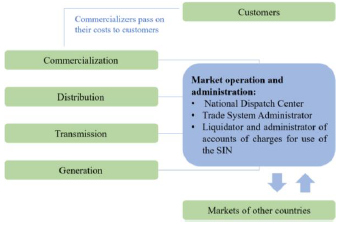
However, it is crucial to acknowledge that the energy transition requires changes in the market structure, leading to the emergence of new actors. According to [14] some of the emerging players in the energy market are prosumers, aggregators, energy communities, and flexibility service providers.
Flexibility service providers play a fundamental role in the emerging flexibility market. For a functioning market, it is necessary to have buyers of flexibility services (distribution and transmission system operators), as well as service providers willing to offer their flexibility in exchange for compensation (final customers, prosumers, generators, aggregators, and other flexibility providers) [15].
The term "flexibility service provider" encompasses various market players, such as energy communities, prosumers, and aggregators.
In this sense, to ensure the systems' economic viability, it is essential to standardize some parameters of the flexibility services market, facilitating the participation of flexibility service providers [15], Additionally, providing access to and availability of information to all suppliers is essential for informed decision-making [16].
Then, the new actors' integration into the national energy market will give rise to new business models that ensure the sector's sustainability and encourage the participation of these new agents in its transformation and evolution [15].
In this context, the following sections present the methodology of systemic thinking and its application to the Colombian case. It also explains the formulation of the case study and provides a causal diagram that considers the offering of flexibility services in the energy market, the sale of energy stored in storage systems, and the energy purchase from storage system promoters. Furthermore, the methodology for evaluating energy arbitrage scenarios is explained, followed by the proposed model for the case study, incorporating initial historical variables of the energy stock market price in Colombia and considerations for analyzing the results of the economic indicators in each evaluated scenario.
2. Systems Thinking
System thinking is a methodology applied to academic and practical domains, which establishes a conceptual framework that facilitates the initial approach to problems [17]. This methodology proves valuable in modeling the causal relationships among the variables that comprise the sector for integration of energy arbitration in the Wholesale Energy Market. Systems thinking encompasses a wide range of methods, tools, and principles, all aimed at understanding the relationships within a system and clarifying its emergent properties [18].
Taking a systems approach, models allow us to simulate real-world processes or systems over time. They represent the interactions between the components of the system under study. Models Enhance our understanding of real-world systems, predict behaviors, evaluate alternatives, and drive improvement and transformation.
From a systemic perspective, a model comprises essential components that the designer believes influence the system under study, represented by exogenous, endogenous, and state variables [18]. The process of modeling involves four fundamental steps that continually interact throughout the construction of the model:
-
Identifying dynamic relationships: In this step, the designer develops a theory about problem behavior and constructs relationships that explain the phenomenon based on the chosen methodological approach. The structure must specify the dynamics of the system and the rules of interaction between variables and agents involved in the model [18].
-
Formulating the model: Here, we fully formalize the model, including all equations, parameters, and initial conditions. This is where we begin to gain a deeper understanding of the problem and our ability to represent it [18].
-
Validating the model: We test the behavior and structure of the constructed model to ensure that each variable corresponds to a real-world concept and that each equation has a solid theoretical and dimensional foundation [17]. Additionally, we compare the behavior and results of the model with the actual structure under study [18].
-
Policy approach and evaluation: Once we have a thorough understanding of the model's structure and behavior, we design policies to improve the system, and implement new strategies, structures, and decision rules that guide it toward the desired outcome [18].
3. Case Study
3.1. Problem formulation and case study
The global electricity demand has been rapidly increasing due to the development and modernization of existing energy systems and the introduction of new power generation technologies [19].
Energy storage plays a crucial role in balancing future low-carbon electric power systems by providing various services for power generation, transmission, and distribution [20], As battery costs decrease with innovation, they are expected to be widely deployed [21].
Currently, energy storage systems are becoming more prevalent in electric power system [19]. They are essential in addressing the intermittency challenges of renewable power systems, leading to improved grid stability and reliability [22]. These storage systems serve multiple purposes, including power balancing, energy arbitrage, avoiding or reducing grid upgrade costs, smoothing the intermittent supply of variable power generators, reactive power compensation, voltage regulation, emergency control, and other applications [19], [21]. Their extensive capabilities make them a key component of future energy systems [19].
Despite offering multiple value propositions, business cases for grid-scale energy storage systems have traditionally focused on individual revenue streams, which is often insufficient to justify the high cost of the technology and the investment required. To overcome this impasse and accelerate the deployment of renewable energy sources, it is crucial to find a way to leverage economies of scale and combine multiple revenue streams [21].
Combining multiple revenue streams in energy storage systems can make investments profitable. However, this poses regulatory and market challenges, as the regulation and market structure need to support the sustainable use of these technologies. Various concepts have been proposed to stack multiple revenue streams. For example, arbitrage can be combined with balancing services like reserve and frequency response and network services such as peak smoothing and constraint reduction [21].
This study aims to evaluate the economic sustainability of the energy arbitration business model using electric energy storage systems and identify possible solutions to improve the cost-benefit ratio of investing in these technologies within the Colombian context.
3.2. Energy arbitrage through storage systems
Energy arbitrage is a strategy that involves capitalizing on favorable conditions such as abundant solar radiation, wind, or water resources to store energy when it is inexpensive. This stored energy can then be utilized or sold during high-demand periods, enabling a reduction in the electric energy price [23]. Additionally, economic benefits can be obtained by selling energy during times when its price is higher [24]. Figure 2 illustrates this concept.
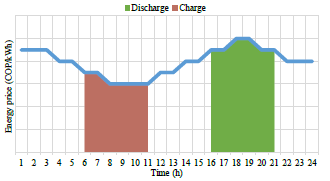
Energy arbitrage presents opportunities for businesses involved in energy storage, as well as optimizing power generation for plants [23]. Several factors are crucial for effectively implementing energy arbitrage, including determining the discharge time, the nominal capacity of the storage system, and identifying the maximum potential price differential in the energy market. These considerations play a vital role in accurately sizing the storage system for energy arbitrage [23].
3.3. Causal diagram
As Based on the discussion of the previous sections, the variables shown in Figure 3 have been identified as crucial factors to consider in the context of energy arbitration through energy storage systems (ESS).
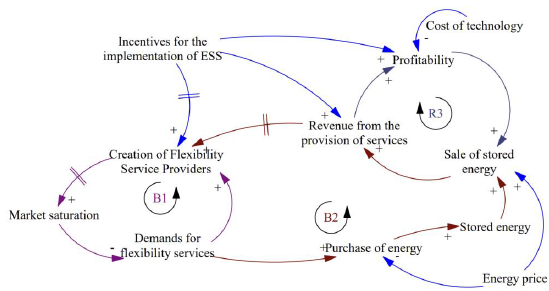
Figure 3
Causal diagram Energy arbitrage through Energy Storage Systems.
Source: Own elaboration in Vensim software.
Employing the systems thinking methodology, the causal relationships among these variables have been recognized to develop a dynamic model that represents the challenge addressed in this document.
The causal diagram displays three cycles: two cycles of balance and one cycle of reinforcement.
The first balance cycle is related to the flexibility provision services in the market. This cycle commences with the creation of flexibility providers, which exhibits a directly proportional relationship with the long-term saturation of the market. The saturation of the market, in turn, stabilizes or limits the demand for flexibility services. Consequently, an increase in demand is directly proportional to the creation of flexibility services.
The second balance cycle corresponds to the buying and selling of energy by the energy storage systems in the market. Within this cycle, it can be observed that an increase in demand for flexibility services stimulates the purchase of energy from energy storage service providers, consequently elevating the energy stored in the market. Which, in turn, leads to an increase in the sales of stored energy. Particularly, the price of energy, as an exogenous variable, must be considered, as a rising price promotes the selling of stored energy, whereas a decreasing price encourages the energy purchase by ESS promoters. The sale of stored energy increases the revenues generated through the provision of flexibility services, thereby incentivizing the creation of new flexibility providers in the market.
The third cycle represents a reinforcement cycle, specifically the profitability cycle, which highlights the relationship between revenue, sales, and profitability for flexibility service providers. As the sales of stored energy increase, so do the revenues, which consequently enhances the profitability of flexibility services. Conversely, higher profitability encourages an increase in the sales of stored energy.
The aforementioned relationships are grounded in the incentives that may arise for the implementation of ESS in the market. These incentives exhibit a positive relationship with each cycle, motivating the creation of flexible service providers, promoting revenue growth from these services, and ultimately tending to boost the business model profitability. It is critical to consider the cost of technology as a final variable, as it exhibits an inversely proportional relationship with the profitability of the business. The cost of technology is a determining factor in the capital expenditure (CAPEX) of investments. Figure 3 shows further details of the diagram.
3.4. Economic evaluation model
To develop a comprehensive financial evaluation that considers cash flows and opportunity costs, two financial indicators will be consider: the Net Present Value (NPV) and the Internal Rate of Return (IRR).
-
• Net Present Value (NPV): It is a financial metric used to estimate the value generation of a project by taking into account a discount rate and a series of future cash flows. The NPV is calculated in today's currency value (t = 0) using the discount rate to adjust cash flows to the same period. The positive and negative cash flow values, expressed in today's currency, are then summed [20]. The formula for calculating NPV is presented below.

Ft: Net cash flow in the period t.
i: Rate of return.
t: Time periods.
The interpretation of its result is based on the following [20]:
-
✓ If NVP > 0, the project is convenient and allows you to generate revenues in the period evaluated.
-
✓ If NVP = 0, the project achieves a point of balance.
-
✓ If the NVP < 0, it is necessary to evaluate alternatives that allow the recapitalization of the project since by itself it fails to meet the expectations of the investor.
-
• Internal Rate of Return: It is a financial indicator that represents the relative value that equals the current value of the income stream with the current value of the estimated expenditure stream. This concept involves criteria of financial mathematics when referring to current values, and accounting criteria when mentioning or including income and expenditure streams. In other words, it is about updating an income stream (expected net flows) at the zero or initial moment of the investment, and comparing it with the current value of an expenditure stream [25]. The way to calculate the IRR is based on finding the value of the rate of return that makes the NPV equal to zero [20].
The interpretation of its result is based on comparisons with respect to the Weighted Average Cost of Capital (WACC) [20]:
-
✓ IRR > WACC, then the project results convenient.
-
✓ If IRR = WACC, the proj ect is satisfactory and meets the expectations.
-
✓ If IRR < WACC, the project does not meet expectations and requires an analysis of alternatives that improve the capitalization of this.
3.5. Initial variables of the case study
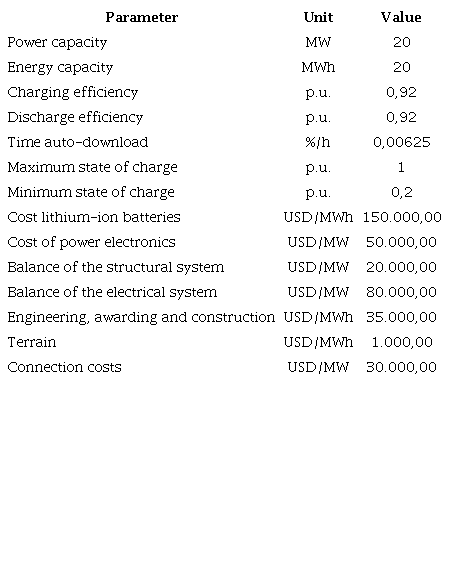
Considering the growth of the installation of energy storage systems based on lithium-ion batteries, this case study takes as a reference the storage system recommended in [24], based on this, the following characteristics are proposed for the case study in Table 1:
Source: Own elaboration based on [24].
This energy storage system will be considered to be connected directly to the Colombian National Interconnected System in a circuit without any restriction to accommodate this energy resource.
The dynamics of the operation of the storage system will consist of arbitrage of electric energy, buying the energy at the times when it is cheaper and selling it in the time slot that turns out to have higher prices. The dynamics of storage and injection of electrical energy into the power system are illustrated below.
3.6. Energy Storage System Operation
This case study is carried out under the consideration of buying energy in the energy exchange and, in the same way, selling it through the same mechanism.
Taking into account the above, a statistical analysis of the historical hourly stock prices between August 2021 and April 2023 reported by XM SA ESP was carried out. [26], the results can be seen in Figure 4.
Figure 4 shows that in the early morning hours the price in the energy exchange decreases, this conclusion is supported by considering that this time slot represents the band with the lowest demand for electricity in the SIN.
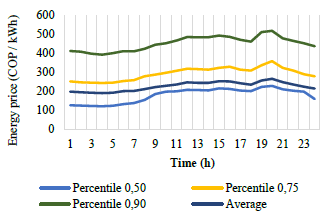
Figure 4
Percentile 0,50, 0,75, 0,90 and the average of the energy bag price between August 2021 and April 2023 reported by XM SA ESP.
Source: Own elaboration with data from [26].
Likewise, the price of energy increases at the end of the afternoon and the beginning of the night, analogously, this is understood because the demand for electricity increases significantly in this time slot.
In this sense, the time slot that has been determined for the purchase of energy is between 2:00 a.m. and 4:00 a.m. On the other hand, the time slot for the sale of energy will be between 6:00 p.m. and 9:00 p.m., this can be seen represented in Figure 5.
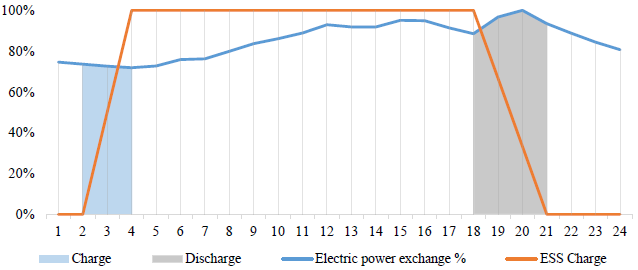
Figure 5
Methodology of loading and discharging the energy storage system proposed for the case study presented.
Source: Own elaboration.
3.7. General aspects in the evaluated scenarios
As points of convergence between the five (5) considered scenarios, the following items are available:
-
The costs associated with the initial investment of the ESS correspond to the costs of batteries, power electronics, and the balance of the structural and electrical system, licenses, engineering, permits, land, and connection costs to the SIN. Considering Table 2, these costs amount to 7'320.000 USD.
-
It is considered an OPEX that includes 21,900 USD for the operation and maintenance of the infrastructure and a component that varies according to the scenario that corresponds to the purchase of electric energy.
-
As an item of depreciable assets over time, lithiumion batteries, power electronics, the balance of the structural system, and the balance of the electrical system are considered; ascending this item to 6.000 USD.
-
For the calculation of the income associated with the sale of energy on the stock exchange, the historical price of the energy stock market between 2021 and 2023 has been taken and the operational conditions described above have been used to estimate the income, taking into account an annual inflation of 4% and an annual starting value of 399.254 USD.
-
The year zero will be that of the initial investment.
-
In year one the operation will begin.
-
The useful life of the assets will be 15 years from the start of operation.
-
The representative market rate used during the financial year is 4.500 COP/USD.
-
The average annual Consumer Price Index is proposed to be 4%.
-
The WACC used for the calculation of the financial indicators shall be 12,09%, this value is taken since it is the current regulatory WACC.
3.8. Scenarios evaluated and review of results
-
Scenario 1: This scenario considers an energy storage system that purchases energy from the energy market at dawn. The purpose is to take advantage of the lower energy prices during this time slot based on historical data analysis. The projected annual cost is calculated with a base cost of USD 295.688, considering annual inflation over a 15-year operational period.
-
Scenario 2: In this scenario, a similar approach to the first is proposed, but with the difference that energy purchases are made through mechanisms with lower costs, such as long-term contracts. Implementing this approach would require regulations standardizing such contracts for energy arbitration. A 25% reduction in the costs associated with energy purchases is expected, with a base value of USD 221.766.
-
Scenario 3: This scenario suggests a different use of stored energy. Energy is purchased from the energy exchange, and half of the capacity (10 MWh) is utilized to meet the customer's needs, resulting in approximately USD 405.555 savings in the energy bill for the first year. The energy price considered is COP 500/kWh. It is important to note that the customer in this scenario is an unregulated user with a preferential tariff from a different energy marketer than the incumbent. The remaining energy is injected into the system during peak stock market price periods.
-
Scenario 4: This scenario adopts the same use of stored electrical energy as explained in Scenario 3. However, the costs associated with energy purchases are reduced by utilizing long-term contracts, taking advantage of a 25% reduction in energy costs. Additionally, half of the stored energy is used for self-consumption.
-
Scenario 5: In this scenario, the focus is on self-consumption, eliminating the premise of injecting energy into the grid. All the energy is used for self-consumption, and electricity is purchased through long-term contracts to minimize costs. This scenario demonstrates the most promising results, as shown below.
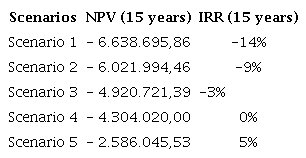
The results obtained for each of the proposed scenarios regarding the calculation of net present value and internal rate of return can be consulted in Table 2.
Source: Own elaboration.
Based on the analysis conducted, it can be concluded that the energy arbitration business model alone is not sustainable and requires additional strategies to enhance its value generation for the project promoter. Moreover, it is crucial to consider the implementation of regulations that support such structures in order to improve the cost-benefit ratio of these projects. Among the evaluated scenarios, only the 5th scenario exhibits a positive Internal Rate of Return (IRR). However, it is important to note that its net present value follows the pattern illustrated in Figure 6.
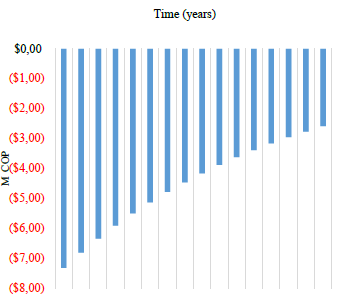
Figure 6
Evolution of the NPV for scenario 5.
Source: Own elaboration.
The fluctuation in the NPV is attributed to the fact that the project's internal rate of return (IRR) is lower than the weighted average cost of capital (WACC) considered (12,09%). As a result, the maximum expected return from this project is limited to 5%, as modeled in scenario 5.
Efficient energy storage plays a vital role in the energy transition as it enhances the flexibility of renewable energy production and ensures its seamless integration into the system [27]. Although these projects may not initially appear highly profitable, they offer various benefits for the network, as outlined below:
Boosting the market share of solar PV and wind energy [28].
According to the International Energy Agency, in a net-zero emissions scenario, energy storage systems (ESS) have the potential to become the primary source of flexibility for electricity systems, replacing coal and natural gas generation, which currently fulfill this role [28].
ESS can enhance cost efficiency and defer investments in the expansion of energy transmission and distribution networks by reducing peak demand in electricity supply systems[28].
They enable the promotion of efficient energy production, allowing the stored energy to be utilized during periods of high electrical demand [29].
ESS facilitates the provision of flexibility services for the electric power system, ensuring its safety, stability, and quality [30].
These additional benefits are expected to be contemplated to encourage these projects from the regulation, promoting the creation of new markets.
Furthermore, future studies should evaluate the model's effectiveness and explore the use of ESS in combination with other resources as sources of variable renewable generation, with the potential to improve the cost-benefit ratio of these projects.
4. Conclusions
This study provides a comprehensive review of the regulatory and normative landscape of the Colombian electricity market, tracing its origins and the laws that have shaped the sector up to the present day. The current regulatory framework aims to promote the integration of new market players and the decentralization of the industry. However, the market is currently undergoing a transition phase that necessitates the development of specific business models to incentivize project promoters to invest in essential infrastructure and other requirements for entering emerging markets.
To achieve a holistic understanding of the case study, the methodology of systemic thinking was employed. This approach facilitated the examination of various scenarios, which were subsequently evaluated from a financial perspective using indicators such as Net Present Value (NVP) and Internal Rate of Return (IRR).
Based on the scenarios evaluated, it is evident that relying solely on energy arbitrage through energy storage systems in the energy exchange is not economically sustainable. Therefore, it is recommended to implement tax incentives that can reduce Capital Expenditure (CAPEX) costs and integrate energy arbitrage with other emerging business models to enhance their cost-benefit ratio.
In Scenario 5, where a change in operational strategy is proposed, utilizing 100% of the stored energy for self-consumption demonstrates a higher cost-benefit ratio compared to the other scenarios. However, this scenario, which revolves around complete self-consumption, distorts the energy arbitrage business model. While self-consumption improves the cost-benefit ratio, it introduces a distinct business model separate from energy arbitrage.
References
Comisión de Regulación de Energía y Gas, "Historia de Colombia," Historia de Colombia, 2020. [En línea]. Disponible en: https://www.creg.gov.co/sectores-que-regulamos/energia-electrica/historia-en-colombia-0/historia-en-colombia
Congreso de Colombia, "Ley 126 de 1938", 1938. [En línea]. Disponible en: https://www.suin-juriscol.gov.co/viewDocument.asp?id=1806968
A. Acosta Medina, "La Regulación del Sector Energético," 1998. [En línea]. Disponible en: https://revistas.uexternado.edu.co/index.php/contexto/article/view/1701/1528
Grupo de Investigación Xué Semillero de Investigación Barión, "Regulación del Sector Energético," 2020, [En línea]. Disponible en: https://regioncentralrape.gov.co/wp-content/uploads/2020/04/Regulacion-del-sector-Energe%CC%81tico.pdf
Congreso de Colombia, "Ley 142 de 1994", 1994. [En línea]. Disponible en: https://www.funcionpublica.gov.co/eva/gestornormativo /norma.php?i=2752
Congreso de Colombia, "Ley 143 de 1994", 1994. [En línea]. Disponible en: https://www.funcionpublica.gov.co/eva/gestornormativo /norma.php?i=4631#:~:text=Por%20la%20cual%20se% 20establece,otras%20disposiciones%20en%20materia%20energ%C3%A9tica
UPME, "Funciones y deberes UPME," 2013. [En línea]. Disponible en: https://www1.upme.gov.co/Entornoinstitucional/Pagina s/Funciones-y-deberes.aspx#:~:text=Fomentar%2C%20dise%C3%B1ar%20y%20establecer%20los,las%20labores%20de%20 difusi%C3%B3n%20necesarias
Ministerio de Minas y Energía, "Funciones y deberes Ministerio de Minas y Energía," 2012. [En línea]. Disponible en: https://www.minenergia.gov.co/es/ministerio/estructura-organizacional/funciones/#:~:text=Formular%2C%20adoptar%2C%20dirigir%20y%20coordinar,de%20minerales%2C%20hidrocarburos%20y%20biocombustibles
Ministerio de Minas y Energía, "Resolución 40283 de 2022", 2022. [En línea]. Disponible en: https://gestornormativo.creg.gov.co/gestor/entorno/docs /resolucion_minminas_40283_2022.htm
Congreso de Colombia, "Ley 1715 de 2014", 2014. [En línea]. Disponible en: http://www.upme.gov.co/normatividad/nacional/2014/ley_1715_2014.pdf
Congreso de Colombia, "Ley 2099 de 2021, 2021. [En línea]. Disponible en: https://www.funcionpublica.gov.co/eva/gestornormativo /norma.php?i=166326
Comisión de Regulación de Energía y Gas, "Respuesta de la Demanda en el Sistema Interconectado Nacional," 2022, [En línea]. Disponible en: http://apolo.creg.gov.co/Publicac.nsf/52188526a7290f8505256eee0072eba7/60ffa0ad021fd467052587eb007d7f03/$FILE/Circular011-2022%20Anexo.pdf
XM S.A. E.S.P., "Estructura del mercado," 2023. [En línea]. Disponible en: https://www.xm.com.co/transacciones/registros/registro -agentes-y-contactos/estructura-del-mercado
Energy Community Regulatory Board, "Prosumers in the Energy Community," 2020, [En línea]. Disponible en: https://energy-community.org/dam/jcr:abacd12d-283c-492a-8aa4-6da5797d044a/ECRB_prosumers_regulatory_framework_032020.pdf
Futured Plataforma Española de Redes Eléctrica, "Flexibilidad en Redes de Distribución Eléctrica," 2021, [En línea]. Disponible en: https://www.futured.es/wp-content/uploads/2021/05/Documento-Futured-Flexibilidad-en-Redes-de-Distribuci%C3%B3n-El%C3%A9ctrica.pdf
Centro de Estudios de Materiales y Control de obra SA, "Flexibilidad en redes eléctricas. Una nueva forma de mejorar la gestión energética.," 2021, [En línea]. Disponible en: https://www.cemosa.es/2021/07/21/flexibilidad-en-redes-electricas-una-nueva-forma-de-mejorar-la-gestion-energetica/
J. D. Sterman, Business dynamics: systems thinking and modeling for a complex world. Boston: Irwin/McGraw-Hill, 2000.
F. Liévano Martínez, J. E. Londoño, "El pensamiento sistémico como herramienta metodológica para la resolución de problemas," Revista Soluciones de Postgrado EIA, vol. 8, pp. 43-65, 2012.
I. A. Razzhivin, A. A. Suvorov, R. A. Ufa, M. V. Andreev, A. B. Askarov, "The energy storage mathematical models for simulation and comprehensive analysis of power system dynamics: A review. Part i," Int J Hydrogen Energy, Mar. 2023, doi: https://doi.org/10.1016/j.ijhydene.2023.03.070
M. F. Valero Sánchez, "Modelaje financiero de un Sistema de Almacenamiento de Energía Eléctrica con Baterías (SAEB) para dar soporte a un sistema hidrodependiente como el colombiano," Universidad de los Andes, Bogotá, 2021. [En línea]. Disponible en: https://repositorio.uniandes.edu.co/bitstream/handle/199 2/53345/24295.pdf?sequence=1&isAllowed=y
E. Pusceddu, B. Zakeri, G. Castagneto Gissey, "Synergies between energy arbitrage and fast frequency response for battery energy storage systems," Appl Energy, vol. 283, Feb. 2021, doi: https://doi.org/10.1016/j.apenergy.2020.116274
Iberdrola, "Almacenamiento de energía: la clave de un futuro descarbonizado," 2023. [En línea]. Disponible en: https://www.iberdrola.com/sostenibilidad/almacenamien to-de-energia-eficiente
E. Malagón, "Energía para el futuro - Sistemas de Almacenamiento," 2021, [En línea]. Disponible en: https://blogs.iadb.org/energia/es/sistemas-de-almacenamiento-de-energia-descarbonizacion/
R. e I. Ciudad Sostenible, "¿Qué ventajas tienen los sistemas de almacenamiento de energía?," 2021.
Comisión de Regulación de Energía y Gas, "Análisis de la utilización de diferentes tipos sistemas de almacenamiento de energía eléctrica," 2022. [En línea]. Disponible en: http://apolo.creg.gov.co/Publicac.nsf/52188526a7290f8505256eee0072eba7/3060300a3ba0ee0a052589190061f3e2/$FILE/IEB_1037_22_01_Informe_2.pdf
T. S. Le, T. N. Nguyen, D. K. Bui, T. D. Ngo, "Optimal sizing of renewable energy storage: A techno -economic analysis of hydrogen, battery and hybrid systems considering degradation and seasonal storage," Appl Energy, vol. 336, Apr. 2023, doi: https://doi.org/10.1016/j.apenergy.2023.120817
Y. Villota Rivera, "Almacenamiento de energía en Colombia," 2021, [En línea]. Disponible en: https://bdigital.uexternado.edu.co/server/api/core/bitstreams/cd704a5b-ed89-48d4-9a75-ed9a9bace807/content
A. F. Peñaranda Bayona, "Beneficios técnicos y económicos de los sistemas de almacenamiento de energía basados en baterías para el suministro de servicios complementarios en el sistema eléctrico colombiano," Universidad Nacional de Colombia, Bogotá, 2022.
J. G. Altuve, "El uso del valor actual neto y la tasa interna de retorno para la valoración de las decisiones de inversión," Actualidad Contable Faces, vol. 7, no. 9, 2004, [En línea]. Disponible en: https://www.redalyc.org/pdf/257/25700902.pdf
XM S.A. E.S.P., "Precio de bolsa nacional," 2023, [En línea]. Disponible en: https://sinergox.xm.com.co/trpr/Paginas/Informes/PrecioBolsaNacional.aspx
Notes
Author notes
ajbeltrang@unal.edu.cobsxcarvajalq@unal.edu.cocdahlopezgar@unal.edu.co