Enviromental Management
Agricultural insurance mechanisms through mutualism: the case of an agricultural cooperative
As relacões entre eco-inovações e o impacto na performance empresarial: uma pesquisa empíricana indústria têxtil brasileira
Las relaciones entre las ecoinnovaciones y su efecto en el desempeño empresarial: un estudio empírico en la industria textil brasileña
Agricultural insurance mechanisms through mutualism: the case of an agricultural cooperative
RAUSP Management Journal, vol. 51, no. 3, pp. 266-275, 2016
Universidade de São Paulo

This work is licensed under Creative Commons Attribution 4.0 International.
Received: January 23, 2014
Accepted: February 28, 2016
Funding
Funding source: CAPES (Coordination for Higher Education Staff Development)
Award recipient: Relationship between eco-innovations and the impact on business performance: an empirical survey research on the Brazilian textile industry
Funding
Funding source: CNPq (National Council for Scientific and Technological Development)
Award recipient: Relationship between eco-innovations and the impact on business performance: an empirical survey research on the Brazilian textile industry
Abstract: This study draws from the resource-based theory and investigates the interrelationships between three types of eco-innovation (process, product, organizational) and their impact on business performance. Using a structural equation design with 70 samples collected from textile industry, research results show that business performance is affected by product and organizational eco-innovations. The process and product eco-innovations significantly influence the effects of organizational eco-innovation, and there are connections between process and product eco-innovations. Research reveals that each type of eco-innovation has its own attributes, determinants, and contributions to business performance. Study on the textile sector broadens the discussion of interdependence and co-evolutionary relationships among different types of eco-innovation and demonstrates that the development of efficient innovation programs requires a holistic view and organizational and technological capabilities.
Keywords: Sustainable innovation, Eco-innovation, Business performance, Textile industry.
Resumo: Este estudo usa a teoria baseada em recursos e investiga as inter-relações entre três tipos de ecoinovação (processo, produto, organizacional) e o seu impacto na performance empresarial. Com o uso de uma modelagem de equações estruturais e com uma amostra que envolveu 70 empresas têxteis, os resultados da pesquisa indicam que a performance empresarial é afetada por ecoinovações de produto e ecoinovações organizacionais. A ecoinovação organizacional influencia significativamente os efeitos das ecoinovações de processo e de produto e existem relações entre as ecoinovações de processos e de produtos. A pesquisa revela que cada tipo de ecoinovação tem seus próprios atributos e determinantes e que contribuem positivamente para a performance empresarial. O estudo no setor têxtil amplia a discussão sobre a interdependência das relações coevolutivas entre os diferentes tipos de ecoinovação e demonstra que o desenvolvimento de programas de inovação eficientes requerem o aprimoramento das capacidades organizacionais e tecnológicas.
Palavras-chave: Inovação sustentável, Eco-inovação, Performance empresarial, Indústria têxtil.
Resumen: En este trabajo se utiliza la teoría basada en los recursos y se estudian las interrelaciones entre tres tipos de ecoinnovación (proceso, producto, organizacional) y su impacto en el desempeño empresarial. Se utilizan modelos de ecuaciones estructurales, con una muestra de 70 empresas del sector textil. Los resultados indican que el desempeño corporativo es afectado por las ecoinnovaciones de producto y ecoinnovaciones organizacionales. La ecoinnovación organizacional influye significativamente en los efectos de las ecoinnovaciones de proceso y de producto. Además, existen relaciones entre las ecoinnovaciones de procesos y de productos. Se sugiere que cada tipo de ecoinnovación tiene sus propios atributos y determinantes, y que contribuye positivamente al desempeño de la empresa. El estudio en la industria textil profundiza el debate sobre la interdependencia de las relaciones coevolutivas entre los distintos tipos de ecoinnovación, y demuestra que el desarrollo de programas de innovación eficientes requiere el perfeccionamiento de las capacidades organizacionales y tecnológicas.
Palabras clave: Innovación sustentable, Ecoinnovación, Desempeño empresarial, Industria textil.
INTRODUCTION
Innovation Establishes New Forms of Competition and Cooperation, and is based on changes in processes, product (goods and services) and management models. Companies with differentiated technological capabilities have a set of valuable organizational resources that are rare and difficult to imitate (Atalay, Anafarta, & Sarvan, 2013). These resources may be heterogeneous (i.e. in larger quantities and differentiated when compared to the competition) and immobile (cannot be purchased easily on the market). Organizational structure defines hierarchy, resources, capabilities, and the decision-making process (Barney & Hesterly, 2007; Cook, Bhamra, & Lemon, 2006).
The confluence of the discussion on innovation with the demands of a global society for sustainability derives from the concept of eco-innovation (Rennings, 2000). This type of innovation is characterized by creation of something new in order to reduce environmental impacts and thus influences social attitudes and cultural and institutional values (Manzini & Vezzoli, 2011; Organisation for Economic Co-operation and Development [OECD], 2009). The use of renewable energy technologies, development of pollution prevention systems, organic agriculture, creation of green investment funds and carbon emission technologies are examples of eco-innovation (Arundel & Kemp, 2009; Ekins, 2010; Kemp & Pearson, 2008; Kemp, 2009).
Studies on eco-innovation by companies should take a holistic view in their development, with the understanding that this may occur in different ways, in different objects and with specific attributes (Carrilo-Hermosilla, del Río, & Könnölä, 2010; Maçaneiro & da Cunha, 2012). In addition to descriptive and prescriptive analysis of the types of eco-innovation, most studies focus on the development and performance of individual eco-innovation programs (e.g., Anttonen, Halme, Houtbeckers, & Nurkka, 2013; Pujari, 2006), such as: innovation products or services (Chou, Chen, & Conley, 2012; Xing, Ness, & Lin, 2013), technological innovations (Moore & Ausley, 2004; Tseng, Wang, Chiu, Geng, & Li, 2013), infrastructure and policy innovations (Rehfeld, Rennings, & Ziegler, 2007; Shin, Curtis, Huisingh, & Zwetsloot, 2008). Therefore, understanding the interrelationships that exist among the different types of eco-innovation is vital for its development and implantation.
Cheng, Yang, and Sheu (2014), inspired by Barney's (1991) resource-based view (RBV), proposed to analyze the relationships between the types of eco-innovations using the typology proposed by Cheng and Shiu (2012). In this typology, eco-innovation can manifest itself in three types: process, product and organizational. The eco-processes are linked to new production methods, including zero CO2 emissions, zero losses and eco-efficiency in the management of natural resources. The eco-products include innovations via product improvement or radical changes through eco-design, sustainable technologies and reverse engineering to minimize the environmental impact of these products. The organizational eco-innovation, meanwhile, involves new programs and techniques linked to organizational systems, and include lifecycle assessment tools, cleaner production and sustainable consumption.
Creativity and innovation in the textile industry are strongly present in the redesign of products that meet customer requirements and reflect the improvement of business performance. Jones, Hillier, and Comfort (2012) emphasize the importance of developing innovative technologies to solve the environmental and social impacts of the textile industry. These issues involve the high consumption of water and energy, the cost of transportation and the final destination of these clothes, the use of pesticides in cotton plantations, the bleaching and washing process that fabrics go through, the final destination of chemical waste, after the fabric is dyed using running water, animal rights and the protection of the local community.
Abreu, de Castro, de Soares, and da Silva Filho (2009) pointed out that textile companies which take a responsible stance on environmental and social issues can increase their profitability and reduce operational costs, which leads to a competitive advantage. Abreu, de Castro, de Soares, and da Silva Filho (2012) complement this thought with concerns regarding the health and safety of workers and the competition that Asian low cost products impose, which affect the competitiveness of the Brazilian textile industry.
There has been an observed gradual loss of competitiveness in the Brazilian textile industry. The national industry of synthetic fibers and silk has been suffocated by strong international competition (Rangel, Da Silva, & Costa, 2010; de Souza, Cattini, & Barbieri, 2014) and, to a lesser extent, the products produced with natural fibers (i.e. cotton). An industrial policy that supports eco-innovation, that protects innovation and that promotes sustainable management designs (Ekins, 2010) is therefore crucial. This means that eco-innovation goes beyond regulatory issues of environmental protection and pollution prevention in their processes, involving the creation of a culture of conscious consumption and the development of differentiated products (Coelho, 2015; de Ferreira & Kiperstok, 2007; Maçaneiro & da Cunha, 2012).
This study, therefore, seeks to fulfill a gap while focusing on a wide view of the interrelationships between the different types of eco-innovations and their impact on the performance of textile companies. Studies on Brazilian companies are still focused on the definition of the elements of an environment conducive to innovation (Machado Netto, Carvalho, & Heinzmann, 2012); innovative capacities that have been accumulated based on deliberate strategies of technological learning (Figueiredo, Andrade, & Brito, 2010) or evaluation of organizational, market and, operational factors and the performance of the development process of new products (Boehe, Milan, & Toni, 2009).
In this context, we seek to answer the following research question: is there a relationship between product, process and organizational eco-innovations? Does the implementation of eco-innovations affect the performance of Brazilian textile companies? This study highlights the need for the Brazilian textile industry to invest in research and product development, eco-innovative processes and services, thus enabling it to meet market requirements and provide a positive impact on business performance. The basic idea is to transform the challenges of reducing environmental and social impact on a business opportunity with a positive impact on business performance (Boons, Montalvo, Quist, & Wagner, 2013; Ekins, 2010).
This study was structured as follows. The next section is a literature review of organizational, process and product eco-innovation, and the impact of innovation on business performance. Then, we present a methodology for collecting and analysing data from 70 textile companies and the analysis through structural equations. The main results are presented and the discussion focused on the comparison with the eco-innovation and performance model proposed by Cheng et al. (2014), which was tested on the Thai industry. Finally, we present conclusions and implications for waste policy development. Lastly, we have the conclusion, with the limitations of the study and its contribution to the area of sustainable innovations.
Types of eco-innovation and their relationship with business performance
Companies should adopt a comprehensive approach to the development and implementation of eco-innovation programs. The theory of socio-technical systems argues that the implementation of innovations should include social issues and management systems to optimize corporate performance. Lam (2005) argues that companies should be able to adjust and organize their internal structures and activities to support technological aspects of eco-innovations. Brunnermeir and Cohen (2003) and Horbach (2008) also state that the implementation of an efficient eco-innovation program cannot solely be the responsibility of the Research and Development Department (R&D).
Knowledge of the types of eco-innovation that complement each other is also critical in order for companies to achieve benefits in terms of productivity and competitiveness. Morelli (2006) argues that eco-innovation should also take into consideration the culture and the organization management designs, as well as the social and technological aspects involved. This means that an effective management should include decent wages, respect for established working hours and human rights, including gender equality and the rejection of child labor (Jones et al., 2012).
Eco-innovative companies must have the ability to delay satisfying their priorities, which are usually financial, in favor of managing resources in order to maximize their usefulness to a larger number of people (Hirschmann & Mueller, 2011). This type of innovative motivation in industrial processes results in proactive behavior regarding environmental and social issues.
According to the framework developed by Cheng et al. (2014), organizational, process and product eco-innovation require dynamic capabilities on a resource-based view (RBV) and may affect company performance. These capabilities should include an organizational structure that favors environmental protection and adopts clean and eco-efficient technologies. The relationship between eco-innovation and performance manifests itself beyond the reduction of environmental risks, and can also reduce costs, increase sales with differentiated products, improve profit margins, brand value and reputation of the company within society (Klewitz, Zeyen, & Hansen, 2012).
The organizational infrastructure should be considered in the development process of a product or process. In terms of organizations, product development of eco-innovation requires contributions from the marketing, R&D, human resources and production departments (Pujari, Wright, & Peattie, 2003). There is also the need for these departments to interact, if they are to develop and achieve sustainable innovation in the market as well as monitor its spread (Hallenga-Brink & Brezet, 2005).
An organization promotes sustainability when it encourages the increase of social, economic and environmental capital in its policies (Dyllick & Hockerts, 2002). Organizations that are committed and qualified in implementing eco-innovations develop training and educational programs that are focused on environmental management, design of innovative products, and that also include organizational efforts designed to reduce social and economic impacts, with a view to reach continuous improvement of processes and products and their relationship with stakeholders (Cheng & Shiu, 2012).
Organizational eco-innovations include, therefore, management designs concerned with the economic, social and environmental dimension, which reduce administrative and transaction costs and further increase productivity. Farias, Costa, Freitas, and Cândido (2012) emphasize that large companies tend to invest significant resources in R&D, and therefore find it easier to incorporate organizational eco-innovations. In contrast, micro and small businesses use creativity in their processes and products through recycling and reuse of materials.
The implementation of new processes involving the reduction of the environmental impact can also be called process eco-innovation, which can be exemplified by recycling materials, as well as with replacement of inputs and raw materials (Cheng & Shiu, 2012). Therefore, process eco-innovations reduce production costs by adopting the recycling and reuse of raw materials. The development of process eco-innovation requires the integration of materials that contemplate human health and the reduction of environmental impacts, and that are compliant with regulations established by government agencies. Pujari et al. (2003) emphasize the importance of planning costs and minimizing environmental risks.
Product eco-innovations focus on the product life cycle, seeking to reduce environmental impact by reducing the consumption of material and energy, which is achieved by increasing productivity and increasing also the efficiency of production systems (Cook et al., 2006). In this sense, product eco-innovation takes into account the environment's ability to recover from the removal of material and the final destination of the product. According to Jansson and Marell (2010), consumers have been paying special attention to environmentally responsible products. Textiles using organic cotton and recyclable packaging are examples of product eco-innovations.
Product eco-innovation also includes the redesign and development of products that use less energy, reduce waste and contain lower amounts of substances that are harmful to human health (Ekins, 2010). However, Pujari (2006) points out the difficulty of reconciling the development of products that do not harm the environment with those that are technically and economically viable.
Industrial products and services are result of a socio-technical process that is influenced by actors who participate in it (Morelli, 2006). The socio-technical system is established by the practices and standardized rules that are shared by networks of actors (financial institutions, clients, suppliers and government). In general, product eco-innovation goes against the pre-established socio-technical system since it transcends limits established by legislation (Tukker & Tischner, 2006). The change caused by product eco-innovations influences individuals and their well-being, as well as their ability to take advantage of new technologies.
The eco-product aims to deliver special benefits to its customers, which are mainly related to environmental issues. The eco-product development strategy must combine economic, social and environmental objectives throughout production process, thereby leveraging the performance of the organization (Pujari et al., 2003). The performance of the company depends on unique historical conditions, such as a pioneering spirit and the trajectory adopted.
The performance evaluation includes market, production and environment dimensions (Pujari et al., 2003). Regarding “market” dimension, we evaluate the cost-benefit ratio, cash flow and profitability. The “production” dimension includes the composition of its productive factors, training systems, infrastructure and technology adopted. The “environmental” dimension is the result of the management of environmental aspects. Innovative effort in the organization should take into consideration the environmental aspects, which focus on reducing the impacts of products and processes by adopting and developing low carbon technologies (Baumgartner & Ebner, 2010).
Pujari et al. (2003) reinforce the need for companies to incorporate environmental indicators in their performance and to conduct benchmarking in order to efficiently evaluate a complete performance. These performance dimensions include increased productivity and profitability, preservation of the environment, welfare and health of workers and the community surrounding the company through the production of goods and services that meet customer requirements (Atalay et al., 2013; Pujari, 2006; Sezen & Çankaya, 2013).
Performance can be measured using variables that are related to the results of innovations, which evaluate the performance of new products in the company's overall performance. These output variables involve the percentage of new products (launched in the last 3 or 5 years) in the sales or market share of the company (Brito, Brito, & Morganti, 2009; Chaney, Devinney, & Winer, 1991). Companies accumulate knowledge and this organizational learning process can result in the development of a product, process or service that is not easily copied by the competition (Barney & Hesterly, 2007; Cook et al., 2006).
Atalay et al. (2013) argue that organizational and technological innovations positively impact performance and can make companies more profitable, which is similar to the argument by Galende and de la Fuente (2003), who connect a company's internal factors to its ability to innovate. Cheng and Shiu (2012) and Cheng et al. (2014) demonstrate using empirical studies that there is a positive relationship between the three types of eco-innovation (product, process and organizational) and performance, which is based on the following variables: return on investment, market share of new products with lower environmental and social impact, profitability and sales of these products.
Therefore, for the decision makers, eco-innovations represent a key point in performance evaluation (Tarnawska, 2013) and can stimulate the development of skills and of new abilities in the company (Carrilo-Hermosilla et al., 2010; Sezen & Çankaya, 2013). Based on the theoretical groundwork presented, Fig. 1 shows our structural equation model (SEM) proposed model and the hypotheses. In this SEM, we observe the theoretical relationship between the three types of eco-innovation and business performance.
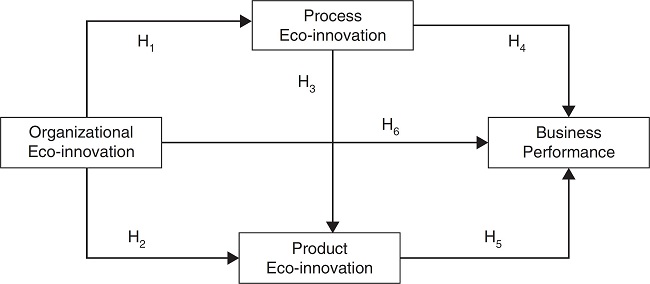
H1. There is a relationship between organizational and process eco-innovation.
H2. There is a relationship between organizational and product eco-innovation.
H3. There is a relationship between product and process eco-innovation.
H4. There is a relationship between process eco-innovation and business performance.
H5. There is a relationship between product eco-innovation and business performance.
H6. There is a relationship between organizational eco-innovations and business performance.
These research hypotheses make it possible to study the direct and indirect effects of eco-innovations on business performance. Following the model proposed by Cheng et al. (2014), the process, product and organizational eco-innovations directly improve business performance. Organizational innovations indirectly affect performance via mediators, such as the eco-innovation of processes and products. The product eco-innovation enables the company to incorporate innovative organizational activities in the development of new products and services. Similarly, these activities also facilitate the process eco-innovations having a positive impact on performance.
Research method
This research is quantitative, descriptive and exploratory in nature and was performed using a survey of textile companies. The questionnaire used was translated from the study performed by Cheng and Shiu (2012) and Cheng et al. (2014). The built and validated scales were the result of a meta-analysis on “eco-innovation”, followed by in-depth interviews with experts in the area of innovation and focus groups for discussion of the topic. The construct business performance was based on the studies developed by Im and Workman (2004), and used the following indicators: return on investment, sales, profitability and market share. The original questionnaire was translated by two experts in the area of innovation and sustainability, both with a firm grasp of the English language.
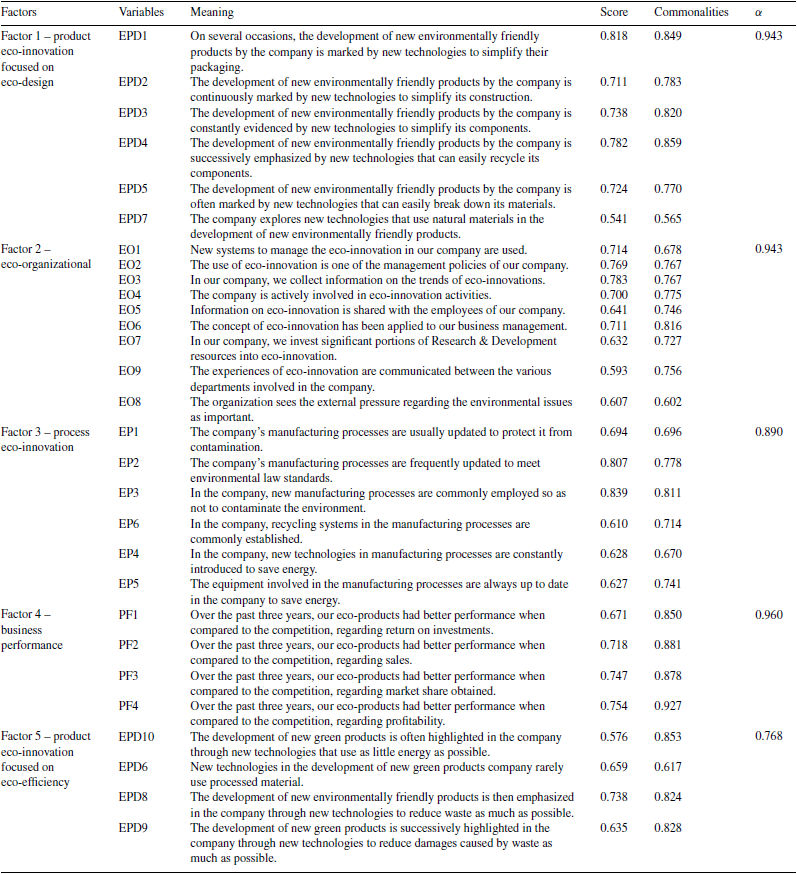
The questionnaire was divided into two parts based on the theoretically well-differentiated categories. The first contained 29 questions, grouped in the Likert scale of 1–5 points, ranging from “strongly disagree” (1) to “strongly agree” (5), and companies were asked to indicate issues related to product, process and organizational eco-innovation, as well as business performance. The research questions used are described in Table 2. The second part of the questionnaire required the following information from the participants: location of the plant, period of operation, size and business activity in the textile chain.
a Rotation converged in 8 interactions. α, Cronbach's alpha.
With the support of the Brazilian Textile Industry Association (ABIT), the survey was conducted both electronically, as well as directly with managers of textile companies. Initially, we employed the electronic form, using the GoogleDocs tool to assemble the questionnaire. Using the Customer Relationship Management (CRM) system from ABIT, emails were sent to all affiliates containing a link to the electronic form. According to CRM management, in August 2014, in total 51,931 e-mails were sent, however, only 3093 associates opened the email, and only 31 questionnaires were answered (1%). There was another attempt in the ABIT of Caxias do Sul (RS) and Maringa (PR), where 225 questionnaires were applied, obtaining a higher rate of return, with 39 (18%) completed questionnaires.
The final sample reached 70 participants, with whom we developed a multivariate statistical analysis using SPSS 20 and Smart PLS 3.0 software, and the latter was used to analyze the structural equations. The regression method of ordinary least squares (OLS) performed using the Smart PLS 3.0 has the advantage of not requiring parametric data and can be used with small samples.
For the exploratory factor analysis (EFA), we used the method of the main components with varimax rotation, while the Cronbach's Alpha was calculated to confirm the reliability of the constructs. We also conducted Kaiser–Meyer–Olkin test (KMO) and Bartlett's sphericity index. The first indicates that correlations between pairs are not explained by other variables (base 0.5), while the second test checks for an appropriate amount of significant correlation in the correlation matrix (Corrar, Paulo, & Dias Filho, 2009).
The structure obtained using the EFA was confirmed by the confirmatory factor analysis (CFA). The structural equation model (SEM) assumes that there is a relationship between a set of variables (product, process and organizational eco-innovations and business performance) and its latent factors, coming after the CFA analysis.
There are sample size recommendations required to use the properties of the OLS regression in Smart PLS 3.0, assuming a level of statistical power of 80%, “when the maximum number of independent variables in the measurement and structural design is 5, with 70 observations necessary to attain the statistical power to detect 80% of the R2 values of at least 0.25 (with a 5% probability of error)” (Hair, Hult, Ringle, & Sarstedt, 2014, pp.21–22). For the multivariate statistical analysis, we require the estimates of structural factors, factor loadings, variances of error and coefficients of determination (Marôco, 2010).
RESULTS
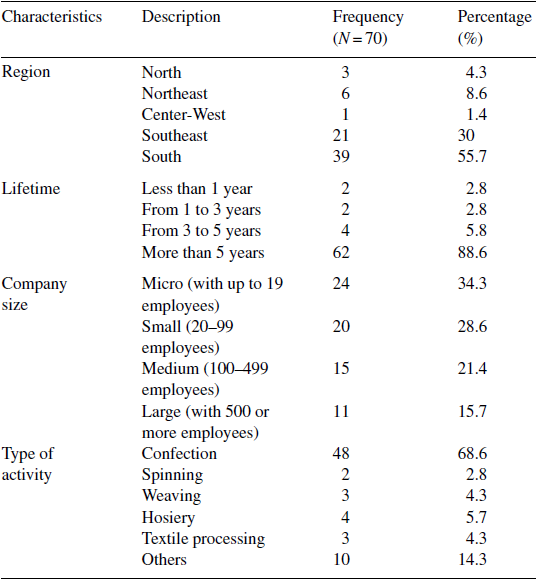
The profile of the participating companies can be seen in Table 1. We studied three companies from the North, 6 companies from the Northeast, 1 company from Midwest, 21 companies from the Southeast and 39 companies from the South. There is a concentration of companies surveyed in the South and Southeast (85.7% of the sample) regions of Brazil. This bias can be considered significant and could possibly lead to the results more culturally and technologically influenced by companies located south and southeast regions.
However, there is no homogeneity in the distribution of textile companies in Brazil. According to Banco do Nordeste do Brasil [BNB] (2014), textile companies are concentrated in Southeast (48.8%) and South (30.4%), and together are responsible for 79.2% of the Brazilian textile industry. The Northeast has 14.3% of these companies, the Midwest has 5.5% and the North has only 1% of textile companies. Thus, the distribution of the surveyed companies reflects their heterogeneous geographic distribution across Brazil.
The companies’ lifetimes show that 88.6% have been operating for over 5 years, i.e. they are mature companies. Companies of all sizes that participate in the textile activity were surveyed. Included within “other activities” are: bed, bath and table, dyes manufacture and textile auxiliaries. Therefore, the sample is characterized by 88.6% of companies that are older than 5 years, 62.9% micro and small companies, 68.6% that work in the garment industry and 55.7% that are located in the Southregion.
The main components method was used for the exploratory factor analysis (EFA) with a varimax rotation. The Kaiser–Meyer–Olkin test (KMO) has a base of 0.5 and indicates a correlation between pairs that are not explained by other variables; in this case the value obtained was 0.902. The KMO indicates that the factors found in the joint EFA can satisfactorily describe the variation of the original data. The Bartlett's sphericity index checks whether an appropriate amount of significant correlation is present in the correlation matrix. The general significance test value should exceed 0.05, for a good EFA. This criterion was also met, and its level of significance was 0.000 (Hair, Black, Babin, Anderson, & Tatham, 2009).
After extracting the commonalities, 29 variables showed reasonable explanatory power, values above 0.50, as shown in Table 2. According to Hair et al. (2009), these variables can be maintained and indicate a good explanation power regarding the total variance. Five factors were extracted by the matrix of rotated components. The Cronbach's alpha was 0.972 and each construct showed an acceptable Cronbach's alpha of close to 1 – product eco-innovation focused on eco-design (0.943); organizational eco-innovation (0.943), process eco-innovation (0.890), product eco-innovation focused on eco-efficiency (0.768), and business performance (0.960) –, which demonstrates the reliability of the constructs’ dimensions (Corrar et al., 2009).
We observed that 77% of the total cumulative variance can be explained by these factors, and eigen values greater than 1 were considered. This percentage indicates that the variables were well selected from a conceptual point of view. For Hair et al. (2009, p. 115), “enough factors to suit a specified percentage of explained variance, usually 60% or more,” are needed. We also submitted it to the Cronbach's alpha reliability test, where the minimum value for exploratory research is 0.6.
While analyzing the factorial scores of the 5 factors resulting from the matrix of rotated components, all variables presented a score of above 0.50, which is minimum acceptable value, according to the recommendation provided by Hair et al. (2009). Factors 1 and 5 can be considered two parts of the same construct: product eco-innovation, since factor 1 meets the variables EPD1, EPD2, EPD3, EPD4, EPD5, EPD7 and factor 5 congregates the variables EDP10, EPD6, EPD8 and EPD9. Thus, the elements for eco-innovation in the Brazilian textile industry involve product attributes, organization, process, and performance, which confirms the constructs found by Cheng et al. (2014).
To analyze the structural equations model, we initially verified the multicollinearity using the Variance Inflation Factor (VIF), i.e. a VIF above 5.00 is considered unacceptable and indicates the existence of multicollinearity among the factors (Hair et al., 2014). The VIF values between constructs are acceptable, where EO and EP was 1.000; EO and EPD 2.298; EP and EPD 2.298; EO and PF 2.416; and EPD and PF 2.416. The structural equation model tested can be seen in Fig. 2.
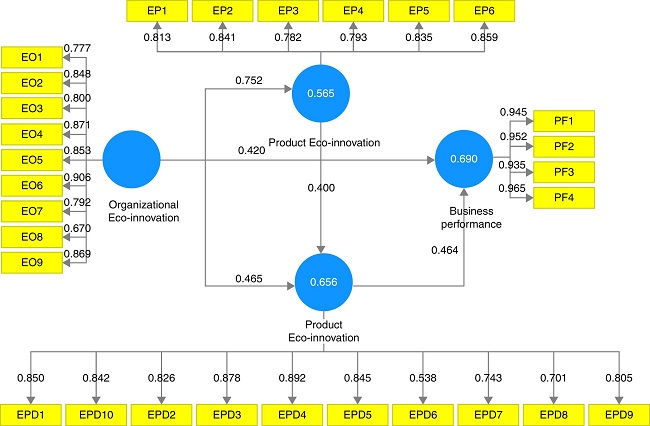
Fig. 2
Structural equation design (with the values of CFA) for the eco-innovation and performance in the Brazilian textile industry.
When comparing the survey results with the original design by Cheng et al. (2014, p. 87), we observed that the path coefficient (β = 0.15) between the process eco-innovation and the business performance of the company is below the original value (β = 0.42). Hair et al. (2014) asserted that in the case of “samples up to 1000 observations, the path coefficients with their standard values above 0.20 are generally significant, and those less than 0.10 are usually not significant”.
Upon bootstrapping before the final design, we found that the connection between the two constructs, process eco-innovation = >business performance, had a p-value of 0.301, in other words, it was not significant. This relationship was thus removed from the design. During the analysis of the final structural equation design (Fig. 2), we obtained an improvement of the other betas, with the exception of the link between organizational eco-innovation and product eco-innovation, as it had a practically equal beta of around 0.46.
We verified the discriminant validity of the design by comparing the root of the explained variance (AVE) with the correlations (Fornell.Larcker criterion). The root of the AVE is displayed in the diagonal of the correlation matrix in Table 3. The root of the AVE of each construct is greater than the correlations between the constructs; therefore, the design has discriminant validity and the result is satisfactory. In the design for the final analysis, all factor scores were above 0.50 and the coefficients of determination (R2) were also above 0.50. In academic research, such value is considered recommendable and acceptable (Hair et al., 2014).
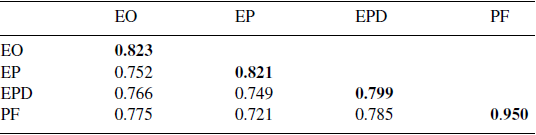
The average variance extracted (AVE) must be greater than 0.50. The composite reliability along with Cronbach's alpha was used to verify that the constructs are indeed reliable. This research demonstrated that the answers are thusly free of bias. R2 indicates the quality of the fitted design, with values of 0.75, 0.50 and 0.25 being considered as substantial, moderate, and weak, respectively (Hair et al., 2014). The design performance index is shown in Table 4, which includes the Explained Variance (AVE), the composite reliability, the determination coefficient (R2) and the commonality of each construct.

According to Hair et al. (2014, p. 186), the commonality (f2) makes it possible to evaluate the contribution of an exogenous construct to the value of a latent endogenous variable R2. The values of (f2) 0.02, 0.15 and 0.35 indicate an effect on the small, medium or large construct, respectively. These values are similar to evaluate redundancy (Q2). In the research, we used a default distance of 9, a value that must be between 5 and 10. The redundancy evaluates the accuracy of the adjusted design. The f2 and Q2 values must be positive (Hair et al., 2014). We used the bootstrapping method in order to verify whether the design was properly adjusted to the sample obtained. Table 5 shows the results of the calculation of 500 subsamples, which show that the values obtained for each ratio of the constructs are close to those of the original sample.
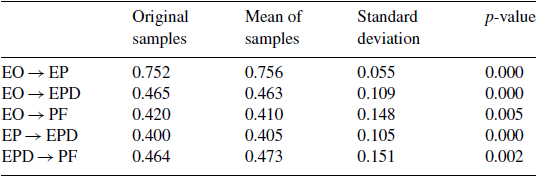
When interpreting the design results, it is necessary to test the significance of the relationship of the structural design, all of which showed significant p-values at 5%. After that, we analyzed the direct, indirect and total effects. Table 6 shows the direct, indirect and total mediation of the structural equation design. The greatest effect of the three types of eco-innovations on business performance is the organizational eco-innovation (β1 = 0.775) due to its direct effect (β2 = 0.420) and indirect effects (β3 = 0.355) via eco-process and eco-product innovations.

This result is similar to the original design proposed by Cheng et al. (2014, p. 87), whose test provided results (β1 = 0.77, β2 = 0.51; β3 = 0.26) for the total, direct and indirect effects, respectively, of the construct of organizational eco-innovation in the company's business performance. We also noted that the total effect of product eco-innovation (β1 = 0.464) has a greater influence on business performance than the process eco-innovation (β2 = 0.185), results that were opposite to those in the original design. The total effect on the company's performance in this study was (β1 = 0.36) and in the study conducted by Cheng et al. (2014), it was (β2 = 0.67).
Analyzing the results of the structural equation model allows us to point to the testing of hypotheses. According to Hair et al. (2014, p. 173) we can use to analyze the significance of the relationship of the structural design “both the t-test, and the p-value, or the bootstrapping confidence interval, and there is no need to report on the three types of significance test, since all lead to the same conclusion”. In this study, we opted for the p-value test, at a 0.05 significance level.
With H1 hypothesis defending the assumption that there is a relationship between organizational eco-innovation and process eco-innovation, we have it thus confirmed. The p-value is significant (0.000) and the path coefficient is positive (0.752). The H2 hypothesis was also confirmed. There is a relationship between organizational eco-innovation and product eco-innovations, since p-value is significant (0.000) and the path coefficient is positive (0.465).
Likewise, the positive path coefficient (0.400) and significant p-value (0.000) confirm the H3 hypothesis, which states that there is a relationship between process eco-innovations and product eco-innovations. However, the H4 hypothesis that there is a relationship between process eco-innovation and business performance was not confirmed, presenting a p-value of 0.301, not significant, and a beta = 0.15, which is considered low.
The H5 hypothesis that there is a relationship between products eco-innovations and business performance was confirmed, since the path coefficient is positive (0.464) and its p-value is significant (0.002). The H6 hypothesis was also confirmed. There a relationship between organizational eco-innovation and business performance, with a positive path coefficient (0.420) and a significant p-value (0.005).
DISCUSSION
This research confirms that organizational and product eco-innovations directly affect the performance of Brazilian textile companies. In addition, there are also significant relationships between organizational and process eco-innovations, organizational and product eco-innovations and process and product eco-innovations. These results converge almost entirely with the results of the eco-innovation and business performance design developed by Cheng et al. (2014) that was applied in the Thai industry, as shown in Table 7.
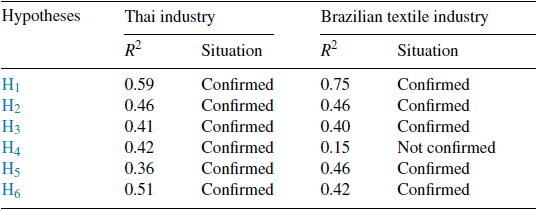
It is important to consider that the original design of structural equation proposed by Cheng et al. (2014) was tested using the method based on covariances, Covariance-Based-Structural Equation Model (CB-SEM), while this study used the method of partial least squares, Partial Least Squares-Structural Equation Model (PLS-SEM). Despite the difference among the methods, these results confirm that the companies in the textile sector have a positive relationship between the implementation of organizational eco-innovations and the implementation of other types of eco-innovations. There is also a direct relationship between the organizational and product eco-innovations and the business performance of the company.
The model tested in the Brazilian textile industries only differed in terms of the existence of a direct relationship between process eco-innovations and business performance (H4). One possible explanation for the rejection of this hypothesis is the requirement of integration in the textile industry for the development of process eco-innovations. Sezen and Çankaya (2013) demonstrated process changes that affect the entire production chain and enable the supply of a product that adds value.
The low rate of participation in this research seems to suggest that eco-innovation is still incipient in the Brazilian textile chain. Thus, the effort of the Brazilian Textile Industry and Clothing Association (ABIT) in its priority agenda means that greater investment in research and development is required in order to bring new processes and innovative products to the domestic textile industry, according to the BNB report (2014). For example, the clothing industry does not have the same access to technologies as the weaving and spinning industry; however, they make use of alternative processes and operational practices (Adler, 2004; Jones et al., 2012).
The analysis of the direct and indirect effects of the individual types of eco-innovation also provides important information regarding the development of innovation programs. Companies must first engage in organizational eco-innovation, developing the necessary infrastructure, and achieving the necessary knowledge so they can improve their processes and products. As the organizational eco-innovations occur, the process eco-innovations develop skills that can be used to improve products, which have positive impact on business performance.
The results achieved in this research are important for the Brazilian textile industry. In general, spinning, weaving, finishing and clothing companies suffer the symptoms of an economic recession, which reduces financial support for eco-innovation activities. According to de Souza et al. (2014), there is an overall reduction of investment earmarked for expanding production capacity and profit, as well as a lack of dynamism and investment in research and innovation. There is a lack of enthusiasm from entrepreneurs, stagnation in the creation of new products, slow adaptation to new technologies, and low technology in production. Additionally, the global textile industry works with a fast fashion logic, and therefore there is a possibility that competition may copy any innovative products or processes.
Eco-innovative textile companies surveyed in this study develop strategic resources, which combine economies of scale with the internal competencies and benefit from the cumulative effects. These companies are able to develop the technical knowledge and expertise to create process and product eco-innovations. Consequently, they are able to increase return on investment, sales and achieve greater market share by offering eco-products. This research supports the findings of Köhler and Som (2014), who argue that eco-innovation strategies must conform with consumer expectations, in accordance with ethical, environmental and legal issues, and have low investment risks and affordable costs.
A systemic view of eco-innovation makes it possible to affirm that the eco-innovative textile companies that participated in this study developed valuable resources. These resources are difficult to copy and are non-substitutable, which can boost performance through a more sustainable management and improve the technological aspect and the socio-cultural system in which they operate. These companies have developed eco-efficient processes that resulted in eco-products, improved the image of the company and provided a differentiated and conscious consumption experience, as per the proposals set out by Guercini (2004).
The results achieved in this research are aligned with the findings made by Barney (1991), Barney and Hesterly (2007) and Klewitz et al. (2012). These authors affirm that sustainable competitive advantage depends on efficient exploitation of internal capabilities and resources. The surveyed textile companies have shown that organizational eco-innovations allow for product cost reduction, risk of environmental impacts reduction, increased profitability and increased reputation of the brand.
CONCLUSION
This research revealed that eco-innovations positively affect business performance, and that there is interdependence between the eco-innovations. The direct effects of organizational and product eco-innovations in the performance were observed, as were the indirect effects of the process eco-innovations on business performance. The process eco-innovations can serve to enhance technological solutions that address the efficient use of natural resources, and develop eco-products.
This study brings contributions to the field of innovation. Firstly, the study reinforces importance of the systematic implementation of various aspects of product, process and organizational eco-innovations. Secondly, the interrelationship found between these three types of innovation and their effects on business performance indicate that each of these components has its own attributes. However, the synergistic effects appear to be expanded, when the company implements innovative programs that require the development and application of valuable resources that are difficult to imitate and/or replace. Finally, the vast majority of studies on innovation focus on technological aspects and neglect social systems. This study reinforces the importance of a systemic view in which where the organizational efforts are supplemented by technological efforts.
Eco-innovations are the result of a gradual change in management and culture and require effort and investment within changing organizational and technological practices (Adler, 2004; Jones et al., 2012). At the same time, this study points out the need to establish public policies that provide incentives for companies to promote eco-innovations. Innovation strategy should take into account internal and external elements of the organization, which ultimately determine the extent of the influence on the performance of the company (Stefan, Varmus, & Lendel, 2014).
The limitations of this work should be taken into consideration such as the fact that only three types of eco-innovations were examined. Strictly technological innovations or marketing innovations can be included in future studies that seek to use the design proposed by Cheng et al. (2014). Another limitation relates to the size of the sample and the non-homogeneous nature Brazil's domestic textile industry. According to Mattar (2007), in cases of atypical or non-homogeneous data when the sample selection is unknown and cannot be estimated, one can resort to inferences on the population by informal samples and arbitrary criteria. The effect of sample choice by accessibility is that it cannot be generalized. However, the sample served as a proxy to understand what is happening within the eco-innovation and performance theme in the Brazilian textile industry.
Despite these limitations, this research contributes to the literature on eco-innovation from the perspective of the Resource-based View Theory (RBV). Innovations are rare, valuable and difficult to copy, and it can positively impact business performance. It is necessary to seek new management designs focus on eco-innovation, to employ processes and to develop eco-efficient products, as well as to encourage sustainable consumption. To this end, the organization of the Brazilian textile chain needs to be renewed with the establishment of sustainable technological absorption goals, including development of new materials, reduction of natural resources consumption and pollution prevention approach.
Peer Review under the responsibility of Departamento de Administração, Faculdade de Economia, Administração e Contabilidade da Universidade de São Paulo – FEA/USP.
Acknowledgements
To CAPES (Coordination for Higher Education Staff Development) for granting a postdoctoral fellowship (PNPD) and CNPq (National Council for Scientific and Technological Development) for the financial support for this research project. To the Brazilian Textile Industry Association (ABIT) for their support in the data collection with textile companies. To the Editor and to the reviewers for their valuable contributions to improving the initial version of this article.
REFERENCES
Abreu, M. C. S., de Castro, O. V., de Soares, F. A., & da Silva Filho, J. C. L. (2009). Efeito da Conduta Social sobre a Performance Econômica: Evidências da Indústria Têxtil Brasileira. Revista Contabilidade Vista & Revista, Universidade Federal de Minas Gerais. Belo Horizonte, 20(1), 119-142.
Abreu, M. C. S., de Castro, F., de Soares, F. A., & da Silva Filho, J. C. L. (2012). A comparative understanding of corporate social responsibility of textile firms in Brazil and China. Journal of Cleaner Production, 20, 119-126.
Adler, U. (2004). Structural change: The dominant feature in the economic development of the German textile and clothing industries. Journal of Fashion Marketing and Management, 8(3), 300-319.
Anttonen, M., Halme, M., Houtbeckers, E., & Nurkka, N. (2013). The other side of sustainable innovation: Is there a demand for innovative services?. Journal of Cleaner Production, 45, 89-103.
Arundel, A., & Kemp, R. (2009). Measuring eco-innovation. UNU-MERIT Working Paper Series (Working Paper No. 017). Netherlands: United Nations University, Maastricht Economic and Social Research and Training Centreon Innovation and Technology. Retrieved from http://www.merit.unu.edu
Atalay, M., Anafarta, N., & Sarvan, F. (2013). The relationship between innovation and firm performance: An empirical evidence from Turkish automotive supplier industry. Procedia – Social and Behavioral Sciences, 75, 226-235.
Banco do Nordeste do Brasil. (2014). Análise retrospectiva e prospectiva do setor têxtil no Brasil e no Nordeste. Fortaleza: Escritório Técnico de Estudos Econômicos do Nordeste (ETENE). Informe nº. 2-Macroeconomia, Indústria e Serviços, Year8.
Barney, J. B. (1991). Firm resources and sustained competitive advantage. Journal of Management, 17(1), 99-120.
Barney, J. B., & Hesterly, W. S. (2007). Administração estratégica e vantagem competitiva. São Paulo: Prentice-Hall.
Baumgartner, R. J., & Ebner, D. (2010). Corporate sustainability strategies: Sustainability profiles and maturity levels. Sustainable Development, 18, 76-89.
Boehe, D. M., Milan, G. S., & Toni, D. (2009). Desempenho do processo de desenvolvimento de novos produtos: o peso relativo de fatores organizacionais, mercadológicos e operacionais. Revista de Administração, 44(3), 250-264.
Boons, F., Montalvo, C., Quist, J., & Wagner, M. (2013). Sustainable innovation, business models and economic performance: An overview. Journal of Cleaner Production, 45, 1-8.
Brito, E. P. Z., Brito, L. A. L., & Morganti, F. (2009). Inovação e desempenho empresarial: lucro ou crescimento?. Revista de Administração de Empresas, 8(1).
Brunnermeir, S., & Cohen, M. (2003). Determinants of environmental innovation in US manufacturing industries. Journal of Environmental Economics and Management, 45, 278-293.
Carrilo-Hermosilla, J., del Río, P., & Könnölä, T. (2010). Diversity of eco-innovations: Reflections from selected case studies. Journal of Cleaner Production, 18, 1073-1083.
Chaney, P. K., Devinney, T. M., & Winer, R. S. (1991). The impact of new product introductions on the market value of firms. The Journal of Business, 64(4), 573-610.
Cheng, C. C., & Shiu, E. C. (2012). Validation of a proposed instrument for measuring eco-innovation: An implementation perspective. Technovation, 32, 329-344.
Cheng, C. C. J., Yang, C., & Sheu, C. (2014). The link between eco-innovation and business performance: A Taiwanese industry context. Journal of Cleaner Production, 64, 81-90.
Chou, C., Chen, C., & Conley, C. (2012). A systematic approach to generate service model for sustainability. Journal of Cleaner Production, 29, 173-187.
Coelho, M. A. (2015). Ecoinovação em uma pequena empresa de reciclagens da cidade de Manaus. Revista de Administração e Inovação, 12(1), 121-147.
Cook, M. B., Bhamra, T. A., & Lemon, M. (2006). The transfer and application of product service systems: From academia to UK manufacturing firms. Journal of Cleaner Production, 14, 1455-1465.
Corrar, L. J., Paulo, E., & Dias Filho, J. M. (2009). Análise multivariada. São Paulo: Atlas.
de Ferreira, M. V. G. Q., & Kiperstok, A. (2007). Aplicação de um modelo de processo de inovação ambiental em uma empresa de química fina. Revista de Gestão Social e Ambiental, 1(2), 93-110.
de Souza, M. T. S., Cattini, O., & Barbieri, J. C. (2014). Novos horizontes para operações competitivas. Revista de Administração de Empresas, 54(5).
Dyllick, T., & Hockerts, K. (2002). Beyond the business case for corporate sustainability. Business Strategy and the Environment, 11, 130-141.
Ekins, P. (2010). Eco-innovation for environmental sustainability: Concepts, progress and policies. International Economics and Economic Policy, 7, 267-290.
Farias, A. S., Costa, D. S., Freitas, L. S., & Cândido, G. A. (2012). Utilização de eco-inovação no processo de manufatura de cerâmica vermelha. Revista de Administração e Inovação, 9(3), 154-174.
Figueiredo, P. N., Andrade, R. F., & Brito, K. N. (2010). Aprendizagem tecnológica e acumulação de capacidades de inovação: evidências de contractmanufacturers no Brasil. Revista de Administração, 45(2), 156-171.
Galende, J., & de la Fuente, J. M. (2003). Internal factors determining a firm's innovative behavior. Research Policy, 32(5), 715-736.
Guercini, S. (2004). International competitive change and strategic behavior of Italian textile-apparel firms. Journal of Fashion Marketing and Management, 8(3), 320-339.
Hair, J. F., Jr., Black, W. C., Babin, B. J., Anderson, R. E., & Tatham, R. L. (2009). Análise multivariada de dados (A.S. Sant’Anna, Trans.) (6a. ed.). Porto Alegre: Bookman.
Hair, J. F., Jr., Hult, G. T. M., Ringle, C. M., & Sarstedt, M. (2014). A primer onpartial least squares structural equation modeling (PLS-SEM). USA: SAGE Publications.
Hallenga-Brink, S. C., & Brezet, J. C. (2005). The sustainable innovation design diamond for micro-sized enterprises in tourism. Journal of Cleaner Production, 13, 141-149.
Hirschmann, T., & Mueller, K. (2011). Social value creation: Outline and first application of a resource management approach to innovation. International Journal of Innovation and Sustainable Development, 5(2), 276-294.
Horbach, J. (2008). Determinants of environmental innovation-new evidence from German panel data sources. Research Policy, 37, 163-173.
Im, S., & Workman, J. P. (2004). Market orientation, creativity, and new product performance in high-technology firms. Journal of Marketing, 68(2), 114-132.
Jansson, J., & Marell, A. (2010). Green consumer behavior: Determinants of curtailment and eco-innovation adoption. Journal of Consumer Marketing, 27(4), 358-370.
Jones, P., Hillier, D., & Comfort, D. (2012). Fashioning corporate social responsibility. Emerald Emerging Markets Case Studies, 2(8), 1-10.
Kemp, R. (2009). From end-of-pipe to system innovation. pp. 1–26. Copenhagen:DRUID Summer Conference. Retrieved from http://kemp.unu-merit.nl/Paper%20for%20DRUID%20conference%20Kemp4.pdf
Kemp, R., & Pearson, P. (2008). Measuring eco-innovation, final report of MEI project for DG Research of the European Commission.. Retrieved from http://www.oecd.org/greengrowth/consumption-innovation/43960830.pdf
Klewitz, J., Zeyen, A., & Hansen, E. G. (2012). Intermediaries driving eco-innovation in SMEs: A qualitative investigation. European Journal of Innovation, 15(4), 442-467.
Köhler, A. R., & Som, C. (2014). Risk preventive innovation strategies for emerging technologies the cases of nano-textiles and smart textiles. Technovation, 34, 420-430.
Lam, A. (2005). Organizational innovation. In J. Fagerberg, D. Mowery, & R.Nelson (Eds.), The Oxford handbook of innovations (pp. 115–147). Oxford: Oxford University Press.
Maçaneiro, M. B., & da Cunha, S. K. (2012). Ecoinovação: um quadro de referência para pesquisas futuras. Revista Innovare, 13, 266-289.
Machado Netto, D. D. P., Carvalho, L. C., & Heinzmann, L. M. (2012). Ambiente favorável ao desenvolvimento de inovações e cultura organizacional: integração de duas perspectivas de análise. Revista de Administração, 47(4), 715-729.
Manzini, E., & Vezzoli, C. (2011). O desenvolvimento de produtos sustentáveis: os requisitos ambientais dos produtos industriais. São Paulo: Editora da Universidade de São Paulo.
Marôco, J. (2010). Análise de Equações Estruturais: Fundamentos Teóricos, Software & Aplicações. Portugal: Report Number.
Mattar, F. N. (2007). Pesquisa de marketing (4a. ed.). São Paulo: Atlas.
Moore, S., & Ausley, L. (2004). Systems thinking and green chemistry in the textile industry: Concepts, technologies and benefits. Journal of Cleaner Production, 12, 585-601.
Morelli, N. (2006). Developing new product service systems (PSS): Methodologies and operational tools. Journal of Cleaner Production, 14, 1495-1501.
Organisation for Economic Co-operation and Development. (2009). Sustainable manufacturing and eco-innovation: Framework, practices and measurement. Paris. Retrieved from http://www.oecd.org/innovation/inno/43423689.pdf
Pujari, D. (2006). Eco-innovation and new product development: Understanding the influences on market performance. Technovation, 26, 76-85.
Pujari, D., Wright, G., & Peattie, K. (2003). Green and competitive influences on environmental new product development performance. Journal of Business Research, 56, 657-671.
Rangel, A. S., Da Silva, M. M., & Costa, B. K. (2010). Competitividade da Indústria Têxtil Brasileira. Revista de Administração e Inovação, 7(1), 151-174.
Rehfeld, K., Rennings, K., & Ziegler, A. (2007). Integrated product policy and environmental product innovations: An empirical analysis. Ecological Economics, 61, 91-100.
Rennings, K. (2000). Redefining innovation–eco-innovation research and the contribution from ecological economics. Ecological Economics, 32, 319-332.
Sezen, B., & Çankaya, S. Y. (2013). Effects of green manufacturing and eco-innovation on sustainability performance. Procedia – Social and Behavioral Sciences, 99, 154-163.
Shin, D., Curtis, M., Huisingh, D., & Zwetsloot, D. (2008). Development of a sustainability policy model for promoting cleaner production: A knowledge integration approach. Journal of Cleaner Production, 16, 1823-1837.
Stefan, H., Varmus, M., & Lendel, V. (2014). Proposal of model for effective implementation of innovation strategy to business. Procedia – Social and Behavioral Sciences, 109, 1194-1198.
Tarnawska, K. (2013). Eco-innovations: Tools for the transition to the green economy. Economic and Management, 18(4), 735-743.
Tseng, M., Wang, R., Chiu, A., Geng, Y., & Li, Y. (2013). Improving performance of green innovation practices under uncertainty. Journal of Cleaner Production, 40, 71-82.
Tukker, A., & Tischner, U. (2006). Product-services as a research field: Past, present and future. Reflection from a decade of research. Journal of Cleaner Production, 14, 1552-1556.
Xing, K., Ness, D., & Lin, F. (2013). A service innovation model for synergistic community transformation: Integrated application of systems theory and product-service systems. Journal of Cleaner Production, 43, 93-102.
Author notes
Additional information
Conflicts of interest: The authors declare no conflicts of interest.