Original Article
SOCIAL NETWORK STRUCTURE AND FIRMS’ INTERNATIONALIZATION: NEW INSIGHTS FROM A WHOLE-NETWORK PERSPECTIVE
ESTRUTURA SOCIAL DA REDE E INTERNACIONALIZAÇÃO DE EMPRESAS: NOVAS IDEIAS A PARTIR DE UMA ANÁLISE GLOBAL DA REDE
 Björn Jindra
Ariane Roder Figueira
Björn Jindra
Ariane Roder Figueira
SOCIAL NETWORK STRUCTURE AND FIRMS’ INTERNATIONALIZATION: NEW INSIGHTS FROM A WHOLE-NETWORK PERSPECTIVE
Revista Eletrônica de Negócios Internacionais (Internext), vol. 19, no. 1, pp. 77-95, 2024
São Paulo
Received: 17 April 2022
Accepted: 13 November 2023
Published: 01 January 2024
ABSTRACT
Objective: The aim of this study was to analyze the social network structure of the oil and gas (O&G) cluster in Rio de Janeiro, Brazil. We explore whether internationalized firms concentrate in specific sections of the social network, and scrutinize whether internationalization is associated with a firm's attributes and its direct and indirect network ties.
Method: This research applies social network analysis, which allows us to identify dense sections, popular nodes, and strategic position. We apply partitioning techniques to determine the extent to which a firm's internationalization is affected by those to whom it is connected.
Main results: Our findings show that internationalized firms concentrate in dense sections of the network, which are characterized by high interconnectedness. Furthermore, there is indicative evidence that interaction among firms and their attributes embedded in the social network structure is associated, at least in part, with the diffusion of internationalization.
Relevance / Originality: Most studies targeting the network focus on the so-called ego network. This study applies a whole-network perspective to consider popular communities and central nodes and, ultimately, show how social behavior is diffused within the social network structure.
Theoretical / Methodological Contributions: Drawing upon the network theory, we emphasize interdisciplinarity to advance international business (IB) scholarship. In particular, we qualify the Uppsala model's assumption of network/relational capability, that is, the ability to build, sustain, and coordinate relationships by demonstrating the relevance of the social network structure to the internationalization process.
Keywords: Internationalization+ Social Network Structure+ Whole-Network Perspective.
RESUMO
Objetivo: Este artigo analisa a estrutura social da rede de Óleo e Gás no Rio de Janeiro, Brasil. Exploramos se as empresas internacionalizadas se concentram em seções específicas da rede; e examinamos se a internacionalização está associada aos atributos de uma empresa e as suas conexões diretas e indiretas.
Método: Esta pesquisa aplica Análise de Redes Sociais, que permite identificar seções densas, popularidade dos atores e posições estratégicas. Aplicamos técnicas de particionamento para determinar até que ponto a internacionalização de uma empresa é afetada por aqueles a quem está ligada.
Principais Resultados: As empresas internacionalizadas se concentram em seções densas da rede, que são caracterizadas por uma maior interligação. Além disso, existem evidências indicativas de que a interação entre empresas e os seus atributos incorporados na estrutura social da rede está associada, pelo menos em parte, a internacionalização de empresas.
Relevância / Originalidade: A maioria dos estudos direcionados à rede concentra-se em um único ator. Este artigo aplica uma perspectiva global da rede para mostrar como a internacionalização é difundida dentro da estrutura social da rede.
Contribuições Teóricas / Metodológicas: Baseando-nos na teoria de redes, enfatizamos a importância da interdisciplinaridade para avançar os estudos de negócios internacionais. Mostramos que os postulados do Modelo de Uppsala em relação a rede se sustentam.
Palavras-chave: Internacionalização, estrutura de redes sociais, perspectiva global da rede.
INTRODUCTION
The importance of network and social relations on the internationalization of firms is now widely accepted ( Anderson, Hakansson, & Johanson, 1994; Anderson & Weitz, 1992; Cook & Emerson, 1978; Coviello, 2006; Ghoshal & Bartlett, 1990; Johanson & Vahlne, 2009; Morgan & Hunt, 1994; Oehme & Bort, 2015; Sharma & Johanson, 1987; Yamin & Kurt, 2018). A majority of studies investigating the relationship between networks and the internationalization of firms focus on the firm and its local relationships in the so-called ego network. This approach has provided most of the knowledge on networks, but scholars also stress that what gets analyzed and explained is not the network itself but the relations that comprise the network ( Provan, Fish, & Sydow, 2007; Provan & Kenis, 2008).
The objective of this study is to go beyond the analysis of relationships among individual firms by adopting a whole-network perspective ( Marsden, 2005). The whole-network approach provides researchers with a bird's eye view of the social structure, as it considers all nodes of a determined population. Through the bird's eye view, we identify popular communities and central nodes and, ultimately, show how social behavior is diffused within the social network structure ( Provan et al., 2007; Robins & Daraganova, 2013). In particular, we explore whether internationalized firms concentrate in dense sections of the social network and whether internationalization is associated with a firm's attributes and its direct and indirect network ties.
As the literature argues that available benefits rise in line with higher network density ( Bellamy, Bellamy, Ghosh, & Hora, 2014; Iurkov & Benito, 2018; Kano, 2018), we first explore whether internationalized firms concentrate in dense sections of the network. Second, as we know that local effects and interactions determine firm behavior ( Leenders, 2002), we explore whether internationalization is associated with a firm's attributes and its direct and indirect ties within the social network structure. To tackle the goals of this research, we use social network analysis (SNA). SNA allows us to identify dense sections, popular nodes, and strategic position and apply partitioning techniques to determine the extent to which a firm's internationalization is affected by those to whom it is connected ( Wang, Neuman, & Newman, 2014).
Empirical research on the distribution or diffusion of attributes in social networks is conducted in a variety of social science fields, including studies on the peer effect in educational decisions ( Davies & Kandel, 1981), political science ( Franzese, Hays, & Kachi, 2012), sociology ( Crowder & South, 2008), cultural psychology and anthropology ( Dow & Eff, 2008), organizational studies ( Mizruchi & Stearns, 2006), mobilization in the Paris Commune ( Gould, 1991), the perceptions of the significance of journals by sociologists ( Burt & Doreian, 1982), and the diffusion of innovations across social structures ( Valente & Rogers, 2010). Influence processes have also generated interest in economics, where they are referred to as ‘peer effects’ ( Jackson, 2013). From this perspective, it is important to note that the internationalization of a firm is conceptualized as an outcome of the whole network — and not a single individual strategy – consisting of a complex interplay between direct and indirect, voluntary and involuntary, and home-country and foreign-country relationships ( Sharma, Kumar, Yan, Borah, & Adhikary, 2019).
We focus on the O&G cluster in Rio de Janeiro, Brazil. The state of Rio de Janeiro is the biggest producer of O&G in Brazil, and royalties are invested in healthcare, education, infrastructure, and other socially beneficial areas ( IBP, 2019). The study of the O&G cluster on internationalization is relevant because it is globally oriented ( Becattini, Bellandi, & de Propis, 2013; Isaksen & Karlsen, 2012; Ketels & Memedovic, 2008; Sasson & Blomgren, 2011; Silvestre & Dalcol, 2010; Wolfe & Gertler, 2004) and directly links firms and other institutions, which enables us to identify the structure of the social network and its influence on the diffusion of behavior ( Xavier Molina-Morales, Belso-Martínez, Más-Verdú, & Martínez-Cháfer, 2015).
We gained access to a list of firms participating in the O&G cluster in Rio de Janeiro, Brazil, and collected primary data using a web-based survey. A total of 46 firms supplied information about one or more business partners, from which we generated relational data. The resulting social network consists of 230 firms and 288 connections between firms. From this, we explored the popularity (the number of ties a firm has) of networked firms that we describe in terms of selected characteristics such as firm size, sector, ownership, and international status (whether the firm is internationalized or not). Next, we decomposed the social network into 18 communities of highly interconnected nodes ( Blondel, Guillaume, Lambiotte, & Lefebvre, 2008). This enabled us to investigate whether the number of internationalized firms is higher in the dense sections of the mapped network. Finally, we applied a linear network autocorrelation model ( Butts, 2008; Leenders, 2002) to a smaller subset of firms to determine their ties with one another. This approach enabled us to conclude that internationalization is part of behavior diffusion associated with firms’ direct and indirect ties and firm attributes embedded in the social network structure.
This study contributes to the state of the art in the following ways. First, we answered Kurt and Kurt's (2020) call to develop an innovative research design that acknowledges interdependencies among social firms in the global environment ( Buckley, Doh, & Benischke, 2017). Second, by applying SNA, we employed an appropriate method to understand firm behavior and outcomes in the context of network-based approaches to understand internationalization ( Sedziniauskiene, Sekliuckiene, & Zucchella, 2019; Sharma et al., 2019). Drawing upon the network theory, we emphasize interdisciplinarity to advance IB scholarship ( Buckley et al., 2017). Third, this research refined the Uppsala model's assumption of network/relational capability, that is, the ability to build, sustain, and coordinate relationships ( Vahlne & Johanson, 2013), by demonstrating the relevance of the social network structure to the internationalization process ( Sharma et al., 2019).
1. LITERATURE REVIEW
1.1. Network perspective and international business
In the network perspective, no firm is an island but connected to numerous other firms via direct and indirect relationships ( Johanson & Vahlne, 2009; Vahlne & Johanson, 2021). The firm is not an independent unit, but an interdependent member of one or several interfirm relationship networks ( Granovetter, 1985). Early advocates using the network perspective to understand the drivers of firm internationalization sought to transcend the utilitarian tradition, which assumes rational and self-interested behavior that ‘disallows by hypothesis any impact of social structure and social relations on production, distribution or consumption’ ( Granovetter, 1985, p. 483). Several early empirical studies ( Anderson et al., 1994; Anderson & Weitz, 1992; Cook & Emerson, 1978; Morgan & Hunt, 1994; Sharma & Johanson, 1987) illustrate this fundamental shift in underlying assumptions.
Over time, IB scholars intensified their interest in the network perspective. For example, concerning international new ventures (INVs), Aldrich, Zimmer and Jones (1986) and Larson (1992) argued that the network is a powerful resource because relationships are based on trust and moral obligations rather than formal contracts and, therefore, tend to decrease opportunistic behavior (see also Oviatt & McDougall, 1994). Sharma and Blomstermo (2003) argued that the network perspective can explain the internationalization process of born globals: the network provides international marketing knowledge and learning in advance of the firm's foray into the international market. Bell (1995) showed that the network approach explains the internationalization process of small-sized computer firms better than traditional stage theories. This was confirmed by Coviello (2006) and Coviello and Munro (1997), who documented the critical and not always supportive role played by the network for small-sized software firms and entrepreneurs seeking to explore international markets and internationalization.
Chetty and Blankenburg Holm (2000) investigated the impact of the network model in the internationalization process of small- to medium-sized manufacturing firms in New Zealand, finding that networks expose the firm to new opportunities, knowledge, and learning. The network approach has also been applied to the study of foreign acquisitions ( Forsgren, 1989) and location choice of FDI ( Chen & Chen, 1998). Oehme and Bort (2015) argued that networks enable imitative behavior in internationalization modes. After analyzing the data of all 977 biotechnology firms in Germany, covering the period from 1996 to 2012, Oehme and Bort (2015) found that firms precisely imitate the internationalization process of their peers, channeled through interorganizational networks.
The literature also suggests that the network supports the rise of Emerging-Market Multinational Enterprises (EMNEs) by providing new opportunities for local capability formation in lower-cost locations outside the industrial heartlands of North America, Western Europe, and Japan ( Ernst, 2002). For example, Elango and Pattnaik (2007) studied 794 firms from India to understand how these EMNEs build capabilities to operate in international markets. They found that the Uppsala model and network models on internationalization can explain how EMNEs build capabilities for international operations. Investigating small-scale enterprises from Pakistan, an emerging economy, Zafarullah, Ali and Young (1998) found the network perspective to be relevant to all aspects of internationalization. Amal, Awuah, Raboch and Andersson (2013) studied the differences and similarities of the internationalization process of multinational firms from developing and developed countries. They found that learning and experience with internationalization and the use of networks influenced the internationalization process. Researchers claim that network influence can be linked directly to firm value and performance ( Gulati, Nohria, & Zaheer, 2000; Kogut, 2000). This is because the performance of an individual firm is highly dependent on its network relationships and the degree of mutual commitment among network parties ( Holm, Eriksson, & Johanson, 1999). In the same vein, Sharma et al. (2019) highlighted the importance of the network's characteristics on the IB performance of its constituents.
In the IB theory, the Uppsala model most explicitly incorporates the network perspective while explaining the internationalization of firms ( Johanson and Vahlne, 2003; Yamin & Kurt, 2018). This model posits that relational learning enables firms to develop new relationships as they enter new country markets ( Johanson & Vahlne, 2003, 2009). Interactions among insiders of relevant networks generate spillovers that are captured by firms and translated into learning, mutual trust, knowledge accumulation, and reciprocal commitment, all of which are antecedents for internationalization ( Vahlne & Bhatti, 2019; Vahlne & Johanson, 2019). They argue that firms, which are not part of relevant networks, suffer from ‘liability of outsidership’ ( Johanson & Vahlne, 2009). Nevertheless, establishing a relevant network position can enable a firm to overcome the ‘liability of outsidership’, defined as liabilities due to the lack of market-specific business knowledge. Firms need to develop network capability, which is a central driver of firm performance, in order to improve their position ( Vahlne & Johanson, 2017). For example, Ong, Freeman, Goxe, Guercini, and Cooper (2022), drawing from case studies, illustrated that the relationships between immigrant and native run SMEs enable them to mitigate their outsidership by adopting positions on the edges of networks. Similarly, Odlin and Benson-Rea (2017) showed that SMEs from the Fleet Management Systems industry segment in New Zealand often compete with foreign rivals by using their position on the edge of a business network to leverage information asymmetries across structural holes.
While many studies suggest the relevance of network relations for firms’ internationalization, other works highlight the potential downsides of networks as a form of governance. These studies associate networks with structural rigidity, technological cul-de-sacs, and geographical inertia. For example, mutual dependence in close network relationships arguably makes it more difficult, costly, and time-consuming to begin and end supplier relationships ( Sturgeon, 2002). Thus, firms tend to rely on the existing ties rather than forging new network linkages that might be key to entrepreneurial success ( Hennart, 2019; Kano, Tsang, & Yeung, 2020). Håkansson and Ford (2002) added that a firm's relationships are the outcome of its strategy and its actions, but the firm itself can be perceived as an outcome of those relationships. The more a firm manages to gain control over the network, the less effective and innovative the network might become. Turning to internationalization of entrepreneurial firms in Russia, Shirokova and McDougall-Covin (2012) found that the existing networks do not necessarily provide assets that facilitate the internationalization process. This might be an example of an ‘antidevelopmental’ network, where network linkages are not oriented toward developmental goals ( von Tunzelmann, 2010).
Despite the number of studies considering the importance of the network for companies and their international expansion, these studies have analyzed nodes and dyads instead of the whole network, therefore overlooking the opportunity to uncover a complex of intra- and interfirm interactions and outcomes. Ernst (2002, p. 1418) claimed that it is increasingly accepted that, to fully understand the organization of industrial firms and diffusion of their knowledge across the globe, the focus of research must move from the industry and the individual firm to the dimension of business networks. In other words, what matters are the outcomes at the network level rather than the individual organizations that integrate the network. Indeed, only by mapping the whole network is it possible to understand how networks evolve, how they are governed, how collective outcomes are generated, and, ultimately, how social behavior is diffused within the social network structure ( Provan & Kenis, 2008; Robins & Daraganova, 2013).
Even though ego and whole network sharply contrast, they are not mutually exclusive and, in fact, are complementary and interrelated perspectives. Vahlne and Johanson (2017, p. 1091), without ever mentioning those terms, argued that the Uppsala model involves not only the focal firm but also all organizations in the network. This is because such organizations are coevolving units.
Nevertheless, despite its growing theoretical utilization, the systematic description, modeling, and analysis of network relationships have been scarce in IB research. Most studies use conventional methodological approaches that hinder the close interaction between theoretical development and empirical reality in the network-based IB research ( Kurt & Kurt, 2020). Therefore, by applying SNA to an investigation of interdependence among IB activities and firms’ behavior, we contribute to more nuanced understanding of the network. Our hypotheses are based on SNA principles and our research method, which enables us to understand interfirm interdependence, can contribute to future IB research.
1.2. Hypotheses development
As we aim to explore whether internationalized firms concentrate in dense sections of the network and whether internationalization is the result of local effects (attributes) and interactions (direct and indirect ties) embedded in the social network structure, we chose to apply a whole-network perspective. Taking a bird's eye view of a social network structure, the whole-network perspective focuses on all nodes rather than privileging the surroundings of any particular node ( Marin & Wellman, 2011). This enables the identification of dense sections and strategic positions within the system of connections and, ultimately, generates a map that shows how social behavior is diffused within the social network structure ( Provan & Kenis, 2008; Robins & Daraganova, 2013). Map generation of this kind is relevant for IB research because it reveals the interdependence of IB activities and firm behavior ( Kurt & Kurt, 2020).
Based on the Sharma et al.'s (2019) study, we focused on the following network constructs: network density, which signifies the depth of connections between network partners or the degree of interconnectedness between network members ( Provan et al., 2007), and betweenness centrality, which refers to the number of firms that has the potential to control information flows between network members ( Bellamy & Basole, 2013). These foci enabled us to explore the influence of these firms on the diffusion of behavior.
Sharma et al. (2019) found that high network density facilitates trust and reputation, builds rich collaboration and resource pooling, and introduces mechanisms of joint problem solving, all of which facilitate the creation of future firm-specific advantages (see also Bellamy et al., 2014). It has been suggested that, by positioning itself in a dense portion of a relevant network, a firm can exploit firm-specific advantages by minimizing its coordination costs, reducing opportunistic behavior by other firms ( Kano, 2018), and improving the speed and value of information exchange ( Iurkov & Benito, 2018). Organizations use network position as a competitive tool to increase performance, profits, or control ( Cowan, Jonard, & Zimmermann, 2007).
Thus, a central position in a network is a powerful source of competitive advantage ( Daraganova et al., 2010; Faulk, McGinnis Johnson, & Lecy, 2016; Mazzola, Perrone, & Handfield, 2018), market-specific business knowledge, trust, commitment, learning, and business strategies ( Blankenburg Holm, Johanson, & Kao, 2015). This is because resources are likely to be concentrated among popular nodes in dense sections within the network. By definition, popular nodes are tied to a greater number of other firms than peripheral locations in the network ( Mizruchi & Potts, 1998). In other words, firms that occupy popular nodes control and enjoy a broad array of benefits and opportunities that are not available to firms on the periphery.
Hypothesis 1. From a whole-network perspective, the proportion of internationalized firms is higher in a network's dense sections.
Opportunities for a firm to migrate toward a network's dense sections are shaped by the boundaries between the network region where the firm is located and the network region to which it seeks to move. Position acquisition in the network needs to go through firms in a favorable structural position known as gatekeepers. Gatekeepers are at the center of resource exchanges, have greater influence, and attract attention from those in less favorable positions ( Gao, Ren, Zhang, & Sun, 2016; Sharma et al., 2019). For example, Gao et al. (2016) found that gatekeepers enabled a newly internationalized New Zealand firm to bridge the trust relationship between outsiders and insiders and reduce the costs of experiential learning. In a similar vein, Xia, Ma, Tong, and Li (2018) showed that gatekeepers affect MNC's cross-border acquisitions. Finally, Shi, Sun, Pinkham, and Peng (2014) argued that brokerage in domestic alliance networks support efforts by Chinese firms to attract INV partners.
The social network structure plays a fundamental role in spreading information, ideas, resources, and influence among members ( Kempe, Kleinberg, & Tardos, 2015; Lea, Yu, Maguluru, & Nichols, 2006). The constraints imposed by the current network position are forces that determine group behavior, thereby shaping the group's actions and experiences ( Scott, 2000; Vahlne & Bhatti, 2019). Firm internationalization is influenced by local effects and interactions because there is an interdependence of firm behavior and IB activities within network relationships ( Kurt & Kurt, 2020). Interaction refers to direct or indirect ties among firms in a network. Local effects are the attributes: size, sector, ownership, and the international status of network members.
Hypothesis 2. Firms’ internationalization is associated with direct and indirect network ties and firm attributes embedded in the social network structure.
The above-outlined hypothesis shifts the focus from the individual firm to the dimension of business network. Internationalization is a form of social collective behavior.
2. METHODS AND DATA
2.1. Social network analysis
As SNA takes relationships among firms as the unit of analysis and asserts that firm behavior is influenced by the structural regularities of relationships surrounding them ( Borgatti & Li, 2009; Carter, Ellram, & Tate, 2007; Otte & Rousseau, 2002), traditional statistical inferences do not hold. This is because the observed network is not a random sample of the actual network. Hence, SNA does not assume that environments, attributes, or circumstances affect firms independently. While research that focuses on firm attribute treats causation as something that comes from within individual firms, SNA assumes that causation is embedded in the social structure ( Marin & Wellman, 2011). The main premise of the SNA is that the social world and firms within it are created and shaped primarily by relationships and by the patterns formed by these relationships ( Marin & Wellman, 2011). SNA enables us to identify key firms who can provide the resources needed for successful internationalization ( Kurt & Kurt, 2020). It also reveals subsets of firms that are organized into cohesive social groups, subsets of firms that occupy equivalent social positions or play similar roles, and enables us to determine the extent to which a firm's behavior is affected by other firms with whom it is connected ( Wang & Li-Ying, 2014).
2.2. Data collection and treatment
This study focuses on firms in the O&G cluster in the state of Rio de Janeiro, Brazil. Rio Negócios, a business agency that fosters partnerships within industrial clusters, provided an initial list of over 1,200 firms. A map that shows the location of each of these firms in Rio de Janeiro can be accessed at https://goo.gl/n1gzJW. The list, although helpful, included a larger number of nonactive firms as well as firms with missing or out-of-date contact details. Using Google and LinkedIn, we curated a clean list of 565 eligible firms.
We opted for an online survey, and, to increase response rate, we followed up via telephone. We sent the initial invitation for participation to the highest ranking staff member we could identify, usually the CEO, a senior manager, or an entrepreneur. The survey took the form of a structured and standardized questionnaire composed of 22 questions intended to generate data on firm attributes, the internationalization process, the geographical dispersion of business functions, and the presence, absence, direction, and reciprocity of ties, as well as the importance of these relationships. While designing the survey, we referred to previous surveys such as the Canadian Survey of Innovation and Business Strategy (2009) , the US National Organizations Survey (2010) , and the Eurostat International Organization and Sourcing of Business Activities (2012) . To collect data regarding the network, respondents were asked to name 10 companies with which they interact. This is because, according to Hakansson & Henders (1992), companies have an average of 10 important business relationships. It is important to mention that the relationship is assessed in terms of value to the network, i.e., ties are assessed in terms of magnitude rather than merely their presence or absence ( Wasserman & Faust, 1994). Respondents were asked to indicate, on a 5-point Likert scale, their level of interaction with other alters, with 1 being very weak and 5 being very strong. This practice is in accordance with Marin and Wellman (2011), where respondents were asked to rank the importance or strength of their relations to different actors in the network and then to provide additional details about their relationships.
A total of 46 firms supplied information about one or more business partners, which allowed us to generate relational data. Most of these can be classified as small-sized (22), followed by medium- (16), micro-, (6) and large-sized (2) firms. The majority of firms are O&G service providers (34), while 12 firms belong to the industry sector. Only four firms have headquarters in foreign countries; 17 of the 42 domestic firms are internationalized — firms able to develop and coordinate value-creating multinational business network structures, involving both internal and external firms ( Vahlne & Johanson, 2013). Next, we generated relational data from the information provided by our 46 respondents.
We asked respondents to list relationships with up to 10 other firms. This is because, according to Hakansson and Henders (1992), firms have an average of 10 important business relationships. To gauge the importance of the identified relationships, respondents were asked to indicate, on a 5-point Likert scale, the level of interaction with each related firm, with 1 being very weak and 5 being very strong.
3. EMPIRICAL ANALYSIS
3.1. The social network structure (exploratory analysis)
The information provided by our 46 respondents on relationships with other firms enabled us to describe and map, at least partially, the social network structure of the O&G cluster in Rio de Janeiro, Brazil. We used the GEPHI 0.9.2 software package to draw the social network structure. The network consists of 230 nodes (firms) and 288 edges (connections between firms). The network is weighted (Likert scale 1–5) and undirected: ties between two nodes exist in no particular direction. The density, i.e., the proportion of all possible ties that are actually present, is 0.005. Network centralization, a measurement at the network level, is 0.098. The average diameter, as a measure of the overall distance and the heterogeneity of distances in the network, is 8. The average cluster coefficient (average of the densities of the neighborhoods of all firms) and average path length (the average shortest path between two nodes) are 0.033 and 4.72, respectively. A firm had minimum ties of 1 and the maximum of 25. Triangles indicate that nodes have ties to themselves. Table 1 summarizes these characteristics.

Figure 1 shows the social network structure generated from the relational data and highlights the network degree: the degree of a node is simply the number of other nodes to which it is directly connected by edges (minimum 1; maximum 25). The bigger the node, the higher the degree and, therefore, its popularity. Note that popular nodes are centered in the social network structure.
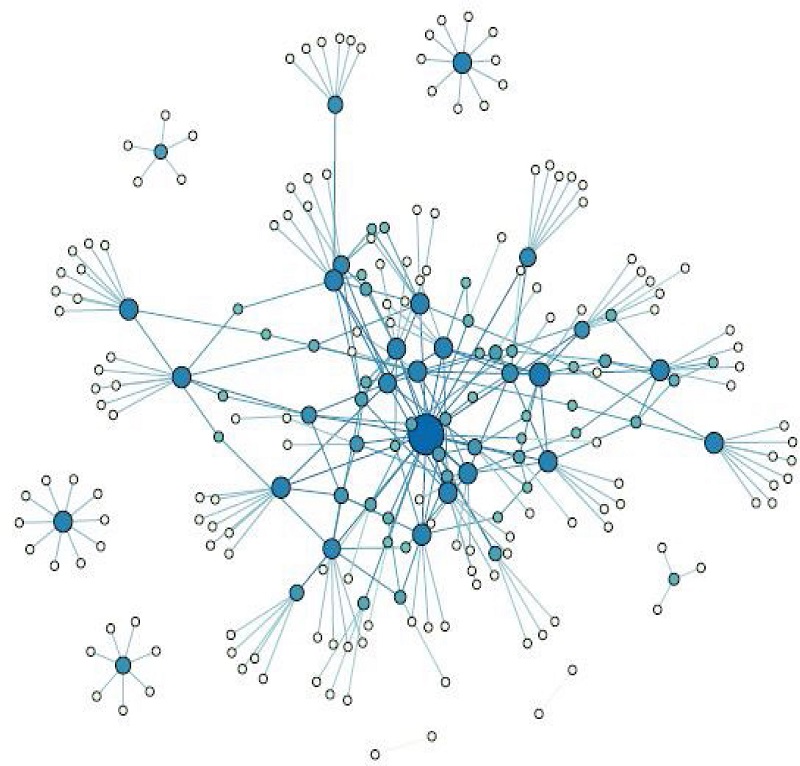
Figure 1
Network degree.
Next, Figures 2A through 2.F highlight firm characteristics (size, sector, ownership, and internationalization 1) of the 46 respondents. Black nodes are firms named by the respondents. Domestically owned multinationals dominate the social network structure (42); only four firms are foreign-owned. These foreign firms do not show any particular popularity or centralization tendency ( Figure 2.A), which might limit their potential as relevant network resources.
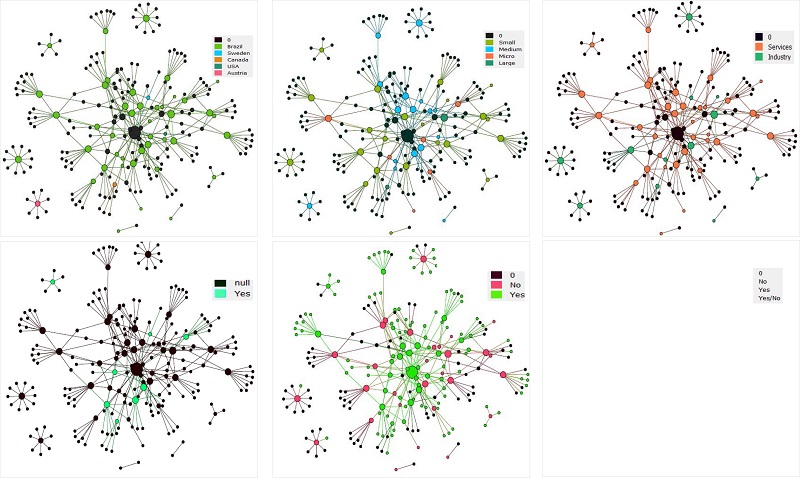
Figure 2
Firm characteristics. (A) Ownership. (B) Size. (C) Sector. (D) Internationalized sourcing. (E) Internationalization. (F) Help internationalization.
The network's many small-sized firms (22) are scattered throughout the social network structure, and medium-sized firms (16) seem to have consistently higher popularity and better strategic positions in the network, relative to small- or micro-sized firms (6), and even to the two large-sized firms in the network. This might indicate that medium-sized firms are more important for the transmission process of behavior in this network ( Figure 2.B). Service providers (34) dominate the network ( Figure 2.C); proportionally, however, industrial firms (12) are more centralized.
We found that 8 of the 17 domestic-owned internationalized firms ( Figure 2.D) source either primary or support business functions from abroad. They seem to have relatively high popularity. Figure 2.E shows that internationalized firms, indicated by green nodes, tend to be popular and cluster toward the center. Internationalized firms tend to have more prominence in the network, which might indicate their importance for the diffusion of behavior. The survey asked internationalized firms to indicate whether their partners have or have not influenced their internationalization ( Figure 2.F). Green nodes are firms that facilitated the internationalization process of a respondent's firm, and blue nodes are firms that some survey respondents considered important for their internationalization, but others did not.
Next, we highlight the betweenness centrality in the social network structure. Different from the network degree, which is based on the number of a node's direct ties via edges, betweenness centrality identifies a favorable structural position (or ‘strategic position’). A firm that is in a favorable structural position is at the center of resource exchanges, has greater influence over and attracts attention from those in less favorable positions, and acts as a gatekeeper that bridges trust relationships between firms ( Gao et al., 2016; Hanneman & Riddle, 2011).
In our social network structure ( Figure 3.A), one node clearly stands at the center as a number of firms with favorable positions orbit around it. These firms might act as gatekeepers for the central node and might attract attention from firms in less favorable positions. The central node and many of the ‘orbiting’ nodes with strategic positions have been described as facilitating the global expansion of the 17 internationalized firms in the O&G cluster of Rio de Janeiro, Brazil ( Figure 3.B).
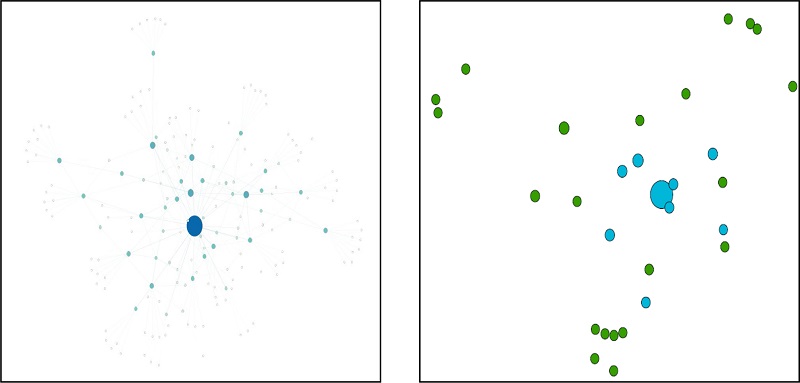
Figure 3
(A) Betweenness centrality in the subnetwork. Note: Larger and darker nodes indicate higher betweenness centrality. (B) Firms that helped internationalization. Note: Nodes follow the logic of Figure 2.6.
Continuing our description of the mapped social network structure, we apply the method of partitioning proposed by Blondel et al. (2008): we decomposed the network into communities of highly interconnected nodes. This enabled us to identify 18 communities in the social network structure. Partitioning is important because it allows us to investigate how firms are grouped in the social network structure. Each color in Figure 4 represents a different community.
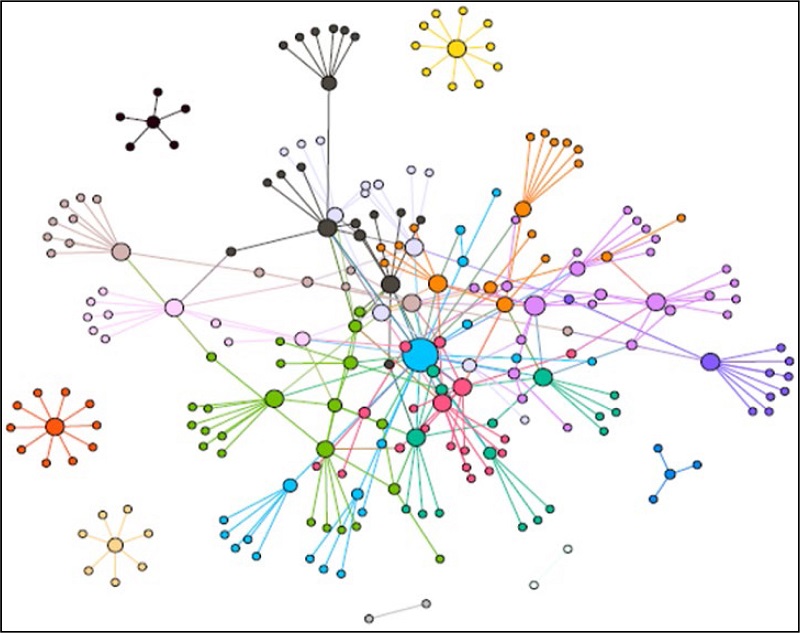
Figure 4
Network communities in the subnetwork. Note: Each color represents a different community.
We order the 18 network communities by average degrees (interconnectivity), from the lowest to the highest. Then, we split the communities into two nine-member groups, each showing the number of internationalized firms by partition ( Table 2).

We find that the first group has an average degree mean of 1.58 and a total of 31 internationalized firms. Communities 9 and 11 have the lowest average degree and do not contain any internationalized firms. Community 6 has the highest average degree of the first set and nine internationalized firms (see Figure 5).

Figure 5
Communities 6, 9, and 11.
Green node: internationalized firms; Black nodes: noninternationalized firms.
The second group has an average degree mean of 2 and a total of 86 internationalized firms, a difference of 55, compared to the first set. All communities in this set have two or more internationalized firms. Communities 1, 3, and 10 have 13 internationalized firms each ( Figure 6).

Figure 6
Communities 1, 3, and 10.
Green node: internationalized firms; Red and black nodes: noninternationalized firms.
In total, the partition suggests that communities with higher average degree (popularity) host more internationalized firms than those with lower popularity. This important finding is in line with our first preposition. It might hint at a relationship between a firm's internationalization and its position in dense sections of the social network structure. So, opportunities for internationalization might be shaped by dense sections (communities) within the whole social network structure.
3.2. Linear network autocorrelation model: contagious effects
Originally developed by Ord (1975), the network autocorrelation model has been used to address the problem of structured dependence. In contrast to a standard linear regression model, the network autocorrelation model does not assume observations to be independent from each other and allows for dependence among them. In a social network context, this opens up the possibility that ego's behavior may not solely depend on exogenous variables. Instead, ego's behavior might be influenced by the behavior of other firms in the network as well. Thus, the network autocorrelation model views ego's behavior as a combination of interaction and exogenous variables, formally expressed as follows ( Equation 1):
where, as in standard linear regression:
y: a vector of length g consisting of values of a dependent variable for the g network firms;
x: a (g×k) matrix of values for the firms on k covariates (including a vector of ones in the first column for the intercept term);
β: a vector of regression coefficients of length k;
Ig: the (g×g) identity matrix;
ε: a vector of length g that contains independent and identical normal distributions of error terms with zero mean and variance of σ 2.
Furthermore, W denotes a given (g×g) connectivity matrix representing social ties in a network, where each entry W ij (I, j ∈ {1,…,g}) stands for the degree of influence of firm j (alter) on firm i (ego). By convention, we exclude loops, i.e., relationships between a firm and itself, so W ii = 0, for all i ∈ {1,…,g}. Finally, ρ is a scalar that we term the network autocorrelation parameter. It is the model's key parameter and measures the level of network influence for given y, W, and X.
In our research context, the linear network autocorrelation model allows us to explore similarity or conforming pressure between a firm's internationalization and the corresponding international status of its proximate alters in the network. The model uses maximum likelihood estimation, a technique to find the mean and variances with a limited number of observations. We could apply the linear network autocorrelation model only to a subset of the 11 firms in our network structure that reported ties with themselves (triangles). According to ( Butts, 2008), the application of this model is possible in very small-sized networks.
In line with Leenders (2002), our model ; uses two equal relational W matrices which show the ties from firms to other firms to indicate a relationship, where 1 indicates the presence of a direct relationship between a pair of firms and 0 indicates the absence of a direct relationship. X refers to three attributes: internationalization (dichotomous variable of 1 and 0, where 1 means the firm is internationalized and 0, otherwise); size (1 = micro, 2 = small, 3 = medium, and 4 = large); and sector (1 = service and 2 = industry). Based on the Butts and Butts’ study (2016), we set the following parameters: ρ1 (0.2); ρ2 (0.1); Σ (0.1); and β (3) to run the model.
For each focal individual, or ego, the term consisting of ρ, W, and Y estimates the effect of the values of the dependent variable on ego's value for the dependent variable, for all alters who are proximate to ego ( Table 3). ρ is the parameter estimate of the average effect of other's values of the dependent variable on one's own dependent variable value. A positive value indicates similarity or conforming pressure between n firm's behavior and those of its proximate alters, and a negative value indicates dissimilarity. A nonsignificant ρ would indicate that the respondent's perceptions may be considered statistically unaffected by those of its alters. In other words, a nonsignificant ρ would indicate that the network does not influence the behavior of firms in the network.

# Significance: 0‘***’ 0.001‘**’ 0.01‘*’ 0.05 ‘.’ 0.1 ‘ ‘ 1.
The results indicate that both ρ1 and ρ2 are statistically significant and positive, which is consistent with our second hypothesis that firms’ internationalization is associated with direct and indirect network ties and firm attributes embedded in the social network structure. We also see that local effects (size, sector, and internationalization) are statistically significant, suggesting that the attributes of firms embedded in the social network structure of these 11 firms affect internationalization. The results suggest that interaction among firms and their attributes embedded in the social network structure is associated, at least in part, with the diffusion of internationalization. This would be an indicative first evidence that a firm's internationalization can be described as an outcome of the whole network.
4. DISCUSSION AND CONCLUSION
4.1. Discussion of findings
Our findings indicate that popular central communities in the investigated social network host a greater proportion of internationalized firms than less popular central communities (see Figure 2.E). This initial, descriptive finding might suggest that there is an association between the position of a firm within social network and its successful internationalization. Internationalized firms tend to be part of dense, strategically positioned communities in a given social network. An argument that might explain this suggests that, by positioning itself in a dense portion of a network, a firm might be able to reduce opportunistic behavior, minimize coordination costs ( Kano, 2018), and improve the information exchange ( Iurkov & Benito, 2018). This, in turn, facilitates the creation of firm-specific advantages ( Bellamy et al., 2014) that can be exploited abroad via internationalization.
However, our investigation tries to go beyond this observation. Building on the theoretical expectation that members of a social network structure are responsive to the contextual cues provided via the behavior of significant firms ( Leenders, 2002), we provide indicative evidence that there exists similarity or conforming pressure between a firm's internationalization and the corresponding international status of its proximate alters in the network. More specifically, we find that firms’ internationalization is associated with direct and indirect network ties and firm attributes embedded in the social network structure (see Figure 2.F).
In this sense, the social network structure seems to exert an influence on the internationalization of firms within the network. This might constitute an important finding for IB research, as internationalization of a firm could be explained as a collective outcome of the whole network, rather than an individual strategy. The causation for the diffusion of internationalization is embedded in the social structure. Our finding supports the idea that this ‘whole-network outcome’ relates to a complex interplay between direct and indirect, voluntary and involuntary, and home-country and foreign-country relationships ( Sharma et al., 2019). It indicates that the whole-network perspective supports the conceptualization of networks in the IB theory; especially as the knowledge of collective behavior, this perspective yields can complement the analysis of individual network relationships in ego networks, the dominant tradition in IB research.
Moreover, our empirical findings indicate that the social network in the O&G cluster in Rio de Janeiro, Brazil, is a source of opportunity, trust, and knowledge exchange among its participants. This supports the argument that networks may support the development of multinational firms from emerging markets ( Amal et al., 2013). In our investigated social network structure, we found few foreign multinationals, most of them being medium- and small-sized firms.
Our findings point in four additional directions. First, firms might initiate their internationalization when they are comparatively small, as suggested in the original Uppsala model ( Johanson & Vahlne, 1977). Second, the ability to exploit network advantages might depend not only on the firm size but also on its position in the network, as postulated by the revised Uppsala model ( Vahlne & Johanson, 2013). Third, a majority of indigenous internationalized firms in the network structure were small- or medium-sized service providers. This could support the view that the O&G sector is strongly prone to internationalization, which benefits not only large-sized but also medium- and small-sized firms ( Silvestre & Dalcol, 2010). Finally, the research confirms that extant literature (e.g., Becattini et al., 2013) adequately explains how firms in a localized cluster integrate with the global economy.
4.2. Conclusion
In contrast to earlier studies, which primarily focused on the effect of individual network relationships upon a firm's internationalization, we apply a whole-network perspective to investigate internationalization of firms. This perspective offers a bird's eye view of a social structure, focusing on all nodes rather than only on the surroundings of any particular node ( Marin & Wellman, 2011). It enables us to identify popular communities and central nodes, which in turn reveals the fundamental structure of the network and the relationships embedded in it. This study found that, as expected, internationalized firms do concentrate in dense sections of the network ( Hypothesis 1), and that internationalization is associated with direct and indirect network ties and firm attributes embedded in the social network structure ( Hypothesis 2).
The main contribution of this research is an understanding of how the social influence or diffusion of behavior within a social network structure can be associated with the internationalization of its network members. Our findings show that internationalized firms concentrate in dense sections of the network, characterized by high interconnectedness. Furthermore, evidence presented here indicates that firms’ internationalization is associated with direct and indirect network ties, as well as with firm attributes that are embedded in the social network structure. This constitutes a relevant extension to the network perspective IB research because causation in this case does not come from within individual firms, with common attributes acting independently on individual firms to produce similar outcomes. Instead, causation is embedded in the social structure. In terms of managerial implications, our study highlighted that managers could facilitate internationalization by moving their firms from less to more connected parts of a network by building corresponding ties. Given that the interaction among firms and their attributes embedded in the social network structure is likely to be associated with the diffusion of internationalization, managers of domestic oriented companies could this way benefit from opportunities for internationalization, which are otherwise less accessible to them.
4.3. Limitations and future research
In this study, we cannot assume the mapped social network to be complete. The relational data creating the social network structure have been provided by survey respondents that comprise only a subset of the whole O&G cluster. Therefore, the mapped social network is partial. The research did not target specific segments to avoid the risk of having a homogeneous network. In principle, the value survey data rest on the presumed validity of self-reports ( Marsden, 2005). Furthermore, the autocorrelation model could only be applied to a very small set of firms that reported having ties with themselves (triangles). Alternative approaches could combine different data sources to deepen the information about network participants and their linkages.
For this study, it was not possible to supplement the survey data with other external sources such as participation in fairs and exhibitions or information about participation in publicly funded research projects to gain more insight into firms’ relations. In essence, we need to be careful when generalizing from our findings, as our findings are related to a partial social network structure.
While our linear network autocorrelation model shows that the social network structure does have an effect on the diffusion of internationalization in the O&G cluster, this finding is specific to this industry. We are not able to derive the same conclusions on sectors that have a different structure in terms of industry concentration and geographical dispersion. In sum, we need to consider our findings as ‘indicative evidence’, which makes our research explorative rather than explanatory in nature.
Future research should aim at improving our understanding of the role of the network as a whole for the internationalization of firms. For example, the network autocorrelation model cannot identify the specific mechanism that produces the effect; therefore, future research should target the mechanisms that produce this diffusion. For example, exponential random graph models could be employed to examine whether attribute-related processes affect network ties. Furthermore, approaches combining whole- and ego-network perspectives may provide additional insights about the social network structure. They are not mutually exclusive and, in fact, are complementary and interrelated perspectives ( Provan et al., 2007).
A combined whole/ego approach would help illuminate the effects and meanings of a tie between two nodes and would be in line with the study by Vahlne and Johanson (2017, p. 1091), who argue that the Uppsala model involves not only the focal firm but also all organizations in the network. After mapping the social network, a focus on central and popular firms might yield valuable insights. A qualitative approach would be appropriate in this case. Finally, our reliance on cross-sectional data did not allow us to subject firms that become international to separate investigation. Therefore, future research on network evolution and firm internationalization would provide valuable insights about the dynamics of internationalization processes.
REFERENCES
Aldrich, H., Zimmer, C., & Jones, T. (1986). Small business still speaks with the same voice: a replication of ‘the voice of small business and the politics of survival.’ The Sociological Review, 34(2), 335-356. https://doi.org/10.1111/j.1467-954X.1986.tb02705.x
Amal, M., Awuah, G. B., Raboch, H., & Andersson, S. (2013). Differences and similarities of the internationalization processes of multinational companies from developed and emerging countries. European Business Review, 25(5), 411-428. https://doi.org/10.1108/EBR-08-2012-0048
Anderson, J., Hakansson, H., & Johanson, J. (1994). Dyadic Business Relationships Within a Business Network Context. Journal of Marketing, 58(4), 1-15. https://doi.org/10.2307/1251912
Anderson, J., & Weitz, B. (1992). The Use of Pledges to Build and Sustain Commitment in Distribution Channels. Journal of Marketing Research, 29(1), 18-34. https://doi.org/10.1177/002224379202900103
Becattini, G., Bellandi, M., & de Propis, L. (2013). Critical Nodes and Contemporary Reflections on Industrial Districts: An Introduction. In Becattini, G., Bellandi, M., & de Propis, L. (Eds.), A Handbook of Industrial Districts. Edward Elgar. https://doi.org/10.4337/9781781007808.00006
Bell, J. (1995). The internationalization of small computer software firms. European Journal of Marketing, 29(8), 60-75. https://doi.org/10.1108/03090569510097556
Bellamy, M. A., & Basole, R. C. (2013). Network analysis of supply chain systems: A systematic review and future research. Systems Engineering, 16(2), 235-249. https://doi.org/10.1002/sys.21238
Bellamy, M. A., Bellamy, M., Ghosh, S., & Hora, M. (2014). The influence of supply network structure on firm innovation. Journal of Operations Management, 32(6), 357-373. https://doi.org/10.1016/j.jom.2014.06.004
Blankenburg Holm, D., Johanson, M., & Kao, P. T. (2015). From outsider to insider: Opportunity development in foreign market networks. Journal of International Entrepreneurship, 13(3), 337-359. https://doi.org/10.1007/s10843-015-0154-8
Blondel, V. D., Guillaume, J. L., Lambiotte, R., & Lefebvre, E. (2008). Fast unfolding of communities in large networks. Journal of Statistical Mechanics: Theory and Experiment, 2008(10), P10008. https://doi.org/10.1088/1742-5468/2008/10/P10008
Borgatti, S. P., & Li, X. (2009). On social network analysis in a supply chain context. Journal of Supply Chain Management, 45(2), 5-22. https://doi.org/10.1111/j.1745-493X.2009.03166.x
Buckley, P. J., Doh, J. P., & Benischke, M. H. (2017). Towards a renaissance in international business research? Big questions, grand challenges, and the future of IB scholarship. Journal of International Business Studies, 48(9), 1045-1064. https://doi.org/10.1057/s41267-017-0102-z
Burt, R. S., & Doreian, P. (1982). Testing a structural model of perception: Conformity and deviance with respect to Journal norms in elite sociological methodology. Quality and Quantity, 16, 109-150. https://doi.org/10.1007/BF00166880
Butts, C. T. (2008). Social network analysis: A methodological introduction. AsianJournal of Social Psychology, 11(1), 13-41. https://doi.org/10.1111/j.1467-839X.2007.00241.x
Butts, C. T., & Butts, M. C. T. (2016). Package ‘sna’. Tools for Social Network Analysis. CRAN.
Canada (2009). Canadian Survey of Innovation and Business Strategy. Government of Canada. Retrieved from: https://www.ic.gc.ca/eic/site/eas-aes.nsf/eng/h_ra02118.html
Carter, C. R., Ellram, L. M., & Tate, W. (2007). The use of social network analysis in logistics research. Journal of Business Logistics, 28(1), 137-168. https://doi.org/10.1002/j.2158-1592.2007.tb00235.x
Chen, H., & Chen, T. J. (1998). Network linkages and location choice in foreign direct investment. Journal of International Business Studies, 29(3), 445-467. https://doi.org/10.1057/palgrave.jibs.8490002
Chetty, S., & Blankenburg Holm, D. (2000). Internationalisation of small to medium-sized manufacturing firms: A network approach. International Business Review, 9(1), 77-93. https://doi.org/10.1016/s0969-5931(99)00030-x
Cook, K. S., & Emerson, R. M. (1978). Power, Equity and Commitment in Exchange Networks. American Sociological Review, 43(5), 721-739. https://doi.org/10.2307/2094546
Coviello, N. E. (2006). The network dynamics of international new ventures. Journal of International Business Studies, 37(5), 713-731. https://doi.org/10.1057/palgrave.jibs.8400219
Coviello, N. E., & Munro, H. (1997). Network relationships and the internationalisation process of small software firms. International Business Review, 6(4), 361-386. https://doi.org/10.1016/S0969-5931(97)00010-3
Cowan, R., Jonard, N., & Zimmermann, J. B. (2007). Bilateral collaboration and the emergence of innovation networks. Management Science, 53(7), 1051-1067. https://doi.org/10.1287/mnsc.1060.0618
Crowder, K., & South, S. J. (2008). Spatial dynamics of white flight: the effects of local and extralocal racial conditions on neighborhood out-migration. American Sociological Review, 73(5), 792-812. https://doi.org/10.1177/000312240807300505
Daraganova, G., Pattison, P., Koskinen, J., Mitchell, B., Bill, A., Watts, M., & Baum, S. (2010). Networks and geography: Modelling community network structures as the outcome of both spatial and network processes. Social Networks, 34(1), 6-17. https://doi.org/10.1016/j.socnet.2010.12.001
Davies, M., & Kandel, D. B. (1981). Parental and Peer Influences on Adolescents’ Educational Plans: Some Further Evidence. American Journal of Sociology, 87(2), 363-387. https://doi.org/10.1086/227462
Dow, M. M., & Eff, E. A. (2008). Global, regional, and local network autocorrelation in the standard cross-cultural sample. Cross-Cultural Research, 42(2), 148-171. https://doi.org/10.1177/1069397107311186
Elango, B., & Pattnaik, C. (2007). Building capabilities for international operations through networks: A study of Indian firms. Journal of International Business Studies, 38(4), 541-555. https://doi.org/10.1057/palgrave.jibs.8400280
Ernst, D. (2002). Global production networks and the changing geography of innovation systems. implications for developing countries. International Journal of Phytoremediation, 11(6), 497-523. https://doi.org/10.1080/10438590214341
Eurostat International Organization (2012). Eurostat International Organization and Sourcing of Business Activities. Eurostat International Organization.
Faulk, L., McGinnis Johnson, J., & Lecy, J. D. (2016). Competitive Advantage in Nonprofit Grant Markets: Implications of Network Embeddedness and Status. International Public Management Journal, 20(2), 261-293. https://doi.org/10.1080/10967494.2016.1141811
Forsgren, M. (1989). Foreign Acquisitions. In Hallen, L. & Johanson, J. (Eds.), Advances in International Marketing (3rd ed., p. 141-159). JAI Press.
Franzese, R. J., Hays, J. C., & Kachi, A. (2012). Modeling history dependence in network-behavior coevolution. Political Analysis, 20(2), 175-190. https://doi.org/10.1093/pan/mpr049
Gao, H., Ren, M., Zhang, J., & Sun, R. (2016). Network gatekeeping in SME exporters’ market entry in China. International Marketing Review, 33(2), 276-297. https://doi.org/10.1108/IMR-06-2014-0191
Ghoshal, S., & Bartlett, C. A. (1990). The Multinational Corporation as an Interorganizational Network. Academy of Management Review, 15(4), 603-625. https://doi.org/10.5465/amr.1990.4310825
Gould, R. (1991). Multiple Networks and Mobilization in the Paris Commune, 1871. American Sociological Review, 56(6), 716-729. https://doi.org/10.2307/2096251
Granovetter, M. (1985). Economic Action and Social Structure: The Problem of Embeddedness Economic Action and Social Structure: The Problem of Embeddedness’. American Journal of Sociology, 91(3), 481-510.
Gulati, R., Nohria, N., & Zaheer, A. (2000). Strategic networks. Strategic Management Journal, 21(3), 203-215. https://doi.org/10.1002/(SICI)1097-0266(200003)21:3≤203::AID-SMJ102≥3.0.CO;2-K
Håkansson, H., & Ford, D. (2002). How should companies interact in business networks? Journal of Business Research, 55(2), 133-139. https://doi.org/10.1016/S0148-2963(00)00148-X
Hakansson, H., & Henders, B. (1992). International Co-operative relationships in technology development. In Forsgren, M., & Johanson, J. (Eds.), Managing Networks in International Business (p. 32-46). Routledge.
Hanneman, R., & Riddle, M. (2011). Concepts and Measures for Basic Network Analysis. In Scott, J. & Carrington, P. (Eds.), The SAGE Handbook of Social Network Analysis (p. 340-369). Sage.
Hennart, J. F. (2019). Digitalized service multinationals and international business theory. Journal of International Business Studies, 50(8), 1388-1400. https://doi.org/10.1057/s41267-019-00256-2
Holm, D., Eriksson, K., & Johanson, J. (1999). Creating value through mutual commitment to business network relationships. Strategic Management Journal, 20(5), 467-486.
Instituto Brasileiro de Petróleo e Gás (IBP). (2019). A relevância do Petróleo & Gás para o Brasil. IBP.
Isaksen, A., & Karlsen, J. (2012). What Is Regional in Regional Clusters? The Case of the Globally Oriented Oil and Gas Cluster in Agder, Norway. Industry and Innovation, 19(3), 249-263. https://doi.org/10.1080/13662716.2012.669616
Iurkov, V., & Benito, G. R. G. (2018). Domestic alliance networks and regional strategies of MNEs: A structural embeddedness perspective. Journal of International Business Studies, 49(8), 1033-1059. https://doi.org/10.1057/s41267-017-0089-5
Jackson, M. O. (2013). Unraveling Peers and Peer Effects: Comments on Goldsmith-Pinkham and Imbens’ "Social Networks and the Identification of Peer Effects." Journal of Business and Economic Statistics, 31(3), 270-273.
Johanson, J., & Vahlne, J.-E. (1977). The Internationalization Process of the Firm—A Model of Knowledge Development and Increasing Foreign Market Commitments. Journal of International Business Studies, 8, 23-32. https://doi.org/10.1057/palgrave.jibs.8490676
Johanson, J., & Vahlne, J.-E. (2003). Business relationship learning and commitment in the internationalization process. Journal of International Entrepreneurship, 1(1), 83-101. https://doi.org/10.1023/A:1023219207042
Johanson, J., & Vahlne, J. E. (2009). The Uppsala internationalization process model revisited: From liability of foreignness to liability of outsidership. Journal of International Business Studies, 40(9), 1411-1431. https://doi.org/10.1057/jibs.2009.24
Kano, L. (2018). Global value chain governance: A relational perspective. Journal of International Business Studies, 49(6), 684-705. https://doi.org/10.1057/s41267-017-0086-8
Kano, L., Tsang, E. W. K., & Yeung, H. W. C. (2020). Global value chains: A review of the multi-disciplinary literature. Journal of International Business Studies, 51(4), 577-622. https://doi.org/10.1057/s41267-020-00304-2
Kempe, D., Kleinberg, J., & Tardos, É. (2015). Maximizing the Spread of Influence through a Social Network. Theory of Computing, 11(4), 105-147. https://doi.org/10.4086/toc.2015.v011a004
Ketels, C. H. M., & Memedovic, O. (2008). From clusters to cluster-based economic development. International Journal of Technological Learning, Innovation and Development, 1(3), 375-392. https://doi.org/10.1504/IJTLID.2008.019979
Kogut, B. (2000). The network as knowledge: generative rules and the emergence of structure. Strategic Management Journal, 21(3), 405-425. https://doi.org/10.1002/(SICI)1097-0266(200003)21:3%3C405::AID-SMJ103%3E3.0.CO;2-5
Kurt, Y., & Kurt, M. (2020). Social network analysis in international business research: An assessment of the current state of play and future research directions. International Business Review, 29(2), 101633. https://doi.org/10.1016/j.ibusrev.2019.101633
Larson, A. (1992). Network Dyads in Entrepreneurial Settings: A Study of the Governance of Exchange Relationships. Administrative Science Quarterly, 37(1), 76-104. https://doi.org/10.2307/2393534
Lea, B. R., Yu, W. B., Maguluru, N., & Nichols, M. (2006). Enhancing business networks using social network based virtual communities. Industrial Management and Data Systems, 106(1), 121-138. https://doi.org/10.1108/02635570610641022
Leenders, R. T. A. J. (2002). Modeling social influence through network autocorrelation: Constructing the weight matrix. Social Networks, 24(1), 21-47. https://doi.org/10.1016/S0378-8733(01)00049-1
Marin, A., & Wellman, B. (2011). Social Network Analysis: An Introduction. In Scott, J. & Carrington, P. (Eds.), The SAGE Handbook of Social Network Analysis (p. 11-25). Sage.
Marsden, P. (2005). Recent developments in network measurement. In Carrington, P. J., Scott, J., & Wasserman, S. (Eds.), Models and Methods in Social Network Analysis (p. 8-30). Cambridge University Press.
Mazzola, E., Perrone, G., & Handfield, R. (2018). Change Is Good, But Not Too Much: Dynamic Positioning in the Interfirm Network and New Product Development. Journal of Product Innovation Management, 35(6), 960-982. https://doi.org/10.1111/jpim.12438
Mizruchi, M. S., & Potts, B. B. (1998). Centrality and power revisited: Actor success in group decision making. Social Networks, 20(4), 353-387. https://doi.org/10.1016/S0378-8733(98)00009-4
Mizruchi, M. S., & Stearns, L. B. (2006). The conditional nature of embeddedness: A study of borrowing by large U.S. firms, 1973-1994. American Sociological Review, 71(2), 310-333. https://doi.org/10.1177/000312240607100207
Morgan, R. M., & Hunt, S. D. (1994). The Commitment-Trust Theory of Relationship Marketing. Journal of Marketing, 58(3), 20-38. https://doi.org/10.1177/002224299405800302
Odlin, D., & Benson-Rea, M. (2017). Competing on the edge: Implications of network position for internationalizing small- and medium-sized enterprises. International Business Review, 26(4), 736-748. https://doi.org/10.1016/J.IBUSREV.2017.01.003
Oehme, M., & Bort, S. (2015). SME internationalization modes in the German biotechnology industry: The influence of imitation, network position, and international experience. Journal of International Business Studies, 46(6), 629-655. https://doi.org/10.1057/jibs.2015.8
Ong, X., Freeman, S., Goxe, F., Guercini, S., & Cooper, B. (2022). Outsidership, network positions and cooperation among internationalizing SMEs: An industry evolutionary perspective. International Business Review, 31(3), 101970. https://doi.org/10.1016/J.IBUSREV.2021.101970
Ord, K. (1975). Estimation methods for models of spatial interaction. Journal of the American Statistical Association, 70(349), 120-126. https://doi.org/10.1080/01621459.1975.10480272
Otte, E., & Rousseau, R. (2002). Social network analysis: a powerful strategy, also for the information sciences. Journal of Information Science, 28(6), 441-453. https://doi.org/10.1177/016555150202800601
Oviatt, B. M., & McDougall, P. P. (1994). Toward a Theory of International New ventures. Journal of International Business Studies, 25, 45-64. https://doi.org/10.1057/palgrave.jibs.8490193
Provan, K. G., Fish, A., & Sydow, J. (2007). Interorganizational networks at the network nevel: A review of the empirical literature on whole networks. Journal of Management, 33(3), 479-516. https://doi.org/10.1177/0149206307302554
Provan, K. G., & Kenis, P. (2008). Modes of network governance: Structure, management, and effectiveness. Journal of Public Administration Research and Theory, 18(2), 229-252. https://doi.org/10.1093/jopart/mum015
Robins, G., & Daraganova, G. (2013). Social Selection, Dyadic Covariates, and Geospatial Effects. In Lusher, D., Koskinen, J., & Robins, G. (Eds.), Exponential Random Graph Models for Social Networks Theory, Methods, and Applications (p. 91-101). Cambridge University Press.
Sasson, A., & Blomgren, A. (2011). Knowledge Based Oil and Gas Industry. Research Report. BI Norwegian Business School.
Scott, J. (2000). Social Network Analysis (2 nd ed.). SAGE.
Sedziniauskiene, R., Sekliuckiene, J., & Zucchella, A. (2019). Networks’ Impact on the Entrepreneurial Internationalization: A Literature Review and Research Agenda. Management International Review, 59(5), 779-823. https://doi.org/10.1007/s11575-019-00395-6
Sharma, A., Kumar, V., Yan, J., Borah, S. B., & Adhikary, A. (2019). Understanding the structural characteristics of a firm's whole buyer–supplier network and its impact on international business performance. Journal of International Business Studies, 50(3), 365-392. https://doi.org/10.1057/s41267-019-00215-x
Sharma, D. D., & Blomstermo, A. (2003). The internationalization process of Born Globals: A network view. International Business Review, 12(6), 739-753. https://doi.org/10.1016/j.ibusrev.2003.05.002
Sharma, D. D., & Johanson, J. (1987). Technical consultancy in nternationalization. International Marketing Review, 4(4), 20-29. https://doi.org/10.1108/eb008339
Shi, W., Sun, S. L., Pinkham, B. C., & Peng, M. W. (2014). Domestic alliance network to attract foreign partners: Evidence from international joint ventures in China. Journal of International Business Studies, 45(3), 338-362. https://doi.org/10.1057/jibs.2013.71
Shirokova, G., & McDougall-Covin, P. (2012). The role of social networks and institutions in the internationalization of Russian entrepreneurial firms: Do they matter? Journal of International Entrepreneurship, 10(3), 177-199. https://doi.org/10.1007/s10843-012-0091-8
Silvestre, B., & Dalcol, P. (2010). Innovation in Natural Resource-based Industrial Clusters: A Study of the Brazilian Oil and Gas Sector. International Journal of Management, 27(3).
Sturgeon, T. J. (2002). Modular production networks: A new American model of industrial organization. Industrial and Corporate Change, 11(3), 451-496. https://doi.org/10.1093/icc/11.3.451
US National Organizations Survey (2010). Demonstration Copy. US National Organizations Survey.
Vahlne, J., & Bhatti, W. (2019). Relationship Development: A Micro-Foundation for the Internationalization Process of the Multinational Business Enterprise. Management International Review, 59, 203-228. https://doi.org/10.1007/s11575-018-0373-z
Vahlne, J., & Johanson, J. (2013). The Uppsala model on evolution of the multinational business enterprise – from internalization to coordination of networks. International Marketing Review, 30(3), 189-210. https://doi.org/10.1108/02651331311321963
Vahlne, J., & Johanson, J. (2017). From internationalization to evolution: The Uppsala model at 40 years. In Journal of International Business Studies, 48, 1087-1102. https://doi.org/10.1057/s41267-017-0107-7
Vahlne, J., & Johanson, J. (2019). The Uppsala model: Networks and micro-foundations. Journal of International Business Studies, 51(1), 4-10. https://doi.org/10.1057/s41267-019-00277-x
Vahlne, J., & Johanson, J. (2021). Coping with complexity by making trust an important dimension in governance and coordination. International Business Review, 30(2), 101798. https://doi.org/10.1016/j.ibusrev.2021.101798
Valente, T. W., & Rogers, E. M. (2010). Science Communication Paradigm as an Example of Scientific Growth The Origins and Development of the Diffusion of Innovations, 16(3), 242-273. https://doi.org/10.1177/1075547095016003002
von Tunzelmann, N. (2010). Alignment, Misalignment and Dynamic Network-Based Capabilities. In Dyker, D. (Ed.), Network Dynamics in Emerging Regions of Europe. Imperial College Press. https://doi.org/10.1142/P633
Wang, W., Neuman, E. J., & Newman, D. (2014). Statistical power of the social network autocorrelation model. Social Networks, 38, 88-99. https://doi.org/10.1016/j.socnet.2014.03.004
Wang, Y., & Li-Ying, J. (2014). How do the BRIC countries play their roles in the global innovation arena? A study based on USPTO patents during 1990-2009. Scientometrics, 98, 1065-1083. https://doi.org/10.1007/s11192-013-1141-2
Wasserman, S., & Faust, K. (1994). Social network analysis: Methods and applications (Vol. 8). Cambridge University Press.
Wolfe, D. A., & Gertler, M. S. (2004). Clusters from the inside and out: Local dynamics and global linkages. Urban Studies, 41(5-6), 1071-1093. https://doi.org/10.1080/00420980410001675832
Xavier Molina-Morales, F., Belso-Martínez, J. A., Más-Verdú, F., & Martínez-Cháfer, L. (2015). Formation and dissolution of inter-firm linkages in lengthy and stable networks in clusters. Journal of Business Research, 68(7), 1557-1562. https://doi.org/10.1016/j.jbusres.2015.01.051
Xia, J., Ma, X., Tong, T. W., & Li, W. (2018). Network information and cross-border M&A activities. Global Strategy Journal, 8(2), 301-323. https://doi.org/10.1002/gsj.1182
Yamin, M., & Kurt, Y. (2018). Revisiting the Uppsala internationalization model: Social network theory and overcoming the liability of outsidership. International Marketing Review, 35(1), 2-17. https://doi.org/10.1108/IMR-11-2014-0345
Zafarullah, M., Ali, M., & Young, S. (1998). The internationalization of the small firm in developing countries—exploratory research from Pakistan. Journal of Global Marketing, 11(3), 21-40. https://doi.org/10.1300/J042v11n03_03
Notes
"Double Blind Review"
Author notes
*Corresponding author: renan.oliveira@coppead.ufrj.br