Original Article
WORK VALUES AND ATTITUDES TOWARD THE TECHNOLOGY OF GENERATION Z IN BRAZIL AND GERMANY
VALORES DO TRABALHO E ATITUDES EM RELAÇÃO À TECNOLOGIA DA GERAÇÃO Z NO BRASIL E NA ALEMANHA
 Celine Münz
WORK VALUES AND ATTITUDES TOWARD THE TECHNOLOGY OF GENERATION Z IN BRAZIL AND GERMANY
Revista Eletrônica de Negócios Internacionais (Internext), vol. 19, no. 1, pp. 63-76, 2024
São Paulo
Received: 15 August 2023
Accepted: 15 December 2023
Published: 31 January 2024
ABSTRACT
Objective: The aim of this study was to analyze the differences related to work values and attitudes toward the technology of Generation Z in Brazil and Germany.
Method: The proposed hypotheses were tested in a survey of 122 Brazilian and German participants. The data were analyzed using t-test and logistic regression models.
Main Results: The results present differences between Brazilian and German Generation Z, challenging the literature that analyzes Generation Z as a global generation and reinforcing cultural differences between nationalities. The Brazilian sample presents more instrumental and prestige work values and is more positive and less negative regarding technology than the German sample.
Relevance/Originality: The paper's contribution provides evidence of Generation Z's differences according to nationalities relevant to shaping their relationship with work and technology. The analysis of both constructs is interesting nowadays because of their interrelationship and the current changes in global work boundaries.
Theoretical/Methodological Contributions: The literature predominantly presents that Generation Z is a global generation. Comparing participants from two countries with different levels of development provides an insight into their differences regarding work values and attitudes, which can be valuable for business management literature.
Practical/Social Contributions: Recommendations for businesses are provided to improve attraction and retention strategies to tackle the shortage of skilled workers. This implies management strategies for firms with multicultural teams.
Keywords: Work Values+ Technology+ Digital Behavior+ Generation Z+ Cross-Country.
RESUMO
Objetivo: Esta pesquisa teve como objetivo analisar as diferenças relacionadas aos valores do trabalho e atitudes em relação à tecnologia da Geração Z no Brasil e na Alemanha.
Método: As hipóteses propostas foram testadas em uma pesquisa com 122 participantes brasileiros e alemães. Os dados foram analisados por meio de testes t e modelos de regressão logística.
Principais Resultados: Os resultados apresentam diferenças entre a Geração Z no Brasil e na Alemanha, desafiando a literatura que analisa a Geração Z como uma geração global e reforçando as diferenças culturais entre as nacionalidades. A amostra de participantes brasileiros apresenta valores do trabalho mais instrumentais e de prestígio e são mais positivos e menos negativos em relação à tecnologia do que a amostra de participantes alemães.
Relevância / Originalidade: A contribuição consiste em fornecer evidências sobre diferenças na Geração Z de acordo com as nacionalidades em sua relação com o trabalho e com a tecnologia. A análise dos construtos é interessante nos dias atuais por sua interrelação e pelas mudanças contemporâneas nas fronteiras de trabalho.
Contribuições Teóricas / Metodológicas: A literatura alega que a Geração Z é uma geração global. Ao comparar indivíduos de países com níveis de desenvolvimento distintos, contribui-se para uma visão sobre as suas diferenças com relação a valores e atitudes profissionais, o que pode ser relevante para a literatura de gestão empresarial.
Contribuições Práticas / Sociais: São fornecidas recomendações para as empresas, a fim de melhorar as estratégias de atração e retenção para combater a escassez de trabalhadores qualificados. Isso implica estratégias de gestão para empresas com equipes multiculturais.
Palavras-chave: Valores do Trabalho, Tecnologia, Comportamento Digital, Geração Z, Cross-Country.
INTRODUCTION
A generation consists of people who were born in a period that is marked by historical and social aspects and takes into consideration their year of birth. Considering this, each generation shares similar beliefs, behaviors, and characteristics that allow them to be distinguished ( Barhate & Dirani, 2022). The focal point is Generation Z (Gen Z). This generation, currently consisting of young people, has received increased interest as a research topic as it is the latest generation that entered the workforce around 2017.
Gen Z, as one of the newer generations, has received different names in research because of its characteristics. While in German literature, the term Gen Z is used chiefly ( Schlotter & Hubert, 2020), in Brazilian research, different labels such as Geração Digital, Geração Internet, or Geração Next can be found ( Colet & Mozzato, 2019). The period of this generation also differs depending on the researcher, but a standard classification is from 1995 to 2010 ( Bieleń & Kubiczek, 2020; Seemiller & Grace, 2017).
In general, however, it can be noticed that Gen Z shows shared characteristics globally with people in the same cohort in different countries (Seemilleret al., 2019). Nonetheless, even by being a global generation ( Scholz & Rennig, 2019) and sharing a common context that influences their worldview, people from Gen Z do not share the same values and experiences ( Aylmer & Dias, 2018; Seemiller & Grace, 2017).
Extreme events, positive or negative, are often stated to shape the way of thinking of a generation. The generation is often presented as a global one where people are more connected with technology. An element nudged for the research topic of this paper is a comparison of this generation in specific countries, Brazil and Germany. Topics that are affecting Gen Z are technology as well as their values in the working environment. Differences in specific countries might be less visible regarding values, beliefs, and attitudes. However, variations might be detected because of aspects such as the labor market situation ( Rocha-de-Oliveira et al., 2012).
The research problem is based on the perspective that generations share a common behavior. However, this behavior can be shaped by cultural differences that make the generation's perspective not globally homogeneous. While other generations have already existed in the labor markets globally, Gen Z is still considerably new and has particular interests that reinforce the importance of understanding their behavior related to work (Aggarwalet al., 2022; Barhate & Dirani, 2022). This is combined with many companies facing problems filling vacant positions and pointing out a shortage of talented workers. To tackle the shortage of skilled workers, employers can, therefore, target Gen Z workers and attract them to their organization. Cultural differences between nationalities are a relevant variable for understanding generational changes ( Beugelsdijk & Welzel, 2018). Previews of literature regarding Gen Z work values are mainly monocultural studies that focus on global values and digital immersive aspects of Gen Z ( De Boer & Bordoloi, 2022). Therefore, research on cultural differences in Gen Z values and attitudes can contribute to the development of the literature on the Gen Z workforce. In this sense, it is relevant to investigate how Gen Z considers work possibilities and how attitudes toward technology influence this generation from a cross-country perspective.
This research aims to analyze the differences related to work values and attitudes toward the technology of Gen Z in Brazil and Germany. The study was conducted using a quantitative approach, applying a survey with 122 participants from Brazilian and German Gen Z and comparing the results between the countries.
This paper contributes to discussing attitudes that shape Gen Z in the process of entering the workforce. In addition, this research points out a different approach to this generation that is mainly presented as a global one with similarities. By comparing the nationalities of two distinctive continents and levels of development, it provides an insight into their differences regarding work values and attitudes, which can be valuable for businesses. Regarding the skill shortage both countries face, providing businesses with a deeper understanding of Brazilians and Germans of Gen Z can help them set up or improve their strategies. The research contributes by presenting cultural differences between Brazilian and German Gen Z participants and discussing factors related to work and technology that are increasingly interrelated concepts due to changes in current work boundaries.
1. THEORETICAL BACKGROUND AND HYPOTHESES
1.1. Generation Z characteristics
Although influenced by events and experiences, giving the term generation a fluid dynamic, researchers try to group people in cohorts of about 20 years. Traits and behaviors are identified and distinguished from those of other generational cohorts ( Shiju, 2022). Ryder (1965, p.845) defines a cohort as "the aggregate of individuals (within some population definition) who experienced the same event within the same time interval." Compared to generations, cohorts are identified by the length of their defining external event ( Schewe & Meredith, 2004).
Gen Z grew up during a time shaped by uncertain economic times, political turbulence, terrorism, and violence in different countries ( Seemiller & Grace, 2017), as can be highlighted by the September 11, 2001 attacks in the United States, the global financial crisis in 2008, the Arab Spring, and the refugees crisis. Recently, this cohort experienced the coronavirus disease 2019 (COVID-19) pandemic during their formative years ( Aman-Ullah et al., 2023; Klaffke, 2021). Regarding demographical aspects, they generally live in smaller families with fewer siblings and older mothers ( Pavan & Vishwanath, 2017). Researchers expect Gen Z to be the most educated generation in the world until now ( Çora, 2019; McCrindle, 2018). As the most diverse generation ( Pichler et al., 2021), Gen Z values women's rights, transgender rights, religious freedom, and human rights ( Seemiller & Grace, 2017). Gen Z, as a global generation, cares less about geographical frontiers ( Barros et al., 2021). For Gen Z, smartphones and social media have become a consistent part of their lives. They are internationally connected through technology, globalization, global brands, online entertainment, social trends, and communication platforms ( McCrindle, 2018). As this generation was raised with technology in their everyday lives, they tend to be quick and efficient while switching between activities and expecting everything to happen fast and instantly with rapid reactions ( Chillakuri & Mahanandia, 2018).
In general, this cohort is less social and more individualistic, which can be noticed in group work at school or teamwork and in their struggles to communicate personally and meet with others ( Pichler et al., 2021). They also prefer to be recognized individually and intensely tend to be independent. However, Brazil's level of individualism is lower as Brazilian people from this cohort tend to be more collaborative ( Martins et al., 2013; Seemiller et al., 2019). Furthermore, Gen Z is open-minded ( Seemiller et al., 2019) and enjoys freedom by having less sense of commitment ( Bencsik et al., 2016).
Interaction with others often occurs in a virtual context, and Bencsik et al. (2016) additionally argue that a level of superficiality is visible in interpersonal relationships. Their interest in higher education comes from valuing innovation and entrepreneurship, resulting in many Gen Z students willing to work for themselves after finishing college ( Seemiller & Grace, 2017). Furthermore, this generation likes challenges, flexibility, and autonomy and is used for multitasking and doing several activities simultaneously ( Colet & Mozzato, 2019).
1.2. Work values
Work values can differ between times, considering the modern work challenges and configurations. So, work values are different across generations ( Hansen & Leuty, 2012). Gen Z can be described as confident and entrepreneurial ( Barhate & Dirani, 2022). When working on tasks, Gen Z gets bored of doing repetitive or standard tasks. Instead, they prefer meaningful, entertaining work that challenges them because they aspire to be innovative and entrepreneurial, giving them a chance to prove themselves. That is why they also like opportunities to work individually and independently, offering this generation much autonomy to complete tasks ( Chillakuri & Mahanandia, 2018; Çora, 2019). Compared to other generations, people from Gen Z are more likely to aspire to hold a leadership position in a company that involves responsibility ( Randstad, 2021).
Since speed is a characteristic that marks this generation, they also expect their careers to progress rapidly ( Colet & Mozzato, 2019). Progress in their career should happen vertically and horizontally, and they prefer to base their performance on the quality of their work instead of working hours ( Çora, 2019). In this sense, Gen Z is motivated by freedom, non-commitment, and receiving these rewards immediately ( Bencsik et al., 2016).
They aspire to have a good working relationship with their coworkers. However, Gen Z does not necessarily prefer to work in a team but rather depends on themselves to accomplish tasks as they are self-reliant. Furthermore, this generation wants to feel valued at work and to have their personal and organizational values lined up ( Barhate & Dirani, 2022). According to Weitzel et al. (2020), they value a carefree and safe work environment, satisfaction, and recognition.
Growing up during uncertain economic times and instability, Gen Z thinks employers must offer job security, as Randstad (2021) stated. Since Gen Z generally does not feel very secure financially, they desire an appropriate salary, performance-related pay, and benefits ( Aggarwal et al., 2022; Egerová et al., 2021; Klein, 2019). This includes immediate remuneration as a motivational factor ( Bencsik et al., 2016) and stability factors such as health plans, paid family leave, or retirement funds ( Barhate & Dirani, 2022). Nevertheless, people from this generation are not very loyal to their employers and quit their jobs easier if they are unhappy ( Ozkan & Solmaz, 2015).
An attractive organizational culture is essential for employers to attract and retain talent from Gen Z. For this generation, activity-based engagement, a diverse working environment without discrimination, and the opportunity to build personal relationships are significant ( Barhate & Dirani, 2022). Furthermore, this generational cohort values coworkers' and supervisors' support ( Barhate & Dirani, 2022; Pichler et al., 2021).
Gen Z values flexibility at work. For them, flexibility can be seen as working on "flexitime," which means working at a time they prefer instead of determined hours or working from home ( Chillakuri & Mahanandia, 2018). In addition, Gen Z seeks open and constant communication at work and prefers communication or discussions in person in order for them to improve ( Chillakuri & Mahanandia, 2018). That is why they like to receive feedback, especially from people in the company that delegate tasks to them ( Dolot, 2018; Schroth, 2019). Differences regarding work values can be visible across generations. However, many similarities exist as well. Leslie et al. (2021) claim that analyzing Gen Z as a group is too general, and they, therefore, propose dividing the cohort into three subgroups.
When choosing to work for a company, Gen Z pays attention to whether the organization is involved in social initiatives and cares about corporate social responsibility ( Bieleń & Kubiczek, 2020; Nguyen Ngoc et al., 2022). In a study conducted by Arora et al. (2020), it was found that for Gen Z students in India, cognitive and instrumental work values were seen as more important than social and prestige work values. Their priorities resulted in continuous learning and career advancement, job security, a work-life balance, and a fun working environment.
Besides the many characteristics that define Gen Z and work values, it is recognized that work values differ according to contextual national culture ( Parry & Urwin, 2011). Weber and Urick (2023) found that differences regarding personal values are more substantial by individuals' country of origin than by generations. For this study, the differences between Brazilian and German Gen Z are evaluated regarding the following hypothesis:
H1: The Brazilian and German people of Gen Z present differences regarding their work values.
1.3. Attitude toward technology
Technology and the Internet have been part of Gen Z since they were born, and they do not know a world without having access to computers, chats, or phones ( Colet & Mozzato, 2019). According to Pichler et al. (2021), 95% of teenagers had access to a smartphone in 2018, and almost half of them were constantly online. Being "digitally savvy" ( Seemiller & Grace, 2017, p.22) has led to researchers labeling this generation as "digital natives" ( Kleinjohann & Reinecke, 2020, p.5). Rosen et al. (2013) also state that young people tend to use a lot of technology and that a preference for switching tasks comes from this technology usage. This generation is constantly connected to the Internet and the virtual world ( Çora, 2019). Through technology and Internet access, they can quickly find all the information they are looking for online, and much of their knowledge comes from these sources ( Seemiller & Grace, 2017). They are used to connectivity in their private and personal lives. Gen Z is actively using social networking sites, where they usually share information about their private lives. Since they spend much time online, they expect fast replies and generally demand speed in activities, processes, or their careers ( Colet & Mozzato, 2019). Moreover, it is common for them to "like" posts or comment on them. Therefore, giving feedback is normal for them, and they expect it from others in return ( Dolot, 2018).
For Gen Z, it is common to communicate through technology and keep in touch with people through frequent Internet use. Therefore, relationships are often less interpersonal ( Barros et al., 2021). Çora (2019) also states that the attention span of this generation is shorter and, therefore, their communication includes many symbols, emojis, and emoticons.
However, Gen Z understands the negative effects it can have on them, such as addiction or distraction. It can also be the feeling of anxiety or the fear of missing something when unable to access technology and check it constantly, making them more dependent on their technological devices ( Janssen & Carradini, 2021). Weitzel et al. (2020) found that more than a third of Gen Z candidates in their study feel exhausted and less capable when using digital technologies at work.
Their consumer behavior shows that they respond less to traditional advertisements but to recommendations from friends or influencers ( Kleinjohann & Reinecke, 2020). Since Gen Z is used to taking advantage of technology and incorporating it into their daily lives, technological advancement makes them feel hopeful for the future ( Broadbent et al., 2017). Nevertheless, Weitzel et al. (2020) discovered that this generation also regarded digital transformation with a sense of worry based on evidence that one in three respondents fears being replaced by artificial intelligence; looking 20 years into the future, more than half of Gen Z shares this fear. The debate about artificial intelligence and work replacement is a concern nowadays and can influence the attitudes of Gen Z. It also indicates that job skills of innovation, creativity, judgment, and empathy have to be developed by the workers that will find a workplace with intensive use of technology ( Verma & Singh, 2022). Considering the global impact of technology across countries in the last few years, the following hypothesis is proposed:
H2: The Brazilian and German people of Gen Z present similarities regarding their attitudes toward technology.
2. METHODOLOGY
The hypotheses proposed were tested in a survey applied to Brazilian and German individuals in Gen Z. The relevance of the cross-country study, the questionnaire, the sample, and the data analysis are presented.
2.1. Cross-country study
The literature about generations has studies comparing generational cohorts, but studies about country differences remain a research opportunity. It was selected from two countries on different continents with different cultures and contexts. The countries are presented, describing their job markets.
Brazil, the largest economy in South America, has about 213 million inhabitants, and 70% of its population is of working age. Its young population, less than 15 years old, has been shrinking steadily and makes up around 20% of the total population, while the elderly population, over 65 years old, is growing to 10% in 2020 ( Organisation for Economic Co-operation and Development, 2022a). One of the Brazilian economy's challenges is labor productivity, which has been low over the past decade, resulting in lower competitiveness ( Silva et al., 2015). Moreover, issues Brazil has to handle are high youth unemployment and underemployment, high informality in the job market, social inequalities, low education quality ( Bandura et al., 2018), and the displacement of jobs caused by automation ( Calicchio et al., 2018).
Germany, as the EU's largest economy, has a population of 83.1 million in 2021 after a low of about 80 million in 2011, with around two-thirds of its inhabitants of working age between 15 and 64 years. The population under 15 years makes up 13.9%, while the elderly population reaches 22.09% of the inhabitants ( Organisation for Economic Co-operation and Development, 2022b). Demographic changes and a shift of the population from a younger to an elderly population considerably influence the number of people in the workforce. Korn Ferry (2018) further claims that in 2020, Germany and Brazil were already experiencing a deficit in terms of labor shortages. They predict that in 2030, Brazil will even face an acute deficit of 12–18 million workers in the labor market.
Comparing both countries is relevant because Brazil and Germany have historically developed economic and commercial collaboration ( Bastos et al., 2014). Germany is one of the most traditional investors in Brazilian territory and has Brazil as its main partner in South America ( Louise, 2023). In this sense, cross-country studies can provide relevant insights into the country's relationship.
2.2. Survey questionnaire
The following two constructs were measured: work value and attitude toward technology. It used two different validated scales. Work values were measured based on the research of Arora et al. (2020), which was conducted with Gen Z students in five postgraduate and undergraduate colleges in India. The authors used a 25-item scale developed by Lyons et al. (2009) in order to measure four dimensions regarding work values, namely, instrumental values (nine items), cognitive values (eight items), social/altruistic values (four items), and prestige values (four items). The measurement for each item based on Lyons et al. (2009) was on a 5-point Likert scale regarding its level of importance, including "not at all important," "somewhat important," "important," "very important," and "absolutely essential." Participants were asked to indicate how important each statement would be in deciding whether to accept a potential job or stay in a job.
The sample group's attitude toward technology was measured using the "Media and Technology Usage and Attitudes Scale" provided by Rosen et al. (2013). As the authors suggest this method for various research fields, a subscale of the 60-item scale was extracted for this paper. Four dimensions were included in this work: positive attitude (six items), anxiety and dependence (three items), negative attitude (three items), and preference for task switching (four items). The items were measured on a 5-point Likert scale ranging from "strongly agree" to "agree," "neither agree nor disagree," "disagree," and "strongly disagree." Participants were asked to what extent they agreed with the statements when thinking about technology in their daily lives. For the Brazilian population, the questions were translated from English to Portuguese using the professional method of translating scales. A translation to German was not found to be necessary. All questions were then transferred to the online portal, Lime Survey.
2.3. Sample
A non-probability sampling method was chosen with the assistance of convenience and volunteers, including the snowball technique. In total, 146 responses were counted as valid for the analysis. Cronbach's alpha was evaluated with 122 valid cases, while 24 were excluded. For the first variable, birth year, the results show that most participants stated their birth year between 1997 and 2000 [f(1997)=19; f(1998)=21; f(1999)=15; f(2000)=25]. For nationality, there are 60 Brazilians and 62 Germans. The study presents a balanced sample in terms of nationality, which contributes to the cross-country analysis. However, it is not a generalizable sample given the choice of the non-probabilistic sample technique.
In the next step, the links were forwarded to Brazilians and Germans among acquaintances of the researcher. Furthermore, they were asked to distribute the link to friends that matched the inclusion criteria. Platforms used for distribution were WhatsApp and Instagram. Geographically, answers were mostly collected in the regions of Bavaria (Germany) and Fortaleza (Brazil) because of the snowball technique using social connections among participants. Both regions are recognized as less cosmopolitan than, for example, Berlin and Sao Paulo. The survey was online from January to February 2023. The current global scenario is characterized by exponential growth in technology, triggering profound transformations in ways of working. The convergence of innovations such as artificial intelligence, automation, and cloud computing is redefining traditional employment structures and driving a digital industrial revolution. The rise of remote work, facilitated by digital connectivity, is challenging conventional notions of workspace, enabling unprecedented flexibility. Furthermore, the need for specialized skills in the digital era is shaping the dynamics of the job market, demanding constant adaptation from professionals.
2.4. Data analysis
Frequency tables were created for socio-demographic variables to get an overview of the number of respondents for each category. A descriptive analysis was performed for each dimension, including the mean and standard deviation. As a next step, Cronbach's alpha was calculated for the two scales' attitudes toward technology and work values to check for the reliability of the items.
To evaluate differences between Brazilian and German Gen Z, a t-test was conducted for these two groups. They come from two different populations in their respective countries. Logistic regression models use a binary variable as the dependent variable (nationality 1=Brazilian; 0=German) and as independent variables work values and attitudes toward technology dimensions. Therefore, an independent t-test was performed. It used the software Stata 13.0 for the data analysis.
3. RESULTS
The results show the analysis of work values in four dimensions: instrumental, cognitive, social/altruistic, and prestige. The attitudes toward technology are also analyzed in four dimensions.
3.1. Work values
Cronbach's alpha was calculated with 122 valid cases and 24 excluded out of the total of 146. With a total number of 25 items, Cronbach's alpha resulted in a reliability of α>0.891, which is considered to be a good reliability of the scale. When items were deleted, Cronbach's alpha showed almost no differences, and it remained at α>0.80.
Analyzing the work values for Brazilian Gen Z resulted in having the opportunity for advancement in their career, cognitively, [M(B)=4.88, SD=0.324] as "being almost absolutely essential." This is followed by an instrumental value: "working in an environment that allows you to balance your work-life with your private life and family responsibilities." [M(B)=4.70, SD=0.462]. The least important factor for Brazilian Gen Z was to have authority in terms of organizing and directing the work of others [M(B)=3.08, SD=1.124].
For German representatives of Gen Z, the least important aspects were all found in the prestige dimension, with the result that they were just somewhat important. This included, as for Brazilians, the aspect of authority [M(G)=2.24, SD=0.935], although comparatively lower. On the other hand, the ability to balance work and private lives [M(G)=4.42, SD=0.666], was most important to German Gen Z.
The mean for each nationality regarding the four dimensions indicated a difference between Brazilian and German Gen Z work values, and Brazil scored higher on each dimension, i.e., instrumental work values: M(B)=4.48; M(G)=3.88; cognitive work values: M(B)=4.29; M(G)=3.70; social/altruistic work values: M(B)=4.09; M(G)=3.55; and prestige work values: M(B)=3.65; M(G)=2.60). To measure significant differences between both nationalities, the t-test was applied. For all of the dimensions of work values, significant differences were found (p<0.000). Figure 1 illustrates the mean differences related to work values.
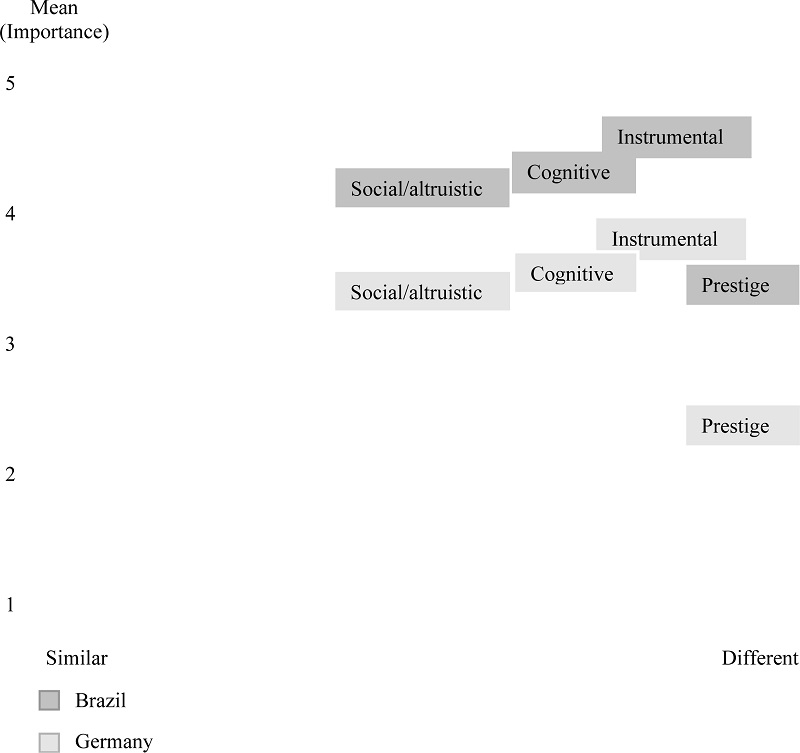
Figure 1
Work values.
Considering the logistic regression, the variables that explain the difference between Brazilians and German participants are instrumental work values and prestige work values. Table 1 presents the result of logistic regression and the mean differences.

Statistically significant values are denoted in bold.
For work values, it can be stated that the four dimensions, i.e., instrumental, cognitive, social/altruistic, and prestige presented significant differences, while the dimensions social/altruistic and cognitive did not present significant coefficients in the regression logistic. Combining the results, the hypothesis H1: The Brazilian and German people of Generation Z present differences regarding their work values is supported by the sample.
3.2. Attitude toward technology
Cronbach's alpha was evaluated with 122 valid cases, while 24 were excluded. With 16 items on the scale, the result showed a reliability of α>0.659. Although this can be seen as uncertain regarding reliability, it was decided to keep the scale as it has been used in previous studies.
Brazilians of Generation Z agreed the most with the statement, "Technology will provide solutions to many of our problems." [M(B)=4.48, SD=0.624], while for German representatives it was the statement "I feel it is important to be able to access the Internet any time I want." [M(G)=4.23, SD=0.857]. However, German Gen Z disagreed mostly with the statement, "I get anxious when I don't have the Internet available to me." [M(G)=2.68, SD=1.170] and Brazilian Gen Z with "New technology makes life more complicated." [M(B)=2.02, SD=1.017].
When calculating the mean for Brazilian and German Gen Z regarding each dimension, it became visible that Brazilians had a more positive [M(B)=4.05; M(G)=3.68] and less negative attitude [M(B)=2.66; M(G)=3.37] than Germans toward technology. For -t-test, both dimensions are statistically different. Regarding anxiety and dependence on technology, Brazilians scored slightly higher than Germans [M(B)=3.47; M(G)=3.21]. For both nationalities, the scores in the dimension of preference for task switching were low [M(B)=2.50; M(G)=2.81]. For the last two dimensions, the means are equal. Figure 2 illustrates the mean differences related to work values.
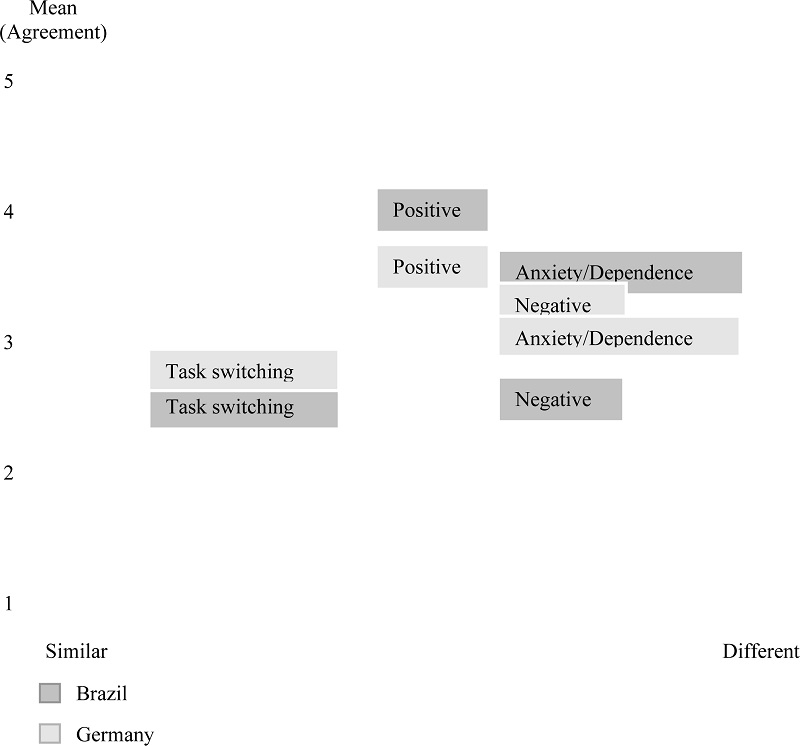
Figure 2
Attitude toward technology.
Considering the logistic regression, the variables that explain the difference between Brazilian and German participants are positive and negative attitudes. Table 2 presents the result of logistic regression and the mean differences.

Statistically significant values are denoted in bold.
For attitudes toward technology, it can be stated that two dimensions presented significant differences. Considering that differences were found, hypothesis H2: The Brazilian and German people of Generation Z present differences regarding their attitude toward technology is supported by the sample.
4. DISCUSSION
This study compares Gen Z in Brazilian and German contexts. It is important to highlight that these countries have cultural differences. Using Hofstede, Hofstede, and Minkov's (2010) model, a largely used perspective to understand differences among national cultures, Martins et al. (2013) emphasize that Brazil and Germany present differences in the dimensions of the model. Germany presents higher scores for individualism and masculinity, and Brazil presents higher scores for power distance and long-term orientation, but the tolerance for unexpected events is similar in both countries ( Martins et al., 2013). Smith et al. (2022) compare cultural differences between Brazil and Germany in the complex problem-solving process. Brazilians may tend to have more emotional expressiveness and are not restricted to formal communication, while Germans may be more focused on orderliness and planning ( Smith et al., 2022). These cultural differences can also be perceived in work values and attitudes toward technology, as discussed in this study.
4.1. Work values
The results for work values suggest that Brazilian and German Gen Z differ in many aspects regarding their attitude at work. While for all the dimensions, the results show a high mean average, for Brazilians, the score is higher. An explanation for the difference could be their distinctive experiences in the labor market. The circumstances in which this generation grew up in each country are different, and, therefore, their geographical location might also impact their attitude, as Ryder (1965) commented.
For Brazilian Gen Z, the most important work value is the opportunity for career advancement, followed by balancing private and work lives. Career advancement was identified as being less important for German respondents. Colet and Mozzato (2019) see a relationship between online usage and aiming for fast career development. The findings can confirm this statement, as German participants have a more negative attitude toward technology and are less interested in career advancement.
Further instrumental items that show a difference between Brazilians and Germans are salary and job security, which can also be traced back to the labor market situation that is more stable in Germany with a higher employment rate and higher wages ( Organisation for Economic Co-operation and Development, 2022b). The importance of recognition and feedback, as indicated by Weitzel et al. (2020), could be confirmed in the findings with a higher score for Brazilians. Having a supportive supervisor is important to both nationalities and coincides with Pichler et al. (2021). On the other hand, the fact that Gen Z likes to work autonomously and independently coincides with Chillakuri and Mahanandia (2018).
Regarding social/altruistic aspects, Barhate and Dirani's (2022) findings confirm that Gen Z prefers to work in a fun and lively working environment and have coworkers with whom they can form friendships. The difference could be detected in doing work that allows for helping people. This difference can be explained by the level of individualism in each country, as stated by Seemiller et al. (2019). While for Brazilians, it is almost absolutely essential, for Germans, it is somewhat important.
Gen Z in both countries places less importance on doing work that is highly regarded by others. Randstad (2021) indicates that this generation is likely to hold leadership positions, which the findings could not confirm. In both groups, the least value was placed on organizing and directing the work of others. Offering a good work-life balance for employees is highly regarded by respondents from both countries, which should allow them to choose hours more freely and the opportunity to work remotely or work a four-day week, as indicated by Chillakuri and Mahanandia (2018). In addition, the findings show the importance of recognizing good performance, providing constructive and frequent feedback, and creating a lively working environment. On the other hand, social interaction at work is less important for Gen Z.
As Brazilians place importance on helping people with their work, employers should find a way to either first implement this aspect in their strategy or employer branding or, in the next step, communicate it openly and visibly. Another aspect is to pay Gen Z workers an adequate salary and provide job security, which will be attractive for this generation. In Germany, social and prestige work values are less important to this generation. Putting them in leadership positions or assigning them tasks or projects where social interaction is necessary can be less attractive to them.
Nevertheless, fostering a fun organizational culture that allows for forming friendships with coworkers can be a plus. Interesting and exciting work is also valued by Gen Z. Therefore, businesses should find out individually in feedback conversations what activities are most interesting for the employee. In addition, rotating jobs can be an opportunity to get to know other areas and improve or develop skills, as Chillakuri and Mahanandia (2018) suggested.
4.2. Attitude toward technology
Gen Z is often presented as a global generation that shares common beliefs, behaviors, and attitudes because they experience the same historical events and are connected through technology. Evaluating the responses of the Brazilian and German participants in Gen Z shows that their attitudes are relatively neutral toward technology; for Brazilians, however, they are moving more in the positive direction.
Brazilian Gen Z has a more positive attitude, stating that technology will provide solutions to problems, which coincides with the research of Broadbent et al. (2017), which indicates that Gen Z feels hopeful about technological advancements. As indicated by Colet and Mozzato (2019), Gen Z places much importance on having access to technology. The results also show this generation's importance in accessing the Internet and finding information online anytime. Germans show a more negative attitude toward technology because it isolates people and wastes too much time. This aligns with the findings that German Gen Z seems more dependent on their technology than Brazilians.
For businesses, the findings suggest that different strategies for Brazilians and Germans should be implemented when using technology in the workplace. The fact that Gen Z desires to use technology at work, as stated by Barhate and Dirani (2022), cannot be entirely backed up by the results. When dealing with Gen Z in Brazil, using technology in the workplace might not result in an issue as their attitude is positive. Nevertheless, it seems helpful to offer training opportunities that show the negative effects technology can have. That could help people from this generation in Brazil deal with their anxiety when they are unable to access the Internet.
In Germany, Gen Z should not get overwhelmed at work by using technology constantly, as their attitude is more negative, which could also lead to worse results in their tasks at work. Weitzel et al. (2020) also concluded that Gen Zs feel exhausted when using technology at work. Therefore, offering tasks that can be concluded offline or having meetings and communication with coworkers and supervisors in an offline environment seems useful. In this sense, creating training opportunities that allow employees to establish a more positive relationship with technology is beneficial.
5. CONCLUSION
Based on the study, it can be concluded that differences are found regarding the work values of Brazilian and German Gen Z. Brazilians' work values, whether instrumental or extrinsic, are stronger. Although both nationalities are interested in having a good relationship with their coworkers and less in social interaction, they differ in terms of doing work where they can help other people. Prestige work values, especially having the authority to direct others, are more important for Brazilians than German Gen Z. Their attitude toward technology presents differences between Gen Z in both countries. While Brazilians have a more positive and less negative attitude regarding technology, Germans are neutral toward it and its negative side effects and express restraint in terms of the usage and development of technology.
Differences that exist between nationalities should be explored more. While the sample size limits the generalizability of the findings, the approach provides insights on two areas that currently impact Gen Z, states their way of thinking, and contributes to presenting an understanding of the generation in both countries. Brazilian participants place high importance on most of the evaluated work values. The highest are instrumental or extrinsic work values, including salary, job security, feedback, having access to information, and work-life balance. The last two are also important factors for Germans, followed by intrinsic work values such as interesting work, freedom of choosing how and when to work, and the opportunity to learn continuously. Brazilian Gen Z puts higher value on their career advancement and the possibility to apply knowledge they have developed during education. Regarding technology, Brazilians experience higher levels of anxiety in relation to the usage of the Internet and phones. Also, both nationalities are less in favor of multitasking and switching between tasks or activities intermittently. These research evidences have practical implications for policies and strategies to attract and maintain workers from Gen Z and also have implications for multinationals or partnerships between countries in terms of adequate work conditions and feedback, as well as expectations of alignment in multicultural teams.
Further research is needed as businesses implement strategies based on these findings targeting Gen Z in Brazil and Germany. Their effectiveness can be evaluated in terms of the attraction and retention of talents. Practitioners should consider conducting qualitative and quantitative analysis with Gen Z representatives in Brazil and Germany and investigating further into specific employment sectors to provide more discussion about the effect of cultural differences in multicultural teams and remote work migration.
As a contribution, the findings support that Gen Z presents differences according to nationalities relevant to shaping their relationship with the work. Their relationship with technology differs, influencing how or if they prefer to use it in the workplace. Regarding work values, the importance of instrumental, cognitive, social/altruistic, and prestige values varies significantly between Brazilian and German Gen Z. The analysis of both constructs is interesting nowadays because of their interrelationship and the current changes in global work boundaries. This implies proper talent management and adapting attraction and retention strategies to tackle the talent shortage.
REFERENCES
Aggarwal, A., Sadhna, P., Gupta, S., Mittal, A., & Rastogi, S. (2022). Gen Z entering the workforce: Restructuring HR policies and practices for fostering the task performance and organizational commitment. Journal of Public Affairs, 22(3), e2535. https://doi.org/10.1002/pa.2535
Aman-Ullah, A., Aziz, A., Ibrahim, H., Mehmood, W., & Aman-Ullah, A. (2023). The role of compensation in shaping employee's behavior: a mediation study through job satisfaction during the Covid-19 pandemic. Revista de Gestão, 30(2), 221-236. https://doi.org/10.1108/REGE-04-2021-0068
Arora, S., Dubey, V., & Vyas, S. (2020). Study of work values of Gen Z students. International Journal of Technology and Globalisation, 8(3-4), 10034407. https://doi.org/10.1504/IJTG.2020.10034407
Aylmer, R., & Dias, M. (2018). Are the Generational Interactions in the Brazilian Workplace Different from Other Countries? Global Journal of Human Resource Management Journal, 6(1), 9-25.
Bandura, R., Hammond, M., & Santoro, J. (2018). The Future of Global Stability: The World of Work in Developing Countries: Brazil's Future Workforce Trends. Center for Strategic and International Studies. Retrieved from https://www.jstor.org/stable/pdf/resrep22495.5.pdf
Barhate, B., & Dirani, K. M. (2022). Career aspirations of Generation Z: a systematic literature review. European Journal of Training and Development, 46(1-2), 139-157. https://doi.org/10.1108/EJTD-07-2020-0124
Barros, M. J. F., Melo, P., & Farias, C. S. S. (2021). Perception of Work Performance in Home-Office Mode. Journal on Innovation and Sustainability, 12(3), 41-47. https://doi.org/10.23925/2179-3565.2021v12i3p41-47
Bastos, V. M., Esche, A., Flores, R., George, S., Gonçalves, A. C. P., Petersen, T., & Rausch, T. (2014). Brazil and Germany: A 21st-Century Relationship. Opportunities in Trade, Investment and Finance. Bertelsmann Stiftung/Foundation.
Bencsik, A., Juhász, T., & Horvath-Csikos, G. (2016). Y and Z Generations at Workplaces. Journal of Competitiveness, 8(3), 90-106. https://doi.org/10.7441/joc.2016.03.06
Beugelsdijk, S., & Welzel, C. (2018). Dimensions and dynamics of national culture: Synthesizing Hofstede with Inglehart. Journal of Cross-Cultural Psychology, 49(10), 1469-1505. https://doi.org/10.1177/0022022118798505
Bieleń, M., & Kubiczek, J. (2020). Response of the labor market to the needs and expectations of Generation Z. E-Mentor, 86(4), 87-94. https://doi.org/10.15219/em86.1486
Broadbent, E., Gougoulis, J., Lui, N., Pota, V., & Simons, J. (2017). Gen Z - Global Citizenship Survey. Verkey Foundation. Retrieved from: https://www.varkeyfoundation.org
Calicchio, N., Chui, M., & Grosman, N. (2018). Preparing Brazil for the Future of Work: Jobs, Technology and Skills. McKinsey Global Institute. Retrieved from https://www.mckinsey.com/featured-insights/future-of-work/preparing-brazil-for-the-future-of-work-jobs-technology-and-skills
Chillakuri, B., & Mahanandia, R. (2018). Generation Z entering the workforce: The need for sustainable strategies in maximizing their talent. Human Resource Management International Digest, 26(4), 34-38. https://doi.org/10.1108/HRMID-01-2018-0006
Colet, D. S., & Mozzato, A. R. (2019). "Nativos digitais": características atribuídas por gestores à Geração Z. Desenvolve Revista de Gestão do Unilasalle, 8(2), 25. https://doi.org/10.18316/desenv.v8i2.5020
Çora, H. (2019). The effects of characteristics of Generation Z on 21st-century business strategies. Kafkas Üniversitesi İktisadi Ve İdari Bilimler Fakültesi Dergisi, 10(20), 909-926. https://doi.org/10.36543/kauiibfd.2019.038
De Boer, P., & Bordoloi, P. (2022). Nationality differences in Gen Z work values: an exploratory study. Journal of International Education in Business, 15(2), 373-392. https://doi.org/10.1108/JIEB-09-2021-0088
Dolot, A. (2018). The characteristics of Generation Z. E-Mentor, 2(74), 44-50. Retrieved from http://cejsh.icm.edu.pl/cejsh/element/bwmeta1.element.desklight-d9ceb8b1-7a18-4ee0-aff8-74604b44c36e
Egerová, D., Komárková, L., & Kutlák, J. (2021). Generation Y and Generation Z Employment Expectations: A Generational Cohort Comparative Study From Two Countries. E+M Ekonomie a Management, 24(3), 93-109. https://doi.org/10.15240/tul/001/2021-03-006
Hansen, J.-I. C., & Leuty, M. E. (2012). Work Values Across Generations. Journal of Career Assessment, 20(1), 34-52. https://doi.org/10.1177/1069072711417163
Hofstede, G., Hofstede, G. J., & Minkov, M. (2010). Cultures and organizations: software of the mind (3rd ed.). McGraw Hill.
Janssen, D., & Carradini, S. (2021). Generation Z Workplace Communication Habits and Expectations. IEEE Transactions on Professional Communication, 64(2), 137-153. https://doi.org/10.1109/TPC.2021.3069288
Klaffke, M. (2021). Erfolgsfaktor Generationen-Management: Roadmap für das Personalmanagement. In M. Klaffke (Ed.), Generationen-Management (pp. 4–41). Springer Gabler.
Klein, C. (2019). Jede Generation hat eigene Werte – Generation Z. Ergopraxis, 12(10), 38-41. https://doi.org/10.1055/a-0957-9252
Kleinjohann, M., & Reinecke, V. (2020). Marketingkommunikation mit der Generation Z. Springer Gabler.
Korn Ferry (2018). Future of Work: The Global Talent Crunch. Korn Ferry. Retrieved from https://www.kornferry.com/content/dam/kornferry/docs/pdfs/KF-Future-of-Work-Talent-Crunch-Report.pdf
Leslie, B., Anderson, C., Bickham, C., Horman, J., Overly, A., Gentry, C., Callahan, C., & King, J. (2021). Generation Z Perceptions of a Positive Workplace Environment. Employee Responsibilities and Rights Journal, 33(3), 171-187. https://doi.org/10.1007/s10672-021-09366-2
Louise, F. (2023). Inspiração e parceria: a importância da relação entre Brasil e Alemanha. Portal da Indústria. Retrieved from https://noticias.portaldaindustria.com.br/noticias/internacional/inspiracao-e-parceria-a-importancia-da-relacao-entre-brasil-e-alemanha/#:~:text=A%20Alemanha%20%C3%A9%20considerada%20um,parceiro%20na%20Am%C3%A9rica%20do%20Sul
Lyons, S. T., Higgins, C. A., & Duxbury, L. (2009). Work values: Development of a new three-dimensional structure based on confirmatory smallest space analysis. Journal of Organizational Behavior, 31(7), 969-1002. https://doi.org/10.1002/job.658
Martins, R. C., Hor-Meyll, L. F., & Ferreira, J. B. (2013). Factors affecting mobile users' switching intentions: A comparative study between the Brazilian and German markets. Brazilian Administration Review, 10(3), 239-262. https://doi.org/10.1590/S1807-76922013000300002
McCrindle, M. (2018). The ABC of XYZ: Understanding the Global Generations. McCrindle Research. Retrieved from https://www.researchgate.net/publication/328347222_The_ABC_of_XYZ_Understanding_the_Global_Generations
Nguyen Ngoc, T., Viet Dung, M., Rowley, C., & Pejić Bach, M. (2022). Generation Z job seekers' expectations and their job pursuit intention: Evidence from transition and emerging economy. International Journal of Engineering Business Management, 14. https://doi.org/10.1177/18479790221112548
Organization for Economic Co-operation and Development (2022a). Brazil - OECD Data. Organization for Economic Co-operation and Development. Retrieved from https://data.oecd.org/brazil.htm
Organization for Economic Co-operation and Development (2022b). Germany - OECD Data. Organization for Economic Co-operation and Development. Retrieved from https://data.oecd.org/germany.htm
Ozkan, M., & Solmaz, B. (2015). The Changing Face of the Employees – Generation Z and Their Perceptions of Work (A Study Applied to University Students). Procedia Economics and Finance, 26, 476-483. https://doi.org/10.1016/S2212-5671(15)00876-X
Parry, E., & Urwin, P. (2011). Generational differences in work values: A review of theory and evidence. International Journal of Management Reviews, 13(1), 79-96. https://doi.org/10.1111/j.1468-2370.2010.00285.x
Pavan, D. S., & Vishwanath, L. (2017). Correlating Internet, Social Networks and Workplace – a Case of Generation Z Students. Journal of Commerce and Management Thought, 8(4), 802-815. https://doi.org/10.5958/0976-478X.2017.00050.7
Pichler, S., Kohli, C., & Granitz, N. (2021). DITTO for Gen Z: A framework for leveraging the uniqueness of the new generation. Business Horizons, 64(5), 599-610. https://doi.org/10.1016/j.bushor.2021.02.021
Randstad (2021). New York Trend Report. Randstad Deutschland. Retrieved from https://www.randstad.de/s3fs-media/de/public/2021-10/randstad-new-work-trendreport-1.pdf
Rocha-de-Oliveira, S., Piccinini, V. C., & Bitencourt, B. M. (2012). Juventudes, gerações e trabalho: é possível falar em geração Y no Brasil? Organizações & Sociedade, 19(62), 551-558. https://doi.org/10.1590/S1984-92302012000300010
Rosen, L. D., Whaling, K., Carrier, L. M., Cheever, N. A., & Rokkum, J. (2013). The Media and Technology Usage and Attitudes Scale: An empirical investigation. Computers in Human Behavior, 29(6), 2501-2511. https://doi.org/10.1016/j.chb.2013.06.006
Ryder, N. B. (1965). The Cohort as a Concept in the Study of Social Change. American Sociological Review, 30(6), 843-861. https://doi.org/10.2307/2090964
Schewe, C. D., & Meredith, G. (2004). Segmenting global markets by generational cohorts: determining motivations by age. Journal of Consumer Behaviour, 4(1), 51-63. https://doi.org/10.1002/cb.157
Schlotter, L., & Hubert, P. (2020). Generation Z – Personal management und Führung. Springer Gabler.
Scholz, C., & Rennig, A. (Eds.). (2019). Generations Z in Europe: Inputs, Insights and Implications. Emerald Group Publishing.
Schroth, H. (2019). Are You Ready for Gen Z in the Workplace? California Management Review, 61(3), 5-18. https://doi.org/10.1177/0008125619841006
Seemiller, C., & Grace, M. (2017). Generation Z: Educating and Engaging the Next Generation of Students. About Campus: Enriching the Student Learning Experience, 22(3), 21-26. https://doi.org/10.1002/abc.21293
Seemiller, C., Grace, M., Dal Bo Campagnolo, P., Da Mara Rosa Alves, I., & Severo De Borba, G. (2019). How Generation Z College Students Prefer to Learn: A Comparison of US and Brazil Students. Journal of Educational Research and Practice, 9(1), 349-368. https://doi.org/10.5590/JERAP.2019.09.1.25
Shiju, C. (2022). Generational cohort characteristics and analysis of behavioral biases of individuals for investment decision making across intergenerational Cohorts groups. Journal of Contemporary Issues in Business and Government, 28(3), 271-286.
Silva, J., Almeida, R., & Strokova, V. (2015). Brazilian Labor Markets: Main Achievements and Remaining Challenges. In W. Bank, R. Almeida, V. Strokova, & J. Silva (Eds.), Sustaining Employment and Wage Gains in Brazil: A Skills and Jobs Agenda (pp. 29-64). The World Bank Group. https://doi.org/10.1596/978-1-4648-0644-5_ch1
Smith, W., Hermida, J., & Güss, C. D. (2022). "Oh no, the forest is burning!" cultural differences in the complex problem-solving process only under high uncertainty. Frontiers in Psychology, 13, 965623. https://doi.org/10.3389/fpsyg.2022.965623
Verma, S., & Singh, V. (2022). Impact of artificial intelligence-enabled job characteristics and perceived substitution crisis on innovative work behavior of employees from high-tech firms. Computers in Human Behavior, 131, 107215. https://doi.org/10.1016/j.chb.2022.107215
Weber, J., & Urick, M. J. (2023). Searching for a stronger generational understanding than just age: A multi-country analysis of millennials' personal values and moral reasoning. Journal of Intergenerational Relationships, 21(1), 110-135. https://doi.org/10.1080/15350770.2021.1951920
Weitzel, T., Maier, C., Weinert, C., Pflügner, K., Oehlhorn, C., Wirth, J., & Laumer, S. (2020). Generation Z - die Arbeitnehmer von morgen. Retrieved from https://www.uni-bamberg.de/fileadmin/uni/fakultaeten/wiai_lehrstuehle/isdl/Recruiting_Trends_2020/Studien_2020_05_Generation_Z_Web.pdf
Notes
"Double Blind Review"
Author notes
*Corresponding author: keysamascena@unifor.br