Artículos
Chronic kidney disease-associated pruritus: features and associated factors
Prurito asociado a enfermedad renal crónica: características y factores asociados
 Dr. Intisar Ahmed Hasan. Intesarahmed14@yahoo.com.
Dr. Rana Khalid Obeed. RaniDermatology@gmail.com.
Dr. Intisar Ahmed Hasan. Intesarahmed14@yahoo.com.
Dr. Rana Khalid Obeed. RaniDermatology@gmail.com.
Chronic kidney disease-associated pruritus: features and associated factors
Archivos Venezolanos de Farmacología y Terapéutica, vol. 40, núm. 5, pp. 479-482, 2021
Sociedad Venezolana de Farmacología Clínica y Terapéutica

Esta obra está bajo una Licencia Creative Commons Atribución-SinDerivar 4.0 Internacional.
Abstract: Introduction: Chronic kidney disease (CKD) is a condition characterized by a gradual loss of kidney function over time due to injured kidneys or when the glomerular filtration rate is less than 60mL/min/1.73 m., for more than three months. The final stage of renal illness is the deadly stage of severe CKDs, and its occurrence has increased in the previous 30 years. Chronic kidney disease-associated pruritus is an undesirable condition that triggers itching and negatively affects sleep quality. The study aims to evaluate the features of Pruritus associated with CKD and its association with sociodemographic variables. Method: Cross-sectional study of 53 patients with chronic kidney disease collected from Baqubah dialysis center from the period of April 1st, 2020, to September 1st, 2020, inclusion criteria are all patients with chronic kidney disease who suffer from rashes and Pruritus while exclusion criteria are all patients suffer from rashes and Pruritus does not associate to CKD and cause by other conditions. All patients reported their sociodemographic data like age, gender, sleep pattern, the severity of disease, negative affection of sleep quality and location of Pruritus. Results: CKD-associated Pruritus were distributed as follows: of all patients, age 52±6 years old; 83% were 45 years and above and 13% with age 45 years old and below .23% of patients were females and 77% males, in 40% of patients’ Pruritus interfered with their sleep while 60% not. About 40% of patients with pruritic are severe, while 60% of them are not. 62% of pruritic patients occur in the trunk, while 38% occur in the entire body. There was a significant association between the severity of Pruritus with gender, the affected area, and sleep. Conclusion: Utmost communal symptom of skin in ESRD is Pruritus, broadly identified as “uremic pruritus.” Due to there is no correct association with uremia, significant association occur in male, age higher than 45 years, interferes with sleep and predominates in the trunk region.
Keywords: Pruritus, chronic kidney disease, features, association factors.
Resumen: Introducción: La enfermedad renal crónica (ERC) es una condición caracterizada por una pérdida gradual de la función renal en el tiempo debido a una lesión renal o cuando la tasa de filtración glomerular es menor de 60 ml / min / 1,73 m2, durante más de tres meses. La etapa final de la enfermedad renal es la etapa mortal de la ERC grave y su aparición ha aumentado en los 30 años anteriores. La prevalencia del prurito asociado a la enfermedad renal crónica es una condición indeseable que desencadena el prurito y afecta negativamente la calidad del sueño. El estudio tiene como objetivo evaluar las características del prurito asociado a la ERC y su asociación con variables sociodemográficas. Método: Estudio transversal de 53 pacientes con enfermedad renal crónica recogidos del centro de diálisis de Baqubah desde el período del 1 de abril de 2020 al 1 de septiembre de 2020, los criterios de inclusión son todos los pacientes con enfermedad renal crónica que padecen erupciones y prurito durante la exclusión. Los criterios son que todos los pacientes padecen erupciones cutáneas y el prurito no se asocia a ERC y es causado por otras enfermedades. Todos los pacientes informaron sus datos sociodemográficos como edad, sexo, patrón de sueño, gravedad de la enfermedad, afectación negativa de la calidad del sueño y localización del prurito. Resultados: el prurito asociado a la ERC se distribuyó de la siguiente manera: de todos los pacientes 52 ± 6 años; El 83% tenía 45 años o más y el 13% tenía 45 años o menos. El 23% de los pacientes eran mujeres y el 77% hombres, en el 40% de los pacientes el prurito interfirió con su sueño, mientras que el 60% no. Aproximadamente el 40% de los pacientes con prurito son graves, mientras que el 60% de ellos no lo son. El 62% de los pacientes con prurito ocurren en el tronco, mientras que el 38% ocurre en todo el cuerpo. Hubo una asociación significativa entre la gravedad del prurito con el sexo, el área afectada y el sueño. Conclusión: El síntoma más común de la piel en la ESRD es el prurito, ampliamente identificado como "prurito urémico". Debido a que no existe una asociación correcta con la uremia, se presenta una asociación importante en el sexo masculino, mayor de 45 años, interfiere con el sueño y predomina en la región del tronco.
Palabras clave: prurito, enfermedad renal crónica, características, factores de asociación.
Introduction
Chronic kidney disease (CKD) is characterized by a gradual loss of kidney function over time due to injured kidneys or when the glomerular filtration rate is less than 60mL/min/1.73 m2. for more than three months1. The final stage of renal illness is the deadly stage of severe CKDs, and its occurrence has increased in the previous 30 years. Chronic kidney disease-associated pruritus is an undesirable condition that triggers itching and negatively affects sleep quality2. More than 80% of patients in advanced republics received management for ESRD3. and wide no. of them selected to be cured with dialysis to rise their lifetime. Pruritus is broadly identified as “uremic pruritus”4,5. Pruritus related to CKD could be problematic to differentiate from Pruritus produced by non-renal problems characteristically related with CKD, for example, thyroid illness and blood malignancy6. Prior studies have stated mutable occurrence rates (8 - 70%) in patients with changeable severity7,8. Peritoneal or hemodialysis dialysis patients suffer from changed Pruritus related to CKD at changed degrees, which needs more studies9,10. In addition, Pruritus related to CKD has poor sleep patterns or severe depression as likened to patients without Pruritus related to CKD11,12. No study instrument for the measurement of Pruritus associated with CKD. Numerous danger issues have been linked to pruritus associated with CKD in patients with dialysis patients13,14. Henceforth, examine the occurrence of Pruritus associated with CKD in dialysis patients to find a reply suitably for decreasing the illness problem. The study aims to show the features of Pruritus associated with CKD and its association with sociodemographic variables.
Methods
A cross-sectional study of 53 patients with chronic kidney disease collected from Baqubah dialysis center from the period of April 1st, 2020, to September 1st, 2020, inclusion criteria are all patients with chronic kidney disease who suffer from rashes and Pruritus while exclusion criteria are all patients suffer from rashes and Pruritus does not associate to CKD and cause by other diseases. All patients reported their sociodemographic data like age, gender, sleep pattern, the severity of disease, negative affection of sleep quality, and location of Pruritus. Data were analyzed using the Statistical Package for Social Sciences version 22 (SPSS 22), frequency and percentage used for categorical data, mean and SD for continuous data. Chi-square was used to assess the association between variables. P-value less or equal to 0.05 was considered significant.
Results
A cross-sectional study of 53 CKD-associated pruritus patients was distributed as follows: of all patients, age 52 ± 6 years old; 83% were 45 years and above and 13% with age 45 years old and below .23% of patients were females and 77% males, in 40% of patients’ Pruritus interfered with their sleep while 60% not (Table 1).
| variables | frequency | percentage | |
| gender | Female | 12 | 22.6 |
| Male | 41 | 77.4 | |
| sleep | Interfere with sleep | 21 | 39.6 |
| No association | 32 | 60.4 | |
| age | below 45 | 7 | 13.2 |
| 45 and above | 46 | 86.8 |
About 40% of patients with pruritic are severe while 60% of them are not. 62% of pruritic patients occur in the trunk while 38% occur in the entire body (Figures 1 and 2).
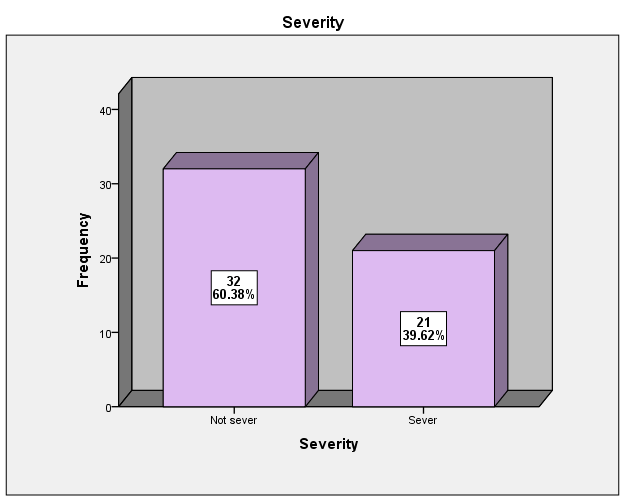
Figure 1.
Incidence of severity.
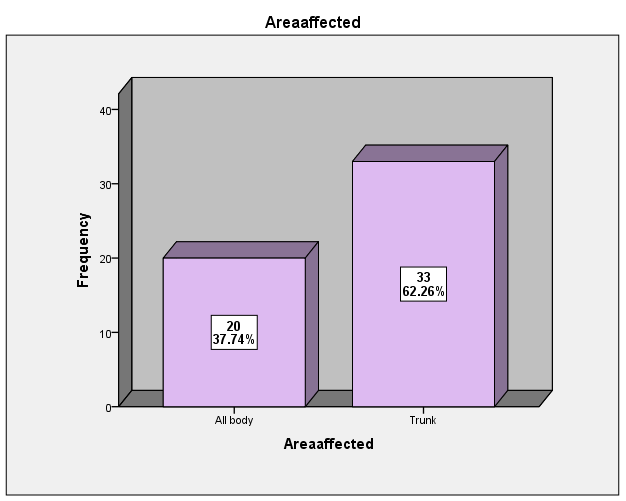
Figure 2.
Distribution of Pruritus in the body of patients.
There is a significant association between severity of Pruritus and gender, 95% of severe Pruritus occur in male while 5% of severe Pruritus occur in female. In addition, there is a significant association between severity of Pruritus and affected area, 76% of severe Pruritus occurs in all body while 24% of severe Pruritus occurs in the trunk. In addition, there is a significant association between pruritus severity and sleep, 100% of severe Pruritus interfere with sleep. Moreover, there is a significant association between pruritus severity and age, 100% of severe Pruritus occurs in age 45 years old and above (Table 2).
| variables | severity | P-value | ||
| no severe | severe | |||
| gender | female | 11 | 1 | 0.017 |
| 34.4% | 4.8% | |||
| male | 21 | 20 | ||
| 65.6% | 95.2% | |||
| affected area | all body | 4 | 16 | 0.0001 |
| 12.5% | 76.2% | |||
| trunk | 28 | 5 | ||
| 87.5% | 23.8% | |||
| sleep | Interfere with sleep | 0 | 21 | 0.0001 |
| 0.0% | 100.0% | |||
| No association | 32 | 0 | ||
| 100.0% | 0.0% | |||
| age | below 45 | 7 | 0 | 0.034 |
| 21.9% | 0.0% | |||
| 45 and above | 25 | 21 | ||
| 78.1% | 100.0% |
P-value less than 0.05 (significant).
Discussion
Pruritus is a troublesome complication that affects patients' health-related quality of life with end-stage renal disease15,16,17.
Our study 87% of all patients with age 45 years old and above and 13% of them below 45 years old. 23% of patients are females, and 77% are males, 40% of patients the Pruritus interferes with their sleep while 60% not. This is similar to other studies that state the majority of gender is males and most of the patients in age more than 45 years old and interfere with sleep18–20.
In the current study, 40% of patients with pruritic are severe, while 60% are not. 62% of pruritic happen in the trunk while 38% happen in the whole body. In addition, this is analogous to other studies that show Pruritus was widespread in 11(28%) of the patients who have CKD. The usually affected local parts were the limbs occur in 10 (26%), trunk in 9 (23%) and a mixture of limbs and trunk in 7(18%), 36% of patient with pruritic are severe while 64% of them are not or mild18,21,22.
In the current study, there is a significant association between severity of Pruritus and gender, 95% of severe Pruritus occur in male while 5% of severe Pruritus occur in female. In contrast to other studies showing no significant association between gender and Pruritus in CKD19,21,23.
In addition, there is a significant association between severity of Pruritus and affected area, 76% of severe Pruritus occur in all body while 24% of severe Pruritus occur in trunk18,24,25.
As well as the gender and affected area, there is a significant association between severity of Pruritus and sleep, 100% of severe Pruritus Interfere with sleep. Pruritus related to CKD related with reduced sleep quality. In the current study, 53% of patients had moderate sleep problems, while 8.4% had severe trouble. Present consequences are allied with outcomes from additional tasks such as by Pisoni et al. where more than 45% of patients have pruritus moderate-severe with poor sleep26, another study by Narita et al. 70% of patients have severe Pruritus, and 34% of patients have mild - modest Pruritus associated with sleep trouble27. Sleep problems as the cause of Pruritus happened in 57% of patients, worrying about falling in sleep stated by 9% of patients.
In comparison, Pruritus awakened 13.0%, and 34.8% stated symptoms collected while dipping asleep and on wakening28. Tessari et al. found that 59% of patients feeling Pruritus protested of trouble in asleep29. Moreover, there is a significant association between severity of Pruritus and age of patients, 100% of severe Pruritus occurs in age 45 years old and above. This is similar to other studies that also state an association between the severity of Pruritus of patients with CKD and the age of patients21,23.
Conclusion
The utmost communal symptom of skin in ESRD is Pruritus, broadly identified as “uremic pruritus.” Due to there is no correct association with uremia, significant association and occur more in male, age more than 45 years, interfere with sleep and more in the trunk region.
References:
1. Jha, V., Garcia-Garcia, G., Iseki, K., Li, Z., Naicker, S., Plattner, B., Saran, R., Wang, A.Y.M., Yang, C.W. Chronic kidney disease: Global dimension and perspectives. Lancet. 2013, 382, 260–272.
2. González, A.O., de Francisco, A., Gayoso, P., García, F. Prevalence of chronic renal disease in Spain: Results of the EPIRCE study. Nefrologia. 2010, 30, 78–86.
3. White, S.L., Chadban, S.J., Jan, S., Chapman, J.R., Cass, A. How can we achieve global equity in provision of renal replacement therapy? Bull. World Health Organ. 2008, 86, 229–237.
4. Mettang, M., Weisshaar, E. Pruritus: control of itch in patients undergoing dialysis. Skin Therapy Lett. 2010, 15, 1–5.
5. Mettang, T. Uremic Itch Management. Curr. Probl. Dermatology. 2016, 50, 133–141.
6. T.A., L. Itch Management in the Elderly. Curr. Probl. Dermatology. 2016, 50, 192–201.
7. Kimata, N., Fuller, D.S., Saito, A., Akizawa, T., Fukuhara, S., Pisoni, R.L., Robinson, B.M., Akiba, T. Pruritus in hemodialysis patients: Results from the Japanese Dialysis Outcomes and Practice Patterns Study (JDOPPS). Hemodial. Int. 2014, 18, 657–667.
8. Weiss, M., Mettang, T., Tschulena, U., Weisshaar, E. Health-related quality of life in haemodialysis patients suffering from chronic itch: results from GEHIS (German Epidemiology Haemodialysis Itch Study). Qual. Life Res. 2016, 25, 3097–3106.
9. Wu, H.Y., Peng, Y. Sen, Chen, H.Y., Tsai, W.C., Yang, J.Y., Hsu, S.P., Pai, M.F., Lu, H.M., Chiang, J.F., Ko, M.J., Wen, S.Y., Chiu, H.C. A comparison of uremic Pruritus in patients receiving peritoneal dialysis and hemodialysis. Med. (United States). 2016, 95.
10. Min, J.W., Kim, S.H., Kim, Y.O., Jin, D.C., Song, H.C., Choi, E.J., Kim, Y.L., Kim, Y.S., Kang, S.W., Kim, N.H., Yang, C.W., Kim, Y.K. Comparison of uremic Pruritus between patients undergoing hemodialysis and peritoneal dialysis. Kidney Res. Clin. Pract. 2016, 35, 107–113.
11. Suseł, J., Batycka-Baran, A., Reich, A., Szepietowski, J.C. Uraemic pruritus markedly affects the quality of life and depressive symptoms in haemodialysis patients with end-stage renal disease. Acta Derm. Venereol. 2014, 94, 276–281.
12. Weiss, M., Mettang, T., Tschulena, U., Passlick-Deetjen, J., Weisshaar, E. Prevalence of chronic itch and associated factors in haemodialysis patients: A representative cross-sectional study. Acta Derm. Venereol. 2015, 95, 816–82.
13. Ko, M.J., Wu, H.Y., Chen, H.Y., Chiu, Y.L., Hsu, S.P., Pai, M.F., Ju-YehYang, Lai, C.F., Lu, H.M., Huang, S.C., Yang, S.Y., Wen, S.Y., Chiu, H.C., Hu, F.C., Peng, Y. Sen, Jee, S.H. Uremic Pruritus, Dialysis Adequacy, and Metabolic Profiles in Hemodialysis Patients: A Prospective 5-Year Cohort Study. PLoS One. 2013, 8.
14. Fallahzadeh, M.K., Roozbeh, J., Geramizadeh, B., Namazi, M.R. Interleukin-2 serum levels are elevated in patients with uremic Pruritus: A novel finding with practical implications. Nephrol. Dial. Transplant. 2011, 26, 3338–3344.
15. Specchio, F., Carboni, I., Chimenti, S., Tamburi, F., Nisticò, S.. Cutaneous manifestations in patients with chronic renal failure on hemodialysis. Int. J. Immunopathol. Pharmacol. 2014, 27, 1–4.
16. Murtagh, F.E.M., Addington-Hall, J., Higginson, I.J. The Prevalence of Symptoms in End-Stage Renal Disease: A Systematic Review. Adv. Chronic Kidney Dis. 2007, 14, 82–99.
17. Weiss, M., Weisshaar, E. Qualitative interviews on chronic Pruritus in haemodialysis patients. Acta Derm. Venereol. 2014, 94, 713–714.
18. Adejumo, O., Akinbodewa, A., Alli, O., Olatunji, A., Ibukun, I. Prevalence, Pattern and Association of Pruritus with Quality of Life in Chronic Kidney Disease Patients Attending Kidney Care Centre, Ondo City, Southwest Nigeria. Ethiop. J. Health Sci. 2016, 26, 549–554.
19. Rehman, I.U., Munib, S., Ramadas, A., Khan, T.M. Prevalence of chronic kidney disease-associated pruritus, and association with sleep quality among hemodialysis patients in Pakistan. PLoS One. 2018, 13.
20. Adejumo, O., Madubuko, R., Olokor, A., Aina, O. Skin changes and dermatological life quality index in chronic kidney disease patients in a tertiary hospital in Southern Nigeria. Niger. J. Clin. Pract. 2019, 22, 245–250.
21. Hu, X., Sang, Y., Yang, M., Chen, X., Tang, W. Prevalence of chronic kidney disease-associated pruritus among adult dialysis patients A meta-analysis of cross-sectional studies. Med. (United States). 2018, 97.
22. Kim KH, Lee MS, Kim TH, Kang JW, Choi TY, Lee JD. Acupuncture and related interventions for symptoms of chronic kidney disease. Cochrane Database Syst Rev. 2016 Jun 28;(6):CD009440.
23. Rehman, I.U., Chan, K.G., Munib, S., Lee, L.H., Khan, T.M. The association between CKD-associated Pruritus and quality of life in patients undergoing hemodialysis in Pakistan: A STROBE compliant cross-sectional study. Med. (United States). 2019, 98.
24. Solak, B., Acikgoz, S.B., Sipahi, S., Erdem, T. Epidemiology and determinants of Pruritus in pre-dialysis chronic kidney disease patients. Int. Urol. Nephrol. 2016, 14, 82–99.
25. Sukul, N., Speyer, E. Zee, J. Pruritus and patient-reported outcomes in non-dialysis CKD. Clinical Journal of the American Society of Nephrology. 2019, 14, 673–681.
26. Pisoni, R.L., Wikström, B., Elder, S.J., Akizawa, T., Asano, Y., Keen, M.L., Saran, R., Mendelssohn, D.C., Young, E.W., Port, F.K. Pruritus in haemodialysis patients: International results from the Dialysis Outcomes and Practice Patterns Study (DOPPS). Nephrol. Dial. Transplant. 2006, 21, 3495–3505.
27. Narita, I., Alchi, B., Omori, K., Sato, F., Ajiro, J., Saga, D., Kondo, D., Skatsume, M., Maruyama, S., Kazama, J.J., Akazawa, K., Gejyo, F. Etiology and prognostic significance of severe uremic Pruritus in chronic hemodialysis patients. Kidney Int. 2006, 69, 1626–1632.
28. Noh, S.H., Park, K., Kim, E.J. The incidence of Pruritus and biochemical marker associated with Pruritus in hemodialysis patients. Ann. Dermatol. 2018, 69, 1626–1632.
29. Tessari, G., Vedove, C.D., Loschiavo, C., Tessitore, N., Rugiu, C., Lupo, A., Girolomoni, G. The impact of Pruritus on quality of life of patients undergoing dialysis: A single-center cohort study. J. Nephrol. 2009, 22, 241–248.