Artículos

Esta obra está bajo una Licencia Creative Commons Atribución-SinDerivar 4.0 Internacional.
Recepción: Diciembre , 28, 2020
Aprobación: Enero , 15, 2021
Publicación: Marzo , 10, 2021
DOI: https://doi.org/10.5281/zenodo.4715724
Abstract:
In any occupational field, all staff members, workers, administrators, and managers should know the available occupational health and safety (OHS). In general, the issue of workplace safety could not be achieved effortlessly. Based on the health and safety management system (HSMS) guidelines, a systematic approach should be existing, which employers administer to minimize the available risks of illness and injury. This comprehensive approach consists of identifying, assessing, and controlling the possible risks to the workers. The main challenges of HSMS guidelines are to decrease the possible ambiguity and hazards and proper management of the job. The present study was carried out to evaluate the safety and health management in the University of Sulaimani, its staff's knowledge and attitudes regarding main elements of health and safety management, and the level of the health and safety principles among the university staff. A total number of 135 administrative staff and health and safety committee members were studied in a descriptive cross-sectional study. Two standard questionnaires were used to collect critical data on the participants' health and safety management evaluation and their knowledge, attitude, and skills about health and safety management training programs. The collected data were analyzed through Statistical Package for the Social Sciences version 22. The results indicated that most of the participants (56.3%) worked in colleges and 43.7% in the directorate sector. Their age range was from 25 to 74 years, with more participants belonging to 35-44 and 45-54 years. Most of the participants (68.9%) were males. Regarding the participants' knowledge of and attitude toward managerial aspects of health and safety, it was seen that most of them were well aware.
Regarding their health and safety responsibilities, it was concluded that most of them had enough knowledge. In terms of the participant's knowledge of health and safety program components, they had sufficient knowledge of most of the components. The main objective of occupational health and safety assessments is to specify the possible risk to workers and staff members' safety and health. However, the effect of occupational health guidelines within the universities on the improvement of university staff's health and safety has not been clarified precisely yet.
Keywords: health, safety, health and safety management assessment, administrative staff, health and safety committee members, university.
Resumen: En cualquier campo ocupacional, todos los miembros del personal, trabajadores, administradores y gerentes deben conocer la salud y seguridad ocupacional (SST) disponible. En general, la cuestión de la seguridad en el lugar de trabajo no podría lograrse sin una facilidad. Basado en las pautas del sistema de gestión de salud y seguridad (HSMS), debe existir un enfoque sistemático que sea administrado por los empleadores para minimizar los riesgos disponibles de enfermedades y lesiones. Este enfoque integral consiste en el proceso de identificación, evaluación y control de los posibles riesgos para los trabajadores. Los principales desafíos de las pautas de HSMS son disminuir la posible ambigüedad y los riesgos y la gestión adecuada del trabajo. El presente estudio se realizó con el fin de evaluar la gestión de seguridad y salud en la Universidad de Sulaimani, el conocimiento y las actitudes de su personal con respecto a los principales elementos de gestión de salud y seguridad, y el nivel de los principios de salud y seguridad entre el personal universitario. Se estudió un número total de 135 miembros del personal administrativo y del comité de salud y seguridad en un estudio descriptivo de corte transversal. Se utilizaron dos cuestionarios estándar para recopilar los datos requeridos sobre la evaluación de gestión de salud y seguridad de los participantes y sus conocimientos, actitudes y habilidades sobre los programas de capacitación en gestión de salud y seguridad. Los datos recopilados se analizaron a través del Paquete Estadístico para la Versión 22 de Ciencias Sociales. Los resultados indicaron que la mayoría de los participantes (56.3%) trabajaban en colegios y 43.7% en el sector de dirección. Su rango de edad fue de 25 a 74 años, con más participantes pertenecientes a los grupos de edad 35-44 y 45-54 años. La mayoría de los participantes (68,9%) eran hombres. Con respecto al conocimiento y la actitud de los participantes hacia los aspectos gerenciales de la salud y la seguridad, se observó que la mayoría de ellos eran muy conscientes. Con respecto a sus responsabilidades de salud y seguridad, se concluyó que la mayoría de ellos tenían suficiente conocimiento. En términos del conocimiento de los participantes sobre los componentes del programa de salud y seguridad, tenían conocimiento suficiente sobre la mayoría de los componentes. El objetivo principal de las evaluaciones de salud y seguridad en el trabajo es especificar el posible riesgo para la seguridad y la salud de los trabajadores y los miembros del personal. Además, debe tenerse en cuenta que los sistemas de gestión de salud y seguridad en el trabajo (OHS) podrían desempeñar un papel de influencia estratégica importante en la seguridad y la salud en cualquier lugar de trabajo. Sin embargo, el efecto de las pautas de salud ocupacional dentro de las universidades en la mejora de la salud y la seguridad del personal universitario no ha aclarado con precisión todavía.
Palabras clave: salud, seguridad, evaluación de gestión de salud y seguridad, personal administrativo, miembros del comité de salud y seguridad, universidad.
Introduction
The existence of safety within the workplace significantly depends on the implementation of occupational safety policy and workplace environment examination for ensuring the fact that the workplace meets safety and health standards. The compliance of safety and health standards within the workplace could be achieved precisely by conducting active efforts for reducing the available occupational hazards when they could not be wholly eliminated1,2 The availability of occupational health and safety standards could enhance the economic, legal, and moral advantages. In this regard, all institutional bodies are responsible for taking up the duty of certifying the safety and health of its' employees. However, the availability of this kind of responsibility could be considered as a standardized procedure of keeping safe, preventing, and avoiding adverse side effects which could threaten the health and safety of workers3. The existence of conclusive health and safety guidelines in any work position with precise standardized instructions of safe and healthy work procedures could notably help to decrease the risk of the hazard 4,5.
In most developing countries like Iraq, the university sector is a large and growing part of an occupation that takes up many employers with broad dissimilar organizational cultures, which import high levels of occupational risks to its staff6. Unfortunately, the knowledge of the requirement of occupational health within the employment sector is not high. These requirements include having information about risks and hazards and further information on planning occupational health preparation among the university staff. As an instance, this information may include health-related guidance of specific groups like medical students, laws related to the health care of research workers which exposed to animals, and some extra information like the university size, the students and university staff age distribution, and the employment pattern of the university which related specialists7,8 should specify.
The issue of occupational safety and health (OSH) has become significant in Iraq's various career fields over the last years. This kind of issue could provide the potential for appropriate identification and appropriate comprehension among workers and administrative staff. However, it could be claimed that setting up appropriate and precise occupational, health and safety improving the overall health of the staff could be achieved9,10. In this regard, in any country, the ministry of health and medical education (MOHME) and cooperatives labor and social welfare (MCLSW) should prepare these rules. The occupational health development based on the World Health Organization (WHO) from a health services point of view recently is significant. However, the Iraqi occupational health and safety national center has set up the standardized requirements for being appointed as a regional cooperative center within the region of the Middle East11,12.
Moreover, the consecutive economic sanctions and wars imposed on Iraq during the past two decades had large adverse effects on the issue of occupational health and safety. Higher rates of unemployment, in addition to a higher rate of inflation, had forced people, mainly university graduates, to try to search and join jobs, especially in sectors not related to their proficiency, to survive. In spite of these job challenges, the people who work at universities tend to deal with these problems8.
In many universities, there should be a Health and Safety Committee (HSC) available, which needs to include the following specific objectives13:
I: Improvement of overall collaboration among the university and its employees nearly in all aspects which dealing with safety, health and happiness at work,
II: Providing appropriate deliberations to the university on the safety and health policy issues and any effective actions to be taken for ensuring the safety, health, and happiness at work among its employees, and
III: For advocating and enhancing the most appropriate practices in safety, health, and wellbeing.
Moreover, the university staff should have informed about their occupational-related safety and health guidelines. Unfortunately, there are just a few related guidance documents published in Iraq that have not reviewed this issue expertly. Consequently, an overall effort should be made to improve occupational safety and health programs and guidelines14.
Materials and Methods
The present descriptive cross-sectional study was carried out in the University of Sulaimani to assess health and safety management. The study sample consisted of 135 individuals, including the university's administrative staff and health and safety committee members. The data were collected from all university council participants, all college committees, and directorates of the University of Sulaimania. Data were collected from 1 October to 28 December 2018.
The required data on health and safety management evaluation were collected through a standard questionnaire adopted and utilized by most universities all over the world to assess health and safety and the relevant elements among the staff (administrative and health and safety committee members). In addition, another standard questionnaire was used to collect relevant data on the participant's knowledge, attitude, and skills regarding health and safety management training programs. The participant completed the questionnaires, and the data collection method was self-report.
All of the collected data were fed into an Excel sheet after the data obtained using the questionnaires were encoded. Afterward, the data were transferred to SPSS version 22, and descriptive statistics were used to analyze the data. The results were expressed as frequencies and percentages.
The study proposal was approved by both the Scientific Committee of the Department of Family and Community Medicine and the Ethical Committee of College of Medicine. Moreover, informed written consent was obtained from all of the participants before the study was started, and they completed the questionnaires.
Results
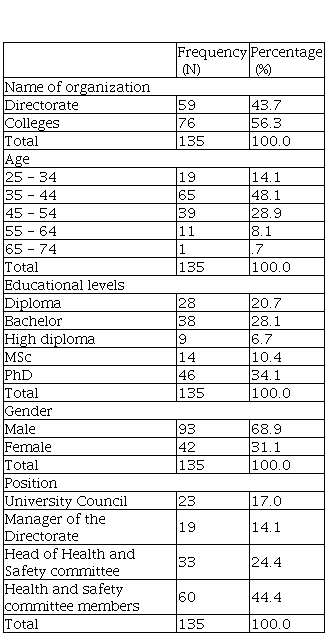
Analyzing the data obtained from the 135 participants of the present study revealed that 76 individuals (56.3%) worked in the colleges and 59 (43.7%) in the directorate. Their age ranged from 25 to 74 years. Most of them belonged to the age groups 35-44 and 45-54 years with 65 and 39 individuals, respectively. Most of them (68.9%) were males. Regarding their educational level, 34.1% had a Ph.D., 38 had a bachelor's degree, 28 a diploma, 14 a master's degree, and 9 a high diploma. In terms of their position, 60 (44.4%) were health and safety committee members, 33 (24.4%) were heads of health and safety committee, 23 (17%) were university councils, and 19 (14% were managers of the directorate) (See Table 1).
Sociodemographic characteristics of studied groups
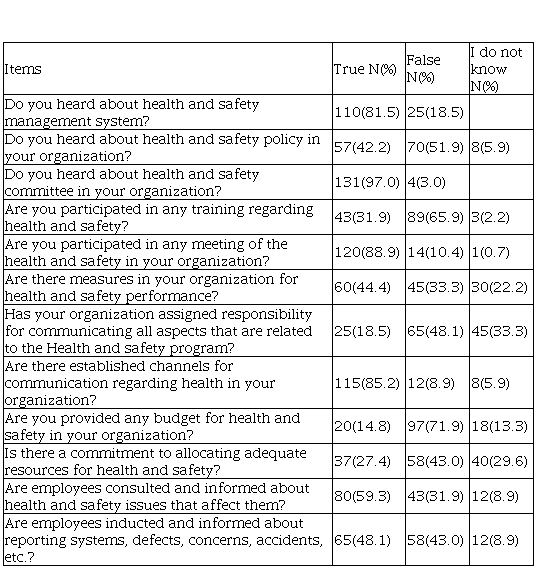
Analyzing the results obtained on the participants' knowledge about and attitude toward managerial aspects of health and safety in their organization indicated that most of them (81.5%) knew about the health and safety management system, 97% knew about the health and safety committee in their organization, 88.9% participated in health and safety meetings held in their organizations, 85.2% stated there were channels for communication regarding health in their organization, and more than half of the participants (59.3%) were informed or consulted regarding health and safety issues. However, 71.9% of them were not provided with any budget for health and safety, 65.9%did not participate in any training for health and safety performance, 51.9% did not know about safety and health policy in their organization, 48.1% stated that their organization assigned no responsibility for communicating all aspects of health and safety program, 43% stated that adequate resources were not allocated to health and safety, 43% were not informed about reporting systems, defects, concerns, and accidents, and 33.3% stated that there were no measures for health and safety performance in their organization (See Table 2).
Knowledge and attitudes of participants regarding managerial aspects of health and safety in organization
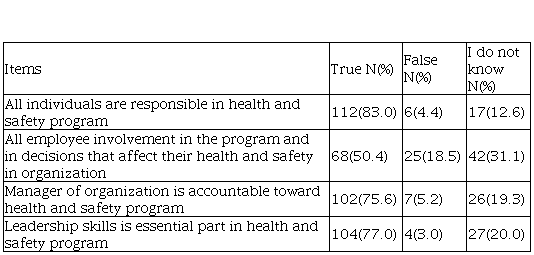
In terms of the participants' attitudes toward their health and safety responsibilities in their organization, the results showed that 83% of them stated that all individuals are responsible for health and safety, 75.6% referred that the organization manager is accountable toward the health and safety program, and 77% believed that leadership skills are essential in health and safety program. It was also seen that 18.5% of the participants stated that their involvement in health and safety programs does not affect their health and safety in the organization, and 31.1% were not sure about this effect (See Table 3).
Attitudes of participants regarding health and safety responsibilities in organization
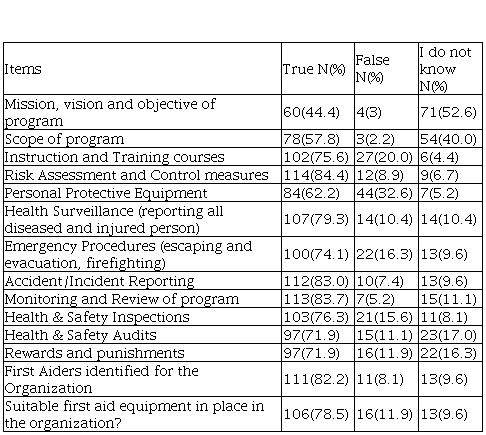
Regarding the participants' knowledge about the components of health and safety program, the results revealed that most of the participants knew about instruction and training courses (75.6%), risk assessment and control measures (84.4%), personal protective equipment (62.2%), health surveillance (79.3%), emergency procedures (74.1%), accident/incident reporting (83%), monitoring and reviewing the program (83.7%), health and safety inspection (76.3%), health and safety audits (71.9%), rewards and punishments (71.9%), first aiders (82.2%), and suitable first aid equipment (78.5%). However, 3% of them did not know about the mission, vision and objective of the program, and 52.6% were not sure about them. Also, 2.2% did not know the scope of the program, and 40% were not sure about it (See Table 4).
Assessment knowledge of participants regarding components of health and safety program in any organization
Discussion
Based on various recent researches, universities are large organizations with various hazards which are in smaller scales, lack of responsibility clarification, and also decentralized organizational structure in comparison with other occupational positions15.People who use the university's services and properties are mainly students and administrative staff of the university, which is not an employer-employee relationship. However, working in universities in comparison with industries is performed with less amount of supervision and training16.
Based on the data achieved from the analysis carried out within this study, most of the present study participants are within the age group of 35-54 years, of whom the number of college employees is higher in comparison with directorate employees. Due to the fact that the participants of this study are mostly doing office work, so they are not meeting hazardous chemicals or hard physical activities17. However, based on the UK's research, the common belief is that universities' staff are healthier than the average, which would be due to the lower mortality rate experienced among university staff, lecturers, or employees18,19.
Moreover, social status, lifestyle factors, and education could significantly affect morbidity and mortality among various occupational groups, even among university staff. Following a cardiovascular risk factors survey carried out at an Australian university, the risk of cardiovascular disease was much less in comparison with the general population, which may be because of higher educational levels of university staff20,21.
This study's obtained information demonstrated that more than 80% of participants had heard about health and safety management systems before. Moreover, having knowledge about health and safety policy in any organization could increase the staff and employees' responsibility for following the standardized rules at work22. In the present study, less than half of participants had heard about health and safety policy in their organization, while more than 95% of them stated that there was a health and safety committee within their organization. Although the availability of health and safety committee is required in any occupation, the lack of an appropriate policy for performing the prepared rules would increase occupational Injuries23.
Conducting regular monthly meetings of health and safety could influence the improvement of university staff's overall knowledge on occupational health and safety. In the present study, 88.9% of the participants reported that they had participated in regularly organized meetings on health and safety, which could be considered an important factor for increasing the participants' safety and health of the participants24.On the other hand, the information collected in this study indicated that the existence of established channels for communication regarding health within the organization could effectively improve overall health and safety in the workplace among employees or the staff of the university. These achieved results are exactly pointing out the fact that the possibility of reporting the workplace disadvantages and shortcomings to the committee of safety and health management would improve the quality of staff performance25.
Safety and health rules are overall requirements that are deliberated in order to prevent accidents in a public area or workplace. The management of these rules is carried out by health and safety executive governmental agencies, which workers should consider significantly. Employees' responsibility to the health and safety programs could increase their occupational health safety and their productivity at work26. In the present study, however, 83% of the participants mentioned that they were responsible for the health and safety program. Also, nearly half of the participants reported that they were not involved in the programs and decisions that affected their health and safety in the organization. The perception of employees about leadership skills in various aspects of health and safety programs is assumed to be a mean index and a medium effect on improving employee's safety and health condition27. However, in the present study, 77% of the participants believed that leadership skills would be essential in the health and safety program.
The employees' perceptions on occupational health and safety at the university could specify the extent to which the staff had accepted the published rules of occupational health and safety. In this regard, conducting instruction and training courses on health and safety issues could positively affect the knowledge of participants regarding components of health and safety programs in any organization28.In the present study, more than 75% of the participants reported that they had participated in instruction and training courses which is assumed as a positive point. The overall compliance rate to safety on the scope of admission of occupational safety and health rules at various workplaces is hardly ever more than 50%. This may be due to the existence of gaps among safety information sharing and training evaluation records. On the other hand, the occupational health and safety rules could not be totally performed in accordance with the policy recommendations25.
The lack of quick access to appropriate emergency medical services could be assumed as a potential risk factor for the increased occurrence rate of threatening events. Based on the obtained results in this study, it could be seen that more than 75% of the participants reported that the health surveillance and emergency procedures were available at their workplace, which could be assumed as a potential factor for improving the employee's health and safety. However, the staff's higher rates of responsibility on the issue of emphasizing the health and safety issues could increase their performance quality at work29,30.
Based on the study outcomes mentioned before, the compliance of university staff with occupational health and safety guidelines is required to achieve the most appropriate performance of employees. One more additional point that should be mentioned is that appointment of a person with adequate knowledge of occupational health and safety rules even amongst university staff is essential for conducting demanded health and safety rules within their workplace.
Conclusion
The present study was carried out to evaluate the level of compliance with occupational health and safety guidelines related to employees involved in the health and safety assessment program at the University of Sulaimani. Based on the present study's findings, preparing standardized guidelines of occupational health and safety (OHS) recommendations is essential in any organization like a university that contains a broad staff with various expertise. Consequently, improving the occupational health and safety conditions for appropriate assistance of a healthy and safe workplace is required. Moreover, the first step within the arranged management of health and safety systems within any organized working environment is setting up the most precise OHS guidelines. Additionally, to incorporate the specified roles and enhance admission of these rules by employees and university staff, their performance should be evaluated through suitable indicators.
References
01. Jagger J, De Carli G, Perry J, et al. 2003. Occupational exposure to bloodborne pathogens: epidemiology and prevention. In: Wenzel RP, editor. Prevention and control of nosocomial infections.4th edn. Philadelphia: Lippincott Williams & Wilkins Publication Ltd, USA.
02. Janine J, Jane P, Ahmed G, et al. 2008. The impact of U.S. policies to protect healthcare workers from bloodborne pathogens: The critical role of safety-engineered devices. Journal of Infection and Public Health, Volume 1, Issue 2, Pages 62-71.
03. Arocena P, Nunez I. 2009. The effect of occupational safety legislation in preventing accidents at work: Traditional versus advanced manufacturing industries. Environment and Planning C 27: 159-174.
04. Brian E. F, Cass M, Cary L. C. 2013. The Relationship between Job Satisfaction and Health: A Meta-Analysis. From Stress to Wellbeing Volume 1 pp 254-271.
05. Noni E. M, Jennifer S, Mary A. 2012. Risk perception, risk management and safety assessment: What can governments do to increase public confidence in their vaccine system? Biologicals, Volume 40, Issue 5, Pages 384-388.
06. Occupational health & safety at workplace in fourteen Iraqi governorates, 1982.
07. Cho C. C, Oliva J. A, Sweitzer E. B; et al. 2007. An Interfaith Workers' Center Approach to Workplace Rights: Implications for Workplace Safety and Health. Journal of Occupational and Environmental Medicine: Volume 49 - Issue 3 - p 275-281.
08. Hilal J. A. T. 2007. Occupational safety and health in Iraq; a national profile.Iraqi journal of public health.
09. Committee to Review the NIOSH Construction Research Program. 2008. Construction Research at NIOSH: Reviews of Research Programs of the National Institute for Occupational Safety and Health. Washington, DC: National Academies Press.
10. HavilandA, Burns W. R, Gray T, et al. 2010. What Kinds of Injuries Do OSHA Inspections Prevent? Journal of Safety Research 41 (4): 339–45.
11. Ali M, Sahand R, Behzad D. 2016. How to integrate social care services into primary health care? An experience from Iran. Medical journal of the Islamic Republic of Iran 30(1):408.
12. World Health Organization. 2008. The World Health Report, primary health care now more than ever. Geneva, WHO.
13. Venables K. M, Allender S. 2006. Occupational health needs of universities: a review with an emphasis on the United Kingdom. Occup Environ Med; 63:159–167.
14. Glorian S, Susan P, Karina N, et al. 2019. Improving Working Conditions to Promote Worker Safety, Health, and Wellbeing for Low-Wage Workers: The Workplace Organizational Health Study. Int J Environ Res Public Health. 16(8): 1449.
15. Steege A. L, Baron S. L, Marsh S. M, et al. 2014. Examining occupational health and safety disparities using national data: A cause for continuing concern. Am. J. Ind. Med.57:527–538.
16. National Institute for Occupational Safety and Health Protecting Temporary Workers. 2019. Available online: https://www.osha.gov/temp_workers.
17. General Social Survey and NORC at the University of Chicago Quality of Working Life Module, 1972–2014 Cumulative Codebook. 2017. Available online: http://gss.norc.org/Documents/codebook/QWL%20Codebook.pdf.
18. Muhammad S, Muhammad R. 2019. An Overview of Construction Occupational Accidents in Hong Kong: A Recent Trend and Future Perspectives. Appl. Sci. 9, 2069; doi:10.3390/app9102069.
19. Choi S. D, Guo, L, Kim J, et al. 2019. Comparison of fatal occupational injuries in construction industry in the United States, South Korea, and China. Int. J. Ind. Ergon.71, 64–74.
20. Marsha L. T⁎ Sarah F, Fiona G, et al. 2015. Socioeconomic inequalities of cardiovascular risk factors among manufacturing employees in the Republic of Ireland: A cross-sectional study. Prev Med Rep. 2: 699–703.
21. Behdin N. K, Anson K. C. L, Christine N, et al. 2018. Heart Disease and Occupational Risk Factors in the Canadian Population: An Exploratory Study Using the Canadian Community Health Survey. Saf Health Work. 9(2): 144–148.
22. Baets A. J, Sifovo S, Pazvakavambwa I. E. 2007. Access to occupational post-exposure prophylaxis for primary health care workers in rural Africa: a cross-sectional study. Am J Infect Control 35: 545-551.
23. Mailu J. M. 2016. Establishing Employees Perception on Occupational Health and Safety concerns at East African Portland cement: Occupational Safety and Health. Master's Thesis. Nairobi: Jomo Kenyatta University of Agriculture and Technology.
24. Tom O, Michael F, Deborah W, et al. 2015. OCCUPATIONAL SAFETY AND HEALTH EDUCATION AND TRAINING FOR UNDERSERVED POPULATIONS. New Solut.Author manuscript; available in PMC.
25. Stephen N. M, Nzuve A. B. L. 2012. The Extent of Compliance with Occupational Safety and Health Regulations at Registered Workplaces in Nairobi. International Journal of Business, Humanities and Technology 7: 161-167.
26. Gerard J. F, Andrew S. 2010. Safety climate and the Theory of Planned Behavior: Towards the prediction of unsafe behavior. Accident Analysis & Prevention Volume 42, Issue 5, Pages 1455-1459.
27. Gil L, Dana Y. 2010. Safety perception referents of permanent and temporary employees: Safety climate boundaries in the industrial workplace. Accident Analysis & Prevention, Volume 42, Issue 5, Pages 1423-1430.
28. Mailu J. M. 2016. Establishing Employees Perception on Occupational Health and Safety concerns at East African Portland cement: Occupational Safety and Health. Master's Thesis. Nairobi: Jomo Kenyatta University of Agriculture and Technology.
29. Ahmed R M. A, Stuart W, John F, et al. 2019. Factors Impacting Patient Outcomes Associated with Use of Emergency Medical Services Operating in Urban Versus Rural Areas: A Systematic Review. Int J Environ Res Public Health. 16(10): 1728.
30. Malin M. M, Ulrica V. T. S, Johnny H, et al. 2019. Leading for Safety: A Question of Leadership Focus. Safety and Health at Work, Volume 10, Issue 2, Pages 180-187.
