Artículos
Mathematical model of thyroid gland functioning as a follicles system
Modelo matemático del funcionamiento de la glándula tiroides como un sistema folicular
 Dmitrii Nikolaevich Tumakov dtumakov@kpfu.ru
Mathematical model of thyroid gland functioning as a follicles system
Archivos Venezolanos de Farmacología y Terapéutica, vol. 40, núm. 1, pp. 15-19, 2021
Sociedad Venezolana de Farmacología Clínica y Terapéutica

Esta obra está bajo una Licencia Creative Commons Atribución-SinDerivar 4.0 Internacional.
Recepción: 28 Diciembre 2020
Aprobación: 15 Enero 2021
Publicación: 10 Febrero 2021
Abstract: The thyroid gland represents one of the endocrine glands. Despite the relatively small size of the gland, it plays an essential role in controlling the regulation of metabolism and individual cells' growth using hormones. The main component of the hormones is iodine. The gland consists of follicles that are the organ's structural elements, in which the synthesized thyroid hormone accumulates in a state associated with protein. To construct a model in which the rate of iodine metabolism is set in dependence on the concentration of substances in the colloid. To investigate the change in the size of the follicle and the entire thyroid gland from the concentration of iodine using a mathematical model. The entire thyroid glands work is considered a mega-system, consisting of individual follicles having different volumes. The mathematical model represents a boundary value problem for a system of nonlinear differential equations for concentrations of substances in the follicle. The dynamics of changes in the size of both an individual follicle and the system as a whole is considered under various initial and external conditions. The degree of influence of follicle volume on the level of iodine in the follicle as well as on the production of the thyroid hormone is assessed. The thyroid gland's work is studied, and a mathematical model of the thyroid gland is constructed, which considers the thyroid gland as a mega-system consisting of a certain number of follicles. According to the results of studies, this approach allows more accurate tracking of changes occurring with a single follicle and, consequently, the work of the entire organ. If the thyroid gland is healthy, the follicle size distribution is lognormal.
Keywords: Thyroid gland, Follicle, Mathematical model, Thyroid hormone, System of ordinary differential equations.
Resumen: La glándula tiroides representa una de las glándulas endocrinas. A pesar del tamaño relativamente pequeño de la glándula, juega un papel importante en el control de la regulación del metabolismo y el crecimiento de células individuales usando hormonas. El componente principal de las hormonas es el yodo. La glándula está formada por folículos que son los elementos estructurales del órgano, en los que la hormona tiroidea sintetizada se acumula en un estado asociado a las proteínas. Construir un modelo en el que la tasa de metabolismo del yodo se establezca en función de la concentración de sustancias en el coloide. Investigar el cambio en el tamaño del folículo y de toda la glándula tiroides a partir de la concentración de yodo utilizando un modelo matemático. El trabajo de toda la glándula tiroides se considera un mega-sistema, que consiste en folículos individuales que tienen diferentes volúmenes. El modelo matemático representa un problema de valor límite para un sistema de ecuaciones diferenciales no lineales para concentraciones de sustancias en el folículo. La dinámica de los cambios en el tamaño de un folículo individual y del sistema en su conjunto se considera bajo diversas condiciones iniciales y externas. Se evalúa el grado de influencia del volumen del folículo en el nivel de yodo en el folículo, así como en la producción de la hormona tiroidea. Se estudia el trabajo de la glándula tiroides y se construye un modelo matemático de la glándula tiroides, que considera a la glándula tiroides como un mega-sistema formado por una determinada cantidad de folículos. Según los resultados de los estudios, este enfoque permite un seguimiento más preciso de los cambios que ocurren con un solo folículo y, como consecuencia, el trabajo de todo el órgano. Si la glándula tiroides está sana, la distribución del tamaño del folículo es logarítmica normal.
Palabras clave: glándula tiroides, folículo, modelo matemático, hormona tiroidea, sistema de ecuaciones diferenciales ordinarias.
Introduction
The thyroid gland plays a vital role in the body of vertebrates. It performs the functions of storing iodine and producing iodine-containing hormones involved in the regulation of metabolism.
According to the Ministry of Healthcare of the Russian Federation, the number of people diagnosed with diseases associated with the thyroid gland increased by 14% over the period from 2013 to 2017, namely from 2037.1 to 2323.8 cases per one hundred thousand people1,2. So far, the number continues to grow.
One of the causes of thyroid abnormalities is a deficit or excess of iodine. Even small fluctuations in the iodine content can lead to diseases of the thyroid gland because metabolic processes are disrupted, leading to malfunctioning of the whole organism with the inclusion of metabolism. In case of serious deviations, the body's metabolism is disturbed so much that the body temperature is insufficiently regulated; therefore, insufficient hematopoiesis takes place, in which anemia can occur.
Mathematical models simulate the thyroid gland's work, identifying the causes of abnormalities in its work, methods of treating for the disease or alleviating its symptoms.
At present, many mathematical models of the thyroid gland are known. However, in most cases, the models consider the thyroid gland as a whole3. Some of the model's study changes taking place in the organ under the influence of any disease4, including cancer5. In addition, some works reproduce the interaction of the thyroid gland with the pituitary gland or with other organs6.
A less popular approach lies in modeling the thyroid gland at the cellular level. One of the examples of such works is a model presented in 7. This paper discusses the base biochemical reactions, such as iodine entry into the follicle, thyroglobulin protein synthesis, as well as hormone production.
The present paper deals with a point single-chamber mathematical model of the thyroid follicle. The follicle model is represented by one chamber - the union of the colloid and thyrocytes. In the proposed model, the rate of iodine exchange depends on the size of the follicle. In turn, the volume of colloid in the follicle depends on the concentration of thyroglobulin and iodine.
The purpose of the work is to construct a model in which the rate of iodine metabolism is set in dependence on the concentration of substances in the colloid. The mathematical model represents a boundary value problem for a system of nonlinear differential equations for the concentrations of substances in the follicle.
Methods
The whole thyroid gland study is regarded as a mega-system, containing individual follicles having different volumes. We utilized a mathematical method, which demonstrates a boundary value problem for a system of nonlinear differential equations for concentrations of substances in the follicle.
Results and Discussion
Forms and Sizes of Thyroid Follicles
The thyroid gland is one of the organs included in the endocrine gland system. They constitute a unified system for monitoring the activities of internal organs. The hormones released by them enter directly into the bloodstream, as well as into the tissue fluid. The thyroid gland itself performs the function of producing thyroid, i.e., iodine-containing hormones involved in metabolism regulation. The organ visually resembles a butterfly and is located in the front of the neck. It consists of two lobes, right and left, of the connecting isthmus and in some cases has a pyramidal lobe extending upward8-10. The size of the gland relative to body weight is tiny in all animals and is about 0.20% of the bodyweight11.
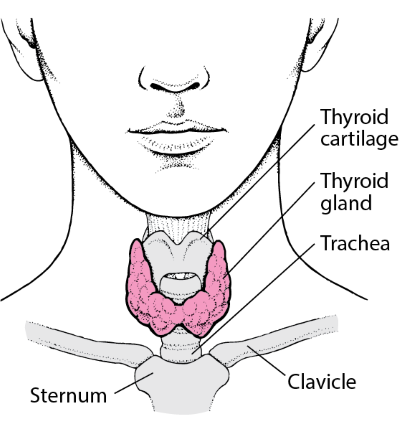
Figure 1.
Thyroid gland
The main structural and functional element of the thyroid gland is the follicle10. Follicles are vesicles, most often round or oval in shape, filled with colloid (protein iodine-containing substance). The follicle consists of an outer monolayer of follicular cells that surround the inner nucleus and a colloid, which is the storage reservoir of thyroid hormones. The colloid stored in the lumen is a clear, viscous liquid. It is produced by the epithelium of the follicle and contains hormones produced by the thyroid gland.
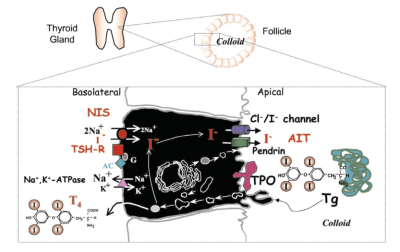
Figure 2.
Thyroid gland follicle 4
The size of an individual follicle varies in a quite wide range. The height of individual follicular cells ranges from 5 to 10 μm, and the diameter of the entire follicle is from 25 to 250 μm. The size of follicles and the height of their cells vary depending on the functional state of the gland12.
The shape of the thyroid follicle is quite variable, but basically, it has three main types, namely angular, round and oval12. Most angular follicles are almond-shaped or heart-shaped, and when viewed from the edge or in profile, they are quite slender. Follicles of bizarre shape are occasionally found. In some of these follicles, the irregularities consist of deep clefts, and in many cases, involve a small artery. There are also large diverticula protruding from the follicle wall, which are formed when the follicle cavity enlarges for the passive placement of the growing amount of colloid inside12. However, most often, researchers make an assumption that the follicles are spherical.
The size of the thyroid gland's follicles in mammals approximately corresponds to the size of animals and is the largest in humans. Note that the average size of follicles increases in the order: mouse - 45.7 µm, rat13, cat, guinea pig, rabbit, sheep, donkey, goat, and dog - 100 µm12. Then a sharp jump in size up to 170-190 µm occurs for cattle14, pigs, camels, and humans.
With a few exceptions, follicle size tends to increase with body size, while the percentage of epithelium decreases. Many researchers have noted a decrease in the size of follicles from the periphery to the center. This has been noted in murine deer15, hamster16, and many other animals12.
The thyroid gland consists of a large number of follicles of various sizes. The number of follicles in mammals varies within a wide range from forty thousand in rats13 to about three million in humans17.
Thus, the follicles for most mammals have the same shape. However, the follicles' size can vary significantly depending on the size of the mammal itself. There are also small differences by gender and age18. The sizes of normal follicles correspond to a lognormal distribution19:
 (1)
(1)Note that in20, for the sizes of rat follicles, distribution (1) is obtained with parameters μ = 3.78 and σ = 0.305 for central follicles, and with parameters μ = 3.96 and σ = 0.52 for peripheral follicles. Moreover, the ratio of central follicles to peripheral follicles ranges from 78% to 22%. However, in a number of pathologies, the distribution of follicle sizes can be approximated by some other distribution functions20.
Mathematical Model of the Single Follicle
The follicle itself is considered as a single chamber in which the colloid and thyrocytes are combined. However, all the main processes that must occur in the follicle, such as the intake of active iodine, the addition of iodine to thyroglobulin, the formation of the hormone, and the release of the hormone through the chamber wall are included in the model.
Following21, instead of the area, we consider the expression (αD + β), where α = -0.015, β = 3.138, and D is the follicle size.
The penetration rate depends on the concentration of iodine in the blood v and the difference between the concentration of iodine in the follicle
 and the normal concentration
 . A system of ordinary differential equations describes the process of formation of the hormone in accordance with 7 by complicating the original system22:
where
 is the concentration of iodine in the follicle;
 is the concentration of iodized thyroid hormone;
 characterize
 is the concentration of hormone
 ,
,  ,
,  ,
,  are system parameters that characterize the rates of individual reactions;
 is follicle membrane permeability;
 is a parameter characterizing the rate of chemical reactions
Equation (2) describes the rate of iodine entry into the follicle (first term) and the rate of iodine decrease due to its binding to thyroglobulin (second term).
Equation (3) describes the rate of change in the content of iodine bound thyroglobulin, which depends on the rate of binding of thyroglobulin to iodine and on the rate of formation of the hormone 
Equation (4) characterizes the rate of change of free thyroglobulin. The first term describes the rate of formation of free thyroglobulin by thyrocytes. The rate of formation is affected by thyrotropin, a hormone produced by the adenohypophysis. The amount of thyrotropin, in turn, decreases with an increase in the concentration of iodine in the blood v is a part of ( ) term. Due to the structure of the differential equation (Bernoulli equation)10, the maximum possible concentration of thyroglobulin is the value of H, and the minimum concentration is zero.
Equation (5) describes the rate of formation of the hormone  and its release into the bloodstream.
The colloid contains thyroglobulin, iodine and other proteins. Thus, the diameter of an individual follicle will vary based on stimulating thyroid hormones and iodine concentrations:
 (6)
(6)Here  are coefficients of proportionality between the size of the follicle and the i-th substance.
Summary
We consider the work of the thyroid gland as a system containing . central follicles. We assume that follicle sizes are distributed according to the lognormal law (1). The values for the follicle sizes are generated using the lognormal_distribution built-in C++ function.
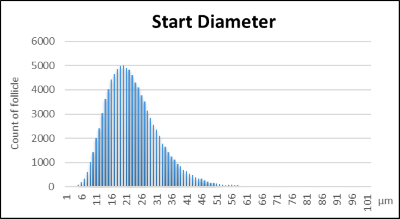
Figure 3.
Start diameter
Next, we set the total concentration of iodine in the blood , where
 are concentrations of iodine received by the i-th follicle. The concentrations of iodine are distributed evenly between all follicles. In other words, takes on V/N values.
The first step in solving the above system of ordinary differential equations (2)-(5) is to determine the initial concentrations of all substances. The initial concentrations of substances are selected according to 5 :
: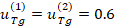 , and
, and ; and in the present work the concentrations depend on the diameter of the i-th follicle. The starting diameter is generated according to the lognormal law by formula (1); the starting diameter distribution is shown in Figure 3.
Let us consider cases of iodine excess and deficit to estimate the general dynamics of follicle diameters. At the uniform distribution of iodine at each iteration on all follicles equal to = 0.96, the follicles' sizes tend to decrease which specifies excess of iodine.
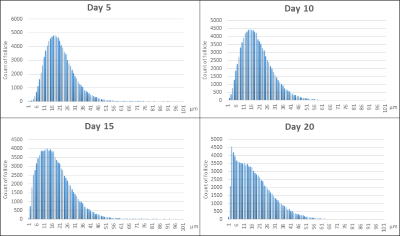
Figure 4.
Iodine express
With iodine deficit, the diameters gradually increase in size, since the follicles accumulate thyroid hormones in themselves, without releasing them into the blood.
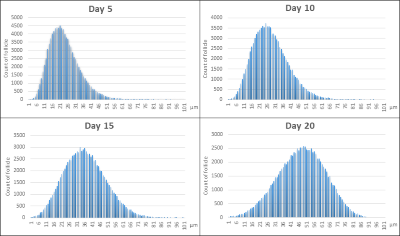
Figure 5.
Iodine deficit
Conclusion
In this paper, the thyroid gland's work is studied, and a mathematical model of the thyroid gland is constructed, which considers the thyroid gland as a mega-system consisting of a certain number of follicles. According to the results of studies, this approach allows more accurate tracking of changes occurring with a single follicle and, as a consequence, the work of the entire organ.
If the thyroid gland is healthy, the follicle size distribution is lognormal. This distribution is reproduced with the help of built-in functions for generating values.
The model itself is the system of nonlinear differential equations, which is solved by the Euler method. The size distribution changes relatively lognormally up or down due to iodine deficit or excess, respectively.
In further work with the model, it makes sense to use parallel algorithms of calculation. The model can also be made even more sophisticated, employing considering the thyroid gland's interaction with other organs of the endocrine system, especially with the pituitary gland.
Acknowledgments
The work is performed according to the Russian Government Program of Competitive Growth of Kazan Federal University.
References
1. Ministry of Health of the Russian Federation. 2014. Statistical Collection [in Russian]
2. Ministry of Health of the Russian Federation. 2017. Statistical Collection [in Russian]
3. Degon, M., Chipkin, S.R., Hollot, C.V., Zoeller, R.T., Chait, Y. 2008. A computational model of the human thyroid. Mathematical Biosciences, 212(2): 22-53.
4. Pandiyan, B. 2019. Mathematical Modeling of Thyroid Size and Hypothyroidism in Hashimoto’s Thyroiditis. Goiter - Causes and Treatment, N.K. Agrawal, IntechOpen, 23 Dec. doi: 10.5772/intechopen.90481.
5. da Silva, J.G., de Morais, R.M., da Silva, I.C.R., de Arruda Mancera, P.F. 2019. Mathematical models applied to thyroid cancer. Biophysical Reviews, 11: 183–189, doi: 10.1007/s12551-019-00504-7
6. Berberich, J., Dietrich, J.W., Hoermann, R., Müller, M.A. 2018. Mathematical Modeling of the Pituitary–Thyroid Feedback Loop: Role of a TSH-T3-Shunt and Sensitivity Analysis. Front Endocrinol (Lausanne), 9(91).
7. Balykina, H., Kolpak, E., Kotina, E. 2014. Mathematical Model of Thyroid Function. Middle-East Journal of Scientific Research, 19(3): 429-433.
8. Ognerubov, N.A., Zhukov, A.O., Sergeev, R.S. 2016. Individual differences of surgery anatomy of thyroid gland: literature review. Bulletin of Russian universities. Mathematics, 21(2): 541-550, [in Russian]
9. Sapin, M.R., Nikolenko, L.L., Nikityuk, D.B. 2018. Textbook of human anatomy. 2: 90-95, [in Russian]
10. Lubimova, Z.V., Nikitina, A.A. 2017. Age anatomy and physiology, 1: 149-152, [in Russian]
11. Singh, R., Beigh, S.A. 2013. Diseases of Thyroid in Animals and Their Management. In Insights from Veterinary Medicine, Ed. Rita Payan-Carreira, IntechOpen, doi: 10.5772/55377
12. Jackson, J.L. 1931. The shape and size of the human thyroid follicle in health and disease. The Anatomical Record, 48(2): 219-239, doi: 10.1002/ar.1090480202
13. Hartoft-Nielsen, M.L., Rasmussen, Å.K., Feldt-Rasmussen, U., Buschard, K., Bock, T. 2005. Estimation of number of follicles, volume of colloid and inner follicular surface area in the thyroid gland of rats. Journal of Anatomy, 207(2): 117-124, doi: 10.1111/j.1469-7580.2005.00442.x
14. Knigge, K.M. 1957. Influence of cold exposure upon the endocrine glands of the hamster, with an apparent dichotomy between morphological and functional response of the thyroid. The Anatomical Record, 127(1): 75-95, doi: 10.1002/ar.1091270108
15. Yocom, H.B. 1928. Histological differences in the thyroid glands from two subspecies of Peromyscus maniculatus. The Anatomical Record, 39(1): 57 - 67, doi: 10.1002/ar.1090390105
16. Igbokwe, C.O., Ezeasor, D.N. 2015. Histologic and ultrastructural observations on the thyroid gland of the White Fulani (Zebu) cattle in Northern Nigeria. African Journal of Biotechnology, 14(2): 156-166, doi: 10.5897/AJB2014.13678
17. Gaikwad, J.R., Dope, S.A., Joshi, D.S. 2012. Histogenesis of Developing Human Thyroid. Indian Medical Gazette: 57-61,
18. Tomonari, M. 1959. Histological studies on the mammalian thyroid glands. Archivum Histologicum Japonicum, 17(4): 497-523, doi: 10.1679/aohc1950.17.497
19. Dror, A.A., Lenz, D.R., Shivatzki, S., Cohen, K., Ashur-Fabian, O., Avraham, K.B. 2014. Atrophic thyroid follicles and inner ear defects reminiscent of cochlear hypothyroidism in Slc26a4-related deafness. Mammalian Genome, 25(7-8): 304-316, doi: 10.1007/s00335-014-9515-1
20. Penel, C, Rognoni, J.B., Bastiani, P. 1985. Thyroid morphological and functional heterogeneity: impact on iodine secretion. General Physiology and Biophysics, 4(1): 55-68,
21. Pleshchinskii, N., Tormasov, A., Tumakov, D. 2015. Model for reliable location of information in storage systems redundancy”, Applied Mathematical Sciences, 9(141): 7027-7042, doi: 10.12988/ams.2015.510652
22. Fadeeva, E. 2020. The mathematical model of the functioning of the thyroid gland. Master's Thesis, Czech Technical University in Prague, Czech Republic.