Artículos
Can the energetic supplementation of ewes influence the behavioral performance of their newborn lambs?
¿La suplementación energética de las ovejas puede influenciar el desempeño conductual de sus corderos neonatos?
 Rafael Arturo Torres-Fajardo rafael-arturo-torres@outlook.es
Mónica Andrea Cardozo-Herrán mach2706@hotmail.com
Ramón Cámara-Sarmiento rcamara@uady.correo.mx
Carlos Alberto Sandoval-Castro carlos.sandoval@correo.uady.mx
Juan Felipe de Jesús Torres-Acosta tacosta@correo.uady.mx
Pedro Geraldo González-Pech pedro.gonzalez@correo.uady.mx
Rafael Arturo Torres-Fajardo rafael-arturo-torres@outlook.es
Mónica Andrea Cardozo-Herrán mach2706@hotmail.com
Ramón Cámara-Sarmiento rcamara@uady.correo.mx
Carlos Alberto Sandoval-Castro carlos.sandoval@correo.uady.mx
Juan Felipe de Jesús Torres-Acosta tacosta@correo.uady.mx
Pedro Geraldo González-Pech pedro.gonzalez@correo.uady.mx
Can the energetic supplementation of ewes influence the behavioral performance of their newborn lambs?
Ciencia y Agricultura, vol. 17, no. 2, 2020
Universidad Pedagógica y Tecnológica de Colombia

This work is licensed under Creative Commons Attribution 4.0 International.
Received: 30 March 2020
Accepted: 11 May 2020
Abstract: The present work evaluated the effect of an energetic supplement (an extra 15% of 1the requirement) intake during the last month of gestation on the suckling behavior of neonatal lambs born from these ewes. The study was performed in a semi- intensive and commercial flock under hot sub humid tropical conditions. 12 Pelibuey ewes and their 20 newborn lambs were included. Five lamb behaviors were evaluated: number of vocalizations (NV), attempts to stand up (ASU), latency to keep stands (LKS), started looking for the udder (SLU) and achieved an effective suckling (AES). Twelve lambs conformed the control group [CG] and came from seven ewes which received an energetic supplementation of 7.37 megajoules of metabolizable energy per day (MJ EM/d). Likewise, eight lambs conformed the treatment group [TG] and came from five ewes which received a high energetic supplementation of 10.85 MJ EM/d. Both groups of ewes gave birth simultaneously. Response variables were initially categorized in low-or-high intensity using their quartile distribution and considering the median value as the reference point and analyzed post-hoc with the Fisher test. Behaviors of high and low intensity in lambs were similar in four of the five variables observed for both treatments. A significant difference was observed in the frequency of ASU, in lambs born from treated ewes when compared with lambs born from control ewes (P = 0.0281). The present results suggest that under semi-extensive breeding systems, the extra supplementation of ewes at 15 % of their energetic requirements during the last pregnancy month is reflected just in a slight improvement of the lamb’s behaviors.
Keywords: energetic supplementation, hair sheep, neonatal behavior.
Resumen: El presente trabajo evaluó el efecto del consumo de un suplemento energético (15 % extra del requerimiento) durante el último mes de gestación sobre la conducta de amamantamiento de los corderos neonatos nacidos de estas ovejas. El estudio se realizó en una granja comercial semi-intensiva bajo condiciones tropicales cálidas subhúmedas. Se incluyeron 12 ovejas Pelibuey y sus 20 corderos recién nacidos. Se evaluaron cinco conductas del neonato: número de vocalizaciones (NV), intentos para ponerse en pie (IQP), latencia para ponerse pie (LDP), comienzo de la búsqueda de la ubre (BU) y amamantamiento efectivo (AE). Doce corderos conformaron el grupo control [GC] y provenían de 7 ovejas que recibieron una suplementación energética de 7.37 mega julios de energía metabolizable por día (MJ EM/d). Por su parte, ocho corderos conformaron el grupo tratado [GT] y provenían de 5 ovejas que recibieron una suplementación energética alta (10.85 MJ EM/d). Ambos grupos parieron de manera simultánea. Las variables de respuesta fueron inicialmente categorizadas como de baja o alta intensidad utilizando la distribución de sus cuartiles y considerando el valor de la mediana como punto de corte y analizadas post-hoc a través de la prueba de Fisher. Las conductas de alta y baja intensidad de los neonatos fueron similares en cuatro de los cinco comportamientos observados en ambos tratamientos. Se observó una diferencia significativa en la frecuencia de intentos para ponerse de pie en los corderos de ovejas tratadas comparados a los corderos de ovejas control (P = 0.0281). Estos resultados sugieren que en sistemas de crianza semi-intensivos, la suplementación extra del 15 % de las madres durante el último mes de gestación solo se refleja en una ligera mejoría de las conductas de sus neonatos
Palabras clave: comportamiento neonatal, ovino de pelo, suplementación energética.
I. INTRODUCTION
In precocial species, like sheep, the role of the neonatal behavior to ensure survival is highly relevant and can be, at least as important as the mother’s behavior (Dwyer, 2003). Since lambs are born with a limited energetic reserve, finding the teat and suckling colostrum as soon as possible becomes of paramount importance for their survival (Nowak & Poindron, 2006). It is well known that the capacitation process of the lambs is partly influenced by some tactile (Schaal et al., 1995; Nowak et al., 2008), auditive (Dwyer et al., 1998) and visual cues (Nowak et al., 2008). However, environmental factors such as nutrition, are also capable of modulating the behavioral performance of ewes and newborn lambs (Dwyer et al., 2003; Hernández et al., 2009; Dwyer, 2014).
The natural scenario for Pelibuey sheep flocks in Yucatán consists in a grazing period of four to six hours a day, in which they must obtain enough nutrients to fulfil their physiological requirements (Torres-Acosta et al., 2000). However, under this nutritional context, scarcity of energy (given the abundance of leguminous plants in the rangeland) is the common picture (Torres-Acosta et al., 2016). Hence, supplementation with high-energetic resources has been proposed as an alternative method to maintain and improve sheep health and welfare (Retama-Flores et al., 2012).
In the local literature, there are few studies aimed at investigating the behavioral catalogue of sheep during the early postpartum period under farm conditions. Olazábal et al. (2013) reported alterations in the mother-lamb mutual recognition in Columbia ewes subjected to a nutritional restriction during the second half of gestation. Also, Ramírez et al. (2011) used Pelibuey ewes/lambs under controlled conditions and described the mother-lamb behaviors during the first postpartum hour. More recently Escobedo-Canul et al. (submitted) investigated the effect of lambing enclosure (individual pens vs. group pens) on the establishment of the mother-lamb bond and reported similar maternal performance in both systems, although ewes seemed quieter on individual enclosures. Apart from these studies, to our knowledge, there are still no studies focusing on the behavioral set displayed by lambs in their early life stages in tropical farms. We hypothesize that an extra-energy supplementation of ewes during their last month of pregnancy may provide ewes with more energy reserves and may also produce larger lambs, which may display an improved behavioral set compared to lambs born from ewes without supplementation. Consequently, the objective of this study was to evaluate the effect of energy food supplementation for ewes during the last month of pregnancy on the behavioral performance of their neonate lambs at birth, related to their sucking instinct under hot semihumid tropical farm conditions.
II. METHODS AND MATERIALS
A. Study area
This study was performed at the small ruminant area of the Faculty of Veterinary Medicine, Universidad Autónoma de Yucatán (FMVZ-UADY) located in Mérida City, México (20°58ˈ N and 89°36ˈ). Experimental protocol fulfilled the standards of the animal welfare committee at FMVZ-UADY. Experimental pen consisted of a structure of 12 x 12 m with a shading area comprising around 20% of the pen area.
B. Experimental animals and group formation
A group of 12 multiparous Pelibuey ewes was used. After confirmation of their pregnancy status through abdominal palpation (Soto, 2004), ewes were allocated randomly according to weight, body condition score and parturition number, to one of two groups as follows:
The control group (CG): Composed of seven ewes supplemented during the last pregnancy month with 300 g fresh basis of a grain-based feed made with sorghum, corn, molasses, hay and minerals. This feed was equivalent to 7.37 mega-joules of metabolizable energy per day (MJ EM/day). The latter fulfilled the energy requirements of ewes during the last four weeks of pregnancy. Supplementation was performed daily at 12:00 hours when the flock returned from browsing to their pens where they spend the rest of the day indoors. Freshwater was provided ad libitum in an automatic water trough system.
The treatment group (TG): Composed of five ewes supplemented with 600 grams of the grain-based feed composed of the same ingredients mentioned above. The feed was equivalent to 10.85 MJ EM/day. Animals received the supplement at the same time of the day as their counterparts. This supplement represented an extra-energy supply of 15% of the energy requirements for ewes during the last four pregnancy weeks.
A group of twenty experimental lambs was obtained from the ewes. Eight lambs were born from the ewes of the TG, and the remaining twelve lambs were born from ewes belonging to the CG.
C. Procedure and behavioral observations
Since the beginning of the 4th week of the supplementation period, ewes were 1habituated to the presence of observers inside and outside of the pen. Support from area staff was provided to maintain 24 h of continuous vigilance over the experimental ewes. Characterization of behaviors related to an imminent birth was done following the guidelines of Nowak et al. (2008). Assistance was only provided if, after fluids appeared in the vulva, the ewe spent more than 1 hour without completing the parturition process, or after the emergence of any lamb body-part without achieving a normal birth process. In any case, the intervention was aimed to be gentle and to allow the ewe to continue their normal parturition process.
Observations were performed in the lambs from the moment of birth by two previously trained observers inside pens with the aid of chronometers, video cameras, sac counters and record formats. An approach of “direct but discrete observations” was implemented (Fahmy et al., 1997). After the observers noticed the lamb emerging from the ewe and falling in the floor, the recording time commenced and lasted for 1 hour. Behavioral catalogue of lambs was previously defined in an ethogram to measure the number of vocalizations (NV), attempts to stand up (ASU), latency to keep stands (LKS), started looking for the udder (SLU) and achieved an effective suckling (AES) (Table I).
| Behavior | Description | Measure type |
| Bleat | Vocalization emitted by the lamb | Frequency |
| Attempt to stand | The lamb supports his/her weight with the four limbs in a period of less than five seconds | Latency |
| On feet | The lamb is capable to support himself with their four limbs during a period of 5 or more seconds | Latency |
| Looking for contact | Once the lamb stands, it begins the exploration of his/her mother’s body using the tactile and olfactory cues which allows them to find the teat | Latency |
| Effective suckling | The lamb can reach a teat with his/her mouth, and feed on it during a period of five or more seconds | Latency |
Frequency means the number of times that a behavior is registered within the observation period.
Latency means the period that the lamb takes since it is expelled until it presents a specific behavior.For effective suckling we use as a guide the “fast-tail-movements” characteristic of small ruminants when they are ingesting milk from the mother
D. Data Analysis
The distribution of data was visualized using boxplot graphics (Figure I). According to this methodology, the median (second quartile) was used as the reference point to categorize the intensity of each behavior into low (under the median) or high presentation (above of the median). Then, a Fisher test was used to establish the association between the energy level of nutrition of the ewes (low or high) and the intensity (low or high presentation) of the observed set of behaviors. A P value < 0.05 was considered as significant. All procedures were performed using the statistical program R (R Core Team, 2018).
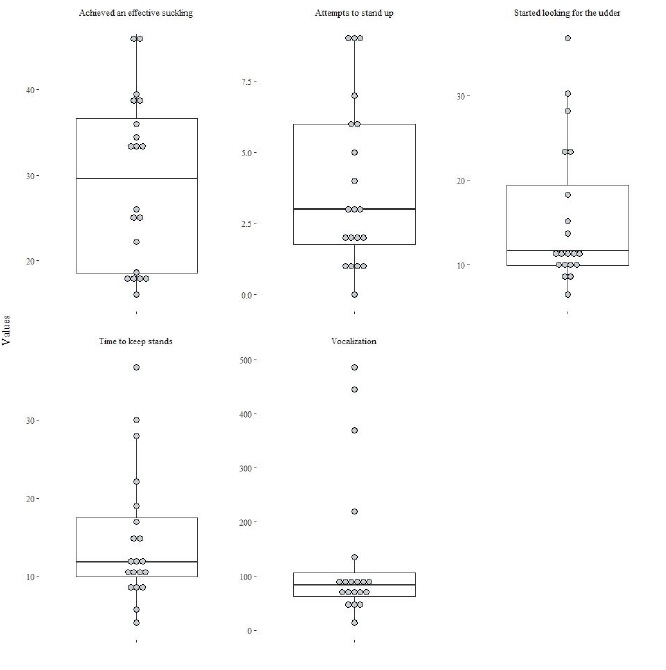
Figure I.
Data distribution using boxplot diagrams for each of the different behaviors in neonatal Pelibuey lambs
The thick horizontal line inside every box corresponded to the median (second quartile). This value was used to categorize every behavior measured on lambs into low or high intensity, respectively.
The grey points represent the data of each experimental animal
III. RESULTS
A total of 20 lambs (3.46 ± 0.49 kg) were born and used. Within these lambs, 8 belonged to the ewes in the TG and 12 belong to dams in the CG. 16 lambs were twins, while the remaining 4 were born as singles. All experimental lambs were capable to reach the udder and take colostrum within the first hour of life. Additionally, all the ewes showed cooperative behaviors with their lambs within the observation period. Assistance was provided to one ewe of the TG and consisted of a brief accommodation of their lamb’s forelimb at parturition moment.
The reference point (median) for the measured behaviors was 11.8 minutes for LKS, 11.7 minutes for SLU, 29.1 minutes for AES, 83 times for NV and 3 times for ASU. The other descriptive values for each behavior can be seen in Table II.
| Group | Mean | S.E | Median | Min | Max | P Value | 95% CI | |
| Vocalizations (frequency) | CG | 174.75 | 55.02 | 93 | 14 | 444 | 0.1698 | 0.6026 – 703.8309 |
| TG | 108.08 | 35.15 | 73 | 41 | 486 | |||
| Attempts to stand up (frequency) | CG | 6.62 | 0.86 | 6.5 | 2 | 9 | 0.0281 | 1.0017 – 703.9391 |
| TG | 1.61 | 0.33 | 2.0 | 0 | 4 | |||
| Latency to keep stands (latency) | CG | 16.90 | 3.28 | 15.8 | 4 | 30 | 0.6499 | 0.2725 – 21.9391 |
| TG | 13.37 | 2.33 | 10.7 | 5.7 | 36.8 | |||
| Started looking for the udder (latency) | CG | 19.32 | 2.94 | 20.70 | 8.4 | 30.3 | 0.1698 | 0.4387 – 55.6169 |
| TG | 12.97 | 2.26 | 10.95 | 6.5 | 36.8 | |||
| Achieved effective suckling (latency) | CG | 28.54 | 2.42 | 33.10 | 17.4 | 38.4 | 0.6499 | 0.2725 – 21.9391 |
| TG | 30.08 | 3.41 | 23.85 | 16 | 46.5 |
Frequency means the number of times that a behavior is registered within the observation period.
Latency means the period that the lamb takes since it is expelled until it presents a specific behavior.
S.E: Standard error of the mean
CG: Control Group, TG: Treatment group
Min: lowest data for each group
Max: highest data for each group
A P value < 0.05 was considered as significative
According to the previous classification of response variables, the P values from the Fisher test showed significance in ASU, with fewer attempt in the TG lambs compared to the CG lambs (P = 0.0281). No difference was observed for the other behaviors (Table II).
IV. DISCUSSION
The importance of a proper ewe-lamb bond has been highlighted as a key factor for minimizing lamb losses in farms (Dwyer et al., 2016). The latter is important because perinatal mortality has been considered as one of the main constraints for the sheep industry in various parts of the world (Fragkou et al., 2010; Darwish & Ashmawy, 2011), including México (Nava-López et al., 2006; Macedo et al., 2010). Hence, any on-farm strategy that contributes to overcome lamb losses is worth to be studied. In this context, nutritional status of ewes during pregnancy has been considered as one of the factors influencing the development of the ewe-lamb bond under different productive systems (Dwyer et al., 2003; Erhard et al., 2004; Rooke et al., 2010; Gronqvist et al., 2018).
The objective of this work was to evaluate the effect of the energetic food supplementation (15% extra of requirement) of Pelibuey ewes during the last month of pregnancy on the behavioral performance of their neonate lambs concerning their suckling instinct under the conditions of a hot tropical farm. This approach aimed at providing ewes with the necessary energy supplementation at the end of parturition. To the best of our knowledge, this is the first work involving together nutritional and ethological approaches in order to better understand some components of the ewe-lamb bond in sheep fed native vegetation in a tropical forest. Some subsequent local works were done to assess the influence of lambing enclosure (Escobedo-Canul et al. submitted) and the effect of polyunsaturated fatty acids supplementation (Valladares-González, 2019) on the ewe-lamb bond.
A rumen degradable energy supplement was used as an alternative to overcome the nutritional shortage of tropical pastures, as well as high availability of protein fodder (Retama-Flores et al., 2012; Ventura-Cordero et al., 2018). Furthermore, supplementation can help to provide nutrients for the lambs’ growth in utero during the final stage of pregnancy and may offer an alternative to counteract the physical restraints of the rumen imposed by the growing foetus (Banchero et al., 2007 & 2009). Our results showed that all experimental lambs achieved an effective suckling within the first hour after birth, which was comparable to other studies performed under different experimental conditions (Fahmy et al., 1997; Capper et al., 2006; Ramírez et al., 2011; Madani et al., 2013).
Concerning the intensity of the neonate behaviors, they were similar for both experimental groups in most of the variables studied. On the contrary, the number of attempts to stand up (ASU) was lower in neonates from ewes that received energetic supplementation. This result shows the relevance of offering extra energy on pregnant ewes to obtain higher energetic reserves on their lambs since, in the first moments after birth, such reserves are necessary to display key behaviors related to stand-up, suckling, and survival (Nowak & Poindron, 2006). For lambs, trying to stand up is an energy-demanding process and the sooner they stand, with fewer attempts, lambs may reduce their energy expenditure. For this reason, if a lamb can stand up rapidly after birth, it will reduce heat loss through convection in moist floors (Dwyer & Morgan, 2006), which is a common feature in a normal birth scenario. These lambs may also obtain their colostrum sooner than others, which may provide more energy for them. The latter highlights the necessity of obtaining evidence under farming conditions like those of the present study. In the present work, the energetic supply of the CG-diet represents around 75% of the requirements during the last two pregnancy weeks, while the TG-diet accounts for 115% during the same period (AFRC, 1993). Our results could be comparable with Budge et al. (2000), which found that lambs from ewes feeding the 150% of their metabolizable energy requirements during the last third of pregnancy increased the thermogenic capacity of their brown fat when compared to lambs from ewes maintained with the 100% of their energy requirements at the same pregnancy stage.
Offering extra energy at the end of gestation is also relevant for tropical sheep farms were an important proportion of flocks are managed on extensive or semi-intensive conditions (Cuéllar et al., 2012). Those regions use heterogeneous tropical forest vegetation as an important source of forages with a high array of availability constituted of plant species dominated by legumes which are feed resources high in protein and low in energy (Flores & Bautista, 2012; Torres-Acosta et al., 2016; Torres-Fajardo et al., 2019). The present study helped to counterbalance the effect of nutrition improvements on neonate’s behavior when a baseline or control group is already fulfilling their nutritional requirements. Future research should cover the behavioral responses of ewes and lambs under complete extensive feeding systems, where there is no human control over the lambing season.
V. CONCLUSION
Most observed behaviors were similar in the experimental lambs irrespective of the dietary energy supplementation level. Neonates born from ewes supplemented with extra-energy showed better performance on one behavior pattern (number of attempts to stand up), which made them more suitable for survival when compared with the control group, especially in natural grazing scenarios.
REFERENCES
AFRC. (1993). Necesidades energéticas y proteicas de los rumiantes. Edición al español. Acribia. Zaragoza, España. p 57.
Banchero, G., Quintans, G., Lindsay, A & Milton, J. (2009). A pre-partum lift in ewe nutrition from a high energy lick or maize or by grazing Lotus uliginosus pasture, increases colostrum production and lamb survival, Animal, 3(8), 1183-1188. doi: https://doi.org/10.1017/S1751731109004571
Banchero, G., Quintans, G., Vazquez, F., Gigena, F., La Manna, A., Lindsay, D & Milton, J. (2007). Effect of supplementation of ewes with barley or maize during the last week of pregnancy on colostrum production, Animal, 1(4), 625-630. doi: https://doi.org/10.1017/S1751731107691885
Budge, H., Bispham, J., Dandrea, J., Evans, E., Heasman, L., Ingleton, P., Sullivan, C., Wilson, V., Stephenson, T & Symonds, M. (2000). Effect of maternal nutrition on brown adipose tissue and its prolactin receptor status in the fetal lamb. PediatricResearch, 47(6), 781-786. DOI: https://doi.org/10.1203/00006450-200006000-00017
Capper, J., Wilkinson, R., MacKenzie, A & Sinclair, L. (2006). Polyunsaturated fatty acid supplementation during pregnancy alters neonatal behaviour in sheep. The Journal of Nutrition, 136(2), 397-403. DOI: https://doi.org/10.1093/jn/136.2.397
Cuéllar, J., Tórtora, J., Trejo, A & Román, P. (2012). La Producción Ovina Mexicana: particularidades y complejidades. Universidad Nacional Autónoma de México. Facultad de estudios superiores Cuautitlán. Ed. Ariadna. p 13.
Darwish, R & Ashmawy, T. (2011). The impact of lambing stress on post-parturient behaviour of sheep with consequences on neonatal homeothermy and survival. Theriogenology, 76(6), 999-1005. doi https://doi.org/10.1016/j.theriogenology.2011.04.028.
Dwyer, C. (2014). Maternal behavior and lamb survival: from neuroendocrinology to practical application, Animal, 8(1), 102-112. doi: https://doi.org/10.1017/S1751731113001614
Dwyer, C.M. (2003a). Behavioural development in the neonatal lamb: effect of maternal and birth- related factors. Theriogenology, 59(3-4), 1027-1050. DOI: https://doi.org/10.1016/S0093-691X(02)01137-
Dwyer, C & Morgan, C. (2006). Maintenance of body temperature in the neonatal lamb: Effects of breed, birth weight, and litter size. Journalof Animal Science, 84(5),1093-1101. doi: https://doi.org/10.2527/2006.8451093x
Dwyer, C.M., Connington, J., Corbiere, F., Holmoy, I.H., Muri, K., Nowak, R., Rooke, J., Vipond,J & Gautier, J.M. (2016). Invited Review: Improving neonatal survival in small ruminants: science into practice. Animal, 10(3), 449-459. https://doi.org/10.1017/S1751731115001974
Dwyer, C., Lawrence, A., Bishop, S & Lewis, M. (2003). Ewe lamb bonding behaviours at birth are affected by maternal undernutrition in pregnancy, British Journal of Nutrition, 89(1), 123-146. DOI: https://doi.org/10.1079/BJN2002743
Dwyer, C., McLean, K., Deans, L., Chirnside, J., Calvert, S & Lawrence, A. (1998). Vocalizations between mother and young in sheep: effects of breed and maternal experience, AppliedAnimal Behaviour Science, 58(1-2), 105-119. https://doi.org/10.1016/S0168-1591(97)00113-5.
Erhard, H., Boissy, A., Rae, M & Rhind, S. (2004). Effects of prenatal undernutrition on emotional reactivity and cognitive flexibility in adult sheep. Behavioural Brain Research, 151(1-2), 25-35. https://doi.org/10.1016/j.bbr.2003.08.003.
Escobedo-Canul, J.A., González-Pech, P.G., Sandoval-Castro, C.A., Cámara-Sarmiento, R & Sarmiento-Franco, L. Compared to grouped lambing, isolation favorize calm animals and faster mother-lamb recognition but not lambs’ survival in tropical hair sheep farms. (submitted to Applied Animal Behaviour Science)
Fahmy, M., Robert, S & Castonguay, F. (1997). Ewe and lamb behavior at parturition in prolific and non-prolific sheep, Canadian Journal of Animal Science, 77(1), 9-15. https://doi.org/10.4141/A96-014
Flores, J.S & Bautista, F. (2012). Knowledge of the Yucatec maya in seasonal in seasonal tropical forest management: the forage plants. Revista Mexicana de Biodiversidad, 85, 503-512. DOI: http://dx.doi.org/10.22201/ib.20078706e.2012.2.1243.
Fragkou, I., Mavrogianni, V & Fthenakis, G. (2010). Diagnostic investigation of cases of deaths of newborn lambs. Small Ruminant Research, 92(1-3), 41-44. https://doi.org/10.1016/j.smallrumres.2010.04.013.
Gronqvist, G.B., Corner-Thomas, R.A., Kenyon, P.R., Stafford, K.J., Morris, S.T & Hickson, R.E. (2018). The effect of nutrition and body condition of triplet-bearing ewes during late pregnancy on the behavior of ewes and lambs. Asian-Australasian Journal of Animal Sciences, 31(12), 1991-2000. https://doi.org/10.5713/ajas.17.0890
Hernández, C., Matthews, L., Oliver, M., Bloomfield, F & Harding, J. (2009). Effects of sex litter size, and periconceptional ewe nutrition on the ewe- lamb bond, Applied Animal Behaviour Science, 120(1-2), 76-83. https://doi.org/10.1016/j.applanim.2009.04.012.
Macedo, R., Arredondo, V., Rodrígues, J., Ramírez, J & López, B. (2010). Effect of production system, season of lambing and sex on neonatal mortality of Pelibuey lambs. Tropical and Subtropical Agroecosystems, 12(1), 77 – 84.
Madani, T., Allouche, L., Saffidine, N., Kaouane, N., Belskami, F & Semara, L. (2013). Maternal and neonatal behaviors of Ouled Djellal sheep breed and their effects on production parameters. Small Ruminant Research, 114(1), 46-50. https://doi.org/10.1016/j.smallrumres.2013.06.003
Nava-López, V.M., Oliva-Hernández, J & Hinojosa-Cellar, J.A. (2006). Mortalidad de los ovinos de pelo en tres épocas climáticas en un rebaño comercial en la Chontalpa, Tabasco, México. Universidad y Ciencia, 22(2), 119-129.
Nowak, R., Porter, R., Blache, D & Dwyer, C. (2008). Behaviour and the welfare of sheep. In: C.M, Dwyer Ed. The Welfare of Sheep, Edinburgh: Springer. pp 81-134.
Nowak, R & Poindron, P. (2006). From birth to colostrum: early steps leading to lamb survival. Reproduction, Nutritionand Development, 46(4), 431-446. DOI: https://doi.org/10.1051/rnd:2006023
Olazábal, A., Vera, H., Serafin, N., Medrano, J., Sánchez, H & Terrazas, A. (2013). Reconocimiento mutuo madre-cría en ovinos Columbia con restricción nutricional durante la gestación, Revista Mexicana de Ciencias Pecuarias, 4(2), 127-147.
R Core Team (2018). R: A language and environment for statistical computing. R Foundation for Statistical Computing, Vienna, Austria. URL https://www.r-project.org/
Ramírez, M., Soto, R., Poindron, P., Álvarez, L., Valencia, J., González, F & Terrazas, A. (2011). Comportamiento maternal alrededor del parto y reconocimiento madre-cría en ovinos Pelibuey, Veterinaria de México, 42(1), 27-46.
Retama-Flores, C., Torres-Acosta, J.F.J., Sandoval-Castro, C.A., Aguilar-Caballero, A.J & Cámara- Sarmiento, R. (2012). Maize supplementation of Pelibuey sheep in a silvopastoral system: fodder selection, nutrient intake and resilience against gastrointestinal nematodes. Animal, 6(1), 145-153. doi: https://doi.org/10.1017/S1751731111001339.
Rooke, J., Houdijk, J., Mcllvaney, K., Ashworth, C & Dwyer, C. (2010). Differential effects of maternal nutrient restriction between days one and ninety of pregnancy on ewe and lamb performance and lamb parasitism of ewes in high and lowland breeds. Journal of Animal Science, 88(12), 3833-3842. https://doi.org/10.2527/jas.2010-2991.
Schaal, B., Orgeur, P & Arnold, C. (1995). Olfactory preferences in newborn lambs: Possible influence of prenatal experience, Behaviour, 132(5-6), 351-365. https://doi.org/10.1163/156853995X00603
Soto, A.T. (2004). Fecundación, gestación y parto. Diagnóstico de la gestación. En: E.G Aisen Ed. Reproducción Ovina y Caprina, Buenos Aires: Intermédica. pp 115-131
Sykes, A. (1982). The shelter requirements of the newborn lamb. Proceedingsof New Zealand Society for Animal Production. 42, 7-11.
Torres-Acosta, J.F.J., González-Pech, P.G., Ortiz-Ocampo, I.G., Rodríguez-Vivas, I., Tun-Garrido, J., Ventura-Cordero, J., Castañeda-Ramírez, G.S., Hernández-Bolio, G.I., Sandoval-Castro, C.A., Chan-Pérez, J.I & Ortega-Pacheco, A. (2016). Revalorizando el uso de la selva baja caducifolia para la producción de rumiantes, Tropical and Subtropical Agroecosystems, 19(1), 73-80.
Torres-Acosta, J., Gutiérrez, E., May, N., Babington, J., Evans, J., Bearman, K., Schmidt, A., Fordham, T., Butler, V., Lightsey, J., Brownlie, T., Schroer, S. & Cámara, G. (2000). Descripción de los sistemas de producción caprina de Yucatán, México, En: Memorias de la XV reunión nacional sobre caprinocultura, Mérida, Yucatán, México, (Universidad Autónoma de Yucatán, Asociación Mexicana de Producción Caprina A.C) 202—205.
Torres-Fajardo, R.A., Navarro-Alberto, J.A., Ventura-Cordero, J., González-Pech, P.G., Sandoval-Castro, C.A., Chan-Pérez, J.I & Torres-Acosta, J.F.J. (2019). Intake and selection of goats grazing heterogeneous vegetation: Effect of gastrointestinal nematodes and condensed tannins. Rangeland Ecology and Management, 72(6), 946 – 953. https://doi.org/10.1016/j.rama.2019.08.002
Valladares-González, D.A. (2019). Efecto del aceite de soya en la dieta sobre algunos parámetros productivos de la oveja de pelo gestante y su cría. (Tesis de Maestría). Universidad Autónoma de Yucatán.
Ventura-Cordero, J., González-Pech, P.G., Sandoval-Castro, C.A., Torres-Acosta, J.F.J. & Tun-Garrido, J. (2018). Feed resource selection by Criollo goats browsing a tropical deciduous forest. Animal Production Science, 58(12), 2314-2320. https://doi.org/10.1071/AN16388.
Additional information
Como Citar: Torres-Fajardo. R., Cardozo - Herrán. M., Camara-Sarmiento. R., Sandoval – Castro. C., Torres-Acosta. J., González- Pech. P. (2020) Can the energetic supplementation of ewes influence the behavioral performance of their newborn lambs?. Revista Ciencia y Agricultura. 17(2):32-38 DOI: https://doi.org/10.19053/01228420.v17.n2.2020.10790