The Application of Electrostatic Precipitator (ESP) as Pollutant Reduction in Ship
Aplicação do Precipitador Eletrostático (ESP) como Redução de Poluentes em Navios
La aplicación del precipitador electrostático (ESP) como reducción de contaminantes en el barco
 Ari Yudha Lusiandri ariyudha@poltekpel-sby.ac.id
Antonius Edy Kristiyono antonius.edy@poltekpel-sby.ac.id
Kuncoro Luhur Waskito kuncoroluhurw@gmail.com
Ari Yudha Lusiandri ariyudha@poltekpel-sby.ac.id
Antonius Edy Kristiyono antonius.edy@poltekpel-sby.ac.id
Kuncoro Luhur Waskito kuncoroluhurw@gmail.com
The Application of Electrostatic Precipitator (ESP) as Pollutant Reduction in Ship
Research, Society and Development, vol. 8, no. 12, pp. 01-15, 2019
Universidade Federal de Itajubá

This work is licensed under Creative Commons Attribution 4.0 International.
Received: 11 September 2019
Revised: 17 September 2019
Accepted: 19 September 2019
Published: 27 September 2019
Abstract: The burning process of fuel from the main engine in ships impacts on air and sea pollution. Afterward, in overcoming the air pollution from the result burning in industry usually use electronic precipitator (ESP) by using electric field to precipitate gas pollutant from burning result. Thus, the aim of this research is making the concept of ESP (Electrostatic Precipitator) which can be used to reduce pollutant from the result burning in the main engine. Afterward, this research is used experiment as its method. The results of this study shows that before using the ESP tool, the NO2 levels is 7.70 mg/Nm3, while after using ESP Nitrogen Oxide (NO2) levels dropped to 3.85 mg/Nm3. Before using the ESP, the data on emissions gas had SO2 levels of 72.3 mg/Nm3, while after using ESP the levels of Nitrogen Oxide (NO2) dropped to 39.6 mg/Nm3. The level of Nitrogen Oxide (NO2) in gas emissions drops to 50% while the level of Sulfur Dioxide (SO2) in emission gas drops to 45.2%.
Keywords: Air pollution, Gas emission, Main engine, Sea pollution, Shipping.
Resumo: O processo de queima de combustível do motor principal nos navios afeta a poluição do ar e do mar. Posteriormente, para superar a poluição do ar causada pelo resultado da queima na indústria, geralmente use o precipitador eletrônico (ESP) usando o campo elétrico para precipitar o poluente gasoso do resultado da queima. Assim, o objetivo desta pesquisa é elaborar o conceito de ESP (Precipitador Eletrostático), que pode ser utilizado para reduzir o poluente resultante da queima do resultado no motor principal. Posteriormente, esta pesquisa é utilizada como método. Os resultados deste estudo mostram que, antes de usar a ferramenta ESP, os níveis de NO2 são 7,70 mg / Nm3, enquanto que após o uso do ESP, os níveis de óxido de nitrogênio (NO2) caíram para 3,85 mg / Nm3. Antes de usar o ESP, os dados sobre as emissões de gases apresentavam níveis de SO2 de 72,3 mg / Nm3, enquanto após o uso do ESP os níveis de óxido de nitrogênio (NO2) caíam para 39,6 mg / Nm3. O nível de óxido de nitrogênio (NO2) nas emissões de gases cai para 50%, enquanto o nível de dióxido de enxofre (SO2) no gás de emissão cai para 45,2%.
Palavras-chave: Poluição do ar, Emissão de gás, Motor principal, Poluição do mar, Transporte.
Resumen: El proceso de combustión del combustible del motor principal en los buques impacta en la contaminación del aire y del mar. Posteriormente, para superar la contaminación del aire causada por el resultado de la quema en la industria, usamos un precipitador electrónico (ESP) usando un campo eléctrico para precipitar el contaminante gaseoso del resultado de la combustión. Por lo tanto, el objetivo de esta investigación es crear el concepto de ESP (precipitador electrostático) que puede usarse para reducir la contaminación del resultado que se quema en el motor principal. Posteriormente, esta investigación se utiliza experimento como su método. Los resultados de este estudio muestran que antes de usar la herramienta ESP, los niveles de NO2 son 7.70 mg / Nm3, mientras que después de usar los niveles de óxido de nitrógeno ESP (NO2) cayeron a 3.85 mg / Nm3. Antes de usar el ESP, los datos sobre las emisiones de gas tenían niveles de SO2 de 72.3 mg / Nm3, mientras que después de usar el ESP los niveles de óxido de nitrógeno (NO2) cayeron a 39.6 mg / Nm3. El nivel de óxido de nitrógeno (NO2) en las emisiones de gas cae al 50%, mientras que el nivel de dióxido de azufre (SO2) en el gas de emisión cae al 45,2%.
Palabras clave: Contaminación del aire, Emisión de gases, Motor principal, Contaminación del mar, Envío.
1. Introduction
The burning process of fuel from the main engine impacts on air pollution. The burning result in a form of emission fuel either Sulfur Oxide (SO2) or Nitrogen Oxide (NO2) also impact on greenhouse effect that will lead into global warming. MARPOL 73/78 is assumed as the most ambitious international regulation in preventing sea pollution cause by the routine activity or ship accidence. However, MARPOL is not merely covering sea pollution preventing, but it also regulate poison materials and dangers materials including trash and waste from ship produced from routine operational through the five annex. Moreover, in amendment of 2007, the annex is added to regulate air pollution from ship namely Annex VI about Preventing Air Pollution from Ship.
The form has been applied since May 19, 2005 which contains of maximum limitation of Sulfur Oxide and Nitrogen Oxide from muffler ship and the prohibition of intention emission as materials that can damage the ozone. A chapter that is adopted in 2001 has covered the steps of energy efficiency and obligatory operational to reduce emission gas of greenhouse in ship. The impact of air pollution in the particular matter size <10 μ as the result of ship diesel engine fuel burning considered to be danger for heart and lung. Further, for particle ultrafine or UFPs which has size 100 nanometer or 0,1 μ or tiniest can cause inflammation and immunology reaction in the lung and even can entering the blood circulation (Kennedy, 2019).
In resolving the air pollution, science research collaboration and environment regulation has provided several innovations to reduce air pollution (Hernandez, 2013). In overcoming the air pollution from the result burning in industry usually use electronic precipitator (ESP) by using electric field to precipitate gas pollutant from burning result. Therefore, it is needed similar development for shipping importance which has contribution air pollution. The development can be in form of electrostatic precipitator (ESP) tool which uses in small scale of company necessary.
Regarding to the explanation above, the focus of this research is making the concept of ESP (Electrostatic Precipitator) which can be used to reduce pollutant from the result burning in main engine.
2. Literature Review
2.1 Sea Pollution and MARPOL 78/78
At first sight, the problems regarding with the sea pollution do not catching people attention especially relating to shipping activity. It can be seen from the regulation which is more concerning on sailing rights and state’s responsibility on registered ship and the state’s ship flag. Hence, the environment problem considered not to be the main focus and merely as an issue. Along with the demand and the need of Navy whether in national or global scale has provide bad impact and danger on environment.
Due to this consideration, Inter-Governmental Maritime Organization (IMCO) has formulated convention which is including regulation about overcoming and tackling the sea pollution cause by the ship namely MARPOL 73/38. MARPOL is not merely covering pollution but also from danger materials such as waste and rubbish from the ship.
In other side, MARPOL convention aims to eliminate all pollutions from ship and minimalize accidental discharge and voluntary discharge. Voluntary discharge can be described as discharge happened while the cleaning process on ship tanks and other operational. Meanwhile, accidental discharge is a discharge happened due to the incident dealing with the ship. The difference between these two discharges becomes important and significant since it needs a law application to control.
MARPOL 1973/1978 consists of six annexes which cover regulations dealing wit the overcoming effort or even pollution tackling from ship.
1. Annex 1 about oil pollution
The attachment of Annex 1 has been validated since October 2nd, 1983 which consists of regulation regulate the early detection to prevent sea pollution from ship activity. The Annex I Amendment has been happened in 1982 which obligates tanks ship to have double facility of submarine and instructs the exist tanks ship to use double submarines as well which being revised in 2001 and 2003.
2. Annex II about Regulation on Pollution Tackling Cause by Liquid Poison Material.
The attachment is started from October 2, 1983 which regulates any criteria of releasing and controlling by danger liquid cause by big ship. This regulation is covering 250 kinds of materials that do not allowed to throw into the sea. The residual releasing only allowed for certain concentration and condition vary based each category. Further, it is forbid to throw residual which contain of dangerous materials from 12 miles from the sea shore.
3. Annex III about Pollution Preventing Cause by Dangerous Materials in Sachet.
The amendment is applied start from July 1, 1992 which contains of general regulation to publish sachet standard, label, documentation, storage, and maximum limit. The third Annex has stated if “dangerous material” as essence which identified as sea pollutant in IMDG Code or covering the criteria in Annex III.
4. Annex IV about Pollutant Preventing Cause by Waste from Ship
The Annex IV is applied start from September 27, 2003 which contains of requirement to control pollution in sea environment by the waste. As known before that, throwing waste to the sea is forbidden, but there is exception in which the ship is in operation or the waste has been disinfection using the system that allowed in the radius 3 miles from nearest land, while waste that has not been disinfection should be thrown away from the radius 12 miles from the nearest land.
5. Annex V about Pollutant Preventing From Ship Waste
The amendment is applied start from December 31, 1988 which about agreement dealing with kind of waste that is forbid. Moreover, it is also regulate the requirement regarding with the limit distance in throwing the waste, as well as the procedure and the mechanism. The importance from Annex V is a whole regulation which clearly forbids any kind of plastic to be thrown into the sea.
6. Annex VI about Air Pollution Preventing from the Ship
The Annex VI is applied start from May 19, 2005 which contain of decree on maximum limitation of sulfur dioxide and nitrogen oxide from muffler ship emission. Further, Annex VI is also containing the prohibition of emission that can cause ozone precipitate. A chapter adopted in 2011 is covering efficiency steps of technical energy and obligatory operational aims to reduce emission greenhouse effect from ship.
These six Annex is central MARPOL regulation dealing with waste and pollution which forming integral part of MARPOL itself. It also strengthens MARPOL position as main legal instrument which strives to prevent sea pollution from ship cause by operational or even incidental cause.
2.2 Air Pollution
The air pollution currently become the crucial problem and have impact environment especially for health. One of the sources considered as the cause of pollution is the fuel burning either in solid (wood, coal, and charcoal), liquid (liquid fuel), and gas fuel (Karwall et al. 2018). Ships that are using HFO (High Fuel Oil) as its fuel consist of high sulphur concentration, heavy metal, polycyclic aromatic hydrocarbons (PAHs) and other concentrations of poison materials (Kennedy, 2019).
It has to be known that, ship which using HFO cause air pollution due to PM (Particular Matter) emission. Then, PM actually has its own characteristic based on the particle size and aerodynamic characteristic. For coarse particle or PM10 has particle size amounts <10μ, while fine particle or PM25 has size amounts < 2.5 μ. Based on the several explanations, the ships which using diesel engine often cause emission gas with PM10 and PM25 size (Kennedy, 2019).
Particular Matter in ultrafine or nanoparticle has a huge impact on human’s health since the particle has poison materials. The body organ that is susceptible to these particles is lung and inhalation system. However, nanoparticle or ultrafine particle can goes through blood circulation system and will be influence on another body organ (Baldauf, et al. 2016; Araujo, et al. 2008; Azzara, 2015).
2.3 Electrostatic Precipitator (ESP)
Electrostatic Precipitator or known as ESP is a tool used to control particle gas emission in industrial process. This tool is working by providing electric capacity in gas stream, so the electric capacity will be separated from gas stream (Nobrega & Falaguasta, 2003: 275-284).
Generally, ESP used in power plant or boiler to control fly ash cause by coal burning as main materials in industrial process (Chandra, 2006). Nevertheless, ESP also used to bound the particle up to < 1μ in a form of emission gas or aerosol (Jaworek, 2015).
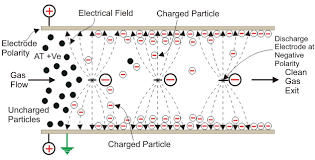
Figure 1.
Electrostatic Precipitator (ESP) working process
ESP is working by controlling emission gas from chimney to be passed in a room that has negatively charged electrode plates by giving a negative pole of direct current (DC) which has a high voltage about 20-50 KV. The higher the strains will increase the fly ash collecting (Jaworek, 2015).
Particulate or smoke or emission gas from burning results will be negatively charged when passing a negatively charged electrode/plate. Furthermore, the negatively charged emission gas is passed through a metal plate that is positively charged so that the emission gas will be attracted and attached to the metal plate. The process of collecting dust with this method uses static electricity, so it is called Electrostatic Precipitator (ESP) or electro static gas/dust collector.
In creating ESP, it is needed electric domain with high strains by using main component as like negative discharge electrode and positive metal sheet collector (Sepfitrah & Rizal, 2015).
At first, the strains using AC electric source amounts 380 V and is increased by step up the transformer up to 55 KV. Then, it is put in line with DC (Direct Current) using rectifier. The difference strains polarization can cause huge electric domain and sometime also emerged fire bow if passing through these two metal sheets (Jaworek, 2015). This occurrence is caused by electron jump or ion from negative pole to positive pole which is being mediated by gas or ash from burning result.
3. Method
This research is using experiment as its method by creating .electrostatic precipitator (ESP) that can be used to reduce pollutant from burning result in the main engine. The research design can be described as follow:
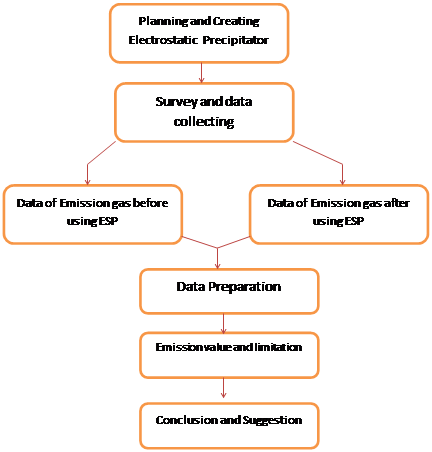
Figure 2.
Research Design
Afterward, the figure 2 will show the tools design planning used in this research.
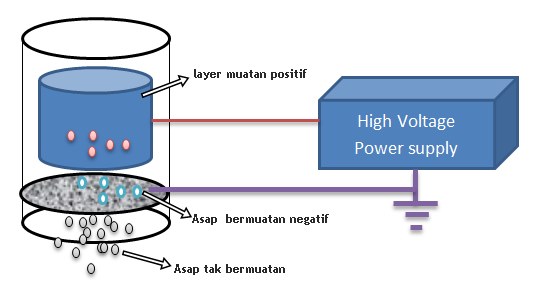
Figure 3.
Tools Design Planning
The electrostatic precipitator as designed above consists of a power supply that produces 34 KV voltages. At the positive pole, the power supply is connected with a screen sheath made of aluminum foil as an anode, while the negative pole of the power supply is connected to the iron net layer as the cathode. When non-charged smoke particles pass through the iron net layer, the smoke particles will be negatively charged. In addition, when approaching the positively charged aluminum foil screen sheath, the smoke particles will stick to the casing.
Figure 4 below is an ESP figure that has been strung with SO2 and NO2 catch pipes.
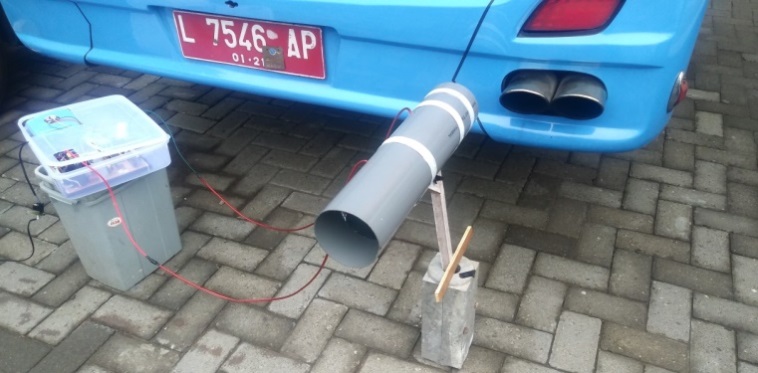
Figure 4.
The series of ESP tools and Catching Pipes
Data collection in this study was carried out in two stages, namely (1) data on SOx and NOx pollutants before using ESP, and (2) data on SOx and NOx pollutants after using ESP.
The instrument of this research is a multi-gas detector E-instrument (e-4500). This instrument used to measure pollutant levels of SOx and NOx from combustion of diesel engines.
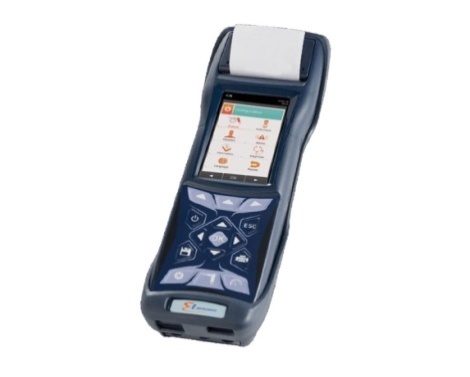
Figure 5.
Instrument e-4500
As for measuring the output voltage at ESP as a DC static electricity filter is using a 40KV HVDC device.
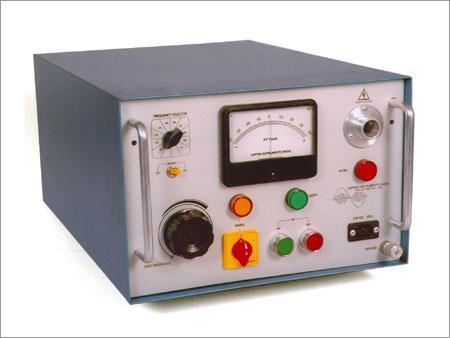
Figure 6.
HVDC Tools 40KV
4. Analysis and Discussion
Data collection was carried out on November 28, 2018 at Surabaya Shipping Polytechnic by taking one sampling on a bus using a diesel engine belonging to the Surabaya Shipping Polytechnic with two different measurement stages. The tool used to obtain emissions of Nitrogen Oxides (NO2) and Sulfur Dioxide (SO2) is in accordance with the IKM / 7.2.36 / MBS method of taking specifications applied to both of these compounds. This data collection uses services from the company MitraLab Buana Company Surabaya, which is a company engaged in the field of environmental certification that has been registered with the Center for Standardization of Environment and Forestry under the Ministry of Environment.
Allocation of data collection time is 15 minutes before the use of Electrostatic Precipitation start from 16.34 - 16.49, while data collection after use of the ESP tool is at 16.50-17.05. The results of the output voltage produced by ESP after measurement with a 40KV HVDC Test device obtained a DC average voltage of 34K.
The results of data collection can be seen as follows.
| No. | Parameter | Measurement Result | Method Specification | |
| Diesel Machine Emission (Before using ESP) | Diesel Machine Emission (After using ESP) | |||
| 1. | Nitrogen Oxide (NO2) | 7.70 mg/Nm3 | 3.85 mg/Nm3 | IKM/7.2.36/MBS |
| 2. | Sulfur Dioxide (SO2) | 72.3 mg/Nm3 | 39.6 mg/Nm3 | IKM/7.2.36/MBS |
The data used in this study is data of gas emissions in diesel machine by testing before using the ESP tool and after using the ESP tool. As Table 1, before the use of ESP, gas emissions data had NO2 levels of 7.70 mg / Nm3, while after ESP use Nitrogen Oxide (NO2) levels dropped to 3.85 mg / Nm3. Before the use of ESP, data on gas emissions is SO2 levels of 72.3 mg / Nm3, while after the use of ESP, the levels of Nitrogen Oxide (NO2) dropped to 39.6 mg / Nm3.
The data above is not a single sampling data, rather it is the average data from the measurement interval for 15 minutes, and during that time, the data changes so that the output for the levels of SO2 and NO2 gas from the tool is calculated for 15 minute. The output of the tool shows the final output for 15 minutes with a tolerance of significance of error of 5%. So that the tools used to measure the levels of Nitrogen Oxide (NO2) and Sulfur Dioxide (SO2) have automatically taken measurements as well as calculations in the field, as in the data in table 4.1 above.
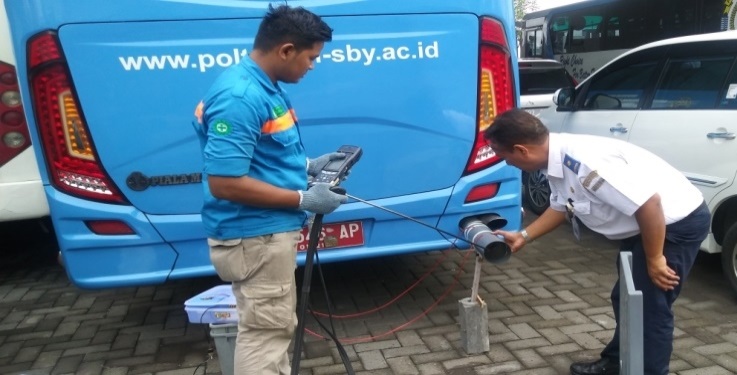
Figure 7.
Data Collection in Field
Regarding to data validity, sampling conducted at 1 (one) test point, namely the output of exhaust emissions from the bus of the Surabaya Shipping Polytechnic campus was only done once with a 15 minute data collection range both before and after the use of ESP, this was due to measurement using an indirect gas meter is stable, which means that in measuring the ambient air threshold, the device needs time to detect levels of Nitrogen Oxide (NO2) and Sulfur Dioxide (SO2). The validity of measurement data depends on the calibration of the device before data collection is carried out, so that before the data is collected, Mitralab Buana Company Surabaya has conducted a calibration and the results are considered valid when measuring Surabaya Shipping Polytechnic.
To calculate the percentage of decreasing levels of Nitrogen Oxide (NO2) and Sulfur Dioxide (SO2), the percentage reduction rate formula is used as follows.

Based on the formula above, the levels of Nitrogen Oxide (NO2) and Sulfur Dioxide (SO2) are obtained as follows:
| No. | Parameter | Measurement Result | Persentase Penurunan | |
| Diesel Machine Emission (Before using ESP) | Diesel Machine Emission (After using ESP) | |||
| 1. | Nitrogen Oksida (NO2) | 7.70 mg/Nm3 | 3.85 mg/Nm3 | 50 % |
| 2. | Sulfur Dioksida (SO2) | 72.3 mg/Nm3 | 39.6 mg/Nm3 | 45,2 % |
Based on the results of the calculations above, there is a significant decrease in the levels of Nitrogen Oxides (NO2) and Sulfur Dioxide (SO2). Nitrogen Oxide (NO2) levels in gas emissions decreased by 50% while Sulfur Dioxide (SO2) levels in exhaust emissions decreased by 45.2%.
When compared with national ambient air data as Republic of Indonesia Minister Regulation Number 41 of 1999, in normal air the content of Sulfur Dioxide (SO2) is 900 μg / Nm3 in 1 hour or 225 μg / Nm3 in 15 minutes or 0.225 mg / Nm3. In normal air, the content of Nitrogen Dioxide (NO2) is 400 μg / Nm3 in 1 hour or 100 μg / Nm3 in 15 minutes or 0.1 mg / Nm3 in 15 minutes. With the results of experiments using ESP for the reduction of levels as above table is equal to 39.6 mg / Nm3 for SO2 gas and 3.85 mg/Nm3 for NO2 gas and it turns out that it is still far from the quality standard standardized by Indonesia Ministerial Regulation Number 41 of 1999.
| Gas | Measurement Duration | The Trial Result of Reduction Level | Quality Standards byMinisterial Regulation Number 41 of 1999 |
| SO2 | 15 minutes | 3,85 mg/Nm3 | 0,225 mg/Nm3 |
| NO2 | 15 minutes | 39,6 mg/Nm3 | 0,1 mg/Nm3 |
Based on table 3 above, it can be seen that the level of reduction using the ESP tool is still greater than the value of the ambient air quality standard according to Ministerial Regulation Number 41 of 1999. The explanation for why the reduction does not achieve the desired results as follows:
-
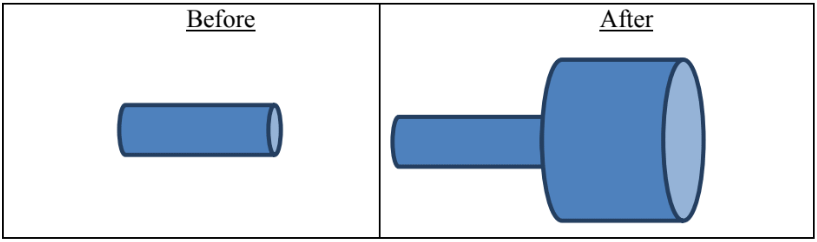
1. The unexpected flow of exhaust emissions is very large and ESP uses pipes with 1 diameter, namely pipes of 3", as the initial solution of pipe 3" connected with pipes with a larger diameter so that the exhaust gas speed can be reduced.
-
2. The need to use filters (in the form of nets) for anode so that particles of SO2 and NO2 gas that pass through the aluminum anode sheath can be caught by an aluminum foil anode.
5. Conclusion
As discussed above, an ESP device with an output DC voltage of 34 KV has been made. As for the emission gas output of diesel engines as follow:
-
a. Before using the ESP tool, the NO2 levels is 7.70 mg/Nm3, while after using ESP Nitrogen Oxide (NO2) levels dropped to 3.85 mg/Nm3.
-
b. Before using the ESP, the data on emissions gas had SO2 levels of 72.3 mg/Nm3, while after using ESP the levels of Nitrogen Oxide (NO2) dropped to 39.6 mg/Nm3.
-
c. The level of Nitrogen Oxide (NO2) in gas emissions drops to 50% while the level of Sulfur Dioxide (SO2) in emission gas drops to 45.2%.
6. Suggestion
-
a. The need for redesigning the ESP tool by using 2 pipes that have different sizes in case to reduce the speed of the exhaust gas flow in the diesel engine.
-
b. The need for screening on a large ESP pipe to capture pollutants that escape from the anode sheath.
References
Araujo JA, Barajas B, Kleinman M, Wang X, Bennett BJ, Gong KW, Navab M, Harkema J, Sioutas C, Lusis AJ, Nel AE. (2008). Ambient particulate pollutants in the ultrafine range promote early atherosclerosis and systemic oxidative stress. Circulation research. 102(5).
Baldauf RW, Devlin RB, Gehr P, Giannelli R, Hassett-Sipple B, Jung H, Martini G, McDonald J, Sacks JD, Walker K. (2016). Ultrafine particle metrics and research considerations: review of the 2015 UFP workshop. International journal of environmental research and public health. 13(11):1054
Chandra, A. (2006). Performance Improvement of Electrostatic Precipitator: Some Experimental Studies. Middle East, 2(179), 110.
Hernandez, R. A. (2015). Prevention and control of air pollution in China: a research agenda for science and technology studies. SAPI EN. S. Surveys and Perspectives Integrating Environment and Society, (8.1).
Jaworek, A., Marchewicz, A., Krupa, A., Sobczyk, A. T., Czech, T., Antes, T., & Rożnowski, W. (2015). Dust particles precipitation in AC/DC electrostatic precipitator. In Journal of Physics: Conference Series (Vol. 646, No. 1, p. 012031). IOP Publishing.
Kennedy, RD. (2019). An investigation of air pollution on the decks of 4 cruise ships. Report of Department of Health, Behavior & Society Johns Hopkins University, Bloomberg School of Public Health.
Nobrega, S. W., Falaguasta, M. C. R., & Coury, J. R. (2004). A study of a wire-plate eletrostatic precipitator operating in the removal of polydispersed particles. Brazilian Journal of Chemical Engineering, 21(2), 275-284.
Sepfitrah., & Rizal, Y. (2015). Analisis Electrostatic Precipitator (ESP) untuk Penurunan Emisi Gas Buang pada Recovery Boiler. JURNAL APTEK, 7(1).
Porcentagem de contribuição de cada autor no manuscrito
Ari Yudha Lusiandri – 40%
Antonius Edy Kristiyono – 30%
Kuncoro Luhur Waskito – 30%