Research article
Is entrepreneurship an emerging area of research? A computational response
O empreendedorismo é uma área emergente de pesquisa? Uma resposta computacional
¿Es el emprendimiento un área de investigación emergente? Una respuesta computacional

 Rosangela Ballini ballini@eco.unicamp.br
José Maria Ferreira Jardim Silveira jmsilv52@gmail.com
Aurora Amélia Castro Teixeira ateixeira@fep.up.pt
Rosangela Ballini ballini@eco.unicamp.br
José Maria Ferreira Jardim Silveira jmsilv52@gmail.com
Aurora Amélia Castro Teixeira ateixeira@fep.up.pt
Is entrepreneurship an emerging area of research? A computational response
REGEPE Entrepreneurship and Small Business Journal, vol. 11, núm. 1, e1742, 2022
Associação Nacional de Estudos em Empreendedorismo e Gestão de Pequenas Empresas

Esta obra está bajo una Licencia Creative Commons Atribución 4.0 Internacional.
Recepción: 02 Octubre 2019
Aprobación: 15 Julio 2021
Publicación: 31 Diciembre 2021
Abstract: Objective: We aim to answer four questions. First, with the increasing number of publications, is there a concentration in specific subjects, or on the contrary, a dispersion, amplifying the span of themes related to entrepreneurship? Second, is there a hierarchy of subjects, in the sense that some of them constitute the “core” of entrepreneurship? Third, are they connected with other established research areas? Finally, it is possible to identify papers that are influential, acting as hubs in the cluster’s formation? Method: We developed an original version of the computational procedure proposed by Shibata et al (2008), which allows us to understand the diversity of the different sub-areas of the topic investigated, reducing the need for specialist supervision. Originality / Relevance: We developed and applied a method to capture the formation and evolution of research areas in entrepreneurship literature, via direct citation networks, allowing us to understand the iteration between the different research sub-areas. Results: The dispersion is a feature of entrepreneurship as field research, with a hierarchy between research areas, indicating an emergent organization in the expansion processes. We concluded that research on entrepreneurship consists of specialization, that is, by application in niches.
Keywords: Entrepreneurship, Basic Education, Entrepreneurial Education, Bibliometrics, Systematic Review..
Resumo: Objetivo: O nosso objetivo é responder a quatro questões: primeira, com o número crescente de publicações sobre empreendedorismo, existe uma concentração em temas específicos ou, pelo contrário, uma dispersão, ampliando os temas relacionados ao empreendedorismo? Segunda, existe uma hierarquia de temas, no sentido de que alguns deles constituem o "núcleo" do empreendedorismo? Em terceiro lugar, estão estes temas ligados a outras áreas de investigação estabelecidas? Finalmente, é possível identificar trabalhos que sejam influentes, atuando como núcleos na formação do clusters? Método: O método é o desenvolvimento de uma versão original do procedimento computacional proposto por Shibata et al (2008), o que nos permite compreender a diversidade das diferentes subáreas do tema investigado, e ainda reduzindo a necessidade de supervisão por especialista no campo de pesquisa investigado. Originalidade e relevância: Desenvolvemos e aplicamos um método para captar a formação e evolução das áreas de investigação em empreendedorismo, através de redes de citação direta, permitindo-nos compreender a iteração entre as diferentes subáreas de pesquisa. Resultados: A dispersão é uma característica da constituição do empreendedorismo como campo de pesquisa, com uma hierarquia entre áreas de pesquisa, o que significa uma organização emergente nos processos de expansão. Concluímos que a pesquisa sobre empreendedorismo é formada por especialização, ou seja, por uma aplicação em nichos.
Palavras-chave: Empreendedorismo, Rede de Citação, Linha de Pesquisa, Área Emergente..
Resumen: Objetivo: Nuestro objetivo es dar respuesta a cuatro preguntas: primero, con el creciente número de publicaciones sobre emprendimiento, ¿existe una concentración en temas específicos o, por el contrario, una dispersión, ampliando los temas relacionados con el emprendimiento? En segundo lugar, ¿existe una jerarquía de temas, en el sentido de que algunos de ellos constituyen el "núcleo" del espíritu empresarial? En tercer lugar, ¿están estos temas vinculados a otras áreas de investigación establecidas? Finalmente, ¿es posible identificar obras que sean influyentes, actuando como núcleos en la formación de clusters? Método: El método es el desarrollo de una versión original del procedimiento computacional propuesto por Shibata et al (2008), que permite comprender la diversidad de las diferentes subáreas del tema investigado, al tiempo que reduce la necesidad de supervisión especializada. en el campo de investigación en estudio. Originalidad y relevancia: Desarrollamos y aplicamos un método para capturar la formación y evolución de áreas de investigación en emprendimiento, a través de redes de citas directas, permitiéndonos entender la iteración entre diferentes subáreas de investigación. Resultados: La dispersión es una característica de la constitución del emprendimiento como campo de investigación, con una jerarquía entre áreas de investigación, lo que significa una organización emergente en los procesos de expansión. Concluimos que la investigación sobre emprendimiento se forma por especialización, es decir, por una aplicación en nichos.
Palabras clave: Emprendimiento, Red de citas, Línea de investigación, Área emergente.
INTRODUCTION
The term entrepreneur first appeared in economic literature in 1755. It was introduced by Richard Cantillon in the Essay study on the nature of commerce in general, where the author accentuates the entrepreneur is an expert in taking risks (Hébert & Link, 1989). Through adding the distinction between risk (measurable) and uncertainty (immeasurable), Knight (1921) highlights that in environments of high uncertainty, there is more demand for entrepreneurs. On the other hand, the Schumpeterian entrepreneur can make crucial decisions to employ resources and explore new ideas (Schumpeter, 1982). The definition of entrepreneur has evolved over the years (Marshall, 1919; Von Hayek, 1937; Kirzner, 1973; Baumol, 1990). However, regardless of the definition, function, and role, entrepreneurship requires a personality with traits of imagination, intuition, alertness, ambition, need for achievement, and a positive attitude towards risk (Casson & Casson, 2014). Studying entrepreneurship contributes to the understanding of how individuals make decisions, why and how they create and grow organizations, and what the intended and unintended consequences of these actions are at both the micro and macroeconomic levels (Minniti & Lévesque, 2008).
The literature on entrepreneurship has increased over the years (Chen, 2015; Lu et al., 2020), particularly since 2008 (Busenitz et al., 2014), resulting in a growing number of publications that use bibliometric analyses to characterize the literature on entrepreneurship. One of the bibliometric applications is the identification of lines of research and, more recently, the identification of lines of inquiry (Rotolo et al., 2015). This work follows recent literature, combining the bibliometric approach with new developments in scientometrics. The contribution of the paper is to use a sequential methodology that allows observing the dynamics of group formation and understanding, amidst the massive diversity of themes in entrepreneurship investigation, what are the predominant areas, those that are becoming laggard behind, and if it exists, the emergent ones. Four research questions appear to be relevant:
- 1. With the increasing number of publications, is there a concentration in specific subjects, or on the contrary, a dispersion, amplifying the span of themes related to entrepreneurship?
- 2. Is there a hierarchy of subjects, in the sense that some of them constitute the “core” of entrepreneurship?
- 3. Are they connected with other established research areas?
- 4. Is it possible to identify papers that are influential, acting as hubs in the cluster’s formation?
Following different methodological paths, the present study is delving into the discussions raised by: Shane & Venkataraman (2000), Gartner (2001), Cornelius et al. (2006), Schildt et al. (2006), Gartner et al. (2006), Grégoire et al. (2006), Landströmet al. (2012), Busenitz et al. (2014), Meyer et al. (2014), and Chen (2015). The method is the development of an original version of the computational procedure proposed by Shibata et al. (2008), which allows us to understand the diversity of the different sub- areas of the topic investigated, reducing the need for specialist supervision.
This paper is organized into four sections beyond this introduction. The following section provides an analysis of the bibliometric studies on entrepreneurship. The method section brings a synthetic explanation of the methodology, including the procedures to generate the data bank and the direct citation network. The results section allows the presentation of clusters content, followed by a discussion session. The conclusion of the paper points to the definite possibility to organize entrepreneurship in areas and classify them according to their dynamism.
LITERATURE REVIEW
The literature on entrepreneurship uses the bibliometric approach to treat a wide range of subjects: a) a regional point of view (Shibata et al., 2008), particularly regarding China (Fang & Wang, 2009; Zhai et al., 2014; Su et al., 2015; Xia et al., 2016; Wu & Wu, 2017); b) the role of schools in entrepreneurial education (Xia et al., 2016); c) the relationship between universities and entrepreneurship (Schmitz et al., 2016; Wu & Wu, 2017; Mascarenhas et al., 2017); d) the social entrepreneurship (Kraus et al., 2014; Ferreira et al., 2016; Rey-Martí et al., 2016; van der Have & Rubalcaba, 2016); e) ethnic entrepreneurship (Ganzaroli et al., 2013); f) female entrepreneurship; (Vita et al., 2014; Ferreira et al., 2017); g) rural entrepreneurship (Pato & Teixeira, 2014), and; h) entrepreneurial orientation (Arias et al., 2016; Restrepo et al., 2016; Martens et al., 2016).
The bibliometric approach also establishes the link between entrepreneurship and companies from the perspective of small businesses and entrepreneurship (Volery & Mazzarol, 2015). The study of the link also includes works on global firms (Garcia-Lillo et al., 2016), family firms (López-Fernández et al., 2015), venture capital (Cornelius & Persson, 2006), and spillover (Ghio et al., 2014). It is worth mentioning the studies on technological entrepreneurship (Ferreira et al. 2016; Ratinho et al., 2015), international entrepreneurship (Kraus, 2011; Ratinho et al., 2015; Ferreira et al., 2017; Servantie et al., 2016), and the relationship between the literature on technological innovation and entrepreneurship (Schmitz et al., 2016).
Up to the end of the 1990s, the literature on entrepreneurship was considered diverse, fragmented, and in development (Shane & Venkataraman, 2000; Gartner, 2001). Trying to put all things together, Cornelius et al. (2006) have built co-citation networks to analyze data from 1982 to 2004. They concluded that entrepreneurship was not completely established as a research field, showing signs of development with the definition of the critical areas of study, coming through an enhanced, discipline- specific, theoretical approach with its professional language.
Schildt et al. (2006) have employed co-citation analysis to investigate the literature between 2000 and 2004, identifying the 25 centermost research streams in entrepreneurship. Gartner et al. (2006) confirmed Cornelis et al. (2006) observation that research of the entrepreneurship field contains multiple but disconnected themes. Building co-citation networks based on individual questionnaires, Gartner et al. (2006) confirmed that the literature at the initial stage of its development was fragmented, making it challenging to categorize its subfields.
Grégoire et al. (2006), on the other hand, emphasize the idea that entrepreneurship is a field on its way to maturity, corroborated by Teixeira (2011). According to the latter, when analyzing publications between 2005 and 2010, The entrepreneurship investigations are no longer part of a mere sub- discipline of management or economics. The most prominent authors have been playing an increasing role in helping the community to become more cohesive, despite concentrated in very few countries, with the hegemony of United States academia. Landström et al. (2012) highlight a strong relationship between entrepreneurship and established scientific areas, such as management studies and economics. Over time, the number of influential ‘insider’ works has increased, and the research clusters in entrepreneurship have moved closer to each other. Entrepreneurship is in the way of creating a knowledge-based of its own, with distinct research specialties and a set of core areas of knowledge.
Seeking to identify the evolution and tendency of entrepreneurship is the common point in all of the works of Busenitz et al. (2014), Meyer et al. (2014), and Chen (2015). Studies carried out by Meyer et al. (2014) and Chen (2015) collected data from the Social Science Citation Index – Web of Science, aiming to find lines of research in entrepreneurship, represented by groups and sub-groups. Meyer et al. (2014) found five main groups and 16 sub-groups, while Chen (2015) found four main groups and 12 sub-groups.
The methods used in the studies that analyzed the field of entrepreneurship were dependent on the interference of a specialist in the field analyzed. In the next section, the methodological procedures used in the present study are presented, employing a method that does not require the intervention of a specialist in the field of study.
METHOD
The methodology to detect emergent research areas from the analysis of the scientific literature on a specific subject proposed in this paper is based on Shibata et al. (2008) and Shibata et al. (2011).
The methodological procedure started with data collection. For studies focusing on scientific cooperation or the evolution of some specific research field, the source was academic journals. Patents were a good source of information for studies in technology. For detecting emergent areas in social applied science, data collection came from the Social Sciences Citation Index compiled by the Institute for Scientific Information (ISI) of Clarivate Analytics, with a citation database covering millions of academic journals and providing bibliographic database services.
Networks are the main instrument for detecting emergent sectors, once it allows a discussion on individuals, the relative position of each individual within it, and the whole network's characteristics. Citation networks are directional, favoring the identification of trajectories (Rotolo et al., 2015). A significant advantage of Network analysis is the possibility of visualizing the results, providing excellent help to the discussion. The paper provides the citation network's visualization (giant component, Adai et al., 2004) to inspect its characteristics and its evolution in time (it is one of the most significant paper's methodological contributions).
Each article is a node of the network, and the citation of one article by another generates an arc (or link). Isolated papers - retrieved by the database collection procedure but not cited by any other document – are eliminated from the sample (Henrique et al., 2018). The idea is to capture the influential papers and the rise of new subjects at a specific moment. One measure of the importance of an article is the Centrality index (CB):
This measurement represents the number of the shortest path between the vertices s and t, σst(e), passing the edge e, considering all the possible paths between s and t, σst.
Not only individuals are relevant, but it is expected that the main (giant) component is prominent in the complete network, allowing the identification of a thematic coherence that is critical to the research.
Community detection is the cornerstone of the methodology adapted from Shibata et al. (2011) to characterize research fields and detect emergent areas. The main feature of the approach is the possibility to generate dynamic clusters and a time network of clusters, representing the evolution of possible research areas. Another advantage is the possibility of going inside each cluster (again, if it has a credible label, like “university and entrepreneurship”) by repeating the community detection procedure.
The implementation of the algorithm divides the networks into groups with the similarity measurements of the relations of the network’ individuals (articles). Newman and Girvan (2004) proposed a metric to find the optimal division of the network, called modularity1:
where ei j is the fraction of all edges in the network that link vertices in community i to community j, such that the sum of the row (or column) is ai= Σjei j . The starting point to calculate the modularity of the network is to take vertices without considering any community, ei j= ai aj . By aggregating vertices by edges, each division has a modularity index. The process continues up to find the higher modularity index of the network.
At each period (getting started in a year t), the algorithm allows identifying the clusters and, consequently, their attributes: number of papers, the average age of the papers, and the distribution of each paper's indegree (number of citations received). At the year t+1 the program implemented in R©, repeats the same routines with one important difference: the addition of new publications launched in t+1. The methodology also allows the knowing contribution of new papers, generating a temporal sequence that can be viewed as a network of clusters. The path will reach the clusters at their endpoints, and this step is crucial to identify the emergent sectors in the network (the year 2014 in this paper).
Computating the degree of relevance of the cluster and each node's participation coefficient in the network allows the groups' interpretation according to the focus of the research. In other words, the relevance of each article is determined by how the node is positioned in its group (within-group) and between groups. By doing this, it is also possible to identify the most relevant clusters (Guimera & Amaral 2005).
This approach is based on the idea that nodes with the same role should have similar topological properties. Let z be the degree of importance of the cluster i calculated as:
where Ki is the number of edges of the node i to other nodes in its cluster si ,k̅si is the average of K over all vertices in si , and σK is the standard diversion of K in s . The degree of relevance of asi node in the group, zi , is high if the number of edges of the node (vertex) in the group is also high. The participation coefficient Pi between groups shows the degree to which the edges of a node i are distributed among different clusters. This coefficient is computed by:
where Kis is the number of edges of the vertex i to other vertices in its group s, Ns is the number of groups, and ki is the total degree of the vertex i, that is, the number of edges that the node i. If the “participation coefficient,” Pi is close to one, which means that the edges are uniformly distributed among all the groups. On the other side, If Pi is close to zero, then all the edges are within its own group.
Each node has a paper with sentences whose analysis is the cornerstone to identify emergent areas or areas with a higher level of thematic coherence. The extraction of characteristic terms of each group by linguistic filtration, using the studies' abstracts and applying Natural Language Processing - NLP. The metric C-value of the Natural Language Processing (NLP) method allows the extraction of each group's terms characteristic.
The approach combines linguistic and statistical information. The C-value method (Frantzi et al., 2000) makes it possible to identify the candidate terms and their respective weights. Jones (1972) and Wu et al. (2008) explain the calculus of these weights in tf-idf metric. Finally, to see if a group is in expansion or losing importance, the methodology proposes the calculation of the average age of the most cited articles in each group.
Figure 1 and Figure 2 present a synthesis of the methodological steps. Although the methodologies come from different research fields, they serve the unique goal of achieving a better characterization of the subject (entrepreneurship) and identifying its emergent areas.
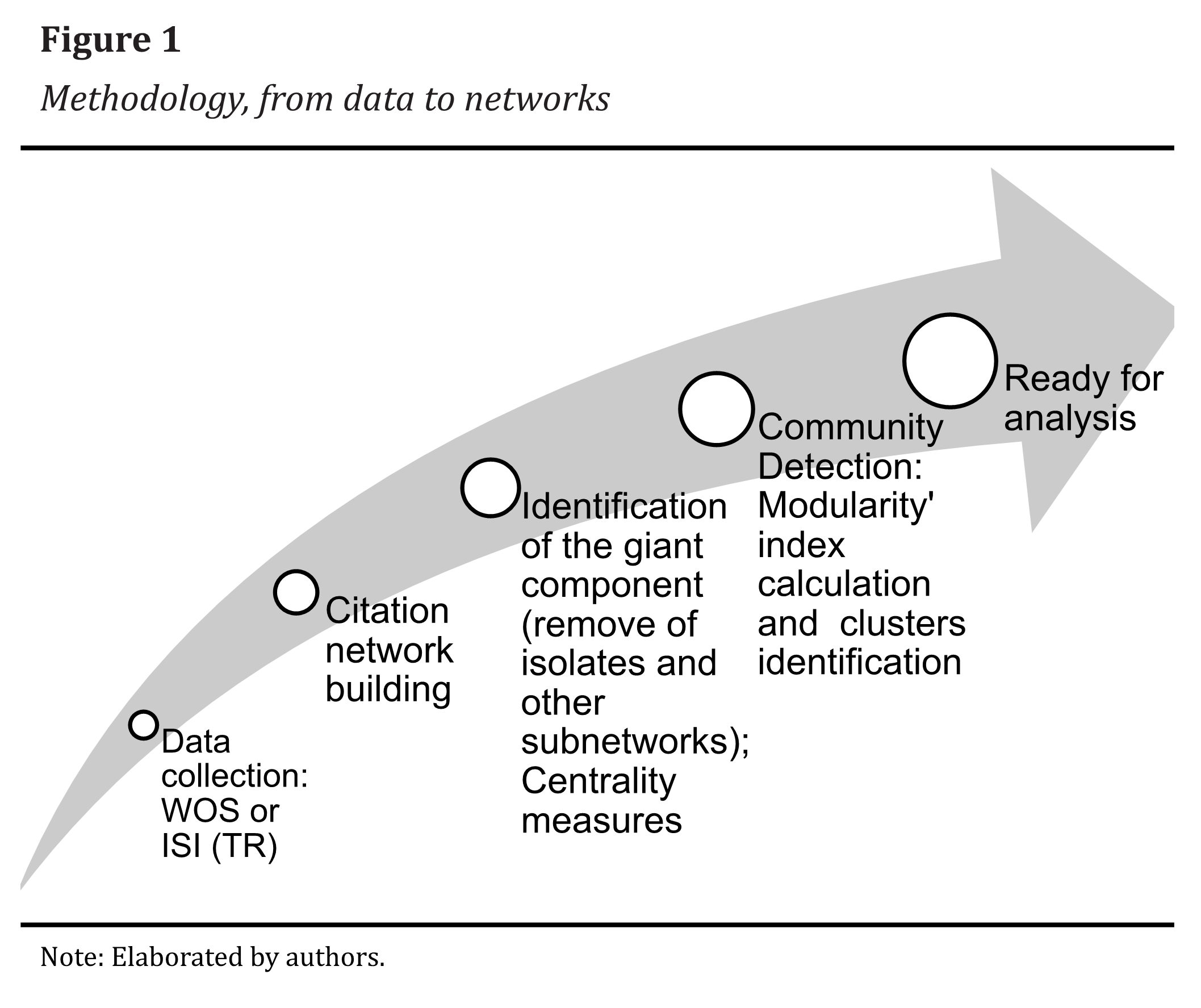
Figure 1
Methodology, from data to networks
Note: Elaborated by authors.
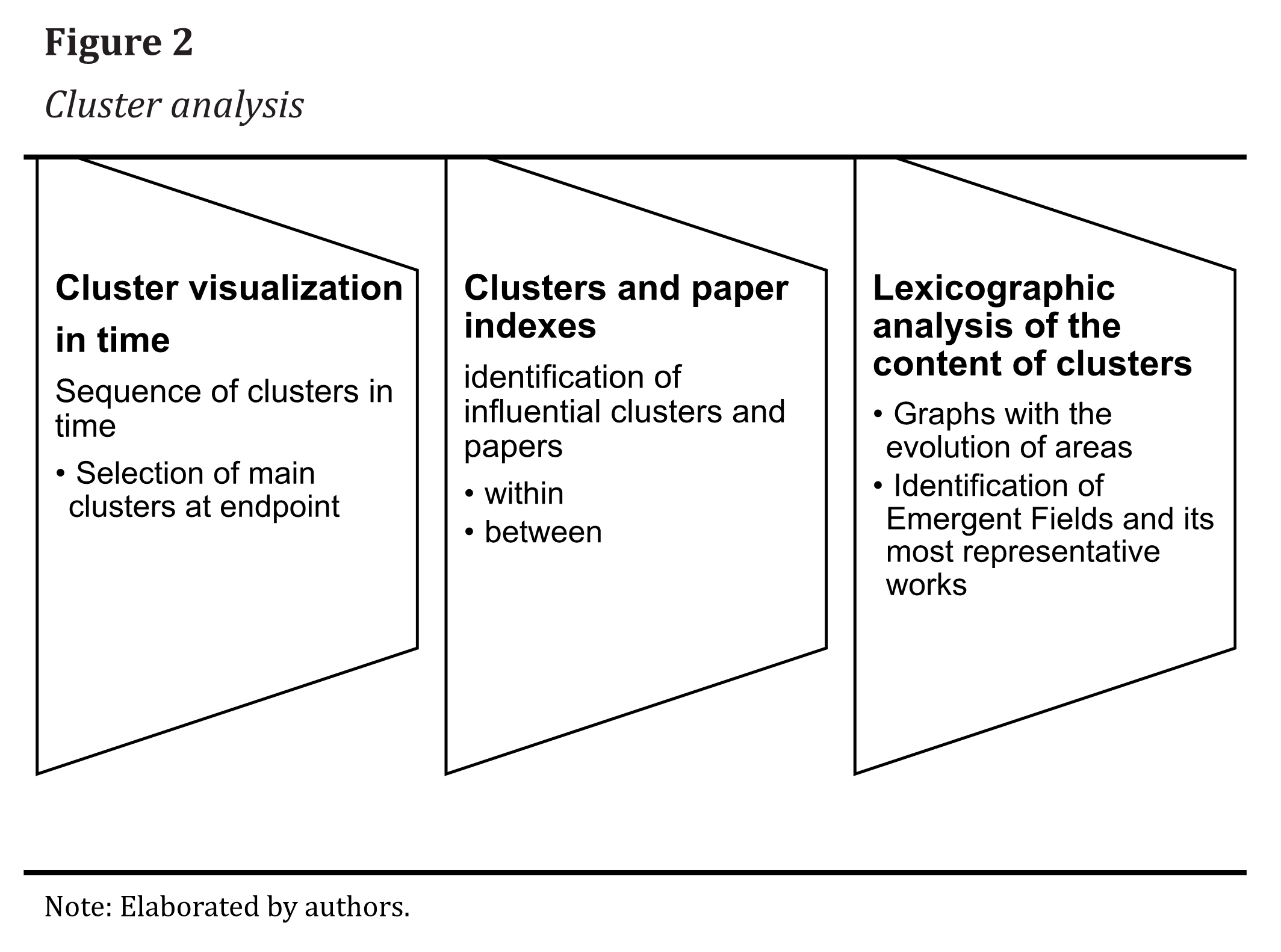
Figure 2
Cluster analysis
Note: Elaborated by authors.
RESULTS
Following the methodological steps from the last session, using the term “entrep*” in a search on the Web of Science - WoS database resulted in 29,241 publications in the data bank (Schildt et al., 2006; Cornelius & Persson, 2006).
Figure 3 shows an exponential pattern of publication’s growth, estimated at 11% a year, which means that the number doubles every 6.6 years. At the end of the period, in 2014, the number of publications reached approximately 29,000 papers. There is an evident acceleration after 2006. Bornmann and Mutz (2015) estimated the growth rate of scientific articles between 1980 and 2012 in 3% a year, taking about 24 years to double the number of scientific publications in general.
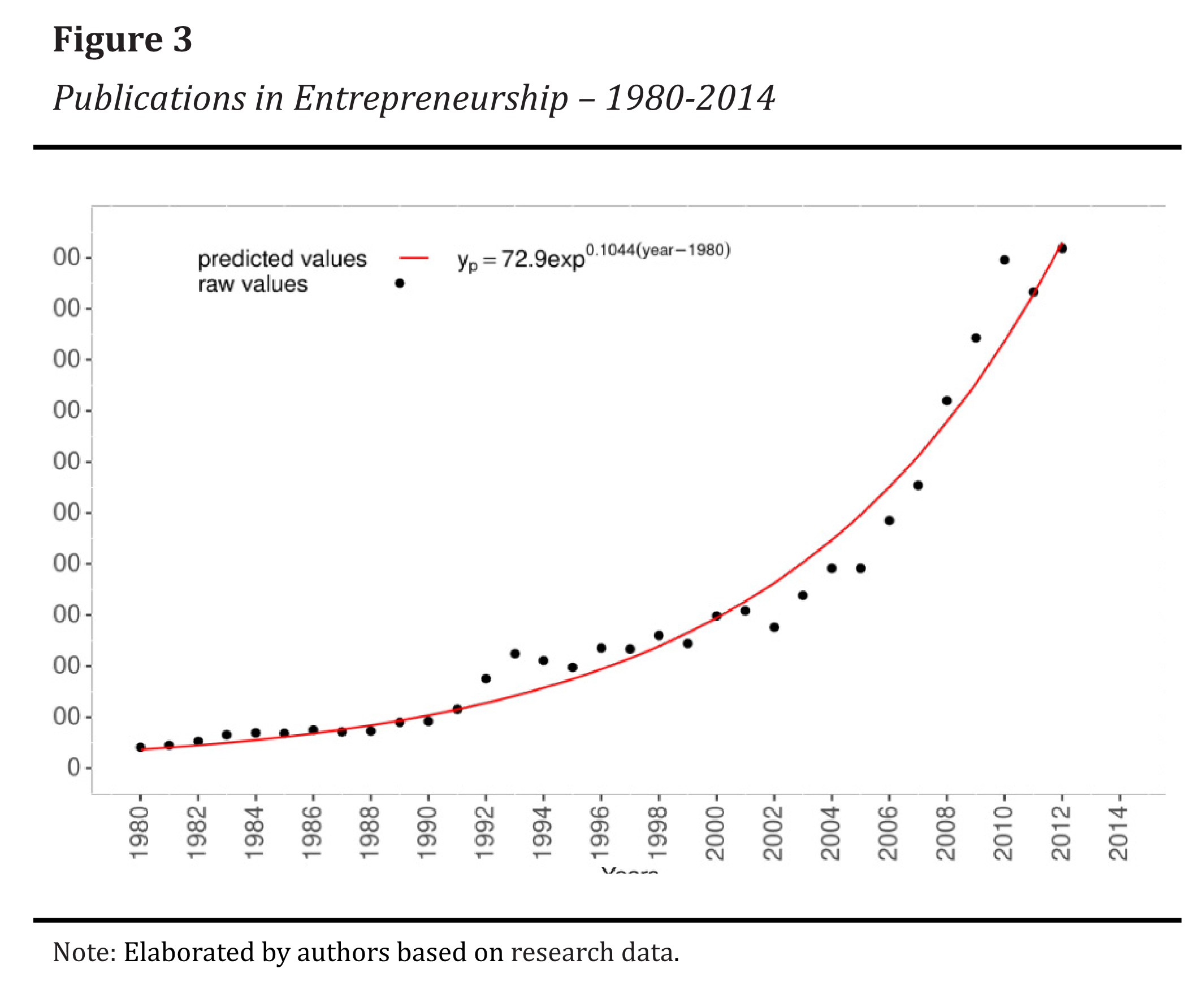
Figure 3
Publications in Entrepreneurship – 1980-2014
Note: Elaborated by authors based on research data.
This quite impressive result claims for a better understanding of the meaning of the term entrepreneurship. Considering a direct citation network is expected that in a growth path, specific vertices receive more citation than others, reflecting the “preferential attachment” property. In other words, a growth process with order resulted in the rapid expansion of scientific activity in entrepreneurship. This kind of organization is what our results can reveal, allowing a better understanding of the discussion presented in the introduction of this paper.
After building the network, the next step was to construct the unique identifying code for each publication - the last name of the first author, year of publication, the volume of paper, and the first page (Persson et al., 2009). Keeping only the network’s giant component resulted that 11,948 publications remained on the net. The majority of documents used are articles (79.8%0) and proceedings papers (7,1%), which fits the idea of scientific publications.
The use of algorithms to cluster year by year since 2000 generates a dynamic vision of the groups and allows the interpretation of the most relevant ones at the end of the path. It is worth pointing out that this is not a trivial outcome but a result of the influence of some important papers, reflecting a mix of specialization and knowledge combination (Namatame & Chen, 2016; Silveira, 2019).
The giant component, as it had been in 2014, was created by the combination of clusters that had started in the past. The dynamic methodology developed in the paper allows the identification of groups every year and the distribution of the average age of the documents. Figure 4 shows the evolution of the groups up to the four more important ones in 2014: g1, g2, g3, and g4. Each ring represents a group, and its size corresponds to the number of publications inside the group.
All the groups had on average, around six years in 2014, which indicates that they are made up of articles that were published, on average, in 2008.
The results of Figure 4 confirm the idea of accelerated growth with some degree of convergence of subjects, which becomes apparent with the inspection of Figure 5.
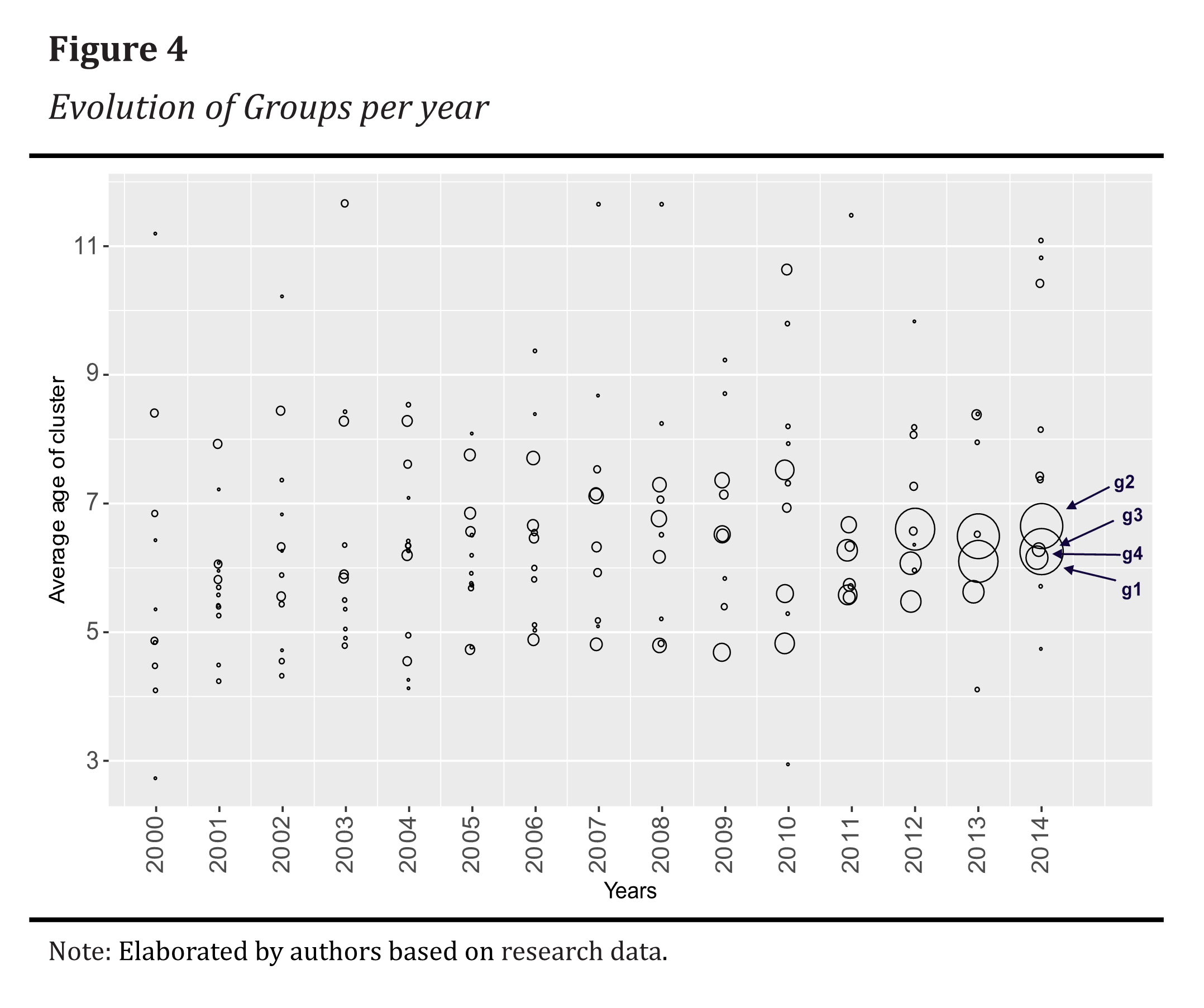
Figure 4
Evolution of Groups per year
Note: Elaborated by authors based on research data.
In Figure 5, the year of 2008 demonstrates the existence of the four main groups in distinct positions, two groups with an average age of 7 years, and the other two groups with an average age of 5 years. Such behavior indicates that none of the four groups represent radical innovation in the literature on entrepreneurship.
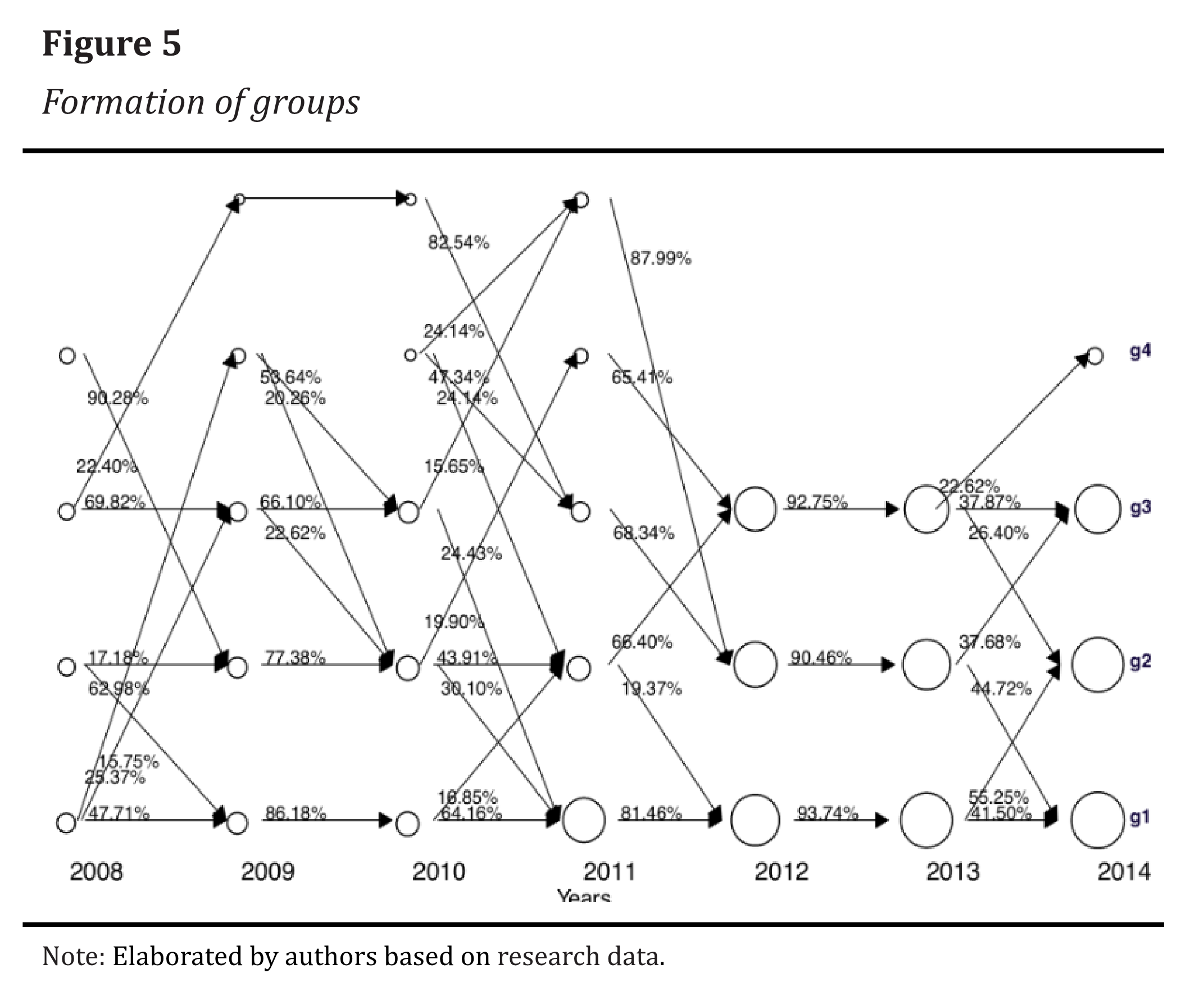
Figure 5
Formation of groups
Note: Elaborated by authors based on research data.
Figure 4 shows how each of the four main groups has received contributions from the former clusters.3 After the year of 2013, it is possible to see some regularity in the inputs to one group, once the percentage of participation of the previous vertices on the next is higher than 60% since 2009. About 56% of the vertices of this same group contributes to forming g2 in 2014, not forgetting the new publications in this very year. On the other hand, g1 received 41,5% from the same cluster marked by the cumulative knowledge. In general, the majority of the groups are the result of a mix of the knowledge that had been already accumulated in other different clusters. For instance, g4, the smaller group, was tributary of a split of one of the three rings in 2013, which also had contributed to two other clusters, g3 and g2.
The question is to identify if the apparent maturity shown from the year 2012 with a correspondence in the consolidation of areas in entrepreneurship and in the appearance of some new (emergent) areas. Considering the groups in 2014, Table 1, Table 2, and Table 3 provide information on three levels: paper characterization, journals of publication, and the most influential articles.
Starting with the paper’s characterization, Table 1 presents the number of documents of the groups, the age, in the average of years of publication of the article and its content.
| Table 1Entrepreneurship: characterization of the four main groups in 2014 | |||||
| Groups | Terms | Number of articles | Average Year | ||
| g1 | Organizational field, entrepreneurial self-efficacy, policy entrepreneurship, cognitive style, opportunity evaluation, social problem, male business owner, opportunity identification, institutional area, social mission, female business owner, portfolio entrepreneur, personal attitude, risk propensity, collective identity, loan officer, entrepreneurial identity, enterprise culture, public entrepreneurship, corporate social responsibility. | 4139 | 2007.75 | ||
| g2 | Migrant entrepreneur, immigrant entrepreneur, urban entrepreneurialism, private equity, tax rate, private information, ethnic business, immigrant group, financial contract, migrant entrepreneurship, entrepreneurial city, self-employment rate, ethnic economy, ethnic enclave, African American, Korean immigrant, urban governance, ethnic entrepreneurship, return migrant, VC investor. | 3952 | 2007.35 | ||
| g3 | International performance, internationalization process, family involvement, subsidiary initiative, organizational performance, born-global firm, international sale, market orientation mo, psychic distance, technology resource, firm innovativeness, market turbulence, dynamic capability, franchise system, cooperative arrangement, entrepreneurial proclivity, competitive aggressiveness, international commitment, innovative culture, non-family firm. | 2915 | 2007.79 | ||
| g4 | University-industry relationship, Bayh-dole act, contract research, research product, research commercialization, scientist entrepreneurship, innovation speed, external agent, research productivity, entrepreneurial hospital, trade-secret protection, patent application, genetic patent application, research performance, invention disclosure, concept center, faculty quality, student town. | 942 | 2007.68 | ||
| Note: Elaborated by authors based on research data. | |||||
| Table 2 | |
| List of main journals per group and its relevance (weight in the group) | |
| Groups | Journals |
| g1 | Journal of business venturing (0.088), Entrepreneurship Theory and practice (0.054), Small business economics (0.032), International small business journal (0.031), Journal of small business management (0.029), Entrepreneurship and regional development (0.026), Organization studies (0.02), Strategic entrepreneurship journal (0.019), Journal of management studies (0.017), Journal of business ethics (0.014). |
| g2 | Small business economics (0.088), Journal of business venturing (0.034), Entrepreneurship and regional development (0.025), Regional studies (0.018), Urban studies (0.016), Entrepreneurship Theory and practice (0.013), Research policy (0.013), International small business journal (0.012), International Journal of urban and regional research (0.012), European planning studies (0.011). |
| g3 | Journal of business venturing (0.059), Entrepreneurship Theory and practice (0.04), Journal of small business management (0.031), International small business journal (0.028), Journal of business research (0.024), Technovation (0.024), International entrepreneurship and management journal (0.021), Strategic management journal (0.021), International business review (0.02), Small business economics (0.019). |
| g4 | Research policy (0.1), Journal of technology transfer (0.069), Technovation (0.069), Higher education (0.027), R & d management (0.022), European planning studies (0.019), Technology analysis & strategic management (0.018), International journal of engineering education (0.016), Journal of business venturing (0.016), Scientometrics (0.016). |
| Note: Elaborated by authors based on research data. | |
| Table 3Most cited articles per group | ||||||
| Groups | Authors | Title | WoS | Cit. within | ||
| g1 | Shane and Venkataraman (2000) | The promise of entrepreneurship as a field of research | 1838 | 1215 | ||
| Shane (2000) | Prior knowledge and the discovery of entrepreneurial opportunities | 915 | 559 | |||
| Davidsson and Honig (2003) | The role of social and human capital among nascententrepreneurs | 625 | 432 | |||
| Busenitz and Barney (1997) | Differences between entrepreneurs and managers in large organizations | 512 | 344 | |||
| Stevenson and jarillo (1990) | A paradigm of entrepreneurship: Entrepreneurial management | 489 | 325 | |||
| g2 | Evans and Leighton (1989) | Some empirical aspects of entrepreneurship | 651 | 463 | ||
| Evans and Jovanovic (1989) | An estimated model of entrepreneurial choice under liquidity constraints | 663 | 412 | |||
| Baumol (1990) | Entrepreneurship: Productive, unproductive, and destructive | 787 | 398 | |||
| Blanchflower and Oswald (1998) | What makes an entrepreneur? | 526 | 317 | |||
| Stuart et al. (1999) | Inter-organizational endorsements and the performance of entrepreneurial ventures | 690 | 250 | |||
| g3 | Lumpkin and Dess (1996) | Clarifying the entrepreneurial orientation construct and linking it to performance | 1235 | 808 | ||
| Miller (1983) | The correlates of entrepreneurship in three types of firms | 755 | 491 | |||
| Oviatt and McDougall (1994) | Toward a theory of international new ventures | 741 | 282 | |||
| Uzzi (1997) | Social structure and competition in interfirm networks: The paradox of embeddedness | 2353 | 256 | |||
| Zahra and Covin (1995) | Contextual influences on the corporate entrepreneurship performance relationship: a .... | 341 | 246 | |||
| g4 | Rothaermel et al. (2007) | University entrepreneurship: a taxonomy of the literature | 240 | 129 | ||
| Siegel et al. (2003) | Assessing the impact of organizational practices on the relative productivity of university ... | 324 | 121 | |||
| Etzkowitz (1998) | The norms of entrepreneurial science: cognitive effects of the new university-industry linkages | 249 | 116 | |||
| Etzkowitz et al. (2000) | The future of the university and the university of the future | 360 | 108 | |||
| Vohora et al. (2004) | Critical junctures in the development of university high-tech spinout companies | 190 | 108 | |||
| Note: Elaborated by authors based on research data. | ||||||
The articles from the g1 are related to the theoretical and conceptual perspectives on entrepreneurship. In the g2, the studies are related to the subject of migrant and ethnic entrepreneurship, and empirical approaches. The g3 group contains works about family firms, global firms, and corporative entrepreneurship. Finally, the g4 group includes texts about the corporate university.
The results show a proper distribution of the papers and small differences in average age, reflecting the expansion movement presented in Figure 3. In sum, the clustering procedures based on direct network citation generated meaningful clusters, showing the specialization of entrepreneurship during the expansion period.
Figure 6, considering the 2014’ clusters as a reference, presents the evolution of the composition of the groups by year. For instance, it shows that the g4 group is smaller, and the contribution of paper for each year is mildly increasing. The bigger size of g1 has demanded a more intense flow of publications, despite the fact both groups have received a growing contribution of papers since the year 2002. As demonstrated before, the four groups have practically the same average age of the documents.
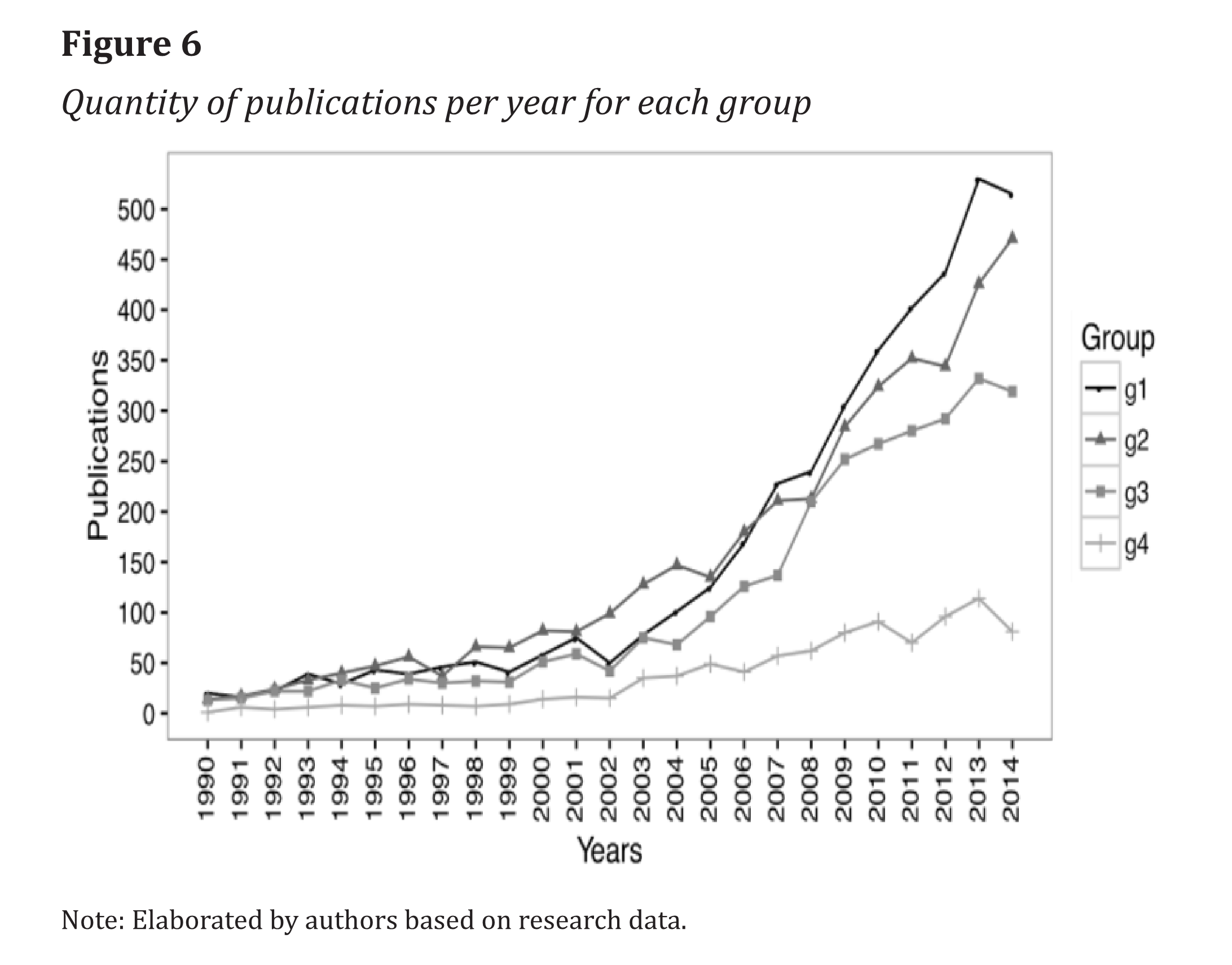
Figure 6
Quantity of publications per year for each group
Note: Elaborated by authors based on research data.
The “preferential attachment” concept encompasses the idea that authors look forward to being recognized by peers, targeting journals with good impact records. It is also expected a good correspondence between the subjects presented in Table 1 and the journals in Table 2, with a low level of recurrence. Table 2 contains the journals with the most significant number of publications for each group and the proportion of papers for each journal in brackets and the entire documents in the group equal to one. It shows that g4, the smallest group, has a significant degree of specialization of clusters than the other three, which signalizes a new research area. However, the average age of the papers is similar to the other groups.
Table 3 contains the most cited articles for each group, the number of citations from the Web of Science (WoS) database, and the number of citations (Cit.) within the network publications4. Group one (g1) has the highest number of studies with 4,139 and 8.8% of these published in the Journal of Business Venturing. Scott Shane has the highest number of citations, with Shane and Venkataraman (2000) and Shane (2000).
In the migrant and ethnic entrepreneurship and empirical approaches group, g2, the most frequent Journal is Small Business Economics, with 8.8% of the 3,952 publications. The author with the highest number of citations in the g2 group is David Evans, with the following studies: Evans and Leighton (1989) and Evans and Jovanovic (1989).
In the g3 group, family firms, global firms, and corporate entrepreneurship and resource management, there are 2,915 studies, with 5.9% published in the Journal of Business Venturing. The most cited authors within the g3 group are G.T. Lumpkin and Gregory G. Dess, with the study of Lumpkin and Dess (1996).
The smallest group - g4 - has 942 publications and analyzes corporate universities. Differently to the other groups, 10% of the studies on academic entrepreneurship are published in the Journal Research Policy. The most cited research in the network is Rothaermel et al. (2007). It is worth mentioning that among the ten most cited studies, two were carried out by Henry Etzkowitz (Etzkowitz, 1998; Etzkowitz et al., 2000).
The first round of applying the methodology has generated useful insights into the progressive organization of entrepreneurship as an academic research field. The methodological procedures applied to the groups g1, g2, g3, and g4 detected 16 subgroups.
Consulting Figure 7 about the evolution of the sub-clusters, it is possible to notice that all groups except for g4 have a breaking point between sub-groups. In 2006, g13 got separated from the other two subgroups, which kept growing. The split in g2 has happened earlier, around 2001, and g24 and g25 were falling behind. Finally, the sub-groups g31 and g32, dealing with innovation and networks, practically skyrocketed from 2004 to 2014.
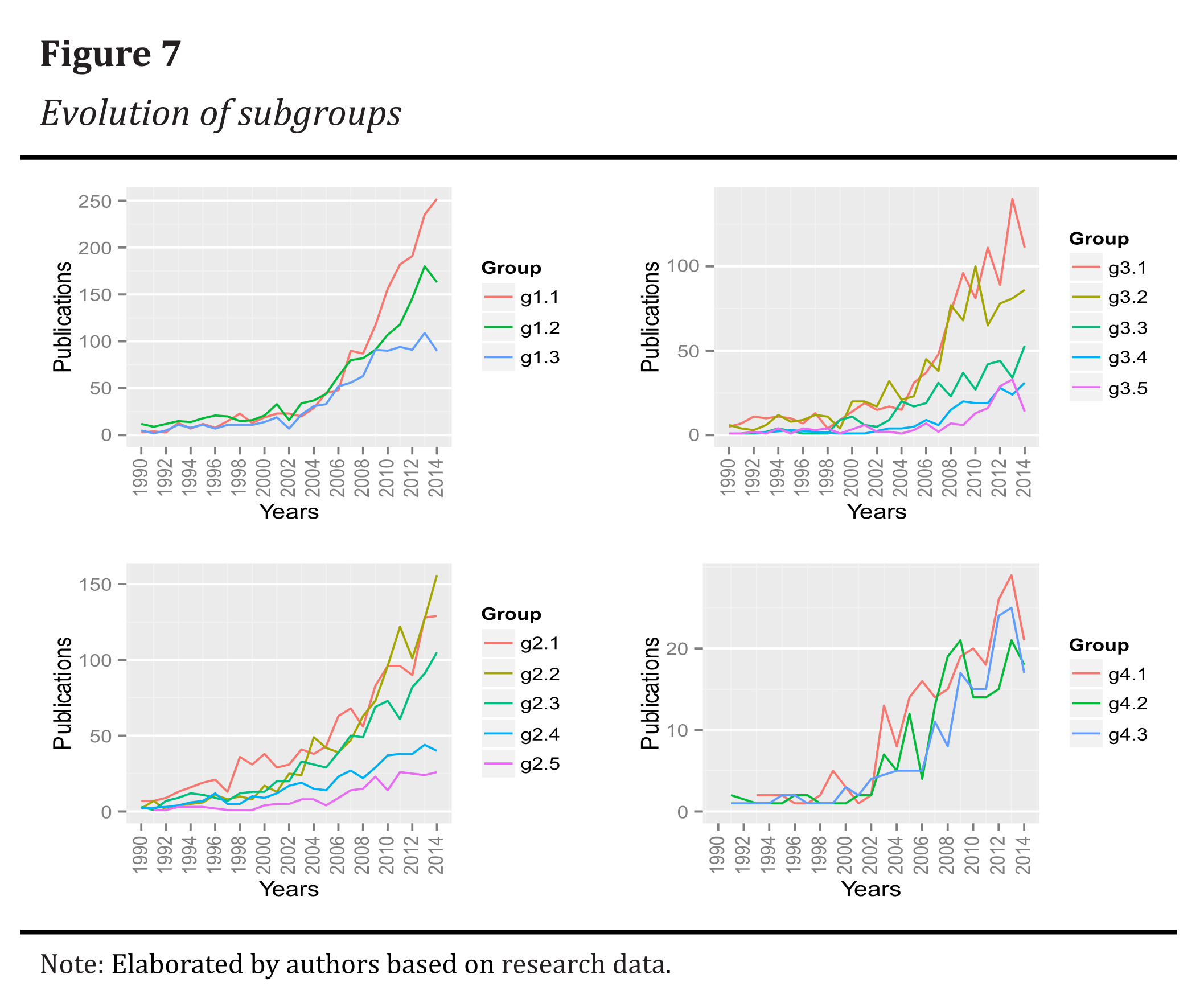
Figure 7
Evolution of subgroups
Note: Elaborated by authors based on research data.
The content of the subgroups (Table 4) is reached by using the natural language processing and tf-idf to the abstracts. The number of articles, hubs of each cluster with values over 2.5 (Guimera & Amaral, 2005), and the average age from publication year complement Table 55.
Table 4 shows 16 clusters keeping the hierarchy from g1 to g4. There is a structure after the second round of clusterization. When disaggregating the g1 group, which is made up of discussions about perspectives, theories, and concepts of entrepreneurship, three subgroups were detected - g1.1, g1.2, and g1.3.
| Table 4Synthesis of the content of groups after the second round | ||||||
| Groups | Content of the group | Number | Hub | Average age | ||
| g1.1 | Analyzes the social institutions, including the potential effects of organizational responsibilities, as well as the attempts of new companies to manage their liabilities. | 1633 | 9 | 2009.08 | ||
| g1.2 | Studies on the behavior and effect of the entrepreneurial as a risk-taking. | 1442 | 14 | 2006.58 | ||
| g1.3 | Investigates business opportunities and the formalization of entrepreneurship as a field of research. | 965 | 6 | 2007.60 | ||
| g2.1 | Studies on the investigation of migration and ethnic aspects. | 1234 | 12 | 2006.42 | ||
| g2.2 | Papers about small businesses: the emergence and growth cycle of small firms. | 1083 | 7 | 2008.16 | ||
| g2.3 | Venture capital and groups of angel investors. | 852 | 4 | 2007.80 | ||
| g2.4 | Investigating entrepreneurship in urban spaces, highlights advancements in entrepreneurship together with urban governance for the local provision of services, facilities, and benefits to urban populations. | 441 | 0 | 2007.06 | ||
| g2.5 | Discussion about finance and entrepreneurship. | 225 | 0 | 2008.30 | ||
| g3.1 | Innovative processes in companies and entrepreneurial orientation. | 1016 | 6 | 2007.70 | ||
| g3.2 | Organizational networks and their influences on firms’ performance. | 853 | 2 | 2007.60 | ||
| g3.3 | The emergence of global companies or international new ventures. | 398 | 5 | 2008.59 | ||
| g3.4 | Family firms and firm-level entrepreneurial activities. | 192 | 0 | 2009.71 | ||
| g.3.5 | Successful entrepreneurial experiences. | 166 | 0 | 2008.01 | ||
| g4.1 | Academic entrepreneurship and how it relates to the economy. | 237 | 1 | 2008.11 | ||
| g4.2 | Technology transfer between the universities and the private sector. | 182 | 1 | 2008.01 | ||
| g4.3 | Science-based entrepreneurial firms, highlighting intellectual property relations, of the determinant factors of spillovers, and other terms related to this area of research. | 169 | 0 | 2008.40 | ||
| Note: Elaborated by authors based on research data. | ||||||
The subgroup g1.1 is the largest of all of the 16 subgroups with 1633 publications, all of which are based on institutions and institutional entrepreneurship. This group, the youngest one, has nine hubs and analyzes social institutions, including the potential effects of organizational responsibilities, as well as the attempts of new companies to manage their liabilities. The subgroup g1.2 refers to the behavior and impact of the entrepreneurial as a risk-taking with fourteen hubs, showing the existence of influential papers. On one hand, we have the mapping of characteristics of entrepreneurship, and on the other, the effects of entrepreneurship. Subgroup g1.3 investigates business opportunities and the formalization of entrepreneurship as a field of research.
The g2 discusses migrant and ethnic entrepreneurship and the correspondent's empirical approaches, which seem to be a homogenous group. However, after carrying out the second level of desegregation, five subgroups were detected.
The subgroup g2.1, the oldest one, contains studies that investigate migration and ethnic aspects, with twelve hubs. The second subgroup, g2.2, with seven hubs, has papers about small businesses. The articles in this group examine, primarily, the emergence and growth cycle of small firms. Subgroup g2.3 studies venture capital and groups of angel investors. The relevant issues investigated are the connection between the capital investor and the new entrepreneurial initiatives and initial public offering (IPO). Subgroup g2.4, studying entrepreneurship in urban spaces, highlights advancements in entrepreneurship together with urban governance for the local provision of services, facilities, and benefits to urban populations. The last subgroup for the g2 level is g2.5, which studies finance and entrepreneurship. The articles in this subgroup investigate how the financial system affects the conditions necessary for entrepreneurship. The last three sub-groups have a smaller number of influential papers, showing less structured networks than the first two.
The publications of groups g1 and g2 study aspects aimed at the individual level analysis, while group g3 contains publications that analyze the corporate level, via corporate entrepreneurship.
After disaggregating group g3, five subgroups were obtained, keeping a hierarchy, regarding the number of papers and average age, the first one, g3.1, investigating innovative processes in companies and entrepreneurial orientation, with six hubs. In subgroup g3.2, the effect of the organizational networks and their influences on firms’ performance is investigated. The impact of network structures on venture performance is related to the internal skills of the firms, via strategic alliances or other managerial mechanisms. Subgroup g3.3, with 5 hubs, investigates the emergence of global companies or international new ventures (INVs). The studies of this field connect international business, entrepreneurship, and strategic management theory, with a focus on worldwide growth in entrepreneurial firms, due to the internationalization of the marketplace and the increasing prominence of entrepreneurial firms in the global economy.
Subgroup g3.4 studies family firms, the firm-level entrepreneurial activities, and attitudes that occur when a family is considerably involved in an established organization. Subgroup g3.5 studies successful entrepreneurial experiences: organization goals, strategic leaders, governance, and other factors that affected the firm’s performance are investigated. The last two sub-groups have no hubs and can be considered specialized and marginal subjects.
Group g4 is composed of studies that investigate the relations between university, entrepreneurship, and the relationship with economic growth. When disaggregating group g4, there are three subgroups, subgroup g4.1 academic entrepreneurship and how it relates to the economy. Based on the idea of a more active role of universities in society's knowledge, these studies presume a role in technological innovation that goes beyond the boundaries of the classroom. Subgroup g4.2 studies the technology transfer between the universities and the private sector. Among the topics investigated are university technology transfer offices (TTOs) and the spin-offs of public research institutions (PRIs). Subgroup g4.3 examines science-based entrepreneurial firms, highlighting intellectual property relations, the determinant factors of spillovers, and other terms related to this area of research.
DISCUSSION
The extensive data analysis allowed us to understand that research on entrepreneurship is divided and much of the time, disconnected, since from the 29,241 publications found, just 11,948 had connections with the core of the literature on entrepreneurship. This procedure was carried out only to maintain the giant component of the network, as described in the methodology.
The review of the literature has pointed to a great diversity of subjects related to entrepreneurship. All the themes in the works cited in the introduction match the content of the clusters from the giant component:
social responsibility, risk attitude, and a discussion on the role of entrepreneurship composing the g1, each of them heading a sub- cluster; b) migration and ethnic aspects, small business, venture capital and investors, entrepreneurship in urban spaces, and finance are the heads of sub-groups of g2; c) innovative processes in entrepreneurship, networks, firm-level global perspective and, family firms, and successful cases in entrepreneurship are the items in g3; d) finally, three subjects that are very close one to another - academic entrepreneurship and economics, and technology transfer and science-based firms.
In analyzing the formation of research areas from different points of view, two factors determine the hierarchy between the four main groups in the giant component: the formation process, presented in Figure 5, and the distribution of the number of papers, in Table 2. There is a rank by the number of documents, but the average age does not differ at this level of clusterization. However, the second point is more enlightening. A substantial contribution to form g1 in 2014 is regular, organized (with the lower level of combination), with a clear definition in 2011. Part of the papers also contributed to g2, a split from more generic matters in g1 to specific issues, both dealing with the individual entrepreneur. The third cluster, g3, is specialized oppositely, with subjects related to the interaction between entrepreneurs in a variety of topics, like globalization, internationalization, innovativeness, market turbulence, among others. The last cluster, g4, is smaller and highly specialized in the university-firm issue. Figure 6 shows that - taking the age of documents in 2014 - the number of papers published up to 2001 is quite similar. From this point on, the main clusters start to receive an increasing number of documents, reflected in the final composition of the groups in 2014.
The span of subjects confirms the first research question: It is possible to conclude that the area has a significant number of the different topics composing entrepreneurship, as in Cornelius, Landström, and Persson (Cornelius et al., 2006). At first sight, dispersion is a feature of the constitution of entrepreneurship as field research. Still, the results point to a hierarchy between clusters, meaning an emergent organization in the expansion processes, casting to the second research question.
There is a substantial superposition of the leading journals in the clusters g1, g2, and g3, highlighting the Journal of Business Venturing, Entrepreneurship Theory and Practice, Small Business Economics, Entrepreneurship, and regional development. The international, urban, and regional and innovation aspects led to the presence of thematic journals in clusters g2 and g3., like Regional Studies, Technnovation, and Research Policy (see Table 3). The inspection of Table 4 shows the existence of influential papers in g1 and g3, operating in quite the opposite directions: Shane (2000) and Lumpkin (1996) articles acting as a broad reflection about the subject of entrepreneurship and Uzzi’s (1997) work highlighting a new frontier of networks.
All of the papers in g4 are focused on the university-science- firm relationship.
These results led to positively answering the research questions “b” and “c,” presented in the introduction, confirming Landström et al. (2012) results. But a question remains: would it be possible to qualify the dispersion of themes better?
The results from a new round of application of the methodology are essential to confirm the existence of a structure in entrepreneurship research and the attempt to identify the “core” or at least some fields that act as reference points to researchers.
The clusters kept an internal hierarchy. The g1 had two of the three clusters with more elements and a significantly higher number of hubs than others. The sub-group g11 is the established segment of the giant component: the “core” of entrepreneurship, while attracting new publications in renewal. The connection with other areas of knowledge can be seen in g12, characterized by the highest number of hubs in the giant component, pointing to the consolidation of the sub-network, and the appearance of the preferential attachment.
Beyond the “core”, which deals with generic aspects, there is room for specialization. There are two remarkable sub-groups in g2: one about migration and ethnic aspects, with twelve hubs and the third place in several papers and other linking small business and economic growth with seven hubs.
Innovation studies have increased in the wake of neo- Schumpeterian economists, and the sub-cluster g3.1 captures how entrepreneurship deals with the subject. Its six hubscontribute to consolidating the segment, with less influence in other areas, which brings the idea of a sub-area demanding consolidation.
The research areas with the most recent articles at its base were groups g3.4 and g3.5 that investigate family firms and successful entrepreneurial experiences. The 10 main articles of these subgroups were published on average in 2005 and 2007, respectively. Thus, they diverge from the other groups, whose studies were published in the 1990s or the beginning of the 2000s. Some authors highlight family firms as an area of knowledge of independent entrepreneurship, but with overlaps between the two areas (Debicki et al., 2009; López-Fernández et al., 2015). Another literature review of both fields can be found in the study carried out by Bettinelli et al. (2017).
Similarly to g3, the publications about the university- industry entrepreneurial relationship have a moderate effect on other clusters and a weak network structure, with few hubs. The most important articles in this area are more recent than the majority of the leading documents in the other subgroups. However, university entrepreneurship was the last line of research created in the area of study that stood out from all of the literature on entrepreneurship.
CONCLUSIONS
This text used unsupervised computational methods, which do not require an expert in the researched area, to analyze scientific publications on entrepreneurship. After finding more than 29 thousand publications on entrepreneurship based on direct network citation, we highlight that only 41% of the publications are connected to the core of the entrepreneurship literature. This indicates that dispersion is a feature of the constitution of entrepreneurship as field research. In the clustering process, we found 16 groups. The results point to a hierarchy between clusters, meaning an emergent organization in the expansion processes. Eight groups have one or no articles as a hub, showing little influence on the other groups, and only three groups have nine or more articles as a hub, which influence several groups. We concluded that research on entrepreneurship consists of specialization, that is, by application in niches.
Entrepreneur as a risk-taker and his influence of the social structure on the process of entrepreneurship is a pivotal content in the entrepreneurship literature. Some research lines present a high degree of specialization and still influence other research lines in the entrepreneurship literature, such as studies on migration and ethnic aspects and studies on small businesses. On the other hand, studies on entrepreneurship at the firm level, through entrepreneurial orientation, networks of firms, or global companies, are research lines with less influence on the rest of the literature on entrepreneurship. We could conclude that the lines bring the idea of a demanding sub-area consolidation. University entrepreneurship was the last line of research created in the area of study. It stood out from all of the literature on entrepreneurship, and the publications have a moderate effect in other clusters and a weak network structure, with few hubs.
Funding
Coordination for the Improvement of Higher Education Personnel (CAPES), Brazil. Process 99999.006541/2014-03.
Conflict of interest statement
The authors declare that there is no conflict of interest.
Authors’ statement of individual contributions
| Authors’ statement of individual contributions | ||||
| Roles | Authors Contributions | |||
| Souza RF | Ballini R | Silveira JMFJ | Teixeira AAC | |
| Conceptualization | ■ | |||
| Methodology | ■ | |||
| Software | ■ | |||
| Validation | ■ | |||
| Formal analysis | ■ | |||
| Investigation | ■ | |||
| Resources | ■ | |||
| Data Curation | ■ | |||
| Writing - Original Draft | ■ | |||
| Writing - Review e Editing | ■ | |||
| Visualization | ■ | |||
| Supervision | ■ | |||
| Project administration | ■ | |||
| Funding acquisition | ■ | ■ | ||
REFERÊNCIAS
Adai, A. T., Date, S. V., Wieland, S., & Marcotte, E. M. (2004). LGL: Creating a map of protein function with an algorithm for visualizing very large biological networks. Journal of Molecular Biology, 340(1), 179-190. https://doi.org/10.1016/j.jmb.2004.04.047
Arias, A. V., Restrepo, I. M., & Restrepo, A. M. (2016). Intención emprendedora en estudiantes universitarios: Un estudio bibliométrico. Intangible Capital, 12(4), 881-922. https://doi.org/10.3926/ic.730
Baumol, W. J. (1990). Entrepreneurship: Productive, unproductive and destructive. Journal of Political Economy, 98(5), 893-921. https://doi.org/10.1016/0883-9026(94)00014-X
Bettinelli, C., Sciascia, S., Randerson, K., & Fayolle, A. (2017). Researching entrepreneurship in family firms. Journal of Small Business Management, 55(4), 506-529. https://doi.org/10.1111/jsbm.12347
Blanchflower, D. G., & Oswald, A. J. (1998). What makes an entrepreneur? Journal of Labor Economics, 16(1), 26–60. https://doi.org/10.1086/209881
Bornmann, L., & Mutz, R. (2015). Growth rates of modern science: A bibliometric analysis based on the number of publications and cited references. Journal of the Association for Information Science and Technology, 66(11), 2215-2222. https://doi.org/10.1002/asi.23329
Busenitz, L. W., & Barney, J. B. (1997). Differences between entrepreneurs and managers in large organizations: Biases and heuristics in strategic decision-making. Journal of Business Venturing, 12(1), 9–30. https://doi.org/10.1016/S0883-9026(96)00003-1
Busenitz, L. W., Plummer, L. A., Klotz, A. C., Shahzad, A., & Rhoads, K. (2014). Entrepreneurship research (1985–2009) and the emergence of opportunities. Entrepreneurship Theory and Practice, 38(6), 1219-1237. https://doi.org/10.1111/etap.12120
Casson, M., & Casson, C. (2014). The history of entrepreneurship: Medieval origins of a modern phenomenon. Business History, 56(8), 1223-1242. https://doi.org/10.1080/00076791.2013.867330
Chen, J. K. (2015, August). Entrepreneurship research dynamics (1992–2013): Aim at entrepreneurial, innovative firms and business operations. In 2015 Portland International Conference on Management of Engineering and Technology (PICMET) (pp. 953-960). IEEE. https://doi.org/10.1109/PICMET.2015.7273054
Cornelius, B., & Persson, O. (2006). Who's who in venture capital research. Technovation, 26(2), 142-150. https://doi.org/10.1016/j.technovation.2005.05.009
Cornelius, B., Landström, H., & Persson, O. (2006). Entrepreneurial studies: The dynamic research front of a developing social science. Entrepreneurship Theory and Practice, 30(3), 375-398. https://doi.org/10.1111/j.1540-6520.2006.00125.x
Davidsson, P., & Honig, B. (2003). The role of social and human capital among nascent entrepreneurs. Journal of Business Venturing, 18(3), 301–331. https://doi.org/10.1016/S0883-9026(02)00097-6
Debicki, B. J., Matherne III, C. F., Kellermanns, F. W., & Chrisman, J. J. (2009). Family business research in the new millennium: An overview of the who, the where, the what, and the why. Family Business Review, 22(2), 151-166. https://doi.org/10.1177/0894486509333598
Etzkowitz, H. (1998). The norms of entrepreneurial science: Cognitive effects of the new university–industry linkages. Research Policy, 27(8), 823–833. https://doi.org/10.1016/S0048-7333(98)00093-6
Etzkowitz, H., Webster, A., Gebhardt, C., & Terra, B. R. C. (2000). The future of the university and the university of the future: Evolution of ivory tower to entrepreneurial paradigm. Research Policy, 29(2), 313–330. https://doi.org/10.1016/S0048-7333(99)00069-4
Evans, D. S., & Jovanovic, B. (1989). An estimated model of entrepreneurial choice under liquidity constraints. Journal of Political Economy, 97(4), 808–827. https://doi.org/10.1086/261629
Evans, D. S., & Leighton, L. S. (1989). Some empirical aspects of entrepreneurship. The American Economic Review, 79(3), 519–535. http://www.jstor.org/stable/1806861
Fang, S., & Wang, T. (2009, September). Entrepreneurship research of China: Assessment based on HN Index and H Index. In 2009 International Conference on Management and Service Science (pp. 1-4). IEEE. https://doi.org/10.1109/ICMSS.2009.5305458
Ferreira, J. J. M., Fernandes, C. I., Peris-Ortiz, M., & Ratten, V. (2017). Female entrepreneurship: A co-citation analysis. International Journal of Entrepreneurship and Small Business, 31(2), 325-340. https://doi.org/10.1504/IJESB.2017.084095
Ferreira, J. J., Fernandes, C. I., Peres-Ortiz, M., & Alves, H. (2017). Conceptualizing social entrepreneurship: Perspectives from the literature. International Review on Public and Nonprofit Marketing, 14(1), 73-93. https://doi.org/10.1007/s12208-016-0165-8
Ferreira, J. J., Ferreira, F. A., Fernandes, C. I., Jalali, M. S., Raposo, M. L., & Marques, C. S. (2016). What do we [not] know about technology entrepreneurship research? International Entrepreneurship and Management Journal, 12(3), 713-733. https://doi.org/10.1007/s11365-015-0359-2
Frantzi, K., Ananiadou, S., & Mima, H. (2000). Automatic recognition of multi-word terms: The c-value/nc-value method. International Journal on Digital Libraries, 3(2), 115-130. https://doi.org/10.1007/s007999900023
Ganzaroli, A., Orsi, L., & De Noni, I. (2013). The evolution of the social understanding of ethnic entrepreneurship: Results from a bibliometric analysis of the literature. International Journal of Entrepreneurship and Small Business, 20(4), 383-401. https://doi.org/10.1504/IJESB.2013.057198
Garcia-Lillo, F., Claver-Cortés, E., Marco-Lajara, B., & Úbeda-García, M. (2017). Mapping the intellectual structure of research on ‘born global’ firms and INVs: A citation/co-citation analysis. Management International Review, 57(4), 631-652. https://doi.org/10.1007/s11575-016-0308-5
Gartner, W. B. (2001). Is there an elephant in entrepreneurship? Blind assumptions in theory development. Entrepreneurship Theory and Practice, 25(4), 27-39. https://doi.org/10.1177/104225870102500403
Gartner, W. B., Davidsson, P., & Zahra, S. A. (2006). Are you talking to me? The nature of community in entrepreneurship scholarship. Entrepreneurship Theory and Practice, 30(3), 321-331. https://doi.org/10.1111/j.1540-6520.2006.00123.x
Ghio, N., Guerini, M., Lehmann, E. E., & Rossi-Lamastra, C. (2015). The emergence of the knowledge spillover theory of entrepreneurship. Small Business Economics, 44(1), 1-18. https://doi.org/10.1007/s11187-014-9588-y
Grégoire, D. A., Noel, M. X., Déry, R., & Béchard, J. P. (2006). Is there conceptual convergence in entrepreneurship research? A co–citation analysis of frontiers of entrepreneurship research, 1981–2004. Entrepreneurship Theory and Practice, 30(3), 333-373. https://doi.org/10.1111/j.1540-6520.2006.00124.x
Guimera, R., & Amaral, L. A. N. (2005). Functional cartography of complex metabolic networks. Nature, 433(7028), 895-900. https://doi.org/10.1038/nature03288
Hébert, R. F., & Link, A. N. (1989). In search of the meaning of entrepreneurship. Small Business Economics, 1(1), 39–49. https://doi.org/10.1007/BF00389915
Henrique, B. M., Sobreiro, V. A., & Kimura, H. (2018). Building direct citation networks. Scientometrics, 115(2), 817-832. https://doi.org/10.1007/s11192-018-2676-z
Jones, K. S. (1972). A statistical interpretation of term specificity and its application in retrieval. Journal of Documentation, 28(1), 11-21. https://doi.org/10.1108/eb026526
Kirzner, I. M. (1973). Entrepreneurship and competition. University of Chicago Press.
Knight, F. H. (1921). Risk, uncertainty, and profit. Hart, Schaffner & Marx.
Kraus, S. (2011). State-of-the-art current research in international entrepreneurship: A citation analysis. African Journal of Business Management, 5(3), 1020-1033. https://doi.org/10.5897/AJBM10.1159
Kraus, S., Filser, M., O’Dwyer, M., & Shaw, E. (2014). Social entrepreneurship: An exploratory citation analysis. Review of Managerial Science, 8(2), 275-292. https://doi.org/10.1007/s11846-013-0104-6
Landström, H., Harirchi, G., & Åström, F. (2012). Entrepreneurship: Exploring the knowledge base. Research Policy, 41(7), 1154-1181. https://doi.org/10.1016/j.respol.2012.03.009
López-Fernández, M. C., Serrano-Bedia, A. M., & Pérez-Pérez, M. (2016). Entrepreneurship and family firm research: A bibliometric analysis of an emerging field. Journal of Small Business Management, 54(2), 622-639. https://doi.org/10.1111/jsbm.12161
Lu, R., Lu, Q., Lv, D., Huang, Y., Li, S., Jian, Z., & Reve, T. (2020). The evolution process of entrepreneurship studies in the 21st century: Research insights from top business and economics journals. Journal of Economic Surveys, 34(4), 922-951.
Lumpkin, G. T., & Dess, G. G. (1996). Clarifying the entrepreneurial orientation construct and linking it to performance. The Academy of Management Review, 21(1), 135–172. https://doi.org/10.2307/258632
Marshall, A. (1919). Industry and trade. Macmillan.
Martens, C. D. P., Lacerda, F. M., Belfort, A. C., & de Freitas, H. M. R. (2016). Research on entrepreneurial orientation: Current status and future agenda. International Journal of Entrepreneurial Behavior & Research, 22(4), 484-508. https://doi.org/10.1108/IJEBR-08-2015-0183
Mascarenhas, C., Marques, C. S., Galvão, A. R., & Santos, G. (2017). Entrepreneurial university: Towards a better understanding of past trends and future directions. Journal of Enterprising Communities: People and Places in the Global Economy, 11(2), 220-239. https://doi.org/10.1108/JEC-02-2017-0019
Meyer, M., Libaers, D., Thijs, B., Grant, K., Glänzel, W., & Debackere, K. (2014). Origin and emergence of entrepreneurship as a research field. Scientometrics, 98(1), 473-485. https://doi.org/10.1007/s11192-013-1021-9
Miller, D. (1983). The correlates of entrepreneurship in three types of firms. Management Science, 29(7), 770–791. http://www.jstor.org/stable/2630968
Minniti, M., & Lévesque, M. (2008). Recent developments in the economics of entrepreneurship. Journal of Business Venturing, 23(6), 603–612. https://doi.org/10.1016/j.jbusvent.2008.01.001
Restrepo, I. M., Arias, A. V., & Restrepo, A. M. (2016). Mapeo del campo de conocimiento en intenciones emprendedoras mediante el análisis de redes sociales de conocimiento. Ingeniare. Revista Chilena de Ingeniería, 24(2), 337-350. https://doi.org/10.4067/S0718-33052016000200015
Morris, S. A., Yen, G., Wu, Z., & Asnake, B. (2003). Time line visualization of research fronts. Journal of the American Society for Information Science and Technology, 54(5), 413-422. https://doi.org/10.1002/asi.10227
Namatame, A., & Chen, S. H. (2016). Agent-based modeling and network dynamics. Oxford University Press.
Newman, M. E. (2004). Fast algorithm for detecting community structure in networks. Physical Review E, 69(6), 066133. https://doi.org/10.1103/PhysRevE.69.066133
Newman, M. E., & Girvan, M. (2004). Finding and evaluating community structure in networks. Physical Review E, 69(2), 026113. https://doi.org/10.1103/PhysRevE.69.026113
Oviatt, B. M., & McDougall, P. P. (1994). Toward a theory of international new ventures. Journal of International Business Studies, 25(1), 45–64. https://doi.org/10.1057/palgrave.jibs.8490193
Pato, M. L., & Teixeira, A. A. (2016). Twenty years of rural entrepreneurship: A bibliometric survey. Sociologia Ruralis, 56(1), 3-28. https://doi.org/10.1111/soru.12058
Persson, O., Danell, R., & Schneider, J. W. (2009). How to use Bibexcel for various types of bibliometric analysis. In Celebrating scholarly communication studies: A festschrift for Olle Persson at his 60th birthday (Vol. 5, pp. 9-24).
Ratinho, T., Harms, R., & Walsh, S. (2015). Structuring the technology entrepreneurship publication landscape: Making sense out of chaos. Technological Forecasting and Social Change, 100, 168-175. https://doi.org/10.1016/j.techfore.2015.05.004
Rey-Martí, A., Ribeiro-Soriano, D., & Palacios-Marqués, D. (2016). A bibliometric analysis of social entrepreneurship. Journal of Business Research, 69(5), 1651-1655. https://doi.org/10.1016/j.jbusres.2015.10.033
Rothaermel, F. T., Agung, S. D., & Jiang, L. (2007). University entrepreneurship: A taxonomy of the literature. Industrial and Corporate Change, 16(4), 691–791. https://doi.org/10.1093/icc/dtm023
Rotolo, D., Hicks, D., & Martin, B. R. (2015). What is an emerging technology? Research Policy, 44(10), 1827-1843. https://doi.org/10.1016/j.respol.2015.06.006
Schildt, H. A., Zahra, S. A., & Sillanpää, A. (2006). Scholarly communities in entrepreneurship research: A co–citation analysis. Entrepreneurship Theory and Practice, 30(3), 399-415. https://doi.org/10.1111/j.1540-6520.2006.00126.x
Schmitz, A., Urbano, D., Dandolini, G. A., de Souza, J. A., & Guerrero, M. (2017). Innovation and entrepreneurship in the academic setting: A systematic literature review. International Entrepreneurship and Management Journal, 13(2), 369-395. https://doi.org/10.1007/s11365-016-0401-z
Schumpeter, J. A. (1982). Teoria do desenvolvimento econômico: Uma investigação sobre lucros, capital, crédito, juros e o ciclo econômico. Abril Cultural.
Servantie, V., Cabrol, M., Guieu, G., & Boissin, J. P. (2016). Is international entrepreneurship a field? A bibliometric analysis of the literature (1989–2015). Journal of International Entrepreneurship, 14(2), 168-212. https://doi.org/10.1007/s10843-015-0162-8
Shane, S. (2000). Prior knowledge and the discovery of entrepreneurial opportunities. Organization Science, 11(4), 448-469. https://doi.org/10.1287/orsc.11.4.448.14602
Shane, S., & Venkataraman, S. (2000). The promise of entrepreneurship as a field of research. Academy of Management Review, 25(1), 217-226. https://doi.org/10.5465/amr.2000.2791611
Shibata, N., Kajikawa, Y., Takeda, Y., & Matsushima, K. (2008). Detecting emerging research fronts based on topological measures in citation networks of scientific publications. Technovation, 28(11), 758-775. https://doi.org/10.1016/j.technovation.2008.03.009
Shibata, N., Kajikawa, Y., Takeda, Y., Sakata, I., & Matsushima, K. (2011). Detecting emerging research fronts in regenerative medicine by citation network analysis of scientific publications. Technological Forecasting and Social Change, 78(2), 274-282. https://doi.org/10.1016/j.techfore.2010.07.006
Siegel, D. S., Waldman, D., & Link, A. (2003). Assessing the impact of organizational practices on the relative productivity of university technology transfer offices: An exploratory study. Research Policy, 32(1), 27–48. https://doi.org/10.1016/S0048-7333(01)00196-2
Silveira, J. M. F. J. (2019). Análise econômica da agricultura: Novos temas demandam novos enfoques? Revista de Economia e Agronegócio, 17(1), 1-7. https://doi.org/10.25070/rea.v17i1.8738
Stevenson, H. H., & Jarillo, C. J. (1990). A paradigm of entrepreneurship: Entrepreneurial management. Strategic Management Journal, 11(5), 17–27. https://www.jstor.org/stable/2486667
Stuart, T. E., Hoang, H., & Hybels, R. C. (1999). Interorganizational endorsements and the performance of entrepreneurial ventures. Administrative Science Quarterly, 44(2), 315–349. https://doi.org/10.2307/2666998
Su, J., Zhai, Q., & Landström, H. (2015). Entrepreneurship research in China: Internationalization or contextualization? Entrepreneurship & Regional Development, 27(1-2), 50-79. https://doi.org/10.1080/08985626.2014.999718
Teixeira, A. A. (2011). Mapping the (in) visible college(s) in the field of entrepreneurship. Scientometrics, 89(1), 1-27. https://doi.org/10.1007/s11192-011-0445-3
Traag, V. A., Waltman, L., & Van Eck, L. G. (2019). From Louvain to Leiden, guaranteeing well-connected communities. Scientific Reports, 9(1). https://doi.org/10.1038/s41598-019-41695-z
Uzzi, B. (1997). Social structure and competition in interfirm networks: The paradox of embeddedness. Administrative Science Quarterly, 42(1), 35–67. https://doi.org/10.2307/2393808
Van der Have, R. P., & Rubalcaba, L. (2016). Social innovation research: An emerging area of innovation studies? Research Policy, 45(9), 1923-1935. https://doi.org/10.1016/j.respol.2016.06.010
Vita, L. De, Mari, M., & Poggesi, S. (2014). Women entrepreneurs in and from developing countries: Evidences from the literature. European Management Journal, 32(3), 451-460. https://doi.org/10.1016/j.emj.2013.07.009
Vohora, A., Wright, M., & Lockett, A. (2004). Critical junctures in the development of university high-tech spinout companies. Research Policy, 33(1), 147–175. https://doi.org/10.1016/S0048-7333(03)00107-0
Volery, T., & Mazzarol, T. (2015). The evolution of the small business and entrepreneurship field: A bibliometric investigation of articles published in the International Small Business Journal. International Small Business Journal, 33(4), 374-396. https://doi.org/10.1177/0266242613516139
Von Hayek, F. A. (1937). Economics and knowledge. Economica, 4(13), 33-54. https://doi.org/10.2307/2548786
Wu, H. C., Luk, R. W. P., Wong, K. F., & Kwok, K. L. (2008). Interpreting tf-idf term weights as making relevance decisions. ACM Transactions on Information Systems (TOIS), 26(3), 1-37. https://doi.org/10.1145/1361684.1361686
Wu, Y. C. J., & Wu, T. (2017). A decade of entrepreneurship education in the Asia Pacific for future directions in theory and practice. Management Decision, 55(9), 2056-2072. https://doi.org/10.1108/MD-05-2017-0518
Xia, T., Shumin, Z., & Yifeng, W. (2016). Status quo and outlook of the studies of entrepreneurship education in China: Statistics and analysis based on papers indexed in CSSCI (2004–2013). Chinese Education & Society, 49(3), 217-227. https://doi.org/10.1080/10611932.2016.1218255
Zahra, S. A., & Covin, J. G. (1995). Contextual influences on the corporate entrepreneurship-performance relationship: A longitudinal analysis. Journal of Business Venturing, 10(1), 43–58. https://doi.org/10.1016/0883-9026(94)00004-E
Zhai, Q., Su, J., & Ye, M. (2014). Focus on China: The current status of entrepreneurship research in China. Scientometrics, 98(3), 1985-2006. https://doi.org/10.1007/s11192-013-1114-5
Notas de autor
Corresponding author: roneyfraga@gmail.com
Información adicional
Article ID: 1742
JEL Code: L26, O30, O38, O25
Editor-in-Chief1 or Adjunct2: 2 Dr. Edmundo Inácio Júnior, Univ. Estadual de Campinas, UNICAMP
Handling Editor: Dr. Eduardo Armando, Tecnologico de Monterrey, ITESM
Executive Editor: M. Eng. Patrícia Trindade de Araújo
Translation / Proofreading: Sarah Stout
Funding: CAPES, #99999.006541/2014-03.
How to Cite: Souza, R. F., Ballini, R., Silveira, J. M. F. J., & Teixeira, A. A. C. (2021). Is entrepreneurship an emerging area of research? A computational response. Revista de Empreendedorismo e Gestão de Pequenas Empresas, 11(1), e1742. https://doi.org/10.14211/ibjesb.e1742
Información adicional
redalyc-journal-id: 5615