Research article
Strategic role of IT and IT governance mechanisms for the context of small and medium enterprises
Papel estratégico de TI e mecanismos de governança de TI para o contexto de pequenas e médias empresas
Rol estratégico de las TI y los mecanismos de gobernanza de TI para el contexto de las pequeñas y medianas empresas

 Jairo Simião Dornelas jerh57@gmail.com
Marcus Augusto Vasconcelos Araújo marcusaugusto77@hotmail.com
Jairo Simião Dornelas jerh57@gmail.com
Marcus Augusto Vasconcelos Araújo marcusaugusto77@hotmail.com
Strategic role of IT and IT governance mechanisms for the context of small and medium enterprises
REGEPE Entrepreneurship and Small Business Journal, vol. 11, no. 1, e2051, 2022
Associação Nacional de Estudos em Empreendedorismo e Gestão de Pequenas Empresas

This work is licensed under Creative Commons Attribution 4.0 International.
Received: 07 January 2021
Accepted: 25 August 2021
Published: 01 September 2021
Abstract: The role of small and medium-sized enterprises in the economy is indisputable. However, these companies face great challenges to continue operating. Among them is the use of IT resources and the return on investments made. Using agency theory as a theoretical lens, this article aims to assess the relationship between the strategic use of IT in small and medium-sized companies and the IT governance mechanisms used in the context. From a survey of 68 companies in the service sector, it was possible to identify that relational IT governance mechanisms are more present in the context than structural or procedural mechanisms. It was also possible to identify that information technology, in the context, has a more operational use. Finally, using the Spearman coefficient and the Logistic Regression analyses, it was found that higher strategic levels of IT use led to greater use of governance mechanisms in the three dimensions, structural, procedural and relational, which corroborates the view that governance is achieved from a mix of formal and informal elements.
Keywords: IT's strategic role, IT governance, Small and medium-sized companies, Agency theory.
Resumo: O papel das pequenas e médias empresas na economia é indiscutível. No entanto, essas empresas enfrentam grandes desafios para continuar operando. Entre eles está o uso de recursos de TI e o retorno dos investimentos realizados. Utilizando como lente teórica a teoria da agência, este artigo tem como objetivo avaliar a relação entre o uso estratégico de TI em pequenas e médias empresas e os mecanismos de governança de TI utilizados no contexto. A partir de uma survey com 68 empresas do setor de serviços, foi possível identificar que os mecanismos relacionais de governança de TI estão mais presentes no contexto do que os mecanismos estruturais ou procedimentais. Também foi possível identificar que a tecnologia da informação, no contexto, tem um uso mais operacional. Por fim, por meio da utilização do coeficiente de Spearman e da análise de Regressão Logística, constatou-se que maiores níveis estratégicos de uso de TI levam a maior utilização de mecanismos de governança nas três dimensões, estrutural, processual e relacional, o que corrobora com a visão que a governança é alcançada a partir de um mix de elementos formais e informais.
Palavras-chave: Papel estratégico da TI, Governança de TI, Pequenas e médias empresas, Teoria da agência.
Resumen: El papel de las pequeñas y medianas empresas en la economía es indiscutible. Sin embargo, estas empresas enfrentan grandes desafíos para seguir operando. Entre ellos se encuentra el uso de recursos de TI y el retorno de las inversiones realizadas. Utilizando la teoría de la agencia como lente teórica, este artículo tiene como objetivo evaluar la relación entre el uso estratégico de TI en pequeñas y medianas empresas y los mecanismos de gobernanza de TI utilizados en el contexto. A partir de una encuesta a 68 empresas del sector servicios, se pudo identificar que los mecanismos relacionales de gobernanza de TI están más presentes en el contexto que los mecanismos estructurales o procedimentales. También se pudo identificar que la tecnología de la información, en el contexto, tiene un uso más operativo. Finalmente, utilizando el coeficiente de Spearman y el análisis de Regresión Logística, se encontró que mayores niveles estratégicos de uso de TI conducen a un mayor uso de los mecanismos de gobernanza en las tres dimensiones, estructural, procedimental y relacional, lo que corrobora con la visión de que la gobernanza se logra a partir de una combinación. de elementos formales e informales.
Palabras clave: Rol estratégico de TI, Gobierno de TI, Pequeñas y medianas empresas, Teoría de la Agencia.
INTRODUCTION
A phenomenon of increasing importance in organizations of the most varied sizes, the use of IT gains space in all segments and activities. Specifically in small businesses, the application and use of IT gains space and importance (Albertin & Albertin, 2008; Silva & Dos Reis, 2015).
The role of small and medium-sized companies in job creation and economic growth, in reducing social inequalities and in technological innovation, has been studied by several authors (Sarfati, 2013; Chege & Wang, 2020). However, despite the economic importance of SMEs for the national and regional economy, Santini et al. (2015), stated that there is a high mortality rate among them and that several factors can influence their closure.
In this context, using IT properly can make companies more efficient and competitive. Typically, small and medium-sized enterprises (SMEs) have a more informal and organic management structure and cope with limited access to resources, whether financial or specialized personnel (Huygh & De Haes, 2016; Bergeron et al., 2020). However, while SMEs only need to ensure that IT is effective and efficient, they also need IT governance; therefore, studying it as an integral part of corporate governance is a task to be faced (Guldentops, 2012, 2014).
Now, investing in IT allows access to information and knowledge, as well as improvements in integration inside and outside the organization, however, Siqueira and De Souza (2016) affirm that there is a true digital exclusion when the context in question is that of SMEs, therefore, despite the fact that they have computers with Internet access, the use of ERP software and electronic commerce is still very low. However, as Kiran and Reddy (2019) claim, the use of information technologies has increased among small and medium-sized companies.
In fact, Silva et al. (2020) state that few IT governance studies have used SMEs as a focus. In addition, the same authors add that, due to the importance of effective IT governance in organizational performance and in the value of information technology for the business, IT governance in the SME area is a necessity and should be studied, as was done in this work, which may lead to higher survival rates for SMEs.
Thus, with the increase in the volume of investments in the IT sector in companies of all sizes, the notion of IT governance, with its structural, procedural and relational mechanisms, converges as an important concern within companies (Lunardi et al., 2014b). Especially in the context of SMEs, the use of relational mechanisms is more present, given the fact that the implementation of these mechanisms is made easier in the context studied (Wilkin et al., 2016; Silva, 2019, Silva et al., 2019).
In this line, Croteau and Bergeron (2001) affirm that the planning, the implantation and the correct use of information technologies can help the organization to have competitive advantages or to reduce possible disadvantages, to improve the quality of the alignment of the IT with the organizational structure, to improve control over IT resources, foresee technological trends, among other positive factors.
Thus, in a context of low investment capacity, such as the SME context, the correct implementation, the appropriate use of IT resources and the alignment of these resources to organizational needs, are fundamental aspects for the success of the investments made, leading to use of structural, procedural and relational IT governance mechanisms (Silva, 2019).
Based on the presented and using the theoretical lens of the agency theory (Eisenhardt, 1989) that, according to Bergeron et al. (2020), is one of the theories commonly used to study the phenomenon of information technology governance and using the IT governance mechanisms proposed in Silva's (2019) framework, this article aims to assess the relationship between the strategic use of IT in small and medium-sized companies and the IT governance mechanisms used in the context. In this way, it is expected to shed light on the phenomenon of IT governance in the context of SMEs, as well as to contribute to the understanding of the applicability of agency theory in contexts where the principal and the agent are close.
To this end, the text has five sections. The first, introductory, presented a brief presentation of the researched subject. Then, in the second part, the theoretical bases of the present study, agency theory, organizational strategy, use of IT in the context of SMEs and IT governance will be treated. The third section points to the methodology used in the present study. The fourth section presents the results and discussions. Finally, the final considerations will be presented.
THEORETICAL BASES OF THE STUDY
A phenomenon of increasing importance in organizations of the most varied sizes, the use of IT gains space in all segments and activities. Specifically in small businesses, the application and use of IT gains space and importance (Albertin & Albertin, 2008; Silva & Dos Reis, 2015).
Agency theory
Agency theory deals with the problem that can occur in the relationship between principal and agents, the so-called agency problem, which occurs when the objectives of the principal, the contractor, and the agent, the contractor, come into conflict and is difficult or expensive for them. the main one is to verify if the agent had an adequate behavior (Eisenhardt, 1989).
The unit of analysis of agency theory is the contract that governs the relationship between the principal and the agent. Thus, the focus of the theory is to determine the most efficient way to manage this contract given some premises about people (personal interests, limited rationality, risk aversion, etc.), organizations (conflict of interests of its constituent members) and information (which is a commodity that can be acquired through formal information systems, reports and budgets, and informal, supervisions and meetings) (Xu et al., 2015).
In the context of IT services, not every result can be measured objectively, so it is to be expected that there are contracts with a greater inclination towards the behavioral aspect of the agent. In these contracts, information about what is being done and monitoring are fundamental to reduce opportunistic behavior and to reduce information asymmetry (Eisenhardt, 1989). Thus, the type of contract signed, formal or informal, will determine the type of monitoring to be implemented and this, therefore, will reduce opportunistic behaviors and information asymmetry (Mahaney & Lederer, 2003; 2011; Vithayathil, 2018).
As the central unit of analysis of agency theory is the contract (Eisenhardt, 1989), and these are incomplete, there is an impossibility of creating a contract that contains all possible contingencies in a relationship (Mouzas & Blois, 2008; Petersen & Ostergaard, 2018).
For Baker, Gibbons and Murphy (2002), a company can choose between using specific or relational governance mechanisms. A point raised is that, when using specific mechanisms, the organization does not count on eventual gains from extra performance performed by the employee or provider. Thus, the creation of control mechanisms is an important task that also serves to direct the creation of performance indicators, financial or non-financial, so that the organization can achieve short-term and long-term strategic objectives (Langfield-Smith, 1997; Lunardi et al., 2010). In this way, the strategy as an organizational element will be presented below.
Organizational strategy
For Mintzberg and Waters (1985), there must be precise intensions in organizations, articulated at a relatively concrete level of details. From these intentions, there will be no doubt about where you want to go before actions are taken. Thus, the strategies carried out are those in which the intentions are put into practice, in the same way as all the desired consequences. However, due to internal factors, such as managers' lack of understanding of the strategy, or external factors, such as the environment in which the organization operates, not all the intended strategies are carried out or do not achieve the desired consequences.
Frigotto, Coller and Collini (2013) stated that the organizational strategy is conceived, mainly, as a long-term plan with the intention of creating value and that the control systems are a result of the proposed strategy. This contingent relationship between strategy and control systems goes back to the origins of the contingency view and is reflected in the formulation and implementation of the organizational strategy (Coller, Frigotto, & Costa, 2018). From the comparison of intended strategies with realized strategies (Figure 1), it is possible to distinguish between deliberate strategies, carried out as planned, unrealized strategies and emerging strategies, which are configured as consistent decision patterns, even if not previously intended (Mintzberg & Waters, 1985; Bozkurt & Kalkan, 2013; Zhou et al., 2021).
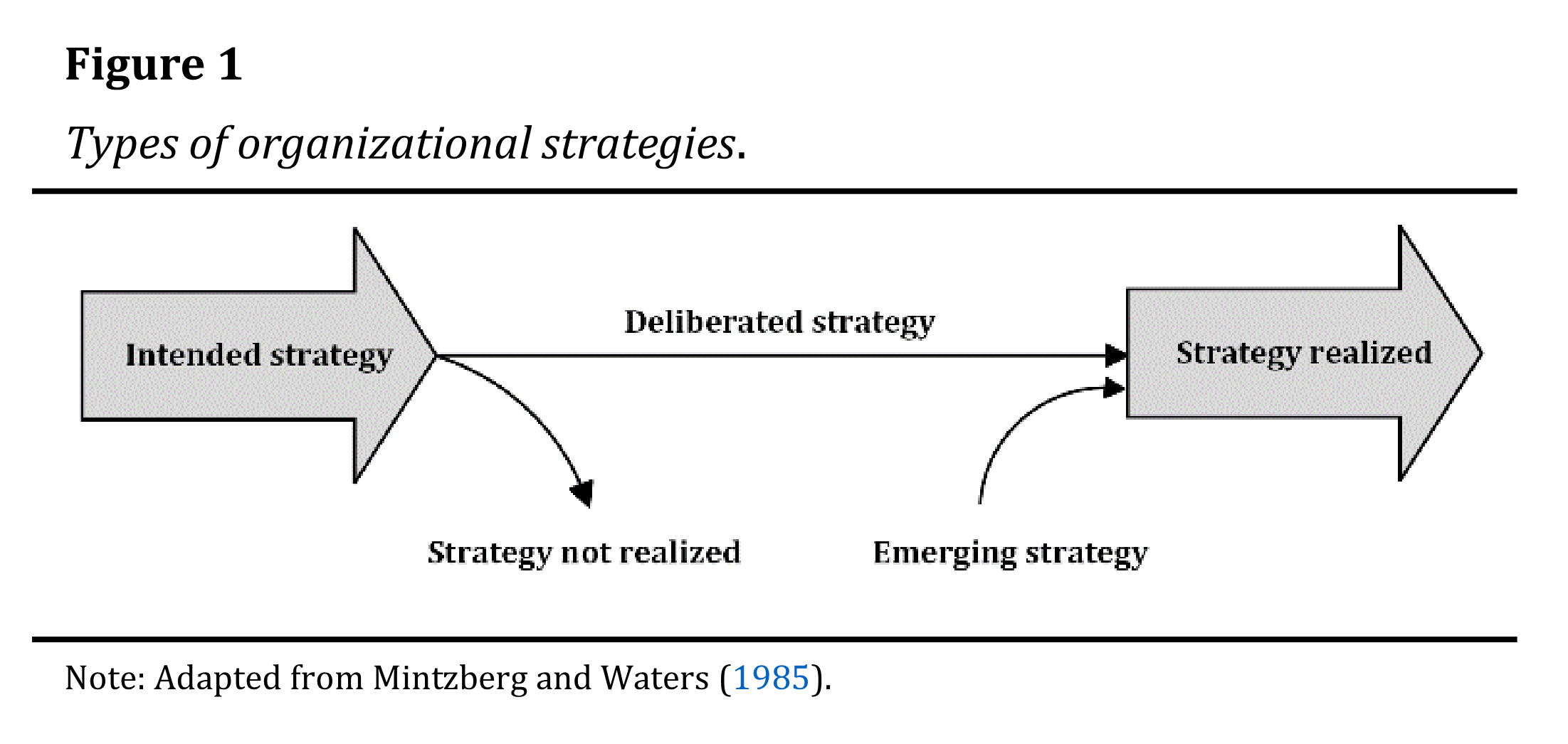
Figure 1
Types of organizational strategies
Note: Adapted from Mintzberg and Waters (1985).
The combined use of deliberate and emerging strategies in the context of SMEs is signaled by Wiesner and Millett (2012), who affirm that companies of the SME type, which use strategic approaches, even if informal, have better performance. Additionally, the same authors point to a formalization of organizational strategies in medium-sized companies in relation to small ones. Thus, medium-sized companies use deliberate strategies more than emerging strategies (Alenzy, 2018).
Thus, IT governance uses organizational elements as an organizational strategy, to create an organizational arrangement that allows the monitoring and control of IT-related activities, within a strategy aligned with current and future organizational needs and objectives. The next section will deal with IT in the context of the SME.
Information technology in small and medium enterprises
The acquisition, processing, storage, delivery and sharing of information are roles played by IT in the organizational context (Baltzan & Phillips, 2012). However, most small and medium-sized companies are unable to perceive the positive effects of using IT resources (Beraldi & Escrivão Filho, 2000; Silva & Dos Reis, 2015).
Some of the causes may be related to the lack of focus on the use of these resources, that is, there is no clear definition in relation to the use nor what will be the resulting benefit in the acquisition of new hardware or software (Beraldi & Escrivão Filho, 2000; Silva & Dos Reis, 2015). Furthermore, the increase in the use of IT in the context of SMEs occurs mainly in operational and administrative functions and not in strategic and decision-making activities (Prates & Ospina, 2004; Silva & Dos Reis, 2015).
Lunardi, Dolci and Dolci (2017) state that small businesses use IS to support activities present in business processes, such as sales, accounts payable and receivable, inventory management, purchase processing, distribution planning and transportation, among others. The same authors continue to affirm that IT is more relevant in organizations that operate in the service sector and that small business owners perceive more clearly the use of IT in automating existing processes, improving business efficiency and productivity.
In general, the operational and strategic advantage in the use of IT in organizations is already a subject with a strong foundation in the literature (Weill & Ross, 2004; Siqueira et al., 2013; Silva et al., 2019). In this line, Raymond et al. (2011) state that information technology plays a strategic role in small and medium-sized companies. However, there are several possible levels of the role played by IT in companies, including: allowing us to improve our operational control; ensure greater operational flexibility; enable a better response to the needs of our customers; facilitate the development of new products; and allow integration with business partners.
Thus, in a context of low investment capacity, as is the context of SMEs, the correct implementation, the appropriate use of IT resources and the alignment of these resources to organizational needs, are fundamental aspects for the success of the investments made. It is in this scenario that IT governance is fundamental.
Information technology governance
Weill and Ross (2004) define IT governance as the specification of decision rights and the framework of responsibilities to stimulate desirable behaviors in the use of IT. IT governance aims to make sure that investments made in technology assist companies in organizational objectives, thus adding greater value to the organization's business (Lunardi et al., 2014a). There are several studies that indicate a relationship between IT governance and greater organizational performance (Weill & Ross, 2004; Bradley et al., 2012; Lunardi et al., 2014a). Thus, efficiently governing IT resources is essential for organizations, including small ones (Guldentops, 2014).
For Peterson (2004), effective IT governance could be achieved through the use of structural, procedural and relationship governance mechanisms. However, as the organization becomes formally aware of the use of one of these mechanisms, its use becomes more frequent, the greater the level of maturity of IT governance, making the organization more in control of investments made in TI (Lunardi et al., 2010; Silva et al., 2019).
Thus, IT governance would be achieved from a mix of formal and informal elements of governance, as in the framework proposed by Silva (2019), which is based on three dimensions (structural, procedural and relationship), shown in Figure 2, where the IT governance mechanisms are presented in each one and its dimensions.
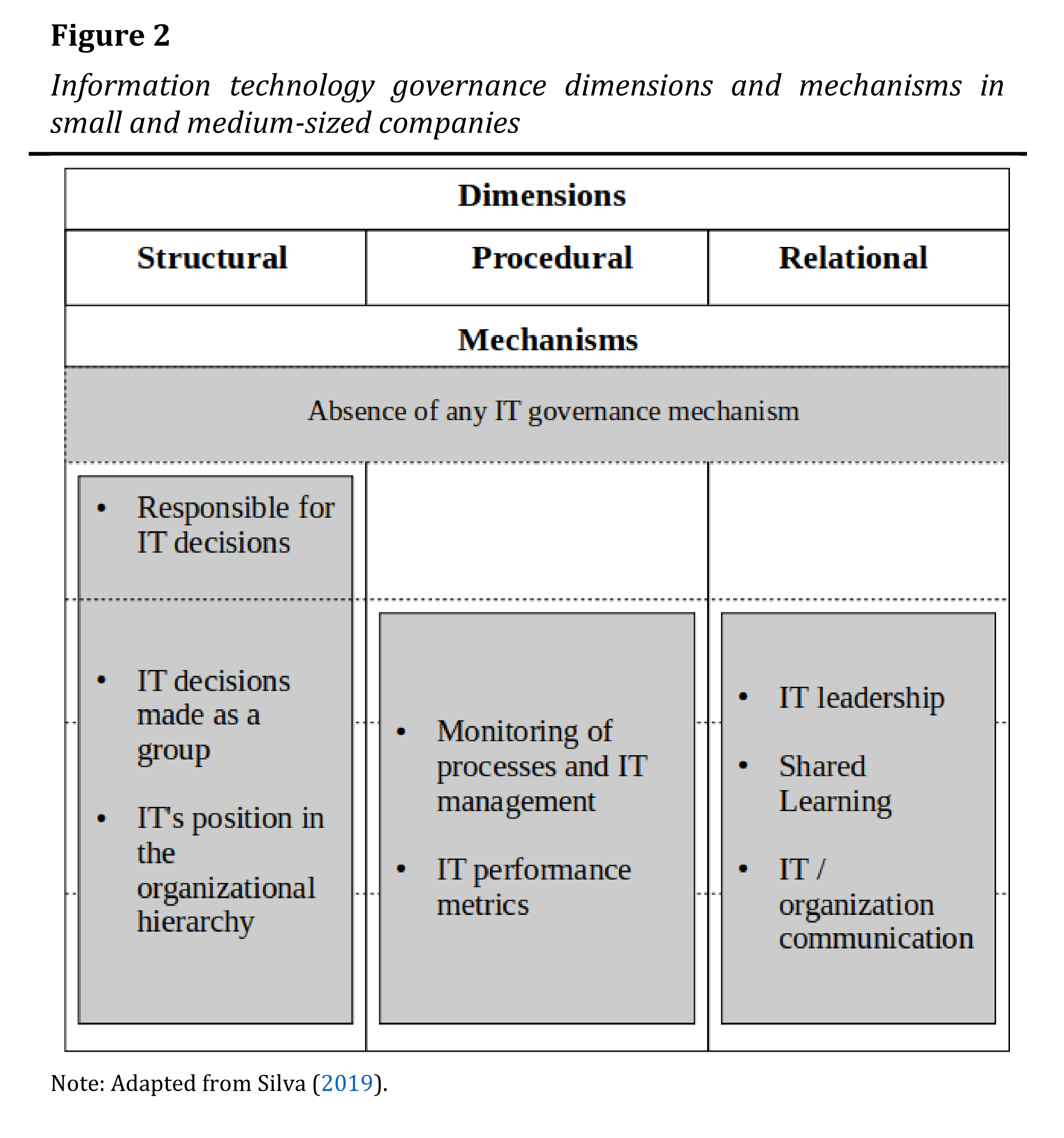
Figure 2
Information technology governance dimensions and mechanisms in small and medium-sized companies
Note: Adapted from Silva (2019).
Next, structural, procedural and relational aspects of IT governance proposed by Silva (2019) and how they are presented in the specificities of the SME context will be discussed below.
IT governance structures in SMEs
Structural IT governance mechanisms involve the way in which the organization is structured in terms of decision-making authority over IT. Commonly, the definition of roles and responsibilities, the use of councils and the use of project offices, are the mechanisms proposed in the literature (Lunardi et al., 2014).
However, in SME environments, with few resources, physical, human and financial, the creation of committees and administrative councils seems to be beyond the reality of everyday life. The creation of these structural governance mechanisms can happen from the moment the organization starts to support them, both financially and structurally, and the use of a clear definition of the roles and responsibilities of those involved with IT can be considered one of the prerequisites for the establishment of an effective IT governance (Lunardi, 2008).
Thus, using Silva’s (2019) framework, the assessment of the IT governance mechanisms used in the context of SMEs, was carried out taking into account the person responsible for the IT sector, IT decisions taken in groups (Silva et al., 2019) and the position of IT in the organizational hierarchy (Nfuka & Rusu, 2011). Table 1 shows the relationship between the structural governance mechanisms and their respective components.
| Table 1 | |
| Combination of structural components of the information technology governance framework | |
| Structural components | Structural mechanisms |
| Roles and responsibilities | Responsible for IT decisions |
| IT strategy committeeIT steering committeeIT project committee | IT decisions made as a group |
| CIO on the board of directorsIT organizational structure | IT's position in the organizational hierarchy |
| Project office | Unmapped component |
| Note: Adapted from Silva (2019). | |
It is noteworthy that from the characteristics of IT use in the context of SMEs, initially focused on operational and administrative aspects, and not on strategic and decision-making activities (Prates & Ospina, 2004), it is expected that the organic structure is better developed around key employees, thanks to the simplicity of information systems, as predicted by Bergeron et al. (2015), since the SME context is characterized by transactions associated with relational norms, with an emphasis on integration, preservation of the relationship, reciprocal expectations for the future, conflict harmonization and supra contractual norms (Mouzas & Blois, 2008). Such an emphasis reverberates in a more significant positioning of the IT structure in the context of SMEs.
Therefore, from the above, the first research hypothesis is presented:
-
H1: The strategic use of IT in the context of small and medium-sized companies is positively related to the use of structural IT governance mechanisms.
IT governance processes in SMEs
The procedural dimension of IT governance emphasizes monitoring and control and refers to tools, techniques, frameworks or standards, which aim to ensure that IT is aligned with the business and to monitor the performance of resources made available to users to carry out their tasks. organizational (Bergeron et al., 2020).
In an SME context, using internationally recognized frameworks, such as COBIT or ITIL, can be a viable alternative, as these frameworks are already tested and applied in the most diverse environments, have ample and available documentation and proven effectiveness. However, it is a fact that its implementation is not simple, which leads to the abandonment of its use (Silva et al., 2019).
Concomitantly, small and medium-sized companies have a greater focus on operational aspects (Prates & Ospina, 2004), thus, using monitoring and control mechanisms that have a greater focus on the operation, make them more likely to success and greater visibility as to the value that IT generates for the business. Based on the above, the identification of governance mechanisms in the context was carried out based on two basic components, that of monitoring processes and IT management and the use of performance metrics (Silva et al., 2019). The relationship between procedural components and IT governance procedural mechanisms is shown in Table 2.
| Table 2 | |
| Combination of procedural components of the information technology governance framework | |
| Procedural components | Procedural mechanisms |
| Strategic planning of information systemsAlignment levelsCOBIT® ITIL®Service level agreements | Monitoring of processes and IT management |
| IT performance indicatorsReturn on investment assessment methodsEx-post evaluation | IT performance metrics |
| Note: Adapted from Silva (2019). | |
It is important, then, to emphasize that small and medium-sized companies focus on operational aspects (Prates & Ospina, 2004) and, therefore, seek to use monitoring and control mechanisms that are more focused on the operation, as these are intended to have greater chances of success and greater visibility for the company's operation. Even so, Silva et al. (2018) mention that in an SME context, using internationally recognized frameworks, such as COBIT® or ITIL®, can be a viable alternative.
So, it is possible to elaborate the second research hypothesis:
-
H2: The strategic use of IT in the context of small and medium-sized companies is positively related to the use of IT governance procedural mechanisms.
Relational mechanisms of IT governance in SMEs
Some of the relational mechanisms of IT governance proposed in the literature are already present in the context of small and medium-sized companies, such as active collaboration between key members and shared work and close to IT and business people. Thus, its formal implementation would not be necessary (Wilkin et al., 2016; Bergeron et al., 2020). Concomitantly, communication is intended to share information about IT and how IT management and organizational management can share knowledge and understand, mutually, how the organization operates (Xu et al., 2015).
In addition, more formal approaches to knowledge transfer are needed and shared learning can be one of the mechanisms used for the business to understand IT and IT to understand the business (Peterson, 2004; Lunardi et al., 2010). The goal is for the organization to understand more details of daily IT life, such as information security, technologies used and trends, and IT to understand how all of this technology is being used to improve organizational processes and what is not working.
Thus, three were the basic components of the relational dimension of IT governance in SMEs raised in the study, the leadership of the IT manager, the shared learning and communication between the organization and IT (Silva, 2019). The mechanisms and their respective components are shown in Table 3.
| Table 3 | |
| Combination of relational components of the information technology governance framework | |
| Relational components | Relational mechanisms |
| Shared understanding of IT and business objectivesActive conflict resolution | IT leadership |
| Active participation of key stakeholdersCollaboration between key stakeholdersCross-functional training between IT and businessRotation of IT and business tasks | Shared learning |
| Physical proximity to IT and business personnelInformal communication practices | IT / organization communication |
| Incentives and rewards | Unmapped component |
| Note: Adapted from Silva (2019). | |
Two points must be emphasized in relation to the mechanisms of IT governance in the context of SMEs, the first is that these are already present in the context of small and medium-sized companies, dressed in active collaboration between key members, shared work and proximity to people of information and business technology. Thus, for these reasons, its formal implementation would not be necessary (Wilkin et al., 2016; Bergeron et al., 2020). The second is that for De Haes and Van Grembergen (2009), the implementation of relational governance mechanisms is, in general, a simple process. In the surveys carried out by the aforementioned authors, only the item information technology leadership obtained a low rate of ease for implementation, although it was perceived by the managers participating in the surveys as the most effective mechanism in IT governance.
Finally, the third research hypothesis is presented:
-
H3: The strategic use of IT in the context of small and medium-sized companies is positively related to the use of relational IT governance mechanisms.
METHODOLOGICAL PROCEDURES
In order to achieve the research objectives, the present work is classified, as to its nature, as being exploratory (Gil, 2008). Exploratory, therefore, as stated by Bergeron et al. (2015), the topic of IT governance in the context of SMEs is poorly studied.
This research used the field study research strategy. Morgan and Finnegan (2014) state that the field study is an appropriate strategy when the phenomenon studied is recent or does not contain an appropriate body of empirical work. Still, for the same authors, the field study is oriented towards transversality and the reach of several cases.
Data collection took place from a quantitative study, having been carried out through a survey and intended to identify the characteristics of the use of information technologies in small and medium-sized companies. Additionally, in order to guarantee the quality of the study carried out, the proposals of Maula and Stam (2019) of rigor in quantitative organizational studies were used.
According to Bergeron et al. (2020), issues such as management characteristics, strategic use of IT, among others, can change the mechanisms of IT governance to be used. Thus, it will be possible to identify the different usage characteristics in the context, which can lead to different IT governance profiles.
To obtain the data, a data collection instrument composed of two main parts was used. The first part aimed to assess the strategic use of IT in organizations (Raymond et al., 2011). The second part surveys the governance mechanisms used in the context (Nfuka & Rusu, 2011; Bergeron et al., 2015).
For the first part of the questionnaire, which assessed the strategic use of IT in organizations, was adapted from a gradual scale proposed by Raymond et al. (2011) was used. This scale was based on Venkatraman (1994) and Philip and Booth (2001) self-typing approach, where the respondent would tick all the options that apply. Thus, the strategic use of IT in the organization can vary from 0 to 5. Originally, the scale, which is shown in Table 4, was composed of 4 items. However, after analysis by the research team, it was decided to separate item 3 into two items, resulting in the 5 used in this research.
| Table 4 | |||
| Questions present in the collection instrument | |||
| Item | Original Question | Item | Adapted question |
| 1 | ITApps should allow us to improve our managerial control and our production monitoring | 1 | IT should allow us to improve our managerial control and our production monitoring |
| 2 | ITApps should insure greater operational flexibility and better response to our customers’ needs | 2 | IT should insure greater operational flexibility and better response to our customers’ needs |
| 3 | ITApps should facilitate and accelerate the development of new products and allow us to increase our market share. | 3 | IT should facilitate and accelerate the development of new products. |
| 4 | IT should allow us to increase our market share. | ||
| 4 | ITApps should allow us to integrate our business and production processes, and to improve exchanges with our business partners. | 5 | IT should allow us to integrate our business and production processes, and to improve exchanges with our business partners. |
| Note: Raymond et al. (2011). | |||
To assemble the second part of the questionnaire, a binary scale was used, where the respondent would indicate whether or not the governance mechanism is present in his organization. The items in the questionnaire were obtained from the work of Nfuka and Rusu (2011) and Bergeron et al. (2015). These authors have raised in the literature (Ali & Green 2007; Abu-Musa, 2009; De Haes & Van Grembergen, 2009; Maidin & Arshad, 2010; Srimai & Damsaman, 2011) a series of structural, procedural and relational IT governance mechanisms. The scale used to measure the mechanisms is available in Table 5.
| Table 5 | |||
| Questions present in the collection instrument | |||
| Item | Question | ||
| Structural mechanisms | |||
| 6 | The company has a responsible for the IT sector | Responsible for IT decisions | |
| 7 | The IT manager participates in organizational decisions | IT's position in the organizational hierarchy | |
| 8 | The IT manager has a direct line of communication with the organizational direction | ||
| 9 | The company has a committee that defines the IT strategy | IT decisions made as a group | |
| 10 | The company has a committee to monitor IT projects | ||
| Procedural mechanisms | |||
| 11 | There is a formal process for updating the IT strategy | Monitoring of processes and IT management | |
| 12 | The company has tools to measure the performance of the IT department | IT performance metrics | |
| 13 | IT costs are known among business units | ||
| 14 | The company has IT sector service level agreements (SLA) | Monitoring of processes and IT management | |
| 15 | The company uses a governance framework such as COBIT, COSO or ITIL | ||
| 16 | The company uses some process to manage IT projects | ||
| 17 | The company controls the costs of the IT sector | IT performance metrics | |
| 18 | In the company there is a process that monitors the benefits after the implementation of IT investments | ||
| Relational mechanisms | |||
| 19 | In the company there is an interaction between IT staff and staff from other sectors | IT / organization communication | |
| 20 | IT professionals and teams from other sectors of the company work closely together | ||
| 21 | The company promotes training of IT staff to better understand the business | Shared learning | |
| 22 | The company has a professional who acts as an intermediary between management and the IT sector | IT leadership | |
| 23 | The IT sector and the company act as partners | IT / organization communication | |
| 24 | In the company, informal meetings take place between the company's management and the person responsible for the IT sector to address issues related to information technology | ||
| 25 | The IT manager understands the business objectives | IT leadership | |
| 26 | The company's internal communications regularly address issues related to the IT industry | IT / organization communication | |
| 27 | The company promotes training to improve the use of IT resources | Shared learning | |
| 28 | IT receives management support and encouragement | IT leadership | |
| Note: Nfuka and Rusu (2011) and Bergeron et al. (2015). | |||
The score for each IT governance mechanism was calculated based on the existence of one of the tools that are part of that mechanism. The dimension score, on the other hand, considered the sum of the mechanisms existing in each of them. Thus, the structural and relational dimensions could take values between 0 and 3 and the procedural dimension could take values between 0 and 2.
Thus, in addition, Table 6 presents the compilation of the studies used to assemble the research instrument, as well as the evaluated construct and the question numbering.
| Table 6 | ||
| Questions present in the collection instrument | ||
| Scale | Construct | Questions1 |
| IT strategic role | IT role | 1 - 5 |
| IT governance mechanisms | Structural mechanisms | 6 - 10 |
| Processual mechanisms | 11 - 18 | |
| Relational mechanisms | 19 - 28 | |
| Note: 1 Origin study: Questions 1 – 5, Raymond et al. (2011); 6 – 28: Bergeron et al. (2015) and Nfuka and Rusu (2011). | ||
Due to the aforementioned importance of IT in the service sector (Lunardi et al., 2017), it was chosen, in the present work, to evaluate the relationships between the constructs studied within the context of service provider companies, being, then, the survey carried out in companies in this sector.
The study participants were managers of organizations considered small and medium-sized. Considering the technique of key informants, which proposes that informants should be selected based on their qualifications, specialized knowledge and their position in the company (Kumar, Stern, & Anderson, 1993). An international criterion was adopted, defined by the Organization for Economic Cooperation and Development (OECD), in which a company is classified as an SME, if the number of employees is in the range between 10 and 250 (OECD, 2019).
In the meantime, for the present study, it is defined that non-probabilistic sampling is one in which the selection of the elements of the population to compose the sample depends, at least in part, on the researcher's judgment, and the convenience sample as the selection of members of the most accessible population (Oliveira, 2001).
After the elaboration and structuring of the research data collection instrument, it underwent a validation procedure known as face validation, in which specialists observed whether the items on the scale seem clear and adequate to what they propose to measure (Lucian & Dornelas, 2015).
The data were analyzed using descriptive statistics, Spearman's correlation coefficient and Logistic Regression. Spearman's correlation coefficient is a highly recommended non-parametric test, as it has some advantages, such as the possibility of using it in a greater number of cases than the parametric method, not requiring normal distributions; the use to detect relationships that are not linear; and the simplicity of calculations in relation to linear correction (César, 2009).
Observing the propositions of Tabachnick and Fidell (2007) and Kline (2011) for the minimum number of 200 cases for the execution of the Structural Equation Modeling technique, it was removed from the list of possibilities due to limitations related to the sample size. We then opted for the use of the Logistic Regression technique, which, according to Van Smeden et al. (2019), requires a minimum of 10 events per variable, which was made possible in the present study.
The Logistic Regression technique enables the assessment of the relevance of each independent variable in relation to the dependent variables of the study. Additionally, Logistic Regression enables the statistical study in cases where there are no parametric characteristics of the studied variables (Hair et al., 2009; Hosmer, Lemeshow & Sturdivant, 2013).
The variables present in the study were transformed from the original 5-point Likert scale to binary scales. This transformation enables better analysis of results and better predictive power of models. The cutoff point was defined as the median of each of the scales, resulting in 0 for cases where values were equal to or less than the median and 1 for cases where values were above the median.
The Logistic Regression models were generated using the Stepwise Backward LR method, so that the statistical software uses an iterative process from a larger model, until only the significant independent variables in the model are kept (Hair et al., 2009).
Thus, from the presented it is expected to have reached the quality criteria for quantitative research in organizations proposed by Maula and Stam (2019), moving on to the presentation of results.
RESULTS
This section will present the results obtained from the data collected from the companies participating in the research. Initially, the characterization of the sample will be presented, followed by the descriptive statistics of the variables present in the study. Then, the results of the correlations between the constructs IT strategic role and the IT governance mechanisms grouped in their dimensions of strategic, procedural and relational mechanisms will be presented.
Sample characterization
The research stage was carried out between the months of May and June 2019 with companies from various areas of service provision, which had between 10 and 250 employees, according to the OECD classification for small and medium-sized companies (OECD, 2019). Altogether 68 companies participated in the study.
Among the companies participating in the study, the type of service that presented itself most frequently was the educational one, with 33.8% of the participating companies. However, it is important to highlight the diversity of respondent companies. Altogether 30 different types of services were captured by the survey. Table 7 shows the distribution of participating companies according to the service provided.
| Table 7 | ||
| Types of services offered by the companies participating in the study | ||
| Type of service | Frequency | Percentage |
| Educational | 23 | 33.8 |
| Finance | 4 | 5.9 |
| Restaurant | 4 | 5.9 |
| Health | 5 | 7.4 |
| Others | 32 | 47.1 |
| Total | 68 | 100.0 |
| Note: Elaborated by authors. | ||
The initial intention of the study was to capture information from companies that operate in different locations. However, due to limitations in the collection process, among the cities in which the participating companies operate, the vast majority, 98.5%, are located in the state of Pernambuco, only one company from Natal, Rio Grande do Norte, participated in the survey. The city with the largest number of participants was Recife, with 36.8% of the total.
Regarding the number of employees, 75% of the participating companies had up to 55 employees. Figure 3 shows the distribution of the number of employees of the participating companies.
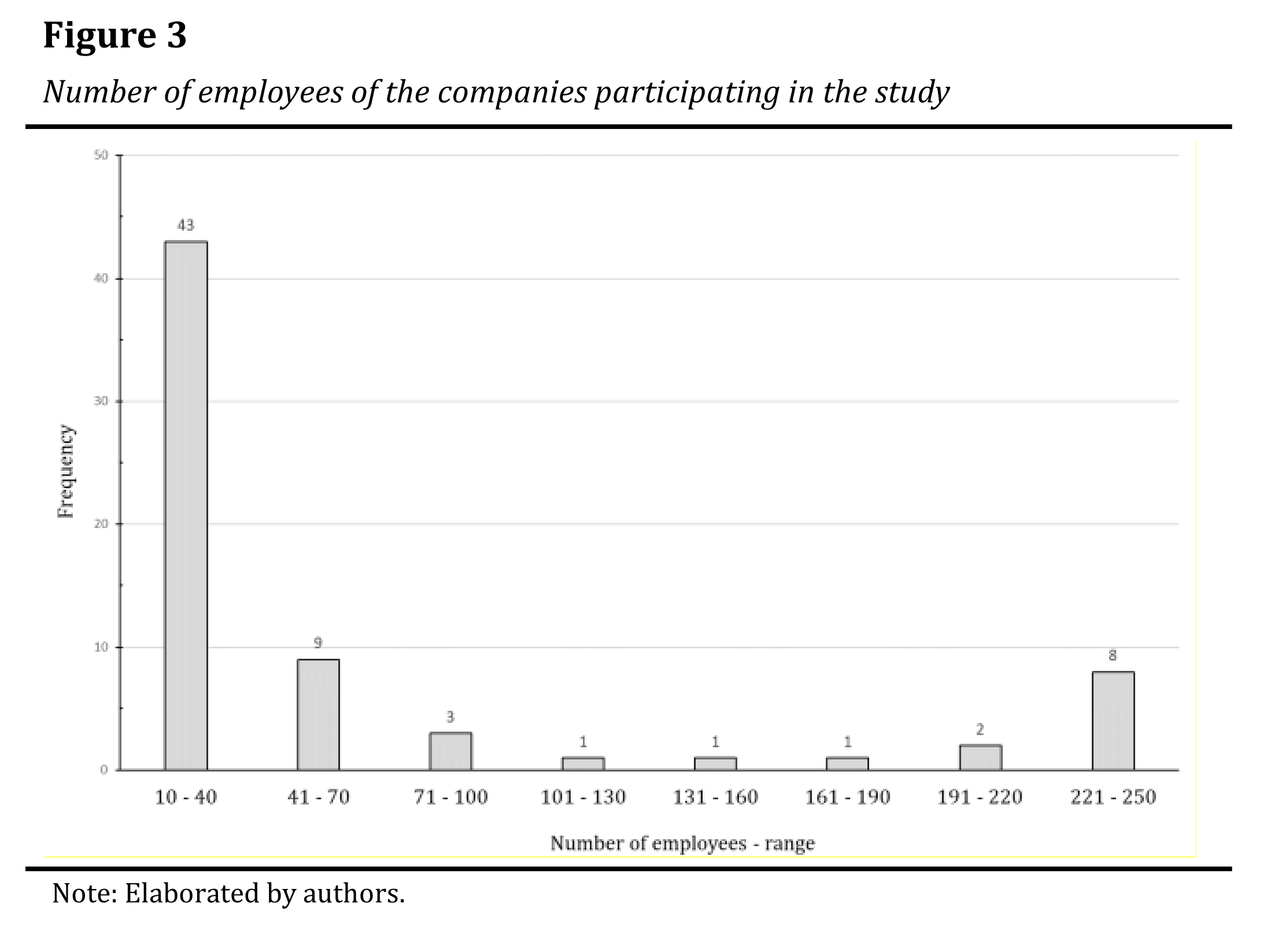
Figure 3
Number of employees of the companies participating in the study
Note: Elaborated by authors.
Regarding the managers participating in the study, 41.2% declared themselves female and 58.8% male. The education of the participants was concentrated in undergraduate and graduate courses, with 41.2% of participants for each of the categories. The respondents' ages were well distributed between 20 and 63 years old.
After presenting the group of research participants, the descriptive data of the variables will follow, as they were part of the research instrument used in the study.
Descriptive statistics of variables
In this topic, descriptive statistics will be presented that enable the characterization of the variables present in the study. Each variable will be presented according to its distribution. The strategic role of TI was evaluated based on an instrument proposed by Raymond et al. (2011), with values between 0 and 5 being obtained. For each question, the participant would answer yes or no, with the final value being the sum of points of the five questions. Table 8 shows the frequency of responses for each item.
| Table 8 | ||
| Frequencies of IT strategic role | ||
| Question | Yes | No |
| Allow us to improve our operational control | 65 | 3 |
| Ensure greater operational flexibility | 60 | 8 |
| Enable better response to the needs of our customers | 60 | 8 |
| Facilitate new product development | 38 | 30 |
| Enable integration with business partners | 45 | 23 |
| Note: Elaborated by authors. | ||
From what is presented in table 6, it is possible to identify that, in the context of SMEs, the role of IT in companies is more related to the operational aspect and to the customer. Corroborating the statements of Prates and Ospina (2004), Silva and Dos Reis (2015) and Lunardi, Dolci and Dolci (2017).
Regarding the final value of the IT role in the organization, the value that presented itself most frequently was 5, with 39.7%, followed by 4, with 32.4%. Table 9 shows the frequency of the final values of the role of IT in the organization.
| Table 9 | ||
| IT strategic role level | ||
| Level | Frequency | Percentage |
| 1 | 4 | 5.9 |
| 2 | 6 | 8.8 |
| 3 | 9 | 13.2 |
| 4 | 22 | 32.4 |
| 5 | 27 | 39.7 |
| Total | 68 | 100.0 |
| Note: Elaborated by authors. | ||
Continuously, the mechanisms of IT governance were classified into structural mechanisms, responsible for the IT sector, IT decisions taken in groups (Silva et al., 2019) and the position of IT in the organizational hierarchy (Nfuka & Rusu, 2011), procedural mechanisms, monitoring of IT processes and management and the use of performance metrics, and relational mechanisms, IT manager leadership, shared learning and communication between the organization and IT (Silva et al., 2019).
The dimension score, on the other hand, considered the sum of the mechanisms existing in each of them. For the structural dimension of IT governance, it was found that about 20% of the companies participating in the study obtained a score of 0, that is, they do not even have a person responsible for the IT sector, which can represent a problem, since they do not there is a clear delegation of responsibilities and, consequently, accountability for the results. Despite this, about 80% of companies have some structural IT governance tool being used.
The procedural dimension was surprisingly present in the context. The fact may have occurred due to the variety of procedural tools available for use by companies, with four tools for each IT governance element and also due to the operational aspect of these tools, since, according to Bergeron et al. (2020), the companies in the studied context have this focus. In this dimension, about 63% of the companies reached the maximum score.
Finally, as expected, the relational dimension had a strong adherence to the context with about 60% of the companies presenting scores of 2 or 3, corroborating with Wilkin et al. (2016) and Silva et al. (2019) in the statement that relational governance mechanisms are more present in the context of SMEs. Table 10 shows a summary of the values obtained for the IT governance mechanisms for each dimension present in the study.
| Table 10 | ||||||
| Values obtained for the IT governance mechanisms for each dimension present in the study | ||||||
| Score | Structural | Processual | Relational | |||
| Value | Percentage | Value | Percentage | Value | Percentage | |
| 0 | 14 | 20.6 | 6 | 8.8 | 5 | 7.4 |
| 1 | 8 | 11.8 | 19 | 27.9 | 3 | 4.4 |
| 2 | 33 | 48.5 | 43 | 63.2 | 22 | 32.4 |
| 3 | 13 | 19.1 | 38 | 55.9 | ||
| Note: Elaborated by authors. | ||||||
Then, the analysis of the correlation between the strategic role of IT in the company and the IT governance mechanisms used is analyzed.
Correlation between the strategic role of IT and governance mechanisms
To assess the relationship between the strategic role of IT and the governance mechanisms used by organizations, Spearman's correlation test was used. The test was chosen because it is indicated for situations where non-parametric variables are used (Hauke & Kossowski, 2011).
The proposition here is that as information technologies become more important to the organization, the control mechanisms used to achieve the desired results must also be important. So, the results indicate that there is a correlation between the role played by IT and the mechanisms of IT governance in all its dimensions. In line with that proposed by Croteau and Bergeron (2001), as IT becomes more important in the organization, IT governance mechanisms also become important, thus enabling better use of technological resources and supporting the H1, H2 and H3 research hypotheses. The results of the correlations are available in Table 11.
| Table 11 | |||
| Correlation between IT's strategic role and IT governance mechanisms | |||
| Structural | Processual | Relational | |
| IT strategic role | 0,398 | 0,348 | 0,288 |
| Sig. | 0,001 | 0,004 | 0,017 |
| Note: Elaborated by authors. | |||
This result corroborates the thesis of Weill and Woodham (2002, p. 9), who maintain that “the primary role played by IT helps in determining IT governance”. Also, along the same lines, Joshi et al. (2018) reaffirm that the strategic role played by IT is a factor that influences IT governance and the use of its mechanisms, as well as a requirement for its maturity. Similarly, it is assumed, the evolution of the role of IT in the organization would also indicate an increase in the use of IT governance mechanisms.
Therefore, aiming at the reduction of opportunistic behaviors and the information asymmetry, foreseen in the agency's theory, the selection of the type of monitoring to be implemented can lead to better results (Mahaney & Lederer, 2011; Vithayathil, 2018). It is clear, then, that in the context of small and medium-sized companies, relational elements of governance are present and should be better used. However, assuming the incompleteness of contracts, the central unit of agency theory (Eisenhardt, 1989), a formal and informal mix can lead to even more positive results in IT governance in the context of SMEs, thus also validating the framework proposed by Silva (2019), since the proposed IT governance mechanisms, structural, procedural and relational, are present in the context of SMEs.
Logistic Regression
To carry out the assessment using the Logistic Regression technique, variables to characterize the population were added, such as type of service, number of employees, manager's age, and manager's education level, in addition to IT governance mechanisms, in order to identify possible relationships with the strategic role of IT.
For each of the variables present in the binary logistic evaluation, a dichotomization procedure was performed. Discrete variables, such as type of service and education level, were marked with values of 0 and 1, according to their category. The variables age and number of employees were dichotomized according to the median of each one. The same technique was used for the variables of structural, procedural and relational governance mechanisms, and for the variable strategic role of IT.
The final logistic model, in which the variables are treated together, presents an Odds Ratio of 4.626 for structural governance mechanisms and 5.486 for relational governance mechanisms, indicating that when there is a perception of the use of structural mechanisms in IT governance, the chances of asserting that IT will play a more important strategic role increase 4.626 times. In the case of relational mechanisms, if the use of these mechanisms is perceived, the chances of IT having a more important strategic role increase by 5.486 times. Only these variables were present in the final regression model, which presented a hit percentage of 89.8% and satisfactory results in the Hosmer and Lemeshow tests (Hosmer, Lemeshow & Sturdivant, 2013).
A point to be highlighted is the absence of procedural governance mechanisms. Despite being present in the context, they seem to be out of harmony with the development of the strategic role of IT in the context of small and medium-sized companies, a fact already warned by Bergeron et al. (2020). The regression values of the final model are available in Table 12.
| Table 12 | ||||||
| Coefficients of the logistic regression model | ||||||
| Variables | B | S.E. | Wald | GL | Sig. | Exp(B) |
| Structural Mechanisms | 1.532 | 0.647 | 5.609 | 1 | 0.018 | 4.626 |
| Relational Mechanisms | 1.702 | 0.681 | 6.238 | 1 | 0.013 | 5.489 |
| Constant | -0.654 | 0.474 | 1.901 | 1 | 0.168 | 0.520 |
| Note: Elaborated by authors. Sig. = Significance. | ||||||
CONCLUSIONS
For many SMEs, investing in IT is something that requires sacrifices, as resources are scarce and the return on investment is somewhat uncertain (Bergeron et al., 2015). Therefore, efficiently governing investments and IT processes of vital importance to SMEs. However, the literature related to the theme has directed efforts towards large companies (Huygh & De Haes, 2016), which makes it necessary to make greater efforts in the context of SMEs.
Managing IT resources effectively is an important issue for researchers in the area of information systems. Hence it is worth identifying standards and models that enable the best management and governance of the technology park.
In small business contexts, as proposed by Wilkin et al. (2016) and Silva et al. (2019), the use of relational governance mechanisms is more present, which can be identified in the present study. Thus, it is possible to use relational mechanisms with greater property in the context, due to their ease of implantation and adherence. However, the combined use of structural, procedural and relational governance mechanisms, would enable higher levels of IT governance and all the benefits linked to its use (Silva, 2019).
Therefore, the issue of the agency is also present in the context of small companies and, according to the theory, it is necessary to use different mechanisms, formal and informal, to achieve greater levels of control over the operations of the IT area. The informal one takes advantage of the context, adding formal elements that can raise the level of governance.
It was also possible to verify that the strategic role of IT in the organization is related to the use of IT governance mechanisms. Thus, managers must be aware of the role that IT plays in their organization, in order to obtain the proper alignment between the technological needs of the organization and the proper control of the IT park.
The use of IT governance mechanisms is possible, even in the context of small businesses. However, the peculiarities inherent to the management of this type of organization generate difficulties in its implementation. It is up to managers to identify mechanisms that can be used in their reality, so that it is possible to enjoy the benefits of information technology for the organization.
Additionally, it is important to highlight the limitations involved in the present study, such as the number of participating companies, since the use of more sophisticated statistical techniques, such as Structural Equation Modeling, requires a larger sample. This does not invalidate the present study but limits it in the type of statistical analysis that can be applied. Another point that may be limiting for the present study was the sector chosen for the collection of information, since the choice of the IT governance mechanism can also be contingent on the sector (Silva, 2019), therefore, further evaluations are necessary. for the application of the findings in different environments.
Therefore, the need for further studies in other areas is highlighted, allowing the evaluation of different governance mechanisms in terms of efficiency and effectiveness, or even their evolution in relation to the size of the company, as proposed by Silva et al. (2019). Also, the investigation of the contingent action of factors such as time of operation, manager's inclination towards IT and other variables that may interfere in the choice of the best control mechanism according to the agency's theory.
Conflict of interest statement
The authors declare that there is no conflict of interest.
Authors’ statement of individual contributions
| Authors’ statement of individual contributions | |||
| Roles | Contributions | ||
| Silva HCC | Dornelas JS | Araújo MAV | |
| Conceptualization | ∎ | ∎ | |
| Methodology | ∎ | ∎ | ∎ |
| Software | N.A. | ||
| Validation | ∎ | ∎ | ∎ |
| Formal analysis | ∎ | ∎ | ∎ |
| Investigation | ∎ | ||
| Resources | N.A. | ||
| Data Curation | ∎ | ||
| Writing - Original Draf | ∎ | ||
| Writing - Review & Editing | ∎ | ∎ | ∎ |
| Visualization | ∎ | ||
| Supervision | ∎ | ||
| Project administration | ∎ | ||
| Funding acquisition | N.A. | ||
REFERENCES
Abu‐Musa, A. (2009). Exploring the importance and implementation of COBIT processes in Saudi organizations. Information Management & Computer Security, 17(2), 73–95. https://doi.org/10.1108/09685220910963974
Albertin, A. L., & de Moura Albertin, R. M. (2008). Tecnologia de informação e desempenho empresarial no gerenciamento de seus projetos: Um estudo de caso de uma indústria. Revista de Administração Contemporânea, 12(3), 599–629. https://doi.org/10.1590/S1415-65552008000300002
Alenzy, M. Z. (2018). Strategic approach of Saudi small and medium-sized enterprises: More of emergent or deliberate? International Business Research, 11(3), 110–122. https://doi.org/10.5539/ibr.v11n3p110
Ali, S., & Green, P. (2007). IT governance mechanisms in public sector organisations: An Australian context. Journal of Global Information Management, 15(4), 41–63. https://doi.org/10.4018/jgim.2007100103
Baker, G., Gibbons, R., & Murphy, K. J. (2002). Relational contracts and the theory of the firm. The Quarterly Journal of Economics, 117(1), 39–84. https://doi.org/10.1162/003355302753399445
Baltzan, P., & Phillips, A. (2012). Sistemas de informação. AMGH Editora.
Beraldi, L. C., & Escrivão Filho, E. (2000). Impacto da tecnologia de informação na gestão de pequenas empresas. Ciência da Informação, 29(1), 46–50. https://doi.org/10.18225/ci.inf..v29i1.898
Bergeron, F., Croteau, A. M., Uwizeyemungu, S., & Raymond, L. (2020). A framework for research on information technology governance in SMEs. In Start-ups and SMEs: Concepts, methodologies, tools, and applications (pp. 1567–1588). IGI Global.
Bergeron, F., Croteau, A. M., Uwizeyemungu, S., & Raymond, L. (2015). IT governance framework applied to SMEs. International Journal of IT/Business Alignment and Governance, 6(1), 33–49. https://doi.org/10.4018/IJITBAG.2015010103
Bozkurt, Ö. Ç., & Kalkan, A. (2013). Strategic focus in Turkish SMEs: Emergent or deliberate strategies? Procedia - Social and Behavioral Sciences, 99, 929–937. https://doi.org/10.1016/j.sbspro.2013.10.566
Bradley, R. V., Byrd, T. A., Pridmore, J. L., Thrasher, E., Pratt, R. M., & Mbarika, V. W. (2012). An empirical examination of antecedents and consequences of IT governance in US hospitals. Journal of Information Technology, 27(2), 156–177. https://doi.org/10.1057/jit.2012.3
César, C. F. (2009). Um estudo sobre as relações entre preferências por atividades técnicas e perfis de comportamento de engenheiros de software [Master’s thesis, Universidade Federal de Pernambuco].
Chege, S. M., & Wang, D. (2020). Information technology innovation and its impact on job creation by SMEs in developing countries: An analysis of the literature review. Technology Analysis & Strategic Management, 32(3), 256–271. https://doi.org/10.1080/09537325.2019.1651263
Croteau, A. M., & Bergeron, F. (2001). An information technology trilogy: Business strategy, technological deployment and organizational performance. The Journal of Strategic Information Systems, 10(2), 77–99. https://doi.org/10.1016/S0963-8687(01)00044-0
De Haes, S., & Van Grembergen, W. (2009). An exploratory study into IT governance implementations and its impact on business/IT alignment. Information Systems Management, 26(2), 123–137. https://doi.org/10.1080/10580530902794786
Eisenhardt, K. M. (1989). Agency theory: An assessment and review. Academy of Management Review, 14(1), 57–74. https://doi.org/10.2307/258191
Frigotto, M. L., Coller, G., & Collini, P. (2013). The strategy and management control systems relationship as emerging dynamic process. Journal of Management & Governance, 17(3), 631–656. https://doi.org/10.1007/s10997-011-9198-x
Coller, G., Frigotto, M. L., & Costa, E. (2018). Management control system and strategy: The transforming role of implementation. Journal of Applied Accounting Research, 19(2), 211–229. https://doi.org/10.1108/JAAR-01-2016-0002
Gil, A. C. (2008). Métodos e técnicas de pesquisa social (6th ed.). Atlas Editora.
Guldentops, E. (2012). What do you do if the CEO tells you to get it done? CIONET Newsletter, Belgium, June.
Guldentops, E. (2014). Governance of IT in small and medium-sized enterprises. In Information systems for small and medium-sized enterprises (pp. 3–24). Springer.
Hair, J. F., Black, W. C., Babin, B. J., Anderson, R. E., & Tatham, R. L. (2009). Análise multivariada de dados (6th ed.). Bookman.
Hauke, J., & Kossowski, T. (2011). Comparison of values of Pearson’s and Spearman’s correlation coefficients on the same sets of data. Quaestiones Geographicae, 30(2), 87–93. https://doi.org/10.2478/v10117-011-0021-1
Hosmer, D. W., Jr., Lemeshow, S., & Sturdivant, R. X. (2013). Applied logistic regression (Vol. 398). John Wiley & Sons.
Huygh, T., & De Haes, S. (2016). Exploring the research domain of IT governance in the SME context. International Journal of IT/Business Alignment and Governance, 7(1), 20–35. https://doi.org/10.4018/IJITBAG.2016010102
Joshi, A., Bollen, L., Hassink, H., De Haes, S., & Van Grembergen, W. (2018). Explaining IT governance disclosure through the constructs of IT governance maturity and IT strategic role. Information & Management, 55(3), 368–380. https://doi.org/10.1016/j.im.2017.09.003
Kline, R. B. (2011). Convergence of structural equation modeling and multilevel modeling. In M. Williams (Ed.), Handbook of methodological innovation. Sage.
Kiran, T. S., & Reddy, A. V. D. (2019). Evaluating critical success factors of ERP implementation in SMEs. Journal of Project Management, 4, 267–280. https://doi.org/10.35940/ijrte.B1716.078219
Kumar, N., Stern, L. W., & Anderson, J. C. (1993). Conducting interorganizational research using key informants. Academy of Management Journal, 36(6), 1633–1651. https://doi.org/10.5465/256824
Langfield-Smith, K. (1997). Management control systems and strategy: A critical review. Accounting, Organizations and Society, 22(2), 207–232. https://doi.org/10.1016/S0361-3682(95)00040-2
Lucian, R., & Dornelas, J. S. (2015). Mensuração de atitude: Proposição de um protocolo de elaboração de escalas. Revista de Administração Contemporânea, 19(SPE2), 157–177. https://doi.org/10.1590/1982-7849rac20151559
Lunardi, G. L., Becker, J. L., Maçada, A. C. G., & Dolci, P. C. (2014a). The impact of adopting IT governance on financial performance: An empirical analysis among Brazilian firms. International Journal of Accounting Information Systems, 15(1), 66–81. https://doi.org/10.1016/j.accinf.2013.02.001
Lunardi, G. L., Dolci, P. C., Maçada, A. C. G., & Becker, J. L. (2014b). Análise dos mecanismos de governança de TI mais difundidos entre as empresas brasileiras. Revista Alcance, 21(1), 46–76. https://doi.org/10.14210/alcance.v21n1.p046-076
Lunardi, G. L. (2008). Um estudo empírico e analítico do impacto da governança de TI no desempenho organizacional [Doctoral dissertation, Universidade Federal do Rio Grande do Sul].
Lunardi, G. L., Becker, J. L., & Maçada, A. C. G. (2010). Impacto da adoção de mecanismos de governança de tecnologia de informação (TI) no desempenho da gestão da TI: Uma análise baseada na percepção dos executivos. Ciências da Administração, 12(28), 11–39. https://doi.org/10.5007/2175-8077.2010v12n28p11
Lunardi, G. L., Dolci, D. B., & Dolci, P. C. (2017). Adoção de tecnologia da informação e sua relação com a gestão de negócios em micro e pequenas empresas (MPEs). Revista de Administração da Universidade Federal de Santa Maria, 10(5), 929–948. https://doi.org/10.5902/1983465913012
Mahaney, R. C., & Lederer, A. L. (2003). Information systems project management: An agency theory interpretation. Journal of Systems and Software, 68(1), 1–9. https://doi.org/10.1016/S0164-1212(02)00132-2
Mahaney, R. C., & Lederer, A. L. (2011). An agency theory explanation of project success. Journal of Computer Information Systems, 51(4), 102–113. https://doi.org/10.1080/08874417.2011.11645506
Maidin, S. S., & Arshad, N. H. (2010, June). Information technology governance practices in Malaysian public sector. In Proceedings of the 2010 International Conference on Financial Theory and Engineering (pp. 281–285). IEEE.
Maula, M., & Stam, W. (2019). Enhancing rigor in quantitative entrepreneurship research. Entrepreneurship Theory and Practice, 44(6), 1153–1167. https://doi.org/10.1177/1042258719891388
Mintzberg, H., & Waters, J. A. (1985). Of strategies, deliberate and emergent. Strategic Management Journal, 6(3), 257–272. https://doi.org/10.1002/smj.4250060306
Morgan, L., & Finnegan, P. (2014). Beyond free software: An exploration of the business value of strategic open source. The Journal of Strategic Information Systems, 23(3), 226–238. https://doi.org/10.1016/j.jsis.2014.07.001
Mouzas, S., & Blois, K. (2008). Relational contract theory: Confirmations and contradictions. In Proceedings of the 24th IMP Conference.
Nfuka, E. N., & Rusu, L. (2011). The effect of critical success factors on IT governance performance. Industrial Management & Data Systems, 111(9), 1418–1448. https://doi.org/10.1108/02635571111182773
OECD. (2019). OECD SME and entrepreneurship outlook 2019. OECD Publishing.
Oliveira, T. D. (2001). Non-probabilistic sampling: Adequacy of situations for use and limitations of convenience, judgment, and quota samples. Administração On-line, 2(3), 1–10. Retrieved from https://pesquisa-eaesp.fgv.br/sites/gvpesquisa.fgv.br/files/arquivos/veludo_-_amostragem_nao_probabilistica_adequacao_de_situacoes_para_uso_e_limitacoes_de_amostras_por_conveniencia.pdf
Petersen, B., & Østergaard, K. (2018). Reconciling contracts and relational governance through strategic contracting. Journal of Business & Industrial Marketing, 33(6), 839–853. https://doi.org/10.1108/JBIM-09-2016-0223
Peterson, R. (2004). Crafting information technology governance. Information Systems Management, 21(4), 7–22. https://doi.org/10.1201/1078/44705.21.4.20040901/84183.2
Philip, G., & Booth, M. E. (2001). A new six ‘S’ framework on the relationship between the role of information systems (IS) and competencies in IS management. Journal of Business Research, 51(3), 233–247. https://doi.org/10.1016/S0148-2963(99)00051-X
Prates, G. A., & Ospina, M. T. (2004). Tecnologia da informação em pequenas empresas: Fatores de êxito, restrições e benefícios. Revista de Administração Contemporânea, 8(2), 9–26. https://doi.org/10.1590/S1415-65552004000200002
Raymond, L., Croteau, A. M., & Bergeron, F. (2011). The strategic role of IT as an antecedent to the IT sophistication and IT performance of manufacturing SMEs. International Journal on Advances in Systems and Measurements, 4(3–4), 203–211. https://r-libre.teluq.ca/720/1/IJASM-7212%5B1%5D-2012-Post-Print.pdf
Santini, S., de Vasconcellos Favarin, E., Nogueira, M. A., de Oliveira, M. L., & Ruppenthal, J. E. (2015). Fatores de mortalidade em micro e pequenas empresas: Um estudo na região central do Rio Grande do Sul. Revista Eletrônica de Estratégia & Negócios, 8(1), 145–169. Retrieved from http://www.spell.org.br/documentos/ver/35173/fatores-de-mortalidade-em-micro-e-pequenas-empresas--um-estudo-na-regiao-central-do-rio-grande-do-sul-/i/pt-br
Sarfati, G. (2013). Estágios de desenvolvimento econômico e políticas públicas de empreendedorismo e de micro, pequenas e médias empresas (MPMEs) em perspectiva comparada: Os casos do Brasil, do Canadá, do Chile, da Irlanda e da Itália. Revista de Administração Pública, 47(1), 25–48. https://bibliotecadigital.fgv.br/ojs/index.php/rap/article/view/7302
Silva, H. C. C. (2019). Proposição de um framework de governança de tecnologia da informação para pequenas e médias empresas: A busca pelo aumento do valor da tecnologia da informação para o negócio [Doctoral dissertation, Universidade Federal de Pernambuco].
Silva, H. C. C., Dornelas, J. S., da Silveira, D. S., & Lucena, R. B. (2019). A governança da tecnologia da informação e seus mecanismos formais e informais: Proposição de um framework para o contexto de empresas de pequeno e médio porte. Revista de Empreendedorismo e Gestão de Pequenas Empresas, 8(3), 200–230. https://doi.org/10.14211/regepe.v8i3.1347
Silva, H. C. C. D., Silveira, D. S. D., Dornelas, J. S., & Ferreira, H. S. (2020). Information technology governance in small and medium enterprises—a systematic mapping. JISTEM - Journal of Information Systems and Technology Management, 17, 1–25. https://doi.org/10.4301/S1807-1775202017001
Silva, P. C. (2010). Uso de TI por pequenas empresas de TI: O caso de uma startup. Revista de Ciências Gerenciais, 14(19), 107–126. https://doi.org/10.17921/1415-6571.2010v14n19p107-126
Silva, R. C. D. C., & dos Reis, M. C. (2015). Pesquisa sobre a utilização das tecnologias da informação e dos recursos de internet: Micro e pequenas empresas do comércio varejista de Londrina. Revista de Ciências Jurídicas e Empresariais, 9(1), 57–65. Retrieved from https://sumarios.org/artigo/pesquisa-sobre-utiliza%C3%A7%C3%A3o-das-tecnologias-da-informa%C3%A7%C3%A3o-e-dos-recursos-de-internet-micro-e
Siqueira, É. S., de Souza, C. A., & Viana, A. B. N. (2013). Uso da tecnologia de informação em empresas de pequeno e médio porte: Uma análise a partir dos dados da pesquisa "TIC Empresas" de 2011. In CONF-IRM (p. 51).
Siqueira, É., & de Souza, C. A. (2016). Exclusão digital das pequenas e médias empresas brasileiras—Um olhar pela teoria de adoção das tecnologias de informação e comunicação. In CONF-IRM (p. 47).
Srimai, S., Damsaman, N., & Bangchokdee, S. (2011). Performance measurement, organizational learning and strategic alignment: An exploratory study in Thai public sector. Measuring Business Excellence, 15(2), 57–69. https://doi.org/10.1108/13683041111131628
Tabachnick, B. G., Fidell, L. S., & Ullman, J. B. (2007). Using multivariate statistics (5th ed., pp. 481–498). Pearson.
van Smeden, M., Moons, K. G., de Groot, J. A., Collins, G. S., Altman, D. G., Eijkemans, M. J., & Reitsma, J. B. (2019). Sample size for binary logistic prediction models: Beyond events per variable criteria. Statistical Methods in Medical Research, 28(8), 2455–2474. https://doi.org/10.1177/0962280218784726
Venkatraman, N. (1994). IT-enabled business transformation: From automation to business scope redefinition. Sloan Management Review, 35, 73–73. Retrieved from https://sloanreview.mit.edu/article/itenabled-business-transformation-from-automation-to-business-scope-redefinition/
Vithayathil, J. (2018). Will cloud computing make the information technology (IT) department obsolete? Information Systems Journal, 28(4), 634–649. https://doi.org/10.1111/isj.12151
Weill, P., & Ross, J. W. (2004). IT governance: How top performers manage IT decision rights for superior results. Harvard Business Press.
Weill, P., & Woodham, R. (2002). Don't just lead, govern: Implementing effective IT governance. MIT Sloan.
Wiesner, R., & Millett, B. (2012). Strategic approaches in Australian SMEs: Deliberate or emergent? Journal of Management and Organization, 18(1), 98–122. https://doi.org/10.5172/jmo.2012.18.1.98
Wilkin, C., Couchman, P., Sohal, A., & Zutshi, A. (2016). Exploring differences between large and medium organizations’ corporate governance of information technology. Accounting & Information Systems, 22, 6–25. https://doi.org/10.1016/j.accinf.2016.07.002
Xu, Y., Tong, Y., Liao, S. S., & Yu, Y. (2015, July). Understanding the impact of indirect system use on task performance in hospital: An agency theory perspective. In PACIS (p. 39).
Zhou, H., Uhlaner, L. M., & Jungst, M. (2021). Knowledge management practices and innovation: A deliberate innovation management model for SMEs. Journal of Small Business Management, 1–34. https://doi.org/10.1080/00472778.2021.1888383
Author notes
Corresponding author: humberto.ccs@gmail.com
Additional information
Article ID: 2051
JEL Code: M15, L10, G30
Editor-in-Chief1or Adjunct2: 2Dr. Edmundo Inácio Júnior, Campinas State University (UNICAMP)
Handling Editor: Dr. Pedro Lucas de Resende Melo, Paulista University(UNIP)
Executive Editor: M. Eng. Patrícia Trindade de Araújo
Translation / Proofreading: Humberto Caetano Cardoso da Silva
Cite as: Silva, H. C. C. da; Dornelas, J. S; Araújo, M. A.V. (2021). Strategic role of IT and IT governance mechanisms for the context of small and medium enterprises. Iberoamerican Journal of Entrepreneurship and Small Business, 11(1), Article e2051. https://doi.org/10.14211/ibjesb.e2051
Additional information
redalyc-journal-id: 5615