Technological article
Educational support to improve female entrepreneurship: A case study amidst social inequalities
Apoio educacional para melhorar o empreendedorismo feminino: Um estudo de caso em meio às desigualdades sociais
Apoyo educativo para mejorar el emprendimiento femenino: Un estudio de caso en medio de desigualdades sociales

 Cleia Denise Santos Ciscato cleia.ciscato@gmail.com
Educational support to improve female entrepreneurship: A case study amidst social inequalities
REGEPE Entrepreneurship and Small Business Journal, vol. 14, e2519, 2025
Associação Nacional de Estudos em Empreendedorismo e Gestão de Pequenas Empresas

This work is licensed under Creative Commons Attribution 4.0 International.
Received: 24 May 2024
Accepted: 26 June 2025
Published: 11 September 2025
Abstract: Objective of the study: This study investigates how higher education can mitigate social inequalities by integrating academic content with female micro-entrepreneurship, addressing socioeconomic challenges through strategic business planning. It specifically investigates the application of active learning methodologies and business tools to enhance the sustainability and resilience of female-led microenterprises. Methodology/Approach: A qualitative case study approach was employed, focusing on a female micro-entrepreneur in Curitiba, Brazil, who participated in a university extension project. The study applied Problem-Based Learning (PBL) and Business Model Canvas (BMC) to provide strategic planning support. Data collection included semi-structured interviews, direct observations, and document analysis to ensure a comprehensive understanding of the case. Main Results: The findings reveal that structured educational support led to significant improvements in business organization, financial planning, and market positioning. The entrepreneur developed a more robust business model, increasing operational efficiency and strategic decision-making capabilities. Additionally, the research highlights the role of active learning methodologies in fostering entrepreneurial skills and addressing gender disparities in business. Relevance/Originality: This study contributes to the literature by demonstrating how academic-business collaboration through extension activities strengthens entrepreneurial capacity among women. It also provides empirical evidence on the effectiveness of integrating PBL and BMC in supporting female micro-entrepreneurs, an area with limited previous exploration. Social/Management Contributions: The study reinforces the potential of female micro-entrepreneurship when supported by structured strategic planning and educational collaboration. It underscores the importance of inclusive entrepreneurship policies and university-led initiatives in reducing gender-based economic disparities.
Keywords: Female micro-entrepreneurship, Higher Education Extension, Problem-Based Learning, Business Model Canvas, Social Inequality.
Resumo: Objetivo do estudo: Este estudo explora a mitigação das desigualdades sociais por meio do ensino superior, com foco na integração de conteúdos acadêmicos com o microempreendedorismo feminino para enfrentar desafios socioeconômicos. Metodologia/abordagem: Uma abordagem qualitativa por meio de um estudo de caso de um microempreendedor brasileiro de Curitiba, cidade localizada no sul do Brasil, engajado em um projeto de extensão universitária empregando a Aprendizagem Baseada em Problemas (ABP) e o Business Model Canvas para planejamento estratégico. Principais resultados: O apoio educacional facilitou a identificação de oportunidades para melhorar a organização, a exploração do mercado e o planejamento financeiro, levando ao desenvolvimento de estratégias de negócios resilientes e sustentáveis. Relevância/originalidade: Destaca a importância de metodologias ativas de aprendizagem e ferramentas de gestão estratégica na educação, contribuindo para a sustentabilidade das microempresas e o papel da educação na redução das desigualdades sociais, com foco no microempreendedorismo. Contribuições sociais/gerenciais: Demonstra o potencial do microempreendedorismo feminino, apoiado por planejamento estratégico e colaboração educacional, para melhorar a organização, a segurança e a visibilidade dos negócios, mitigando as desigualdades sociais e empoderando mulheres empreendedoras.
Palavras-chave: Micro empreendedorismo feminino, Extensão universitária, Aprendizagem baseada em problemas, Business Model Canvas, Desigualdade social.
Resumen: Propósito del estudio: Este estudio explora la mitigación de las desigualdades sociales a través de la educación superior, enfocándose en la integración del contenido académico con el microemprendimiento femenino para enfrentar desafíos socioeconómicos. Metodología/enfoque: Un enfoque cualitativo mediante un estudio de caso de una micro emprendedora brasileña de Curitiba, una ciudad ubicada en el sur de Brasil, comprometida en un proyecto de extensión universitaria que utiliza el Aprendizaje Basado en Problemas (ABP) y el Business Model Canvas para la planificación estratégica. Resultados: El apoyo educativo facilitó la identificación de oportunidades para mejorar la organización, exploración del mercado y planificación financiera, llevando al desarrollo de estrategias de negocios resilientes y sostenibles. Relevância/originalidade: Destaca la importancia de las metodologías de aprendizaje y herramientas de gestión estratégica en la educación, contribuindo para la sostenibilidad de los microempresarios y el papel de la educación en la reducción de las desigualdades sociales, con enfoque en el microemprendimiento. Contribuciones sociales/administrativas: Demuestra el potencial del microemprendimiento femenino, apoyado por planificación estratégica y colaboración educativa, para mejorar la organización, seguridad y visibilidad de los negocios, mitigando así las desigualdades sociales y empoderando a las mujeres emprendedoras.
Palabras clave: Microemprendimiento femenino, Extensión Universitaria, Aprendizaje Basado en Problemas, Business Model Canvas, Desigualdad Social.
INTRODUCTION
Female entrepreneurship plays a critical role in reducing socioeconomic disparities in emerging countries, especially in Brazil, where structural inequalities continue to limit the economic autonomy of women. Despite public policy advances, Brazilian female entrepreneurs still face significant challenges in accessing credit, gaining managerial knowledge, and consolidating their businesses in competitive markets (SEBRAE, 2022; GEM, 2023). These challenges are even more pronounced among micro-entrepreneurs from vulnerable social contexts, who often lack access to support networks, formal education in business, and customized instruments for enterprise development.
This study investigates how higher education institutions can contribute to fostering female entrepreneurship through structured and practice-oriented extension programs. It focuses on a university-based project that combines Problem-Based Learning (PBL) and the Business Model Canvas (BMC) to promote entrepreneurial learning among women-led micro-enterprises.
This study is guided by the following research question: How can higher education contribute to female entrepreneurship by providing structured business support and strategic planning methodologies?
The article is grounded in entrepreneurial learning theory (Cope, 2005; Rae, 2006), which emphasizes the importance of learning through experience, interaction, and reflection to develop entrepreneurial competencies. By engaging in this learning process, women gain autonomy in decision-making, increase their strategic thinking, and better position their businesses in the market.
Although BMC is widely used in business education and startup environments (Osterwalder & Pigneur, 2011), its application in contexts of socioeconomic vulnerability remains underexplored. Similarly, PBL is an established active learning methodology in management education but rarely implemented in entrepreneurship support for marginalized groups. This research addresses this theoretical and practical gap by demonstrating how the combined use of BMC and PBL in a university extension setting contributes to the empowerment and business development of a female fashion entrepreneur in Curitiba, Paraná.
Female micro-entrepreneurs often struggle with structuring their businesses, as they frequently operate in informal settings with limited access to financial planning and strategic tools (Brush et al., 2009). The Business Model Canvas (BMC) is a practical and adaptable framework that enables these entrepreneurs to clarify their value proposition, define customer segments, and improve operational efficiency. By integrating BMC within the educational approach of this study, we aim to provide female micro-entrepreneurs with a structured business model that enhances financial planning and long-term sustainability. This study also explores how Problem-Based Learning (PBL) and BMC contribute to the sustainability and strategic growth of female-led micro-businesses by providing structured educational support.
The relevance of the topic is amplified by the intersection with the Sustainable Development Goals - SDGs, particularly SDG 5 (Gender Equality) and SDG 8 (Decent Work and Economic Growth), reinforcing the role of higher education institutions in the 2030 Agenda (United Nations, 2024). Recent national initiatives, such as the “Movimente – Mulheres Criativas Quebrando Barreiras”, which led to the development of 51 public policy proposals aimed at strengthening female entrepreneurship, addressing business environment conditions, education, financial inclusion, and social protection measures (Correio Braziliense, 2024). Additionally, in April 2024, the Brazilian government launched “Estratégia Elas Empreendem”, a nationwide initiative to foster female entrepreneurship through targeted policies, financial inclusion strategies, and support for women-led businesses, with a particular focus on racial equity and low-income entrepreneurs (Brasil, 2024).
Through a qualitative and practice-based approach, this case study offers empirical evidence of how active methodologies contribute to knowledge transfer, business modeling, and strategic awareness in women-led enterprises. The findings underscore the importance of co-creating educational interventions customized to the specific realities of female micro-entrepreneurs, which go beyond traditional training by promoting agency, creativity, and self-efficacy.
By presenting an intervention that is replicable, scalable, and aligned with public interest, this study contributes to the academic debate on entrepreneurship education and offers practical insights for educators, policymakers, and civil society actors committed to fostering inclusive and sustainable development.
THEORETICAL FRAMEWORK
This section explores the theoretical foundations supporting the study, focusing on female entrepreneurship, social inequalities, and the role of higher education in fostering business skills through strategic management tools. It investigates how university extension programs using active learning methodologies, such as PBL and BMC, can enhance entrepreneurial capacity and business sustainability for female micro-entrepreneurs.
The critical aspects from this section focus on the following points: i) gender inequalities in entrepreneurship, as women face structural barriers that hinder business growth; ii) educational support as essential to address these challenges; iii) BMC as a business planning tool that can be effective for structuring business models. However, its application in female micro-entrepreneurship remains understudied; iv) PBL as an educational methodology, facilitates active learning and problem-solving, benefiting both students and female entrepreneurs; v) university extension as a bridge as an academic-business collaboration that strengthens business resilience, sustainability, and long-term success.
Female Entrepreneurship and Social Inequalities
Female entrepreneurship is a multidimensional phenomenon influenced by individual, institutional, and contextual factors (Welter et al., 2017). Women's motivations to undertake entrepreneurship may be associated with both the search for opportunities and the need to generate income due to barriers in the formal labor market (Brush et al., 2009). In addition, factors such as restricted access to financing, limited contact networks, and the burden of family responsibilities represent significant challenges to the consolidation and expansion of businesses led by women. The Diana project, developed by Brush et al. (2009), identified that women face substantial difficulties in attracting investment due to gender biases and the lack of mentoring and support networks. On the other hand, recent studies reinforce that adaptation to the institutional context and individual resilience are fundamental elements for overcoming these barriers and the success of women's businesses (Welter et al., 2017). Therefore, understanding the structural variables that impact female entrepreneurship, such as access to capital, institutional support, networks and work-life balance, is essential for formulating effective policies and developing academic programs that strengthen the capacity of female entrepreneurs.
Entrepreneurship is the process by which individuals or groups identify and pursue business opportunities despite resource constraints (Michael et al., 2012). Recognized as a key driver of market innovation and economic development, its impact has been studied since Schumpeter (1982) and influenced by theorists like Adam Smith and John Keynes, particularly regarding market stability during economic shifts (Smith, 2017). However, gender disparities persist, with women underrepresented in leadership roles due to biases, limited financial access, and restricted business networks (Fernández-Guadaño & Martín-Lopez, 2023; World Bank, 2024).
Female entrepreneurs are more likely to operate in low-revenue sectors and struggle to balance business demands with family responsibilities, reinforcing the need for inclusive policies and targeted support (Golla et al., 2011; Hughes et al., 2015). Considering the pursuit of United Nations SDG 5, which seeks gender equality and the empowerment of women and girls (IPEA, 2020), and SDG 8 about decent work and economic growth, it is important to delve into the transformative potential of social entrepreneurship in fostering female entrepreneurship development and its alignment with policy objectives (Fernández-Guadaño & Martín-Lopez, 2023).
Female entrepreneurship plays a crucial role as a driver of social transformation, benefiting not only the entrepreneurs themselves but also their communities. By engaging in entrepreneurial activities, women stimulate economic growth and empower others to break through barriers related to gender bias, discrimination, and lack of opportunities. This movement fosters greater social inclusion, financial independence, and the expansion of opportunities for women in the business landscape (Silva & Oliveira, 2023).
The concept of women's economic empowerment has moved beyond academic discourse to prominence in international organizations and development agendas. It is recognized that empowering women economically promotes human rights advancements such as poverty reduction, health improvement, and education, and can reduce gender violence when combined with sociocultural strategies (Golla et al., 2011; Hughes et al., 2015). This approach is crucial for addressing inequalities in access to resources and opportunities for female entrepreneurs relative to their male counterparts.
The importance of this topic was underscored by the work of the 2019 Nobel Prize in Economic Sciences laureates Abhijit Banerjee, Esther Duflo, and Michael Kremer, whose research on poverty alleviation in developing countries emphasized policy decisions based on empirical evidence. Their analysis particularly highlighted the role of microcredit in women’s economic empowerment and provided insights into enhancing female entrepreneurship programs (The Nobel Prize, 2019).
Regarding gender equality, The World Bank and the OECD have been pivotal in promoting that, despite persistent legal and social barriers, as evidenced by 1,500 reforms in 190 countries over the past 50 years (World Bank, 2024; OECD, 2023). The Covid-19 pandemic further highlighted these challenges by increasing unemployment among women, yet it also demonstrated the value of gender diversity in corporate governance during crises (Muzaffar, 2023; María-Florencia et al., 2023).
In Brazil, the Global Entrepreneurship Monitor (GEM, 2023) reports that 34.4% of businesses are led by women, yet these entrepreneurs face higher barriers to financial credit, mentorship, and strategic planning support compared to their male counterparts (SEBRAE, 2022). These challenges highlight the need for targeted educational interventions that equip female micro-entrepreneurs with the tools and strategies necessary for business sustainability. Thus, entrepreneurial education has been identified as a key driver for reducing gender-based economic disparities, enabling women to develop strategic business models, improve economic management, and expand market opportunities (OECD, 2023; Pontes & Dinis, 2022).
Business Model Canvas (BMC) as a Strategic Planning Tool
Strategy in entrepreneurship often emerges not from deliberate planning but from patterns of action shaped by the unpredictability of resource organization (Tidd & Bessant, 2015). This complexity demands adaptable models that support decision-making, particularly for entrepreneurs facing structural limitations (Stokes, 2000). A fundamental resource for this purpose is the business model, which enables firms to coordinate assets and processes for competitive advantage (Padoveze, 2015).
Michael Porter outlined cost leadership, differentiation, and focus as core strategies to improve performance. These principles are central to constructing business models that clearly define value delivery and competitive positioning (Porter, 1989). Teece (2010) highlights that understanding revenues and costs in delivering value is essential, and Silva (2017) expands this by arguing for a broader view of financial health that includes qualitative and strategic dimensions.
From a financial standpoint, access to external capital requires well-prepared business presentations, as noted by Hawawini and Viallet (2009). For female micro-entrepreneurs, this includes challenges in accessing microcredit, which demands both fiscal regularity and credible strategic planning.
The Business Model Canvas (Osterwalder & Pigneur, 2011) offers a visual and simplified framework for organizing business models into nine building blocks. It aligns strategic elements with customer expectations and, when applied in Problem-Based Learning (PBL) contexts, facilitates the structuring of value propositions and operational identity, as demonstrated in university-led interventions (Instituto Cória, 2023). While more detailed analyses are available (Viante et al., 2019; Malacarne et al., 2014), BMC remains accessible for fostering reflection and strategic planning among entrepreneurs in vulnerable settings.
While more complex models might require detailed economic and financial analysis (Viante et al., 2019; Malacarne et al., 2014), the simplicity of the Canvas facilitates discussion of business models and strategies, breaking down organizational complexity into nine descriptive components. BMC is widely recognized as an effective tool for visualizing, designing, and refining business strategies. The BMC has nine building blocks: 1) value proposition, 2), customer segments, 3) channels, 4) customer relationships, 5) key resources, 6) key activities, 7) key partnerships, 8) cost structure, and 9) revenue stream. Those nine elements offer a structured yet flexible framework for business planning which are represented in a visual diagram as illustrated in Figure 1.
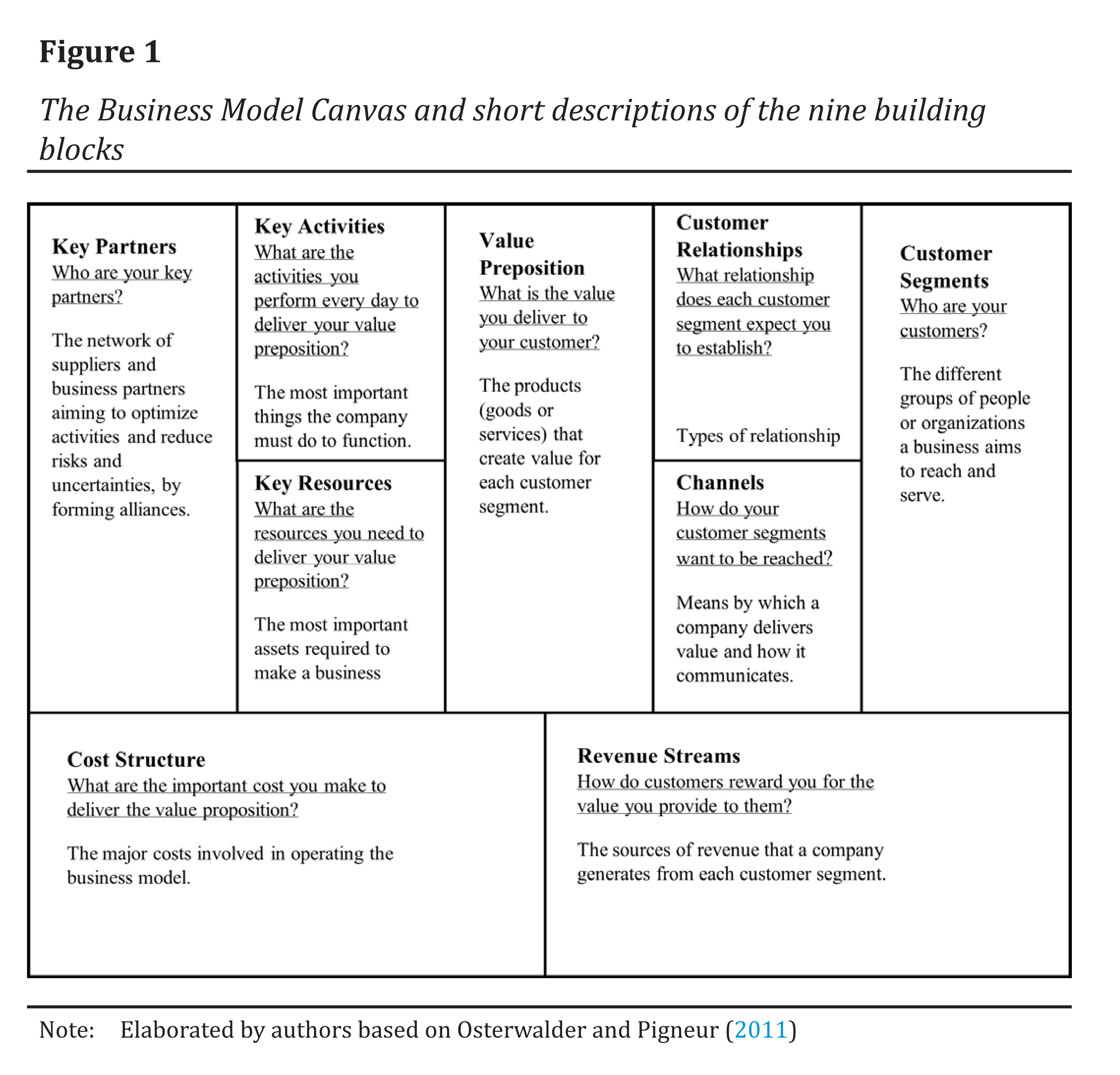
Figure 1
The Business Model Canvas and short descriptions of the nine building blocks
Note: Elaborated by authors based on Osterwalder and Pigneur (2011)
Research on female entrepreneurship highlights that women-led businesses often lack structured financial planning, market positioning strategies, and business development frameworks (Fernández-Guadaño & Martín-Lopez, 2023; Welter et al., 2017). The Business Model Canvas provides an accessible and visual approach to business structuring, allowing female entrepreneurs to identify critical aspects of their operations, refine their strategies, and improve sustainability. By applying BMC in this study, we address the need for structured planning tools that support long-term business success in female micro-entrepreneurship.
While the BMC has been extensively applied in startups and corporate environments, its use among female micro-entrepreneurs in socially vulnerable contexts remains underexplored. This study investigates how the application of BMC within a university extension project can enhance female entrepreneurs’ understanding of market positioning, financial planning, and business sustainability.
Problem-Based Learning (PBL) and Entrepreneurial Education
Entrepreneurial education is most effective when it incorporates active learning methodologies that allow students and practitioners to engage in real-world problem-solving (Cope, 2005; Rae, 2006). PBL has gained prominence as a student-centered approach that fosters critical thinking, collaboration, and decision-making skills (Lopera et al., 2022; Da Silva Pontes et al., 2022). According to Alexander et al. (2024), active learning impacts practical abilities for professional success and future leadership roles. PBL is an educational approach that uses real-world challenges to facilitate knowledge acquisition. Particularly effective in entrepreneurship education, it engages students by simulating entrepreneurial realities, reinforcing risk-taking, innovation, and proactivity as core principles.
Following Education Resolution, no 7 from 12/18/2018, educational institutions were mandated to integrate extension activities into undergraduate curricula, linking education with institutional political projects (MEC, 2018). This initiative facilitated exchanges of knowledge and experience among students, teachers, and the entrepreneurial community, thereby enhancing entrepreneurial skills necessary for starting or improving businesses. Within this cooperative environment, a particular entrepreneurial case was chosen for detailed study, emphasizing strategic planning's role in business success.
Institutions implementing methodologies that track impacts provide valuable entrepreneurial knowledge and foster entrepreneurial attitudes (Sendra-Pons et al., 2022). Moreover, innovative pedagogical projects integrate practical experience and skills training, enhancing students' educational and intellectual development (Rocha & Motta, 2023).
Thus, the application of PBL in university extension programs enables students to collaborate directly with entrepreneurs, analyzing significant business challenges and proposing evidence-based solutions. In this study, PBL was used to guide the strategic planning process for a female micro-entrepreneur, helping her assess business gaps, refine market strategies, and improve financial sustainability. The combination of PBL and BMC in this context strengthens experiential learning, allowing both students and entrepreneurs to apply theoretical concepts to practical business situations.
The extension program aims to develop a proposal for entrepreneurial action for a community, promoting economic and social development. It is autonomous learning, including action planning that requires technical and multidisciplinary knowledge.
Higher Education and Female Entrepreneurship
University extension programs provide a structured environment for business experimentation, offering mentorship, financial literacy, and strategic development to female entrepreneurs (Sendra-Pons et al., 2022; Fernández-Guadaño & Martín-Lopez, 2023). This study highlights the potential of female micro-entrepreneurship when supported by strategic planning and educational collaboration to reduce social inequalities. The integration of BMC within PBL proved effective in strengthening the connection between universities and entrepreneurship, enhancing business organization, financial sustainability, and visibility, while equipping female entrepreneurs with the tools needed to navigate market challenges.
By integrating entrepreneurial education with PBL and BMC, higher education plays a key role in strengthening female entrepreneurship, addressing challenges in strategic planning, financial sustainability, and business growth. The findings highlight the impact of structured business training in reducing social inequalities and fostering inclusive economic development. This theoretical framework supports the analysis of educational interventions in socioeconomically vulnerable contexts, providing the basis for the study’s methodology, case findings, and practical applications.
MATERIAL AND METHODS
This study adopts a qualitative case study design to examine how a university extension initiative, incorporating Problem-Based Learning (PBL) and the Business Model Canvas (BMC), supports the development of female micro-entrepreneurship. Its methodological foundation is based on Yin’s (2018) principles for case study research, which emphasize understanding a real-life phenomenon within its context.
The research was carried out in an extension program at a university in Curitiba, Brazil, involving a multidisciplinary team of six students from Business Administration, Software Engineering, and Law. The selected case involved a female entrepreneur legally registered as a Microempreendedora Individual -MEI (Brasil, 2008), with over three years of business activity and challenges related to strategic positioning and growth. The entrepreneur’s willingness to participate in academic collaboration and improve her business strategy was also a selection criterion.
Data was collected through: (i) semi-structured interviews, using a protocol developed by academics and professionals to address business challenges, financial structure, and customer relations; (ii) direct observations during local fairs, to understand real-time interactions, marketing practices, and product strategies, and (iii) document analysis, including business records and project materials. All interviews were recorded, transcribed, and triangulated with field notes (McCracken, 1988; Merriam, 2009; Denzin & Lincoln, 2006).
The intervention unfolded in three PBL cycles: (i) diagnosis, where students and the entrepreneur identified problems related to value proposition and revenue management; (ii) strategic modeling using the BMC (Osterwalder & Pigneur, 2011), facilitating alignment between theory and the business context; and (iii) validation, during which proposed changes were tested and analyzed collaboratively. Observational insights were systematically incorporated into the redesign of the entrepreneur’s business model.
The analytical strategy was based on thematic analysis (Merriam & Tisdell, 2015), with categories emerging inductively through coding of the interviews and observational data using Microsoft™ tools. Cross-validation ensured consistency across data sources, reinforcing the depth of analysis (Yin, 2015, 2018).
The study design is cross-sectional in execution but incorporates longitudinal elements as it draws upon the entrepreneur’s past experiences and subsequent strategic decisions. Research was conducted in the participant’s natural setting, enhancing contextual authenticity (Vieira, 2004; Cooper & Schindler, 2014). The use of BMC and PBL provided a structure for experiential learning and collaborative decision-making.
This approach aligns with recommendations for entrepreneurship education (Cooper & Schindler, 2014; Eisenhardt, 1989; Richards, 2015), particularly in contexts of social vulnerability where learning is more impactful when rooted in lived experience.
RESULTS
This section presents the findings of the case study, analyzing how the integration of PBL and BMC within a university extension project contributed to the strategic planning and business sustainability of a female micro-entrepreneur. The results are structured into three key areas: i) business challenges before the intervention; ii) impact of educational support through PBL and BMC and, iii) strategic adjustments and business outcomes.
The entrepreneur operates in the fashion segment, having gradually started her business. Her venture began with sewing activities initiated by her mother. Seeing an opportunity during the 2020 pandemic, she began producing and selling sweatshirts known for their comfort and casual style. She later expanded to resell uniquely designed socks, described as "creative" for their distinctive models and colors. However, she could not define her value proposition or new plans, noting only that the quality of her products pleased her customers. Initially, the business lacked formal planning and continued out of economic necessity. She operates in Curitiba-PR, primarily selling her products at city fairs and, for some clients, offering on-demand personal delivery. She mentioned developing a geek-themed collection (Caim, 2018), identifying a niche in this subculture highly engaged with technology, science fiction, and pop culture, which she observed at the fairs.
The proposal developed helped the entrepreneur define her business and provided technical learning. With this information, she engaged in her entrepreneurial activities more assertively. This proposal is an example for other entrepreneurs who participate in the university's extension projects.
Regarding business challenges before the intervention, the female micro-entrepreneur operated in the fashion industry, primarily selling at local fairs. Her business faced several challenges, including lack of structured financial planning; limited market positioning and brand differentiation; operational inefficiencies, such as inadequate inventory control and absence of a defined value proposition.
These issues are consistent with the broader structural barriers faced by female entrepreneurs, such as restricted access to business training and financial resources (World Bank, 2024; Fernández-Guadaño & Martín-Lopez, 2023). The initial assessment indicated that the entrepreneur lacked formalized business strategies, which made her business vulnerable to economic fluctuations and competitive pressures (SEBRAE, 2022; GEM, 2023). According to Brinckmann et al. (2010), the absence of structured business planning can significantly impact the sustainability and growth potential of small enterprises, emphasizing the need for targeted interventions.
Concerning the impact of educational support through PBL and BMC, through PBL-driven interventions, students and the entrepreneur worked collaboratively to identify business gaps and develop strategic solutions.
When it comes to key adjustments, the following points where observed: i) clarification of value proposition, shifted from generic product sales to purposefully crafted themed collections targeting niche markets; ii) market segmentation strategy with the identification of two core customer segments, which are the general fair visitors and niche communities (e.g., geek fashion enthusiasts); iii) brand positioning to enhance digital marketing efforts through targeted social media campaigns, thereby increasing brand visibility; iv) financial restructuring with the implementation of a cost-tracking system to optimize pricing strategies, which improved overall financial health (Padoveze, 2015).
The BMC application facilitated a more structured approach to business planning, allowing the entrepreneur to develop strategic insights and enhance her decision-making capabilities. This aligns with findings from Fayolle & Gailly (2015), which highlight the role of educational interventions in reshaping entrepreneurial attitudes and strategies.
From the perspective of visual representation of business evolution, the reformulated BMC reflects the strategic adjustments made during the intervention. The before-and-after comparison is presented in Table 1, demonstrating how each component evolved based on PBL discussions and market analysis.
In terms of strategic adjustments and business outcomes, following the implementation of the refined business model, the entrepreneur experienced measurable improvements in business performance. Key outcomes include: i) revenue growth of 14% increase in monthly sales was observed, attributed to improved pricing strategies and market segmentation; ii) social media engagement increased by 23%, indicating stronger brand recognition and customer interaction; iii) operational efficiency, as the entrepreneur adopted a streamlined inventory tracking system, reducing supply chain inefficiencies and increasing operational efficiency.
These outcomes demonstrate the practical benefits of structured business planning and the effective application of PBL and BMC in real-world settings. According to Brinckmann et al. (2010), structured business planning directly correlates with enhanced business performance, particularly in small enterprises. Furthermore, this study validates the findings of Fayolle & Gailly (2015), confirming that entrepreneurial education significantly impacts business sustainability by empowering entrepreneurs with critical strategic tools.
DISCUSSION
Following the application of BMC, the entrepreneur was able to clearly define her business structure, improving pricing strategies, customer segmentation, and operational efficiency. Prior to the intervention, her business lacked a clear value proposition and financial planning framework. The implementation of BMC allowed her to visualize key business components, leading to a 14% increase in revenue and improved decision-making processes. This result aligns with studies emphasizing the role of structured business planning in enhancing the sustainability of female-led businesses (Brinckmann et al., 2010; Fayolle & Gailly, 2015).
The findings of this study highlight the transformative role of educational interventions in strengthening female micro-entrepreneurship. The structured application of PBL and BMC provided the entrepreneur with strategic tools to enhance business operations, refine market positioning, and improve financial planning. These results align with prior studies emphasizing the impact of entrepreneurial education on business performance and sustainability (Fayolle & Gailly, 2015; Brinckmann et al., 2010).
Over a four-month period, data collected via interviews and observations helped students propose process improvements, despite limited time for comprehensive data analysis and projections. A key recommendation for the entrepreneur was pricing, deemed the final yet most crucial decision. As Padoveze (2015) states, pricing should reflect not just costs, but also the economic value perceived by customers. Additionally, monitoring the cash cycle, including payment timings, receipts, and inventory management for materials or finished goods, was advised to better understand cash flow dynamics. According to Assaf Neto and Lima (2009), financing needs cover from purchasing inputs to receiving sales revenue, outlining the cash cycle.
Female-led micro-businesses often lack access to structured business training, leading to higher failure rates and limited growth potential (Fernández-Guadaño & Martín-Lopez, 2023). This study reinforces the idea that academic-business collaborations can bridge this gap, equipping female entrepreneurs with strategic knowledge and problem-solving capabilities. These insights clarified the company's financials for management and financing pursuits for operational and commercial growth, what shows the role of educational interventions in female entrepreneurship, widely recognized as a key factor in fostering business innovation and resilience (World Bank, 2024).
The importance of structured planning became evident during the interviews, as the entrepreneur stated that, before using the Business Model Canvas, she had difficulties understanding where business was headed. Now, she could better organize pricing and customer segmentation strategies. This perception aligns with the revenue increase observed after the intervention, reinforcing the effectiveness of structured business modeling. Similarly, the financial planning challenges encountered were expressed by the entrepreneur who stated she still struggles with making precise financial projections; it is something she needs additional training for. These insights highlight that while BMC enhances strategic organization, complementary financial education is necessary to ensure long-term sustainability.
The use of PBL and BMC as intervention tools demonstrates how practical learning experiences enable entrepreneurs to develop adaptable business models, improving decision-making processes (Osterwalder & Pigneur, 2011; Eisenhardt, 1989). The findings suggest that entrepreneurial success is strongly linked to structured business planning, which supports prior research on the positive correlation between strategic management practices and business performance (Teece, 2010).
Regarding business model adaptation and strategic planning, one of the key contributions of this study is the demonstration of how the BMC framework can be adapted to micro-entrepreneurs operating in informal and resource-constrained settings. The before-and-after comparison of the business model as demonstrated in Table 1 illustrates the importance of: i) clearly defining value proposition to enhance brand differentiation; ii) implement financial tracking tools to improve pricing strategies; and iii) targeting niche customer segments to strengthen market positioning.
| Table 1 | ||
| First results on Canvas preparation | ||
| Planning component | Prior situation | Post-Canvas Situation |
| Mission | Undefined | To allow people to express themselves through clothing and accessories |
| Vision | Undefined | To expand sales throughout the city of Curitiba and the Metropolitan Region, providing sweatshirts and customized pieces that reinforce the personal expression of its customers |
| Values | Undefined | Innovation, quality, flexibility, honesty, guarantee, and transparency |
| Value Proposition | Handcrafted, high-quality sweatshirt sales at more affordable prices. | To produce and deliver customized clothing items with quality, guarantee, flexibility, and agility, at an affordable cost |
| Customer Segments | Men and women aged 15 to 30. | Customers aged between 15 and 30 years old. Fair attendee |
| Channels | Instagram (initially) | |
| Word-of-mouth marketing | Word-of-mouth marketing | |
| Fairs | Fairs | |
| Social media. Fan clubs. Themed fairs and events (geeks). Use of hashtag | ||
| Customer Relationships | Quality customer service | Customer loyalty through discounts on the 2nd purchase onwards |
| Customized sweatshirts | Gifts for larger buyers | |
| Made-to-order, according to the customer's request | Communication via social media | |
| Loyalty cards | ||
| Key Resources | Labor (entrepreneur + 1 person) | New workspace for creating pieces |
| Machinery (straight stitch machine, overlock machine, coverstitch machine) | Diversified suppliers | |
| Vehicle | Fabric diversification | |
| Location: Entrepreneur's home | Designing customized pieces | |
| Key Activities | Sewing of custom sweatshirts (by size) | Designing custom pieces. Purchasing materials |
| Seeking suppliers with quality fabrics | Scheduling fairs | |
| Cutting of sweatshirts | In-person sales at fairs | |
| Molding sweatshirts for sewing. | ||
| Fair to sell products. | ||
| Purchase of socks for resale | ||
| Key Partnerships | Suppliers of raw materials | All suppliers of materials and packaging |
| Suppliers of sweatshirt molds | City hall-fairs | |
| Suppliers of prints | Transporters | |
| Labor and embroidery (mother) | Bank | |
| Cost Structure | Estimates for: | Managing receivables Pricing: |
| • Supplies | • Materials for garment production (fabrics, trimmings, embroidery) | |
| • Transportation | • Packaging | |
| • Participation in fairs | • Fair fees | |
| • Molds | • Logistics | |
| • Embroidery | • Utility bills: water, electricity, internet, machine maintenance | |
| • Socks | ||
| Revenue Streams | Sweatshirts (R$160.00) | Recalculate selling prices per item |
| Socks (R$20.00) | Revenue tracking (Spreadsheet) | |
| Direct sales of customized products | ||
| Note: Elaborated by the authors. | ||
These adjustments resulted in a 14% increase in revenue and a 23% improvement in customer engagement, reinforcing the idea that structured business planning leads to measurable outcomes (Brinckmann et al., 2010).
In terms of implications for policy and practice, the results also emphasize the need for greater institutional support for female entrepreneurs, particularly through university-led programs that integrate PBL with business model development. Also, to microcredit initiatives tailored to women-led businesses, addressing financial access constraints (SEBRAE, 2022; GEM, 2023). It is important to emphasize the longitudinal mentorship programs to track business performance beyond short-term interventions (Fayolle & Gailly, 2015). Given the success of this study’s approach, policymakers and educational institutions should consider expanding structured training initiatives to foster greater gender equity in entrepreneurship.
On the financial aspects, an option presented to micro-entrepreneurs is a microcredit when the small business is fiscally legal and organized (Fomento Paraná, 2024). Microcredit contributes to female empowerment by being available to women entrepreneurs. "However, the enterprise must have a structured business plan, along with proof of fiscal legality and professional capacity to sustain its operations. This requirement applies to funding from financial agents that offer specific financing lines for women entrepreneurs. For fiscally legal small businesses, resources such as from Fomento Paraná's Microcredit for Women, are vital for simplifying business complexity and integrating strategic plans (SEBRAE, 2017; Fomento Paraná-Microcrédito, 2024).
An important insight from this study is the need to adapt the BMC to better align with the realities of female micro-entrepreneurs. Given the financial literacy challenges observed, an alternative approach could involve integrating a simplified financial planning module within the BMC framework, offering step-by-step guidance on cost estimation and revenue forecasting. Additionally, the traditional BMC could be adjusted into a Life Cycle Canvas, emphasizing different business growth stages and addressing key challenges faced by female entrepreneurs at each phase (Brush et al., 2009). Future research could explore the development of gender-sensitive business models that incorporate elements of social capital and community networks, which are particularly relevant for women-led enterprises in emerging economies (Welter et al., 2017).
The results presented show that the strategy is crucial to provide resources and opportunities to female entrepreneurs (Golla et al., 2011; Hughes et al., 2015). Additionally, the results offer support for one female business, manly financial suggestions, and mentoring, offering flexibility to manage professional and family responsibilities (Fernández-Guadaño & Martín-Lopez, 2023).
CONCLUSIONS
This study was guided by the question: How can higher education contribute to female entrepreneurship by providing structured business support and strategic planning methodologies? To answer this, we examined a university extension project that integrated Problem-Based Learning (PBL) and the Business Model Canvas (BMC) to support a woman-led micro-enterprise in the fashion sector. The findings show that these pedagogical tools, when operationalized in a context-sensitive manner, contributed to enhancing the entrepreneur’s capacity to articulate her value proposition, strengthen financial planning, and reposition her business strategically. The intervention demonstrated the transformative potential of structured educational processes when co-created and adapted to the lived realities of micro-entrepreneurs in vulnerable contexts.
Theoretically, this research contributes to the field of entrepreneurial learning by operationalizing concepts from experiential education and strategy development within a practical academic initiative. The study expands the literature on how the BMC can serve not merely as a planning tool, but as a vehicle for reflection, strategic decision-making, and entrepreneurial identity construction. Similarly, the use of PBL reinforces its potential to foster autonomy, problem-solving skills, and the articulation of knowledge in real-world scenarios. The integration of these methodologies within a university extension setting positions higher education as a key factor in promoting inclusive economic development through entrepreneurial education. These findings align with prior research emphasizing the importance of structured business training in fostering entrepreneurship and economic sustainability (Fayolle & Gailly, 2015; Fernández-Guadaño & Martín-Lopez, 2023).
In terms of managerial and social contributions, the project had a direct impact on the entrepreneur’s business model, helping her to rethink pricing, target customer profiles, and partnerships. The intervention allowed for redefinition of goals and priorities based on structured diagnosis and collaborative analysis. For other micro-entrepreneurs, this suggests that participatory and practice-oriented support can be more effective than generic training. From a social development standpoint, the case reinforces the relevance of educational actions aligned with the Sustainable Development Goals, especially SDG 5 (Gender Equality) and SDG 8 (Decent Work and Economic Growth). University extension programs, when strategically structured, can bridge gaps between academic knowledge and local economic needs, offering inclusive and context-responsive support (Fernández-Guadaño & Martín-Lopez, 2023; World Bank, 2024).
Nevertheless, this study has limitations. It is based on a single-case design, which restricts the generalization of its findings (Yin, 2018). While the richness of the qualitative data provides depth of understanding, the outcomes are highly context-dependent, shaped by the specific characteristics of the entrepreneur, the nature of the business, and the institutional dynamics of the extension program. Furthermore, the short time frame of the intervention limits the ability to assess long-term impacts. Future studies might benefit from longitudinal designs and comparative cases to assess replicability and scalability of similar methodologies in other socioeconomic and cultural contexts.
It is important to acknowledge that while the BMC provided a structured planning framework, external factors may also have contributed to the observed improvements. For example, local economic recovery and increased consumer spending following the COVID-19 pandemic could have influenced sales growth. However, the entrepreneur’s statements and behavioral adjustments during the intervention suggest that the structured decision-making process introduced by BMC played a pivotal role in clarifying business priorities. This aligns with previous studies indicating that business planning tools enhance entrepreneurial resilience in dynamic market conditions (Fayolle & Gailly, 2015; Brinckmann et al., 2010).
This study reaffirms that structured entrepreneurial education can empower female micro-entrepreneurs, equipping them with the strategic knowledge and tools necessary for business success. By fostering stronger academic-business collaborations, educational institutions can contribute to a more inclusive and equitable entrepreneurial ecosystem, where women may have the opportunity to thrive as business leaders and innovators.
In closing, we suggest that future research deepen the understanding of how BMC and PBL can be adapted across gender, sectoral, and regional variations, particularly among entrepreneurs from marginalized backgrounds. There is also a need to explore the role of interdisciplinary university teams in supporting business modeling and innovation, as well as to analyze the effectiveness of extension projects in public policy agendas. Integrating structured pedagogical methodologies with community engagement can strengthen the academic contribution to regional development and social inclusion. As shown in this study, female entrepreneurship is not only a path to income generation, but also a process of empowerment, and higher education institutions can, and should, be catalysts in this transformation.
Conflict of interest statement
The authors declare that there is no conflict of interest.
Authors’ statement of individual contributions
| Authors’ statement of individual contributions | ||
| Roles | Contributions | |
| Rodrigues G. P. | Ciscato C. D. S. | |
| Conceptualization | ∎ | |
| Methodology | ∎ | ∎ |
| Software | NA | |
| Validation | ∎ | ∎ |
| Formal analysis | ∎ | ∎ |
| Investigation | ∎ | ∎ |
| Resources | NA | |
| Data Curation | ∎ | |
| Writing - Original Draf | ∎ | ∎ |
| Writing - Review & Editing | ∎ | ∎ |
| Visualization | ∎ | ∎ |
| Supervision | ∎ | |
| Project administration | ∎ | |
| Funding acquisition | NA | |
| Note: Acc. CRediT (Contributor Roles Taxonomy): https://credit.niso.org/ | ||
Open Science: Data availability
| Open Science: Data availability | |
| The entire dataset that supports the results of this study has been made available on SciELO Data from the REGEPE Entrepreneurship and Small Business Journal and can be accessed at the following DOIs: | |
| Badge | Description |
| Not applicable. | |
| Not applicable. | |
| https://doi.org/10.48331/SCIELODATA.BK2DC7 | |
| https://doi.org/10.14211/regepe.esbj.e2519pr | |
| Not applicable. | |
REFERENCES
Alexander, E. S., White, A. A., Varol, A., Appel, K., & Lieneck, C. (2024). Team- and Problem-Based Learning in Health Services: A Systematic Literature Review of Recent Initiatives in the United States. Education Sciences, 14(5), 515. https://doi.org/10.3390/educsci14050515
Assaf Neto, A., & Lima, F. G. (2009). Curso de administração financeira. Editora Atlas.
Brasil. (2024, 10 de abril). Decreto nº 11.994, de 10 de abril de 2024. Diário Oficial da União. https://www.in.gov.br/en/web/dou/-/decreto-n-11.994-de-10-de-abril-de-2024-553566966
Brasil. (2008, 19 de dezembro). Lei complementar nº 128, de 19 de dezembro de 2008. Diário Oficial da União. http://www.planalto.gov.br/ccivil_03/Leis/LCP/Lcp128.htm
Brinckmann, J., Grichnik, D., & Kapsa, D. (2010). Should entrepreneurs plan or just storm the castle? A meta-analysis on contextual factors impacting the business planning-performance relationship in small firms. Journal of Business Venturing, 25(1), 24-40. https://doi.org/10.1016/j.jbusvent.2008.10.007
Brush, C., De Bruin, A., Gatewood, E., & Henry, C. (2009). "The Diana Project: A legacy for research on gender in entrepreneurship." International Journal of Gender and Entrepreneurship, 1(1), 6-17.
Caim, F. (2018). Multiplicidades do masculino nas histórias em quadrinhos dos X-MEN: Um olhar sobre a ‘generificação’ do herói. In E. Carvalho (Ed.), Comunicação e cultura geek (cap. 5, pp. 76-90). Cásper Líbero.
Cooper, D. R., & Schindler, P. S. (2014). Business research methods (12a ed.). McGraw-Hill/Irwin.
Cope, J. (2005). Toward a dynamic learning perspective of entrepreneurship. Entrepreneurship Theory and Practice, 29(4), 373-397.
Correio Braziliense. (2024, 29 de junho). Mulheres enviam proposta de políticas públicas para o empreendedorismo feminino. Cidades DF.
Da Silva Pontes, P. R., Senna, M. L. G. S., Cavalcante, R. P., & Castilho, W. S. (2022). PBL mais aprendizagem colaborativa: Práticas metodológicas para o ensino médio integrado. Revista Brasileira da Educação Profissional e Tecnológica, 2(22), 1-15. https://doi.org/10.15628/rbept.2022.11098
Denzin, N. K., & Lincoln, Y. S. (2006). Introdução: A disciplina e a prática da pesquisa qualitativa. In N. K. Denzin & Y. S. Lincoln (Eds.), O planejamento da pesquisa qualitativa: Teorias e abordagens (2a ed., pp. 15-41). Bookman e Artmed.
Eisenhardt, K. M. (1989). Building theories from case study research. Academy of Management Review, 14(4), 532-550.
Fayolle, A., & Gailly, B. (2015). The impact of entrepreneurship education on entrepreneurial attitudes and intention: Hysteresis and persistence. Journal of Small Business Management, 53(1), 75-93.
Fernández-Guadaño, J., & Martín-Lopez, S. (2023). Gender differences in social entrepreneurship: Evidence from Spain. Women’s Studies International Forum, 96, 102663. https://doi.org/10.1016/j.wsif.2022.102663
Fomento Paraná. (2024). Home page. https://www.fomento.pr.gov.br/
Fomento Paraná-Microcrédito. (2024). Banco da Mulher Paranaense – Microcrédito. https://www.fomento.pr.gov.br/Banco-da-Mulher-Paranaense-Microcredito
GEM - Global Entrepreneurship Monitor. (2023). New GEM women’s entrepreneurship report underscores breaking stereotypes and seizing opportunities. https://www.gemconsortium.org/reports/womens-entrepreneurship
Golla, A. M., Malhotra, A., Priya, N., & Mehra, R. (2011). Understanding and measuring women’s economic empowerment. Definition, framework, and indicators. International Center for Research on Women. https://themimu.info/sites/themimu.info/files/documents/RefDoc_Gen_UnderstandingMeasuringWomensEcoEmpowerment_ICRW_2011.pdf
Hawawini, G., & Viallet, C. (2009). Finanças para executivos: Gestão para a criação de valor (3a ed.). Cengage Learning.
Hughes, C., Bolis, M., Fries, R., & Finigan, S. (2015). Women´s economic inequality and domestic violence: Exploring the links and empowering women. Gender and Development, 23(2), 279-297. https://doi.org/10.1080/13552074.2015.1053216
Instituto Cória. (2023). Canvas de empreendedorismo feminino: Conheça a ferramenta por trás da nossa metodologia. https://institutocoria.org.br/blog/inovacao-para-mulheres/canvas-empreendedorismo-feminino/
IPEA – Instituto de Pesquisa Econômica Aplicada. (2020). Objetivos do desenvolvimento sustentável. https://www.ipea.gov.br/ods/ods5.html
Lopera, H. A. C., Gutiérrez-Velásquez, E., & Ballesteros, N. (2022). Bridging the gap between theory and active learning: A case study of project-based learning in introduction to materials science and engineering. IEEE Revista Iberoamericana de Tecnologías del Aprendizaje, 17(2), 160-169. https://doi.org/10.1109/RITA.2022.3166862
Malacarne, R., Brunstein, J., Brito, M. D., Bedoni, J. L., & Rodrigues, R. N. (2014). Desenvolvimento de pessoas em um micro empreendimento do terceiro setor: A experiência da ADESJOVEM. Revista Pensamento Contemporâneo em Administração, 8(3), 101-117.
María-Florencia, A., & Sánchez, G. María, I. (2023). Leadership in heels: Women on boards and sustainability in times of COVID-19. Corporate Social-Responsibility and Environmental Management, 30(4), 1987-2010.
McCracken, G. (1988). The long interview. SAGE Publications Inc.
MEC. Ministério da Educação Conselho Nacional de Educação. (2018, 18 de dezembro). Resolução nº 7.
Merriam, S. B. (2009). Qualitative research: A guide to design and implementation. Jossey-Bass.
Merriam, S. B., & Tisdell, E. J. (2015). Qualitative research: A guide to design and implementation (4a ed.). Jossey-Bass.
Michael, A. H., Ireland, D., & Hoskisson, R. E. (2012). Administração estratégica: Competitividade e globalização (2a ed.). Cengage Learning.
Muzaffar, H. (2023). Pandemic silver lining: How the Covid-19 pandemic helped women to beat the “gender stereotypes pandemic” in entrepreneurship. Gender in Management, 38(1), 76-92.
OECD. (2023). Organization for Economic Co-operation and Development. Gender equality. https://www.worldbank.org/pt/news/press-release/2024/03/04/new-data-show-massive-wider-than-expected-global-gender-gap
ONU. (2024). Mulheres Brasil Report. Empoderamento econômico. https://www.onumulheres.org.br/areas-tematicas/empoderamento-economico/
Osterwalder, A., & Pigneur, Y. (2011). Business model generation: Inovação em modelos de negócios. Alta Books.
Padoveze, C. L. (2015). Controladoria estratégica e operacional: Conceitos, estrutura, aplicação (3a ed.). Cengage.
Pontes, T. L. D., & Dinis, A. R. L. (2022). When the doors open: Implications of COVID-19 and the work-family interface for women entrepreneurs. Revista Organizações em Contexto, 18(36), 225-251.
Porter, M. E. (1989). Vantagem competitiva: Criando e sustentando um desempenho superior. Elsevier.
Rae, D. (2006). Entrepreneurial learning: A conceptual framework for technology-based enterprise. Technology Analysis & Strategic Management, 18(1), 39-56.
Richards, C. (2015). Outcomes-based authentic learning, portfolio assessment, and a systems approach to ‘complex problem-solving’: Related pillars for enhancing the innovative role of PBL in future higher education. Journal of Problem Based Learning in Higher Education, 3(1), 1-15. https://doi.org/10.5278/ojs.jpblhe.v3i1.1204
Rocha, C. R. N. C., & Motta, R. G. (2023). Quando a educação prioriza a prática e o desenvolvimento de competências: A inovação em um projeto pedagógico da educação básica. Teoria e Prática em Administração, 13(2).
Schumpeter, J. A. (1982). Teoria do desenvolvimento econômico. Abril Cultural.
SEBRAE - Serviço Brasileiro de Apoio às Micro e Pequenas Empresas. (2017). O microcrédito melhorando o ambiente de negócios no Paraná.
SEBRAE - Serviço Brasileiro de Apoio às Micro e Pequenas Empresas. (2022). Empreendedorismo feminino no Brasil em 2022. https://agenciasebrae.com.br/wp-content/uploads/2023/03/Pesquisa-Emp-Feminino-2022.pdf
Sendra-Pons, P., Calatayud, C., & Garzón, D. (2022). Una revisión de la investigación y la práctica de la educación emprendedora. Journal of Management and Business Education, 5(4), 361-376.
Silva, J. P. (2017). Análise financeira das empresas (13a ed.). Cengage Learning.
Silva, M. S., & Oliveira, C. M. M. (2023). Empreendedorismo feminino no Brasil e as características comportamentais empreendedoras; Uma breve revisão de literatura. Revista Foco - Interdisciplinary Studies, 16(10), 1-18.
Smith, A. (2017). A riqueza das nações. Nova Fronteira.
Stokes, D. (2000). Putting entrepreneurship into marketing: The processes of entrepreneurial marketing. Journal of Research in Marketing and Entrepreneurship, 2(1), 1-16.
Teece, D. J. (2010). Business models, business strategy, and innovation. Long Range Planning, 43(2–3), 172-194.
The Nobel Prize. (2019). Press release: The Prize in Economic Sciences 2019. https://www.nobelprize.org/prizes/economic-sciences/2019/press-release/
Tidd, J., & Bessant, J. (2015). Gestão da inovação. Bookman.
United Nations. (2024). Department of Economic and Social Affairs. Sustainable development goals. https://sdgs.un.org/goals
Viante, M. F., Stéfano, S. R., & Costa, Z. F. (2019). Sustentabilidade e desenvolvimento social: O caso de uma microempresa de serviços eletrônicos. Revista CSP – Ciências Sociais em Perspectiva, 13(2), 1-18.
Vieira, M. M. F. (2004). Por uma boa pesquisa (qualitativa) em administração. In M. M. F. Vieira & D. M. Zouain (Orgs.), Pesquisa qualitativa em administração. FGV.
Welter, F., Baker, T., Audretsch, D. B., & Gartner, W. B. (2017). "Everyday entrepreneurship: A call for entrepreneurship research to embrace entrepreneurial diversity." Entrepreneurship Theory and Practice, 41(3), 311-321.
World Bank. (2024). Novos dados revelam uma disparidade global de gênero enorme e acima do previsto. https://www.worldbank.org/pt/news/press-release/2024/03/04/new-data-show-massive-wider-than-expected-global-gender-gap
Yin, R. K. (2015). Case study research: Design and methods (5a ed.). Sage Publications Inc.
Yin, R. K. (2018). Case study research and applications: Design and methods (6a ed.). SAGE Publications.
Author notes
Corresponding author: grazielarodrigues@gmail.com
Additional information
Article ID: 2519
JEL classification: M10, M13, M14
Editor-in-Chef1 or Adjunct2: 1 Dr. Edmundo Inácio Júnior, Univ. Estadual de Campinas, UNICAMP
Associate Editor: Dr. Julio Araújo Carneiro Cunha, Universidade Nove de Julho, UNINOVE
Executive1 or Assistant2 Editor: 1 M. Eng. Patrícia Trindade de Araújo
How to cite: Rodrigues, G. P., & Ciscato, C. D. S. (2025). Apoio educacional para melhorar o empreendedorismo feminino: Um estudo de caso em meio às desigualdades sociais. REGEPE Entrepreneurship and Small Business Journal, 14. https://doi.org/10.14211/regepe.esbj.e2519
Additional information
redalyc-journal-id: 5615