Research article (Theoretical-empirical)
Entrepreneurial behaviour and education in times of adversity
Comportamento empreendedor e educação em tempos de adversidade
Comportamiento emprendedor y educación en tiempos de adversidad
 Anne Kathleen Lopes da Rocha anne.rocha@hotmail.com.br
 Gustavo Hermínio Salati Marcondes de Moraes salati@unicamp.br
Entrepreneurial behaviour and education in times of adversity
REGEPE Entrepreneurship and Small Business Journal, vol. 11, no. 2, e2040, 2022
Associação Nacional de Estudos em Empreendedorismo e Gestão de Pequenas Empresas

This work is licensed under Creative Commons Attribution 4.0 International.
Received: 16 December 2020
Accepted: 11 January 2022
Published: 09 September 2022
Abstract: Objective: The goal of this research is to identify whether the Coronavirus pandemic has influenced students’ entrepreneurial behavior and perceived university support in a public university in Brazil. Methodology: This study used Partial Least Squares-Structural Equation Modeling (PLS-SEM) to assess the survey answered by 508 Business Administration students. Findings: Results reassured the positive relationship amongst Perceived University Support, Entrepreneurial Intention and Entrepreneurial Self-Efficacy. Considering students’ perceptions of such elements prior and during the confinement, the relationship amongst Perceived University Support, Entrepreneurial Intention and Entrepreneurial Self-Efficacy did not present significant changes. Originality: This study contributes to the discussion of lockdowns and quarantines repercussions in entrepreneurial behavior and education, since this period has brought uncertainties in economic, social and health scenarios. This period of instability also raises discussions concerning technological resources and related initiatives, highlighting a necessity of innovative ideas and solutions. Moreover, these results may also offer support for professors and pedagogical staff in the disciplines remake and university environments. Social/management contributions: The discussion around lockdowns and quarantines repercussions is broaden, especially in the field of entrepreneurship. Educational institutions have the opportunity to invest even more in the university environment to support entrepreneurship, preparing the student for the opportunities and new scenarios that will arise and that will be necessary for the economic recovery.
Keywords: Entrepreneurial Behavior, University Support, Pandemic Effects.
Resumo: Objetivo: O objetivo desta pesquisa é identificar se a pandemia do Coronavírus influenciou o comportamento empreendedor dos alunos e a percepção do suporte universitário em uma universidade pública do Brasil Metodologia: Este estudo utilizou a Modelagem de Equações Estruturais por Mínimos Quadrados Parciais (MEE-MQP) para avaliar a pesquisa respondida por 508 estudantes de Administração. Principais resultados: Os resultados reafirmaram a relação positiva entre Suporte Universitário Percebido, Intenção Empreendedora e Autoeficácia Empreendedora. Considerando as percepções dos alunos sobre tais elementos antes e durante o confinamento, a relação entre o Suporte Universitário Percebido, a Intenção Empreendedora e a Autoeficácia Empreendedora não apresentou mudanças significativas. Originalidade: Este estudo contribui para a discussão das repercussões dos lockdowns e quarentenas no comportamento e na educação empreendedora, uma vez que esse período trouxe incertezas nos cenários econômico, social e de saúde. Este período de instabilidade também suscita discussões sobre recursos tecnológicos e iniciativas relacionadas, evidenciando a necessidade de ideias e soluções inovadoras. Além disso, os resultados da pesquisa fornecem subsídios para professores e equipe pedagógica na reformulação de disciplinas e ambientes universitários. Contribuições sociais/práticas: A discussão em torno das repercussões dos lockdowns e quarentenas é ampliada, principalmente no campo do empreendedorismo. As instituições de ensino têm a oportunidade de investir ainda mais no ambiente universitário para apoiar o empreendedorismo, preparando o aluno para as oportunidades e novos cenários que surgirão e que serão necessários para a recuperação econômica.
Palavras-chave: Comportamento empreendedor, apoio universitário, efeitos pandêmicos.
Resumen: Objetivo: El objetivo de esta investigación es identificar si la pandemia de Coronavirus influyó en el comportamiento emprendedor de los estudiantes y en la percepción de apoyo universitario en una universidad pública del Estado de São Paulo. Metodología: Este estudio utilizó el modelo de ecuaciones estructurales por mínimos cuadrados parciales (MEE-MQP) para evaluar la encuesta respondida por 508 estudiantes de Negocios. Resultados principales: Los resultados reafirmaron la relación positiva entre el Apoyo Universitario Percibido, la Intención Emprendedora y la Autoeficacia Emprendedora. Considerando las percepciones de los estudiantes sobre dichos elementos antes y durante el encierro, la relación entre el Apoyo Universitario Percibido, la Intención Emprendedora y la Autoeficacia Emprendedora no ha cambiado significativamente. Originalidad: Este estudio contribuye a la discusión de las repercusiones de los encierros y cuarentenas en el comportamiento y educación emprededora, ya que este período he trajo incertidumbre en los escenarios económico, social y de salud. Este período de inestabilidad también suscita discusiones sobre recursos tecnológicos e iniciativas relacionadas, destacando la necesidad de ideas y soluciones innovadoras. Además, la investigación brindan subsidios para docentes y personal pedagógico en la reformulación de disciplinas y entornos universitarios. Contribuciones sociales / de Gestión: Se amplía el debate en torno a las repercusiones de los encierros y cuarentenas, especialmente en el ámbito del emprendimiento. Las instituciones educativas tienen la oportunidad de invertir aún más en el ámbito universitario para apoyar el emprendimiento, preparando a los estudiantes para las oportunidades y nuevos escenarios que se presentarán y que serán necesarios para la recuperación económica.
Palabras clave: Comportamiento emprendedor, apoyo universitario, efectos de la pandemia.
INTRODUCTION
World War II was the last episode countries had seen schools and educational institutions go into lockdown around the same time, for the same reason (Luthra & Mackenzie, 2020). This changed in December 2019, when Wuhan Health Commission notified the National Health Commission, China Center for Disease Control and Prevention and World Health Organization (WHO) of a cluster of 27 cases of pneumonia of unknown etiology (Kakodkar et al., 2020). These patients presented a virus called novel coronavirus 2019 (COVID-19), which rapidly spread out around the globe (Kakodkar et al., 2020; Rezaeetalab et al., 2020; WHO, 2020b). This rapid dissemination led millions of people in quarantine and lockdowns, affecting several pillars of society, which was translated into an unprecedent turbulence on societal systems, whether through the implementation of social distancing measures or the reorganization of public health systems (Neumeyer et al., 2020).
The emergence of COVID-19 crisis brings focus to entrepreneurship education (Loan et al., 2021; Neumeyer et al., 2020), since the compelled adaptation led the usual practical classes, hands-on activities and learning by doing process to another type of exposure (Campos et al., 2021; Moraes et al., 2021; Neumeyer et al., 2020; Rönkkö & Lepistö, 2015). This change could have resulted in distancing and less practical activities due to the virtual environment. At the same time, entrepreneurial education is considered as one of the influential forces in the venture creation process (Jena, 2020), just like entrepreneurial self-efficacy, which refers to an individual's belief in his/her capability to perform tasks and roles aimed at entrepreneurial outcomes (Newman et al., 2019), it also plays an important role in determining whether individuals pursue entrepreneurial careers (Newman et al., 2019). Another force is entrepreneurial intention, which is seen as a good predictor of the decision to become an entrepreneur (Fragoso et al., 2020). It represents the first step into a long chain of actions directed towards starting a business (Voda & Florea, 2019).
Scholars have acknowledged a positive relation between entrepreneurial intention and entrepreneurial self-efficacy (Asimakopoulos et al., 2019; Fragoso et al., 2020; Moraes et al., 2018); entrepreneurial intention and entrepreneurial education (Ahmed et al., 2019; Atiya et al., 2019; Liu et al., 2020), as well as entrepreneurial self-efficacy and entrepreneurial education (Amaral et al., 2018; Newman et al., 2019). However, literature has identified factors that may foster or inhibit entrepreneurial education (Jena, 2020; Pittaway & Edwards, 2012; Rideout & Gray, 2013; Shi et al., 2020; Stamboulis & Barlas, 2014; Vesper & Gartner, 1997). Such works highlight the effects of interventions in the learning and the new business creation process. Considering that entrepreneurial education and behavior is individually driven (Caliendo & Kritikos, 2011; Krakauer et al., 2018; Schmidt & Bohnenberger, 2009) and susceptible to environmental changes (Bullough & Renko, 2013; Koe, et al., 2012; Küttim et al., 2014; Newman et al., 2019), especially in the context of developing countries (Fischer et al., 2019; Guerrero, et al., 2018; Moraes et al., 2020), there is a need to assess entrepreneurship in turbulent environments, such as COVID-19 pandemic (Aldairany et al., 2018).
In the context of the pandemic, research has shown that the feelings generated, such as anxiety and fear, had a negative impact on entrepreneurial intention (Loan et al., 2021; Ruiz-Rosa et al., 2020) and self-efficacy (Loan et al., 2021). In addition, there is a lack of integration between crisis management, entrepreneurship, and covid-19 literature (Ratten, 2020, 2021). Therefore, this research addresses the fundamental gap of effects caused by the coronavirus pandemic (Yang et al., 2020) on the relationship amongst entrepreneurial education, self-efficacy and intention (Loan et al., 2021; Ratten, 2020, 2021; Ruiz-Rosa et al., 2020), in a specific context.
Moreover, once personal factors matter in the pursuit of entrepreneurship (Bullough & Renko, 2013), this article addresses the following research question: what is the COVID-19 pandemic effect on entrepreneurial behavior and in the supported importance perceived that a university should provide for entrepreneurship? In this manner, it is intended to analyze how the pandemic, with its confinement and drastic changes to people’s and organization’s daily life, affected the relationships between perceived university support, entrepreneurial self-efficacy and entrepreneurial intention.
This research contributes to entrepreneurship knowledge area by expanding the information about behavioral changes related to entrepreneurship in times of crisis and uncertainty. The impacts of the pandemic on entrepreneurship, especially its education, require further investigation (Nassif et al., 2020), as the outbreak has hit several countries and the outcome is still unpredictable (WHO, 2020b). Thus, this study is an interesting case because it assesses university students’ understanding about the effects of COVID-19 on their entrepreneurial behavior and on the received university support, in two main stages: before and during confinement.
From a practical standpoint, this study can contribute to the discussion of lockdowns and quarantines repercussions in entrepreneurial behavior and education, in addition to serve as support for professors and pedagogical staff in the disciplines remake and university environments.
THEORETICAL DISCUSSION
The theoretical framework of this research is based on three main topics: the support of universities; the entrepreneurial behavior of students; and the coronavirus pandemic.
The Support of Universities
According to Schumpeter (1911), the entrepreneurial process is vital in economic development. Many studies have been done with the intention of unraveling the predecessors of entrepreneurship and amongst them, scholars have found the entrepreneurial education and university environment as crucial vectors (Bignotti & Le Roux, 2016; Canever et al., 2017; Küttim et al., 2014; Shi et al., 2020; Vodă & Florea, 2019). Besides, the impact of entrepreneurial education and training have been recognized as relevant factors in developing startup firms (Zhao et al., 2005; Saeed et al., 2015).
The university environment is a space that offers knowledge creation and dissemination, where the formation of professional knowledge, skills, abilities and attitudes is provided by this educational base. Furthermore, universities have the responsibility to present careers to students, being entrepreneurship one possibility (Raposo & do Paço, 2011). Also, there is an appeal for universities to get closer to the market, to go beyond the role of producing science and technology, exploring the commercial sphere as well (Alves et al., 2019; Campos et al., 2021; Moraes et al., 2021). This new role of the university allows for a process of contextual change, where research institutions become entrepreneurial institutions (Urbano & Guerrero, 2013).
In this sense, universities behave as entrepreneurship catalyst through, amongst other paths, the availability of entrepreneurial education with disciplines, events, workshops, and so on (Moraes et al., 2018; Turker & Selcuk, 2009). Entrepreneurial education goes beyond traditional classroom methods, it provides students with knowledge, skills and additional capacities necessary to apply to the context of setting up a new company or business (Bezerra et al., 2017; Vodă & Florea, 2019). Additionally, Ahmed et al. (2019) establish four broad components for entrepreneurship education: (i) taught component, where students gain specific entrepreneurial knowledge; (ii) business planning component, which aims at motivating and inspiring students to propose business ideas; (iii) interaction with practice component, that acts as networking with investors; and (iv) university support component, whose assistance will be directed at converting the ideas into a successful venture.
Similarly, Liu et al. (2020) follows three modes of entrepreneurship education (i) classroom delivery involving entrepreneurship lectures, student business plan competitions, entrepreneurial projects and social organization; (ii) establishment of experimental centres, university science parks, innovation and entrepreneurship incubator bases and research centres; and (iii) through occasional part-time work placements and work-related internships, which are designed to promote students’ awareness of entrepreneurship, improve students’ entrepreneurial knowledge and cultivate their entrepreneurial qualities and skills (Liu et al., 2020). Hence it is crucial to acknowledge that entrepreneurship education programs reinforce interactive learning, experience-based learning, role models and community and business links, formed by three main objectives.
In this fashion, university support can foster entrepreneurship (Shi et al., 2020) through, for example, product creation (Almeida et al., 2019), university incubators (Ahmed et al., 2019; Trivedi, 2016), technology transformation and consultants (Rideout & Gray, 2013) and financial funds (Inácio Júnior et al., 2016). In consonance, Kraaijenbrink et al. (2010) suggested that to understand the effect of university support on entrepreneurship, it was crucial to measure in which extent they could have an impact on students. Thus, this can be achieved by measuring students’ perceptions of the university support that they receive or, as called by Saeed et al. (2015, p. 1131), “perceived university support”.
According to Saeed et al. (2015), universities can play an important role in identifying and developing entrepreneurial traits and inclinations among students and making them capable of starting their own venture; therefore, it is critical for universities to position themselves as a hub of new venture creation. Besides, it is clear that an effective entrepreneurial education program and the entrepreneurial support provided by universities are efficient ways of obtaining the necessary knowledge about entrepreneurship and motivating young people to seek entrepreneurial careers (Saeed et al., 2015).
Complementarily, the university support can be estimated in different aspects. Namely: (i) perceived concept development, related to knowledge and skills development to transform ideas into workable concepts; (ii) perceived educational support, which consists in the university’s effort to raise awareness about entrepreneurship field itself; and (iii) perceived business development support, related to financial arrangements given to students (Saeed et al., 2015). These dimensions illustrate the broad spectrum on how university can support entrepreneurship. Thereby, a supportive university environment performs as a vector that might enhance students’ interest in the entrepreneurial field as a career option, by also developing knowledge-related, confidence and more importantly, promote and enhance self-efficacy (Mustafa et al., 2016).
Entrepreneurial Behavior: Entrepreneurial Intention and Self-Efficacy
Several characteristics are linked to entrepreneurial behavior. Intention is a construct which has been acquiring attention in entrepreneurship field due to its ability of foreseeing behavior and to understand how intentions are shaped within entrepreneurship field (Fayolle & Gailly, 2015; Moraes et al., 2021). Due to this issue, growing interest emerged to initiate and enhance promotion and support for entrepreneurship amongst students (Schwarz et al., 2006), besides being pointed as one of the most relevant aspects to be researched in respect to the initial phases of creating a business (Vodă & Florea, 2019). For that matter, entrepreneurial intention can be a state of mind that directs individuals towards a specific goal (Saeed et al., 2015).
Several models have been created to deal with entrepreneurial intentions, being the most used in the literature: The Theory of Planned Behavior (Ajzen, 1991) and Shapero’s model of Entrepreneurship Event (Shapero & Sokol, 1982). The Theory of Planed Behavior (TPB) suggests that regarding intentional behaviors, the actions are preceded by intent, which, in turn, is influenced by three aspects: attitudes towards behaviors, subjective norms and perceived behavioral control (Ajzen, 1991). Attitude towards behavior refers to the degree to which an individual tends to present certain behaviors in question, the second aspect is a social factor named subjective norms, which refers to the social pressures an individual may receive whether to perform certain behavior and perceived behavioral control consists in the perceived ease or difficulty at presenting certain behavior (Ajzen, 1991).
On the other hand, Pihie & Bagheri (2013) states that self-efficacy also plays a motivating role on individuals towards getting into a new career, e.g. opening a new venture. Self-efficacy is considered by some researchers as an influencer of the individual’s choice of activities (Fragoso et al., 2020; Kusmintarti et al., 2014; Zhao et al., 2005). In this fashion, self-efficacy is defined by Bandura (1994) as one’s beliefs about their capability. It determines how individuals feel, think, behave and motivate themselves (Bandura, 1994), reason why it relates closely to business creation, once individuals tend to undertake task they consider manageable. High levels of perceived self-efficacy would enhance people’s behavior in regarding to how they master their challenges, enabling stress reduction, goals accomplishments and higher effort employment (Bandura, 1994).
Regarding self-efficacy’s influence on intentions, among students, several studies had previously proven self-efficacy impact on entrepreneurial intentions development and enhancement (Moraes et al., 2021; Saraih et al., 2018). In short, this construct measures a person’s belief in his own capability of launching a business successfully (Rodríguez Gutiérrez et al., 2019).
Entrepreneurship does not involve only risk-taking, creativity, leadership and proactivity, but it also requires passion and persistence, for all that, self-efficacy plays a very relevant role (Newman et al., 2019). Therefore, entrepreneurial self-efficacy emerged as a research topic, being considered as an influencer of entrepreneurial intention, behavior and performance, which also led universities to focus on entrepreneurial education and training (Newman et al., 2019). In this context, hypotheses 1, 2 and 3 are presented:
H1: Perceived University Support has a positive influence on Entrepreneurial Intention.
H2: Perceived University Support has a positive influence on Entrepreneurial Self-Efficacy.
H3: Entrepreneurial Self-Efficacy has a positive influence on Entrepreneurial Intention.
Coronavirus Pandemic
COVID-19 is an infectious disease caused by the most recently discovered type of Coronavirus, in Wuhan, China in December, 2019 (WHO, 2020b), which allegedly originated from wild animals (bats, snakes and pangolins) (Yang et al., 2020). Its contamination occurs mainly by droplets generated when people cough, sneeze or talk, i.e. a person can be contaminated by breathing it in when staying less than one meter away from the contaminated patient or also by touching contaminated surfaces (Rezaeetalab et al., 2020; WHO, 2020b). Its incubation process is estimated to take from 1-14 days, however, 5-6 days is the average period (Rezaeetalab et al., 2020; WHO, 2020b).
Due to rapid global spread of the COVID-19 epidemic, the WHO declared the COVID-19 outbreak a pandemic in March, 2020 (WHO, 2020a), becoming the world’s foremost challenge with no clear solution (Bacq et al., 2020). Many countries initiated immediate responses in order to contain its spread, such as: limited travels, social distancing, home office implementations, among others (Sahu, 2020). In parallel, in order to avoid a catastrophic crash in their health systems, several countries set up extreme quarantine measures - including sealing off large cities, closing borders and confining people to their homes – in an attempt to prevent spread of the virus (Yang et al., 2020), but the human-human transmission rapidly grew. In consonance, the state of São Paulo released the Decree No 64.881, on March 22nd, 2020, which marked the beginning of the quarantine in the State of São Paulo. It had the objective of avoiding possible contaminations and virus propagation (Brasil, 2020). The decree stated that activities involving public, such as: malls, nightclubs, gyms and stores in general were forbidden, making it possible for stores and companies to operate through delivery systems and drive thru (Brasil, 2020). These impositions restrained entrepreneurs, since they are social agents only capable of developing regional economy, not able to solve all problems related to the same locality (Nassif et al., 2020).
Against this background, other spheres implanted efforts to contain the virus, especially institutions that hold larges amount of people gathered in a closed space (Liguori & Winkler, 2020; Sahu, 2020). Such measures were extended to universities, as conveners of large groups of people (Liguori & Winkler, 2020), to avoid contamination. In Brazil, Unicamp, in agreement with the Decree No 64.881, suspended its presential classes and public events in the Resolution GR 24/2020, initially from March 12th to April 12th, sequentially postponed indefinitely awaiting the situation evolution and improvement (UNICAMP, 2020a, 2020b). Once entrepreneurs, business owners and public organs are under conditions of uncertainty and under resource constraints, it is crucial refocus discussions on entrepreneurial education (Bacq et al., 2020; Nassif et al., 2020; Neumeyer et al., 2020).
Even though entrepreneurial students are open to the new concepts, entrepreneurial education and university support may be placed at stake once activities face-to-face shifted to online education (Liguori & Winkler, 2020; Neumeyer et al., 2020). The new learning environment requires adaptation to a new routine, teaching method and study rhythm, and more, demands for unorthodox actions to address immediate challenges and opportunities under conditions of uncertainty (Bacq et al., 2020). Thus, the negative impact of these contextual and personal factors may have influenced entrepreneurial intention (Ahmed et al., 2019; Loan et al., 2021; Ruiz-Rosa et al., 2020) and entrepreneurial self-efficacy (Loan et al., 2021; Newman et al., 2019), therefore, the perceived university support for entrepreneurship can be perceived differently by students from the learning process. In this sense, the following hypotheses are presented:
H4: The relationship amongst Perceived University Support, Entrepreneurial Intention and Entrepreneurial Self-Efficacy before confinement differs to the one presented during the confinement.
H4a: The Perceived University Support prior to confinement presented a better relationship with Entrepreneurial Intention than to the one demonstrated during confinement.
H4b: The Perceived University Support prior to confinement presented a better relationship with Entrepreneurial Self-Efficacy than to the one demonstrated during confinement.
H4c: Entrepreneurial Self-efficacy, prior to confinement, presented a better relationship with Entrepreneurial Intention than to the one demonstrated during confinement.
Table 1 presents the research hypotheses and summarizes the main authors used as a conceptual basis.
| Table 1 | ||
| Research hypotheses | ||
| Description | Conceptual basis | |
| H1 | Perceived University Support has a positive influence on Entrepreneurial Intention | Saeed et al. (2015); Moraes et al. (2018; 2021); Mustafa et al. (2016) |
| H2 | Perceived University Support has a positive influence on Entrepreneurial Self-Efficacy | Saeed et al. (2015); Moraes et al. (2018; 2021); Mustafa et al. (2016) |
| H3 | Entrepreneurial Self-Efficacy has a positive influence on Entrepreneurial Intention | Moraes et al. (2021); Saraih et al. (2018) |
| H4 | The relationship amongst Perceived University Support, Entrepreneurial Intention and Entrepreneurial Self-Efficacy before confinement differs to the one presented during the confinement | Loan et al. (2021); Ruiz-Rosa et al. (2020); Yang et al. (2020) |
| Source: Elaborated by the authors (2022). | ||
Thus, based on the hypotheses presented, in an attempt to answer the research questions, Figure 1 presents the conceptual model of research.
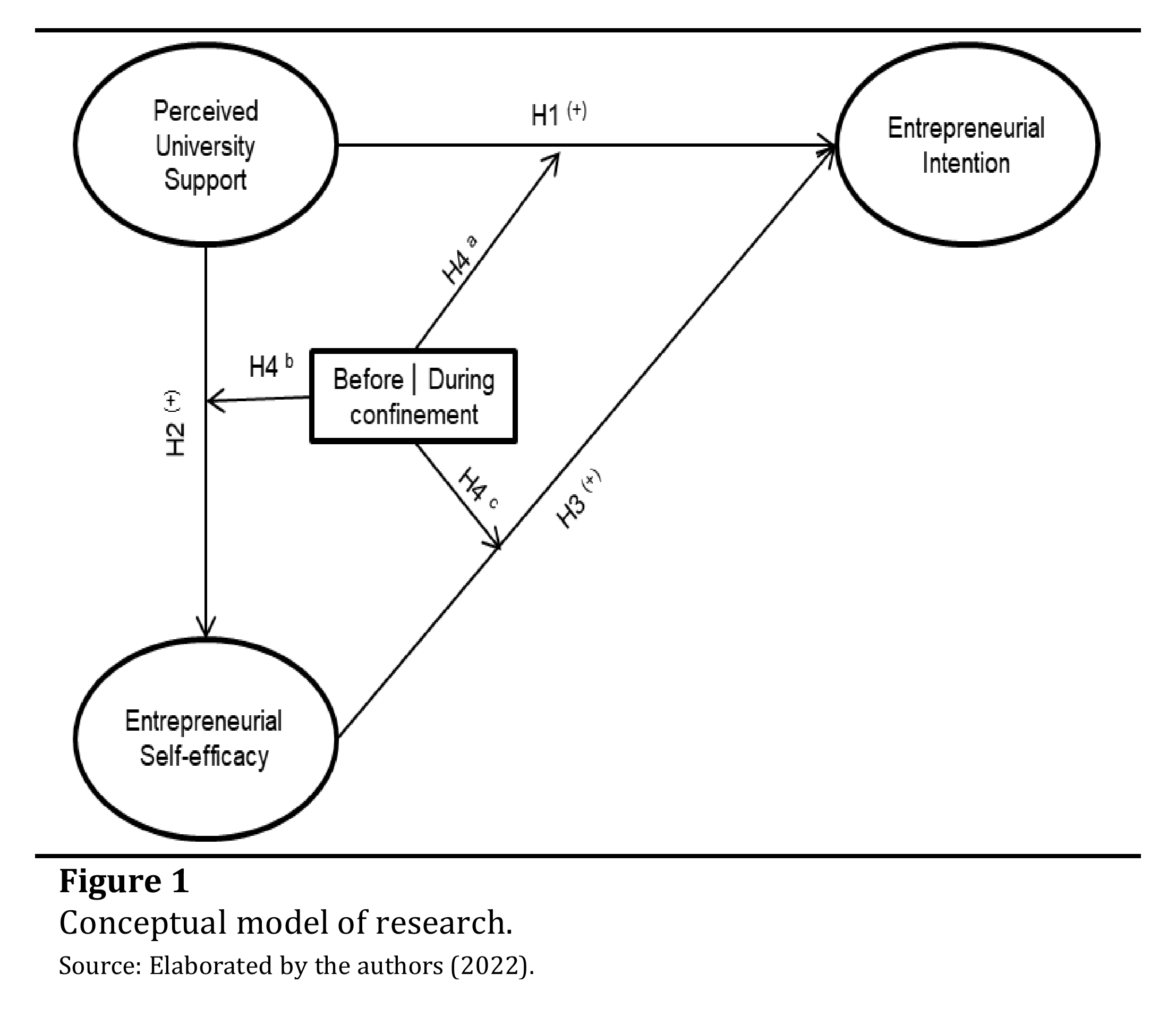
Figure 1
Conceptual model of research.
Source: Elaborated by the authors (2022).
RESEARCH METHODOLOGY AND SAMPLE
The empirical assessment of this research was developed through quantitative methodology, with the use of multivariate data analysis. Hair et al. (2019) state that Partial Least Squares-Structural Equation Modeling (PLS-SEM) is a statistical model used for examining the prediction and explanation of the constructs and, also, it provides a common point between path modeling and confirmatory factor analysis (CFA). Thus, it is an adequate approach to comprehend this research’s purpose, which aims at identifying whether the Coronavirus pandemic has influenced entrepreneurial behavior and perceived university support.
The conceptual model constructs (Perceived University Support, Entrepreneurial Self-Efficacy, Entrepreneurial Intention and Before/During Confinement) were based in previous researches (Ahmed et al., 2019; Liu et al., 2020; Moraes et al., 2018; Nassif et al., 2020; Newman et al., 2019; Rocha & Freitas, 2014; Saeed et al., 2015; Shi et al., 2020; Yang et al., 2020), even though their relationship as a whole brings novelty to literature. Additionally, the questions regarding Perceived University Support and Entrepreneurial Self-Efficacy were based and adapted from Shi, et al. (2020) and Rocha, et al. (2014), the construct of entrepreneurial intention had as main reference the study of Saeed et al. (2015), while some indicators were developed by the authors.
A pre-test was carried out after formulating the hypotheses and developing the research conceptual model, to assess face validity in three types of audience, as suggested by Forza (2002). The first audience was three experts in entrepreneurial intention models, the second audience was three experts in structural equation modeling, and the third audience five students who were potential respondents to the questionnaire. At this stage, minor adjustments were made to the questionnaires.
Next, to evaluate the sample size and statistical power of the analysis, an analysis with the G*Power 3.1 software (Faul et al., 2009) was conducted and based on the recommendations by Chin and Newsted (1999), Cohen (1988) and Hair et al. (2019). Considering two predictors, a significance level of 5%, a statistical power of 0.8, and an average effect size (f² = 0.15, which is equivalent to r² = 13%), the minimum size of the sample required is 68 to be suitable for estimation by Partial Least Squares Path Modeling (PLS-PM). Considering that the total number of Business students at Unicamp is 960, the final sample of 508 students covered 53% of the course's students. Thus, the sample can be considered probabilistic for Business students at Unicamp, although it is not probabilistic for the Brazilian context of business students.
Thus, the final sample included 508 Business Administration students from Unicamp, with a mean age of 21 to 25 years, 52% female and 96% single. With the authorization of the unit's management, invitations were sent in the institutional email of all Business Administration students to voluntarily participate in the questionnaire. The questionnaire was available to be answered between October 20th and November 12th, 2020.
The University of Campinas (Unicamp) is the second best teaching and research institution in Brazil and the 214th best in the world, according to the QS World University Rankings (Elsevier, 2021). In the international ranking by the British publication, Times Higher Education, of the World University Ranking 2019, the university is at the 401–500 level in the world and first place in Brazil (“Times Higher Education | World University Rankings,” 2020). Unicamp’s internal entrepreneurial university pathways have a positive effect on students’ start-up actions (Guerrero et al., 2014) and when compared with other universities from emerging countries, it has higher entrepreneurship outputs.
The first part of the questionnaire asked the respondent to consider the scenario prior to the pandemic, and the second part of the questionnaire asked the respondent to consider the current scenario, during the pandemic.
Since, the indicators used in the questionnaire were validated by previous research or adapted from related literature, a first step in the analysis was to perform a Confirmatory Data Analysis (CFA), where measures were tested in the same model and were restricted to load on their respective factor (Brady & Cronin, 2001). CFA results and descriptive statistics are presented in Table 2. No indicators needed to be excluded from the model.
| Table 2 | ||||||
| Confirmatory Factor Analysis (CFA) | ||||||
| Questions | Standardized path loading | Critical ratio | p-value | Mean | Standard deviation | |
| Perceived University Supporta | ||||||
| PUS1 | Offer entrepreneurship disciplines | 0.805 | 39.899 | 0.000 | 4.545 | 0.748 |
| PUS2 | Organize entrepreneurship events | 0.886 | 86.115 | 0.000 | 4.376 | 0.834 |
| PUS3 | Contact entrepreneurship students with one another | 0.854 | 65.364 | 0.000 | 4.456 | 0.810 |
| PUS4 | Support student organizations | 0.444 | 7.670 | 0.000 | 4.614 | 0.708 |
| PUS5 | Offer makerspaces and fablabs | 0.711 | 20.923 | 0.000 | 4.351 | 0.874 |
| PUS6 | Develop alumni programs | 0.593 | 13.876 | 0.000 | 4.075 | 0.932 |
| EntrepreneurialSelf-Efficacyb | ||||||
| SE1 | Confident that I can successfully identify new business opportunities | 0.836 | 70.061 | 0.000 | 3.355 | 1.083 |
| SE2 | Confident that I can successfully create new products | 0.872 | 84.537 | 0.000 | 3.029 | 1.072 |
| SE3 | Confident that I can think creatively | 0.758 | 40.268 | 0.000 | 3.721 | 1.053 |
| SE4 | Confident that I can successfully market an idea or new development | 0.883 | 115.342 | 0.000 | 3.220 | 1.142 |
| Entrepreneurial Intentionb | ||||||
| EI1 | Be willing to do whatever it takes to be an entrepreneur | 0.897 | 136.827 | 0.000 | 3.244 | 1.208 |
| EI2 | Feeling that I would make every effort to start and run my own business | 0.924 | 188.757 | 0.000 | 3.206 | 1.242 |
| EI3 | To feel that my greatest achievement would be to have my own business | 0.867 | 95.506 | 0.000 | 3.088 | 1.352 |
| EI4 | Intend to start a business in the coming years | 0.838 | 68.517 | 0.000 | 3.101 | 1.342 |
| Source: Based on Rocha et al. (2014); Saeed et al. (2015) and Shi et al. (2020). Note: a Likert scale response from 1 (irrelevant) to 5 (very important). The students answered how much they thought some actions by the university were important. b Likert scale responses from 1 (totally disagree) to 5 (totally agree). The students responded how much they agreed with the statements | ||||||
FINDINGS
The internal consistency, composite reliability, convergent validity and discriminant validity of the constructs were evaluated with SmartPLS 3 software (Hair et al., 2019). Cronbach's alpha assessed internal consistency. Cronbach's alpha values between 0.70 and 0.90 are considered satisfactory for studies in more advanced stages (Fornell & Larcker, 1981). The composite reliability values should be at least 0.70 to indicate that the items are enough to represent their respective constructs (Hair et al., 2019). The average variance extracted (AVE) is one of the criteria for testing the convergent validity of a construct (Fornell & Larcker, 1981). AVE values higher than 0.50 are acceptable to indicate that a large amount of the mean-variance of the indicators is captured by each factor and not by the measurement error (Hair et al., 2019). All the mentioned values are within these limits (Table 3). The discriminant validity evaluates the distinction between two similar constructs. To confirm the discriminant validity of the model, the square root of AVE that is presented on the diagonal of the correlation matrix (Table 3) should present values higher than the correlation with other constructs (Hair et al., 2019). The square root of AVE values suggests that there is no relationship between the indicators associated with their respective construct with other constructs of the model.
| Table 3 | |||
| Summary of the Evaluation of Measurement Models | |||
| Constructs | Perceived University Support | Entrepreneurial Self-efficacy | Entrepreneurial Intention |
| Perceived University Support | 0.839 | ||
| Entrepreneurial Self-efficacy | 0.584 | 0.882 | |
| Entrepreneurial Intention | 0.290 | 0.310 | 0.732 |
| Cronbach’s Alpha | 0.833 | 0.859 | 0.905 |
| Composite Reliability | 0.897 | 0.904 | 0.914 |
| Average Variance Extracted (AVE) | 0.536 | 0.703 | 0.778 |
| Rho_A | 0.897 | 0.877 | 0.914 |
| Source: Elaborated by the authors (2022). | |||
The value of Variance Inflation Factor (VIF) for each subsection of the structural model was analyzed to assess collinearity. If 0.2 < VIF < 5, the collinearity of the construct is adequate, and all values are within those established by Hair et al. (2019). The Student’s t-test analyzes the hypothesis that the coefficients of correlation are equal to zero. If the results of this test indicate values higher than 1.96, the hypothesis is rejected, and the correlation is significant (Hair et al., 2019).
The bootstrapping technique was used to evaluate the statistical significance of the constructs and all values of the relationships presented Student t-values higher than 1.96 (significance level = 5%), as seen on Table 4.
| Table 4 | ||||
| Coefficients of the Structural Model – Between constructs | ||||
| Path | Sample mean | Standard deviation | T-statistics | p-values |
| Entrepreneurial Self-efficacy à Entrepreneurial Intention | 0.539 | 0.025 | 21.657 | 0.000 |
| Perceived University Support à Entrepreneurial Self-efficacy | 0.290 | 0.031 | 9.408 | 0.000 |
| Perceived University Support à Entrepreneurial Intention | 0.154 | 0.026 | 5.806 | 0.000 |
| Source: Elaborated by the authors (2022). | ||||
According to the results (Table 4), all relationships are significant at a significance level of 5%, supporting hypotheses 1, 2 and 3. These results are in line with previous studies, which indicate that the perceived university support has a positive influence on entrepreneurial intention and self-efficacy (Saeed et al., 2015; Moraes et al. 2018, 2021; Mustafa et al., 2016), and that self-efficacy has a positive influence on entrepreneurial intention (Moraes et al. , 2021; Saraih et al., 2018).
To evaluate the coefficient of determination (R2), analysis was based on Cohen (1988) and Faul, Erdfelder, Lang, and Buchner (2007), whose studies established that R2 values equal to 2%, 13%, and 25% are considered, respectively, as small, medium and large effects. Regarding our analysis, the model presented R2 of 0.084 for the construct self-efficacy, considered between small and medium, and R2 of 0.363 for the construct entrepreneurial intention, considered high. Also, for SEM models, values of Q2 higher than zero indicate the predictive relevance of the path model, which means that, in this study, the values are considered adequate (Hair et al., 2019).
In order to test whether there are differences between the relationships prior and during the pandemic periods, a multigroup analysis (Table 5) was performed (Hair et al., 2019).
| Table 5 | ||
| Analysis of relationships according to the moment - during and before the pandemic | ||
| Path | Path coefficients difference (during – before) | p-values |
| Entrepreneurial Self-efficacy à Entrepreneurial Intention | 0.011 | 0.821 |
| Perceived University Support à Entrepreneurial Self-efficacy | -0.027 | 0.659 |
| Perceived University Support à Entrepreneurial Intention | 0.044 | 0.384 |
| Source: Elaborated by the authors (2022). | ||
Following our empirical results, it is possible to acknowledge that there are no differences prior and during the pandemic concerning the relationships amongst perceived university support, entrepreneurial self-efficacy and entrepreneurial intention, not confirming hypotheses 4, 4a, 4b and 4c. These results are contrary to those found by other authors. For Loan et al. (2021) and Ruiz-Rosa et al. (2020), the pandemic resulted in a decrease in entrepreneurial intention. Also, in Loan et al. (2021), the results point to an impact on self-efficacy as well. In the present study, in which we compared the moment before and the moment during the pandemic, the results indicated the students' perception did not change significantly. This may have been due to the fact that we were confronted two different moments, while other authors carried out an analysis in just one moment. The complete model is presented in Figure 2.
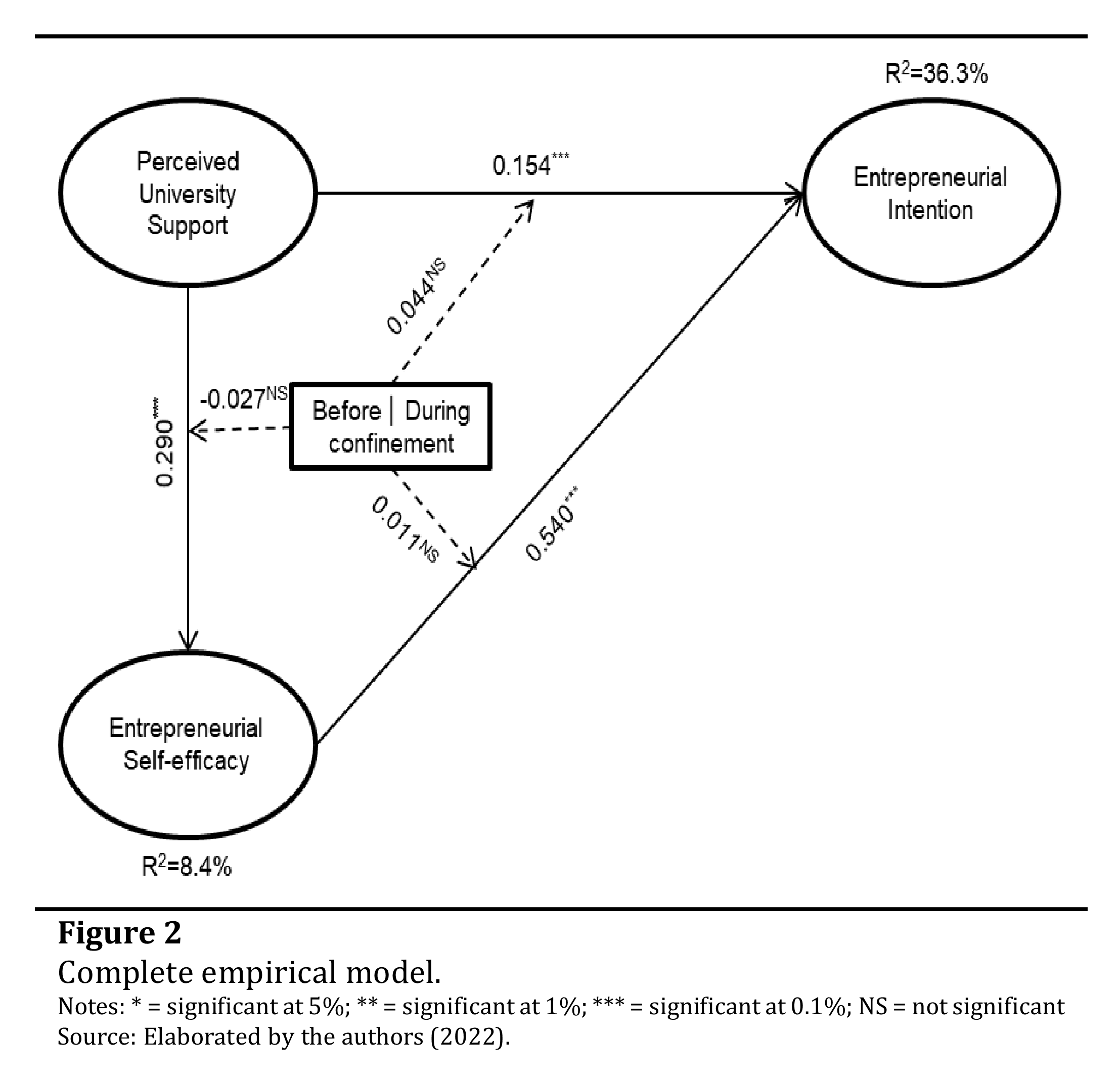
Figure 2
Complete empirical model
Notes: * = significant at 5%; ** = significant at 1%; *** = significant at 0.1%; NS = not significant Source: Elaborated by the authors (2022).
The synthesis of the study hypotheses is shown in Table 6.
| Table 6 | ||
| Synthesis of the Study Hypotheses Tests | ||
| Description | Result | |
| H1 | Perceived University Support has a positive influence on Entrepreneurial Intention | Confirmed |
| H2 | Perceived University Support has a positive influence on Entrepreneurial Self-Efficacy | Confirmed |
| H3 | Entrepreneurial Self-Efficacy has a positive influence on Entrepreneurial Intention | Confirmed |
| H4 | The relationship amongst Perceived University Support, Entrepreneurial Intention and Entrepreneurial Self-Efficacy before confinement differs to the one presented during the confinement | Not confirmed |
| H4a | The Perceived University Support prior to confinement presented a better relationship with Entrepreneurial Intention than to the one demonstrated during confinement | Not confirmed |
| H4b | The Perceived University Support prior to confinement presented a better relationship with Entrepreneurial Self-Efficacy than to the one demonstrated during confinement | Not confirmed |
| H4c | Entrepreneurial Self-Efficacy, prior to confinement, presented a better relationship with Entrepreneurial Intention than to the one demonstrated during confinement | Not confirmed |
| Source: Elaborated by the authors (2022). | ||
DISCUSSION
This research focused on unraveling the effect of Coronavirus pandemic at Unicamp students on entrepreneurship behavior, in specifics self-efficacy and intention, as well as on the entrepreneurial education, particularly perceived university support. The results reaffirmed previous research results that studied the university environment, entrepreneurial intention and self-efficacy (Moraes et al., 2018, 2021; Mustafa et al., 2016; Saeed et al., 2015; Saraih et al., 2018). However, the results were contrary to those found in the literature regarding the impact of covid on entrepreneurial behavior (Loan et al., 2021; Ruiz-Rosa et al., 2020; Yang et al., 2020).
Considering the confirmed hypotheses, the research reiterates the complementarity of the entrepreneurship triad and reinforces the determining factors of entrepreneurial intention (Fragoso et al., 2020), as seen in Newman et al. (2019). Although Newman et al. (2019) centered their study in entrepreneurial self-efficacy, they highlighted the extant research on entrepreneurial self-efficacy, its antecedents and outcomes. According to their perspective, self-efficacy interacts reciprocally with internal and external environments, acting as a key theoretical approach to study entrepreneurial actions and beliefs. Entrepreneurial education act as one of its antecedents, due to proper experiences supply, emotional competences and psychological traits enhancement, whereas entrepreneurial intention is transmitted as one of its outcomes, since it is associated with the individuals' perceptions of handling given situations. Therefore, the entrepreneurial thinking englobes entrepreneurial education, entrepreneurial self-efficacy and entrepreneurial intention.
Regarding the unconfirmed hypotheses, although the relationships between perceived university support, entrepreneurial intention and entrepreneurial self-efficacy show differences, these differences were not significant. It is noteworthy that the effect of the pandemic was considered through the students' perceptions of such elements, before and during confinement. The COVID-19 pandemic and the many blockages in economies around the world have created a unique situation that has no documented equivalent in the entrepreneurship literature (Kuckertz et al., 2020). Thus, these results may be linked to the achievement of long-term goals and the tendency to persevere and sustain the effort when faced with difficulties or setbacks in life (Salisu et al., 2020). It aligns with the concept of resilience within the field of entrepreneurship, since it relates to one's preparedness or capacity to adjust, and, it also carries an encouragement of entrepreneurial activity, behaving as a determinant of entrepreneurial intention (Korber & McNaughton, 2018).
Alongside these findings, individuals have to sail through tough conditions and in crisis context to minimize the impacts of COVID-19 crisis and, optimistically, restore functionality (Salisu et al., 2020). Within entrepreneurship field, crisis management is predominantly aimed at evaluating the actions done to mitigate its potential negative consequences, but taking into consideration the challenges presented by COVID-19, it seems suitable the embrace of iterative and flexible approaches such as effectual logic (Kuckertz et al., 2020; Sarasvathy, 2001).
Another point to be highlighted is that, although entrepreneurial self-efficacy generally demonstrates high levels of influence on entrepreneurial intention (Fragoso et al., 2020; Moraes et al., 2021; Saraih et al., 2018), results showed that perceived university support was higher assessed at Unicamp, as they imply entrepreneurial knowledge lead to entrepreneurial intention. Put differently, entrepreneurial education contributes to the development of entrepreneurial intentions (Küttim et al., 2014; Lüthje & Franke, 2003; Peterman & Kennedy, 2003). Accordingly, the online instruction broadens the spectrum of learning entrepreneurial education, straying away from the traditional teaching and pedagogical solutions (Liguori & Winkler, 2020).
Such fundamental aspects of this entrepreneurship triad make noteworthy its unity and triple nexus. Alternatively, the dramatic nature of COVID-19 could have initiated an undesired outcome for potential entrepreneurs, but these research findings illustrated the entrepreneurship connection to risk-taking, resilience, uncertainty and agile nature (Bacq et al., 2020; Caliendo & Kritikos, 2011; Kuckertz et al., 2020; Neumeyer et al., 2020).
CONCLUSION
This paper portrayed the relationship amongst Perceived University Support, Entrepreneurial Self-Efficacy and Entrepreneurial Intention during one of most economically and socially disruptive events since the financial crisis in 2008 (Neumeyer et al., 2020). This article addressed the COVID-19 possible effects, prior and during confinement, on student’s entrepreneurial behavior and education and found no significant difference between the two-time sets.
It is known that entrepreneurial success depends on the support that entrepreneurs receive from their environment (Neumeyer et al., 2020), such as entrepreneurial resilience, that may serve as a crucial passageway to entrepreneurial success (Salisu et al., 2020). However, from a different perspective, the lack of support also matters. Kucketz et al. (2020) enlighten Germany’s current economic climate and state that since the COVID-19 outbreak, the niche of entrepreneurs had sales reduced while unaltering the fixed cost, representing a combination unfavorable for the long-term survival. Thus, the COVID-19 crisis besides threatening economy and health systems, it also threatens the potential for innovation that small business could have proven viable in normal times.
The research helped to fill the research gaps, which contribute to the construction of the field of scientific knowledge. By presenting an investigation model with two cross-sections of data collection, the research adds information about the effects of the coronavirus pandemic on the relationship between entrepreneurial education, self-efficacy and entrepreneurial intention (Loan et al., 2021; Ratten, 2020, 2021; Ruiz-Rosa et al., 2020) in a developing country context. The results reinforce that an online and non-traditional approach to entrepreneurship education can be used perfectly, despite the contextual circumstances (Liguori & Winkler, 2020). Furthermore, even with the uncertainties of the COVID-19 pandemic (WHO, 2020a), this may not be a strange scenario for entrepreneurship in Latin America, as uncertainty plays a central role as linked to the decision to innovate, continuous experimentation and learning (Guerrero et al., 2014; Isenberg, 2010). Finally, the information collected from a renowned Brazilian university complements the studies on perception of university support, entrepreneurial self-efficacy and entrepreneurial intention, while complementing the body of research on possible influences of the COVID-19 pandemic, integrating crisis management and entrepreneurship, which is another gap in the literature (Ratten, 2020, 2021).
From a practical point of view, the results bring interesting perspectives to the context of a developing country. Although the pandemic has aroused fears of an economic crisis, where many jobs were lost in all economic sectors (Nicola et al., 2020), it is possible to see positive points, such as a period of accelerated diffusion of digital technologies, micro-level initiatives and consideration of established forms of resource intensive use (Karabag, 2020). Thus, understanding that the pandemic has not yet impacted the entrepreneurial behavior of students, universities can take the opportunity to improve the university environment to support entrepreneurship, better preparing students for the opportunities and challenges in the post-pandemic moment. The results also demonstrate the need to increase students' self-efficacy, which can be achieved with more innovative initiatives to promote entrepreneurship in universities, connecting students to markets and going beyond conventional strategies based on courses and training aimed at entrepreneurship (Moraes et al., 2021).
It is important to notice that our results and discussion do not go without limitations. Mainly, it comprised only students enrolled at Unicamp. Therefore, the debate brought evidences of this specific group. This study considered the student’s perception, which stands as a subjective manner and reflects personal inclination. Besides, students from all years were approached, therefore the maturation in students' perceptions might differ when considering freshmen and senior students. Also, despite the extensive efforts to characterize the periods prior and during the confinement, scholars are still uncovering this theme and there might be more dimensions to be considered.
Further investigations are needed to validate this conceptual model. Replicating the study with students from other universities and other states, as well as encompassing an array of fields and levels could enrich the analyses. Besides, future investigation can focus on students from a specific course or year of graduation to understand their intention on endeavoring, even with external influences. Also, deepening the understanding of these constructs and their relation by performing a qualitative approach could offer further the understanding of these constructs and their interrelations. Another possibility is to perform a longitudinal study to evaluate the phases prior, during and posterior of students’ perception on entrepreneurial intention, self-efficacy and university environment. From our perspective, perhaps COVID-19 effects are still immature, which demands closer and longer investigations, particularly in the field of entrepreneurship.
Funding
This work was supported by the São Paulo Research Foundation [grant number 2021/08267-2]; and the Coordination for the Improvement of Higher Education Personnel – CAPES [grant number 303924/2021-7].
Conflict of interest statemen
I declare for due purposes that the authors have no conflicts of interest.
Authors’ statement of individual contributions
| Authors’ statement of individual contributions | |||
| Roles | Contributions by authors | ||
| Rocha A.K.L. da | Pelegrini G.C. | Moraes G.H.S.M. de | |
| Conceptualization | ∎ | ∎ | ∎ |
| Methodology | ∎ | ||
| Software | ∎ | ||
| Validation | ∎ | ∎ | ∎ |
| Formal analysis | ∎ | ∎ | ∎ |
| Investigation | ∎ | ∎ | |
| Resources | ∎ | ∎ | ∎ |
| Data Curation | ∎ | ∎ | ∎ |
| Writing - Original Draf | ∎ | ∎ | ∎ |
| Writing - Review & Editing | ∎ | ∎ | ∎ |
| Visualization | ∎ | ∎ | |
| Supervision | ∎ | ||
| Project administration | ∎ | ∎ | ∎ |
| Funding acquisition | ∎ | ∎ | ∎ |
REFERENCES
Ahmed, T., Ur Rehman, I., & Sergi, B. S. (2019). A Proposed Framework on the Role of Entrepreneurial Education and Contextual Factors. In Entrepreneurship and Development in the 21st Century (pp. 47–68). https://doi.org/10.1108/978-1-78973-233-720191005
Ajzen, I. (1991). The theory of planned behavior. Organizational Behavior and Human Decision Processes, 50(2), 179–211. https://doi.org/10.1016/0749-5978(91)90020-T
Aldairany, S., Omar, R., & Quoquab, F. (2018). Systematic review: entrepreneurship in conflict and post conflict. Journal of Entrepreneurship in Emerging Economies, 10(2), 361–383. https://doi.org/10.1108/JEEE-06-2017-0042
Almeida, L. R. S. de, Cordeiro, E. D. P. B., & Silva, J. A. G. da. (2019). Proposições acerca do Ensino de Empreendedorismo nas Instituições de Ensino Superior Brasileiras: uma Revisão Bibliográfica. Revista de Ciências Da Administração, 1(3), 109–122. https://doi.org/10.5007/2175-8077.2018v20n52p109
Alves, A. C., Fischer, B. B., Schaeffer, P. R., & Queiroz, S. (2019). Determinants of student entrepreneurship An assessment on higher education institutions in Brazil. Innovation & Management Review, 16(2), 2515–8961. https://doi.org/10.1108/INMR-02-2018-0002
Amaral, M., Toledo Hernandez, C., Henrique, M., & Bastos, R. (2018). The entrepreneurial profile of Brazilian business administration students. International Journal of Innovation Science, 10(2), 160–177. https://doi.org/10.1108/IJIS-05-2017-0040
Asimakopoulos, G., Hernández, V., & Peña Miguel, J. (2019). Entrepreneurial Intention of Engineering Students: The Role of Social Norms and Entrepreneurial Self-Efficacy. Sustainability, 11(16), 4314. https://doi.org/10.3390/su11164314
Atiya, T. M. S., Bilal, Z. O., Abulhamid, M., & Shoaib, S. A. (2019). The Impact of Entrepreneurial Characteristics on Entrepreneurial Intention of Sudanese and Omani University Students. European Scientific Journal, 15(4), 1857–7881. https://doi.org/10.19044/esj.2019.v15n4p66
Bacq, S., Geoghegan, W., Josefy, M., Stevenson, R., & Williams, T. A. (2020). The COVID-19 Virtual Idea Blitz: Marshaling social entrepreneurship to rapidly respond to urgent grand challenges. Business Horizons. https://doi.org/10.1016/j.bushor.2020.05.002
Bandura, A. (1994). Bandura Self-efficacy defined. Encyclopedia of Human Behavior.
Bezerra, É. D., Borges, C., & Andreassi, T. (2017). Universities, local partnerships and the promotion of youth entrepreneurship. International Review of Education, 63(5), 703–724. https://doi.org/10.1007/s11159-017-9665-y
Bignotti, A., & Le Roux, I. (2016). Unravelling the conundrum of entrepreneurial intentions, entrepreneurship education, and entrepreneurial characteristics. Acta Commercii, 16(1), 10. https://doi.org/10.4102/ac.v16i1.352
Brady, M. K., & Cronin, J. J. (2001). Some new thoughts on conceptualizing perceived service quality: A hierarchical approach. Journal of Marketing, 65(3). https://doi.org/10.1509/jmkg.65.3.34.18334
Brasil. Governo do Estado de São Paulo Decreto 64.881. , (2020).
Bullough, A., & Renko, M. (2013). Entrepreneurial resilience during challenging times. Business Horizons, 56(3), 343–350. https://doi.org/10.1016/j.bushor.2013.01.001
Caliendo, M., & Kritikos, A. (2011). Searching for the entrepreneurial personality: New evidence and avenues for further research. Journal of Economic Psychology, 33(2), 319–324. https://doi.org/10.1016/j.joep.2011.06.001
Campos, M. L., Moraes, G. H. S. M., and Spatti, A. C. (2021). Do University Ecosystems Impact Student's Entrepreneurial Behavior? BAR. Brazilian Administration Review, v. 18, p. 1-30, 2021.
Canever, M. D., Barral, M. R. M., & Ribeiro, F. G. (2017). How does the public and private university environment affect students’ entrepreneurial intention? Education and Training. https://doi.org/10.1108/ET-12-2016-0187
Chin, W., & Newsted, P. (1999). Structural Equation Modeling Analysis with Small Samples Using Partial Least Square. Statistical Strategies for Small Sample Research.
Cohen, J. (1988). Statistical Power Analysis for the Behavioral Sciences (2nd editio). Hillsdale, NJ: Lawrence Erlbaum Associates.
Elsevier (Ed.). (2021). QS World University Rankings 2021. Retrieved from https://www.qs.com/portfolio-items/qs-world-university-rankings-2021/
Faul, F., Erdfelder, E., Buchner, A., & Lang, A.-G. (2009). Statistical power analyses using G*Power 3.1: Tests for correlation and regression analyses. Behavior Research Methods, 41(4), 1149–1160. https://doi.org/10.3758/BRM.41.4.1149
Faul, F., Erdfelder, E., Lang, A.-G., & Buchner, A. (2007). G*Power 3: A flexible statistical power analysis program for the social, behavioral, and biomedical sciences. Behavior Research Methods, 175–191.
Fayolle, A., & Gailly, B. (2015). The Impact of Entrepreneurship Education on Entrepreneurial Attitudes and Intention: Hysteresis and Persistence. Journal of Small Business Management, 53(1), 75–93. https://doi.org/10.1111/jsbm.12065
Fischer, B. B., Moraes, G. H. S. M. de, & Schaeffer, P. R. (2019). Universities’ institutional settings and academic entrepreneurship: Notes from a developing country. Technological Forecasting and Social Change, 147, 243–252. https://doi.org/10.1016/J.TECHFORE.2019.07.009
Fornell, C., & Larcker, D. F. (1981). Evaluating Structural Equation Models with Unobservable Variables and Measurement Error. Journal of Marketing Research. https://doi.org/10.2307/3151312
Forza, C. (2002). Survey research in operations management: A process-based perspective. International Journal of Operations and Production Management, Vol. 22. https://doi.org/10.1108/01443570210414310
Fragoso, R., Rocha-Junior, W., & Xavier, A. (2020). Determinant factors of entrepreneurial intention among university students in Brazil and Portugal. Journal of Small Business & Entrepreneurship, 32(1), 33–57. https://doi.org/10.1080/08276331.2018.1551459
Guerrero, M., Urbano, D., Cunningham, J. A., & Gajón, E. (2018). Determinants of Graduates’ Start-Ups Creation across a Multi-Campus Entrepreneurial University: The Case of Monterrey Institute of Technology and Higher Education. Journal of Small Business Management, 56(1), 150–178. https://doi.org/10.1111/jsbm.12366
Guerrero, M., Urbano, D., & Gajón, E. (2014). The internal pathways that condition university entrepreneurship in latin america: An institutional approach. Advances in the Study of Entrepreneurship, Innovation, and Economic Growth, 24. https://doi.org/10.1108/S1048-473620140000024004
Hair, J. F., Risher, J. J., Sarstedt, M., & Ringle, C. M. (2019). When to Use and How to Report the Results of PLS-SEM. European Business Review, Vol. 31 No. 1, pp. 2-24. https://doi.org/10.1108/EBR-11-2018-0203
Hair, Joseph, Sarstedt, M., Ringle, C. M., & Gudergan, S. P. (2018). Advanced Issues in Partial Least Squares Structural Equation Modeling. SAGE.
Isenberg, D. (2010). How to Start an Entrepreneurial Revolution. Retrieved from www.hbr.org
Jena, R. K. (2020). Measuring the impact of business management Student’s attitude towards entrepreneurship education on entrepreneurial intention: A case study. Computers in Human Behavior, 107, 106275. https://doi.org/10.1016/j.chb.2020.106275
Inácio Júnior, E., Autio, E., Morini, C., Gimenez, F. A. P., & Dionisio, E. A. (2016). Analysis of the Brazilian Entrepreneurial Ecosystem. Desenvolvimento Em Questão, 14(37), 5-36. https://doi.org/10.21527/2237-6453.2016.37.5-36
Kakodkar, P., Kaka, N., & Baig, M. (2020). A Comprehensive Literature Review on the Clinical Presentation, and Management of the Pandemic Coronavirus Disease 2019 (COVID-19). Cureus, 12(4), 7560. https://doi.org/10.7759/cureus.7560
Karabag, S. F. (2020). An Unprecedented Global Crisis! The Global, Regional, National, Political, Economic and Commercial Impact of the Coronavirus Pandemic. In Journal of Applied Economics and Business Research JAEBR (Vol. 10).
Koe, W.-L., Sa’ari, J. R., Majid, I. A., & Ismail, K. (2012). Determinants of Entrepreneurial Intention Among Millennial Generation. Procedia - Social and Behavioral Sciences, 40, 197–208. https://doi.org/10.1016/j.sbspro.2012.03.181
Korber, S., & McNaughton, R. B. (2018). Resilience and entrepreneurship: a systematic literature review. International Journal of Entrepreneurial Behaviour and Research, 24(7), 1129–1154. https://doi.org/10.1108/IJEBR-10-2016-0356
Kraaijenbrink, J., Bos, G., & Groen, A. (2010). What do students think of the entrepreneurial support given by their universities ? Jeroen Kraaijenbrink *, Ger Bos and Aard Groen. International Journal of Entrepreneurship and Small Business, 9(1), 2010. https://doi.org/10.1504/IJESB.2010.029512
Krakauer, P. V. de C., Moraes, G. H. S. M., Coda, R., & Berne, D. de F. (2018). Brazilian women’s entrepreneurial profile and intention. International Journal of Gender and Entrepreneurship, 10(4), 361–380. https://doi.org/10.1108/IJGE-04-2018-0032
Krueger, N. F., Reilly, M. D., & Carsrud, A. L. (2000). Competing models of entrepreneurial intentions. Journal of Business Venturing. https://doi.org/10.1016/S0883-9026(98)00033-0
Kuckertz, A., Brändle, L., Gaudig, A., Hinderer, S., Morales Reyes, C. A., Prochotta, A., … Berger, E. S. C. (2020). Startups in times of crisis – A rapid response to the COVID-19 pandemic. Journal of Business Venturing Insights, 13, e00169. https://doi.org/10.1016/j.jbvi.2020.e00169
Kusmintarti, A., Thoyib, A., Ashar, K., & Maskie, G. (2014). The Relationships among Entrepreneurial Characteristics, Entrepreneurial Attitude, and Entrepreneurial Intention (Vol. 16). Retrieved from www.iosrjournals.orgwww.iosrjournals.org
Küttim, M., Kallaste, M., Venesaar, U., & Kiis, A. (2014). Entrepreneurship Education at University Level and Students’ Entrepreneurial Intentions. Procedia - Social and Behavioral Sciences, 110, 658–668. https://doi.org/10.1016/J.SBSPRO.2013.12.910
Le Thi Loan, Doung Cong Doanh, Ha Ngoc Thang, Ngo Thi Viet Nga, Pham Thanh Van,& Phan Thanh Hoa. (2021). Entrepreneurial behaviour: The effects of the fear and anxiety of Covid-19 and business opportunity recognition. Entrepreneurial Business & Economics Review. 2021;9(3):7-23. https://doi.org/10.15678/EBER.2021.090301
Liguori, E., & Winkler, C. (2020). From Offline to Online: Challenges and Opportunities for Entrepreneurship Education Following the COVID-19 Pandemic. Entrepreneurship Education and Pedagogy, 251512742091673. https://doi.org/10.1177/2515127420916738
Liu, T., Walley, K., Pugh, G., & Adkins, P. (2020). Entrepreneurship education in China Evidence from a preliminary scoping study of enterprising tendency in Chinese university students. Journal of Entrepreneurship in Emerging, 12(2), 305–326. https://doi.org/10.1108/JEEE-01-2019-0006
Lüthje, C. L., & Franke, N. (2003). The “making” of an entrepreneur: testing a model of entrepreneurial intent among engineering students at MIT. R&D Management, 33(2), 135–147. Retrieved from http://epub.wu.ac.at/4612/1/Luethje_Franke-2003-RDM_The-making-of-an-entrepreneur.pdf
Luthra, P., & Mackenzie, S. (2020). 4 ways COVID-19 could change how we educate future generations.
Moraes, G. H. S. M., Fischer, B. B., Campos, M. L., & Schaeffer, P. R. (2020). University ecosystems and the commitment of faculty members to support entrepreneurial activity. Brazilian Administration Review, 17(2), 1–26. Retrieved from http://dx.doi.org/10.1590/1807-7692bar2020190013
Moraes, G. H. S. M., Iizuka, E. S., & Pedro, M. (2018). Effects of Entrepreneurial Characteristics and University Environment on Entrepreneurial Intention. Revista de Administração Contemporânea, 22(2), 226–248. https://doi.org/10.1590/1982-7849rac2018170133
Moraes, G. H. S. M., Fischer, B. B., Guerrero, M., Rocha, A. K. L., and Schaeffer, P. (2021). An inquiry into the linkages between university ecosystem and students’ entrepreneurial intention and self-efficacy. Innovations in Education and Teaching International, p. 1-12.
Mustafa, M. J., Hernandez, E., Mahon, C., & Chee, L. K. (2016). Entrepreneurial intentions of university students in an emerging economy: The influence of university support and proactive personality on students’ entrepreneurial intention. Journal of Entrepreneurship in Emerging Economies, 8(2), 162–179. https://doi.org/10.1108/JEEE-10-2015-0058
Nassif, V. M. J., Armando, E., & La Falce, J. L. (2020). O Empreendedorismo e a Pequena Empresa no Contexto do Pós Covid-19: Há luz no Fim do Túnel. Revista de Empreendedorismo e Gestão de Pequenas Empresas, 9(3), I–VII. https://doi.org/10.14211/regepe.v9i3.1940
Neneh, B. N. (2020). Entrepreneurial passion and entrepreneurial intention: the role of social support and entrepreneurial self-efficacy. Studies in Higher Education, 1–17. https://doi.org/10.1080/03075079.2020.1770716
Neumeyer, X., Ashton, W. S., & Dentchev, N. (2020). Addressing resource and waste management challenges imposed by COVID-19: An entrepreneurship perspective. https://doi.org/10.1016/j.resconrec.2020.105058
Newman, A., Obschonka, M., Schwarz, S., Cohen, M., & Nielsen, I. (2019). Entrepreneurial self-efficacy: A systematic review of the literature on its theoretical foundations, measurement, antecedents, and outcomes, and an agenda for future research. Journal of Vocational Behavior, 110(May 2018), 403–419. https://doi.org/10.1016/j.jvb.2018.05.012
Nicola, M., Alsafi, Z., Sohrabi, C., Kerwan, A., Al-Jabir, A., Iosifidis, C., … Agha, R. (2020). The socio-economic implications of the coronavirus pandemic (COVID-19): A review. International Journal of Surgery, Vol. 78. https://doi.org/10.1016/j.ijsu.2020.04.018
Peterman, N. E., & Kennedy, J. (2003). Enterprise Education: Influencing Students’ Perceptions of Entrepreneurship. Entrepreneurship Theory and Practice. https://doi.org/10.1046/j.1540-6520.2003.00035.x
Pihie, Z. A. L., & Bagheri, A. (2013). Self-Efficacy and Entrepreneurial Intention: The Mediation Effect of Self-Regulation. Vocations and Learning, 6(3). https://doi.org/10.1007/s12186-013-9101-9
Pittaway, L., & Edwards, C. (2012). Assessment: Examining practice in entrepreneurship education. Education and Training. https://doi.org/10.1108/00400911211274882
Raposo, M., & do Paço, A. (2011). Entrepreneurship education: Relationship between education and entrepreneurial activity. 23(2001), 453–457.
Ratten V. (2020). Coronavirus (COVID-19) and Entrepreneurship: Changing Life and Work Landscape. Journal of Small Business and Entrepreneurship. 32(5):503-516. http://www.tandfonline.com/loi/rsbe20
Ratten V. (2021). COVID‐19 and entrepreneurship: Future research directions. Strategic Change. 30(2):91-98. doi:10.1002/jsc.2392
Rezaeetalab, F., Mozdourian, M., Amini, M., Javidarabshaihi, Z., & Akbari, F. (2020). COVID-19: A New Virus as a Potential Rapidly Spreading in the Worldwide. Journal of Cardio-Thoracic Medicine, 2020;8(1):https://doi.org/10.22038/jctm.2020.46924.1264
Rideout, E. C., & Gray, D. O. (2013). Does entrepreneurship education really work? A review and methodological critique of the empirical literature on the effects of university-based entrepreneurship education. Journal of Small Business Management. https://doi.org/10.1111/jsbm.12021
Rocha, E. L. de C., & Freitas, A. A. F. (2014). Avaliação do Ensino de Empreendedorismo entre Estudantes Universitários por meio do Perfil Empreendedor. Revista de Administração Contemporânea, 18(4), 465–486. https://doi.org/10.1590/1982-7849rac20141512
Rodríguez Gutiérrez, P. I., Pastor Pérez, M. del P., & Alonso Galicia, P. E. (2019). University entrepreneurship: how to trigger entrepreneurial intent of undergraduate students. Journal of Science and Technology Policy Management, 10(4), 927–950. https://doi.org/10.1108/JSTPM-04-2018-0037
Rönkkö, M. L., & Lepistö, J. (2015). Finnish student teachers’ critical conceptions of entrepreneurship education. Journal of Enterprising Communities. https://doi.org/10.1108/JEC-03-2013-0003
Ruiz-Rosa, I., Gutiérrez-Taño D., & García-Rodríguez F. J. (2020). Social Entrepreneurial Intention and the Impact of COVID-19 Pandemic: A Structural Model. Sustainability (2071-1050). 12(17):6970. doi:10.3390/su12176970
Saeed, S., Yousafzai, S. Y., Yani-De-Soriano, M., & Muffatto, M. (2015). The Role of Perceived University Support in the Formation of Students’ Entrepreneurial Intention. Journal of Small Business Management, 53(4), 1127–1145. https://doi.org/10.1111/jsbm.12090
Sahu, P. (2020). Closure of Universities Due to Coronavirus Disease 2019 ( COVID-19 ): Impact on Education and Mental Health of Students and Academic Staff Challenges. 2019(4), 4–9. https://doi.org/10.7759/cureus.7541
Salisu, I., Hashim, N., Shehu Mashi, M., & Galadanchi Aliyu, H. (2020). Perseverance of effort and consistency of interest for entrepreneurial career success Does resilience matter? Journal of Entrepreneurship in Emerging, 12(2), 279–304. https://doi.org/10.1108/JEEE-02-2019-0025
Saraih, U. N., Zin Aris, A. Z., Abdul Mutalib, S., Tunku Ahmad, T. S., Abdullah, S., & Harith Amlus, M. (2018). The Influence of Self-Efficacy on Entrepreneurial Intention among Engineering Students. MATEC Web of Conferences, 150, 1–6. https://doi.org/10.1051/matecconf/201815005051
Sarasvathy, S. D. (2001). Causation and effectuation: Toward a theoretical shift from economic inevitability to entrepreneurial contingency. Academy of Management Review. https://doi.org/10.5465/AMR.2001.4378020
Schmidt, S., & Bohnenberger, M. C. (2009). Perfil empreendedor e desempenho organizacional. Revista de Administração Contemporânea, 13(3), 450–467. https://doi.org/10.1590/S1415-65552009000300007
Schumpeter, J. (1911). Die Theorie wirtschaftlicher Entwicklung. Duncker & Humblot, 61–116.
Schwarz, E. J., Almer-Jarz, D. A., & Wdowiak, M. A. (2006). A structural model of entrepreneurial intent among students: findings from Austria. Diversity in Entrepreneurship, (January 2014), 29–43.
Shapero, A., & Sokol, L. (1982). The Social Dimensions of Entrepreneurship, in The Encyclopaedia of Entrepreneurship. In Encyclopedia of Entrepreneurship.
Shi, L., Yao, X., & Wu, W. (2020). Perceived university support, entrepreneurial self-efficacy, heterogeneous entrepreneurial intentions in entrepreneurship education The moderating role of the Chinese sense of face. Journal of Entrepreneurship in Emerging Economies, 12(2), 205–230. https://doi.org/10.1108/JEEE-04-2019-0040
Stamboulis, Y., & Barlas, A. (2014). Entrepreneurship education impact on student attitudes. International Journal of Management Education, 12(3), 365–373. https://doi.org/10.1016/j.ijme.2014.07.001
Times Higher Education | World University Rankings. (2020). Retrieved July 22, 2020, from https://www.timeshighereducation.com/world-university-rankings/2020/world-ranking#!/page/0/length/25/sort_by/rank/sort_order/asc/cols/stats
Trivedi, R. (2016). Does university play significant role in shaping entrepreneurial intention? A cross-country comparative analysis. Journal of Small Business and Enterprise Development. https://doi.org/10.1108/JSBED-10-2015-0149
Turker, D., & Selcuk, S. S. (2009). Which factors affect entrepreneurial intention of university students? Journal of European Industrial Training, 33(2), 142–159. https://doi.org/10.1108/03090590910939049
UNICAMP. Resolução GR n. 24/2020. , (2020).
UNICAMP. Resolução GR n. 72/2020. , (2020).
Urbano, D., & Guerrero, M. (2013). Entrepreneurial Universities: Socioeconomic Impacts of Academic Entrepreneurship in a European Region. Gender and Society, 27(1), 40–55. https://doi.org/10.1177/0891242412471973
Vesper, K. H., & Gartner, W. B. (1997). Measuring progress in entrepreneurship education. Journal of Business Venturing. https://doi.org/10.1016/S0883-9026(97)00009-8
Vodă, A., & Florea, N. (2019). Impact of Personality Traits and Entrepreneurship Education on Entrepreneurial Intentions of Business and Engineering Students. Sustainability, 11(4), 1192. https://doi.org/10.3390/su11041192
WHO. (2020a). Director-General’s opening remarks at the media briefing on COVID-19. Retrieved from https://www.who.int/dg/speeches/detail/who-director-general-s-opening-remarks-at-the-media-briefing-on-covid-19---11-march-2020
WHO. (2020b). World Health Organization - Q&A on coronaviruses (COVID-19).
Yang, Y., Peng, F., Wang, R., Guan, K., Jiang, T., Xu, G., … Chang, C. (2020, May 1). The deadly coronaviruses: The 2003 SARS pandemic and the 2020 novel coronavirus epidemic in China. Journal of Autoimmunity, Vol. 109, p. 102434. https://doi.org/10.1016/j.jaut.2020.102434
Zhao, H., Hills, G. E., & Seibert, S. E. (2005). The mediating role of self-efficacy in the development of entrepreneurial intentions. Journal of Applied Psychology. https://doi.org/10.1037/0021-9010.90.6.1265
Author notes
Corresponding author: gi_consolmagno@hotmail.com
Additional information
Article ID: 2040
Editor-in-Chief1or Adjunct2: 2Dr. Edmundo Inácio Júnior, University of Campinas (UNICAMP)
Handling Editor: Dr. Eduardo Pinto Vilas Boas, Escola Sup. de Empreend., Sebrae/SP
ExecutiveEditor: M. Eng. Patrícia Trindade de Araújo
Translation / Proofreading: The authors
Additional information
redalyc-journal-id: 5615