Artigos
Received: 14 January 2020
Accepted: 17 June 2020
DOI: https://doi.org/10.17648/dilemas.v14n2.31576
ABSTRACT: In 2005 the government of Álvaro Uribe approved the Justice and Peace Law (no 975/2005) and 40 additional laws intended to achieve the demobilization of armed groups outside the law in Colombia, but only the violent right-wing groups called autodefensas were demobilized. This law, which aimed to reintegrate members of outlawed armed groups into civilian life, introduced “alternative sanctions” and gave to the autodefensas’ counterinsurgency a political nature. This paper argues that, despite the development of many legal instruments concerning the rights of victims and transitional justice, the Colombian state has failed to repair and restore the dignity of the population under study.
Keywords: Nueva Venecia slaughter, internal armed conflict in Colombia, transitional justice, Justice and Peace Law.
RESUMO: Em 2005, o governo de Álvaro Uribe aprovou a Lei de Justiça e Paz (no 975/2005) e 40 leis adicionais para desmobilizar grupos armados fora da lei atuando na Colômbia, mas apenas as autodefensas, grupos violentos de direita, foram desmobilizadas. Essa lei, que visava reintegrar membros de grupos armados fora da lei à vida civil, estabeleceu “sanções alternativas” e conferiu à contrainsurgência das autodefensas uma natureza política. Desafios da justiça transicional na periferia: Lições do massacre de Nueva Venecia argumenta que, apesar do desenvolvimento de instrumentos legais relacionados aos direitos das vítimas e à justiça transicional, o Estado colombiano não conseguiu reparar e restaurar a dignidade da população estudada.
Palavras-chave: massacre de Nueva Venecia, conflito armado interno colombiano, justiça transicional, Lei de Justiça e Paz.
Introduction
The Ciénaga Grande de Santa Marta is the most important and largest extension ecosystem of mangroves of the Colombian Caribbean. This wetland system is composed of more than 20 lagoons, with different levels of sedimentation and salinity, which the Ciénaga Grande de Santa Marta (CGSM) is the largest (45,000ha or 4280km2) (MINISTERIO DE AMBIENTE COLOMBIA, 1998). The CGSM has some declarations which remarked their ecological importance: Flora and Fauna Sanctuary of the Ciénaga Grande de Santa Marta, 1977; Exclusive Reservation Zone: Ciénaga Grande de Santa Marta, 1978; Declaration of Unesco Biosphere Reserve “Ciénaga Grande de Santa Marta,” 2000.
Trojas of Cataca, Nueva Venecia and Buenavista are stilt populations that have emerged from a recent colonization. Although there are studies that prove a pre-Columbian settlement (362 A.D.), it is only until the nineteenth century when the definitive colonization occurs. The swamp was initially populated by temporary fishing camps, but it was later when the population finally settled and built their houses on stakes driven into the bottom of the bogs, above the water level. The oldest of these settlements is Nueva Venecia, which originated in 1847 (AGUILERA, 2011, p. 13).
The particular needs of the population have been permanently unsatisfied. According to the 2005 and 2011 population census, 57.5% of the population of Nueva Venecia, 31.4% of the population of Buenavista, and 18.7% of the inhabitants of Trojas of Cataca are illiterate (Ibid., pp. 24-26). In the three mentioned stilt villages there are only primary schools. This condition is compounded by the precarious situation of basic public health, that cause disease acute respiratory infections (ARI) and acute diarrheal diseases (ADD). According to data from the government of Magdalena, 75.7% of the population has no affiliation to the health service in 2009. 46% of the population receives less than U$ 400 for a month, and 54% received less than U$ 250 (Ibid., pp. 27, 36).
The Cienaga Grande of Santa Marta has been an area disputed violently and the place of several massacres (CARREÑO, 2012, p. 57). The first massacre occurred on February 10 of 2000 in the municipality Trojas de Cataca, near to Nueva Venecia, where 13 fishermen were killed (AGUILERA, 2011, p. 21). This slaughter devastated this population and produced a massive forced displacement of all the habitants of the area. Currently, only 20 families live in Trojas de Cataca, who dispute their territory with growers of African oil palm and banana; the church, the police headquarters and the community just remember the cruelty and devastating consequences of violence. This slaughter has been explained as a possible retaliation against a resident family of this municipality given that the majority of killed people were relatives (CARREÑO, 2012, p. 57)1.
The second slaughter occurred on November 22, 2000, in the municipality of Nueva Venecia, by the “Bloque Norte” de las Autodefensas Unidas de Colombia (AUC)2, commanded by the paramilitary Rodrigo Tovar Pupo, alias “Jorge 40.” Tovar Pupo was demobilised in the framework of the Justice and Peace Law (no 975/2005). The number of victims of this massacre is uncertain, but it is estimated that from 15 to 60 inhabitants were assassinated. The reason, according to some demobilized paramilitaries, is that some inhabitants of Nueva Venecia had been identified as collaborators or provided services and goods to the Guerrilla of the Ejército de Liberación Nacional (ELN) (Ibid., p. 6)3. The National Centre for Historical Memory estimates that 37 inhabitants were murdered and affirms that the massacre was carried out in retaliation for the kidnapping of nine citizens perpetrated by ELN Guerrillas, on June 6, 1999 (NATIONAL CENTRE FOR HISTORICAL MEMORY, 2013, p. 42).
The third slaughter took place in December 2000 in the Ciénaga de la Aguja, part of the Cienaga Grande of Santa Marta, where four fishermen were murdered. Nevertheless, this massacre has not been explained and there are not any official explanations until now, and has even been considered as part of the second massacre (Idem). Even so, other consulted research affirms that the total of slaughtered people in the year 2000 ranges between 45 and 117 fishermen killed (AGUILERA, 2011, p. 21).
The fourth massacre occurred on June 15, 2004, where happened the murder of three fishermen accused of being part of the Guerrilla of the Fuerzas Armadas Revolucionarias de Colombia - Ejército del Pueblo (Farc-EP). Currently, and after the attacks of 2000, the security forces occupied the territory with the intention of protection to possible attacks from armed groups or criminal gangs, and control of possible drug trafficking routes.
This paper presents the evaluation of the effectiveness of the tools of transitional justice in the massacre of Nueva Venecia, 15 years after it occurred. The main contribution presented is to provide a study from “below,” and to explore how the victims of this massacre have received justice, truth, and reparations4. As it will be demonstrated, there is a case where the lack of job opportunities and the traditional “amphibian” culture caused the return of displaced people to their territory; the state had paid administratively economic compensation and humanitarian aid, but public documents of historical memory have left more questions than answers about the reasons for this massacre.
We propose an operational framework, as it provides a micro focused view of transitional justice and a methodology that can be extrapolated to other local experiences and provides inputs to evaluate cases where transitional justice could be considered to have failed.
To develop this argument, we will expose the normative framework to show the institutional design and the recognition of the rights of victims who had a direct relationship with the massacre of Nueva Venecia, adopted by the Colombian state in the middle of a “transitional justice” (1), following by a reflection on the implementation of these tools in Nueva Venecia, a victim population of the internal armed conflict (2).
Transitional justice in Colombia: actors and human rights legal design
Colombian history is surrounded by major paradoxes that we unlike the rest of Latin America: Colombia has been demonstrated exceptional financial and institutional stability to the region but has been a place where exceptional violence has taken place. The constitutional stability has been sufficient to allow a relatively independent judicial administration, but still, has not guaranteed in any way the democratization of Colombian society. The country has had more civil wars than any other Latin American republic; only between independence in 1811 and the end of the politic violence in 1958-among conservative (right) and liberal (left centre) political parties-, Colombia has experienced more than 11 civil wars. Colombia is thus an example of political and social violence and at the same time one of the most stable procedural democracies in the region, which makes the rural violence in a “continuity” issue in the country’s history (UPRIMMY, 2007). The continuous political violence is an attribute of the Colombian history, since the federalist-centralist battles in 1863, the catholic “regeneración” in 1886, and the partisan civil war (1948-1953) would plunge the country into a bloody civil war and a historical period called “La Violencia,” which in turn would lead to the creation of liberal guerrillas who would be influenced by the Cold War and socialist ideas. These irregular forces mutates to subversives groups, like M-19, Farc, Ejército de Liberación Nacional (ELN) and Ejército Popular de Liberación (EPL). To mention a few cases, the mentioned wars describe the Colombian “situation” that dragged down any democratic form of power.
However, the Colombian Constitution of 1991 was born in the midst of a transition process from authoritarian regimes to a regime which has established protection and promotion of fundamental rights guarantees and a liberal political system (RESTREPO, 2002). This transition was marked by inclusive institutional design in the Constitution of 1991 with a widely charged on Economic and Social Rights Charter, subject to public policies that favour those who find themselves in situations of manifest weakness or material inequality (ARANGO, 2006). In effect, the Constitution of 1991 was regarded as the most inclusive constitution in terms of pluralism and participation of the National Constituent Assembly of 1991, emerging between the student movement and the confluence of various political parties, social movements, and some representatives in demobilization of armed movement of the M-19. However, the Assembly excluded the armed groups Farc, ELN and part of the EPL (GRANDA, 1994).
The Constitution clearly defines those amnesties and pardons for political crimes (rebellion, sedition, and insurrection). Nevertheless, the war continued, but the protagonists changed. The state lose significant political legitimacy with the government of Ernesto Samper (1994-1998) due to the funding of his campaign with money from drug trafficking, and subsequently led to a new peace negotiations, now with the guerrillas of the Farc, by the government of Andrés Pastrana (1998-2002) that included a “demilitarized zone,” leaving 42,000km2 of territory without military operations, and at the end of his presidential term, it failed and radicalized the political debate, leading to the electoral victory of Álvaro Uribe, with the promise of a military defeat of the illegal armed group, deepening a war in order to exterminate the “narco-terrorism” and the Farc.
Subsequently, the government of Álvaro Uribe approved the Justice and Peace Law (law no 975/2005) and 40 additional laws intended to achieve the demobilization of armed groups outside the law, but only the violent right-wing groups called “autodefensas”5 were demobilised. This law was directed to “individual or collective civil life of members of armed groups outside the law reinstatement” and, as well as the other 40 laws, sought to achieve the demobilization of illegal armed groups. However, it only had effect on the right-wing violent “autodefensas,” whose benefactors included to the perpetrators of massacres analysed here.
This law also defined broadly the victim, basically, as the individual who suffers damage by any crime committed by members of illegal armed groups and recognized the rights of truth, justice, and integral reparation for the victims of the armed conflict. Nevertheless, the law no 975/2005 contemplated that the demobilized can have specific benefits provided if they surrender the proceeds of illegal activity, cease all illicit activity, deliver information, or collaborate with the group dismantling to which he/she belonged, and to release any kidnapped person. The Justice and Peace Law introduced “alternative sanctions” that replaced prison for confinement sentences between five and eight years in prison6. Of course, those benefits receive international and domestic objections.
This brief peace process with the “autodefensas” was rapidly questioned because the law gave them a counterinsurgency political nature, and it ended including many drug lords. For this reason, 14 paramilitary commanders were extradited to United States (LEMAITRE, 2011, p. 137). This process could be considered failed because of the emergence of demobilized groups who returned to rural and urban violence, called by the Colombian Army as “Emerging Criminal Gangs” or “Bacrim” (Bandas Criminales in Spanish), whose main activity is the drug trafficking and control of drug trafficking routes combined with extortion, kidnapping, and other crimes.
Completed the second presidential period of Álvaro Uribe, his ideological successor, Juan Manuel Santos, won the elections to the Presidency. In the government of Santos, the peace negotiations begin with the Farc-EP-the main, but not the only guerrilla group operating in the country. The law no 1424/2010 aimed to establish a legal framework for “transitional justice” in relation to the conduct of demobilized from armed groups operating outside the law. After this reform, the Victims Law (law no 1448/11) was approved, by which measures of attention, assistance and integral reparation would be issued to the victims of the internal armed conflict. Its rules govern exclusively humanitarian aid, assistance, support, and economic compensation of victims, offsetting the failed paramilitary group’s demobilization and repair the damages caused by them.
This is the first law, since the last ten years, in which the rights for reparation and guarantee of non-recurrence of victims are established. The law no 1448 establishes as measures of satisfaction: the public recognition of the character of victims; their dignity, reputation and honour to the community and the offender; make public acknowledgments; building public monuments; publicly recognize the responsibility of perpetrators of human rights violations, and others. Also, the law establishes measures of symbolic reparation, like the preservation of historical memory, public acceptance of the facts, the application of public forgiveness and restoration of the dignity of the victims. In order to guarantee the right to justice, the law establishes that the recognition of these compensations do not exempt the Colombian state from its responsibility to investigate and sanction the perpetrators; the right to land restitution if the person was affected; the right to know the status of ongoing legal and administrative process, in which have an interest as part or interveners; and the right of women to live free from violence.
The law created the National Centre for Historical Memory (CMH in Spanish), whose goal is to recover all documental material, oral testimonies and any other source related to the victims of armed conflict. The CMH also has the objective to design, create and administer a Memory Museum, aimed to strengthen the collective memory about the developed facts in the recent history of violence in Colombia.
Sitaraman (2003) proves that the Colombian case represents a step backward in terms of universal justice and provides an example of how systems can be structured on minimalistic penal responsibility system. The reduced sentences were nothing more than a form of veiled amnesty, the restrictions on investigations, such as time limits prevented that the justice covered all cases and limited the participation of victims (Ibid., p. 125).
These laws were emitted without a significant demobilization of militants or armed group; the law of victims seems to be an answer, perhaps later, to a conflict that still remains. In other words, it is about a transitional justice without transition, and even worse, as the armed conflict continues dominating the Colombian reality. In fact, the negotiations with Farc that were made first in Oslo, Norway, and now, in La Habana, Cuba, started officially on October 18, 2012. In these negotiations, the counterparts are discussing the policy of comprehensive agricultural development and participation in politics that would look Farc members to a possible surrender of weapons, the end of the conflict, a policy of illegal drugs, and, finally, reparations for victims, both of the Farc and the state. However, cases such the object of this study allows us to learn from some unsuccessful experiences in the implementation of the tools of transitional justice and post-conflict.
The transitional process is based on a values classification that usually is developed through three political options: Amnesty, Truth Commissions and Criminal Prosecution (GRODCKY, 2009, pp. 820-825), and in every case they turn into mechanisms that offer a diversification of collective memory to bring the possibility, just the possibility, to reconfigure the societies instead of stimulating the hate (MINOW, 2011, p. 90). In any case, these are reflected in an accountability about where, why, and how these acts of violence were provoked. Brian Grodcky (2009, p. 824) proposes a policies spectrum that has been implemented in the transitional justice cases:
-
1) Cessation and codification of human rights violation
-
2) Rebuke of old regime
-
3) Rehabilitation and compensation for the victims
-
4) Creation of Truth Commission
-
5) Purging human rights abusers from public function
-
6) Criminal conviction of “executors” (those lower on the chain-of-command)
-
7) Criminal prosecution of “commanders” (those higher on the chain-of-command)
Authors, such as Lambourne (2009, p. 14), also include within the policy spectrum socio-economics justice that can be incorporated in the material compensation, restitution or reparation for previous violations, but that supposes also, a fair socio-economic distribution for the future, called “prospective justice,” that usually goes together with the assurance for overcoming structural violence and sustainable peace. However, comparative experiences are not identical; frequently, the weakest regimen where the transitions were not deep, ended in the fourth level (4) of transitional justice policies; whereas, in those cases in which the power transfer was profound7, the transitions tend to reach the seven levels suggested by Grodcky (2009, p. 824). Grodcky demonstrates that it depends mostly on the sensitivity of the elite to change or the extent of commitments in times of post conflict on economic and common goods matters, that make a notorious difference in the “non-successful launches of each spectrum mechanism” (Ibid., p. 831).
According to this, Arthur Paige (2009, p. 341) advises an analytical impoverishment of transitional justice, in which the state of violence is analysed in terms of human rights violations; but not as an expression of the dominant class. In effect, the “minimalist transitional justice” observes that judicial decisions involve symbolic or comparatively insubstantial programs where decisions are limited to each case, and limited to a specific delinquency type (SITARAMAN, 2013, p. 117). Hence, transitional justice in Latin American practice (mainly in Chile, Argentina, and Venezuela) has been focused on criminal persecution, ignoring the cause-interests or ideologies-behind such violence.
The “transitional justice” in Colombia seems to share the “minimalist transitional justice” and the absence of a transition. Indeed, the state has deployed a significant amount of laws aimed to mitigate the effects of internal armed conflict, to encourage the demobilization of illegal armed groups, and extend the rights of victims. As a result of the gradual and differenced demobilization of armed groups, the violence and the internal armed conflict never have ceased, the illegal armed groups have not demobilized in their entirety and victims are more numerous, without forgetting that earlier victims have not been compensated yet, and that the Colombian state has not openly acknowledged its responsibility for the violation of human rights, except for very particular cases resulted from judicial sentences (national and international).
In fact, the law no 1448/2011 seems to encourage the administrative compensation and the humanitarian aid. But that legal design described falls in the paradoxical search to repair the irreparable. Once paid, the compensation damages may suggest that the loss feeling stopped and that those should not be discussed again, because it manifests the risk of trivializing the damages of war. “Perhaps, ironically, reparation without apologies seem inauthentic, and apologies without reparation seem cheap” (MINOW, 2011, p. 90).
The implementation of legal tools for transitional justice and post-conflict in Nueva Venecia
The data collected from the fieldwork allow to establish that the entire population in Nueva Venecia migrated, and that the cause of this displacement was the massacre of November 2000. In consultations about the displacement, we establish that 97.5% of the surveyed people, moved outside Nueva Venecia because of the massacre in 20008.
After the displacement, 98.7% of the surveyed people returned to Nueva Venecia. They claimed that the main reason for returning was the lack of job opportunities and the hard economic situation in the sites to which they had moved; similarly, they manifested as other reasons: their relatives who live in Nueva Venecia; their roots in the region and their “amphibian” culture; the fact that they felt strange in other environment; their homes and boats that were left in municipality; and the fishing, which constitutes their only economic activity. The vast majority of the surveyed people returned two years after the slaughter of 2000, and the others have been returning during the last ten years from the massacre.
To continue, we will expose the spectrum of the transitional justice applied in Nueva Venecia: 1) the judgment in old system but with alternatives sentences; 2) the rehabilitation and compensation for victims; 3) measures of non- recurrence; and 4) the results of truth commission and historical memory.
Justice, punishment in old system and alternative sentences for the perpetrators of slaughter in Nueva Venecia
In the process of transitional justice described above, and in the application of the Justice and Peace Law, the legal authorities have applied alternative sentences for the perpetrators of massacre in Nueva Venecia. The main sentence, issued as a result of the demobilization of “Bloque 40” of the AUC, was emitted by the Superior Court of the Judicial District of Bogotá9 and confirmed by the Supreme Court of Justice10, on the individualization of punishment against former members of the “Bloque Norte” of AUC: Edgar Ignacio Fierro Flores, known by the alias “Don Antonio,” “Isaac Bolívar,” “Trinito Tolueno,” “William Ramirez Dueñas” and “Tijeras.” Ferro Flores acted as commander of the front named “José Pablo Díaz,” and Andrés Mauricio Torres León, known with alias “Z1,” “Zeus,” “Jesucristo” or “Cristo,” acted as patrolman of the front named Mártires del Cesar.
However, the sentence of the Superior Court underlined that the “Bloque Norte” of AUC had in its consolidation with the assistance (by action or omission) of Army and Police agents, regional civil authorities, businesses owners and members of the national government11. The same court received the accusation from the prosecution and highlighted that the “Bloque Norte” executed 344 massacres with more than 2,000 registered victims, of which 106 were admitted by members of the organization; the recruitment of 410 minors; 15,700 targeted killings; the disappearance of 2,100 people; and the forced displacement of 81,700 people, providing a total of more than de 111,000 victims12.
Because of his participation in the AUC, Edgar I. Fierro Flores was found criminally responsible after accepting 170 charges13. In the same way, Andrés Mauricio Torres León, patrolman of the front Mártires del Cesar, was found criminally responsible after accepting eight homicide charges of protected persons; the crime of illegal possession of weapons of self-defence; two charges of forced disappearance; one aggravated and extortive kidnapping; three charges of simple kidnapping; two forced displacement; and five offenses of aggravated robbery and possession disturbance14.
By judgment from December 7, 2011, the Superior Court of the District of Bogotá sentenced both demobilised paramilitaries, Edgar I. Fierro Flores and Andrés M. Torres León, to 40 years in prison, 20 years of disqualification from the exercise of rights and public functions, a fine of 50,000 monthly statutory minimum wage, and compensate the damages caused.
However, in application of the benefits of the law no 975/2005, the same Superior Court suspended the execution of that sentence and imposed the alternative sentence of eight years in prison in order to balance, as it affirms by the verdict, the tension between the rights of victims (justice, truth, and reparation) and the demobilization, allowing that the justice parameters ceded in relation to punishment of criminal conduct committed on behalf of transitional justice15.
In the same verdict, the Superior Court ordered public commemorative ceremonies, seeking collective reparation to victims; and offering apologies and publication of the truth. It also ordered the reparation payment for the victims of Edgar I. Fierro Flores and Andrés M. Torres León and the other members of the “Bloque Norte”; rejected the compensation claims of other people for “pre-temporality”16; ordered to offer public apologies for the acts committed; exhorted the regional authorities to evaluate the victims medically and psychologically; and urged regional authorities to support medical and psychological evaluations to victims; national authorities have to support attention in affected communities, in commemorative ceremonies and to publish memory facts of what occurred; and ordered the termination of ownership for several goods delivered for compensation to victims.
According to the sentence against Edgar Ignacio Fierro Flores, he has made socialization activities of public apologies with the victims in Barranquilla, Sabanalarga, Atlántico; Valledupar and Pueblo Bello, Cesar; and Sitio Nuevo and Santa Marta, Magdalena. This in order to seek an approach with the entities specifying each of the measures contained in the sentence.
There have been nine socialization activities of public apologies that have involved the participation of roughly 400 people. Besides, the strategy of rebuilding the social fabric “Entrelazando” is implemented in Sitio Nuevo, Magdalena. In sequence, it has been managed the Diploma in Dance and Movement Psychotherapy in alliance with the Ministry of Culture (COMISIONES PRIMERAS DE SENADO Y CÁMARA, 2012, p. 230).
The Unit for Victims published “The 14 Truths,”17 as a measure of symbolic compensation and the right to the truth, by sentence. In the event of public apologies and their publication, there have been activities for socialization and approach to the victims in order to create opportunities to build trust and contribute to the construction and implementation of that. This experience has been carried out in the municipality of Sitio Nuevo (Magdalena), Pueblo Bello (Cesar), Sabanalarga, Barranquilla, Santo Tomas, Ponedera, Sabanalarga, Soledad, and Palmar de la Varela (Atlántico), so that by implementing oriented participatory methodologies can deepen and give a repaired sense.
As it is noted, these measures did not involve the municipality of Nueva Venecia. The majority of the interviewed and surveyed people reveal that people are unaware about the effects of this sentence, and if the perpetrators were sentenced, and, if somehow, have received any compensation by their perpetrators. For the people of Nueva Venecia, it is the Colombian state that has assumed their reparation, but none of the surveyed has a notion on the measures ordered by the sentences shown in this document.
Finally, it is important to underline that several people proceeded to present petition to the Inter-American Commission on Human Rights (IACHR)18, claiming the responsibility of the Colombian government for the massacre of de Nueva Venecia, and the American Convention on Human Rights, and the adoption of necessary measures to obtain an adequate and appropriate compensation for victims of the massacre. Both petitions continue to proceed with the Commission.
Reparation, rehabilitation, and compensation for victims
The results in the relief of victims and the return of the displaced population in Nueva Venecia will be presented at following. “Families in their Land” (Familias en Su Tierra [Fest] in Spanish), is the programme by the Department of Social Prosperity in coordination with the Unit for Victims; nationally, for 2012, 17,388 families in all the country were benefited. However, due to the breach of commitments and voluntary retirement from the program, there are 17,002 families enrolled in the program as reports dated on 2013. These families received support during the 12 months of the first year from the petition and the payment of socioeconomic incentive that the programme contemplates (SNARIV, 2013, p. 128).
“Families in their Land” has beneficiated to 101 homes in the village of Nueva Venecia throughout conditioned supplies for the return or the relocation materialized in monetary resources and material supplies. The investment for the program ascends to 117 million of Colombian pesos19. But there is not enough information about the application of the programme in the municipality of Trojas de Cataca20. Regarding the situation in Trojas de Cataca, it is known only about the suffering of massive displacement of people (3,000 people) and the return of no more than 20 families (CARREÑO, 2012, p. 57).
Nevertheless, Nueva Venecia achieved the return of almost all its population, and this is due to the roots of this population in their way of life, rather than effective transitional justice measures. Certainly, studies on the population and fieldwork, made for this paper, allows affirming that most people displaced have returned to Nueva Venecia (ORRANTIA, 2010, p. 191)21. The reasons for the return were principally related to the fishing trade as their main economic income; and their cultural roots or sense of belonging; and the connection with the water that allows them to be defined as an “amphibious town.” Gladys Carreño (2012) explains that the residents failed to establish themselves in the labour dynamics that take place in the city, and those land towns, where situations progressively were becoming unbearable and more untenable for each one of the inhabitants that used to be part of an amphibious culture22.
The fishing trade, practiced for more than two centuries (AGUILERA, 2011, p. 13), has been the initiator of a lifestyle that has dignified this line of work within a lacustrine system as a natural habitat, where cultural practices and socials dynamics developed, and also, it contributes to consolidate a simple lagoon territory into a living space conceived as owned, which brings cultural roots23 to it though the relationships established with it, through the different uses of spaces, whether economic or cultural (CARREÑO, 2012, pp. 59-60).
Non-recurrence
The Unit for Victims, through the strategy “Families in their Land,” has documented victimization facts such as individual forced displacement and a slaughter. During the period between January 2008 and June 2011, it was documented 137 processes of return and/or relocation in short-term or “emergency returns.”24 These are part of the 232 massive, forced displacement events presented in that period (COMISIONES PRIMERAS DE SENADO Y CÁMARA, 2012, p. 249). These situations could constitute re-victimizing actions of the returnee and/or relocated population.
As it was anticipated, although there has been support to displaced communities, currently without safety assessments or evaluations that demonstrate the success of the promoted strategy. It is evidenced the lack of efficient tools that allow assessing the return process in the short, medium, and long term, which impedes obtaining enough information to confirm whether the vulnerability conditions of returnee population ceased and thus, establish that the process of re-establishing of rights was successful. Even though the government has made teamwork meetings in the matters of prevention and emergency of the Unit for Victims to establish variables and methods of monitoring and support to returns, it has not been developed an effective tool for measuring and monitoring the processes of return and relocation (Ibid., p. 250).
In all the country, is frequently the report of cases of forced displacement25. Although, it is validated a decrease in reports of mass displacement events and this is because of the pressure and threats that illegal armed groups have been practising against the victims of forced displacement in order to prohibit them their right to testify to the representatives from the Public Ministry, such as violations (Idem, 2013, p. 150).
On the other hand, the Unit for Victims do not recognize the displacement cases occurred in the context of events and situations presented during the armed conflict, especially, those related to the production and commercialization of drugs, as well as the actions of illegal armed groups post demobilization of AUC, also known as criminal gangs to the service of drug trafficking (Bacrim in Spanish)26 (Ibid., p. 151).
According to an Ombudsman’s Office report, some employees from the Unit for Victims, have been systematically mislead to the population, telling them that they are already included in the RUPD-RUV (national database to register all displacement population by the internal conflict) due to the displacement occurred in 2000 and that it was not relevant to declare the new facts, on that moment. As a result, it has concealed the occurrence of new facts which affect the rights to the truth, to justice and reparation, as well as the reconstruction process of historical memory. In addition to this, several regional ombudsmen offices have reported that the Unit for Victims is demonstrating serious delays in the assessing statements by victims of massive displacement and have had difficulties to know the result of assessments, despite of the notorious facts (Ibid., p. 154).
Giving the situation in the Cienaga Grande of Santa Marta, Sandra Vilardy prove that several emergent armed groups still have presence there, specially “Los Urabeños” and “Los Paisas,” along with the recent incursion of “Los Rastrojos,” dedicated to control the drug production and traffic routes, as well as, to control the extortion to local entrepreneurs and businessmen (UARIV, 2007). Some previous groups such as Los Nevados (part of Los Mellizos’ structure) and Los Gaitanistas fought with the group called “Aguilas Negras” until 2008. This group was formed by demobilized ex-militants from the AUC, but it was co-opted by the new entrants, or disappeared because of captures or deaths of their leaders, as well as the entry of armed groups from other regions, consolidating the Paisas and Urabeños. The Farc were reorganized by combining several fronts to create the Libertadores Company that acts, since 2006, at the southwestern side of the Simon Bolivar Guerrilla Coordinator System. The ELN has also had presence since 2007, especially in areas of the southeaster side of the system, by the Front called Francisco Javier Castaño (RODRÍGUEZ, 2005; ECHANDÍA and BECHARA, 2006), but the National Army has publicly insisted that the presence of Guerrilla insurgents is not certain (VILARDY and RENAN-RODRIGUEZ, 2011, p. 172).
The Index of Victimization Risk (IVR) of the Unit for Victims27 located in a middle range the risk of occurrence of human rights violations to the municipalities from the Department of Magdalena. The municipalities of Pueblo Viejo and Sitio Nuevo are in a middle low range (UARIV, 2013, p. 494). In regard to the implementation of the index of victimization risk, this is part of the prevention policies and seeks to focus directed actions aimed at reducing this risk. The Unit for Victims does not explain how these identified risks are taken into account in the design of the Plan of Attention, Support and Reparation for Victims (Paari in Spanish) for each victim, regardless that they are in a process of return or relocation. So, the Unit for Victims does not respond on how restorative measures, contained in the Plan, are adequate to the realities of geographic context of each victim apart from the forced displacement events (COMISIONES PRIMERAS DE SENADO Y CÁMARA, 2013, p. 495).
Humanitarian aid
The humanitarian aid consists in the temporary and transient disbursement of resources necessary in order that victims can survive while their situation is consolidated and/or it is administratively repaired. Through the fieldwork, it can be underlined that it is the main instrument known by victims of Nueva Venecia and that has been implemented in their municipality, as it is shown at following:
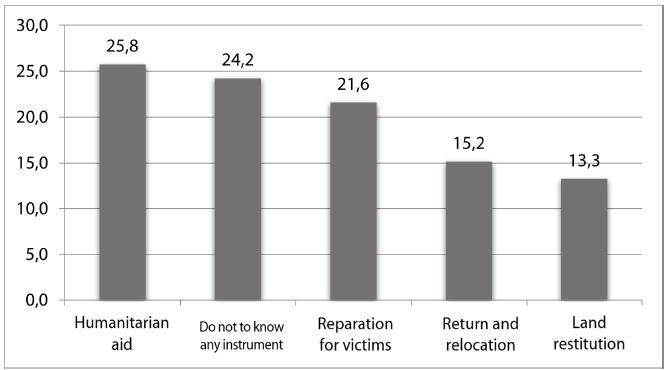
Graphic 1:
Do you identify one of the following state tools for the post-conflict period?
Source: Compiled by the author.Note: N=80; Trust Level 90% / Sample Error +/- 6.
With regard to the question on the knowledge of the state tools for the post-conflict period, 25.8% of the 528 families expressed their knowledge on the tool of humanitarian aid, 24.2% evidenced that they do not to know any instrument, 21.6% identify the instrument of reparation for victims, 15.2% expressed to have knowledge on return and relocation, and the remained 13.3% know about land restitution.
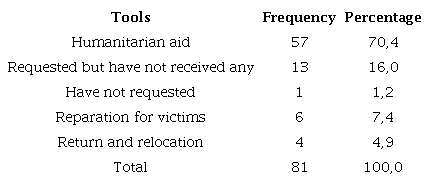
Have you received benefit from any of the following post-conflict state tools?
Source: Compiled by the author. Note: N=80; Trust Level 90% / Sample Error +/- 6.
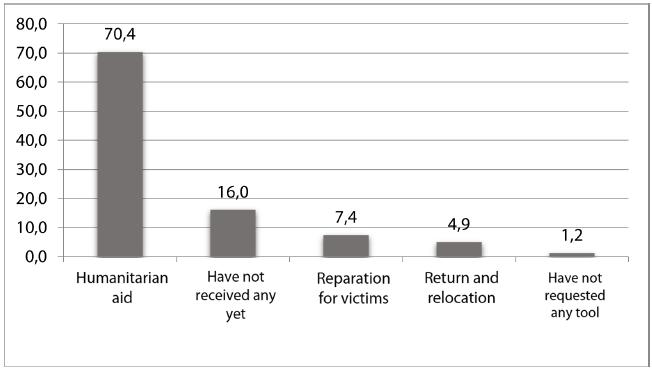
Graphic 2:
Have you been a beneficiary of any of the following post-conflict state tools?
Source: Compiled by the author.Note: N=80; Trust Level 90% / Sample Error +/- 6.
70.4% of the surveyed families stated that they have received benefits from the humanitarian aid tools, 16% expressed that they requested some of the post-conflict tools, but they have not received any yet. 7.4% have been beneficiaries of reparation for victims, 4.9%, of the return and relocation tool, and the remained 1.2% expressed they have not requested any tool.
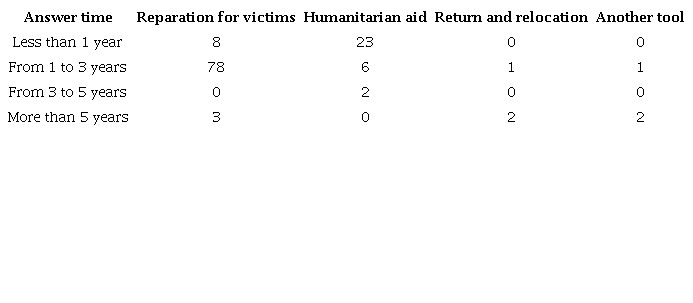
If you requested the tool of reparation for victims and have not received a response, please indicate how long ago (in months)
Source: Compiled by the author. Note: Question with multiple answers, the frequency total exceeds the N=70.
Regarding requests of post-conflict tools without answers, the longer time is presented from one to three years with a cumulative total of 78 applications of reparation for victims. It is underlined delays of more than five years for two requests of reparation for victims, two for return and relocation, and two for other tools.
The truth and the historical memory
Truth commissions often provide an environment in which the victim and the perpetrator can tell their stories protected by an official channel that recognizes the existence of past abuses. The commissions are a public platform for victims, where they receive symbolic compensation for their suffering, and they promote the reconciliation and sometimes contribute to system reform (GRODCKY, 2009, p. 827).
The Unit for Attention and Reparation of Victims made presented a diagnosis of psychosocial trauma in Nueva Venecia from October 23, 2013, made by Maria Auxiliadora Sarmiento Escobar, that shows the effects caused by the massacre in the community and the devastation that, even today, the population is suffering. One of the transcribed questions in the mentioned report asks “remember (...) the fact that impacted the community?”. The community response was the following:
Yes, the events that took place on Nov 22nd, when killed so many innocent people, looking for I do not know who. (...) I remember that day as if it was yesterday, every time that my mind thinks on what happened that day; I feel something in my chest. It still hurts and makes me cry when I remember what they made us.
The report continues:
remember the situations on which the people felt humiliation even when you have not been affected; remember some situations that had been extremely humiliating to the community? Yes, when those people arrived to Nueva Venecia, we were all sleeping and we had to get out of there, we were all in underwear, women in brassieres, in order that they do not kill us. Many people came out from the latrines that we have in our homes; it was awful. People tell that those who seek for shelter in the woods arrived there in underwear and with their knees and feet bleeding because they did not have time to put on their shoes. The ones that were there were all in their underwear.
In addition, the report mentions “which are the places related to fear?”. The answer to this question reflects that the wounds from this massacre are gigantic. So, it is stated that
yes, there are places, the house of deceased Parejo, the Church, the Clarin channel, and nobody walks close to the house of deceased Parejo after six, people say that a white shadow it is seen there. Yes the Chapel, when the night arrives, I do not like to be around there, it scares me. When I go to the Clarin river, I get goosebumps.
In the same story of inhabitants, it is noted that the population is still living in fear, that they are still frightened of a new massacre, and that the community has divisions inside itself. In the fieldwork is not possible to find any alliances between the cohabitants, and it seems, there is evident erosion in the social structures.
Conclusion
The transitional justice has been described as a “balance between the rights of victims and the incentives to end the armed conflict.” It is a form of juridical transition that occurs in certain moments of social alteration after an armed conflict and that sacrifice some values in order to achieve the peace, understanding that this becomes a higher relevant value given that human lives are involved, which is translated as a “Victory for Humanity” (MINOW, 2008, pp. 1287-1309).
In the words of Martha Minow, transitional justice seeks responses to the collective violence that open a path between vengeance and forgiveness (Idem, 2011, p. 87). It is clear that all transitional processes try to balance the “moral imperatives” (MEISTER, 2011, p. 162) and to reconcile the legal justice demands with equity and the stabilization of social peace promoting the relationship between justice for past crimes and a new political order (PAIGE, 2009, p. 323).
Nevertheless, the absence of collective response to the dehumanization that precedes and carries the violence leaves it unpunished and intact. In absence of collective responses, “the individuals remain, as some people describe it, with too much or too little memory” (MINOW, 2011, p. 80). Hence, the assessment of the political role of transitional justice institutions often omits the analysis of the tension between the efforts to expose, remember and understand political violence; and their role as a tool for ensuring stability and legitimacy of transition commitments (BRONWYN, 2008, p. 97). The transitional justice institutions also aspire to challenge and transform the inherited values and the long-term political relations, and not just designed to promote the punishment, also seek to reach to an imperative political reform (Ibid., p. 101).
Complaints concerning to the role of transitional justice in the healing of people, communities, and nations, continue to serve as “artefacts of faith.” The restorative justice has ideal combinations related to therapeutic healing and the traditional use of informal justice as a tool for conflict mediation (Ibid., p. 114). Nevertheless, the failed transition process rapidly erodes the legitimation of the institutions in post-conflict and revives, in a very short time, the political violence.
Perhaps, in the Colombian context, justice institutions can function primarily as tool for the legitimizing at the state power; but exceptionally, it can also be transformed into open routes for expanding the accountability, dialogue, and reform policy in the long term (Ibid., p. 118). However, the transitional justice here described does not seem to be the starting point or an important milestone. Those seem to be temporal tools for relief, the needs of community victims, instead of discovering and re-describing social realities.
Certainly, the distance between the legal tools deployed in Colombia and post-conflict social transition is remarkable. Peacebuilding is a multifaceted tasking, and covers a wide range of programs of political, development, humanitarian, and social rights, aimed to prevent the spread, the recurrence, or the continuation of armed conflict. The “consolidation of a sustainable peace” requires the “negative peace,” as the absence of physical violence, and the creation of a “positive peace” that can be guaranteed with social justice, socioeconomic, and political justice and the rule according to a higher law (LAMBORUNE, 2009, p. 7)28.
References
AGUILERA, María. Habitantes del agua: El complejo lagunar de la Ciénaga Grande de Santa Marta. Cartagena: Banco de la República, 2011.
BRONWYN, Anne Leebaw. “The Irreconcilable Goals of Transitional Justice”. Human Rights Quarterly, vol. 30, n. 1, pp. 95-118, 2008.
CARREÑO, Gladys. Presentación del informe final del Proyecto de Semilleros: Construcciones de identidad en Nueva Venecia: Pueblo Palafítico de la Ciénaga Grande de Santa Marta, Narrativa Audiovisual y Cultura Popular en el Caribe Colombiano. Oraloteca, Universidad del Magdalena, Santa Marta, 2012.
COMISIONES PRIMERAS DE SENADO Y CÁMARA. Informe del Gobierno Nacional a las Comisiones Primeras del Congreso de la República: Avances en la Ejecución de la Ley 1448 de 2011. 2012. Available at: https://www.unidadvictimas.gov.co/sites/default/files/documentos_biblioteca/Informe%20Gobierno%20Nacional%20Comisiones%20Primeras.pdf
COMISIONES PRIMERAS DE SENADO Y CÁMARA. “Informe del Gobierno Nacional a las Comisiones Primeras del Congreso de la República (2012): Avances en la Ejecución de la Ley 1448 de 2011”. 2012. Available at: https://www.comisionprimerasenado.com/comisiones-elegidas/cuatrienio-2014-2018-2/1084-comision-de-seguimiento-a-la-ley-de-victimas-ley-1448-de-2011-2/file
COMISIONES PRIMERAS DE SENADO Y CÁMARA. Primer Informe de Seguimiento a la Ley 1448 de 2011 de Víctimas y Restitución de Tierras 2012). Controladoría General de la República, Procuradoría General de la Nación, Defensoría del Pueblo, Aug. 21, 2012. Available at: http://www.viva.org.co/attachments/article/195/INFORME_MONITOREO_Y_SEGUIMIENTO_LEY_1448_2011.pdf
COMISIONES PRIMERAS DE SENADO Y CÁMARA. Segundo Informe de Seguimiento y Monitoreo a la Implementación de la Ley de Víctimas y Restitución de Tierras 2012-2013. 2013. Available at: https://www.camara.gov.co/segundo-informe-de-la-comision-de-seguimiento-y-monitoreo-a-la-ley-de-victimas-y-restitucion-de
DANE. Censo General: Pueblo Viejo - Magdalena. Bogotá, D.C.: Departamento Administrativo Nacional de Estadística (Dane), 2005.
DANE. Censo General: Sitio Nuevo - Magdalena. Bogotá, D.C.: Departamento Administrativo Nacional de Estadística (Dane), 2005.
GRANDA, Alberto. “Asamblea Nacional Constituyente de 1991”. Pensamiento Humanista, vol. 2, pp. 83-95, 1994.
GÓMEZ, Felipe. “Desmovilización paramilitar en Colombia: Entre la paz y la justicia”. Documentos de Trabajo Fundación para las relaciones internacionales y el diálogo exterior, n. 57, 2008.
GRODCKY, Brian. “Re-Ordering Justice: Towards a New Methodological Approach to Studying Transitional Justice”. Journal of Peace Research, vol. 46, n. 6, pp. 819-837, 2009.
GRUPO DE MEMORIA HISTÓRICA. Basta ya! Colombia: Memorias de guerra y dignidad. Informe General. Bogotá: Imprenta Nacional, 2013.
LAMBORUNE, Wendy. “Transitional Justice and Peacebuilding After Mass Violence”. The International Journal of Transitional Justice, vol. 21, n. 1, pp. 28-48, 2009.
LEMAITRE, Julieta. La paz en cuestión: La guerra y la paz en la Asamblea Constituyente de 1991. Bogotá: Uniandes, 2011.
LOCHER, Martina; STEINMANN, Bernd; RAJ UPRETI, Bishnu. “Land Grabbing, Investment Principles and Plural Legal Orders of Land Use”. Journal of Legal Pluralism and Unofficial Law, vol. 65, n. 1, pp. 31-63, 2012.
MEISTER, Robert. After Evil, a Politics of Human Rights. New York: Columbia University Press, 2011.
MINOW, Martha. “Memoria y odio: ¿Se pueden encontrar lecciones por el mundo?”. In: MORALES, Carlos; SAFFON, María (orgs). Justicia transicional. Bogotá: Siglo del Hombre/Uniandes/Pontificia Universidad Javeriana, 2011, pp. 79-105.
MINISTERIO DE AMBIENTE COLOMBIA. Decreto no 224 de 1998: Por el cual se designa un humedal para ser incluido en la lista de humedales de importancia internacional, en cumplimiento de lo dispuesto en la Ley 357 de 1997. Santafé de Bogotá, D.C., Feb. 2, 1998.
ODDR. Estructuras de Autodefensas y Proceso de Paz en Colombia. Bogotá: Universidad Nacional de Colombia/Observatorio de Procesos de Desarme, Desmovilización y Reintegración (ODDR), 2012.
ORRANTIA, Juan. “En la corriente viajan…”. Revista Colombiana de Antropología, vol. 46, n. 1, pp. 187-206, 2010.
PAIGE, Arthur. “How ‘Transitions’ Reshaped Human Rights: A Conceptual History of Transitional Justice”. Human Rights Quarterly, vol. 31, n. 1, pp. 321-367, 2009.
SARMIENTO, Juan Pablo. “Territorio sin Estado: El caso de los pueblos palafíticos en la Ciénaga Grande de Santa Marta”. Revista de Derecho, vol. 43, n. 1, pp. 110-157, 2015.
SARMIENTO, Juan Pablo. “Justicia transicional sin transición El caso de la masacre de Nueva Venecia, Revista Co-herencia, vol. 13, n. 24, pp. 181-211, 2016.
SARMIENTO, Juan Pablo. Los pueblos palafíticos en la Ciénaga Grande de Santa Marta: Estudios sobre eficacia instrumental del Estado y pluralismo jurídico de facto. Barranquilla: Uninorte, 2017.
SITARAMAN, Ganesh. The Counterinsurgent’s Constitution: Law in the Age of Small Wars. Cambridge: Oxford University Press, 2013.
SNARIV. Informe del Sistema Nacional de Atención y Reparación Integral a las Víctimas a las Comisiones Primeras de Senado y Cámara. Bogotá, D.C.: Sistema Nacional de Atención y Reparación Integral a las Víctimas (SNARIV), 2013. Available at: http://www.mininterior.gov.co/sites/default/files/noticias/informe_al_congreso_final.pdf
TREIBER, Hubert. “The Dependence of the Concept of Law upon Cognitive Interest”. Journal of Legal Pluralism and Unofficial Law, vol. 66, n. 1, pp. 1-47, 2012.
UNIDAD ADMINISTRATIVA Y ESPECIAL DE PARQUES NACIONALES NATURALES. Plan de Manejo de Santuario de Fauna y Flora de la Ciénaga Grande de Santa Marta. Unidad Administrativa y Especial de Parques Nacionales Naturales, 2014. Available at: http://www.parquesnacionales.gov.co/portal/wp-content/uploads/2013/12/Cienaga.pdf
UARIV. Índice de Riesgo de Victimización, 3 Septiembre 2014. Unidad para la Atención y Reparación Integral a las Víctimas, 2014. Available at: https://www.unidadvictimas.gov.co/sites/default/files/documentosbiblioteca/irv20102014.pdf
VELÁSQUEZ, Edgar. “Historia del paramilitarismo en Colombia”. História, vol. 26, n. 1, pp. 134-153, 2007.
VILARDY, Sandra; RENAN-RODRIGUEZ, William. “La influencia del conflicto armado en las dinámicas socio-ecológicas de la ecorregión Ciénaga Grande de Santa Marta”. In: VILARDY, Sandra (org). Repensando la Ciénaga: Nuevas miradas y estrategias para la sostenibilidad de la Ciénaga Grande de Santa Marta. Santa Marta: Universidad del Magdalena/UAM, 2011, pp. 74 - 105.
VILARDY, Sandra; GONZÁLEZ José. Repensando la Ciénaga: Nuevas miradas y estrategias para la sostenibilidad de la Ciénaga Grande de Santa Marta. Santa Marta: Universidad del Magdalena/UAM, 2011.
YASHAR Deborah. Contesting Citizenship in Latin America. London: Cambridge University Press, 2005.
Notes
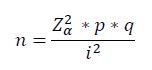
Where n is the maximum size of the resulting sample, the statistical reference level Z for 90% confidence (λ = 0.1), equal proportions of dichotomous responses p and q and i error 0.06. The application of this equation indicates the result of a sample size of 80 experimental units. Based on this sample size a total of 84 surveys, of which four were annulled, for a total of 80 valid questionnaires were applied. All of these surveys were applied in person with visits to each stilt house.
Author notes
