Article
The Force of Grace, the Grace of Force: Joking Critique of Figures of ‘Urban Violence’ on the Covers of a Tabloid Newspaper as the ‘Violentization’ of Public Discourse1
 Alexandre Werneck av.werneck@ifcs.ufrj.br
The Force of Grace, the Grace of Force: Joking Critique of Figures of ‘Urban Violence’ on the Covers of a Tabloid Newspaper as the ‘Violentization’ of Public Discourse1
Dilemas: Revista de Estudos de Conflito e Controle Social, vol. 15, no. 3, pp. 735-773, 2022
Universidade Federal do Rio de Janeiro
Received: 20 September 2021
Accepted: 25 February 2022
Abstract: This article sets out to analyse how a set of social representations of urban violence in Rio de Janeiro is revealed in public humorous critique. The research is based on a study of around 2,400 covers of the tabloid Meia Hora, famous for its comic presentation of the news, which were published between 2011 and 2017, a period corresponding to a routinization established by Rio’s Pacifying Police Units (UPPs). The analysis reveals how the ridicule deployed in humorous critique expresses the social representations of three main figures in the context of Rio de Janeiro’s urban violence: the criminal, the police officer and Rio de Janeiro itself as a social order.
Keywords: comic, humorous critique, urban violence, ‘Meia Hora’, newspaper, tabloids.
Resumo: O objetivo de A força da graça, a graça da força: A crítica jocosa aos personagens da ‘violência urbana’ nas capas de um jornal popular como ‘violentização’ da fala pública é analisar como um conjunto de representações sobre a violência urbana no Rio de Janeiro se desdobra em críticas jocosas públicas. Isso é feito por meio de um estudo de cerca de 2400 capas do jornal popular Meia Hora, notório por sua apresentação jocosa das notícias, no período entre 2011 e 2017, correspondente a uma rotinização estabelecida por conta das Unidades de Polícia Pacificadora (UPPs). A análise mostrou como a ridicularização operada na crítica jocosa expressa representações sobre três figuras centrais no cenário da violência urbana fluminense: o bandido, o policial e o próprio Rio de Janeiro como ordem social.
Palavras-chave: graça, crítica jocosa, violência urbana, Meia Hora, jornal popular.
The aim of this article is to analyse the way in which a set of representations of urban violence in Rio de Janeiro is revealed in the form of joking mechanisms deployed in public discourses-and to demonstrate some of the consequences of this movement in terms of what colleagues and I have called violentization (WERNECK, TEIXEIRA and TALONE, 2020), that is, the definition of situations (THOMAS, 1966[1923]) involving the mobilization of notable differences of force as situations of violence. This analysis is based on a study of the covers of the tabloid newspaper Meia Hora-notorious for the comic presentation of news on its front pages-between 2011 and 2017. During this period, the current configurations of what has been called the social accumulation of violence (MISSE, 1999) and the language of urban violence (MACHADO DA SILVA et al., 2011) underwent a routinization due to the activities of Rio’s Pacifying Police Units (UPPs),2 thereby clearing the way for this specific form of the phenomenon,3 a scenario that, as various works have shown, fell into terminal decline in the final year of this series.4 The idea here is to analyse how the ridicularization (BILLIG, 2005; ROMANIENKO, 2008; WERNECK, 2019) deployed in humorous critique contributes to the definition of three figures central to the representation of ‘urban violence’ (MACHADO DA SILVA, 1993; PORTO, 1999; MISSE, 1999): the bandido (bandit/criminal), the policial (police officer) and Rio de Janeiro itself as a social order. In the research, which involved a semiotic analysis (HODGE, 2017) of around 2,400 front pages of the newspaper, treated here as a sounding board of the representations of urban violence circulating in this environment, it was possible to observe how a critical discourse is constructed through the intervention (WERNECK, 2022a) of joking devices, a voice capable of expressing a series of characteristics of the moral configuration of this debate by reducing to the ridiculous (and thus the absurd) the worth5 (BOLTANSKI and THÉVENOT, 2020[1991]) of these characters, treated here as actants (GREIMAS, 1966; LATOUR, 1984; BOLTANSKI, 1990; WERNECK, 2015b)6 of violentization-that is, as entities with a determinant role in defining the situation, in this case, as violent.
In various works I have shown the role played by joking discourse in the construction and recognition of critiques (WERNECK, 2016a), both privately or in face-to-face interactions (WERNECK, 2015a) and publicly (WERNECK and LORETTI, 2018). In Werneck (2019), I demonstrated how the deployment of a humorous register as a platform for critique helps construct a singular observer capable of effectuating (WERNECK, 2012a, 2022b) the critique through a reduction to the ridiculous without the need to comply with the rationalist protocol of providing proof (BOLTANSKI and THÉVENOT, 2020[1991]), thereby ratifying the idea of a transitory truth (NIELSEN, 01/04/2019) to be accepted without objectivist evaluations. This demonstrates the role performed by the deployment of grace-that is, a competence founded on inspiration (BOLTANSKI and THÉVENOT, 2020[1991]), creativity and singularity, the main element of effectuation of a joking action (fundamentally, a demonstration of witness). Here, this operation is seen at the level of the maintenance of a representation of routine life in Rio de Janeiro (i.e., under a large-scale urban social order) represented as violentized. In an earlier work (WERNECK, 2015b), I demonstrated how this current state of the social accumulation of violence and the current grammar of the language of urban violence can be described as an actantial system (LATOUR, 1997[1987]; BOLTANSKI, 1990), a configuration of elements capable of effectuating a social phenomenon through the intervention of certain actants.7 In an actantial system, a configuration of typical key actants mobilize the phenomenon through the actions of each of them in their most effective state of worth (BOLTANSKI, 1990; WERNECK, 2012a).
In this earlier text, I also suggested a discrete set of actants to define the actantial system of urban violence in Rio de Janeiro, as represented by residents in their everyday conversations about the city. In another work, my colleagues and I (WERNECK, TEIXEIRA, TALONE and CAMINHAS, 2021) expanded this picture into a much broader gallery: the tyrant (tirano), epitomized by the favela drug trafficker; the extorter (achacador), symbolized by the corrupt police officer; the soldier (soldado), represented by the combative version of the police officer (an idea that, from the viewpoint of the actors, covers a huge spectrum of formalized figures from military police and municipal guards to prison officers, even including private security staff-in other words, anyone who, in legal possession of firearms, is recognised to have the power to give orders/coerce);8 the grabber (apoderador) or simply thief (ladrão);9 the threatener (ameaçador), the paradigmatic example of whom is the killer; the platypus (ornitorrinco), a composite of tyrant, extorter and threatener consubstantiated by the militia member (miliciano); the urchin (pivete), a representation of ‘idle’ children, ‘let loose in the street,’ associated with violent actions; the crackhead (crackudo), an image of the homeless person, whether or not a user of drugs, but represented as violent; and the city, the environment where conflictual social relations unfold and capable of transforming into a dystopia (TALONE, 2015, 2018) in the eyes of the actors.
The research on the front pages of Meia Hora, however, revealed the assemblage of a more simplified version of this array of representative figures, such as they are typically polarized in Rio’s social order: police v. criminal (a category that includes various of the criminalizable actants cited above)10 in a city that is Rio de Janeiro as a social order. Hence, the analysis consisted of studying how these three figures are presented comically-in other words, how they are ridiculed on the tabloid’s covers, demonstrating a dynamic according to which, as I shall demonstrate here, the particular cases of each are reduced to the ridiculous each time that they fail to occupy the greatest state of worth as actants; that is, when they do not prove to be ideal representatives of the categories to which they pertain. In this way, the newspaper covers present images of each of them at various moments, as in these examples:11
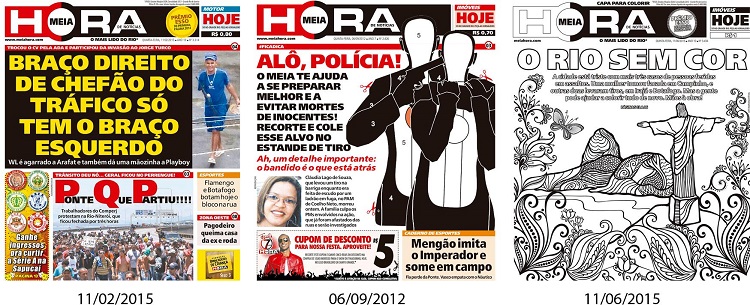
On the first cover-‘Right Arm of the Drug Trade Boss Only Has a Left Arm’-we see a criminal. But although his position of potency is shown (carrying a rifle and a walkie-talkie) along with his involvement in criminality (his connections to the drug trade are made explicit, naming him as the boss ‘right arm,’ the basis of the joke), he is displayed as bizarre (mocked for his disability) and ineffectual or ridiculous (not only as an amputee warrior, but also on account of his clothing, flipflops and the chaotic environment in which he moves about), thereby subverting the image of the cold and serious ‘big criminal.’
On the second cover we see the police being mocked (WERNECK, 2015b) by the newspaper, labelled incompetent and mirim, amateur, incapable of distinguishing criminals from ‘innocents’ (a fundamental distinction in this system of representations). The tabloid goes as far as to provide an illustration with the caption: ‘Hello Police! Meia Will Help You Improve your Training and Avoid Killing Innocents! Cut Out and Stick on your Target Stand. Oh, An Important Detail: The Criminal is the One Standing Behind’ (as in the saying ‘do you want me to draw you a picture?’ when someone fails to grasp a simple idea).
Finally, on the third cover-‘Colourless Rio’-the newspaper adopts as a comic element the editorial fashion of the time, colouring books for adults, normally presented as relaxing pastimes, simulating their aesthetic: it shows a Rio without colors, left lifeless, dazed by reports of more crime victims, telling its readers in the subheading that ‘[the] city is sad over another three cases of people injured in assaults. A woman was knifed in Campinho and another two injured by gunshots in Irajá and Botafogo. But we can help colour in everything again. Hands to work!’ An apparent message of optimism, but more likely ironic in tone since it basically insinuates that the only remedy available to Rio’s citizens is to colour in a page, given that changing the real world is impossible.
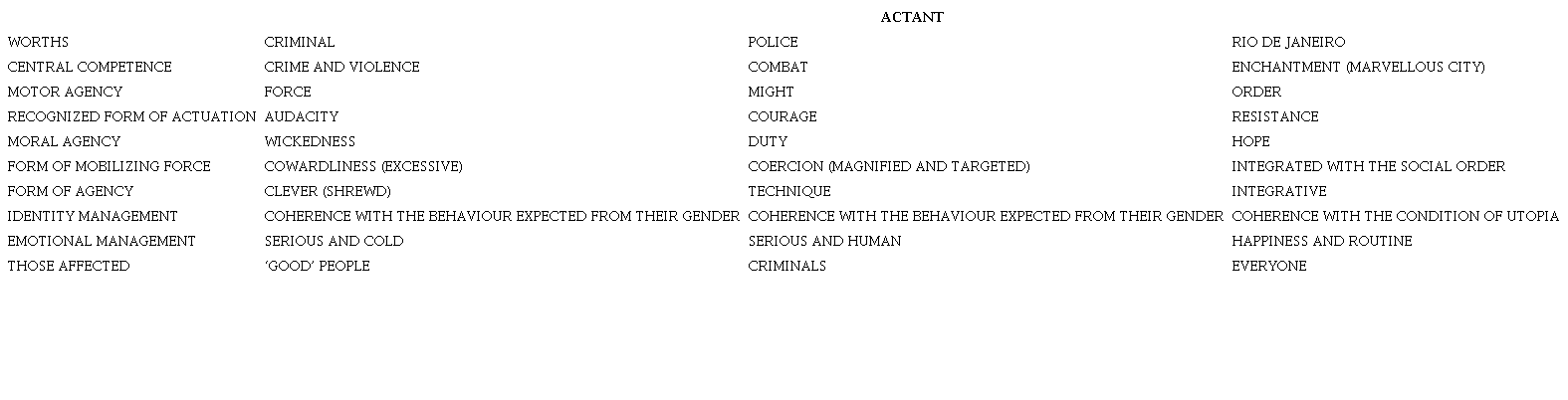
The examples synthesize a movement observed throughout the sample: the newspaper expresses through humour the debasement or ‘moral fall’ (WERNECK, 2015b) of each of these actants, reducing them to the ridiculous and thereby simultaneously expressing through inversion their representational characteristics commonly established in the Rio de Janeiro imaginary.12 In these cases, then, we find a questioning of the characteristics of these actants typically represented in the Rio social order in an environment of urban violence. Moreover, these characteristics can be apprehended precisely because of their negation through humour: it was the recurrence of the subversion evoked by ridicularization that enables to characterize the images of these figures more usually anticipated, their characteristic worths, in which they are expected to prove effective. From the criminal (bandido), for example, it was possible to infer the image of a figure defined by perpetrating crime and acting with violence, who moves around using force and behaves as a coward, who displays malandragem (shrewdness) in his (or her) audacious and defiant strategies and actions, who as a man shows himself virile and as a woman low key, and who acts against the worker (trabalhador), against good people (gente de bem).13 The police officer (policial), in turn, is idealized by the common representation as someone whose reason for being is combat, recognized for his military might; someone motivated by duty (dever) who mobilizes force in a strictly coercive, technical form, although he demonstrates courage in his actions; someone virile and serious, but human with the good people, whose only victims are criminals. As for Rio de Janeiro, in a setting of violence, the anticipated representation is that the city always resists as the Cidade Maravilhosa, the Marvellous City, despite the many demanding situations it faces.14 The negative of this image is the assertion of an unprecedented and unbearable chaos-reflecting not only a social accumulation of violence but also a social accumulation of disorder (LORETTI, 2016, p. 58).
Based on the perception of this movement that implicates the three main actants in the sample, I was able to define a matrix of formal elements (WERNECK and LORETTI, 2018) characterizing these actants of urban violence. Setting out from central competences, observed in negative (WATSON, 2015) throughout the universe of tabloid covers and definitive of how each one would ideally be, it was possible to perceive the distinctions made between each and highlight other determinant characteristics.
The analysed sample comprised 2,403 covers, all the newspaper editions during the period.15 In addition, an interview was conducted with the executive editor of the newspaper at the time.16 In Meia Hora, the front pages are usually divided into four lead stories, hierarchically arranged (a distinction expressed in headline sizes, occupation of space, use of images and other resources). The research counted, classified and analysed the occurrences of different categories of topics to appear on the covers in each of these lead stories (taking into account this difference in weightings), observing when the topic was linked to violence in general and to the representation of ‘urban violence’ in particular (a distinction explained later), with an emphasis on the allusion to the three key actants, including when these allusions were made through humorous means. Analysed next was the formal matrix (WERNECK and LORETTI, 2018) involved in the construction of these comic allusions in terms of humorous devices in the various elements of the lead stories (headlines, subheadings, photos, illustrations, captions and so on). Finally, the analysis observed the forms of critique specifically directed at each of the actants in these comic discourses. The results, presented below, ultimately show how criminals, public security agents and the city itself17 are idealized-and deconstructed through ridicularization. Here I present a synthesis of the matrix with the main formal elements observed, notably the competence being ridicularized (and thus simultaneously negated in the particular case, newsworthy by its exceptionality, and made explicit through the routine):
As stated earlier, the research observed the front pages of Meia Hora between 1 January 2011 and 29 July 2017, an edition I adopted as the end point to the research due to its symbolic character, as explained earlier in a footnote. This is the cover from the day in question:
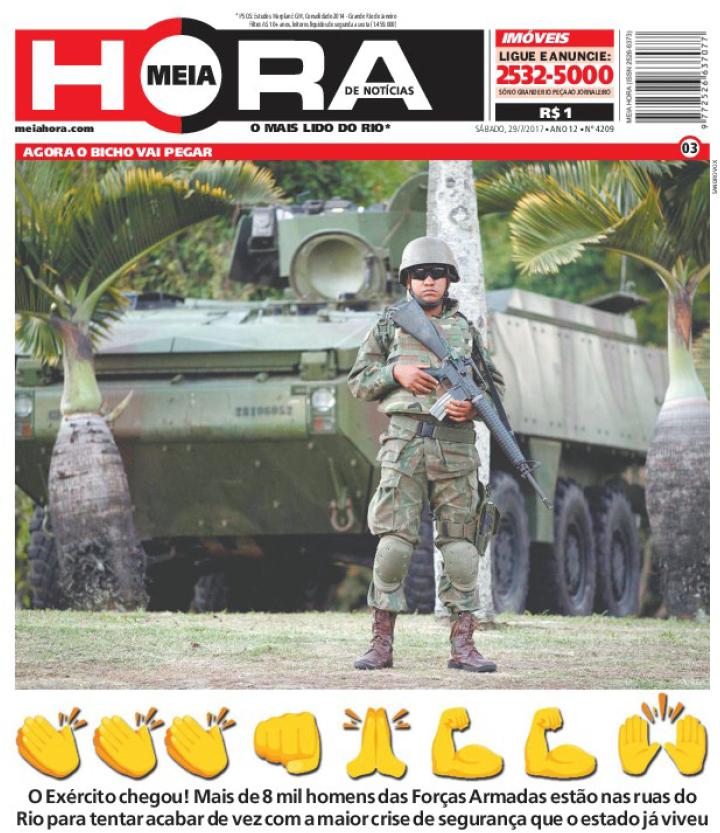
The captionless image taking up practically the entire page suggests that words are unnecessary to announce the news: the armed forces have arrived in Rio de Janeiro (‘The Army Arrived!’ the subheading below the photo exclaims, somewhat redundantly). At that moment, the dispatch of the national army was presented as a desperate measure against, as the same subheading puts it, ‘the biggest security crisis the state has ever experienced,’ something perceived, as seen in the analyses, as an outcome of the crisis in the UPPs (BARRETTO, 28/07/2017; BIANCHI, 29/07/2017).18 The humour (which I shall discuss in more detail in the next item) of this cover derives from the use of emojis, icons typically used in internet communication to represent gestures and emotional states, as if the front page were a social media post: applause; a clenched fist, two hands meeting (an image itself a kind of visual pun since many people point out its ambiguity as either a prayer or a high-five greeting); two arms displaying muscles, thus showing force; and finally two raised hands indicating movement and/or commemoration: ‘Hallelujah!’ ‘Thank God!’-signs both of celebration and of ‘it was about time!’ In the process, the tabloid simultaneously expresses the idea that Rio de Janeiro is immersed in chaos and that its analysis based on a ‘war’ (LEITE, 2000, 2012; GRILLO, 2019) of police versus criminals is set to change: a bigger force has turned up. Up until then, the routine of the state had been otherwise. The research showed that this period, which today tends to be called ‘the UPP era,’ corresponded to a routine, precisely what I am interested in analysing here.
The idea of routine and its tense relationship to urban violence is fundamental in this context. Machado da Silva (2004, p. 54) makes explicit its importance when he stresses the need for studies of urban violence to take seriously its “impact on the structuring of everyday routines.”19 At the same time, Misse (1999), discussing the social accumulation of violence, points to a contradiction in the behaviour of what the author calls a ‘phantasm’ (the representation of an omnipresent violence): the fact that it constructs a perennial state of exception, a quotidian feeling of relational chaos. More recently, Talone (2015, 2018) analysed this routinization as a ‘realized dystopia’-building from Boltanski’s (1990) idea of a ‘realized utopia.’ Continuing Machado da Silva’s line of interpretation but guided by Dewey’s ideas of indeterminacy and inquiry (DEWEY, 1938), Menezes (2014) analysed how the entrance of the UPPs into the life of the favelas inaugurated an investigative process among the residents, seeking to define what was happening. In particular, the author explored how the attempt to assuage indeterminacy through rumours (MENEZES, 2014, 2015) represented a strong key to everyday life in these localities at that moment. My argument is that although this indeterminacy began in 2008 with the genesis of the UPP program, from 2011 the public discourse of the city, here epitomized by the representations published in Meia Hora, underwent a routinization, the fixation of a series of signs and their meanings as quotidian, which enabled consolidation of the elements of a grammar of urban violence20 in the aforementioned actantial system and its simplification as a set of actants, enabling a critical dialogue on urban violence to be made through ridicularization (WERNECK, 2019).
This analysis simultaneously converges with two of my principal areas of inquiry: a comprehensive and pragmatic sociology of critique (BOLTANSKI, 2009; WERNECK, 2012a, 2015a, 2016a, 2016b; WERNECK and LORETTI, 2018) and an analysis of the question of violence in Rio de Janeiro as a sociology of morality (WERNECK, 2012b; 2015b, 2018; WERNECK and TALONE, 2019; WERNECK, TEIXEIRA and TALONE, 2020; WERNECK, TEIXEIRA, TALONE and CAMINHAS, 2021). The meeting of these perspectives enabled an advance in the comprehension of critique as a moral phenomenon and of violence as an interpretant (PEIRCE, 1977[1897]; WERNECK and TALONE, 2019; WERNECK, TEIXEIRA and TALONE, 2020; WERNECK, TEIXEIRA, TALONE and CAMINHAS, 2021).
The comedy of crime, the police and Rio de Janeiro
As I have shown in other works cited before, humour can be an important device for presenting critiques. Here I include myself among scholars who have focused attention on the use of jokes as a critical tool, especially in politics (CHOCK, 2001; COLEBROOK, 2004; BOS and T’HART, 2008; BECKMAN, 2014; YACINTAS, 2015; BERGER, 2017[1997]; TRNKA and REHAK, 2018; MINA, 2019), but also in other spheres (HERZFELD, 2001; GILBERT, 2004; SMITH, 2018). In my more recent analyses in this area (WERNECK, 2019, 2021), I have highlighted the need to take humour seriously as form of grace competence (the competence of inspirtion), a means of effectuation, as Boltanski and Thévenot (2020[1991]) formulate the idea in their model of economies of worth: more than aim to provoke laughter, comic devices seek to be witty, make fun or, in Portuguese, fazer graça, literally ‘make grace’ (which means to prove inspiration); in other words, they seek to account for a given situation through a competence inherent to inspiration as a worth. This inspired humour (WERNECK, 2019, p. 619) or wit is
perceived by social actors to indicate that something singular has been introduced into the world and derives from a creative breath, originating from a higher - and to some extent transcendent - source. This inspiration (whether divine or some other origin) marks the production of mystic speech in religious contexts but equally also underpins the singularity of the great creator/creation in the arts and the sciences.
Continuing this line of argument, I suggested (WERNECK, 2019, pp. 620-621) that being witty or making fun (or grace/graça)
makes explicit the singularity of a mechanism and demonstrates one’s inspiration or spiritedness. It is no accident that someone who makes fun/grace/graça is described [in Portuguese] as engraçado, full of grace/graça (that is, filled with the gift of this superior entity called inspiration). The configuration of the humorous game, therefore, in this scenario - and in the actual scene of its own art - suggests a dislocation of the effectiveness of the comic through a rationalist inversion: the perception of humour as an emotional event (in which the primordial aim is to make someone laugh, to produce an involuntary response) shifts to the recognition of grace as an intellectual phenomenon, a witticism: it is not so much a question of judging what is ‘funny’ (engraçado) as something that provokes laughter (Bergson, (2001[1900]) but of judging that something ‘has wit/grace/graça’ in the sense of that which makes explicit a great idea, something that provokes (...) the validation indicative of an ‘insight.’ Thus [the observed occurrences of jokes] work with a huge spectrum of joking strategies, meaning that a ‘humoristic’ analytic perspective proves insufficient to explain (...) creative constructions: (...) a huge plethora [of these occurrences of jokes] seemed to be immersed in an inspired grammar, grounded in ‘grace’, basically demanding, in their analysis of competence, a demonstration of ‘cleverness’ or ‘wit’ in the message, an affirmation of creativity along highly technical lines, configuring a compromise between an inspired logic and an industrial logic [Boltanski and Thévenot, 2020[1991]] - seeking a less informative and more symbolic message (Peirce, 1977[1897]), or in other words, one open to interpretation. Consequently, it was necessary to broaden the scope [of the sample] to a level that included all [the discourses] whose message was not explicit and objective (Werneck and Loretti, 2018) and seek some creative presentation (that is, a symbolic presentation, open in semiotic terms) of their critique, given that all of them could represent grace.
As I also demonstrated in the same text, the advantage of this analytic operation was that it allowed inference of a mechanics of avoiding the central protocol of critique based on the regime of justice, the imperative to test (épreuve) (BOLTANSKI and THÉVENOT, 2020[1991]), whereby any critique needs to pass through a reflexive pondering of their justifications vis-à-vis worths (valorative principles) and proofs (concrete evidence capable of demonstrating the adjustment of the situation to these principles). This makes
the logical protocol pivots the situation: from a critical moment [BOLTANSKI and THÉVENOT (1999)] that would induce the process of providing proof (of rational evaluation based on proofs of consistent tangibility) to a moment of critique in which, through humour, nothing is evaluated rationally; on the contrary, the invitation to ridicule leads one to endorse the public denunciation (WERNECK, 2019, p. 623).
In this way, the analysis of Meia Hora’s covers showed how headlines, photos and graphic elements contributed to the construction of critiques of the actants concerned: whether the criminal who fails as a criminal-a situation designated by the expression perdeu, ‘lost’-or the police officer who fails as a police officer, that is, by acting in an incompetent or disastrous form, when he manezou, as the expression goes (that is, he acted as a mané, a ‘dickhead,’ simultaneously an assertion of his technical incompetence and his incapacity to show a certain malandragem, the smartness required of any Carioca, or resident of Rio, without possessing the malicious shrewdness of the criminal); and of Rio de Janeiro by failing as a paradise and permitting nihilism to reign. All are objects of a ridicularized presentation, which allows them to be attacked along similar lines to those observed in political critiques (WERNECK, 2019, 2021): reduced to the ridiculous, their potency is diminished, making them opponents easy to accuse.
The newspaper as a sounding board and Meia Hora as graces’ agentic device
Ever since its launch in 2005, Meia Hora has become famous as a tabloid newspaper par excellence in Rio de Janeiro.21 Although no specific survey on the subject exists, save for the company’s own market research, it is very likely that the place occupied in the Rio imaginary by this publication, which became the state’s third highest selling newspaper with an average circulation of 115,000 copies per day, derives from its humorous form of presenting the news. Tabloid in format and sold at a low price-at the time of publishing this article, a copy cost R$ 1-it is described by the company itself as a jornal popular, a tabloid newspaper, possessing a target public in the C and D classes, and using simple language and short texts (characteristics typical of this sector).22 But the joking identity, especially in the front page lead stories, made it a singular publication, demonstrating a strong personality and making explicit the strong creative agency and identity of its editors: there is clearly a Meia Hora front page ‘style.’
Despite this fact, one of the premises adopted in this analysis involved bracketing the condition of actor (political, economic, etc.) of the newspaper itself and focusing solely on its dimension as a sounding board. Thus, while Meia Hora can be recognised as an author of the jokes (obviously as a metonym for its editors), it can primarily be conceived as an assemblage of a set of representations circulating in the city and its metropolitan region and registered by the publication. One of the reasons why this approach is possible is the fact that, even though it takes humour as its trademark, the newspaper does so in order to act out the basic operation of journalistic logic, precisely critique (LEMIEUX, 2000; WERNECK, 2004). The structure of the journalistic text follows a formal protocol: a story is justified on the basis of the idea of publicization, that is, the fact that it enunciates a fact of public interest (HABERMAS, 2014[1962]; LEMIEUX, 2000; NEVEU, 2001). This interest generally presumes either a civic grammar (BOLTANSKI and THÉVENOT, 2020[1991]), where this interest stems from the enunciated fact constituting a public problem (GUSFIELD, 1981; CEFAÏ, 2002) or representing a solution to such a problem; or an inspired grammar and/or a grammar of fame (BOLTANSKI and THÉVENOT, 2020[1991]), where the public character stems from a series of curiosities about personalities or things. But whether derived from a logic of the problem or from a curiosity, the journalistic text and, consequently, its preparation will be based on the same form: a) the presentation of the fact; b) the presentation of proofs of the fact (evidential data and/or witnesses) and, in so doing, the justification for its publicization; c) the observation that the fact has someone or something responsible and the identification of the latter; d) the interpellation of those responsible for the fact, implying a critique when a public problem is involved or a potentially critical questioning of its legitimacy as a solution or a curiosity; and e) the presentation of specialized discourses analysing the fact (that is, corroborating the public interest, responsibility and/or questioning). This matrix will be followed in most journalistic texts in their most basic genres, news stories and reporting (ERBOLATO, 1991), with more or less space and depth for each element, depending on the dynamic of the case. In other words, whatever its interests as an economic and/or political agent, a newspaper needs to balance them textually and formally with its technical product, critical interpellation, and this is the point that I wish to extrapolate here: the humorous stance of the journal as a political project or a voluntarist morality-on which various analyses exist, as cited earlier-matters less than how its function in legitimizing the public character of its presentations.
But while this journalistic imperative is centred on the formal dimension, it demands an adjustment to the content that it effectuates. Among contemporary societies, the frameworks of values used as a reference for the construction of the interpellations and critiques are not left solely to the whim of journalists, editors or even media executives-although all of them can pursue their own agendas and indeed commonly do so with greater or lesser effectiveness, depending on the case (IGGERS, 1999; HERMAN and CHOMSKY, 2002). As a profoundly modern device (HABERMAS, 2014[1962]; LEMIEUX, 2000; NEVEU, 2001), journalism follows, save in its explicitly and expressly militant versions, a more or less homogeneous moral agenda, one centred on both a contemporary set of technical consensuses about the key disciplines for certain specialized publishers-such as those of economics,23 health or arts/culture-and also on a more or less definitive set of principles for a minimal liberal hegemonic moral agenda (PRESSMAN, 2018, HERMAN and CHOMSKY, 2002) that is also more or less consensual: democracy, justice in an ample sense, individual freedoms, freedom of the press/expression, respect for human rights and the self-determination of peoples, respect for law and order, and so on. In this sense, it can be said that the normal journalistic construction needs to balance the formal critical imperative, the technical/moral consensuses of the time and the interests in play.
When it comes to so-called ‘popular’ or ‘tabloid’ newspapers, their specificity needs to be conceived, then, in terms of a pragmatics concerning their specific way of operationalizing this balancing, a way capable of characterizing it in the same terms by the actors themselves. In the social sciences, works on journalism in a broad sense and on tabloid journalism in particular are generally dedicated to a sociology critical of these media outlets as apparatuses of knowledge/power (for a synthesis, see NEVEU, 2001). The areas of communication and studies of language tend to invest more in discussions on their characterization and the mechanics of their fundamental operations-see, for example, Atallah and Nogueira (2012); Mota e Mota and Souza (2012); Freire and Valente (2014); Moura (2015), Valentim (2016), Costa and Menezes (2016), all on the specific case of Meia Hora, as well as the previously cited Amaral (2006) and Costa (2016). To undertake a sociology of critique in/of journalism (LEMIEUX, 2000) it is necessary to take seriously not only the critical operations made in the ‘media’ (an idea itself an idealization of a constructed unit) as insights into the news media’s interpellation/verification/effectuation, but also-and primordially-the critical operations made as a public discourse in/by the media outlets as constructions to be analysed themselves. Without ignoring the need for a critical examination of the discourses of the newspapers, it is also necessary to set aside this task for now in order-without redounding in an analytic naivety-to take seriously the specific mechanics of the critique produced on the interface between journalism and social life (of which journalism obviously forms part). Thus, the idea itself of a tabloid newspaper should be explored not only in terms of its project (commercial, epistemological, political) but also in terms of its praxeology: how it functions, how it produces meanings, what results from them in terms of social phenomenon. It is necessary to think, therefore, about what a ‘tabloid newspaper’ is a posteriori to the observation, specifically how it is understood by the social actors involved, and not just think about it a priori as a device designed to manipulate them. Along these lines, the exhaustive observation of the covers of this specific newspaper revealed the operationalization of a specific strategy of publicist legitimation (TARDE, 2005[1901]), grounded in a game of proximity that simultaneously seeks to equalize and horizontalize the dialogue between newspaper and reader, and also effectuate its public character through an intensive thematic agenda (less diverse than that of traditional newspapers, based on a strategy of technical authority and an agenda of ‘big politics’ and authorized knowledge) and a set of devices for approximation with the readership (such as, for example, colloquial language and obviously, in this case, humour). In this sense, Meia Hora found its niche in comic speech by converting the critical mechanics of the newspaper into a daily operation of gracejo, the insertion of wit or grace/graça into the voice enunciating the news, creating the singular observer (WERNECK, 2019, 2021) who ultimately is legitimized by and legitimizes a complicity with the reader.
Joking, then, is adapted to the mechanics of this search for public legitimacy specifically established by this publication. In an interview with me, the chief editor of Meia Hora at the time of the investigation, Humberto Tziolas, states that he only ever sought humour in response to an important news story: “I never made a headline just for the joke’s sake. Behind the joke is the information. I think that [if] we managed a [witty] take, it’s because the information is important.” Although this may be questionable in a few cases, the study did not reveal a significant number of headlines of flagrantly minor interest being turned into lead stories just because of the possibility of a humorous angle.
In the case of my sample, the fact that the publication, as a tabloid newspaper, prioritized news stories about urban violence, as we shall see in figures below, makes sense from the viewpoint of legitimization among its readership, many of them residents of peripheral areas and favelas, making them social issues whose publicization is easily justified. Moreover, the fact that this theme, which some might find ‘heavy,’ is turned into the butt of a joke does not seem to conflict with any evaluation of its legitimacy: it precisely makes explicit a routinization capable of integrating the topic into the daily life of the actors and the city, the use of humour figuring as an attraction strategy for any of the newspaper’s themes in a formal decision to use humour that itself makes sense in the collusion between a ‘tabloid’ newspaper and readers.
Humour makes the news: lead stories on ‘violence’ and humorous devices
As a typical tabloid newspaper, therefore, Meia Hora, as could be seen in the research, privileges lead stories on (in decreasing order of occurrences): ‘violence,’24 sports and celebrities. In addition, its front page also includes headlines on what could be called oddities (for example, the history of a woman married to a tree), tragedies, service provisions, festivities/gossip, and sex. Graph 1 below maps the presence of these themes in the main lead stories:
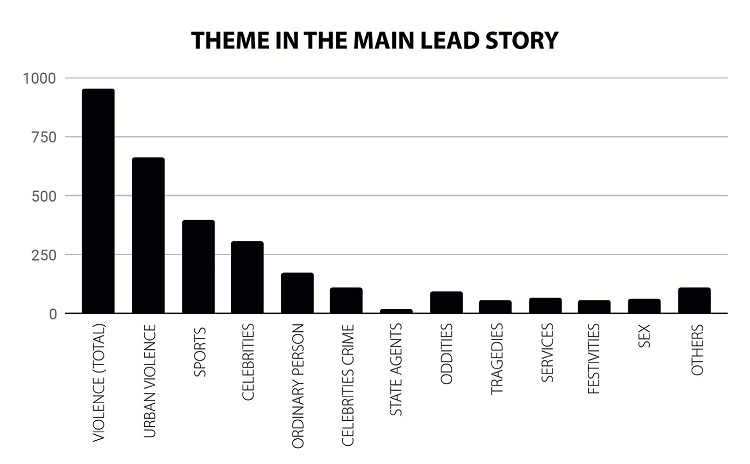
Graph 1
Source: Source: Author’s elaboration.
As can be seen, the stories on violence in general and on urban violence in particular dominate the news reports25 (representing 44.8% of the main lead stories and 39.7% of the total leads).26 I worked with a general category of news about ‘violence’ and divided the latter into four subcategories: urban violence, specifically with news stories involving criminals (bandidos), the police and Rio de Janeiro in a public security crisis; ordinary person crimes, relating to occurrences outside the idealization of a criminal career, such as rapes, crimes of passion, deaths from road rage incidents, larceny, and so on; celebrity crimes, in which famous people27 are involved (curiously common), treated separately from the prodigious output of celebrity news stories in this type of publication; and crimes by State agents, including cases of corruption and other deviant behaviours by public agents. In this coverage of urban violence, the recourse to humorous presentation is considerable: 38.2% of the total lead stories on the theme use humour and in the universe of main lead stories on violence, the proportion is overwhelming: 85.4%.
Nonetheless, there is an important inflexion in how humour is deployed: there are crimes about which jokes are not made: ‘cowardly’ occurrences, the murder of ‘innocents’ (such as children or elderly people), rapes, paedophilia and any other characterized as ‘very serious’ are not subject to mocking (deboche, the word preferred by the editors). At the same time, the idea of innocence that seems to inform this distinction makes explicit the resonance of a widely consecrated moral division: deaths of bandidos, whether at the hands of other criminals or the police, in general are not considered cowardly, even if the security forces have used disproportionate force or their actions have bordered on the unlawful-incidents unquestioned by the newspaper except when ‘innocents’ end up dead (as in the cover presented earlier). “Death is always lamentable. Very often [when the newspaper is criticized for a more or less ‘exaggerated’ lead story] there is some confusion when we mock the criminals. Very often there is a confused idea that perhaps we are celebrating a death,” says Tziolas in the interview, seeking to make a distinction between the ‘mocking’ of the death of a suspect and a supposed pro-execution stance. In response to the question “Does the newspaper lament some deaths more than others?” made by the interviewer in the aforementioned documentary on Meia Hora, the editorial director of the publication in the period 2007-2012, Alexandre Freeland, makes explicit the anti-crime stance typically adopted by any media outlet: “Certainly, certainly. It [the newspaper] does not celebrate the death of criminals [bandido], it doesn’t set off fireworks and balloons, but it does give more prominence and intense coverage when a criminal is killed.”28 This preference is also impressed in the figures: more than half (56.9%) of the humorous news items on violence relate to criminals while just 11% concern the police. Put otherwise, the recourse to perdeu or ‘lost’ (81.1%) is far higher than the recourse to manezou or ‘failed’ (9.2%).29
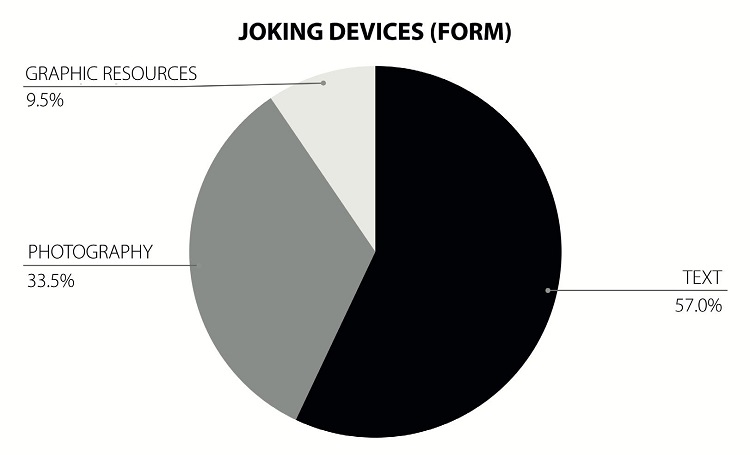
In the process, the tabloid deploys various formal devices, especially in terms of text, photography and graphic resources. Graph 2 below presents the distribution of each:
Graph 2
Source: Author’s elaboration.
Firstly, attention can be drawn to the hegemony of the written text over the other forms-though this is unsurprising, not only because journalism is primarily a written activity but especially because the domain of what elsewhere (WERNECK, 2015a) I have called the joke-form is especially consecrated as textual. The protocol formed by a setup situation-the “presentation of the set of elements (…), the part that establishes the expectation and the set of devices around which the joke is logically constructed” (WERNECK, 2015a, p. 491)-and the punchline-“the part that establishes the turn in the situation that will produce the humoristic effect” (WERNECK, 2015a)-is facilitated by the textual grammatical structure. Furthermore, observing the subdivision of this type into its specific humorous devices, as shown in Graph 3, we can see the set of resources available to the editors to make jokes:

Graph 3
Source: Author’s elaboration.
Wordplays are the tool most often used by the newspaper, followed by jokes based on problematic logic-a contradiction, a non sequitur, an absurdity. Little use is made of puns-also a kind of wordplay but one I treated separately given their specific logic in which part of a sign is swapped, maintaining an allusion to the original but creating a new sign with another meaning, producing a shift in how they co-exist (POLLACK, 2012). On the other hand, the use of nicknames is understandable in the universe of police reporting due to the tradition using aliases for criminals and because the labels create characters and allow a simplifying malleability. This produces front pages like the following:
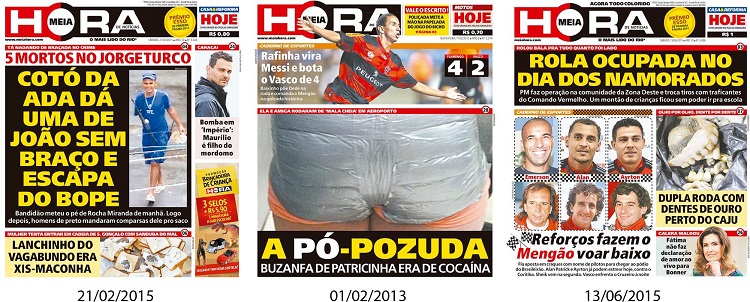
In the first example, we re-encounter the character cited on another cover, who acquires an alias, ‘Cotó da ADA’ (‘ADA’s Stump Man,’ ADA: Amigos dos Amigos, Friends of Friends, a drug faction). At the same time, the play on words about his amputated arm is developed into a parody: dar uma de joão sem braço, literally ‘act like an armless man,’ means to play the fool, feign innocence of a situation. Moreover, the subhead continues to include his limbs in the joke and states that he meteu o pé (‘stuck out his foot,’ went away): he left the favela in which a police operation had been launched. On the second cover, another nickname, this time producing a pun: poposuda, big booty, becomes pó-posuda, combining ‘pó’ (powder: cocaine) and the rest of the word, which may also refer to ‘pose.’ The subhead also reports that ‘She and her Friend Went Around’ [‘rodaram,’ also meaning ‘failed,’ that is, they were caught by the police, they ‘lost’] ‘With a Full Baggage in the Airport.’ ‘Baggage’ (mala) is also slang for buttocks-and this point is noteworthy: the tabloid newspaper has no qualms about using colloquial and sometimes vulgar language. In the third case, ‘Rola Occupied on Valentine’s Day,’ the name of a favela, Rola, a kind of bird, serves as a source for a pun in which the double meaning derives from the reported event: the military police conducted an operation in the favela precisely on Valentine’s Day, allowing a double message to be created: rola, also slang for penis, was found in intense sexual activity (‘occupied/busy’) just as the community was the target of a police occupation. On the other hand, the nicknames, less frequently mobilized as the main textual element (as shown by the survey data), appear as an accessory device in numerous news reports since, as already mentioned, aliases are commonplace in this universe. They also express the legalist moral dichotomy of the publication: it takes the side, like any typical publication, of law and order-and, in a moral simplification, of the security forces (except when they are acting blatantly outside the law or the accepted moral code for their behaviours, as in flagrant massacres). Consequently, again as the editorial director Alexandre Freeland stated in the documentary on the newspaper, thieves receive more or less standardized labels: “vagabundo, mequetrefe, pilantra, safado, marginal… Bandido; living or dead, all bandidos are the same: vagabundos.” A rapist is “soulless, motherless, heartless, a monster…” “…And the police when they invade?” the film’s interviewer asks, receiving the reply: “They tear up, burst, rip apart, mop up, clean up…” and when they shoot, “they finger the trigger, they send a bullet.” The designations thus tend to exalt police power and ridicularize the criminals.
In these three cases, consistently with most of the sample, the actants are ridiculed by their placing in a ‘normal’ situation to which a twist is added, all of them textual: the unexpected effect of encountering the second (and third) meanings of the words produces the humour of the headline and wittily mocks the police (incapable of capturing a disabled criminal who proved to be smarter); a criminal woman (also called a patricinha, that is, a young woman from outside the favela who can be attributed the label of ‘middle-class’ drug trafficker30 and, at the same time, someone not ‘naturally’ belonging to this world, who could earn money doing something else, and so on);31 and an entire favela (whose name is turned into a motive for ridicule).
Photographs and graphic resources are less frequent but involve potent signs. The mobilization of both and their specific devices are shown in Graphs 4 and 5:
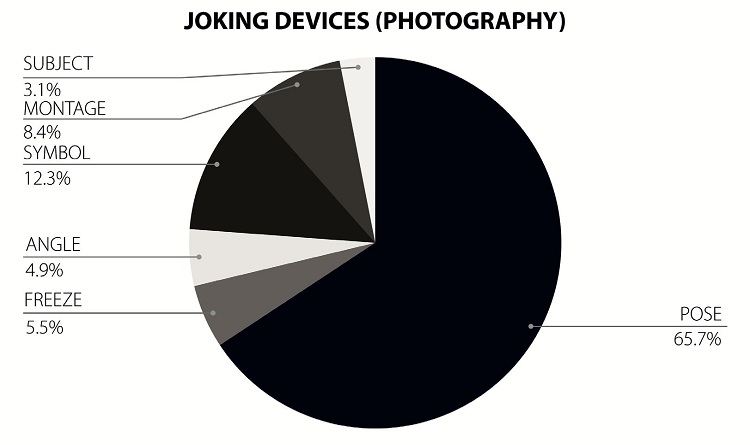
Graph 4
Source: Author’s elaboration.
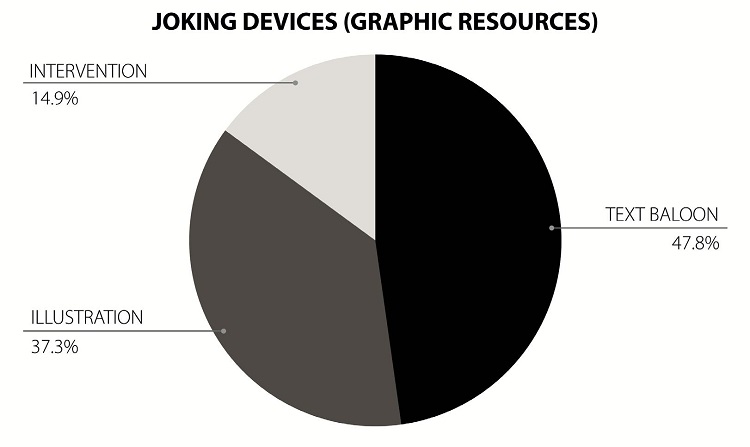
Graph 5
Source: Author’s elaboration.
I wish to illustrate this case with three more covers:

In the first example, ‘Bope Celebrates Birthday and Blows Out Four’, we see a photo with four prayer candles. The contrast between the headline informing the anniversary of the military police’s Special Operations Battalion (Batalhão de Operações Especiais: Bope, a paradigmatic figure from this period)-a moment when commemorative candles are blown out-and this image of the type more often used in prayers and funeral rites (surrounded here by graphic symbols of balloons decorated with the battalion’s logo) appears to simultaneously celebrate the killings and emphasize the seriousness of the police unit: the subhead states that the ‘Skulls [as these police officers are nicknamed, positively] Could not Celebrate as They Had to Work Hard’. Controversial, the cover was one of the reasons that the editor Humberto Tziolas commented about the paper seeming to celebrate by mocking the deaths of bandidos. In the second case, ‘Help [Police] to Find Fat Family’, a classic use of a graphic resource: the illustrator has drawn a maze, in an aesthetic style typical of the puzzles section of a newspaper, with the prize to be reached the Fat Family drug trafficker (also drawn), so-called because of his obesity.32 He had been rescued from the hospital by his accomplices a few days earlier after being shot by the police. The newspaper dedicated a series of front pages mocking the physical size of the criminal and the supposed ease with which he could therefore be found. But ‘even so’ the military police had proved incapable of finding him, which inspired the joke: given that the security forces have failed, find him yourself-in fact, the news story announces a reward for information passed to Disque Denúncia (the Denunciation Hotline) on the criminal’s whereabouts. The cover shows, then, three officers faced with a very simple maze of paths, ‘mocking’ the police. Finally, in the third cover, the photo of the subject of the news story is simply shown, accompanied by the headline ‘Crime has Decrease’ and the subhead ‘Dwarf Arrested for Trafficking’. The subhead in fact seems redundant given that the information that the actor arrested for drug trafficking has dwarfism would be dispensable for any careful reader.
As well as mobilizing these three material forms, the operationalization of perdeu (lost), manezou (failed) or niilismo (nihilism) involves constructing metaphors (based on any of them) to mock the three actants. These are produced primarily via five semiotic domains (Graph 6):

Graph 6
Source: Author’s elaboration.
The recourse to metaphor seems to follow two regimes of ridicularization, both linked to potency, one focused on demeaning the subject of the critique, negativized for a perceived weakness; the other emphasizing the subject’s strength but highlighting the negative aspect of its (cowardly) use. Studying the data, the only metaphoric forms to overlap just one of these two regimes are those of a sexual nature, which occupy the largest portion of the graph (31.5%). These are always used to reduce potency: either by attacking virility, in the case of men, or purity, in the case of women (the discourse relating to crime is highly misogynist); or by mocking the stereotypical profile of members of the LGBTQIA+ universe-although the mere allusion to sex tends in itself to be an identifier of humour, being a topic especially privileged for this purpose (KUIPERS, 2006; DAVIES, 2011). Meanwhile, the other two categories most often used, based on transformations in the nature of the subject being mocked (28.2%) and those based on constructions of characters (27.8%), as well as religious metaphors,33 are variable in this regard, although they tend more often to highlight the negativity of the subject’s potency and their competences, skills or capacities-given that we see more metaphors calling a subject a ‘monster,’ ‘animal’ or ‘demon’ than a ‘rat’ or ‘vermin.’ Finally, the sporting metaphors and/or those linked to events or festivities are usually fairly elastic and little related to potency: they are more a chance to exploit a festive universe as part of the punchline than used to mock the condition of the actants. Below are some examples:

The first three front pages contain sexual metaphors. The first-‘Shook his Todger in the Bus’ [busão, also meaning ass] and Ended Up on The Police Station’-belittles the accused subject less by exposing his condition as a tarado (pervert, ultimately perceived as a demonstration of potency) and more by calling his penis a miserinha (miserable little thing).34 The second-‘Pervy Horse Mistakes MP [military police officer] for Mare (eguinha pocotó, a character from a popular funk hit alluding to a girl as such)-mocks the police officer by placing him in the passive position of sexual intercourse with a ‘partner’ with the huge potency of a stallion. Finally, the third one resorts to a complex network of devices to ridicularize a female criminal: the nickname ‘Póriguete’ is a pun on periguete, a slang term used to refer to a considerable range of ‘deviant’ female behaviours-from a woman who dresses provocatively (according to the customs of the favela) or who shows herself to be barraqueira, someone who ‘takes no crap,’ to a woman who flirts with another woman’s partner, including ‘easy’ or ‘available’ women or those who let themselves be played by certain men and even those linked to crime-especially when described from the viewpoint of the asfalto-that is, the formally urbanized (non-favela) part of the city. However, the woman on the cover is not just any periguete: she is linked to drug trafficking, making pó (cocaine) part of her epithet, as in the earlier example of ‘Pó-posuda.’ However, this name does not appear motive enough because the main reason for calling this woman acting as a drug carrier between one favela and another a periguete is the fact that she posted photos of herself in a bikini on a social network. The newspaper, therefore, displays on its front page a black-and-white image taken from the internet with the woman in a provocative pose, as though suggesting both vanity (the photo could be from a men’s magazine) and the young woman’s ‘audacity’-demeaned not only for her ‘inappropriate’ behaviour but also for appearing ‘ruined’ (estragada) in the inset photo, indicating that she had ‘lost’ even in terms of aesthetic decline, falling from gostosa (‘hot chick,’ WERNECK and GOLDENBERG, 2010) to baranga (‘ugly chick’).35
The other lead stories focus on the nature of the specific figure concerned, the second replacing the subject with a religious image and the third turning to the world of sport. In the first case, the newspaper converts the well-known nickname of a drug trafficker, Juninho Cagão (something like Johnny Pooper), into excrement, reporting that he had been sent ‘Down the Sewer’ (esgoto abaixo, killed) by Comando Vermelho (‘CV’, one of the biggest Brazilian traffickers faction), while he was taking a shower. The metaphor is completed visually with the words printed over the image of a toilet water tank. On the second cover, the evangelical church thief is called a demon-but the joke is extended with a metaphor about his nature: he was a ‘loose wire’ (fio desencapado), that is, hot-headed, easily capable of killing and so on. On the third cover, the witticism concerns the situation of Rio de Janeiro, faced by the prospect that in 2014, the year when the FIFA World Cup would be hosted by the city, the drug gangs would spill a gigantic quantity of drugs to meet the global demand: “The World Coke is Ours’. Based on a pun parodying the song ‘A taça do mundo é nossa,’ ‘The World Cup is ours,’ remembered even today as an icon of Brazil’s first World Cup win in 1958, the report goes on to state that the cocaine sold will permit the drug gangs to double their profits during the competition.
Final considerations: the humorous translation of ‘urban violence’ as a form of making ‘violentization’ routine
Graph 7 below expresses the quantity of main lead stories on violence in general and urban violence in particular over the analysed period, year by year. The presence of humour throughout the universe analysed remained around the same level of 38%, so that we can see at the same time a balance of humorous coverage of that theme by this newspaper:

Graph 7
Source: Author’s elaboration.
The data show a certain stability in the level of the number of lead stories over the period. Obviously, the data from the final year of the series skew the sample since they were analysed until the middle of the year only. However, we can note that in July the number of main lead stories on violence had already reached the level of previous years. Indeed, if we count the lead stories of the other three levels too, 2017 displays a consistent fixation with the theme of violence on the newspaper’s front page, which is also manifested symbolically: it is the moment with the largest set of nihilistic ‘assessment covers,’ showing Rio de Janeiro immersed in chaos. The figures and cases constantly shown on the first pages confirm the impression that the relative calm-or at least the semiotic routinization-recorded previously was collapsing (along with the UPP program itself). Examples of ‘assessment covers’ include the following:

There were 23 covers following this model (18% of the total for 2017), asking ‘Why?’ or exclaiming ‘Enough!’ or asking ‘How much longer?’ or simply listing the accumulated cases. Among them, an aesthetic movement begins to form: few are like the first and third of these examples, few making use of humour-like the puns ‘Tiro de Janeiro’ (where tiro means gunshot) and UPP (pacifying police unit) versus UPA (emergency unit): ‘UPP? Best forget it! The Thing is to Rush to the UPA.’ Urban violence began to enter the gallery of themes too serious to inspire jokes.
But while at this moment the nihilism concerning security in the state dominated news reports, humorous or otherwise, in the earlier period the routine involves normalizing a news story about crime with around half of the main lead stories in the year reporting on violent incidents, the majority of them emphasizing urban violence-that is, the confrontation between criminals (bandidos) and police in a Rio de Janeiro in which life continues despite everything, and the largest category of them resorting to humorous devices to present their cases, as we have seen.
At the time of publication of this text, the data on 2011-2017 already no longer reflected many aspects of the public security scenario of Rio de Janeiro-as we have seen, the UPPs are ‘counted beans’ as the saying goes, already over, a situation demonstrated by assorted studies already cited here. Furthermore, a change of policy has taken place, implemented by the government of Wilson Witzel, elected in 2018 on a platform based around public security with an emphasis on authorization to kill suspects in favelas (BETIM, 22/08/2018), which continued under the administration of his replacement, Cláudio Castro, his vice-mayor, who took over the post after Witzel’s impeachment in 2021, and indeed intensified, especially due to the issue of the Federal Supreme Court (STF) banning police operations in favelas during the Covid-19 pandemic-a measure that did not prevent them from happening.36 Indeed, the episode known as the Jacarezinho Massacre took place in May 2021, when the Civil Police entered the favela in Rio’s North Zone, resulting in 28 deaths, the largest ever number of deaths in a police operation in Rio de Janeiro state (SOUZA and SOARES, 06/05/2021). An analysis of the current situation lies beyond the objectives of the present text. However, besides its value as a historical record, the data presented here for the period under analysis expresses a mechanics that continues into the present, a set of sociological information on the social accumulation of violence in Rio de Janeiro (MISSE, 1999) that the earlier period of routinization helped make explicit: the social construction of a transition to the condition of a socially shared metaphysics of the simplified actantial system described earlier (police v. criminals in utopian/dystopian Rio) and the elements for its comprehension and operationalization by contemporary discourses. As stated previously, through the negatives expressed in the kinds of mocking coverage promoted by the newspaper, not only did these figures themselves become consolidated as the central actants in this scenario, but also the elements of their worth. As I demonstrated in Werneck (2019), the construction of a singular observer (represented here by the humorous journalistic self) enables the creation of a voice capable not only of circulating the critique contained in the inspired discourse but also of ensuring it is taken seriously. Humour/grace/graça, in become effectuated as form-through the intervention of recognizable devices of inspiration-makes providing proof of the contexts that it expresses somewhat superfluous, at least until the questioning is resumed.
In Werneck, Teixeira and Talone (2020), I proposed with my colleagues a model for a pragmatic sociology of violence, founded on the recognition that the semiotic multiplicity of the sign violence results in a plural framework of worldviews, full-blown native theories concerning the social, ‘sociologies,’ as we call them, which imply forms of defining the situation (THOMAS, 1966[1923]) in terms of violence and, in the final instance, of behaving in relation to others and the social order itself in which the phenomenon occurs of mobilizing notable differences of force, thereby violentizing these situations. For each of these regimes of violentization there corresponds a form of defining violence and, with this definition, of defining what is happening on its basis. These different sociologies, then, represent different investments by the social actors themselves in relation to what the mobilization of force in a situation signifies and determine the way in which people situate violence-or in our terms, how they violentize the situation. Hence, it comprises a model capturing how people represent different dimensions of the situations in which they are inserted as ‘violent,’ establishing diverse definitions of what, in the situation, is considered violence. Table 2 below, taken from the cited joint work, synthesizes the different forms of violentization inferred by us:
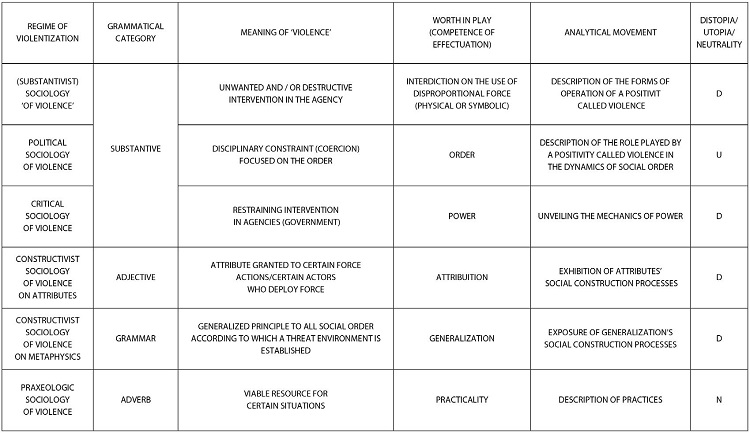
This model presents innumerable dimensions relating to the idea of violentization, detailed in the cited article. In summarized form, the first column refers to the type of native theory of the social that founds the definition of violence; the second, to the form in which the idea of violence is treated grammatically by people, whether as a substance in itself (noun), an attributed associated with substances (adjective), a modality of executing actions (adverb) or a metaphysics taken as a generalized logic for comprehending the social (grammar). However, the column of most interest here is the third, relating to the meanings of violence. I shall not explore the various meanings in depth here since they were examined to exhaustion in the other text. I shall merely emphasize the operation implied here: the generalization of the idea of violence, raised to the category of a grammar, inscribed here under the representational sign of ‘urban violence.’ In this sense, the social accumulation of violence described by Misse (1999) can be comprehended as a historical process through the reiteration of cases (accumulation) of impregnation of the interpretant (PEIRCE, 1977[1897]) violence in the interpretative toolkit disseminated in an urban social order. But not in just any sense: violence here is the sign of a threat become routine, the centre of a dystopia (TALONE, 2015). The covers of Meia Hora show how it takes the form of recipients, iconic actants that also become generalized as abstract forms and actualized in innumerable cases. Criminals, police officers and the urban order submerged in chaos are concentrated forms of this violence, themselves violentized by being represented as force-bearing bodies (WERNECK, TEIXEIRA and TALONE, 2020; WERNECK, TEIXEIRA, TALONE and CAMINHAS, 2021), a force capable of imposing itself since these actants are activated in their full worth-a worth questioned by the humorous discourse, as we have seen. Moreover, in the routinized environment of certain historical moments, such as the ‘UPP era,’ the inner workings of the naturalization of this condition of force are made explicit, displaying its fragility as a construct. In fact, the same situation is revealed in the recurrent presentation of Rio as the platform of a ‘war’ (LEITE, 2000, 2012; GRILLO, 2019) between police and criminals, as a dystopia (TALONE, 2015) even outside a regime of ridicularization: the types are the same.
The proposal of a pragmatic sociology of violence, here put into practice, is founded on the idea of mapping the pairings between the grounding metaphysics (regimes) of violentizations as they overlap and correlate with the ‘sociologies’ of violence presented and the devices mobilized in situations in order to account for them as situations of violence. In the observed sample, the humorous devices are employed precisely as devices in this violentization: the critical actors (represented here by the newspaper in the form of the humorous journalistic self) resort to humour to naturalize the actancy of a critique that is also itself perennial because routinized: the critique of the social problem turned into the public problem (GUSFIELD, 1981) of public security-in general labelled ‘violence,’ the ‘phantasm’ of Misse (1999)-albeit constructed as a major problem in a diffuse form and therefore as something ultimately unresolvable (GUALANDE JUNIOR, 2019). In Werneck (2019, pp. 646-647), I proposed that
[the] path of a critique aspiring to public generalization and, therefore, to the adherence of collective force to its actancy (…) is subdivided into two (at least): on one hand, a civic path (BOLTANSKI; THÉVENOT, 2019[1991]) according to which, as the dynamic of public denunciation shows (BOLTANSKI, 1990), critics claim to act as representatives of the rest of society, suggesting that what they make public is in the latter’s interest, that their voice is society’s voice; on the other hand, an inspired path (BOLTANSKI; THÉVENOT, ibid), that presents the form of the critique as filled with grace, but strong from the viewpoint of the singularization of its expression. (…) In the second case (…), it is a question of opting for a regime of ridicularization in order to, using some humorous device, construct an actant to be inserted in the actantial system of denunciation, the singular observer, who, filled with grace, becomes a fixed viewpoint from which the world can always be interpreted as absurd and its moral negativity as obvious (so much so that it can become an object of humour, a joke). This observer adopts a position vis-à-vis the possibility of épreuve and, being singular, moves to a circumstance specific to the situation, constructing what Nielsen (2019) calls a ‘transitory truth,’ intrinsic to the construction of comic utterances, a type that ‘precede all reflection by hitting you in the gut with the immediate and corporeal realization that the insights [...presented...] have some weird and distorted truth-value to them.’ The author’s idea is that this truth is one ‘proven’ by the emotional discharge of laughter. However, the argument can be extended: it is founded on the circumstantiality of the humour, expressed here by the emotional/involuntary effectuation of the laugh, but in a general sense in the contingent effectuation of the veracity of the critique contained in the humorous discourse.
The argument of this text has been that adoption of this form of ridicularization by the Meia Hora newspaper appears in the form in which it is stabilized as the representation of a constructivist perspective (a sociology) of violence relating to metaphysics, thereby exposing the generalized character of the social representation of urban violence as a language/grammar (MACHADO DA SILVA, 1993; WERNECK and TALONE, 2019) fully accumulated in the imaginary of Rio de Janeiro (MISSE, 1999). Making jokes (graça) about crime, the police and the current state of the social order, as Meia Hora did during the period under study, is to make explicit, joke by joke, the texture of this process of generalization, which, to be effectuated, needs to be continually constructed, thereby justifying for many a series of counterforce movements-such as the one expressed in the front pages themselves at the end of 2017, the need for a magnified difference in forces (on the part of the State) to account for the difference of forces (supposedly of the crime world) whose mobilization is expressed as a quotidian fact-which ends up being substantialized in an appeal for force to be used on the part of the population, as my colleagues and I have shown (WERNECK, TEIXEIRA, TALONE and CAMINHAS, 2021). What the research demonstrated, therefore, is that the singular observer represented by the newspaper’s humorous journalistic discourse-and thus dealing with the transition between the emotional and mobilization (THÉVENOT, 1989, 1995)-makes explicit a diffuse set of critiques of the behaviours of the figures considered central to routinized urban violence-at that moment, due to the UPPs. Thus, the discourse of humour (grace/graça) is violentized, filled with elements that qualify it as a discourse about violence, as a discourse that qualifies this phenomenon, enabling the stabilization of a definition of a situation as one of urban violence.
References
AMARAL, Márcia Franz. “Imprensa popular: Sinônimo de jornalismo popular?”. Paper presented at the XXIX Congresso Brasileiro de Ciências da Comunicação, Brasília, 2006.
ARAUJO, Marcella. “A ideia de cotidiano na produção sociológica de Luiz Antonio Machado da Silva sobre a criminalidade violenta”. Dilemas, Rev. Estud. Conflito Controle Soc., Rio de Janeiro, vol. 12, n. 1, pp. 6-23, 2019.
ATALLAH, Mariana; NOGUEIRA, Mayara. “A construção do humor em capas do jornal Meia Hora”. Interletras, vol. 15, 2012.
BECKMAN, John. American Fun: Four Centuries of Joyous Revolt. New York: Pantheon, 2014.
BERGER, Peter L. O riso redentor: A dimensão cômica da experiência humana. Petrópolis: Vozes, 2017[1997].
BERGSON, Henri. O riso: Ensaio sobre a significação da comicidade. São Paulo: Martins Fontes, 2001[1900].
BILLIG, Michael. Laughter and Ridicule: Towards a Social Critique of Humour. London: Sage, 2005.
BOLTANSKI, Luc. L’amour et la justice comme compétences: Trois essais de sociologie de l’action. Paris: Métailié, 1990.
BOLTANSKI, Luc. De la critique: Précis de sociologie de l’émancipation. Paris: Gallimard, 2009.
BOLTANSKI, Luc; THÉVENOT, Laurent. A justificação: Sobre as economias da grandeza. Rio de Janeiro: Editora UFRJ, 2020[1991].
BOLTANSKI, Luc; THÉVENOT, Laurent. “The Sociology of Critical Capacity”. European Journal of Social Theory, vol. 2, n. 3, pp. 359-377, 1999.
CANO, Ignacio; BORGES, Doriam; RIBEIRO, Eduardo. Os donos do morro: Uma avaliação exploratória do impacto das Unidades de Polícia Pacificadora (UPPs) no Rio de Janeiro. São Paulo/Rio de Janeiro: Fórum Brasileiro de Segurança Pública, LAV/Uerj, 2012.
BOS, Dennis; T’HART, Marjolein (eds). Humour and Social Protest. Cambridge: Cambridge University Press, 2008.
CAMINHAS, Diogo Alves; BEATO, Claudio Chaves. “‘Todo ladrão vai trabalhar com a sua mente’: O uso da força e de armas nos assaltos em Belo Horizonte, Minas Gerais”. Dilemas, Rev. Estud. Conflito Controle Soc., Rio de Janeiro, vol. 13, n. 3, pp. 645-667, 2020.
CEFAÏ, Daniel. “Qu’est-ce Qu’une Arene Publique? Quelques Pistes pour une Approche Pragmatiste”. In: CEFAÏ, Daniel; JOSEPH, Isaac (eds). L’heritage du pragmatisme: Conflits d’urbanité et épreuves de civisme. La Tour d’Aigues (FR): Éditions de l’Aube, 2002, pp. 51-82.
CHOCK, Phyllis Pease. “The Constrained Use of Irony in US Congressional Hearings on Immigration.” In: FERNANDEZ, James W.; HUBER, Mary Taylor (eds). Irony in Action: Anthropology, Practice and the Moral Imagination. Chicago: The University of Chicago Press, 2001, pp. 41-62.
COLEBROOK, Claire. Irony. New York: Routledge, 2004.
COSTA, Wagner Alexandre dos Santos. O contrato de comunicação no jornalismo popular: Um foco na categoria título. São Paulo: Paço Editorial, 2016.
COSTA, Wagner Alexandre dos Santos; MENEZES, Vanda Maria Cardozo de. “Cadeias referenciais e produção de sentidos no jornalismo popular”. Revista do Gel, vol. 13, n. 3, pp. 241-259, 2016.
DAVIES, Christie. Jokes and Targets. Bloomington (USA): Indiana University Press, 2011.
DEFANTI, Angelo. Meia Hora e as manchetes que viram manchete. Film, video, 81min. Rio de Janeiro: Sobretudo Produções, 2014.
DEWEY, John. Logic: The Theory of Inquiry. New York: Henry Holt, 1938.
DUARTE, Thais Lemos; ARAÚJO, Isabela Cristina. “PCC em pauta: Narrativas jornalísticas sobre a expansão do grupo pelo Brasil”. Dilemas, Rev. Estud. Conflito Controle Soc., Rio de Janeiro, vol. 13, n. 2, pp. 505-532, 2020.
ERBOLATO, Mario. Técnicas de codificação em jornalismo. São Paulo: Ática, 1991.
FREIRE, Jussara. “‘Violência urbana’ e ‘cidadania’ na cidade do Rio de Janeiro: Tensões e disputas em torno das ‘justas atribuições’ do Estado”. Dilemas, Rev. Estud. Conflito Controle Soc., Rio de Janeiro, vol. 7, n. 1, pp. 73-94, 2014.
FREIRE, Jussara. Mobilizações coletivas e problemas púbicos em Nova Iguaçu. Rio de Janeiro: Garamond, 2016.
FREIRE, Jussara; TEIXEIRA, Cesar Pinheiro. “Humanidade disputada: Sobre as (des)qualificações dos seres no contexto de ‘violência urbana’ do Rio de Janeiro”. Terceiro Milênio: Revista Crítica de Sociologia e Política, vol. 6, n. 1, pp. 58-85, 2016.
FREIRE, Gesseldo de Brito; VALENTE, André Crim. “dialogismo, polifonia e intertextualidade nas capas do jornal Meia Hora.” Cadernos do CNLF, vol. XVIII, n. 1, pp. 130-155, 2014.
GILBERT, Joanne R. Performing Marginality: Humor, Gender, and Cultural Critique. Detroit (USA), Wayne State University Press, 2004.
GREIMAS, Algirdas Julien. Sémantique Structurale: Recherche et Méthode. Paris: Larousse, 1966.
GRILLO, Carolina Christoph. “O ‘morro’ e a ‘pista’: Um estudo comparado de dinâmicas do comércio ilegal de drogas”. Dilemas, Rev. Estud. Conflito Controle Soc., Rio de Janeiro, vol. 1, n. 1, pp. 127-148, 2008.
GRILLO, Carolina Christoph. “Da violência urbana à guerra: Repensando a sociabilidade violenta”. Dilemas, Rev. Estud. Conflito Controle Soc., Rio de Janeiro, vol. 12, n. 1, pp. 62-92, 2019.
GRILLO, Carolina Christoph; MARTINS, Luana Almeida. “Indo até o problema: Roubo e circulação na cidade do Rio de Janeiro”. Dilemas, Rev. Estud. Conflito Controle Soc., Rio de Janeiro, vol. 13, n. 2, pp. 565-590, 2020.
GUALANDE JUNIOR, Ailton. Mosaico de críticas: Formação e dispersão de públicos em torno do transporte coletivo carioca. Dissertation (M.A. in Sociology [with concentration in Anthropology]) - Universidade Federal do Rio de Janeiro, Rio de Janeiro, 2019.
GUSFIELD, Joseph. The Culture of Public Problems: Drinking Driving and the Symbolic Order. Chicago: The University of Chicago Press, 1981.
HABERMAS, Jürgen. Mudança estrutural da esfera pública. São Paulo: Editora Unesp, 2014[1962].
HERMAN, Edward; CHOMSKY, Noam. Manufacturing Consent: The Political Economy of the Mass Media. New York: Pantheon, 2002.
HERZFELD, Michael. “Irony and Power: Towards a Politics of Mockery in Greece”. In: FERNANDEZ, James W.; HUBER, Mary Taylor (eds). Irony in Action: Anthropology, Practice and the Moral Imagination. Chicago: The University of Chicago Press, 2001, pp. 63-83.
HIRATA, Daniel Veloso; GRILLO, Carolina Christoph; DIRK, Renato. “Relatório Efeitos da Medida Cautelar na ADPF 635 sobre as Operações Policiais na Região Metropolitana do RJ”. Dilemas, Rev. Estud. Conflito Controle Soc., Reflexões na Pandemia (seção excepcional), 25 June 2020. Available online at: https://www.reflexpandemia.org/texto-39
HIRATA, Daniel Veloso; GRILLO, Carolina Christoph; DIRK, Renato. “Relatório Operações Policiais e Ocorrências Criminais: Por um Debate Público Qualificado”. Dilemas, Rev. Estud. Conflito Controle Soc., Reflexões na Pandemia (seção excepcional), 18 Aug. 2020. Available online at: https://www.reflexpandemia.org/texto-57
HIRATA, Daniel Veloso; GRILLO, Carolina Christoph; DIRK, Renato; LYRA, Diogo. Relatório Operações Policiais e Violência Letal no Rio de Janeiro: Os impactos da ADPF 635 na defesa da vida. Dilemas, Rev. Estud. Conflito Controle Soc., Rio de Janeiro, Reflexões na Pandemia (seção excepcional), 15 Apr. 2021. Available online at: https://www.reflexpandemia2021.org/texto-107
HODGE, Bob. Social Semiotics for a Complex World: Analysing Language and Social Meaning. London: Polity, 2017.
IGGERS, Jeremy. Good News, Bad News: Journalism Ethics and the Public Interest. New York: Perseus, 1999.
KUIPERS, Giselinde. Good Humor, Bad Taste: A Sociology of the Joke. Berlin; New York: Mouton de Gruyter, 2006.
LATOUR, Bruno. Les microbes: Guerre et paix, suivi de Irréductions. Paris: Métailié, 1984.
LATOUR, Bruno. Ciência em ação: Como seguir cientistas e engenheiros sociedade afora. São Paulo: Editora Unesp, 1997[1987].
LEITE, Márcia Pereira. “Entre o individualismo e a solidariedade: Dilemas da política e da cidadania no Rio de Janeiro”. Revista Brasileira de Ciências Sociais, vol. 15, n. 44, pp. 73-90, 2000.
LEITE, Márcia Pereira. “Da ‘metáfora da guerra’ ao projeto de ‘pacificação’: Favelas e políticas de segurança pública no Rio de Janeiro”. Revista Brasileira de Segurança Pública, vol. 6, n. 2, pp. 374-389, 2012.
LEMIEUX, Cyril. Mauvaise presse: Une sociologie crompréhensive du travail journalistique et de ses critiques. Paris: Métailié, 2000.
LORETTI, Pricila. Energias da crítica: O conflito entre a Light e os moradores da favela Santa Marta, Rio de Janeiro, em contexto de pacificação. Thesis (PhD in Social Sciences) - Universidade do Estado do Rio de Janeiro, Rio de Janeiro, 2016.
MACHADO DA SILVA, Luiz Antônio. “Violência urbana: Representação de uma ordem social”. In: NASCIMENTO, Elimar Pinheiro; BARREIRA, Irlys. Brasil urbano: Cenário da ordem e da desordem. Rio de Janeiro: Notrya, 1993, pp. 131-142.
MACHADO DA SILVA, Luiz Antônio. “Sociabilidade violenta: Por uma interpretação da criminalidade contemporânea no Brasil urbano”. Sociedade e Estado, vol. 19, n. 1, 2004, pp. 53-84.
MACHADO DA SILVA, Luiz Antônio; LEITE, Márcia Pereira. “Continuidades e mudanças em favelas ‘pacificadas’: Apresentação ao dossiê Unidades de Polícia Pacificadora-Cevis”. Dilemas, Rev. Estud. Conflito Controle Soc., Rio de Janeiro, vol. 7, n. 4, pp. 607-610, 2014.
MACHADO DA SILVA, Luiz Antônio; MISSE, Michel; WERNECK, Alexandre; ZALUAR, Alba; LEITE, Márcia Pereira; VIEIRA, Neiva; FELTRAN, Gabriel. “Uma vida e uma obra dedicadas à favela e às ciências sociais: Entrevista comemorativa de 70 anos de Luiz Antonio Machado da Silva”. Dilemas, Rev. Estud. Conflito Controle Soc., Rio de Janeiro, vol. 4, n. 4, pp. 663-698, 2011.
MENEZES, Palloma Valles. “Os rumores da ‘pacificação’: A chegada da UPP e as mudanças nos problemas públicos no Santa Marta e na Cidade de Deus”. Dilemas, Rev. Estud. Conflito Controle Soc., Rio de Janeiro, vol. 7, n. 4, 2014, pp. 665-684.
MENEZES, Palloma Valles. Entre o ‘fogo cruzado’ e o ‘campo minado’: Uma etnografia do processo de ‘pacificação’ de favelas cariocas. Thesis (PhD in Sociology) - Universidade do Estado do Rio de Janeiro, Rio de Janeiro, 2015.
MENEZES, Palloma Valles. “Monitorar, negociar e confrontar: As (re)definições na gestão dos ilegalismos em favelas ‘pacificadas’”. Tempo Social, vol. 30, n. 3, pp. 191-216, 2018.
MENEZES, Palloma Valles; CORRÊA, Diogo. “From Disarmament to Rearmament: Elements for a Sociology of Critique of the Pacification Police Unit Program.” Vibrant: Virtual Brazilian Anthropology, vol. 14, n. 3, pp. 192-215, 2018.
MINA, Na Xiao. Memes to Movements: How the World’s Most Viral Media Is Changing Social Protest and Power. Boston: Beacon, 2019.
MISSE, Daniel Ganem. “Cinco anos de UPP: Um breve balanço.” Dilemas, Rev. Estud. Conflito Controle Soc., Rio de Janeiro, vol. 7, n. 3, pp. 675-700, 2014.
MISSE, Michel. Malandros, marginais e vagabundos: A acumulação social da violência no Rio de Janeiro. Thesis (PhD in Sociology) - Instituto Universitário de Pesquisas do Rio de Janeiro, Rio de Janeiro, 1999.
MISSE, Michel; GRILLO, Carolina Christoph; TEIXEIRA, Cesar Pinheiro; Neri, Natasha Elbas. Quando a polícia mata: Homicídios por ‘autos de resistência’ no Rio de Janeiro (2001-2011). Rio de Janeiro: Booklink, 2013.
MORELLATO, Ana Carolina Batista; SANTOS, André Filipe Pereira Reid dos. “Intervenção federal e a guerra contra os pobres na cidade do Rio de Janeiro”. Dilemas, Rev. Estud. Conflito Controle Soc., Rio de Janeiro, vol. 13, n. 3, pp. 711-736, 2020.
MOTA E MOTA, Flávia Moreira; SOUZA, Ester Maria de Figueiredo. “Ironia como recurso de linguagem: Uma análise do jornal Meia-Hora de Notícias”. Litterata: Revista do Centro de Estudos Hélio Simões, vol. 2, n. 1, pp. 119-138, 2012.
MOURA, Jonathan Ribeiro Farias de. Capas do jornal Meia-Hora: Uma análise discursiva do verbal e do não verbal. Dissertation (M.A. in Letters) - Universidade Federal do Rio de Janeiro, Rio de Janeiro, 2015.
NEVEU, Érik. Sociologie du journalisme. Paris: La Découverte, 2001.
NIELSEN, Morten. “Comedic Lies as Transitory Truths”. Anthropology News, 01 Apr. 2019. Available online at: http://www.anthropology-news.org/index.php/2019/04/01/comedic-lies-as-transitory-truths/
PEIRCE, Charles Sanders. “Divisão dos signos.” In: Semiótica. São Paulo: Perspectiva, 1977[1897], pp. 45-61.
POLLACK, John. The Pun Also Rises: How the Humble Pun Revolutionized Language, Changed History, and Made Wordplay More Than Some Antics. New York: Avery, 2012.
PRADO, Sophia. “Vivendo o roubo: Um momento de adrenalina, deleite e performance”. Dilemas, Rev. Estud. Conflito Controle Soc., Rio de Janeiro, vol. 13, n. 3, pp. 669-690, 2020.
PRESSMAN, Matthew. On Press: The Liberal Values That Shaped the News. Cambridge: Harvard University Press, 2018.
PULITI, Paula. A financeirização do noticiário econômico no Brasil (1989-2002). Thesis (PhD in Communication Sciences) - Universidade de São Paulo, São Paulo, 2009.
RIBEIRO, Ludmila; VILAROUCA, Márcio Grijó. “‘Ruim com ela, pior sem ela’: O desejo de continuidade das UPPs para além das Olimpíadas”. Revista de Administração Pública, vol. 52, n. 6, pp. 1155-1178, 2018.
ROMANIENKO, Lisiunia A. “Carnival Laughter and the Disarming of the Opponent: Antagonism, Absurdity, and the Avant-Garde: Dismantling Soviet Oppression through the Use of Theatrical Devices by Poland ‘Orange’ Solidarity Movement”. In: BOS, Dennis; T’HART, Marjolein (eds). Humour and Social Protest. Cambridge: Cambridge University Press, 2008, pp. 133-152.
SMITH, Daniel. Comedy and Critique: Stand-up Comedy and the Professional Ethos of Laughter. Bristol (RU), Bristol University Press, 2018.
TALONE, Vittorio da Gama. Confiança e desconfiança como dispositivos morais situacionais em trânsito: Um estudo em viagens de ônibus na cidade do Rio de Janeiro. Dissertation (M.A. in Sociology [with concentration in Anthropology]) - Universidade Federal do Rio de Janeiro, Rio de Janeiro, 2015.
TALONE, Vittorio da Gama. “Evitação e afastamento como dispositivos morais da gramática da desconfiança: Uma leitura pragmatista do deslocamento urbano pela ‘violenta’ cidade do Rio de Janeiro”. Dilemas, Rev. Estud. Conflito Controle Soc., Rio de Janeiro, vol. 11, n. 1, pp. 153-172, 2018.
TARDE, Gabriel. A opinião e as massas. São Paulo: Martins Fontes, 2005[1901].
TEIXEIRA, Cesar. A teia do bandido: Um estudo sociológico sobre bandidos, policiais, evangélicos e agentes sociais. Thesis (PhD in Sociology) - Universidade Federal do Rio de Janeiro, Rio de Janeiro, 2013.
THÉVENOT, Laurent. “Équilibre et Rationalité dans un Univers Complexe”. Revue Économique, vol. 40, n. 2, pp. 147-198, 1989.
THÉVENOT, Laurent. “Émotions et évaluations dans les coordinations publiques”. In: PAPERMAN, Patricia; OGIEN, Ruwen (eds). La couleur des pensées: Emotions, sentiments, intentions. Paris: Éditions de l’EHESS, 1995, pp. 145-174.
THOMAS, William I. Unadjusted Girl: With Cases and Standpoint for Behavior Analysis. New York: Harper and Row, 1966[1923].
TRNKA, Susanna; REHAK, Jana Kopelent. The Politics of Joking: Anthropological Engagements. London: Routledge, 2018.
UNDURRAGA, Tomás. “Making News of Value: Exploiting Dissonances in Economic Journalism”. Journal of Cultural Economy, vol. 10, n. 6, pp. 510-523, 2017.
VALENTIM, Renata Patricia Forain de. “A invenção do popular: Uma análise discursiva do jornal Meia Hora”. Athenea Digital, vol. 16, n. 3, pp. 465-479, 2016.
WATSON, Cate. “A Sociologist Walks into a Bar (and Other Academic Challenges): Towards a Methodology of Humour”. Sociology, vol. 49, n. 3, pp. 407-421, 2015.
WERNECK, Alexandre. Comunicação e cinismo: A razão cínica na esfera pública observada na cobertura do Primeiro de Maio em jornais. Dissertation (M.A. in Comunicação e Cultura) - Universidade Federal do Rio de Janeiro, Rio de Janeiro, 2004.
WERNECK, Alexandre. A desculpa: As circunstâncias e a moral das relações sociais. Rio de Janeiro: Civilização Brasileira, 2012a.
WERNECK, Alexandre. “A contribuição de uma abordagem pragmatista da moral para a sociologia do conflito”. In: MISSE, Michel; WERNECK, Alexandre (eds). Conflitos de (grande) interesse: Estudos sobre crimes, violências e outras disputas conflituosas. Rio de Janeiro: Garamond, 2012b, pp. 337-354.
WERNECK, Alexandre. “‘Dar uma zoada’, ‘botar a maior marra’: Dispositivos morais de jocosidade como formas de efetivação e sua relação com a crítica.” Dados: Revista de Ciências Sociais, vol. 58, n. 1, 2015a, pp. 187-221.
WERNECK, Alexandre. “O ornitorrinco de criminalização: A construção social moral do miliciano a partir dos personagens da ‘violência urbana’ do rio de janeiro”. Dilemas, Rev. Estud. Conflito Controle Soc., Rio de Janeiro, vol. 8, n. 3, pp. 429-454, 2015b.
WERNECK, Alexandre. “Uma sociologia da compreensão a partir do par crítica e jocosidade”. Civitas: Revista de Ciências Sociais, vol. 16, n. 3, pp. 482-503, 2016a.
WERNECK, Alexandre. “A força das circunstâncias: Sobre a metapragmática das situações”. In: VANDENBERGHE, Frédéric; VÉRAN, Jean-François (eds). Além do habitus: Teoria social pós-bourdieusiana. Rio de Janeiro, 7Letras, 2016b, pp. 155-192.
WERNECK, Alexandre. “Política e ridicularização: Uma sociologia da ‘graça’ da crítica em cartazes das ‘Jornadas de Junho’”. Interseções: Revista de Estudos Interdisciplinares, vol. 21, n. 3, pp. 611-653, 2019.
WERNECK, Alexandre. “Viral Jokes: Humour and Grace as Critical Devices in Memes About the Covid-19 Pandemic in Brazil”. In: MPOFU, Shepherd (ed). Digital Humour in the Covid-19 Pandemic: Perspectives from the Global South. London: Palgrave Macmillan, 2021, pp. 47-73.
WERNECK, Alexandre. “Por uma sociologia pragmática da moral da política: Crítica, ‘bem de todos’/‘bem comum’ e ‘comparecimento’”. Política and Trabalho: Revista de Ciências Sociais, vol. 38, n. 55, pp. 113-128, 2022a.
WERNECK, Alexandre. “Apontamentos para uma sociologia da efetivação (isto é, uma sociologia pragmática)”. In: NEVES, Fabrício; CORRÊA, Diogo; PETERS, Gabriel (eds). Construção conceitual nas ciências sociais. Rio de Janeiro: Telha, 2022b (forthcoming).
WERNECK, Alexandre; GOLDENBERG, Mirian. “O nu em evidência: As formas de legitimação de ‘o corpo’ como capital”. Trama Interdisciplinar, vol. 1, n. 1, pp. 125-139, 2010.
WERNECK, Alexandre; LORETTI, Pricila. “Critique-Form, Forms of Critique: The Different Dimensions of the Discourse of Discontent”. Sociologia and Antropologia, vol. 8, n. 3, pp. 973-108, 2018.
WERNECK, Alexandre; TALONE, Vittorio. “A ‘sociabilidade violenta’ como interpretante efetivador de ações de força: Uma sugestão de encaminhamento pragmático para a hipótese de Machado da Silva”. Dilemas, Rev. Estud. Conflito Controle Soc., Rio de Janeiro, vol. 12, n. 1, pp. 24-61, 2019.
WERNECK, Alexandre; TEIXEIRA, Cesar Pinheiro; TALONE, Vittorio. “An Outline of a Pragmatic Sociology of ‘Violence’”. Sociologias, vol. 22, n. 54, pp. 286-326, 2020.
WERNECK, Alexandre; TEIXEIRA, Cesar Pinheiro; TALONE, Vittorio; CAMINHAS, Diogo. “Forças em forma: Um estudo sobre a ‘violentização’ da força em diferentes modalidades”. Paper presented at the 20º Congresso Brasileiro de Sociologia, Belém (on-line), 2021.
YACINTAS, Altug (ed). Creativity and Humour in Occupy Movements: Intellectual Disobedience in Turkey and Beyond. Basingstoke (RU): Palgrave Macmillan, 2015.
ZALUAR, Alba. Integração perversa: Pobreza e tráfico de drogas. Rio de Janeiro: Editora FGV, 2004.
Media publications
BARRETTO, Eduardo. “Edição extra do Diário Oficial autoriza o uso das Forças Armadas no Rio: Medida vai até o fim do ano, como parte do plano de segurança do governo federal no estado”. O Globo, Rio, 28 Jul. 2017. Available online at: https://oglobo.globo.com/rio/edicao-extra-do-diario-oficial-autoriza-uso-das-forcas-armadas-no-rio-21641941
BETIM, Felipe. “Sob Witzel, policiais já respondem por quase metade de mortes violentas na Região Metropolitana do Rio: Agentes mataram 194 pessoas em julho em todo o Estado, segundo dados oficiais. É a maior cifra para um mês desde 1998. Governo Witzel já assumiu 1.075 mortes de janeiro a julho deste ano”. El País, Rio de Janeiro, 21 Aug. 2019. Available online at: https://brasil.elpais.com/brasil/2019/08/21/politica/1566423448_948955.html
BIANCHI, Paula. “Rio Chama Exército Contra Violência pela 12ª Vez em 10 Anos. Adianta?”. UOL, Cotidiano, 29 Jul. 2017. Available online at: https://noticias.uol.com.br/cotidiano/ultimas-noticias/2017/07/29/rio-chama-exercito-contra-violencia-pela-12-em-10-anos-virou-rotina.htm
DUARTE, Daniel Edler. “Sobre o fim das UPPs”. Escuta: Revista de Política e Cultura, 22 June 2017. Available online at: https://revistaescuta.wordpress.com/2017/06/22/sobre-o-fim-das-upps/
LEMOS, Marcela; BIANCHI, Paula. “A era UPP chegou ao fim? Cinco perguntas sobre o que muda no projeto”. UOL, Cotidiano, 30 Aug. 2017. Available online at: https://noticias.uol.com.br/cotidiano/ultimas-noticias/2017/08/30/a-era-upp-chegou-ao-fim-5-perguntas-sobre-o-que-muda-no-projeto.htm
NOLEN, Stephanie. “How Brazil’s big experiment in policing failed to make Rio safer for the Olympics”. The Globe and Mail, 12 Nov. 2017. Available online at: https://www.theglobeandmail.com/news/world/how-brazils-big-policing-experiment-failed-to-make-rio-safer-for-theolympics/article31222945/
SETA, Isabel. “A falência das UPPs: A reformulação vem em um momento de questionamento da eficácia do modelo e de aumento dos índices de violência na capital fluminense”. Exame, Brasil, 03 Jul. 2017. Available online at: https://exame.abril.com.br/brasil/a-falencia-das-upps/
SOUZA, Rafael Nascimento de; SOARES, Rafael. “Mortes no Jacarezinho: Com 28 mortos, operação policial na comunidade da Zona Norte é a mais letal da História do Rio: Entre os mortos, está um agente da Polícia Civil que foi baleado na cabeça”. O Globo, Rio, 06 May 2021. Available online at: https://oglobo.globo.com/rio/mortes-no-jacarezinho-com-28-mortos-operacao-policial-na-comunidade-da-zona-norte-a-mais-letal-da-historia-do-rio-25006044
Notes
Author notes