Articles
The prison system and the constitution of modern slavery by the State
O sistema prisional e a constituição da escravidão moderna pelo estado
 Paula Cristina de Moura Fernandes paulacristina.m.fernandes@gmail.com
Deise Luiza da Silva Ferraz deiseluiza@face.com.br
Paula Cristina de Moura Fernandes paulacristina.m.fernandes@gmail.com
Deise Luiza da Silva Ferraz deiseluiza@face.com.br
The prison system and the constitution of modern slavery by the State
Dilemas: Revista de Estudos de Conflito e Controle Social, vol. 17, no. 3, e61309, 2024
Universidade Federal do Rio de Janeiro
Received: 04 October 2023
Accepted: 17 July 2024
Funding
Funding source: institution’s research ethics committee
Contract number: 76795517.2.0000.5149
Funding statement: We would like to thank CAPES for the funding during the execution of the research. This research was approved by the institution’s research ethics committee, whose process number is: CAAE 76795517.2.0000.5149
Abstract: This study, based on Marxian theory, aims to fill an existing gap in discussions on modern slavery, i.e., the role of the state in institutionalized slavery. We analyze how the participation of the state in social relations, which has built and permeates the penal system, has transformed part of the working class, mostly composed of young and Black people that previously were part of the reserve army of labor, into an imprisoned reserve army of labor, allowing it to be exploited under conditions akin to slavery. We used the method of historical materialism to understand the essence of social relations that we observed over an eight-month period using on-site (in loco) research in seventeen prison units in the state of Minas Gerais and semi-structured interviews. Our analysis allowed us to grasp the expression of the working class overcoming common moral sense, as it is irrelevant whether industrial activities are legal or illegal from the perspective of value and capital accumulation. The difference lies in the particularity of Brazilian capitalist development, which imposed on Black people an intense process of impoverishment due to their initial exclusion from the processes of capitalist exploitation, determining a place for this population with numerous obstacles to the sale of their workforce in the sectors developed under capitalism and in unequal conditions of pay. In this way, with the development of Brazilian capitalism, we see the historical constitution of a predominantly Black stagnant superpopulation, in which the maximum amount paid for their working time is the minimum wage, incorporated by the State into slave labor in prison, especially from the political of rehabilitation and private management1 of the prison system.
Keywords: Prison System, modern slavery, slave labor, labor relations, state-capital.
Resumo: O estudo de base teórica marxiana teve como objetivo preencher uma lacuna nas discussões sobre a escravidão moderna: o papel do Estado na instituição desse fenômeno. Analisamos como a mediação do Estado que constitui o sistema penal transforma parte da classe trabalhadora, que em sua maioria é jovem e negra em exército ativo ou de reserva, em exército de reserva encarcerado apto para ser explorado em condições análogas à escravidão. A forma como desenvolvemos nossa investigação e exposição foi o materialismo histórico, a fim de compreender a essência das relações sociais observadas durante os oito meses de pesquisa in loco em dezessete unidades prisionais do estado de Minas Gerais e das entrevistas semiestruturadas. Nossas análises nos permitiram apreender a expressão da classe trabalhadora superando o senso moral comum, pois na perspectiva do valor e de sua acumulação nada se altera se as atividades industriais são legais ou ilegais. A diferença encontra-se na particularidade do desenvolvimento capitalista brasileiro que impingiu aos negros e negras um intenso processo de pauperização por sua exclusão inicial dos processos de exploração capitalista, determinando um lugar a essa população com inúmeros obstáculos à venda de sua força de trabalho nos setores mais desenvolvidos do capitalismo e em condições desiguais de salário. Deste modo, com o desenvolvimento do capitalismo brasileiro vemos a constituição histórica de uma superpopulação estagnada predominantemente negra, onde o máximo de tempo de trabalho é o mínimo de salário, apta a ser incorporada pelo Estado ao trabalho escravo no cárcere, sobretudo a partir das políticas de ressocialização e gestão privada do sistema prisional.
Palavras-Chave: Sistema prisional, escravidão moderna, trabalho escravo, relações de trabalho, estado-capital.
Introduction
The number of people incarcerated in Brazil has surpassed 800,000 people (MONTEIRO; ARAÚJO, 2018). Brazil ranks second in global world rankings for incarceration, with the state of Minas Gerais (MG) showing the second largest prison population, with 72,683 inmates, about 9% of the total population of the state. The average age of inmates in prison MG ranges from 18 to 24 years (32%). In total, 25% of the prison population is aged from 25 to 29 years. Young Black people (18 to 29 years old), however, constitute 57% of all incarcerated people. Before going to prison, 45% of all inmates had jobs (INFOPEN, 2017). Around 27% of the crimes that led to imprisonment were related to drug trafficking, whereas 37% were related to theft and robbery (DEPEN, 2018). These numbers show that the prison population is composed of both Economically Active Agents (EAA)-engaging in either legal or illegal activities-or Economically Inactive Agents (EIA), also known as the Relative Surplus of Labor (MARX, 2013).
These indices are an expression of Brazilian criminal justice and how it is based on the process of marginalizing poverty. We can define this process by emphasizing the second dimension analyzed by Weiss (2017), which defines penal selectivity, dealing with forms of social control of the popular and impoverished classes. Criminal selectivity is also pointed out by Alexander (2018), who states that, when the slave system was replaced, the new justice system was designed to recreate slavery via Jim Crow laws; which was later replaced by drug trafficking laws. In this regard, Goes et al. (2023) observed that this caused an increase in violence throughout Latin America.
Analogously, this same process happened with the Brazilian penal system, which provides a reserve army for the state, to which we draw attention with this research into modern slavery. This article provides evidence for this proposition and seeks to fill a gap in the discussions on modern slavery, especially regarding the role of the state in institutionalized modern slavery. For this purpose, we analyze capital-labor relations in the Brazilian prison system.
In order to understand the productive forces that make up capital, one must overcome the traditional, obtuse, and imprecise conception that capital-labor relationships are restricted to companies that adopt Toyota or Taylorist models that follow legal regulations. In Brazil these legal regulations are known as the Labor Laws or, more recently, as Uberization (FRANCO; FERRAZ, 2019), which is manifested as entrepreneurship. The Labor Law system that regulates the relationships between working capital is a moral expression coming from a particular time. When the working class obtains concessions from the capitalist class-e.g., limiting working hours, improving working conditions, increasing salaries, granting vacations, etc.-the state apparatus must step in to legalize and audit these rights so that workers do not become an obstacle to the general accumulation of capital. A tendency is for the state to act in a distinct form to each sector of the economy (being more rigorous in auditing or abstaining from it, or over taxing certain sectors, legalizing certain activities while criminalizing others) seeking to guarantee a generalized average rate of profit.
Maximum exploitation of the labor force with the participation of the state, is defined by the International Labor Organization (ILO) as a form of slave labor or as contemporary working slaves, as was established in the 1st and 2nd Brazilian National Plan for the Eradication of Slave Labor (PNETE) from 2003 and 2008, as well as in the studies of Gama et al (2023), Da Silva and Gentil (2022), and Garcia (2020), respectively. These plans place the discussion at the state level, i.e., state is the auditor for this type of exploitive forced-labor. A goal established in the 2nd PNETE aims to defend laborers by maintaining a registry of all employers that have a history of practicing slave labor, a blacklist of sorts, as it is commonly known among employers. However, due to a suspension by the Brazilian Supreme Federal Court2 (STF) in 2014, the federal government was prevented from publishing this updated list.
This injunction is just one of the developments that lead to mediation on behalf of the state in “the fight to eradicate slave labor,” as the state both audits and yet withdraws jurisprudence that would otherwise aid in punishing employers who practice these abuses. It would seem that legislation is incapable of directly intervening in capital accumulation, yet when it does interfere, it is the responsibility of legislation to guarantee the state interferes in a way that favors workers3. In reality, even if employers are financially punished, not many changes are noted for the status quo of workers and working structures of these companies with respect to slave labor. This was addressed in various studies4 (OIT, 2017; MERCANTE, 2015; SIQUEIRA, 2010; CASTRO, 2018; COSANDEY SOARES, 2016; FIGUEIRA, 2011) that show that the same workers are rescued several times at different locations, and different workers are rescued again from the same companies.
The ILO (2011)5 investigates the broader movement of capital accumulation in general, albeit privately and with private capitalist gains, and guides state regulation in different countries, promoting the eradication of modern slave labor-which in reality means keeping it under control-, as this can be an obstacle when trying to equalize average rates of profit, depending on how this phenomenon takes effect globally. The ILO sets out definitions for modern slave working conditions, such as forcing labor or indentured servitude to repay debts, restricting freedom, increasing working hours, degrading working/living conditions (determined according to each particular economic activity), disregarding personal protective equipment, not providing food or water, or dismissing formal work contracts.
We understand that the ILO seeks to emphasize that there are working relations and working conditions similar to those of the pre-capitalist period in contemporary times. We also see two other facts. First, capitalism develops by expropriating wealth created by free workers in capitalist countries and the wealth created by enslaved workers in non-capitalist regions of the world. Second, capitalist development promotes slave relationships within the capitalist society itself.
Regarding the first case, the relationship between the metropolis and colony served as a trigger for the development of capitalism in Europe by allowing universal trade, as highlighted by Marx (2009, pp. 127-128):
Direct slavery is just as much the pivot of bourgeois industry as machinery, credits, etc. Without slavery you have no cotton; without cotton you have no modern industry. It is slavery that gave the colonies their value; it is the colonies that created world trade, and it is world trade that is the precondition of large-scale industry. Thus slavery is an economic category of the greatest importance.
Slave labor played a role in developing the wage society and modern bourgeois society. It is up to us to investigate how society promotes or hinders relations in which all work is dedicated to third parties assuming a reasonable form of abstraction. Unlike the ILO, we aim to emphasize that modern slave labor conditions are a feature and a product of the development of modern capitalist societies. It may not be necessary to eradicate slave labor conditions as a whole in order to control the general movement of capital. Nevertheless, it is a moral expression of desire that corresponds to the economic needs of private capitalists in the modern era, as highlighted in Alexander’s work (2018).
In 2015, regulatory agencies found that around 40 million workers were working as modern slaves (ILO, 2019). The now extinct Brazilian Ministry of Labor found that 49,816 workers have been working as modern slaves in Brazil since 2002. Agricultural workers cutting sugar cane, workers in textile factories located on the outskirts of large cities, and construction workers, are all examples of modern slaves (FIGUEIRA, 2005; LYRA, 2014). However, if on one hand the Brazilian government has fought modern slavery6, on the other hand it has simultaneously instituted and regularized it according to the needs of capital. This paper provides evidence for this proposition and aims to fill a gap in discussions on modern slavery, mainly with respect to the role of the State in institutionalized modern slavery. We have achieved this by analyzing the capital-labor relationships within the Brazilian prison system.
In summary, after studying the Brazilian prison system, we observed that the state fails to adjust to the new economic, social, and political lifestyle of the Black population in the post-abolition period (FERNANDES, 2008), and how much this produces what we currently have as an impoverished working class population marked by its initial condition of slavery, and how much the State intervenes, on the other hand, in war on drugs that penalize communities, transforming part of the working class (formerly EAAs or the free reserve army of labor) into an imprisoned army that can be exploited like slave labor. For this analysis, we structured the text based on our methodological characteristics, so the reader can understand how incarcerated people have been transformed from a free reserve army of labor into an incarcerated active army. Later, we detail the conditions of modern slavery, and finally, we offer considerations on the institution of modern slavery via state intervention in the Brazilian prison system.
Methodological characteristics
This study is relevant at the national level, as the Scopus database shows only 78 articles related to modern slavery, with only two studies conducted in Brazil. There are no publication related to the prison system. This highlights the need for investigations to fill this academic gap. The study of the Scopus database allows one to enter into the debate on modern slave working conditions to fill this gap. This study seeks to explain the role of the State in institutionalized modern slavery. The data were collected via systematic observation of 17 prisons in Minas Gerais state conducted from December 2017 to July 2018. Prisons were selected using the following criteria:
- 1. the micro-region where the prison and criminal court are located;
- 2. the unit classification, including public jails, penitentiaries, and Inmate Transfer Facilities (CERESPs - Centros de Remanejamento do Sistema Prisional);
- 3. the types of workshops offered inside and outside the prison unit;
- 4. whether the units were mediumor maximum-security prisons.
No Federal prison units were selected since none are located in Minas Gerais.
Additionally, 39 interviews were carried out with professionals who work at the prison (prison officers, managers, psychologists, lawyers, and other professionals who work directly in the system) and with inmates. The subjects of these surveys were aware that they were participating in a research study, and signed an informed consent form. Given the vulnerability of the situation, especially for the inmates, the interviews were recorded only after receiving their consent. Only a few participants did not authorize recording the interview in full. Moreover, 16 federal documents7 were analyzed, including the Brazilian National Survey of Prison Information (INFOPEN - Levantamento Nacional de Informações Penitenciárias), the Brazilian National Prison Department (DEPEN - Departamento Penitenciário Nacional) database, the Brazilian Penal Execution Law 7210/84, and the contracts signed between the State and partner companies of the prison system in Minas Gerais. The analysis process consisted of immanent data analysis, seeking to ensure the integrity of the object of study, while respecting the proposed structure and logic of the study.
The material was analyzed using dialectical historical materialism, considering theoretical perspectives and contemporary social realities. The analysis is presented as follows: the Brazilian prison population is examined to show how the free reserve army of labor has been transformed into an incarcerated labor force. Then, working and wage conditions are analyzed in order to contextualize modern slavery. Lastly, suggestions for future research are offered. The structure of this paper deviates the common format used in other papers due to the method of investigation employed to analyze the topic, which will be presented below.
Incarcerated population: the transition of the free reserve army of labor into an incarcerated labor force.
following the general laws of capital accumulation, the working class manifests itself as a free reserve army of labor (EAA) and Economically Inactive Agents (EIA). Changes in the organic composition of capital produce different needs for free labor when developing the productive forces. Thus, an exploited population arises alongside this traditional labor force, a relative surplus of labor that can be exploited (MARX, 2013), particularly the Black population, as Fernandes (2008, p. 36, free translation), states “it is important to highlight, for the analysis of the position of Black and Mixed-race people in the emerging economic and social order, that they were excluded, as a social category, from modern trends of expansion of capitalism.”
The relative surplus of labor is “1) a necessary production for capital accumulation; 2) a mechanism that leverages capital appreciation; and 3) a condition of the capitalist mode of production” (FERRAZ, 2013, p. 71; free translation).
EAAs belong to capital, as it provides, “for the changing need of the self-expansion of capital, a mass of human material always ready for exploitation” (MARX, 2013, p. 858). Every worker, during the time they are partially or fully unemployed, makes up the Relative Surplus of Labor.
An obtuse understanding of the economy of a nation and the process of valuation states that incarcerated individuals should originate from the Relative Surplus of Labor force. However, it is evident that one way of guaranteeing an available means of production among the non-owners of the means of production is via the industry of crime. The crime industry absorbs individuals belonging to the Relative Surplus of Labor force (young people who can enter the labor market) and Economically Inactive Agents (people who used to work in the legal economic sectors but who are unemployed and have not yet found employment in the legal sector).
The industry of crime provides workers a place within the sphere of production and circulation of value, introducing them as Economically Active Agents in illegal activities, activities that cannot be found within the traditional legal framework of labor markets. Industries of crime develop in function of activities that are considered illegal according to the moral principles of a certain era. As a result, these criminal Economically Active workers appear more frequently on police records than in economic registries.
According to Rusche and Keircheimer (2004), crime is another product of social relations in capitalist production systems. As the free reserve army of labor is reduced, it stands to reason that crime rates increase (increase in Economically Active Illegal Agents). In other words, capital accumulation changes the organic composition of capital in the legal industrial sector leading to an increase in the Relative Surplus of Labor, freeing up many workers to work in highly unregulated legal productive activities-when Labor Laws reduce the cost of labor-and in illegal activities. Illegal activities correspond to manifestations observed by Marx (2013) regarding the working class in general. The crime industry also shows its own free reserve army of labor and EIAs. From the point of view of value, workers flow from one stratum to another. The prison system and the high mortality rate among individuals who make up illegal organizations are expressions of this flow.
The penal system gathers people who would have otherwise made up the legal free reserve army of labor or Economically Active Illegal Agents. However, capital is ripe for exploitation, and the capitalist production system produces modes of expropriation that meet its needs while also advancing on the products it generates, i.e., the State. Wherever and whenever the legal free reserve army of labor is displaced, capital can advance towards its most extreme form of exploitation, in spite of legal regulations, and ultimately works in total complicity with the State. This is why labor relations are widely regulated via certain legislations (the well-known labor laws, for example, which currently guarantee maternity leave, a thirteenth salary, paid rest, etc.) that are implemented to address the struggles of the working class, that is, labor relations that would otherwise be completely deprived of rights, and an intensive and extensive use of the labor force that would otherwise be exploited.
The Brazilian Penal Execution Law 7210/84 (LEP) defines the rules for compulsory labor for all convicted persons and those deprived of their liberty. It establishes that these people can be subjected to the exploitation of capital while they pay their debt to society. As Matos (2019) and Fernandes and Ferraz (2019) state, it is based on the LEP that the ruling class legitimizes its fallacious discourse that prison work allows resocializing these people. However, due to the first failure in the Brazilian judicial system (INFOPEN, 2022), around 48% of all incarcerated individuals currently working have not received a sentence. This leads us to question whether this social debt-according to a set of moral standards of a given era-is acquired at the moment of apprehension or at the moment of sentencing? The second flaw, on the other hand, is on an abstract level, as the law disregards whether or not these people were inserted into the labor process illegally. All incarcerated people are subjected to the process of resocialization, as if not being part of the accumulation of capital in a legal way meant being outside of society.
Currently, around 95,000 people are incarcerated and perform work activities under the tutelage of the State in Brazil. There are approximately 13,000 prisoners performing so-called External Work, i.e., work outside the prison in the agricultural, livestock, industrial, and service sectors. These workers are allowed access to existing labor rights in the country, e.g., the right to leave prison during the day guaranteed by a signed worker’s card. These same rights are denied to more than 36,000 imprisoned workers performing so-called Internal Work. Internal work is carried out inside the prison under the supervision of private companies and prison security officers. About 13,000 people are under the supervision of companies operating in the agricultural sector, about 11,000 in the industrial sector, and about 12,000 in the service sector.
Moreover, there are approximately 47,000 incarcerated people working in prison maintenance jobs (DEPEN, 2022) or unproductive work (MARX, 2013). These workers clean the buildings and administrative spaces, repair infrastructure, vehicles, and furniture. Some of these occupations grant no access to labor rights and no payment. However, it is still considered to be the best place to work in the prison system. According to reports from our field diary (2017), workers in this sector can move around the prison more easily and can commune with others. According to SALLA (2006), it is during this time that inmates conduct trades.
Prison units have become more like industrial complexes over the years, but they are not industrial complexes because they conform to classical descriptions of production organization models, e.g., Fordist or post-Fordist models (MELOSSI; PAVARINI, 2006). They are, however, industrial complexes because money is invested in the prison system in the form of capital, as explained by Marx (2013, p. 223; our translation) “All new capital (…) comes (…) on the market (…) in the shape of money that by definite process has to be transformed into capital.” Value takes different forms in the valuation process (monetary capital, productive capital, commodity capital). These forms are necessary for expanded capital accumulation, centralization, and concentration, and metamorphoses produced during multiple processes that symbiotically involve productive and unproductive work. Being a productive or unproductive worker does not change the wage condition to which one is subjected in the self-appreciation of value. However, the concreteness of a paid work relationship assumes multiple forms, according to the needs of the valuation process.
The work carried out in prison represents a metamorphosis of monetary capital (D-M), productive capital (P), and commodity capital (M’-D’). People with money exchange money for raw material and labor, which are then consumed by the labor force over multiple work processes. These processes often do not appear immediately as a value-producing work, as they are not part of a classical organization. However, the work does produce value, as the owner of the money seeks to exchange the value of the goods produced when investing-whether in the form of a product or in the form of a service. The systematic observation of activities conducted at prisons allows us to track multiple activities and observe how the work is a process of valorization. In some prisons, we could more easily see the presence of industry since we saw free workers hired as production managers, controlling the work of the incarcerated individuals on the production line. The use of an incarcerated workforce is a major advance for production and the creation of value, and every year the increase in the number of prisoners shows how the use of this cheap, unskilled labor has intensified and expanded. The social implications of this are also highlighted in Alexander’s (2018) studies, which illustrate the process of total commodification of the penal system, whose exorbitant profits draw attention and make incarceration an extremely lucrative business. It is a source of profit, on the one hand, and a source of entry into the labor market on the other. Thus, prison and ‘security’ are booming hand in hand with the financial market.
In summary, we observed the flow of free people towards prison, i.e., the transformation of a free reserve army of labor into an incarcerated State reserve army of labor, in conjunction with public-private partnerships. Workers flow, to a greater or lesser extent, away from the free reserve army of labor to the free active army (legal or illegal) and the incarcerated reserve army can be activated. What remains common to this flow are the fetters that bind them to the capitalist class. Showing evidence of this phenomenon is sufficient to demonstrate that the State institutes modern slave labor in prison, as it supplies human capital for exploitation and mediates the transaction of incarcerated individuals to the private capitalists. Incarcerated individuals have their travel rights restricted as a result of their debt with society, a sine qua non condition for the contemporary penal system. However, there are other elements present within these working relationships in the prison systems that show the irrefutable existence of modern slavery, as we will see in the next section.
The incarcerated population: modern slavery
Marx (2013) demonstrates that the same movement that enables wealth accumulation also leads to misery. The Relative Surplus of Labor, and the active labor force are subject to processes of impoverishment. Ferraz and Muller (2014), highlight that, although impoverishment is expressed at different levels for the EAA and the ER, it is a manifestation of expanded valuation. The incarcerated population is not protected from this impoverishment.
The Brazilian prison system is overpopulated, not only under Marxian terms, but also in observational terms. There are more people in prison than the occupational capacity of the prison system. Currently, there are five times more inmates than space available for these inmates (DEPEN, 2022). Although the state imprisons, it does not offer the infrastructure necessary for managing prisoners. Since our objective is not to debate this matter, we will simply state that Brazil does not have an adequate prison infrastructure, offering precarious living conditions for inmates judged according to the moral standards of our time. Cells smaller than four meters squared hold up to 31 males inmates or 62 female inmates, as we observed in the field and in the interviews.
When you were in the pavilion, how many inmates were in a cell? | E23: - Seventeen. | In a cell for six? | E23: - Yes. | How many beds did you have in the cell? | E23: - Six. | So there were seventeen people for six beds. Where did the other people sleep? | E23: - On the floor. | Did you ever sleep on the floor? | E23: - Many times (Fragment of interview- E23, 2018). And how many were with you in the cell? | E5: - About 60 (Fragments of interview- E05, 2018).
Men rotated sleep cycles, while women slept sitting. Inmates, even those who work within the prison system, are denied the right to rest.
And what are the rest conditions like for you? | E01: - So, it depends on the unit. Here, we work on a 24/72 basis. |Since we stay for 24 hours, we have the right to 2 hours of rest, you can’t even call it sleep because here your brain doesn’t turn off, you don’t feel safe even in the bathroom, let alone sleeping (laughing), and there’s also the question of lack of space, right. We take turns here. We have two mattresses that we put on the floor, there in that administrative wing, and we sleep in twos. One covering the other. (Fragment of interview- E01, 2018)
|E03: - Here, we work the 12/36 shift, we don’t have that here. Didn’t you see me coming today?! We have to bring things from home so we can work properly. (Observation in the field diary: The object to which the person is referring to is a rest bench) (Fragment of interview- E03, 2018).
As Dostoevsky warned in Memoirs from The House of the Dead, the only thing separating the cells from coffins were the living who still ate and defecated. In Brazilian prisons, people do not eat or defecate whenever they want because water and electric energy use are controlled in the cells, as can be seen in the photograph below.
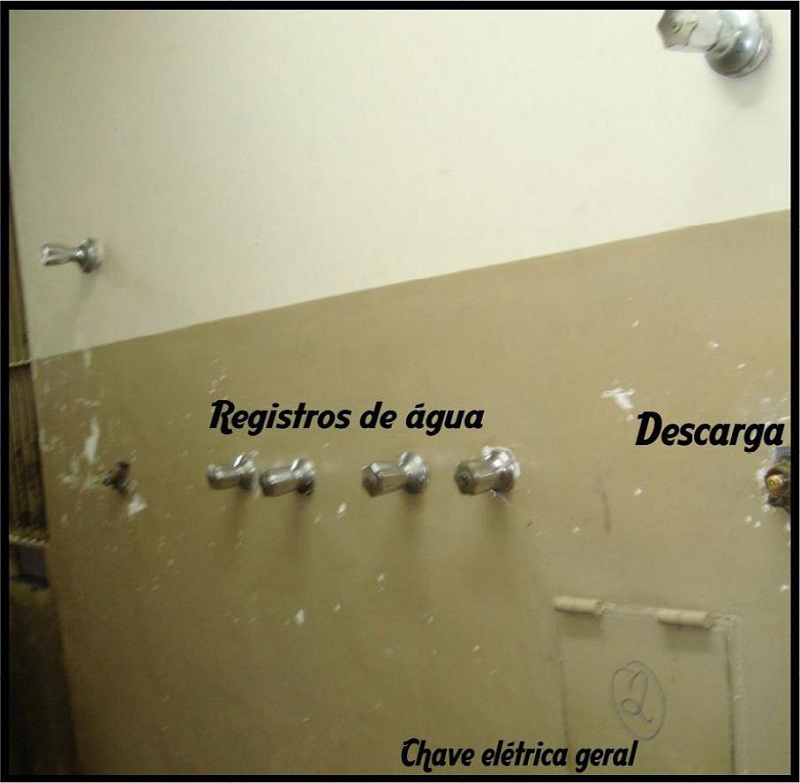
Image 1
Control access to water and electricity
Water spigots; Flush knob; Circuit breakerSource: research data (2018).
People in prison have access to room temperature piped water inside the cell only three times per day. This imposed rationing leads inmates to regulate all their cell activities cells like bathing, private use, cleaning the floor, washing clothes, and water consumption for hydration. According to the prison agents, water rationing is necessary to avoid waste and to deprive the inmates of a “good living.” The few cells that contained hot water were in the prisons located further from the metropolitan regions, specifically where the average room temperatures are kept low, not for comfort, but rather as a minimum condition to keep the labor force productive the following day.
Access to electric energy is granted during “commercial business hours” after which time the circuit is shut off for the entire sector of the jail, keeping power on for administrative sectors and prison units only. Electric energy supplied to the cells during the day is provided via “regalia” (luxuries), as one prison agent put it; inmates can have a television and a radio in each cell, regardless of how many people are living in the enclosure. These domestic appliances are gifted by friends and family or donated by the prison pastor, and constitute trade mechanisms between penitentiary agents, e.g., when a prisoner disrespects disciplinary order or exhibits bad behavior (outlined in the disciplinary regulations for prisoners) the regalia is cut off for the whole cell. The active incarcerated labor force does not have access to these regalias, as they generally return to work after 18 hours and are subject to the same degrading conditions as the rest of the inmates
Upon arriving at the prison, each inmate receives a kit with a toothbrush, coconut soap, a mattress, a uniform that the person needs to dress immediately after being processed, 10 units of maxi pads for women, one per month, a cloth, and a towel8. The family of each inmate is responsible for buying materials to restock inmates but the prison restricts what and how much can be taken in. For example, close friends of inmates can restock toothbrushes and cleaning and hygienic material that is not supplied by the state, like soap, toilet paper, shampoo and conditioner, skin cream, deodorant, 12 units of Q-tips, a blade for shaving, a nail cutter (provided there is an exchange), detergent, 400 grams of powdered soap, toothpaste, maxi pads, hair coloring, a pair of flip-flops, 8 packs of cigarettes, and a pack of cornstarch biscuits or milk biscuits, powdered juice, two slices of ham and cheese, sliced bread, fruit cake (only peeled apples, oranges, and pears) among other materials, like envelopes, seals, and notebooks to write letters.
The person on register responsible for delivering the sack of goods must inspect9 each item following the penitentiary rules and Department of Prison Administration (SEAP - Secretaria de Estado de Administração Prisional) norms. Everything that enters into the prison units must be carefully inspected to ensure no drugs or cell phones enter the prison. This inspection involves opening (untying or unsealing) food or hygiene items. The donor must hand over plastic bags to put the food in, medium bags for personal hygiene items, and a larger plastic bag to hold the smaller bags. The prisoner only receives one bag, as shown in the following image. Any items that do not fit in the larger bag must be taken back, or the agents will discard them. Prisoners must take stock of their belongings, and when items run out, they are often “smuggled,” as Ramalho (2008) states.

Image 2
Inspection and storage of food and hygiene products
X-Ray machine; Large back to be sent to the pavilionSource: research data (2018).
The material assistance provided by the prisoner’s family member can be sent to the prison every 15 days, according to the prison schedule, as they are divided by cells and section. Each week, a specific section or pavilion can receive these products. Each prison unit has a specific list of consumable items that can enter weekly. Although the food items remain the same, some prisons set format, color, and brand requirements to facilitate mandatory inspection of each food, personal hygiene, and cleaning items. When these items run out, people tend to conduct exchanges/trades inside prison or, in dire times, to adapt in the most inhumane ways possible. As was reported in a field diary (2017), some people shouted and asked for food and women said they did not have enough maxi pads so they put bread inside their vaginas. There are other reports of human rights violations.
The personal belongings and food items of the inmates are hung on the bars and walls of the cells, as there is no space for storing these items in the cell and the floor must always remain clear for walking and counting the prisoners. There are no spaces for storing lunches or dinners. We saw lunches being delivered to several prisons and noticed the low quality of the provided food. The food was stored in aluminum to-go containers, which were left outside until being delivered to prisoners, as is shown in the image below (03). The lunches were left in the sun for hours and many were left semi-open, which attracted flies and other animals. There were many reports from prisoners and prison officers that mentioned the advanced state of putrefaction of the distributed food.
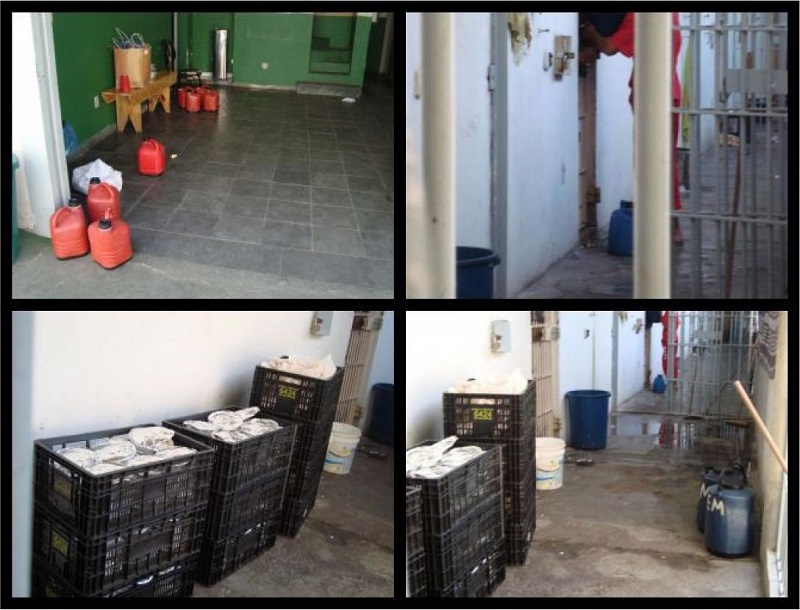
Image 03
Distribution of food
Source: research data (2018)
If the conditions in the cells were poor, the same was true for the working conditions. The day starts at 5:00 AM for the active incarcerated labor force and generally ends at6:00 PM, when inmates return to their cells. However a work shift can extend to 12 hours or more. Many of the labor-intensive physical activities generally require little to no specialized motor skills.
Regardless of whether they worked in the agricultural, industrial, or service sectors, the inmates worked under unhealthy conditions, with no personal protective equipment, and a total disregard for existing labor laws in Brazil, all while receiving low salaries. When asked about the lack of protections, inmates were amazed and scoffed, as the following report shows.
Do you receive any glasses, boots, or gloves to work with the machines? | E13: - No | Why? | E13: - You know this is a prison, right?! | Yes, but I would like to know if you guys don’t use the equipment because it gets in the way of performing your job or because it’s not offered? | E13: - No, there is nothing like that here (Fragment of interview- E13, 2017).
The inmates are well aware of the fact that, in the factory environment, there is only one motivation: exploitation. The images (04) below show a lack of PPE for jobs involving cutting machines, sparks, and sewing.
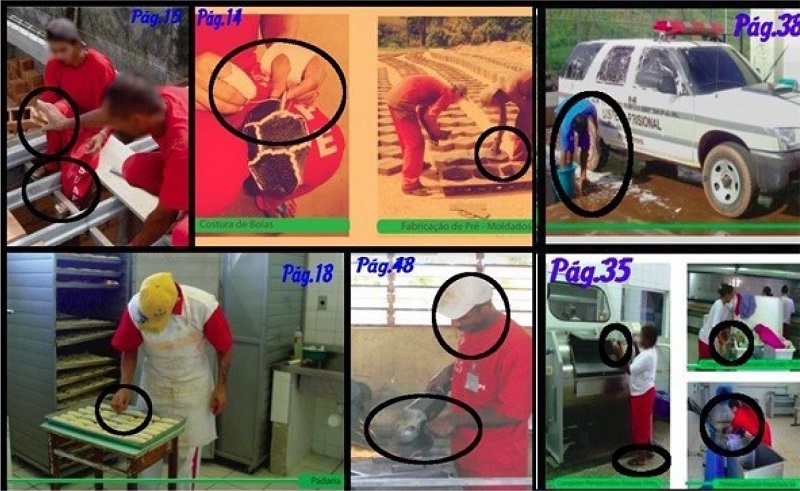
Image 4
Workers without PPE at industrial complexes in the prison system
Source: Coleman research data (2018). Handbook10.
At prisons where work was carried out in workshops, inmates required transportation and, thus, supervisors hired by private companies. The working day was limited since prison agents had schedules and needed to transfer prisoners accordingly.
However, handcraft work, such as sewing balls and other products, can be carried out inside cells and is not limited. It can extend to the physical capacity of each prisoner. “We don’t have anything to do here, lady. This is what we do [handcrafts] here 24 hours a day. When we’re not sleeping or eating, we work ”(Account of a prisoner recorded in the field diary, 2017).
In the absence of activities that could otherwise help them develop their skills, and deprived of their family relationships, they are left with work, and the State, via its laws and regulations, oversees it all. An analysis of public-private partnership contracts and the Penal Law itself shows that the State does not promote activities toward developing their skills but instead allows the inmates to be exploited by capital (FERNANDES, FERRAZ and FERRAZ, 2018).
Private capitalists invest their capital in activities carried out by inmates, meaning the worker has no choice in who they sell their labor to, while capitalist are free to purchase or not purchase these goods according to state regulations. The incarcerated reserve army of labor is not entitled to vacation, paid rest, maternity leave, a thirteenth salary, or, in some cases, even a salary-rights guaranteed to free workers with employment contracts.
Regarding salaries, public-private partnerships ensure that the purchasers of this labor force pay ¾ of the legal minimum wage (about 747 BRL per month). However, 25% (186.75 BRL) can be deducted and paid into an estate fund, and another 25% is used to cover the operation and maintenance costs of the prisons, mainly electricity, water, and tool expenses. It should be noted that incarcerated workers are paying for goods that are partially denied to them via these deductions, as water and electricity are rationed in the cells, even though these costs should be covered by the State. After these deductions, incarcerated workers receive about 370 BRL/month on their benefit cards. However, they do not have access to this money until they are released, which is a distant, if at all possible, reality for most inmates.
Freedom, or more precisely, the time spent in prison, in practice, takes the place of the general equivalent commodity exchange in the Brazilian prison system labor force when we look at it from the prisoner’s perspective. Brazilian law mandates prison work and establishes in Article 126 that people deprived of liberty may redeem part of their sentence by work or study. Specifically, one day can be redeemed for every three working days or for every 12 hours spent in school (LEP 7210/84).
Under this legal obligation, the State must create conditions for prison work, which justifies exonerating businesses from payroll costs under current labor regulations. By doing so, the State provides a mass capital, in the form of workers, which can be exploited at a much lower cost than in the traditional labor market outside prison walls, as demonstrated in the work Valor Aprisionado: Crise, Trabalho e Cárcere desde o Capitalismo Brasileiro [Imprisoned Value: Crisis, Work, and Prison in Brazilian Capitalism]; ABBOUD, 2022).
The State makes it clear in the rules that establish how incarcerated people can be paid that part of the value created by the incarcerated worker is used to purchase the means of production necessary for the work itself. This also occurs in the valorization process in general, but it succumbs to commodity fetishism. The State establishes the price for forgiving a debt contracted with society via this obligation: for every three days of value production, one day is granted to the worker towards freedom (non-incarcerated reserve army of labor), following the tendency to join Economically Active illegal Agents-reintroduction rates of people back into the formal labor market and the high rates of repeat offenders are evidence of this movement. In this sense, alluding to the post-abolition period, we have once again that “Brazilian society left Black people to their own destiny, laying on their shoulders the responsibility to re-educate and transform themselves to match the new standards and ideals of the human being created by the advent of capitalism” (FERNANDES, 2008, p. 19; free translation).
Modern slavery instituted by the state and the working class… final notes
given the information presented here, we see the State’s role as a mediator in the relationship between capital and labor within the prison system, depriving incarcerated subjects of both their freedom and the right to sell their labor independently. The State controls the goods traded with capitalists, meaning that they also join into the production process of other goods. This is the central aspect of the study, highlighting the State as an institution of modern slavery. Incarceration time becomes the primary value form in the exchange of labor, and the physical and spiritual poverty of this population enables the overexploitation of their workforce. Incarcerated people are slaves providing labor surplus to equalize the average rate of profit in certain sectors of the economy.
One can observe a trend of transforming all aspects of life into working time, and ultimately into unpaid working time, following the general movement of capital. In this sense, in light of what has been shown here, incarcerated labor plays an important role as a cog in the capitalist machine, extracting more value in its movement to consolidate modern slavery under the recognition and mediation of the State. The prison is thus a place predominantly destined for the Black population, ensuring they remain stagnant in unequal conditions of wages, in which all active life is converted into working time for capital.
Studying the capital-labor relationship in the Brazilian prison system from a dialectical materialist perspective allows us to understand the working class in its active and reserve army roles, transcending moral common sense. From a value and value accumulation perspective, it does not matter whether industrial activities are legal or illegal, or whether they are performed by non-incarcerated workers or by incarcerated workers, provided that the latter are not the predominant form of employment. The difference lies only in the intensity with which the process of exploitation and impoverishment imposes human misery upon the working class, especially the Black working class.
This study provides points for future investigations into the capital-labor relationship phenomenon in the prison system. It shows that we still need to further explore many other aspects associated with this phenomenon, such as the relationship between wages of incarcerated individuals collected by the State and the financial sector, as well as the expansion of the productive chain from prison. This is crucial in order to analyze how value is transferred to exploit incarcerated individuals across various productive spheres. This also raises a discussion on the symbiotic overlap between traditional wage forms and those associated with modern slavery. Moreover, future studies could investigate indebtedness of people deprived of their liberty due to procedural costs and/or fines from the their sentences. In addition, another area of interest regards how non-governmental organizations and religious entities operate in controlling and disciplining the inmate workforce. Lastly, a dangerous question also emerges: what is the relationship between the Brazilian State and capitalists in the industry of crime? A dangerous question, but one that demands answers if the working class is to be fully liberated. As Marx (2013, p. 372; our translation) states, “Labour cannot emancipate itself in the white skin where in the black it is branded.”
Acknowledgements
We would like to thank CAPES for the funding during the execution of the research.
This research was approved by the institution’s research ethics committee, whose process number is: CAAE 76795517.2.0000.5149
References
ABBOUD, Gabriel. Valor aprisionado: crise, trabalho e cárcere desde o capitalismo brasileiro. Editora Dialética, 2022.
ALEXANDER, Michelle. A nova segregação: racismo e encarceramento em massa. São Paulo: Boitempo, 2018.
BRASIL. [Constituição (1988)]. Constituição da República Federativa do Brasil de 1988. Brasília, DF: Presidência da República, [2016].
BRASIL. Lei nº 7.210, de 11 de julho de 1984. Instituiu a Lei de Execução Penal. Brasília: Presidência da República. Disponível em: http://www.planalto.gov.br/ccivil_03/leis/L7210.htm . Acesso em: 23 ago. 2024.
BRASIL. Ministério da Justiça e Segurança Pública. Departamento Penitenciário Nacional. Levantamento nacional de informações penitenciárias: INFOPEN Atualização - Junho de 2016. Brasília: Ministério de Justiça e Segurança Pública. Departamento Penitenciário Nacional, 2017. Disponível em: http://depen.gov.br/DEPEN/noticias-1/noticias/infopen-levantamento-nacional-de-informacoes-penitenciarias-2016/relatorio_2016_22111.pdf. Acesso em: 17 maio 2017.
BRASIL. Ministério do Trabalho. Portaria n.º 3.214, de 8 de junho de 1978. Aprova as Normas Regulamentadoras - NR - do Capítulo V, Título II, da Consolidação das Leis do Trabalho, relativas à Segurança e Medicina do Trabalho. Brasília: Ministério do Trabalho, 1978.
BRASIL. Manual de combate ao trabalho em condições análogas às de escravo. Brasília: Ministério do Trabalho e Emprego, 2011.
CASTRO, Antonio Erismar de. Trabalho escravo contemporâneo no Maranhão: políticas públicas aos trabalhadores egressos do trabalho escravo em Açailandia-MA. 2018. Trabalho de Conclusão de Curso (Especialização em Gestão de Políticas Públicas) - Fundação Escola de Sociologia e Política de São Paulo, São Paulo, 2018. Disponível em: http://bibliotecadigital.fpabramo.org.br/xmlui/handle/123456789/346. Acesso em: 20 abr. 2020.
COSANDEY, José Victor Juliboni; SOARES, Fagno da Silva. “Por uma cartografia dos casos de trabalho escravo contemporâneo: Trabalho análogo ao de escravo no cerrado Brasileiro“. Contribuciones a las Ciencias Sociales, vol. junho, pp. 10-35, 2016.
DOSTOIÉVSKI, Fiódor M. Recordações da casa dos mortos. São Paulo: Nova Alexandria, 2019.
FERNANDES, Florestan. A integração do negro na sociedade de classes. São Paulo: Contracorrente, 2021.
FERNANDES, Paula Cristina de Moura; FERRAZ, Deise Luiza da Silva. “A política de ressocialização: Um estudo sobre os seus limites no sistema prisional de Minas Gerais“. Revisbrato, vol. 6, n. 4, pp. 1258-1278, 2022. DOI: 10.47222/2526-3544.rbto50015
FERNANDES, Paula Cristina de Moura; FERRAZ, Deise Luiza da Silva; FERRAZ, Janaynna de Moura. Human Formation or Capital Formation? An analysis of educational assistance in the prison system. In: International Society for the Study of Work and Organizational Values, 2018, Trieste. Anais […]. Trieste: ISSWOV, 2018.
FERRAZ, Deise Luiza da Silva. “Pelo Fim da Dicotomia Exclusão/Inclusão: a questão do exército de reserva no capitalismo contemporâneo“. In: CATTANI, Antonio D.; DÍAZ, Laura M.; COHEN, Nestor. A Construção da Justiça Social na América Latina. Porto Alegre: Tomo Editorial, 2013.
FERRAZ, Deise Luiza da Silva; MULLER, Rafael. “Assistantialisme et entrepreneuriat populaire: une nécessaire articulation pour éradiquer la pauvreté? “. In: ULYSSE, Pierre-Joseph; LESEMANN, Frédéric; DE SOUSA, Fernando J. Pires. Les travailleurs pauvres: précarisation du marché du travail, érosion des protections sociales et initiatives citoyennes. PUQ, 2014. p. 265-284.
FIGUEIRA, Ricardo Rezende. “A migração e o trabalho escravo por dívida no Brasil“. In: Serviço Pastoral dos Migrantes (org.). Travessia na desordem global: Fórum Social das Migrações. São Paulo: Paulinas, 2005, pp. 181-189.
FIGUEIRA, Ricardo Resende. “A persistência da Escravidão ilegal no Brasil“. In: MAYBURY-LEWIS, Biorn; RANINCHESKI, Sonia (org.). Desafios aos direitos humanos no Brasil contemporâneo. Brasília: CAPES / Verbena, 2011, pp. 49-63.
FRANCO, David Silva; FERRAZ, Deise Luiza da Silva. “Uberização do trabalho e acumulação capitalista“. Cadernos Ebape. BR, vol. 17, pp. 844-856, 2019.
GAMA, Fernanda. C.; SILVA, Priscila. T. de C.; GARCIA, Fabiane. M.; DE JESUS, A. S. “Trabalhos análogos à escravidão: uma análise de indivíduos escravizados no século XXI no Brasil“. Cadernos EBAPE.BR, Rio de Janeiro, vol. 21, n. 3, pp. e2021-0211, 2023. DOI: 10.1590/1679-395120210211.
GARCIA, Maria F. 82% dos resgatados de trabalho escravo no brasil são negros. Observatório do Terceiro Setor. 12 jun. 2020. Disponível em: https://observatorio3setor.org.br/noticias/82-dos-resgatados-de-trabalho-escravo-no-brasil-sao-negros/. Acesso em: 1 de out. 2023.
GOES, Jefferson V. de; PAES, Lígia R. R.; FERRAZ, D. L. S. “Guerra às Drogas e Ideologia: A indústria Ilegal de Cocaína pelas Lentes Cinematográficas“. RECADM: Revista Eletrônica de Ciência Administrativa, vol. 22, n. 3, pp. 397-421, 2023. DOI:10.21529/RECADM.2023016.
KOERNER, Andrei. História da justiça penal no Brasil: pesquisas e análises. São Paulo: IBCCRIM, 2006.
LYRA, Alexandre Rodrigo T. da C. “O enfrentamento do trabalho em condição análoga à de escravo“. Trabalho, Emprego e Renda, vol. 28, n. 81, pp. 213-227, 2014. DOI: 10.1590/S0103-40142014000200015
MARINHO, Maiara Oliveira; VIEIRA, Fernando de Oliveira. “A jornada exaustiva e a escravidão contemporânea“. Cadernos EBAPE. BR, vol. 17, n. 2, pp. 351-361, 2019. DOI: 10.1590/1679-395171623
MARX, Karl. Para crítica da economia política. São Paulo: Nova Cultural, 2006.
MARX, Karl. O Capital: Crítica da Economia Política. Livro I. Tradução: Rubens Enderle. São Paulo: Boitempo, 2013.
MARX, Karl. Manuscritos Econômicos e Filosóficos. São Paulo: Boitempo, 2004.
MATOS, Erica do Amaral. Cárcere e trabalho: significações, contradições e ambivalências. 2019. Dissertação (Mestrado em Direito Penal) - Universidade de São Paulo, São Paulo, 2019. DOI: 10.11606/D.2.2019.tde-03072020-154439
MELOSSI, Dario; PAVARINI, Massimo. Cárcere e fábrica: As origens do sistema penitenciário (séculos XVI e XIX). Rio de Janeiro: Revan/ICC, 2006.
MERCANTE, Carolina Vieira. A terceirização na indústria de confecções e a reincidência do trabalho análogo ao escravo. In: Encontro Nacional da ABET, 16. Anais […]. Campinas: ABET, 2015.
MONTEIRO, Rodrigo Padrini; ARAÚJO, José Newton Garcia. “Manicômio judiciário e agentes penitenciários: entre reprimir e cuidar“. Psicologia: Ciência e Profissão, vol. 38, n. 2, pp. 144- 158, 2018. DOI: 10.1590/1982-3703000211962
MORAES, Pedro Rodolfo Bodê de. Punição, encarceramento e construção de identidade profissional entre agentes penitenciários. São Paulo: IBCCRIM, 2005.
OIT - Organização Internacional do Trabalho. Trabalho Escravo no Brasil do século XXI. Brasília: OIT, 2006.
RAMALHO, José Ricardo. Mundo do crime: a ordem pelo avesso. Rio de Janeiro: Centro Edelstein de Pesquisas Sociais, 2008. DOI: 10.7476/9788599662267
SILVA, Pamilhan. A. F. da; GENTIL, Plínio. A. B. “A metamorfose da escravidão e gestão do conflito capital-trabalho / The metamorphosis of slavery and management of conflict capital-work“. Brazilian Journal of Development, vol. 8, n. 4, pp. 26820-26837, 2022. DOI: 10.34117/bjdv8n4-270.
SIQUEIRA, Túlio Manoel Leles de. “O trabalho escravo perdura no Brasil no século XXI“. Revista do Tribunal Regional do Trabalho da 3a Região, vol. 52, n. 82, pp. 127-147, 2010.
WEIS, Valeria Vegh. Marxism and criminology: a history of criminal selectivity. Boston/Leiden: Brill, 2017.
Notes
Author notes
paulacristina.m.fernandes@gmail.comdeiseluiza@face.com.br